
Last Updated May 6, 2026
The idea of a safe operating space matters because sustainable development is not only about what societies hope to achieve, but about the biophysical, institutional, and social conditions under which human development remains viable over the long run. A society may expand production, infrastructure, welfare, and technological capacity in the present while destabilizing the ecological systems on which future prosperity depends. The concept of a safe operating space addresses this problem by asking whether development is taking place within conditions compatible with Earth-system stability, resilience, and future human flourishing.
In that sense, safe operating space is not a peripheral environmental concern. It is a way of specifying the ecological preconditions of durable human development. It asks whether current development pathways preserve the climatic, hydrological, ecological, and geochemical conditions that allow agriculture, health, infrastructure, settlement, public finance, and social order to remain governable over time.
Main Library
Publications
Article Map
Sustainable Development
Related Topic
Planetary Boundaries
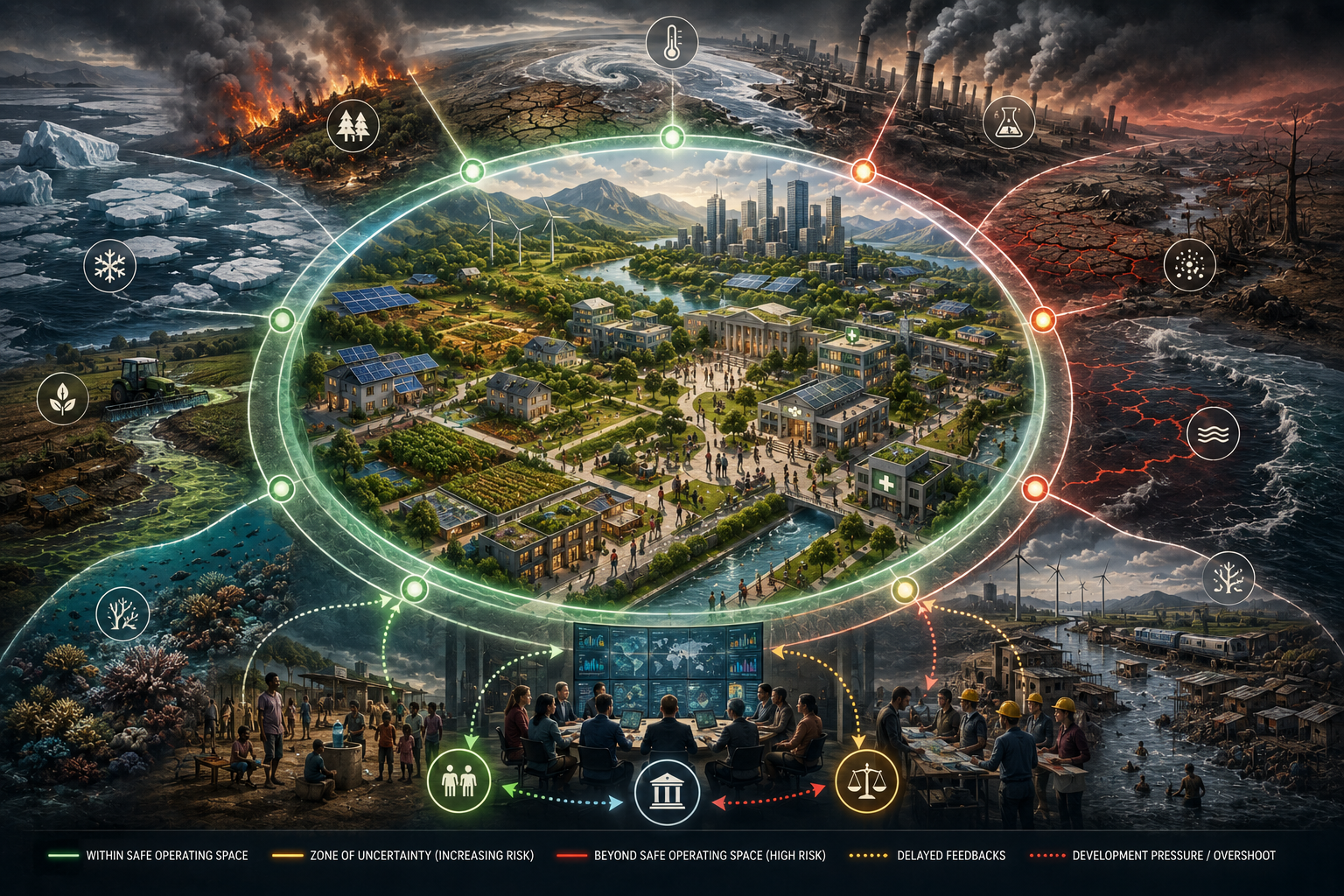
The safe-operating-space framework emerged from the planetary-boundaries tradition. The original 2009 Nature paper introduced the phrase “a safe operating space for humanity,” while the companion Ecology and Society paper elaborated the planetary-boundaries framework as a structured way to think about large-scale Earth-system risk. This was a major shift in sustainability thought. It moved the conversation from general appeals to environmental responsibility toward a more explicit account of the conditions under which human societies can continue to develop without triggering destabilizing Earth-system change.
The significance of this move becomes even clearer in later updates. The 2015 Science article framed planetary boundaries as a way of guiding human development on a changing planet. The 2023 update concluded that six of the nine boundaries were already transgressed, suggesting that Earth was well outside the safe operating space for humanity. Stockholm Resilience Centre then reported in 2025 that seven of nine are now breached, with ocean acidification newly transgressed. These developments make the concept newly urgent. It is no longer only a framework for anticipating future pressure. It is increasingly a way of describing the unstable environmental context within which development is already unfolding.
What Is a Safe Operating Space?
A safe operating space refers to the range of biophysical conditions within which humanity can continue to develop without generating unacceptable risks of destabilizing the Earth system. The original planetary-boundaries formulation described these boundaries as defining a safe operating space for humanity. The point is not that the world is perfectly safe inside those boundaries or instantly catastrophic beyond them. Rather, the concept identifies conditions within which the probability of large-scale destabilization is lower, and beyond which uncertainty, nonlinearity, and systemic risk become more pronounced.
This framing matters because it shifts sustainability away from a purely discretionary ethic of environmental care and toward a structural question of conditions. Human societies do not develop in the abstract. They develop inside climatic, hydrological, ecological, geochemical, and atmospheric systems whose relative stability shapes the possibilities of agriculture, public health, infrastructure, settlement, and social order. A safe operating space therefore concerns the background conditions that allow development to remain viable rather than self-undermining.
The concept also clarifies that limits are not only about resource exhaustion in a narrow sense. They are about system behavior. Boundary transgression can alter resilience, destabilize feedbacks, and increase the probability of abrupt or cascading shifts. A society may still have access to materials, energy, infrastructure, and financial capacity, yet still be operating outside safe conditions if its development pathway undermines the planetary systems that regulate stability.
Once this is recognized, the problem of long-run development becomes inseparable from the problem of maintaining a viable operating space for human societies at planetary scale. Development is not simply about expanding output or improving welfare indicators in the present. It is also about preserving the conditions under which future welfare can be pursued. This places the article in direct continuity with Sustainable Development as a Systems Problem.
Conditions of Development and Conditions of Stability
One of the most important implications of the safe-operating-space framework is that it distinguishes between the visible achievements of development and the conditions that make those achievements durable. A society can increase output, extend infrastructure, reduce poverty, and improve welfare in the short run while still weakening the larger systems on which those improvements depend. Development, in other words, can progress materially while regressing ecologically.
This distinction matters because development debates often focus on outcomes while neglecting enabling conditions. Roads, hospitals, schools, incomes, housing, sanitation, electricity, and public services are all development achievements. But they remain dependent on stable climatic patterns, water systems, ecological productivity, functioning institutions, and sufficient resilience to absorb shock. Once those background conditions deteriorate, what looked like development gains can become harder and more expensive to maintain.
A safe operating space therefore widens the meaning of development by connecting it to the stability of the systems that silently support it. It does not replace human-development goals. It deepens them. It asks whether improvements in health, education, income, food security, infrastructure, and public welfare are being produced in ways that strengthen the background conditions of future development or draw them down.
This is especially important because supporting conditions are often invisible until they fail. Stable rainfall, functioning watersheds, biodiversity, fertile soils, predictable seasons, public trust, institutional competence, and infrastructure maintenance can all be taken for granted while they are working. They become visible only when their deterioration begins to disrupt everyday life. A safe-operating-space perspective asks societies to value these conditions before crisis makes their importance undeniable.
In this sense, safe operating space is not a separate environmental threshold sitting beside the development agenda. It is part of the architecture of development itself. It asks whether the world within which human capability is being expanded remains sufficiently stable, resilient, and governable for that expansion to continue.
Planetary Boundaries and the Conditions of Stability
The planetary-boundaries framework was designed to identify critical Earth-system processes whose destabilization raises risks to the stability and resilience of the planet as a whole. The framework focuses on nine Earth-system processes: climate change, biosphere integrity, land-system change, freshwater change, biogeochemical flows, ocean acidification, atmospheric aerosol loading, stratospheric ozone depletion, and novel entities. This matters because it provides a way of operationalizing the safe-operating-space concept. Rather than speaking generically of environmental limits, the framework directs attention to specific domains of pressure and stability.
The 2015 Science update made the developmental relevance of the framework explicit by describing planetary boundaries as guiding human development on a changing planet. That title is not incidental. It signals that the boundaries are not proposed only for ecological accounting. They are presented as conditions under which development itself must be rethought. Human development is not happening against a neutral backdrop. It is occurring within a changing Earth system whose dynamics condition whether gains remain durable over time.
The later updates sharpen the urgency of this claim. The 2023 assessment concluded that Earth was already well outside the safe operating space, with six of the nine boundaries transgressed. The 2025 Stockholm Resilience Centre update reported that seven of nine are now breached, with ocean acidification newly transgressed. In policy terms, this means that sustainable development is no longer only about preventing future pressure from arising. It is increasingly about navigating development under already intensified conditions of systemic strain.
The value of the planetary-boundaries framework lies in its systemic character. It prevents sustainable development from being reduced to climate policy alone. Climate is central, but a stable Earth system also depends on biosphere integrity, freshwater systems, land systems, nutrient cycles, ocean chemistry, pollution control, atmospheric conditions, and ozone recovery. A development pathway that decarbonizes while degrading biodiversity, freshwater, soils, and chemical safety would still remain incomplete from a safe-operating-space perspective.
This section links naturally to Boundary Transgression and Development Fragility and Anthropocene and Planetary Boundaries, because the same core insight runs through all three: Earth-system conditions are not external to development. They are part of development’s operating foundation.
Development Within Limits
The phrase “development within limits” is often misread as a call to suppress development. Properly understood, it means something more demanding and more important: development must proceed in ways consistent with the conditions that make future development possible. Limits are not anti-human prohibitions. They are design constraints for viable human flourishing over time. The point is not to halt welfare improvement, but to prevent welfare gains from being financed through the destabilization of the larger systems on which welfare depends.
This distinction is crucial because sustainable development cannot morally abandon present need. The 2030 Agenda states that eradicating poverty in all its forms and dimensions is the greatest global challenge and an indispensable requirement for sustainable development. Poverty eradication, health systems, food security, infrastructure, education, water, sanitation, housing, and energy access remain indispensable. The challenge is therefore not whether development should occur, but on what ecological, institutional, and distributive terms it can occur durably.
Development within limits means expanding human capability without relying on pathways that intensify boundary transgression and future fragility. It asks how societies can meet present needs through energy systems, food systems, cities, industries, finance, and public institutions that do not undermine future conditions of possibility. This is not a call for less human dignity. It is a call for forms of development that do not make dignity temporary.
In this sense, the safe-operating-space framework changes the meaning of constraint. Constraint is not simply a barrier imposed on development from outside. It is part of the architecture of responsible development. Ignoring limits does not preserve freedom; it often converts short-term expansion into long-term instability. Recognizing limits, by contrast, can be understood as a way of protecting the future conditions of meaningful freedom.
That is why this article remains strongly continuous with The Brundtland Definition and Its Legacy. Brundtland’s formulation did not ask societies to choose present needs or future needs. It asked them to meet present needs without compromising future ability. A safe operating space gives that moral formulation a more explicit Earth-system foundation.
Earth-System Stability, Resilience, and Long-Run Viability
A safe operating space is not only about avoiding catastrophic collapse. It is also about preserving stability and resilience. Stability matters because human societies depend on a degree of regularity in climatic, hydrological, atmospheric, and ecological conditions. Resilience matters because systems are always subject to stress, and what matters is whether they can absorb disturbance without shifting into more dangerous or degraded states. Long-run development depends on both.
The planetary-boundaries literature is significant precisely because it treats Earth-system resilience as a developmental condition. If the larger environmental system becomes less resilient, then local and national development systems become more vulnerable to shocks, nonlinear changes, and interacting failures. Agriculture becomes less predictable, infrastructure more exposed, health systems more burdened, insurance systems more fragile, and governance more difficult.
The safe operating space is therefore not a luxury threshold. It is a way of thinking about the background order within which societies can continue to plan, invest, and coordinate. A development system depends on predictable seasons, reliable water, livable temperatures, healthy ecosystems, manageable disease risks, and public institutions that are not constantly overwhelmed by cascading emergencies. When Earth-system resilience weakens, the planning assumptions of development weaken with it.
This is one reason long-run development must be distinguished from short-run gain. A policy can deliver visible benefits while weakening the stability conditions that would allow those benefits to persist. A city may grow rapidly while becoming more exposed to heat, flood, congestion, and water stress. A food system may increase output while degrading soils, water, biodiversity, and nutrient cycles. An economy may expand while deepening carbon lock-in and future adaptation burdens. Sustainable development becomes more demanding once resilience enters the frame, because it asks not simply whether societies are improving, but whether they are improving in ways that remain governable under future stress.
This also aligns closely with Intergenerational Justice and Long-Term Stewardship. Future generations inherit not only wealth and infrastructure, but the stability or instability of the systems that make wealth and infrastructure usable.
Overshoot, Boundary Transgression, and Developmental Risk
The safe-operating-space framework is closely connected to the concept of overshoot. Overshoot occurs when human activity exceeds the capacities of larger ecological systems to absorb pressure while remaining resilient. Boundary transgression is one way of identifying where overshoot is becoming structurally visible. If humanity is already outside several planetary boundaries, then development is increasingly taking place under overshooting conditions rather than safely within a stable operating range.
This matters because overshoot is often politically difficult to perceive. Systems can continue to generate output, infrastructure, and welfare gains for some time even after underlying conditions of resilience are being eroded. The visible success of the present can therefore mask the instability being transmitted into the future. A society can appear to be advancing while actually drawing down the ecological and institutional conditions that make future advancement possible.
The safe-operating-space concept is valuable precisely because it challenges this illusion. It asks whether present development is operating within conditions of stability or merely moving across them while the consequences remain delayed. It connects current welfare to future support conditions. It also makes clear that a development model can be self-undermining even before it visibly fails.
In sustainable-development terms, long-run development must be judged not only by what is achieved, but by whether achievement is occurring in a way that avoids self-undermining overshoot. The concept of a safe operating space gives this judgment a more explicit ecological structure. It asks whether growth, infrastructure, consumption, and policy systems are strengthening resilience or intensifying boundary pressure.
This section pairs directly with Growth, Limits, and the Problem of Overshoot. Overshoot is the condition in which development continues visibly while the systems that support it become increasingly brittle. Safe operating space is the counter-concept: the range of conditions within which development remains less likely to become self-undermining.
Governability, Planning, and Long-Horizon Coordination
One of the strongest implications of safe operating space is that it is also a condition of governability. Development is not only a matter of producing goods and services. It is a matter of maintaining a world in which planning, coordination, and adaptation remain possible. When climatic, hydrological, and ecological conditions become more volatile, institutions face greater uncertainty, infrastructure faces greater stress, and public authority faces greater strain. What is at risk is not only environmental quality, but the practical governability of development itself.
This is why safe operating space should be understood not merely as a ceiling on impact, but as an enabling condition of social order. States and communities can plan more effectively when ecological background conditions remain relatively stable and predictable. They struggle more when those conditions are destabilized through cumulative boundary transgression. Long-run development therefore depends on preserving enough Earth-system regularity that institutions can function as organizers of collective life rather than merely as emergency responders.
From this perspective, the safe-operating-space framework links ecology and governance directly. It suggests that ecological destabilization is not simply another policy challenge to be managed alongside development. It can erode the very conditions under which coherent development policy is possible. If governments are increasingly forced into reactive crisis management, they have less capacity for education, infrastructure, public health, poverty reduction, industrial strategy, housing, and long-term resilience.
Long-horizon coordination is therefore essential. A safe operating space cannot be protected through isolated short-term interventions alone. It requires climate policy, food policy, water policy, land-use planning, infrastructure investment, finance, trade, technology governance, and social protection to be understood as parts of one development system. This argument complements Trade-Offs, Synergies, and Policy Coherence, because policy coherence is one of the ways institutions attempt to govern interdependence before it becomes fragility.
Institutions, Governance, and the Management of Safe Operating Space
The existence of a safe operating space does not automatically produce governance capable of respecting it. Institutions remain central. Governments, markets, legal systems, infrastructures, scientific bodies, and international organizations shape whether societies respond to ecological signals early or continue along trajectories of delayed recognition. The challenge is not only to know that boundaries exist, but to build institutions capable of acting on long-term constraints before they harden into crisis.
This requires more than environmental policy narrowly construed. It requires integrating ecological limits into infrastructure planning, land use, industrial strategy, fiscal policy, energy transition, food systems, water governance, public health, and public investment. It also requires governance arrangements capable of acting under uncertainty. A safe operating space is not something that can be maintained by a single ministry, dashboard, or regulation. It depends on whether the larger development model is being redesigned to remain compatible with long-run resilience.
In this sense, the safe-operating-space concept is institutionally demanding. It asks political systems to govern with respect to conditions that are cumulative, planetary, and often delayed in their visible effects. That is one reason implementation is so difficult. Short-term incentives and fragmented institutions remain poorly matched to long-term Earth-system constraints. A government may know the direction of risk and still fail to act if budgets, electoral incentives, administrative mandates, and vested interests pull in the opposite direction.
Good governance within a safe operating space therefore requires more than awareness. It requires monitoring, law, public finance, regulatory competence, institutional coordination, social legitimacy, international cooperation, and the capacity to phase out harmful systems while supporting affected communities. It also requires mechanisms for learning. Boundaries are scientific frameworks, but governance must translate them into planning, budgeting, investment, infrastructure design, and public accountability.
This section links especially well with The 2030 Agenda and the Logic of the SDGs. The SDGs are integrated and indivisible because the development problem itself is integrated. A safe operating space clarifies the ecological foundation of that integration.
Justice, Uneven Responsibility, and Uneven Exposure
The safe-operating-space framework raises difficult questions of justice. Humanity may be moving beyond planetary boundaries, but responsibility for doing so is not evenly distributed, nor is exposure to the consequences. High-consuming populations, historically carbon-intensive development pathways, extractive production systems, and ecologically damaging forms of consumption have contributed disproportionately to planetary pressure. At the same time, many lower-income societies remain far from meeting basic developmental needs and are often more vulnerable to ecological instability.
The safe-operating-space framework must therefore be read alongside questions of inequality, historical responsibility, and differentiated capacity. The concept should not be reduced to a simple call for universal restraint, as if all societies and communities were equally responsible for boundary pressure or equally able to respond. Sustainable development cannot abandon the urgency of poverty reduction and capability expansion. The challenge is to create development pathways that remain compatible with a safe operating space without reproducing the high-throughput models that helped destabilize it in the first place.
In that sense, the framework does not remove the politics of development. It sharpens it. It asks how needs can be met in a world where the planetary room for error is narrowing and where responsibility for boundary pressure is profoundly uneven. This requires distinguishing between basic needs and luxury consumption, between development pathways that expand human capability and patterns of overconsumption that intensify ecological risk.
Justice also requires attention to exposure. Climate instability, freshwater stress, biodiversity loss, pollution, and food-system disruption do not affect everyone equally. Poor communities, Indigenous peoples, small farmers, low-income urban residents, informal workers, coastal communities, children, and future generations often bear heightened risks despite having contributed least to the pressures that generate them. A safe operating space is therefore not only a planetary concept. It is also a justice concept because the loss of safe conditions is lived unevenly.
Long-run development policy cannot treat those asymmetries as secondary. A stable Earth system is a shared condition of human development, but the burdens of protecting that condition and the costs of its destabilization are distributed unequally. This places the article alongside From Economic Growth to Human Development and Inequality and Inclusive Development, where capability expansion and social justice remain non-negotiable.
Measurement, Thresholds, and Boundary Visibility
The safe-operating-space concept depends on measurement, but measurement is not straightforward. Each planetary boundary requires scientific assessment of pressure, state, control variables, uncertainty, and systemic risk. Climate change can be represented through atmospheric carbon dioxide concentration and radiative forcing. Biosphere integrity involves genetic diversity and functional integrity. Freshwater change requires attention to both blue water and green water. Novel entities involve synthetic chemicals, plastics, and other human-made substances whose cumulative effects are difficult to assess fully.
This measurement challenge does not make the framework irrelevant. It makes it careful. The boundaries are not simple switches that separate a safe world from an instantly unsafe world. They are risk zones. Crossing a boundary indicates that humanity has moved into conditions where instability, nonlinearity, or irreversible damage becomes more likely. That is why the framework is precautionary. It organizes attention before destabilization becomes impossible to ignore.
Boundary visibility matters for development governance because what remains invisible is easily neglected. If national development systems measure GDP, infrastructure, employment, and public spending but fail to measure ecological pressure, resilience loss, pollution burden, freshwater stress, and boundary transgression, then policy may mistake short-term output for long-run progress. A safe-operating-space perspective strengthens development measurement by asking whether present gains are compatible with planetary conditions.
Measurement also needs to connect global and local scales. Global boundary assessment helps identify systemic risk, but local and regional experience determines how that risk is lived. A global freshwater boundary does not replace local water justice. Global climate metrics do not show which communities are most exposed to heat, flood, crop failure, or displacement. Safe-operating-space governance must therefore link planetary indicators to disaggregated data on vulnerability, capability, and institutional capacity.
In this sense, boundary measurement should not become technocratic closure. It should support public reasoning. It should help societies ask whether development pathways are preserving or degrading the conditions of long-run viability, who is responsible for boundary pressure, who is most exposed, and what institutional changes are needed to return development to safer ground.
Critiques, Ambiguities, and Open Questions
The safe-operating-space concept is not without criticism. Some argue that planetary boundaries are too global and may obscure regional variation, local ecological dynamics, political economy, or social context. Others worry that limits language can be used in ways that ignore inequality or justify restriction without confronting who has driven environmental destabilization most intensely. These are serious concerns. Any framework of limits that ignores power, distribution, and uneven responsibility will be inadequate to sustainable development.
There are also methodological questions. Boundaries involve uncertainty, changing scientific knowledge, debates over thresholds, and choices about indicators and interpretation. But uncertainty does not make the framework irrelevant. It is precisely because Earth-system change is nonlinear and difficult to reverse that structured precaution matters. The safe-operating-space idea does not promise perfect precision. It provides a way of organizing responsibility under conditions where delayed recognition can be extraordinarily costly.
Another open question concerns governance itself. Even if a safe operating space can be scientifically described, it does not follow that institutions are willing or able to govern within it. The challenge is therefore not only conceptual but political: how to translate long-range ecological conditions into development choices that remain legitimate, feasible, and just. Scientific knowledge can describe risk, but public institutions must decide how to act on it.
A further tension concerns development need. If safe operating space is used to restrict the development claims of poorer societies while protecting high-consuming lifestyles elsewhere, it becomes unjust. The framework must therefore be paired with differentiated responsibility, technology transfer, climate finance, poverty reduction, and pathways for low-carbon, low-throughput capability expansion. The point is not to freeze global inequality under the language of planetary limits. The point is to transform development so that human needs can be met without deepening Earth-system instability.
These critiques do not weaken the concept so much as clarify its conditions of legitimate use. Safe operating space must be scientific, but not technocratic; precautionary, but not anti-development; global, but attentive to local vulnerability; and ecological, but inseparable from justice.
Why This Matters for Sustainable Development
The safe operating space matters for sustainable development because it clarifies that long-run prosperity depends on more than economic performance or present welfare gains. Development requires conditions. Those conditions include health, education, infrastructure, institutions, peace, public trust, and financial capacity. But they also include a stable climate, functioning ecosystems, freshwater security, biosphere integrity, manageable pollution, resilient land systems, and a planetary context in which social and economic life remains governable.
Without a safe operating space, development becomes increasingly reactive. Resources that could support education, public health, poverty reduction, infrastructure, and social protection are diverted toward disaster response, adaptation stress, emergency repair, migration pressure, conflict risk, and loss recovery. The erosion of Earth-system stability therefore does not remain environmental. It becomes fiscal, institutional, social, and political.
The concept also strengthens the meaning of intergenerational justice. Present societies do not only leave future people money, buildings, and technologies. They leave future people a planetary operating context. If that context is more unstable, more polluted, less resilient, and harder to govern, then present development has transferred hidden burdens forward. A safe operating space is therefore one of the conditions of just inheritance.
For sustainable development, the practical question is not whether societies should choose development or ecological limits. That is the wrong framing. The real question is what forms of development can preserve the conditions under which development itself remains possible. Safe operating space answers by insisting that human flourishing and Earth-system stability are not separate projects. They are mutually dependent.
This is why the safe-operating-space concept belongs near the center of the sustainable-development series. It connects planetary boundaries, overshoot, intergenerational justice, governance, policy coherence, resilience, and human development into one problem: how to build human wellbeing without destabilizing the operating conditions of human life.
Mathematical Lens
The safe-operating-space framework can be expressed as a problem of keeping cumulative pressure below destabilizing thresholds across interacting Earth-system domains. Let \(S\) denote safe-operating-space integrity, \(B_i\) the normalized pressure on boundary \(i\), and \(w_i\) the relative systemic importance or coupling weight of that boundary:
S = 1 – \sum_{i=1}^{n} w_i B_i
\]
Interpretation: Safe-operating-space integrity declines as cumulative weighted boundary pressure rises across interacting Earth-system domains.
Lower values of \(S\) indicate a weakening safe operating space as cumulative boundary pressure rises. This captures the article’s core point: long-run development depends not only on current welfare gains, but on whether aggregate pressures remain within conditions compatible with Earth-system stability.
We can also express developmental risk under overshoot as:
R_d = \alpha O + \beta N + \gamma G
\]
Interpretation: Developmental risk rises when boundary overshoot, nonlinear tipping sensitivity, and governability strain reinforce one another.
Here, \(O\) is boundary overshoot intensity, \(N\) is nonlinearity or tipping-risk sensitivity, and \(G\) is governability strain. Higher \(R_d\) means development is proceeding under more fragile planetary conditions.
Finally, long-run viability can be represented as a function of resilience, adaptation, and ecological restraint:
V = \lambda R + \mu A + \nu E
\]
Interpretation: Long-run viability increases when Earth-system resilience, adaptive institutional capacity, and effective ecological-pressure reduction are strengthened together.
Here, \(R\) is Earth-system resilience, \(A\) is adaptive institutional capacity, and \(E\) is effective ecological-pressure reduction. This helps show why similar growth trajectories can produce very different long-run developmental outcomes depending on whether they preserve the conditions of stability.
| Term | Meaning | Interpretive role |
|---|---|---|
| \(S\) | Safe-operating-space integrity | Represents the degree to which development remains within stable Earth-system conditions. |
| \(B_i\) | Boundary pressure | Represents normalized pressure on planetary boundary \(i\). |
| \(w_i\) | Boundary weight | Represents the systemic importance or coupling strength of a boundary process. |
| \(R_d\) | Developmental risk under overshoot | Represents rising risk when development occurs under boundary transgression and governance strain. |
| \(O\) | Overshoot intensity | Represents the degree to which boundary pressure exceeds safer operating ranges. |
| \(N\) | Nonlinearity or tipping sensitivity | Represents risk of abrupt, cascading, or hard-to-reverse change. |
| \(G\) | Governability strain | Represents institutional pressure created by ecological volatility and systemic uncertainty. |
| \(V\) | Long-run viability | Represents whether development can remain durable under future stress. |
The equations are conceptual rather than predictive. Their value is to make visible the structure of the problem: safe operating space depends on cumulative boundary pressure, resilience, adaptive capacity, and the ability of institutions to reduce ecological pressure before development becomes self-undermining.
Advanced Python Workflow: Safe Operating Space and Long-Run Development Risk Scoring
This Python workflow translates the article’s core argument into a structured long-run-development model. Rather than treating development success as output or welfare alone, it scores territories across boundary pressure, resilience loss, governance strain, adaptation readiness, and justice-sensitive exposure. That makes it possible to compare not only where ecological stress is rising, but where development is becoming most vulnerable to operating outside safe planetary conditions.
from __future__ import annotations

import pandas as pd
import numpy as np

INPUT_FILE = "safe_operating_space_long_run_development_panel.csv"
OUTPUT_FILE = "safe_operating_space_long_run_development_scores.csv"


def load_data(path: str) -> pd.DataFrame:
    """
    Load a territory-level safe-operating-space dataset.

    All *_index columns should be normalized to [0, 1].
    Higher values should mean more of the named property.

    Examples:
      - climate_boundary_pressure_index: higher = more climate pressure
      - resilience_loss_index: higher = greater loss of ecological resilience
      - adaptation_capacity_index: higher = stronger adaptive capacity
      - justice_exposure_index: higher = greater vulnerability or unequal exposure
    """
    df = pd.read_csv(path)

    required_columns = [
        "territory_name",
        "country_or_region",
        "territory_type",
        "climate_boundary_pressure_index",
        "biosphere_boundary_pressure_index",
        "land_system_pressure_index",
        "freshwater_pressure_index",
        "biogeochemical_pressure_index",
        "novel_entities_pressure_index",
        "ocean_acidification_pressure_index",
        "resilience_loss_index",
        "governability_strain_index",
        "adaptation_capacity_index",
        "institutional_coordination_index",
        "ecological_pressure_reduction_index",
        "justice_exposure_index",
        "sustainable_development_alignment_index",
    ]

    missing = [col for col in required_columns if col not in df.columns]

    if missing:
        raise ValueError(f"Missing required columns: {missing}")

    return df


def validate_indices(df: pd.DataFrame) -> pd.DataFrame:
    """Validate that all *_index fields are complete and normalized to [0, 1]."""
    index_columns = [col for col in df.columns if col.endswith("_index")]

    for col in index_columns:
        if df[col].isna().any():
            raise ValueError(f"Column '{col}' contains missing values.")

        if ((df[col] < 0) | (df[col] > 1)).any():
            raise ValueError(f"Column '{col}' contains values outside [0, 1].")

    return df


def compute_scores(df: pd.DataFrame) -> pd.DataFrame:
    """
    Compute boundary pressure, viability support,
    and safe-operating-space risk.

    Boundary pressure rises with pressure across climate, biosphere,
    land, freshwater, biogeochemical, novel-entity, and ocean-acidification domains.

    Long-run viability support rises with ecological resilience, lower governability strain,
    adaptation capacity, institutional coordination, ecological pressure reduction,
    lower justice exposure, and sustainable-development alignment.
    """
    df = df.copy()

    df["boundary_pressure_score"] = (
        0.16 * df["climate_boundary_pressure_index"] +
        0.16 * df["biosphere_boundary_pressure_index"] +
        0.14 * df["land_system_pressure_index"] +
        0.14 * df["freshwater_pressure_index"] +
        0.14 * df["biogeochemical_pressure_index"] +
        0.13 * df["novel_entities_pressure_index"] +
        0.13 * df["ocean_acidification_pressure_index"]
    ).clip(lower=0, upper=1)

    df["long_run_viability_support_score"] = (
        0.24 * (1 - df["resilience_loss_index"]) +
        0.18 * (1 - df["governability_strain_index"]) +
        0.18 * df["adaptation_capacity_index"] +
        0.16 * df["institutional_coordination_index"] +
        0.14 * df["ecological_pressure_reduction_index"] +
        0.06 * (1 - df["justice_exposure_index"]) +
        0.04 * df["sustainable_development_alignment_index"]
    ).clip(lower=0, upper=1)

    df["safe_operating_space_risk_score"] = (
        0.46 * df["boundary_pressure_score"] +
        0.18 * df["resilience_loss_index"] +
        0.14 * df["governability_strain_index"] +
        0.10 * (1 - df["adaptation_capacity_index"]) +
        0.07 * (1 - df["institutional_coordination_index"]) +
        0.05 * df["justice_exposure_index"]
    ).clip(lower=0, upper=1)

    df["risk_band"] = np.select(
        [
            df["safe_operating_space_risk_score"] >= 0.80,
            df["safe_operating_space_risk_score"] >= 0.60,
            df["safe_operating_space_risk_score"] >= 0.40,
        ],
        [
            "Extreme long-run development risk",
            "High long-run development risk",
            "Moderate long-run development risk",
        ],
        default="Lower long-run development risk",
    )

    df["viability_gap"] = (
        df["boundary_pressure_score"] - df["long_run_viability_support_score"]
    )

    df["viability_warning"] = np.select(
        [
            df["viability_gap"] >= 0.35,
            df["viability_gap"] >= 0.20,
            df["viability_gap"] >= 0.05,
        ],
        [
            "Severe safe-operating-space gap",
            "High safe-operating-space gap",
            "Moderate safe-operating-space gap",
        ],
        default="Lower safe-operating-space gap or stronger viability support",
    )

    return df


def build_summary(df: pd.DataFrame) -> pd.DataFrame:
    """Return a ranked summary table for review or reporting."""
    columns = [
        "territory_name",
        "country_or_region",
        "territory_type",
        "boundary_pressure_score",
        "long_run_viability_support_score",
        "safe_operating_space_risk_score",
        "risk_band",
        "viability_gap",
        "viability_warning",
    ]

    summary = df[columns].copy()

    summary = summary.sort_values(
        by=[
            "safe_operating_space_risk_score",
            "boundary_pressure_score",
            "long_run_viability_support_score",
        ],
        ascending=[False, False, True],
    ).reset_index(drop=True)

    return summary


def main() -> None:
    df = load_data(INPUT_FILE)
    df = validate_indices(df)
    scored = compute_scores(df)
    summary = build_summary(scored)

    summary.to_csv(OUTPUT_FILE, index=False)

    print("Safe operating space and long-run development scoring complete.")
    print(summary.to_string(index=False))


if __name__ == "__main__":
    main()
This workflow is intentionally transparent. It does not claim that safe-operating-space risk can be reduced to a single objective score. Instead, it makes assumptions visible: boundary pressure, resilience loss, governability strain, adaptation capacity, institutional coordination, ecological pressure reduction, justice exposure, and sustainable-development alignment are treated as distinct components. The value of the model is diagnostic. It helps identify where present development may be drifting outside the ecological conditions of long-run viability.
Advanced R Workflow: Boundary Pressure, Resilience Loss, and Governance Risk
This R workflow is designed for the part of the article that emphasizes transgression, resilience loss, and institutional strain. It compares settings across boundary pressure, ecological resilience, adaptation capacity, governance coordination, pressure reduction, and justice-sensitive exposure, then builds grouped summaries that help show where long-run development is becoming most fragile under overshoot conditions.
library(readr)
library(dplyr)

input_file <- "safe_operating_space_long_run_development_country_panel.csv"
region_output_file <- "cross_region_safe_operating_space_summary.csv"
territory_output_file <- "cross_territory_safe_operating_space_summary.csv"

sos_df <- read_csv(input_file, show_col_types = FALSE)

required_cols <- c(
  "territory_name",
  "country_or_region",
  "territory_type",
  "climate_boundary_pressure_index",
  "biosphere_boundary_pressure_index",
  "land_system_pressure_index",
  "freshwater_pressure_index",
  "biogeochemical_pressure_index",
  "novel_entities_pressure_index",
  "ocean_acidification_pressure_index",
  "resilience_loss_index",
  "governability_strain_index",
  "adaptation_capacity_index",
  "institutional_coordination_index",
  "ecological_pressure_reduction_index",
  "justice_exposure_index",
  "sustainable_development_alignment_index"
)

missing_cols <- setdiff(required_cols, names(sos_df))

if (length(missing_cols) > 0) {
  stop(paste("Missing required columns:", paste(missing_cols, collapse = ", ")))
}

index_cols <- names(sos_df)[grepl("_index$", names(sos_df))]

invalid_index_cols <- index_cols[
  vapply(
    sos_df[index_cols],
    function(x) any(is.na(x) | x < 0 | x > 1),
    logical(1)
  )
]

if (length(invalid_index_cols) > 0) {
  stop(
    paste(
      "Index columns must be complete and normalized to [0, 1]:",
      paste(invalid_index_cols, collapse = ", ")
    )
  )
}

sos_df <- sos_df %>%
  mutate(
    boundary_pressure_proxy = (
      climate_boundary_pressure_index +
      biosphere_boundary_pressure_index +
      land_system_pressure_index +
      freshwater_pressure_index +
      biogeochemical_pressure_index +
      novel_entities_pressure_index +
      ocean_acidification_pressure_index
    ) / 7,
    viability_support_proxy = (
      (1 - resilience_loss_index) +
      (1 - governability_strain_index) +
      adaptation_capacity_index +
      institutional_coordination_index +
      ecological_pressure_reduction_index +
      (1 - justice_exposure_index) +
      sustainable_development_alignment_index
    ) / 7,
    safe_operating_space_proxy = (
      boundary_pressure_proxy +
      resilience_loss_index +
      governability_strain_index +
      (1 - adaptation_capacity_index) +
      (1 - institutional_coordination_index) +
      (1 - ecological_pressure_reduction_index) +
      justice_exposure_index +
      (1 - sustainable_development_alignment_index)
    ) / 8,
    viability_gap = boundary_pressure_proxy - viability_support_proxy,
    risk_band = case_when(
      safe_operating_space_proxy >= 0.75 ~ "Extreme long-run development risk",
      safe_operating_space_proxy >= 0.55 ~ "High long-run development risk",
      safe_operating_space_proxy >= 0.35 ~ "Moderate long-run development risk",
      TRUE ~ "Lower long-run development risk"
    )
  )

region_summary <- sos_df %>%
  group_by(country_or_region) %>%
  summarise(
    avg_safe_operating_space_proxy = mean(safe_operating_space_proxy, na.rm = TRUE),
    avg_boundary_pressure_proxy = mean(boundary_pressure_proxy, na.rm = TRUE),
    avg_viability_support_proxy = mean(viability_support_proxy, na.rm = TRUE),
    avg_resilience_loss = mean(resilience_loss_index, na.rm = TRUE),
    avg_governability_strain = mean(governability_strain_index, na.rm = TRUE),
    avg_adaptation_capacity = mean(adaptation_capacity_index, na.rm = TRUE),
    avg_institutional_coordination = mean(institutional_coordination_index, na.rm = TRUE),
    avg_ecological_pressure_reduction = mean(ecological_pressure_reduction_index, na.rm = TRUE),
    avg_justice_exposure = mean(justice_exposure_index, na.rm = TRUE),
    avg_viability_gap = mean(viability_gap, na.rm = TRUE),
    observations = n(),
    .groups = "drop"
  ) %>%
  mutate(
    regional_risk_band = case_when(
      avg_safe_operating_space_proxy >= 0.75 ~ "Extreme long-run development risk",
      avg_safe_operating_space_proxy >= 0.55 ~ "High long-run development risk",
      avg_safe_operating_space_proxy >= 0.35 ~ "Moderate long-run development risk",
      TRUE ~ "Lower long-run development risk"
    )
  ) %>%
  arrange(desc(avg_safe_operating_space_proxy))

territory_summary <- sos_df %>%
  group_by(territory_type) %>%
  summarise(
    avg_safe_operating_space_proxy = mean(safe_operating_space_proxy, na.rm = TRUE),
    avg_boundary_pressure_proxy = mean(boundary_pressure_proxy, na.rm = TRUE),
    avg_viability_support_proxy = mean(viability_support_proxy, na.rm = TRUE),
    avg_resilience_loss = mean(resilience_loss_index, na.rm = TRUE),
    avg_governability_strain = mean(governability_strain_index, na.rm = TRUE),
    avg_adaptation_capacity = mean(adaptation_capacity_index, na.rm = TRUE),
    avg_institutional_coordination = mean(institutional_coordination_index, na.rm = TRUE),
    avg_ecological_pressure_reduction = mean(ecological_pressure_reduction_index, na.rm = TRUE),
    avg_justice_exposure = mean(justice_exposure_index, na.rm = TRUE),
    avg_viability_gap = mean(viability_gap, na.rm = TRUE),
    observations = n(),
    .groups = "drop"
  ) %>%
  arrange(desc(avg_safe_operating_space_proxy))

write_csv(region_summary, region_output_file)
write_csv(territory_summary, territory_output_file)

cat("Cross-region safe operating space summary exported to:", region_output_file, "\n")
print(region_summary)

cat("\nCross-territory safe operating space summary exported to:", territory_output_file, "\n")
print(territory_summary)
This workflow helps distinguish present development pressure from long-run viability support. A territory may show strong economic or infrastructure performance while facing high boundary pressure, resilience loss, governability strain, and justice-sensitive exposure. Conversely, strong adaptation capacity, institutional coordination, and ecological pressure reduction can help preserve development viability even under stress. The workflow therefore treats safe operating space as a systems-governance issue rather than a purely environmental indicator.
GitHub Repository
Complete Code Repository
The full code distribution for this article, including safe-operating-space scoring workflows, boundary-pressure diagnostics, SQL materials, optional monitoring support tooling, supporting documentation, and repository structure, is available on GitHub.
Related Articles
- Sustainable Development as a Systems Problem
- From Economic Growth to Human Development
- Boundary Transgression and Development Fragility
- Growth, Limits, and the Problem of Overshoot
- Intergenerational Justice and Long-Term Stewardship
- Trade-Offs, Synergies, and Policy Coherence
- The 2030 Agenda and the Logic of the SDGs
- Planetary Boundaries and Sustainable Development
- Anthropocene and Planetary Boundaries
- Development Under Deep Uncertainty
Further Reading
- Rockström, J. et al. (2009) ‘A safe operating space for humanity’, Nature, 461, pp. 472–475. Available at: https://www.nature.com/articles/461472a
- Rockström, J. et al. (2009) ‘Planetary Boundaries: Exploring the Safe Operating Space for Humanity’, Ecology and Society, 14(2), 32. Available at: https://www.stockholmresilience.org/download/18.8615c78125078c8d3380002197/1459560331662/ES-2009-3180.pdf
- Steffen, W. et al. (2015) ‘Planetary Boundaries: Guiding Human Development on a Changing Planet’, Science, 347(6223). Available at: https://www.science.org/doi/10.1126/science.1259855
- Richardson, K. et al. (2023) ‘Earth beyond six of nine planetary boundaries’, Science Advances, 9(37), eadh2458. Available at: https://www.science.org/doi/10.1126/sciadv.adh2458
- Stockholm Resilience Centre (2025) Seven of nine planetary boundaries now breached. Stockholm: Stockholm University. Available at: https://www.stockholmresilience.org/news–events/general-news/2025-09-24-seven-of-nine-planetary-boundaries-now-breached.html
- Stockholm Resilience Centre (2025) Planetary Health Check 2025. Stockholm: Stockholm University. Available at: https://www.stockholmresilience.org/publications/publications/2025-11-29-planetary-health-check-2025.html
- Stockholm Resilience Centre (n.d.) Planetary boundaries. Stockholm: Stockholm University. Available at: https://www.stockholmresilience.org/research/planetary-boundaries.html
- World Commission on Environment and Development (1987) Our Common Future. New York: United Nations. Available at: https://digitallibrary.un.org/record/139811
- United Nations (2015) Transforming our world: the 2030 Agenda for Sustainable Development. New York: United Nations. Available at: https://sdgs.un.org/2030agenda
- IPCC (2023) Climate Change 2023: Synthesis Report. Geneva: Intergovernmental Panel on Climate Change. Available at: https://www.ipcc.ch/report/ar6/syr/
References
- Rockström, J., Steffen, W., Noone, K., Persson, Å., Chapin, F.S. III, Lambin, E., Lenton, T.M., Scheffer, M., Folke, C., Schellnhuber, H.J., Nykvist, B., de Wit, C.A., Hughes, T., van der Leeuw, S., Rodhe, H., Sörlin, S., Snyder, P.K., Costanza, R., Svedin, U., Falkenmark, M., Karlberg, L., Corell, R.W., Fabry, V.J., Hansen, J., Walker, B., Liverman, D., Richardson, K., Crutzen, P. and Foley, J. (2009) ‘A safe operating space for humanity’, Nature, 461, pp. 472–475. Available at: https://www.nature.com/articles/461472a
- Rockström, J., Steffen, W., Noone, K., Persson, Å., Chapin, F.S. III, Lambin, E., Lenton, T.M., Scheffer, M., Folke, C., Schellnhuber, H.J., Nykvist, B., de Wit, C.A., Hughes, T., van der Leeuw, S., Rodhe, H., Sörlin, S., Snyder, P.K., Costanza, R., Svedin, U., Falkenmark, M., Karlberg, L., Corell, R.W., Fabry, V.J., Hansen, J., Walker, B., Liverman, D., Richardson, K., Crutzen, P. and Foley, J. (2009) ‘Planetary Boundaries: Exploring the Safe Operating Space for Humanity’, Ecology and Society, 14(2), 32. Available at: https://www.stockholmresilience.org/download/18.8615c78125078c8d3380002197/1459560331662/ES-2009-3180.pdf
- Steffen, W., Richardson, K., Rockström, J., Cornell, S.E., Fetzer, I., Bennett, E.M., Biggs, R., Carpenter, S.R., de Vries, W., de Wit, C.A., Folke, C., Gerten, D., Heinke, J., Mace, G.M., Persson, L.M., Ramanathan, V., Reyers, B. and Sörlin, S. (2015) ‘Planetary Boundaries: Guiding Human Development on a Changing Planet’, Science, 347(6223). Available at: https://www.science.org/doi/10.1126/science.1259855
- Richardson, K., Steffen, W., Lucht, W., Bendtsen, J., Cornell, S.E., Donges, J.F., Drüke, M., Fetzer, I., Bala, G., von Bloh, W., Feulner, G., Fiedler, S., Gerten, D., Gleeson, T., Hofmann, M., Huiskamp, W., Kummu, M., Mohan, C., Nogués-Bravo, D., Petri, S., Porkka, M., Rahmstorf, S., Schaphoff, S., Thonicke, K., Tobian, A., Virkki, V., Wang-Erlandsson, L., Weber, L. and Rockström, J. (2023) ‘Earth beyond six of nine planetary boundaries’, Science Advances, 9(37), eadh2458. Available at: https://www.science.org/doi/10.1126/sciadv.adh2458
- Stockholm Resilience Centre (2025) Seven of nine planetary boundaries now breached. Stockholm: Stockholm University. Available at: https://www.stockholmresilience.org/news–events/general-news/2025-09-24-seven-of-nine-planetary-boundaries-now-breached.html
- Stockholm Resilience Centre (2025) Planetary Health Check 2025. Stockholm: Stockholm University. Available at: https://www.stockholmresilience.org/publications/publications/2025-11-29-planetary-health-check-2025.html
- Stockholm Resilience Centre (n.d.) Planetary boundaries. Stockholm: Stockholm University. Available at: https://www.stockholmresilience.org/research/planetary-boundaries.html
- Stockholm Resilience Centre (n.d.) Ocean acidification. Stockholm: Stockholm University. Available at: https://www.stockholmresilience.org/research/planetary-boundaries/the-nine-planetary-boundaries/ocean-acidification.html
- World Commission on Environment and Development (1987) Our Common Future. New York: United Nations. Available at: https://digitallibrary.un.org/record/139811
- United Nations (2015) Transforming our world: the 2030 Agenda for Sustainable Development. New York: United Nations. Available at: https://sdgs.un.org/2030agenda
- IPCC (2023) Climate Change 2023: Synthesis Report. Geneva: Intergovernmental Panel on Climate Change. Available at: https://www.ipcc.ch/report/ar6/syr/