
Last Updated May 6, 2026
Growth, limits, and overshoot belong together because growth in complex social and ecological systems is never merely a question of increase; it is a question of whether expansion is outrunning the material, institutional, and planetary conditions that make long-run stability possible. Overshoot occurs when societies push beyond the regenerative, absorptive, or stabilizing capacities of the systems on which they depend, often while the full consequences remain delayed, displaced, or politically obscured.
In that sense, overshoot is not simply an endpoint or a sudden catastrophe. It is a structural condition in which apparent success in the present is being financed through the erosion of future viability. A society may continue to grow, consume, build, extract, urbanize, and innovate while the ecological and institutional foundations of that growth become weaker. Overshoot therefore names a dangerous interval between expansion and recognition: a period in which systems still appear productive, successful, or manageable even as the conditions of their continuity are being depleted.
Main Library
Publications
Article Map
Sustainable Development
Related Topic
Planetary Boundaries
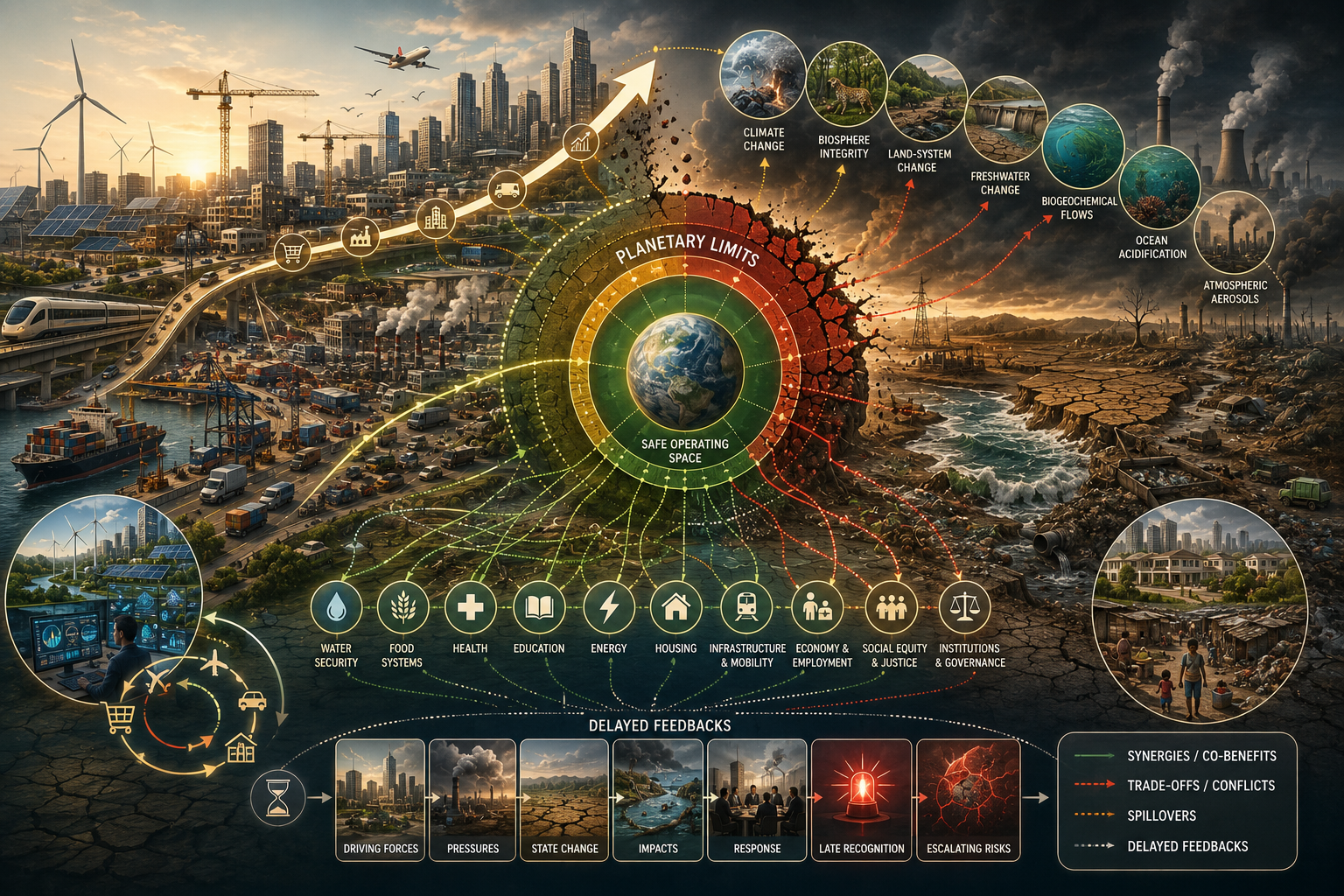
The modern discussion of overshoot is inseparable from the systems tradition associated with The Limits to Growth. Its enduring contribution lies less in any single prediction than in the structural insight that exponential growth inside finite systems can generate delayed crisis precisely because visible growth may continue even after underlying constraints are already being crossed. In systems terms, the danger is not only that limits exist. It is that delays, buffers, feedback loops, sunk infrastructure, and political incentives can allow expansion to continue long after the system has moved beyond a safe range.
That insight matters even more now because sustainable development can no longer be framed simply as the pursuit of more growth with better intentions. The central question is whether development pathways remain compatible with long-run social and ecological viability. The Brundtland tradition kept human need morally central, but contemporary sustainability science has sharpened the ecological side of the problem by showing that human development is taking place under intensifying Earth-system pressure. Overshoot is therefore no longer only a theoretical concern about future risk. It is an increasingly plausible description of the condition under which development is already occurring.
What Is Overshoot?
Overshoot occurs when a system’s scale of activity exceeds the regenerative, absorptive, or stabilizing capacities of the larger system that contains it. In ecological terms, this can mean drawing resources faster than they can regenerate, emitting wastes faster than they can be safely absorbed, or altering environmental processes faster than the larger system can remain resilient. In social and economic terms, overshoot can also describe forms of expansion that undermine their own conditions of reproduction: infrastructure growth that locks in fragility, production growth that degrades essential inputs, or welfare gains that depend on hidden depletion.
Overshoot is therefore not reducible to scarcity in the narrow sense. It is about systemic mismatch between expansion and support conditions. A society may possess resources, technology, and productive capacity, yet still be in overshoot if the way those resources are used weakens the systems that make future wellbeing possible. The issue is not simply whether something “runs out.” It is whether cumulative pressure exceeds the capacity of ecological, institutional, and social systems to absorb, regenerate, adapt, and stabilize.
The concept is most powerful when understood dynamically rather than statically. Overshoot is not simply the moment a line crosses another line on a graph. It is a condition in which reinforcing processes continue pushing a system forward even after the conditions that made that advance safe or sustainable have begun to deteriorate. Stocks, buffers, borrowed time, sunk infrastructure, and delayed feedbacks all allow the system to continue operating beyond its viable range. That is why overshoot can coexist with visible prosperity. The system may still be producing gains, even as it is quietly consuming the basis of its future stability.
For sustainable development, overshoot is therefore not an apocalyptic slogan. It is a way of naming the condition in which present developmental gains are being financed through future instability. A society may become richer, more mobile, more technologically sophisticated, and more materially capable while simultaneously eroding climate stability, freshwater security, biosphere integrity, soil fertility, public trust, or institutional resilience. In that case, development is not absent; it is occurring on terms that are increasingly self-undermining.
This directly extends the argument developed in Sustainable Development as a Systems Problem, where interdependence, delay, feedback, and institutional coordination were shown to be central to the structure of developmental risk. Overshoot is one of the most important expressions of that systems problem because it explains why a society can appear successful while becoming less viable.
Growth, Throughput, and Welfare
A deeper account of overshoot requires distinguishing among growth, throughput, and welfare. These are often blurred together, but they are not the same. Growth refers to expansion in output or economic activity. Throughput refers to the material and energetic flows passing through an economy: energy, water, minerals, biomass, land, nutrients, chemicals, waste, emissions, and other physical flows. Welfare refers to the actual quality of life, security, capability, dignity, health, education, and wellbeing that people experience.
In political argument, growth is often treated as if it guarantees welfare, and welfare is often treated as if it can expand indefinitely through rising throughput. Overshoot analysis challenges both assumptions. Growth can produce welfare gains, especially where poverty, underinvestment, and deprivation remain severe. But growth can also fail to translate into broad wellbeing if gains are captured narrowly, if public goods remain weak, or if social and ecological costs accumulate elsewhere. Similarly, welfare can be improved through better distribution, public services, care systems, institutional quality, and ecological resilience—not only through ever-greater material throughput.
This distinction matters because societies can experience growth without proportionate welfare gains, and they can also secure some welfare gains through pathways that intensify unsustainable throughput. A development model may raise incomes, build infrastructure, expand mobility, and widen consumption while simultaneously increasing waste loads, emissions, land stress, freshwater depletion, and ecological instability. In such cases, growth is real, and some welfare gains may also be real, but the underlying throughput is placing the larger system under strain. Overshoot is the concept that keeps these layers analytically separate while showing how they interact.
This is one reason limits discourse should not be caricatured as a rejection of welfare. The deepest issue is not whether human wellbeing should expand, but whether wellbeing is being pursued through pathways that remain compatible with the systems that support it. Overshoot becomes likely when throughput expands faster than either ecological resilience or institutional adaptation can manage. Growth, in this view, must be evaluated by what it does to welfare, what it requires in physical throughput, and whether the systems that sustain welfare remain viable over time.
This section also connects naturally to From Economic Growth to Human Development. Once development is judged by capability and lived possibility rather than output alone, the distinction between growth and welfare becomes harder to evade. Sustainable development requires asking not only whether economies grow, but whether growth is converted into human flourishing without pushing ecological and institutional systems into overshoot.
The Systems Logic of The Limits to Growth
The Limits to Growth remains significant because it introduced a way of thinking rather than merely a warning. The Club of Rome presents the report as a study of the implications of continued growth in a world of interlocking resources, population, industrial production, pollution, and environmental systems. Its most enduring insight was that growth under finite conditions cannot be judged safely through short-run trend extrapolation alone. One must instead examine system structure: reinforcing loops, delays, resource stocks, pollution sinks, technology, and adaptive constraints.
This systems logic remains powerful because it challenges linear reasoning. Linear reasoning assumes that if a trend has been beneficial so far, more of it will continue to be beneficial. Systems reasoning asks instead whether the trend is changing the background conditions that make it possible. Growth may increase output, but it may also degrade the ecological, institutional, or social stocks on which future output depends. In that sense, overshoot can emerge not in spite of growth, but through growth’s very success. What looks like momentum may already be destabilization in motion.
The continuing relevance of this framework lies in its emphasis on interaction. Population, production, pollution, resource use, food systems, and technological adaptation are not isolated variables. They co-evolve. Once that is recognized, overshoot becomes harder to dismiss as a single-issue environmental concern. It becomes a general systems problem of development under constraint.
The importance of The Limits to Growth is not that every reader must accept every scenario as a prediction. Its importance is that it made visible a structural pattern: systems can grow past safe limits because feedback arrives late, because stocks buffer short-term consequences, because institutions reward visible expansion, and because harms are often displaced in time or space. Those are precisely the conditions under which sustainable development becomes difficult.
This also complements the systems orientation of The 2030 Agenda and the Logic of the SDGs, where development was treated not as a checklist of sectors but as an architecture of interdependence. The SDG language of integration and indivisibility is easier to understand once one sees development as a system whose parts interact, reinforce, delay, and sometimes destabilize one another.
Exponential Growth, Finite Systems, and Delayed Crisis
Overshoot becomes especially difficult to recognize when growth is exponential. Exponential growth can appear manageable for long periods because the largest absolute increases occur late. A process may double slowly at first, then suddenly place overwhelming pressure on the systems that must support it. This creates a political and cognitive problem: by the time pressure becomes obvious, the system may already be operating near or beyond critical limits.
Finite systems do not necessarily impose limits in a simple or immediate way. They contain buffers, substitutes, reserves, technologies, and adaptive capacities. These can delay visible crisis, and delay can be valuable if it creates time for transformation. But delay can also be dangerous if societies mistake the absence of immediate collapse for proof of long-run safety. Overshoot often occurs precisely because systems continue to function after limits are already being approached. The visible signal arrives late.
This is why short-term trend analysis can mislead. If production, consumption, or extraction continues rising, policymakers may infer that the system remains robust. But systems can maintain surface performance by drawing down hidden stocks: soil fertility, groundwater, biodiversity, public trust, infrastructure quality, fiscal capacity, or climate stability. In such cases, the development model is converting stored resilience into current output. The economy looks productive because it is consuming the conditions that made productivity possible.
Delayed crisis is not only ecological. It can also be institutional. A state may postpone infrastructure maintenance, underinvest in education, weaken public-health systems, ignore housing insecurity, or tolerate corruption while still reporting growth. The consequences may emerge later as lower resilience, political distrust, fiscal strain, or social fracture. Overshoot is therefore a broader systems pattern: growth can outrun the capacities that stabilize growth.
For sustainable development, this means that early-warning systems, long-run indicators, scenario analysis, and precautionary governance are not optional luxuries. They are necessary because the most dangerous system failures are often prepared before they are visible. Overshoot is the result of late recognition meeting accumulated pressure.
Why Growth Can Become Self-Undermining
Growth is not inherently pathological. It can reduce poverty, expand state capacity, improve infrastructure, support public health, increase educational access, and widen access to goods and services. This is why sustainable development cannot simply reject growth as such. Where deprivation remains severe, growth and productive transformation may still be essential. But growth becomes self-undermining when it is measured narrowly, governed weakly, or detached from the conditions that sustain it.
This can happen through several mechanisms. Resource extraction may increase national income while exhausting ecological assets or destabilizing local livelihoods. Industrialization may generate employment while weakening air, water, or climate stability. Agricultural intensification may raise output while degrading soils, freshwater systems, or nutrient balance. Urbanization may improve productivity while locking cities into heat vulnerability, land conversion, and energy-intensive infrastructure. In each case, visible success is coupled with a hidden drawdown of resilience.
The result is not the absence of development, but development on increasingly brittle terms. A system may be growing, but the quality of that growth is unstable because the supporting conditions are deteriorating. This is what makes overshoot so important for sustainable development. It forces the question of whether present gains are durable or whether they depend on borrowing stability from the future.
Self-undermining growth can also arise when economic indicators overstate wellbeing. GDP may rise because of extraction, reconstruction, defensive spending, or high-throughput consumption, even as welfare remains stagnant or ecological conditions worsen. Output measures can therefore record activity without distinguishing whether the activity strengthens or weakens long-run prosperity. This is why Beyond GDP Development: Measuring Prosperity as a Systems Outcome is closely related to the overshoot problem. If the measurement system is too narrow, overshoot can be hidden by the very indicators used to claim success.
Overshoot is therefore best understood not as the opposite of development, but as a distorted form of development: one in which the means of improvement progressively weaken the conditions of continuity. That question sits at the center of The Brundtland Definition and Its Legacy, where development legitimacy is tied to what present action leaves behind for future generations.
Delays, Feedback Loops, and the Politics of Late Recognition
One reason overshoot is so difficult to govern is that systems respond with delays. Damage often accumulates before it becomes politically legible. Ecological stress, institutional fragility, and infrastructural lock-in may deepen gradually while standard performance indicators continue to look favorable. This creates a dangerous asymmetry: the very dynamics that drive overshoot are often rewarded in the short run, while the consequences are deferred into the future. By the time the system begins to register visible crisis, the underlying structure may already be harder to stabilize.
Feedback loops intensify this problem. Some are reinforcing: more production generates more resource throughput, which supports still more production, even as ecological pressure accumulates. Others are destabilizing: environmental degradation weakens food systems, health systems, or migration stability, which then strain institutions and reduce adaptive capacity. Still others are political: short-run growth increases public expectations, which makes it harder for governments to slow damaging systems even when long-run risk is rising.
What makes overshoot politically treacherous is that these loops do not announce themselves clearly. They often show up first as disconnected symptoms: crop stress here, water pressure there, institutional strain elsewhere, rising insurance costs somewhere else, and local conflicts over land or infrastructure. Without systemic interpretation, the underlying pattern remains partially hidden. Problems are treated as isolated failures rather than as expressions of an overshooting system.
Overshoot is therefore also a problem of recognition. Systems organized around annual budgets, quarterly performance, electoral cycles, or short-horizon growth targets are structurally poorly equipped to respond to pressures that accumulate slowly and become visible only after thresholds are being approached or crossed. The issue is not just scientific knowledge. It is whether political systems are capable of acting on long-range feedbacks before they harden into structural crisis.
This is why the article links strongly with Risk, Shock, and Fragility in Development Systems and Development Under Deep Uncertainty. Overshoot is the condition in which fragility accumulates before shock makes it obvious. A system that seems stable under normal conditions may reveal deep weakness once delayed feedbacks begin to interact.
Earth-System Limits, Safe Operating Space, and Planetary Boundaries
Contemporary sustainability science has deepened the limits discussion by translating it into a more explicit Earth-system framework. The planetary-boundaries literature defines a safe operating space for humanity based on the biophysical processes that regulate Earth-system stability and resilience. This matters because it moves the discussion from general caution about limits toward a more structured account of the conditions within which development can remain viable.
The planetary-boundaries framework identifies major Earth-system processes such as climate change, biosphere integrity, land-system change, freshwater change, biogeochemical flows, ocean acidification, atmospheric aerosol loading, stratospheric ozone depletion, and novel entities. These are not isolated environmental problems. They are regulating systems and pressure domains that influence the stability of the conditions under which agriculture, health, infrastructure, water systems, cities, and economies function.
The 2023 scientific update concluded that six of the nine planetary boundaries were transgressed. Stockholm Resilience Centre later reported in September 2025 that seven of the nine are now breached, with ocean acidification newly assessed as beyond the safe operating space. Whether one emphasizes the peer-reviewed 2023 assessment or the later 2025 Planetary Health Check update, the core implication is the same: development is taking place under increasingly destabilized Earth-system conditions.
This reframes overshoot in a crucial way. Overshoot is not only about exhausting a single resource. It is about exceeding the stability conditions of coupled Earth systems that support climate regulation, freshwater availability, biosphere integrity, nutrient balance, ocean chemistry, and broader ecological resilience. In that sense, overshoot is not a side concern for environmental policy. It is a condition that can reorganize the entire developmental landscape.
Earth-system overshoot also changes how economic growth must be interpreted. A growth pathway may still expand output while intensifying climate risk, water insecurity, biodiversity loss, nutrient disruption, and pollution burdens. If those pressures weaken the planetary conditions of future development, then growth is no longer simply growth. It becomes a transfer of risk across time, geography, and generations. This section links directly to Boundary Transgression and Development Fragility and Freshwater Change and Development Risk.
Overshoot, Inequality, and the Problem of Development Justice
The problem of overshoot becomes especially difficult when viewed through the lens of development justice. Large parts of the world still face severe poverty, limited energy access, weak infrastructure, public-health deficits, food insecurity, inadequate housing, and constrained state capacity. Development remains morally urgent. The Brundtland Report underscored this by giving priority to the essential needs of the world’s poor. Any limits discourse that ignores those needs fails the ethical test of sustainable development itself.
But development urgency does not dissolve limits. It intensifies the challenge of how development can proceed without reproducing the overshooting pathways of earlier industrial expansion. The issue is not whether poorer societies should develop, but whether the global developmental model they inherit is already ecologically destabilizing. This is why overshoot cannot be discussed honestly without also discussing inequality. Those who have benefited most from high-throughput growth are not always those most exposed to its consequences, and those with the least historical responsibility often face the harshest vulnerabilities.
This makes overshoot both a biophysical and distributive problem. Sustainable development must grapple with the fact that the world cannot simply universalize the most resource-intensive historical development pathways without intensifying instability. The task is therefore not to deny development, but to redesign it so that human need can be met without reproducing forms of growth that consume the future as the hidden subsidy of the present.
Development justice also requires distinguishing between luxury consumption and basic need. Limits discourse becomes ethically distorted if it treats subsistence energy, clean water, housing, public health, and basic infrastructure as equivalent to high-consumption patterns that generate disproportionate ecological pressure. A just approach to overshoot must ask who is using ecological space, for what purposes, with what consequences, and with what historical responsibility.
That is why the article belongs alongside From Economic Growth to Human Development: development justice requires a clearer view of what growth is for, and for whom. It also belongs beside Inequality and Inclusive Development, because overshoot is not only produced by aggregate human activity. It is produced through highly unequal systems of production, consumption, extraction, and vulnerability.
Institutions, Governance, and the Management of Limits
Overshoot is rarely just a failure of science. It is also a failure of governance. Systems overshoot when institutions remain organized around narrow indicators, fragmented sectors, short political time horizons, or incentives that reward immediate output over long-run resilience. In such settings, warning signs may exist, but they are not adequately translated into policy. The problem is not ignorance alone; it is the inability of institutions to act on systemic knowledge before delayed effects become harder to reverse.
This is why institutions matter so much. Managing limits requires the capacity to coordinate across sectors, evaluate long-run trade-offs, invest in preventive resilience, and respond before cumulative pressures harden into crisis. It also requires dealing with asymmetry: those who benefit most from overshooting growth are not always those who bear the earliest or sharpest costs. Overshoot is therefore inseparable from questions of power, timing, and distribution.
Sustainable development becomes more credible when institutions can treat limits not as external obstacles but as design constraints for viable development. That means rethinking infrastructure, energy, land use, agriculture, finance, public investment, and social protection in ways that reduce the likelihood of long-run destabilization rather than amplifying it. Overshoot is not prevented through aspiration alone; it is prevented through systemic redesign.
Institutional design also determines whether societies can respond before crisis. A state with strong statistical systems, public trust, fiscal capacity, scientific institutions, regulatory competence, and long-term planning mechanisms is better positioned to detect and manage overshoot than a state governed by fragmented agencies and short-term incentives. But capacity alone is not enough. Institutions must also be accountable, because limits can be managed unjustly if powerful actors protect themselves while vulnerable communities absorb the burdens of adjustment.
This institutional dimension links back to The 2030 Agenda and the Logic of the SDGs, where implementation, review, partnership, and coordination were shown to be core features of sustainable development governance. The SDGs assume integration, but overshoot reveals why integration is not optional: a system that manages one sector while ignoring its effects on others can create apparent progress and real fragility at the same time.
Technology, Efficiency, and the Rebound Problem
Technology is central to any serious discussion of growth, limits, and overshoot. Technological innovation can improve efficiency, reduce pollution, substitute materials, expand renewable energy, strengthen monitoring systems, support precision agriculture, improve water use, and lower the resource intensity of some activities. A credible sustainable development strategy must therefore take technology seriously. Limits are not fixed in a simplistic way; they are mediated by knowledge, institutions, infrastructure, and social organization.
But technology does not abolish the logic of overshoot by itself. Efficiency gains can lower the resource or energy intensity of each unit of output, but total pressure can still rise if the scale of activity expands faster than efficiency improves. This is often described as a rebound problem: improvements in efficiency can reduce costs, increase demand, and lead to higher total consumption. The result is that efficiency gains may slow overshoot without reversing it if underlying growth dynamics remain unchanged.
Technology can also shift burdens rather than eliminate them. Electric vehicles reduce tailpipe emissions, but they depend on minerals, electricity systems, land use, battery supply chains, and waste management. Digital systems can improve coordination, but they require energy, water, data infrastructure, minerals, and governance safeguards. Renewable energy reduces fossil dependence, but deployment still requires material systems, transmission infrastructure, land decisions, and social legitimacy. A systems approach asks whether technology reduces total pressure and strengthens resilience, not only whether it improves one component.
This does not make technology suspect. It makes technology insufficient on its own. Sustainable development requires innovation, but also governance, equity, demand management, infrastructure redesign, public investment, and ecological accounting. Technology can expand the range of possible pathways, but it cannot substitute for institutional capacity or ethical judgment about what kinds of growth should be pursued.
Overshoot analysis therefore offers a disciplined way to evaluate technological optimism. The question is not whether innovation can help. It can. The question is whether innovation is changing the system logic quickly enough to reduce cumulative pressure, preserve ecological stability, and support human wellbeing without intensifying other forms of fragility.
Misreadings, Critiques, and Open Questions
The language of limits and overshoot is often criticized as deterministic, anti-development, or insufficiently attentive to technological change. Some of these criticisms respond to caricatures rather than to the strongest version of the argument. The core systems claim of The Limits to Growth was not that collapse occurs automatically at a fixed date, but that continued growth in finite systems can generate instability when reinforcing expansion outruns ecological and institutional adaptation. The argument is conditional and structural, not fatalistically prophetic.
Other critiques are more serious. Limits are not experienced uniformly, and they are mediated by technology, institutions, and power. A world marked by large inequality, concentrated consumption, and uneven responsibility cannot discuss limits as if all populations contribute equally to overshoot or face equal constraints. Likewise, technological innovation can alter the form of limits, delay some pressures, or reduce certain kinds of throughput, even if it does not abolish finitude altogether. Overshoot analysis therefore must be joined to political economy, justice, and institutional analysis rather than treated as a purely ecological diagnosis.
Another open question concerns sequencing. How should societies reduce overshoot while still meeting urgent human needs? How should high-income, high-throughput economies reduce material pressure without exporting burdens elsewhere? How should lower-income countries expand energy access, housing, sanitation, health systems, and industry without being trapped by high-carbon or ecologically destructive pathways? How should international finance and technology transfer support development pathways that are both just and viable?
There is also a measurement challenge. Overshoot cannot always be captured through one variable. It involves resource depletion, emissions, pollution, biodiversity, water, land, infrastructure, social vulnerability, institutional fragility, and delayed feedbacks. Because of this, overshoot requires dashboards, models, qualitative judgment, historical analysis, and public reasoning. No single index can fully settle the question of whether development is self-undermining.
These open questions do not make overshoot less relevant. They make it more demanding. A serious theory of growth and limits must explain not only that overshoot is possible, but how it is produced, who drives it, who pays for it, and what forms of governance might redirect systems before destabilization becomes harder to reverse.
Why Overshoot Matters for Sustainable Development
Overshoot matters because it clarifies why sustainable development cannot be reduced to better intentions, greener language, or short-run improvement in selected indicators. A system can improve some visible metrics while weakening the conditions that allow those metrics to remain meaningful. A country can grow while depleting ecological assets. A city can expand while locking in vulnerability. A food system can become more productive while undermining soils, water, and biodiversity. A society can increase consumption while weakening public trust, climate stability, and resilience.
This makes overshoot one of the central concepts for interpreting the difference between business as usual and sustainable development. Business as usual tends to assume that familiar growth patterns can continue with incremental adjustment. Sustainable development asks whether the underlying growth system can remain viable under ecological, social, and institutional constraint. Overshoot is the warning that familiar growth can keep succeeding in visible terms while failing in structural terms.
The concept also strengthens the Brundtland definition. Development that meets present needs while compromising the ability of future generations to meet their own needs is not sustainable development. Overshoot is one mechanism by which that compromise occurs. It is the hidden conversion of future capacity into present output. When development consumes the future as a silent subsidy for the present, it violates the core intergenerational logic of sustainable development.
Overshoot also gives practical force to the planetary-boundaries framework. Boundaries are not abstract scientific lines detached from development. They are signals of the conditions within which development remains safe enough to endure. If development pathways push climate, biosphere integrity, freshwater, land systems, nutrient flows, ocean chemistry, and pollution beyond safe operating conditions, then the development project itself becomes more fragile.
The sustainable development challenge is therefore not to choose between growth and limits in a simplistic way. It is to redefine growth so that welfare, capability, equity, and ecological stability can advance together. That requires measurement beyond GDP, institutions beyond short-termism, technology beyond efficiency alone, and justice beyond aggregate averages. Overshoot matters because it reveals the cost of pretending that expansion can continue without confronting the systems that make expansion possible.
Mathematical Lens
Overshoot can be expressed as a problem of cumulative throughput exceeding regenerative, absorptive, or stabilizing capacity under delayed feedback. Let \(O\) denote overshoot intensity, \(G\) growth pressure, \(T\) material and energetic throughput, \(C\) regenerative or absorptive capacity, and \(D\) delay in corrective feedback:
O = \alpha G + \beta T – \gamma C + \delta D
\]
Interpretation: Overshoot increases when growth pressure and throughput rise faster than regenerative capacity, especially when corrective feedback is delayed.
This captures the article’s core point: overshoot emerges when visible growth continues while the support conditions of continuity are being weakened and the system is responding too slowly to correct course.
We can also express overshoot risk under coupled Earth-system pressure as:
R_o = w_1 P + w_2 L + w_3 F
\]
Interpretation: Overshoot risk rises when planetary pressure, late-recognition risk, and governance fragility reinforce one another.
In this formulation, \(P\) is planetary pressure, \(L\) is long-delay recognition risk, and \(F\) is governance fragility. Higher \(R_o\) means development is more likely to be occurring on increasingly brittle terms.
Finally, durable-development viability can be represented as:
V = \lambda W + \mu A + \nu S
\]
Interpretation: Durable development viability increases when welfare gains, adaptive institutional capacity, and stability preservation are strengthened together.
Here, \(W\) is welfare gain, \(A\) is adaptive institutional capacity, and \(S\) is stability preservation. This helps show why growth and welfare must be judged together with the conditions of continuity rather than in isolation.
| Term | Meaning | Interpretive role |
|---|---|---|
| \(O\) | Overshoot intensity | Represents the degree to which activity exceeds support conditions. |
| \(G\) | Growth pressure | Represents pressure from expanding output, consumption, infrastructure, or population demand. |
| \(T\) | Throughput | Represents material and energetic flows through the economy. |
| \(C\) | Regenerative or absorptive capacity | Represents the capacity of ecological or institutional systems to renew, absorb, stabilize, or adapt. |
| \(D\) | Delayed feedback | Represents the lag between pressure, harm, recognition, and corrective action. |
| \(R_o\) | Overshoot risk | Represents the likelihood that development is becoming brittle through planetary pressure, late recognition, and governance weakness. |
| \(V\) | Durable-development viability | Represents whether welfare gains are compatible with adaptive capacity and stability preservation. |
The equations are conceptual rather than predictive. Their value is to make visible the article’s central argument: growth must be evaluated against throughput, capacity, delay, governance, and long-run viability. A system can expand and still become less sustainable if its support conditions are weakening faster than its institutions can respond.
Advanced Python Workflow: Growth, Limits, and Overshoot Risk Scoring
This Python workflow translates the article’s core argument into a structured overshoot model. Rather than treating growth as self-justifying, it scores territories across throughput pressure, regenerative-capacity loss, delay risk, planetary stress, infrastructure lock-in, governance fragility, adaptive capacity, and welfare conversion. That makes it possible to compare not only where expansion is occurring, but where apparent success is most likely to be financed through erosion of future viability.
from __future__ import annotations

import pandas as pd
import numpy as np

INPUT_FILE = "growth_limits_overshoot_panel.csv"
OUTPUT_FILE = "growth_limits_overshoot_scores.csv"


def load_data(path: str) -> pd.DataFrame:
    """
    Load a territory-level growth, limits, and overshoot dataset.

    All *_index columns should be normalized to [0, 1].
    Higher values should mean more of the named property.

    Examples:
      - growth_pressure_index: higher = stronger expansion pressure
      - throughput_pressure_index: higher = greater material and energetic throughput
      - adaptive_capacity_index: higher = stronger adaptive capacity
      - welfare_conversion_index: higher = stronger conversion of growth into wellbeing
    """
    df = pd.read_csv(path)

    required_columns = [
        "territory_name",
        "country_or_region",
        "territory_type",
        "growth_pressure_index",
        "throughput_pressure_index",
        "resource_depletion_index",
        "waste_absorptive_stress_index",
        "planetary_pressure_index",
        "delay_recognition_risk_index",
        "infrastructure_lockin_index",
        "governance_fragility_index",
        "adaptive_capacity_index",
        "welfare_conversion_index",
        "sustainable_development_alignment_index",
    ]

    missing = [col for col in required_columns if col not in df.columns]

    if missing:
        raise ValueError(f"Missing required columns: {missing}")

    return df


def validate_indices(df: pd.DataFrame) -> pd.DataFrame:
    """Validate that all *_index fields are complete and normalized to [0, 1]."""
    index_columns = [col for col in df.columns if col.endswith("_index")]

    for col in index_columns:
        if df[col].isna().any():
            raise ValueError(f"Column '{col}' contains missing values.")

        if ((df[col] < 0) | (df[col] > 1)).any():
            raise ValueError(f"Column '{col}' contains values outside [0, 1].")

    return df


def compute_scores(df: pd.DataFrame) -> pd.DataFrame:
    """
    Compute overshoot pressure, stability support, and overshoot risk.

    Overshoot pressure rises with growth pressure, throughput pressure,
    resource depletion, waste stress, planetary pressure, delay recognition,
    and infrastructure lock-in.

    Stability support rises with stronger governance, adaptive capacity,
    welfare conversion, and sustainable-development alignment.
    """
    df = df.copy()

    df["overshoot_pressure_score"] = (
        0.15 * df["growth_pressure_index"] +
        0.15 * df["throughput_pressure_index"] +
        0.13 * df["resource_depletion_index"] +
        0.13 * df["waste_absorptive_stress_index"] +
        0.14 * df["planetary_pressure_index"] +
        0.15 * df["delay_recognition_risk_index"] +
        0.15 * df["infrastructure_lockin_index"]
    ).clip(lower=0, upper=1)

    df["stability_support_score"] = (
        0.28 * (1 - df["governance_fragility_index"]) +
        0.28 * df["adaptive_capacity_index"] +
        0.24 * df["welfare_conversion_index"] +
        0.20 * df["sustainable_development_alignment_index"]
    ).clip(lower=0, upper=1)

    df["overshoot_risk_score"] = (
        0.50 * df["overshoot_pressure_score"] +
        0.18 * df["governance_fragility_index"] +
        0.14 * (1 - df["adaptive_capacity_index"]) +
        0.10 * (1 - df["welfare_conversion_index"]) +
        0.08 * (1 - df["sustainable_development_alignment_index"])
    ).clip(lower=0, upper=1)

    df["risk_band"] = np.select(
        [
            df["overshoot_risk_score"] >= 0.80,
            df["overshoot_risk_score"] >= 0.60,
            df["overshoot_risk_score"] >= 0.40,
        ],
        [
            "Extreme overshoot risk",
            "High overshoot risk",
            "Moderate overshoot risk",
        ],
        default="Lower overshoot risk",
    )

    df["welfare_throughput_gap"] = (
        df["throughput_pressure_index"] - df["welfare_conversion_index"]
    )

    df["development_quality_warning"] = np.select(
        [
            df["welfare_throughput_gap"] >= 0.35,
            df["welfare_throughput_gap"] >= 0.20,
            df["welfare_throughput_gap"] >= 0.05,
        ],
        [
            "Severe throughput-welfare mismatch",
            "High throughput-welfare mismatch",
            "Moderate throughput-welfare mismatch",
        ],
        default="Lower throughput-welfare mismatch",
    )

    return df


def build_summary(df: pd.DataFrame) -> pd.DataFrame:
    """Return a ranked summary table for review or reporting."""
    columns = [
        "territory_name",
        "country_or_region",
        "territory_type",
        "overshoot_pressure_score",
        "stability_support_score",
        "overshoot_risk_score",
        "risk_band",
        "welfare_throughput_gap",
        "development_quality_warning",
    ]

    summary = df[columns].copy()

    summary = summary.sort_values(
        by=[
            "overshoot_risk_score",
            "overshoot_pressure_score",
            "stability_support_score",
        ],
        ascending=[False, False, True],
    ).reset_index(drop=True)

    return summary


def main() -> None:
    df = load_data(INPUT_FILE)
    df = validate_indices(df)
    scored = compute_scores(df)
    summary = build_summary(scored)

    summary.to_csv(OUTPUT_FILE, index=False)

    print("Growth, limits, and overshoot scoring complete.")
    print(summary.to_string(index=False))


if __name__ == "__main__":
    main()
This workflow is intentionally transparent. It does not claim that overshoot can be reduced to a final objective score. Instead, it makes assumptions visible: growth pressure, throughput, depletion, waste stress, planetary pressure, delayed recognition, infrastructure lock-in, governance fragility, adaptive capacity, welfare conversion, and sustainable-development alignment are treated as distinct components. The value of the model is diagnostic. It helps identify where development may be producing apparent success while weakening future viability.
Advanced R Workflow: Throughput Pressure, Delay Risk, and Governance Fragility
This R workflow is designed for the part of the article that emphasizes throughput, late recognition, and systemic brittleness. It compares settings across growth pressure, throughput stress, delay risk, adaptive capacity, welfare conversion, governance fragility, and sustainable-development alignment, then builds grouped summaries that help show where development is most likely to be progressing on self-undermining terms.
library(readr)
library(dplyr)

input_file <- "growth_limits_overshoot_country_panel.csv"
region_output_file <- "cross_region_overshoot_summary.csv"
territory_output_file <- "cross_territory_overshoot_summary.csv"

overshoot_df <- read_csv(input_file, show_col_types = FALSE)

required_cols <- c(
  "territory_name",
  "country_or_region",
  "territory_type",
  "growth_pressure_index",
  "throughput_pressure_index",
  "resource_depletion_index",
  "waste_absorptive_stress_index",
  "planetary_pressure_index",
  "delay_recognition_risk_index",
  "infrastructure_lockin_index",
  "governance_fragility_index",
  "adaptive_capacity_index",
  "welfare_conversion_index",
  "sustainable_development_alignment_index"
)

missing_cols <- setdiff(required_cols, names(overshoot_df))

if (length(missing_cols) > 0) {
  stop(paste("Missing required columns:", paste(missing_cols, collapse = ", ")))
}

index_cols <- names(overshoot_df)[grepl("_index$", names(overshoot_df))]

invalid_index_cols <- index_cols[
  vapply(
    overshoot_df[index_cols],
    function(x) any(is.na(x) | x < 0 | x > 1),
    logical(1)
  )
]

if (length(invalid_index_cols) > 0) {
  stop(
    paste(
      "Index columns must be complete and normalized to [0, 1]:",
      paste(invalid_index_cols, collapse = ", ")
    )
  )
}

overshoot_df <- overshoot_df %>%
  mutate(
    overshoot_proxy = (
      growth_pressure_index +
      throughput_pressure_index +
      resource_depletion_index +
      waste_absorptive_stress_index +
      planetary_pressure_index +
      delay_recognition_risk_index +
      infrastructure_lockin_index +
      governance_fragility_index +
      (1 - adaptive_capacity_index) +
      (1 - welfare_conversion_index) +
      (1 - sustainable_development_alignment_index)
    ) / 11,
    stability_support_proxy = (
      adaptive_capacity_index +
      welfare_conversion_index +
      sustainable_development_alignment_index +
      (1 - governance_fragility_index)
    ) / 4,
    throughput_welfare_gap = throughput_pressure_index - welfare_conversion_index,
    risk_band = case_when(
      overshoot_proxy >= 0.75 ~ "Extreme overshoot risk",
      overshoot_proxy >= 0.55 ~ "High overshoot risk",
      overshoot_proxy >= 0.35 ~ "Moderate overshoot risk",
      TRUE ~ "Lower overshoot risk"
    )
  )

region_summary <- overshoot_df %>%
  group_by(country_or_region) %>%
  summarise(
    avg_overshoot_proxy = mean(overshoot_proxy, na.rm = TRUE),
    avg_stability_support_proxy = mean(stability_support_proxy, na.rm = TRUE),
    avg_growth_pressure = mean(growth_pressure_index, na.rm = TRUE),
    avg_throughput_pressure = mean(throughput_pressure_index, na.rm = TRUE),
    avg_planetary_pressure = mean(planetary_pressure_index, na.rm = TRUE),
    avg_delay_recognition_risk = mean(delay_recognition_risk_index, na.rm = TRUE),
    avg_governance_fragility = mean(governance_fragility_index, na.rm = TRUE),
    avg_adaptive_capacity = mean(adaptive_capacity_index, na.rm = TRUE),
    avg_welfare_conversion = mean(welfare_conversion_index, na.rm = TRUE),
    avg_throughput_welfare_gap = mean(throughput_welfare_gap, na.rm = TRUE),
    observations = n(),
    .groups = "drop"
  ) %>%
  mutate(
    regional_risk_band = case_when(
      avg_overshoot_proxy >= 0.75 ~ "Extreme overshoot risk",
      avg_overshoot_proxy >= 0.55 ~ "High overshoot risk",
      avg_overshoot_proxy >= 0.35 ~ "Moderate overshoot risk",
      TRUE ~ "Lower overshoot risk"
    )
  ) %>%
  arrange(desc(avg_overshoot_proxy))

territory_summary <- overshoot_df %>%
  group_by(territory_type) %>%
  summarise(
    avg_overshoot_proxy = mean(overshoot_proxy, na.rm = TRUE),
    avg_stability_support_proxy = mean(stability_support_proxy, na.rm = TRUE),
    avg_growth_pressure = mean(growth_pressure_index, na.rm = TRUE),
    avg_throughput_pressure = mean(throughput_pressure_index, na.rm = TRUE),
    avg_planetary_pressure = mean(planetary_pressure_index, na.rm = TRUE),
    avg_delay_recognition_risk = mean(delay_recognition_risk_index, na.rm = TRUE),
    avg_governance_fragility = mean(governance_fragility_index, na.rm = TRUE),
    avg_adaptive_capacity = mean(adaptive_capacity_index, na.rm = TRUE),
    avg_welfare_conversion = mean(welfare_conversion_index, na.rm = TRUE),
    avg_throughput_welfare_gap = mean(throughput_welfare_gap, na.rm = TRUE),
    observations = n(),
    .groups = "drop"
  ) %>%
  arrange(desc(avg_overshoot_proxy))

write_csv(region_summary, region_output_file)
write_csv(territory_summary, territory_output_file)

cat("Cross-region overshoot summary exported to:", region_output_file, "\n")
print(region_summary)

cat("\nCross-territory overshoot summary exported to:", territory_output_file, "\n")
print(territory_summary)
This workflow helps distinguish expansion from viable development. A territory may show strong growth pressure while also facing high throughput, planetary pressure, delayed recognition, and governance fragility. Conversely, a territory with moderate growth but strong welfare conversion, adaptive capacity, and sustainable-development alignment may be more viable in the long run. The workflow therefore treats overshoot as a systems-governance issue rather than a simple resource-scarcity problem.
GitHub Repository
Complete Code Repository
The full code distribution for this article, including overshoot-risk scoring workflows, throughput diagnostics, SQL materials, optional monitoring support tooling, supporting documentation, and repository structure, is available on GitHub.
Related Articles
- Sustainable Development as a Systems Problem
- From Economic Growth to Human Development
- Beyond GDP Development: Measuring Prosperity as a Systems Outcome
- The 2030 Agenda and the Logic of the SDGs
- The Brundtland Definition and Its Legacy
- Risk, Shock, and Fragility in Development Systems
- Development Under Deep Uncertainty
- Boundary Transgression and Development Fragility
- Freshwater Change and Development Risk
- Planetary Boundaries and Sustainable Development
Further Reading
- Meadows, D.H., Meadows, D.L., Randers, J. and Behrens III, W.W. (1972) The Limits to Growth. New York: Universe Books. Available at: https://www.clubofrome.org/publication/the-limits-to-growth/
- Meadows, D.H., Randers, J. and Meadows, D.L. (2004) Limits to Growth: The 30-Year Update. White River Junction, VT: Chelsea Green Publishing. Available at: https://www.clubofrome.org/publication/limits-and-beyond/
- Club of Rome (2022) The Limits to Growth+50. Winterthur: Club of Rome. Available at: https://www.clubofrome.org/ltg50/
- World Commission on Environment and Development (1987) Our Common Future. New York: United Nations. Available at: https://digitallibrary.un.org/record/139811
- United Nations (2015) Transforming our world: the 2030 Agenda for Sustainable Development. New York: United Nations. Available at: https://sdgs.un.org/2030agenda
- Rockström, J. et al. (2009) ‘A safe operating space for humanity’, Nature, 461, pp. 472–475. Available at: https://www.nature.com/articles/461472a
- Steffen, W. et al. (2015) ‘Planetary Boundaries: Guiding Human Development on a Changing Planet’, Science, 347(6223). Available at: https://www.science.org/doi/10.1126/science.1259855
- Richardson, K. et al. (2023) ‘Earth beyond six of nine planetary boundaries’, Science Advances, 9(37), eadh2458. Available at: https://www.science.org/doi/10.1126/sciadv.adh2458
- Stockholm Resilience Centre (2025) Seven of nine planetary boundaries now breached. Stockholm: Stockholm University. Available at: https://www.stockholmresilience.org/news–events/general-news/2025-09-24-seven-of-nine-planetary-boundaries-now-breached.html
- Stockholm Resilience Centre (2025) Planetary Health Check 2025. Stockholm: Stockholm University. Available at: https://www.stockholmresilience.org/publications/publications/2025-11-29-planetary-health-check-2025.html
References
- Club of Rome (n.d.) The Limits to Growth. Winterthur: Club of Rome. Available at: https://www.clubofrome.org/publication/the-limits-to-growth/
- Club of Rome (2022) The Limits to Growth+50. Winterthur: Club of Rome. Available at: https://www.clubofrome.org/ltg50/
- World Commission on Environment and Development (1987) Our Common Future. New York: United Nations. Available at: https://digitallibrary.un.org/record/139811
- United Nations (2015) Transforming our world: the 2030 Agenda for Sustainable Development. New York: United Nations. Available at: https://sdgs.un.org/2030agenda
- Rockström, J. et al. (2009) ‘A safe operating space for humanity’, Nature, 461, pp. 472–475. Available at: https://www.nature.com/articles/461472a
- Steffen, W., Richardson, K., Rockström, J., Cornell, S.E., Fetzer, I., Bennett, E.M., Biggs, R., Carpenter, S.R., de Vries, W., de Wit, C.A., Folke, C., Gerten, D., Heinke, J., Mace, G.M., Persson, L.M., Ramanathan, V., Reyers, B. and Sörlin, S. (2015) ‘Planetary Boundaries: Guiding Human Development on a Changing Planet’, Science, 347(6223). Available at: https://www.science.org/doi/10.1126/science.1259855
- Richardson, K., Steffen, W., Lucht, W., Bendtsen, J., Cornell, S.E., Donges, J.F., Drüke, M., Fetzer, I., Bala, G., von Bloh, W., Feulner, G., Fiedler, S., Gerten, D., Gleeson, T., Hofmann, M., Huiskamp, W., Kummu, M., Mohan, C., Nogués-Bravo, D., Petri, S., Porkka, M., Rahmstorf, S., Schaphoff, S., Thonicke, K., Tobian, A., Virkki, V., Wang-Erlandsson, L., Weber, L. and Rockström, J. (2023) ‘Earth beyond six of nine planetary boundaries’, Science Advances, 9(37), eadh2458. Available at: https://www.science.org/doi/10.1126/sciadv.adh2458
- Stockholm Resilience Centre (n.d.) Planetary boundaries. Stockholm: Stockholm University. Available at: https://www.stockholmresilience.org/research/planetary-boundaries.html
- Stockholm Resilience Centre (2025) Seven of nine planetary boundaries now breached. Stockholm: Stockholm University. Available at: https://www.stockholmresilience.org/news–events/general-news/2025-09-24-seven-of-nine-planetary-boundaries-now-breached.html
- Stockholm Resilience Centre (2025) Planetary Health Check 2025. Stockholm: Stockholm University. Available at: https://www.stockholmresilience.org/publications/publications/2025-11-29-planetary-health-check-2025.html
- Stockholm Resilience Centre (n.d.) Quantitative evolution of the planetary boundaries. Stockholm: Stockholm University. Available at: https://www.stockholmresilience.org/research/planetary-boundaries/quantitative-evolution-of-boundaries.html
- IPCC (2023) Climate Change 2023: Synthesis Report. Geneva: Intergovernmental Panel on Climate Change. Available at: https://www.ipcc.ch/report/ar6/syr/