
Last Updated May 14, 2026
Infrastructure governance and policy systems are the institutional, legal, financial, regulatory, and administrative arrangements through which infrastructure is planned, prioritized, financed, delivered, operated, maintained, and held accountable across its life cycle. They include strategic planning, regulation, budgeting, procurement, contract management, asset management, transparency, public participation, intergovernmental coordination, public-private arrangements, performance monitoring, integrity controls, and the policy frameworks that connect infrastructure decisions to wider social, economic, environmental, fiscal, and democratic goals. Infrastructure governance is therefore not a secondary administrative layer surrounding physical assets. It is the decision system through which infrastructure choices are made, justified, implemented, monitored, repaired, renewed, contested, and learned from over time.
Infrastructure is often discussed as though its principal challenges are technical: how to build roads, grids, ports, water systems, digital networks, housing-supporting systems, flood defenses, civic buildings, and climate-resilient assets more effectively. Technical competence matters, but infrastructure succeeds or fails just as often through governance. Projects may be badly chosen, misaligned with public need, delayed in procurement, distorted by weak incentives, underfunded in maintenance, fragmented across jurisdictions, insulated from accountability, or structured around financial models that shift risk away from the public balance sheet while leaving service obligations unresolved. Governance shapes whether infrastructure investment serves long-run public value or merely produces visible assets without durable civic, fiscal, environmental, or social benefit.
This article develops Infrastructure Governance and Policy Systems: Planning, Delivery, and Public Accountability as an advanced article within the Intelligent Infrastructure Systems knowledge series. It examines infrastructure governance as a full life-cycle system connecting strategic planning, prioritization, public finance, procurement, contract management, public-private participation, operations, maintenance, asset stewardship, institutional coordination, transparency, integrity, public accountability, resilience, and policy learning. Selected Python and R examples appear here, while the full GitHub repository contains expanded computational scaffolding for governance indicators, project appraisal registers, procurement and delivery logs, life-cycle asset records, maintenance evidence, transparency scoring, public accountability reviews, SQL metadata, and reproducible infrastructure-governance workflows.
Main Library
Publications
Article Map
Intelligent Infrastructure
Related Article Map
Institutions & Governance
Related Article Map
Economic Systems
Related Article Map
Risk & Resilience
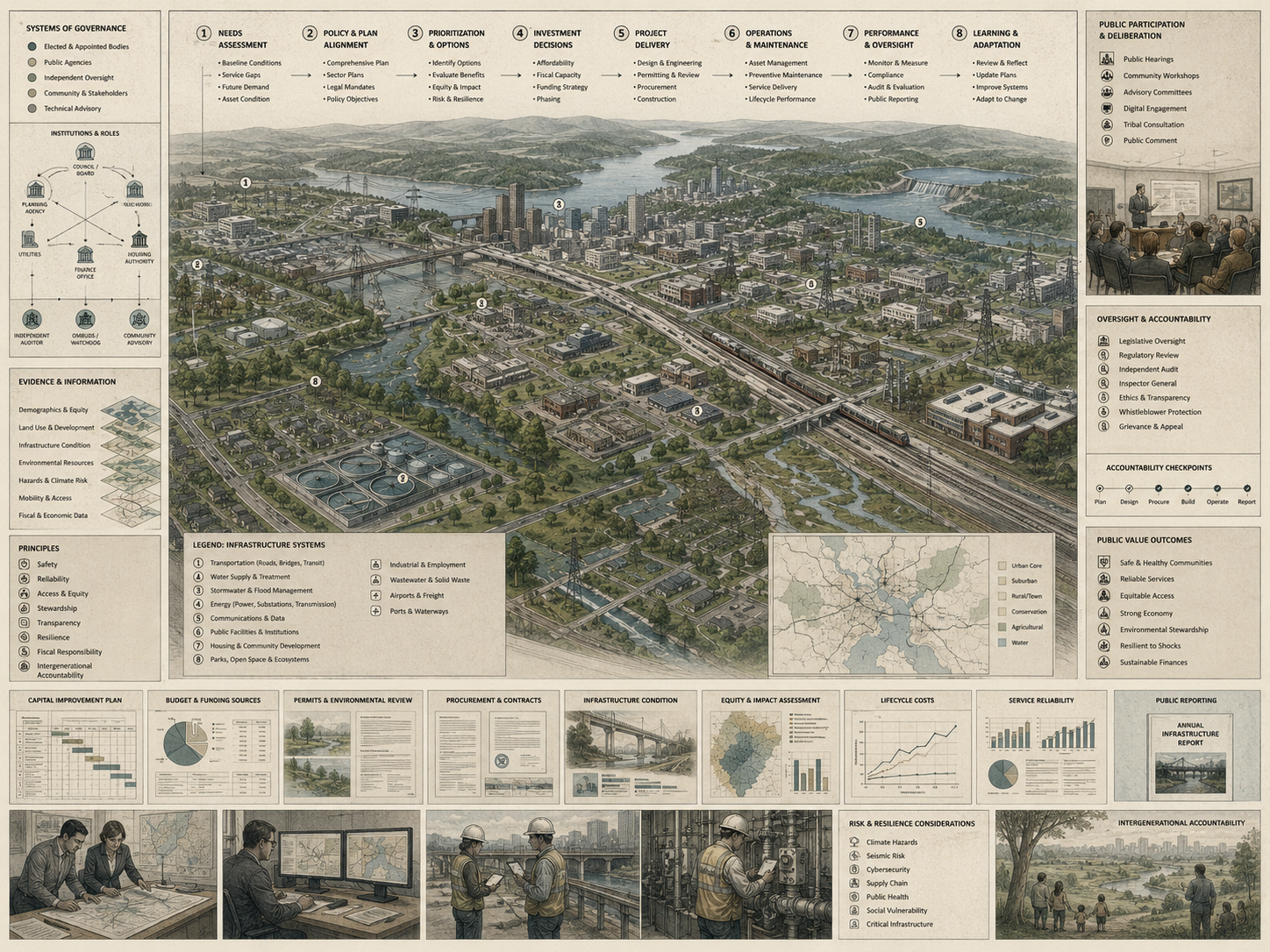
For that reason, infrastructure governance should not be reduced to compliance, paperwork, or administrative oversight after core decisions have already been made. Governance is the architecture of decision-making itself. It determines how governments identify infrastructure needs, compare options, balance fiscal constraints, structure procurement, manage delivery risk, govern public-private arrangements, operate assets, disclose information, and remain accountable to the people who depend on infrastructure services. It also determines whether infrastructure remains tied to long-term service obligations rather than short-term political cycles.
Infrastructure governance and policy systems therefore sit at the intersection of public investment, regulation, institutional design, democratic accountability, public finance, life-cycle stewardship, and long-term resilience. Where these layers remain weak, infrastructure can become expensive, delayed, exclusionary, brittle, environmentally damaging, or politically distorted. Where they are integrated thoughtfully, infrastructure is more likely to support public value, fiscal credibility, reliable service delivery, adaptation capacity, and sustained public legitimacy.
Engineering Problem
The engineering problem is how to design infrastructure governance and policy systems that can select the right projects, finance them responsibly, procure them fairly, deliver them competently, operate them reliably, maintain them over time, adapt them under changing conditions, and hold institutions accountable for public outcomes. This is not a narrow problem of administrative compliance. It is a systems problem involving public purpose, fiscal constraint, technical uncertainty, legal authority, procurement markets, institutional capacity, public participation, risk allocation, long-run service obligations, and the credibility of democratic decision-making.
This problem is difficult because infrastructure decisions are durable and path dependent. A poorly selected road, transit line, water project, energy asset, digital platform, flood defense, or civic facility can shape land use, fiscal commitments, service access, environmental exposure, and political expectations for decades. Once major investments are authorized, financed, and embedded in contracts or asset networks, reversal becomes difficult. Governance failures therefore do not merely produce isolated project mistakes. They can create long-lived institutional and material lock-in.
Strong infrastructure governance therefore requires more than better project management. It requires an operating model that links strategy, appraisal, affordability, delivery, operations, maintenance, resilience, transparency, and accountability across the full life cycle. It must distinguish political promises from evidence-based priorities, capital expenditure from service obligations, financial closure from public value, and disclosure from genuine intelligibility.
| Governance Tension | Why It Matters | Required Evidence |
|---|---|---|
| Political visibility versus public need | Highly visible projects may crowd out maintenance, adaptation, or less visible service improvements. | Strategic needs assessment, options appraisal, prioritization criteria |
| Speed versus scrutiny | Accelerated delivery can weaken appraisal, competition, consultation, and risk evaluation. | Procurement timeline, appraisal record, public consultation log, risk register |
| Capital delivery versus life-cycle stewardship | Infrastructure value depends on operations, maintenance, renewal, and service performance after construction. | Asset management plan, maintenance backlog, service-level indicators |
| Affordability today versus obligations tomorrow | Financing can conceal long-run costs, contingent liabilities, tariff effects, and maintenance burdens. | Life-cycle cost model, affordability analysis, contingent-liability register |
| Risk transfer versus public responsibility | Contracts may allocate risk formally while public institutions remain responsible for essential service outcomes. | Risk allocation matrix, contract monitoring log, public-interest safeguards |
| Technical expertise versus democratic legitimacy | Infrastructure decisions require specialized analysis but also allocate costs, benefits, and risks across communities. | Public participation record, equity analysis, expert review, decision rationale |
| Disclosure volume versus usable accountability | Large document releases do not guarantee public understanding or meaningful scrutiny. | Open data inventory, plain-language decision statement, audit trail |
The practical question is therefore: can infrastructure institutions make, implement, maintain, and explain long-term decisions in ways that remain technically credible, fiscally responsible, publicly accountable, and adaptive under stress?
Reference Architecture
A practical reference architecture for infrastructure governance links policy intent to public outcomes. The exact institutional design varies across countries, regions, utilities, authorities, regulators, public-private arrangements, state-owned enterprises, and municipal systems, but the functional responsibilities are consistent: define public purpose, identify need, appraise alternatives, prioritize investment, secure sustainable finance, procure transparently, manage delivery risk, operate and maintain assets, disclose evidence, coordinate across institutions, and learn from outcomes.
| Layer | Governance Role | Primary Risk | Evidence Artifact |
|---|---|---|---|
| Public-purpose layer | Defines the social, economic, environmental, territorial, and service outcomes infrastructure should support. | Projects become detached from public need and strategic goals. | Strategic infrastructure plan, policy mandate, needs assessment |
| Appraisal and prioritization layer | Compares options, assesses benefits and costs, and ranks projects against transparent criteria. | Political visibility, lobbying, or institutional habit outweigh evidence. | Options appraisal, project pipeline, prioritization scorecard |
| Fiscal and finance layer | Tests affordability, life-cycle costs, funding sources, debt implications, tariff effects, and contingent liabilities. | Cost is displaced into the future or hidden outside ordinary budget scrutiny. | Life-cycle cost model, affordability review, fiscal-risk register |
| Procurement and delivery layer | Structures competition, contract terms, delivery oversight, risk allocation, and performance management. | Weak market design, unrealistic risk transfer, cost escalation, delay, or poor-quality delivery. | Procurement plan, contract register, delivery risk log, variation order log |
| Operations and stewardship layer | Manages service performance, asset condition, maintenance, renewal, adaptation, and operational capability. | Assets are delivered but value erodes through neglect, deferred maintenance, or weak service monitoring. | Asset register, maintenance plan, condition assessment, service performance dashboard |
| Institutional coordination layer | Clarifies roles among ministries, municipalities, utilities, regulators, state-owned enterprises, and private partners. | Fragmented responsibility produces delay, duplication, inconsistent incentives, or accountability gaps. | Role matrix, intergovernmental agreement, regulator mandate, coordination log |
| Transparency and accountability layer | Discloses decisions, evidence, contracts, performance, risks, audits, and after-action learning in usable form. | Opacity, corruption risk, weak scrutiny, and loss of public trust. | Public evidence package, audit report, open data release, accountability statement |
| Learning and adaptation layer | Updates standards, appraisal methods, operating rules, funding approaches, and institutional design after evidence changes. | Rules remain stable while climate, technology, fiscal, and service conditions change. | Policy review, lessons-learned log, standard revision record, resilience review |
This architecture makes clear that infrastructure governance is not a single approval moment. It is a continuous evidence system linking strategic choice, public finance, delivery, stewardship, accountability, and learning.
Implementation Pattern
A rigorous implementation pattern begins with public-service purpose rather than project announcement. Institutions should define the problem to be solved, identify who is affected, compare non-build and build alternatives, test affordability, assess fiscal risk, document trade-offs, structure procurement, monitor delivery, preserve maintenance funding, disclose evidence, and maintain a clear accountability chain across the asset life cycle. Only then should a governance system claim that infrastructure investment is aligned with long-term public value.
| Artifact | Purpose | Suggested Format |
|---|---|---|
| Governance objective manifest | Defines scope, public purpose, decision use, institutional boundary, and valid-use limits. | YAML, Markdown, architecture decision record |
| Infrastructure project register | Documents projects, sectors, sponsors, status, strategic fit, cost, public-value rationale, and risk rating. | CSV, SQL table, investment pipeline export |
| Project appraisal register | Records options appraisal, benefit-cost evidence, equity effects, resilience effects, and rejected alternatives. | CSV, JSON, appraisal summary, decision memo |
| Fiscal-risk and affordability register | Tracks capital cost, operating cost, maintenance cost, debt exposure, contingent liabilities, tariffs, and funding sources. | CSV, SQL table, budget workbook |
| Procurement and delivery log | Tracks procurement method, competition, contract type, variation orders, delay, cost escalation, and quality issues. | CSV, SQL table, procurement record |
| Asset stewardship register | Tracks asset condition, maintenance backlog, service-level indicators, renewal needs, and resilience vulnerabilities. | CSV, SQL table, asset-management system export |
| Institutional responsibility matrix | Clarifies who plans, funds, procures, regulates, operates, maintains, audits, and communicates. | CSV, Markdown, RACI matrix |
| Transparency and accountability log | Documents disclosure, consultation, audit findings, integrity risks, public complaints, and accountability responses. | CSV, SQL table, public evidence log |
| Policy learning record | Tracks lessons learned, after-action findings, standards updates, appraisal revisions, and institutional reforms. | CSV, Markdown, policy review log |
The implementation goal is to make infrastructure-governance claims reconstructable. A reader should be able to move from a decision, score, project announcement, procurement claim, maintenance assertion, or public-value statement back to the evidence, criteria, assumptions, fiscal analysis, institutional mandate, delivery record, and accountability pathway that support it.
Research-Grade Framing: Governance as the Operating System of Infrastructure
A research-grade account of infrastructure governance treats institutions, incentives, evidence, and accountability as part of the infrastructure system itself. Physical assets are visible, but governance determines whether those assets answer the right problems, serve the right publics, remain financially sustainable, operate reliably, and adapt to changing conditions. Governance is therefore not an abstract administrative domain sitting outside engineering. It is the institutional operating system through which engineering capability becomes public value.
This framing matters because many infrastructure failures are misdiagnosed. Cost overruns may be blamed on contractors when upstream appraisal was weak. Service failures may be blamed on operators when maintenance funding was structurally inadequate. Corruption risk may be treated as an ethical anomaly when procurement transparency and contract oversight were poorly designed. Climate vulnerability may be treated as external shock when planning standards failed to update. A systems view asks where in the governance architecture failure was produced, amplified, ignored, or normalized.
Infrastructure governance also has a moral and public-interest dimension. Infrastructure distributes access, safety, environmental burden, time, opportunity, and dignity. It affects whose neighborhoods receive protection, whose commutes improve, whose water systems are maintained, whose communities face pollution, whose assets are stranded, and whose voices are heard before decisions harden into concrete, steel, code, contracts, and rights-of-way. Governance is therefore inseparable from legitimacy.
| Limited Pattern | Stronger Pattern | Why the Shift Matters |
|---|---|---|
| Approve projects | Justify infrastructure choices against public need, alternatives, fiscal capacity, and long-run service value | Selection quality determines whether public investment solves the right problem. |
| Track capital expenditure | Track full life-cycle cost, maintenance, renewal, service performance, and fiscal risk | Infrastructure value is realized over decades, not at groundbreaking or commissioning. |
| Procure contractors | Design markets, contracts, risk allocation, delivery oversight, and public-interest safeguards | Delivery quality depends on governance after contract award as much as procurement compliance. |
| Disclose documents | Provide intelligible, timely, comparable, and decision-relevant transparency | Public accountability requires usable evidence, not merely document abundance. |
| Operate assets | Steward service obligations, asset condition, maintenance, adaptation, and public trust | Infrastructure is a continuing public commitment, not a completed capital event. |
| Evaluate after completion | Learn across planning, finance, procurement, operations, resilience, and institutional design | Governance systems must update when evidence and conditions change. |
The central research question is therefore: how can infrastructure institutions convert political authority, technical knowledge, public finance, and market capacity into durable public value under uncertainty, constraint, and accountability?
Formal Model: Public Value, Delivery Risk, Stewardship, and Accountability
A useful formal model separates public need, strategic fit, affordability, delivery risk, stewardship readiness, transparency, accountability, and resilience. Let \(N_i\) represent public need for infrastructure option \(i\), \(S_i\) strategic fit, \(A_i\) affordability, \(R_i\) resilience contribution, \(E_i\) equity contribution, \(D_i\) delivery risk, \(M_i\) maintenance and stewardship readiness, \(T_i\) transparency, and \(G_i\) governance capacity.
PV_i =
w_1N_i +
w_2S_i +
w_3A_i +
w_4R_i +
w_5E_i –
w_6D_i
\]
Interpretation: A public-value score for project \(i\) should combine public need, strategic fit, affordability, resilience, and equity while subtracting delivery risk.
LCC_i = C^{\mathrm{capital}}_i + \sum_{t=1}^{T}\frac{C^{\mathrm{operations}}_{i,t} + C^{\mathrm{maintenance}}_{i,t} + C^{\mathrm{renewal}}_{i,t}}{(1+r)^t}
\]
Interpretation: Life-cycle cost includes capital cost plus discounted operations, maintenance, and renewal costs over the asset life.
DR_i =
\alpha C_i +
\beta K_i +
\gamma P_i +
\delta X_i
\]
Interpretation: Delivery risk may combine project complexity \(C_i\), market capacity \(K_i\), procurement risk \(P_i\), and external uncertainty \(X_i\).
Q_{\mathrm{stewardship},i} =
w_1M_i +
w_2O_i +
w_3B_i +
w_4R_i +
w_5V_i
\]
Interpretation: Stewardship quality depends on maintenance planning, operational capability, budget provision, renewal planning, and service visibility.
Q_{\mathrm{accountability},i} =
w_1T_i +
w_2C_i +
w_3U_i +
w_4A_i +
w_5L_i
\]
Interpretation: Accountability quality depends on transparency, consultation, usability of disclosure, auditability, and learning.
GQ_i =
w_1PV_i +
w_2Q_{\mathrm{stewardship},i} +
w_3Q_{\mathrm{accountability},i} +
w_4G_i
\]
Interpretation: Governance quality combines public-value justification, stewardship readiness, accountability quality, and institutional capacity.
This formal structure protects against a common infrastructure-governance mistake: treating approval, procurement, or project completion as proof of public value. Governance quality depends on whether infrastructure choices are justified, affordable, deliverable, maintainable, accountable, and adaptable over time.
What Are Infrastructure Governance and Policy Systems?
Infrastructure governance and policy systems are the institutional arrangements through which infrastructure decisions are made and implemented. They include the rules, mandates, procedures, incentives, evidence systems, financing arrangements, procurement practices, regulatory responsibilities, oversight channels, and accountability mechanisms that shape which projects are selected, how they are financed, who delivers them, how risks are allocated, how quality is monitored, and how assets are maintained over time.
This is broader than project management alone. A project may be delivered competently and still reflect poor governance if it was badly prioritized, fiscally unsound, politically distorted, weakly maintained, inequitable, environmentally damaging, or disconnected from wider public goals. Conversely, strong governance can improve outcomes before construction even begins by clarifying need, comparing alternatives, sequencing investment, testing affordability, and aligning infrastructure choices with long-term policy objectives.
Infrastructure governance is therefore best understood as the institutional operating system of infrastructure. Physical assets may be the visible expression of public investment, but governance is what determines how those assets come into being, whose interests they serve, how well they perform, whether they remain useful over time, and how failures are corrected when reality diverges from plan.
| Function | Primary Question | Evidence Needed |
|---|---|---|
| Strategic planning | Which public problems justify infrastructure intervention? | Needs assessment, sector strategy, territorial analysis |
| Prioritization | Which options deserve scarce fiscal, institutional, and political capacity? | Criteria, project pipeline, options appraisal, public-value scorecard |
| Finance and affordability | Can the infrastructure be funded, operated, maintained, and renewed responsibly? | Life-cycle cost, fiscal-risk register, affordability review |
| Procurement and delivery | Can the market, contract, and oversight structure deliver public value? | Procurement plan, bid evaluation, contract register, delivery log |
| Operations and maintenance | Will the asset continue to provide reliable service after construction? | Asset condition data, maintenance plan, performance indicators |
| Transparency and accountability | Can decisions, costs, risks, and outcomes be scrutinized? | Disclosure log, audit findings, consultation record, public evidence package |
| Policy learning | Can the system update rules and assumptions when evidence changes? | After-action review, lessons-learned record, standards update |
Seen more analytically, governance is the bridge between infrastructure as capital expenditure and infrastructure as long-run social obligation. It mediates the movement from political promise to public service. This is why governance failures are often more consequential than engineering failures: they can reproduce poor choices at scale, normalize weak maintenance, and lock in distorted incentives for decades.
Why Infrastructure Governance Matters
Infrastructure governance matters because infrastructure choices are large, long-lived, and difficult to reverse. Transport corridors, water systems, power networks, digital systems, ports, public buildings, housing-supporting infrastructure, and flood defenses shape development patterns, service access, climate exposure, economic opportunity, fiscal obligations, and social trust for decades. Poor governance can therefore lock in inefficiency, inequity, vulnerability, and public cost at scale. Strong governance improves the likelihood that projects are selected for real public need, delivered with integrity, maintained over time, and adapted as conditions change.
This matters because infrastructure is often where strategic ambition meets institutional constraint. Governments may pursue growth, inclusion, resilience, decarbonization, service reliability, or territorial development through infrastructure, yet still underperform if planning is fragmented, budgeting is weak, procurement is slow, maintenance is neglected, regulatory mandates are unclear, or operations are poorly supervised. Governance is what connects aspiration to durable service outcomes.
Governance also matters because infrastructure is politically consequential. It allocates public resources, shapes territorial development, determines who benefits from mobility or protection, and often involves concentrated economic interests. Without credible governance systems, infrastructure can become a site of rent-seeking, politicized prioritization, opaque contracting, or poor-quality delivery rather than long-run public value.
At a deeper level, infrastructure governance matters because infrastructure is path dependent. Once major systems are selected, financed, and built, they shape subsequent choices about land use, service models, fiscal obligations, technological change, regulatory design, and adaptation options. Governance therefore affects not only current performance but the structure of future possibility. A badly governed infrastructure system does not merely waste money in the present; it narrows the quality of choices available later.
| Governance Weakness | Immediate Effect | Long-Run Consequence |
|---|---|---|
| Weak prioritization | Wrong projects enter the investment pipeline. | Public resources and institutional capacity are locked into low-value assets. |
| Incomplete affordability analysis | Capital approval proceeds without full life-cycle cost visibility. | Maintenance, renewal, tariffs, or debt burdens become future crises. |
| Opaque procurement | Competition, quality, and risk allocation are harder to scrutinize. | Cost escalation, corruption risk, and weak public trust increase. |
| Fragmented institutional roles | Planning, funding, regulation, and operations become misaligned. | Responsibility diffuses and problems persist without clear ownership. |
| Neglected maintenance | Asset condition declines below service expectations. | Replacement costs rise, service reliability falls, and public safety may deteriorate. |
| Weak policy learning | Failures are documented but not translated into new standards or incentives. | The system repeats preventable mistakes across future projects. |
Infrastructure governance is therefore one of the central determinants of whether infrastructure produces public value or public liability.
Core Architecture of Infrastructure Governance
Infrastructure governance can be understood through a layered architecture that links public purpose to long-run asset stewardship. These layers are not isolated stages. They interact continuously: poor strategic framing weakens appraisal; weak fiscal analysis distorts procurement; poor procurement shapes delivery risk; weak maintenance erodes service value; and weak transparency prevents learning across the entire system.
Strategic Policy Layer
This layer includes national and subnational strategies, sector plans, investment frameworks, spatial plans, service objectives, and development goals that define why infrastructure is needed and what purposes it should serve. It is where public authority decides whether infrastructure should advance accessibility, resilience, sustainability, reliability, health, economic capability, territorial equity, or other public goals.
Fiscal and Budgeting Layer
This layer includes affordability analysis, fiscal rules, budget systems, financing strategies, tariff frameworks, debt management, subsidy policy, contingent-liability control, and long-term expenditure planning. It determines whether infrastructure can be funded sustainably and sequenced responsibly rather than authorized through optimism or off-balance-sheet illusion.
Delivery Layer
This layer includes procurement systems, contract design, market engagement, tender evaluation, project management, construction oversight, variation control, dispute resolution, and implementation monitoring. It is where public intent encounters technical complexity, market capability, information asymmetry, and contractual risk.
Operational and Asset Management Layer
This layer includes operation and maintenance, asset condition monitoring, service performance, renewal planning, reliability management, resilience upgrades, and long-term stewardship. It determines whether infrastructure continues to provide value after construction is complete.
Transparency and Accountability Layer
This layer includes disclosure, audit, integrity controls, anti-corruption safeguards, stakeholder engagement, public participation, information access, grievance mechanisms, and performance reporting. It is what allows infrastructure decisions and outcomes to be scrutinized rather than merely asserted.
| Layer | Core Capability | Maturity Question |
|---|---|---|
| Strategic policy | Public purpose, needs assessment, project pipeline, sector alignment | Are infrastructure choices tied to real service need and long-run goals? |
| Fiscal and budgeting | Affordability, life-cycle costing, financing discipline, fiscal-risk control | Can the system afford the full obligation, not only the initial build? |
| Delivery | Procurement, contract design, risk allocation, market oversight, implementation control | Can public value survive contact with markets, contracts, and complexity? |
| Operations and stewardship | Maintenance, asset condition, service monitoring, renewal, resilience | Does governance preserve value after political attention moves elsewhere? |
| Transparency and accountability | Disclosure, audit, consultation, integrity, public evidence, learning | Can decisions and outcomes be understood, challenged, corrected, and improved? |
This layered view is useful because different governance failures cluster in different places. Selection failures tend to emerge in the strategic layer. Hidden liabilities accumulate in the fiscal layer. Cost escalation and delay often intensify in the delivery layer. Asset decline appears in the operational layer. Loss of trust and reduced legitimacy emerge in the accountability layer. Treating governance as a layered system makes it easier to diagnose why apparently similar infrastructure failures often arise from different institutional weaknesses.
Core Governance Tensions and Failure Modes
Infrastructure governance is not simply a matter of following best practice. It is structured by persistent tensions that cannot be eliminated entirely and must instead be managed. One tension lies between speed and scrutiny. Governments want infrastructure delivered quickly, especially under political, fiscal, or emergency pressure, but faster processes can weaken project appraisal, competition, consultation, environmental review, and risk evaluation. Another lies between central control and local responsiveness. National coordination may improve strategic coherence, yet overly centralized systems can ignore territorial knowledge and local service realities.
A third tension lies between technocratic expertise and democratic legitimacy. Infrastructure decisions often require specialized analysis, but they also allocate costs, benefits, risks, and burdens across communities. Systems can become distorted if expertise is politicized, but they can also lose legitimacy if decisions are insulated from meaningful public accountability. A fourth tension lies between capital delivery and life-cycle stewardship. Political systems often reward visible construction more than disciplined maintenance, even though long-run public value depends heavily on operations, renewal, and asset management.
These tensions generate recurring failure modes. One is selection failure, in which the wrong projects are chosen because visibility, lobbying, territorial politics, or institutional habit outweigh public purpose. Another is delivery failure, where worthwhile projects are undermined by weak procurement, unrealistic contracting, or poor supervision. A third is stewardship failure, where assets are delivered but not maintained, monitored, or renewed coherently. A fourth is legitimacy failure, where opacity, corruption risk, weak consultation, or unequal burden erodes trust in infrastructure decisions even when outputs are delivered.
| Tension | Failure Mode | Governance Response |
|---|---|---|
| Speed versus scrutiny | Rushed appraisal, low competition, weak consultation, underestimated risk | Fast-track rules with minimum evidence, transparent exceptions, post-decision review |
| Central control versus local responsiveness | Strategic coherence without local legitimacy or local responsiveness without system integration | Clear multilevel roles, territorial evidence, shared planning platforms |
| Expertise versus legitimacy | Technocratic insulation or politicized analysis | Independent review, public explanation, participatory appraisal, auditable assumptions |
| Capital delivery versus stewardship | Asset creation without maintenance capacity | Life-cycle budgeting, maintenance mandates, asset-condition reporting |
| Risk transfer versus public responsibility | Contractual risk allocation that does not protect public service | Public-interest tests, contract monitoring, service-continuity obligations |
| Transparency versus information overload | Documents are disclosed but not usable for public accountability | Plain-language summaries, comparable data, decision trails, open standards |
What distinguishes mature governance systems is not the absence of these tensions, but the presence of institutions capable of recognizing and managing them explicitly. Governance becomes more credible when trade-offs are surfaced rather than concealed, and when institutions can explain why one balance among competing objectives has been chosen over another.
Strategic Planning, Prioritization, and Public Purpose
One of the most important tasks of infrastructure governance is deciding what should be built, upgraded, maintained, retired, or avoided in the first place. Strategic planning matters because infrastructure demand always exceeds available fiscal and administrative capacity. Governments must therefore prioritize among competing projects, sectors, territories, and time horizons.
This matters because weak prioritization can produce infrastructure that is technically impressive but poorly aligned with public need. Projects may be chosen for political visibility, short-term stimulus, or lobbying pressure rather than long-run service value. In these cases, the governance failure occurs before procurement begins. The problem is not that the project was badly delivered, but that it should never have occupied such a high place in the investment queue.
Infrastructure governance is strongest where prioritization is transparent, criteria-based, and connected to a wider conception of public purpose. That means linking projects not only to output targets, but to accessibility, resilience, sustainability, territorial equity, fiscal realism, climate adaptation, and service reliability. Strategic planning is where infrastructure begins either as public value or as future burden.
Deeper governance questions also arise here. What counts as need? Who defines strategic value? Which alternatives are considered before capital-intensive solutions are selected? Strong systems do not merely rank projects; they also ask whether the problem itself has been framed correctly, whether demand management or maintenance would outperform new construction, and whether infrastructure decisions remain aligned with broader development strategy rather than institutional habit.
| Planning Question | Evidence Required | Governance Risk if Missing |
|---|---|---|
| What public problem is being addressed? | Needs assessment, service-gap evidence, affected-population analysis | Infrastructure becomes a solution in search of a problem. |
| What alternatives were considered? | Options appraisal, demand-management review, maintenance alternative, no-build case | Capital-intensive solutions crowd out better or cheaper interventions. |
| How does the project fit wider strategy? | Sector plan, spatial plan, climate plan, public-service objectives | Projects fragment across agencies and time horizons. |
| Who benefits and who bears costs? | Distributional analysis, equity review, consultation record | Infrastructure reproduces exclusion or shifts burdens to less powerful communities. |
| Can the system deliver and maintain it? | Capacity assessment, maintenance funding plan, institutional responsibility matrix | Projects are approved beyond institutional capacity. |
Strategic planning is therefore not merely the first step in infrastructure governance. It is the stage at which public purpose either becomes disciplined or begins to drift.
Fiscal Sustainability, Affordability, and Value for Money
Infrastructure governance is also about managing the tension between ambition and affordability. Because infrastructure projects are large and long-lived, they create commitments that extend far beyond the initial capital outlay. Good governance therefore requires looking at full life-cycle cost, long-term affordability, contingent liabilities, tariff implications, maintenance obligations, renewal needs, and operational sustainability rather than only the politics of project announcement.
This matters because fiscally weak infrastructure governance can create stranded assets, deferred maintenance, hidden liabilities, or delivery models that conceal cost until later phases. Affordability is not only about whether a project can be financed today, but whether it can be operated, maintained, adapted, and renewed without undermining fiscal stability, service quality, public access, or institutional credibility.
Value for money is similarly a governance concept, not merely a procurement slogan. It depends on whether infrastructure decisions compare alternatives credibly, allocate risk sensibly, preserve competition, monitor performance, and generate durable public benefit rather than short-term expenditure. Finance is therefore not separate from governance. It is one of the clearest expressions of whether governance is realistic, disciplined, and oriented toward long-run stewardship.
At a more analytical level, fiscal governance disciplines infrastructure optimism. It forces institutions to confront whether ambitions are compatible with future obligations. This includes not only direct spending, but maintenance burdens, tariff implications, implicit guarantees, climate adaptation needs, and the way infrastructure choices interact with debt, service standards, and political commitment over time.
| Question | Evidence Artifact | Risk Without Evidence |
|---|---|---|
| What is the full life-cycle cost? | Capital, operation, maintenance, renewal, and decommissioning estimate | Initial affordability masks future fiscal stress. |
| How will the asset be funded and financed? | Funding plan, financing structure, repayment source, tariff or tax analysis | Financial closure is confused with public affordability. |
| What liabilities are contingent or implicit? | Guarantee register, demand-risk analysis, termination-payment review | Costs appear only after underperformance or crisis. |
| What maintenance burden follows? | Maintenance budget, asset-management plan, renewal schedule | Deferred maintenance becomes hidden debt. |
| What public benefits justify the cost? | Benefit-cost review, distributional analysis, public-value statement | Expenditure becomes its own rationale. |
Fiscal sustainability is therefore not a technical accounting appendix. It is a central test of whether infrastructure governance can tell the truth about long-term obligations.
Procurement, Delivery, and Contract Management
Many infrastructure failures emerge during the delivery phase, where strategic intent meets market conditions, technical complexity, and contractual risk. Procurement matters because it determines who builds infrastructure, under what terms, with what competitive pressure, with what quality standards, with what risk allocation, and with what degree of transparency and enforceability.
This matters because procurement failures differ from selection failures. A project may be worthwhile in principle but still go wrong through weak tender design, low competition, unrealistic risk transfer, unclear specifications, excessive optimism, poor bid evaluation, or insufficient market capacity. Contract management failures then create a second layer of risk: cost escalation, schedule slippage, quality disputes, opportunistic variation orders, weak enforcement, and erosion of public value after award.
Delivery governance therefore depends on more than compliance. It depends on competent institutions, credible markets, clear allocation of risk, enforceable contracts, independent scrutiny, technical supervision, and the ability to manage complexity after financial or contractual closure. A project is not well governed simply because a contract was signed. Governance continues through supervision, dispute management, performance monitoring, variation control, and the protection of public value once implementation becomes difficult.
This is also where transaction costs become politically important. Poorly specified contracts and weakly governed procurement do not merely create technical problems. They redistribute power toward actors better able to exploit uncertainty once delivery begins. Mature governance systems recognize that the contract is not the endpoint of governance but the beginning of a more demanding phase of oversight.
| Control Area | Governance Purpose | Evidence Artifact |
|---|---|---|
| Market sounding | Tests whether procurement assumptions fit actual supplier capacity and competition. | Market engagement record, competition analysis |
| Tender design | Clarifies requirements, evaluation criteria, risk allocation, and performance standards. | Procurement plan, tender documents, evaluation matrix |
| Bid evaluation | Protects against low-quality bids, unrealistic pricing, and political distortion. | Evaluation report, conflict-of-interest declaration, award rationale |
| Contract management | Maintains control after award and responds to changing conditions. | Contract register, variation log, claims register, performance report |
| Delivery oversight | Tracks cost, schedule, quality, safety, environmental performance, and public impact. | Milestone report, independent engineer review, risk register |
| Integrity controls | Reduces corruption risk, favoritism, conflicts, and manipulation of procurement outcomes. | Audit trail, disclosure log, beneficial ownership review, complaints record |
Procurement governance is therefore not only about buying infrastructure. It is about designing a controlled institutional pathway through which public value can survive complexity, market power, uncertainty, and implementation stress.
Operations, Maintenance, and Life-Cycle Stewardship
Infrastructure governance often underperforms not at the point of construction, but in the years that follow. Assets require maintenance, monitoring, operational adjustment, renewal, adaptation, and eventual replacement or retirement. Yet many governance systems remain capital-biased: they celebrate commissioning and visibility while underfunding maintenance, asset registers, service monitoring, and operational capability.
This matters because under-maintained infrastructure can destroy value even when capital delivery was initially successful. Deferred maintenance, weak asset registers, fragmented operational accountability, inadequate funding, and poor performance monitoring can shorten asset life, reduce safety, undermine service quality, increase long-term costs, and deepen vulnerability during crisis. In these cases, governance failure is not about whether a project was delivered on time. It is about whether a service obligation was sustained over time.
Good governance therefore requires viewing infrastructure as a continuing public commitment rather than a completed capital event. Life-cycle stewardship is where governance connects most clearly to reliability, fiscal discipline, resilience, environmental performance, and public trust. It is also where many systems reveal whether they were built for service or for political display.
This distinction between capital-event governance and service-obligation governance is one of the most important in infrastructure analysis. Systems that are good at ribbon-cutting but weak at stewardship often appear successful in the short run while quietly accumulating operational and fiscal fragility. True governance maturity appears not at commissioning, but in the unglamorous routines that preserve value across decades.
| Stewardship Dimension | Evidence Needed | Failure Signal |
|---|---|---|
| Asset condition | Condition assessment, inspection record, asset register | Assets decline without visibility or timely intervention. |
| Maintenance funding | Maintenance budget, backlog estimate, renewal forecast | Maintenance becomes a residual item in annual budgeting. |
| Service performance | Reliability, availability, safety, access, and quality indicators | Infrastructure output exists but service quality deteriorates. |
| Operational capability | Staffing, training, operating procedures, emergency plans | Assets outpace the capacity of institutions to operate them. |
| Renewal and adaptation | Renewal schedule, resilience review, climate adaptation plan | Systems remain designed for past conditions. |
Life-cycle stewardship is the point at which infrastructure governance proves whether public investment has become durable service or merely completed construction.
State-Owned Enterprises, Regulators, and Institutional Boundaries
Infrastructure governance is often shaped by institutional forms that sit between ministries and markets. State-owned enterprises, public utilities, independent regulators, municipal corporations, special-purpose authorities, and specialized delivery agencies frequently play central roles in sectors such as energy, water, transport, telecommunications, housing-supporting infrastructure, and public buildings. These arrangements matter because governance quality depends not only on formal policy, but on how authority is distributed across operational institutions.
State-owned enterprises can improve delivery capacity and technical continuity, but they can also create governance ambiguity if commercial logic, political direction, and public-service obligations are poorly balanced. Regulators can strengthen consistency, transparency, and long-run credibility, but only if mandates are clear, capabilities are strong, data access is reliable, and independence is matched by accountability. Where institutional boundaries are blurred, infrastructure systems may suffer from duplicated authority, weak performance incentives, unclear ownership of risk, or chronic deferral of difficult decisions.
This means infrastructure governance is not only about government in the narrow ministerial sense. It is also about the ecology of institutions through which infrastructure is financed, regulated, delivered, operated, and contested. Strong systems clarify who sets strategy, who delivers service, who monitors performance, who regulates tariffs or standards, who owns risk, and who remains accountable when trade-offs become politically costly.
The deeper issue is boundary design. Institutional boundaries create incentives, shape discretion, and determine whether difficult choices are surfaced or deferred. A well-designed system uses institutional differentiation to improve clarity and credibility; a poorly designed one uses it to diffuse responsibility until no actor can be held meaningfully accountable for long-run outcomes.
| Institutional Actor | Legitimate Role | Boundary Risk |
|---|---|---|
| Ministry or central agency | Strategy, policy, funding framework, public accountability | Political direction overwhelms technical appraisal or operational reality. |
| State-owned enterprise or utility | Delivery, operations, technical continuity, service performance | Commercial, political, and public-service objectives remain unresolved. |
| Regulator | Tariff review, service standards, performance monitoring, public-interest oversight | Independence without capacity, accountability, or data access. |
| Municipal or regional authority | Local service knowledge, territorial planning, implementation coordination | Local needs are either ignored by central systems or fragmented across weak local capacity. |
| Special-purpose delivery body | Focused implementation capacity for complex projects or programs | Delivery autonomy becomes accountability distance. |
| Audit and integrity institution | Independent scrutiny, anti-corruption control, performance review | Findings do not translate into enforcement or policy learning. |
Institutional design is therefore one of the strongest predictors of whether infrastructure systems can make difficult choices clearly and sustain them credibly over time.
Transparency, Integrity, and Public Accountability
Infrastructure governance is inseparable from transparency and integrity because infrastructure concentrates money, discretion, technical complexity, land use, market power, and political importance. Opaque systems are more vulnerable to corruption, weak prioritization, distorted contracting, environmental injustice, and loss of public trust.
This matters because transparency allows stakeholders to scrutinize project choice, procurement design, contract performance, cost escalation, risk allocation, environmental effects, maintenance outcomes, and long-run service quality. It also improves the credibility of difficult decisions, such as prioritization, cost recovery, tariff adjustment, climate adaptation reinvestment, or service restructuring. Without visibility into how decisions are made and how risks are allocated, infrastructure governance becomes vulnerable to informal power and institutional drift.
Public accountability matters not only for democratic legitimacy, but for infrastructure quality itself. Governance improves when decision-makers must justify why a project exists, what alternatives were rejected, what risks it creates, how costs are managed, who benefits, who bears burdens, and whether promised benefits are actually delivered. Accountability is therefore not an external constraint on infrastructure systems. It is part of how those systems remain aligned with public purpose.
At a more demanding level, transparency should not be confused with disclosure volume alone. A system can disclose large quantities of information and still remain opaque if the information arrives too late, lacks comparability, omits assumptions, buries risk allocation in technical language, or obscures rather than clarifies performance. Strong governance requires intelligible transparency, not document abundance.
| Transparency Level | Pattern | Accountability Value |
|---|---|---|
| Minimal disclosure | Only final approvals or summary announcements are published. | Low: decisions cannot be meaningfully scrutinized. |
| Document disclosure | Reports, contracts, and project documents are published but not standardized. | Moderate: information exists but may be hard to compare or use. |
| Decision-trail disclosure | Criteria, alternatives, assumptions, costs, risks, and decision rationales are published. | High: the public can reconstruct why decisions were made. |
| Performance disclosure | Delivery, cost, service, maintenance, and outcome indicators are updated over time. | High: accountability extends beyond project approval. |
| Learning disclosure | Audit findings, lessons learned, standards updates, and corrective actions are published. | Very high: governance becomes adaptive and publicly contestable. |
Infrastructure transparency is strongest when it allows people to see not only what was built, but why it was chosen, how risks were allocated, whether it performed, and what institutions learned.
Multilevel Governance and Institutional Coordination
Infrastructure systems frequently cross levels of government, sector boundaries, and regulatory domains. National ministries, regional authorities, municipalities, utilities, regulators, implementing agencies, private partners, emergency-management bodies, environmental agencies, and fiscal authorities may all shape the same infrastructure outcome.
This matters because many governance failures arise not from absence of policy, but from fragmentation. Responsibilities may be split between planning and financing bodies, between national and local authorities, between utilities and regulators, or between public agencies and state-owned enterprises. Coordination failures can produce delay, duplication, contradictory incentives, unfunded mandates, unclear ownership of risk, or infrastructure that is sound in one jurisdiction but weak across the wider system.
Infrastructure governance therefore depends heavily on institutional clarity: who plans, who approves, who pays, who regulates, who delivers, who operates, who maintains, who audits, who communicates, and who remains accountable after the ribbon-cutting. Multilevel governance is not a peripheral concern. It is often the practical terrain on which infrastructure success or failure is decided.
This is especially important in networked systems where administrative boundaries rarely align neatly with service territories, environmental risks, watershed systems, labor markets, freight corridors, grid regions, or functional urban economies. Governance quality depends in large part on whether institutions can coordinate across mismatched scales without losing clarity of responsibility.
| Coordination Problem | Typical Effect | Governance Remedy |
|---|---|---|
| Mismatch between service area and jurisdiction | Regional infrastructure problems are managed through fragmented local mandates. | Regional planning bodies, intergovernmental agreements, shared data systems |
| Unfunded mandates | Local institutions receive responsibilities without sufficient fiscal capacity. | Clear funding formula, fiscal transfer rules, capacity assessment |
| Separated planning and operations | Projects are selected without sufficient attention to operating realities. | Operations input in appraisal, asset-management integration |
| Regulatory fragmentation | Environmental, safety, tariff, and service requirements conflict or delay decisions. | Mandate clarity, coordinated review, transparent trade-off documentation |
| Weak data sharing | Agencies cannot build a common view of need, performance, risk, or backlog. | Shared indicators, interoperable registers, data governance agreements |
Multilevel governance is mature when coordination does not mean blurring responsibility, and responsibility does not mean isolating institutions from the systems they must manage together.
Private Participation, Regulation, and Public Interest
Infrastructure governance also includes the frameworks through which private actors participate in financing, building, operating, maintaining, or managing infrastructure. This includes public-private partnerships, concessions, regulated utilities, independent power producers, managed-service contracts, availability-payment models, and hybrid arrangements.
This matters because private participation can improve delivery capacity, technical specialization, and financing options, but it can also create governance challenges around risk allocation, contract design, tariff setting, access, service quality, transparency, and long-run accountability. Good governance must therefore ensure that private participation remains aligned with public purpose rather than substituting financial closure for public value.
Regulation is especially important in this context. Infrastructure governance is not only about initial investment; it is also about ensuring that service quality, safety, affordability, integrity, continuity, and resilience remain compatible with the public interest over time. Private participation is not inherently a governance weakness or strength. Its effects depend on the institutional architecture surrounding it.
The deeper analytical issue is credible commitment on both sides. Public authorities must be able to commit to stable and intelligible rules, while also retaining the capacity to protect the public interest if circumstances change. Private actors need predictability, but publics need adaptability and accountability. Good governance does not dissolve this tension; it manages it without pretending that contractual design alone can remove political conflict.
| Question | Public-Interest Concern | Evidence Artifact |
|---|---|---|
| Why involve private participation? | Private finance or delivery should address a real governance, capacity, or value-for-money problem. | Options appraisal, value-for-money review, public-sector comparator |
| How is risk allocated? | Formal risk transfer may fail if risks are not controllable or enforceable. | Risk allocation matrix, contract summary, contingent-liability analysis |
| How is affordability protected? | Tariffs, availability payments, or guarantees can create long-term public burdens. | Affordability review, tariff model, fiscal commitment register |
| How is performance governed? | Service quality and maintenance can degrade if monitoring is weak. | Performance indicators, monitoring reports, penalty and remedy mechanisms |
| How is public accountability preserved? | Commercial confidentiality can obscure public-interest decisions. | Contract disclosure, public reporting, regulator review, audit access |
The public-interest test is not whether private actors are involved, but whether the governance system remains capable of directing, monitoring, correcting, and explaining infrastructure outcomes in public terms.
Resilience, Adaptation, and Policy Learning
Infrastructure governance increasingly has to incorporate resilience, integrity, cyber-physical dependence, climate adaptation, and technological change rather than assuming stable operating conditions. Systems built for past assumptions may perform poorly under climate stress, digital dependence, geopolitical disruption, supply-chain volatility, demographic change, fiscal pressure, or compound risk.
This matters because governance has to learn, not merely administer. It must update standards, revise appraisal methods, integrate resilience into project selection, strengthen operational transparency, improve risk management across the asset life cycle, and adapt institutional roles when old arrangements no longer fit current conditions. Governance failure under new conditions often takes the form of institutional lag: the rules remain stable while the environment changes around them.
Policy learning is therefore part of infrastructure governance itself. Systems improve when they evaluate what worked, what failed, and how institutional arrangements should change rather than repeatedly reproducing the same mistakes. A governance system that cannot learn becomes one more source of infrastructure fragility.
Learning here should be understood as institutional adaptation, not just retrospective evaluation. It includes revising standards, rethinking assumptions, changing financing logic, improving public participation, updating procurement models, modernizing asset data, and adjusting organizational boundaries when conditions make older arrangements obsolete. Infrastructure governance becomes resilient when it can revise itself without waiting for crisis to do the revising on its behalf.
| Learning Stage | Governance Task | Evidence Artifact |
|---|---|---|
| Observe | Monitor performance, costs, service quality, risks, and public impacts. | Performance dashboard, asset-condition data, public complaint log |
| Diagnose | Identify whether failures came from planning, finance, procurement, operations, coordination, or accountability. | Root-cause review, audit report, after-action analysis |
| Revise | Update appraisal methods, design standards, funding rules, procurement practices, or operating procedures. | Policy update, standard revision, procurement guidance |
| Institutionalize | Embed changes into mandates, budgets, data systems, contracts, and oversight routines. | Revised mandate, budget line, data standard, contract clause |
| Disclose | Explain what changed and why in a way that supports public accountability. | Public evidence package, lessons-learned note, accountability statement |
Resilient governance is not only the ability to withstand disruption. It is the institutional capacity to learn before failure becomes normal.
Measurement, Indicators, and Governance Assessment
Infrastructure governance is difficult to improve without measurement. Governance performance cannot be reduced to whether a project was completed. Assessment needs to consider whether infrastructure was strategically prioritized, fiscally sustainable, transparently procured, effectively delivered, properly operated, maintained over time, adapted to changing conditions, and monitored publicly.
This matters because different governance failures appear in different phases. Selection failures produce the wrong projects. Procurement failures distort delivery quality and cost. Operational failures erode service over time even when the initial build was sound. Transparency failures weaken public trust. Coordination failures diffuse responsibility. Governance indicators are valuable when they help institutions distinguish among these failure modes rather than collapsing all performance into project completion.
Indicators are most useful when they help institutions diagnose where governance systems are weak across the life cycle rather than simply scoring administrative compliance. Good governance assessment should improve prioritization, integrity, maintenance, resilience, and accountability rather than creating another reporting exercise detached from public value.
The OECD Infrastructure Governance Indicators and the World Bank’s assessment frameworks are particularly useful because they treat governance as a structured, multi-phase problem rather than as a binary distinction between good and bad administration. They reinforce a key point: governance quality is not visible in one outcome alone but in the consistency of judgment, discipline, stewardship, and accountability across the full infrastructure life cycle.
| Indicator Family | What It Measures | Example Evidence |
|---|---|---|
| Strategic alignment | Whether projects are tied to clear public need and policy objectives. | Project pipeline, sector plan, public-value statement |
| Affordability and fiscal risk | Whether costs, funding, liabilities, maintenance, and long-run obligations are visible. | Life-cycle cost model, fiscal-risk register, affordability review |
| Procurement integrity | Whether procurement is competitive, transparent, fair, and well governed. | Tender records, bid evaluation, contract disclosure, complaint records |
| Delivery performance | Whether cost, schedule, quality, safety, and scope remain controlled. | Delivery dashboard, variation log, independent review |
| Stewardship capacity | Whether assets are maintained, monitored, renewed, and adapted. | Asset condition, maintenance backlog, renewal plan |
| Transparency and accountability | Whether decisions and outcomes can be understood, challenged, audited, and learned from. | Disclosure log, audit report, consultation record, lessons-learned note |
Measurement should make governance more intelligent, not merely more performative. The test is whether indicators improve decisions, not whether they produce attractive dashboards.
Deployment Readiness Gate
Before infrastructure governance analytics, project scorecards, appraisal workflows, procurement dashboards, asset stewardship reports, or public accountability systems are used for decision-making, they should pass a readiness gate. The goal is to prevent governance tools from producing false confidence, decorative transparency, or metrics that reward administrative appearance rather than public value.
| Gate | Required Test | Failure Condition |
|---|---|---|
| Public-purpose definition | The system identifies the service problem, affected public, alternatives, and policy objective. | Projects are scored without knowing what problem they solve. |
| Life-cycle scope | Capital, operations, maintenance, renewal, adaptation, and decommissioning are included. | Only upfront capital cost is visible. |
| Institutional ownership | Planning, funding, delivery, operation, regulation, audit, and accountability roles are assigned. | Indicators exist without a responsible owner. |
| Evidence traceability | Scores and claims can be traced to underlying data, assumptions, dates, and responsible institutions. | Governance dashboards cannot be audited. |
| Public usability | Disclosure is timely, comparable, plain-language, and meaningful for scrutiny. | Transparency means document volume rather than intelligibility. |
| Learning mechanism | Findings are connected to standards, budgets, procurement guidance, maintenance policy, or institutional reform. | Assessment produces reports but not institutional change. |
A governance analytics system is ready only when it supports better judgment, clearer responsibility, stronger stewardship, and more credible public accountability.
Data and Configuration Artifacts
A research-grade companion workflow for infrastructure governance should treat governance records as reproducible evidence rather than informal administrative material. The repository scaffold therefore uses simple files that can be inspected, versioned, queried, and extended.
| Artifact | Purpose | Repository Path |
|---|---|---|
| Governance objective manifest | Defines scope, decision use, public-purpose framing, and valid-use caveats. | config/governance_objective.yml |
| Infrastructure project register | Tracks projects, sector, sponsor, cost, status, strategic fit, and risk. | data/infrastructure_project_register.csv |
| Project appraisal register | Documents public-value, resilience, equity, affordability, and alternatives evidence. | data/project_appraisal_register.csv |
| Fiscal risk register | Tracks life-cycle costs, funding sources, contingent liabilities, and maintenance obligations. | data/fiscal_risk_register.csv |
| Procurement delivery log | Tracks procurement method, competition, delivery status, cost escalation, delay, and variation orders. | data/procurement_delivery_log.csv |
| Asset stewardship register | Tracks asset condition, maintenance backlog, service indicators, and renewal needs. | data/asset_stewardship_register.csv |
| Accountability and transparency log | Documents disclosure status, consultation, audit findings, public complaints, and corrective action. | data/accountability_transparency_log.csv |
The point is not to reduce governance to spreadsheets. The point is to ensure that infrastructure-governance claims can be inspected, tested, revised, and connected to a durable public evidence base.
Mathematical Lens: Governance Quality, Delivery Risk, and Public Value
A computational approach to infrastructure governance can model governance quality as a composite of public-value justification, affordability, delivery risk, stewardship readiness, accountability, and institutional capacity. The equations below are simplified, but they make an important conceptual distinction: infrastructure governance is not the same as project completion.
GQ_i =
0.20P_i +
0.15A_i +
0.15D_i +
0.20S_i +
0.15T_i +
0.15L_i
\]
Interpretation: Governance quality \(GQ_i\) for project \(i\) can be approximated as a weighted combination of public-value justification \(P_i\), affordability \(A_i\), delivery readiness \(D_i\), stewardship readiness \(S_i\), transparency \(T_i\), and learning capacity \(L_i\).
R^{\mathrm{governance}}_i =
(1 – GQ_i) \times C_i \times K_i
\]
Interpretation: Governance risk rises when governance quality is low and the project has high complexity \(C_i\) and high criticality \(K_i\).
B^{\mathrm{maintenance}}_i =
M^{\mathrm{required}}_i – M^{\mathrm{funded}}_i
\]
Interpretation: A maintenance backlog emerges when required maintenance exceeds funded maintenance.
A^{\mathrm{accountability}}_i =
\frac{T_i + U_i + C_i + Audit_i}{4}
\]
Interpretation: Accountability quality can be approximated by the average of transparency, usability of disclosure, consultation, and auditability.
These formulas are not substitutes for judgment. They are scaffolds for disciplined questions: is public value explicit, is affordability real, is delivery risk controlled, is maintenance funded, is disclosure usable, and can institutions learn?
Python Workflow: Infrastructure Governance Readiness Review
The Python workflow below demonstrates how a governance-readiness review can combine project registers, appraisal scores, fiscal-risk data, procurement delivery records, stewardship indicators, and accountability records into a diagnostic output. In the full repository, this logic is expanded into reusable scripts, generated CSV outputs, and testable assumptions.
from pathlib import Path
import pandas as pd

ARTICLE_DIR = Path(__file__).resolve().parents[1]
DATA_DIR = ARTICLE_DIR / "data"
OUTPUT_DIR = ARTICLE_DIR / "outputs"
OUTPUT_DIR.mkdir(exist_ok=True)

projects = pd.read_csv(DATA_DIR / "infrastructure_project_register.csv")
appraisal = pd.read_csv(DATA_DIR / "project_appraisal_register.csv")
fiscal = pd.read_csv(DATA_DIR / "fiscal_risk_register.csv")
delivery = pd.read_csv(DATA_DIR / "procurement_delivery_log.csv")
stewardship = pd.read_csv(DATA_DIR / "asset_stewardship_register.csv")
accountability = pd.read_csv(DATA_DIR / "accountability_transparency_log.csv")

df = (
    projects
    .merge(appraisal, on="project_id", how="left")
    .merge(fiscal, on="project_id", how="left")
    .merge(delivery, on="project_id", how="left")
    .merge(stewardship, on="project_id", how="left")
    .merge(accountability, on="project_id", how="left")
)

df["maintenance_backlog"] = (
    df["required_annual_maintenance_musd"] -
    df["funded_annual_maintenance_musd"]
).clip(lower=0)

df["accountability_quality"] = df[
    ["transparency_score", "consultation_score", "auditability_score", "disclosure_usability_score"]
].mean(axis=1)

df["governance_quality"] = (
    0.20 * df["public_value_score"] +
    0.15 * df["affordability_score"] +
    0.15 * df["delivery_readiness_score"] +
    0.20 * df["stewardship_readiness_score"] +
    0.15 * df["accountability_quality"] +
    0.15 * df["learning_capacity_score"]
)

df["governance_risk"] = (
    (1 - df["governance_quality"]) *
    df["complexity_score"] *
    df["criticality_score"]
)

def classify(row):
    if row["governance_quality"] < 0.60 or row["governance_risk"] > 0.25:
        return "escalate"
    if row["maintenance_backlog"] > 0 or row["accountability_quality"] < 0.65:
        return "review_required"
    return "ready_with_monitoring"

df["readiness_status"] = df.apply(classify, axis=1)

summary = df[
    [
        "project_id",
        "project_name",
        "sector",
        "governance_quality",
        "governance_risk",
        "maintenance_backlog",
        "accountability_quality",
        "readiness_status",
    ]
].sort_values(["readiness_status", "governance_risk"], ascending=[True, False])

summary.to_csv(OUTPUT_DIR / "governance_readiness_review.csv", index=False)
print(summary.to_string(index=False))
This workflow is intentionally conservative. It treats a low governance-quality score, high governance risk, maintenance backlog, or weak accountability score as a reason for review rather than as a detail to bury inside a composite average.
R Workflow: Governance Indicators, Life-Cycle Gaps, and Accountability Reporting
The R workflow emphasizes reporting and grouped diagnostics. It is useful for summarizing governance readiness by sector, identifying maintenance and disclosure gaps, and producing review tables for public evidence packages or internal governance reports.
library(readr)
library(dplyr)

article_dir <- normalizePath(file.path(dirname(sys.frame(1)$ofile), ".."))
data_dir <- file.path(article_dir, "data")
output_dir <- file.path(article_dir, "outputs")
dir.create(output_dir, showWarnings = FALSE, recursive = TRUE)

projects <- read_csv(file.path(data_dir, "infrastructure_project_register.csv"), show_col_types = FALSE)
appraisal <- read_csv(file.path(data_dir, "project_appraisal_register.csv"), show_col_types = FALSE)
fiscal <- read_csv(file.path(data_dir, "fiscal_risk_register.csv"), show_col_types = FALSE)
delivery <- read_csv(file.path(data_dir, "procurement_delivery_log.csv"), show_col_types = FALSE)
stewardship <- read_csv(file.path(data_dir, "asset_stewardship_register.csv"), show_col_types = FALSE)
accountability <- read_csv(file.path(data_dir, "accountability_transparency_log.csv"), show_col_types = FALSE)

governance <- projects |>
  left_join(appraisal, by = "project_id") |>
  left_join(fiscal, by = "project_id") |>
  left_join(delivery, by = "project_id") |>
  left_join(stewardship, by = "project_id") |>
  left_join(accountability, by = "project_id") |>
  mutate(
    maintenance_backlog = pmax(required_annual_maintenance_musd - funded_annual_maintenance_musd, 0),
    accountability_quality = rowMeans(
      across(c(transparency_score, consultation_score, auditability_score, disclosure_usability_score)),
      na.rm = TRUE
    ),
    governance_quality =
      0.20 * public_value_score +
      0.15 * affordability_score +
      0.15 * delivery_readiness_score +
      0.20 * stewardship_readiness_score +
      0.15 * accountability_quality +
      0.15 * learning_capacity_score,
    governance_risk = (1 - governance_quality) * complexity_score * criticality_score,
    readiness_status = case_when(
      governance_quality < 0.60 ~ "escalate",
      governance_risk > 0.25 ~ "escalate",
      maintenance_backlog > 0 ~ "review_required",
      accountability_quality < 0.65 ~ "review_required",
      TRUE ~ "ready_with_monitoring"
    )
  )

sector_summary <- governance |>
  group_by(sector) |>
  summarise(
    projects = n(),
    avg_governance_quality = mean(governance_quality, na.rm = TRUE),
    avg_governance_risk = mean(governance_risk, na.rm = TRUE),
    total_maintenance_backlog = sum(maintenance_backlog, na.rm = TRUE),
    escalate_count = sum(readiness_status == "escalate"),
    review_required_count = sum(readiness_status == "review_required"),
    .groups = "drop"
  ) |>
  arrange(desc(avg_governance_risk))

write_csv(governance, file.path(output_dir, "governance_project_diagnostics.csv"))
write_csv(sector_summary, file.path(output_dir, "governance_sector_summary.csv"))

print(sector_summary)
Reporting workflows are especially important for governance because decision-makers often need to see where weaknesses cluster: planning, finance, delivery, stewardship, transparency, coordination, or learning.
Systems Code: Governance Registers, Procurement Logs, Asset Stewardship, and Public Evidence
The companion repository extends the article with a reproducible infrastructure-governance scaffold. Python supports readiness diagnostics and risk classification. R supports grouped reporting. SQL provides a relational backbone for project, appraisal, fiscal-risk, procurement, stewardship, accountability, and policy-learning records. TypeScript provides a lightweight dashboard scaffold. Go and Rust provide validation-oriented examples. C and C++ illustrate simple scoring routines for embedded or performance-constrained governance-monitoring contexts where infrastructure systems must evaluate readiness signals at the edge or within constrained operational tooling.
| Language / Layer | Role in the Repository | Example File |
|---|---|---|
| Python | Governance readiness scoring, risk classification, data joins, evidence exports | python/governance_readiness_review.py |
| R | Sector summaries, reporting tables, grouped governance diagnostics | r/governance_reporting.R |
| SQL | Relational schema for projects, appraisal, fiscal risk, delivery, stewardship, and accountability | sql/schema.sql |
| TypeScript | Dashboard-ready governance status transformation and readable status labels | typescript/src/governanceDashboard.ts |
| Go | Simple readiness checks and command-line validation examples | go/governance_check.go |
| Rust | Strict validation example for governance score bounds and status classification | rust/src/main.rs |
| C / C++ | Compact scoring examples for constrained systems or edge-oriented infrastructure monitoring contexts | c/governance_score.c, cpp/governance_score.cpp |
| Bash | Manifest validation, workflow execution, and reproducible command entry point | bash/validate_manifests.sh |
This code is not intended to automate infrastructure policy judgment. It is a reproducible evidence scaffold for testing whether governance claims are traceable, comparable, documented, and reviewable.
GitHub Repository
The companion repository extends the article into a reproducible infrastructure-governance workflow. It includes sample governance registers, appraisal records, fiscal-risk data, procurement logs, stewardship indicators, accountability records, SQL schemas, validation scripts, reporting examples, and documentation templates that can be adapted for real infrastructure governance research.
Testing and Validation
Testing and validation for infrastructure governance systems should focus on evidence quality, traceability, assumptions, score sensitivity, role clarity, and public usability. A governance dashboard may look polished while still hiding weak evidence, missing maintenance costs, unclear institutional ownership, or non-auditable assumptions. Validation therefore has to examine both data and governance meaning.
| Validation Area | Test | Failure Signal |
|---|---|---|
| Data completeness | Every project has appraisal, fiscal, delivery, stewardship, and accountability records. | Scores are calculated from partial evidence. |
| Score bounds | Indicator scores remain within expected ranges and have documented meaning. | Composite values cannot be interpreted or compared. |
| Life-cycle coverage | Capital, operating, maintenance, renewal, and adaptation costs are included. | Affordability excludes future obligations. |
| Institutional ownership | Each decision, risk, asset, and corrective action has a named responsible institution. | Governance findings lack enforceable responsibility. |
| Public accountability | Public-facing outputs are intelligible, timely, comparable, and auditable. | Disclosure is technically present but practically unusable. |
| Learning connection | Findings connect to standards, budgets, policy revisions, or institutional reforms. | Assessment becomes reporting without change. |
Validation should be treated as an institutional practice, not merely a data-cleaning step. The aim is to ensure that infrastructure governance evidence can withstand scrutiny, guide decisions, and support corrective action.
Operational Signals and Governance Observability
Governance observability means the ability to see whether infrastructure decision systems are functioning, not only whether assets are operating. It asks whether planning pipelines are aligned with need, whether procurement remains competitive, whether cost escalation is visible, whether maintenance backlogs are growing, whether public evidence is updated, whether audit findings close, and whether policy learning occurs after failure.
| Signal | Interpretation | Governance Concern |
|---|---|---|
| Projects approved without alternatives appraisal | Strategic justification may be weak. | Selection failure |
| Rising maintenance backlog | Life-cycle stewardship is underfunded. | Stewardship failure |
| High number of single-bid procurements | Competition may be weak or market design may be poor. | Procurement risk |
| Repeated contract variations | Scope, risk allocation, or delivery oversight may be weak. | Delivery risk |
| Audit findings remain open | Accountability mechanisms may lack enforcement or follow-through. | Learning failure |
| Public disclosure lacks comparable data | Transparency may not support public scrutiny. | Legitimacy risk |
Governance observability is essential because infrastructure systems can look active while becoming institutionally brittle. The visible project pipeline is not the same as a healthy governance system.
Engineer and Researcher Checklist
- Define the public-service problem before ranking infrastructure solutions.
- Document alternatives, including non-build, maintenance-first, and demand-management options.
- Include full life-cycle cost, not only capital expenditure.
- Track contingent liabilities, tariff implications, operating subsidies, and maintenance obligations.
- Separate public-value justification from political visibility.
- Design procurement around competition, clarity, risk realism, integrity, and contract manageability.
- Track delivery cost, schedule, quality, safety, scope changes, and variation orders.
- Maintain asset registers, condition data, maintenance backlogs, and renewal plans.
- Clarify planning, funding, regulation, delivery, operation, audit, and public communication responsibilities.
- Make disclosure intelligible, timely, comparable, and decision-relevant.
- Connect audit findings and performance data to policy learning and institutional reform.
- Avoid treating dashboards, project completion, or compliance documents as substitutes for public value.
This checklist is deliberately life-cycle oriented. Infrastructure governance should be judged by whether it improves public decisions before projects are built and preserves public value after assets are delivered.
Where This Fits in the Series
Infrastructure governance and policy systems provide the institutional foundation for the entire Intelligent Infrastructure Systems series. Sensor networks, infrastructure data platforms, predictive maintenance systems, digital twins, intelligent transportation systems, smart grids, water infrastructure, cyber resilience, urban resilience, and climate adaptation all depend on governance. Without governance, intelligent infrastructure can become technically sophisticated while remaining publicly unaccountable, fiscally brittle, poorly maintained, or misaligned with the communities it is supposed to serve.
This article connects the technical and institutional sides of the series. It shows why infrastructure intelligence must include not only sensors, analytics, simulation, and control, but also planning discipline, public finance, procurement integrity, maintenance stewardship, institutional coordination, public accountability, and policy learning. Intelligent infrastructure is not merely infrastructure with more data. It is infrastructure whose decisions, operations, risks, and consequences can be governed responsibly over time.
Related Articles
- Infrastructure Data Platforms and Analytics
- Infrastructure Systems for Climate Adaptation
- Infrastructure Systems for Urban Resilience
- Flood and Disaster Early Warning Infrastructure
- Digital Infrastructure Systems
- Infrastructure Security and Cyber Resilience
- Asset Management and Predictive Maintenance Systems
These connections are substantive rather than decorative. Infrastructure governance is not an administrative afterthought, but a systems domain connecting institutions, finance, delivery, stewardship, risk, public value, and accountability.
Future Directions
The future of infrastructure governance will likely involve stronger integration of resilience, integrity, decarbonization, cyber-physical dependence, digital public infrastructure, asset data, and life-cycle management into planning and investment systems. It will also likely require better coordination across levels of government, stronger operational governance for infrastructure-owning entities, more explicit treatment of maintenance and adaptation as strategic priorities, and improved public evidence systems that make decisions intelligible beyond expert audiences.
The deeper challenge, however, is not simply improving administrative process. It is aligning infrastructure policy systems with long-term public value under fiscal constraint, institutional fragmentation, climate stress, technological change, and unequal power. Infrastructure governance and policy systems will matter most where they improve strategic choice, delivery integrity, operational stewardship, and public accountability rather than merely formalizing procedure. The long-run goal is not governance as paperwork. It is governance as the institutional capacity to build, operate, maintain, adapt, and renew infrastructure in ways that remain credible, durable, publicly legitimate, and oriented toward the common good.
Future research should therefore examine how infrastructure governance systems can become more anticipatory, evidence-rich, and publicly contestable without becoming technocratic or exclusionary. It should ask how governance can foreground communities most affected by infrastructure failure, how maintenance can become politically visible, how public finance can tell the truth about future obligations, how procurement can protect public value under complexity, and how intelligent infrastructure systems can remain accountable as they become more digital, automated, and interdependent.
Further Reading
- Organisation for Economic Co-operation and Development (OECD) (n.d.) Infrastructure governance. Available at: https://www.oecd.org/en/topics/infrastructure-governance.html.
- Organisation for Economic Co-operation and Development (OECD) (2020) Recommendation on Governance of Infrastructure. Available at: https://legalinstruments.oecd.org/en/instruments/OECD-LEGAL-0460.
- Organisation for Economic Co-operation and Development (OECD) (2023) OECD Infrastructure Governance Indicators. Available at: https://www.oecd.org/en/publications/oecd-infrastructure-governance-indicators_95c2cef2-en.html.
- Organisation for Economic Co-operation and Development (OECD) (n.d.) Governance — OECD Infrastructure Toolkit. Available at: https://infrastructure-toolkit.oecd.org/governance/.
- World Bank (2020) Infrastructure Governance Assessment Framework. Available at: https://thedocs.worldbank.org/en/doc/96550c14d62154355b6edc367d4d7f33-0080012021/original/Infrastructure-Governance-Assessment-Framework-December-2020.pdf.
- World Bank (2023) Overview of the Infrastructure Governance Framework. Available at: https://www.worldbank.org/en/topic/governance/brief/infrastructure-governance-framework.
- World Bank (n.d.) Benchmarking Infrastructure Development. Available at: https://bpp.worldbank.org/en/about.
References
- Organisation for Economic Co-operation and Development (OECD) (2020) Recommendation on Governance of Infrastructure. Available at: https://legalinstruments.oecd.org/en/instruments/OECD-LEGAL-0460.
- Organisation for Economic Co-operation and Development (OECD) (2023) OECD Infrastructure Governance Indicators. Available at: https://www.oecd.org/en/publications/oecd-infrastructure-governance-indicators_95c2cef2-en.html.
- Organisation for Economic Co-operation and Development (OECD) (2023) Mapping institutional arrangements for infrastructure governance in OECD countries. Available at: https://www.oecd.org/content/dam/oecd/en/publications/reports/2023/07/mapping-institutional-arrangements-for-infrastructure-governance-in-oecd-countries_dfe01d89/31825d0d-en.pdf.
- Organisation for Economic Co-operation and Development (OECD) (2025) Methodology for the infrastructure governance indicators. Available at: https://www.oecd.org/en/publications/government-at-a-glance-2025_0efd0bcd-en/full-report/methodology-for-the-infrastructure-governance-indicators_aeb6c860.html.
- Organisation for Economic Co-operation and Development (OECD) (n.d.) Infrastructure governance. Available at: https://www.oecd.org/en/topics/infrastructure-governance.html.
- Organisation for Economic Co-operation and Development (OECD) (n.d.) Governance — OECD Infrastructure Toolkit. Available at: https://infrastructure-toolkit.oecd.org/governance/.
- World Bank (2020) Infrastructure Governance Assessment Framework. Available at: https://thedocs.worldbank.org/en/doc/96550c14d62154355b6edc367d4d7f33-0080012021/original/Infrastructure-Governance-Assessment-Framework-December-2020.pdf.
- World Bank (2023) Overview of the Infrastructure Governance Framework. Available at: https://www.worldbank.org/en/topic/governance/brief/infrastructure-governance-framework.
- World Bank (n.d.) Benchmarking Infrastructure Development. Available at: https://bpp.worldbank.org/en/about.