
Last Updated May 14, 2026
Infrastructure systems for urban resilience are the physical, ecological, digital, operational, and institutional systems through which cities absorb shocks, adapt to chronic stress, maintain essential services, and recover under changing conditions. They include transport, energy, water, wastewater, drainage, housing, communications, health-supporting infrastructure, public space, emergency systems, data platforms, nature-based systems, maintenance regimes, finance mechanisms, and the governance arrangements that connect them. In this sense, urban resilience is not a standalone infrastructure category. It is a systems condition in which infrastructure is designed, maintained, monitored, and governed to endure disruption while continuing to support urban life.
Cities concentrate people, assets, networks, institutions, and risk. That concentration creates enormous social and economic possibility, but it also means that infrastructure failures can propagate quickly across urban systems. Flooding can interrupt transport, power, communications, water services, housing access, health care, and emergency response simultaneously. Heat can strain energy systems, degrade labor productivity, worsen health outcomes, intensify fire risk, and amplify social inequality. Drought can affect water supply, food systems, ecosystems, affordability, and public-health resilience. Infrastructure systems for urban resilience emerge from the recognition that cities must be governed not only for efficiency under normal conditions, but for continuity, adaptation, and recovery under stress.
This article develops Infrastructure Systems for Urban Resilience: Risk, Adaptation, and Service Continuity as an advanced article within the Intelligent Infrastructure Systems knowledge series. It examines urban resilience as an infrastructure systems discipline rather than as emergency response, disaster recovery branding, or isolated asset hardening. It connects service continuity, cascading risk, interdependent infrastructure, climate adaptation, nature-based systems, urban data platforms, maintenance, redundancy, public facilities, governance capacity, social vulnerability, and recovery planning. Selected Python and R examples appear here, while the companion GitHub repository can support reproducible workflows for hazard registers, critical-service inventories, infrastructure dependency graphs, service-continuity scoring, resilience indicators, coverage and vulnerability reviews, SQL-backed urban-risk archives, scenario modeling, embedded monitoring, and multi-language systems-engineering scaffolds.
Main Library
Publications
Article Map
Intelligent Infrastructure
Related Article Map
Risk & Resilience
Related Article Map
Environmental Monitoring
Related Article Map
Data Systems
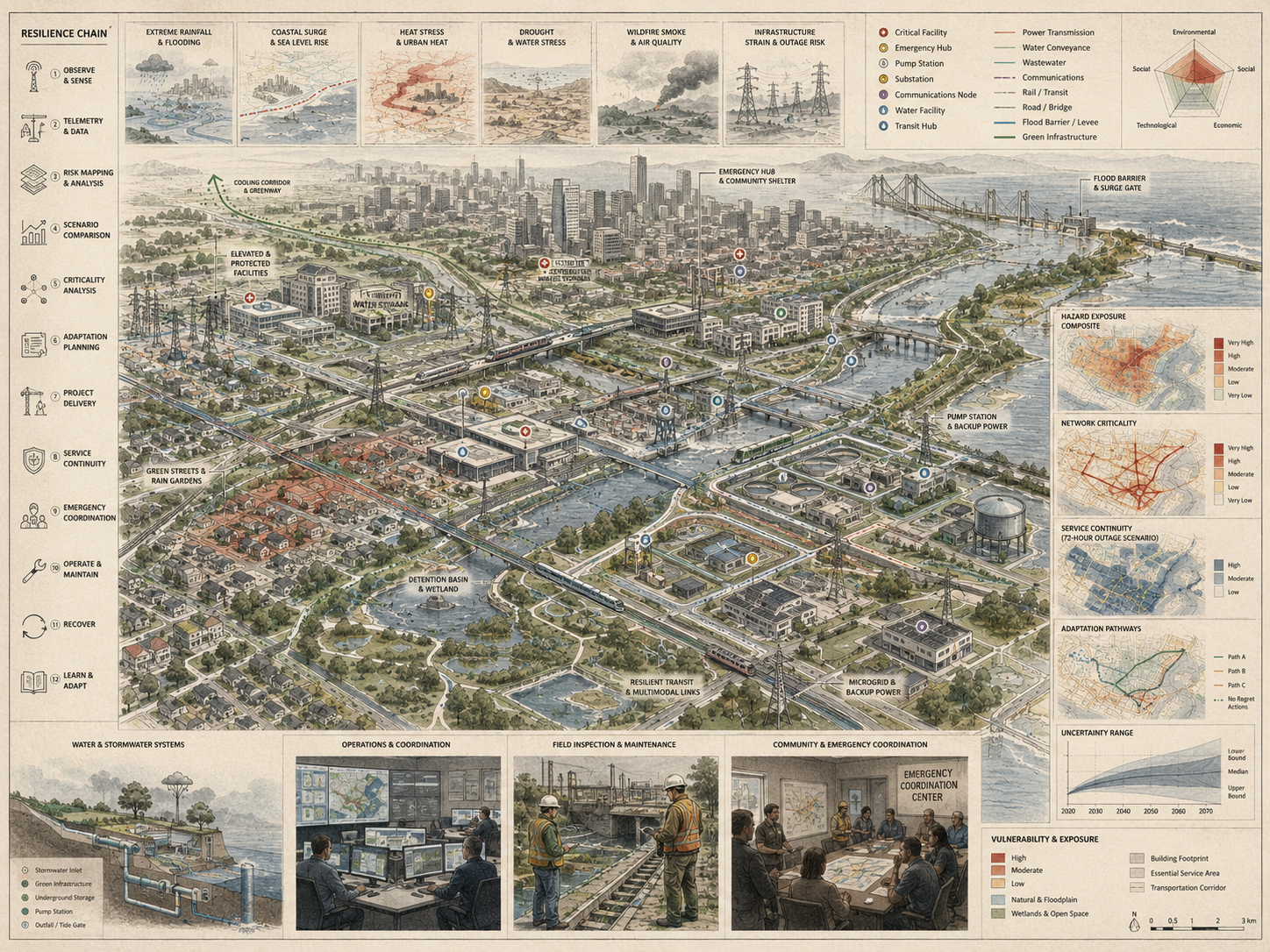
For that reason, urban resilience should not be reduced to emergency response or hardening individual assets in isolation. A city does not become resilient merely by adding stronger flood walls, backup generators, scattered green infrastructure projects, or isolated adaptation investments. It becomes more resilient when infrastructure systems are planned, connected, maintained, financed, monitored, and governed in ways that reduce exposure, manage interdependence, preserve critical services, support recovery, and adapt across different kinds of disruption.
Infrastructure systems for urban resilience therefore sit at the intersection of climate adaptation, disaster risk reduction, infrastructure planning, systems engineering, public finance, social vulnerability, environmental justice, and institutional capability. Where these layers remain disconnected, cities may appear prepared while remaining brittle. Where they are integrated thoughtfully, cities become better able to withstand shocks, adapt to uncertainty, recover service continuity, and protect public life under pressure.
Engineering Problem
The engineering problem is how to design and govern urban infrastructure systems so that essential services continue, degrade gracefully, recover quickly, and adapt over time under acute shocks and chronic stresses. This is not a narrow problem of strengthening assets one by one. It is a systems problem involving infrastructure interdependence, spatial exposure, social vulnerability, hazard dynamics, service continuity, operational redundancy, recovery sequencing, finance, maintenance, governance, and public accountability.
This problem is difficult because urban systems are tightly coupled. Drainage failure can disable roads, interrupt emergency access, contaminate water, damage housing, and disrupt electricity. Power outages can affect pumping, communications, cooling, hospitals, transit, payments, and information systems. Heat stress can strain electricity demand, increase mortality risk, reduce labor productivity, degrade rail and road performance, and expose housing inequality. A city may have strong individual assets yet remain fragile when dependencies, recovery pathways, or vulnerable populations are overlooked.
Strong urban resilience infrastructure therefore requires a full-chain operating model. It must identify critical services, map infrastructure dependencies, assess exposure and vulnerability, define continuity targets, evaluate redundancy and recovery options, preserve maintenance capacity, monitor operational signals, and connect findings to investment, planning, emergency management, and adaptation governance. The central engineering question is not simply whether assets can survive disruption, but whether the city can preserve life-supporting functions and recover them equitably when disruption occurs.
| Engineering Tension | Why It Matters | Required Evidence |
|---|---|---|
| Asset robustness versus system continuity | An individual asset can be hardened while the service system remains fragile because dependencies and alternate pathways are weak. | Critical-service inventory, dependency graph, continuity target |
| Efficiency versus redundancy | Highly optimized systems can perform well under normal conditions while lacking spare capacity under stress. | Redundancy review, restoration plan, spare-capacity assessment |
| Hazard protection versus adaptation | Protective defenses may reduce current risk while failing to adapt to changing climate, exposure, and urban growth. | Scenario analysis, adaptive pathway, climate-risk update cycle |
| Physical resilience versus institutional capacity | Infrastructure performance depends on finance, maintenance, coordination, procurement, staffing, and governance. | Governance charter, maintenance backlog, response protocol |
| Aggregate resilience versus unequal exposure | Citywide indicators can improve while vulnerable populations remain exposed to flood, heat, pollution, poor housing, or weak services. | Vulnerability map, service-equity review, exposure register |
| Emergency response versus long-term transformation | Rapid recovery can reproduce vulnerability if reconstruction restores the same fragile system. | After-action review, resilience investment log, adaptation roadmap |
The practical question is therefore: can urban infrastructure systems preserve critical service continuity, reduce unequal risk, and adapt to changing conditions without producing brittle or unjust forms of protection?
Reference Architecture
A practical reference architecture for urban resilience links hazard awareness to service continuity, institutional response, and adaptive investment. The exact design varies across flood-prone cities, heat-exposed cities, coastal cities, drought-stressed cities, fast-growing cities, and cities facing aging infrastructure, but the responsibilities remain consistent: understand risk, map dependencies, protect critical services, monitor conditions, coordinate response, support vulnerable populations, recover function, and revise systems after disruption.
| Layer | Engineering Role | Primary Risk | Evidence Artifact |
|---|---|---|---|
| Hazard and exposure layer | Maps floods, heat, storms, drought, wildfire smoke, seismic risk, service outages, and chronic stresses against urban geography. | Infrastructure planning assumes past or average conditions rather than changing risk. | Hazard register, exposure map, climate scenario file, vulnerability overlay |
| Critical-service layer | Defines essential urban services that must continue or recover quickly under stress. | Resilience is evaluated by assets rather than by service outcomes. | Critical-service inventory, continuity target, restoration priority list |
| Infrastructure dependency layer | Maps dependencies among power, water, drainage, transport, communications, housing, health, and emergency systems. | Cascading failures are missed until disruption occurs. | Dependency graph, interdependency matrix, cascading-risk scenario |
| Operational continuity layer | Defines redundancy, backup systems, emergency routing, restoration sequencing, maintenance plans, and service recovery procedures. | Infrastructure survives physically but services remain interrupted. | Continuity plan, redundancy review, recovery-time objective table |
| Monitoring and data layer | Uses sensors, service data, infrastructure condition records, environmental monitoring, public reporting, and scenario models. | Risk becomes visible too late or remains fragmented across agencies. | Urban observability register, sensor inventory, service status log, data platform manifest |
| Equity and vulnerability layer | Reviews who is exposed, who has weak service access, who lacks recovery capacity, and who receives investment. | Resilience improvements protect high-value areas while leaving vulnerable populations exposed. | Vulnerability register, service-equity review, community feedback record |
| Governance and adaptation layer | Connects planning, finance, maintenance, emergency management, community participation, and adaptive investment. | Resilience remains a plan without authority, funding, maintenance, or learning. | Governance log, adaptation pathway, capital plan, after-action review |
This architecture makes clear that urban resilience is not only a protective design problem. It is a service-continuity, recovery, adaptation, and governance problem across interdependent systems.
Implementation Pattern
A rigorous implementation pattern begins with the service functions that must be protected, not with isolated infrastructure assets. A city should identify which services are essential for life, mobility, health, shelter, water, sanitation, energy, communication, emergency access, economic continuity, and civic coordination. It should then map the assets, agencies, dependencies, communities, hazards, maintenance conditions, and recovery pathways that determine whether those services remain available under stress.
| Artifact | Purpose | Suggested Format |
|---|---|---|
| Urban resilience objective manifest | Defines hazards, critical services, decision uses, continuity targets, and valid-use limits. | YAML, Markdown, architecture decision record |
| Hazard and stress register | Documents acute shocks, chronic stresses, affected districts, and likely service impacts. | CSV, SQL table, GeoJSON |
| Critical-service inventory | Defines essential urban services, responsible institutions, continuity targets, and restoration priorities. | CSV, SQL table, service catalog |
| Infrastructure dependency graph | Maps dependencies among power, water, drainage, transport, communications, health, housing, and emergency services. | CSV edge list, graph database, network model |
| Vulnerability and service-equity review | Evaluates exposure, access, recovery capacity, social vulnerability, and uneven service risk. | CSV, GeoJSON, map layer, community review |
| Continuity and recovery plan | Connects hazards to continuity targets, redundancy, backup systems, restoration sequencing, and drills. | CSV, YAML, operations plan, recovery-time objective table |
| Nature-based systems register | Tracks green infrastructure, blue infrastructure, flood storage, canopy, permeable surfaces, and ecosystem services. | CSV, GeoJSON, asset register |
| Governance and adaptation log | Documents resilience investments, policy decisions, maintenance actions, after-action findings, and adaptive pathway updates. | CSV, SQL table, public evidence package |
The implementation goal is to make resilience claims reconstructable. A reader should be able to move from a resilience indicator, adaptation investment, service-continuity claim, or recovery target back to the hazard evidence, service inventory, dependency graph, vulnerability review, operations plan, governance record, and public evidence that support it.
Research-Grade Framing: Urban Resilience as Service-Continuity Infrastructure
A research-grade account of urban resilience begins by treating resilience as a property of service-continuity systems rather than as a vague synonym for toughness, recovery, or preparedness. Cities are resilient when essential services can absorb disturbance, maintain acceptable function, recover within tolerable timeframes, adapt to changing conditions, and protect the populations most exposed to disruption. This shifts the focus from asset survival to urban life-support functions.
This framing matters because urban systems can fail even when individual components remain intact. A road may be undamaged but unusable because drainage failed. A hospital may remain structurally sound but lose access to electricity, water, staff mobility, or digital connectivity. A flood wall may protect one district while increasing pressure elsewhere. A heat action plan may exist while housing, transit, and cooling infrastructure remain inadequate for vulnerable residents. Resilience therefore has to be assessed across interdependencies and lived service outcomes.
Urban resilience also requires humility. Risk changes over time. Climate baselines shift. Demographics change. Maintenance backlogs accumulate. Informal growth alters exposure. Infrastructure dependencies deepen as digital systems become embedded in every service. A resilience plan written once and left static is not resilience infrastructure. The deeper task is to build systems that monitor, learn, finance, adapt, and redistribute protection as conditions change.
| Limited Pattern | Stronger Pattern | Why the Shift Matters |
|---|---|---|
| Harden individual assets | Protect critical urban services and their dependencies | Service failure can occur through network dependency rather than asset damage alone. |
| Plan for single hazards | Model compound, cascading, and chronic risk | Urban disruption often emerges through interacting hazards and infrastructure systems. |
| Focus on emergency response | Integrate preparedness, maintenance, adaptation, finance, and recovery | Resilience is built before disruption, not only during response. |
| Use citywide averages | Assess exposure, vulnerability, service access, and recovery by population and place | Aggregate improvement can hide unequal risk. |
| Rebuild after disruption | Use recovery to reduce future vulnerability | Recovery can reproduce fragility unless learning and adaptation are institutionalized. |
The central research question is therefore: how can cities build infrastructure systems that preserve essential services, reduce unequal risk, and adapt over time under changing environmental and social conditions?
Formal Model: Hazards, Exposure, Interdependence, Continuity, and Recovery
A useful formal model separates hazard intensity, exposure, vulnerability, infrastructure dependency, service continuity, redundancy, recovery time, and governance capacity. Let \(H_{z,t}\) represent hazard intensity in zone \(z\) at time \(t\), \(E_z\) exposure, \(V_z\) vulnerability, \(D_{ij}\) dependency between infrastructure services \(i\) and \(j\), \(C_{s,t}\) continuity for service \(s\), \(R_s\) redundancy, \(T_{\mathrm{recover},s}\) recovery time, and \(G_s\) governance response capacity.
R_{z,t} = H_{z,t} \times E_z \times V_z \times (1 – G_z)
\]
Interpretation: Urban risk rises when hazard intensity, exposure, and vulnerability are high and governance response capacity is weak.
C_{s,t} = \frac{S_{s,t}}{S_{s,\mathrm{normal}}}
\]
Interpretation: Service continuity compares service available during disruption with normal service capacity. Values closer to one indicate stronger continuity.
I_s = \sum_{j=1}^{n} D_{sj} \times F_j
\]
Interpretation: Interdependency stress for service \(s\) depends on its dependencies \(D_{sj}\) and the failure state \(F_j\) of connected systems.
Q_{\mathrm{resilience},s} =
w_1C_s +
w_2R_s +
w_3M_s +
w_4A_s +
w_5G_s
\]
Interpretation: Service resilience can be treated as a composite of continuity \(C\), redundancy \(R\), maintainability \(M\), adaptability \(A\), and governance capacity \(G\).
L_{\mathrm{recovery},s} =
\max(0,\ T_{\mathrm{recover},s} – T_{\mathrm{target},s})
\]
Interpretation: Recovery lag measures how far actual or expected recovery time exceeds the target recovery time for a critical service.
This formal structure protects against a common mistake in resilience planning: treating resilience as a static asset property. In urban systems, resilience depends on continuity, interdependence, recovery, vulnerability, and governance under changing conditions.
What Are Infrastructure Systems for Urban Resilience?
Infrastructure systems for urban resilience are the interdependent systems that allow cities to continue functioning under disruption and adapt over time to changing environmental, social, and economic conditions. These systems include conventional physical infrastructures such as roads, bridges, transit, water, wastewater, drainage, power, and communications, but also ecological systems, digital layers, public facilities, maintenance systems, emergency protocols, finance mechanisms, and governance structures.
Urban resilience is therefore broader than protection against single hazards. It concerns whether a city can sustain critical functions when exposed to floods, heat waves, storms, infrastructure failure, public-health emergencies, cyber incidents, drought, wildfire smoke, economic shocks, or chronic deterioration. A resilient city is not a city that avoids all disruption. It is a city whose infrastructure systems can absorb disturbance, reorganize when necessary, and recover without severe or prolonged collapse of essential services.
This means resilience is not only a property of individual assets. A bridge may be structurally robust, but the transport system may still be fragile if rerouting capacity is weak. A pumping station may survive flooding, but the water system may still fail if power, communications, drainage dependencies, or staffing are overlooked. A hospital may remain open, but its ability to function may still depend on roads, cooling, water, sanitation, staff mobility, fuel delivery, and digital connectivity. Urban resilience emerges through the relationships among systems rather than through the strength of isolated components alone.
Why Urban Resilience Must Be Infrastructural
Urban resilience must be infrastructural because cities depend on the continuity of services embedded in networks. Water, mobility, power, drainage, waste removal, public health support, shelter, communications, food access, emergency response, and civic coordination all depend on infrastructure that is spatially distributed, operationally interdependent, and socially consequential. When those systems fail, disruption is rarely confined to one sector. It spreads across everyday life, public safety, economic activity, and institutional legitimacy.
This matters because contemporary urban risk is increasingly systemic. Climate impacts do not arrive as isolated engineering problems. Heat affects energy systems, buildings, labor conditions, public health, transit systems, and housing conditions simultaneously. Flooding affects transport, housing, drainage, water quality, waste systems, and emergency access at the same time. Storms can damage communications, mobility, power, and digital infrastructure in ways that compound each other. Housing insecurity, informal growth, weak service provision, and maintenance backlogs can magnify the consequences of what might otherwise appear to be manageable infrastructure shocks.
Urban resilience is therefore not an optional layer added after infrastructure planning. It is part of infrastructure planning itself. Cities that treat resilience as a downstream concern often discover that systems built for average conditions fail under extremes, and that recovery becomes slower, more unequal, and more expensive than expected. Resilience has to be designed into land use, capital planning, maintenance, operations, emergency management, ecological systems, public finance, and community governance from the beginning.
| Infrastructure Need | Resilience Function | Failure If Missing |
|---|---|---|
| Service continuity planning | Defines which services must remain available or recover quickly. | Resilience is evaluated by assets rather than by public function. |
| Dependency mapping | Identifies cascading risk across power, water, transport, communications, health, and housing. | Failures propagate through hidden interdependencies. |
| Spatial exposure analysis | Shows where hazards, infrastructure assets, and vulnerable populations overlap. | Investment misses the places where risk is most concentrated. |
| Maintenance and asset condition | Preserves resilience capacity before disruption occurs. | Deferred maintenance becomes disaster vulnerability. |
| Recovery and adaptation governance | Connects disruption, learning, investment, and long-term adaptation. | Recovery rebuilds fragility rather than reducing future risk. |
Urban resilience becomes credible when the full chain from hazard exposure to service continuity, recovery, equity, and adaptation is treated as infrastructure.
Core Architecture of Urban Resilience Systems
Infrastructure systems for urban resilience can be understood through a layered architecture that links physical networks to adaptation and recovery capacity. Each layer matters because resilience is not produced by a single asset, agency, or technology. It emerges from the interaction of physical systems, ecological systems, operations, information, governance, finance, and community capability.
Physical Infrastructure Layer
This layer includes transport, utilities, drainage, flood control, communications, buildings, public facilities, waste systems, and other critical urban assets. It remains the material foundation of resilience because the city’s capacity to function depends on the condition, capacity, location, and connectivity of these systems. Physical robustness matters, but so do redundancy, maintenance, upgrade cycles, accessibility, and recovery pathways.
Ecological and Spatial Layer
This layer includes wetlands, green corridors, urban forests, permeable surfaces, river corridors, floodplains, coastal buffers, open space, slopes, land-use structure, and neighborhood form. These systems influence how cities absorb water, regulate heat, buffer exposure, support biodiversity, and create space for adaptation. The ecological and spatial layer also determines whether urban development amplifies or reduces hazard exposure.
Operational and Service Layer
This layer includes emergency protocols, maintenance systems, public-health coordination, dispatch, redundancy planning, restoration strategies, mutual aid, continuity planning, procurement, and workforce readiness. It is where infrastructure resilience becomes visible in practice during stress. A physically strong system may still fail if operations, staffing, restoration sequencing, or emergency procedures are weak.
Digital and Informational Layer
This layer includes sensor systems, data platforms, communications networks, alert systems, urban observatories, asset-management systems, geospatial data, digital twins, decision-support tools, and public information systems. These systems help cities detect risk, interpret conditions, coordinate response, prioritize restoration, and communicate with the public.
Governance and Institutional Layer
This layer includes planning systems, public finance, regulation, land-use control, inter-agency coordination, public accountability, procurement, maintenance budgeting, community engagement, and the broader institutions through which cities decide what to protect, how to adapt, and whose risks to prioritize. Without this layer, resilience remains a technical aspiration rather than a durable public capability.
| Layer | Core Capability | Maturity Question |
|---|---|---|
| Physical infrastructure | Transport, water, drainage, power, buildings, communications, waste, public facilities | Can assets sustain or recover essential service under stress? |
| Ecological and spatial systems | Floodplains, wetlands, canopy, green corridors, land use, permeable surfaces | Does the city’s spatial form reduce or intensify exposure? |
| Operations and service continuity | Maintenance, redundancy, restoration sequencing, emergency protocols, continuity plans | Can services continue or recover within acceptable timeframes? |
| Data and digital systems | Sensors, service data, asset systems, alerts, dashboards, decision support | Can risk and service disruption be detected early enough to coordinate response? |
| Governance and finance | Planning, investment, regulation, coordination, community accountability, adaptation pathways | Can the city turn risk evidence into sustained public action? |
Together these layers show that urban resilience is neither purely physical nor purely institutional. It is a systems property emerging from the interaction between infrastructure, ecology, information, operations, finance, and governance.
Shocks, Stresses, and Compound Urban Risk
Urban resilience must address both acute shocks and chronic stresses. Shocks include floods, storms, wildfires, landslides, earthquakes, industrial accidents, blackouts, cyber incidents, public-health emergencies, and sudden service disruptions. Chronic stresses include rising temperatures, sea-level rise, water scarcity, infrastructure deterioration, affordability pressures, informal growth, pollution exposure, housing insecurity, institutional fragmentation, and long-term social vulnerability. Cities are rarely exposed to only one of these at a time.
This distinction matters because infrastructure often performs differently under chronic and acute pressures. A drainage system may appear adequate during normal rainfall but fail under intensified storm events. A building stock may function under ordinary summers but become dangerous under prolonged heat. A transport system may be efficient in routine operation while proving highly fragile during flood or wildfire conditions. An electricity system may meet everyday demand yet become unstable during sustained heat combined with high cooling loads and stressed transmission capacity.
Compound risk is especially important in cities because disruptions overlap. A flood during a heat wave, a blackout during extreme cold, a storm affecting an already congested and unequal housing system, or a cyber incident during an emergency response creates conditions that exceed the assumptions behind conventional infrastructure planning. Urban resilience systems must therefore be designed for interaction effects, not only for single hazards considered in isolation.
| Risk Pattern | Infrastructure Implication | Planning Requirement |
|---|---|---|
| Flooding | Can disrupt drainage, transport, housing, sanitation, water quality, electricity, and emergency access. | Watershed planning, drainage capacity, road closure protocols, evacuation and shelter coordination |
| Extreme heat | Strains electricity, housing, transit, labor, health systems, and cooling infrastructure. | Heat action plans, cooling centers, building upgrades, tree canopy, power resilience |
| Drought and water stress | Affects supply reliability, ecosystems, affordability, fire risk, and public health. | Water conservation, source diversification, demand management, reuse, drought contingency planning |
| Power outage | Disrupts pumping, cooling, communications, transit, health care, payments, and security systems. | Backup power, microgrids, restoration priorities, critical facility continuity plans |
| Chronic infrastructure deterioration | Reduces resilience before a shock occurs and increases recovery cost. | Asset management, maintenance funding, lifecycle renewal, condition monitoring |
| Housing insecurity | Converts hazard exposure into displacement, health risk, and slow recovery. | Resilient housing policy, shelter planning, tenant protection, neighborhood recovery support |
Urban resilience planning should therefore treat hazards, social conditions, and infrastructure systems as interacting rather than separate risk categories.
Critical Urban Infrastructure Domains
Urban resilience depends on multiple infrastructure domains whose failures can cascade across one another. The most important question is not whether each domain has an individual resilience plan, but whether the domains are coordinated around shared continuity targets, dependency awareness, and recovery priorities.
Water, Wastewater, and Drainage
Water systems are foundational because they shape public health, sanitation, flood management, and everyday urban viability. Resilience here includes source protection, treatment reliability, drainage capacity, flood pathways, backup power, safe wastewater management, stormwater storage, and the ability to maintain safe water services under climate and operational stress. In dense cities, stormwater and wastewater failures can quickly become mobility, sanitation, housing, and public-health crises.
Energy and Communications
Power and communications increasingly underpin every other infrastructure domain. Energy resilience involves not only asset hardening, but redundancy, restoration speed, load management, distributed energy resources, backup power, and continuity for critical facilities. Communications resilience matters because urban coordination, alerts, service management, payments, emergency dispatch, health services, and utility restoration increasingly depend on digital connectivity. A communications outage can now undermine transport, health coordination, emergency dispatch, and utility restoration simultaneously.
Transport and Access
Transport resilience concerns whether people, goods, emergency services, and workers can continue moving under disruption. Redundancy in routes, multimodal capacity, reliable transit, protected evacuation access, accessible streets, and recoverable corridor systems all matter. A city that cannot move under stress is a city that struggles to protect life and sustain recovery, especially where vulnerable populations depend heavily on public transit or where emergency access is geographically uneven.
Buildings, Shelter, and Public Facilities
Housing, schools, hospitals, cooling centers, community facilities, emergency shelters, libraries, and other public buildings are part of resilience infrastructure because they mediate exposure, shelter, care, and continuity of daily life. Their design, location, maintenance, accessibility, and backup systems shape whether urban populations can withstand heat, floods, storms, and prolonged service disruption. Housing quality is especially important because poorly insulated, overcrowded, or insecure dwellings can convert environmental stress into social crisis.
Waste, Public Space, and Civic Systems
Waste removal, public-space management, civic buildings, parks, neighborhood facilities, and local service systems also matter because urban resilience depends on sanitation, social cohesion, daily functionality, and visible institutional presence during recovery. These systems are often underestimated until they fail, at which point their absence can erode both health protection and public trust.
| Domain | Resilience Function | Dependency Concern |
|---|---|---|
| Water, wastewater, and drainage | Safe water, sanitation, flood management, public health | Power, telemetry, treatment capacity, roads, watershed condition |
| Energy | Power continuity, cooling, pumping, communications, critical facilities | Fuel, grid stability, heat demand, cyber systems, restoration access |
| Communications and digital systems | Alerts, coordination, dispatch, service management, public information | Power, network redundancy, cybersecurity, device access |
| Transport | Mobility, evacuation, emergency access, supply chains, workforce access | Flood exposure, power, traffic systems, transit operations, road condition |
| Buildings and public facilities | Shelter, health care, cooling, education, civic continuity | Power, water, access roads, staffing, building condition |
| Public space and ecological systems | Heat mitigation, flood absorption, social cohesion, recovery space | Maintenance, land-use protection, ecological health, equitable access |
The key point is that urban resilience does not rest on a single heroic system. It depends on the continuity and coordination of multiple infrastructures whose value becomes clearest under stress.
Nature-Based Systems and Ecological Resilience
Urban resilience is not built only through engineered hard infrastructure. Nature-based systems such as wetlands, bioswales, permeable landscapes, river restoration, urban forests, green roofs, parks, coastal buffers, and open-space networks can reduce heat, absorb water, support biodiversity, improve air quality, and create more adaptive urban environments.
This matters because cities often inherit spatial forms that intensify exposure: sealed surfaces, channelized waterways, deforested slopes, heat-retaining districts, filled wetlands, fragmented habitats, and development in flood-prone zones. Nature-based systems can improve resilience not by replacing engineered systems entirely, but by complementing them and reducing the pressure placed on them during extremes. A well-designed green corridor can be part of flood management, heat mitigation, biodiversity support, public-space provision, and community health at the same time.
Ecological resilience also has a governance dimension. Nature-based systems require land-use protection, maintenance, monitoring, institutional coordination, community stewardship, and long time horizons. They work best when urban planning treats ecosystems as infrastructure rather than as residual amenities. A bioswale that is not maintained, a tree canopy strategy that ignores neighborhood heat burden, or a wetland buffer threatened by development cannot provide reliable resilience function.
| Nature-Based System | Resilience Function | Governance Requirement |
|---|---|---|
| Wetlands and floodplains | Store floodwater, slow runoff, support habitat, buffer downstream systems | Land protection, hydrological monitoring, development controls |
| Urban tree canopy | Reduces heat, improves air quality, supports public health and comfort | Equitable planting, maintenance, drought resilience, species selection |
| Green roofs and permeable surfaces | Reduces runoff, moderates building heat, supports stormwater management | Building standards, inspection, maintenance, incentive programs |
| River restoration and blue-green corridors | Improves flood conveyance, ecosystem function, public space, and adaptation capacity | Cross-agency planning, watershed coordination, long-term monitoring |
| Parks and public open space | Provides cooling, recovery space, social cohesion, and emergency assembly areas | Equitable access, maintenance, safety, integration with emergency planning |
Nature-based infrastructure becomes resilient only when ecological function, social access, engineering design, and governance capacity are treated together.
Governance, Coordination, and Institutional Capacity
Governance is central to urban resilience because infrastructure systems cross sectors, jurisdictions, agencies, budgets, ownership structures, and time horizons. Water agencies, transport authorities, utilities, planners, emergency services, housing departments, public-health institutions, environmental agencies, community organizations, and private operators all influence resilience outcomes. A city may possess technically strong assets yet remain institutionally fragile if coordination is weak or responsibilities are fragmented.
This matters because resilient infrastructure depends on planning, maintenance, investment, and response long before a disaster occurs. Resilience is often weakened not only by lack of assets, but by mismatched mandates, underfunded maintenance, poor land-use enforcement, delayed upgrades, weak procurement, limited staffing, insufficient public finance, or the absence of cross-sector planning. A city may know where its vulnerabilities are yet remain unable to act on them if finance, governance, and coordination are weak.
Institutional capacity also includes finance, procurement, maintenance discipline, risk assessment, participatory planning, regulatory authority, scenario planning, public reporting, and the ability to learn from disruption. A city that rebuilds quickly but reproduces vulnerability has not built resilience in a meaningful sense. Urban resilience requires institutions capable not only of recovery, but of adaptation and transformation where necessary.
| Capability | Purpose | Evidence Artifact |
|---|---|---|
| Cross-sector coordination | Links water, energy, transport, housing, health, communications, emergency management, and land use. | Coordination charter, interagency protocol, dependency map |
| Capital planning and resilience finance | Connects risk evidence to investment, maintenance, adaptation, and renewal. | Capital plan, resilience investment register, lifecycle cost analysis |
| Land-use and exposure governance | Prevents development patterns that intensify flood, heat, wildfire, landslide, or service risk. | Zoning policy, risk overlay, development-control record |
| Maintenance and asset management | Preserves infrastructure condition and reduces hidden fragility. | Maintenance backlog, condition register, renewal schedule |
| Community participation and accountability | Ensures resilience priorities reflect lived exposure, local knowledge, and unequal risk. | Community feedback record, equity review, public evidence package |
| After-action learning | Turns disruption into system improvement rather than repetition of failure. | After-action review, corrective action log, adaptation pathway update |
The governance question is whether a city can turn risk knowledge into coordinated, financed, maintained, and publicly accountable infrastructure action over time.
Equity, Vulnerability, and the Social Distribution of Risk
Urban resilience is inseparable from equity because infrastructure risk is distributed unevenly. Lower-income communities, informal settlements, poorly serviced neighborhoods, renters, older adults, disabled people, migrants, outdoor workers, socially marginalized groups, and residents with limited transport access are often more exposed to floods, heat, pollution, service interruptions, weak housing, and slow recovery capacity.
This matters because a city can improve average resilience while leaving vulnerable populations exposed. A flood barrier protecting a central business district does not automatically protect informal settlements. Backup power for major institutions does not ensure continuity for households. Cooling infrastructure may help some districts while others remain exposed to dangerous heat. Drainage investments can improve high-value corridors while low-income neighborhoods continue to flood. Resilience planning that ignores distributional questions can deepen inequality even while claiming success.
Urban resilience infrastructure therefore has to be judged not only by aggregate protection, but by who is protected, who receives reliable service, who has feasible evacuation or shelter options, who recovers quickly, and who remains at risk. Social vulnerability is not external to infrastructure systems. It is part of how those systems perform.
| Equity Question | Infrastructure Requirement | Failure Mode |
|---|---|---|
| Who is exposed? | Map hazards against population, housing, infrastructure services, health, and social vulnerability. | Risk appears geographically neutral while exposure is concentrated. |
| Who has service redundancy? | Assess backup access to power, water, cooling, transit, communications, and shelter. | Critical services remain reliable for some groups but not others. |
| Who can evacuate or shelter? | Plan transport, accessibility, care, communication, and shelter systems for vulnerable residents. | Warnings are issued but action is not feasible. |
| Who recovers quickly? | Track restoration time, insurance access, housing stability, public assistance, and service return. | Recovery reproduces or deepens pre-existing inequality. |
| Who participates in planning? | Include communities in defining risks, priorities, metrics, and accountability. | Resilience investments reflect institutional assumptions more than lived exposure. |
A resilience system that cannot see unequal burden cannot fully protect urban life. Equity is not a separate moral supplement to infrastructure planning; it is a core dimension of service continuity and recovery capacity.
Measurement, Indicators, and Resilience Assessment
Measurement matters because cities need ways to assess whether resilience strategies are improving preparedness, continuity, adaptation, and recovery capability. Indicators may include service continuity, restoration times, redundancy, exposure reduction, adaptive capacity, asset condition, maintenance backlog, risk mapping, institutional coordination, public facility readiness, nature-based system performance, and the coverage of critical populations or places.
But resilience cannot be reduced to a single number. Assessment is most useful when it connects infrastructure performance with social vulnerability, planning quality, maintenance condition, institutional capacity, and lived service outcomes rather than treating resilience as a purely technical engineering score. A city may report improved system redundancy while vulnerable neighborhoods still lack cooling, drainage, evacuation access, or reliable communications. A resilience dashboard may show progress while deferred maintenance continues to accumulate hidden risk.
Indicators are most useful when they help cities learn, prioritize, and govern under uncertainty. They are less useful when they become symbolic checklists detached from real infrastructure conditions, unequal exposure, or recovery experience. Good resilience assessment should therefore combine technical performance, spatial exposure, service continuity, governance capacity, and public accountability.
| Indicator Type | Example Measure | Interpretive Caution |
|---|---|---|
| Service continuity | Share of water, power, transport, communications, health, or shelter service maintained during disruption | Citywide continuity can hide localized service collapse. |
| Recovery time | Time required to restore critical services after disruption | Restoration order may privilege high-value districts unless equity is tracked. |
| Redundancy | Availability of alternate routes, backup power, distributed systems, emergency supplies, or substitute facilities | Redundancy may exist on paper but fail operationally if untested. |
| Exposure reduction | Population, assets, or services moved out of high-risk zones or protected through adaptation | Protection in one area can shift risk elsewhere. |
| Asset and maintenance condition | Condition ratings, renewal backlog, critical maintenance gaps, inspection status | Deferred maintenance can undermine resilience despite new projects. |
| Equity and vulnerability | Resilience benefits, service access, and recovery times by population and neighborhood | Aggregate indicators can conceal unequal risk distribution. |
| Governance capacity | Interagency plans, finance, public reporting, drills, after-action reviews, adaptation updates | Plans without funding, authority, or maintenance do not produce resilience. |
Good resilience measurement evaluates the health of the entire service-continuity and adaptation chain, not only the presence of plans or assets.
Deployment Readiness Gate
Before urban resilience infrastructure analytics are used for public reporting, capital planning, emergency management, adaptation strategy, infrastructure investment, service-continuity claims, or equity review, they should pass a readiness gate. The purpose is not to slow action. It is to confirm that resilience claims are supported by evidence about hazards, services, dependencies, vulnerability, operations, recovery, governance, and public accountability.
| Readiness Check | Pass Condition | Evidence |
|---|---|---|
| Hazard and stress scope | Acute shocks, chronic stresses, affected zones, and scenario assumptions are documented. | Hazard and stress register, scenario file, exposure map |
| Critical-service definition | Essential services, continuity targets, responsible agencies, and restoration priorities are defined. | Critical-service inventory, continuity target table |
| Dependency mapping | Power, water, drainage, transport, communications, housing, health, and emergency dependencies are mapped. | Dependency graph, interdependency matrix |
| Vulnerability and equity review | Exposure, social vulnerability, service access, and recovery capacity are assessed by population and place. | Vulnerability register, equity review, community feedback record |
| Operational continuity | Redundancy, backup systems, recovery-time objectives, restoration sequencing, and drills are documented. | Continuity plan, redundancy register, exercise log |
| Nature-based and spatial adaptation | Green infrastructure, land-use controls, flood storage, canopy, and ecological buffers are documented and maintained. | Nature-based systems register, maintenance plan, spatial adaptation map |
| Governance and finance | Authorities, funding, maintenance responsibilities, update cycles, and public reporting are defined. | Governance log, capital plan, maintenance backlog, public evidence package |
| Learning and adaptation | After-action reviews, corrective actions, and adaptive pathways are updated after disruptions and new evidence. | After-action review, adaptation pathway, improvement log |
A resilience system that cannot pass this readiness gate may still contain useful projects, but its outputs should be treated cautiously when used for public claims about citywide resilience.
Data and Configuration Artifacts
The companion repository can use a data-first structure so urban resilience claims can be examined rather than merely asserted. Each artifact has a specific role in making the resilience chain reconstructable across hazards, services, dependencies, vulnerability, continuity, recovery, governance, and public evidence.
| Artifact | File | Purpose |
|---|---|---|
| Urban resilience objective manifest | config/urban_resilience_objective.yml |
Defines hazards, services, continuity targets, valid-use caveats, and public evidence needs. |
| Hazard and stress register | data/hazard_stress_register.csv |
Documents shocks, chronic stresses, affected districts, and likely infrastructure impacts. |
| Critical-service inventory | data/critical_service_inventory.csv |
Tracks essential services, owners, continuity targets, normal capacity, and recovery-time targets. |
| Infrastructure dependency graph | data/infrastructure_dependency_edges.csv |
Stores dependencies among power, water, drainage, transport, communications, housing, health, and emergency systems. |
| Vulnerability and service-equity review | data/vulnerability_service_equity_review.csv |
Assesses exposure, service access, vulnerability, recovery capacity, and equity concerns. |
| Continuity and recovery plan | data/continuity_recovery_plan.csv |
Connects services to redundancy, recovery sequencing, drills, and recovery-time targets. |
| Nature-based systems register | data/nature_based_resilience_register.csv |
Tracks green, blue, ecological, and spatial systems that support flood, heat, and recovery resilience. |
| SQL schema | sql/schema.sql |
Creates a local SQLite database for urban resilience records and evidence. |
These artifacts are designed to make resilience evidence auditable. They can be replaced with institutional data sources later, but the scaffold makes the logic of service continuity, cascading risk, and adaptation explicit from the beginning.
Mathematical Lens: Service Continuity, Cascading Risk, and Recovery
A lightweight mathematical lens helps distinguish urban resilience from asset survival. The point is not to reduce city resilience to a single score, but to make visible the relationships among hazards, exposure, vulnerability, service continuity, interdependence, recovery time, redundancy, and governance capacity.
C_{s,t} = \frac{S_{s,t}}{S_{s,\mathrm{normal}}}
\]
Interpretation: Service continuity compares service available during disruption with normal service capacity. This places public function, rather than asset survival alone, at the center of resilience analysis.
I_s = \sum_{j=1}^{n} D_{sj} \times F_j
\]
Interpretation: Interdependency stress for a service depends on how strongly it depends on other systems and whether those systems are disrupted.
R_{z,t} = H_{z,t} \times E_z \times V_z \times (1 – G_z)
\]
Interpretation: Urban risk remains high when hazard intensity, exposure, and vulnerability are high and governance response capacity is weak.
L_{\mathrm{recovery},s} =
\max(0,\ T_{\mathrm{recover},s} – T_{\mathrm{target},s})
\]
Interpretation: Recovery lag identifies where service restoration exceeds the target recovery time for a critical service.
This mathematical framing should be used as a structured diagnostic, not as a substitute for engineering judgment, community knowledge, emergency management, ecological assessment, or public governance.
Python Workflow: Urban Resilience and Service-Continuity Review
The Python workflow in the companion repository can read hazard records, service inventories, dependency edges, continuity plans, and vulnerability reviews; compute service-continuity scores, cascading dependency stress, recovery lag, and resilience watchlists; and export governance-ready review tables. The sample below illustrates the core logic.
from pathlib import Path
import pandas as pd

ARTICLE_DIR = Path("articles/infrastructure-systems-for-urban-resilience-risk-adaptation-and-service-continuity")
DATA_DIR = ARTICLE_DIR / "data"
OUTPUT_DIR = ARTICLE_DIR / "outputs"
OUTPUT_DIR.mkdir(parents=True, exist_ok=True)

hazards = pd.read_csv(DATA_DIR / "hazard_stress_register.csv")
services = pd.read_csv(DATA_DIR / "critical_service_inventory.csv")
dependencies = pd.read_csv(DATA_DIR / "infrastructure_dependency_edges.csv")
equity = pd.read_csv(DATA_DIR / "vulnerability_service_equity_review.csv")
continuity = pd.read_csv(DATA_DIR / "continuity_recovery_plan.csv")

review = (
    services
    .merge(continuity, on="service_id", how="left")
    .merge(equity, on="service_zone_id", how="left")
)

review["service_continuity_score"] = (
    review["disruption_capacity"] / review["normal_capacity"]
).clip(upper=1.0)

review["recovery_lag_hours"] = (
    review["expected_recovery_hours"] - review["target_recovery_hours"]
).clip(lower=0)

review["urban_risk_score"] = (
    review["hazard_intensity"] *
    review["exposure_score"] *
    review["vulnerability_score"] *
    (1 - review["governance_response_score"])
)

dependency_stress = (
    dependencies
    .merge(
        services[["service_id", "service_failure_probability"]],
        left_on="dependent_service_id",
        right_on="service_id",
        how="left"
    )
    .assign(
        dependency_stress=lambda df: df["dependency_weight"] * df["service_failure_probability"]
    )
    .groupby("source_service_id", as_index=False)["dependency_stress"]
    .sum()
    .rename(columns={"source_service_id": "service_id"})
)

review = review.merge(dependency_stress, on="service_id", how="left")
review["dependency_stress"] = review["dependency_stress"].fillna(0)

review["resilience_review_flag"] = (
    (review["service_continuity_score"] < 0.75) |
    (review["recovery_lag_hours"] > 0) |
    (review["urban_risk_score"] >= 0.25) |
    (review["dependency_stress"] >= 0.30) |
    (review["equity_gap_score"] >= 0.35)
)

review.to_csv(OUTPUT_DIR / "urban_resilience_service_continuity_review.csv", index=False)

watchlist = (
    review[review["resilience_review_flag"]]
    .sort_values(["urban_risk_score", "dependency_stress", "recovery_lag_hours"], ascending=[False, False, False])
)

watchlist.to_csv(OUTPUT_DIR / "urban_resilience_governance_watchlist.csv", index=False)

print(watchlist[[
    "service_id",
    "service_name",
    "service_zone_id",
    "service_continuity_score",
    "recovery_lag_hours",
    "dependency_stress",
    "urban_risk_score",
    "equity_gap_score"
]])
This workflow is intentionally transparent. It allows analysts to see whether resilience concern arises from weak continuity, long recovery, cascading dependency, exposure, vulnerability, or governance gaps.
R Workflow: Critical Services, Vulnerability, and Recovery Reporting
The R workflow can summarize urban resilience by service domain, identify continuity and recovery gaps, and create stewardship-oriented reports for infrastructure planners, emergency managers, public agencies, and community review processes.
library(readr)
library(dplyr)

article_dir <- "articles/infrastructure-systems-for-urban-resilience-risk-adaptation-and-service-continuity"
data_dir <- file.path(article_dir, "data")
output_dir <- file.path(article_dir, "outputs")
dir.create(output_dir, recursive = TRUE, showWarnings = FALSE)

services <- read_csv(file.path(data_dir, "critical_service_inventory.csv"), show_col_types = FALSE)
continuity <- read_csv(file.path(data_dir, "continuity_recovery_plan.csv"), show_col_types = FALSE)
equity <- read_csv(file.path(data_dir, "vulnerability_service_equity_review.csv"), show_col_types = FALSE)

review <- services %>%
  left_join(continuity, by = "service_id") %>%
  left_join(equity, by = "service_zone_id") %>%
  mutate(
    service_continuity_score = pmin(disruption_capacity / normal_capacity, 1),
    recovery_lag_hours = pmax(expected_recovery_hours - target_recovery_hours, 0),
    urban_risk_score =
      hazard_intensity *
      exposure_score *
      vulnerability_score *
      (1 - governance_response_score),
    resilience_review_flag =
      service_continuity_score < 0.75 |
      recovery_lag_hours > 0 |
      urban_risk_score >= 0.25 |
      equity_gap_score >= 0.35
  )

domain_summary <- review %>%
  group_by(service_domain) %>%
  summarise(
    services = n_distinct(service_id),
    mean_service_continuity = mean(service_continuity_score, na.rm = TRUE),
    mean_recovery_lag_hours = mean(recovery_lag_hours, na.rm = TRUE),
    mean_urban_risk = mean(urban_risk_score, na.rm = TRUE),
    mean_equity_gap = mean(equity_gap_score, na.rm = TRUE),
    review_flags = sum(resilience_review_flag, na.rm = TRUE),
    .groups = "drop"
  ) %>%
  arrange(desc(mean_urban_risk))

write_csv(review, file.path(output_dir, "urban_resilience_review_report.csv"))
write_csv(domain_summary, file.path(output_dir, "urban_resilience_domain_summary.csv"))

print(domain_summary)
The purpose is not to produce a definitive city-resilience rating. It is to demonstrate how critical-service records, continuity targets, vulnerability reviews, and recovery indicators can be made reproducible and auditable.
Systems Code: Urban Infrastructure, Monitoring, and Resilience Engineering
The companion repository can extend the article into a reproducible systems scaffold. Python and R support analytical review; SQL stores evidence; YAML files define objectives and policies; GeoJSON provides spatial placeholders; TypeScript can support dashboard interfaces; Go can support service-status APIs; Rust can support strict record validation; C can support resilience-index calculations; Fortran can support numerical scenario routines; MicroPython can support field telemetry from urban infrastructure nodes; PYNQ and HDL can support hardware-assisted stream validation where appropriate.
| Directory | Role | Example Use |
|---|---|---|
python/ |
Service-continuity scoring, cascading-risk review, governance watchlists | Compute continuity, dependency stress, recovery lag, and risk scores |
r/ |
Domain summaries, vulnerability reporting, resilience indicator review | Summarize continuity and recovery by service domain |
sql/ |
Evidence tables and auditable queries | Join hazards, services, dependencies, continuity plans, and equity reviews |
c/ and embedded_c/ |
Low-level service-continuity and sensor-status checks | Validate threshold status, backup power, or continuity values at the edge |
rust/ |
Strict validation and CLI scaffolding | Validate service records, continuity scores, and dependency weights |
go/ |
Service-status API scaffold | Expose critical-service continuity metadata over a lightweight endpoint |
fortran/ |
Numerical resilience and recovery calculations | Prototype recovery lag, continuity, and scenario calculations |
micropython/ |
Edge telemetry scaffold | Prototype low-power urban service-status or environmental monitoring nodes |
pynq/ and hdl/ |
Hardware-assisted stream validation | Prototype FPGA checks for service thresholds, missingness, and alert flags |
typescript/ |
Dashboard/interface scaffold | Display service continuity, dependency stress, recovery lag, and equity gaps |
The code should be understood as an engineering scaffold for reproducible urban resilience workflows, not as a replacement for official emergency management, infrastructure operations, public finance analysis, or community-led resilience planning.
GitHub Repository
The companion repository can house the reproducible data, code, schemas, validation tools, and systems-engineering examples that support this article’s urban resilience framework.
Testing and Validation
Testing urban resilience infrastructure requires more than checking whether plans exist or whether assets meet design standards. Validation should examine whether critical services can continue under realistic disruption, whether dependencies are understood, whether vulnerable populations are protected, whether recovery targets are feasible, whether redundancy works under stress, and whether governance systems can finance, maintain, coordinate, and adapt infrastructure over time.
| Validation Area | Test Question | Failure Signal |
|---|---|---|
| Hazard and stress coverage | Are acute shocks and chronic stresses represented across relevant spatial and service domains? | Plans focus on a narrow hazard while compound risks remain untested. |
| Critical-service definition | Are essential services, continuity targets, and restoration priorities defined? | Infrastructure resilience is measured without reference to public service outcomes. |
| Dependency modeling | Are cross-sector dependencies among power, water, drainage, communications, transport, health, and housing mapped? | Cascading failures appear only during actual disruption. |
| Continuity and redundancy | Are backup systems, alternative routes, spare capacity, and operational procedures tested? | Redundancy exists in documents but fails operationally. |
| Recovery-time feasibility | Can services recover within target timeframes under realistic scenarios? | Recovery targets are aspirational rather than operational. |
| Equity and vulnerability | Are exposure, service access, recovery capacity, and public investment reviewed by population and place? | Aggregate resilience improves while vulnerable groups remain exposed. |
| Governance and finance | Are authorities, budgets, maintenance, coordination, and public reporting in place? | Resilience strategy lacks implementation capacity. |
Validation should be repeated after major disruptions, infrastructure upgrades, land-use changes, scenario updates, climate-risk revisions, maintenance audits, and after-action reviews.
Operational Signals and Urban Resilience Observability
Urban resilience observability means being able to see whether the city’s infrastructure systems are functioning as trustworthy service-continuity systems before, during, and after disruption. This includes asset condition, service status, sensor data, restoration progress, backup system availability, emergency access, social vulnerability, recovery assistance, public facility readiness, and governance follow-through.
| Signal | What It Reveals | Operational Use |
|---|---|---|
| Critical-service status | Whether water, power, transport, communications, health, shelter, and emergency services are functioning | Operations coordination, public reporting, restoration prioritization |
| Asset condition and maintenance backlog | Whether hidden deterioration is reducing resilience before disruption | Capital planning, renewal scheduling, risk prioritization |
| Dependency stress | Whether failures in one system are likely to propagate into others | Cascading-risk management and restoration sequencing |
| Recovery lag | Whether actual or expected recovery exceeds service targets | Continuity planning and emergency management review |
| Public facility readiness | Whether shelters, cooling centers, hospitals, schools, and civic facilities can function under stress | Preparedness checks and public-health coordination |
| Vulnerability and service-equity signals | Whether high-risk populations face weak service continuity or slow recovery | Targeted intervention, equitable investment, community accountability |
| After-action closure | Whether corrective actions are completed after disruption | Institutional learning and resilience governance |
Urban resilience observability is strongest when the system can monitor not only hazards and assets, but also the continuity of public services and the distribution of recovery across populations and places.
Engineer and Researcher Checklist
- Define the critical urban services, continuity targets, recovery-time objectives, and restoration priorities the resilience system must support.
- Map acute shocks, chronic stresses, climate scenarios, and affected service zones.
- Document dependencies among water, wastewater, drainage, power, communications, transport, housing, health, emergency response, and public facilities.
- Evaluate asset condition, maintenance backlog, spare capacity, redundancy, and operational recovery procedures.
- Review service continuity and recovery by neighborhood, population, vulnerability, and infrastructure access.
- Include nature-based systems, ecological buffers, land-use controls, and spatial adaptation as infrastructure components.
- Test backup systems, emergency routing, public facilities, communications, and restoration sequencing under realistic compound scenarios.
- Connect resilience evidence to capital planning, maintenance budgets, public finance, regulation, and land-use decisions.
- Publish public evidence that explains hazards, services, assumptions, caveats, responsible institutions, and review cycles.
- Use after-action reviews to revise infrastructure design, governance arrangements, recovery targets, and adaptation pathways.
This checklist is intentionally practical. It keeps urban resilience focused on service continuity, public life, and adaptation rather than symbolic resilience language alone.
Where This Fits in the Series
Infrastructure systems for urban resilience connect several major threads within the Intelligent Infrastructure Systems knowledge series. They rely on urban sensor networks to observe service and environmental conditions, intelligent water systems to manage floods and public-health risk, transportation networks to preserve access, digital infrastructure to coordinate response, environmental monitoring to detect exposure and stress, infrastructure data platforms to integrate evidence, and governance systems to turn risk analysis into public action.
This article therefore functions as a bridge between infrastructure planning and resilience governance. It shows that intelligent infrastructure is not only about automation, sensing, optimization, or digital control. It is also about whether cities can preserve essential services, reduce unequal risk, and adapt as shocks and stresses become more complex.
Future Directions
The future of urban resilience infrastructure will likely involve stronger integration of climate risk into infrastructure planning, wider use of nature-based systems, deeper attention to heat and water stress, better digital observability, stronger resilience finance, more robust maintenance systems, and greater use of scenario-based urban adaptation. It will also require better integration of housing, public health, social vulnerability, land use, and infrastructure investment into a single resilience framework.
The deeper challenge, however, is not simply making cities better defended. It is making them more adaptive, more equitable, and more governable under uncertainty. Infrastructure systems for urban resilience will matter most where they improve continuity of life, reduce unequal exposure, and enable cities to learn from disruption rather than merely survive it. The long-run goal is not resilience as branding. It is an urban infrastructure system capable of enduring stress, recovering function, and adapting intelligently as risks change.
Future resilience work should therefore move beyond isolated projects and toward institutionalized service-continuity systems: monitored, financed, governed, updated, and accountable to the people most affected by urban risk.
Related Articles
- Smart City Infrastructure Systems
- Urban Sensor Networks and Infrastructure Monitoring
- Intelligent Water Infrastructure Systems
- Intelligent Transportation Networks
- Infrastructure Data Platforms and Analytics
- Infrastructure for Environmental Monitoring Systems
- Climate Monitoring Infrastructure
- Flood and Disaster Early Warning Infrastructure
- Infrastructure Security and Cyber Resilience
- Infrastructure Governance and Policy Systems
These connections are substantive rather than decorative. Urban resilience is not an isolated policy theme, but a systems domain connecting infrastructure continuity, adaptation, environmental monitoring, service equity, risk, and public governance.
Further Reading
- United Nations Human Settlements Programme (UN-Habitat) (2024) World Cities Report 2024: Cities and Climate Action. Available at: https://unhabitat.org/world-cities-report-2024-cities-and-climate-action.
- United Nations Human Settlements Programme (UN-Habitat) (2024) World Cities Report 2024: Cities and Climate Action, full report. Available at: https://unhabitat.org/sites/default/files/2024/11/wcr2024_-_full_report.pdf.
- Organisation for Economic Co-operation and Development (OECD) (2024) Building Systemic Climate Resilience in Cities. Available at: https://www.oecd.org/content/dam/oecd/en/publications/reports/2023/10/building-systemic-climate-resilience-in-cities_a040ad72/f2f020b9-en.pdf.
- Organisation for Economic Co-operation and Development (OECD) (2024) Infrastructure for a Climate-Resilient Future. Available at: https://www.oecd.org/en/publications/infrastructure-for-a-climate-resilient-future_a74a45b0-en.html.
- United Nations Office for Disaster Risk Reduction (UNDRR) (2023) Principles for Resilient Infrastructure. Available at: https://www.undrr.org/publication/principles-resilient-infrastructure.
- United Nations Office for Disaster Risk Reduction (UNDRR) (2023) Handbook for Implementing the Principles for Resilient Infrastructure. Available at: https://www.undrr.org/publication/handbook-implementing-principles-resilient-infrastructure.
- United Nations Office for Disaster Risk Reduction (UNDRR) (n.d.) Making Cities Resilient 2030. Available at: https://mcr2030.undrr.org/.
- World Bank (n.d.) Urban Development. Available at: https://www.worldbank.org/ext/en/topic/urban-development.
- World Bank (2025) Handbook for Livable and Resilient Cities. Available at: https://openknowledge.worldbank.org/entities/publication/d7ee1212-42ed-4d8a-9ffa-225152ee65df.
References
- Organisation for Economic Co-operation and Development (OECD) (2024) Infrastructure for a Climate-Resilient Future. Paris: OECD. Available at: https://www.oecd.org/en/publications/infrastructure-for-a-climate-resilient-future_a74a45b0-en.html.
- Organisation for Economic Co-operation and Development (OECD) (2024) Building Systemic Climate Resilience in Cities. Paris: OECD. Available at: https://www.oecd.org/content/dam/oecd/en/publications/reports/2023/10/building-systemic-climate-resilience-in-cities_a040ad72/f2f020b9-en.pdf.
- United Nations Human Settlements Programme (UN-Habitat) (2024) World Cities Report 2024: Cities and Climate Action. Nairobi: UN-Habitat. Available at: https://unhabitat.org/world-cities-report-2024-cities-and-climate-action.
- United Nations Human Settlements Programme (UN-Habitat) (2024) World Cities Report 2024: Cities and Climate Action. PDF available at: https://unhabitat.org/sites/default/files/2024/11/wcr2024_-_full_report.pdf.
- United Nations Office for Disaster Risk Reduction (UNDRR) (2023) Principles for Resilient Infrastructure. Available at: https://www.undrr.org/publication/principles-resilient-infrastructure.
- United Nations Office for Disaster Risk Reduction (UNDRR) (2023) Handbook for Implementing the Principles for Resilient Infrastructure. Available at: https://www.undrr.org/publication/handbook-implementing-principles-resilient-infrastructure.
- United Nations Office for Disaster Risk Reduction (UNDRR) (n.d.) Making Cities Resilient 2030. Available at: https://mcr2030.undrr.org/.
- World Bank (n.d.) Urban Development. Available at: https://www.worldbank.org/ext/en/topic/urban-development.
- World Bank (2016) Cities Building Resilience for a Changing World. Washington, DC: World Bank. Available at: https://www.worldbank.org/en/topic/urbandevelopment/publication/Cities-Building-Resilience-for-a-Changing-World.
- World Bank (2025) Handbook for Livable and Resilient Cities. Washington, DC: World Bank. Available at: https://openknowledge.worldbank.org/entities/publication/d7ee1212-42ed-4d8a-9ffa-225152ee65df.