
Last Updated May 14, 2026
Infrastructure for renewable energy systems consists of the physical, digital, operational, and institutional systems required to connect, balance, store, transmit, coordinate, and govern renewable energy at scale. It includes renewable generation assets such as solar, wind, hydro, geothermal, and bioenergy facilities, but extends well beyond generation to include transmission and distribution networks, substations, interconnectors, grid-forming and grid-following inverters, storage systems, forecasting environments, flexibility resources, digital control systems, market arrangements, planning institutions, permitting systems, and public governance. Renewable energy systems therefore depend not only on clean generation technologies, but on the infrastructures that make variable, distributed, and increasingly electrified energy systems reliable, resilient, flexible, and governable.
The energy transition is often visualized through solar panels and wind turbines, but generation technology is only one part of the system. Renewable energy becomes infrastructural when it can be connected, integrated, dispatched or curtailed when necessary, balanced across time, coordinated across geography, protected from disruption, and supported by institutions capable of planning, financing, permitting, operating, and governing system change. Clean-energy transitions therefore depend not only on more renewable capacity, but on urgent upgrades to the way grids are built, planned, monitored, and managed.
This article develops Infrastructure for Renewable Energy Systems: Grids, Storage and Flexibility as an advanced article within the Intelligent Infrastructure Systems knowledge series. It examines renewable energy infrastructure as a full cyber-physical and institutional system rather than as a narrow generation category. It connects renewable generation, grid expansion, transmission planning, distribution hosting capacity, storage, flexibility, forecasting, digital coordination, distributed resources, microgrids, resilience, interconnection, cyber-physical monitoring, and governance capacity. Selected Python and R examples appear here, while the companion GitHub repository can support reproducible workflows for renewable asset inventories, grid-connection records, flexibility analysis, storage dispatch, curtailment review, SQL-backed renewable infrastructure archives, embedded monitoring, and multi-language systems-engineering scaffolds.
Main Library
Publications
Article Map
Intelligent Infrastructure
Related Article Map
Data Systems
Related Article Map
Risk & Resilience
Related Article Map
Environmental Monitoring
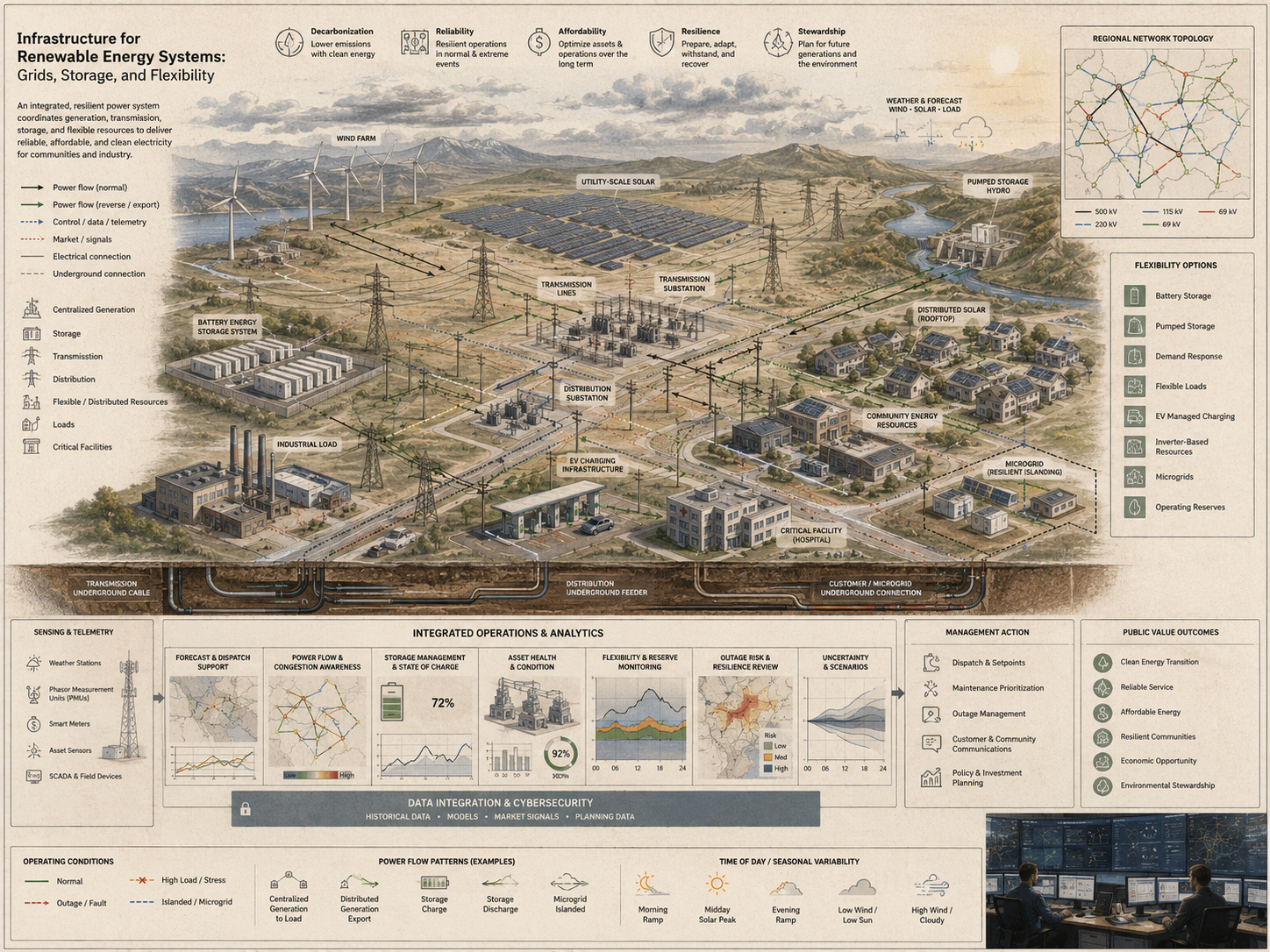
For that reason, infrastructure for renewable energy systems must be understood in systems terms. High shares of variable renewable energy do not simply require more generation capacity. They require stronger networks, more flexible operations, better visibility into system state, more capable storage, faster forecasting, demand-side coordination, interconnection, and governance frameworks able to align long-horizon infrastructure with fast-moving technological change.
Renewable energy infrastructure therefore sits at the intersection of energy systems, intelligent infrastructure, digital coordination, resilience planning, and institutional governance. Where supporting infrastructure is weak, renewable deployment can outpace the system’s ability to use it effectively, producing curtailment, congestion, instability, delayed interconnection, or inequitable access. Where supporting infrastructure is strong, renewable energy becomes not simply an added source of electricity, but a foundation for more adaptive, distributed, resilient, and publicly accountable energy systems.
Engineering Problem
The engineering problem is how to turn renewable generation potential into reliable, flexible, secure, affordable, and governable energy service across real infrastructure systems. Solar panels, wind farms, hydro facilities, geothermal plants, and bioenergy assets produce energy, but the value of that energy depends on whether the power system can connect it, forecast it, transmit it, store it, balance it, protect it, and use it when and where it is needed. Renewable infrastructure is therefore not only a question of generation capacity. It is a question of system integration.
This problem is difficult because renewable energy changes the temporal and spatial structure of electricity systems. Variable renewable energy output shifts with weather, daylight, season, geography, and resource availability. Many high-quality renewable resources are located far from demand centers, while distributed solar, electric vehicles, batteries, heat pumps, and flexible loads increasingly appear at the distribution edge. These changes place new demands on transmission planning, distribution hosting capacity, grid codes, inverters, forecasting, storage dispatch, demand-side flexibility, interconnection queues, and system operations.
Strong renewable energy infrastructure therefore requires an end-to-end operating model. It must define renewable assets, grid constraints, interconnection status, curtailment risk, storage capacity, flexibility resources, demand response, forecasting quality, telemetry integrity, dispatch logic, cybersecurity controls, institutional responsibilities, market incentives, resilience objectives, and public accountability. The central engineering question is not simply whether renewable capacity has been built. It is whether the surrounding infrastructure can convert renewable generation into dependable low-carbon service across time, geography, and institutional boundaries.
| Engineering Tension | Why It Matters | Required Evidence |
|---|---|---|
| Generation capacity versus usable energy | Installed renewable capacity can exceed the system’s ability to connect, transmit, store, or use output effectively. | Capacity factor, curtailment records, interconnection status, grid constraint review |
| Variable output versus reliability | Wind and solar variability must be balanced across time without weakening service continuity. | Forecast records, storage dispatch logs, reserve margin, flexibility resource register |
| Transmission expansion versus deployment speed | Renewable generation can be built faster than networks are permitted, financed, and constructed. | Transmission plan, queue records, congestion metrics, permitting timeline |
| Distribution growth versus grid-edge visibility | Distributed solar, EV charging, batteries, and flexible loads can stress local networks if visibility is weak. | Hosting capacity analysis, feeder telemetry, voltage records, grid-edge asset inventory |
| Storage deployment versus flexibility strategy | Storage is valuable, but it must be coordinated with demand response, transmission, dispatch, interconnection, and market rules. | Storage dispatch record, flexibility policy, demand-response register, market participation rules |
| Digital coordination versus cyber-physical risk | Renewable-rich systems depend on forecasting, telemetry, communications, inverter controls, and platforms that must be secured. | Cybersecurity review, telemetry integrity log, failover plan, device and inverter inventory |
The practical question is therefore: can renewable energy infrastructure convert variable, distributed, and weather-sensitive generation into reliable, resilient, flexible, and accountable energy service?
Reference Architecture
A practical reference architecture for renewable energy systems links generation assets to grids, storage, flexibility, forecasting, operations, data platforms, market rules, governance, and resilience planning. The architecture should not begin with generation alone. It should begin with the system responsibilities that make renewable energy usable: connection, transmission, balancing, forecasting, protection, flexibility, service continuity, and institutional coordination.
| Layer | Engineering Role | Primary Risk | Evidence Artifact |
|---|---|---|---|
| Renewable objective layer | Defines decarbonization goals, service obligations, integration objectives, flexibility needs, resilience requirements, and valid decision uses. | Renewable deployment is pursued without sufficient system-integration strategy. | Renewable infrastructure objective manifest, integration policy, flexibility plan |
| Generation asset layer | Includes solar, wind, hydro, geothermal, bioenergy, marine, hybrid plants, and distributed renewable assets. | Generation capacity is treated as sufficient even when connection, congestion, or curtailment limits system value. | Renewable asset inventory, resource profile, interconnection status |
| Grid and interconnection layer | Connects renewable assets through substations, inverters, transformers, transmission lines, distribution feeders, interconnectors, and protection systems. | Network constraints delay projects, increase congestion, or produce curtailment and instability. | Grid-connection register, transmission plan, hosting-capacity review |
| Storage and flexibility layer | Coordinates batteries, pumped hydro, long-duration storage, demand response, flexible loads, interconnection, and dispatchable balancing resources. | Variability is managed reactively rather than through planned flexibility portfolios. | Flexibility resource register, storage dispatch log, demand-response record |
| Digital and forecasting layer | Provides resource forecasting, system-state estimation, telemetry, grid-edge visibility, data integration, and dispatch coordination. | Renewable integration depends on data that are delayed, incomplete, insecure, or poorly linked to operations. | Forecast dataset, telemetry log, data-quality register, model card |
| Operations and market layer | Connects renewable output, storage, flexible demand, congestion management, curtailment, reserves, grid services, and market incentives. | Technical flexibility exists but is not activated, valued, or governed effectively. | Dispatch rules, grid-service register, market participation record, curtailment review |
| Governance and resilience layer | Coordinates planning, permitting, standards, public value, resilience, cybersecurity, environmental justice, finance, and institutional accountability. | Infrastructure expansion fails to keep pace with transition goals or shifts burdens unevenly. | Governance log, permitting timeline, resilience review, public evidence package |
This architecture makes clear that renewable energy infrastructure is not a collection of clean generation assets. It is a coordinated energy-system architecture in which physical networks, digital systems, flexibility resources, and institutions must evolve together.
Implementation Pattern
A rigorous implementation pattern begins with the integration problem. A planner, utility, system operator, regulator, or infrastructure agency should identify whether the renewable system problem is grid connection, curtailment, congestion, storage adequacy, forecasting weakness, local hosting capacity, demand flexibility, interconnection delay, resilience exposure, inverter coordination, market design, or governance capacity. It should then determine what must be measured, which assets and networks must be coordinated, which thresholds matter, which institutions have authority, and which actions can change outcomes.
| Artifact | Purpose | Suggested Format |
|---|---|---|
| Renewable infrastructure objective manifest | Defines asset classes, integration objectives, flexibility needs, decision uses, valid-use limits, and governance commitments. | YAML, Markdown, architecture decision record |
| Renewable asset inventory | Documents renewable generation, storage, inverters, substations, interconnection points, distributed assets, and grid-edge resources. | CSV, SQL table, asset-management export, GIS layer |
| Grid connection and constraint register | Tracks interconnection queue status, grid capacity, congestion, curtailment, hosting capacity, and reinforcement needs. | CSV, SQL table, planning model export |
| Renewable generation and forecast record | Stores resource forecasts, actual generation, forecast error, curtailment, availability, and dispatch status. | CSV, time-series table, historian export, API export |
| Storage and flexibility register | Documents batteries, pumped storage, demand response, flexible loads, EV charging, interconnectors, and grid-service capabilities. | CSV, SQL table, flexibility market export |
| Reliability and resilience review | Assesses service continuity, reserve adequacy, fallback capacity, restoration capability, weather exposure, and disturbance response. | CSV, SQL table, resilience report, scenario review |
| Cyber-physical monitoring review | Assesses telemetry integrity, inverter and device visibility, communications availability, access control, and failover procedures. | Markdown, YAML, device inventory, security review |
| Governance and planning action log | Connects indicators to permitting, reinforcement, storage procurement, market reform, demand-response design, or public reporting. | CSV, SQL table, planning action log, governance register |
The implementation goal is to make renewable infrastructure claims reconstructable. A reader should be able to move from a curtailment indicator, storage adequacy claim, grid constraint warning, flexibility score, or resilience assessment back to the renewable asset, forecast record, grid-connection status, telemetry source, threshold rule, model assumption, and governance action that support it.
Research-Grade Framing: Renewable Energy as System Infrastructure
A research-grade account of renewable energy infrastructure begins by treating renewable energy as a system transformation rather than as a generation substitution alone. A wind farm, solar plant, battery system, interconnector, demand-response platform, inverter fleet, or distribution feeder has value only in relation to the system architecture in which it operates. Renewable infrastructure therefore has to be evaluated through connection, flexibility, dispatchability, forecastability, resilience, governance, and public service value.
This framing matters because renewable deployment can be technically successful and systemically constrained at the same time. A region can install large amounts of renewable capacity and still face curtailment, interconnection backlogs, transmission congestion, local voltage issues, storage shortfalls, weak demand flexibility, or grid-code challenges. Capacity statistics can therefore overstate transition progress if they are separated from the infrastructure conditions required to use renewable output reliably and equitably.
Renewable energy infrastructure also requires humility. A clean resource is not automatically a just, resilient, or well-governed system. Transmission corridors involve land, permitting, Indigenous rights, community acceptance, ecological impacts, and long planning timelines. Distributed systems raise questions of access, affordability, grid-cost allocation, data visibility, and who benefits from flexibility markets. Storage and digital coordination create new dependencies on minerals, supply chains, software, telemetry, cybersecurity, and institutional capacity. Strong renewable infrastructure makes these trade-offs visible rather than hiding them behind celebratory capacity numbers.
| Limited Pattern | Stronger Pattern | Why the Shift Matters |
|---|---|---|
| Build renewable generation | Build connected, flexible, monitored, resilient, and governable renewable energy systems | Generation capacity only creates system value when the grid can use it. |
| Measure installed capacity | Measure usable output, curtailment, congestion, flexibility, storage dispatch, reliability, and resilience | Capacity alone can obscure integration bottlenecks. |
| Treat storage as the flexibility solution | Coordinate storage, demand response, interconnection, transmission, dispatch rules, and grid services | Flexibility is a system property, not a single asset type. |
| Modernize grids after deployment | Plan grids, interconnection, and flexibility ahead of renewable growth | Network delays can become transition bottlenecks. |
| Treat digital systems as neutral enablers | Govern forecasting, telemetry, device visibility, inverter controls, cybersecurity, and data access | Renewable integration increasingly depends on trusted digital coordination. |
The central research question is therefore: how can renewable infrastructure be designed so that clean generation becomes reliable, flexible, secure, resilient, affordable, and publicly accountable energy service?
Formal Model: Renewable Integration, Storage, Flexibility, and Grid Constraint
A useful formal model separates renewable generation, forecast error, grid capacity, curtailment, storage state, flexibility, service continuity, and resilience. Let \(G_{r,t}\) represent renewable generation available at time \(t\), \(D_t\) demand, \(K_{g,t}\) grid transfer capacity, \(S_t\) storage state of charge, \(F_t\) available flexibility, \(C_t\) curtailment, and \(R_{\mathrm{resilience}}\) resilience performance.
U_t =
\min(G_{r,t},\ K_{g,t} + F_t + P_{\mathrm{charge},t})
\]
Interpretation: Usable renewable energy depends not only on generation availability, but on grid capacity, flexibility, and storage charging capability.
C_t =
\max(0,\ G_{r,t} – U_t)
\]
Interpretation: Curtailment occurs when renewable generation exceeds the system’s ability to transmit, store, or use it.
S_{t+1} =
S_t +
\eta_c P_{\mathrm{charge},t}
–
\frac{P_{\mathrm{discharge},t}}{\eta_d}
\]
Interpretation: Storage evolves through charging and discharging, adjusted by charge and discharge efficiency.
F_t =
F_{\mathrm{storage},t} +
F_{\mathrm{demand},t} +
F_{\mathrm{interconnection},t} +
F_{\mathrm{dispatch},t}
\]
Interpretation: Flexibility is a portfolio property produced by storage, demand response, interconnection, and dispatchable operational resources.
E_{\mathrm{forecast},t} =
\left|G_{r,t}^{\mathrm{forecast}} – G_{r,t}^{\mathrm{actual}}\right|
\]
Interpretation: Forecast error measures the difference between expected and actual renewable generation, which affects balancing and dispatch.
Q_{\mathrm{renewable}} =
\alpha U +
\beta F +
\gamma R_{\mathrm{resilience}}
–
\delta C
–
\eta E_{\mathrm{forecast}}
–
\theta K_{\mathrm{constraint}}
\]
Interpretation: Renewable infrastructure quality rises with usable renewable energy, flexibility, and resilience, while curtailment, forecast error, and grid constraints reduce performance.
This formal structure protects against a common mistake: treating renewable energy capacity as equivalent to renewable energy capability. System capability depends on whether the grid, storage, flexibility, forecasting, and governance layers can turn generation into usable service.
What Is Infrastructure for Renewable Energy Systems?
Infrastructure for renewable energy systems refers to the wider enabling architecture through which renewable generation can be connected, integrated, balanced, transmitted, stored, protected, and governed. This includes not only generation assets themselves, but also the networks and institutions that allow renewable electricity to become dependable system capability rather than isolated generation potential. In practice, the concept encompasses transmission expansion, distribution-grid modernization, substations, inverters, grid codes, storage systems, dispatch coordination, forecasting environments, digital platforms, interconnectors, flexibility mechanisms, system-operation frameworks, and planning institutions.
Renewable energy infrastructure is therefore broader than clean power plants. A wind farm or solar array may generate electricity, but without the surrounding infrastructure needed for connection and integration, its contribution to system performance remains constrained. This is especially important for variable renewable energy such as wind and solar, where output changes across time, weather, and geography. Variable renewable energy must be assessed not only in terms of generation potential but also in relation to grid requirements, flexibility needs, operational arrangements, and system-wide capacity to absorb variability.
Seen in these terms, renewable energy systems are not separate from infrastructure systems more broadly. They are a major contemporary example of how physical infrastructure, digital infrastructure, cyber-physical coordination, and institutional governance must evolve together under transition pressure. Renewable energy infrastructure is therefore one of the clearest examples of intelligent infrastructure: a domain where sensors, networks, forecasting, analytics, control, storage, planning, and public governance have to work together to sustain essential services.
Why Renewable Energy Requires System Infrastructure
Renewable energy requires system infrastructure because energy transitions are not merely substitution problems. Replacing fossil-fuel generation with renewable generation changes the temporal, spatial, and operational characteristics of electricity supply. Solar and wind are more weather-dependent, often more geographically dispersed, and frequently added more rapidly than the transmission and distribution systems that must support them. They also interact with demand differently, making flexibility, forecasting, and system responsiveness more valuable than in conventional generation systems dominated by controllable thermal plants.
This means that renewable energy expansion can expose infrastructure bottlenecks rather than simply solving energy problems through capacity additions alone. Transmission congestion, delayed interconnection, curtailment, weak distribution hosting capacity, limited storage, insufficient operational flexibility, and poor forecasting can all constrain the effective use of renewable generation. Grids have become one of the main limiting factors in many energy transitions, and grid modernization, digitalization, and flexibility resources are now essential to integrating much larger shares of renewable power.
Infrastructure therefore matters because renewable energy becomes socially and economically meaningful only when it can be delivered, balanced, and governed as part of a functioning power system. The transition challenge is not simply to install more renewable generation, but to build the system conditions under which renewable generation can provide secure, affordable, resilient, and low-carbon energy services.
| Renewable-System Condition | Infrastructure Need | Failure If Missing |
|---|---|---|
| Weather-dependent output | Forecasting, balancing, storage, flexible demand, reserves, and interconnection. | Variability becomes a reliability problem rather than a manageable operating condition. |
| Remote high-quality resources | Transmission expansion, substations, interconnection, permitting, and regional planning. | Strong renewable resources remain stranded or curtailed. |
| Distributed generation growth | Distribution visibility, hosting capacity, smart inverters, feeder monitoring, and grid-edge coordination. | Local voltage, congestion, and protection issues emerge at the distribution edge. |
| High electrification | Load forecasting, demand flexibility, EV charging coordination, storage, and grid reinforcement. | Demand growth outpaces local network capability. |
| Resilience and secure transition | Redundancy, islanding options, interconnection, storage, black-start planning, and cyber-physical monitoring. | Renewable deployment improves decarbonization but leaves critical services exposed. |
Renewable energy requires system infrastructure because electricity systems must balance power continuously, across networks, under uncertainty, and in relation to public service obligations.
Core Architecture of Renewable Energy Infrastructure
Infrastructure for renewable energy systems can be understood through a layered architecture that links renewable generation to broader system function. Each layer matters because renewable integration fails when generation, grids, storage, forecasting, operations, markets, and governance are treated as separate problems rather than as interdependent parts of one transition system.
Generation Layer
This layer includes solar photovoltaics, concentrating solar power, onshore wind, offshore wind, hydropower, geothermal, bioenergy, marine energy, and hybrid renewable plants. These assets provide the primary renewable energy input into the system, but their system value depends heavily on the infrastructure around them. A solar plant with weak grid connection, a wind farm in a congested transmission region, or distributed assets without local visibility can produce energy that is difficult to use fully.
Connection and Grid Layer
This layer includes substations, transformers, inverters, transmission lines, distribution feeders, grid interconnectors, protection systems, grid codes, and reinforcement investments. It determines whether renewable generation can be connected and transmitted without excessive congestion, curtailment, or instability. Transmission and distribution are not passive backbones in renewable systems; they are active conditions of transition success.
Storage and Flexibility Layer
This layer includes batteries, pumped storage, thermal storage, hydrogen where appropriate, demand response, flexible industrial load, EV charging coordination, interconnection capacity, dispatchable backup, long-duration storage, and sector coupling. Flexibility resources help the system cope with variability and uncertainty across sub-hourly, daily, weekly, and seasonal timescales.
Digital and Operational Layer
This layer includes forecasting systems, control rooms, data platforms, system-state estimation, advanced metering, inverter telemetry, digital communications, dispatch tools, and analytical environments that improve situational awareness and coordination across the power system. Renewable-rich systems depend on digital intelligence because they must anticipate and coordinate many changing variables simultaneously.
Institutional and Governance Layer
This layer includes planning frameworks, permitting systems, market design, interconnection rules, investment regulation, technical standards, cybersecurity requirements, public engagement, environmental review, and institutions responsible for coordination. It determines whether infrastructure expansion keeps pace with renewable deployment and whether the resulting system remains governable over time.
| Layer | Core Capability | Maturity Question |
|---|---|---|
| Generation | Solar, wind, hydro, geothermal, bioenergy, marine, hybrid plants, and distributed renewables | Can renewable output be connected, forecast, and used effectively? |
| Grids and interconnection | Transmission, distribution, substations, inverters, grid codes, interconnectors, and protection systems | Can networks absorb renewable growth without excessive congestion or curtailment? |
| Storage and flexibility | Batteries, pumped storage, demand response, flexible loads, EV charging, long-duration storage, and dispatchable flexibility | Can the system balance variability across relevant timescales? |
| Digital operations | Forecasting, telemetry, system-state estimation, dispatch platforms, grid-edge visibility, and control systems | Can renewable conditions be observed and coordinated in time to act? |
| Governance and planning | Permitting, market design, planning, standards, cybersecurity, public engagement, and investment coordination | Can institutions align infrastructure development with transition needs? |
Together these layers show that infrastructure for renewable energy is not reducible to generation assets alone. It is a multi-layered system that combines material networks, digital coordination, and institutional capacity.
Grids, Interconnection, and Transmission Expansion
Grids are the central infrastructure challenge of renewable energy transitions. Renewable resources are often located far from demand centers, geographically dispersed, or added at the distribution edge rather than solely through centralized plants. This increases the importance of transmission expansion, interconnection, substation upgrades, grid reinforcement, and distribution-grid modernization. Without these investments, renewable generation may face delayed grid access, non-firm connections, congestion, instability, or higher curtailment.
Interconnection is equally important because it increases the spatial scale over which renewable variability can be managed. Regional and cross-border power exchanges allow systems to balance variability more effectively, share reserves, reduce local curtailment, access complementary resource profiles, and improve resilience. Grid interconnection is not just a market issue. It is a foundational infrastructure strategy for renewable integration and energy security.
Transmission and distribution planning must therefore be treated as core renewable-energy infrastructure rather than as downstream afterthoughts. In transition systems, network adequacy becomes a condition of decarbonization itself. A region can have excellent renewable resources but weak renewable outcomes if interconnection, transmission expansion, distribution hosting capacity, permitting, and system planning fail to keep pace.
| Grid Function | Renewable Integration Role | Failure Mode |
|---|---|---|
| Transmission expansion | Moves renewable energy from resource-rich regions to load centers. | Congestion, curtailment, stranded renewable projects, and delayed decarbonization. |
| Distribution modernization | Supports rooftop solar, EV charging, batteries, flexible load, and local voltage management. | Hosting capacity limits, voltage problems, protection challenges, and local constraints. |
| Substations and transformers | Enable connection, voltage transformation, switching, protection, and network reinforcement. | Connection delays and bottlenecks around critical nodes. |
| Interconnectors | Expand balancing areas and improve access to complementary renewable resources. | Local variability becomes harder to manage and reserves are less efficient. |
| Grid codes and inverter requirements | Define how renewable assets support voltage, frequency, fault ride-through, and grid services. | Renewable assets connect physically but do not support system stability adequately. |
Grid infrastructure is therefore not a supporting detail in renewable energy systems. It is one of the main ways renewable capacity becomes usable, reliable, and systemically valuable.
Flexibility, Storage, and Demand Coordination
High-renewables systems require flexibility because variable renewable generation introduces temporal variation and forecast uncertainty that must be managed without undermining reliability. Flexibility is the system’s ability to respond to those variations across different timescales while continuing to supply demand and minimize curtailment.
Storage is one major flexibility resource. Batteries can support short-duration balancing, peak shifting, frequency response, and grid services, while pumped storage and long-duration storage can help address longer time horizons. But storage alone is not enough. Demand-side management, flexible loads, transmission reinforcement, interconnectors, flexible market arrangements, grid-forming capabilities, and intelligent dispatch all contribute to system flexibility.
This broader systems view matters because renewable integration is not solved by a single infrastructure type. It depends on how storage, demand, networks, forecasting, and operations interact across scales and across time. Flexibility is a system attribute produced by multiple interacting resources rather than by batteries alone.
| Flexibility Resource | Primary Role | System Question |
|---|---|---|
| Battery storage | Short-duration balancing, peak shifting, frequency response, grid services, and local constraint relief. | Is dispatch preserving both short-term system value and long-term asset health? |
| Pumped hydro and long-duration storage | Longer-duration balancing, seasonal support, and resilience under extended renewable shortfall. | Can storage cover the timescales of renewable variability that matter most? |
| Demand response | Adjusts demand to align with renewable availability and grid constraints. | Are flexible loads visible, compensated, reliable, and equitable? |
| EV charging coordination | Shifts or controls charging demand to support local networks and renewable availability. | Can transport electrification become a flexibility asset rather than only a load burden? |
| Interconnection | Shares variability, reserves, and renewable surpluses across larger geographies. | Can regions coordinate balancing rather than solving variability locally? |
| Dispatch and market design | Activates flexible resources through operational rules and incentives. | Are flexibility resources technically available and institutionally usable? |
Flexibility is therefore both an engineering and governance problem. The physical resource must exist, but the system also needs telemetry, dispatch rules, market design, customer participation, and institutional authority to use it effectively.
Digital Infrastructure, Forecasting, and System Visibility
Infrastructure for renewable energy systems increasingly depends on digital capability. High-renewables systems require better forecasting of weather-dependent generation, improved visibility into distributed resources, faster detection of constraints, and more coordinated management of flexible assets. Digital systems help transform renewable infrastructure from a collection of variable inputs into a more governable and observable operating environment.
Forecasting is especially important. Renewable output is not random, but it is variable and weather-sensitive. Better forecasting reduces balancing costs, improves dispatch decisions, supports interconnection management, and helps planners anticipate congestion or flexibility needs. Forecast quality matters because errors propagate into reserve needs, storage dispatch, curtailment risk, market prices, and system reliability.
Digital infrastructure also matters at the grid edge, where distributed renewables, electric vehicles, storage, heat pumps, building systems, and flexible demand increasingly interact through data, communications, and control systems. In this respect, renewable infrastructure is inseparable from intelligent infrastructure. Its performance depends not only on physical assets, but on the quality of visibility, coordination, and digital governance surrounding those assets.
| Digital Capability | Renewable Infrastructure Value | Governance Requirement |
|---|---|---|
| Resource forecasting | Improves dispatch, balancing, storage scheduling, reserve planning, and curtailment management. | Forecast validation, model cards, uncertainty reporting, and operational integration. |
| Grid-edge telemetry | Improves visibility into distributed solar, EV charging, batteries, voltage, and local constraints. | Data governance, privacy safeguards, interoperability, and aggregation rules. |
| Storage dispatch platforms | Coordinates charging, discharging, grid services, and asset-health constraints. | Dispatch transparency, degradation management, cybersecurity, and market accountability. |
| Inverter monitoring and control | Supports voltage, frequency, fault ride-through, reactive power, and grid-forming capabilities. | Grid codes, device inventory, firmware governance, and cyber-physical security. |
| Energy data platforms | Integrates forecasts, telemetry, market data, storage, demand response, and constraint records. | Metadata, lineage, access controls, data quality, and platform continuity. |
Digital coordination should therefore be treated as part of renewable infrastructure, not as a secondary analytics layer placed on top of physical systems after deployment.
Distributed Renewables, Mini-Grids, and Grid-Edge Systems
Renewable infrastructure is not confined to large interconnected power systems. Distributed renewables, mini-grids, and off-grid solar systems are also major parts of the renewable-energy landscape, especially in developing, remote, island, rural, and resilience-oriented contexts. These systems often rely on local storage, smart inverters, demand management, remote monitoring, modular controls, and hybrid operating environments to provide stable service.
This distributed dimension matters because infrastructure for renewables is increasingly multi-scalar. Some systems require continental transmission and interconnection. Others require localized resilience, autonomous control, modular deployment, and low-cost monitoring. The broader challenge is to build coordination architectures that allow different scales of renewable infrastructure to coexist and support wider system goals rather than operating as isolated silos.
Grid-edge systems also change the direction of power-system intelligence. Historically, distribution networks were often designed around one-way flows from central generation to passive consumers. Renewable-rich systems increasingly involve two-way power flows, active customers, prosumers, batteries, EVs, smart appliances, and flexible demand. This requires distribution systems to become more observable, controllable, and governable.
| Pattern | Infrastructure Need | Governance Question |
|---|---|---|
| Rooftop and community solar | Hosting capacity, smart inverters, voltage management, metering, and interconnection processes. | Who gains access to distributed generation benefits? |
| Mini-grids | Local generation, storage, controls, demand management, remote monitoring, and maintenance capacity. | Can service quality, affordability, and long-term maintenance be sustained? |
| Remote renewable systems | Hybrid generation, batteries, local controls, spare parts, communications, and resilience planning. | Does local infrastructure reduce dependence while preserving reliability? |
| EV and building flexibility | Managed charging, building controls, tariffs, telemetry, and aggregation platforms. | Can demand flexibility be mobilized without burdening vulnerable users? |
| Microgrids | Local generation, islanding controls, storage, protection, black-start capability, and service prioritization. | Which critical services should be prioritized under disruption? |
Distributed renewable infrastructure therefore requires both technical design and institutional design. It must address not only how local systems operate, but how they are maintained, financed, governed, connected, and made accessible over time.
Reliability, Resilience, and Secure Energy Transition
Renewable energy systems are often discussed in terms of decarbonization and affordability, but infrastructure quality also shapes reliability and resilience. Reliability concerns the system’s ability to provide electricity consistently under expected conditions. Resilience concerns its ability to withstand, adapt to, and recover from disruptions such as storms, heat stress, cyber incidents, equipment failures, market shocks, and network disruptions.
High-renewables systems can strengthen resilience in some respects by diversifying supply, reducing fuel dependence, enabling distributed generation, supporting microgrids, and widening the system’s portfolio of response options. But they also place greater importance on grid planning, storage, interconnection, forecasting, digital coordination, and inverter-based resource management. Renewable deployment without adequate supporting infrastructure can weaken system performance; well-built renewable infrastructure can strengthen long-run resilience.
The idea of secure energy transitions is useful because it rejects the false choice between decarbonization and energy security. Instead, it shows that transition depends on infrastructure capable of supporting both. Resilience in renewable-rich systems therefore depends less on the mere presence of clean generation than on the quality of the system architecture into which that generation is embedded.
| System Requirement | Reliability Role | Resilience Role |
|---|---|---|
| Forecasting | Supports dispatch, reserves, and storage scheduling under expected variability. | Improves preparation for extreme weather and abnormal renewable shortfall. |
| Storage | Balances short-term variability and supports grid services. | Provides backup, islanding support, and recovery capacity under disruption. |
| Interconnection | Shares balancing resources across larger regions. | Expands recovery options and access to complementary resources. |
| Distributed renewables | Can reduce local demand on the bulk system under normal operation. | Can support critical services when paired with storage and microgrid controls. |
| Digital monitoring | Improves situational awareness and operational coordination. | Supports faster response, but requires cybersecurity and fallback planning. |
Renewable infrastructure becomes resilience infrastructure when it supports not only lower emissions, but also continuity, adaptability, redundancy, recovery, and public service under stress.
Planning, Governance, and Institutional Capacity
Infrastructure for renewable energy systems depends on governance because the technical challenge is inseparable from planning, permitting, financing, and institutional coordination. Grid expansion, interconnectors, storage deployment, renewable siting, distribution hosting capacity, connection rules, and flexibility markets all depend on institutions that can align long-term infrastructure development with rapidly changing technology and policy goals.
Governance also shapes which flexibility resources are rewarded, how interconnection queues are managed, whether non-firm connections are used strategically, how cost recovery is structured, how grid codes are updated, how public engagement is handled, and whether public and private actors can coordinate around shared system priorities. Modernized infrastructure development, integrated power-capacity planning, transparent queue management, and multistakeholder processes are all essential to scaling renewables securely.
Institutional capacity is therefore part of renewable infrastructure itself. A technically promising system can still underperform if planning institutions are weak, rules are fragmented, asset visibility is poor, cost allocation is contested, permitting is slow, or governance cannot keep pace with transition complexity. Renewable energy infrastructure is successful only when the institutions responsible for planning and governing it are capable of managing both technical and public consequences.
| Capability | Purpose | Evidence Artifact |
|---|---|---|
| Integrated resource and grid planning | Aligns renewable generation, transmission, distribution, storage, flexibility, and demand growth. | Integrated plan, scenario review, grid-expansion roadmap |
| Interconnection governance | Manages queues, technical standards, connection costs, grid studies, and project readiness. | Queue register, interconnection rules, grid-study record |
| Flexibility market design | Rewards storage, demand response, grid services, and flexible operation where they support system value. | Market rules, participation register, grid-service settlement records |
| Permitting and public engagement | Balances infrastructure speed with rights, ecological impacts, land use, and community legitimacy. | Permitting timeline, consultation record, environmental review |
| Cybersecurity and device governance | Protects inverter fleets, telemetry, control platforms, remote access, and distributed resources. | Device inventory, firmware policy, security architecture, incident response plan |
| Public accountability | Explains curtailment, congestion, costs, reliability, equity, and investment trade-offs. | Public evidence package, transparency report, planning decision record |
The governance question is whether renewable infrastructure planning strengthens public energy capability, or whether renewable deployment becomes constrained by queues, networks, markets, permitting, data gaps, and fragmented authority.
Deployment Readiness Gate
Before renewable infrastructure workflows are used for planning, grid integration, storage procurement, curtailment review, demand flexibility, interconnection decisions, public reporting, resilience planning, or investment prioritization, they should pass a readiness gate. The purpose is not to slow renewable deployment. It is to confirm that renewable-integration claims are supported by documented assets, grid context, trustworthy data, validated indicators, operational pathways, and governance accountability.
| Readiness Check | Pass Condition | Evidence |
|---|---|---|
| Integration purpose | Renewable asset classes, service goals, integration questions, decision uses, and valid-use limits are defined. | Renewable infrastructure objective manifest, integration policy |
| Asset and grid context | Generation, storage, interconnection points, substations, feeders, transmission paths, and grid-edge resources are documented. | Renewable asset inventory, grid connection register, topology map |
| Forecast and telemetry quality | Forecast error, latency, missingness, timestamp quality, resource conditions, and telemetry provenance are tracked. | Forecast record, telemetry log, metadata dictionary |
| Grid constraint validation | Congestion, hosting capacity, curtailment, interconnection limits, and reinforcement needs are defined and reviewed. | Constraint register, curtailment report, hosting-capacity analysis |
| Storage and flexibility connection | Storage, demand response, flexible loads, interconnectors, and dispatch rules are connected to renewable integration needs. | Flexibility register, storage dispatch log, demand-response record |
| Cybersecurity and continuity | Inverters, telemetry, APIs, remote access, grid-edge devices, and control platforms are protected with fallback procedures. | Security architecture, device inventory, continuity plan |
| Resilience review | Renewable infrastructure supports outage response, weather stress, islanding, fallback capacity, and restoration planning where relevant. | Resilience scenario review, service-continuity metric, after-action record |
| Governance accountability | Assumptions, limitations, responsible institutions, trade-offs, review cycles, and public claims are documented. | Public evidence package, governance log, planning record |
A renewable infrastructure workflow that cannot pass this readiness gate may still collect useful data, but its outputs should be treated cautiously when used for investment decisions, public claims, operational planning, or system adequacy assessments.
Data and Configuration Artifacts
The companion repository can use a data-first structure so renewable infrastructure claims can be examined rather than merely asserted. Each artifact has a specific role in making the renewable integration chain reconstructable across generation, grids, storage, flexibility, forecasting, resilience, cybersecurity, and governance.
| Artifact | File | Purpose |
|---|---|---|
| Renewable infrastructure objective manifest | config/renewable_infrastructure_objective.yml |
Defines asset classes, integration goals, flexibility needs, service obligations, decision uses, and valid-use limits. |
| Renewable asset inventory | data/renewable_asset_inventory.csv |
Documents solar, wind, hydro, storage, inverters, substations, interconnection points, and distributed renewable assets. |
| Grid connection and constraint register | data/grid_connection_constraint_register.csv |
Tracks interconnection status, transmission constraints, distribution hosting capacity, congestion, and reinforcement needs. |
| Renewable generation and forecast record | data/renewable_generation_forecast_records.csv |
Stores forecast generation, actual generation, forecast error, curtailment, availability, and resource conditions. |
| Storage and flexibility register | data/storage_flexibility_register.csv |
Documents storage capacity, demand response, flexible loads, EV charging, interconnection, and grid-service capability. |
| Reliability and resilience review | data/renewable_reliability_resilience_review.csv |
Stores service continuity, fallback capacity, reserve contribution, restoration role, and resilience metrics. |
| Governance and planning action log | data/renewable_governance_planning_log.csv |
Documents interconnection decisions, storage planning, grid reinforcement, permitting actions, and public review commitments. |
| SQL schema | sql/schema.sql |
Creates a local SQLite database for renewable infrastructure evidence records. |
These artifacts are designed to make renewable infrastructure analysis auditable. They can be replaced with institutional data sources later, but the scaffold makes the logic of grid integration, storage, flexibility, forecasting, curtailment, and governance explicit from the beginning.
Mathematical Lens: Grids, Storage, Flexibility, and Curtailment
A lightweight mathematical lens helps distinguish renewable infrastructure from renewable generation alone. The point is not to reduce energy transition performance to a single score, but to make visible the relationships among renewable output, grid capacity, curtailment, storage, flexibility, forecast error, and resilience.
U_t =
\min(G_{r,t},\ K_{g,t} + F_t + P_{\mathrm{charge},t})
\]
Interpretation: Usable renewable energy depends on generation availability, grid capacity, flexibility, and storage charging capability.
C_t =
\max(0,\ G_{r,t} – U_t)
\]
Interpretation: Curtailment is not simply a generation problem. It often signals insufficient grid capacity, storage, flexibility, dispatch coordination, or demand alignment.
S_{t+1} =
S_t +
\eta_c P_{\mathrm{charge},t}
–
\frac{P_{\mathrm{discharge},t}}{\eta_d}
\]
Interpretation: Storage state changes through charging and discharging, adjusted by efficiency losses.
F_t =
F_{\mathrm{storage},t} +
F_{\mathrm{demand},t} +
F_{\mathrm{interconnection},t} +
F_{\mathrm{dispatch},t}
\]
Interpretation: Flexibility is a portfolio property. Storage is important, but so are demand flexibility, interconnection, dispatch, and operational coordination.
Q_{\mathrm{renewable}} =
\alpha U +
\beta F +
\gamma R_{\mathrm{resilience}}
–
\delta C
–
\eta E_{\mathrm{forecast}}
–
\theta K_{\mathrm{constraint}}
\]
Interpretation: Renewable infrastructure quality increases when usable renewable energy, flexibility, and resilience rise, and decreases when curtailment, forecast error, and grid constraints grow.
This mathematical framing should be used as a structured diagnostic, not as a substitute for certified power-system planning, grid-code compliance, operator judgment, protection engineering, cybersecurity review, environmental assessment, or public infrastructure governance.
Python Workflow: Renewable Infrastructure Review
The Python workflow in the companion repository can read renewable asset inventories, grid-connection registers, generation and forecast records, storage and flexibility registers, reliability and resilience reviews, and governance logs; compute usable renewable energy, curtailment, forecast error, flexibility adequacy, grid-constraint severity, storage contribution, resilience scores, and planning review flags; and export a governance-ready renewable infrastructure watchlist.
from pathlib import Path
import pandas as pd

ARTICLE_DIR = Path("articles/infrastructure-for-renewable-energy-systems-grids-storage-and-flexibility")
DATA_DIR = ARTICLE_DIR / "data"
OUTPUT_DIR = ARTICLE_DIR / "outputs"
OUTPUT_DIR.mkdir(parents=True, exist_ok=True)

assets = pd.read_csv(DATA_DIR / "renewable_asset_inventory.csv")
grid = pd.read_csv(DATA_DIR / "grid_connection_constraint_register.csv")
generation = pd.read_csv(DATA_DIR / "renewable_generation_forecast_records.csv", parse_dates=["timestamp"])
flexibility = pd.read_csv(DATA_DIR / "storage_flexibility_register.csv")
resilience = pd.read_csv(DATA_DIR / "renewable_reliability_resilience_review.csv")

review = (
    generation
    .merge(assets, on="asset_id", how="left")
    .merge(grid, on="grid_node_id", how="left")
    .merge(flexibility, on="flexibility_zone_id", how="left")
    .merge(resilience, on="service_zone_id", how="left")
)

review["forecast_error_mw"] = (
    review["forecast_generation_mw"] - review["actual_generation_mw"]
).abs()

review["usable_renewable_mw"] = review[
    ["actual_generation_mw", "grid_transfer_capacity_mw"]
].min(axis=1)

review["usable_renewable_mw"] = (
    review["usable_renewable_mw"] +
    review["available_flexibility_mw"] +
    review["available_storage_charge_mw"]
).clip(upper=review["actual_generation_mw"])

review["curtailment_mw"] = (
    review["actual_generation_mw"] - review["usable_renewable_mw"]
).clip(lower=0)

review["curtailment_rate"] = (
    review["curtailment_mw"] / review["actual_generation_mw"].replace(0, pd.NA)
).fillna(0).clip(lower=0, upper=1)

review["flexibility_adequacy_score"] = (
    review["available_flexibility_mw"] / review["flexibility_need_mw"].replace(0, pd.NA)
).fillna(1).clip(lower=0, upper=1)

review["grid_constraint_score"] = (
    1 - review["grid_transfer_capacity_mw"] / review["connection_capacity_mw"].replace(0, pd.NA)
).fillna(0).clip(lower=0, upper=1)

review["renewable_infrastructure_score"] = (
    0.25 * (1 - review["curtailment_rate"]) +
    0.20 * review["flexibility_adequacy_score"] +
    0.20 * review["resilience_score"] +
    0.15 * review["forecast_quality_score"] +
    0.10 * review["storage_readiness_score"] -
    0.10 * review["grid_constraint_score"]
).clip(lower=0, upper=1)

review["renewable_review_flag"] = (
    (review["curtailment_rate"] >= 0.10) |
    (review["flexibility_adequacy_score"] < 0.75) |
    (review["grid_constraint_score"] >= 0.30) |
    (review["forecast_quality_score"] < 0.70) |
    (review["resilience_score"] < 0.70) |
    (review["interconnection_status"].isin(["delayed", "queued", "constrained"]))
)

watchlist = (
    review[review["renewable_review_flag"]]
    .sort_values(
        ["curtailment_rate", "grid_constraint_score", "flexibility_adequacy_score"],
        ascending=[False, False, True]
    )
)

review.to_csv(OUTPUT_DIR / "renewable_infrastructure_review.csv", index=False)
watchlist.to_csv(OUTPUT_DIR / "renewable_infrastructure_governance_watchlist.csv", index=False)

print(watchlist[[
    "asset_id",
    "asset_name",
    "technology",
    "grid_node_id",
    "interconnection_status",
    "curtailment_rate",
    "flexibility_adequacy_score",
    "grid_constraint_score",
    "renewable_infrastructure_score"
]])
This workflow is intentionally transparent. It allows analysts to see whether renewable infrastructure concern arises from curtailment, grid constraint, interconnection delay, forecast error, insufficient flexibility, weak storage readiness, or resilience weakness.
R Workflow: Renewable Integration and Flexibility Reporting
The R workflow can summarize renewable infrastructure performance by technology, grid node, service zone, flexibility zone, or interconnection status; identify curtailment, grid-constraint, storage, forecasting, and flexibility concerns; and create stewardship-oriented reports for planners, utilities, regulators, system operators, energy analysts, and governance review teams.
library(readr)
library(dplyr)

article_dir <- "articles/infrastructure-for-renewable-energy-systems-grids-storage-and-flexibility"
data_dir <- file.path(article_dir, "data")
output_dir <- file.path(article_dir, "outputs")
dir.create(output_dir, recursive = TRUE, showWarnings = FALSE)

assets <- read_csv(file.path(data_dir, "renewable_asset_inventory.csv"), show_col_types = FALSE)
grid <- read_csv(file.path(data_dir, "grid_connection_constraint_register.csv"), show_col_types = FALSE)
generation <- read_csv(file.path(data_dir, "renewable_generation_forecast_records.csv"), show_col_types = FALSE)
flexibility <- read_csv(file.path(data_dir, "storage_flexibility_register.csv"), show_col_types = FALSE)
resilience <- read_csv(file.path(data_dir, "renewable_reliability_resilience_review.csv"), show_col_types = FALSE)

review <- generation %>%
  left_join(assets, by = "asset_id") %>%
  left_join(grid, by = "grid_node_id") %>%
  left_join(flexibility, by = "flexibility_zone_id") %>%
  left_join(resilience, by = "service_zone_id") %>%
  mutate(
    forecast_error_mw = abs(forecast_generation_mw - actual_generation_mw),
    usable_base_mw = pmin(actual_generation_mw, grid_transfer_capacity_mw),
    usable_renewable_mw = pmin(
      actual_generation_mw,
      usable_base_mw + available_flexibility_mw + available_storage_charge_mw
    ),
    curtailment_mw = pmax(actual_generation_mw - usable_renewable_mw, 0),
    curtailment_rate = if_else(
      actual_generation_mw > 0,
      pmax(0, pmin(1, curtailment_mw / actual_generation_mw)),
      0
    ),
    flexibility_adequacy_score = if_else(
      flexibility_need_mw > 0,
      pmax(0, pmin(1, available_flexibility_mw / flexibility_need_mw)),
      1
    ),
    grid_constraint_score = if_else(
      connection_capacity_mw > 0,
      pmax(0, pmin(1, 1 - grid_transfer_capacity_mw / connection_capacity_mw)),
      0
    ),
    renewable_infrastructure_score = pmax(
      0,
      pmin(
        1,
        0.25 * (1 - curtailment_rate) +
        0.20 * flexibility_adequacy_score +
        0.20 * resilience_score +
        0.15 * forecast_quality_score +
        0.10 * storage_readiness_score -
        0.10 * grid_constraint_score
      )
    ),
    renewable_review_flag =
      curtailment_rate >= 0.10 |
      flexibility_adequacy_score < 0.75 |
      grid_constraint_score >= 0.30 |
      forecast_quality_score < 0.70 |
      resilience_score < 0.70 |
      interconnection_status %in% c("delayed", "queued", "constrained")
  )

technology_summary <- review %>%
  group_by(technology) %>%
  summarise(
    assets = n_distinct(asset_id),
    mean_curtailment_rate = mean(curtailment_rate, na.rm = TRUE),
    mean_flexibility_adequacy = mean(flexibility_adequacy_score, na.rm = TRUE),
    mean_grid_constraint = mean(grid_constraint_score, na.rm = TRUE),
    mean_infrastructure_score = mean(renewable_infrastructure_score, na.rm = TRUE),
    review_flags = sum(renewable_review_flag, na.rm = TRUE),
    .groups = "drop"
  ) %>%
  arrange(desc(review_flags), desc(mean_curtailment_rate))

write_csv(review, file.path(output_dir, "renewable_infrastructure_review_report.csv"))
write_csv(technology_summary, file.path(output_dir, "renewable_technology_summary.csv"))

print(technology_summary)
The purpose is not to produce a definitive renewable infrastructure grade. It is to demonstrate how curtailment, grid capacity, forecast quality, storage readiness, flexibility adequacy, resilience, and interconnection status can be made reproducible and auditable.
Systems Code: Renewable Energy Monitoring, Edge Sensing, and Flexibility Coordination
The companion repository can extend the article into a reproducible systems scaffold. Python and R support analytical review; SQL stores evidence; YAML files define objectives and policies; GeoJSON can provide spatial placeholders; TypeScript can support dashboard interfaces; Go can support renewable infrastructure status APIs; Rust can support strict renewable-record validation; C can support curtailment, storage, and flexibility calculations; Fortran can support numerical power-system routines; MicroPython can support low-power renewable monitoring nodes; PYNQ and HDL can support hardware-assisted stream validation where appropriate.
| Directory | Role | Example Use |
|---|---|---|
python/ |
Renewable infrastructure review, curtailment scoring, flexibility adequacy, governance watchlists | Compute curtailment, forecast error, grid constraints, storage contribution, and review flags |
r/ |
Technology summaries, grid-node reports, flexibility and integration review | Summarize renewable integration performance by technology or service zone |
sql/ |
Evidence tables and auditable queries | Join renewable assets, grid constraints, forecasts, storage, flexibility, and governance actions |
c/ and embedded_c/ |
Low-level renewable telemetry and threshold checks | Validate voltage, inverter status, generation, latency, curtailment, and battery flags at the edge |
rust/ |
Strict validation and CLI scaffolding | Validate renewable asset records, forecast fields, and curtailment calculations |
go/ |
Renewable infrastructure status API scaffold | Expose asset, grid-node, storage, flexibility, and curtailment status over a lightweight endpoint |
fortran/ |
Numerical renewable integration calculations | Prototype curtailment, storage state, flexibility adequacy, and resilience equations |
micropython/ |
Edge sensing-node scaffold | Prototype low-power solar, storage, inverter, or grid-edge telemetry |
pynq/ and hdl/ |
Hardware-assisted stream validation | Prototype FPGA checks for voltage, generation, curtailment, latency, and threshold flags |
typescript/ |
Dashboard/interface scaffold | Display curtailment, grid constraint, flexibility adequacy, storage readiness, resilience, and review flags |
The code should be understood as an engineering scaffold for reproducible renewable infrastructure workflows, not as a replacement for certified power-system planning, grid operations, protection engineering, energy-market settlement, cybersecurity review, regulatory compliance, environmental review, or public governance.
GitHub Repository
The companion repository can house the reproducible data, code, schemas, validation tools, and systems-engineering examples that support this article’s renewable energy infrastructure framework.
Testing and Validation
Testing renewable energy infrastructure requires more than checking whether renewable assets generate power or dashboards load. Validation should examine whether assets are correctly identified, whether forecasts are trustworthy, whether grid constraints are represented accurately, whether curtailment is measured correctly, whether storage and flexibility are connected to system needs, whether telemetry is secure, and whether governance pathways can turn integration evidence into infrastructure action.
| Validation Area | Test Question | Failure Signal |
|---|---|---|
| Asset inventory | Are renewable assets, storage systems, inverters, substations, interconnection points, and distributed resources documented? | Generation and grid records cannot be interpreted in system context. |
| Forecast and generation data | Are forecasts, actual generation, resource conditions, timestamps, missingness, and forecast error tracked? | Variability is misread as underperformance or integration weakness. |
| Grid connection and constraint data | Are interconnection status, transfer capacity, hosting capacity, congestion, and reinforcement needs documented? | Renewable capacity appears available while grid constraints remain hidden. |
| Curtailment measurement | Is curtailment distinguished from resource variability, outages, forecasting error, and dispatch decisions? | Curtailment is undercounted, misclassified, or disconnected from planning action. |
| Storage and flexibility | Are storage, demand response, EV charging, flexible loads, interconnection, and dispatch rules mapped to integration needs? | Flexibility exists as nominal capacity but does not solve system constraints. |
| Cybersecurity and telemetry integrity | Are inverters, APIs, remote access, telemetry streams, and grid-edge devices protected and monitored? | Digital coordination creates cyber-physical fragility. |
| Governance and planning response | Are findings connected to grid reinforcement, storage procurement, demand-response design, permitting, or public reporting? | Renewable infrastructure analysis observes bottlenecks but does not change action. |
Validation should be repeated after major renewable additions, storage deployments, grid-code updates, interconnection reforms, transmission planning updates, extreme weather events, cybersecurity findings, curtailment spikes, and major changes in demand or electrification patterns.
Operational Signals and Renewable Infrastructure Observability
Renewable infrastructure observability means being able to see whether renewable generation, grids, storage, flexibility, forecasting, digital systems, and governance processes are functioning as trustworthy public infrastructure. This includes generation availability, forecast error, curtailment, grid congestion, hosting capacity, storage state, battery cycling, inverter status, voltage behavior, demand flexibility, interconnection status, telemetry latency, cybersecurity events, resilience metrics, and planning response closure.
| Signal | What It Reveals | Operational Use |
|---|---|---|
| Actual versus forecast generation | Whether renewable output is predictable enough for dispatch and balancing | Forecast improvement, reserve planning, storage scheduling, market operations |
| Curtailment rate | Whether renewable energy is being generated but not used | Grid reinforcement, storage planning, market reform, demand flexibility |
| Grid constraint score | Whether connection capacity or transfer capacity limits renewable output | Transmission planning, hosting-capacity review, interconnection studies |
| Storage state and dispatch | Whether storage is available and used in ways that support system needs | Storage scheduling, degradation management, grid services, resilience planning |
| Flexibility adequacy | Whether available flexibility matches renewable variability and grid constraints | Demand-response design, market incentives, flexible load coordination |
| Grid-edge telemetry | Whether distributed solar, EV charging, storage, and local voltage conditions are visible | Distribution planning, inverter coordination, local constraint management |
| Governance action closure | Whether observations lead to permitting, reinforcement, procurement, policy, or public reporting action | Planning accountability and infrastructure learning |
Renewable infrastructure observability is strongest when the system can monitor not only renewable generation, but also the grid, flexibility, digital, and governance systems that determine whether renewable energy can be used effectively.
Engineer and Researcher Checklist
- Define renewable integration goals, service obligations, asset classes, decision uses, and valid-use limits before selecting indicators.
- Document renewable generation assets, storage systems, inverters, substations, interconnection points, grid nodes, feeders, and distributed resources.
- Track forecast quality, actual generation, resource conditions, telemetry latency, missingness, timestamp quality, and provenance.
- Measure usable renewable energy, curtailment, grid constraints, storage dispatch, flexibility adequacy, resilience, and interconnection status rather than capacity alone.
- Link renewable records to grid topology, hosting capacity, congestion, curtailment causes, storage availability, market rules, and governance actions.
- Distinguish resource variability, equipment underperformance, grid congestion, curtailment, forecast error, and dispatch decisions.
- Protect inverters, telemetry networks, APIs, remote access, grid-edge devices, firmware, and digital platforms through cybersecurity architecture.
- Connect indicators to grid reinforcement, storage procurement, demand-response design, interconnection reform, permitting action, or public reporting.
- Document assumptions, model limits, thresholds, uncertainty, data-quality caveats, and responsible institutional owners.
- Use curtailment events, interconnection delays, grid constraints, extreme weather, and after-action reviews to revise planning and governance procedures.
This checklist is intentionally practical. It keeps renewable infrastructure focused on usable energy, flexibility, resilience, grid adequacy, and accountable action rather than installed capacity alone.
Where This Fits in the Series
Infrastructure for renewable energy systems connects several major threads within the Intelligent Infrastructure Systems knowledge series. It relies on digital infrastructure to move telemetry and forecasts, cyber-physical systems to connect renewable assets and grid controls, infrastructure monitoring to capture field conditions, data platforms to integrate records, smart energy grids to coordinate distributed power systems, energy monitoring to assess reliability and degradation, security systems to protect grid-edge infrastructure, and governance systems to translate renewable integration evidence into accountable planning, investment, and resilience decisions.
This article therefore functions as a bridge between renewable energy, smart grids, storage, flexibility, and infrastructure governance. It shows that intelligent infrastructure is not only about sensing, automation, optimization, or digital platforms. It is also about whether low-carbon systems can be connected, balanced, protected, governed, and sustained over time.
Future Directions
The future of renewable energy infrastructure will likely involve faster grid expansion, more non-wire and hybrid solutions, deeper storage integration, stronger demand-side coordination, more capable digital forecasting and control environments, more grid-forming inverter capabilities, more distributed resource coordination, wider regional interconnection, and more serious attention to the lag between generation deployment and network readiness.
The deeper challenge, however, is not simply building more renewable capacity. It is building the infrastructures through which renewable capacity becomes reliable, resilient, affordable, and socially valuable energy service. Renewable systems will matter most where they improve operational and public capability rather than merely adding technology at the edge of legacy systems.
The long-run goal is not renewable deployment in isolation. It is an energy system whose networks, storage resources, digital coordination, flexibility mechanisms, and governance structures are capable of sustaining a secure and adaptive low-carbon transition. Future work should therefore move beyond renewable generation targets toward governed renewable infrastructure: grid-aware, flexibility-centered, digitally observable, cyber-resilient, publicly accountable, and grounded in the practical requirements of reliable energy service.
Related Articles
- Digital Infrastructure Systems
- Cyber-Physical Infrastructure Systems
- Infrastructure Monitoring and Sensor Integration
- Infrastructure Data Platforms and Analytics
- Smart Energy Grids and Digital Power Systems
- Monitoring Energy Infrastructure Performance
- Asset Management and Predictive Maintenance Systems
- Infrastructure Security and Cyber Resilience
- Infrastructure Governance and Policy Systems
- Infrastructure Systems for Urban Resilience
These connections are substantive rather than decorative. Renewable-energy infrastructure is not simply about generation technology. It is a systems domain connecting networks, storage, digital coordination, resilience strategy, grid-edge visibility, and institutional capability.
Further Reading
- International Energy Agency (IEA) (2024) Renewable Integration. Available at: https://www.iea.org/energy-system/electricity/renewable-integration.
- International Energy Agency (IEA) (2023) Electricity Grids and Secure Energy Transitions. Available at: https://www.iea.org/reports/electricity-grids-and-secure-energy-transitions.
- International Energy Agency (IEA) (n.d.) Smart Grids. Available at: https://www.iea.org/energy-system/electricity/smart-grids.
- International Energy Agency (IEA) (n.d.) Unlocking Smart Grid Opportunities in Emerging Markets and Developing Economies. Available at: https://www.iea.org/reports/unlocking-smart-grid-opportunities-in-emerging-markets-and-developing-economies.
- International Renewable Energy Agency (IRENA) (2018) Power System Flexibility for the Energy Transition. Available at: https://www.irena.org/publications/2018/Nov/Power-system-flexibility-for-the-energy-transition.
- International Renewable Energy Agency (IRENA) (n.d.) Energy Storage. Available at: https://www.irena.org/Energy-Transition/Technology/Energy-Storage.
- World Bank (2020) Transmitting Renewable Energy to the Grid. Available at: https://openknowledge.worldbank.org/entities/publication/fd101817-83af-5254-adc6-688995d56005.
- World Bank (2019) Grid Integration Requirements for Variable Renewable Energy. Available at: https://documents1.worldbank.org/curated/en/934921562859528380/pdf/Grid-Integration-Requirements-for-Variable-Renewable-Energy.pdf.
- International Electrotechnical Commission (IEC) (n.d.) System Committee Smart Energy Deliveries. Available at: https://syc-se.iec.ch/deliveries/.
References
- International Electrotechnical Commission (IEC) (n.d.) System Committee Smart Energy Deliveries. Available at: https://syc-se.iec.ch/deliveries/.
- International Energy Agency (IEA) (2023) Electricity Grids and Secure Energy Transitions. Paris: IEA. Available at: https://www.iea.org/reports/electricity-grids-and-secure-energy-transitions.
- International Energy Agency (IEA) (2024) Renewable Integration. Available at: https://www.iea.org/energy-system/electricity/renewable-integration.
- International Energy Agency (IEA) (n.d.) Smart Grids. Available at: https://www.iea.org/energy-system/electricity/smart-grids.
- International Energy Agency (IEA) (n.d.) Unlocking Smart Grid Opportunities in Emerging Markets and Developing Economies. Available at: https://www.iea.org/reports/unlocking-smart-grid-opportunities-in-emerging-markets-and-developing-economies.
- International Renewable Energy Agency (IRENA) (2018) Power System Flexibility for the Energy Transition. Abu Dhabi: IRENA. Available at: https://www.irena.org/publications/2018/Nov/Power-system-flexibility-for-the-energy-transition.
- International Renewable Energy Agency (IRENA) (n.d.) Energy Storage. Available at: https://www.irena.org/Energy-Transition/Technology/Energy-Storage.
- World Bank (2019) Grid Integration Requirements for Variable Renewable Energy. Washington, DC: World Bank. Available at: https://documents1.worldbank.org/curated/en/934921562859528380/pdf/Grid-Integration-Requirements-for-Variable-Renewable-Energy.pdf.
- World Bank (2020) Transmitting Renewable Energy to the Grid. Washington, DC: World Bank. Available at: https://openknowledge.worldbank.org/entities/publication/fd101817-83af-5254-adc6-688995d56005.
- World Bank (2025) Beyond Borders: Power Grid Interconnections for a Renewable and Resilient Future. Washington, DC: World Bank. Available at: https://openknowledge.worldbank.org/entities/publication/4020f27e-341c-4883-a3ad-b603fc82cb48.