
Last Updated May 14, 2026
Smart energy grids and digital power systems are electricity systems in which sensing, communication, computation, control, analytics, automation, and institutional governance are integrated into generation, transmission, distribution, storage, and end-use environments in order to improve reliability, resilience, flexibility, efficiency, operational visibility, and public-service continuity. They extend traditional electric power systems by embedding digital intelligence into the physical grid, allowing operators, utilities, regulators, planners, and infrastructure institutions to monitor changing conditions, coordinate distributed assets, respond more dynamically to disturbances, and manage increasingly complex patterns of electricity supply and demand.
Electric power systems have always depended on coordination, but the form of that coordination is changing. Historically, grids were organized around large central generators, predominantly one-way power flows, limited operational visibility at the distribution edge, and a narrower range of controllable assets outside bulk power-system operations. That architecture supported industrial expansion for decades, but it is increasingly strained by variable renewable generation, distributed energy resources, electrified transport and buildings, storage systems, microgrids, flexible demand, climate-related hazards, cybersecurity threats, aging assets, and rising expectations for resilience. Smart energy grids emerge in response to this transition. They do not replace the grid; they transform its informational, operational, and governance architecture.
This article develops Smart Energy Grids and Digital Power Systems: Resilience, Flexibility and Control as an advanced article within the Intelligent Infrastructure Systems knowledge series. It examines smart grids not as a narrow set of digital devices, but as cyber-physical electricity infrastructure involving measurement, telemetry, communications, grid state awareness, distributed energy resource coordination, control systems, interoperability, cybersecurity, resilience planning, data platforms, regulatory governance, and public accountability. Selected Python and R examples appear here, while the companion GitHub repository can support reproducible workflows for grid asset inventories, telemetry records, distributed energy resource coordination, reliability and resilience indicators, grid-edge visibility, cyber-physical risk review, SQL-backed power-system evidence archives, embedded monitoring, and multi-language systems-engineering scaffolds.
Main Library
Publications
Article Map
Intelligent Infrastructure
Related Article Map
Data Systems
Related Article Map
Risk & Resilience
Related Article Map
Environmental Monitoring
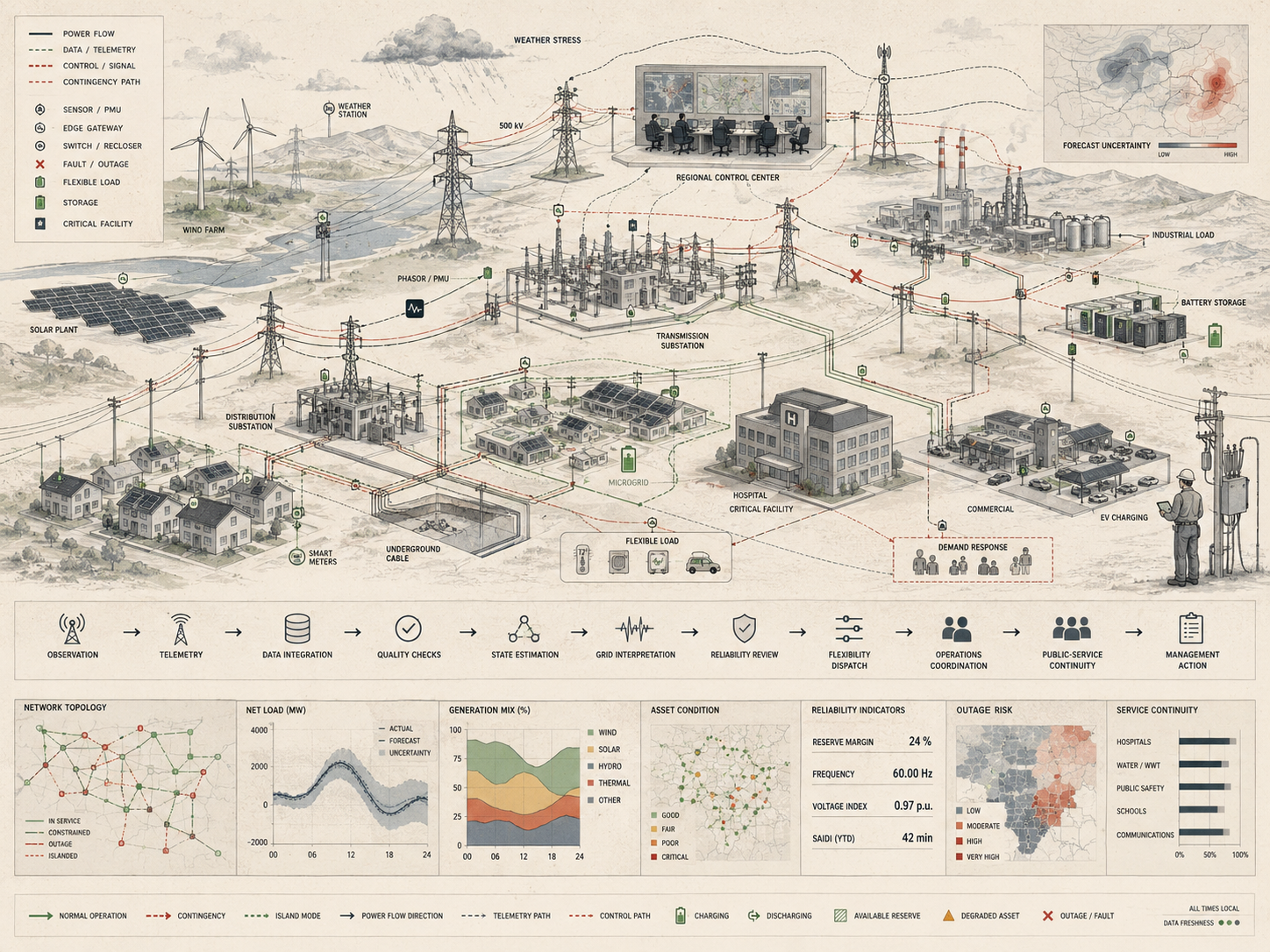
In practical terms, a smart grid is not a single device, platform, dashboard, or policy. It is a system condition in which digital communications, time-sensitive measurement, distributed monitoring, automated or semi-automated control, data platforms, analytical capabilities, interoperability frameworks, and institutional workflows become integral to the operation of the electricity system. Advanced meters, phasor measurement units, grid sensors, supervisory control systems, distribution management systems, outage management platforms, distributed energy resource management systems, grid-edge devices, microgrid controllers, storage platforms, and demand-response systems all contribute to this transition. What matters is not the presence of isolated technologies, but whether they are integrated into a grid that becomes more observable, more adaptive, more secure, and more governable under changing conditions.
This transformation also carries risk. As the electricity system becomes more digital, questions of interoperability, cybersecurity, data governance, asset visibility, vendor dependency, system coordination, workforce capability, public accountability, and institutional capacity become inseparable from questions of reliability and resilience. Smart grids therefore sit at the center of intelligent infrastructure because they illustrate, in especially consequential form, how digital systems become operationally embedded in critical physical infrastructure whose failure can cascade across energy, water, transport, communications, health care, food systems, public safety, and everyday life.
Engineering Problem
The engineering problem is how to operate, protect, coordinate, and govern an electricity system that is becoming more distributed, more variable, more digital, more interdependent, and more exposed to cyber-physical disruption. A conventional grid must continuously balance supply and demand, maintain voltage and frequency, protect equipment, restore service after faults, and preserve reliability under changing load conditions. A smart grid must still do all of that, but it must do so while integrating renewable variability, distributed generation, battery storage, electric vehicles, flexible loads, bidirectional power flows, digital control layers, remote telemetry, market participation, and more granular customer-side activity.
This problem is difficult because the modern electricity grid is no longer a mostly centralized delivery system with passive endpoints. It is becoming a multi-directional coordination system. Distributed solar can export power from rooftops. Electric vehicles can create local peak loads or flexible charging opportunities. Batteries can shift energy, provide grid services, or create new operational constraints. Microgrids can isolate and reconnect. Flexible demand can support reliability if it is visible and dispatchable. Inverter-based resources can support voltage and frequency, but only if technical standards, control strategies, and interoperability are strong. Each of these capabilities can improve grid performance, but each also adds complexity, communication needs, governance requirements, and risk.
Strong digital power infrastructure therefore requires an end-to-end operating model. It must define grid assets, service zones, measurement systems, telemetry requirements, control authority, data quality, distributed resource visibility, cyber-physical dependencies, outage response, restoration rules, resilience objectives, interoperability standards, market or regulatory constraints, and governance responsibilities. The central engineering question is not simply whether the grid has digital devices. It is whether the grid can use digital systems to understand system state, coordinate distributed resources, protect critical operations, and sustain electricity service under routine, transitional, and disrupted conditions.
| Engineering Tension | Why It Matters | Required Evidence |
|---|---|---|
| Centralized operation versus distributed activity | Grid-edge resources can support reliability and flexibility, but only if operators can observe and coordinate them safely. | Distributed energy resource inventory, telemetry records, interconnection status, control permissions |
| Digital visibility versus operational trust | More telemetry does not improve grid performance if readings are delayed, incomplete, uncalibrated, insecure, or poorly contextualized. | Sensor inventory, data-quality flags, latency records, time synchronization, telemetry integrity review |
| Automation versus degraded-mode operation | Automation can improve response speed, but overdependence on fragile digital systems can weaken resilience during communications or cyber disruption. | Fallback procedures, manual operating modes, continuity plan, cyber-physical incident response log |
| Flexibility versus control authority | Storage, demand response, EV charging, and distributed resources can provide flexibility only when operating authority and incentives are defined. | Flexibility register, dispatch rules, market participation records, demand-response program evidence |
| Interoperability versus vendor fragmentation | Smart grid systems often involve many vendors, protocols, platforms, devices, and operational environments. | Architecture model, standards register, interface inventory, procurement and data portability requirements |
| Reliability metrics versus resilience reality | A grid may perform well in routine conditions while remaining fragile under extreme weather, cyber incident, fuel disruption, or cascading failure. | Outage history, restoration records, resilience scenarios, backup and microgrid capability, after-action review |
The practical question is therefore: can digital power infrastructure convert measurement, communication, control, and distributed flexibility into reliable, resilient, secure, and accountable electricity service?
Reference Architecture
A practical reference architecture for smart energy grids links physical power infrastructure to measurement, communications, data integration, control, operations, distributed energy resource coordination, cybersecurity, market or regulatory governance, and resilience planning. The architecture should not begin with a dashboard. It should begin with the electricity system’s public and engineering responsibilities: safe operation, frequency stability, voltage control, reliable service, restoration capability, renewable integration, affordability, resilience, cyber security, and institutional accountability.
| Layer | Engineering Role | Primary Risk | Evidence Artifact |
|---|---|---|---|
| Grid-service objective layer | Defines reliability obligations, flexibility objectives, resilience targets, operational goals, market or regulatory uses, and valid decision uses. | Digital grid capabilities are deployed without clear service, reliability, or governance purpose. | Smart grid objective manifest, service-level register, flexibility policy |
| Physical power layer | Includes generation assets, transmission, substations, distribution feeders, protection systems, storage, meters, microgrids, and end-use demand. | Digital interpretation becomes detached from physical grid constraints, protection requirements, or asset condition. | Grid asset inventory, network topology, service-zone register |
| Measurement and sensing layer | Captures voltage, frequency, current, power flows, outages, equipment status, synchrophasor signals, meter readings, storage state, and grid-edge behavior. | Faults, congestion, power-quality problems, asset stress, and distributed resource behavior remain poorly observed. | Sensor inventory, phasor records, AMI records, telemetry log, calibration record |
| Communications and telemetry layer | Moves readings and commands among substations, control centers, field devices, distributed resources, customer systems, and enterprise platforms. | Operational awareness becomes unreliable because data are delayed, missing, insecure, or unavailable during disturbance. | Communications architecture, latency log, availability record, time-synchronization review |
| Data integration and analytics layer | Aligns telemetry, asset records, topology, weather, outage events, maintenance, DER records, and market or program participation data. | Measurements cannot support diagnosis, state awareness, forecasting, reliability review, or planning. | SQL schema, data catalog, metadata dictionary, model card, data-quality report |
| Control and coordination layer | Connects indicators to dispatch, protection, voltage control, outage management, restoration, DER coordination, storage dispatch, and demand flexibility. | Digital visibility does not translate into safe and accountable operational action. | Operations protocol, dispatch rules, DERMS record, outage response log |
| Governance and resilience layer | Defines interoperability, cybersecurity, data governance, customer protections, regulatory review, emergency management, procurement, workforce capability, and public accountability. | Digital grid modernization becomes fragmented, insecure, opaque, exclusionary, or weakly accountable. | Governance log, cyber-physical risk review, public evidence package, resilience scenario review |
This architecture makes clear that smart grids are not merely electricity systems with more digital devices. They are cyber-physical public-service systems whose digital layers must be integrated with grid engineering, operational authority, resilience planning, and institutional accountability.
Implementation Pattern
A rigorous implementation pattern begins with the grid problem rather than the technology. A utility, grid operator, regulator, public infrastructure agency, or energy planner should identify whether the challenge is outage restoration, DER visibility, renewable integration, voltage management, congestion, asset condition, demand flexibility, storage dispatch, cyber-physical exposure, grid-edge coordination, resilience planning, or interoperability. It should then determine what must be measured, which assets and zones are involved, what thresholds matter, who has authority to act, and how findings will be connected to operational response or planning action.
| Artifact | Purpose | Suggested Format |
|---|---|---|
| Smart grid objective manifest | Defines reliability, flexibility, resilience, service-continuity, operational, regulatory, and governance objectives. | YAML, Markdown, architecture decision record |
| Grid asset inventory | Documents generation, transmission, substations, distribution feeders, storage, meters, DERs, microgrids, EV charging, and control systems. | CSV, SQL table, asset-management export, GIS layer |
| Grid telemetry record | Stores timestamped voltage, frequency, power flow, current, breaker state, outage status, meter data, storage state, and grid-edge readings. | CSV, historian export, AMI export, synchrophasor dataset, API export |
| Distributed resource coordination register | Documents rooftop solar, batteries, EV charging, flexible loads, microgrids, demand response, aggregators, and dispatch permissions. | CSV, SQL table, DERMS export, program register |
| Reliability and resilience review | Tracks outage frequency, restoration time, fault isolation, backup capability, microgrid support, and recovery performance. | CSV, SQL table, outage-management export, after-action report |
| Cyber-physical grid review | Assesses telemetry integrity, remote access, segmentation, device visibility, firmware governance, incident response, and degraded-mode operation. | Markdown, YAML, asset inventory, security review |
| Interoperability and governance log | Connects standards, data access, device certification, public reporting, procurement, and review commitments. | CSV, SQL table, governance register, standards matrix |
The implementation goal is to make smart grid claims reconstructable. A reader should be able to move from a reliability score, DER flexibility claim, outage restoration indicator, voltage risk flag, telemetry quality warning, or resilience assessment back to the asset record, telemetry source, network context, data-quality flag, control rule, operational response, and governance decision that support it.
Research-Grade Framing: Digital Power as Public Infrastructure Stewardship
A research-grade account of smart grids begins by treating digital power systems as public infrastructure stewardship rather than as technology modernization alone. Electricity grids are not only engineering networks; they are public-service systems, economic systems, climate-transition systems, household systems, emergency-response systems, and dependency structures for nearly every other critical infrastructure domain. Their performance affects hospitals, water treatment, communications, transportation, housing, food systems, heating and cooling, public safety, industrial production, and the basic conditions of social life. Digital grid modernization therefore has public consequences beyond efficiency, optimization, or customer convenience.
This framing matters because digital systems shape what institutions can see, prioritize, and control. If a utility improves meter visibility but not outage restoration, customers may experience digitalization as billing modernization rather than service improvement. If distributed resources become visible only for higher-income participants, grid flexibility may reproduce unequal access to benefits. If automation accelerates operations while weakening degraded-mode procedures, digital modernization may increase fragility. If cybersecurity is treated as a technology department issue rather than a grid reliability issue, cyber risk can become physical service risk.
Digital power systems also require humility. Sensors can drift, telemetry can be delayed, models can be wrong, device inventories can be incomplete, distributed resources can behave unpredictably, and digital platforms can fail. A mature smart grid makes uncertainty, missingness, data latency, time synchronization, vendor dependency, model assumptions, device status, cybersecurity posture, and institutional responsibility visible. It combines digital systems with field engineering, operator judgment, protection engineering, public communication, regulatory oversight, and realistic fallback procedures.
| Limited Pattern | Stronger Pattern | Why the Shift Matters |
|---|---|---|
| Install smart meters and sensors | Build governed grid observability systems linked to service, reliability, resilience, and public accountability | Devices create public value only when they improve decisions and service outcomes. |
| Track system averages | Track local voltage, outage exposure, DER visibility, flexibility, asset stress, telemetry quality, and restoration equity | Grid risk often appears unevenly across geography, infrastructure age, and customer vulnerability. |
| Automate operations | Balance automation with cybersecurity, fallback procedures, human oversight, and degraded-mode operation | Automation can improve speed while creating brittleness if continuity planning is weak. |
| Treat DERs as customer-side assets | Integrate distributed resources into system flexibility, visibility, resilience, and planning frameworks | Grid-edge resources can become system assets only when they are visible, interoperable, and governable. |
| Modernize platforms separately | Build interoperable architectures across SCADA, AMI, DMS, OMS, DERMS, GIS, asset management, and analytics | Fragmented platforms reduce operational intelligence and increase institutional burden. |
The central research question is therefore: how can digital power systems strengthen reliability, resilience, flexibility, decarbonization, and public accountability without becoming fragmented, opaque, insecure, exclusionary, or overly dependent on fragile digital layers?
Formal Model: State Awareness, Flexibility, Reliability, and Resilience
A useful formal model separates grid observability, flexibility, reliability, service continuity, cyber-physical exposure, and resilience. Let \(O_{g,t}\) represent grid observability, \(F_t\) flexibility, \(D_t\) demand, \(S_t\) supply, \(V_{z,t}\) voltage condition in zone \(z\), \(C_{\mathrm{service}}\) service continuity, \(T\) telemetry reliability, and \(R_{\mathrm{grid}}\) grid resilience.
O_{g,t} =
\alpha T_t +
\beta Q_{\mathrm{data},t} +
\gamma C_{\mathrm{coverage},t} +
\delta M_{\mathrm{metadata},t}
–
\eta G_{\mathrm{gaps},t}
\]
Interpretation: Grid observability improves with telemetry reliability, data quality, measurement coverage, and metadata completeness, and weakens when monitoring gaps grow.
F_t =
F_{\mathrm{storage},t} +
F_{\mathrm{demand},t} +
F_{\mathrm{DER},t} +
F_{\mathrm{interconnection},t}
\]
Interpretation: Grid flexibility is a portfolio property created by storage, flexible demand, distributed resources, interconnection, and operational coordination.
B_t =
\left|S_t + F_t – D_t\right|
\]
Interpretation: A simplified balance residual shows the gap between available supply plus flexibility and demand; larger residuals indicate greater balancing pressure.
V_{\mathrm{adequacy},z,t} =
1 –
\frac{\left|V_{z,t} – V_{\mathrm{nominal}}\right|}{\Delta V_{\max}}
\]
Interpretation: Voltage adequacy expresses how close a zone remains to nominal voltage within an allowed deviation band.
C_{\mathrm{service},t} =
\frac{H_{\mathrm{served},t}}{H_{\mathrm{required},t}}
\]
Interpretation: Service continuity compares hours of electricity service delivered with required or expected service hours.
R_{\mathrm{grid}} =
\lambda_1 C_{\mathrm{service}} +
\lambda_2 F +
\lambda_3 O_g +
\lambda_4 B_{\mathrm{backup}} +
\lambda_5 A_{\mathrm{response}}
–
\lambda_6 E_{\mathrm{exposure}}
\]
Interpretation: Grid resilience rises with service continuity, flexibility, observability, backup capability, and response capacity, while physical, climate, and cyber-physical exposure reduce resilience.
This formal structure protects against a common mistake: treating smart grids as simple digital overlays. Grid intelligence must be evaluated through observability, flexibility, reliability, control capability, service continuity, cyber-physical integrity, and resilience together.
What Are Smart Energy Grids and Digital Power Systems?
Smart energy grids and digital power systems are electricity systems in which digital technologies are used to improve the monitoring, coordination, control, and adaptation of the grid. They connect measurement systems, communications networks, control environments, analytical models, operational platforms, and increasingly distributed assets across the full electricity value chain. This includes generation assets, transmission networks, substations, distribution systems, distributed generation, storage systems, flexible loads, microgrids, electric vehicles, customer-side devices, and grid-edge control environments.
Smart grids are best understood as the modernization of the electricity system’s informational and operational layers rather than as an entirely separate grid. Electricity still has to be generated, transmitted, distributed, balanced, protected, and delivered within engineering limits. What changes is the system’s capacity to sense conditions, communicate across its own network, coordinate a wider variety of assets, and respond to shifting operational realities more dynamically than conventional architectures allowed. A smart grid can therefore be understood as a more observable and more coordinatable grid, not simply as a more automated one.
Digital power systems encompass more than advanced metering and grid-edge devices. The concept includes the wider ecosystem of measurement, communication, control, interoperability, data platforms, cybersecurity, workforce practice, regulatory oversight, and institutional workflows that make modern grid operations possible. Smart grids and digital power systems therefore describe overlapping aspects of the same transition: the movement from a more centralized and relatively opaque electricity system toward one that is increasingly data-rich, cyber-physical, distributed, and analytically intensive.
The key distinction is that smartness should not be defined by digital intensity alone. A grid becomes meaningfully smarter when digital systems improve reliability, restoration, power quality, renewable integration, flexibility, resilience, asset stewardship, customer protection, and public accountability. Digital tools that do not improve service, reduce risk, strengthen governance, or clarify operational responsibility may add complexity without adding real intelligence.
Why the Electric Grid Is Becoming More Digital
The electric grid is becoming more digital because the operating environment of power systems has become more complex. Variable renewable generation, electrification of transport and buildings, distributed energy resources, rising load volatility, stronger resilience demands, aging infrastructure, climate-related hazards, power-quality challenges, and expanding customer participation all place pressure on legacy grid architectures. A system designed primarily around one-way delivery from central plants to passive consumers now has to accommodate bidirectional flows, local generation, storage, flexible demand, and more granular operational decision-making.
This shift increases the need for visibility and coordination. Operators must understand not only whether the grid is functioning at a broad level, but how local conditions, distributed assets, feeder constraints, voltage conditions, storage state, load profiles, and network vulnerabilities interact in real time and over longer planning horizons. A more digital grid allows measurements to be captured more frequently and from more locations, enabling better state awareness, faster fault detection, improved restoration workflows, more nuanced system balancing, and better integration of emerging technologies.
Digitalization also responds to transition and resilience pressures. As power systems face a wider range of extreme weather events, equipment stress, cyber threats, and interdependencies with other critical systems, the ability to monitor conditions, isolate faults, coordinate distributed response, and maintain situational awareness becomes more valuable. The modern grid is therefore not simply a more automated grid. It is a grid being redesigned for greater complexity, tighter coupling, lower-carbon resources, higher customer participation, and higher expectations of continuity.
| Grid-System Condition | Digital Capability Needed | Failure If Missing |
|---|---|---|
| Variable renewable generation | Forecasting, state awareness, flexibility coordination, storage dispatch, and congestion monitoring. | Renewable integration becomes constrained by curtailment, imbalance, congestion, or poor visibility. |
| Distributed energy resources | DER inventory, grid-edge telemetry, interconnection records, inverter visibility, and dispatch coordination. | Local resources remain invisible, unmanaged, or unable to support system reliability. |
| Electrification | Load forecasting, feeder monitoring, EV charging coordination, transformer stress tracking, and demand flexibility. | Local bottlenecks emerge before planning or reinforcement catches up. |
| Extreme weather and outage exposure | Situational awareness, outage management, fault location, restoration prioritization, and resilience analytics. | Restoration is slower, less targeted, and less transparent. |
| Cyber-physical dependence | Asset visibility, segmentation, telemetry integrity, incident response, and degraded-mode procedures. | Digital modernization creates new reliability and security fragility. |
The grid is becoming more digital because the cost of opacity is rising. A grid that cannot see itself clearly cannot reliably integrate new resources, coordinate flexibility, manage local constraints, recover from disruption, or explain its performance to the public.
Core Architecture of Digital Power Systems
Smart energy grids can be understood through a layered architecture that links physical power flows to digital measurement, communication, control, analytics, and governance. Each layer matters because weaknesses in physical assets, telemetry, communications, data quality, control logic, cybersecurity, or institutional accountability can undermine the whole system.
Physical Power Layer
This layer includes generation assets, renewable facilities, transmission lines, substations, distribution feeders, transformers, protection systems, storage assets, inverters, meters, microgrids, electric vehicles, flexible loads, and end-use demand. It remains the material foundation of the grid and determines the engineering realities within which all digital capabilities must operate. Digital systems can improve visibility and coordination, but they cannot eliminate physical limits such as thermal constraints, voltage conditions, fault currents, protection coordination, and equipment degradation.
Measurement and Sensing Layer
Digital power systems depend on extensive measurement. This may include advanced metering infrastructure, supervisory control and data acquisition signals, phasor measurements, substation sensors, feeder monitoring, equipment diagnostics, transformer temperature, breaker status, inverter telemetry, battery state of charge, outage indications, and grid-edge sensing. These systems make the grid more observable by rendering voltage, frequency, power flow, load, asset condition, disturbance patterns, and distributed resource behavior more legible.
Communication Layer
Measurements and commands must move across communications networks connecting field devices, substations, control centers, distributed assets, customer systems, and enterprise platforms. Reliability, latency, time synchronization, security, and segmentation matter here because communications integrity increasingly becomes part of grid integrity. A digital grid is only as trustworthy as the communications pathways and data-quality practices that support it.
Control and Coordination Layer
This layer includes energy management systems, distribution management systems, outage management systems, distributed energy resource management systems, storage dispatch tools, demand response platforms, protection logic, microgrid controllers, advanced distribution automation, operator interfaces, and field coordination workflows. It is where digital awareness becomes operational coordination.
Data and Analytics Layer
Smart grids increasingly depend on data platforms and analytics to integrate telemetry, asset records, weather inputs, event histories, customer programs, outage records, DER inventories, cybersecurity events, and planning data. This supports forecasting, fault analysis, condition assessment, restoration planning, operational optimization, flexibility evaluation, and longer-horizon resilience work.
Governance and Assurance Layer
This layer includes interoperability standards, cybersecurity governance, data access rules, procurement requirements, regulatory reporting, customer protections, workforce capability, incident response, public communication, and institutional review. It determines whether smart grid systems produce durable public value rather than fragmented technical complexity.
| Layer | Core Capability | Maturity Question |
|---|---|---|
| Physical power infrastructure | Generation, transmission, substations, distribution, storage, inverters, meters, protection, and end-use demand | Can the material grid provide reliable and safe service under changing operating conditions? |
| Measurement and sensing | AMI, SCADA, synchrophasors, grid sensors, feeder monitors, DER telemetry, and equipment diagnostics | Can system state be observed with enough accuracy, latency, and coverage to act? |
| Communications | Field networks, substation links, utility communications, time synchronization, device connectivity, and data transmission | Can readings and commands move securely and reliably during routine and disrupted conditions? |
| Control and operations | EMS, DMS, OMS, DERMS, storage dispatch, demand response, protection logic, and restoration workflows | Can signals be translated into timely and safe operational decisions? |
| Data and analytics | Data platforms, state estimation, forecasting, digital twins, anomaly detection, reliability analysis, and planning tools | Can grid evidence be integrated across assets, zones, time, and institutions? |
| Governance and assurance | Cybersecurity, interoperability, regulatory review, customer protections, procurement, workforce capability, and accountability | Can digital power infrastructure remain safe, legitimate, secure, and publicly accountable? |
Together these layers create a cyber-physical electricity system in which monitoring, communications, analytics, and decision support are integral to grid performance rather than merely adjacent to it.
Measurement, Visibility, and Grid State Awareness
Expanded visibility into system state is central to smart grids. Traditional grid operations already involved significant monitoring, but digital power systems increase both the granularity and the speed of observation. This matters because electric power systems must maintain balance, stability, voltage quality, frequency control, protection coordination, and service continuity under conditions that can change rapidly across geography and time.
Grid visibility supports several functions at once. It helps operators detect faults, identify abnormal conditions, understand restoration priorities, monitor congestion, assess power quality, manage equipment stress, and observe distributed resource behavior. More advanced measurement systems also support time-sensitive awareness of dynamic conditions across broader parts of the network. In practice, this means digital power systems can improve not only control, but diagnosis: they make it easier to distinguish between local anomalies, network-wide problems, equipment degradation, cyber-physical disruption, and emerging patterns of grid stress.
Visibility also matters for planning and stewardship. Historical and real-time measurements can inform maintenance prioritization, asset replacement, reliability analysis, resilience investment, grid modernization, DER hosting capacity, and capital planning. In this respect, measurement is not simply an operational convenience. It is one of the foundations of intelligent grid governance.
| Signal Type | What It Reveals | Operational Use |
|---|---|---|
| Voltage and frequency | Power quality, stability, local stress, inverter behavior, and abnormal operating conditions | Voltage regulation, power-quality review, protection coordination, grid-edge management |
| Power flow and loading | Congestion, thermal stress, feeder limits, transformer loading, and network bottlenecks | Congestion management, dynamic ratings, maintenance prioritization, reinforcement planning |
| Outage and fault data | Where service is interrupted, where faults occur, and how restoration is progressing | Fault location, isolation, restoration prioritization, public communication |
| Distributed resource telemetry | Solar, storage, EV charging, demand response, inverter behavior, and local flexibility | DER coordination, hosting capacity, local constraint management, flexibility dispatch |
| Asset condition data | Thermal stress, degradation, equipment health, maintenance needs, and failure precursors | Predictive maintenance, asset replacement, condition-based planning |
| Telemetry health | Latency, missingness, device status, time synchronization, communications availability, and data integrity | Data-quality governance, cybersecurity monitoring, operational trust review |
Grid state awareness is strongest when signals are integrated rather than isolated. Voltage without topology, outage records without field context, DER telemetry without interconnection status, and sensor readings without data-quality flags all produce partial intelligence. The goal is not more data in the abstract, but better situational awareness connected to safe and accountable action.
Distributed Energy Resources and Grid Coordination
The growth of distributed energy resources is a major driver of smart grid development. Rooftop solar, distributed storage, controllable loads, microgrids, electric vehicles, flexible building systems, and distributed generation complicate grid management because they introduce more nodes of activity, more variable behavior, and more bidirectional relationships between supply and demand. They also create new opportunities for resilience, local balancing, peak management, and customer participation when coordination is strong.
In a less digital system, these assets are harder to observe and coordinate. In a smarter grid, they can increasingly be integrated into operational logic through measurement, communications, data platforms, and control environments. This allows distributed assets to support broader system goals such as peak management, local resilience, voltage support, flexibility, restoration capacity, and renewable integration. The actual value depends heavily on interoperability, governance, customer protections, cybersecurity, and market or regulatory design.
The importance of distributed coordination also changes the meaning of the grid edge. End-use devices and local energy resources are no longer merely downstream loads. They can become active components within a wider electricity system. This makes digital coordination more important, but also raises new questions about access, standards, authority, security, compensation, privacy, and the balance between local autonomy and system-wide reliability.
| Distributed Resource | Grid Value | Coordination Requirement |
|---|---|---|
| Rooftop and community solar | Local renewable generation, peak reduction, customer participation, and resilience when paired with storage | Hosting capacity, inverter standards, voltage monitoring, interconnection records |
| Distributed storage | Peak shifting, backup power, local balancing, grid services, and outage support | State-of-charge visibility, dispatch rules, degradation management, safety review |
| Electric vehicles | Managed charging, flexible load, potential grid services, and transport-energy integration | Charging telemetry, tariffs or incentives, feeder monitoring, customer protections |
| Flexible buildings and loads | Demand response, load shifting, peak reduction, and grid support | Program enrollment, control permissions, comfort and equity safeguards, verification |
| Microgrids | Local resilience, islanding, critical-service continuity, and restoration support | Protection coordination, islanding rules, reconnection protocols, public-service priorities |
| Aggregated DER portfolios | System-level flexibility from many small assets | Aggregator governance, telemetry standards, dispatch verification, cybersecurity controls |
Distributed coordination is therefore both an engineering problem and a governance problem. The asset must exist, but the system also needs visibility, interoperability, operating authority, incentives, cyber protection, and institutional accountability to use it effectively.
Reliability, Resilience, and Grid Adaptation
Smart grids are often associated with efficiency, but their deeper significance lies in reliability and resilience. Reliability concerns the grid’s ability to perform consistently under expected operating conditions and maintain continuity of service within established performance standards. Resilience concerns the grid’s ability to withstand, adapt to, and recover from disturbances, including extreme weather, cyber incidents, equipment failures, fuel disruptions, communications outages, and complex cascading events. The distinction matters because a system may be reliable under normal conditions without being resilient under severe stress.
Digital power systems can support both goals, though in different ways. They can improve routine reliability by enhancing visibility, fault detection, load management, power-quality awareness, asset condition monitoring, and operational coordination. They can support resilience by improving situational awareness before and during disruptions, accelerating fault isolation and restoration, helping coordinate distributed backup and microgrid capability, and improving understanding of network dependencies and recovery priorities.
At the same time, resilience is not guaranteed by digitalization alone. A more instrumented grid can still be brittle if it becomes overly dependent on fragile communications links, opaque vendor systems, poorly segmented architectures, insufficient backup power, weak manual fallback, or institutional workflows that do not function well under stress. Digital modernization can strengthen resilience, but only when it is paired with robust engineering, disciplined operations, cybersecurity, realistic planning for degraded modes of performance, and institutional learning from incidents.
| Monitoring Focus | Reliability Question | Resilience Question |
|---|---|---|
| Service continuity | Is electricity service available under normal operating conditions? | Can critical service continue or be restored under extreme weather, cyber incident, or cascading disruption? |
| Grid state awareness | Can operators see voltage, frequency, loading, outages, and asset condition? | Can operators maintain situational awareness if telemetry, communications, or platforms degrade? |
| Distributed flexibility | Can storage, demand response, EV charging, and DERs support routine balancing? | Can distributed resources support recovery, islanding, or critical loads during disruption? |
| Outage management | Can faults be detected, isolated, and restored efficiently? | Can restoration be prioritized across vulnerable customers, critical services, and damaged network segments? |
| Digital systems | Are control platforms, sensors, and communications normally available? | Can operators function if SCADA, AMI, DERMS, OMS, or communications systems are degraded? |
Smart grids become resilience infrastructure when they support not only efficient operations, but continuity, redundancy, flexibility, degraded-mode operation, public communication, restoration learning, and institutional adaptation under stress.
Cyber-Physical Risk and System Vulnerability
Because smart grids are more digitally integrated, they also face more pronounced cyber-physical risks. Electricity systems are already complex and safety-critical. When communications, software, remote access, distributed control, platform dependencies, customer-side devices, inverter fleets, and third-party integrations are added, the system’s exposure profile changes. Vulnerabilities may arise through industrial control systems, third-party components, insecure interfaces, misconfiguration, weak credentials, inadequate segmentation, legacy devices, insufficient logging, or poor visibility into digital dependencies.
The central issue is that cyber events can become physical events. A compromised control environment, corrupted telemetry stream, unavailable communications pathway, manipulated inverter fleet, disrupted outage-management platform, or poorly secured edge device can affect restoration, protection, voltage control, dispatch, or operational stability. The smart grid is therefore not merely a more efficient version of the conventional grid. It is a more tightly coupled cyber-physical environment in which digital assurance becomes part of power-system assurance.
This does not mean digitalization should be treated as inherently destabilizing. It means grid modernization must be approached with serious attention to asset visibility, industrial control system security, network segmentation, identity and access management, telemetry integrity, secure device configuration, firmware governance, incident response, fallback procedures, and institutional preparedness. The challenge is not whether digital systems belong in the grid. They already do. The challenge is how to govern and secure them in ways consistent with the public importance of electricity infrastructure.
| Risk Category | Failure Mode | Mitigation Requirement |
|---|---|---|
| SCADA and control-system compromise | Dispatch, protection, switching, voltage control, or restoration behavior is disrupted or manipulated. | Segmentation, authentication, logging, access control, incident response, manual fallback |
| Telemetry corruption or loss | Operators see delayed, missing, incorrect, or spoofed grid conditions. | Data validation, redundancy, sensor health, latency monitoring, anomaly detection |
| Grid-edge device exposure | Meters, inverters, EV chargers, batteries, or DER devices become entry points for disruption. | Device inventory, firmware management, secure configuration, network monitoring |
| Vendor and platform dependency | Public service depends on opaque, proprietary, or fragile vendor-controlled systems. | Procurement standards, data portability, contract governance, continuity planning |
| DER aggregation risk | Aggregated customer-side resources behave in ways that destabilize distribution or bulk-system operations. | Aggregator governance, telemetry requirements, dispatch verification, fail-safe design |
| Customer data and privacy risk | Metering and grid-edge data expose sensitive patterns of household or business activity. | Data minimization, privacy review, access controls, aggregation, public explanation |
Cyber-physical risk must be treated as a core design condition of smart energy grids, not as a peripheral technology concern.
Interoperability, Governance, and Institutional Capacity
Smart grids depend on interoperability because modern electricity systems involve many devices, vendors, protocols, institutions, markets, customer programs, and control environments. If these systems cannot communicate coherently or be integrated into a usable operational architecture, digitalization produces fragmentation rather than intelligence. Interoperability standards therefore play a central role in making smart grids workable over time, especially when grid modernization spans transmission operators, distribution utilities, regulators, aggregators, equipment vendors, public agencies, and customers.
Governance matters just as much. Utilities, regulators, system operators, vendors, public agencies, market actors, aggregators, and communities all shape how digital power systems are built and used. Decisions about data access, device certification, cybersecurity expectations, market participation, rate design, resilience investment, public reporting, customer protections, and operational responsibility all influence whether smart grid capabilities translate into durable public value.
Institutional capacity is the final piece. A technically advanced system can still fail if organizations lack the staffing, documentation, training, asset inventories, recovery procedures, cybersecurity expertise, field coordination, and governance structures needed to interpret and act on digital information effectively. Smart grids are therefore not only technical systems. They are institutional systems whose quality depends on standards, governance, skills, accountability, and long-term stewardship as much as hardware and software.
| Capability | Purpose | Evidence Artifact |
|---|---|---|
| Interoperability governance | Prevents fragmentation across devices, vendors, communications protocols, control systems, data platforms, and DER programs. | Standards matrix, interface register, API documentation, procurement requirements |
| Cybersecurity governance | Protects operational technology, telemetry, remote access, device firmware, credentials, and platform continuity. | Security architecture, asset inventory, incident response plan, fallback procedure |
| Operational authority | Connects alerts, telemetry, and flexibility signals to dispatch, restoration, field work, and control-room decisions. | Operations protocol, DER dispatch rules, outage-response log, work-order integration |
| Customer and data governance | Protects privacy, access, affordability, participation, communication, and customer rights in smart grid programs. | Data-access policy, privacy review, customer communication plan, affordability review |
| Regulatory accountability | Connects smart grid investments to reliability, resilience, flexibility, equity, and public-service outcomes. | Regulatory filing, performance report, public evidence package, benefit-cost review |
| Institutional learning | Uses outages, cyber incidents, near misses, DER events, complaints, and after-action reviews to improve systems over time. | After-action report, corrective-action log, governance review cycle |
The governance question is whether smart grid modernization strengthens service quality, resilience, flexibility, decarbonization, public trust, and accountability, or whether it simply adds digital complexity to already strained institutions.
Deployment Readiness Gate
Before smart grid workflows are used for operations, distributed resource coordination, outage management, voltage control, storage dispatch, demand response, reliability reporting, resilience planning, cyber-physical incident response, regulatory claims, or capital prioritization, they should pass a readiness gate. The purpose is not to slow modernization. It is to confirm that digital grid outputs are supported by documented objectives, trustworthy data, validated indicators, cybersecurity controls, operational response pathways, and governance accountability.
| Readiness Check | Pass Condition | Evidence |
|---|---|---|
| Service and reliability purpose | Grid-service goals, reliability objectives, flexibility needs, operational domains, decision uses, and valid-use limits are defined. | Smart grid objective manifest, reliability policy, flexibility plan |
| Asset and topology context | Generation, transmission, substations, feeders, transformers, meters, storage, DERs, EV charging, and microgrids are documented. | Grid asset inventory, topology map, DER register |
| Telemetry and data quality | Latency, missingness, calibration, timestamps, time synchronization, device status, and provenance are tracked. | Telemetry log, data-quality report, time-synchronization review, metadata dictionary |
| Operational validation | Voltage, frequency, power flow, outage, DER, storage, and flexibility indicators are tested against field evidence and operational experience. | Validation report, outage record, field inspection record, model card |
| DER and flexibility governance | Distributed resources, storage, demand response, EV charging, and aggregators are connected to dispatch rules and customer protections. | DERMS register, flexibility program rules, participation records, verification report |
| Cybersecurity and continuity | SCADA, AMI, DERMS, OMS, telemetry, remote access, field devices, credentials, logging, segmentation, and fallback procedures are defined and tested. | Security architecture, device inventory, continuity plan, incident response playbook |
| Operational response | Alerts and indicators are connected to dispatch, voltage control, outage restoration, field response, customer communication, or capital planning. | Operations protocol, work-order integration, response log, public communication plan |
| Public accountability | Assumptions, limitations, responsible institutions, review cycles, public claims, customer-facing communication, and regulatory evidence are documented. | Public evidence package, regulatory report, transparency record |
A digital grid system that cannot pass this readiness gate may still collect useful data, but its outputs should be treated cautiously when used for operational automation, regulatory assurance, public claims, resilience scoring, or infrastructure investment decisions.
Data and Configuration Artifacts
The companion repository can use a data-first structure so smart grid claims can be examined rather than merely asserted. Each artifact has a specific role in making the grid observability chain reconstructable across assets, telemetry, reliability, flexibility, cyber-physical risk, distributed energy resources, outage response, and governance.
| Artifact | File | Purpose |
|---|---|---|
| Smart grid objective manifest | config/smart_grid_objective.yml |
Defines service obligations, reliability objectives, flexibility needs, digital coordination goals, decision uses, and valid-use limits. |
| Grid asset inventory | data/grid_asset_inventory.csv |
Documents generation, transmission, substations, feeders, transformers, storage, meters, DERs, EV charging, and microgrids. |
| Grid telemetry records | data/grid_telemetry_records.csv |
Stores timestamped voltage, frequency, current, power flow, loading, outage state, storage state, and telemetry-quality readings. |
| Distributed resource coordination register | data/distributed_resource_coordination_register.csv |
Documents DERs, batteries, EV chargers, flexible loads, microgrids, aggregators, dispatch permissions, and grid-service capability. |
| Reliability and resilience review | data/grid_reliability_resilience_review.csv |
Tracks outage frequency, restoration time, service continuity, fallback capability, resilience, and recovery indicators. |
| Cyber-physical grid review | data/cyber_physical_grid_review.csv |
Assesses telemetry integrity, segmentation, remote access, device visibility, firmware status, incident readiness, and fallback capability. |
| Governance and interoperability log | data/grid_governance_interoperability_log.csv |
Documents standards, procurement, regulatory, customer, cybersecurity, and institutional-review actions. |
| SQL schema | sql/schema.sql |
Creates a local SQLite database for smart grid evidence records. |
These artifacts are designed to make smart grid infrastructure auditable. They can be replaced with institutional data sources later, but the scaffold makes the logic of observability, flexibility, reliability, resilience, cybersecurity, distributed coordination, and governance explicit from the beginning.
Mathematical Lens: Digital Power, Flexibility, and Resilience
A lightweight mathematical lens helps distinguish smart grid infrastructure from simple digital-device deployment. The point is not to reduce grid performance to a single score, but to make visible the relationships among observability, telemetry quality, flexibility, supply-demand balance, voltage adequacy, service continuity, cyber-physical exposure, and resilience.
O_{g,t} =
\alpha T_t +
\beta Q_{\mathrm{data},t} +
\gamma C_{\mathrm{coverage},t} +
\delta M_{\mathrm{metadata},t}
–
\eta G_{\mathrm{gaps},t}
\]
Interpretation: Grid observability improves when telemetry reliability, data quality, coverage, and metadata are strong, and weakens when monitoring gaps grow.
F_t =
F_{\mathrm{storage},t} +
F_{\mathrm{demand},t} +
F_{\mathrm{DER},t} +
F_{\mathrm{interconnection},t}
\]
Interpretation: Flexibility is a portfolio property. Storage is important, but so are demand response, distributed resources, interconnection, and dispatch coordination.
B_t =
\left|S_t + F_t – D_t\right|
\]
Interpretation: Balancing pressure grows when supply plus flexibility does not closely match demand.
V_{\mathrm{adequacy},z,t} =
1 –
\frac{\left|V_{z,t} – V_{\mathrm{nominal}}\right|}{\Delta V_{\max}}
\]
Interpretation: Voltage adequacy measures whether local voltage remains within a useful operating range around nominal voltage.
C_{\mathrm{service},t} =
\frac{H_{\mathrm{served},t}}{H_{\mathrm{required},t}}
\]
Interpretation: Service continuity links grid performance to the actual availability of electricity service.
R_{\mathrm{grid}} =
\lambda_1 C_{\mathrm{service}} +
\lambda_2 F +
\lambda_3 O_g +
\lambda_4 B_{\mathrm{backup}} +
\lambda_5 A_{\mathrm{response}}
–
\lambda_6 E_{\mathrm{exposure}}
\]
Interpretation: Grid resilience depends on service continuity, flexibility, observability, backup capability, and response capacity, while climate, physical, and cyber-physical exposure reduce resilience.
This mathematical framing should be used as a structured diagnostic, not as a substitute for certified power-system planning, protection engineering, reliability standards, cybersecurity review, operator judgment, regulatory compliance, or public infrastructure governance.
Python Workflow: Smart Grid Infrastructure Review
The Python workflow in the companion repository can read grid asset inventories, telemetry records, distributed resource coordination registers, reliability and resilience reviews, cyber-physical risk reviews, and governance logs; compute observability, voltage adequacy, flexibility adequacy, balancing pressure, service continuity, resilience, cybersecurity risk, and review flags; and export a governance-ready smart grid infrastructure watchlist.
from pathlib import Path
import pandas as pd

ARTICLE_DIR = Path("articles/smart-energy-grids-and-digital-power-systems-resilience-flexibility-and-control")
DATA_DIR = ARTICLE_DIR / "data"
OUTPUT_DIR = ARTICLE_DIR / "outputs"
OUTPUT_DIR.mkdir(parents=True, exist_ok=True)

assets = pd.read_csv(DATA_DIR / "grid_asset_inventory.csv")
telemetry = pd.read_csv(DATA_DIR / "grid_telemetry_records.csv", parse_dates=["timestamp"])
der = pd.read_csv(DATA_DIR / "distributed_resource_coordination_register.csv")
resilience = pd.read_csv(DATA_DIR / "grid_reliability_resilience_review.csv")
cyber = pd.read_csv(DATA_DIR / "cyber_physical_grid_review.csv")

review = (
    telemetry
    .merge(assets, on="asset_id", how="left")
    .merge(der, on="service_zone_id", how="left")
    .merge(resilience, on="service_zone_id", how="left")
    .merge(cyber, on="service_zone_id", how="left")
)

review["latency_score"] = (
    1 - review["latency_seconds"] / review["latency_seconds"].max()
).clip(lower=0, upper=1)

review["grid_observability_score"] = (
    0.25 * review["telemetry_reliability_score"] +
    0.25 * review["data_quality_score"] +
    0.20 * review["coverage_score"] +
    0.15 * review["metadata_completeness_score"] +
    0.15 * review["latency_score"]
).clip(lower=0, upper=1)

review["voltage_adequacy_score"] = (
    1 - (review["voltage_pu"] - 1.0).abs() / review["allowed_voltage_deviation_pu"]
).clip(lower=0, upper=1)

review["flexibility_adequacy_score"] = (
    review["available_flexibility_mw"] / review["flexibility_need_mw"].replace(0, pd.NA)
).fillna(1).clip(lower=0, upper=1)

review["balancing_pressure_score"] = (
    (review["load_mw"] - review["available_supply_mw"] - review["available_flexibility_mw"]).abs() /
    review["load_mw"].replace(0, pd.NA)
).fillna(0).clip(lower=0, upper=1)

review["service_continuity_score"] = (
    review["served_hours"] / review["required_service_hours"].replace(0, pd.NA)
).fillna(0).clip(lower=0, upper=1)

review["grid_resilience_score"] = (
    0.25 * review["service_continuity_score"] +
    0.20 * review["flexibility_adequacy_score"] +
    0.20 * review["grid_observability_score"] +
    0.15 * review["backup_capability_score"] +
    0.15 * review["response_capacity_score"] -
    0.15 * review["exposure_risk_score"]
).clip(lower=0, upper=1)

review["smart_grid_review_flag"] = (
    (review["grid_observability_score"] < 0.70) |
    (review["voltage_adequacy_score"] < 0.70) |
    (review["flexibility_adequacy_score"] < 0.75) |
    (review["balancing_pressure_score"] >= 0.20) |
    (review["service_continuity_score"] < 0.90) |
    (review["grid_resilience_score"] < 0.70) |
    (review["cyber_physical_risk_score"] >= 0.35) |
    (review["quality_flag"].eq("review"))
)

watchlist = (
    review[review["smart_grid_review_flag"]]
    .sort_values(
        ["cyber_physical_risk_score", "balancing_pressure_score", "exposure_risk_score"],
        ascending=[False, False, False]
    )
)

review.to_csv(OUTPUT_DIR / "smart_grid_infrastructure_review.csv", index=False)
watchlist.to_csv(OUTPUT_DIR / "smart_grid_governance_watchlist.csv", index=False)

print(watchlist[[
    "asset_id",
    "asset_name",
    "asset_class",
    "service_zone_id",
    "grid_observability_score",
    "voltage_adequacy_score",
    "flexibility_adequacy_score",
    "grid_resilience_score"
]])
This workflow is intentionally transparent. It allows analysts to see whether smart grid concern arises from weak observability, voltage risk, flexibility shortfall, balancing pressure, service-continuity weakness, cyber-physical exposure, or resilience weakness.
R Workflow: Grid Visibility, Flexibility, and Resilience Reporting
The R workflow can summarize digital power-system performance by service zone, asset class, operational domain, distributed resource zone, or governance concern; identify observability, voltage, flexibility, reliability, resilience, and cyber-physical risks; and create stewardship-oriented reports for utilities, regulators, operators, energy planners, resilience teams, and governance review groups.
library(readr)
library(dplyr)

article_dir <- "articles/smart-energy-grids-and-digital-power-systems-resilience-flexibility-and-control"
data_dir <- file.path(article_dir, "data")
output_dir <- file.path(article_dir, "outputs")
dir.create(output_dir, recursive = TRUE, showWarnings = FALSE)

assets <- read_csv(file.path(data_dir, "grid_asset_inventory.csv"), show_col_types = FALSE)
telemetry <- read_csv(file.path(data_dir, "grid_telemetry_records.csv"), show_col_types = FALSE)
der <- read_csv(file.path(data_dir, "distributed_resource_coordination_register.csv"), show_col_types = FALSE)
resilience <- read_csv(file.path(data_dir, "grid_reliability_resilience_review.csv"), show_col_types = FALSE)
cyber <- read_csv(file.path(data_dir, "cyber_physical_grid_review.csv"), show_col_types = FALSE)

review <- telemetry %>%
  left_join(assets, by = "asset_id") %>%
  left_join(der, by = "service_zone_id") %>%
  left_join(resilience, by = "service_zone_id") %>%
  left_join(cyber, by = "service_zone_id") %>%
  mutate(
    latency_score = pmax(0, pmin(1, 1 - latency_seconds / max(latency_seconds, na.rm = TRUE))),
    grid_observability_score = pmax(
      0,
      pmin(
        1,
        0.25 * telemetry_reliability_score +
        0.25 * data_quality_score +
        0.20 * coverage_score +
        0.15 * metadata_completeness_score +
        0.15 * latency_score
      )
    ),
    voltage_adequacy_score = pmax(
      0,
      pmin(1, 1 - abs(voltage_pu - 1.0) / allowed_voltage_deviation_pu)
    ),
    flexibility_adequacy_score = if_else(
      flexibility_need_mw > 0,
      pmax(0, pmin(1, available_flexibility_mw / flexibility_need_mw)),
      1
    ),
    balancing_pressure_score = if_else(
      load_mw > 0,
      pmax(0, pmin(1, abs(load_mw - available_supply_mw - available_flexibility_mw) / load_mw)),
      0
    ),
    service_continuity_score = if_else(
      required_service_hours > 0,
      pmax(0, pmin(1, served_hours / required_service_hours)),
      0
    ),
    grid_resilience_score = pmax(
      0,
      pmin(
        1,
        0.25 * service_continuity_score +
        0.20 * flexibility_adequacy_score +
        0.20 * grid_observability_score +
        0.15 * backup_capability_score +
        0.15 * response_capacity_score -
        0.15 * exposure_risk_score
      )
    ),
    smart_grid_review_flag =
      grid_observability_score < 0.70 |
      voltage_adequacy_score < 0.70 |
      flexibility_adequacy_score < 0.75 |
      balancing_pressure_score >= 0.20 |
      service_continuity_score < 0.90 |
      grid_resilience_score < 0.70 |
      cyber_physical_risk_score >= 0.35 |
      quality_flag == "review"
  )

zone_summary <- review %>%
  group_by(service_zone_id) %>%
  summarise(
    assets = n_distinct(asset_id),
    observations = n(),
    mean_observability = mean(grid_observability_score, na.rm = TRUE),
    mean_voltage_adequacy = mean(voltage_adequacy_score, na.rm = TRUE),
    mean_flexibility_adequacy = mean(flexibility_adequacy_score, na.rm = TRUE),
    mean_balancing_pressure = mean(balancing_pressure_score, na.rm = TRUE),
    mean_resilience = mean(grid_resilience_score, na.rm = TRUE),
    mean_cyber_physical_risk = mean(cyber_physical_risk_score, na.rm = TRUE),
    review_flags = sum(smart_grid_review_flag, na.rm = TRUE),
    .groups = "drop"
  ) %>%
  arrange(desc(review_flags), desc(mean_cyber_physical_risk))

write_csv(review, file.path(output_dir, "smart_grid_infrastructure_review_report.csv"))
write_csv(zone_summary, file.path(output_dir, "smart_grid_service_zone_summary.csv"))

print(zone_summary)
The purpose is not to produce a definitive smart grid grade. It is to demonstrate how observability, voltage adequacy, flexibility, balancing pressure, service continuity, cyber-physical risk, and resilience can be made reproducible and auditable.
Systems Code: Grid Monitoring, Edge Sensing, and Digital Power Control
The companion repository can extend the article into a reproducible systems scaffold. Python and R support analytical review; SQL stores evidence; YAML files define objectives and policies; GeoJSON can provide spatial placeholders; TypeScript can support dashboard interfaces; Go can support smart grid status APIs; Rust can support strict grid-record validation; C can support voltage, observability, flexibility, and resilience calculations; Fortran can support numerical grid and resilience routines; MicroPython can support low-power grid-edge monitoring nodes; PYNQ and HDL can support hardware-assisted stream validation where appropriate.
| Directory | Role | Example Use |
|---|---|---|
python/ |
Smart grid review, observability scoring, voltage review, flexibility analysis, resilience indicators, governance watchlists | Compute grid observability, voltage adequacy, flexibility adequacy, balancing pressure, and review flags |
r/ |
Service-zone summaries, reliability and flexibility reports, resilience and cyber-physical risk reporting | Summarize digital power performance by zone and asset class |
sql/ |
Evidence tables and auditable queries | Join asset inventory, telemetry, DER records, resilience reviews, cyber risk, and governance actions |
c/ and embedded_c/ |
Low-level grid telemetry and threshold checks | Validate voltage, frequency, loading, latency, battery, telemetry, and quality flags at the edge |
rust/ |
Strict validation and CLI scaffolding | Validate grid telemetry records, voltage ranges, frequency ranges, and telemetry fields |
go/ |
Smart grid status API scaffold | Expose zone, asset, observability, voltage, flexibility, resilience, and cyber-risk status over a lightweight endpoint |
fortran/ |
Numerical power-system calculations | Prototype observability, balancing pressure, flexibility adequacy, and resilience equations |
micropython/ |
Edge sensing-node scaffold | Prototype low-power voltage, current, frequency, loading, or device-health telemetry |
pynq/ and hdl/ |
Hardware-assisted stream validation | Prototype FPGA checks for voltage, frequency, current, loading, latency, and threshold flags |
typescript/ |
Dashboard/interface scaffold | Display observability, voltage adequacy, flexibility, service continuity, cyber risk, and resilience flags |
The code should be understood as an engineering scaffold for reproducible smart grid infrastructure workflows, not as a replacement for certified grid operations, protection engineering, reliability standards, cybersecurity review, regulatory compliance, power-system planning, or operator judgment.
GitHub Repository
The companion repository can house the reproducible data, code, schemas, validation tools, and systems-engineering examples that support this article’s smart grid and digital power systems framework.
Testing and Validation
Testing smart grid infrastructure requires more than checking whether sensors report values or dashboards load. Validation should examine whether assets are correctly identified, whether telemetry is trustworthy, whether voltage and frequency indicators correspond to operational reality, whether distributed resource records reflect field conditions, whether flexibility is actually dispatchable, whether outage and restoration indicators are meaningful, whether cybersecurity controls protect monitoring and control environments, and whether governance pathways can turn evidence into public-service improvement.
| Validation Area | Test Question | Failure Signal |
|---|---|---|
| Asset inventory | Are generation, substations, feeders, transformers, meters, storage systems, DERs, EV chargers, microgrids, and control systems documented? | Telemetry cannot be interpreted in topology, service, or operational context. |
| Telemetry quality | Are timestamps, latency, missingness, calibration, time synchronization, device health, units, and provenance tracked? | Dashboards appear current while data are delayed, partial, unsynchronized, or invalid. |
| Voltage and power-quality validation | Do voltage, frequency, power-flow, and loading indicators correspond to field evidence and operational systems? | Local constraints, power-quality issues, or instability risks remain hidden. |
| Distributed resource validation | Are DERs, storage, EV charging, flexible loads, microgrids, and aggregators visible and connected to dispatch or planning rules? | Flexibility exists nominally but cannot support system operations. |
| Reliability and resilience validation | Do outage, restoration, service-continuity, backup, and response indicators distinguish routine reliability from stress resilience? | Systems appear reliable until extreme conditions expose hidden weakness. |
| Cybersecurity and continuity | Are SCADA, AMI, DERMS, OMS, telemetry, remote access, devices, credentials, communications, and fallback procedures protected and tested? | Digital visibility creates new operational fragility. |
| Operational response | Are alerts connected to dispatch, voltage control, outage restoration, field response, public communication, or capital planning? | Digital grid systems observe problems but do not change action. |
Validation should be repeated after sensor deployments, AMI changes, SCADA migrations, DERMS deployments, grid-code updates, major outages, extreme weather events, cyber findings, storage deployments, demand-response program changes, and major shifts in electrification or distributed resource adoption.
Operational Signals and Smart Grid Observability
Smart grid observability means being able to see whether the physical power system, digital monitoring system, distributed resource environment, operational workflow, cyber-physical security posture, and governance process are functioning as trustworthy public infrastructure. This includes voltage, frequency, loading, outages, restoration progress, asset condition, DER status, storage state, flexible load availability, telemetry latency, missingness, device health, time synchronization, cybersecurity events, service continuity, and response closure.
| Signal | What It Reveals | Operational Use |
|---|---|---|
| Voltage and frequency | Whether power quality and stability remain within useful operating limits | Voltage control, frequency response, inverter coordination, grid-edge management |
| Loading and power flow | Whether assets are approaching thermal, capacity, or congestion constraints | Congestion management, dynamic ratings, reinforcement planning, asset protection |
| Outage and restoration status | Where service is interrupted and how recovery is progressing | Fault isolation, crew dispatch, restoration prioritization, public communication |
| Distributed resource availability | Whether storage, DERs, EV charging, flexible loads, and microgrids can support system needs | Flexibility dispatch, peak management, resilience planning, DER program design |
| Telemetry and platform health | Whether monitoring systems themselves are current, complete, synchronized, secure, and available | Data-quality governance, cybersecurity, continuity planning |
| Cyber-physical risk status | Whether control systems, remote access, field devices, credentials, and platforms are exposed | Security response, segmentation review, incident response, degraded-mode preparation |
| Governance action closure | Whether observations lead to field action, policy change, procurement, investment, or public reporting | Accountability and institutional learning |
Smart grid observability is strongest when the system can monitor not only physical grid conditions, but also the quality, reliability, security, and actionability of the digital and governance systems that support electricity service.
Engineer and Researcher Checklist
- Define grid-service goals, reliability objectives, flexibility needs, operational domains, regulatory uses, and valid-use limits before selecting indicators.
- Document generation, transmission, substations, feeders, transformers, protection systems, storage, meters, DERs, EV charging, microgrids, and control platforms.
- Track telemetry quality: timestamps, latency, missingness, calibration, device health, time synchronization, units, metadata, and provenance.
- Evaluate voltage, frequency, loading, power flow, outage status, restoration progress, DER availability, and storage state in topology context.
- Connect distributed resources to interconnection records, dispatch rules, customer protections, verification, cybersecurity, and planning assumptions.
- Protect SCADA, AMI, DERMS, OMS, field devices, remote access, credentials, data platforms, and communications through cybersecurity architecture and fallback procedures.
- Distinguish routine reliability from resilience under extreme weather, cyber incident, equipment failure, communications outage, or cascading disruption.
- Connect alerts and indicators to dispatch, voltage control, outage restoration, field response, public communication, regulatory reporting, or capital planning.
- Document assumptions, thresholds, quality caveats, model limits, data gaps, responsible institutions, and public reporting responsibilities.
- Use incidents, near misses, outages, DER events, cyber findings, customer complaints, and after-action reviews to improve systems over time.
This checklist is intentionally practical. It keeps smart grid infrastructure focused on reliability, resilience, flexibility, cyber-physical safety, interoperability, public accountability, and operational action rather than digital modernization alone.
Where This Fits in the Series
Smart energy grids and digital power systems connect several major threads within the Intelligent Infrastructure Systems knowledge series. They rely on digital infrastructure to move telemetry and operational data, cyber-physical systems to connect software with physical electricity assets, infrastructure monitoring to capture field conditions, data platforms to integrate records, renewable energy infrastructure to manage variable generation, energy performance monitoring to evaluate reliability and degradation, security systems to protect control environments, and governance systems to translate grid evidence into accountable maintenance, investment, and resilience decisions.
This article therefore functions as a bridge between energy systems, digital infrastructure, cyber-physical control, distributed resources, resilience planning, and infrastructure governance. It shows that intelligent infrastructure is not only about automation, sensing, optimization, or digital platforms. It is also about whether essential systems can see clearly, act safely, coordinate flexibly, recover under stress, preserve public trust, and adapt under changing conditions.
Future Directions
The future of smart energy grids will likely involve deeper integration of distributed energy resources, more advanced grid-edge coordination, richer measurement environments, stronger interoperability frameworks, more grid-forming inverter capabilities, wider storage dispatch, expanded demand response, more granular distribution visibility, more resilient communications, and more extensive use of analytics, automation, and digital twin approaches in planning and operations. Grid modernization is likely to continue shifting attention from simple one-way delivery toward adaptive network management across transmission, distribution, and customer-side resources.
The deeper challenge, however, is not simply building a more digital grid. It is building a power system that remains reliable, resilient, secure, interpretable, affordable, flexible, and governable as digital complexity grows. Smart grids will matter most where they improve public and operational capability rather than merely adding technological layers. The long-run goal is not smartness as branding. It is an electricity system that can see more clearly, respond more effectively, integrate new resources more safely, protect critical service more reliably, and recover more robustly under changing conditions.
Future work should therefore move beyond smart grid rhetoric toward governed grid observability: rigorous, interoperable, cyber-resilient, public-purpose, operator-centered, customer-aware, and connected to the practical requirements of reliable electricity service. The grid of the future will not be intelligent simply because it contains more devices. It will be intelligent when its physical, digital, operational, and institutional layers are coordinated well enough to sustain essential service under uncertainty.
Related Articles
- Digital Infrastructure Systems
- Cyber-Physical Infrastructure Systems
- Infrastructure Monitoring and Sensor Integration
- Infrastructure Data Platforms and Analytics
- Infrastructure for Renewable Energy Systems
- Monitoring Energy Infrastructure Performance
- Asset Management and Predictive Maintenance Systems
- Infrastructure Security and Cyber Resilience
- Infrastructure Governance and Policy Systems
- Infrastructure Systems for Urban Resilience
These connections are substantive rather than decorative. Smart energy grids are not isolated energy technologies, but infrastructural systems that connect digital coordination, physical operations, analytical visibility, distributed flexibility, cyber-physical risk, resilience planning, and institutional stewardship.
Further Reading
- International Energy Agency (IEA) (2023) Smart grids. Available at: https://www.iea.org/energy-system/electricity/smart-grids.
- International Energy Agency (IEA) (2023) Electricity Grids and Secure Energy Transitions. Available at: https://www.iea.org/reports/electricity-grids-and-secure-energy-transitions.
- International Energy Agency (IEA) (2023) Unlocking Smart Grid Opportunities in Emerging Markets and Developing Economies. Available at: https://www.iea.org/reports/unlocking-smart-grid-opportunities-in-emerging-markets-and-developing-economies.
- International Renewable Energy Agency (IRENA) (2022) Smart Electrification with Renewables: Driving the Transformation of Energy Services. Available at: https://www.irena.org/publications/2022/Feb/Smart-Electrification-with-Renewables.
- IEC 61850 (n.d.) Communication concepts. Available at: https://iec61850.dvl.iec.ch/what-is-61850/technical-principles/comm_concepts/.
- IEC 61850 (n.d.) Targeted markets. Available at: https://iec61850.dvl.iec.ch/what-is-61850/targeted-markets/.
- International Smart Grid Action Network (ISGAN) (2022) Flexibility for Resilience. Available at: https://www.iea-isgan.org/wp-content/uploads/2022/06/2022-ISGAN-WG6_Flexibility-for-Resilience.pdf.
- International Smart Grid Action Network (ISGAN) (2024) Exploring the Interaction Between Power System Stakeholders: Insights from Pilot Projects. Available at: https://www.iea-isgan.org/wp-content/uploads/2025/02/Exploring-the-interaction-between-power-system-stakeholders-Insights-from-Pilot-Projects.pdf.
References
- IEC 61850 (n.d.) Communication concepts. Available at: https://iec61850.dvl.iec.ch/what-is-61850/technical-principles/comm_concepts/.
- IEC 61850 (n.d.) Targeted markets. Available at: https://iec61850.dvl.iec.ch/what-is-61850/targeted-markets/.
- International Energy Agency (IEA) (2023) Electricity Grids and Secure Energy Transitions. Paris: IEA. Available at: https://www.iea.org/reports/electricity-grids-and-secure-energy-transitions.
- International Energy Agency (IEA) (2023) Smart grids. Available at: https://www.iea.org/energy-system/electricity/smart-grids.
- International Energy Agency (IEA) (2023) Unlocking Smart Grid Opportunities in Emerging Markets and Developing Economies. Paris: IEA. Available at: https://www.iea.org/reports/unlocking-smart-grid-opportunities-in-emerging-markets-and-developing-economies.
- International Renewable Energy Agency (IRENA) (2022) Smart Electrification with Renewables: Driving the Transformation of Energy Services. Abu Dhabi: IRENA. Available at: https://www.irena.org/publications/2022/Feb/Smart-Electrification-with-Renewables.
- International Smart Grid Action Network (ISGAN) (2022) Flexibility for Resilience. Available at: https://www.iea-isgan.org/wp-content/uploads/2022/06/2022-ISGAN-WG6_Flexibility-for-Resilience.pdf.
- International Smart Grid Action Network (ISGAN) (2024) Exploring the Interaction Between Power System Stakeholders: Insights from Pilot Projects. Available at: https://www.iea-isgan.org/wp-content/uploads/2025/02/Exploring-the-interaction-between-power-system-stakeholders-Insights-from-Pilot-Projects.pdf.