
Last Updated May 14, 2026
Climate early warning systems are anticipatory socio-technical infrastructures designed to detect climate- and weather-related hazards, translate uncertain forecasts and risk knowledge into actionable warnings, and create protective lead time before environmental threats escalate into disaster. They combine hazard monitoring, forecasting and prediction, exposure and vulnerability analysis, communication systems, institutional protocols, and preparedness capacity in order to reduce mortality, protect livelihoods, and improve resilience. An early warning system is therefore not merely a forecast service, alert feed, or sensor network. It is a coordinated architecture for converting environmental knowledge into timely action under uncertainty.
Climate-related hazards are especially demanding because they span multiple temporal scales, institutional domains, and forms of uncertainty. Some threats, such as cyclones, severe storms, floods, and heatwaves, require lead times ranging from hours to days. Others, such as drought, rainfall failure, wildfire conditions, glacial-lake outburst exposure, or compound coastal risk, emerge more gradually but still demand anticipatory action before losses mount. Effective early warning systems must therefore work across a continuum from sensing and prediction to risk interpretation, communication, preparedness, and response. Their purpose is not simply to describe dangerous conditions, but to make danger governable before impact becomes irreversible.
Modern climate early warning systems support public safety, disaster risk reduction, humanitarian action, adaptation planning, infrastructure resilience, and long-horizon governance. Their deeper significance lies in the fact that they transform environmental information into institutional and social lead time. A warning is valuable not because it predicts the future with certainty, but because it creates a window in which households, communities, agencies, and businesses can reduce harm. In a climate-risk era, this anticipatory capacity increasingly functions as a core measure of governance quality.
Main Library
Publications
Article Map
Environmental Monitoring
Related Topic
Risk & Resilience
Related Topic
Data Systems
Related Topic
Intelligent Infrastructure
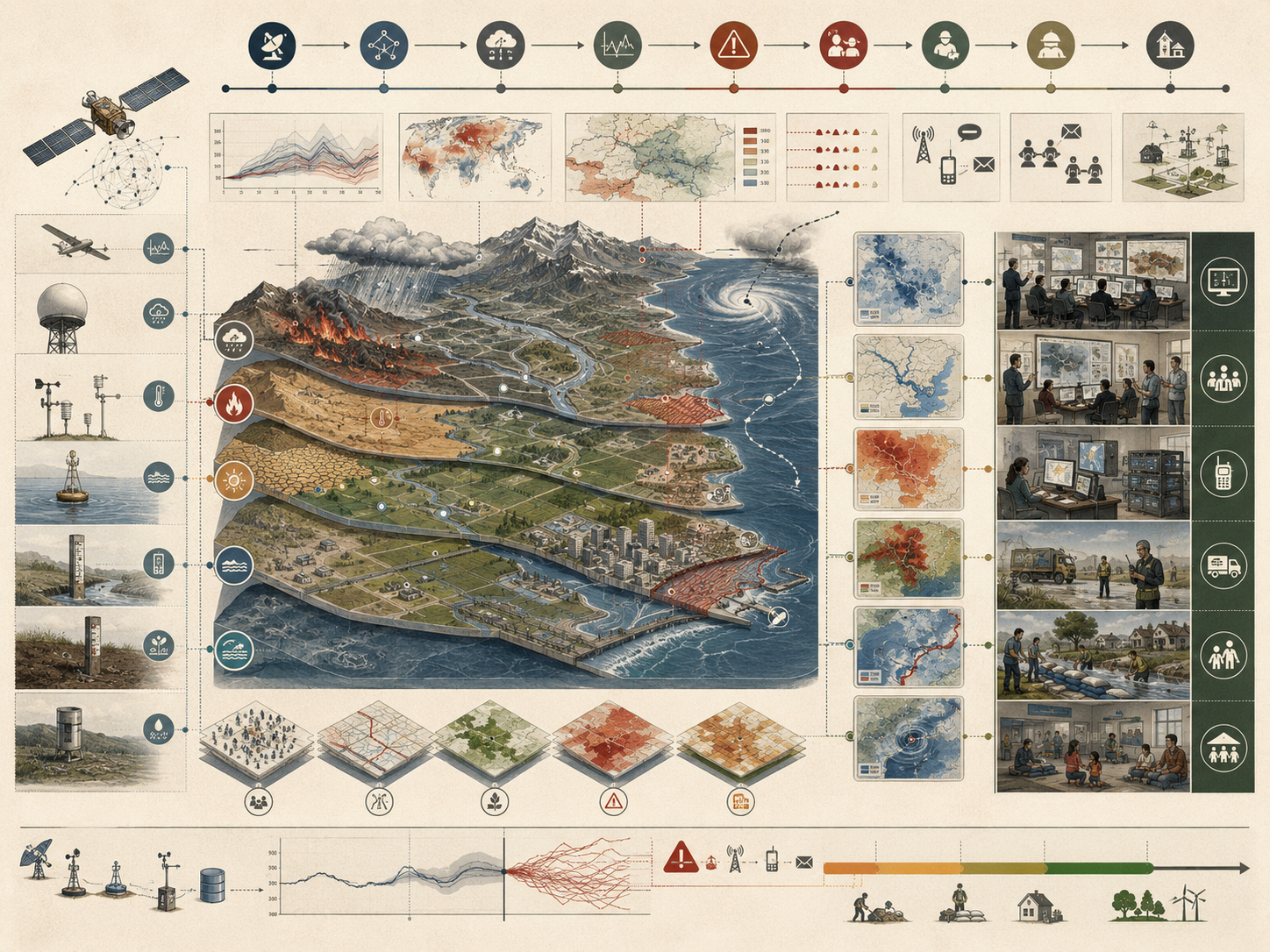
Climate early warning is where environmental intelligence becomes protective time. It asks not only whether a hazard can be forecast, but whether risk can be interpreted, communicated, trusted, and acted upon before consequences intensify. The central question is not simply whether a forecast exists. It is whether the warning chain can transform uncertain future conditions into timely, inclusive, and accountable action.
Engineering Problem
The engineering problem is how to design climate early warning systems that can transform uncertain environmental signals into timely, trusted, actionable protection. Early warning is not only a forecasting problem. It is a full-chain systems problem involving observations, hazard models, exposure data, vulnerability analysis, thresholds, alert rules, communication channels, institutional authority, preparedness capacity, response workflows, feedback loops, and public trust.
This problem is difficult because warning systems must act before certainty is complete. If agencies wait until a hazard is fully confirmed, protective lead time may collapse. If they warn too often, too broadly, or without clear consequence and action guidance, public trust can erode. Strong early warning systems therefore do not eliminate uncertainty; they structure it. They decide what level of probability, consequence, and timing justifies warning, who should receive it, what action it should trigger, and how evidence should be revised as conditions evolve.
Weak early warning treats alerts as the final output of forecasting. Strong early warning treats warnings as part of a socio-technical evidence chain. It asks whether hazards are monitored, forecasts are credible, exposure and vulnerability are understood, messages are actionable, communities can respond, institutions are coordinated, and post-event learning updates the system. The decisive question is not simply whether a forecast was accurate. It is whether the system produced protective time for the people and places at risk.
| Engineering Tension | Why It Matters | Required Evidence |
|---|---|---|
| Forecast accuracy versus protective lead time | Earlier warnings are often more useful but less certain; later warnings may be more accurate but less actionable. | Forecast horizon, confidence score, lead-time target, decision threshold |
| Hazard detection versus risk interpretation | Hazard intensity does not automatically reveal who or what will be harmed. | Exposure layers, vulnerability indicators, impact thresholds, consequence statements |
| Coverage versus effectiveness | A system may formally exist while failing to reach or support vulnerable communities. | Coverage audit, channel diversity, accessibility review, response-capacity assessment |
| False alarms versus missed events | Excessive warnings can degrade trust; missed events can cause preventable loss. | False-alarm ratio, probability of detection, warning verification, trust review |
| Static warning areas versus moving hazards | Hazards evolve spatially, and static polygons may over-warn some places while under-warning others. | Threat-tracking logic, spatial update frequency, warning-area revision log |
| Technical alerting versus public action | A technically correct alert does not reduce harm if people lack clear, trusted, feasible action options. | Message template, preparedness plan, action protocol, community feedback |
| National reporting versus local protection | Reported national coverage may conceal gaps in last-mile communication, inclusion, language access, or local capacity. | Local reach audit, community preparedness record, inclusion checklist |
The practical question is therefore: can the system detect risk early enough, interpret consequence clearly enough, communicate warnings effectively enough, and support action equitably enough to reduce avoidable harm?
Reference Architecture
A practical climate early warning architecture can be understood as an end-to-end anticipatory action system. The exact implementation may include meteorological stations, radar, satellites, streamgages, ocean observations, drought indicators, wildfire indices, climate forecasts, hazard models, risk maps, exposure layers, social vulnerability data, alert platforms, emergency operations systems, broadcast channels, mobile warnings, community networks, humanitarian triggers, and post-event review workflows. The responsibilities remain consistent: observe, forecast, interpret, decide, warn, disseminate, act, document, and learn.
| Layer | Engineering Role | Primary Risk | Evidence Artifact |
|---|---|---|---|
| Risk objective layer | Defines hazard type, geography, protected population, decision use, lead-time goal, and responsible authorities. | Warnings are designed around available data rather than protective action. | Early warning objective manifest, lead-time target, authority matrix |
| Observation layer | Detects environmental conditions through meteorological, hydrological, oceanic, climate, and environmental monitoring. | Critical hazards or precursor conditions remain unobserved or stale. | Observation registry, sensor inventory, telemetry status, data-quality flags |
| Forecast and prediction layer | Projects hazard evolution, timing, intensity, probability, and uncertainty. | Forecasts are treated as certainty or used beyond their valid horizon. | Forecast model card, uncertainty statement, forecast-performance review |
| Risk knowledge layer | Links hazards to exposure, vulnerability, coping capacity, infrastructure, livelihoods, and likely impacts. | Warnings communicate physical conditions without consequence. | Risk map, exposure layer, vulnerability matrix, impact-threshold registry |
| Warning decision layer | Determines when forecast probability and expected consequence justify alerts, advisories, warnings, or early action. | Thresholds are opaque, inconsistent, or poorly calibrated. | Warning trigger table, decision log, escalation protocol |
| Communication and dissemination layer | Delivers messages through official, digital, broadcast, mobile, siren, institutional, and community channels. | Warnings fail to reach, persuade, or guide people at risk. | Message template, channel registry, delivery log, accessibility checklist |
| Preparedness and response layer | Connects warnings to evacuation, sheltering, water management, public-health action, anticipatory finance, or operational response. | Warnings produce awareness but not protection. | Response protocol, exercise record, action log, resource-readiness table |
| Governance and learning layer | Reviews performance, equity, false alarms, missed events, trust, and corrective actions. | The system repeats failures or hides uneven protection. | After-action review, governance log, coverage audit, public evidence package |
This architecture makes clear that early warning is not only alert dissemination. It is the management of a protective chain from environmental signal to human action.
Implementation Pattern
A rigorous climate early warning implementation begins with the hazard, population, decision horizon, and action pathway. A tornado warning, cyclone warning, flash-flood alert, heat-health warning, drought early action trigger, wildfire readiness alert, coastal storm surge warning, and seasonal food-security forecast do not require identical architectures. Each implies different observations, forecast horizons, uncertainty structures, exposure data, communication channels, authority rules, and preparedness actions.
| Artifact | Purpose | Suggested Format |
|---|---|---|
| Early warning objective manifest | Defines hazard type, geography, protected population, decision use, lead-time goal, and warning authority. | YAML, Markdown, architecture decision record |
| Hazard monitoring registry | Stores stations, sensors, remote-sensing feeds, model inputs, update frequency, and quality status. | CSV, SQL table, geospatial registry |
| Forecast model card | Documents forecast method, valid horizon, uncertainty, update frequency, calibration, and intended use. | Markdown, model card, technical note |
| Exposure and vulnerability matrix | Links hazard areas to people, assets, infrastructure, health vulnerability, livelihoods, and response capacity. | CSV, GeoJSON, SQL table, risk register |
| Impact-threshold registry | Defines physical thresholds, expected consequences, alert levels, and action triggers. | CSV, YAML, SQL table |
| Warning decision log | Records forecast evidence, trigger status, authority decision, uncertainty, and warning issuance time. | CSV, SQL table, incident-management export |
| Communication-channel registry | Documents broadcast, mobile, siren, agency, community, language, accessibility, and fallback channels. | CSV, Markdown, communications plan |
| Preparedness and response log | Tracks warnings, action taken, evacuation, sheltering, service changes, anticipatory finance, or operational measures. | CSV, SQL table, emergency-management log |
| Coverage and inclusion audit | Identifies populations, geographies, languages, disabilities, connectivity limits, and capacity gaps. | CSV, GIS layer, equity review memo |
| Governance and after-action review | Tracks false alarms, missed events, communication failures, trust issues, corrective actions, and system revisions. | Markdown, CSV, SQL table, public evidence package |
The implementation goal is to make warnings reconstructable. A user should be able to move from an issued warning back to the observations, forecasts, thresholds, exposure data, authority decision, communication pathway, response protocol, and governance record that produced it.
Research-Grade Framing: Early Warning as Anticipatory Governance Infrastructure
A research-grade account of climate early warning begins by treating warning systems as anticipatory governance infrastructure rather than as forecast delivery tools. These systems organize how uncertain future risk becomes knowable early enough to influence behavior. They determine which hazards are monitored, whose exposure is represented, which thresholds trigger action, which institutions are authorized to warn, which channels reach the public, and which communities receive enough practical support to act.
This role is epistemically demanding because a warning must often be issued before the future is fully knowable. Forecasts are probabilistic, hazards evolve, impacts depend on exposure and vulnerability, and response capacity is uneven. The warning system’s task is not to wait for certainty, but to define when uncertainty is serious enough to justify protective action. This makes early warning a discipline of actionable foresight: a method for converting incomplete environmental evidence into time-sensitive public decisions.
This is also why early warning is never only technical. Warning thresholds, message tone, channel selection, evacuation triggers, shelter guidance, and action protocols embed judgments about risk tolerance, trust, public authority, institutional capacity, and social protection. A forecast can be scientifically sound while the warning system fails because the message does not reach people, does not make sense, is not trusted, or cannot be acted upon. The quality of early warning therefore depends on both environmental intelligence and public capability.
| Limited Pattern | Stronger Pattern | Why the Shift Matters |
|---|---|---|
| Issue alerts from forecast thresholds | Design an end-to-end system for risk knowledge, warning, preparedness, and early action | Prevents alerts from being mistaken for protection. |
| Communicate hazard intensity | Communicate likely impacts, affected places, uncertainty, and protective action | People act on consequence, not raw hazard data alone. |
| Optimize technical prediction | Balance accuracy, lead time, clarity, trust, and response feasibility | Warnings must be useful before they are certain. |
| Report national system coverage | Audit local reach, inclusion, language, accessibility, and last-mile capacity | Formal existence does not guarantee local protection. |
| Treat false alarms as technical errors only | Evaluate false alarms, missed events, trust, and learning together | Warning legitimacy depends on transparent performance review. |
| End at dissemination | Track whether warnings triggered action and reduced harm | Warning value is measured by protective outcomes, not message delivery alone. |
The central research question is not “Did the warning system issue an alert?” but “Did it create timely, trusted, inclusive, and actionable protective lead time under uncertainty?”
Formal Model: Hazard, Exposure, Lead Time, Trust, and Warning Readiness
A useful formal model separates hazard probability, expected impact, exposure, vulnerability, forecast confidence, protective lead time, communication reach, action capacity, trust, and governance readiness. Let \(H_p\) represent hazard probability, \(I_e\) expected impact, \(E_x\) exposure, \(V_u\) vulnerability, \(C_f\) forecast confidence, \(L_p\) protective lead time, \(C_r\) communication reach, \(A_c\) action capacity, \(T_r\) trust readiness, and \(G_r\) governance readiness. Warning quality depends on these dimensions together, not on forecast data alone.
R_{\mathrm{risk}} = H_p \times E_x \times V_u
\]
Interpretation: Climate risk depends on hazard probability, exposure, and vulnerability. A warning system must interpret all three rather than communicating hazard intensity alone.
L_{\mathrm{protective}} = T_{\mathrm{impact}} – T_{\mathrm{warning}}
\]
Interpretation: Protective lead time is the time between warning issuance and expected impact. It is one of the primary outputs of an early warning system.
C_{\mathrm{coverage}} = \frac{P_{\mathrm{reached}}}{P_{\mathrm{at\ risk}}}
\]
Interpretation: Warning coverage measures the share of the at-risk population that receives the warning through usable channels.
F_{\mathrm{alarm}} = \frac{N_{\mathrm{false\ alarms}}}{N_{\mathrm{warnings}}}
\]
Interpretation: False-alarm ratio helps evaluate warning calibration and trust risk, but should be interpreted together with missed-event and lead-time metrics.
Q_{\mathrm{early\ warning}} =
w_1C_f +
w_2R_k +
w_3L_p +
w_4C_r +
w_5A_c +
w_6T_r +
w_7I_c +
w_8G_r
\]
Interpretation: Early-warning quality depends on forecast confidence, risk knowledge, protective lead time, communication reach, action capacity, trust readiness, inclusion capacity, and governance readiness.
This formal structure protects against a common mistake in early warning: treating forecasts as if they automatically produce protection. Warning quality becomes stronger when probability, consequence, lead time, communication, action capacity, trust, inclusion, and governance are evaluated together.
What Are Climate Early Warning Systems?
Climate early warning systems are integrated systems that anticipate hazardous hydrometeorological, climatological, and related environmental events and enable people and institutions to act before impacts intensify. Their defining feature is not detection alone, but anticipatory linkage. A forecast becomes an early warning only when it is connected to risk knowledge, communication pathways, and practical response capacity.
Such systems may include meteorological, hydrological, ocean, climate, and environmental monitoring networks; forecasting and prediction systems for storms, floods, heat, drought, wildfire, and related hazards; risk maps and exposure data describing vulnerable populations, assets, and places; alert dissemination systems using broadcast, mobile, digital, siren, institutional, and community channels; protocols for evacuation, sheltering, anticipatory action, and emergency coordination; and community preparedness, drills, response capacity, and feedback loops.
UNDRR defines early warning systems as integrated systems that include hazard monitoring, forecasting and prediction, disaster risk assessment, communication, and preparedness activities that enable individuals, communities, governments, businesses, and others to take timely action. WMO’s Early Warnings for All initiative and global status reporting frame early warning as a people-centered, end-to-end, multi-hazard system whose value depends on risk knowledge, monitoring and forecasting, warning dissemination, and preparedness to respond.
| Warning Form | Primary Question | Typical Evidence | Main Risk |
|---|---|---|---|
| Severe-weather warning | Is a dangerous storm, tornado, wind, hail, rainfall, or related hazard imminent? | Radar, satellite, model guidance, storm reports, forecaster analysis | Short lead time and rapidly changing threat geometry. |
| Flood early warning | Will rainfall, river stage, storm surge, or drainage failure produce damaging inundation? | Rainfall, streamflow, hydrological models, inundation maps, impact thresholds | Hydrological values are not translated into place-based impact. |
| Heat-health warning | Will heat conditions create danger for exposed or vulnerable populations? | Temperature, humidity, heat index, health vulnerability, urban exposure, public-health thresholds | Warnings reach people without cooling access, social support, or feasible action options. |
| Drought and food-security early warning | Are rainfall failure, soil moisture, crop stress, water scarcity, or livelihood risk emerging? | Seasonal forecasts, precipitation anomalies, soil moisture, vegetation indices, market and livelihood indicators | Slow-onset risk is recognized too late for anticipatory action. |
| Wildfire conditions warning | Are fuel, weather, ignition, and exposure conditions creating dangerous fire risk? | Fuel dryness, wind, humidity, temperature, lightning, land cover, evacuation context | Hazard potential is not linked to evacuation, public-health, and infrastructure risk. |
| Multi-hazard early warning | How do multiple hazards interact, cascade, or compound over time? | Hazard layers, exposure data, vulnerability, infrastructure dependencies, cascading-risk models | Single-hazard warnings miss combined or sequential impacts. |
An early warning system therefore differs from a stand-alone forecast service or technical alert mechanism. Its purpose is to connect environmental signals to consequence and response. It succeeds not when it produces information alone, but when it enables protective action in time.
Why Early Warning Systems Matter
Early warning systems matter because disaster is not caused by hazard alone. Harm emerges when dangerous conditions intersect with exposed and vulnerable populations that do not have enough time, information, trust, or capacity to act. Warnings create protective lead time. That lead time can reduce mortality, prevent injuries, preserve assets, support emergency logistics, trigger anticipatory finance, and improve coordination before a hazard arrives or worsens.
They matter especially in climate-sensitive systems because exposure is rising. Urbanization, coastal development, infrastructure concentration, heat vulnerability, water stress, and compounding extremes all increase the consequences of warning failure. Early warning systems are therefore not just emergency tools. They are adaptation mechanisms that help societies operate under a more volatile environmental baseline.
They also matter because they sit at the boundary between science and action. A technically accurate forecast that does not reach the right people in an understandable, trusted, and actionable form is not an effective warning. Conversely, strong communication cannot compensate for weak detection or poor risk interpretation. Early warning systems matter because they connect scientific credibility, institutional readiness, and public response in a single chain.
| Need | Warning-System Contribution | Risk Without Effective Early Warning |
|---|---|---|
| Mortality reduction | Creates time for evacuation, sheltering, cooling, avoidance, and emergency support. | People encounter hazards before protective decisions can be made. |
| Impact reduction | Connects forecasts to protective action for assets, infrastructure, agriculture, water, health, and livelihoods. | Losses mount even when hazards were scientifically foreseeable. |
| Disaster risk reduction | Links risk knowledge, monitoring, communication, and preparedness into one operational chain. | Forecasting, emergency management, and public action remain fragmented. |
| Climate adaptation | Helps institutions act under more volatile baselines and compounding extremes. | Adaptation planning remains too slow for near-term climate hazards. |
| Equitable protection | Identifies who receives warnings, who can act, and where last-mile barriers remain. | Warning capacity reproduces inequality while appearing universal. |
| Public accountability | Creates evidence about lead time, reach, response, failure, and system revision. | Warning failures become difficult to inspect or correct. |
Early warning systems matter because environmental knowledge only becomes protective when it is converted into timely, trusted, and actionable warning.
Early Warning as Anticipatory Governance Infrastructure
Climate early warning systems are best understood as infrastructures of anticipatory governance. They organize how uncertain future risk becomes knowable early enough to influence behavior. This requires more than descriptive environmental observation. Hazard signals must be interpreted in relation to probability, timing, exposure, vulnerability, consequence, and feasible action. The warning system thus acts as a bridge between environmental sensing and coordinated social response.
This anticipatory role makes early warning epistemically demanding. A useful warning must often be issued before certainty is possible. Waiting for complete confirmation can destroy lead time; warning too aggressively can erode trust through false alarms or warning fatigue. Early warning systems therefore do not eliminate uncertainty. They manage it. Their task is to produce actionable foresight calibrated to consequence, probability, and decision horizon.
Seen in this way, early warning is not a downstream afterthought appended to forecasting. It is a distinct governance function whose role is to transform probabilistic environmental knowledge into protective time. The quality of that transformation determines whether observational and forecasting advances actually reduce harm.
| System Choice | What Becomes More Visible | What May Remain Less Visible |
|---|---|---|
| Hazard-centered forecasting | Physical intensity, timing, track, probability, and forecast confidence. | Social vulnerability, exposure, feasibility of action, local trust. |
| Impact-based warning | Likely consequence for people, places, infrastructure, and services. | Unmodeled vulnerabilities or informal exposure if risk layers are incomplete. |
| Multi-hazard warning | Compound, cascading, cumulative, and simultaneous hazards. | Local action complexity when multiple warnings compete for attention. |
| Mobile and digital alerting | Fast dissemination across connected populations. | People without devices, connectivity, language access, or trust in alerts. |
| Community-based warning | Local relevance, trusted messengers, social interpretation, and response support. | Scalability and consistency without strong institutional integration. |
| National reporting | System-level progress, formal coverage, and institutional capability. | Local reach, inclusion, actionability, and last-mile protection gaps. |
Early warning is powerful because it turns uncertain futures into public decisions. It is risky when alert delivery is mistaken for actual protective capacity.
The Core Logic of Effective Early Warning Systems
Effective early warning systems work because several interdependent functions operate together. These are often summarized through risk knowledge, monitoring and forecasting, warning communication and dissemination, and preparedness or response capability. The deeper systems insight is that none of these functions is sufficient on its own.
Monitoring and forecasting without risk knowledge are incomplete. Knowing that heavy rainfall, extreme heat, or cyclone conditions are likely does not yet indicate who is in danger, where consequences will concentrate, or what action is most urgent.
Risk knowledge without communication is inert. Exposure maps and vulnerability models matter only if they inform operational warning and reach those who need them.
Communication without preparedness is performative. A warning message that reaches people who lack shelter options, evacuation routes, institutional guidance, cooling access, mobility support, or the means to act may create awareness without reducing harm.
Preparedness without trust is fragile. Even well-designed response protocols can fail if warnings are not credible, understandable, locally meaningful, or perceived as relevant by those at risk.
| Pillar | Function | Failure Mode | Readiness Evidence |
|---|---|---|---|
| Risk knowledge | Identifies hazards, exposure, vulnerability, likely impacts, and response constraints. | Warnings describe weather but not consequence. | Risk maps, exposure layers, vulnerability matrices, impact thresholds. |
| Monitoring and forecasting | Detects hazards and projects timing, probability, intensity, and uncertainty. | Warnings lack credible lead time or valid forecast horizon. | Observation registry, model card, forecast verification, uncertainty statement. |
| Warning communication | Translates risk into clear, authoritative, accessible, actionable messages. | Messages are late, confusing, inaccessible, or mistrusted. | Message templates, channel registry, language plan, delivery logs. |
| Preparedness and response | Connects warnings to evacuation, shelter, cooling, water, health, logistics, or early action. | People are warned but cannot act. | Response protocols, exercises, resource plans, action logs. |
| Governance and learning | Coordinates authority, accountability, review, equity, and system revision. | Failures repeat and uneven protection remains hidden. | Governance logs, after-action reviews, coverage audits, corrective actions. |
For this reason, early warning should be understood as a chain whose breakdown is often social and institutional, not merely technical. Warnings fail as often through weak coordination, inaccessible delivery, mistrust, or response barriers as through deficient hazard science.
Key Analytical Distinctions
A forecast is not the same as a warning. A forecast estimates likely environmental conditions. A warning is an urgent, consequence-oriented call to action tied to a hazard, place, time window, and protective response.
Hazard detection is not the same as risk assessment. Measuring rainfall intensity, heat anomaly, cyclone probability, or wildfire conditions does not by itself indicate likely impact. Risk assessment asks how hazard intersects with exposure, vulnerability, capacity, and consequence.
Warning is not the same as response. A warning can be issued correctly yet still fail if institutions or communities cannot act on it.
Severe-weather warning is not the same as climate early warning. Short-horizon severe-weather warning often deals with imminent events over minutes to hours. Climate early warning includes these domains but also extends to slower-onset and compound risks such as drought, seasonal failure, wildfire conditions, glacial-lake risk, heat-health risk, or climate-linked multi-hazard exposure.
Early warning is not the same as adaptation planning. Adaptation often concerns long-term structural adjustment. Early warning concerns actionable lead time before or during unfolding risk. The two are connected, but they are not identical.
Coverage is not the same as effectiveness. A country, region, or agency may report the existence of a warning system while still facing major gaps in local reach, inclusion, actionability, trust, or response capacity.
| Distinction | Why It Matters | Design Implication |
|---|---|---|
| Forecast versus warning | Forecasts estimate conditions; warnings trigger protective action. | Link forecast evidence to consequence, authority, message, and action protocol. |
| Hazard versus risk | Hazard intensity does not equal social consequence. | Integrate exposure, vulnerability, infrastructure, and capacity data. |
| Dissemination versus protection | Message delivery does not guarantee action or harm reduction. | Track response capacity, accessibility, and outcomes after warnings. |
| Physical threshold versus impact threshold | The same hazard magnitude can have different consequences in different places. | Use local impact-based thresholds and consequence statements. |
| System existence versus system performance | Formal warning systems may leave local and vulnerable populations under-protected. | Audit last-mile reach, inclusion, trust, and response feasibility. |
| Lead time versus legitimacy | Earlier warnings increase action time but may increase uncertainty and false alarms. | Balance missed events, false alarms, uncertainty communication, and public trust. |
These distinctions prevent early warning from being reduced to forecast dashboards or alert feeds. The system’s purpose is to support protective action under uncertainty.
Uncertainty, False Alarms, and Warning Tradeoffs
An exceptional understanding of early warning requires confronting the tradeoffs embedded in warning decisions. Warning systems operate under asymmetrical risk: the cost of missed events can be catastrophic, but the cost of excessive false alarms can degrade credibility, induce warning fatigue, and reduce later compliance.
This creates a persistent governance problem. Issue warnings too late, and protective time disappears. Issue them too often, too broadly, or with poorly calibrated thresholds, and public trust can erode. Warning systems must therefore balance missed detections, false alarms, specificity, lead time, and clarity. This is not a flaw in the system. It is intrinsic to acting under uncertain futures.
These tradeoffs are also political and institutional. Agencies may face incentives that favor caution, liability reduction, reputational protection, or avoidance of public criticism. Communities may interpret repeated warnings differently depending on prior experience, trust in institutions, visible outcomes, and perceived capacity to act. In this sense, warning thresholds are never purely technical. They are also social decisions about how much uncertainty a society is willing to act on before consequences are certain.
| Tradeoff | Risk of One Extreme | Risk of the Other Extreme | System Response |
|---|---|---|---|
| Lead time versus confidence | Early warnings may be uncertain. | Late warnings may be too late for action. | Use probabilistic thresholds and staged escalation. |
| Specificity versus reach | Narrow warnings may miss people at risk. | Broad warnings may over-warn many people. | Use dynamic hazard tracking and clear uncertainty language. |
| False alarms versus missed events | Too many false alarms may reduce trust. | Missed events may cause preventable harm. | Review both false-alarm ratio and probability of detection. |
| Technical detail versus public clarity | Oversimplification may hide uncertainty. | Too much detail may confuse action. | Separate public messages from technical evidence packages. |
| Centralized authority versus local relevance | Central messages may ignore local barriers. | Local variation may become inconsistent. | Use authoritative warnings with community-grounded action guidance. |
| Automation versus human judgment | Automation may issue rigid warnings. | Manual review may delay action. | Use decision support with accountable human authority. |
The key question is not whether uncertainty can be eliminated. It cannot. The key question is whether uncertainty is managed in ways that preserve both lead time and legitimacy. Strong early warning systems remain credible precisely because they are honest about uncertainty while still enabling timely action.
System Architecture: From Hazard Detection to Early Action
Climate early warning systems operate as layered architectures that connect environmental signals to protective action. Observations detect emerging conditions through meteorological, hydrological, climate, ocean, satellite, and environmental monitoring systems. Forecasting and prediction models estimate likely hazard evolution, timing, probability, and intensity. Risk interpretation combines hazard information with exposure, vulnerability, infrastructure, health, livelihood, and community context. Warning formulation turns that evidence into operational and public-facing alerts. Dissemination moves messages through multiple channels. Preparedness and response systems then convert warnings into evacuation, sheltering, cooling, water management, public-health action, humanitarian assistance, infrastructure operations, or other protective measures. Feedback and learning assess lead time, reach, trust, response, false alarms, missed events, and outcomes.
| Stage | Transformation | Failure Risk |
|---|---|---|
| Environmental process | Hazards emerge through weather, water, climate, ocean, fire, or compound-risk dynamics. | The system monitors the wrong precursors or update frequency. |
| Observation | Sensors, satellites, radar, gauges, field reports, and model inputs capture partial evidence. | Data are missing, stale, biased, or spatially sparse. |
| Forecasting | Models and expert analysis project hazard timing, intensity, probability, and uncertainty. | Forecast confidence and limitations are not communicated. |
| Risk interpretation | Hazard evidence is linked to exposure, vulnerability, and likely consequence. | Warnings describe physical conditions without human impact. |
| Warning decision | Authorities determine alert level, geography, timing, and action guidance. | Decision thresholds are opaque, inconsistent, or late. |
| Dissemination | Messages move through official, broadcast, mobile, digital, siren, and community channels. | Warnings do not reach people at risk or are not understandable. |
| Preparedness and action | People, agencies, utilities, health systems, and responders take protective steps. | Warnings create awareness without feasible response. |
| Learning | Performance, outcomes, trust, equity, and failures are reviewed. | The system repeats errors or conceals uneven protection. |
This architecture matters because warning systems are chain systems. Hazard science can be excellent while communication fails. Dissemination can be rapid while risk interpretation remains shallow. Preparedness can be formally present while socially inaccessible. The operational strength of the whole depends on the coordination of all parts.
Multi-Hazard and Impact-Based Warning Logic
Climate early warning systems are increasingly framed as multi-hazard systems because real-world risk rarely emerges from a single isolated process. Flooding may follow storms. Storm surge may compound with heavy rain. Heat may interact with urban power stress. Drought may intensify wildfire exposure. Landslide risk may follow wildfire, deforestation, and heavy precipitation. Warning systems that treat hazards in isolation can miss the ways impacts overlap, cascade, or reinforce one another.
Alongside this multi-hazard perspective, many warning systems are moving toward impact-based logic. Instead of communicating only physical thresholds, they seek to explain likely consequence: what may happen, where, to whom, and with what urgency. This matters because people do not act on meteorological data alone. They act on interpreted consequence. The same rainfall amount, heat index, wind speed, or surge height may produce very different outcomes depending on terrain, settlement, infrastructure, health vulnerability, service access, or time of day.
| Design Shift | Traditional Pattern | Impact-Based Pattern | Why It Matters |
|---|---|---|---|
| Hazard framing | Warn for one hazard category at a time. | Warn for simultaneous, cascading, cumulative, or compound hazards. | Real events often interact across weather, water, infrastructure, and health systems. |
| Message content | State physical values or hazard category. | Explain likely impact, location, urgency, and action. | People respond more effectively to consequence and instruction. |
| Risk geography | Use fixed zones or broad administrative areas. | Adapt warning areas to evolving hazard and exposure. | Reduces over-warning and under-warning as hazards move. |
| Data integration | Rely mainly on hazard forecasts. | Combine forecasts with exposure, vulnerability, infrastructure, and social data. | Risk depends on who and what is affected. |
| Action guidance | Provide generic caution. | Provide hazard-specific, population-specific, feasible protective action. | Warning value depends on actionability. |
Multi-hazard and impact-based warning design deepen the anticipatory function of early warning. They move the system away from announcing environmental conditions in abstraction and toward communicating what those conditions mean for real populations under specific circumstances.
Communication, Trust, and Public Response
Communication is one of the most decisive and fragile dimensions of early warning. A warning succeeds only if it reaches people in time, in formats they can understand, through channels they trust, and with enough clarity to support action. This is why effective systems use multiple dissemination paths rather than assuming one medium reaches all audiences.
Trust is equally central. False alarms, inaccessible language, inconsistent message framing, politicized communication, or warnings disconnected from visible public response can all degrade confidence. Yet waiting for certainty can reduce lead time so severely that warning utility collapses. Communication must therefore balance urgency with credibility. It is a practice of calibrated persuasion under uncertainty.
Public response also depends on whether warnings are tied to known protective options. Messages that communicate hazard without practical implication may not improve outcomes. This is why preparedness, drills, local institutional guidance, and community-based planning remain integral parts of the warning system itself rather than external complements.
| Requirement | Purpose | Failure Mode | Evidence |
|---|---|---|---|
| Authoritative source | Clarifies who is issuing the warning and why it should be trusted. | Conflicting messages reduce compliance. | Authority registry, official channel list, coordination protocol |
| Clear action guidance | Tells people what to do, when, where, and why. | People receive hazard information without response direction. | Message templates, action statements, preparedness materials |
| Channel redundancy | Reaches people across digital, broadcast, institutional, and community pathways. | Single-channel failure leaves groups unwarned. | Channel registry, delivery logs, fallback procedures |
| Language and accessibility | Supports people with different languages, disabilities, literacy levels, and communication needs. | Warnings are delivered but not usable. | Accessibility checklist, translation workflow, disability-inclusive design |
| Local relevance | Connects hazard messages to familiar places, risks, and feasible actions. | Warnings feel abstract or irrelevant. | Local impact statements, community consultation, trusted messenger map |
| Trust feedback | Measures how warnings are perceived and acted upon. | Loss of confidence goes undetected. | Post-event surveys, response data, community review |
Communication is not the final packaging of early warning. It is part of the warning system’s evidence and action architecture.
Inclusion, Equity, and Uneven Protection
Climate early warning systems have an equity dimension because protection is unevenly distributed. Remote regions, informal settlements, coastal margins, islands, low-connectivity areas, and lower-capacity institutional settings may receive weaker warning coverage or less actionable messaging than more resourced populations. This means that warning systems can reproduce inequalities even when formally present at national scale.
Inclusion is not only about physical reach. It is also about language access, disability inclusion, mobility constraints, gendered vulnerability, digital access, local relevance, institutional trust, and the social capacity to act on a warning once received. A message that is technically delivered but practically unusable is not inclusive protection.
For this reason, warning systems should be understood as infrastructures of unequal protection unless deliberate efforts are made to broaden coverage and tailor delivery. Universal protection is not achieved by issuing more alerts alone. It requires reducing the institutional and social barriers that prevent warnings from becoming protective time.
| Equity Dimension | Question | Evidence Needed | Failure Risk |
|---|---|---|---|
| Geographic reach | Are remote, coastal, rural, island, and informal areas covered? | Coverage map, at-risk population layer, communication-gap audit | Warnings reach formal centers but not exposed margins. |
| Digital access | Can people without smartphones, internet, or reliable electricity receive warnings? | Channel diversity, radio/broadcast/siren/community fallback | Digital alerts exclude disconnected populations. |
| Language access | Are messages available in languages people understand? | Translation workflow, language inventory, local messenger plan | Warnings are delivered but not understood. |
| Disability inclusion | Are warnings accessible to people with hearing, visual, cognitive, or mobility needs? | Accessible formats, inclusive drills, support networks | Warnings assume a single mode of perception or response. |
| Action capacity | Do people have shelter, transport, cooling, water, money, or support to act? | Preparedness assessment, social support map, evacuation resource plan | Warnings create anxiety without feasible protection. |
| Trust and legitimacy | Do communities believe warnings and know who to trust? | Community feedback, trusted messenger registry, post-event trust review | Messages are ignored despite technical accuracy. |
Equitable early warning requires designing for people who are least likely to be reached, least likely to be believed, and least able to act without support.
Forecast Innovation and Warning Modernization
Climate early warning systems are evolving through advances in forecasting, hazard modeling, and warning design. Warn-on-Forecast approaches seek to extend lead times by moving from warning-on-detection toward warning informed by storm-scale predictive capability. Threats-in-Motion approaches seek to align warnings more dynamically with moving hazards rather than relying only on static polygons or fixed geographies.
These innovations matter because modernization is not only about increasing scientific precision. It is also about improving the temporal and spatial fairness of warning delivery. A system that updates warnings more responsively can improve lead time for downstream communities, reduce over-warning in places where threat has passed, and better align communication with evolving risk.
Such changes show that early warning systems are no longer static public-alert mechanisms. They are increasingly dynamic anticipatory systems in which forecast science, communication design, and protective action are intertwined.
| Innovation Area | Contribution | Governance Need |
|---|---|---|
| Warn-on-Forecast | Uses storm-scale predictive guidance to increase warning lead time for hazards such as tornadoes, severe thunderstorms, and flash floods. | Transparent confidence, human oversight, and careful false-alarm review. |
| Threats-in-Motion | Moves warnings continuously with hazards to improve downstream lead time and reduce warnings where threat has passed. | Clear public communication, dynamic geographies, and channel compatibility. |
| Impact-based forecasting | Links physical hazards to likely consequence. | Reliable exposure, vulnerability, and infrastructure data. |
| AI-assisted forecasting | Can support pattern detection, rapid guidance, and ensemble interpretation. | Model transparency, validation, bias review, and accountable authority. |
| Multi-channel dissemination | Combines mobile, broadcast, siren, institutional, and community systems. | Accessibility, redundancy, message consistency, and delivery auditing. |
| Anticipatory action triggers | Connects forecasts to pre-arranged finance, logistics, or humanitarian action. | Trigger calibration, accountability, and post-action evaluation. |
Modernization should be judged not only by model sophistication, but by whether it improves usable lead time, reduces uneven protection, and strengthens public trust.
Governance, Coordination, and Global Status
Climate early warning systems depend on governance because their components span meteorological and hydrological services, disaster management agencies, telecommunications actors, local authorities, public-health systems, humanitarian organizations, infrastructure operators, media, and community institutions. Their effectiveness depends not only on technical capability, but on coordination across these actors and across scales.
Global progress is real but incomplete. WMO’s 2025 global status reporting says that 119 countries, or 60 percent of all countries, reported having a multi-hazard early warning system, while coverage gaps persisted, especially among small island developing States, where 43 percent reported such systems in place. These figures point to both progress and uneven protection.
These disparities matter because observational and warning inequality shape whose risks become governable. Where systems are weak, hazards may still be forecast in principle, yet insufficiently translated into timely local protection. Early warning therefore belongs not only to the domain of technical modernization, but also to the politics of resilience investment, public capacity, and distributive safety.
| Governance Responsibility | Question | Evidence |
|---|---|---|
| Authority governance | Who has authority to issue, escalate, revise, or cancel warnings? | Authority matrix, escalation protocol, warning decision log |
| Risk knowledge governance | Who maintains exposure, vulnerability, and impact data? | Risk data registry, update schedule, public caveat statement |
| Forecast governance | How are model performance, uncertainty, and valid-use limits documented? | Forecast model card, verification report, uncertainty statement |
| Communication governance | How are official messages coordinated across channels and jurisdictions? | Message templates, channel registry, coordination protocol |
| Preparedness governance | Can agencies and communities act on warnings? | Preparedness plan, exercises, resources, response log |
| Equity governance | Are high-risk and underserved populations adequately reached and supported? | Coverage audit, inclusion checklist, accessibility review |
| Learning governance | Does the system revise itself after false alarms, missed events, and failures? | After-action review, corrective-action log, public evidence package |
Early warning becomes trustworthy when governance connects scientific evidence, public authority, institutional coordination, and community protection. Without governance, warning systems can produce alerts without accountability.
Future Directions
The future of climate early warning systems lies in deeper integration across monitoring, forecasting, risk knowledge, communication, preparedness, and anticipatory action. Systems are moving toward more impact-based, multi-hazard, dynamic, and inclusive designs, with stronger use of exposure data, richer dissemination strategies, and more explicit links between warning and early action.
The deeper challenge is not simply technical sophistication. It is whether systems can remain trusted, understandable, and actionable under growing climate volatility. They must work for populations with uneven connectivity, differing capacities to respond, and exposure to more compound, prolonged, and cascading risks. In this sense, warning systems are becoming central infrastructures of adaptation and resilience governance rather than narrow emergency tools.
Artificial intelligence, storm-scale forecasting, satellite observation, probabilistic modeling, mobile alerting, community-based warning, and anticipatory finance will expand what warning systems can do. But each innovation will also increase the need for transparency, validation, inclusion, and governance. A faster alert system that excludes people, a sophisticated model that hides uncertainty, or a dynamic warning that cannot be understood locally may improve technical performance while leaving protection incomplete.
Climate early warning systems ultimately convert knowledge into protective time. Where they are robust, societies gain the capacity to act earlier, coordinate better, and reduce avoidable loss. Where they are weak, environmental knowledge arrives too late, too narrowly, or too unevenly to prevent harm. In a climate-risk era, warning failure is often a failure of institutions as much as a failure of forecasts, and anticipatory capacity increasingly becomes one of the clearest tests of governance quality.
Deployment Readiness Gate
Before a climate early warning system is used for public alerts, evacuation guidance, humanitarian triggers, heat-health action, flood response, drought early action, wildfire readiness, infrastructure operation, or adaptation planning, it should pass a deployment readiness gate. This gate should test whether the system is observationally sufficient, forecast-aware, risk-informed, communication-ready, action-capable, inclusive, and governance-aligned.
| Readiness Area | Required Question | Pass Evidence |
|---|---|---|
| Purpose readiness | Does the system define hazard type, geography, protected population, lead-time goal, decision use, and authority? | Early warning objective manifest, authority matrix, lead-time target |
| Observation readiness | Are hazard precursors and environmental signals monitored with adequate coverage and update frequency? | Observation registry, telemetry report, data-quality flags |
| Forecast readiness | Are model sources, forecast horizon, uncertainty, confidence, and limitations documented? | Forecast model card, verification report, uncertainty statement |
| Risk knowledge readiness | Are exposure, vulnerability, infrastructure, livelihoods, and impact thresholds integrated? | Risk map, exposure layer, vulnerability matrix, impact-threshold registry |
| Warning decision readiness | Are triggers, escalation levels, decision authority, and cancellation rules defined? | Trigger table, warning decision log, escalation protocol |
| Communication readiness | Are messages clear, authoritative, accessible, multilingual where needed, and channel-redundant? | Message template, channel registry, accessibility checklist, delivery log |
| Action readiness | Are evacuation, sheltering, cooling, water, health, logistics, or other response actions feasible? | Preparedness plan, resource table, exercise record, response protocol |
| Inclusion readiness | Are vulnerable, remote, digitally disconnected, disabled, or language-minority populations reached and supported? | Coverage and inclusion audit, trusted messenger plan, accessibility review |
| Governance readiness | Are false alarms, missed events, performance, trust, equity, and corrective actions reviewed? | After-action review, governance log, public evidence package |
This readiness gate prevents early warning from being treated as complete merely because forecasts or alerts exist. The stronger standard is whether the system can create protective lead time in ways that are trusted, usable, inclusive, and accountable.
Data and Configuration Artifacts
A reproducible early-warning workflow should include explicit artifacts for objectives, hazards, observations, forecasts, risk knowledge, thresholds, warning decisions, communications, response actions, inclusion, and governance. These artifacts make warnings auditable rather than hidden inside forecast dashboards, alert systems, or emergency-management routines.
| Artifact | Purpose | Suggested Path |
|---|---|---|
| Early warning objective manifest | Defines hazard type, geography, protected population, lead-time goal, decision use, and authority. | config/early_warning_objective.yml |
| Hazard monitoring registry | Stores observation sources, stations, sensors, remote-sensing products, telemetry, and quality status. | data/hazard_monitoring_registry.csv |
| Forecast model card | Documents model source, valid horizon, update frequency, calibration, uncertainty, and intended use. | model_cards/forecast_model_card.md |
| Exposure and vulnerability matrix | Links hazard areas to population, infrastructure, health vulnerability, livelihoods, and capacity. | data/exposure_vulnerability_matrix.csv |
| Impact-threshold registry | Documents hazard thresholds, likely consequences, warning levels, and action triggers. | data/impact_threshold_registry.csv |
| Warning decision log | Tracks forecast evidence, decision time, authority, uncertainty, alert level, and issuance status. | data/warning_decision_log.csv |
| Communication-channel registry | Documents channels, languages, fallback systems, accessibility, and delivery status. | data/communication_channel_registry.csv |
| Preparedness and action log | Tracks evacuation, sheltering, cooling, water, health, infrastructure, humanitarian, or community actions. | data/preparedness_action_log.csv |
| Coverage and inclusion audit | Identifies reach gaps, vulnerable populations, language needs, disability inclusion, and action barriers. | data/coverage_inclusion_audit.csv |
| Early-warning governance log | Tracks false alarms, missed events, trust feedback, corrective actions, and public evidence. | data/early_warning_governance_log.csv |
These artifacts turn early warning into a reproducible anticipatory governance system rather than a loose collection of forecasts, alerts, and emergency messages.
Mathematical Lens: Warning Lead Time, Coverage, False Alarms, and Evidence Quality
Several simple metrics can help evaluate early-warning readiness. These metrics are not substitutes for hazard science, emergency management, social trust, community knowledge, or public authority, but they make warning evidence quality more inspectable.
R_{\mathrm{risk}} = H_p \times E_x \times V_u
\]
Interpretation: Risk depends on hazard probability, exposure, and vulnerability, not hazard alone.
L_{\mathrm{protective}} = T_{\mathrm{impact}} – T_{\mathrm{warning}}
\]
Interpretation: Protective lead time measures how much time remains between warning issuance and expected impact.
C_{\mathrm{coverage}} = \frac{P_{\mathrm{reached}}}{P_{\mathrm{at\ risk}}}
\]
Interpretation: Coverage measures the share of the at-risk population reached through usable warning channels.
F_{\mathrm{alarm}} = \frac{N_{\mathrm{false\ alarms}}}{N_{\mathrm{warnings}}}
\]
Interpretation: False-alarm ratio helps evaluate calibration and trust risk, but must be interpreted alongside missed-event and harm-reduction metrics.
Q_{\mathrm{early\ warning}} =
w_1C_f +
w_2R_k +
w_3L_p +
w_4C_r +
w_5A_c +
w_6T_r +
w_7I_c +
w_8G_r
\]
Interpretation: Early-warning quality depends on forecast confidence, risk knowledge, protective lead time, communication reach, action capacity, trust readiness, inclusion capacity, and governance readiness.
These measures evaluate early warning as a protective evidence system. They ask whether forecasts, risk knowledge, messages, action pathways, inclusion, and governance are strong enough to support the warning claim being made.
Python Workflow: Early Warning Readiness and Protective Lead-Time Evidence
A Python workflow can demonstrate how early warning systems might be evaluated for forecast confidence, risk knowledge, protective lead time, communication reach, action capacity, trust readiness, inclusion capacity, and governance readiness. The purpose is not to create a universal warning score, but to make evidence-quality dimensions visible.
from dataclasses import dataclass
from typing import List
import pandas as pd

@dataclass
class EarlyWarningProgram:
    program_id: str
    hazard_type: str
    geography: str
    forecast_confidence: float
    risk_knowledge: float
    protective_lead_time: float
    communication_reach: float
    action_capacity: float
    trust_readiness: float
    inclusion_capacity: float
    governance_readiness: float
    high_stakes_use: bool

def early_warning_quality(program: EarlyWarningProgram) -> float:
    return (
        0.14 * program.forecast_confidence +
        0.14 * program.risk_knowledge +
        0.14 * program.protective_lead_time +
        0.13 * program.communication_reach +
        0.13 * program.action_capacity +
        0.10 * program.trust_readiness +
        0.11 * program.inclusion_capacity +
        0.11 * program.governance_readiness
    )

def classify_review_priority(program: EarlyWarningProgram, score: float) -> str:
    if program.high_stakes_use and program.protective_lead_time < 0.70:
        return "high_stakes_lead_time_review"
    if program.forecast_confidence < 0.70:
        return "forecast_confidence_review"
    if program.risk_knowledge < 0.70:
        return "risk_knowledge_review"
    if program.communication_reach < 0.75:
        return "communication_reach_review"
    if program.action_capacity < 0.75:
        return "action_capacity_review"
    if program.trust_readiness < 0.70:
        return "trust_readiness_review"
    if program.inclusion_capacity < 0.75:
        return "inclusion_capacity_review"
    if program.governance_readiness < 0.75:
        return "governance_readiness_review"
    if score < 0.75:
        return "early_warning_quality_review"
    return "routine_monitoring"

programs: List[EarlyWarningProgram] = [
    EarlyWarningProgram(
        "flash-flood-early-warning",
        "flood",
        "urban_and_riverine_basins",
        0.80,
        0.76,
        0.72,
        0.82,
        0.78,
        0.76,
        0.74,
        0.78,
        True,
    ),
    EarlyWarningProgram(
        "heat-health-warning-system",
        "heat",
        "metropolitan_region",
        0.84,
        0.78,
        0.86,
        0.80,
        0.70,
        0.72,
        0.68,
        0.76,
        True,
    ),
    EarlyWarningProgram(
        "drought-anticipatory-action",
        "drought",
        "agricultural_livelihood_zone",
        0.74,
        0.72,
        0.82,
        0.68,
        0.66,
        0.70,
        0.72,
        0.70,
        True,
    ),
    EarlyWarningProgram(
        "coastal-compound-risk-warning",
        "compound_coastal",
        "coastal_communities",
        0.76,
        0.68,
        0.70,
        0.74,
        0.72,
        0.70,
        0.66,
        0.72,
        True,
    ),
]

records = []
for program in programs:
    score = early_warning_quality(program)
    records.append({
        "program_id": program.program_id,
        "hazard_type": program.hazard_type,
        "geography": program.geography,
        "forecast_confidence": program.forecast_confidence,
        "risk_knowledge": program.risk_knowledge,
        "protective_lead_time": program.protective_lead_time,
        "communication_reach": program.communication_reach,
        "action_capacity": program.action_capacity,
        "trust_readiness": program.trust_readiness,
        "inclusion_capacity": program.inclusion_capacity,
        "governance_readiness": program.governance_readiness,
        "early_warning_quality": round(score, 3),
        "review_priority": classify_review_priority(program, score),
    })

df = pd.DataFrame(records)
print(df.sort_values(["review_priority", "early_warning_quality"]))
This workflow treats early warning programs as protective systems, not alert systems alone. A program is not ready because it can issue messages. It must preserve enough evidence about forecast confidence, risk knowledge, lead time, communication, action capacity, trust, inclusion, and governance to support the warning claim.
R Workflow: Warning Coverage, Lead Time, and Governance Readiness
An R workflow can support early-warning governance by summarizing readiness across flash flood, heat, drought, coastal, severe-weather, and multi-hazard systems. This is useful for warning-program audits, public evidence packages, emergency-management review, and anticipatory-action planning.
library(dplyr)
library(readr)

early_warning_programs <- tribble(
  ~program_id, ~hazard_type, ~geography, ~forecast_confidence, ~risk_knowledge, ~protective_lead_time, ~communication_reach, ~action_capacity, ~trust_readiness, ~inclusion_capacity, ~governance_readiness, ~high_stakes_use,
  "flash-flood-early-warning", "flood", "urban_and_riverine_basins", 0.80, 0.76, 0.72, 0.82, 0.78, 0.76, 0.74, 0.78, TRUE,
  "heat-health-warning-system", "heat", "metropolitan_region", 0.84, 0.78, 0.86, 0.80, 0.70, 0.72, 0.68, 0.76, TRUE,
  "drought-anticipatory-action", "drought", "agricultural_livelihood_zone", 0.74, 0.72, 0.82, 0.68, 0.66, 0.70, 0.72, 0.70, TRUE,
  "coastal-compound-risk-warning", "compound_coastal", "coastal_communities", 0.76, 0.68, 0.70, 0.74, 0.72, 0.70, 0.66, 0.72, TRUE
)

early_warning_summary <- early_warning_programs %>%
  mutate(
    early_warning_quality = round(
      0.14 * forecast_confidence +
      0.14 * risk_knowledge +
      0.14 * protective_lead_time +
      0.13 * communication_reach +
      0.13 * action_capacity +
      0.10 * trust_readiness +
      0.11 * inclusion_capacity +
      0.11 * governance_readiness,
      3
    ),
    review_priority = case_when(
      high_stakes_use & protective_lead_time < 0.70 ~ "high_stakes_lead_time_review",
      forecast_confidence < 0.70 ~ "forecast_confidence_review",
      risk_knowledge < 0.70 ~ "risk_knowledge_review",
      communication_reach < 0.75 ~ "communication_reach_review",
      action_capacity < 0.75 ~ "action_capacity_review",
      trust_readiness < 0.70 ~ "trust_readiness_review",
      inclusion_capacity < 0.75 ~ "inclusion_capacity_review",
      governance_readiness < 0.75 ~ "governance_readiness_review",
      early_warning_quality < 0.75 ~ "early_warning_quality_review", TRUE ~ "routine_monitoring" ) ) %>%
  arrange(review_priority, early_warning_quality)

print(early_warning_summary)

write_csv(
  early_warning_summary,
  "outputs/early_warning_readiness_summary.csv"
)
The R workflow emphasizes that early-warning review should account for forecast confidence, risk knowledge, lead time, communication reach, action capacity, trust, inclusion, and governance. These dimensions help prevent warning systems from being judged by alert issuance alone.
Systems Code: Hazards, Forecasts, Alerts, Exposure, Action, and Governance Logs
Climate early warning depends on full-stack environmental, risk, communication, and emergency-management systems code. The stack includes hazard registries, observation feeds, forecast outputs, exposure layers, vulnerability matrices, warning triggers, alert records, channel registries, delivery logs, preparedness actions, response workflows, accessibility checks, false-alarm reviews, missed-event records, and governance logs. A serious companion repository should therefore include both analytical workflows and systems-code scaffolding.
| Language / Tool | Role in Companion Repository | Example Use |
|---|---|---|
| Python | Early-warning readiness scoring, lead-time review, communication coverage, and risk triage | Evidence-quality scoring and review prioritization |
| R | Warning-program summaries, coverage reporting, inclusion audits, and governance tables | Public evidence and emergency-management reports |
| SQL | Hazard registries, forecast records, warning decisions, channel logs, response actions, and governance records | Auditable early-warning database schema |
| GeoJSON | Warning areas, exposed populations, critical infrastructure, evacuation zones, and coverage gaps | Spatial registry for impact-based warning |
| TypeScript | Dashboard and platform data models | Alert cards, hazard panels, exposure layers, channel-status views |
| Go | Lightweight early-warning status endpoint | Expose forecast, alert, communication, and action readiness |
| Rust | Safe validation CLI for warning records and alert payloads | Validate timestamps, hazard codes, authority fields, channels, and quality flags |
| C / C++ | Low-level alert-event and bounded queue examples | Demonstrate embedded alert records and emergency-event queues |
| Shell scripts | Reproducible directory, validation, and export workflows | One-command scaffold validation and output generation |
This breadth is appropriate because climate early warning is not only forecasting. It is evidence infrastructure spanning environmental observation, risk interpretation, public communication, emergency action, and accountability.
GitHub Repository
A companion repository for this article should translate the early-warning framework into reproducible technical scaffolding. The repository should include early-warning objective manifests, hazard-monitoring registries, forecast model cards, exposure and vulnerability matrices, impact-threshold registries, warning decision logs, communication-channel registries, preparedness and action logs, coverage and inclusion audits, readiness scoring workflows, SQL schemas, dashboard data types, and governance records.
Testing and Validation
Testing climate early warning systems requires more than confirming that forecasts and alerts are produced. It requires validating observation coverage, forecast performance, risk data, impact thresholds, trigger logic, message clarity, channel delivery, accessibility, action readiness, false-alarm behavior, missed-event behavior, trust, and governance review. A warning system can appear sophisticated while failing to create protective time if any part of the chain is weak.
| Test Type | Purpose | Example Test |
|---|---|---|
| Observation coverage test | Ensure hazards and precursors are monitored with sufficient spatial and temporal coverage. | Compare observation registry with hazard geography and update-frequency requirements. |
| Forecast verification test | Evaluate model skill, lead time, uncertainty, and valid-use limits. | Compare forecast events against observed outcomes and warning decisions. |
| Risk knowledge test | Ensure exposure and vulnerability data support impact-based interpretation. | Review exposure layers, vulnerable populations, infrastructure, and capacity fields. |
| Trigger test | Ensure thresholds and escalation rules match hazard probability and expected consequence. | Audit warning decision logs against trigger table and event outcomes. |
| Message test | Ensure warnings are understandable, actionable, accessible, and authoritative. | Review message templates, language, action guidance, and disability-inclusive formats. |
| Channel delivery test | Ensure warnings reach intended populations through redundant channels. | Audit mobile, broadcast, siren, agency, and community delivery logs. |
| Action-readiness test | Ensure warnings connect to real protective actions. | Trace warning-to-action records for evacuation, sheltering, cooling, water, or health actions. |
| Inclusion test | Ensure vulnerable and hard-to-reach populations receive usable warning and support. | Review coverage, language, disability, digital access, and response-capacity audits. |
| False-alarm and missed-event test | Evaluate warning calibration, trust risk, and missed harm. | Compute false-alarm ratio and missed-event review with context. |
| Governance test | Ensure failures, uncertainty, corrective actions, and public caveats are documented. | Review after-action reports, governance logs, and public evidence packages. |
Validation should test the warning system as an end-to-end protective chain. The decisive question is not whether an alert was issued, but whether the system enabled timely, trusted, and feasible protective action.
Operational Signals and Early-Warning Observability
Climate early warning systems must observe themselves. A system that warns about hazards but cannot report observation health, forecast confidence, warning latency, channel delivery, message reach, action readiness, trust feedback, false alarms, missed events, inclusion gaps, and corrective actions is operationally fragile. Monitoring-system observability should track both hazard evidence and warning-chain health.
| Signal | Why It Matters | Failure Indicator |
|---|---|---|
| Observation health | Determines whether hazard signals are current, complete, and trustworthy. | Missing feeds, stale sensors, telemetry gaps, unflagged data quality issues. |
| Forecast confidence | Determines how warning thresholds should be interpreted under uncertainty. | Warnings issued without confidence or valid-horizon statements. |
| Warning latency | Determines whether protective lead time is preserved. | Long delay between forecast trigger and warning issuance. |
| Channel delivery | Determines whether warnings reach intended audiences. | Delivery failure, single-channel dependence, no fallback pathway. |
| Message comprehension | Determines whether people understand risk and action guidance. | Confusion, inconsistent messages, inaccessible language or format. |
| Action readiness | Determines whether people and institutions can act on warnings. | No shelter, transport, cooling, water, health, or evacuation support. |
| Trust signal | Determines whether warnings remain credible over time. | Warning fatigue, low compliance, community skepticism. |
| Equity coverage | Determines whether warning protection is distributed fairly. | Remote, disabled, language-minority, low-connectivity, or low-capacity communities remain underserved. |
| Learning closure | Determines whether system failures lead to correction. | After-action findings lack owner, deadline, or completion record. |
Operational observability protects early warning from silent chain failure. It helps ensure that the appearance of public alerting does not outlast the quality and accountability of the protective system beneath it.
Engineer and Researcher Checklist
- Define hazard type, geography, protected population, lead-time goal, decision use, and warning authority before selecting tools.
- Distinguish forecasts, warnings, advisories, alerts, risk assessments, and response protocols.
- Document observation sources, forecast models, update frequency, uncertainty, valid-use limits, and data-quality status.
- Link hazard forecasts to exposure, vulnerability, infrastructure, livelihoods, health risk, and likely impact.
- Maintain impact thresholds, warning triggers, escalation levels, cancellation rules, and decision logs.
- Use redundant communication channels and document delivery, language, accessibility, and fallback procedures.
- Evaluate whether warnings are actionable for people with limited mobility, limited connectivity, language barriers, or low response capacity.
- Track protective lead time, warning latency, false alarms, missed events, response actions, and outcomes.
- Distinguish national system coverage from local reach and inclusion.
- Review trust, warning fatigue, community feedback, and message comprehension after events.
- Use after-action reviews to revise thresholds, models, communication pathways, and preparedness plans.
- Expose public caveats about uncertainty, coverage gaps, and valid-use limits.
Where This Fits in the Series
This article connects Environmental Monitoring Systems to climate monitoring, weather sensing, flood monitoring, remote sensing, environmental data platforms, environmental risk and resilience, intelligent infrastructure, public-health warning, and disaster risk reduction. It sits at the anticipatory-action layer of the series: the point where environmental evidence becomes protective lead time.
Within the broader series, this article provides the early-warning framework that supports climate monitoring systems and environmental observation, weather sensing and atmospheric data systems, flood monitoring systems and hydrological risk detection, remote sensing systems in environmental monitoring, environmental data platforms and decision support systems, monitoring environmental risk and resilience, IoT architectures for environmental monitoring, edge computing in environmental monitoring, and the future of environmental monitoring systems. Its role is to show that environmental intelligence does not reduce harm automatically. It becomes protective when it is translated into warnings, preparedness, response, trust, inclusion, and governance.
Related articles
- Environmental Monitoring Systems
- Climate Monitoring Systems and Environmental Observation
- Weather Sensing and Atmospheric Data Systems
- Flood Monitoring Systems and Hydrological Risk Detection
- Remote Sensing Systems in Environmental Monitoring
- Environmental Data Platforms and Decision Support Systems
- Monitoring Environmental Risk and Resilience
- IoT Architectures for Environmental Monitoring
- Edge Computing in Environmental Monitoring
- The Future of Environmental Monitoring Systems
Further reading
- United Nations Office for Disaster Risk Reduction (2026) Early warning system definition. Available at: https://www.undrr.org/terminology/early-warning-system
- United Nations Office for Disaster Risk Reduction (2026) Early Warnings for All. Available at: https://www.undrr.org/implementing-sendai-framework/sendai-framework-action/early-warnings-for-all
- United Nations Office for Disaster Risk Reduction (2024) Handbook on the Use of Risk Knowledge for Multi-Hazard Early Warning Systems. Available at: https://www.undrr.org/publication/handbook-use-risk-knowledge-multi-hazard-early-warning-systems-2024
- United Nations Office for Disaster Risk Reduction (2025) Inclusive Early Warning / Early Action Checklist and Implementation Guide. Available at: https://www.undrr.org/publication/inclusive-early-warning-early-action-checklist-and-implementation-guide
- World Meteorological Organization (2026) Early Warnings for All. Available at: https://wmo.int/site/knowledge-hub/programmes-and-initiatives/early-warnings-all-ew4all
- World Meteorological Organization (2025) Global Status of Multi-Hazard Early Warning Systems 2025. Available at: https://wmo.int/resources/publication-series/global-status-of-multi-hazard-early-warning-systems/global-status-of-multi-hazard-early-warning-systems-2025
- World Meteorological Organization (2026) Global Multi-Hazard Alert System. Available at: https://wmo.int/activities/global-multi-hazard-alert-system
- World Meteorological Organization Community (2025) Global Multi-hazard Alert System. Available at: https://community.wmo.int/global-multi-hazard-alert-system-gmas
- NOAA National Severe Storms Laboratory (2026) Warn-on-Forecast. Available at: https://www.nssl.noaa.gov/projects/wof/
- NOAA National Severe Storms Laboratory (2026) Research Tools: Warning. Available at: https://www.nssl.noaa.gov/tools/warning/
- NOAA National Severe Storms Laboratory (2026) Research Tools: Forecast. Available at: https://www.nssl.noaa.gov/tools/forecast/
References
- NOAA National Severe Storms Laboratory (2026) Research Tools: Forecast. Available at: https://www.nssl.noaa.gov/tools/forecast/ (Accessed: 14 May 2026).
- NOAA National Severe Storms Laboratory (2026) Research Tools: Warning. Available at: https://www.nssl.noaa.gov/tools/warning/ (Accessed: 14 May 2026).
- NOAA National Severe Storms Laboratory (2026) Warn-on-Forecast. Available at: https://www.nssl.noaa.gov/projects/wof/ (Accessed: 14 May 2026).
- United Nations Office for Disaster Risk Reduction (2024) Handbook on the Use of Risk Knowledge for Multi-Hazard Early Warning Systems. Available at: https://www.undrr.org/publication/handbook-use-risk-knowledge-multi-hazard-early-warning-systems-2024 (Accessed: 14 May 2026).
- United Nations Office for Disaster Risk Reduction (2025) Inclusive Early Warning / Early Action Checklist and Implementation Guide. Available at: https://www.undrr.org/publication/inclusive-early-warning-early-action-checklist-and-implementation-guide (Accessed: 14 May 2026).
- United Nations Office for Disaster Risk Reduction (2026) Early warning system definition. Available at: https://www.undrr.org/terminology/early-warning-system (Accessed: 14 May 2026).
- United Nations Office for Disaster Risk Reduction (2026) Early Warnings for All. Available at: https://www.undrr.org/implementing-sendai-framework/sendai-framework-action/early-warnings-for-all (Accessed: 14 May 2026).
- World Meteorological Organization (2025) Global Status of Multi-Hazard Early Warning Systems 2025. Available at: https://wmo.int/resources/publication-series/global-status-of-multi-hazard-early-warning-systems/global-status-of-multi-hazard-early-warning-systems-2025 (Accessed: 14 May 2026).
- World Meteorological Organization (2026) Early Warnings for All. Available at: https://wmo.int/site/knowledge-hub/programmes-and-initiatives/early-warnings-all-ew4all (Accessed: 14 May 2026).
- World Meteorological Organization (2026) Global Multi-Hazard Alert System. Available at: https://wmo.int/activities/global-multi-hazard-alert-system (Accessed: 14 May 2026).
- World Meteorological Organization Community (2025) Global Multi-hazard Alert System. Available at: https://community.wmo.int/global-multi-hazard-alert-system-gmas (Accessed: 14 May 2026).