
Last Updated May 11, 2026
Data governance and stewardship are the disciplines through which organizations assign accountability for data, define how it should be managed, and ensure that data remains usable, trustworthy, secure, lawful, and ethically handled across its lifecycle. Data systems do not become reliable merely because they are technically sophisticated. An organization may have modern databases, streaming infrastructure, machine learning pipelines, data catalogs, semantic layers, reporting systems, and cloud platforms and still fail analytically if ownership is unclear, definitions drift, quality problems go unresolved, access decisions are inconsistent, lifecycle rules are ignored, or no one is responsible for the meaning and condition of critical data assets. Governance is the authority structure that defines decision rights, policies, standards, and accountability. Stewardship is the operational practice that keeps those expectations alive in daily work.
This topic matters because analytical and operational systems increasingly depend on data that moves across teams, platforms, applications, jurisdictions, business processes, and regulatory contexts. Governance is not a narrow administrative add-on to data engineering. It is the coordinating layer that makes data usable at organizational scale while preserving trust, security, privacy, quality, and responsible reuse. Stewardship matters because governance without operational ownership quickly becomes symbolic. Policy documents may exist, committees may meet, and catalogs may be populated, but data remains fragile if no one maintains definitions, resolves quality issues, reviews access patterns, manages metadata, classifies sensitive data, or ensures that lifecycle rules are followed. Governance defines authority. Stewardship translates authority into accountable practice.
Main Library
Publications
Article Map
Data Systems & Analytics
Related Topic
Artificial Intelligence Systems
Related Topic
Institutions & Governance
Related Topic
Stewardship & Ethics
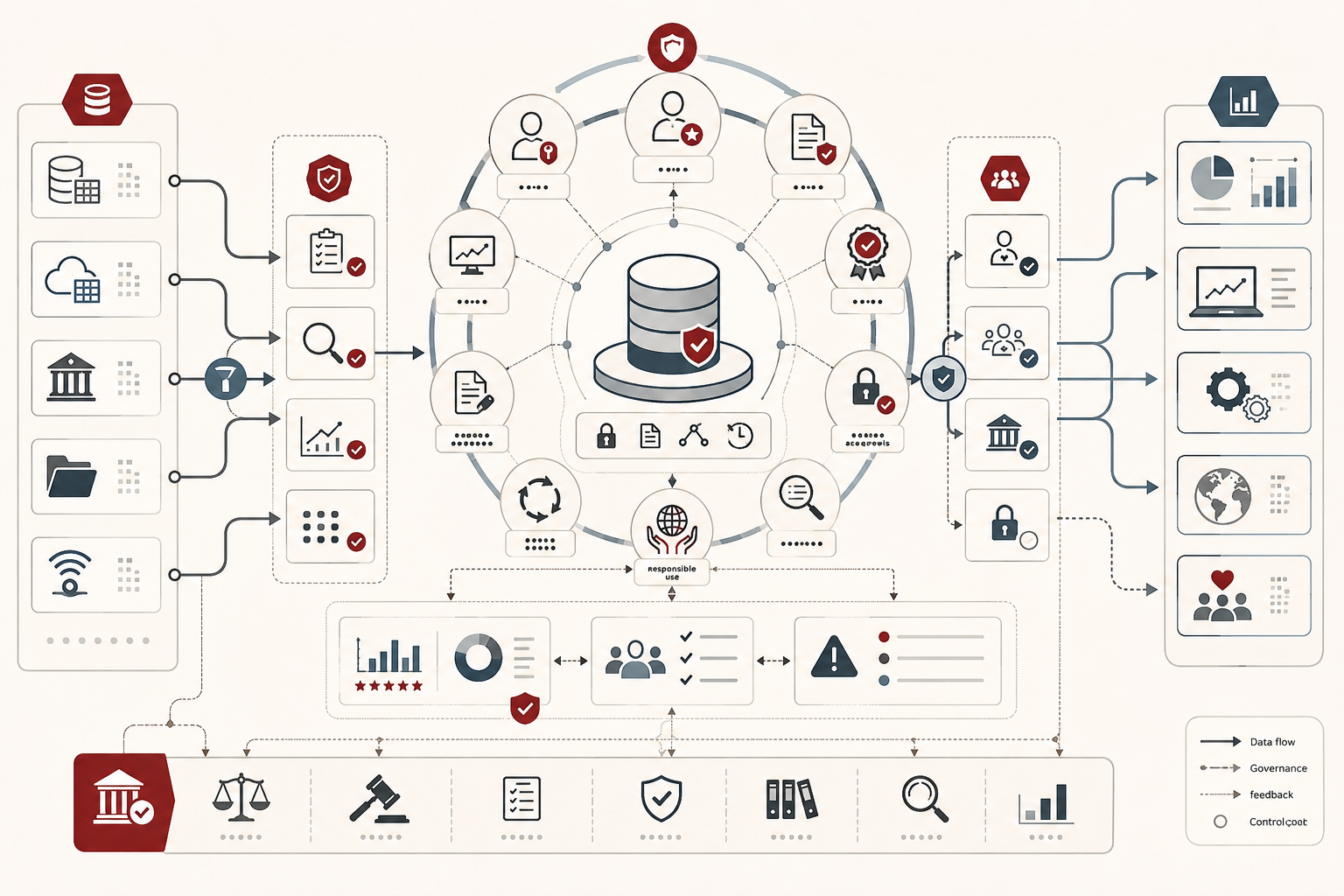
This article builds on the themes developed in Database Systems and Data Architecture, Metadata, Data Catalogs, and Lineage, Data Quality Metrics and Observability, Master Data Management and Entity Resolution, Data Security, Privacy, and Access Control, Data Lifecycle Management and Retention, and Reproducible Analytics and Versioned Data Workflows. If those articles explain how data is structured, described, monitored, secured, retained, and reproduced, this article addresses the operating authority behind those practices: who decides, who maintains, who resolves disputes, who approves reuse, and how data responsibility is made durable across time.
Data governance as accountable decision rights
The strongest way to understand data governance is as accountable decision rights over data. Governance defines who has authority to decide what a data asset means, who may use it, how it should be classified, what quality expectations apply, how lifecycle rules are enforced, when reuse is legitimate, and how disputes are resolved. This framing matters because many governance programs fail when they treat governance as documentation, tooling, or general oversight rather than as an operating structure for decisions.
A data governance program is mature when important data questions do not drift indefinitely across teams. If a customer definition changes, someone has authority to approve it. If a finance metric fails reconciliation, someone owns the issue and the escalation path. If sensitive data is requested for a new analytical use case, someone has authority to approve, deny, or condition that access. If an aging dataset should be archived or deleted, someone is accountable for that lifecycle decision. If a model feature is derived from restricted data, someone must evaluate whether reuse is lawful, proportionate, and aligned with governance policy.
This is why governance is institutional rather than merely technical. It converts data from a set of unmanaged technical artifacts into a field of accountable responsibility. Stewardship is the operational expression of that responsibility. It makes sure the decisions, definitions, policies, and quality expectations created by governance are maintained where data is actually created, transformed, shared, interpreted, and used.
What data governance and stewardship mean
Data governance is the discipline that defines how data should be managed by establishing accountability, policies, standards, decision rights, roles, and oversight. It is concerned with the rules and authority structures that determine how data is collected, owned, stored, processed, secured, classified, shared, retained, deleted, and reused. Governance is therefore not only about compliance. It is about creating the conditions under which data can be used responsibly and trusted across organizational boundaries.
Data stewardship is the operational practice through which governance expectations are maintained in day-to-day data work. Stewards help maintain definitions, metadata, reference data, quality rules, classification labels, lineage visibility, access-review context, issue queues, lifecycle controls, and responsible-use review processes. Stewardship is where governance becomes practical. It is the bridge between formal policy and the lived condition of data assets.
The distinction matters because organizations often confuse aspirational governance with functional governance. A policy may exist, but if no steward maintains the related definitions or resolves the related quality issues, the policy has weak operational force. A catalog may exist, but if ownership is stale and definitions are unmaintained, the catalog becomes a directory of uncertainty. A quality dashboard may exist, but if no one is accountable for remediation, it becomes monitoring without stewardship. Governance defines authority; stewardship makes authority usable.
Governance, management, and stewardship are not the same thing
One of the most important distinctions in data systems is the difference among governance, data management, and stewardship. Data management is the broad field of acquiring, storing, modeling, integrating, securing, processing, describing, sharing, maintaining, and retiring data. It includes architecture, database management, integration, metadata, quality, warehousing, analytics engineering, privacy, security, lifecycle control, and many other technical and organizational practices.
Data governance is the authority and accountability layer within that broader field. It defines who decides, what rules apply, how conflicts are resolved, and how responsibility is assigned. Governance does not perform every data-management task. Instead, it sets the decision framework within which those tasks should occur.
Data stewardship is the role-based operational layer that helps governance work in practice. Stewards may maintain glossary terms, approve or review definitions, triage data-quality issues, classify data, monitor metadata completeness, validate reference data, review access requests, assess reuse risks, or coordinate issue remediation across teams. Stewardship without governance becomes inconsistent local caretaking. Governance without stewardship becomes abstract policy. Data management without either becomes technical activity without durable accountability.
This distinction also explains why governance initiatives fail when they are framed as tooling projects. Catalogs, quality platforms, lineage tools, policy engines, and access workflows are useful, but they do not by themselves create decision rights, ownership, stewardship, or accountability. Tools support governance. They do not substitute for it.
Why governance matters in data systems
Governance matters because modern data systems are distributed socially as well as technically. Data moves across source systems, cloud platforms, data warehouses, lakes, pipelines, dashboards, notebooks, semantic layers, APIs, AI systems, and external reporting environments. It is created by one group, transformed by another, interpreted by another, and acted upon by still another. Without governance, responsibility fragments and meaning drifts.
The recurring symptoms are familiar. Teams use different definitions for the same metric. Critical fields lack owners. Quality issues are detected but not resolved. Access decisions are handled by informal precedent. Sensitive data is copied into uncontrolled environments. Retention rules are ignored. Reports disagree because no one knows which source is authoritative. Data products are launched without lifecycle ownership. Models are trained on data whose reuse has not been reviewed. Executives lose trust not because the platform cannot scale, but because the organization cannot explain its data.
Governance matters because data is both an asset and a risk-bearing resource. It can generate insight, coordination, public value, operational efficiency, scientific discovery, and better services. It can also create privacy exposure, security risk, discriminatory outcomes, compliance failures, misleading analysis, unmanaged surveillance, and institutional harm. Governance exists to make data more usable without allowing usability to become chaotic, extractive, unlawful, or unsafe.
Decision rights, accountability, and organizational roles
The heart of governance is decision rights. These define who has authority to approve a business definition, certify a metric, accept a data-quality exception, classify sensitive data, approve access, authorize sharing, change a schema, retire an asset, or permit reuse in a new context. Decision rights are necessary because data conflicts are rarely solved by technical facts alone. They often involve questions of meaning, risk, priority, ownership, legality, and acceptable trade-off.
A mature governance model usually includes several roles. Executive sponsors provide institutional authority and resources. Data owners are accountable for important domains or assets. Data stewards maintain definitions, metadata, quality expectations, and issue-resolution processes. Data custodians or platform teams operate the technical environments. Security teams manage technical access controls. Privacy, legal, risk, records, and compliance teams interpret obligations. Analytics and domain teams use the governed assets and surface problems when definitions or quality conditions fail.
These roles must be more than titles. A strong program clarifies what each role decides, what each role recommends, what each role maintains, what each role escalates, and how conflicts are resolved. If no one can tell who approves a metric definition or who resolves a quality dispute, governance remains symbolic. If every question escalates to a central committee, governance becomes a bottleneck. The goal is distributed accountability with coherent standards.
| Role | Primary responsibility | Typical decision or action |
|---|---|---|
| Executive sponsor | Provides authority, funding, and organizational backing | Approves governance strategy and resolves major cross-functional conflicts |
| Data owner | Accountable for a domain, asset, or data product | Approves domain priorities, certification, and major policy exceptions |
| Data steward | Maintains definitions, metadata, quality expectations, and issue triage | Reviews definitions, validates data quality, and coordinates remediation |
| Data custodian | Operates and protects technical data environments | Implements storage, access, backup, performance, and platform controls |
| Security or privacy officer | Defines and enforces protection requirements | Reviews sensitive data handling, access exceptions, and policy compliance |
| Analytics or domain user | Consumes governed data and identifies practical gaps | Reports data issues, requests access, and provides feedback on definitions |
Policies, standards, and operating rules
Governance is implemented through policies, standards, and operating rules. Policies define broad expectations: how data should be classified, protected, shared, retained, documented, certified, and reused. Standards translate those expectations into more specific requirements, such as naming conventions, metadata fields, quality thresholds, access categories, retention classes, glossary requirements, model-input review rules, or lifecycle states. Operating rules define how work actually happens: who approves an exception, how often an asset is reviewed, which queue receives a quality issue, how access expires, or what must happen before a dataset is certified.
This layered structure matters because vague governance cannot guide practice. A policy that says data should be high quality is not enough. A steward needs to know which fields are critical, what thresholds apply, what happens when an issue is detected, who is notified, and what remediation timeline is expected. A policy that says sensitive data should be protected is not enough. Teams need classification levels, handling rules, access workflows, retention expectations, and audit evidence.
The strongest governance systems treat policies as living operational infrastructure. They are attached to assets through metadata, enforced through workflows where possible, reviewed through stewardship processes, and tested through issue history. Weak systems treat policy as a document repository. The difference is whether rules shape real data behavior.
Metadata, definitions, and common understanding
Governance depends heavily on metadata because metadata is the mechanism through which meaning becomes shareable, inspectable, and enforceable. A governance policy cannot operate well if people do not agree on what a dataset, field, entity, metric, label, classification, or data product means. Stewarded metadata connects governance to real data assets: it identifies owners, definitions, classifications, quality expectations, lineage, approved use cases, retention rules, sensitivity labels, and trust status.
This is why metadata governance is not secondary documentation work. It is one of the central practices through which organizations create common understanding. When a data catalog lists a certified revenue mart, the catalog should not merely show that the table exists. It should show what revenue means, who owns the metric, how it is calculated, what quality checks apply, what downstream assets depend on it, what policies govern access, and whether it is appropriate for board reporting, experimentation, exploratory analysis, or operational decision support.
At a deeper level, metadata is where governance and semantics meet. A policy without definitions is hard to enforce meaningfully. A metric without stewarded meaning is hard to trust. A catalog without maintained metadata becomes a directory of ambiguity. A lineage graph without business metadata can explain technical dependency while leaving interpretation unresolved. Stewardship is therefore partly the discipline of keeping meaning alive inside metadata systems.
Data quality, issue resolution, and stewardship practice
One of stewardship’s most visible functions is the operational management of data quality. Data quality is not only a technical property of records. It is also a governance question about what quality means, who defines it, who monitors it, who is affected by failure, who resolves issues, and when data becomes unfit for use. A quality check without an owner is a signal without accountability. A quality dashboard without remediation is governance theater.
Stewardship usually includes identifying critical data elements, defining acceptable thresholds, managing data-quality rules, validating reference data, triaging issues, notifying consumers, coordinating remediation, and documenting root causes. In practice, this often requires negotiation across technical and business teams. A failed reconciliation check may require finance judgment. A customer-field missingness issue may require upstream application changes. A supplier-risk category drift may require reference-data review. A model-feature drift issue may require coordination among data engineering, model governance, and domain stakeholders.
This is why stewardship is best understood as issue-resolution infrastructure. It provides a path from “this data looks wrong” to “who decides what right means, who fixes it, who is notified, and how recurrence is prevented?” Without that path, quality monitoring becomes observation without governance.
A mathematical lens for governance and stewardship
Data governance and stewardship can also be evaluated through a mathematical lens. The goal is not to reduce governance to a superficial score, but to make accountability visible. A data asset is more governable when ownership is clear, decision rights are defined, policies are attached, quality issues are resolved, access decisions are reviewed, lifecycle controls are current, and responsible-use risks are assessed.
G_a = w_R R_a + w_D D_a + w_P P_a + w_Q Q_a + w_A A_a + w_L L_a + w_E E_a
\]
Interpretation: Governance maturity \(G_a\) for asset \(a\) can be modeled as a weighted combination of role coverage \(R_a\), decision-rights clarity \(D_a\), policy coverage \(P_a\), quality-issue resolution \(Q_a\), access-review discipline \(A_a\), lifecycle-control maturity \(L_a\), and ethical or responsible-use review \(E_a\).
The weights should be explicit:
w_R + w_D + w_P + w_Q + w_A + w_L + w_E = 1
\]
Interpretation: Governance scoring should reveal what the organization values. A restricted AI feature store may weight responsible-use review and access control heavily, while a finance mart may weight metric certification, quality reconciliation, and stewardship resolution more heavily.
Governance gaps can be represented as the inverse of maturity:
H_a = 1 – G_a
\]
Interpretation: Governance gap \(H_a\) shows the remaining weakness in accountability and control for asset \(a\). A high gap does not necessarily mean the asset is incorrect, but it means the organization has less evidence that the asset is responsibly governed.
Issue-resolution health can also be modeled directly:
Q_a = 1 – \frac{\sum_{i=1}^{n} S_i O_i}{n}
\]
Interpretation: Quality-resolution score \(Q_a\) declines as unresolved issues accumulate. Each issue \(i\) can be weighted by severity \(S_i\) and openness \(O_i\), so unresolved high-severity issues reduce trust more than resolved low-severity issues.
Access governance can be evaluated by risk-adjusted decision quality:
A_a = \frac{1}{m}\sum_{j=1}^{m} C_j X_j
\]
Interpretation: Access-review score \(A_a\) averages the control strength \(C_j\) applied to each access decision \(j\), adjusted by expiration, purpose limitation, approval conditions, and risk level \(X_j\).
This mathematical lens changes the question from “do we have governance?” to “which assets have explicit authority, active stewardship, enforced policy, resolved quality issues, reviewed access, lifecycle control, and responsible-use evidence?”
Python Workflow: Data Governance and Stewardship Scorecard
The following Python workflow shows how governance and stewardship can be evaluated across governed assets. It combines role coverage, decision rights, policy coverage, policy enforcement, quality-issue resolution, access-review discipline, lifecycle controls, responsible-use review, and governance-event evidence.
#!/usr/bin/env python3
"""
Python Workflow: Data Governance and Stewardship Scorecard

This compact workflow evaluates governance maturity for data assets
using roles, decision rights, policies, quality issues, access reviews,
lifecycle controls, and responsible-use review.
"""

from __future__ import annotations

from dataclasses import dataclass


@dataclass
class GovernedAsset:
    asset_id: str
    domain: str
    classification: str
    criticality: str
    certification_status: str


@dataclass
class GovernanceSignals:
    role_coverage: float
    decision_rights: float
    policy_coverage: float
    policy_enforcement: float
    issue_resolution: float
    access_review: float
    lifecycle_control: float
    responsible_use_review: float
    event_evidence: float


def governance_maturity_score(signals: GovernanceSignals) -> float:
    return round(
        0.12 * signals.role_coverage
        + 0.13 * signals.decision_rights
        + 0.13 * signals.policy_coverage
        + 0.12 * signals.policy_enforcement
        + 0.15 * signals.issue_resolution
        + 0.12 * signals.access_review
        + 0.10 * signals.lifecycle_control
        + 0.08 * signals.responsible_use_review
        + 0.05 * signals.event_evidence,
        3,
    )


def governance_gap(signals: GovernanceSignals) -> float:
    return round(1.0 - governance_maturity_score(signals), 3)


def main() -> None:
    examples = [
        (
            GovernedAsset(
                asset_id="asset_revenue_mart",
                domain="finance",
                classification="confidential",
                criticality="high",
                certification_status="certified",
            ),
            GovernanceSignals(
                role_coverage=1.0,
                decision_rights=1.0,
                policy_coverage=1.0,
                policy_enforcement=1.0,
                issue_resolution=1.0,
                access_review=0.9,
                lifecycle_control=1.0,
                responsible_use_review=1.0,
                event_evidence=1.0,
            ),
        ),
        (
            GovernedAsset(
                asset_id="asset_ai_feature_store",
                domain="ai",
                classification="restricted",
                criticality="high",
                certification_status="reviewed",
            ),
            GovernanceSignals(
                role_coverage=1.0,
                decision_rights=1.0,
                policy_coverage=0.8,
                policy_enforcement=0.7,
                issue_resolution=0.6,
                access_review=0.8,
                lifecycle_control=1.0,
                responsible_use_review=0.6,
                event_evidence=0.8,
            ),
        ),
        (
            GovernedAsset(
                asset_id="asset_legacy_kpi",
                domain="legacy",
                classification="internal",
                criticality="low",
                certification_status="uncertified",
            ),
            GovernanceSignals(
                role_coverage=0.4,
                decision_rights=0.2,
                policy_coverage=0.5,
                policy_enforcement=0.3,
                issue_resolution=0.2,
                access_review=0.7,
                lifecycle_control=0.2,
                responsible_use_review=0.2,
                event_evidence=0.3,
            ),
        ),
    ]

    for asset, signals in examples:
        print(
            asset.asset_id,
            "governance_maturity_score=",
            governance_maturity_score(signals),
            "governance_gap=",
            governance_gap(signals),
        )


if __name__ == "__main__":
    main()
This workflow separates policy existence from governance maturity. A policy may exist, but if stewardship is inactive, access is not reviewed, quality issues remain open, and lifecycle controls are overdue, the asset remains weakly governed. Scoring does not replace judgment, but it makes the basis of judgment visible.
R Workflow: Governance Roles, Policies, Quality, Access, Lifecycle, and Risk Summary
The following R workflow summarizes asset certification, stewardship roles, decision rights, policy enforcement, quality issues, access reviews, lifecycle controls, and responsible-use risks. It supports a recurring governance review: where is ownership active, where are policies weak, where are quality issues unresolved, where are access decisions high risk, and where are lifecycle or responsible-use reviews still open?
#!/usr/bin/env Rscript

# R Workflow: Governance Roles, Policies, Quality, Access, Lifecycle, and Risk Summary
#
# This workflow summarizes governance assets, stewardship roles,
# decision rights, policy enforcement, quality issues, access reviews,
# lifecycle controls, and responsible-use risks using base R.

assets <- data.frame(
  asset_id = c(
    "asset_customer_360",
    "asset_revenue_mart",
    "asset_usage_events",
    "asset_supplier_risk",
    "asset_legacy_kpi",
    "asset_ai_feature_store"
  ),
  domain = c("customer", "finance", "product", "operations", "legacy", "ai"),
  classification = c("confidential", "confidential", "internal", "confidential", "internal", "restricted"),
  certification_status = c("certified", "certified", "certified", "reviewed", "uncertified", "reviewed"),
  lifecycle_status = c("active", "active", "active", "active", "deprecated", "active"),
  stringsAsFactors = FALSE
)

roles <- data.frame(
  role_id = c("role001", "role002", "role003", "role004", "role005", "role006"),
  domain = c("customer", "finance", "enterprise", "enterprise", "operations", "ai"),
  role_type = c("data_steward", "data_steward", "policy_owner", "control_owner", "data_steward", "data_steward"),
  active = c(TRUE, TRUE, TRUE, TRUE, TRUE, TRUE),
  stringsAsFactors = FALSE
)

policies <- data.frame(
  policy_id = c("pol001", "pol002", "pol003", "pol004", "pol005", "pol006"),
  policy_domain = c("security", "finance", "customer", "enterprise", "records", "legacy"),
  policy_type = c("classification", "metric_governance", "stewardship", "responsible_use", "lifecycle", "lifecycle"),
  enforcement_status = c("enforced", "enforced", "enforced", "review", "enforced", "weak"),
  stringsAsFactors = FALSE
)

issues <- data.frame(
  issue_id = c("iss001", "iss002", "iss003", "iss004", "iss005", "iss006"),
  severity = c("medium", "high", "high", "medium", "medium", "high"),
  status = c("in_review", "resolved", "resolved", "in_review", "open", "in_review"),
  assigned_steward = c(
    "customer-steward",
    "finance-steward",
    "product-steward",
    "supplier-steward",
    "legacy-steward",
    "ai-steward"
  ),
  stringsAsFactors = FALSE
)

access_reviews <- data.frame(
  access_id = c("acc001", "acc002", "acc003", "acc004", "acc005"),
  risk_level = c("medium", "medium", "high", "high", "low"),
  decision = c("approved", "approved", "approved_with_conditions", "denied", "approved"),
  approver_role = c(
    "customer-steward",
    "finance-steward",
    "ai-steward",
    "privacy-office",
    "legacy-steward"
  ),
  stringsAsFactors = FALSE
)

lifecycle_controls <- data.frame(
  control_id = c("life001", "life002", "life003", "life004", "life005"),
  lifecycle_stage = c("use", "use", "retention", "use", "deprecation"),
  control_type = c(
    "certification_review",
    "metric_certification_review",
    "partition_retention_review",
    "third_party_risk_review",
    "retirement_plan"
  ),
  status = c("current", "current", "current", "current", "overdue"),
  stringsAsFactors = FALSE
)

responsible_use_risks <- data.frame(
  risk_id = c("risk001", "risk002", "risk003", "risk004"),
  risk_type = c("privacy_and_fairness", "model_bias_and_reuse", "third_party_fairness", "misleading_reporting"),
  severity = c("medium", "high", "medium", "medium"),
  review_status = c("approved", "in_review", "in_review", "open"),
  stringsAsFactors = FALSE
)

asset_summary <- aggregate(
  asset_id ~ domain + classification + certification_status + lifecycle_status,
  data = assets,
  FUN = length
)
names(asset_summary) <- c(
  "domain",
  "classification",
  "certification_status",
  "lifecycle_status",
  "asset_count"
)

role_summary <- aggregate(
  role_id ~ domain + role_type + active,
  data = roles,
  FUN = length
)
names(role_summary) <- c("domain", "role_type", "active", "role_count")

policy_summary <- aggregate(
  policy_id ~ policy_domain + policy_type + enforcement_status,
  data = policies,
  FUN = length
)
names(policy_summary) <- c(
  "policy_domain",
  "policy_type",
  "enforcement_status",
  "policy_count"
)

issue_summary <- aggregate(
  issue_id ~ severity + status + assigned_steward,
  data = issues,
  FUN = length
)
names(issue_summary) <- c(
  "severity",
  "status",
  "assigned_steward",
  "issue_count"
)

access_summary <- aggregate(
  access_id ~ risk_level + decision + approver_role,
  data = access_reviews,
  FUN = length
)
names(access_summary) <- c(
  "risk_level",
  "decision",
  "approver_role",
  "access_count"
)

lifecycle_summary <- aggregate(
  control_id ~ lifecycle_stage + control_type + status,
  data = lifecycle_controls,
  FUN = length
)
names(lifecycle_summary) <- c(
  "lifecycle_stage",
  "control_type",
  "status",
  "control_count"
)

risk_summary <- aggregate(
  risk_id ~ risk_type + severity + review_status,
  data = responsible_use_risks,
  FUN = length
)
names(risk_summary) <- c(
  "risk_type",
  "severity",
  "review_status",
  "risk_count"
)

dir.create("outputs", showWarnings = FALSE, recursive = TRUE)

write.csv(asset_summary, "outputs/asset_summary_r.csv", row.names = FALSE)
write.csv(role_summary, "outputs/role_summary_r.csv", row.names = FALSE)
write.csv(policy_summary, "outputs/policy_summary_r.csv", row.names = FALSE)
write.csv(issue_summary, "outputs/quality_issue_summary_r.csv", row.names = FALSE)
write.csv(access_summary, "outputs/access_review_summary_r.csv", row.names = FALSE)
write.csv(lifecycle_summary, "outputs/lifecycle_control_summary_r.csv", row.names = FALSE)
write.csv(risk_summary, "outputs/responsible_use_risk_summary_r.csv", row.names = FALSE)

cat("Wrote governance roles, policies, quality, access, lifecycle, and risk summaries.\n")
This workflow highlights the practical shape of governance. It is not only about having policies. It is about whether assets have stewards, decision rights, quality issue queues, access review evidence, lifecycle controls, and responsible-use review processes.
Lifecycle control: creation, use, retention, and deletion
Governance is a lifecycle discipline. Data changes in meaning, risk, ownership, and usefulness as it moves from creation to processing, sharing, reuse, retention, archive, deletion, or disposal. A dataset that is legitimate to collect for one purpose may not be legitimate to reuse for another. A table that is useful today may become stale, duplicative, or risky to keep indefinitely. A model-input feature may require review before reuse. A report may need deprecation when its underlying metric changes.
Lifecycle control includes questions such as: Why was the data collected? Which purpose justifies its use? How long should it be retained? What transformations are acceptable? When should access expire? When must data be archived, anonymized, minimized, or deleted? Which assets should be deprecated rather than maintained indefinitely? Which downstream users must be notified when an asset is retired?
This lifecycle framing prevents governance from being reduced to one-time access approval or documentation. Stewardship must account for time. A governed dataset is not only defined and monitored; it is intentionally created, reviewed, reused, retained, archived, or retired. In mature systems, lifecycle controls are connected to metadata, records policy, platform automation, access workflows, and stewardship queues so that lifecycle decisions are not left to memory.
Privacy, security, classification, and sensitive data handling
Governance and stewardship are inseparable from privacy, security, and classification. An organization cannot govern data well without deciding which data is sensitive, which classifications apply, who may access it, which uses are permitted, and how controls follow the data across systems. Classification is not merely a label. It is a bridge between policy intent and operational handling.
A mature classification system distinguishes categories such as public, internal, confidential, restricted, personal, sensitive personal, regulated, contractual, financial, operationally critical, or model-sensitive data. Those classifications should influence access, retention, logging, encryption, sharing, masking, tokenization, export restrictions, and review requirements. They should also be connected to lineage, because sensitive data often moves downstream into derived tables, dashboards, feature stores, extracts, and analytical products.
Governance should also distinguish security from privacy. Security asks whether data is protected from unauthorized access, alteration, disclosure, or disruption. Privacy asks whether personal data is collected, used, shared, retained, and linked in ways that are justified, proportionate, transparent, and aligned with rights and expectations. The two overlap, but they are not identical. A dataset can be secure and still be used in a privacy-invasive way. Stewardship helps surface that distinction by connecting classification, access, purpose, and reuse review.
Access, sharing, and controlled reuse
A mature governance program must balance control with reuse. Data that is overcontrolled becomes inaccessible and loses public, analytical, operational, or scientific value. Data that is undercontrolled becomes risky, misleading, extractive, or unlawful. The governance question is therefore not whether data should be open or closed in the abstract. It is what form of access, sharing, and reuse is justified for a given asset, purpose, actor, context, and risk level.
Controlled reuse requires structured review. Who is requesting access? For what purpose? Is the purpose compatible with the original collection context or approved governance policy? Is the data minimized to what is necessary? Are sensitive fields included? Is export allowed? Does access expire? Are downstream uses logged? Are conditions attached? Can the decision be audited later?
Access governance should be metadata-aware and proportional. Low-risk reference data should not be governed like restricted personal data. A certified finance mart used for internal reporting should not be handled like an experimental feature store used for model training. A vendor export should face a different review process from an internal dashboard refresh. Stewardship helps implement this proportionality by connecting access requests to domain knowledge, policy constraints, classification labels, lifecycle rules, and responsible-use review.
Ethics, fairness, and responsible data use
Governance is not only an operational control system. It is also a discipline of responsible use. Data can be accurate, secure, and well documented while still being used in ways that are unfair, disproportionate, opaque, or socially harmful. Ethical governance asks whether data use is justified by legitimate purpose, whether it respects rights and expectations, whether it creates unequal burdens, whether people can contest harmful outcomes, and whether the organization can explain how decisions were made.
This is especially important in analytics, AI, public-sector systems, healthcare, finance, education, employment, insurance, policing, social services, sustainability reporting, and supply-chain oversight. Data-driven systems can distribute opportunity, risk, surveillance, exclusion, or accountability. Governance must therefore address more than whether the data is technically available. It must ask whether the use is legitimate.
Responsible data use often requires review of sensitive attributes, proxy variables, group impact, secondary use, consent or lawful basis, data minimization, transparency, retention, and human accountability. Stewardship helps operationalize this review by making responsible-use questions part of the workflow rather than a late-stage legal formality. In mature systems, high-impact reuse does not proceed simply because data access is technically possible. It proceeds only when purpose, proportionality, safeguards, and accountability are clear.
Governance operating models and stewardship structures
Organizations implement governance through different operating models. Some use centralized data governance offices. Others rely on federated domain stewardship. Many adopt hybrid models in which enterprise standards are centrally maintained while domain stewards manage local definitions, quality expectations, and issue resolution. The right model depends on organizational scale, regulatory exposure, platform maturity, domain complexity, and how distributed data creation and use have become.
A centralized model can create consistency and strong policy control, but it can become slow or detached from domain reality. A federated model can embed stewardship where data knowledge actually exists, but it can fragment if enterprise standards are weak. A hybrid model can combine shared rules with domain ownership, but it requires clear escalation paths and strong coordination.
High-maturity governance usually includes executive sponsorship, domain ownership, steward communities, policy owners, governance councils, issue queues, metadata workflows, access-review processes, lifecycle controls, and recurring review cadences. The structure matters less than the operating clarity: who decides, who maintains, who escalates, who resolves, and how evidence is recorded.
The key is that governance must be resourced. Stewardship cannot be treated as invisible extra labor assigned to people whose performance is measured only by other work. If definitions, quality issues, metadata, access review, and lifecycle controls matter, the organization must create time, authority, and incentives for maintaining them.
Governance in the analytical workflow
Governance and stewardship shape the analytical workflow long before data reaches modeling or reporting. They influence how data is defined, classified, documented, quality-checked, shared, retained, and reused. Analytics does not begin with analysis-ready tables. It begins with governed conditions that determine whether later work is interpretable and trustworthy.
In practical analytical work, governance affects whether features are meaningful, whether metrics are consistent across reports, whether lineage is auditable, whether sensitive data is handled correctly, whether access is lawful and proportionate, and whether dashboards can be defended when challenged. Two technically capable teams can produce very different levels of trustworthiness from similar infrastructure if one has strong stewardship and the other relies on informal memory.
A mature analytics organization therefore designs governance into the lifecycle of data products, pipelines, semantic models, dashboards, notebooks, machine learning workflows, and decision processes. Governance should not appear only after a model is built or a report is challenged. It should be present when the data asset is defined, certified, transformed, accessed, monitored, reused, and retired.
Governance for data products, semantic layers, and AI systems
Modern data platforms increasingly organize data as products, expose metrics through semantic layers, and feed data into AI systems. These shifts increase the importance of governance rather than reducing it. A data product needs an owner, steward, quality expectations, consumer-facing documentation, lifecycle controls, and access rules. A semantic layer needs certified definitions, versioning, impact review, and stewardship over metric meaning. An AI system needs data provenance, feature governance, training-data documentation, sensitive-data review, monitoring, and responsible-use controls.
In data-product environments, governance clarifies what makes an asset trustworthy enough to publish and consume. In semantic-layer environments, governance clarifies which definitions are certified, which are exploratory, which are domain-specific, and how changes are reviewed. In AI environments, governance clarifies whether data can be used for training, evaluation, retrieval, feature engineering, personalization, or decision support.
This matters because AI systems can amplify weak governance. Poorly classified data can enter model pipelines. Undefined metrics can become optimization targets. Biased or incomplete data can shape automated decisions. Unreviewed features can create privacy or fairness risks. Governance and stewardship therefore become part of AI readiness. An organization that lacks data accountability will struggle to build accountable AI, no matter how advanced its models become.
Failure modes in governance and stewardship
Governance programs fail in recognizable ways. One failure mode is performative governance: committees, glossaries, policies, and dashboards exist, but definitions are not maintained, quality issues remain unresolved, and access decisions are still handled informally. The appearance of governance masks the absence of operational accountability.
A second failure mode is tool-first governance. Organizations buy catalogs, lineage systems, quality platforms, or policy engines before clarifying decision rights, ownership, stewardship capacity, or conflict-resolution processes. The result is technology without authority.
A third is overcentralized control. Governance becomes so bureaucratic that legitimate analytical work slows down, users route around the process, and stewardship is perceived as obstruction rather than trust-building.
A fourth is governance minimalism. Data is treated as if modern infrastructure alone will keep it meaningful, high-quality, and lawful to use. Definitions fork across teams, metadata erodes, sensitive data spreads, and reports disagree because no one owns the interpretive layer.
A fifth is orphaned stewardship. Roles are assigned, but stewards lack time, authority, or incentives. Their names appear in catalogs, but they cannot resolve issues or enforce standards.
A sixth is policy fragmentation. Privacy, security, records, analytics, AI, quality, and compliance policies exist separately but do not connect to common data assets or workflows.
A seventh is responsible-use afterthought. Governance checks whether data access is permitted but fails to ask whether the use is proportionate, fair, explainable, or aligned with stakeholder rights.
The best governance programs avoid both ritualized control and laissez-faire ambiguity. They create enough structure to preserve trust and enough operational fit to remain usable.
Implementation principles for high-maturity governance
Start with critical assets and domains. Do not try to govern everything at the same depth immediately. Begin with assets whose failure would create material analytical, operational, legal, privacy, reputational, financial, or ethical risk.
Make decision rights explicit. Governance becomes real when people know who approves definitions, access, certification, classification, lifecycle exceptions, and responsible-use decisions.
Resource stewardship as work. Stewardship requires time, authority, tooling, and recognition. It cannot be sustained as informal extra labor.
Connect policy to metadata. Policies should attach to real assets through classification labels, glossary terms, owners, lifecycle states, access controls, and lineage.
Measure quality resolution, not only quality detection. The key question is not only whether issues are detected, but whether they are assigned, resolved, communicated, and prevented from recurring.
Design access governance for proportionality. Low-risk, high-value data should be reusable. Restricted or high-impact data should require stronger review, purpose limitation, expiration, and logging.
Embed lifecycle controls. Creation, reuse, retention, archival, deprecation, and deletion should be governed as part of the same system rather than handled separately.
Include responsible-use review for high-impact contexts. Privacy, fairness, contestability, purpose limitation, and group impact should be part of governance where data use affects people, communities, public systems, or consequential decisions.
Keep governance close to analytical work. Governance should not be a detached compliance layer. It should shape how data products, metrics, dashboards, models, and reports are built and maintained.
| Control | Purpose | Failure it prevents |
|---|---|---|
| Decision-rights registry | Defines who can approve definitions, access, classification, quality exceptions, and lifecycle changes | Endless ambiguity and unresolved governance disputes |
| Stewardship roles | Assigns operational responsibility for definitions, metadata, quality, and issue resolution | Policy without maintenance or accountability |
| Policy register | Links governance rules to assets, domains, and review cycles | Policy fragmentation and unenforced governance expectations |
| Quality issue queue | Tracks defects, severity, ownership, notification, and remediation | Monitoring without resolution |
| Access review workflow | Evaluates purpose, risk, classification, conditions, and expiration | Ad hoc access and uncontrolled reuse |
| Lifecycle controls | Manages creation, review, retention, deprecation, archival, and deletion | Data hoarding, stale assets, and unmanaged retention risk |
| Responsible-use review | Assesses privacy, fairness, proportionality, contestability, and high-impact reuse | Technically permitted but ethically or socially harmful data use |
| Governance events | Records decisions, approvals, denials, exceptions, and conditions | Untraceable accountability and weak auditability |
GitHub Repository
This article can be paired with a companion code workflow that models data governance and stewardship as accountable operating infrastructure. The example includes data assets, stewardship roles, decision rights, policy registers, quality issues, access reviews, lifecycle controls, responsible-use risks, governance events, SQL schemas, scorecard scripts, typed contracts, governance checklists, and multi-language examples across Python, R, Julia, SQL, Go, Rust, C, C++, TypeScript, and Terraform placeholders.
Conclusion
Data governance and stewardship are foundational to trustworthy data systems because they create the authority, accountability, and operating practices through which data remains usable, secure, meaningful, lawful, and responsible across its lifecycle. Governance defines decision rights, policies, standards, and oversight. Stewardship maintains definitions, metadata, quality expectations, access context, lifecycle controls, and responsible-use review in the daily life of data assets.
Their deeper importance is institutional. Data systems do not only require storage, compute, pipelines, catalogs, and dashboards. They require accountable structures for deciding what data means, who may use it, how quality is maintained, which risks are acceptable, when reuse is legitimate, and when data should be retained or retired. When governance and stewardship are weak, analytical trust erodes even if infrastructure is modern. When they are strong, data becomes not only available but accountable, interpretable, and fit for responsible use.
Related articles
- Data Systems and Analytics knowledge series
- Database Systems and Data Architecture
- Metadata, Data Catalogs, and Lineage
- Data Quality Metrics and Observability
- Master Data Management and Entity Resolution
- Data Security, Privacy, and Access Control
- Data Lifecycle Management and Retention
- Reproducible Analytics and Versioned Data Workflows
Further reading
- DAMA International (2017) DAMA-DMBOK: Data Management Body of Knowledge. 2nd edn. Basking Ridge, NJ: Technics Publications.
- Khatri, V. and Brown, C.V. (2010) ‘Designing data governance’, Communications of the ACM, 53(1), pp. 148–152.
- Ladley, J. (2019) Data Governance: How to Design, Deploy, and Sustain an Effective Data Governance Program. 2nd edn. London: Academic Press.
- OECD (2023) Data Stewardship, Access, Sharing and Control. Paris: OECD Publishing.
- Redman, T.C. (2008) Data Driven: Profiting from Your Most Important Business Asset. Boston: Harvard Business Press.
- Seiner, R.S. (2014) Non-Invasive Data Governance: The Path of Least Resistance and Greatest Success. Basking Ridge, NJ: Technics Publications.
References
- DAMA International (n.d.) DAMA-DMBOK. Available at: https://dama.org/learning-resources/dama-data-management-body-of-knowledge-dmbok/
- DAMA International (n.d.) What is Data Management?. Available at: https://dama.org/about-dama/what-is-data-management/
- IBM (n.d.) What is Data Governance?. Available at: https://www.ibm.com/think/topics/data-governance
- IBM (n.d.) What is Data Stewardship?. Available at: https://www.ibm.com/think/topics/data-stewardship
- IBM (n.d.) What is Metadata Management?. Available at: https://www.ibm.com/think/topics/metadata-management
- Khatri, V. and Brown, C.V. (2010) ‘Designing data governance’, Communications of the ACM, 53(1), pp. 148–152.
- NIST (2024) NIST Research Data Framework (RDaF): Version 2.0. Available at: https://nvlpubs.nist.gov/nistpubs/SpecialPublications/1500-18/NIST.SP.1500-18r2.html
- NIST NCCoE (2021) Data Classification Practices. Available at: https://www.nccoe.nist.gov/data-classification
- NIST (n.d.) Privacy Framework. Available at: https://www.nist.gov/privacy-framework
- OECD (n.d.) Data governance. Available at: https://www.oecd.org/en/topics/data-governance.html
- OECD (2023) Data Stewardship, Access, Sharing and Control. Available at: https://one.oecd.org/document/DSTI/CDEP%282022%296/FINAL/en/pdf
- OECD (2024) Going Digital Guide to Data Governance Policy Making. Available at: https://www.oecd.org/en/publications/going-digital-guide-to-data-governance-policy-making_40d53904-en.html
- Redman, T.C. (2008) Data Driven: Profiting from Your Most Important Business Asset. Boston: Harvard Business Press.