
Last Updated May 11, 2026
Database systems and data architecture form the structural foundation of modern information environments. Every analytical platform, application ecosystem, reporting system, integration pipeline, machine-learning workflow, governance process, audit trail, public registry, and decision-support layer depends on some underlying design for how data is stored, related, constrained, queried, secured, moved, retained, recovered, and interpreted. Databases are often treated as technical utilities that sit behind applications, but they are also institutional systems of memory. They determine what an organization can know, what it can retrieve, what it can trust, what it can audit, what it can preserve, and what it can responsibly build upon.
A database is not merely a container for records. It is a formal structure for representing entities, relationships, transactions, histories, states, events, rules, and evidence. Data architecture is broader still. It defines how databases, schemas, pipelines, warehouses, lakes, lakehouses, catalogs, governance controls, metadata systems, semantic layers, and analytical models fit together across an organization. A strong data architecture allows operational systems, analytical systems, AI systems, and governance systems to work from coherent structures rather than disconnected files, duplicated extracts, undocumented fields, and inconsistent definitions.
Main Library
Publications
Article Map
Data Systems & Analytics
Related Topic
Relational Databases
Related Topic
Warehouses & Lakes
Related Topic
Cloud Data Platforms
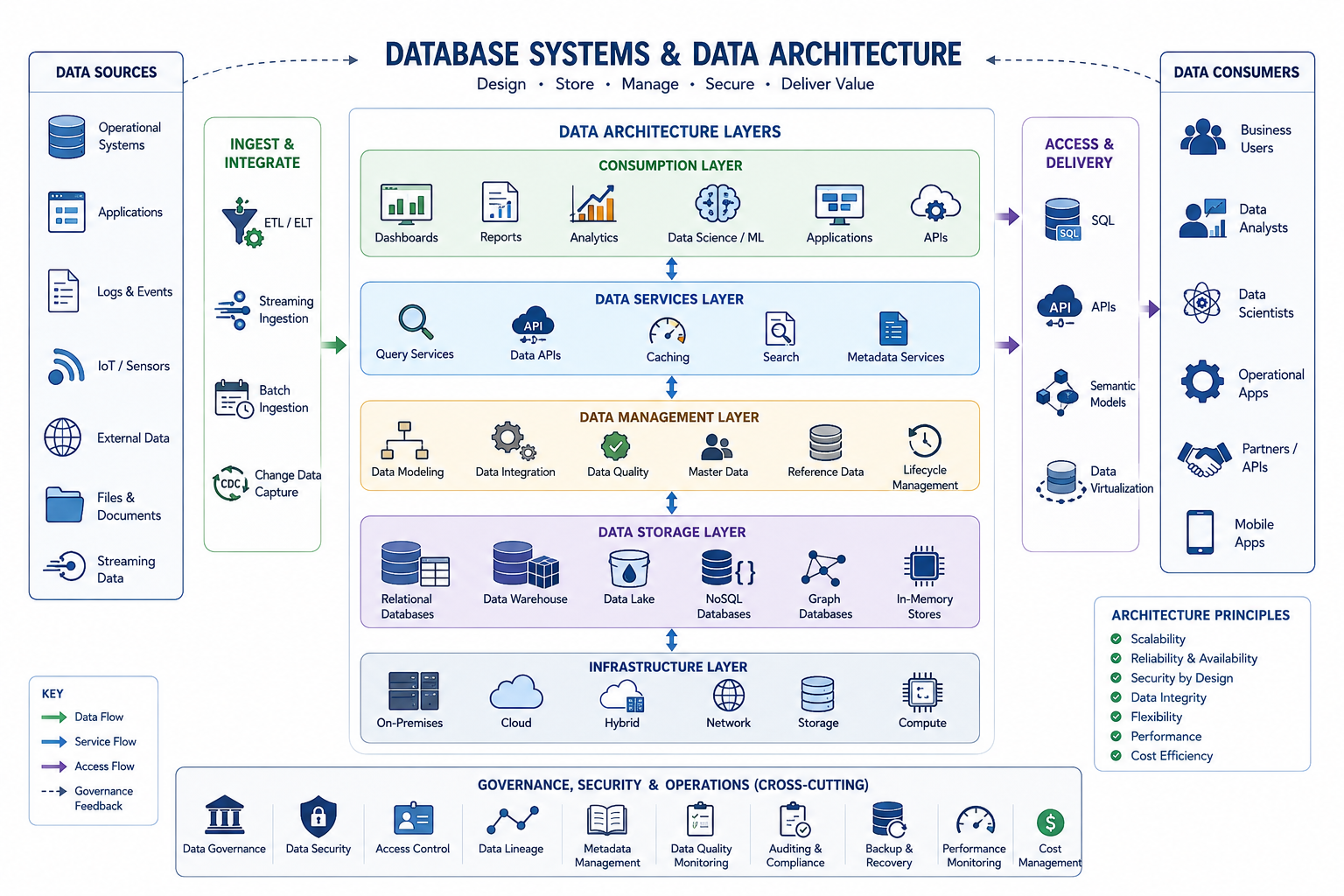
The importance of database systems becomes clearer when they are understood as both computational and organizational infrastructure. A database must support technical requirements such as consistency, durability, query performance, indexing, transactions, concurrency, replication, backup, and recovery. But it must also support institutional requirements such as ownership, accountability, documentation, privacy, security, retention, interpretability, lineage, auditability, and long-term reuse. Good data architecture sits at the intersection of these concerns.
This article should be read alongside Relational Databases and SQL Systems, Data Warehouses and Data Lakes, Cloud Data Platforms and Modern Data Stack Architecture, Data Pipelines and Data Processing Systems, Distributed Data Systems, Metadata, Data Catalogs, and Lineage, Data Quality Metrics and Observability, and Reproducible Analytics and Versioned Data Workflows. Database architecture is where representation, storage, performance, governance, integration, recovery, and institutional memory become one design problem.
Database architecture as institutional memory
The strongest way to understand database systems is as institutional memory made executable. A database does not simply preserve facts. It defines what kinds of facts can exist, how they relate, which identifiers stabilize them, which rules constrain them, who may change them, how long they should persist, how they can be recovered, and how later users can interpret them. A customer record, patient encounter, product catalog, permit registry, payment ledger, sensor reading, audit event, or research sample is not merely a row, document, event, object, or graph node. It is an organized claim about the world.
Data architecture gives that memory a wider structure. It connects operational databases to data pipelines, warehouses, lakes, metadata catalogs, lineage systems, semantic models, BI tools, feature stores, governance workflows, archives, and AI-facing systems. Without architecture, database systems may function locally while the wider information environment becomes fragmented. Teams may store data reliably in one system, duplicate it incorrectly in another, transform it without lineage, report it through inconsistent metrics, and retain it without clear lifecycle policy.
This is why database architecture is not only backend engineering. It is one of the principal ways institutions decide what they know, how they know it, and how that knowledge can be used responsibly over time. When database systems are designed well, they become durable foundations for application behavior, analytics, governance, accountability, and decision support. When they are designed poorly, institutional memory becomes brittle, opaque, and difficult to trust.
What a database system is
A database system is an organized environment for storing, managing, querying, changing, protecting, and recovering data. It usually includes the database itself, a database management system, query interfaces, schema definitions, storage structures, transaction controls, indexing mechanisms, security controls, backup and recovery processes, administrative tools, and monitoring systems. In relational systems, data is organized into tables, rows, columns, keys, constraints, and relationships. In other systems, data may be organized as documents, key-value pairs, graphs, time series, events, objects, vectors, or wide-column structures.
The central function of a database system is to make data durable, consistent, accessible, and meaningful. Durability means the system can preserve information across failures. Consistency means the system maintains defined rules about valid states. Accessibility means users and applications can retrieve or modify data through controlled interfaces. Meaningfulness means the system’s structures reflect entities, events, relationships, and states in ways that can be interpreted and reused.
A database system therefore involves more than storage. It expresses assumptions about the world. A customer table, a patient record, a product catalog, a permit registry, a research sample, an infrastructure asset, or a transaction ledger is never just a technical object. It is a modeled representation of reality, shaped by institutional categories, business rules, legal obligations, analytical needs, user workflows, and historical decisions.
Data architecture, database architecture, and information architecture
Data architecture, database architecture, and information architecture overlap, but they are not identical. Database architecture focuses on the design of database systems themselves: schema structure, storage models, indexing, query performance, transactions, replication, backup, security, administration, and workload behavior. Data architecture is broader. It addresses the organization of data across systems, pipelines, platforms, domains, governance structures, analytical layers, metadata catalogs, semantic models, lifecycle processes, and downstream uses. Information architecture is broader still in some contexts, focusing on how information is organized, classified, navigated, understood, and used by people.
This distinction matters because organizations often solve database problems while neglecting architectural problems. A database may be well-tuned and reliable within its own boundary while the wider data environment remains chaotic. Conversely, an organization may have impressive architecture diagrams but poorly designed databases underneath. Reliable systems require both levels: strong local database design and coherent enterprise data architecture.
Data architecture becomes especially important as organizations scale. A single application may survive with a narrowly designed schema. A larger institutional data environment cannot. Once data must move among operational systems, warehouses, lakes, APIs, dashboards, machine-learning models, compliance systems, public reporting pipelines, and archives, architecture becomes the difference between reusable information and endless reconciliation.
Entities, events, state, and evidence
Database design begins with the question of what kind of reality the system needs to represent. Some databases primarily model entities: customers, patients, employees, facilities, products, assets, accounts, species, instruments, locations, or organizations. Other databases primarily model events: transactions, orders, readings, alerts, inspections, payments, shipments, logins, observations, incidents, or state transitions. Many systems model both. A payment ledger, for example, may represent accounts as entities and payments as events. A monitoring system may represent sensors as entities and measurements as events.
This distinction matters because entities and events behave differently. Entities usually persist and change through attributes. Events occur at points in time and should often remain append-only or historically traceable. State records describe current conditions, while event records explain how those conditions came to be. Analytical systems often need both: current state for operational decisions and historical events for explanation, accountability, trend analysis, and forecasting.
A strong database architecture makes these representational choices explicit. It asks whether a table is one row per entity, one row per event, one row per state snapshot, one row per relationship, or one row per aggregate. It asks which identifiers are stable, which attributes can change, which histories must be preserved, which events are immutable, and which downstream users need current state versus full evidence. These choices shape the trustworthiness of every later query, dashboard, model, report, and audit trail.
Relational structure and transactional integrity
The relational model remains one of the most influential ideas in database history because it separates logical structure from physical storage and represents data through relations, attributes, keys, and constraints. Its enduring strength is not merely that it uses tables, but that it provides a disciplined way to represent relationships, avoid unnecessary duplication, enforce integrity, and query data declaratively.
Transactional integrity is equally important. Many database systems must support operations where multiple changes succeed or fail together. A payment, enrollment, inventory update, medical record change, shipment update, or account transfer cannot be treated as a loose collection of unrelated writes. Transactional systems use principles often summarized as atomicity, consistency, isolation, and durability. These properties help ensure that data remains reliable even when multiple users, applications, or processes interact with it at the same time.
Relational systems are not the correct answer to every data problem, but their conceptual discipline remains foundational. Even when organizations use document stores, graph databases, event streams, lakehouse tables, vector indexes, or key-value stores, they still need to answer relational questions: What entities exist? What relationships matter? Which identifiers are stable? Which constraints protect validity? Which rules determine whether a record is complete, current, or trustworthy?
Schemas, keys, constraints, and normalization
Schema design is the practice of defining how data is structured. In relational systems, this includes tables, columns, data types, primary keys, foreign keys, uniqueness constraints, nullability rules, indexes, and relationships. In document, event, or semi-structured systems, schema may be more flexible, but the underlying design questions remain: What entities are being represented? Which fields are required? Which identifiers connect records? Which rules protect the data from ambiguity or corruption?
Keys are especially important because they allow records to be distinguished and joined. A primary key identifies a record within a table. A foreign key connects one table to another. Natural keys may come from the real world, such as a code or account number. Surrogate keys are generated by the system. Poor key design can create duplicate entities, broken relationships, inconsistent joins, and analytical errors that propagate across the organization.
Normalization is a design approach that reduces redundancy and protects integrity by organizing data into coherent relations. It is especially useful in transactional systems where updates must be reliable and duplication can create contradictions. Analytical systems often use denormalized or dimensional structures for performance and usability, but even there, normalization remains conceptually important because it clarifies entities, relationships, and grain.
The grain of a table is one of the most important architectural decisions in data design. A table might represent one row per customer, one row per transaction, one row per product per day, one row per sensor reading, one row per account-period, or one row per certified metric. If the grain is unclear, downstream analytics become unstable. Metric definitions, joins, aggregations, dashboards, and models can all become unreliable because users are not working from a shared understanding of what each row represents.
| Design concept | Architecture question | Failure if neglected |
|---|---|---|
| Entity model | What kinds of things does the system recognize? | Duplicate or conflicting representations of customers, assets, places, products, or events |
| Grain | What does one row, document, event, or record represent? | Ambiguous aggregation, double counting, and unstable metrics |
| Primary key | What uniquely identifies each record? | Duplicate identity and broken joins |
| Foreign key or relationship | How are records connected across structures? | Orphaned records and weak referential accountability |
| Constraint | What states are valid? | Impossible, contradictory, or corrupt data states |
| Normalization | Which facts belong together, and which should be separated? | Redundancy, update anomalies, and semantic confusion |
| Lifecycle rule | How long should data be retained, archived, or deleted? | Uncontrolled retention, legal risk, or loss of institutional memory |
Query processing, indexing, and physical design
Logical data design defines what the data means. Physical design affects how efficiently the system can store, retrieve, and process it. Indexes, partitions, clustering, compression, caching, materialized views, query plans, replication, columnar storage, row storage, and storage layouts all shape database performance. A schema that looks elegant in logical form can become slow, expensive, or operationally fragile if physical design is ignored.
Indexes provide structured shortcuts for locating records. They can dramatically improve query performance, but they also impose maintenance costs during writes. Partitioning can improve performance and manageability by dividing data into meaningful segments such as dates, regions, tenants, or categories. Clustering can improve performance when related data is physically colocated. Materialized views can precompute common queries but require refresh strategies and governance.
Query processing is where the database system translates user intent into execution. A query optimizer evaluates possible execution plans and chooses a strategy for scanning, joining, filtering, aggregating, and returning results. Understanding query plans helps engineers and analysts diagnose slow queries, expensive joins, missing indexes, poor cardinality estimates, inefficient access patterns, and workload mismatches.
Database architecture therefore requires both semantic clarity and mechanical realism. The system must represent the world accurately enough for users to trust it, but it must also process data efficiently enough for applications and analytics to work at scale. A trustworthy architecture is neither purely logical nor purely physical. It connects meaning, workload, performance, reliability, and governance.
Operational, analytical, and hybrid data stores
Operational databases and analytical databases serve different purposes. Operational systems are designed to support applications and transactions. They prioritize correctness, availability, concurrent updates, and predictable response times. Analytical systems are designed to support exploration, reporting, aggregation, modeling, and decision support. They prioritize scan performance, historical depth, dimensional analysis, semantic consistency, and flexible query patterns.
This difference explains why data architecture often separates operational databases from warehouses, lakes, lakehouses, marts, cubes, semantic layers, and BI systems. Operational schemas are usually optimized around application workflows. Analytical schemas are usually organized around questions, metrics, dimensions, histories, and decision contexts. Moving data from operational systems into analytical systems requires transformation, modeling, documentation, testing, and governance.
Hybrid patterns have become more common as organizations seek lower latency and more integrated architectures. Some platforms support transactional and analytical workloads in closer proximity. Others use streaming pipelines, change data capture, replicated read models, or lakehouse tables to reduce delay between operational events and analytical availability. These patterns can be powerful, but they do not eliminate the need to distinguish between operational truth, analytical readiness, semantic certification, and governed consumption.
Warehouses, lakes, lakehouses, and architectural layering
Modern data architecture often includes multiple storage and processing layers. A data warehouse provides curated, structured, governed analytical data for reporting, business intelligence, and decision support. A data lake preserves raw or lightly processed data in flexible forms for exploration, machine learning, archival retention, and future reinterpretation. A lakehouse attempts to combine lake flexibility with stronger table management, transactional reliability, and warehouse-like analytical behavior.
These patterns matter because data moves through stages of readiness. Raw data is not automatically trustworthy. Curated data is not automatically traceable. Certified metrics are not automatically connected to source evidence. Good architecture creates a path from source data to raw retention, standardized forms, refined analytical assets, governed data products, semantic definitions, dashboards, models, and archives.
Layering also prevents false choices. The goal is not to force every workload into one storage model. Some workloads need relational transactions. Some need low-cost raw retention. Some need fast analytical scans. Some need streaming state. Some need graph traversal. Some need vector search. Some need legally durable archives. Architecture is the discipline of matching storage and processing models to data meaning, workload requirements, governance obligations, and institutional risk.
Distributed databases, replication, and consistency
As systems scale, database architecture often becomes distributed. Data may be replicated across regions, partitioned across nodes, cached near users, synchronized across systems, or streamed into downstream platforms. Distributed design supports availability, performance, resilience, and geographic reach, but it also introduces difficult tradeoffs.
Replication creates copies of data for availability, performance, or disaster recovery. Synchronous replication can protect consistency but may increase latency. Asynchronous replication can improve performance and availability but may allow temporary divergence. Sharding divides data across partitions or nodes, allowing larger scale but requiring careful key design and query routing. Eventual consistency can be acceptable for some workloads and unacceptable for others.
The architectural issue is not whether distributed systems are good or bad. It is whether their consistency, latency, recovery, and governance properties match the use case. A social feed, an inventory system, a public health registry, a financial ledger, a research repository, and an environmental sensor network may all require different tradeoffs. Good data architecture makes those tradeoffs explicit rather than hiding them behind platform language.
Metadata, governance, lineage, and security
Database systems do not become trustworthy simply because they are technically available. Users need to know what data exists, where it came from, what it means, who owns it, how current it is, how it has changed, who can access it, how long it should be retained, and whether it is appropriate for a given use. Metadata, governance, lineage, and security make those questions answerable.
Metadata describes data assets. It may include names, definitions, schemas, owners, classifications, quality scores, freshness status, retention rules, lineage, access permissions, and usage patterns. Lineage shows how data moves and changes across systems. Governance defines policies, accountabilities, approvals, stewardship responsibilities, and lifecycle rules. Security enforces access, privacy, encryption, auditability, and protection against misuse.
These elements must be treated as part of the architecture, not as after-the-fact documentation. A database without ownership becomes difficult to maintain. A schema without definitions becomes difficult to interpret. A table without lineage becomes difficult to trust. A warehouse without access control becomes a risk. A metric without semantic governance becomes a source of conflict. A model without data provenance becomes difficult to audit.
Backup, recovery, retention, and durable memory
Database architecture must also answer what happens when systems fail, data is corrupted, users make mistakes, migrations go wrong, ransomware strikes, hardware disappears, regions become unavailable, or auditors ask what existed at a prior point in time. Backup, recovery, retention, and archival design are not operational afterthoughts. They are part of the architecture of durable memory.
A backup strategy should define recovery point objectives, recovery time objectives, backup frequency, restore testing, geographic redundancy, encryption, access controls, and evidence of successful recovery. A retention strategy should define how long data is kept, when it is archived, when it is deleted, and which legal or institutional obligations govern those decisions. Recovery plans should be tested before they are needed, not merely documented.
This matters because an unrecoverable database is not durable in any meaningful institutional sense. A table may be well-designed, indexed, and governed, but if it cannot be restored after failure, its value is fragile. Similarly, data retained forever without policy can become a legal, ethical, and operational liability. Durable memory requires both preservation and disciplined lifecycle control.
Data architecture for AI and advanced analytics
AI and advanced analytics intensify the need for strong database architecture rather than making it obsolete. Predictive models, retrieval systems, feature stores, semantic layers, and agentic workflows all depend on underlying data structures. If those structures are poorly governed, weakly documented, stale, biased, duplicated, or inconsistent, downstream analytical and AI systems inherit those weaknesses.
Model training requires clear datasets, labels, time windows, feature definitions, versioning, and provenance. Retrieval systems require curated documents, metadata, access controls, freshness indicators, and source traceability. Decision-support systems require stable definitions, quality checks, and accountable data lineage. AI systems that act on institutional data require even stronger controls because errors can scale quickly across decisions, workflows, and user interactions.
The architectural lesson is simple: AI does not replace databases, metadata, lineage, quality, or governance. It depends on them. Advanced analytics raises the stakes for data architecture because the consequences of weak data design can become more automated, more opaque, and more widely distributed.
Common failures in database and data architecture design
Several failures recur across database and data architecture work. One is schema drift, where structures change without adequate documentation, testing, or downstream coordination. Another is duplicate entity modeling, where customers, products, accounts, locations, or events are represented differently across systems. A third is weak grain definition, where tables are used without clarity about what one row means. A fourth is performance-first design without semantic discipline, where shortcuts improve speed but create long-term interpretive confusion.
Another common failure is analytical extraction without governance. Organizations often move data from operational systems into warehouses or lakes without clear ownership, lineage, certification, or quality checks. This creates large analytical environments that are technically impressive but difficult to trust. Users may have access to more data than ever before while still lacking confidence in definitions, freshness, completeness, or correctness.
There is also a failure of institutional memory. Databases often outlive the teams that created them. When design decisions are not documented, future users inherit structures they cannot explain. This is why data architecture must treat documentation, metadata, and governance as durable infrastructure rather than optional maintenance work.
What good looks like
A strong database system has clear entities, stable identifiers, well-defined relationships, appropriate constraints, reliable transactions, tested recovery procedures, useful indexes, documented schemas, monitored workloads, and security controls. It supports the workload it was designed for without forcing every use case into the same structure. It can be monitored, tuned, backed up, restored, audited, and explained.
A strong data architecture extends those qualities across systems. Operational databases, analytical stores, integration pipelines, catalogs, semantic layers, dashboards, feature stores, archives, and governance processes fit together coherently. Data assets have owners. Tables have definitions. Metrics have certified logic. Lineage is visible. Access is controlled. Retention is planned. Recovery is tested. Quality checks are routine. Analytical users can find and understand trustworthy data without reverse-engineering every field from scratch.
Most importantly, good architecture makes data reusable without making it careless. It allows information to move, but not without controls. It allows analysis to scale, but not without meaning. It supports innovation, but not at the cost of trust. Under those conditions, database systems become more than backend infrastructure. They become durable foundations for institutional knowledge.
A mathematical lens for database architecture
A database estate can be represented as a set of systems:
E = \{S_1, S_2, \ldots, S_n\}
\]
Interpretation: The estate \(E\) contains database and data systems \(S_i\), such as operational databases, warehouses, lakes, streaming platforms, catalogs, semantic layers, archives, and feature stores.
A data asset can be represented by its schema, key, owner, classification, and lifecycle status:
A_i = (G_i, K_i, O_i, C_i, L_i)
\]
Interpretation: Asset \(A_i\) has grain \(G_i\), key structure \(K_i\), owner \(O_i\), classification \(C_i\), and lifecycle status \(L_i\). These features make the asset interpretable and governable.
A lineage graph connects sources, transformations, and targets:
G_L = (V, E_L)
\]
Interpretation: The lineage graph \(G_L\) contains data systems and assets as vertices \(V\), with lineage edges \(E_L\) showing movement, transformation, publication, and dependency.
A governance-readiness score can combine metadata, lineage, ownership, access, recovery, retention, quality, and certification:
Q_g = w_MM + w_LL + w_OO + w_AA + w_RR + w_TT + w_QQ + w_CC
\]
Interpretation: Governance readiness \(Q_g\) combines metadata coverage \(M\), lineage coverage \(L\), ownership \(O\), access controls \(A\), recovery readiness \(R\), retention maturity \(T\), quality gates \(Q\), and certification \(C\).
Recovery readiness can be evaluated by comparing actual backup and restore evidence against targets:
R_s = f(\mathrm{RPO}_s,\mathrm{RTO}_s,B_s,T_s)
\]
Interpretation: Recovery readiness \(R_s\) for system \(s\) depends on recovery point objective, recovery time objective, backup age \(B_s\), and restore-test evidence \(T_s\).
Architecture risk can be represented as severity times likelihood:
\rho_i = \mathrm{severity}_i \times \mathrm{likelihood}_i
\]
Interpretation: Architecture risk \(\rho_i\) increases when severe problems are likely to occur, especially around lineage gaps, recovery failures, semantic inconsistency, weak access controls, or unresolved ownership.
An estate-readiness score can combine system readiness, asset quality, workload fit, lineage quality, and risk resolution:
Q_e = w_SS_e + w_AA_e + w_WW_e + w_LL_e + w_RR_e
\]
Interpretation: Estate readiness \(Q_e\) combines system readiness \(S_e\), asset architecture quality \(A_e\), workload fit \(W_e\), lineage quality \(L_e\), and risk-resolution maturity \(R_e\).
The point of this mathematical lens is not to reduce architecture to a single number. It is to make architecture inspectable: systems, assets, metadata, lineage, recovery, workloads, access, lifecycle, and risks should all be explicit enough to review.
Python Workflow: Database Systems and Data Architecture Readiness Scorecard
The following Python workflow demonstrates how a database architecture review can evaluate system inventory, schema assets, workload fit, governance controls, recovery plans, lineage edges, architecture risks, and estate-readiness scoring.
#!/usr/bin/env python3
"""
Python Workflow: Database Systems and Data Architecture
Readiness Scorecard

This compact example treats database architecture as institutional
information infrastructure: systems, assets, workloads, governance,
recovery, lineage, risk, and readiness scoring.
"""

from __future__ import annotations

from statistics import mean


def status_score(value: str) -> float:
    return {
        "certified": 1.0,
        "approved": 1.0,
        "pass": 1.0,
        "good": 1.0,
        "complete": 1.0,
        "registered": 0.75,
        "in_review": 0.60,
        "watch": 0.45,
        "warn": 0.40,
        "planned": 0.35,
        "partial": 0.45,
        "missing": 0.10,
        "failed": 0.0,
    }.get(value, 0.5)


def severity_weight(value: str) -> float:
    return {
        "low": 0.10,
        "medium": 0.25,
        "high": 0.45,
        "critical": 0.65,
    }.get(value, 0.25)


def likelihood_weight(value: str) -> float:
    return {
        "low": 0.20,
        "medium": 0.50,
        "high": 0.80,
    }.get(value, 0.50)


def recovery_score(
    rpo_minutes: float,
    rto_minutes: float,
    backup_age_minutes: float,
    restore_test_days_ago: float,
    status: str,
) -> float:
    rpo_score = 1.0 if backup_age_minutes <= rpo_minutes else max(
        0.0,
        1.0 - min((backup_age_minutes - rpo_minutes) / max(rpo_minutes, 1), 1.0),
    )
    rto_score = status_score(status)
    restore_score = max(0.0, 1.0 - min(restore_test_days_ago / 120.0, 1.0))
    return round(mean([rpo_score, rto_score, restore_score]), 3)


def database_architecture_readiness(
    system_readiness: float,
    asset_readiness: float,
    workload_fit: float,
    lineage_quality: float,
    risk_resolution: float,
) -> float:
    return round(
        0.35 * system_readiness
        + 0.20 * asset_readiness
        + 0.18 * workload_fit
        + 0.15 * lineage_quality
        + 0.12 * risk_resolution,
        3,
    )


def main() -> None:
    systems = [
        {
            "system": "customer_core",
            "type": "operational_database",
            "storage": "relational",
            "criticality": "critical",
            "metadata": 0.96,
            "lineage": 0.92,
            "access": "approved",
            "quality": "pass",
            "certification": "certified",
            "recovery": recovery_score(15, 60, 8, 21, "pass"),
            "risk_penalty": 0.0,
        },
        {
            "system": "raw_data_lake",
            "type": "analytical_storage",
            "storage": "object_storage",
            "criticality": "high",
            "metadata": 0.72,
            "lineage": 0.64,
            "access": "approved",
            "quality": "warn",
            "certification": "registered",
            "recovery": recovery_score(1440, 480, 900, 80, "warn"),
            "risk_penalty": 0.08,
        },
        {
            "system": "semantic_layer",
            "type": "analytics_service",
            "storage": "metric_model",
            "criticality": "critical",
            "metadata": 0.80,
            "lineage": 0.68,
            "access": "in_review",
            "quality": "warn",
            "certification": "in_review",
            "recovery": recovery_score(60, 180, 45, 70, "in_review"),
            "risk_penalty": 0.12,
        },
    ]

    system_scores = []

    for system in systems:
        score = max(
            0.0,
            0.18 * system["metadata"]
            + 0.18 * system["lineage"]
            + 0.16 * status_score(system["access"])
            + 0.16 * status_score(system["quality"])
            + 0.16 * status_score(system["certification"])
            + 0.16 * system["recovery"]
            - system["risk_penalty"],
        )
        system_scores.append(score)

    assets = [
        {
            "asset": "customers",
            "grain_defined": True,
            "primary_key": True,
            "constraint_count": 6,
            "lineage": "complete",
            "quality": "pass",
            "access": "approved",
            "lifecycle": "approved",
        },
        {
            "asset": "raw_clickstream",
            "grain_defined": True,
            "primary_key": True,
            "constraint_count": 1,
            "lineage": "partial",
            "quality": "warn",
            "access": "approved",
            "lifecycle": "approved",
        },
        {
            "asset": "revenue_metrics",
            "grain_defined": True,
            "primary_key": True,
            "constraint_count": 4,
            "lineage": "partial",
            "quality": "warn",
            "access": "in_review",
            "lifecycle": "in_review",
        },
    ]

    asset_scores = []

    for asset in assets:
        asset_scores.append(
            0.18 * float(asset["grain_defined"])
            + 0.18 * float(asset["primary_key"])
            + 0.14 * min(1.0, asset["constraint_count"] / 8)
            + 0.16 * status_score(asset["lineage"])
            + 0.14 * status_score(asset["quality"])
            + 0.10 * status_score(asset["access"])
            + 0.10 * status_score(asset["lifecycle"])
        )

    workloads = [
        {
            "name": "checkout_transaction",
            "status": "good",
            "governance_need": "critical",
            "availability_need": "critical",
            "latency_fit": 0.95,
        },
        {
            "name": "daily_revenue_dashboard",
            "status": "watch",
            "governance_need": "critical",
            "availability_need": "high",
            "latency_fit": 0.80,
        },
        {
            "name": "churn_feature_generation",
            "status": "in_review",
            "governance_need": "critical",
            "availability_need": "high",
            "latency_fit": 0.85,
        },
    ]

    workload_scores = [
        0.35 * status_score(workload["status"])
        + 0.25 * workload["latency_fit"]
        + 0.20 * (1.0 if workload["governance_need"] in {"high", "critical"} else 0.70)
        + 0.20 * (1.0 if workload["availability_need"] in {"high", "critical"} else 0.70)
        for workload in workloads
    ]

    lineage_edges = [
        {"edge": "customer_core_to_warehouse_marts", "lineage": "complete", "quality": "pass", "contract": "approved", "status": "pass"},
        {"edge": "event_stream_to_raw_data_lake", "lineage": "partial", "quality": "warn", "contract": "approved", "status": "warn"},
        {"edge": "warehouse_marts_to_semantic_layer", "lineage": "partial", "quality": "warn", "contract": "in_review", "status": "in_review"},
    ]

    lineage_scores = [
        0.30 * status_score(edge["lineage"])
        + 0.25 * status_score(edge["quality"])
        + 0.25 * status_score(edge["contract"])
        + 0.20 * status_score(edge["status"])
        for edge in lineage_edges
    ]

    risks = [
        {"severity": "high", "likelihood": "medium", "status": "in_review"},
        {"severity": "medium", "likelihood": "medium", "status": "planned"},
        {"severity": "high", "likelihood": "medium", "status": "in_review"},
    ]

    risk_scores = []

    for risk in risks:
        raw_risk = severity_weight(risk["severity"]) * likelihood_weight(risk["likelihood"])
        risk_scores.append(status_score(risk["status"]) * (1.0 - min(raw_risk, 0.8) / 2.0))

    print({
        "system_readiness": round(mean(system_scores), 3),
        "asset_readiness": round(mean(asset_scores), 3),
        "workload_fit": round(mean(workload_scores), 3),
        "lineage_quality": round(mean(lineage_scores), 3),
        "risk_resolution": round(mean(risk_scores), 3),
        "database_architecture_readiness": database_architecture_readiness(
            system_readiness=mean(system_scores),
            asset_readiness=mean(asset_scores),
            workload_fit=mean(workload_scores),
            lineage_quality=mean(lineage_scores),
            risk_resolution=mean(risk_scores),
        ),
    })


if __name__ == "__main__":
    main()
This workflow treats architecture as evidence. It does not only list systems. It evaluates whether those systems are documented, recoverable, governed, linked through lineage, aligned with workloads, and protected from unresolved architecture risk.
R Workflow: Database Estate, Workloads, Governance, Recovery, and Lineage Summary
The following R workflow summarizes a database estate across system types, schema assets, workloads, governance controls, recovery posture, lineage edges, and architecture risks.
#!/usr/bin/env Rscript

# R Workflow: Database Estate, Workloads, Governance,
# Recovery, and Lineage Summary

systems <- data.frame(
  system_name = c(
    "customer_core",
    "order_management",
    "payment_ledger",
    "event_stream",
    "raw_data_lake",
    "warehouse_marts",
    "feature_store",
    "metadata_catalog",
    "semantic_layer"
  ),
  system_type = c(
    "operational_database",
    "operational_database",
    "operational_database",
    "streaming_platform",
    "analytical_storage",
    "analytical_database",
    "ml_data_platform",
    "governance_platform",
    "analytics_service"
  ),
  storage_model = c(
    "relational",
    "relational",
    "relational",
    "log_based",
    "object_storage",
    "columnar_sql",
    "key_value_and_table",
    "metadata_graph",
    "metric_model"
  ),
  records_millions = c(12, 85, 97, 900, 1500, 260, 130, 8, 2),
  data_volume_gb = c(420, 950, 780, 4200, 18500, 3100, 950, 210, 40),
  certification_status = c(
    "certified",
    "certified",
    "certified",
    "registered",
    "registered",
    "certified",
    "in_review",
    "certified",
    "in_review"
  ),
  stringsAsFactors = FALSE
)

assets <- data.frame(
  asset_name = c(
    "customers",
    "orders",
    "order_lines",
    "payments",
    "order_events",
    "raw_clickstream",
    "fact_sales",
    "customer_features",
    "business_glossary",
    "revenue_metrics"
  ),
  asset_type = c(
    "table",
    "table",
    "table",
    "table",
    "topic",
    "object_prefix",
    "warehouse_table",
    "feature_table",
    "metadata_asset",
    "semantic_model"
  ),
  classification = c(
    "restricted",
    "confidential",
    "confidential",
    "restricted",
    "confidential",
    "confidential",
    "confidential",
    "restricted",
    "internal",
    "internal"
  ),
  lineage_status = c(
    "complete",
    "complete",
    "complete",
    "complete",
    "partial",
    "partial",
    "complete",
    "partial",
    "complete",
    "partial"
  ),
  quality_status = c(
    "pass",
    "pass",
    "pass",
    "pass",
    "warn",
    "warn",
    "pass",
    "warn",
    "pass",
    "warn"
  ),
  access_status = c(
    "approved",
    "approved",
    "approved",
    "approved",
    "approved",
    "approved",
    "approved",
    "in_review",
    "approved",
    "in_review"
  ),
  constraint_count = c(6, 7, 8, 8, 3, 1, 8, 5, 4, 4),
  stringsAsFactors = FALSE
)

governance <- data.frame(
  system_name = systems$system_name,
  metadata_coverage = c(0.96, 0.94, 0.98, 0.78, 0.72, 0.95, 0.84, 0.99, 0.80),
  lineage_coverage = c(0.92, 0.90, 0.96, 0.70, 0.64, 0.90, 0.76, 0.97, 0.68),
  owner_assigned = c(1, 1, 1, 1, 1, 1, 1, 1, 1),
  classification_applied = c(1, 1, 1, 1, 1, 1, 1, 1, 1),
  access_policy_status = c(
    "approved",
    "approved",
    "approved",
    "approved",
    "approved",
    "approved",
    "in_review",
    "approved",
    "in_review"
  ),
  recovery_test_status = c(
    "pass",
    "pass",
    "pass",
    "warn",
    "warn",
    "pass",
    "warn",
    "pass",
    "warn"
  ),
  quality_gate_status = c(
    "pass",
    "pass",
    "pass",
    "warn",
    "warn",
    "pass",
    "warn",
    "pass",
    "warn"
  ),
  certification_status = c(
    "certified",
    "certified",
    "certified",
    "registered",
    "registered",
    "certified",
    "in_review",
    "certified",
    "in_review"
  ),
  stringsAsFactors = FALSE
)

recovery <- data.frame(
  system_name = c(
    "customer_core",
    "order_management",
    "payment_ledger",
    "event_stream",
    "raw_data_lake",
    "warehouse_marts",
    "feature_store",
    "metadata_catalog",
    "semantic_layer"
  ),
  recovery_point_objective_minutes = c(15, 15, 5, 30, 1440, 60, 60, 15, 60),
  recovery_time_objective_minutes = c(60, 60, 30, 120, 480, 180, 240, 60, 180),
  last_backup_age_minutes = c(8, 10, 4, 20, 900, 30, 55, 12, 45),
  last_restore_test_days_ago = c(21, 24, 14, 45, 80, 32, 95, 28, 70),
  replication_mode = c(
    "synchronous_multi_az",
    "synchronous_multi_az",
    "synchronous_multi_az",
    "replicated_log",
    "cross_region_object_replication",
    "snapshot_and_replica",
    "snapshot_and_replica",
    "synchronous_multi_az",
    "snapshot_and_replica"
  ),
  status = c("pass", "pass", "pass", "warn", "warn", "pass", "warn", "pass", "in_review"),
  stringsAsFactors = FALSE
)

lineage <- data.frame(
  source_system = c(
    "customer_core",
    "order_management",
    "order_management",
    "payment_ledger",
    "event_stream",
    "raw_data_lake",
    "warehouse_marts",
    "metadata_catalog"
  ),
  target_system = c(
    "warehouse_marts",
    "event_stream",
    "warehouse_marts",
    "warehouse_marts",
    "raw_data_lake",
    "feature_store",
    "semantic_layer",
    "semantic_layer"
  ),
  flow_type = c(
    "cdc_pipeline",
    "event_publish",
    "elt_pipeline",
    "elt_pipeline",
    "stream_sink",
    "feature_pipeline",
    "metric_model_publish",
    "metadata_sync"
  ),
  lineage_visibility = c("complete", "partial", "complete", "complete", "partial", "partial", "partial", "complete"),
  quality_gate = c("pass", "warn", "pass", "pass", "warn", "warn", "warn", "pass"),
  contract_status = c("approved", "in_review", "approved", "approved", "approved", "in_review", "in_review", "approved"),
  status = c("pass", "warn", "pass", "pass", "warn", "in_review", "in_review", "pass"),
  stringsAsFactors = FALSE
)

risks <- data.frame(
  risk_area = c(
    "semantic_consistency",
    "lineage_visibility",
    "recovery_testing",
    "feature_reproducibility",
    "contract_maturity"
  ),
  severity = c("high", "medium", "medium", "high", "high"),
  likelihood = c("medium", "medium", "medium", "medium", "medium"),
  status = c("in_review", "in_review", "planned", "in_review", "in_review"),
  stringsAsFactors = FALSE
)

system_summary <- aggregate(
  cbind(records_millions, data_volume_gb) ~ system_type + storage_model + certification_status,
  data = systems,
  FUN = function(x) c(system_count = length(x), total_value = sum(x), mean_value = mean(x))
)
system_summary <- do.call(data.frame, system_summary)

asset_summary <- aggregate(
  constraint_count ~ asset_type + classification + lineage_status + quality_status + access_status,
  data = assets,
  FUN = mean
)

governance_summary <- aggregate(
  cbind(metadata_coverage, lineage_coverage, owner_assigned, classification_applied) ~ access_policy_status + recovery_test_status + quality_gate_status + certification_status,
  data = governance,
  FUN = mean
)

recovery_summary <- aggregate(
  cbind(recovery_point_objective_minutes, recovery_time_objective_minutes, last_backup_age_minutes, last_restore_test_days_ago) ~ replication_mode + status,
  data = recovery,
  FUN = mean
)

lineage_summary <- aggregate(
  source_system ~ flow_type + lineage_visibility + quality_gate + contract_status + status,
  data = lineage,
  FUN = length
)
names(lineage_summary) <- c(
  "flow_type",
  "lineage_visibility",
  "quality_gate",
  "contract_status",
  "status",
  "edge_count"
)

risk_summary <- aggregate(
  risk_area ~ severity + likelihood + status,
  data = risks,
  FUN = length
)
names(risk_summary) <- c(
  "severity",
  "likelihood",
  "status",
  "risk_count"
)

dir.create("outputs", showWarnings = FALSE, recursive = TRUE)

write.csv(system_summary, "outputs/system_summary_r.csv", row.names = FALSE)
write.csv(asset_summary, "outputs/asset_summary_r.csv", row.names = FALSE)
write.csv(governance_summary, "outputs/governance_summary_r.csv", row.names = FALSE)
write.csv(recovery_summary, "outputs/recovery_summary_r.csv", row.names = FALSE)
write.csv(lineage_summary, "outputs/lineage_summary_r.csv", row.names = FALSE)
write.csv(risk_summary, "outputs/architecture_risk_summary_r.csv", row.names = FALSE)

cat("Wrote database estate, asset, governance, recovery, lineage, and risk summaries.\n")
This workflow treats data architecture as an estate-level review problem. It shows how system type, storage model, asset structure, governance coverage, recovery posture, lineage quality, and architecture risk can be summarized together rather than managed as disconnected concerns.
Applications across domains
Database systems and data architecture appear in nearly every modern domain, but their design priorities differ. Banking and finance require durable transactional systems, ledgers, audit trails, access controls, risk reporting, and regulatory extracts. Healthcare requires patient identity, encounter histories, privacy controls, clinical workflows, billing data, research datasets, and interoperability across institutional boundaries. Public agencies require registries, permitting systems, benefits systems, inspection records, administrative data, geospatial layers, and public reporting infrastructure.
Scientific and environmental systems require observational databases, instrument metadata, sensor networks, long-term archives, quality flags, provenance, reproducible workflows, and data products that can be shared across research communities. Infrastructure systems require asset registries, telemetry streams, maintenance histories, event logs, geospatial relationships, outage records, and operational analytics. Digital commerce systems require customer state, product catalogs, orders, inventory, payments, shipments, events, recommendation features, and reporting marts.
Across all these domains, the architectural challenge is the same: structured data must be durable enough to preserve institutional memory, flexible enough to support multiple uses, governed enough to protect rights and trust, and transparent enough to explain how downstream outputs were produced.
Implementation principles for high-integrity database architecture
Treat databases as institutional memory. Schema, keys, constraints, histories, and recovery plans define what the institution can preserve and explain.
Define entities, events, state, and evidence explicitly. A table, document, event stream, or archive should make clear what kind of reality it represents.
Separate operational truth from analytical readiness. Application databases, warehouses, lakes, marts, semantic layers, and feature stores serve different functions.
Make grain visible. Every important table or analytical asset should define what one row, event, document, or record represents.
Use constraints and quality gates where trust matters. Validity should not rely only on downstream cleanup.
Design indexes and physical structures from workload evidence. Performance tuning should follow query patterns, access paths, data volume, and write behavior.
Connect systems through lineage. Downstream reports, dashboards, models, and metrics should be traceable back to source systems and transformations.
Govern access across all layers. Raw data, operational data, warehouse tables, feature stores, semantic models, and archives all need appropriate controls.
Test recovery before failure. Backups, restore tests, replication, failover, and retention rules should be visible, measured, and owned.
Document architecture decisions. Databases outlive teams. Future users need to understand why structures exist, how they changed, and what they can be trusted to support.
| Control | Purpose | Failure it prevents |
|---|---|---|
| System inventory | Identifies operational, analytical, streaming, metadata, archive, and semantic systems | Hidden platforms and unmanaged data sprawl |
| Schema inventory | Documents assets, grain, keys, owners, and classifications | Ambiguous data meaning and duplicate entity modeling |
| Constraint and quality controls | Protect valid state and analytical readiness | Invalid records, corrupt joins, and unreliable outputs |
| Workload catalog | Maps systems to latency, consistency, throughput, and governance needs | Storage choices that do not match use cases |
| Metadata catalog | Makes assets discoverable and interpretable | Data that exists technically but cannot be trusted or reused |
| Lineage graph | Connects sources, transformations, and downstream targets | Unexplainable dashboards, models, and data products |
| Access governance | Controls who can read, modify, export, or administer data | Overexposure, misuse, and weak accountability |
| Recovery plan | Defines backup, restore, replication, RPO, RTO, and failover behavior | Unrecoverable institutional memory after failure |
| Retention and lifecycle policy | Defines when data is retained, archived, or removed | Uncontrolled accumulation or premature loss of evidence |
| Architecture risk register | Tracks unresolved weaknesses with owners and status | Invisible technical debt and unmanaged systemic risk |
GitHub Repository
This article can be paired with a companion code workflow that models database systems and data architecture as institutional information infrastructure. The example includes system inventories, schema assets, workload catalogs, governance controls, recovery plans, lineage edges, architecture risks, SQL schemas, Python and R workflows, Julia scoring, typed contracts, Quarto report templates, and multi-language examples across Python, R, Julia, SQL, Go, Rust, C, C++, TypeScript, and Terraform placeholders.
The companion repository provides a vendor-neutral database systems and data architecture scaffold with system inventories, schema and asset scorecards, workload-fit review, metadata and lineage coverage, recovery-plan analysis, architecture risk tracking, SQL governance queries, reproducible reporting templates, typed contracts, documentation, and CI smoke-test patterns.
Conclusion
Database systems and data architecture are foundational because they determine how information is represented, protected, retrieved, related, governed, recovered, and reused. Databases provide the durable structures that allow applications and analytical systems to function. Data architecture provides the wider design logic that connects those systems into coherent environments for governance, integration, analytics, AI, and decision support.
The most important lesson is that database design is never merely technical. It is also semantic, institutional, and operational. A schema defines what counts as an entity. A key defines identity. A constraint defines validity. An index expresses expected access. A transaction defines controlled change. A lineage record connects present use to prior transformation. A recovery plan defines whether memory can survive failure. A governance policy determines who can see, modify, retain, or explain data. These choices shape what an organization can know and how responsibly it can act on that knowledge.
Strong database systems make data reliable. Strong data architecture makes data usable across time, teams, systems, and purposes. Together, they form the foundation on which modern analytics, governance, cloud platforms, AI systems, and decision-support environments depend.
Related articles
- Data Systems & Analytics
- Relational Databases and SQL Systems
- Data Warehouses and Data Lakes
- Cloud Data Platforms and Modern Data Stack Architecture
- Data Pipelines and Data Processing Systems
- Distributed Data Systems
- Metadata, Data Catalogs, and Lineage
- Reproducible Analytics and Versioned Data Workflows
Further reading
- Connolly, T. and Begg, C. (2015) Database Systems: A Practical Approach to Design, Implementation, and Management. 6th edn. Harlow: Pearson.
- Date, C.J. (2019) Database Design and Relational Theory: Normal Forms and All That Jazz. 2nd edn. Sebastopol, CA: O’Reilly Media.
- Harrington, J.L. (2016) Relational Database Design and Implementation. 4th edn. Cambridge, MA: Morgan Kaufmann.
- Kimball, R. and Ross, M. (2013) The Data Warehouse Toolkit: The Definitive Guide to Dimensional Modeling. 3rd edn. Indianapolis: Wiley.
- Kleppmann, M. (2017) Designing Data-Intensive Applications. Sebastopol, CA: O’Reilly Media.
- Reis, J. and Housley, M. (2022) Fundamentals of Data Engineering. Sebastopol, CA: O’Reilly Media.
References
- ACM (1982) The 1981 ACM Turing Award Lecture: Relational Database: A Practical Foundation for Productivity. Available at: https://dl.acm.org/doi/10.1145/358396.358400
- Codd, E.F. (1970) ‘A relational model of data for large shared data banks’, Communications of the ACM, 13(6), pp. 377–387. Available at: https://dl.acm.org/doi/10.1145/362384.362685
- IBM (n.d.) Edgar F. Codd: The inventor made relational databases possible. Available at: https://www.ibm.com/history/edgar-codd
- International Organization for Standardization (2023) ISO/IEC 9075-1:2023 Database languages SQL — Part 1: Framework (SQL/Framework). Available at: https://www.iso.org/standard/76583.html
- International Organization for Standardization (2023) ISO/IEC 9075-2:2023 Database languages SQL — Part 2: Foundation (SQL/Foundation). Available at: https://www.iso.org/standard/76584.html
- PostgreSQL Global Development Group (2026) PostgreSQL 18 Documentation: Constraints. Available at: https://www.postgresql.org/docs/current/ddl-constraints.html
- PostgreSQL Global Development Group (2026) PostgreSQL 18 Documentation: Indexes. Available at: https://www.postgresql.org/docs/current/indexes.html
- PostgreSQL Global Development Group (2026) PostgreSQL 18 Documentation: Transactions. Available at: https://www.postgresql.org/docs/current/tutorial-transactions.html
- SQLite (2026) Query Planning. Available at: https://sqlite.org/queryplanner.html
- SQLite (2026) SQLite Foreign Key Support. Available at: https://sqlite.org/foreignkeys.html