
Last Updated May 10, 2026
Deep learning systems are large-scale neural architectures that learn hierarchical representations of data through optimization over high-dimensional parameter spaces, enabling artificial intelligence systems to model complex structure across language, vision, speech, biology, multimodal reasoning, scientific discovery, infrastructure analysis, and decision-support environments. Their defining feature is not merely depth in the number of layers. It is the interaction among representation learning, compositional architecture, large-scale data, computational infrastructure, optimization dynamics, and generalization behavior. Modern deep learning operates at the intersection of function approximation, statistical inference, representation geometry, distributed computing, and systems engineering.
The central argument of this article is that deep learning should be understood as a form of governed representational infrastructure. A deep model is not simply a stack of neural layers. It is a system that transforms data into internal representations, organizes those representations through architecture, trains them through optimization, scales them through compute and data, evaluates them through benchmark and deployment evidence, and embeds them inside institutions, platforms, products, scientific workflows, and public decision environments. Its power comes from representation at scale. Its risk comes from the same source.
Main Library
Publications
Article Map
Artificial Intelligence Systems
Related Topic
Data Systems & Analytics
Related Topic
Generative AI
Related Topic
Intelligent Infrastructure Systems
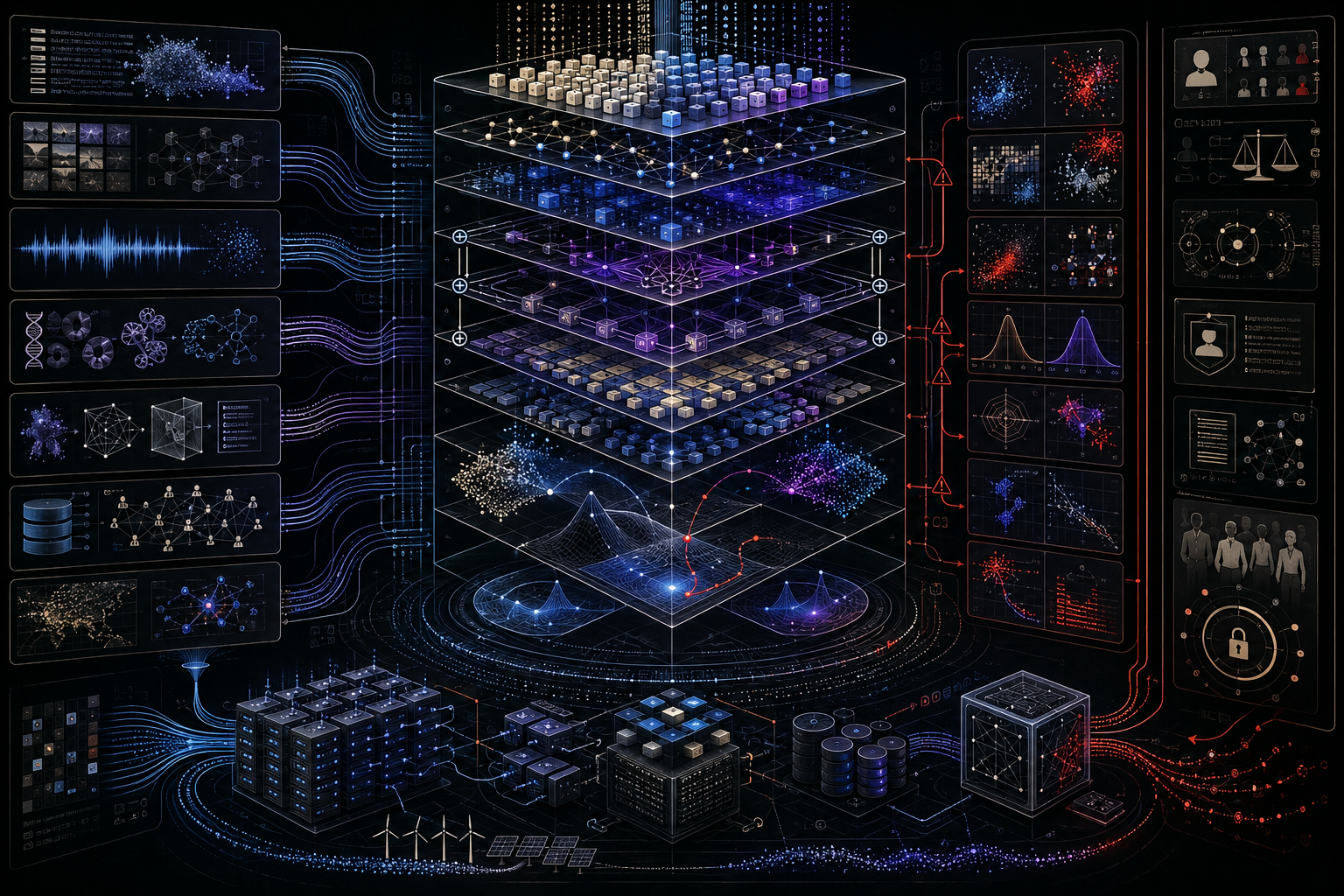
The contemporary success of deep learning did not arise from one isolated breakthrough. It emerged from the convergence of architectures capable of learning expressive internal representations, optimization methods capable of training those architectures, large datasets capable of exposing statistical structure, and hardware systems capable of supporting massive computation. Together, these forces produced systems that can recognize images, translate language, generate text, model proteins, transcribe speech, retrieve multimodal knowledge, simulate scientific patterns, and support complex inference across high-dimensional data environments. Yet these same systems challenge traditional assumptions about interpretability, robustness, causality, generalization, accountability, and governance.
This article develops Deep Learning Systems: Representation, Scale, and Generalization as an advanced article within the Artificial Intelligence Systems knowledge series. It explains representation learning, the manifold hypothesis, depth, compositionality, expressive power, scaling laws, transformers, attention, overparameterization, double descent, emergent behavior, optimization geometry, infrastructure, robustness, failure modes, and governance. Selected Python and R examples appear here, while the full GitHub repository contains expanded computational scaffolding for neural representation geometry, scaling-law simulation, overparameterization diagnostics, loss landscapes, synthetic deep-learning experiments, grouped diagnostics, SQL metadata, governance notes, and advanced Jupyter notebooks.
Why Deep Learning Systems Matter
Deep learning systems matter because they have become the dominant technical foundation for many modern AI capabilities. Computer vision, speech recognition, natural language processing, machine translation, protein structure prediction, recommender systems, generative image models, large language models, multimodal assistants, autonomous perception, scientific machine learning, and representation-based retrieval all depend on deep neural architectures. These systems are not simply larger versions of earlier machine learning methods. They reorganize data into learned internal representations that can support classification, generation, search, reasoning-like behavior, translation, prediction, simulation, and decision support across complex domains.
The importance of deep learning lies in the relationship between representation and scale. Earlier machine learning systems often depended on hand-designed features. Deep learning shifts much of the feature-discovery burden into the model itself. Given sufficient data, compute, architecture, and optimization, the system learns internal structures that make downstream tasks possible. In image models, early layers may identify edges and textures while deeper layers encode objects and scenes. In language models, token embeddings and attention layers construct contextual representations that support generation, summarization, translation, retrieval, and reasoning-like interaction. In biology, deep architectures can learn structural patterns in sequences or molecules that would be difficult to specify manually.
This power also creates risk. Deep learning systems can be opaque, brittle, expensive, data-hungry, and difficult to evaluate. They may generalize impressively in some settings while failing unpredictably under distribution shift, adversarial perturbation, rare cases, or unfamiliar contexts. They may produce capabilities that are hard to forecast from smaller systems. They may concentrate computational power in institutions with access to large-scale data, specialized hardware, engineering talent, and deployment infrastructure. For that reason, deep learning should be studied not only as a model class, but as a systems phenomenon.
Deep\ Learning = Representation + Scale + Optimization + Infrastructure
\]
Interpretation: Deep learning capability emerges from the interaction of learned representation, large-scale data, model architecture, optimization dynamics, compute infrastructure, and deployment context.
| Domain | Deep Learning Capability | System Value | Governance Concern |
|---|---|---|---|
| Language systems | Contextual embeddings, attention, generation, retrieval, summarization. | Supports writing, search, translation, knowledge work, and conversational interfaces. | Hallucination, source misrepresentation, bias, privacy, and institutional overtrust. |
| Vision systems | Feature hierarchies, detection, segmentation, image-text alignment. | Supports medical imaging, robotics, inspection, accessibility, and environmental monitoring. | Domain shift, surveillance risk, subgroup error, and visual overconfidence. |
| Speech and multimodal systems | Audio representation, cross-modal embeddings, fusion, transcription. | Supports accessibility, interaction, multimodal search, and human-machine interfaces. | Unequal error rates, privacy exposure, and compounding multimodal uncertainty. |
| Scientific discovery | Learned representations of molecules, proteins, climate, materials, or complex systems. | Accelerates modeling, prediction, simulation, and hypothesis generation. | Weak interpretability, extrapolation error, and false confidence in scientific settings. |
| Decision-support environments | High-dimensional prediction, ranking, scoring, and representation-based retrieval. | Supports operational intelligence, triage, forecasting, and automation. | Opaque models can shape rights, resources, access, and institutional decisions. |
Note: Deep learning becomes most consequential when learned representations enter workflows that people treat as evidence, recommendation, explanation, or authority.
Representation Learning and the Manifold Hypothesis
A central idea in deep learning is that high-dimensional data often contains lower-dimensional structure. Natural images, speech signals, human language, biological sequences, sensor streams, and user behavior do not occupy arbitrary regions of their possible data spaces. They exhibit regularities, constraints, symmetries, repeated patterns, and latent structure. The manifold hypothesis states that meaningful data often lies near lower-dimensional manifolds embedded within high-dimensional ambient spaces.
A deep network learns a sequence of transformations:
f_\theta:\mathbb{R}^{n}\rightarrow\mathbb{R}^{m}
\]
Interpretation: A deep model maps high-dimensional inputs into output or representation spaces through learned parameters \(\theta\).
Layer by layer, the network transforms the geometry of the data. Early layers may preserve local structure. Intermediate layers may combine local patterns into reusable motifs. Deeper layers may separate classes, compress irrelevant variation, align related concepts, or expose latent factors. In many cases, relationships that are nonlinear in the original input space become more accessible in the learned representation space.
A layer-wise representation can be written as:
h_{\ell+1}=\phi_{\ell}(h_\ell;\theta_\ell)
\]
Interpretation: Each layer \(\ell\) transforms a representation \(h_\ell\) into a new representation \(h_{\ell+1}\).
This reframes the problem of intelligence. Instead of manually specifying all relevant features, the system learns which features matter. Deep learning is therefore not only prediction. It is representation construction. The model reorganizes the input domain so that meaningful patterns become usable for downstream tasks.
| Representation Level | What It Captures | Example | Risk if Misread |
|---|---|---|---|
| Raw input | Pixels, tokens, audio samples, sensor values, sequences, or records. | Image tensor, token sequence, waveform, protein sequence. | Raw data may reflect measurement bias or missing context. |
| Early representation | Local patterns and low-level structure. | Edges, phonetic features, token embeddings, molecular motifs. | Low-level artifacts can be mistaken for meaningful signal. |
| Intermediate representation | Reusable motifs, parts, relational structure, or compressed features. | Object parts, phrase structure, acoustic units, embedding clusters. | Representations may encode spurious correlations. |
| Deep representation | Task-relevant abstractions and separable structure. | Semantic embeddings, image classes, multimodal concepts. | High-level abstractions can hide uncertainty and bias. |
| Output representation | Prediction, generated text, score, action, retrieval result, or embedding. | Class label, token distribution, image caption, recommendation. | Users may treat outputs as more grounded than the model evidence supports. |
Note: Representation learning is powerful because it discovers features automatically, but learned features still reflect data, architecture, loss functions, and deployment context.
Learned\ Representation \neq Neutral\ Representation
\]
Interpretation: A representation is shaped by training data, architecture, objectives, optimization, and evaluation. It should not be treated as a transparent map of reality.
Depth, Compositionality, and Expressive Power
Depth enables compositional representation. A deep network can be understood as a composition of functions:
f(x)=f_L\circ f_{L-1}\circ \cdots \circ f_1(x)
\]
Interpretation: A deep model composes many transformations, allowing complex functions to be built from simpler layers.
This compositionality matters because many real-world structures are themselves compositional. Images combine edges, textures, parts, objects, and scenes. Language combines characters, subwords, words, syntax, clauses, discourse, and context. Music combines notes, intervals, phrases, patterns, and form. Biological systems combine molecular units into higher-order structures. A deep architecture can mirror this layered organization by learning features at multiple levels of abstraction.
From a theoretical perspective, depth can provide expressive efficiency. Some functions that require a very large shallow network can be represented more compactly by a deep network. Depth is therefore not only a matter of stacking layers. It changes the kinds of functions that can be represented efficiently and the kinds of structures that can be learned from data.
However, expressive power does not guarantee learnability. A model may be capable of representing a function but unable to discover it through training. This is why depth must be understood together with optimization, data distribution, architecture, normalization, initialization, regularization, and compute. Deep learning works when representational capacity, learning dynamics, and data structure align.
| Deep Learning Concept | Meaning | Why It Matters | Failure Mode |
|---|---|---|---|
| Depth | Multiple layers of transformation. | Enables hierarchical representation. | Deep systems may be hard to optimize or interpret. |
| Compositionality | Complex functions built from simpler functions. | Matches structure in language, vision, biology, and systems data. | Model may learn shortcuts instead of meaningful composition. |
| Expressive power | Capacity to represent complex mappings. | Supports rich modeling across domains. | High capacity can fit noise or artifacts. |
| Inductive bias | Architectural assumptions guiding learning. | Makes learning more efficient and structured. | Bias may not match deployment setting. |
| Learnability | Ability to find useful parameters through training. | Connects representation to optimization. | Representable functions may still be hard to learn. |
Note: Depth is valuable when it supports compositional representation that aligns with the structure of the data and the task.
Capacity \neq Competence
\]
Interpretation: A model may be expressive enough to represent a solution without learning the right structure, generalizing reliably, or behaving safely in deployment.
Scaling Laws: Data, Parameters, and Compute
One of the most important empirical findings in modern deep learning is that performance often follows scaling relationships with respect to model size, dataset size, and computational budget. In language modeling and other domains, loss may decrease according to approximate power laws as scale increases, though the exact relationship depends on architecture, data quality, optimization, and task domain.
A simplified scaling relationship can be written as:
\mathcal{L}(N)
\approx
aN^{-\alpha}+b
\]
Interpretation: A scaling law expresses how loss \(\mathcal{L}\) may decrease as a resource \(N\), such as parameters, data, or compute, increases.
Scale is not one-dimensional. Increasing parameters without enough data can undertrain the model. Increasing data without enough model capacity can underuse the data. Increasing compute without efficient architecture or optimization can waste resources. Compute-optimal training asks how model size and training tokens should be balanced under a fixed compute budget.
A stylized compute relationship can be written as:
C \propto ND
\]
Interpretation: Training compute \(C\) scales with model size \(N\) and training data \(D\) under simplified assumptions.
This reveals a critical point: deep learning is not only about models. It is about systems of scale. Data pipelines, accelerators, distributed training, memory bandwidth, cluster scheduling, storage, monitoring, and energy use all become part of model capability. A deep learning system is therefore an infrastructural system as well as an algorithmic one.
| Scaling Dimension | What Increases | Potential Benefit | Governance Concern |
|---|---|---|---|
| Parameters | Number of learned weights or model degrees of freedom. | Greater representational capacity. | Opacity, compute cost, concentration of power, and harder evaluation. |
| Training data | Number, diversity, or richness of examples. | Broader coverage and better representation learning. | Data provenance, privacy, bias, copyright, and synthetic contamination. |
| Compute | Training FLOPs, accelerators, memory, and infrastructure. | Enables larger models and longer training runs. | Energy use, access inequality, and infrastructure dependency. |
| Context length | Tokens, frames, patches, records, or history available to the model. | Supports long-document, multimodal, or memory-like behavior. | Long context can dilute evidence or hide contradictions. |
| Deployment scale | Number of users, workflows, domains, and decisions affected. | Broad utility and system integration. | Errors, bias, or hallucinations can propagate quickly. |
Note: Scale improves capability only when data quality, architecture, optimization, evaluation, and governance scale with it.
Scale \neq Reliability
\]
Interpretation: Larger systems may become more capable, but reliability still depends on grounding, validation, calibration, robustness, monitoring, and responsible deployment.
Transformers and Attention as General-Purpose Architectures
Transformers have become a general-purpose architecture for language, vision, speech, code, multimodal systems, and sequence modeling. Their central mechanism is attention, which allows elements of an input to dynamically relate to one another.
Scaled dot-product attention can be written as:
\mathrm{Attention}(Q,K,V)
=
\mathrm{softmax}
\left(
\frac{QK^T}{\sqrt{d_k}}
\right)V
\]
Interpretation: Attention compares queries \(Q\) and keys \(K\), normalizes the resulting scores, and uses them to combine values \(V\).
Attention can be interpreted as adaptive information routing. Instead of relying only on fixed local structure or sequential recurrence, the model learns which elements of the input should influence one another. In language, tokens can attend to other tokens across a context window. In vision, image patches can exchange information globally. In multimodal systems, text, image, audio, and other embeddings can be aligned or fused through attention-based mechanisms.
Transformers matter because they separate representation learning from strict locality. Convolution emphasizes local spatial structure. Recurrence emphasizes sequential order. Attention allows global relational structure. This flexibility is one reason transformers became central to large language models and many multimodal AI systems.
Yet attention is not magic. It requires data, compute, positional structure, optimization, regularization, and careful evaluation. Attention weights are also not automatically reliable explanations. A transformer can be powerful and still opaque. Its relational computations may support strong performance without providing straightforward interpretability.
| Architecture Element | Function | Deep Learning Role | System Concern |
|---|---|---|---|
| Token or patch embedding | Converts inputs into vector representations. | Creates the computational substrate for attention. | Tokenization or patching can affect fairness, efficiency, and meaning. |
| Self-attention | Computes relationships among input elements. | Supports contextual and relational representation. | Attention patterns are not complete explanations. |
| Feed-forward layers | Transform representations after attention. | Add nonlinear representational capacity. | Internal behavior becomes difficult to attribute at scale. |
| Residual connections | Carry information across layers. | Support training of deep stacks. | Layer contributions may become hard to isolate. |
| Positional information | Encodes order, location, or structure. | Preserves sequence or spatial organization. | Long-context and out-of-distribution behavior may degrade. |
Note: Transformers are powerful because they flexibly route information, but their reliability depends on data, architecture, training, evaluation, and deployment controls.
Attention \neq Explanation
\]
Interpretation: Attention is a mechanism for relational computation, not a complete explanation of model reasoning, causality, or reliability.
Generalization in the Overparameterized Regime
Classical statistical learning theory often suggests that models with excessive capacity should overfit. Deep learning systems complicate this picture. Modern networks may contain far more parameters than training examples and can sometimes fit training data extremely well while still generalizing effectively to new data. This is known as the overparameterized regime.
A generalization gap can be written as:
\mathrm{Gap}
=
R_{\mathrm{test}}(\theta)-R_{\mathrm{train}}(\theta)
\]
Interpretation: The generalization gap compares performance on held-out data with performance on training data.
Several explanations have been proposed for why deep networks generalize despite high capacity. Implicit regularization suggests that optimization procedures bias models toward solutions that generalize better than arbitrary parameter settings. Data structure suggests that natural data contains learnable regularities that constrain effective complexity. Architecture provides inductive biases through convolution, attention, normalization, residual connections, or tokenization. Scale can improve representation quality when data and compute are balanced.
This means generalization is not determined by parameter count alone. It emerges from interactions among architecture, training data, optimization dynamics, regularization, representation geometry, and evaluation setting. Deep learning therefore forces a more systems-oriented theory of generalization.
| Factor | How It Supports Generalization | Why It Matters | Failure Mode |
|---|---|---|---|
| Data structure | Natural data contains reusable regularities. | Allows high-capacity models to learn meaningful patterns. | Model may exploit dataset artifacts instead of durable structure. |
| Architecture | Provides inductive bias through locality, attention, hierarchy, or recurrence. | Makes some functions easier to learn than others. | Architecture may not match deployment domain. |
| Optimization | Training dynamics bias the model toward some solutions. | Implicit regularization can shape generalization. | Different seeds, schedules, or optimizers can alter behavior. |
| Regularization | Constrains complexity, noise sensitivity, or instability. | Improves robustness and validation behavior. | May suppress rare but important patterns. |
| Evaluation design | Tests whether learning transfers beyond training data. | Defines what generalization claim is justified. | Weak benchmarks create false confidence. |
Note: Deep learning generalization is a systems property, not a simple consequence of parameter count.
Double Descent, Interpolation, and Modern Capacity
The double descent phenomenon challenges the older assumption that test error simply worsens after model capacity exceeds a certain point. In the classical bias-variance picture, increasing model complexity eventually causes overfitting. In modern overparameterized systems, test error may rise near the interpolation threshold and then fall again as capacity increases further.
A stylized risk curve can be described as:
R_{\mathrm{test}} =
g(\mathrm{capacity})
\]
Interpretation: Test risk can vary non-monotonically with model capacity, producing a double-descent pattern in some settings.
The interpolation threshold is the point where a model has enough capacity to fit the training data exactly. Classical intuition treats this as dangerous. Modern deep learning shows that models beyond this threshold can sometimes generalize well, especially when optimization, data structure, and architecture guide the model toward stable solutions.
This does not mean larger models are always better or that overfitting is no longer a problem. It means that model capacity must be understood in relation to data, optimization, architecture, regularization, and evaluation. The double descent discussion is valuable because it shows that deep learning operates in regimes where classical simplifications are incomplete.
| Capacity Region | Typical Behavior | Interpretation | Governance Concern |
|---|---|---|---|
| Underparameterized | Model lacks capacity to fit training structure. | High bias and underfitting. | Weak model may be deployed despite poor validity. |
| Interpolation threshold | Model can fit training data closely or exactly. | Test error may spike in some settings. | Training fit may be mistaken for real reliability. |
| Overparameterized | Model has more capacity than needed to fit training data. | Can still generalize if data, architecture, and optimization align. | Capability may hide fragility, memorization, or poor calibration. |
| Large-scale regime | Performance may improve with data, compute, and balanced scaling. | Representation quality can increase with scale. | Evaluation, monitoring, and governance must scale with capability. |
Note: Double descent does not remove overfitting risk. It shows that capacity, data, optimization, and generalization interact in modern systems.
Interpolation \neq Understanding
\]
Interpretation: A model may fit training data exactly without learning causal, robust, or institutionally reliable structure.
Emergence, Phase Transitions, and Capability Thresholds
Large-scale deep learning systems sometimes exhibit nonlinear capability changes. A model may perform poorly on a task at smaller scales and then improve rapidly after crossing a threshold in data, parameters, compute, architecture, or training procedure. These changes are often discussed as emergent capabilities.
A threshold-style transition can be represented abstractly as:
\mathrm{Capability}(N)
=
\begin{cases}
\mathrm{low}, & N < N_c \\
\mathrm{high}, & N\geq N_c
\end{cases}
\]
Interpretation: A capability may appear to change sharply once scale \(N\) crosses a critical threshold \(N_c\), though real systems are usually more gradual and task-dependent.
Emergence should be interpreted carefully. Some apparent discontinuities may reflect the choice of metric, benchmark, or evaluation threshold. Other changes may reflect genuine nonlinear transitions in representation quality, task competence, or optimization dynamics. In either case, the phenomenon matters because it complicates forecasting. A model’s behavior at small scale may not fully predict behavior at larger scale.
This has governance implications. If capabilities can change sharply with scale, then safety evaluation cannot rely only on extrapolation from smaller systems. More capable systems require direct evaluation, stress testing, red teaming, monitoring, and post-deployment review.
| Threshold Type | What Changes | Example System Concern | Governance Response |
|---|---|---|---|
| Representation threshold | Model develops more useful internal structure. | New capability appears after scale increase. | Retest across domains and tasks after scaling. |
| Benchmark threshold | Score crosses a metric boundary. | Capability may look sudden because metric is discrete or thresholded. | Use multiple metrics and continuous diagnostics. |
| Tool-use threshold | Model begins using external tools more effectively. | Language outputs become operational actions. | Require permissions, logging, sandboxing, and human approval. |
| Multimodal threshold | Model coordinates across text, image, audio, or video. | Errors can compound across modalities. | Evaluate modality alignment and uncertainty jointly. |
| Deployment threshold | System reaches many users or consequential workflows. | Small error rates can create large aggregate harm. | Implement monitoring, incident response, and audit trails. |
Note: Capability thresholds should trigger fresh evaluation, not merely celebration of benchmark gains.
Optimization at Scale and Loss Landscape Geometry
Training deep networks involves navigating high-dimensional loss landscapes. These landscapes are non-convex, often containing many saddle points, basins, flat regions, sharp regions, and parameter symmetries. Yet practical optimization with stochastic gradient methods often succeeds.
A standard gradient update can be written as:
\theta_{t+1}
=
\theta_t
–
\eta\nabla_\theta\mathcal{L}(\theta_t)
\]
Interpretation: Gradient descent updates parameters by moving against the gradient of the loss.
A second-order local approximation shows curvature:
\mathcal{L}(\theta+\delta)
\approx
\mathcal{L}(\theta)
+
\nabla\mathcal{L}(\theta)^T\delta
+
\frac{1}{2}\delta^T H_\theta \delta
\]
Interpretation: The Hessian \(H_\theta\) captures local curvature of the loss landscape.
Optimization at scale depends on learning-rate schedules, batch size, normalization, residual connections, initialization, optimizer choice, distributed training, numerical precision, memory limits, and hardware topology. These are not merely engineering details. They shape which solutions are found and how the model generalizes.
Loss landscape geometry also connects optimization to robustness. Flat regions are often interpreted as more stable because small parameter perturbations produce smaller loss changes. Sharp regions may indicate sensitivity. The relationship is subtle, but the core point remains: training dynamics influence model behavior, not just training speed.
| Optimization Element | Function | Why It Matters | Risk if Undocumented |
|---|---|---|---|
| Learning-rate schedule | Controls update size over time. | Stabilizes convergence and affects final solution. | Model behavior may be difficult to reproduce. |
| Batch size | Defines how many examples estimate each gradient. | Shapes gradient noise and training dynamics. | Changes generalization and hardware behavior. |
| Optimizer | Determines parameter-update rule. | Controls search path through parameter space. | Different optimizers can produce different solutions. |
| Normalization | Stabilizes activation and gradient scales. | Improves training of deep systems. | Can interact with batch size and deployment conditions. |
| Distributed training | Splits computation across hardware systems. | Enables frontier-scale training. | Infrastructure failures, nondeterminism, and hidden configuration differences. |
Note: Training infrastructure is part of the model’s development history. It should be documented when reproducibility, auditability, or safety matter.
Final\ Model = Data + Architecture + Objective + Optimization\ Path
\]
Interpretation: A trained deep model is shaped by what it saw, what it optimized, how it was structured, and how training moved through parameter space.
Deep Learning as a Systems-Level Phenomenon
Deep learning systems are not isolated neural networks. They are large sociotechnical systems involving data collection, labeling, filtering, tokenization, augmentation, storage, distributed compute, training infrastructure, evaluation suites, model serving, monitoring, feedback loops, human review, governance documentation, and deployment environments.
A deployed deep learning system can be represented abstractly as:
S_{\mathrm{DL}}=(D,A,\Theta,C,E,G)
\]
Interpretation: A deep learning system includes data \(D\), architecture \(A\), parameters \(\Theta\), compute \(C\), environment \(E\), and governance \(G\).
This systems view matters because feedback loops shape deep learning outcomes. Model outputs influence users. User behavior generates new data. New data shapes retraining or fine-tuning. Deployment changes the environment. Monitoring defines what failures are visible. Institutional incentives determine which metrics are optimized. These recursive dynamics mean that deep learning systems both observe and alter the worlds in which they operate.
This is especially important in recommender systems, generative AI platforms, search systems, autonomous systems, financial models, medical AI, infrastructure monitoring, and public-sector decision-support tools. In each case, the model is one component in a larger adaptive system.
| System Layer | Function | Why It Matters | Failure Mode |
|---|---|---|---|
| Data layer | Collects, filters, labels, transforms, and versions training material. | Defines the evidence base for representation learning. | Unreviewed data bias becomes model behavior. |
| Architecture layer | Defines the model’s representational structure. | Shapes what patterns can be learned efficiently. | Architecture assumptions may not match deployment context. |
| Training layer | Optimizes parameters through compute infrastructure. | Creates the final learned system. | Training instability, poor reproducibility, hidden configuration drift. |
| Evaluation layer | Measures benchmark, domain, robustness, and subgroup behavior. | Defines what claims can be made about performance. | Weak evaluation creates false assurance. |
| Deployment layer | Serves model outputs in real workflows. | Connects representation to consequence. | Outputs influence users, decisions, and future data. |
| Governance layer | Documents limits, monitoring, accountability, and review. | Supports responsible use and correction. | Responsibility diffuses behind technical complexity. |
Note: Deep learning governance should follow the full system: data, architecture, training, evaluation, deployment, feedback, monitoring, and accountability.
Limits, Robustness, and Failure Modes
Deep learning systems have major limitations. They may be sensitive to distribution shift, adversarial inputs, spurious correlations, dataset artifacts, rare cases, and changing environments. They may lack causal understanding. They may require large-scale data and compute. They may perform well on benchmarks but fail under domain-specific stress. They may produce fluent outputs that are ungrounded, incorrect, or misleading.
Distribution shift can be written as:
\Delta=d(P_{\mathrm{train}},P_{\mathrm{deploy}})
\]
Interpretation: Deployment risk increases when the deployment distribution differs from the training distribution.
An adversarial perturbation can be written as:
x’=x+\delta,\qquad \|\delta\|\leq \epsilon
\]
Interpretation: A small perturbation \(\delta\) can sometimes change model behavior even when the input appears similar to humans.
These limitations are not reasons to dismiss deep learning. They are reasons to evaluate it rigorously. Robust systems require domain-specific tests, calibration, uncertainty estimation, subgroup diagnostics, out-of-distribution evaluation, adversarial testing, monitoring, and human oversight.
| Failure Mode | Description | Example | Mitigation |
|---|---|---|---|
| Distribution shift | Deployment data differs from training data. | Medical model fails on a new hospital system or scanner. | External validation, drift monitoring, domain-specific testing. |
| Shortcut learning | Model relies on spurious but predictive cues. | Classifier uses background artifacts instead of object or disease features. | Counterfactual tests, dataset review, stress testing. |
| Adversarial sensitivity | Small input changes alter output. | Perturbed image, prompt, audio signal, or sensor record changes prediction. | Robust training, threat modeling, uncertainty handling. |
| Hallucination or weak grounding | Model produces plausible but unsupported output. | Generated text invents a citation, fact, or causal explanation. | Retrieval, source verification, human review, abstention. |
| Subgroup failure | Performance varies across people, regions, languages, devices, or conditions. | Speech, vision, or text system performs worse for underrepresented groups. | Grouped diagnostics and inclusive evaluation. |
| Overconfident error | Model presents uncertain output as confident. | High-confidence classification under domain shift. | Calibration, confidence review, escalation thresholds. |
Note: Deep learning failures often become serious when outputs are treated as authoritative without uncertainty, context, or review.
High\ Performance \neq High\ Robustness
\]
Interpretation: Strong benchmark performance does not guarantee reliability under shift, stress, rare cases, adversarial inputs, or institutional use.
Implications for Infrastructure, Power, and Governance
The scale of deep learning introduces governance challenges that go beyond ordinary software risk. Large models require data, compute, infrastructure, energy, specialized expertise, and deployment channels. This can concentrate power in organizations capable of training and operating frontier systems. It can also create dependencies for institutions that rely on external model providers.
Governance questions include: What data was used? What was filtered out? What values are encoded in the training process? What compute and energy costs are involved? What evaluation evidence supports deployment? Who can inspect model limitations? Who can contest outputs? How are failures logged? How are updates documented? What monitoring exists after deployment? What human oversight is required for consequential use?
Deep learning governance must address both model behavior and system structure. A capable model can still be unsafe if deployed without monitoring. A strong benchmark score can still hide subgroup failure. A large model can still lack domain reliability. A powerful representation can still encode harmful bias. Responsible deep learning therefore requires auditability at every layer: data, architecture, training, evaluation, deployment, feedback, and governance.
| Governance Area | Question | Evidence Needed | Risk if Ignored |
|---|---|---|---|
| Data provenance | What data trained the model, and under what conditions? | Dataset documentation, filtering records, licensing, consent, lineage. | Hidden data problems become model behavior. |
| Training record | How was the model trained? | Architecture, objective, optimizer, compute, checkpoints, configuration. | Model behavior cannot be reconstructed or audited. |
| Evaluation coverage | What domains, groups, shifts, and failure modes were tested? | Benchmark reports, stress tests, subgroup diagnostics, calibration review. | Gaps are discovered only after deployment. |
| Infrastructure accountability | Who controls compute, access, serving, updates, and monitoring? | System documentation, access controls, vendor records, update logs. | Power and responsibility become opaque. |
| Contestability | Can users challenge or correct outputs? | Appeal paths, correction interfaces, human review, audit logs. | Automated outputs become unchallengeable. |
| Post-deployment monitoring | Does the system remain reliable over time? | Drift reports, incident logs, retraining records, human oversight. | Degradation or harm remains invisible. |
Note: Deep learning governance should treat models as infrastructure: powerful, adaptive, consequential, and in need of continuous oversight.
Model\ Scale + Deployment\ Scale \Rightarrow Governance\ Scale
\]
Interpretation: As deep learning systems become larger and more widely deployed, evaluation, monitoring, accountability, and institutional responsibility must scale with them.
Mathematical Lens: Composition, Attention, Scaling, and Shift
A mathematics-first view begins with a neural network as a composed function:
f_\theta(x)=f_L\circ f_{L-1}\circ\cdots\circ f_1(x)
\]
Interpretation: A deep network composes multiple transformations to map inputs into outputs or learned representations.
Layer representations evolve through learned transformations:
h_{\ell+1}=\sigma(W_\ell h_\ell+b_\ell)
\]
Interpretation: A simple layer applies weights \(W_\ell\), bias \(b_\ell\), and nonlinearity \(\sigma\).
Residual connections improve optimization:
h_{\ell+1}=h_\ell+F(h_\ell;\theta_\ell)
\]
Interpretation: Residual layers learn corrections to existing representations, helping deeper networks train effectively.
Training minimizes empirical risk:
\theta^*
=
\arg\min_\theta
\frac{1}{n}
\sum_{i=1}^{n}
\ell(y_i,f_\theta(x_i))
\]
Interpretation: Deep learning selects parameters that reduce average loss over training examples.
Gradient descent updates parameters:
\theta_{t+1}
=
\theta_t
–
\eta\nabla_\theta\mathcal{L}(\theta_t)
\]
Interpretation: Optimization changes model parameters in response to loss gradients.
Attention computes relational structure:
\mathrm{Attention}(Q,K,V)
=
\mathrm{softmax}
\left(
\frac{QK^T}{\sqrt{d_k}}
\right)V
\]
Interpretation: Attention dynamically routes information among tokens, patches, frames, or modality embeddings.
Scaling laws approximate performance change:
\mathcal{L}(N)
\approx
aN^{-\alpha}+b
\]
Interpretation: Loss may decline as scale increases, though practical outcomes depend on data quality, architecture, optimization, and compute allocation.
Generalization compares training and test risk:
\mathrm{Gap}=R_{\mathrm{test}}(\theta)-R_{\mathrm{train}}(\theta)
\]
Interpretation: Generalization depends on whether training performance transfers to held-out or deployment data.
Distribution shift compares environments:
\Delta=d(P_{\mathrm{train}},P_{\mathrm{deploy}})
\]
Interpretation: Deep learning systems become less reliable when deployment data diverges from training data.
A governance-aware deep learning reliability score can combine performance, calibration, shift exposure, interpretability limits, and downstream risk:
Reliability_i =
\alpha M_i
–
\beta C_i
–
\gamma \Delta_i
–
\lambda O_i
–
\rho R_i
\]
Interpretation: Reliability for system \(i\) may combine task performance \(M_i\), calibration error \(C_i\), distribution shift \(\Delta_i\), opacity \(O_i\), and downstream risk \(R_i\). The weights should be documented and tied to deployment context.
This mathematical lens shows that deep learning systems combine representation, composition, optimization, scale, attention, generalization, and deployment risk into one systems-level framework.
Variables and System Interpretation
| Symbol or Term | Meaning | Typical Type | System Interpretation |
|---|---|---|---|
| \(x\) | Input | Text, image, audio, signal, sequence, graph, or record | Observed data provided to the system. |
| \(y\) | Target or output | Label, token, value, action, or structure | Desired or observed output used for training or evaluation. |
| \(h_\ell\) | Layer representation | Vector, matrix, tensor, or token sequence | Intermediate learned representation at layer \(\ell\). |
| \(W_\ell,b_\ell\) | Layer weights and bias | Parameters | Trainable quantities that define a layer transformation. |
| \(\theta\) | All model parameters | Parameter vector or tensor collection | Learned structure of the model. |
| \(f_\theta\) | Deep model | Composed function | Maps inputs into outputs or representations. |
| \(\mathcal{L}\) | Loss | Scalar | Training objective minimized by optimization. |
| \(N\) | Scale variable | Parameters, data, or compute | Resource axis in scaling-law analysis. |
| \(Q,K,V\) | Queries, keys, values | Matrices | Attention components used for relational computation. |
| \(d_k\) | Key dimension | Positive integer | Normalizes attention scores. |
| \(\Delta\) | Distribution shift | Distance or divergence | Difference between training and deployment environments. |
| \(S_{\mathrm{DL}}\) | Deep learning system | Data, architecture, parameters, compute, environment, governance | Systems-level view of deep learning beyond the model alone. |
Note: Deep learning reliability depends not only on model architecture, but also on data provenance, optimization history, evaluation design, deployment context, monitoring, and governance.
Worked Example: From Input Data to Learned Representation
A simplified deep learning pipeline begins with input data:
x\in\mathbb{R}^{n}
\]
Interpretation: The input is represented as a high-dimensional vector, tensor, sequence, or structured observation.
The first layer produces an initial representation:
h_1=\sigma(W_0x+b_0)
\]
Interpretation: The model transforms raw input into a learned feature representation.
Deeper layers build compositional abstractions:
h_L=f_\theta(x)
\]
Interpretation: The final hidden representation encodes task-relevant structure learned across layers.
A prediction head maps representation to output:
\hat{y}=g_\phi(h_L)
\]
Interpretation: A task-specific head converts learned representation into a prediction, token, class, score, or decision.
Training adjusts parameters to reduce loss:
\theta_{t+1}
=
\theta_t
–
\eta\nabla_\theta\mathcal{L}(\theta_t)
\]
Interpretation: Optimization changes the model so future representations better support the training objective.
This simple chain captures the central logic of deep learning: transform data into representations, use those representations for tasks, and update parameters through optimization.
| Pipeline Stage | Technical Question | Governance Question | Evidence Needed |
|---|---|---|---|
| Input data | What data enters the system? | Is the data representative, lawful, documented, and fit for purpose? | Dataset documentation, provenance, filtering, consent, source records. |
| Representation | What structure does the model learn? | Does the representation encode bias, shortcuts, or missing context? | Representation audits, probing, subgroup diagnostics, drift tests. |
| Training objective | What loss is minimized? | Does the objective match the real-world purpose? | Objective rationale, metric alignment, validation design. |
| Output head | How does representation become output? | How will outputs be interpreted and acted upon? | Threshold rules, calibration, uncertainty, human review. |
| Deployment loop | How does the model affect future data? | Does the system create feedback loops or incentives? | Monitoring, incident reports, retraining logs, governance review. |
Note: Deep learning outputs should be evaluated through the whole pipeline, from data origin to representation, prediction, use, and feedback.
Computational Modeling
Computational modeling makes deep learning concepts more auditable. A representation workflow can show how learned features separate data. A scaling-law simulation can show how performance changes with resources. An overparameterization workflow can compare train and test error as model capacity increases. A loss-landscape workflow can visualize optimization geometry in a simplified setting. A grouped diagnostics workflow can examine whether model performance varies across synthetic conditions. A SQL metadata schema can document architectures, datasets, training runs, evaluation runs, scaling experiments, monitoring events, and governance reviews.
The selected examples below focus on representation geometry, scaling-law simulation, and generalization diagnostics because they are foundational, readable, and directly reusable. The GitHub repository extends the same logic into advanced Jupyter notebooks, synthetic neural-network experiments, residual connection intuition, attention demonstrations, double-descent simulations, scaling-law diagnostics, drift monitoring, SQL metadata, and governance documentation.
| Artifact | Purpose | Governance Value |
|---|---|---|
| Representation geometry output | Shows how high-dimensional data is compressed or separated. | Supports inspection of learned structure. |
| Scaling-law simulation | Models how loss changes with scale. | Supports resource planning and evaluation of scaling assumptions. |
| Generalization diagnostics | Compares training and test behavior. | Identifies overfitting, underfitting, or unstable transfer. |
| Loss-landscape visualization | Illustrates simplified optimization geometry. | Supports interpretation of training dynamics. |
| Grouped diagnostics | Measures performance across groups, domains, or conditions. | Reveals hidden failure patterns. |
| Governance memo | Summarizes limitations, shift risks, and audit needs. | Supports responsible deployment and review. |
Note: Deep learning workflows should produce reviewable evidence, not only model artifacts or benchmark scores.
Python Workflow: Representation Geometry, Scaling, and Generalization
Python is useful for modeling representation learning, scaling behavior, and generalization diagnostics. The following example creates synthetic data, learns a low-dimensional representation with PCA as a transparent stand-in for representation geometry, simulates a scaling-law curve, evaluates generalization, and writes governance-ready outputs.
"""
Deep Learning Systems: Representation, Scale, and Generalization
Python workflow: representation geometry, scaling, and generalization.

This educational workflow demonstrates:
1. synthetic high-dimensional data
2. representation geometry with PCA
3. scaling-law simulation
4. generalization-gap diagnostics
5. governance-ready output records

It does not require private data.
"""

from __future__ import annotations

from pathlib import Path

import numpy as np
import pandas as pd

from sklearn.datasets import make_classification
from sklearn.decomposition import PCA
from sklearn.linear_model import LogisticRegression
from sklearn.metrics import accuracy_score
from sklearn.model_selection import train_test_split
from sklearn.pipeline import Pipeline
from sklearn.preprocessing import StandardScaler


RANDOM_SEED = 42
rng = np.random.default_rng(RANDOM_SEED)

OUTPUT_DIR = Path("outputs")
OUTPUT_DIR.mkdir(exist_ok=True)


def create_synthetic_high_dimensional_data() -> tuple[np.ndarray, np.ndarray]:
    """Create synthetic high-dimensional data for representation diagnostics."""
    x, y = make_classification(
        n_samples=3000,
        n_features=50,
        n_informative=12,
        n_redundant=8,
        class_sep=1.2,
        random_state=RANDOM_SEED,
    )
    return x, y


def representation_geometry(x: np.ndarray, y: np.ndarray) -> tuple[pd.DataFrame, pd.DataFrame]:
    """
    Use PCA as a transparent representation-learning proxy.

    PCA is not deep learning, but it provides an interpretable way to inspect
    how high-dimensional data can be projected into a lower-dimensional space.
    """
    pca = PCA(n_components=2, random_state=RANDOM_SEED)
    z = pca.fit_transform(x)

    coordinates = pd.DataFrame(
        {
            "representation_1": z[:, 0],
            "representation_2": z[:, 1],
            "target": y,
        }
    )

    summary = pd.DataFrame(
        [
            {
                "pc1_explained_variance": pca.explained_variance_ratio_[0],
                "pc2_explained_variance": pca.explained_variance_ratio_[1],
                "total_explained_variance": pca.explained_variance_ratio_.sum(),
            }
        ]
    )

    return coordinates, summary


def generalization_diagnostics(x: np.ndarray, y: np.ndarray) -> pd.DataFrame:
    """Train a simple classifier and compare train/test performance."""
    x_train, x_test, y_train, y_test = train_test_split(
        x,
        y,
        test_size=0.30,
        stratify=y,
        random_state=RANDOM_SEED,
    )

    model = Pipeline(
        steps=[
            ("scale", StandardScaler()),
            (
                "classifier",
                LogisticRegression(max_iter=1000, random_state=RANDOM_SEED),
            ),
        ]
    )

    model.fit(x_train, y_train)

    train_accuracy = accuracy_score(y_train, model.predict(x_train))
    test_accuracy = accuracy_score(y_test, model.predict(x_test))

    return pd.DataFrame(
        [
            {
                "train_accuracy": train_accuracy,
                "test_accuracy": test_accuracy,
                "generalization_gap_train_minus_test": train_accuracy - test_accuracy,
                "train_rows": len(y_train),
                "test_rows": len(y_test),
            }
        ]
    )


def scaling_law_simulation() -> pd.DataFrame:
    """Simulate a stylized scaling-law curve."""
    scale = np.logspace(2, 7, 40)
    alpha = 0.08
    a = 2.0
    b = 0.9

    simulated_loss = a * scale ** (-alpha) + b

    return pd.DataFrame(
        {
            "scale": scale,
            "simulated_loss": simulated_loss,
        }
    )


def create_governance_memo(
    representation_summary: pd.DataFrame,
    generalization: pd.DataFrame,
    scaling_curve: pd.DataFrame,
) -> str:
    """Create a governance memo for the deep learning workflow."""
    rep = representation_summary.iloc[0]
    gen = generalization.iloc[0]

    return f"""# Deep Learning Systems Governance Memo

## Summary

Total explained variance in 2D representation: {rep["total_explained_variance"]:.3f}
Train accuracy: {gen["train_accuracy"]:.3f}
Test accuracy: {gen["test_accuracy"]:.3f}
Generalization gap: {gen["generalization_gap_train_minus_test"]:.3f}
Minimum simulated scaling loss: {scaling_curve["simulated_loss"].min():.3f}

## Interpretation

- Representation geometry helps inspect how high-dimensional data is reorganized.
- Scaling-law simulations illustrate how loss may decline with resources, but they do not prove reliability.
- Generalization diagnostics compare training and held-out behavior.
- Real deep learning systems require calibration, robustness testing, subgroup diagnostics,
  drift monitoring, data provenance, model cards, and governance review.
- Deployment decisions should not rely on a single benchmark or scaling curve.
"""


def main() -> None:
    """Run representation, scaling, and generalization diagnostics."""
    x, y = create_synthetic_high_dimensional_data()

    coordinates, representation_summary = representation_geometry(x, y)
    generalization = generalization_diagnostics(x, y)
    scaling_curve = scaling_law_simulation()
    memo = create_governance_memo(
        representation_summary,
        generalization,
        scaling_curve,
    )

    coordinates.to_csv(OUTPUT_DIR / "python_representation_coordinates.csv", index=False)
    representation_summary.to_csv(
        OUTPUT_DIR / "python_representation_summary.csv",
        index=False,
    )
    generalization.to_csv(
        OUTPUT_DIR / "python_generalization_diagnostics.csv",
        index=False,
    )
    scaling_curve.to_csv(OUTPUT_DIR / "python_scaling_curve.csv", index=False)
    (OUTPUT_DIR / "python_deep_learning_governance_memo.md").write_text(memo)

    print("Representation summary")
    print(representation_summary)

    print("\nGeneralization diagnostics")
    print(generalization)

    print("\nScaling curve preview")
    print(scaling_curve.head())

    print("\nGovernance memo")
    print(memo)


if __name__ == "__main__":
    main()
This workflow does not train a large deep network. Its purpose is to expose the computational logic behind representation geometry, scale-performance relationships, and generalization diagnostics in a lightweight, reproducible form.
R Workflow: Scaling-Law and Generalization Diagnostics
R is useful for scaling diagnostics, summary tables, simulation, and reporting. The following workflow simulates scaling-law behavior, compares synthetic training and test error across capacity levels, and writes governance-ready outputs.
# Deep Learning Systems: Representation, Scale, and Generalization
# R workflow: scaling-law and generalization diagnostics.
#
# This educational workflow simulates:
# - a power-law scaling curve
# - training and test error across capacity levels
# - generalization gap diagnostics
# - governance-ready summary outputs

set.seed(42)

if (!dir.exists("outputs")) {
  dir.create("outputs")
}

capacity <- seq(50, 5000, length.out = 80)

scaling_loss <- 2.0 * capacity^(-0.18) + 0.25 +
  rnorm(length(capacity), 0, 0.01)

train_error <- 0.45 * exp(-capacity / 900) + 0.02

test_error <- 0.30 * exp(-capacity / 1400) + 0.08 +
  0.05 * exp(-((capacity - 900)^2) / (2 * 280^2))

diagnostics <- data.frame(
  capacity = capacity,
  simulated_scaling_loss = scaling_loss,
  train_error = train_error,
  test_error = test_error,
  generalization_gap = test_error - train_error
)

summary_table <- data.frame(
  min_scaling_loss = min(diagnostics$simulated_scaling_loss),
  max_generalization_gap = max(diagnostics$generalization_gap),
  capacity_at_min_test_error = diagnostics$capacity[which.min(diagnostics$test_error)],
  min_test_error = min(diagnostics$test_error),
  min_train_error = min(diagnostics$train_error)
)

review_flags <- diagnostics[
  diagnostics$generalization_gap >
    mean(diagnostics$generalization_gap) + sd(diagnostics$generalization_gap),
]

memo <- paste0(
  "# Deep Learning Scaling and Generalization Diagnostics Memo\n\n",
  "Capacity points reviewed: ", nrow(diagnostics), "\n",
  "Minimum simulated scaling loss: ",
  round(summary_table$min_scaling_loss, 3), "\n",
  "Maximum generalization gap: ",
  round(summary_table$max_generalization_gap, 3), "\n",
  "Capacity at minimum test error: ",
  round(summary_table$capacity_at_min_test_error, 1), "\n",
  "Review-flag rows: ", nrow(review_flags), "\n\n",
  "Interpretation:\n",
  "- Scaling curves can summarize performance trends, but they are not deployment guarantees.\n",
  "- Generalization gaps should be inspected across model capacity, data regime, and evaluation setting.\n",
  "- Capacity increases can reduce error while still leaving robustness, calibration, and shift risks.\n",
  "- Real systems should add subgroup diagnostics, distribution-shift monitoring, uncertainty analysis, and model-card documentation.\n"
)

write.csv(
  diagnostics,
  "outputs/r_deep_learning_scaling_diagnostics.csv",
  row.names = FALSE
)

write.csv(
  summary_table,
  "outputs/r_deep_learning_summary.csv",
  row.names = FALSE
)

write.csv(
  review_flags,
  "outputs/r_deep_learning_review_flags.csv",
  row.names = FALSE
)

writeLines(
  memo,
  "outputs/r_deep_learning_scaling_governance_memo.md"
)

print("Deep learning scaling summary")
print(summary_table)

print("Review flags")
print(head(review_flags))

cat(memo)
This workflow is synthetic, but the diagnostic logic is real. Deep learning systems should be evaluated across capacity, data scale, compute, training dynamics, calibration, robustness, subgroup behavior, and deployment conditions rather than by a single benchmark score.
GitHub Repository
The article body includes selected computational examples so the conceptual and mathematical argument remains readable. The full repository contains expanded computational infrastructure: advanced Jupyter notebooks, representation-learning labs, scaling-law simulations, attention demonstrations, overparameterization diagnostics, double-descent intuition, loss-landscape visualization, grouped diagnostics, SQL metadata schemas, model-card notes, governance documentation, and reproducible outputs.
Complete Code Repository
The full code distribution for this article includes Python, R, SQL, Julia, Rust, Go, TypeScript, C++, representation-learning experiments, scaling diagnostics, generalization analysis, attention demonstrations, overparameterization diagnostics, double-descent simulations, loss-landscape visualization, grouped diagnostics, SQL metadata, model-card notes, advanced notebooks, reproducible outputs, and audit scaffolding for studying deep learning systems.
From Deep Learning to Auditable AI Systems
Deep learning systems show how artificial intelligence moves from hand-designed features toward learned representations at scale. Their power comes from the interaction of architecture, optimization, data, compute, and representation geometry. Their risks come from the same place. When systems become large, flexible, and difficult to interpret, capability must be paired with evaluation, documentation, monitoring, and governance.
The central lesson is that deep learning is not just a modeling technique. It is a systems regime. Data pipelines, hardware, optimization, architecture, benchmarks, deployment environments, feedback loops, and institutional incentives all shape what the model becomes. A deep learning model is therefore never only a parameter file. It is a product of the technical and institutional system that trained, evaluated, deployed, and monitors it.
The future of trustworthy deep learning will require more than larger models. It will require reproducible training records, stronger evaluation suites, explicit uncertainty, domain-specific validation, energy and infrastructure awareness, interpretability research, robustness testing, subgroup diagnostics, and governance mechanisms that match the scale of deployment. Training records, dataset documentation, benchmark reports, model cards, drift monitors, incident logs, and audit trails should become part of ordinary deep learning practice rather than afterthoughts.
Within the Artificial Intelligence Systems knowledge series, this article belongs near Neural Networks and Pattern Recognition, Machine Learning Foundations: How Systems Learn from Data, Model Training, Optimization, and Evaluation, Supervised, Unsupervised, and Reinforcement Learning, Computer Vision and Machine Perception, Natural Language Processing and Computational Language Systems, Model Validation, Benchmarking, and Generalization Theory, Data Governance, Provenance, and Lineage in AI Systems, and AI Governance and Regulatory Systems. It provides the systems bridge between neural representation, scale, generalization, infrastructure, and AI governance.
The final point is institutional. Deep learning systems do not merely learn from data; they reorganize data into representations that can shape knowledge, perception, automation, and decision-making. Responsible deep learning requires that this representational power become visible, testable, documented, monitored, and contestable.
Related Articles
- Machine Learning Foundations: How Systems Learn from Data
- Supervised, Unsupervised, and Reinforcement Learning
- Model Training, Optimization, and Evaluation
- Neural Networks and Pattern Recognition
- Computer Vision and Machine Perception
- Natural Language Processing and Computational Language Systems
- Speech Recognition and Multimodal AI Systems
- Model Validation, Benchmarking, and Generalization Theory
- Data Governance, Provenance, and Lineage in AI Systems
- AI Governance and Regulatory Systems
Further Reading
- Goodfellow, I., Bengio, Y. and Courville, A. (2016) Deep Learning. Cambridge, MA: MIT Press. Available at: https://www.deeplearningbook.org/
- LeCun, Y., Bengio, Y. and Hinton, G. (2015) ‘Deep learning’, Nature, 521, pp. 436–444. Available at: https://www.nature.com/articles/nature14539
- Vaswani, A. et al. (2017) ‘Attention Is All You Need’, Advances in Neural Information Processing Systems. Available at: https://arxiv.org/abs/1706.03762
- Kaplan, J. et al. (2020) ‘Scaling Laws for Neural Language Models’. Available at: https://arxiv.org/abs/2001.08361
- Hoffmann, J. et al. (2022) ‘Training Compute-Optimal Large Language Models’, Advances in Neural Information Processing Systems. Available at: https://arxiv.org/abs/2203.15556
- Belkin, M., Hsu, D., Ma, S. and Mandal, S. (2019) ‘Reconciling modern machine-learning practice and the classical bias–variance trade-off’, Proceedings of the National Academy of Sciences, 116(32), pp. 15849–15854. Available at: https://www.pnas.org/doi/10.1073/pnas.1903070116
- Zhang, C., Bengio, S., Hardt, M., Recht, B. and Vinyals, O. (2017) ‘Understanding Deep Learning Requires Rethinking Generalization’, International Conference on Learning Representations. Available at: https://openreview.net/forum?id=Sy8gdB9xx
- Prince, S.J.D. (2023) Understanding Deep Learning. Cambridge, MA: MIT Press. Available at: https://udlbook.github.io/udlbook/
- Bengio, Y., Courville, A. and Vincent, P. (2013) ‘Representation Learning: A Review and New Perspectives’, IEEE Transactions on Pattern Analysis and Machine Intelligence, 35(8), pp. 1798–1828. Available at: https://arxiv.org/abs/1206.5538
- Dosovitskiy, A. et al. (2021) ‘An Image is Worth 16×16 Words: Transformers for Image Recognition at Scale’, International Conference on Learning Representations. Available at: https://openreview.net/forum?id=YicbFdNTTy
References
- Belkin, M., Hsu, D., Ma, S. and Mandal, S. (2019) ‘Reconciling modern machine-learning practice and the classical bias–variance trade-off’, Proceedings of the National Academy of Sciences, 116(32), pp. 15849–15854. Available at: https://www.pnas.org/doi/10.1073/pnas.1903070116
- Bengio, Y., Courville, A. and Vincent, P. (2013) ‘Representation Learning: A Review and New Perspectives’, IEEE Transactions on Pattern Analysis and Machine Intelligence, 35(8), pp. 1798–1828. Available at: https://arxiv.org/abs/1206.5538
- Dosovitskiy, A. et al. (2021) ‘An Image is Worth 16×16 Words: Transformers for Image Recognition at Scale’, International Conference on Learning Representations. Available at: https://openreview.net/forum?id=YicbFdNTTy
- Goodfellow, I., Bengio, Y. and Courville, A. (2016) Deep Learning. Cambridge, MA: MIT Press. Available at: https://www.deeplearningbook.org/
- Hoffmann, J. et al. (2022) ‘Training Compute-Optimal Large Language Models’, Advances in Neural Information Processing Systems. Available at: https://arxiv.org/abs/2203.15556
- Kaplan, J. et al. (2020) ‘Scaling Laws for Neural Language Models’. Available at: https://arxiv.org/abs/2001.08361
- LeCun, Y., Bengio, Y. and Hinton, G. (2015) ‘Deep learning’, Nature, 521, pp. 436–444. Available at: https://www.nature.com/articles/nature14539
- Prince, S.J.D. (2023) Understanding Deep Learning. Cambridge, MA: MIT Press. Available at: https://udlbook.github.io/udlbook/
- Vaswani, A. et al. (2017) ‘Attention Is All You Need’, Advances in Neural Information Processing Systems. Available at: https://arxiv.org/abs/1706.03762
- Zhang, C., Bengio, S., Hardt, M., Recht, B. and Vinyals, O. (2017) ‘Understanding Deep Learning Requires Rethinking Generalization’, International Conference on Learning Representations. Available at: https://openreview.net/forum?id=Sy8gdB9xx