
Last Updated May 10, 2026
Machine learning is the study of how computational systems learn from data by estimating structure, updating internal parameters, and improving performance on defined tasks without requiring every relevant rule to be explicitly programmed in advance. It is one of the central foundations of modern artificial intelligence because many real-world problems are too complex, noisy, high-dimensional, dynamic, or context-dependent to solve through fixed rule systems alone. Instead of prescribing every instruction, machine learning systems infer patterns from examples, optimize objective functions, evaluate performance on unseen data, and produce predictions, classifications, rankings, recommendations, generated outputs, or actions under uncertainty.
The central argument of this article is that machine learning should be understood as governed inference infrastructure. A model does not simply “learn from data” in a neutral or automatic way. It learns from measured evidence, represented through features or embeddings, shaped by architecture, directed by objective functions, adjusted through optimization, judged by validation design, and deployed into environments that may change because the model exists. Machine learning is therefore not only an algorithmic method. It is a systems process through which evidence becomes inference and inference becomes action.
Main Library
Publications
Article Map
Artificial Intelligence Systems
Related Topic
Data Systems & Analytics
Related Topic
Embedded & Edge Systems
Related Topic
Intelligent Infrastructure Systems
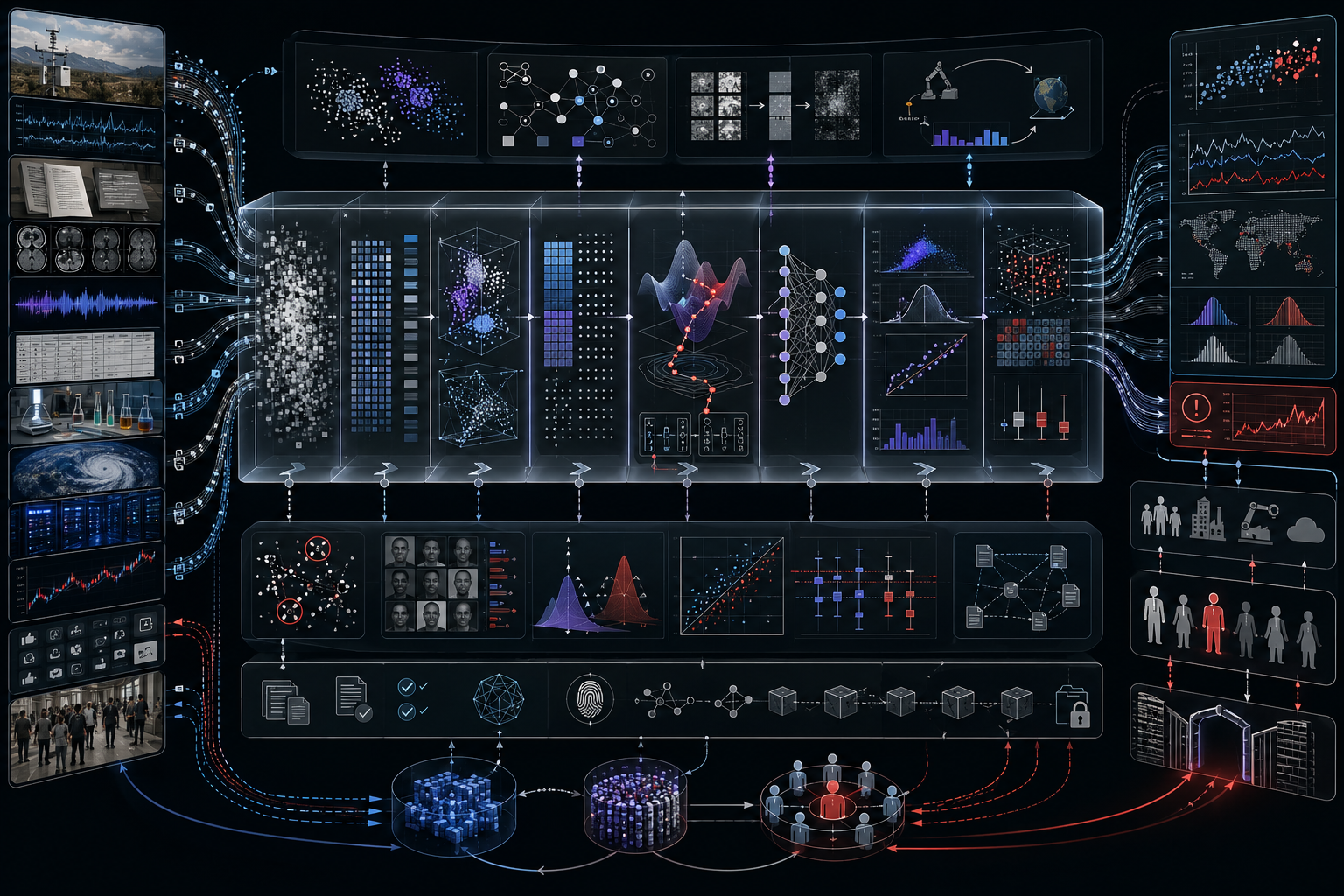
At a deeper level, machine learning transforms measurement into representation, representation into model behavior, model behavior into operational outputs, and outputs into feedback that may reshape the environment being modeled. Data is generated through sensors, institutions, platforms, human behavior, scientific instruments, documents, images, markets, ecological processes, and historical systems. Models learn from that data only through the assumptions built into representation, architecture, objective functions, optimization, evaluation, and deployment. To understand how systems learn from data, one must therefore study the full pipeline through which evidence becomes inference, inference becomes decision support, and decision support becomes institutional consequence.
This article develops Machine Learning Foundations: How Systems Learn from Data as an advanced article within the Artificial Intelligence Systems knowledge series. It explains machine learning as adaptive computation, statistical inference, empirical risk minimization, representation learning, optimization, generalization, uncertainty, validation, error analysis, deployment, monitoring, and governance. Selected Python and R examples appear here, while the full GitHub repository contains expanded computational scaffolding for supervised learning, train/test splitting, feature representation, loss functions, optimization intuition, calibration, grouped diagnostics, drift monitoring, SQL metadata, governance notes, and advanced Jupyter notebooks.
Why Machine Learning Matters
Machine learning matters because it provides a general method for building computational systems that adapt from evidence. Many of the most important problems in artificial intelligence cannot be solved by enumerating fixed rules. Images vary by lighting, angle, resolution, occlusion, background, and context. Language is ambiguous, historically situated, culturally variable, and socially dynamic. Economic, ecological, biological, medical, industrial, and institutional systems generate noisy, incomplete, and shifting data. In such settings, machine learning enables systems to infer useful regularities from examples rather than depending entirely on hand-coded procedural instructions.
This shift from explicit programming to statistical learning is one of the major epistemic transitions in modern computation. A traditional program executes rules supplied by designers. A machine learning system estimates rules, boundaries, patterns, weights, representations, or policies from data. The system’s behavior is therefore shaped not only by code, but by measurement, sampling, data quality, target definitions, optimization objectives, validation design, and deployment context.
This makes machine learning powerful and fragile at the same time. It can reveal patterns too complex for manual specification, but it can also learn spurious correlations, reproduce biased measurements, overfit historical artifacts, and degrade under distribution shift. Understanding machine learning therefore requires both technical precision and systems judgment. It is not enough to ask whether a model predicts well in development. One must ask what it learned, from what evidence, under what assumptions, with what uncertainty, and for what operational purpose.
Machine\ Learning = Data + Representation + Objective + Optimization + Evaluation
\]
Interpretation: Machine learning systems learn only through a structured combination of measured evidence, representation choices, objectives, optimization procedures, and evaluation design.
| Context | Machine Learning Capability | System Value | Governance Concern |
|---|---|---|---|
| Scientific systems | Detects patterns in high-dimensional biological, physical, chemical, ecological, or environmental data. | Supports discovery, simulation, classification, forecasting, and hypothesis generation. | Prediction may be mistaken for causal explanation or mechanistic understanding. |
| Institutional systems | Classifies, scores, ranks, routes, or predicts cases from records. | Supports triage, allocation, monitoring, and operational decision support. | Models can reproduce historical bias, measurement gaps, or institutional priorities. |
| Digital platforms | Learns from clicks, interactions, text, images, behavior, and feedback. | Supports search, recommendation, personalization, moderation, and generation. | Feedback loops can shape behavior and distort future training data. |
| Infrastructure systems | Predicts failures, detects anomalies, monitors conditions, and supports control. | Improves maintenance, reliability, situational awareness, and planning. | Distribution shift, sensor failure, and brittle automation can create cascading risk. |
| Knowledge systems | Supports retrieval, summarization, translation, classification, and language generation. | Improves access to information and reduces cognitive load. | Fluent outputs can appear authoritative even when weakly grounded. |
Note: Machine learning becomes most consequential when model outputs enter decisions, workflows, knowledge systems, infrastructure, or public-facing services.
What Is Machine Learning?
Machine learning is the field concerned with building systems that improve performance through experience. A widely cited formulation states that a computer program learns from experience \(E\), with respect to a class of tasks \(T\) and performance measure \(P\), if its performance at tasks in \(T\), as measured by \(P\), improves with experience \(E\). This definition remains useful because it focuses on observable improvement without requiring claims about consciousness, understanding, or human likeness.
The definition can be summarized as:
\mathrm{Learning}
=
(E,T,P)
\]
Interpretation: Machine learning requires experience \(E\), a task \(T\), and a performance measure \(P\).
This deceptively simple structure contains the architecture of the field. There must be a task, such as classification, regression, ranking, anomaly detection, clustering, translation, generation, forecasting, or control. There must be a performance measure, such as accuracy, recall, loss, calibration, reward, error rate, or domain-specific utility. There must also be some form of experience: labeled examples, unlabeled observations, reward signals, human feedback, simulations, logs, documents, images, signals, or interactive environmental data.
Machine learning is therefore not reducible to algorithms alone. A model only learns relative to a defined relationship among goals, evidence, and evaluation. A system trained on click data learns patterns about clicks, not necessarily user well-being. A system trained on historical medical codes learns patterns in coding practices, not necessarily disease mechanisms. A model trained on arrest records learns patterns in enforcement data, not necessarily patterns of criminal behavior. The task and performance measure define what the system is actually adapting toward.
This distinction is central to responsible AI. Machine learning produces adaptation, but adaptation is not automatically wisdom. A model can become very good at optimizing a narrow objective while failing to serve the larger purpose people assume it represents.
| Element | Definition | Example | Governance Question |
|---|---|---|---|
| Experience \(E\) | Information available to the system during learning. | Labels, observations, documents, images, rewards, interactions, simulations. | What does the system actually learn from? |
| Task \(T\) | The operation the system is trained to perform. | Classification, ranking, forecasting, clustering, generation, control. | Is the task well specified and appropriate for the domain? |
| Performance measure \(P\) | The metric used to judge improvement. | Accuracy, recall, F1, calibration, loss, reward, utility. | Does the metric match the real-world purpose? |
| Model \(f_\theta\) | Parameterized function adjusted through learning. | Linear model, tree model, neural network, ensemble, policy. | Can its behavior be evaluated, explained, monitored, and constrained? |
| Deployment context | The environment where outputs are used. | Clinical workflow, search engine, infrastructure dashboard, classroom, public service. | What happens when outputs influence people or future data? |
Note: A machine learning system is defined by the relationship among experience, task, performance measure, model design, and use context.
Optimized\ Performance \neq Responsible\ Purpose
\]
Interpretation: A model can improve on a measured task while failing the broader purpose that motivated the system.
What Does It Mean for a System to Learn?
For a computational system to learn is for it to undergo a durable change in internal configuration such that future performance improves relative to a task. In many modern systems, this change takes the form of parameter updates. A model begins with initial parameters, processes data, produces outputs, compares those outputs to targets or feedback, and adjusts its internal state through optimization.
A learned model can be written as a parameterized function:
\hat{y}=f_\theta(x)
\]
Interpretation: The model \(f_\theta\) maps input \(x\) to prediction \(\hat{y}\) using learned parameters \(\theta\).
Learning updates those parameters:
\theta_0 \rightarrow \theta_1 \rightarrow \cdots \rightarrow \theta^*
\]
Interpretation: Training changes model parameters over time until a selected parameter configuration \(\theta^*\) is obtained.
Learning is not the same as memorization. A model that stores training examples without extracting generalizable structure may perform well on known cases but fail on new inputs. Genuine machine learning requires abstraction: the system must capture regularities that extend beyond the exact observations it has already seen. This is why generalization is central. The goal is not to fit the past perfectly, but to perform credibly on future or unseen cases drawn from relevant conditions.
Learning also differs by regime. In supervised learning, the model learns from input-output pairs. In unsupervised learning, it discovers latent structure from inputs alone. In reinforcement learning, it learns from actions and rewards across time. In self-supervised learning, it constructs supervisory signals from the structure of the data itself. All of these forms share the same broad principle: experience modifies internal state in ways that change future behavior.
The philosophical significance is important but limited. Machine learning does not prove that machines think as humans do. It does show that many functions associated with intelligence—prediction, recognition, adaptation, language generation, classification, planning support, and pattern discovery—can be achieved through computational learning under the right representational and objective structures.
| Learning Dimension | What Changes | Example | Failure Mode |
|---|---|---|---|
| Parameters | Internal numerical quantities are updated. | Weights, coefficients, embeddings, tree splits, policy values. | Parameters fit noise, leakage, or biased historical patterns. |
| Representation | Inputs are reorganized into features or latent structure. | Embeddings, hidden states, clusters, feature maps. | Representation encodes spurious proxies or missing context. |
| Decision boundary | The model separates classes, risks, scores, or actions differently. | Classifier boundary, ranking threshold, anomaly score. | Boundary is brittle under shift or unfair across conditions. |
| Policy | Action selection changes under reward or feedback. | Routing, recommendation, control, scheduling. | Policy optimizes reward while violating intended purpose. |
| Operational behavior | System outputs change future workflows or decisions. | Alerts, rankings, recommendations, classifications, generated text. | Outputs create feedback loops that alter future data. |
Note: Learning should be judged by generalizable, reliable, and domain-valid behavior—not by training fit alone.
Learning \neq Memorization
\]
Interpretation: A system learns usefully only when it captures patterns that transfer beyond the exact observations used during training.
Machine Learning as Statistical Inference
Machine learning is deeply rooted in statistics. A model is trained on observed data and used to make claims about unseen cases. This is a statistical inference problem. Even sophisticated neural architectures ultimately estimate patterns, dependencies, mappings, distributions, or policies from finite observations under uncertainty.
A dataset can be written as:
D=\{(x_i,y_i)\}_{i=1}^{n}
\]
Interpretation: A supervised dataset contains \(n\) observed input-output examples.
A basic statistical learning problem is to estimate a function that generalizes beyond the sample:
f_\theta \approx f^*
\]
Interpretation: The learned model \(f_\theta\) approximates an unknown target relationship \(f^*\).
This statistical foundation clarifies what models can and cannot do. They do not extract certainty from reality. They estimate structure under assumptions. The observed data provide only a sample from a larger and partly unknown data-generating process. Some patterns in that sample correspond to durable relationships. Others reflect noise, measurement artifacts, social bias, sampling distortion, leakage, or historical contingency.
This is why machine learning is inseparable from bias, variance, noise, representativeness, and uncertainty. These are not peripheral ethical concerns added after the fact. They are internal to the mathematics of learning. A model trained from partial evidence cannot automatically know which patterns are causal, which are spurious, which are stable, and which are artifacts of the measurement system.
The distinction between prediction and explanation is especially important. A model can forecast outcomes accurately without identifying the mechanisms that produce them. Predictive success is not the same as causal understanding. Machine learning can support scientific and strategic reasoning, but it does not automatically supply theory, mechanism, or justified intervention. That distinction becomes crucial in high-stakes domains where acting on a prediction may alter the system itself.
| Statistical Concept | Meaning | Machine Learning Role | Risk if Ignored |
|---|---|---|---|
| Sample | Observed data available for training or evaluation. | Provides evidence for fitting and testing. | Sample may not represent deployment conditions. |
| Population or process | Broader data-generating environment. | Defines what generalization is meant to approximate. | Model may fail when future data differs from observed data. |
| Noise | Random variation or measurement uncertainty. | Limits achievable performance and increases uncertainty. | Model may fit noise as if it were signal. |
| Bias | Systematic distortion in data, labels, or model assumptions. | Shapes what the model learns and misses. | Historical or measurement bias becomes automated behavior. |
| Inference | Using observed evidence to estimate unseen structure. | Supports prediction, classification, forecasting, and representation. | Predictive inference may be mistaken for explanation or causality. |
Note: Machine learning systems estimate patterns from finite evidence. Their outputs should be interpreted as conditional estimates, not certainty.
Prediction \neq Explanation
\]
Interpretation: A model can predict well without explaining the causal mechanisms that produce the outcome.
The Machine Learning System Pipeline
Machine learning is best understood as a pipeline through which data becomes operational output. Different applications vary in detail, but most deployed systems involve a sequence: data acquisition, preprocessing, representation, model training, validation, inference, monitoring, and feedback. Failure at any stage can compromise the system, regardless of how advanced the core algorithm appears.
Data Acquisition
All learning begins with data. Data may come from sensors, transactions, images, audio, text corpora, clickstreams, surveys, medical records, satellite imagery, laboratory instruments, scientific measurements, institutional logs, or human annotations. At this stage, the critical questions concern provenance, coverage, sampling, measurement quality, consent, licensing, and temporal stability. A model can learn only from the world its data makes visible.
Preprocessing and Cleaning
Raw data is rarely ready for training. Missing values may require imputation. Categories may need encoding. Text may need tokenization. Images may need normalization or augmentation. Time series may need alignment, resampling, or smoothing. Outliers may need investigation. These steps are not neutral housekeeping. They shape what the model treats as signal, noise, anomaly, or missingness.
Representation
The system must convert observations into forms that support learning. Classical workflows often use engineered features. Modern deep learning systems may learn embeddings or latent representations. Representation determines what patterns are visible to the model. Good representations make learning tractable; poor ones obscure structure or encourage spurious correlations.
Model Training
Training is the stage at which the model updates internal parameters to improve performance on a target objective. It processes data, computes predictions, measures error using a loss function, and adjusts parameters through an optimization method such as gradient descent. Training is the dynamic core of machine learning.
Validation and Evaluation
Evaluation estimates how well the model generalizes beyond the data used to fit it. This may involve train-validation-test splits, cross-validation, time-aware validation, group-aware validation, calibration checks, robustness tests, or domain-specific performance measures. Evaluation is where claims about learning become evidentiary rather than rhetorical.
Inference and Deployment
Once deployed, a trained model receives new inputs and produces outputs in real time or batch workflows. These outputs may be predictions, classifications, rankings, risk scores, recommendations, generated text, anomaly alerts, or control signals. Deployment is where machine learning enters operational life.
Monitoring and Feedback
Deployed models must be monitored for drift, degradation, changing user behavior, adversarial adaptation, data-pipeline failure, and altered environmental conditions. A model that worked yesterday may fail tomorrow if the underlying data-generating process changes. Monitoring and feedback are therefore part of machine learning, not optional maintenance.
| Pipeline Stage | Function | Evidence Produced | Failure Mode |
|---|---|---|---|
| Data acquisition | Collects examples, observations, labels, or feedback. | Dataset manifest, source records, provenance notes. | Biased, incomplete, stale, or unlawful data enters the system. |
| Preprocessing | Cleans, transforms, encodes, filters, or normalizes data. | Transformation logs, cleaning rules, feature records. | Important context is removed or leakage is introduced. |
| Representation | Converts observations into features, embeddings, or states. | Feature definitions, embedding records, schema documentation. | Representation hides uncertainty, bias, or missingness. |
| Training | Fits model parameters to a learning objective. | Training logs, model artifacts, optimizer settings. | Model optimizes the wrong objective or overfits artifacts. |
| Evaluation | Tests performance, calibration, robustness, and error patterns. | Metric reports, validation design, subgroup diagnostics. | Weak tests create false confidence. |
| Deployment | Places model outputs into workflows. | Inference logs, user interactions, decision records. | Outputs are used beyond validated scope. |
| Monitoring | Tracks drift, degradation, incidents, and feedback loops. | Drift reports, alerts, incident logs, retraining records. | Model failure remains invisible until harm occurs. |
Note: A model is only one part of a machine learning system. The full pipeline determines whether the system is reliable and auditable.
This pipeline perspective connects machine learning directly to Feedback Loops in Resilient Systems and Decision-Making in Complex Systems. A model is not an isolated object. It is a component embedded in measurement, inference, action, and recursive consequence.
Representation, Features, and Embeddings
Representation is one of the deepest questions in machine learning: how should the world be encoded so that a model can learn useful structure from it? Classical machine learning often depends on engineered features. A credit model may use debt-to-income ratio, payment history, and utilization. A sensor model may use rolling averages, lag variables, frequency transforms, or variance. A clinical model may use lab values, diagnoses, medications, and time since prior visits. In these workflows, feature engineering is part of the intellectual work of learning.
Modern deep learning shifted part of this burden by allowing systems to learn internal representations automatically. Instead of specifying every relevant feature by hand, multi-layer networks transform raw or lightly processed inputs into increasingly abstract structures. In language models, tokens become embeddings in high-dimensional spaces. In vision systems, pixels become feature maps encoding edges, textures, shapes, objects, and scenes. In recommender systems, users and items may become vectors in latent spaces that reveal affinity patterns.
A representation function can be written as:
z=\phi(x)
\]
Interpretation: A representation function \(\phi\) maps raw input \(x\) into a feature or embedding representation \(z\).
A model may then operate on the representation rather than the raw input:
\hat{y}=g_\theta(\phi(x))
\]
Interpretation: The predictive model \(g_\theta\) learns from represented features or embeddings rather than raw observations alone.
Representation determines what is learnable. A powerful optimizer cannot recover information that the representation discards. Conversely, a well-structured representation can make simple models effective. This is why representation learning became a central theme in modern AI.
Representation also raises epistemic and governance questions. When a system learns latent structure automatically, what has it captured? Are the representations robust, interpretable, transferable, or sensitive to spurious artifacts? In some cases, latent representations correspond to meaningful structure. In others, they encode brittle shortcuts, proxy variables, or historical bias. This is why machine learning must be evaluated not only by output metrics but by the quality and stability of the structures it internalizes.
| Representation Type | How It Works | Useful For | Governance Risk |
|---|---|---|---|
| Hand-engineered features | Domain-informed variables are manually defined. | Interpretability, small datasets, regulated settings. | Feature definitions may encode institutional assumptions or missing context. |
| Learned embeddings | Models learn vector representations from data. | Search, retrieval, language, vision, recommendation, transfer learning. | Embedding similarity may encode bias or shallow association. |
| Latent variables | Hidden factors explain observed patterns. | Dimensionality reduction, clustering, generative modeling. | Latent factors may not correspond to real causes. |
| Sequence representations | Inputs are encoded across time, text, or order. | Language, speech, time series, logs, events. | Context windows or temporal assumptions may distort meaning. |
| Graph representations | Entities and relations are encoded as nodes and edges. | Infrastructure, knowledge graphs, molecules, networks. | Graph construction choices shape what relationships appear meaningful. |
Note: Representation is not neutral. It determines what information is visible, compressed, discarded, or amplified before learning begins.
Representation\ Choice \Rightarrow Learnable\ Structure
\]
Interpretation: A model can only learn patterns made available through the way inputs are represented.
Supervised, Unsupervised, Reinforcement, and Self-Supervised Learning
Machine learning includes several major learning paradigms, each defined by the type of experience available and the structure of the objective.
Supervised Learning
In supervised learning, each input is paired with a target output. The task may involve classification, where the target is categorical, or regression, where the target is continuous. The model learns a mapping from inputs to targets by minimizing prediction error and generalizing to unseen examples.
D_{\mathrm{sup}}=\{(x_i,y_i)\}_{i=1}^{n}
\]
Interpretation: Supervised learning uses labeled input-output pairs.
Unsupervised Learning
In unsupervised learning, the system observes inputs without explicit target labels. It attempts to discover structure within the data itself: clusters, latent factors, lower-dimensional manifolds, anomalies, topics, or density patterns.
x_i \sim P(X)
\]
Interpretation: Unsupervised learning seeks structure in the distribution of observed inputs.
Reinforcement Learning
In reinforcement learning, an agent interacts with an environment over time, takes actions, receives rewards, and learns a policy that maximizes cumulative reward. This introduces sequential dependence, delayed consequences, exploration-exploitation tradeoffs, and long-horizon optimization.
J(\pi)=\mathbb{E}_{\pi}\left[\sum_{t=0}^{\infty}\gamma^t r_t\right]
\]
Interpretation: A reinforcement learning policy \(\pi\) is optimized to maximize expected discounted reward.
Self-Supervised and Semi-Supervised Learning
Self-supervised learning creates supervisory signals from the structure of the data itself, such as predicting masked tokens, reconstructing missing image patches, or contrasting related and unrelated examples. Semi-supervised learning combines limited labeled data with larger unlabeled datasets. These approaches became especially important as available data grew faster than high-quality human labels.
Together, these paradigms show that machine learning is not one method. It is a family of strategies for extracting useful information from experience. Supervised learning assumes externally specified targets. Unsupervised learning assumes latent structure in data. Reinforcement learning assumes action under reward. Self-supervised learning assumes that the world contains internal predictive regularities that can be used to learn representations.
| Paradigm | Learning Signal | Primary Objective | Governance Concern |
|---|---|---|---|
| Supervised learning | Labeled input-output examples. | Predict targets from inputs. | Labels may encode bias, noise, proxy measurement, or historical practice. |
| Unsupervised learning | Unlabeled observations. | Discover latent structure, density, clusters, or embeddings. | Discovered structure may not be meaningful, stable, or fair. |
| Reinforcement learning | States, actions, rewards, and transitions. | Maximize cumulative reward over time. | Reward proxies may diverge from human intention or safety. |
| Self-supervised learning | Training signals generated from the data itself. | Learn representations at scale. | Hidden corpus bias and data provenance issues can scale into foundation behavior. |
| Semi-supervised learning | Small labeled set plus larger unlabeled set. | Improve learning when labels are scarce. | Unlabeled structure may reinforce flawed label assumptions. |
Note: Learning paradigms define the structure of evidence available to the system. Evaluation and governance should match that structure.
Learning\ Signal \Rightarrow Failure\ Mode
\]
Interpretation: A system’s failure risks depend on whether it learns from labels, latent structure, rewards, feedback, interactions, or hybrid signals.
Optimization, Loss Functions, and Gradient-Based Learning
If data supplies the evidence for learning, optimization supplies the mechanism. Training a machine learning model usually means solving an optimization problem: finding parameter values that minimize a loss function or maximize an objective. The loss function quantifies how wrong the model is relative to the task.
A standard empirical risk objective can be written as:
\theta^*
=
\arg\min_\theta
\frac{1}{n}
\sum_{i=1}^{n}
\ell(y_i,f_\theta(x_i))
\]
Interpretation: Training selects parameters that minimize average loss on observed examples.
In differentiable models, training often proceeds through gradient descent:
\theta_{t+1}
=
\theta_t
–
\eta\nabla_\theta\mathcal{L}(\theta_t)
\]
Interpretation: Parameters are updated by moving against the gradient of the loss, with learning rate \(\eta\).
The objective function is not merely a technical detail. It operationalizes the meaning of success. A model optimized for average accuracy may neglect rare but important cases. A recommender optimized for engagement may amplify attention-capturing but low-quality content. A logistics model optimized only for cost may reduce resilience. A risk model optimized on historical outcomes may reproduce historical inequities. The loss function sits at the junction of mathematics, institutional purpose, and governance.
Optimization alone is not enough. A model can optimize the wrong objective, optimize on the wrong data, optimize beyond the point of generalizable learning, or exploit shortcuts in the dataset. The meaningful question is always: optimized for what, over which evidence, under what deployment assumptions, and with what consequences?
| Element | Function | Why It Matters | Risk if Weak |
|---|---|---|---|
| Loss function | Defines what counts as prediction error. | Directs learning toward a formal objective. | May optimize a proxy instead of the real purpose. |
| Optimizer | Updates model parameters based on loss or reward. | Controls how learning proceeds through parameter space. | Training may be unstable, irreproducible, or poorly documented. |
| Learning rate | Controls update size during training. | Affects convergence, stability, and final model behavior. | Too high can destabilize; too low can stall learning. |
| Regularization | Constrains complexity or instability. | Improves generalization and robustness. | May suppress rare but important patterns. |
| Stopping rule | Defines when training ends. | Controls overfitting, underfitting, and cost. | Training may stop too early or continue into overfitting. |
Note: Objective design should be reviewed as a technical, institutional, and ethical decision because it defines what the system is trained to optimize.
Optimized\ Loss \neq Real\ World\ Success
\]
Interpretation: A model can minimize formal loss while failing the broader purpose if the objective is misaligned with the real-world task.
Generalization, Overfitting, and Model Capacity
A machine learning model is valuable not because it fits the training data well, but because it performs well on new data drawn from relevant conditions. This ability is called generalization. Generalization is the central practical test of learning because deployed systems operate beyond the exact cases used for training.
The generalization gap can be written as:
\mathrm{Gap}
=
R_{\mathrm{test}}(\theta)
–
R_{\mathrm{train}}(\theta)
\]
Interpretation: The generalization gap compares held-out test risk with training risk.
The main threat to generalization is overfitting. A model overfits when it captures noise, idiosyncrasies, leakage, or accidental patterns in the training data rather than durable structure relevant to future inputs. Overfitting often occurs when model capacity is high relative to the informational quality or size of the dataset, but it can also result from flawed validation, target leakage, poor sampling, or distribution mismatch.
The classical bias-variance tradeoff remains useful. Models with overly rigid assumptions may underfit, missing real structure. Models with excessive flexibility may overfit, learning noise. Model design often requires balancing these errors through architecture choice, regularization, validation design, and domain-aware evaluation.
Modern deep learning complicates the classical picture because very large models sometimes generalize surprisingly well despite enormous capacity. This has led to research on implicit regularization, interpolation, double descent, scaling behavior, and high-dimensional representation learning. Even so, the practical lesson remains: apparent performance is never sufficient. One must ask how the model behaves under shift, how stable its learned structure is, and whether its generalization properties hold where decisions will actually be made.
| Concept | Meaning | Development Signal | Governance Concern |
|---|---|---|---|
| Generalization | Performance transfers to unseen or future data. | Held-out metrics, external validation, temporal tests. | Test design may not reflect deployment conditions. |
| Overfitting | Model learns noise, leakage, or sample-specific artifacts. | Training performance improves while validation worsens. | Model appears strong but fails in real use. |
| Underfitting | Model is too weak or poorly trained to capture relevant structure. | Poor training and validation performance. | System may miss important patterns or underperform operationally. |
| Capacity | Model flexibility or representational power. | Parameter count, architecture complexity, effective degrees of freedom. | High capacity can create opacity, memorization, and misuse risk. |
| Regularization | Constraints used to improve stability and transfer. | Weight decay, early stopping, dropout, augmentation. | May hide weak data or suppress minority patterns if misapplied. |
Note: Generalization is an empirical claim. It requires evidence from evaluation designs that match the intended deployment environment.
Training\ Fit \neq Future\ Reliability
\]
Interpretation: A model can fit historical data while failing on new cases, shifted environments, rare events, or underrepresented populations.
Uncertainty, Noise, and Distribution Shift
Machine learning always operates under uncertainty. Data is incomplete. Labels may be noisy. Measurement processes may be biased. The underlying world may change. Deployment inputs may differ from training inputs. Model outputs should therefore be treated as estimates produced under finite information and conditional assumptions.
Several distinctions are useful. Aleatoric uncertainty refers to irreducible variability in observations. Epistemic uncertainty refers to uncertainty arising from limited knowledge, sparse data, or incomplete model understanding. Distribution shift occurs when training and deployment environments diverge.
Distribution shift can be represented as:
\Delta
=
d(P_{\mathrm{train}}(X,Y),P_{\mathrm{deploy}}(X,Y))
\]
Interpretation: Distribution shift measures how far deployment conditions differ from the training data-generating process.
Distribution shift is not rare. A credit model trained in stable economic conditions may degrade during recession. A medical model trained in one hospital may fail in another with different patient populations or documentation practices. An ecological classifier trained under one climate regime may fail as seasonal baselines change. A language model retrieval system may become outdated as source material changes.
This is why resilience matters. The goal is not only high static benchmark performance, but credible behavior across changing conditions. In many domains, the most useful model is not the one with the highest average score under controlled test conditions, but the one whose uncertainty, failure modes, and monitoring procedures are well characterized.
| Uncertainty or Shift Type | Meaning | Example | Evaluation Response |
|---|---|---|---|
| Aleatoric uncertainty | Irreducible variability in observations or outcomes. | Noisy sensors, variable human behavior, stochastic events. | Estimate uncertainty and avoid overconfident point predictions. |
| Epistemic uncertainty | Uncertainty from limited data or model knowledge. | Rare cases, new domains, sparse measurements. | Collect more data, use uncertainty estimates, escalate for review. |
| Covariate shift | Input distribution changes. | New users, regions, devices, sensors, or document types. | Monitor input drift and validate in new settings. |
| Label shift | Outcome distribution changes. | Changing disease prevalence, fraud rates, demand patterns. | Recalibrate thresholds and reassess base rates. |
| Concept drift | Relationship between input and outcome changes. | Policy change, market shift, climate regime change, adversarial adaptation. | Use temporal validation, retraining review, and incident monitoring. |
Note: Uncertainty should be represented, communicated, and monitored. Ignoring uncertainty turns estimates into false authority.
Model\ Confidence \neq Model\ Correctness
\]
Interpretation: A model may assign high confidence to predictions that are wrong, especially under ambiguity, sparse data, or distribution shift.
Evaluation, Validation, and Error Analysis
Evaluation is the discipline through which machine learning claims become credible. A model should not be assessed by a single number unless the task is unusually simple. Serious evaluation requires matching metrics to the task, risk, data structure, and decision environment.
In balanced classification tasks, accuracy may provide a useful first measure. In imbalanced domains, precision and recall may matter more. In probabilistic settings, calibration is crucial. In regression, mean squared error or mean absolute error may be informative, but not sufficient if errors have asymmetric consequences. In ranking systems, ordering quality may matter more than absolute scores. In reinforcement learning, cumulative reward, stability, safety, and long-horizon robustness may matter more than immediate performance.
Calibration can be written as:
P(Y=1\mid \hat{p}=p)=p
\]
Interpretation: A calibrated model’s predicted probabilities correspond to observed outcome frequencies.
Validation design is equally important. Train-test splits are useful, but not always sufficient. Cross-validation can help when data is limited. Time-aware validation is necessary in temporal systems to avoid leakage from the future. Group-aware validation may be necessary when related observations cluster by person, geography, institution, device, or time period. Without appropriate validation design, impressive metrics can be artifacts of flawed experimental structure.
Error analysis asks where the model fails, for whom it fails, under what conditions it fails, and whether those failures reveal missing variables, poor representation, target ambiguity, or structural bias. Aggregate performance can conceal systematic weaknesses. A model may perform well overall while failing on rare but important cases, marginalized populations, extreme conditions, or novel contexts. Serious machine learning therefore requires decomposition of error, not just reporting of summary scores.
| Evaluation Dimension | Question | Evidence | Risk if Ignored |
|---|---|---|---|
| Predictive performance | Does the model perform the task? | Accuracy, precision, recall, F1, AUC, RMSE, task metrics. | System may not meet basic functional requirements. |
| Calibration | Do probabilities correspond to observed frequencies? | Calibration curves, ECE, reliability diagrams. | Users overtrust or misuse confidence scores. |
| Robustness | Does performance hold under shift, stress, or perturbation? | Stress tests, external validation, drift checks. | Model fails outside benchmark conditions. |
| Grouped performance | Are errors concentrated by group, domain, site, device, or condition? | Subgroup diagnostics and stratified metrics. | Aggregate metrics hide unequal failure. |
| Error analysis | Why and where does the model fail? | False-positive/false-negative review, case studies, audit records. | Failure modes remain invisible until deployment. |
| Monitoring | Does performance remain valid after release? | Drift reports, incident logs, recalibration records. | Model degradation goes undetected. |
Note: Evaluation should support deployment decisions, not merely benchmark reporting. Metrics must match task, risk, and use context.
Single\ Metric \neq System\ Reliability
\]
Interpretation: Reliable machine learning requires multiple forms of evidence: performance, calibration, robustness, subgroup diagnostics, error review, and monitoring.
Machine Learning in Complex Systems
Machine learning does not act in a vacuum. Models are inserted into financial systems, logistics platforms, public institutions, ecological monitoring networks, healthcare workflows, industrial control environments, digital platforms, scientific research pipelines, and organizational decision systems. Once embedded, they interact with human behavior, incentives, measurement processes, and downstream decisions.
A recommendation engine does not only predict preferences. It shapes attention, which changes click behavior, which changes the next round of training data. A predictive risk model does not merely observe social outcomes. It may alter intervention priorities, which changes the outcomes later recorded as data. A maintenance model in infrastructure changes inspection schedules and repair timing, which changes asset condition and future failure distributions.
These feedback loops can be written abstractly as:
D_t \rightarrow f_{\theta_t} \rightarrow a_t \rightarrow E_{t+1} \rightarrow D_{t+1}
\]
Interpretation: Data trains a model, the model influences action, action changes the environment, and the changed environment generates future data.
This recursive character connects machine learning to Scenario Modeling for Complex Systems, Robust Decision-Making, Decision-Making Under Deep Uncertainty, and Infrastructure Futures. The value of a machine learning system depends not only on what it predicts, but on how its outputs alter the system in which it operates.
This is also why domain knowledge remains indispensable. A purely technical model may achieve short-term predictive gains while eroding long-term resilience if it ignores institutional dynamics, human interpretation, infrastructure constraints, or system-level side effects. Machine learning is strongest when integrated with substantive domain knowledge, not when imagined as a substitute for it.
| System Context | Model Role | Feedback Loop | Governance Need |
|---|---|---|---|
| Recommendation systems | Ranks content, products, people, or information. | Recommendations shape attention, which shapes future data. | Monitor feedback loops, exposure effects, and content quality. |
| Public-sector systems | Scores risk, prioritizes cases, routes services, or flags anomalies. | Interventions change measured outcomes and future records. | Preserve appeal, human review, transparency, and public accountability. |
| Healthcare workflows | Supports diagnosis, triage, documentation, or resource planning. | Model outputs influence clinical action and subsequent data. | Require external validation, clinician oversight, and safety monitoring. |
| Infrastructure operations | Predicts failures, detects anomalies, or optimizes maintenance. | Maintenance actions change asset condition and future failure patterns. | Integrate model outputs with engineering judgment and resilience planning. |
| Scientific modeling | Detects patterns, predicts outcomes, or guides experiments. | Model-guided research changes what data is collected next. | Distinguish prediction from mechanism and preserve reproducibility. |
Note: Machine learning systems are adaptive components inside larger adaptive systems. Their outputs can reshape the data they later learn from.
Bias, Reliability, and Responsible Deployment
Because machine learning systems derive structure from historical data and explicit optimization objectives, they inherit both the informational richness and the distortions of their training environments. Bias can enter through sampling, labeling, proxy variables, target construction, measurement design, preprocessing, model selection, thresholding, or deployment context. Reliability can degrade through shift, adversarial inputs, strategic adaptation, data-pipeline failure, or organizational misuse.
Responsible deployment begins upstream. It requires scrutiny of data provenance, target definition, measurement validity, validation design, uncertainty communication, and monitoring. It also requires institutional clarity about the model’s role. Is it advisory or authoritative? Is human review meaningful or merely procedural? Are there appeal mechanisms? Is performance audited over time? Can the system be paused when conditions change?
Governance is not separate from model quality. It is part of the conditions under which model quality can be meaningfully trusted. A model may be accurate but poorly governed, powerful but opaque, efficient but misaligned, or optimized but harmful. The mature study of machine learning must therefore move beyond algorithmic fascination toward broader analysis of objectives, accountability, and system design.
Machine learning gives systems the ability to adapt from data. The harder question is where that adaptive power belongs, under what constraints, with what oversight, and in service of which ends.
| Governance Area | Question | Evidence Needed | Risk if Ignored |
|---|---|---|---|
| Data provenance | Where did the data come from, and what does it represent? | Dataset documentation, lineage, consent, licensing, source records. | Hidden data problems become model behavior. |
| Target validity | Does the label or outcome measure the intended concept? | Target rationale, measurement review, domain validation. | Model optimizes a proxy that distorts the purpose. |
| Evaluation coverage | Where was the model tested? | Validation design, external tests, subgroup diagnostics, robustness checks. | Performance claims exceed available evidence. |
| Human oversight | Who reviews, challenges, or overrides outputs? | Workflow records, escalation paths, review policies. | Automation becomes unchallengeable authority. |
| Monitoring | Does the model remain valid over time? | Drift reports, incident logs, recalibration records, retraining review. | Degradation remains invisible until harm occurs. |
| Accountability | Who is responsible for model use and correction? | Model cards, risk registers, approval logs, governance memos. | Responsibility diffuses behind technical complexity. |
Note: Governance turns model performance from a narrow metric into an auditable claim about data, purpose, evidence, limits, and responsibility.
Adaptive\ Power + Institutional\ Use \Rightarrow Institutional\ Responsibility
\]
Interpretation: When institutions use machine learning outputs in real workflows, responsibility remains with the institution—not with the model alone.
Mathematical Lens: Data, Risk, Optimization, Generalization, and Drift
A mathematics-first view begins with a dataset:
D=\{(x_i,y_i)\}_{i=1}^{n}
\]
Interpretation: The dataset contains observed examples used for learning or evaluation.
A model maps inputs to predictions:
\hat{y}_i=f_\theta(x_i)
\]
Interpretation: The model produces a prediction \(\hat{y}_i\) from input \(x_i\).
A loss function measures error:
\ell(y_i,\hat{y}_i)
\]
Interpretation: The loss function assigns a penalty to the difference between observed target and prediction.
Empirical risk averages loss over observed data:
\hat{R}(\theta)
=
\frac{1}{n}
\sum_{i=1}^{n}
\ell(y_i,f_\theta(x_i))
\]
Interpretation: Empirical risk is the average training loss under parameters \(\theta\).
Expected risk describes performance over the broader data-generating process:
R(\theta)
=
\mathbb{E}_{(X,Y)\sim P}
\left[
\ell(Y,f_\theta(X))
\right]
\]
Interpretation: Expected risk is the loss the model would incur over the underlying distribution \(P\).
Training minimizes empirical risk:
\theta^*
=
\arg\min_{\theta}\hat{R}(\theta)
\]
Interpretation: Learning selects parameters that reduce measured loss on observed data.
Gradient descent updates parameters:
\theta_{t+1}
=
\theta_t
–
\eta\nabla_\theta\mathcal{L}(\theta_t)
\]
Interpretation: Optimization changes parameters in the direction that reduces loss.
A representation function maps raw input into features or embeddings:
z=\phi(x)
\]
Interpretation: Representation transforms observed data into a form that supports learning.
A model may learn from represented features:
\hat{y}=g_\theta(\phi(x))
\]
Interpretation: The prediction depends on both representation \(\phi\) and learned model \(g_\theta\).
Generalization compares train and test risk:
\mathrm{Gap}
=
R_{\mathrm{test}}(\theta)-R_{\mathrm{train}}(\theta)
\]
Interpretation: A smaller generalization gap suggests that performance transfers more effectively beyond training data.
Calibration describes probability reliability:
P(Y=1\mid \hat{p}=p)=p
\]
Interpretation: A calibrated model’s predicted probability \(p\) corresponds to observed outcome frequency.
Distribution shift compares training and deployment environments:
\Delta=d(P_{\mathrm{train}},P_{\mathrm{deploy}})
\]
Interpretation: Deployment risk rises when the environment generating future data differs from the training environment.
A governance-aware machine learning reliability score can combine performance, calibration, shift exposure, data quality, and downstream risk:
Reliability_i =
\alpha M_i
–
\beta C_i
–
\gamma \Delta_i
+
\lambda Q_i
–
\rho R_i
\]
Interpretation: Reliability for system \(i\) may combine task performance \(M_i\), calibration error \(C_i\), distribution shift \(\Delta_i\), data quality \(Q_i\), and downstream risk \(R_i\). The weights should be documented and tied to deployment context.
This mathematical lens shows that machine learning is a discipline of representation, estimation, optimization, uncertainty, generalization, and deployment validity.
Variables and System Interpretation
| Symbol or Term | Meaning | Typical Type | System Interpretation |
|---|---|---|---|
| \(D\) | Dataset | Collection of examples | Observed evidence used for learning or evaluation. |
| \(x_i\) | Input | Feature vector, image, text, signal, record, or state | Information provided to the model. |
| \(y_i\) | Target | Label, value, token, reward, or outcome | Observed output used for training or evaluation. |
| \(f_\theta\) | Parameterized model | Function | Maps inputs to predictions using learned parameters. |
| \(\theta\) | Parameters | Weights, coefficients, embeddings, states | Internal quantities adjusted during learning. |
| \(\hat{y}\) | Prediction | Model output | Estimated output produced by the system. |
| \(\ell\) | Loss function | Scalar penalty | Defines what counts as error. |
| \(\hat{R}(\theta)\) | Empirical risk | Sample average loss | Measured loss on observed data. |
| \(R(\theta)\) | Expected risk | Expected loss | Idealized performance over the underlying data-generating process. |
| \(\eta\) | Learning rate | Positive scalar | Controls parameter update size during optimization. |
| \(z\) | Representation | Feature vector, embedding, latent variable, or state | Encoded form of input used for learning. |
| \(\phi\) | Representation function | Feature map or encoder | Transforms raw input into a learnable representation. |
| \(\Delta\) | Distribution shift | Distance or divergence | Difference between training and deployment environments. |
| \(P\) | Performance measure or distribution | Metric or probability law | Defines success or the data-generating process, depending on context. |
Note: Machine learning systems depend on data provenance, representation, objective design, validation structure, monitoring, and governance. The same model can behave differently under different data-generation and deployment conditions.
Worked Example: From Data to Learned Prediction
A simple supervised learning workflow begins with training data:
D_{\mathrm{train}}=\{(x_i,y_i)\}_{i=1}^{n}
\]
Interpretation: The training dataset provides examples used to estimate model parameters.
The model predicts outputs:
\hat{y}_i=f_\theta(x_i)
\]
Interpretation: The model maps each input to a predicted output.
Training minimizes average loss:
\theta^*
=
\arg\min_\theta
\frac{1}{n}
\sum_{i=1}^{n}
\ell(y_i,\hat{y}_i)
\]
Interpretation: The selected parameters reduce prediction error on the training sample.
Held-out testing estimates generalization:
\hat{R}_{\mathrm{test}}(\theta^*)
=
\frac{1}{m}
\sum_{j=1}^{m}
\ell(y_j,f_{\theta^*}(x_j))
\]
Interpretation: Test risk estimates performance on examples not used to fit the model.
Deployment introduces new inputs:
x_{\mathrm{new}}\rightarrow f_{\theta^*}(x_{\mathrm{new}})\rightarrow \hat{y}_{\mathrm{new}}
\]
Interpretation: The trained model produces predictions for new operational inputs.
Monitoring asks whether the deployment environment still resembles the training environment:
d(P_{\mathrm{train}},P_{\mathrm{current}})>\tau
\]
Interpretation: A drift alert may be triggered when current data differs from training data beyond threshold \(\tau\).
This example shows that machine learning is not complete when training ends. Learning becomes trustworthy only when training, validation, deployment, monitoring, and governance are connected.
| Workflow Stage | Technical Question | Governance Question | Evidence Needed |
|---|---|---|---|
| Training data | What examples were used to fit the model? | Are they representative, lawful, current, and fit for purpose? | Data documentation, provenance, sampling notes, lineage. |
| Target definition | What outcome is the model learning? | Does the target measure the intended concept? | Target rationale, measurement review, label audit. |
| Training objective | What loss or reward is optimized? | Does the objective match the real-world purpose? | Loss function notes, metric rationale, threshold policy. |
| Validation design | How was generalization tested? | Does the test reflect deployment conditions? | Train/test split logic, external validation, stress tests. |
| Deployment monitoring | Does the model remain valid over time? | Can drift, degradation, and incidents be detected? | Monitoring dashboards, drift reports, escalation procedures. |
Note: Machine learning reliability depends on connecting training evidence, deployment context, monitoring, and governance.
Computational Modeling
Computational modeling makes machine learning foundations more auditable. A supervised learning workflow can show how data is split, represented, trained, and evaluated. A calibration workflow can compare predicted probabilities with observed frequencies. A grouped diagnostics workflow can reveal whether error rates vary across synthetic groups or deployment conditions. A drift workflow can test whether current data differs from training data. A SQL metadata schema can document datasets, model versions, training runs, evaluation runs, monitoring events, and governance reviews.
The selected examples below focus on classification, evaluation, calibration, and grouped diagnostics because they are foundational, readable, and directly reusable. The GitHub repository extends the same logic into advanced Jupyter notebooks, feature-representation labs, optimization intuition, supervised and unsupervised examples, calibration diagnostics, drift monitoring, SQL metadata, model-card notes, and governance documentation.
| Artifact | Purpose | Governance Value |
|---|---|---|
| Split manifest | Records training, validation, and test partitioning. | Supports leakage review and reproducibility. |
| Metric report | Summarizes task performance. | Supports evidence-based model comparison. |
| Calibration table | Compares predicted probability with observed frequency. | Supports confidence and threshold review. |
| Grouped diagnostics | Measures errors across groups, domains, and conditions. | Reveals hidden failure concentrations. |
| Drift monitor | Compares current data with training data. | Supports post-deployment reliability monitoring. |
| Governance memo | Summarizes assumptions, limits, risks, and release conditions. | Supports auditability and institutional accountability. |
Note: Machine learning workflows should generate durable review artifacts, not only model predictions.
Python Workflow: Supervised Learning, Evaluation, and Calibration
Python is useful for machine learning workflows, reproducible training, evaluation metrics, calibration tables, and diagnostics. The following example creates synthetic data, trains a model, evaluates held-out performance, computes calibration bins, and writes governance-ready outputs.
"""
Machine Learning Foundations: How Systems Learn from Data
Python workflow: supervised learning, evaluation, and calibration.

This educational workflow demonstrates:
1. synthetic data generation
2. train/test splitting
3. model fitting
4. evaluation metrics
5. calibration diagnostics
6. governance-ready output records

It does not use private data.
"""

from __future__ import annotations

from pathlib import Path

import numpy as np
import pandas as pd

from sklearn.datasets import make_classification
from sklearn.linear_model import LogisticRegression
from sklearn.metrics import (
    accuracy_score,
    precision_score,
    recall_score,
    f1_score,
    roc_auc_score,
)
from sklearn.model_selection import train_test_split
from sklearn.pipeline import Pipeline
from sklearn.preprocessing import StandardScaler


RANDOM_SEED = 42
OUTPUT_DIR = Path("outputs")
OUTPUT_DIR.mkdir(exist_ok=True)


def create_synthetic_dataset() -> tuple[np.ndarray, np.ndarray]:
    """Create a synthetic binary classification dataset."""
    x, y = make_classification(
        n_samples=4000,
        n_features=12,
        n_informative=7,
        n_redundant=2,
        weights=[0.65, 0.35],
        random_state=RANDOM_SEED,
    )
    return x, y


def train_and_evaluate(
    x: np.ndarray,
    y: np.ndarray,
) -> tuple[pd.DataFrame, pd.DataFrame, pd.DataFrame]:
    """Train a classifier, evaluate performance, and compute calibration bins."""
    x_train, x_test, y_train, y_test = train_test_split(
        x,
        y,
        test_size=0.30,
        stratify=y,
        random_state=RANDOM_SEED,
    )

    model = Pipeline(
        steps=[
            ("scale", StandardScaler()),
            ("classifier", LogisticRegression(max_iter=1000, random_state=RANDOM_SEED)),
        ]
    )

    model.fit(x_train, y_train)

    score = model.predict_proba(x_test)[:, 1]
    prediction = (score >= 0.50).astype(int)

    metrics = pd.DataFrame(
        [
            {
                "accuracy": accuracy_score(y_test, prediction),
                "precision": precision_score(y_test, prediction, zero_division=0),
                "recall": recall_score(y_test, prediction, zero_division=0),
                "f1": f1_score(y_test, prediction, zero_division=0),
                "roc_auc": roc_auc_score(y_test, score),
                "train_rows": len(y_train),
                "test_rows": len(y_test),
            }
        ]
    )

    audit_frame = pd.DataFrame(
        {
            "target": y_test,
            "score": score,
            "prediction": prediction,
            "correct": prediction == y_test,
        }
    )

    audit_frame["confidence_bin"] = pd.cut(
        audit_frame["score"],
        bins=np.linspace(0, 1, 11),
        include_lowest=True,
    )

    calibration = (
        audit_frame.groupby("confidence_bin", observed=True)
        .agg(
            n=("target", "size"),
            mean_confidence=("score", "mean"),
            empirical_rate=("target", "mean"),
            accuracy=("correct", "mean"),
        )
        .reset_index()
    )

    calibration["calibration_gap"] = (
        calibration["mean_confidence"] - calibration["empirical_rate"]
    ).abs()

    return metrics, calibration, audit_frame


def create_governance_memo(
    metrics: pd.DataFrame,
    calibration: pd.DataFrame,
) -> str:
    """Create a governance memo for the machine learning workflow."""
    m = metrics.iloc[0]
    max_calibration_gap = calibration["calibration_gap"].max()

    return f"""# Machine Learning Foundations Governance Memo

## Summary

Train rows: {int(m["train_rows"])}
Test rows: {int(m["test_rows"])}
Accuracy: {m["accuracy"]:.3f}
Precision: {m["precision"]:.3f}
Recall: {m["recall"]:.3f}
F1: {m["f1"]:.3f}
ROC AUC: {m["roc_auc"]:.3f}
Maximum calibration gap: {max_calibration_gap:.3f}

## Interpretation

- Held-out evaluation provides a first check on generalization.
- Calibration bins test whether probabilities behave like probabilities.
- Aggregate metrics should be supplemented with subgroup, drift, and robustness diagnostics.
- Real systems require data provenance, target-definition review, monitoring,
  incident logging, and human-review procedures.
- Deployment decisions should not rely on a single metric.
"""


def main() -> None:
    """Run the supervised learning, evaluation, and calibration workflow."""
    x, y = create_synthetic_dataset()
    metrics, calibration, audit_frame = train_and_evaluate(x, y)
    memo = create_governance_memo(metrics, calibration)

    metrics.to_csv(OUTPUT_DIR / "python_machine_learning_metrics.csv", index=False)
    calibration.to_csv(OUTPUT_DIR / "python_machine_learning_calibration.csv", index=False)
    audit_frame.to_csv(OUTPUT_DIR / "python_machine_learning_audit_records.csv", index=False)
    (OUTPUT_DIR / "python_machine_learning_governance_memo.md").write_text(memo)

    print("Metrics")
    print(metrics)

    print("\nCalibration")
    print(calibration)

    print("\nAudit record preview")
    print(audit_frame.head())

    print("\nGovernance memo")
    print(memo)


if __name__ == "__main__":
    main()
This workflow is deliberately modest, but it exposes the core logic of machine learning: train on evidence, test on held-out data, measure performance, and examine whether probabilities behave as probabilities.
R Workflow: Machine Learning Diagnostics by Group and Condition
R is useful for evaluation summaries, grouped diagnostics, and reporting. The following workflow simulates model error across synthetic groups and deployment conditions, then writes governance-ready summaries.
# Machine Learning Foundations: How Systems Learn from Data
# R workflow: machine learning diagnostics by group and condition.
#
# This educational workflow simulates classification error rates across
# synthetic groups and deployment conditions.

set.seed(42)

if (!dir.exists("outputs")) {
  dir.create("outputs")
}

n <- 1800

ml_eval <- data.frame(
  record_id = paste0("ML", sprintf("%04d", 1:n)),
  group = sample(
    c("A", "B", "C"),
    n,
    replace = TRUE,
    prob = c(0.50, 0.30, 0.20)
  ),
  condition = sample(
    c("training_like", "moderate_shift", "high_shift"),
    n,
    replace = TRUE
  ),
  target = rbinom(n, size = 1, prob = 0.40)
)

condition_error <- ifelse(
  ml_eval$condition == "training_like", 0.08,
  ifelse(ml_eval$condition == "moderate_shift", 0.15, 0.25)
)

group_multiplier <- ifelse(
  ml_eval$group == "A", 1.00,
  ifelse(ml_eval$group == "B", 1.15, 1.35)
)

error_probability <- pmin(condition_error * group_multiplier, 0.90)

is_error <- rbinom(n, size = 1, prob = error_probability)

ml_eval$prediction <- ifelse(
  is_error == 1,
  1 - ml_eval$target,
  ml_eval$target
)

ml_eval$error <- ml_eval$prediction != ml_eval$target

summary_table <- aggregate(
  error ~ group + condition,
  data = ml_eval,
  FUN = mean
)

names(summary_table)[3] <- "classification_error_rate"

group_summary <- aggregate(
  error ~ group,
  data = ml_eval,
  FUN = mean
)

names(group_summary)[2] <- "mean_error_rate"

condition_summary <- aggregate(
  error ~ condition,
  data = ml_eval,
  FUN = mean
)

names(condition_summary)[2] <- "mean_error_rate"

overall_summary <- data.frame(
  records_reviewed = nrow(ml_eval),
  mean_error_rate = mean(ml_eval$error),
  max_group_condition_error = max(summary_table$classification_error_rate),
  min_group_condition_error = min(summary_table$classification_error_rate),
  diagnostic_gap = max(summary_table$classification_error_rate) -
    min(summary_table$classification_error_rate)
)

review_flags <- summary_table[
  summary_table$classification_error_rate >
    overall_summary$mean_error_rate + 0.05,
]

write.csv(ml_eval, "outputs/r_machine_learning_records.csv", row.names = FALSE)
write.csv(summary_table, "outputs/r_machine_learning_diagnostics.csv", row.names = FALSE)
write.csv(group_summary, "outputs/r_machine_learning_group_summary.csv", row.names = FALSE)
write.csv(condition_summary, "outputs/r_machine_learning_condition_summary.csv", row.names = FALSE)
write.csv(overall_summary, "outputs/r_machine_learning_overall_summary.csv", row.names = FALSE)
write.csv(review_flags, "outputs/r_machine_learning_review_flags.csv", row.names = FALSE)

memo <- paste0(
  "# Machine Learning Diagnostics Memo\n\n",
  "Records reviewed: ", nrow(ml_eval), "\n",
  "Mean error rate: ", round(mean(ml_eval$error), 3), "\n",
  "Maximum group-condition error rate: ",
  round(max(summary_table$classification_error_rate), 3), "\n",
  "Minimum group-condition error rate: ",
  round(min(summary_table$classification_error_rate), 3), "\n",
  "Diagnostic gap: ",
  round(overall_summary$diagnostic_gap, 3), "\n\n",
  "Interpretation:\n",
  "- Aggregate accuracy should not be the only evaluation metric.\n",
  "- Grouped diagnostics reveal whether errors differ across groups and deployment conditions.\n",
  "- Shifted conditions should trigger robustness and drift-monitoring review.\n",
  "- Elevated error rates should be reviewed before deployment in high-stakes workflows.\n",
  "- Real systems should extend this analysis to domains, sites, time periods, devices, user groups, and operational settings where those categories are relevant and ethically appropriate.\n"
)

writeLines(memo, "outputs/r_machine_learning_diagnostics_memo.md")

print("Grouped machine learning diagnostics")
print(summary_table)

print("Group summary")
print(group_summary)

print("Condition summary")
print(condition_summary)

print("Overall summary")
print(overall_summary)

print("Review flags")
print(review_flags)

cat(memo)
This workflow is synthetic, but the diagnostic logic is real. Machine learning systems should not be evaluated only by aggregate accuracy. Error rates should be examined across groups, domains, time periods, deployment conditions, and operational contexts where those categories are relevant, privacy-preserving, and ethically appropriate.
GitHub Repository
The article body includes selected computational examples so the conceptual and mathematical argument remains readable. The full repository contains expanded computational infrastructure: advanced Jupyter notebooks, supervised learning labs, train/test workflows, representation experiments, optimization intuition, calibration diagnostics, grouped error analysis, drift monitoring examples, SQL metadata schemas, model-card notes, governance documentation, and reproducible outputs.
Complete Code Repository
The full code distribution for this article includes Python, R, SQL, Julia, Rust, Go, TypeScript, C++, supervised learning labs, train/test workflows, representation experiments, optimization intuition, calibration diagnostics, grouped error analysis, drift monitoring, SQL metadata, model-card notes, advanced notebooks, reproducible outputs, and audit scaffolding for studying machine learning foundations and how systems learn from data.
From Learning from Data to Auditable AI Systems
Machine learning shows how artificial intelligence moves from explicit programming toward adaptive inference from data. Its power comes from the ability to estimate patterns, optimize objectives, learn representations, generalize from examples, and act under uncertainty. Its risk comes from the same source. A system that learns from data inherits the assumptions, omissions, distortions, and incentives embedded in that data and in the objectives used to train it.
The central lesson is that learning is not only mathematical. It is institutional. Data is measured by someone, for some purpose, under some constraints. Objectives encode priorities. Validation protocols define what counts as evidence. Deployment environments determine whether development-time performance remains valid. Monitoring determines whether failure becomes visible. Governance determines whether outputs can be questioned, corrected, or constrained.
The future of trustworthy machine learning will require more than stronger algorithms. It will require better data provenance, clearer target definitions, rigorous evaluation, uncertainty communication, robustness testing, calibration, subgroup diagnostics, drift monitoring, human oversight, and lifecycle documentation. Training records, dataset documentation, model cards, validation reports, calibration outputs, incident logs, and monitoring evidence should become ordinary parts of machine learning practice. In short, machine learning systems must become auditable.
Within the Artificial Intelligence Systems knowledge series, this article belongs near What Is Artificial Intelligence?, The History of Artificial Intelligence: From Symbolic Logic to Machine Learning, Supervised, Unsupervised, and Reinforcement Learning, Model Training, Optimization, and Evaluation, Neural Networks and Pattern Recognition, Deep Learning Systems: Representation, Scale, and Generalization, Data Quality, Bias, and Measurement in Machine Learning, Model Validation, Benchmarking, and Generalization Theory, and AI Governance and Regulatory Systems. It provides the foundational bridge between statistical learning, representation, optimization, evaluation, and responsible AI systems.
The final point is practical. Machine learning systems should not be trusted because they are adaptive, automated, or accurate in development. They should be trusted only to the extent that their evidence, assumptions, limitations, monitoring, and accountability structures are visible enough to inspect. Learning from data must become learning with responsibility.
Related Articles
- What Is Artificial Intelligence?
- The History of Artificial Intelligence: From Symbolic Logic to Machine Learning
- Knowledge Representation and Artificial Reasoning
- Supervised, Unsupervised, and Reinforcement Learning
- Model Training, Optimization, and Evaluation
- Neural Networks and Pattern Recognition
- Deep Learning Systems: Representation, Scale, and Generalization
- Data Quality, Bias, and Measurement in Machine Learning
- Model Validation, Benchmarking, and Generalization Theory
- AI Governance and Regulatory Systems
Further Reading
- Bishop, C.M. (2006) Pattern Recognition and Machine Learning. New York: Springer. Available at: https://www.microsoft.com/en-us/research/people/cmbishop/prml-book/
- Goodfellow, I., Bengio, Y. and Courville, A. (2016) Deep Learning. Cambridge, MA: MIT Press. Available at: https://www.deeplearningbook.org/
- Hastie, T., Tibshirani, R. and Friedman, J. (2009) The Elements of Statistical Learning. 2nd edn. New York: Springer. Available at: https://hastie.su.domains/ElemStatLearn/
- Mitchell, T.M. (1997) Machine Learning. New York: McGraw-Hill. Available at: https://www.cs.cmu.edu/~tom/mlbook.html
- Murphy, K.P. (2022) Probabilistic Machine Learning: An Introduction. Cambridge, MA: MIT Press. Available at: https://probml.github.io/pml-book/book1.html
- Murphy, K.P. (2023) Probabilistic Machine Learning: Advanced Topics. Cambridge, MA: MIT Press. Available at: https://probml.github.io/pml-book/book2.html
- Russell, S. and Norvig, P. (2021) Artificial Intelligence: A Modern Approach. 4th edn. Harlow: Pearson. Available at: https://aima.cs.berkeley.edu/
- Shalev-Shwartz, S. and Ben-David, S. (2014) Understanding Machine Learning: From Theory to Algorithms. Cambridge: Cambridge University Press. Available at: https://www.cs.huji.ac.il/~shais/UnderstandingMachineLearning/copy.html
- Sutton, R.S. and Barto, A.G. (2018) Reinforcement Learning: An Introduction. 2nd edn. Cambridge, MA: MIT Press. Available at: http://incompleteideas.net/book/the-book-2nd.html
- Prince, S.J.D. (2023) Understanding Deep Learning. Cambridge, MA: MIT Press. Available at: https://udlbook.github.io/udlbook/
References
- Bishop, C.M. (2006) Pattern Recognition and Machine Learning. New York: Springer. Available at: https://www.microsoft.com/en-us/research/people/cmbishop/prml-book/
- Goodfellow, I., Bengio, Y. and Courville, A. (2016) Deep Learning. Cambridge, MA: MIT Press. Available at: https://www.deeplearningbook.org/
- Hastie, T., Tibshirani, R. and Friedman, J. (2009) The Elements of Statistical Learning. 2nd edn. New York: Springer. Available at: https://hastie.su.domains/ElemStatLearn/
- Mitchell, T.M. (1997) Machine Learning. New York: McGraw-Hill. Available at: https://www.cs.cmu.edu/~tom/mlbook.html
- Murphy, K.P. (2022) Probabilistic Machine Learning: An Introduction. Cambridge, MA: MIT Press. Available at: https://probml.github.io/pml-book/book1.html
- Murphy, K.P. (2023) Probabilistic Machine Learning: Advanced Topics. Cambridge, MA: MIT Press. Available at: https://probml.github.io/pml-book/book2.html
- Prince, S.J.D. (2023) Understanding Deep Learning. Cambridge, MA: MIT Press. Available at: https://udlbook.github.io/udlbook/
- Russell, S. and Norvig, P. (2021) Artificial Intelligence: A Modern Approach. 4th edn. Harlow: Pearson. Available at: https://aima.cs.berkeley.edu/
- Shalev-Shwartz, S. and Ben-David, S. (2014) Understanding Machine Learning: From Theory to Algorithms. Cambridge: Cambridge University Press. Available at: https://www.cs.huji.ac.il/~shais/UnderstandingMachineLearning/copy.html
- Sutton, R.S. and Barto, A.G. (2018) Reinforcement Learning: An Introduction. 2nd edn. Cambridge, MA: MIT Press. Available at: http://incompleteideas.net/book/the-book-2nd.html
- Vapnik, V.N. (1998) Statistical Learning Theory. New York: Wiley.