
Last Updated June 3, 2026
Futures thinking and risk analysis examine how uncertainty can be structured, modeled, stress-tested, and governed in complex systems where outcomes cannot be predicted with precision. Traditional risk analysis often assumes that uncertainty can be quantified through probabilities derived from historical data, observed frequencies, expert judgment, or modeled distributions. That approach remains useful in bounded settings, but it becomes fragile when systems are changing, feedback loops are nonlinear, data are incomplete, and the future does not behave like an extension of the past.
Many of the most consequential risks facing institutions today emerge under conditions of deep uncertainty: climate change, technological disruption, geopolitical conflict, financial instability, public health emergencies, infrastructure failure, ecological thresholds, democratic erosion, cyber disruption, artificial intelligence, supply-chain fragility, and institutional breakdown. These risks cannot be reduced to simple probability tables because the underlying systems are evolving. The relevant models may be contested. The probability distributions may be unknowable. The consequences may cascade across domains that are usually analyzed separately.
This leads to a fundamental shift: risk is not simply a function of probability. It is a function of uncertainty, system structure, exposure, vulnerability, adaptive capacity, institutional legitimacy, and the limits of knowledge. Futures thinking expands risk analysis beyond prediction toward scenario exploration, system modeling, robustness testing, early warning, adaptive strategy, and public responsibility under uncertainty.
At its strongest, this approach does not reject probability, statistics, or quantitative modeling. It places them inside a broader decision framework. It asks when probabilistic models are valid, when they become misleading, what kinds of uncertainty remain unquantified, and how institutions should act when waiting for certainty would itself become irresponsible. Futures-oriented risk analysis therefore combines analytical discipline with humility: it seeks structure without pretending that the future is fully knowable.
This article examines futures thinking and risk analysis through measurable risk, Knightian uncertainty, deep uncertainty, scenario planning, model uncertainty, nonlinear dynamics, tail risk, vulnerability, exposure, adaptive capacity, institutional risk, technological acceleration, robust decision-making, mathematical strategy evaluation, and reproducible computational workflows for comparing strategies across uncertain futures.
Main Library
Publications
Article Map
Futures Thinking
Related Topic
Risk & Resilience
Related Topic
Systems Thinking
Related Topic
Resilience Thinking
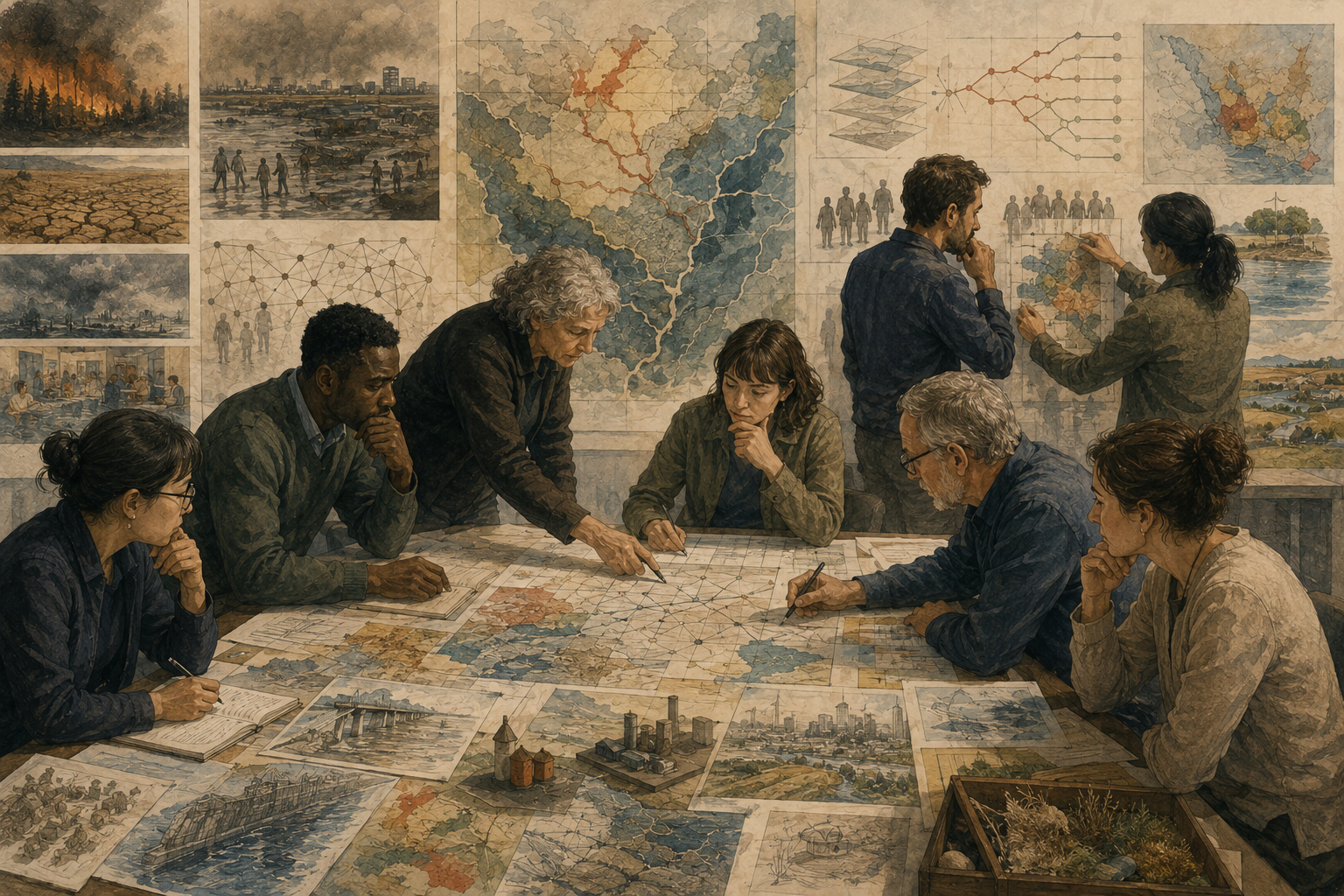
Risk, Uncertainty, and the Limits of Probability
Risk analysis traditionally relies on probabilistic models that assume stable distributions, repeatable conditions, and reasonably knowable relationships between causes and outcomes. This framework works well in domains where uncertainty can be quantified with relative confidence: insurance portfolios, quality control, bounded operational systems, routine safety engineering, inventory planning, actuarial analysis, and some forms of financial modeling.
But many real-world systems do not satisfy those assumptions. Structural change, technological disruption, environmental instability, political conflict, public health shocks, institutional breakdown, and social polarization create non-stationary conditions in which past data may no longer provide a reliable guide to future behavior. The issue is not only that the future is unknown. It is that the structure producing future outcomes may itself be changing.
Frank Knight’s classic distinction between measurable risk and unmeasurable uncertainty remains useful here. Measurable risk refers to situations where probabilities can be assigned with some credibility. Uncertainty refers to situations where probabilities are unknown, unstable, contested, or not meaningfully inferable from past data. Futures thinking becomes most important when decision-makers must act in this second domain.
Where probability is credible, it should be used. Where probability becomes false precision, futures thinking becomes necessary.
| Condition | Risk Analysis Approach | Limitation |
|---|---|---|
| Stable historical pattern | Probability modeling, statistical inference, actuarial estimation. | Assumes the future resembles the observed past. |
| Known uncertainty | Sensitivity analysis, confidence intervals, decision trees, stress tests. | May still assume known model structure. |
| Deep uncertainty | Scenario planning, robust decision-making, adaptive pathways. | Requires judgment about plausible futures rather than precise prediction. |
| Systemic risk | Network analysis, cascade modeling, resilience assessment. | Requires understanding interdependence and feedback. |
| Institutional risk | Governance analysis, legitimacy assessment, coordination stress testing. | Often excluded from technical risk models. |
| Transformational risk | Foresight, horizon scanning, anticipatory governance. | May involve weak signals and contested futures. |
The central question is not whether probability is useful. It is whether probability is being used honestly. A quantified model can clarify decision-making when assumptions are explicit and conditions are stable enough for inference. But a quantified model can become dangerous when it hides uncertainty, ignores structural change, or gives decision-makers the illusion that complex futures have been domesticated by numbers.
Knowns, Unknowns, and Deep Uncertainty
Risk is often described through the language of known knowns, known unknowns, and unknown unknowns. Known knowns are risks already recognized and measured. Known unknowns are uncertainties that can be named but not fully resolved. Unknown unknowns are risks outside the present frame of awareness. Futures thinking extends this vocabulary by emphasizing deep uncertainty: a condition in which decision-makers cannot agree on the correct model, the relevant probability distributions, the value of outcomes, or even the boundaries of the system being analyzed.
Deep uncertainty appears in climate policy, AI governance, geopolitical rivalry, infrastructure transition, biosecurity, financial contagion, public health preparedness, democratic stability, migration systems, ecological change, and technological innovation. In such domains, uncertainty is not a temporary data gap. It is a structural feature of the decision environment.
The most important risks are often those that cannot be precisely defined in advance. This does not mean analysis is impossible. It means analysis must shift from prediction to exploration, from optimization to robustness, and from confidence to preparedness.
| Uncertainty Type | Description | Useful Response |
|---|---|---|
| Data uncertainty | The data are incomplete, noisy, biased, or unavailable. | Improve measurement, triangulate sources, quantify confidence. |
| Model uncertainty | Analysts disagree on the correct causal structure. | Compare models, stress-test assumptions, use ensemble reasoning. |
| Parameter uncertainty | The model is accepted, but key values are uncertain. | Sensitivity analysis, Bayesian updating, uncertainty intervals. |
| Scenario uncertainty | Different future contexts produce different outcomes. | Scenario planning, adaptive pathways, robust decision-making. |
| Value uncertainty | Stakeholders disagree on what outcomes matter most. | Participatory deliberation, ethical analysis, transparent trade-offs. |
| Structural uncertainty | The system may change in ways that invalidate past assumptions. | Horizon scanning, early warning, adaptive governance. |
| Ignorance | Important risks are not yet known or recognized. | Precaution, redundancy, learning systems, humility. |
Deep uncertainty requires a different institutional posture. It rewards monitoring, flexibility, diversity of expertise, public accountability, and the ability to revise strategy as conditions change. It punishes rigidity, overconfidence, single-model planning, and narrow optimization around one expected future.
Risk Modeling and System Representation
Risk analysis always depends on representation. A model does not simply describe risk; it frames what counts as risk. It defines boundaries, variables, relationships, time horizons, feedback loops, thresholds, and outcomes. A simplified model can create clarity, but it can also omit the very mechanisms through which risk accumulates.
In complex systems, danger often resides in interactions. A power outage becomes a public health emergency when hospitals, cooling systems, communication networks, water pumps, fuel supplies, and vulnerable households are connected. A financial shock becomes a political crisis when debt, unemployment, public services, housing, food prices, and public trust interact. A climate event becomes a security risk when it intersects with weak institutions, food insecurity, migration pressure, and conflict history.
Model uncertainty is itself a major source of risk. Incorrect assumptions about system structure can generate false confidence, and false confidence can be more dangerous than acknowledged ignorance.
| Modeling Choice | What It Clarifies | What It Can Hide |
|---|---|---|
| Single forecast | Provides a clear planning number. | Conceals alternative futures and structural uncertainty. |
| Expected value model | Combines probability and consequence. | Can underweight extreme outcomes and distributional harm. |
| Linear model | Clarifies direct relationships. | Misses thresholds, feedback, and nonlinear amplification. |
| Sector model | Allows detailed analysis within one domain. | Misses cross-sector cascade risk. |
| Network model | Shows interdependence and transmission pathways. | May oversimplify agency, power, and institutional behavior. |
| Scenario model | Explores plausible future contexts. | Can become narrative theater if not linked to decisions. |
| Simulation model | Tests dynamic behavior over time. | Can create false precision if assumptions are hidden. |
A futures-oriented risk model should make its assumptions visible. It should identify what is included, what is excluded, what is uncertain, what is contested, and what would cause the model to fail. The goal is not to build a perfect representation. It is to build a responsible representation that improves judgment without hiding uncertainty.
Scenario Analysis and Alternative Futures
Scenario analysis provides a framework for exploring multiple possible futures rather than attempting to predict a single one. Instead of reducing uncertainty to one forecast, scenarios reveal how systems may behave under contrasting assumptions about drivers, shocks, constraints, institutional responses, technological changes, ecological stress, political conditions, and social behavior.
Scenarios are especially valuable when probabilities are difficult to assign. They allow decision-makers to test strategies across plausible future contexts without pretending that each path can be precisely weighted. A scenario is not a prediction. It is a structured possibility used to examine assumptions, vulnerabilities, opportunities, and strategic options.
Scenarios expand the decision space by making uncertainty explicit. They help institutions ask: What if the baseline does not hold? What if shocks compound? What if coordination fails? What if technology diffuses faster than regulation? What if climate hazards arrive sooner than expected? What if public trust erodes? What if a strategy performs well in one future but fails in another?
| Scenario Function | Purpose | Risk Analysis Value |
|---|---|---|
| Explore uncertainty | Shows multiple plausible futures. | Reduces dependence on one forecast. |
| Stress-test strategy | Examines how plans perform under different conditions. | Identifies fragile assumptions. |
| Reveal blind spots | Introduces neglected drivers, weak signals, and second-order effects. | Improves anticipatory awareness. |
| Support deliberation | Creates a shared language for discussing uncertainty. | Enables transparent trade-offs. |
| Design adaptive pathways | Links scenarios to triggers, monitoring, and revised action. | Prevents lock-in to one future. |
| Expose distributional risk | Shows who is exposed, protected, ignored, or harmed. | Connects risk analysis to justice and legitimacy. |
Good scenario analysis should not stop at narrative. It should connect scenarios to decisions, budgets, investments, monitoring indicators, governance reforms, contingency plans, communication systems, and accountability. Scenarios matter when they change how institutions prepare.
Nonlinear Risk and System Dynamics
Complex systems often exhibit nonlinear behavior. Small changes can produce disproportionately large effects when thresholds are crossed, feedback loops intensify, or dependencies align. This is especially important in infrastructure, ecological systems, financial markets, public health, political systems, climate systems, and digital platforms.
Nonlinear risk arises when systems contain amplification mechanisms. In a financial system, declining asset prices can trigger margin calls, forced selling, liquidity shortages, and wider panic. In an ecological system, incremental warming can contribute to tipping dynamics. In infrastructure systems, one failure can overload adjacent systems. In political systems, small events can trigger public backlash when trust is already low.
Risk in complex systems is often driven by structure rather than probability alone. A low-probability event can become strategically important if the system is tightly coupled, poorly buffered, or vulnerable to cascading failure.
| Nonlinear Mechanism | Description | Example Risk |
|---|---|---|
| Feedback loop | An effect reinforces or dampens its own cause. | Market panic, arms racing, misinformation spread, climate feedback. |
| Threshold | System behavior changes sharply after a critical point. | Grid failure, ecosystem collapse, social unrest, bank runs. |
| Cascade | Failure moves from one system component to another. | Energy outage affecting water, health, transport, and communications. |
| Tight coupling | Components depend on each other with little slack or delay. | Supply-chain disruption, automated trading failure, logistics breakdown. |
| Hidden dependency | A system relies on components not visible in ordinary operation. | Critical minerals, cloud platforms, undersea cables, staffing bottlenecks. |
| Delayed signal | Warning signs appear after damage has already accumulated. | Climate risk, public health spread, infrastructure deterioration. |
Futures-oriented risk analysis must therefore examine structure. It must ask where stress accumulates, where feedback loops exist, where thresholds may lie, where dependencies are concentrated, where buffers are missing, and where early signals are delayed or ignored.
Tail Risk and Extreme Events
Tail risks are low-probability, high-impact events that can dominate long-run outcomes. Financial crashes, pandemics, extreme weather events, infrastructure collapse, cyber cascades, geopolitical escalation, ecological thresholds, and technological accidents all illustrate how rare or underestimated events can reshape entire systems.
Traditional models may understate tail risk when they assume normal distributions, stable correlations, independent events, or historical continuity. But many extreme events emerge when conditions change, correlations tighten, buffers erode, and stress propagates across domains. In those contexts, the past does not provide a clean sample of future extremes.
Extreme events often shape systems more than average outcomes. A risk framework that focuses only on central tendencies can miss the events that matter most for resilience, public responsibility, and institutional survival.
| Tail Risk Issue | Why It Is Difficult | Futures-Oriented Response |
|---|---|---|
| Rare events | Limited historical observations make probability estimation unstable. | Use stress testing and scenario analysis. |
| Compound shocks | Multiple hazards occur together or in sequence. | Model cross-domain interaction. |
| Correlation breakdown | Assumed diversification fails during crisis. | Stress-test under tightened correlations. |
| Structural change | Past distributions no longer represent future conditions. | Use adaptive monitoring and nonstationary assumptions. |
| Hidden exposure | Risk accumulates in overlooked dependencies. | Map networks, chokepoints, and vulnerable groups. |
| Asymmetric harm | Small probability hides catastrophic or unjust consequences. | Include severity, irreversibility, and distributional impact. |
Tail-risk analysis requires seriousness about consequences. A risk that is unlikely but catastrophic may deserve more attention than a risk that is likely but manageable. Futures thinking helps institutions examine such possibilities without reducing the future to an average case.
Exposure, Vulnerability, and Adaptive Capacity
Risk is not determined by hazard alone. A hazard becomes harmful when it intersects with exposure, vulnerability, and limited capacity. A heat wave is more dangerous where housing lacks cooling, workers lack protection, public communication is weak, older adults are isolated, electricity is unreliable, and healthcare systems are strained. A cyberattack is more dangerous where systems lack redundancy, backups, trained staff, incident response, and trust. A flood is more destructive where land-use planning, drainage, housing quality, emergency response, insurance, and public finance are weak.
Futures-oriented risk analysis therefore distinguishes between hazard and vulnerability. It asks not only what could happen, but who or what is exposed, why exposure exists, who has protection, who lacks protection, and what capacities determine recovery.
Risk is socially and institutionally distributed. The same hazard produces different outcomes depending on public systems, infrastructure, rights, resources, trust, and adaptive capacity.
| Risk Component | Meaning | Example |
|---|---|---|
| Hazard | The event, stressor, or disturbance that may cause harm. | Flood, heat wave, cyberattack, disease outbreak, market shock. |
| Exposure | The people, assets, systems, or institutions located in harm’s way. | Homes in floodplains, hospitals on fragile grids, workers exposed to heat. |
| Vulnerability | The conditions that make exposed systems more likely to suffer harm. | Poverty, weak infrastructure, poor housing, social isolation, lack of redundancy. |
| Adaptive capacity | The ability to adjust, respond, recover, learn, and transform. | Emergency response, public finance, community networks, flexible institutions. |
| Resilience | The ability to absorb disturbance while preserving core functions and dignity. | Maintaining care, water, energy, communication, and public trust during crisis. |
| Transformative capacity | The ability to change system structure when existing arrangements produce recurring risk. | Managed retreat, energy transition, public health renewal, care-system redesign. |
This distinction matters ethically and strategically. If analysis treats disasters as natural events alone, it hides the public choices that produce unequal vulnerability. Futures thinking keeps attention on preventable harm, institutional responsibility, and the need to reduce exposure before crisis.
Decision-Making Under Uncertainty
Decision-making under uncertainty requires moving beyond optimization for a single expected future. When the future cannot be specified reliably, strategies must be judged by how they perform across multiple plausible conditions. A decision that appears optimal under one model may fail badly if structural assumptions prove wrong. A less optimal strategy under one forecast may be superior if it remains viable across many futures.
This is the logic behind robustness. Robust strategies are not necessarily the most efficient under ideal conditions. They are designed to avoid catastrophic failure across diverse conditions. In complex systems, robustness often matters more than narrow efficiency because the cost of failure may be irreversible, unjust, or systemically destabilizing.
Good decisions are not always those that optimize for a predicted future. Often, they are those that remain viable across multiple possible futures.
| Decision Logic | Strength | Weakness Under Deep Uncertainty |
|---|---|---|
| Optimization | Efficient under known assumptions. | Can fail if assumptions are wrong. |
| Expected value | Balances probability and consequence. | Requires credible probabilities and bounded outcomes. |
| Cost-benefit analysis | Compares trade-offs in a structured way. | May understate irreversibility, dignity, ecological thresholds, and justice. |
| Precaution | Protects against severe or irreversible harm. | Requires judgment about proportionality and action thresholds. |
| Robust decision-making | Tests strategies across many futures. | Can be resource-intensive and analytically demanding. |
| Adaptive pathways | Allows strategy to evolve as information changes. | Requires monitoring, triggers, institutional flexibility, and learning capacity. |
Decision-making under uncertainty is not passive. It does not mean waiting for perfect knowledge. It means acting with humility, building monitoring systems, preserving options, reducing irreversible exposure, and designing strategies that can be revised as the future reveals itself.
Adaptive Strategy and Robust Decision-Making
Adaptive strategies are designed to evolve. They rely on monitoring, feedback, trigger points, learning systems, staged investment, flexible governance, and the ability to revise action as conditions change. Robust decision-making evaluates whether strategies perform acceptably across a wide range of possible futures rather than performing perfectly in one forecast.
This approach is especially important when uncertainty is persistent and decisions have long lifetimes. Infrastructure systems, climate adaptation plans, public health preparedness, energy transitions, urban planning, AI governance, water systems, and national security strategies all involve decisions whose consequences extend across decades. A plan optimized for today’s assumptions may become fragile if those assumptions change.
The goal is not to predict the future, but to prepare for multiple futures while preserving the capacity to learn.
| Adaptive Strategy Element | Function | Example |
|---|---|---|
| Monitoring indicators | Track changing conditions and weak signals. | Heat mortality, water levels, cyber incidents, migration pressure, supply shortages. |
| Trigger points | Define when strategy should change. | Thresholds for drought response, hospital surge, infrastructure retreat, reserve release. |
| Flexible pathways | Keep multiple options available over time. | Staged infrastructure adaptation or modular energy investment. |
| Redundancy | Prevents single-point failure. | Backup power, diversified suppliers, multiple communication channels. |
| Learning loops | Update assumptions based on evidence and feedback. | After-action reviews, scenario refresh cycles, adaptive regulation. |
| Institutional flexibility | Allows decision-making to adjust without paralysis. | Contingency funds, emergency authorities, adaptive procurement. |
| Public accountability | Maintains legitimacy while strategies evolve. | Transparent criteria, community participation, published risk reviews. |
Adaptive strategy is strongest when it avoids both rigidity and improvisation. It does not lock institutions into one forecast, but it also does not leave them unprepared. It creates disciplined flexibility.
Institutional Risk and Governance Limits
Institutions play a central role in managing risk, but institutional design can also generate risk. Fragmented authority, short-term incentives, rigid procedures, underfunded capacity, poor data systems, political denial, weak accountability, and delayed learning can amplify systemic vulnerability even when hazards are already visible.
In many settings, the greatest risk is not lack of awareness. It is inability to coordinate action. Institutions may know a risk exists but fail to prepare because costs are immediate, benefits are invisible, responsibility is distributed, and accountability is delayed. Prevention often loses to crisis response because avoided harm is harder to see than visible emergency action.
Institutional failure is often a major source of systemic risk. Risk analysis must therefore include governance capacity, legitimacy, coordination, public finance, authority, trust, and the ability to learn before disruption intensifies.
| Institutional Risk | Mechanism | Consequence |
|---|---|---|
| Fragmented authority | No single institution can coordinate across the whole system. | Delayed response, gaps, duplication, blame shifting. |
| Short-term incentives | Leaders prioritize visible near-term gains over long-term risk reduction. | Underinvestment in prevention and resilience. |
| Data invisibility | Signals are missing, delayed, or not shared. | Risk accumulates before recognition. |
| Rigid procedures | Institutions cannot adapt as conditions change. | Plans become obsolete under stress. |
| Legitimacy deficit | Publics do not trust institutions or guidance. | Compliance, cooperation, and crisis communication weaken. |
| Accountability failure | Past harm does not produce learning or repair. | Repeated mistakes and deepened distrust. |
| Capacity erosion | Workforce, finance, expertise, and institutional memory decline. | Systems fail when shocks arrive. |
Institutional risk analysis must ask whether organizations can detect signals, interpret them honestly, coordinate action, allocate resources, communicate clearly, revise strategy, and remain legitimate under pressure. Without these capacities, even strong technical analysis may fail to become protective action.
Technology Risk and System Acceleration
Technological change introduces new forms of risk: unintended consequences, automation error, rapid diffusion, tighter coupling, cyber vulnerability, platform dependence, data extraction, algorithmic bias, surveillance, dual-use capability, and the acceleration of social and economic processes beyond governance capacity. New technologies expand capability, but they also expand the range of possible failure modes.
Technology often compresses time. Automated systems can make decisions faster than institutions can deliberate. Platforms can spread information faster than verification systems can respond. Cyber incidents can propagate quickly across infrastructure. AI systems can scale analysis, persuasion, classification, and automation in ways that are difficult to audit. Biotechnology can expand health and agricultural capability while raising biosecurity and governance concerns.
Technology increases both capability and uncertainty. Futures-oriented risk analysis must therefore treat technological systems not merely as tools, but as evolving sources of strategic, institutional, and systemic risk.
| Technology Risk | Mechanism | Risk Analysis Question |
|---|---|---|
| Automation error | Systems act quickly based on flawed assumptions or data. | Where is human oversight necessary? |
| Cyber dependence | Critical systems rely on digital infrastructure. | What failures cascade if digital systems are disrupted? |
| AI opacity | Models produce outputs that are difficult to interpret or audit. | Who is accountable when systems fail? |
| Platform concentration | Information and commerce depend on a few infrastructures. | What happens if platforms are manipulated, degraded, or withdrawn? |
| Dual-use capability | Tools have civilian and harmful applications. | How are safety, access, and misuse governed? |
| Regulatory lag | Governance adapts slower than technological diffusion. | What harms accumulate before rules catch up? |
| Social acceleration | Technology changes behavior faster than institutions can respond. | How does speed affect trust, accountability, and stability? |
Technology foresight should connect risk analysis to governance. It should examine standards, audits, liability, public accountability, procurement, safety testing, labor impacts, environmental costs, data rights, and the distribution of benefits and harms.
Climate Risk and Nonstationarity
Climate risk challenges traditional probability-based planning because climate systems are changing. Historical weather records no longer provide a stable basis for future risk. Flood maps, heat expectations, fire regimes, drought assumptions, water reliability, storm intensity, crop suitability, insurance models, infrastructure design standards, and public health plans may all become unreliable if they are based on stationary assumptions.
Climate risk is also systemic. Heat affects labor, health, energy demand, transport, agriculture, and housing. Drought affects water, food, ecosystems, hydropower, migration, and conflict risk. Flooding affects homes, roads, hospitals, wastewater, insurance, public finance, and mental health. Wildfire affects air quality, power systems, emergency services, housing markets, and regional economies.
Climate risk is not only environmental risk. It is infrastructure risk, health risk, financial risk, food risk, labor risk, governance risk, and justice risk.
| Climate Risk Challenge | Why It Matters | Futures-Oriented Response |
|---|---|---|
| Nonstationarity | Historical patterns no longer represent future conditions. | Use dynamic scenarios and updated hazard projections. |
| Compound hazards | Heat, drought, fire, flood, and power failures can interact. | Stress-test multi-hazard scenarios. |
| Infrastructure lock-in | Long-lived assets may be built for obsolete assumptions. | Use adaptive design, modularity, and trigger points. |
| Distributional exposure | Vulnerable communities often face greater hazard and less protection. | Prioritize exposure reduction and justice-centered adaptation. |
| Financial instability | Insurance, property values, public finance, and debt can be affected. | Assess fiscal and financial resilience. |
| Governance lag | Institutions adapt slower than hazards intensify. | Strengthen anticipatory governance and public accountability. |
Climate futures require moving from historical risk management to forward-looking adaptation. The question is not only what climate risk is today, but what risks become plausible over the lifetime of infrastructure, institutions, communities, ecosystems, and future generations.
Geopolitical Risk and Strategic Uncertainty
Geopolitical risk involves strategic interaction among actors whose intentions, capabilities, thresholds, domestic constraints, and future responses are not fully known. It is not enough to model one actor’s behavior. Risk emerges from interaction: deterrence, signaling, misperception, escalation, sanctions, alliances, technological rivalry, resource competition, and domestic political pressure.
Geopolitical risk is difficult because decision-makers act under uncertainty while also trying to influence one another’s expectations. A defensive action by one actor may appear offensive to another. A sanction may deter, harden, or redirect behavior. A military exercise may reassure allies while alarming rivals. A cyber operation may remain below the threshold of war or trigger escalation through misinterpretation.
Geopolitical risk analysis must examine how actions are interpreted by others, not only how they are intended by the actor taking them.
| Geopolitical Risk Mechanism | Description | Futures Analysis Use |
|---|---|---|
| Security dilemma | Defensive preparations appear threatening to others. | Explore escalation pathways and reassurance strategies. |
| Deterrence uncertainty | Actors may misread red lines or resolve. | Stress-test signaling and crisis communication. |
| Economic statecraft | Sanctions, export controls, and trade restrictions create pressure. | Map second-order effects and retaliation pathways. |
| Alliance dynamics | Commitments deter conflict but may create entrapment or credibility risk. | Examine alliance stress across scenarios. |
| Resource competition | Energy, food, water, and minerals become strategic variables. | Assess dependency, chokepoints, and substitution pathways. |
| Information conflict | Narratives, propaganda, leaks, and synthetic media shape public perception. | Evaluate trust, legitimacy, and cognitive resilience. |
Geopolitical futures require scenario analysis, red teaming, strategic empathy, regional knowledge, systems mapping, and attention to human consequences. The risk is not simply that conflict occurs. The risk is that complex interactions produce outcomes no actor fully intended.
Financial Risk and Systemic Contagion
Financial risk analysis has long used quantitative models, but financial systems remain vulnerable to systemic contagion because they are highly interconnected, confidence-sensitive, leveraged, and shaped by expectations. A shock in one domain can propagate through credit, liquidity, asset prices, insurance, currency markets, debt, public finance, and political legitimacy.
Systemic financial risk is not simply the sum of individual balance-sheet risks. It emerges from network structure, common exposure, leverage, maturity mismatch, feedback loops, herding behavior, regulatory gaps, and confidence dynamics. Institutions that appear sound individually can become fragile collectively if they hold similar assets, rely on similar funding sources, or respond to stress in the same way.
Financial futures require attention to correlation, contagion, liquidity, public trust, and the political consequences of economic stress.
| Financial Risk Mechanism | System Dynamic | Futures-Oriented Response |
|---|---|---|
| Leverage | Small losses can force large adjustments. | Stress-test under asset-price declines and liquidity constraints. |
| Liquidity risk | Assets cannot be sold without large price effects. | Model market depth and crisis liquidity. |
| Common exposure | Many actors rely on the same assets or assumptions. | Assess correlation and concentration. |
| Confidence collapse | Expectations shift quickly and trigger withdrawal or selling. | Monitor trust, communication, and backstop credibility. |
| Debt stress | Rising costs or declining revenue reduce fiscal and institutional capacity. | Scenario-test debt, austerity, and public service risks. |
| Climate-financial risk | Physical and transition risks affect assets, insurance, and credit. | Integrate climate scenarios into financial risk analysis. |
Financial risk analysis is strongest when it treats markets as social and institutional systems, not only as numerical series. Expectations, confidence, regulation, public legitimacy, and political response are part of the system.
Core Dimensions of Futures-Oriented Risk Analysis
Futures-oriented risk analysis can be evaluated through several interacting dimensions. These dimensions should not be treated separately. Probability confidence depends on data quality and model validity. Vulnerability depends on exposure, inequality, infrastructure, and institutional capacity. Robustness depends on how strategies perform across multiple futures. Adaptive capacity depends on monitoring, learning, trust, finance, and governance flexibility.
1. Probability Confidence
Probability confidence assesses whether probabilities are credible, stable, and evidence-based. Low probability confidence does not mean analysis stops; it means analysis must rely more heavily on scenarios, stress tests, and robustness.
2. Structural Uncertainty
Structural uncertainty concerns whether the system model itself is contested or unstable. It includes uncertainty about drivers, feedback loops, thresholds, boundaries, causal pathways, and emergent behavior.
3. Interdependence and Cascade Risk
Interdependence and cascade risk examine how disruptions move across networks, sectors, institutions, geographies, and populations. They identify where local shocks may become systemic crises.
4. Exposure and Vulnerability
Exposure and vulnerability assess who or what is in harm’s way and what conditions make harm more likely. This includes infrastructure, communities, ecosystems, institutions, workers, households, and supply systems.
5. Tail Risk and Irreversibility
Tail risk and irreversibility examine low-probability, high-impact, catastrophic, or irreversible outcomes. These risks require special attention because expected-value methods can underweight them.
6. Robustness Across Scenarios
Robustness across scenarios evaluates whether strategies remain viable under multiple plausible futures rather than optimizing for a single forecast.
7. Adaptive Capacity and Learning
Adaptive capacity and learning include monitoring, trigger points, feedback interpretation, institutional memory, flexible funding, contingency planning, and the ability to revise strategy.
8. Legitimacy and Public Responsibility
Legitimacy and public responsibility examine whether risk decisions are transparent, accountable, participatory, just, and attentive to those who bear the greatest consequences.
| Dimension | Core Question | Failure if Ignored |
|---|---|---|
| Probability confidence | Can probabilities be estimated honestly? | False precision hides uncertainty. |
| Structural uncertainty | Is the system model stable and agreed upon? | Wrong models create wrong strategies. |
| Cascade risk | Can disruption spread across connected systems? | Local shocks become systemic crises. |
| Exposure and vulnerability | Who or what is in harm’s way? | Risk analysis hides unequal harm. |
| Tail risk | What severe outcomes could dominate the future? | Average-case planning misses catastrophic failure. |
| Robustness | Does the strategy work across multiple futures? | Plans fail when the expected future does not occur. |
| Adaptive capacity | Can institutions learn and revise action? | Systems remain locked into outdated assumptions. |
| Legitimacy | Are risk decisions accountable and just? | Public trust erodes and cooperation fails. |
Futures-oriented risk analysis is strongest when probability, uncertainty, system structure, vulnerability, robustness, adaptation, and public legitimacy are evaluated together.
Scenario Planning for Risk Analysis
Scenario planning helps risk analysts move beyond baseline thinking. It allows institutions to examine what happens if assumptions fail, if risks interact, if shocks compound, if governance capacity erodes, or if new technologies transform the decision environment. In futures-oriented risk analysis, scenarios are not decorative narratives. They are structured test environments for decisions.
A strong risk scenario should specify drivers, assumptions, system boundaries, vulnerable groups, early indicators, potential cascades, institutional stress points, decision triggers, and strategy implications. It should also identify what the scenario is not claiming. Scenarios are not predictions, forecasts, or probability claims. They are disciplined ways of making uncertainty actionable.
Scenario planning becomes risk analysis when it tests vulnerability, exposure, robustness, and institutional capacity.
| Scenario Planning Step | Risk Analysis Function | Example Question |
|---|---|---|
| Identify critical uncertainties | Clarifies which assumptions shape future risk. | What is most uncertain and most consequential? |
| Define plausible scenarios | Creates alternative future contexts. | What happens under technological disruption, climate stress, or institutional breakdown? |
| Map system exposure | Identifies who and what is vulnerable. | Which systems, communities, assets, and institutions are exposed? |
| Stress-test strategies | Evaluates plans across multiple futures. | Which strategy fails first, where, and why? |
| Identify early indicators | Links scenarios to monitoring. | What signals would suggest this future is becoming more likely? |
| Define trigger points | Connects analysis to action. | When should institutions revise strategy? |
| Update over time | Maintains relevance as conditions change. | How will scenarios be refreshed as new evidence appears? |
Risk scenarios should also include uncomfortable futures. Institutions often prefer scenarios that are plausible but politically safe. Futures thinking requires examining futures that challenge assumptions, expose fragile commitments, and reveal uncomfortable responsibilities.
Risk Futures Scenarios
Risk futures can unfold across multiple pathways. These scenarios are not predictions. They are structured contexts for testing assumptions about uncertainty, probability, model validity, system interdependence, institutional capacity, technology, climate, finance, and governance.
| Scenario | Description | Systemic Risk | Strategic Opportunity |
|---|---|---|---|
| Stable Baseline Extension | Historical patterns remain broadly useful, and existing risk models perform adequately. | Institutions become complacent and miss structural change. | Use stability to build reserves, monitoring, and adaptive capacity. |
| Technological Disruption | AI, cyber systems, automation, platforms, biotechnology, or data infrastructures change risk faster than governance adapts. | Regulatory lag, opacity, cascading technical failure, accountability gaps. | Build technology foresight, audits, safety systems, and adaptive governance. |
| Climate Stress Escalation | Climate hazards intensify faster than infrastructure, insurance, public health, and planning systems adapt. | Nonstationarity, infrastructure failure, displacement, fiscal stress, unequal exposure. | Use climate scenarios, exposure reduction, resilient infrastructure, and adaptation triggers. |
| Geopolitical Fragmentation | Conflict, sanctions, supply-chain disruption, institutional rivalry, and bloc formation increase uncertainty. | Trade disruption, energy shock, food insecurity, cyber escalation, institutional weakness. | Build redundancy, diplomacy, regional resilience, and strategic reserves. |
| Financial Contagion | Debt stress, liquidity pressure, asset repricing, climate risk, or confidence collapse spreads across institutions. | Market failure, austerity, public-service stress, political instability. | Stress-test correlated risk, public finance, and systemic safeguards. |
| Institutional Breakdown | Public agencies, governance systems, or coordination mechanisms lose capacity or legitimacy. | Known risks go unmanaged, and response fails under crisis. | Strengthen accountability, legitimacy, workforce, finance, and public trust. |
| Systemic Cascade | Multiple risks interact across climate, finance, technology, infrastructure, health, and politics. | Local disruption becomes cross-domain crisis. | Develop integrated early warning, cross-sector coordination, and resilience planning. |
Scenario analysis reveals that risk futures are not isolated hazard futures. They are systems futures shaped by interdependence, institutional capacity, social vulnerability, technological change, ecological stress, and public legitimacy.
Strategic Questions
Futures-oriented risk analysis should guide strategic questions for public agencies, research institutions, governments, infrastructure owners, businesses, community organizations, universities, emergency managers, and governance bodies. These questions reveal assumptions about probability, uncertainty, preparedness, legitimacy, and the distribution of harm.
| Strategic Question | What It Reveals | Why It Matters |
|---|---|---|
| What assumptions make this risk model work? | Dependence on stable data, model structure, and historical continuity. | Models fail when hidden assumptions collapse. |
| What futures would make this strategy fail? | Fragility across scenarios. | Identifies where robustness is weak. |
| What risks are not being measured? | Blind spots in data, values, exposure, and system boundaries. | Unmeasured risks can become decisive. |
| Who is most exposed and least protected? | Distributional vulnerability and justice implications. | Aggregate risk can hide unequal harm. |
| Where could shocks cascade? | Dependencies across sectors and institutions. | Prevents narrow hazard-by-hazard planning. |
| What signals would require action? | Monitoring indicators and trigger points. | Turns foresight into adaptive governance. |
| What capacities are needed before crisis? | Prevention, preparedness, workforce, finance, trust, and coordination. | Crisis response fails when capacity is absent. |
| How will decisions remain legitimate under uncertainty? | Public accountability, transparency, participation, and fairness. | Risk governance depends on trust and cooperation. |
The purpose of these questions is to move risk analysis from passive assessment to responsible preparation. A risk framework is only useful if it changes decisions before harm becomes unavoidable.
Limitations and Failure Modes
Futures-oriented risk analysis has limits. Scenarios can be poorly designed. Models can hide assumptions. Expert judgment can reproduce institutional bias. Quantitative tools can create false precision. Qualitative scenarios can become vague narratives. Participatory processes can be symbolic rather than influential. Risk language can be used to justify control, austerity, surveillance, or avoidance of responsibility.
The answer is not to abandon risk analysis. It is to practice it more honestly. Strong risk analysis must be transparent about uncertainty, explicit about values, attentive to power, open to revision, and connected to action.
| Failure Mode | Problem | Corrective Practice |
|---|---|---|
| False precision | Numbers imply certainty that does not exist. | State assumptions, uncertainty ranges, and model limits. |
| Single-forecast dependence | Planning assumes one expected future. | Use scenarios and robustness testing. |
| Scenario theater | Scenarios are written but not linked to decisions. | Connect scenarios to budgets, triggers, governance, and accountability. |
| Model blindness | Models omit feedback, vulnerability, and cascade pathways. | Use systems mapping and cross-domain analysis. |
| Average-case bias | Planning focuses on central tendencies. | Include tail risks and severe outcomes. |
| Equity blindness | Aggregate risk hides unequal exposure and harm. | Use distributional and justice-centered risk assessment. |
| Institutional denial | Known risks are ignored because action is politically difficult. | Use public accountability and independent review. |
| Over-militarized risk framing | Risk language justifies coercive control rather than public protection. | Center rights, dignity, prevention, and democratic oversight. |
Futures-oriented risk analysis should be rigorous without becoming technocratic, precautionary without becoming paralyzing, and strategic without becoming morally empty.
Mathematical Lens: Risk, Deep Uncertainty, and Strategy Evaluation
A classical risk formulation often represents expected loss as:
E(L) = \sum_{i=1}^{n} p_i \cdot l_i
\]
Interpretation: \(E(L)\) is expected loss, \(p_i\) is the probability of state \(i\), and \(l_i\) is the associated loss. This formulation is useful when probabilities are credible and outcomes are bounded, but it becomes fragile when the probabilities themselves are uncertain, contested, or nonstationary.
Scenario-based evaluation can instead represent strategy \(j\) across multiple futures as:
\Pi_j = \{V_{j1}, V_{j2}, \dots, V_{jn}\}
\]
Interpretation: \(\Pi_j\) is the performance profile of strategy \(j\), and \(V_{js}\) is the value or viability of strategy \(j\) under scenario \(s\). The analytical question shifts from one expected value to cross-scenario performance.
A simple robustness criterion can be written as:
R_j = \min_{s \in S} V_{js}
\]
Interpretation: \(R_j\) is the worst-case performance of strategy \(j\) across scenario set \(S\). This captures a central insight of futures-oriented risk analysis: when the future is structurally uncertain, strategic quality often depends on survivability across many plausible conditions.
A vulnerability-adjusted risk expression can be written as:
\mathcal{R}_{g,t} = H_t \cdot X_{g,t} \cdot V_{g,t} – A_{g,t}
\]
Interpretation: \(\mathcal{R}_{g,t}\) is risk for group or system \(g\) at time \(t\), \(H_t\) is hazard intensity, \(X_{g,t}\) is exposure, \(V_{g,t}\) is vulnerability, and \(A_{g,t}\) is adaptive capacity. This makes visible that risk is not only hazard probability; it is also shaped by exposure, vulnerability, and protection.
A cascade-risk expression can be represented as:
C_i = \sum_{j=1}^{n} w_{ij}D_j
\]
Interpretation: \(C_i\) is cascade exposure for system \(i\), \(w_{ij}\) is the dependency weight between systems \(i\) and \(j\), and \(D_j\) is disruption in system \(j\). This expresses the idea that risk can move through networks rather than remain confined to the original hazard.
An adaptive pathway can be represented as a sequence of decisions conditioned on signals:
A_t =
\begin{cases}
a_1, & z_t < \tau_1 \\ a_2, & \tau_1 \leq z_t < \tau_2 \\ a_3, & z_t \geq \tau_2 \end{cases} \]
Interpretation: \(A_t\) is the action taken at time \(t\), \(z_t\) is a monitored indicator, and \(\tau_1, \tau_2\) are trigger thresholds. This represents adaptive strategy: institutions revise action when conditions cross predefined thresholds.
These equations are conceptual tools rather than complete predictive models. Their purpose is to make assumptions explicit: expected loss depends on credible probabilities, robustness depends on cross-scenario performance, vulnerability depends on exposure and adaptive capacity, cascade risk depends on network dependence, and adaptive strategy depends on monitoring and triggers.
Computational Modeling for Futures-Oriented Risk Analysis
Computational modeling can support futures-oriented risk analysis by comparing scenarios, stress-testing strategies, mapping vulnerabilities, simulating adaptive pathways, and identifying when strategies are robust or fragile. It should not be used to create false precision. Its value lies in making assumptions visible and allowing decision-makers to explore uncertainty systematically.
A professional futures-oriented risk workflow may include:
- Risk profiles: probability confidence, structural uncertainty, interdependence, vulnerability, resilience capacity, governance capacity, and public legitimacy.
- Scenario records: stable baseline, technological disruption, climate stress escalation, geopolitical fragmentation, financial contagion, institutional breakdown, and systemic cascade.
- Strategy options: efficiency strategy, balanced strategy, adaptive strategy, precautionary strategy, resilient redundancy, and transformative risk reduction.
- Risk indicators: model confidence, exposure, vulnerability, cascade potential, tail-risk severity, signal visibility, preparedness, and distributional harm.
- Outputs: risk-profile scores, strategy robustness rankings, scenario stress tables, adaptive-pathway simulations, and reproducibility reports.
Computational risk analysis is most useful when it supports judgment, transparency, and preparedness—not when it conceals uncertainty behind technical authority.
Advanced R Workflow: Comparing Risk Profiles Across Future Scenarios
The R workflow below compares stylized risk scenarios across probability confidence, structural uncertainty, interdependence, vulnerability, resilience capacity, governance capacity, and signal visibility. It illustrates how futures thinking broadens risk analysis beyond single expected-value estimates.
# ------------------------------------------------------------
# R Workflow: Comparing Risk Profiles Across Future Scenarios
# Purpose:
#   Compare stylized futures risk profiles using probability
#   confidence, structural uncertainty, interdependence,
#   vulnerability, resilience capacity, governance capacity,
#   and signal visibility.
#
# Optional dependency:
#   install.packages(c("tidyverse"))
# ------------------------------------------------------------

library(tidyverse)

scenarios <- tibble(
  scenario = c(
    "Stable Baseline",
    "Technological Disruption",
    "Climate Stress Escalation",
    "Geopolitical Fragmentation",
    "Financial Contagion",
    "Institutional Breakdown",
    "Systemic Cascade"
  ),
  probability_confidence = c(0.78, 0.42, 0.36, 0.34, 0.45, 0.32, 0.18),
  structural_uncertainty = c(0.22, 0.68, 0.74, 0.71, 0.62, 0.76, 0.88),
  interdependence = c(0.41, 0.63, 0.66, 0.72, 0.86, 0.70, 0.91),
  vulnerability = c(0.34, 0.58, 0.70, 0.66, 0.64, 0.78, 0.84),
  resilience_capacity = c(0.72, 0.55, 0.49, 0.46, 0.44, 0.36, 0.31),
  governance_capacity = c(0.70, 0.46, 0.44, 0.42, 0.50, 0.30, 0.28),
  signal_visibility = c(0.76, 0.48, 0.52, 0.44, 0.42, 0.36, 0.26)
)

scenarios <- scenarios %>%
  mutate(
    futures_risk_profile =
      0.14 * (1 - probability_confidence) +
      0.18 * structural_uncertainty +
      0.17 * interdependence +
      0.18 * vulnerability -
      0.14 * resilience_capacity -
      0.11 * governance_capacity -
      0.08 * signal_visibility,

    preparedness_gap =
      0.25 * (1 - resilience_capacity) +
      0.25 * (1 - governance_capacity) +
      0.20 * (1 - signal_visibility) +
      0.15 * structural_uncertainty +
      0.15 * vulnerability,

    profile_class = case_when(
      futures_risk_profile >= 0.45 ~ "High futures risk",
      futures_risk_profile >= 0.30 ~ "Moderate futures risk",
      TRUE ~ "Lower futures risk"
    )
  ) %>%
  arrange(desc(futures_risk_profile))

print(scenarios)

scenarios_long <- scenarios %>%
  select(
    scenario,
    probability_confidence,
    structural_uncertainty,
    interdependence,
    vulnerability,
    resilience_capacity,
    governance_capacity,
    signal_visibility
  ) %>%
  pivot_longer(
    cols = -scenario,
    names_to = "dimension",
    values_to = "value"
  )

ggplot(scenarios_long, aes(x = dimension, y = value, fill = scenario)) +
  geom_col(position = "dodge") +
  labs(
    title = "Stylized Futures Risk Dimensions Across Scenarios",
    x = "Dimension",
    y = "Value",
    fill = "Scenario"
  ) +
  theme_minimal(base_size = 12) +
  coord_flip()

ggplot(scenarios, aes(x = reorder(scenario, futures_risk_profile), y = futures_risk_profile)) +
  geom_col() +
  coord_flip() +
  labs(
    title = "Futures Risk Profile by Scenario",
    x = "Scenario",
    y = "Risk Profile"
  ) +
  theme_minimal(base_size = 12)

ggplot(scenarios, aes(x = futures_risk_profile, y = preparedness_gap, label = scenario)) +
  geom_point(size = 3) +
  geom_text(nudge_y = 0.02, size = 3) +
  labs(
    title = "Futures Risk Profile vs Preparedness Gap",
    x = "Futures Risk Profile",
    y = "Preparedness Gap"
  ) +
  theme_minimal(base_size = 12)

dir.create("outputs", showWarnings = FALSE)
write_csv(scenarios, "outputs/futures_risk_profiles.csv")
This workflow illustrates why futures-oriented risk analysis should evaluate uncertainty, interdependence, vulnerability, resilience, governance, and signals together rather than relying on probability confidence alone.
Advanced Python Workflow: Simulating Adaptive Strategy Under Deep Uncertainty
The Python workflow below simulates several strategies across multiple uncertain futures and compares their average, worst-case, and regret-adjusted performance. It illustrates why futures-oriented risk analysis often favors robustness and adaptability over narrow optimization.
# ------------------------------------------------------------
# Python Workflow: Adaptive Strategy Under Deep Uncertainty
# Purpose:
#   Compare strategy performance across multiple plausible futures
#   and evaluate average performance, worst-case performance,
#   maximum regret, and robustness.
#
# Optional dependencies:
#   pip install pandas numpy matplotlib
# ------------------------------------------------------------

from pathlib import Path

import numpy as np
import pandas as pd
import matplotlib.pyplot as plt

OUTPUT_DIR = Path("outputs")
OUTPUT_DIR.mkdir(exist_ok=True)

strategies = [
    "Efficiency Strategy",
    "Balanced Strategy",
    "Adaptive Strategy",
    "Precautionary Strategy",
    "Resilient Redundancy"
]

scenarios = [
    "Stable Baseline",
    "Technological Disruption",
    "Climate Stress",
    "Geopolitical Fragmentation",
    "Financial Contagion",
    "Institutional Breakdown",
    "Systemic Cascade"
]

performance = {
    "Efficiency Strategy":       [0.92, 0.55, 0.48, 0.44, 0.42, 0.36, 0.28],
    "Balanced Strategy":         [0.78, 0.71, 0.66, 0.63, 0.61, 0.56, 0.52],
    "Adaptive Strategy":         [0.72, 0.76, 0.73, 0.70, 0.68, 0.64, 0.60],
    "Precautionary Strategy":    [0.66, 0.72, 0.76, 0.68, 0.70, 0.66, 0.64],
    "Resilient Redundancy":      [0.64, 0.70, 0.74, 0.72, 0.73, 0.70, 0.68]
}

rows = []

for strategy in strategies:
    for scenario, value in zip(scenarios, performance[strategy]):
        rows.append({
            "strategy": strategy,
            "scenario": scenario,
            "performance": value
        })

df = pd.DataFrame(rows)

scenario_best = (
    df.groupby("scenario")["performance"]
    .max()
    .rename("scenario_best")
    .reset_index()
)

df = df.merge(scenario_best, on="scenario")
df["regret"] = df["scenario_best"] - df["performance"]

summary = (
    df.groupby("strategy")
    .agg(
        mean_performance=("performance", "mean"),
        worst_case=("performance", "min"),
        best_case=("performance", "max"),
        maximum_regret=("regret", "max"),
        mean_regret=("regret", "mean")
    )
    .reset_index()
)

summary["robustness_score"] = (
    0.45 * summary["worst_case"]
    + 0.30 * summary["mean_performance"]
    - 0.25 * summary["maximum_regret"]
)

summary = summary.sort_values("robustness_score", ascending=False)

print("Strategy-scenario performance:")
print(df)

print("\nStrategy robustness summary:")
print(summary)

plt.figure(figsize=(10, 6))
for strategy in df["strategy"].unique():
    subset = df[df["strategy"] == strategy]
    plt.plot(subset["scenario"], subset["performance"], marker="o", label=strategy)

plt.xticks(rotation=25, ha="right")
plt.ylabel("Performance")
plt.title("Strategy Performance Across Multiple Futures")
plt.legend()
plt.tight_layout()
plt.savefig(OUTPUT_DIR / "strategy_performance_across_futures.png", dpi=150)
plt.close()

plt.figure(figsize=(10, 6))
ranked = summary.sort_values("robustness_score")
plt.barh(ranked["strategy"], ranked["robustness_score"])
plt.xlabel("Robustness Score")
plt.title("Strategy Robustness Under Deep Uncertainty")
plt.tight_layout()
plt.savefig(OUTPUT_DIR / "strategy_robustness_scores.png", dpi=150)
plt.close()

summary.to_csv(OUTPUT_DIR / "adaptive_strategy_under_uncertainty.csv", index=False)
df.to_csv(OUTPUT_DIR / "strategy_scenario_performance.csv", index=False)
This workflow shows why the most efficient strategy under stable conditions may be inferior under deep uncertainty. Adaptive and resilient strategies may sacrifice peak performance in the baseline but perform better across disruptive, fragmented, and cascading futures.
GitHub Repository
The companion repository for this article contains computational examples for futures-oriented risk analysis, deep uncertainty, scenario comparison, adaptive strategy, robustness testing, vulnerability, cascade risk, institutional capacity, preparedness gaps, and reproducible risk-foresight workflows.
Complete Code Repository
The companion code includes Python, R, Julia, SQL, Rust, Go, C++, Fortran, C, documentation, synthetic datasets, outputs, and notebook placeholders for applied futures-oriented risk analysis workflows.
Why This Matters
Futures thinking and risk analysis matter because many of the most important risks facing societies cannot be responsibly managed through prediction alone. Climate disruption, AI governance, financial contagion, public health emergencies, infrastructure fragility, geopolitical instability, ecological thresholds, and institutional breakdown all involve uncertainty that exceeds ordinary forecasting. The future may not resemble the past, and the systems generating future outcomes may change while decisions are being made.
That does not make analysis useless. It makes better analysis necessary. Futures-oriented risk analysis helps institutions distinguish between measurable risk and deep uncertainty, between hazard and vulnerability, between average outcomes and tail events, between isolated failures and cascade pathways, between technical models and public responsibility.
The future cannot be predicted with certainty, but it can be explored, stress-tested, prepared for, and governed with greater honesty.
This shift is practical. It changes how institutions build infrastructure, regulate technology, prepare for pandemics, govern climate adaptation, manage financial systems, design public services, protect vulnerable communities, and decide when to act before proof is complete. It also changes what counts as responsible leadership. Under uncertainty, responsibility means acknowledging limits, preserving options, reducing irreversible exposure, building adaptive capacity, and protecting those who bear the greatest risk.
Futures-oriented risk analysis is therefore not only technical. It is institutional, ethical, and political. It asks who decides, who benefits, who is exposed, who is protected, what evidence is trusted, what uncertainty is admitted, and what futures are treated as worth preparing for.
Risk analysis becomes more serious when it stops pretending that uncertainty can always be eliminated and begins helping institutions act wisely when uncertainty remains.
Related Articles
- Futures Thinking
- Geopolitical Futures
- Global Governance Futures
- Scenario Planning
- Strategic Foresight Methods
- Horizon Scanning
- Weak Signals and Early Indicators
- Backcasting and Strategic Planning
- Strategic Robustness Across Futures
- Early Warning Systems and Futures Intelligence
- Systems Thinking
- Systems Modeling
- Resilience Thinking
- Risk & Resilience
Further Reading
- Knight, F.H. (1921) Risk, Uncertainty and Profit. Boston: Houghton Mifflin.
- Lempert, R.J., Popper, S.W. and Bankes, S.C. (2003) Shaping the Next One Hundred Years: New Methods for Quantitative, Long-Term Policy Analysis. Santa Monica, CA: RAND Corporation. Available at: https://www.rand.org/pubs/monograph_reports/MR1626.html.
- Taleb, N.N. (2007) The Black Swan: The Impact of the Highly Improbable. New York: Random House.
- Walker, W.E., Lempert, R.J. and Kwakkel, J.H. (2013) ‘Deep uncertainty’, in Gass, S.I. and Fu, M.C. (eds.) Encyclopedia of Operations Research and Management Science. New York: Springer. Available at: https://research.tudelft.nl/en/publications/deep-uncertainty/.
- Haasnoot, M., Kwakkel, J.H., Walker, W.E. and ter Maat, J. (2013) ‘Dynamic adaptive policy pathways: A method for crafting robust decisions for a deeply uncertain world’, Global Environmental Change, 23(2), pp. 485–498.
- Marchau, V.A.W.J., Walker, W.E., Bloemen, P.J.T.M. and Popper, S.W. (eds.) (2019) Decision Making under Deep Uncertainty: From Theory to Practice. Cham: Springer. Available at: https://link.springer.com/book/10.1007/978-3-030-05252-2.
- Organisation for Economic Co-operation and Development (OECD) (no date) Strategic Foresight. Available at: https://www.oecd.org/en/about/programmes/strategic-foresight.html.
- World Bank (no date) Strategic Foresight. Available at: https://www.worldbank.org/en/topic/governance/brief/strategic-foresight.
References
- Haasnoot, M., Kwakkel, J.H., Walker, W.E. and ter Maat, J. (2013) ‘Dynamic adaptive policy pathways: A method for crafting robust decisions for a deeply uncertain world’, Global Environmental Change, 23(2), pp. 485–498.
- Knight, F.H. (1921) Risk, Uncertainty and Profit. Boston: Houghton Mifflin.
- Kwakkel, J.H., Walker, W.E. and Marchau, V.A.W.J. (2010) ‘Classifying and communicating uncertainties in model-based policy analysis’, International Journal of Technology, Policy and Management, 10(4), pp. 299–315.
- Lempert, R.J., Popper, S.W. and Bankes, S.C. (2003) Shaping the Next One Hundred Years: New Methods for Quantitative, Long-Term Policy Analysis. Santa Monica, CA: RAND Corporation. Available at: https://www.rand.org/pubs/monograph_reports/MR1626.html.
- Marchau, V.A.W.J., Walker, W.E., Bloemen, P.J.T.M. and Popper, S.W. (eds.) (2019) Decision Making under Deep Uncertainty: From Theory to Practice. Cham: Springer. Available at: https://link.springer.com/book/10.1007/978-3-030-05252-2.
- Organisation for Economic Co-operation and Development (OECD) (no date) Strategic Foresight. Available at: https://www.oecd.org/en/about/programmes/strategic-foresight.html.
- Taleb, N.N. (2007) The Black Swan: The Impact of the Highly Improbable. New York: Random House.
- Walker, W.E., Lempert, R.J. and Kwakkel, J.H. (2013) ‘Deep uncertainty’, in Gass, S.I. and Fu, M.C. (eds.) Encyclopedia of Operations Research and Management Science. New York: Springer. Available at: https://research.tudelft.nl/en/publications/deep-uncertainty/.
- World Bank (no date) Strategic Foresight. Available at: https://www.worldbank.org/en/topic/governance/brief/strategic-foresight.