
Last Updated May 25, 2026
Fairness and reciprocity are central social preferences in economic behavior because individuals often evaluate outcomes not only by what they personally receive, but by whether allocations, intentions, procedures, and institutional arrangements appear equitable, respectful, cooperative, and legitimate. Behavioral economics shows that markets, organizations, contracts, public policies, and governance systems do not operate through incentives alone. They also depend on shared expectations about fair treatment, mutual obligation, good faith, proportional burden, and reciprocal response when cooperation is honored or violated.
Classical economic models often treated individuals as agents whose preferences depended primarily on their own material payoff. Under that view, fairness matters only instrumentally: people care about it when it affects reputation, incentives, enforcement, or future gain. Experimental economics, behavioral economics, institutional economics, and organizational research have challenged that narrow view. People frequently reject unfair offers, reward generosity, punish opportunism, reduce cooperation when they feel exploited, and judge institutions according to whether procedures and outcomes can be justified. These behaviors are not marginal anomalies. They are recurring features of economic life.
Main Library
Publications
Article Map
Behavioral Economics
Related Topic
Economic Systems
Related Topic
Institutions & Governance
Related Topic
Stewardship & Ethics
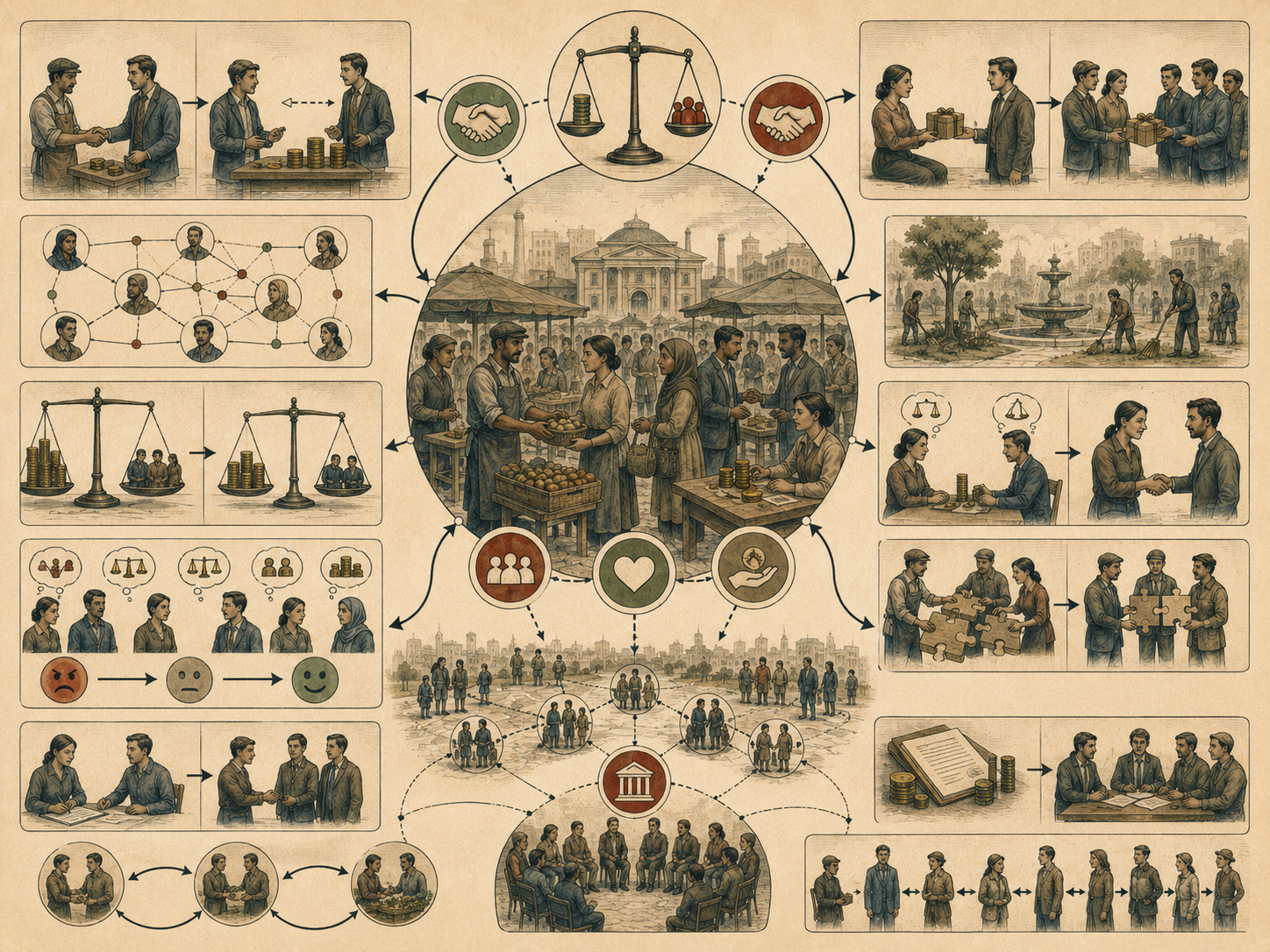
Fairness and reciprocity therefore sit at the intersection of behavioral economics, social preference theory, institutional economics, labor economics, organizational psychology, public economics, political economy, and moral philosophy. They help explain why cooperation persists even when free-riding is tempting, why contracts often rely on trust as well as enforcement, why workers respond strongly to perceived wage fairness, why consumers object to opportunistic pricing, why citizens evaluate taxation through burden sharing, and why institutions lose legitimacy when they appear arbitrary or exploitative.
The subject is especially important because fairness is not simply a moral ideal outside economics. It affects behavior inside economic systems. A policy can be efficient on paper and still fail because people regard it as unfair. A contract can be legally enforceable and still become unstable if one party feels exploited. A wage structure can align incentives but damage morale if workers perceive it as unjust. A tax rule can raise revenue but lose legitimacy if burdens appear unequally shared. In this sense, fairness and reciprocity are not decorative ethical concerns. They are part of the operating logic of markets, organizations, and institutions.
Social Preferences and Economic Behavior
Behavioral economists use the term social preferences to describe preferences in which people care not only about their own material payoff, but also about the welfare, treatment, intentions, and outcomes of others. Social preferences include fairness, reciprocity, altruism, inequality aversion, spite, guilt, shame, norm compliance, status concerns, trust, and willingness to punish behavior perceived as exploitative or uncooperative.
The social-preference perspective marks a major shift in economic analysis. It does not deny that people respond to incentives. Instead, it expands the concept of what people value. A worker may care about wages, but also whether wages are fair relative to peers and executives. A consumer may care about price, but also whether a firm is exploiting scarcity or emergencies. A taxpayer may care about personal tax burden, but also whether others are contributing and whether public benefits are visible. A bargaining partner may care about the proposed split, but also about what the offer signals regarding respect, recognition, and good faith.
This means that economic outcomes are often socially interpreted. The same material payoff can produce different behavior depending on the perceived intention behind it, the available alternatives, the reference point, the distribution of gains, and whether the process appears legitimate. A low wage may be accepted when a firm is visibly struggling, but resented when executives receive large bonuses. A price increase may be accepted when costs rise, but condemned when it appears opportunistic. A tax obligation may be tolerated when public goods are trusted, but resisted when institutions are seen as corrupt or unequal.
Fairness and reciprocity therefore help explain why markets and institutions cannot be understood as purely mechanical systems of exchange. People do not merely respond to prices, contracts, and incentives; they interpret them. These interpretations shape trust, cooperation, punishment, compliance, effort, participation, exit, and political support. Social preferences are thus not peripheral to economics. They are part of how economic systems operate in practice.
This article connects closely to Inequality Aversion in Economic Decision-Making, Trust and Cooperation in Economic Systems, Behavioral Regulation and Institutional Design, and Nudge Theory and Behavioral Public Policy. Together, these topics show how social meaning, distributive judgment, and institutional trust shape economic behavior beyond isolated payoff maximization.
What Fairness Means in Economic Interaction
Fairness in economic interaction can refer to several related but distinct ideas: equal treatment, proportional reward, procedural justice, reciprocal obligation, deserved outcome, non-exploitation, impartial rule enforcement, and legitimate burden sharing. Because fairness has multiple dimensions, people may disagree sharply about what fairness requires in a particular case. One person may view equal shares as fair; another may view reward proportional to effort as fair; another may emphasize need, vulnerability, or historic disadvantage.
Behavioral economics does not settle those philosophical disputes by itself. Its contribution is empirical and analytical: it shows that fairness judgments influence behavior in systematic ways. People may reject offers, punish defectors, support redistribution, withdraw effort, boycott firms, distrust institutions, or refuse cooperation when they perceive unfairness. Conversely, they may cooperate more, accept burdens, comply with rules, and support institutions when they perceive treatment as fair and reciprocal.
Fairness often depends on reference points. A wage cut may be judged unfair if profits are high, but acceptable if the firm faces collapse and managers share the burden. A price increase may be acceptable when input costs rise, but unfair when it exploits a temporary shortage. A tax increase may be accepted if public benefits are visible, but contested if wealthy actors appear to avoid contribution. The fairness of an outcome is therefore shaped not only by the outcome itself, but by expectations, alternatives, process, and perceived intention.
Fairness also differs from equality. Equal treatment can be unfair when circumstances differ; unequal treatment can be fair when it reflects need, contribution, risk, or repair. Similarly, people may accept inequality when it appears earned, transparent, temporary, or socially useful, while resisting inequality that appears arbitrary, inherited, discriminatory, coercive, corrupt, or exploitative. This is why fairness is closely connected to legitimacy. An institution must not only produce outcomes; it must be able to justify them.
In economic behavior, fairness serves several functions. It reduces conflict by setting expectations. It supports cooperation by reassuring participants that they will not be exploited. It stabilizes contracts by encouraging good faith. It supports institutional trust by making rules appear legitimate. It also provides a basis for punishment when norms are violated. Fairness is therefore both a moral language and a coordination mechanism.
Reciprocity, Cooperation, and Conditional Behavior
Reciprocity refers to the tendency to respond to the behavior of others with corresponding conduct. Positive reciprocity rewards generosity, cooperation, trust, or good faith. Negative reciprocity punishes unfairness, betrayal, exploitation, or opportunism. In economic behavior, reciprocity makes action conditional on how others behave and how their intentions are interpreted.
This conditionality is central. People are often willing to cooperate when they believe others are also cooperating. They are often willing to contribute to public goods when free-riding is limited or punished. They are often willing to work harder when employers treat them fairly. They are often willing to comply with rules when institutions are legitimate and others are also complying. But cooperation can unravel when people perceive exploitation, hypocrisy, arbitrary enforcement, or unequal burden.
Positive reciprocity can support durable economic relationships. A firm that treats workers well may receive loyalty, discretionary effort, and lower turnover. A supplier that behaves reliably may earn long-term business. A public agency that communicates transparently may increase voluntary compliance. A platform that resolves disputes fairly may strengthen user trust. In each case, cooperative behavior is rewarded not only through formal incentives, but through reciprocal goodwill.
Negative reciprocity is equally important. People may punish free-riders, reject unfair offers, boycott exploitative firms, expose misconduct, organize collectively, or withdraw effort when they perceive unfair treatment. Such punishment can be costly, but it helps enforce norms. Negative reciprocity is one reason unfair systems often face resistance even when individuals could gain materially by accepting the status quo.
Reciprocity therefore helps explain why cooperation is not simply a product of altruism. People may cooperate conditionally, based on whether others are perceived as cooperative. This connects reciprocity to game theory, repeated interaction, trust, social norms, and institutional design. Cooperation becomes more sustainable when reciprocal behavior is visible, defection is constrained, and institutions make fair dealing credible.
Experimental Evidence from Behavioral Economics
Experimental economics provides strong evidence that fairness and reciprocity influence economic behavior. The most widely discussed examples include ultimatum games, dictator games, trust games, public-goods games, gift-exchange games, and costly-punishment experiments. These experiments do not reproduce the full complexity of real economies, but they isolate behavioral mechanisms that matter across markets, organizations, and institutions.
The Ultimatum Game remains a foundational example. One participant proposes a division of money, and the other can accept or reject. If accepted, both receive the proposed amounts. If rejected, both receive nothing. A narrow self-interest model predicts that any positive offer should be accepted, because something is better than nothing. In practice, low offers are frequently rejected. This indicates that responders often prefer to sacrifice money rather than accept treatment they interpret as unfair or disrespectful.
The Dictator Game removes the responder’s rejection power. One participant simply chooses how much to give another. Standard self-interest predicts that dictators should keep everything. Many do not. Positive transfers suggest that some people care about fairness, altruism, moral identity, or discomfort with advantageous inequality even when punishment is impossible. The Dictator Game therefore helps separate voluntary fairness from strategic fear of rejection.
Gift-exchange experiments show that people may respond to generous treatment with greater effort. Employers who offer higher wages than necessary may receive higher effort in return, even when effort cannot be perfectly enforced. This is one of the clearest links between fairness and labor economics. It suggests that wage-setting can operate partly through reciprocal norms, not only through formal contract incentives.
Public-goods experiments show that cooperation often depends on expectations of others’ contributions and on the possibility of sanctioning free-riders. People frequently contribute more than strict self-interest predicts, but contributions can decline when free-riding is common and unpunished. Costly-punishment experiments show that individuals may pay to punish defectors, suggesting that fairness enforcement can be motivated by norm defense rather than immediate material gain.
Taken together, this evidence shows that fairness and reciprocity are not occasional moral afterthoughts. They are recurring behavioral forces. People care about how outcomes are produced, how gains are shared, whether others act in good faith, and whether violations of cooperation are punished or tolerated.
Ultimatum Games, Dictator Games, and Rejection of Unfair Offers
Ultimatum and dictator games are especially useful because they reveal different dimensions of fairness. The ultimatum game shows fairness enforcement under bargaining power. The dictator game shows voluntary distributive concern when enforcement is absent. Together, they demonstrate that fairness can matter both strategically and intrinsically.
In ultimatum games, responders often reject low offers even at a personal cost. This behavior can be interpreted as negative reciprocity: the responder punishes a proposer who has acted unfairly. It can also be interpreted as self-respect, norm enforcement, or refusal to legitimize exploitation. In any case, rejection shows that the material value of an offer is not the only thing being evaluated. The offer is also interpreted as a social act.
Proposers in ultimatum games often anticipate this response and make offers closer to equal division than a pure self-interest model would predict. This anticipation is important. It means that fairness norms shape not only the behavior of those who reject unfairness, but also the behavior of those who design offers in the first place. Markets, wages, contracts, and policies may similarly be shaped by anticipated reactions to perceived unfairness.
Dictator games reveal a different side of fairness. When recipients cannot reject, some allocators still share resources. This may reflect altruism, fairness norms, image concerns, empathy, moral identity, or discomfort with excessive advantage. The interpretation varies, but the behavior demonstrates that some people do not maximize private payoff even when they can do so without direct punishment.
These games also expose the importance of context. Offers and giving patterns can change depending on anonymity, framing, earned versus unearned endowments, group identity, cultural norms, and perceived legitimacy of the experimental setting. This variation matters because real economic interactions are always contextual. Fairness judgments depend on whether inequality is seen as earned, arbitrary, exploitative, generous, deserved, or imposed.
The broader lesson is that bargaining cannot be understood only as division of surplus. It is also a process of social recognition. Offers communicate respect, status, entitlement, and intention. When those signals violate fairness expectations, people may reject or punish even at a cost.
Gift Exchange, Public Goods, and Costly Punishment
Gift-exchange experiments show how positive reciprocity can support economic cooperation. In a typical gift-exchange setting, one party offers a wage or benefit, and the other chooses effort. Standard models may predict minimal effort when effort cannot be fully enforced. But experiments often show that generous offers can elicit higher effort, suggesting that workers or participants reciprocate fair treatment with cooperation.
This has direct implications for labor markets and organizations. Wages are not merely prices for labor. They can also signal respect, trust, and membership in a cooperative relationship. When workers perceive pay as fair, they may be more willing to contribute discretionary effort. When they perceive pay as unfair, they may reduce effort, resist management, seek exit, or withdraw trust. Fairness therefore affects productivity, not only satisfaction.
Public-goods experiments reveal the fragility and importance of cooperation. Individuals may contribute to a shared resource even when they could free-ride. However, contributions often depend on whether others are also contributing. If people perceive widespread free-riding, they may reduce their own cooperation. If free-riders can be punished, cooperation may stabilize. This pattern mirrors real public problems such as taxation, environmental protection, workplace teamwork, infrastructure maintenance, and public-health compliance.
Costly punishment is particularly important because it shows that people may spend resources to sanction unfair or uncooperative behavior. Punishment can appear irrational if evaluated only in immediate payoff terms. But it can be rational in a broader social sense: punishment enforces norms, deters future defection, expresses moral objection, and signals commitment to cooperative order. In repeated or institutional settings, such norm enforcement can support long-term cooperation.
However, punishment can also be misused. It can enforce unjust norms, target outsiders, escalate conflict, or preserve hierarchy. Behavioral economics should therefore distinguish norm enforcement that protects fairness from punishment that defends exclusion or domination. Reciprocity is powerful, but it is not automatically virtuous.
The combined evidence from gift exchange, public goods, and punishment shows that economic cooperation depends on perceived fairness, not only material incentives. Institutions that reward good faith, punish opportunism proportionately, and make cooperation visible can support more durable collective behavior.
Fairness Norms and Market Institutions
Fairness norms do not operate only in laboratory experiments. They shape market institutions. Contracts, prices, wages, platform rules, credit terms, dispute-resolution procedures, and regulatory systems all depend partly on whether participants view the rules as fair, predictable, and non-exploitative.
Contracts are a clear example. Real contracts are incomplete. They cannot specify every future contingency, every possible interpretation, or every form of good faith. For that reason, contract performance often depends on trust, reciprocity, reputation, and perceived fairness. When one party exploits loopholes or behaves opportunistically, formal compliance may coexist with relational breakdown. Fair dealing matters because contracts operate within social and institutional expectations.
Consumer markets also depend on fairness norms. People often distinguish between price increases caused by cost changes and price increases caused by opportunistic exploitation. A firm that raises prices after a disaster, shortage, or crisis may face backlash even if the price increase could be defended by supply and demand logic. Consumers evaluate whether pricing behavior violates norms of reasonable conduct.
Credit and financial markets raise similar issues. Fees, interest rates, default terms, overdraft charges, and lending practices may be legally disclosed but still perceived as unfair if they exploit information asymmetry, urgency, poverty, or lack of alternatives. Behavioral economics helps explain why formal consent is not always sufficient for legitimacy when the decision environment is unequal, complex, or coercive.
Market institutions therefore depend on more than efficiency. They require legitimacy. A market arrangement that repeatedly produces outcomes experienced as exploitative may face resistance, regulation, reputational damage, or political backlash. Fairness norms are part of what makes markets socially sustainable.
This does not mean markets must eliminate all inequality or disagreement. It means that durable market systems must maintain some credible relationship between reward, contribution, risk, transparency, and non-exploitation. When that relationship breaks down, economic actors may stop interpreting market outcomes as legitimate.
Labor Markets, Organizations, and Wage Fairness
Labor markets are one of the most important settings for fairness and reciprocity. Employment relationships involve incomplete contracts, repeated interaction, unequal bargaining power, monitoring limits, identity, status, and cooperation under uncertainty. Wages, promotions, schedules, benefits, discipline, and recognition are all interpreted through fairness norms.
Workers often compare their treatment with that of peers, managers, executives, prior expectations, and perceived contribution. A wage may be acceptable in isolation but unacceptable when similar workers earn more, when executives are rewarded despite layoffs, or when productivity gains are not shared. Wage fairness is therefore relational. It depends on comparison, justification, and institutional trust.
Reciprocity also matters. Employees may respond to fair treatment with loyalty, effort, cooperation, and knowledge sharing. They may respond to unfair treatment with withdrawal, turnover, unionization, protest, reduced effort, or strategic compliance. These responses can be economically significant. A compensation system that minimizes short-term labor costs may increase hidden costs through distrust, turnover, lower morale, and weaker cooperation.
Organizations also depend on procedural fairness. Employees may accept unfavorable outcomes more readily when processes are transparent, consistent, participatory, and respectful. Conversely, even materially favorable outcomes may fail to build trust if procedures appear arbitrary or biased. Procedural justice is therefore not merely symbolic. It shapes organizational legitimacy and cooperation.
Fairness also affects leadership. Leaders who ask for sacrifice must demonstrate shared burden and credible commitment. Workers may accept temporary wage restraint, schedule changes, or restructuring if leaders are seen as honest and reciprocal. They are less likely to accept sacrifice when executives protect their own rewards or hide information. Reciprocity requires visible mutuality.
Labor-market policy must therefore consider fairness as an economic variable. Minimum wage rules, pay transparency, collective bargaining, anti-discrimination enforcement, worker classification, platform labor regulation, and unemployment insurance all affect not only income, but perceived legitimacy and willingness to cooperate within the labor system.
Implications for Economic Governance and Public Policy
Fairness and reciprocity have major implications for public policy because people evaluate institutions through distributive and procedural judgments. Tax systems, welfare programs, environmental policies, public-health rules, labor regulations, infrastructure investments, and social insurance programs all depend on whether burdens and benefits are perceived as fairly distributed.
Tax compliance illustrates this point. People may comply not only because penalties exist, but because they believe taxation is legitimate, public goods are valuable, and others are also contributing. When wealthy actors appear to evade taxes, when public services are poor, or when tax rules are opaque, voluntary compliance may weaken. Reciprocity matters: citizens are more willing to contribute when they believe institutions and other citizens are also acting in good faith.
Environmental policy provides another example. People may support costly climate or sustainability measures when they believe burdens are shared fairly and institutions are credible. But if policies appear to impose costs on ordinary households while protecting powerful industries, support may collapse. Behavioral economics helps explain why technically efficient policies can fail when they lack distributive legitimacy.
Welfare administration is also shaped by fairness narratives. Public support for benefits depends on how recipients are framed, whether eligibility rules are perceived as fair, whether administrative burdens are dignified or punitive, and whether the system appears reciprocal across the life course. A policy may reduce poverty and still become politically vulnerable if public narratives depict it as unfair. Conversely, policies grounded in shared risk and social insurance may gain broader legitimacy.
Public-health compliance depends on similar mechanisms. People are more likely to follow rules when they trust institutions, see others complying, and believe burdens are proportionate. If rules appear arbitrary, hypocritical, or unequally enforced, compliance may decline. Fairness is therefore part of policy implementation, not merely policy justification.
The policy lesson is clear: public systems require more than incentives and information. They require credible fairness. Policies should be designed with attention to who bears costs, who receives benefits, whether procedures are transparent, whether exceptions are justified, and whether institutions are trustworthy enough to ask for cooperation.
Fairness, Distribution, and Institutional Legitimacy
Fairness connects directly to distribution and institutional legitimacy. Institutions do not merely allocate resources; they produce judgments about whose claims count, whose burdens matter, whose losses are acceptable, and whose gains are justified. When those judgments are perceived as unfair, legitimacy can weaken even if institutions remain formally legal.
Distributive fairness concerns who gets what. Procedural fairness concerns how decisions are made. Interactional fairness concerns whether people are treated with dignity, respect, and honesty. Institutional legitimacy depends on all three. A fair distribution reached through corrupt process may still be distrusted. A transparent process that produces severe unequal burden may still be contested. Respectful treatment may mitigate but not erase material injustice.
This is why fairness and reciprocity sit close to Inequality Aversion in Economic Decision-Making. People often distinguish between inequalities they regard as acceptable and inequalities they regard as arbitrary, exploitative, discriminatory, inherited, or corrupt. The legitimacy of institutions depends partly on whether the distributions they generate can be defended through shared norms.
Fairness also sustains trust. When people believe institutions apply rules consistently, distribute burdens proportionately, and respond to violation, they are more likely to cooperate. When fairness norms are violated, trust weakens and compliance becomes more costly. Institutions then rely more on surveillance, enforcement, coercion, and administrative burden, which may further erode legitimacy.
Legitimacy therefore has behavioral consequences. It affects tax compliance, labor effort, public-policy support, market participation, environmental cooperation, institutional trust, and willingness to accept temporary sacrifice. Fairness is not merely a normative evaluation after policy is complete. It is a condition of policy durability.
Public systems that ignore fairness may produce a legitimacy deficit. They may appear efficient in narrow terms while generating distrust, resistance, or withdrawal. A serious economic analysis must therefore treat fairness as part of institutional performance.
Fairness and Reciprocity in Digital Platforms
Digital platforms have made fairness and reciprocity newly urgent. Online marketplaces, gig-work systems, social-media platforms, delivery apps, financial apps, search engines, recommendation systems, and digital public-service portals all structure interaction through rules, rankings, ratings, visibility, data access, dispute systems, and algorithmic decisions. Users must decide whether these environments are fair enough to trust and participate in.
Platform fairness involves more than equal access. It includes transparent rules, explainable penalties, credible reviews, fair dispute resolution, non-discriminatory ranking, meaningful appeal, predictable moderation, reasonable fees, and protection from exploitation. A platform can create the appearance of neutral exchange while embedding asymmetric power in algorithmic systems that users cannot inspect.
Reciprocity is also central. Sellers provide quality because they expect fair ratings and dispute resolution. Buyers participate because they expect trustworthy sellers and platform protection. Drivers, creators, contractors, and gig workers continue using platforms when they believe effort is rewarded and rules are not arbitrarily changed. If platforms extract value while shifting risk downward, reciprocity weakens.
Digital platforms can also weaponize unfairness invisibly. Rating systems may discipline workers without giving them due process. Recommendation algorithms may favor incumbents or paid placement. Cancellation systems may impose friction asymmetrically. Consent flows may appear voluntary while nudging users toward disclosure. Behavioral economics should therefore distinguish fairness from the interface cues that simulate fairness.
This connects closely to Behavioral Economics and Digital Platforms and Behavioral Design in Technology Systems. Digital systems are not neutral containers for choice. They are decision environments. Their fairness depends on governance, accountability, transparency, and the distribution of power between users and platform operators.
The future of fairness and reciprocity research will increasingly involve digital institutions. As economic interaction becomes more algorithmically mediated, fairness norms must be studied not only in face-to-face bargaining, but also in platform rules, AI systems, data governance, and automated decision environments.
Power, Constraint, and Unequal Exposure to Unfairness
A serious account of fairness and reciprocity must include power. People may accept unfair outcomes not because they regard them as legitimate, but because they lack alternatives. Workers may accept unfair wages because unemployment is worse. Tenants may accept exploitative rent terms because housing supply is constrained. Borrowers may accept predatory credit because mainstream credit is unavailable. Platform workers may accept algorithmic control because exit is costly. Observed acceptance should not be confused with fairness.
This point is crucial for revealed preference. Economic behavior often reflects constraint, not endorsement. A person who accepts an unequal contract may still perceive it as unfair. A community that complies with a burdensome policy may still distrust the institution imposing it. A worker who remains in an unfair workplace may be trapped by health insurance, visa status, debt, location, family obligations, or labor-market weakness. Behavioral economics becomes more rigorous when it distinguishes preference from constrained choice.
Power also shapes whose fairness claims are heard. Powerful actors may frame their gains as earned and others’ claims as entitlement. Marginalized groups may be accused of resentment when they object to unfair treatment. Institutions may demand reciprocity from citizens, workers, or users while failing to reciprocate with accountability. Fairness cannot be understood apart from who has the authority to define it.
Reciprocity can also become unequal. Workers may be expected to show loyalty without receiving security. Citizens may be asked to comply while elites evade rules. Users may be asked to trust platforms that reserve the right to change terms unilaterally. Communities may be asked to sacrifice for public goals while powerful actors externalize costs. These asymmetries are not failures of individual psychology. They are institutional and political problems.
This does not mean fairness is merely subjective or that every grievance is justified. It means that fairness judgments must be analyzed in relation to power, history, process, and alternatives. A behaviorally serious economics cannot treat all accepted transactions as legitimate or all resistance as irrational.
The ethical task is not to make people more tolerant of unfairness. It is to design institutions that deserve cooperation because they are fair, reciprocal, transparent, and accountable.
Empirical and Policy-Evaluation Lens
A professional economist-facing treatment of fairness and reciprocity should ask what can be measured, identified, estimated, and evaluated. Fairness and reciprocity can be studied through laboratory experiments, field experiments, survey experiments, administrative data, wage data, tax compliance data, public-goods games, trust games, organizational surveys, platform metrics, dispute records, and policy rollouts.
The empirical challenge is that fairness is inferred indirectly. Researchers observe rejection, punishment, effort, compliance, giving, trust, turnover, protest, or policy support, but these behaviors can have multiple causes. A rejected offer may reflect fairness concerns, anger, strategy, identity, or distrust. A generous transfer may reflect altruism, reputation, guilt, experimenter demand, or norm compliance. A refusal to comply may reflect unfairness, confusion, material constraint, or political opposition. Careful design is necessary.
Experimental methods allow researchers to vary allocations, intentions, process transparency, earned versus unearned income, group identity, and sanction mechanisms. Field experiments can examine how changes in institutional communication, wage transparency, tax letters, platform dispute systems, or benefit administration affect cooperation and perceived fairness. Administrative data can reveal behavioral responses to policy changes, but must be interpreted alongside institutional context.
Policy evaluation should distinguish between behavioral outcomes and welfare outcomes. Increasing compliance is not automatically good if the rule is unfair. Increasing trust is not automatically good if the institution is untrustworthy. Increasing cooperation is not automatically good if cooperation sustains exploitation. A serious evaluation asks whether the intervention improves fairness, legitimacy, material welfare, and reciprocal accountability.
Heterogeneity is central. Fairness preferences vary by income, class, race, gender, occupation, cultural context, institutional experience, political ideology, bargaining power, and prior exposure to unfair treatment. A fairness intervention that works for one group may fail another. A compensation system that appears fair to managers may be perceived differently by workers. A tax rule that appears efficient to analysts may be experienced as unfair by households facing liquidity constraints.
A rigorous workflow should ask: What fairness norm is being tested? What is the reference point? What is the counterfactual? Is the outcome voluntary or constrained? Are intentions known or inferred? Who benefits from the rule? Who bears the burden? Are effects measured on behavior, welfare, trust, legitimacy, or distribution? These questions make fairness and reciprocity analytically precise rather than rhetorically vague.
An Analytical Framework for Fairness and Reciprocity
A useful starting point is to allow utility to depend not only on one’s own payoff, but also on fairness evaluation and reciprocal response. Let the utility of agent \(i\) in an interaction with agent \(j\) be:
U_i = x_i + \alpha F_i + \beta R_i
\]
Interpretation: Utility depends on material payoff, fairness valuation, and reciprocal response to the perceived behavior or intention of the other party.
Here, \(x_i\) is agent \(i\)’s material payoff, \(F_i\) represents the perceived fairness of the allocation or procedure, and \(R_i\) captures reciprocal response to the other party’s behavior. Parameters \(\alpha\) and \(\beta\) measure the strength of fairness and reciprocity in the utility function. This simple formulation shows why two materially identical outcomes may produce different behavior if one is interpreted as fair and the other as exploitative.
Rabin’s fairness-equilibrium framework formalizes the idea that intentions matter in strategic interaction. A player does not evaluate only the other player’s action, but whether that action is kind or hostile relative to feasible alternatives. In simplified terms, reciprocal utility may be written as:
U_i = \pi_i + \theta_i K_i K_j
\]
Interpretation: Utility includes material payoff and a reciprocity term based on how kindly each player treats the other.
Here, \(\pi_i\) is material payoff, \(K_j\) reflects the perceived kindness of the other player toward agent \(i\), \(K_i\) reflects agent \(i\)’s reciprocal response, and \(\theta_i\) measures the importance of reciprocity. The model helps explain why people may reward generosity or punish selfishness even when doing so is costly.
Fehr and Schmidt’s inequality-aversion model can be interpreted as part of this broader social-preference structure. In simplified two-person form, utility is:
U_i = x_i – \alpha_i\max(x_j – x_i, 0) – \beta_i\max(x_i – x_j, 0)
\]
Interpretation: Utility falls when the other person receives more, and may also fall when the individual receives much more than the other person.
Here, \(\alpha_i\) captures aversion to disadvantageous inequality and \(\beta_i\) captures aversion to advantageous inequality. This model helps explain why low offers are rejected and why unequal outcomes may be evaluated negatively even when one’s own payoff rises.
For public-goods and cooperation settings, reciprocity can be modeled through conditional contribution. Let the contribution of person \(i\) be:
c_i = c_0 + \gamma E_i(c_{-i}) + \delta T_i – \lambda P_i
\]
Interpretation: Contribution depends on baseline willingness, expected contributions by others, trust, and perceived unfair burden.
Here, \(E_i(c_{-i})\) is the expected contribution of others, \(T_i\) is institutional or interpersonal trust, and \(P_i\) is perceived unfairness or disproportionate burden. Cooperation rises when people expect others to cooperate and trust institutions, but falls when they perceive unequal burden or exploitation.
For policy evaluation, the effect of a fairness or reciprocity intervention can be expressed as:
\tau = E[Y_i(1) – Y_i(0)]
\]
Interpretation: The treatment effect compares behavior, welfare, trust, cooperation, or legitimacy under a fairness intervention with the counterfactual condition.
A broader welfare function should account for material payoff, fairness, reciprocity, cooperation, and legitimacy:
W = \sum_i x_i + \phi F + \psi R + \omega C – \kappa E
\]
Interpretation: Welfare depends on material output, perceived fairness, reciprocal cooperation, collective contribution, and enforcement or conflict cost.
This framework prevents a narrow reading of fairness as merely a psychological preference. Fairness and reciprocity affect cooperation, enforcement costs, institutional trust, and the stability of economic systems.
R Workflow: Bargaining, Fairness Sensitivity, and Reciprocal Rejection
The following R workflow simulates bargaining interactions in which agents differ in fairness sensitivity, reciprocity sensitivity, and willingness to reject unfair treatment. It is designed as a reproducible scaffold for economists, policy researchers, and organizational analysts studying bargaining, labor negotiations, contract fairness, or policy legitimacy.
# Fairness and Reciprocity in Economic Behavior
# R workflow: bargaining, fairness sensitivity, and reciprocal rejection
# Synthetic data only. Economist-facing research scaffold.

set.seed(1001)

n_agents <- 3000
n_rounds <- 7000

agents <- data.frame(
  id = 1:n_agents,
  fairness_sensitivity = pmin(pmax(rnorm(n_agents, mean = 1.2, sd = 0.4), 0), 3),
  reciprocity_sensitivity = pmin(pmax(rnorm(n_agents, mean = 1.0, sd = 0.35), 0), 3),
  trust = pmin(pmax(rnorm(n_agents, mean = 0.55, sd = 0.20), 0), 1),
  punishment_willingness = pmin(pmax(rnorm(n_agents, mean = 0.45, sd = 0.18), 0), 1),
  process_fairness_weight = pmin(pmax(rnorm(n_agents, mean = 0.55, sd = 0.18), 0), 1)
)

utility_from_offer <- function(offer_to_responder, fairness_sensitivity, process_fairness) {
  responder_share <- offer_to_responder
  proposer_share <- 1 - offer_to_responder
  inequality_penalty <- fairness_sensitivity * max(proposer_share - responder_share, 0)

  responder_share - inequality_penalty + 0.25 * process_fairness
}

history <- vector("list", n_rounds)

for (t in seq_len(n_rounds)) {
  pair_ids <- sample(agents$id, 2, replace = FALSE)

  proposer <- agents[agents$id == pair_ids[1], ]
  responder <- agents[agents$id == pair_ids[2], ]

  process_fairness <- runif(1, min = 0.30, max = 0.90)
  candidate_offers <- seq(0.05, 0.95, by = 0.05)

  proposer_scores <- sapply(candidate_offers, function(offer) {
    proposer_share <- 1 - offer

    expected_acceptance <- plogis(
      5 * (offer - 0.30) -
        responder$fairness_sensitivity +
        responder$trust +
        process_fairness
    )

    reciprocity_bonus <- proposer$reciprocity_sensitivity * offer * process_fairness

    proposer_share * expected_acceptance + 0.10 * reciprocity_bonus
  })

  chosen_offer <- candidate_offers[which.max(proposer_scores)]

  responder_utility <- utility_from_offer(
    offer_to_responder = chosen_offer,
    fairness_sensitivity = responder$fairness_sensitivity,
    process_fairness = process_fairness
  )

  accepted <- as.integer(responder_utility >= 0)

  punishment_probability <- plogis(
    responder$punishment_willingness * 2.0 -
      chosen_offer * 4.0 -
      process_fairness
  )

  punished <- ifelse(
    accepted == 0,
    rbinom(1, 1, punishment_probability),
    0
  )

  total_welfare <- accepted * 1.0 -
    punished * 0.15 +
    process_fairness * 0.20 -
    abs(0.50 - chosen_offer) * 0.30

  history[[t]] <- data.frame(
    round = t,
    proposer_id = proposer$id,
    responder_id = responder$id,
    offer_to_responder = chosen_offer,
    proposer_share = 1 - chosen_offer,
    accepted = accepted,
    punished = punished,
    process_fairness = process_fairness,
    responder_utility = responder_utility,
    total_welfare = total_welfare,
    responder_fairness_sensitivity = responder$fairness_sensitivity,
    responder_reciprocity_sensitivity = responder$reciprocity_sensitivity,
    responder_trust = responder$trust,
    responder_punishment_willingness = responder$punishment_willingness
  )
}

bargaining <- do.call(rbind, history)

summary_stats <- data.frame(
  mean_offer = mean(bargaining$offer_to_responder),
  median_offer = median(bargaining$offer_to_responder),
  acceptance_rate = mean(bargaining$accepted),
  rejection_rate = 1 - mean(bargaining$accepted),
  punishment_rate = mean(bargaining$punished),
  mean_total_welfare = mean(bargaining$total_welfare)
)

print(summary_stats)

bargaining$fairness_quartile <- cut(
  bargaining$responder_fairness_sensitivity,
  breaks = quantile(bargaining$responder_fairness_sensitivity, probs = seq(0, 1, 0.25)),
  include.lowest = TRUE,
  labels = paste0("Q", 1:4)
)

fairness_summary <- aggregate(
  cbind(accepted, punished, total_welfare, offer_to_responder) ~ fairness_quartile,
  data = bargaining,
  FUN = mean
)

fairness_summary$rejection_rate <- 1 - fairness_summary$accepted
print(fairness_summary)

dir.create("outputs/tables", recursive = TRUE, showWarnings = FALSE)
write.csv(bargaining, "outputs/tables/r_fairness_reciprocity_bargaining_history.csv", row.names = FALSE)
write.csv(summary_stats, "outputs/tables/r_fairness_reciprocity_bargaining_summary.csv", row.names = FALSE)
write.csv(fairness_summary, "outputs/tables/r_fairness_reciprocity_quartile_summary.csv", row.names = FALSE)
This workflow highlights how fairness sensitivity and process fairness can change acceptance, rejection, punishment, and welfare. It also shows why fairness analysis should not be limited to final distributions. The process by which an offer is made can shape whether the same material allocation is interpreted as legitimate or exploitative.
Python Workflow: Comparing Fairness Regimes in Economic Interaction
The following Python workflow compares stylized fairness regimes under heterogeneous social preferences. It includes cooperative, unequal-but-cooperative, unequal-and-noncooperative, and exploitative regimes. The workflow produces regime summaries, subgroup summaries, and a synthetic experiment-style dataset suitable for treatment-effect estimation.
# Fairness and Reciprocity in Economic Behavior
# Python workflow: fairness regimes, reciprocity, treatment effects, and welfare
# Synthetic data only. Economist-facing research scaffold.

from __future__ import annotations

from pathlib import Path

import numpy as np
import pandas as pd

rng = np.random.default_rng(1001)

n = 9000

agents = pd.DataFrame({
    "agent_id": np.arange(1, n + 1),
    "fairness_sensitivity": np.clip(rng.normal(1.2, 0.4, n), 0, 3),
    "reciprocity_sensitivity": np.clip(rng.normal(1.0, 0.35, n), 0, 3),
    "trust": np.clip(rng.normal(0.55, 0.20, n), 0, 1),
    "punishment_willingness": np.clip(rng.normal(0.45, 0.18, n), 0, 1),
    "process_fairness_weight": np.clip(rng.normal(0.55, 0.18, n), 0, 1),
})

def utility_from_allocation(
    self_payoff: np.ndarray,
    other_payoff: np.ndarray,
    fairness_sensitivity: np.ndarray,
    reciprocity_sensitivity: np.ndarray,
    reciprocity_signal: float,
    process_fairness: float
) -> np.ndarray:
    """Compute fairness- and reciprocity-adjusted utility."""
    disadvantage_penalty = fairness_sensitivity * np.maximum(other_payoff - self_payoff, 0)
    reciprocity_component = reciprocity_sensitivity * reciprocity_signal
    process_component = 0.30 * process_fairness

    return self_payoff - disadvantage_penalty + reciprocity_component + process_component

def evaluate_regime(
    df: pd.DataFrame,
    self_payoff: float,
    other_payoff: float,
    reciprocity_signal: float,
    process_fairness: float
) -> dict[str, float]:
    """Evaluate a stylized fairness regime."""
    utility = utility_from_allocation(
        self_payoff=np.repeat(self_payoff, len(df)),
        other_payoff=np.repeat(other_payoff, len(df)),
        fairness_sensitivity=df["fairness_sensitivity"].to_numpy(),
        reciprocity_sensitivity=df["reciprocity_sensitivity"].to_numpy(),
        reciprocity_signal=reciprocity_signal,
        process_fairness=process_fairness,
    )

    rejection_prob = 1 / (
        1 + np.exp(-(
            -0.5
            + df["fairness_sensitivity"].to_numpy() * np.maximum(other_payoff - self_payoff, 0) * 2.0
            - process_fairness
            - 0.4 * df["trust"].to_numpy()
        ))
    )

    rejected = rng.binomial(1, rejection_prob)

    punishment_prob = 1 / (
        1 + np.exp(-(
            df["punishment_willingness"].to_numpy() * 2.0
            - process_fairness
            - self_payoff
        ))
    )

    punished = rng.binomial(1, punishment_prob) * rejected

    total_welfare = (
        utility
        + 0.25 * process_fairness
        - 0.20 * rejected
        - 0.10 * punished
    )

    return {
        "mean_utility": float(utility.mean()),
        "share_negative_utility": float((utility < 0).mean()),
        "rejection_rate": float(rejected.mean()),
        "punishment_rate": float(punished.mean()),
        "mean_total_welfare": float(total_welfare.mean()),
        "mean_process_fairness": process_fairness,
    }

regimes = {
    "fair_cooperative_regime": {
        "self_payoff": 0.50,
        "other_payoff": 0.50,
        "reciprocity_signal": 0.40,
        "process_fairness": 0.85
    },
    "unequal_but_cooperative_regime": {
        "self_payoff": 0.35,
        "other_payoff": 0.65,
        "reciprocity_signal": 0.40,
        "process_fairness": 0.70
    },
    "unequal_noncooperative_regime": {
        "self_payoff": 0.35,
        "other_payoff": 0.65,
        "reciprocity_signal": -0.20,
        "process_fairness": 0.45
    },
    "exploitative_low_process_fairness_regime": {
        "self_payoff": 0.25,
        "other_payoff": 0.75,
        "reciprocity_signal": -0.35,
        "process_fairness": 0.25
    }
}

rows = []

for name, params in regimes.items():
    out = evaluate_regime(agents, **params)
    out["regime"] = name
    rows.append(out)

results = pd.DataFrame(rows)[[
    "regime",
    "mean_utility",
    "share_negative_utility",
    "rejection_rate",
    "punishment_rate",
    "mean_total_welfare",
    "mean_process_fairness"
]]

print(results.sort_values("mean_total_welfare", ascending=False))

agents["fairness_group"] = pd.qcut(
    agents["fairness_sensitivity"],
    4,
    labels=["low", "medium", "high", "very_high"]
)

distribution_rows = []

for name, params in regimes.items():
    for group in agents["fairness_group"].unique():
        subset = agents.loc[agents["fairness_group"] == group].copy()
        out = evaluate_regime(subset, **params)
        out["regime"] = name
        out["fairness_group"] = str(group)
        distribution_rows.append(out)

distribution = pd.DataFrame(distribution_rows)
print(distribution.sort_values(["regime", "fairness_group"]))

experimental = agents.copy()
experimental["assigned_regime"] = rng.choice(
    ["fair_cooperative_regime", "unequal_but_cooperative_regime", "unequal_noncooperative_regime"],
    size=len(experimental),
    p=[0.34, 0.33, 0.33]
)

regime_lookup = {
    "fair_cooperative_regime": (0.50, 0.50, 0.40, 0.85),
    "unequal_but_cooperative_regime": (0.35, 0.65, 0.40, 0.70),
    "unequal_noncooperative_regime": (0.35, 0.65, -0.20, 0.45),
}

outcome_rows = []

for _, row in experimental.iterrows():
    self_payoff, other_payoff, reciprocity_signal, process_fairness = regime_lookup[row["assigned_regime"]]
    utility = utility_from_allocation(
        np.array([self_payoff]),
        np.array([other_payoff]),
        np.array([row["fairness_sensitivity"]]),
        np.array([row["reciprocity_sensitivity"]]),
        reciprocity_signal,
        process_fairness
    )[0]

    outcome_rows.append({
        "self_payoff": self_payoff,
        "other_payoff": other_payoff,
        "reciprocity_signal": reciprocity_signal,
        "process_fairness": process_fairness,
        "fairness_reciprocity_utility": utility,
    })

experimental = pd.concat([experimental, pd.DataFrame(outcome_rows)], axis=1)

experimental["unequal_cooperative_treat"] = (
    experimental["assigned_regime"] == "unequal_but_cooperative_regime"
).astype(int)

experimental["unequal_noncooperative_treat"] = (
    experimental["assigned_regime"] == "unequal_noncooperative_regime"
).astype(int)

try:
    import statsmodels.api as sm

    X = experimental[[
        "unequal_cooperative_treat",
        "unequal_noncooperative_treat",
        "fairness_sensitivity",
        "reciprocity_sensitivity",
        "trust",
        "punishment_willingness",
        "process_fairness_weight"
    ]]
    X = sm.add_constant(X)

    model = sm.OLS(experimental["fairness_reciprocity_utility"], X).fit(cov_type="HC1")
    print(model.summary().tables[1])

except ImportError:
    print("statsmodels is not installed; skipping regression table.")

output_dir = Path("outputs/tables")
output_dir.mkdir(parents=True, exist_ok=True)

results.to_csv(output_dir / "fairness_reciprocity_regime_summary.csv", index=False)
distribution.to_csv(output_dir / "fairness_reciprocity_distributional_summary.csv", index=False)
experimental.to_csv(output_dir / "synthetic_fairness_reciprocity_experiment.csv", index=False)
For analysts and policymakers, the value of this comparison is that it shows how fairness and reciprocal interpretation can materially alter welfare rankings across institutional environments. A formally similar material allocation may be experienced very differently depending on process fairness, reciprocity, trust, and whether the other party appears cooperative or exploitative.
Stata Replication Note: Fairness and Reciprocity Policy Evaluation
For an economist-facing repository, the companion code should support Stata as well as R and Python. The article-level GitHub folder should include a Stata workflow that imports the synthetic experiment dataset, estimates treatment effects, reports robust standard errors, and exports regression tables. A compact Stata pattern for this article would look like this:
clear all
set more off

* Fairness and Reciprocity in Economic Behavior
* Stata policy-evaluation scaffold using synthetic data.

global ROOT "`c(pwd)'"
global TABLES "$ROOT/outputs/tables"
global REG "$ROOT/outputs/regression_tables"

capture mkdir "$REG"

import delimited "$TABLES/synthetic_fairness_reciprocity_experiment.csv", clear varnames(1)

label variable unequal_cooperative_treat "Unequal but cooperative treatment"
label variable unequal_noncooperative_treat "Unequal noncooperative treatment"
label variable fairness_reciprocity_utility "Fairness and reciprocity utility"

local controls fairness_sensitivity reciprocity_sensitivity trust punishment_willingness process_fairness_weight
local outcomes fairness_reciprocity_utility self_payoff other_payoff process_fairness reciprocity_signal

tempname handle
postfile `handle' str50 outcome str50 term double estimate double std_error double p_value double n using "$REG/stata_fairness_reciprocity_estimates.dta", replace

foreach y of local outcomes {
    regress `y' unequal_cooperative_treat unequal_noncooperative_treat `controls', vce(robust)

    foreach x in unequal_cooperative_treat unequal_noncooperative_treat {
        local b = _b[`x']
        local se = _se[`x']
        local p = 2 * ttail(e(df_r), abs(_b[`x'] / _se[`x']))
        local n = e(N)
        post `handle' ("`y'") ("`x'") (`b') (`se') (`p') (`n')
    }
}

postclose `handle'

use "$REG/stata_fairness_reciprocity_estimates.dta", clear
export delimited using "$REG/stata_fairness_reciprocity_estimates.csv", replace

display "Stata fairness and reciprocity policy-evaluation workflow complete."
The purpose of including Stata is to make the repository useful to economists, policy analysts, and graduate-level applied researchers who commonly work across Stata, R, and Python. The full repository scaffold should also include identification notes, robustness plans, replication instructions, synthetic bargaining data, treatment-effect estimation, distributional summaries, and sensitivity tests for assumptions about fairness sensitivity, reciprocity sensitivity, trust, punishment willingness, process fairness, and welfare.
GitHub Repository
The companion repository provides reproducible scaffolding for the computational side of this article, including synthetic fairness-and-reciprocity datasets, bargaining simulations, social-preference utility functions, treatment-effect estimation, welfare analysis, distributional summaries, robustness checks, Stata/R/Python workflows, SQL metadata structures, and scientific-computing examples for behavioral economics research.
Complete Code Repository
This article is supported by an article-level folder in the Behavioral Economics computational repository, with synthetic panel and experiment-style datasets, causal-inference workflows, welfare analysis, econometric identification notes, policy-evaluation scripts, robustness and sensitivity checks, Stata/R/Python workflows, SQL metadata structures, and scientific-computing examples for studying fairness, reciprocity, social preferences, bargaining, rejection, punishment, trust, process legitimacy, wage fairness, institutional compliance, and behavioral governance.
Interpretive Limits and Cautions
Fairness and reciprocity are powerful concepts, but they can be misused if treated as simple or universally agreed-upon. People do not all share the same fairness standard. Some emphasize equality, others proportionality, others need, others effort, others reciprocity, others legal entitlement, and others historical repair. A serious account must therefore specify which fairness norm is being invoked and whose perspective is being centered.
There is also a risk of psychologizing structural conflict. If workers, consumers, tenants, borrowers, or citizens object to unfairness, the objection should not automatically be reduced to bias, resentment, or emotional overreaction. It may be a rational response to unequal power, weak alternatives, institutional capture, exploitation, discrimination, or lack of accountability. Behavioral economics should not be used to make unfair systems more tolerable. It should help identify when economic systems fail to earn cooperation.
Experimental evidence also has limits. Ultimatum games and public-goods games clarify mechanisms, but real institutions involve law, history, race, class, gender, property rights, labor power, political institutions, and administrative systems. Laboratory findings should therefore be interpreted alongside institutional analysis. A fairness model without power can become too abstract; a power analysis without behavioral evidence can miss how people actually respond to norms and expectations.
Reciprocity is also ambivalent. Positive reciprocity can sustain cooperation, but it can also preserve exclusionary in-group norms. Negative reciprocity can punish exploitation, but it can also escalate retaliation or enforce unjust standards. Fairness norms can support justice, but they can also be manipulated through framing, identity, or selective narratives about deservingness. Behavioral economics must therefore be connected to ethical and institutional judgment.
Finally, fairness should not be confused with mere perception management. Institutions sometimes attempt to appear fair while preserving unequal or exploitative arrangements. The goal should not be to design better fairness signals for unfair systems. The goal should be to build institutions whose procedures, distributions, and reciprocal obligations are substantively defensible.
Conclusion
Fairness and reciprocity reveal that economic behavior is not governed solely by isolated self-interest. People evaluate outcomes through distributive, procedural, relational, and moral lenses. They ask whether gains are shared equitably, whether burdens are proportionate, whether others have acted cooperatively or exploitatively, whether institutions are trustworthy, and whether rules are applied with legitimacy. These judgments shape bargaining, trust, compliance, punishment, labor effort, market participation, and public-policy support.
Behavioral economics matters here because it gives these social preferences analytical and empirical standing. It shows that fairness is not a vague moral add-on to otherwise self-contained markets. It is part of how markets, organizations, and institutions actually function. Economic systems depend on incentives, but also on whether people believe cooperation will be reciprocated and unfairness will not be rewarded.
The mature lesson is not that people are always fair, always cooperative, or always morally consistent. They are not. Fairness standards differ, reciprocity can be selective, and institutions can manipulate social expectations. The stronger lesson is that economic systems require legitimacy as well as efficiency. When fairness and reciprocity are violated, cooperation becomes fragile, enforcement becomes more costly, and institutions lose the trust they need to function.
In that sense, fairness and reciprocity are among the clearest examples of how behavioral economics expands economics beyond narrow payoff maximization toward a fuller account of social preferences, institutional trust, distributive legitimacy, and the conditions under which people cooperate in shared economic life.
Related Articles
- Behavioral Economics
- Inequality Aversion in Economic Decision-Making
- Trust and Cooperation in Economic Systems
- Behavioral Regulation and Institutional Design
- Choice Architecture and Decision Environments
- Nudge Theory and Behavioral Public Policy
- Loss Aversion and Risk Perception
- Framing Effects and Consumer Choice
- Behavioral Economics and Organizational Decision-Making
- Behavioral Economics and Digital Platforms
Further Reading
- Bolton, G.E. and Ockenfels, A. (2000) ‘ERC: A theory of equity, reciprocity, and competition’, American Economic Review, 90(1), pp. 166–193. Available at: https://www.aeaweb.org/articles?id=10.1257/aer.90.1.166.
- Bowles, S. and Gintis, H. (2011) A Cooperative Species: Human Reciprocity and Its Evolution. Princeton, NJ: Princeton University Press. Available at: https://press.princeton.edu/books/hardcover/9780691151250/a-cooperative-species.
- Camerer, C.F. (2003) Behavioral Game Theory: Experiments in Strategic Interaction. Princeton, NJ: Princeton University Press. Available at: https://press.princeton.edu/books/paperback/9780691090399/behavioral-game-theory.
- Fehr, E. and Gächter, S. (2000) ‘Cooperation and punishment in public goods experiments’, American Economic Review, 90(4), pp. 980–994. Available at: https://www.aeaweb.org/articles?id=10.1257/aer.90.4.980.
- Fehr, E. and Schmidt, K.M. (1999) ‘A theory of fairness, competition, and cooperation’, Quarterly Journal of Economics, 114(3), pp. 817–868. Available at: https://academic.oup.com/qje/article-abstract/114/3/817/1848113.
- Kahneman, D., Knetsch, J.L. and Thaler, R.H. (1986) ‘Fairness and the assumptions of economics’, Journal of Business, 59(4), pp. S285–S300. Available at: https://www.jstor.org/stable/2352761.
- Ostrom, E. (1990) Governing the Commons: The Evolution of Institutions for Collective Action. Cambridge: Cambridge University Press. Available at: https://www.cambridge.org/core/books/governing-the-commons/7AB7AE11BADA84409C34815CC288CD79.
- Rabin, M. (1993) ‘Incorporating fairness into game theory and economics’, American Economic Review, 83(5), pp. 1281–1302. Available at: https://www.jstor.org/stable/2117561.
References
- Berg, J., Dickhaut, J. and McCabe, K. (1995) ‘Trust, reciprocity, and social history’, Games and Economic Behavior, 10(1), pp. 122–142. Available at: https://www.sciencedirect.com/science/article/pii/S0899825685710275.
- Bolton, G.E. and Ockenfels, A. (2000) ‘ERC: A theory of equity, reciprocity, and competition’, American Economic Review, 90(1), pp. 166–193. Available at: https://www.aeaweb.org/articles?id=10.1257/aer.90.1.166.
- Bowles, S. and Gintis, H. (2011) A Cooperative Species: Human Reciprocity and Its Evolution. Princeton, NJ: Princeton University Press. Available at: https://press.princeton.edu/books/hardcover/9780691151250/a-cooperative-species.
- Camerer, C.F. (2003) Behavioral Game Theory: Experiments in Strategic Interaction. Princeton, NJ: Princeton University Press. Available at: https://press.princeton.edu/books/paperback/9780691090399/behavioral-game-theory.
- Fehr, E. and Gächter, S. (2000) ‘Cooperation and punishment in public goods experiments’, American Economic Review, 90(4), pp. 980–994. Available at: https://www.aeaweb.org/articles?id=10.1257/aer.90.4.980.
- Fehr, E. and Schmidt, K.M. (1999) ‘A theory of fairness, competition, and cooperation’, Quarterly Journal of Economics, 114(3), pp. 817–868. Available at: https://academic.oup.com/qje/article-abstract/114/3/817/1848113.
- Kahneman, D., Knetsch, J.L. and Thaler, R.H. (1986) ‘Fairness and the assumptions of economics’, Journal of Business, 59(4), pp. S285–S300. Available at: https://www.jstor.org/stable/2352761.
- Ostrom, E. (1990) Governing the Commons: The Evolution of Institutions for Collective Action. Cambridge: Cambridge University Press. Available at: https://www.cambridge.org/core/books/governing-the-commons/7AB7AE11BADA84409C34815CC288CD79.
- Rabin, M. (1993) ‘Incorporating fairness into game theory and economics’, American Economic Review, 83(5), pp. 1281–1302. Available at: https://www.jstor.org/stable/2117561.