
Last Updated May 20, 2026
Cognitive load refers to the amount of mental effort required to process information within the limits of working memory. In cognitive psychology, cognitive load theory provides a framework for understanding how the structure, organization, sequence, and presentation of information shape learning, reasoning, decision making, interface use, and performance. Because working memory capacity is constrained, cognition does not fail only when information is absent. It also fails when too much must be processed at once, when irrelevant demands consume scarce resources, or when complexity is presented in a form the mind cannot efficiently organize.
Cognitive load emerges from the interaction of core cognitive systems. Attention determines what enters the system. Working memory maintains and manipulates what has been selected. Memory provides the prior knowledge that can make new information easier or harder to process. Cognitive learning depends on whether new information can be integrated into usable schemas rather than merely encountered.
From this perspective, cognitive load is not simply a feature of classroom learning. It is a broader property of cognition under limitation. It helps define the boundaries within which reasoning, problem solving, decision making, and human-computer interaction occur. Research associated with John Sweller and later developments in cognitive load theory made clear that understanding mental effort is essential for designing systems that align with human cognitive architecture rather than overburden it.
Main Library
Publications
Article Map
Cognitive Psychology
Related Topic
Behavioral Economics
Related Topic
Artificial Intelligence Systems
Related Topic
Data Systems & Analytics
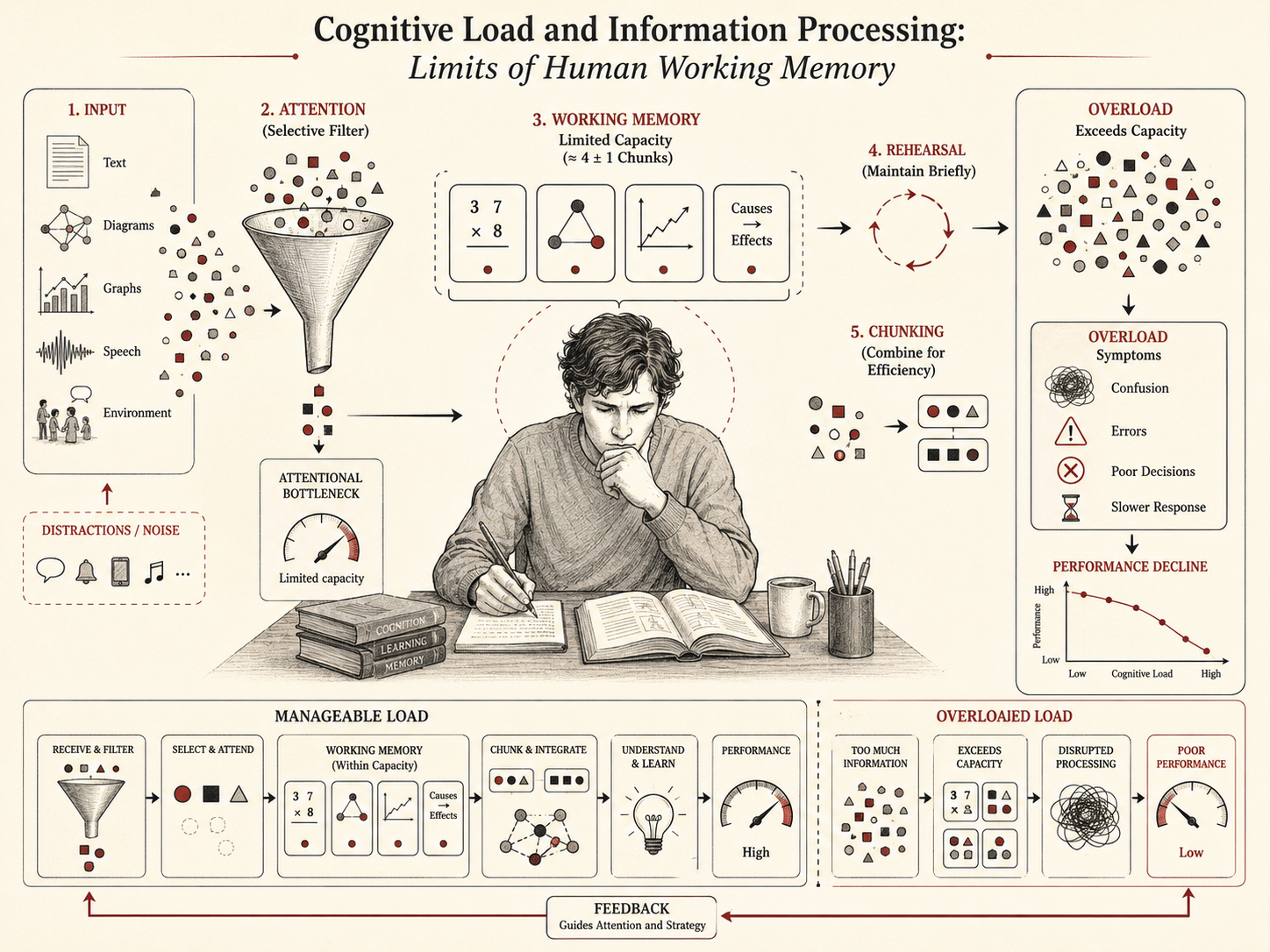
Cognitive load reflects the limits of working memory and shapes how effectively information can be processed, understood, learned, transferred, and applied. The central issue is not whether a task is difficult in some general sense. The central issue is whether the demands imposed by a task are aligned with the cognitive resources available to the learner, user, worker, analyst, clinician, or decision maker.
What is cognitive load?
Cognitive load refers to the mental resources required to process and maintain information within working memory. Because working memory can only hold and manipulate a limited amount at any given moment, the demands imposed by a task must remain within those limits if cognition is to proceed efficiently.
Cognitive load theory, originally associated with John Sweller, explains how the structure and presentation of information influence performance. When information is aligned with prior knowledge and organized in a way the mind can handle, it can be processed effectively. When information is overly complex, poorly ordered, redundant, split across disconnected sources, or cluttered with unnecessary demands, working memory becomes overloaded and comprehension begins to break down.
Cognitive load therefore describes the balance between task demand and cognitive capacity. It helps explain why some material feels manageable while other material, even when objectively learnable, becomes difficult because too much must be processed at once.
The concept also clarifies why effort alone is not the same as good learning. Some effort is productive because it supports schema construction, conceptual integration, transfer, and durable understanding. Other effort is wasted because it is consumed by poor layout, irrelevant detail, unnecessary search, confusing terminology, poorly sequenced steps, or institutional procedures that force people to perform avoidable cognitive work.
In this sense, cognitive load is both a psychological concept and a design concept. It tells us something about the mind, but it also tells us something about the environments that minds are forced to navigate.
Cognitive load as a system constraint
Cognitive load is best understood as a constraint imposed by cognitive architecture. It is not merely a vague feeling of difficulty. It is a consequence of how information-processing systems are organized.
Working memory has limited capacity. Attention can only select and maintain a subset of available information. Long-term memory can store richly structured schemas that reduce burden once learning has occurred, but when such structure is absent, novel material must be coordinated under severe limits. These constraints shape how information flows through the system.
As a result, cognitive load affects not only learning but also reasoning, decision making, problem solving, interface use, communication, and organizational work. When demands exceed capacity, performance deteriorates, errors increase, response times lengthen, frustration rises, and individuals become more reliant on simplified strategies such as heuristics. Under sufficient overload, they may also become more vulnerable to cognitive biases, not because reasoning disappears, but because the conditions for careful reasoning are no longer fully available.
This is why cognitive load is central to understanding cognition under real conditions rather than idealized conditions. People do not reason in a vacuum. They reason under time pressure, interruption, uncertainty, fatigue, interface friction, information clutter, unfamiliar terminology, institutional requirements, and unequal access to prior knowledge.
Cognitive load theory helps translate these conditions into a researchable problem: how does the relationship between demand, capacity, prior knowledge, and design shape human performance?
Working memory and processing limits
The concept of cognitive load is directly tied to working memory, the temporary workspace of cognition. Working memory allows individuals to hold and manipulate information during tasks such as reasoning, comprehension, analysis, planning, calculation, diagnosis, comparison, and problem solving. But that workspace is small.
Many discussions of cognitive load theory rely on the broader principle that working memory is sharply limited for novel information, while long-term memory can store richly structured schemas that reduce burden once learning has occurred. This distinction is essential. A novice may need to process many separate elements because they have not yet organized them into meaningful units. An expert may process the same situation more efficiently because long-term memory supplies schemas that reduce working-memory burden.
This explains why prior knowledge matters so much. Prior knowledge does not simply add more facts to the mind. It changes the effective load imposed by a task. A diagram that overwhelms a novice may be immediately meaningful to an expert. A worked example that helps a beginner may become redundant for an advanced learner. A formula may be a burden until the learner understands what its parts represent.
Because of this limitation, the organization of information matters greatly. Well-structured material can be processed more efficiently because it reduces unnecessary search, comparison, and coordination demands. Poorly structured material imposes heavier burdens because the learner or decision maker must do more of the organizing work internally.
Cognitive load therefore turns working memory from a static capacity concept into a design problem. If working memory is limited, then the structure of materials, interfaces, tasks, and institutions matters.
Types of cognitive load
Cognitive load theory traditionally distinguishes three major forms of mental effort:
- Intrinsic load — the inherent complexity of the material, especially the degree to which its elements must be processed together.
- Extraneous load — unnecessary effort created by poor presentation, bad design, irrelevant demands, split attention, redundancy, clutter, or unclear sequencing.
- Germane processing — productive effort directed toward schema construction, integration, understanding, transfer, and learning.
This distinction matters because not all cognitive effort is undesirable. Some mental effort is the very point of learning. If a learner is comparing examples, testing explanations, integrating concepts, retrieving knowledge, or building a more coherent mental model, that effort can be valuable. The problem is not effort itself. The problem is effort spent on work that does not contribute to understanding.
Intrinsic load depends partly on element interactivity. A task with many independent pieces may be manageable if each can be processed separately. A task with fewer but tightly interacting pieces may be difficult because the learner must coordinate several relations simultaneously. For example, solving a physics problem may require understanding force, mass, acceleration, direction, units, diagram interpretation, and algebraic transformation together rather than separately.
Extraneous load depends heavily on design. A cluttered diagram, poorly labeled interface, separated text and figure, redundant narration, ambiguous instruction, or multi-step administrative form can force users to spend working-memory resources on unnecessary coordination rather than the core task.
Germane processing is the effort that supports learning. It includes forming schemas, comparing examples, recognizing patterns, elaborating explanations, and integrating new material with prior knowledge. Good design does not eliminate germane processing. It protects it from being crowded out by avoidable burden.
Formalizing cognitive load: capacity, demand, and performance
Cognitive load can be expressed formally as the relation between task demand and available capacity. Let total available working-memory resources be \(C\), and let total task demand be the sum of intrinsic, extraneous, and germane demands:
L_{\text{total}}=L_i+L_e+L_g
\]
Interpretation: Total load combines intrinsic load \(L_i\), extraneous load \(L_e\), and germane processing \(L_g\).
Efficient cognition requires that total demand remain within available capacity:
L_{\text{total}}\leq C
\]
Interpretation: When cognitive demand exceeds available capacity, overload becomes more likely.
One can also represent the probability of successful task performance as a function of the gap between capacity and total load:
Pr(\text{success})=\frac{1}{1+e^{-(\beta_0+\beta_1(C-L_{\text{total}}))}}
\]
Interpretation: Success depends not on task difficulty alone, but on the relation between available capacity and total cognitive demand.
Intrinsic load can be represented in terms of element interactivity. If a task contains \(n\) elements, but only \(k\) of them must be coordinated simultaneously, then effective load depends more on \(k\) than on \(n\) alone:
L_i\propto k
\]
Interpretation: Intrinsic load rises with the number of interacting elements that must be processed together.
Extraneous load can be represented as excess demand introduced by presentation format:
L_e=f(d)
\]
Interpretation: Extraneous load is a function of design inefficiencies \(d\), such as split attention, redundancy, clutter, ambiguity, or poor sequencing.
Instructional or task efficiency can be expressed by combining performance and effort. A common standardized form is:
E=\frac{z_{\text{performance}}-z_{\text{effort}}}{\sqrt{2}}
\]
Interpretation: Efficiency increases when performance is high and required effort is low.
These formalizations are simplified, but useful. They show why cognitive-load research should measure performance, effort, prior knowledge, design quality, and task structure together rather than treating difficulty as a single undifferentiated experience.
Measuring cognitive load
Cognitive load is difficult to measure because it is not directly visible. Researchers often use multiple indicators, including subjective ratings, performance measures, response time, physiological measures, secondary-task performance, eye tracking, behavioral logs, and workload scales.
Subjective mental-effort ratings are common because they are easy to administer and often sensitive to instructional differences. Paas and van Merriënboer helped establish the importance of combining performance and effort rather than relying on accuracy alone. Two learners may achieve the same performance, but one may require far more mental effort to do so. That difference matters for learning, transfer, fatigue, and system design.
Performance measures include accuracy, error rate, transfer score, learning gain, and task completion. Response-time measures can reveal processing difficulty, especially when accuracy is similar across conditions. Physiological measures may include pupil dilation, heart-rate variability, EEG, or other indicators of mental workload, though such measures require careful interpretation.
Human factors research often uses workload instruments such as NASA-TLX-style measures, which separate workload into dimensions such as mental demand, temporal demand, effort, perceived performance, frustration, and physical demand where relevant. These measures are broader than cognitive load theory in the strict instructional sense, but they are useful in applied settings where cognitive burden is part of a larger workload profile.
Good cognitive-load measurement should usually include:
- task performance;
- subjective mental effort;
- prior knowledge or expertise;
- task complexity or element interactivity;
- design-condition indicators;
- response time or process data where available;
- transfer or delayed performance when learning matters.
The most important methodological principle is that cognitive load should not become a vague label for “this felt hard.” It should remain connected to measurable task demands, cognitive architecture, performance consequences, and design conditions.
Cognitive load and learning
Learning depends on the successful integration of new information into long-term memory, and that process must pass through working memory. When cognitive load is too high, learners may fail to build the relations necessary for durable understanding. When load is appropriately managed, they can direct more effort toward recognizing patterns, forming schemas, and understanding conceptual structure.
Instructional strategies that reduce unproductive load include:
- chunking information into meaningful units;
- using worked examples for novices;
- integrating visual and verbal representations rather than fragmenting them;
- sequencing information progressively;
- reducing redundant or irrelevant elements;
- signaling important structure;
- using completion tasks before full problem solving;
- matching support to learner expertise;
- removing decorative material that distracts from learning goals.
These strategies matter because they align presentation with the way cognitive systems actually process information. If a learner must spend working-memory resources searching, cross-referencing, resolving ambiguity, or filtering irrelevant information, fewer resources remain for understanding.
This does not mean instruction should be effortless. Deep learning often requires effort, retrieval, comparison, explanation, and practice. The purpose of cognitive-load theory is not to make learning shallow. It is to shift effort away from avoidable confusion and toward meaningful processing.
Learning therefore depends on load management, not load elimination. The goal is to reduce extraneous burden, manage intrinsic complexity, and protect productive cognitive activity.
Cognitive load in instructional design
Cognitive load theory has had major influence on instructional design because it provides a direct link between cognitive architecture and learning materials. If working memory is limited, then instructional design should not merely present correct information. It should present information in a way that makes essential relations easier to select, coordinate, and encode.
Several instructional effects are especially important:
- Worked-example effect — novices often learn more efficiently from worked examples than from solving conventional problems immediately.
- Goal-free effect — reducing means-ends search can free capacity for understanding problem structure.
- Completion-problem effect — partially completed examples can bridge worked examples and independent problem solving.
- Split-attention effect — separated sources of information create unnecessary integration burden.
- Redundancy effect — duplicate or unnecessary information can increase load rather than help.
- Modality effect — combining visual and auditory channels can sometimes reduce load when used well.
- Signaling effect — cues can guide attention toward important structure.
- Expertise-reversal effect — supports useful for novices can become redundant or harmful for experts.
The underlying principle is that instruction should be designed for the learner’s current cognitive state. Novices need structure because they lack schemas. More advanced learners may need less support and more opportunities for independent performance, transfer, and adaptation.
Instructional design is therefore not only about content coverage. It is about sequencing, representation, timing, support, prior knowledge, and the removal of unnecessary burden.
Multimedia learning, split attention, and redundancy
Multimedia learning is one of the areas where cognitive-load research has been especially influential. When text, diagrams, narration, animation, video, labels, and examples are combined, the design can either support cognition or overload it.
Mayer and Moreno’s work on multimedia learning emphasized that people process pictorial and verbal material through limited-capacity systems and that meaningful learning requires active processing. This makes design choices central. Multimedia can help when it distributes information across complementary channels and makes structure clear. It can hurt when it fragments attention, adds decorative distractions, or forces learners to coordinate disconnected sources.
Common multimedia load problems include:
- text separated from the diagram it explains;
- narration that repeats visible text without adding structure;
- decorative graphics unrelated to the learning goal;
- animations that move too quickly to inspect;
- interfaces that require constant switching among panels;
- labels that are ambiguous or too distant from the objects they identify;
- simultaneous streams of information that compete for attention.
Good multimedia design reduces unnecessary search and integration burden. It uses proximity, signaling, pacing, segmentation, coherence, and clear hierarchy to support working memory.
The broader lesson is that adding more media does not automatically improve learning. More information can produce less understanding if the format consumes the resources needed to process it.
Expertise, schemas, and the expertise-reversal effect
Cognitive load is strongly shaped by expertise. A novice and an expert can face the same task and experience very different load because they have different long-term memory structures. The expert can rely on schemas that organize multiple elements into meaningful units. The novice must coordinate those elements separately.
This is why cognitive-load theory emphasizes schema acquisition and automation. Learning changes what counts as difficult. Once a schema has been acquired, a task that once imposed high working-memory burden may become easier because the relations among elements are stored and retrieved as a meaningful structure.
The expertise-reversal effect follows from this logic. Instructional support that helps novices can become unnecessary or even burdensome for more advanced learners. A detailed worked example may reduce load for a beginner but feel redundant to an expert. Explanatory labels may guide a novice but clutter the display for an experienced user. Step-by-step prompts may support early learning but slow advanced performance.
This effect is important because it prevents cognitive-load theory from becoming a one-size-fits-all design doctrine. The same design can reduce load for one group and increase load for another. Effective learning systems must therefore adapt to prior knowledge, not merely apply generic simplification.
Expertise does not eliminate cognitive load. It changes its structure. Experts can still be overloaded by novelty, time pressure, uncertainty, poor tools, excessive interruption, or high-stakes decision environments. But their schemas give them more efficient access to domain-relevant structure.
Cognitive load and decision making
Cognitive load also matters deeply for decision making. When load is low enough to allow careful comparison, individuals are more capable of analytic evaluation. When load is high, they are more likely to rely on heuristics, framing effects, default options, superficial cues, and simplified rules.
This helps explain why decision quality often declines in complex environments. The problem is not simply that the stakes are high or that uncertainty is present. The problem is that the decision architecture itself may consume too many resources, leaving less capacity for reflective comparison. Under such conditions, simplified strategies become more attractive — not because people prefer poor judgment, but because overload narrows what cognition can realistically do.
Cognitive load can affect decision making by:
- reducing attention to relevant variables;
- increasing reliance on familiar or default choices;
- making framing effects stronger;
- reducing willingness to compare alternatives;
- increasing error in probability and risk judgment;
- raising frustration and decision avoidance;
- making people more vulnerable to manipulation or misleading design.
This connection matters in finance, healthcare, legal forms, public benefits, risk communication, safety procedures, and digital platforms. When people make poor decisions in overloaded environments, the explanation may lie partly in design. A system that demands excessive cognitive work can produce predictable error.
Cognitive load in HCI, interfaces, and human factors
Cognitive load is central to human-computer interaction and human factors. A user interface is not merely a visual surface. It is a cognitive environment that distributes attention, memory, search, comparison, error recovery, and decision effort.
High-load interfaces often force users to:
- remember information across screens;
- compare separated fields or panels;
- decode ambiguous labels;
- recover from hidden system states;
- navigate unnecessary steps;
- interpret inconsistent visual hierarchy;
- manage interruptions and alerts;
- verify outputs without adequate provenance.
Low-load interfaces do not necessarily remove complexity. Instead, they organize complexity in ways that match task structure. They show relevant information near the point of use, reduce unnecessary memory demands, make system state visible, support error recovery, use consistent conventions, and preserve user control.
In high-stakes environments such as healthcare, aviation, industrial control, emergency response, transportation, cybersecurity, and infrastructure monitoring, cognitive load is not only a usability issue. It is a safety issue. Poor interface design can create avoidable overload, and avoidable overload can create harm.
This is why cognitive-load thinking belongs not only in education but also in the design of systems, workflows, dashboards, forms, decision-support tools, and organizational processes.
Cognitive load, institutions, and unequal burden
Cognitive load is often discussed as if it belongs only to individual learners or users. But institutions also create cognitive load. Forms, policies, administrative procedures, eligibility systems, legal requirements, benefit applications, medical portals, employment platforms, and compliance workflows all impose mental demands.
These demands are not evenly distributed. People with more time, money, education, language access, technical confidence, professional support, and institutional familiarity can often navigate high-load systems more easily. People facing poverty, disability, stress, language barriers, unstable housing, precarious work, medical crisis, or bureaucratic distrust may experience the same system as far more burdensome.
Institutional cognitive load can appear through:
- complex eligibility rules;
- unclear instructions;
- repeated documentation demands;
- fragmented portals and offices;
- hidden deadlines;
- confusing appeals processes;
- technical jargon;
- inaccessible interface design;
- punitive consequences for small errors.
This matters because cognitive load can become a barrier to rights, services, learning, participation, and safety. A system may formally provide access while practically denying access through overload.
A serious account of cognitive load should therefore include not only classroom design and interface design, but institutional design. The question is not only how much a learner can process. It is also how much unnecessary cognitive work institutions force people to perform.
Cognitive load and artificial intelligence systems
Artificial intelligence systems can reduce cognitive load, increase it, or shift it into less visible forms. A useful AI system may summarize information, identify patterns, reduce search, organize alternatives, explain uncertainty, and support decision making. A poor AI system may produce fluent but unreliable outputs that require heavy verification, create hidden dependency, or overload users with recommendations they cannot evaluate.
Human-AI systems should therefore be evaluated not only by speed or output quality, but by their effects on cognitive load. A tool that saves time but increases verification burden may not reduce total load. A tool that gives answers without provenance may reduce immediate effort while increasing downstream risk. A tool that supports explanation, source tracking, uncertainty awareness, and structured comparison may reduce extraneous load while preserving productive cognitive engagement.
AI can support cognitive load management by:
- summarizing without hiding uncertainty;
- grouping related evidence;
- making assumptions visible;
- reducing repetitive search;
- flagging missing information;
- supporting comparison among alternatives;
- providing adjustable explanations for different expertise levels;
- keeping source provenance visible;
- reducing interface friction without removing user judgment.
AI can increase cognitive load when it produces too much output, too little explanation, unclear confidence, hidden errors, poor formatting, or recommendations that users must audit under time pressure. In those cases, automation does not remove cognitive work. It relocates it.
The design goal should not be blind cognitive offloading. It should be better cognitive allocation: removing avoidable burden while preserving the human understanding needed for responsibility, learning, and accountability.
Contemporary developments in cognitive load theory
Recent work has continued to refine cognitive load theory rather than merely repeat its original claims. Sweller’s later reviews emphasize the role of human cognitive architecture, element interactivity, individual differences, and theory development in response to new evidence. The theory has also expanded into medical education, digital learning, multimedia instruction, complex task training, adaptive instruction, human factors, and human-machine collaboration.
Several contemporary issues remain important:
- Measurement — how to distinguish intrinsic, extraneous, and productive effort empirically.
- Individual differences — how prior knowledge, working-memory capacity, language, disability, fatigue, and motivation shape load.
- Expertise adaptation — how instructional supports should change as learners acquire schemas.
- Digital environments — how interfaces, notifications, dashboards, and platforms create or reduce load.
- Human-AI collaboration — how automation changes verification burden, trust, and cognitive offloading.
- Institutional design — how systems impose unnecessary cognitive work on people seeking services, rights, care, or education.
This continuing expansion is a strength of the concept, but it also raises a caution: cognitive load should remain tied to clear accounts of cognitive architecture and measurable demand rather than becoming a vague label for any experience of difficulty.
The strongest use of cognitive-load theory remains precise: identify the mental demands imposed by a task, distinguish useful from unnecessary effort, account for prior knowledge, and design conditions that make high-quality cognition more possible.
R code for cognitive-load data
The following R workflow illustrates analyses relevant to cognitive-load experiments, including intrinsic load, extraneous load, germane processing, working-memory capacity, prior knowledge, subjective effort, performance, transfer, response time, and mental efficiency.
# Install packages if needed:
# pak::pak(c("tidyverse", "lme4", "lmerTest", "emmeans", "broom.mixed"))

library(tidyverse)
library(lme4)
library(lmerTest)
library(emmeans)
library(broom.mixed)

# Expected columns:
# participant, condition, domain, trial, task_id, expertise_level,
# intrinsic_load, extraneous_load, germane_load, element_interactivity,
# prior_knowledge, working_memory_capacity, design_quality,
# split_attention, redundancy, subjective_effort,
# mental_demand, temporal_demand, frustration,
# performance_accuracy, correct, rt_ms, error_rate,
# transfer_score, learning_gain, mental_efficiency, confidence

dat <- read_csv("cognitive_load_trials.csv") %>%
  mutate(
    participant = factor(participant),
    condition = factor(condition),
    domain = factor(domain),
    task_id = factor(task_id),
    expertise_level = factor(
      expertise_level,
      levels = c("novice", "intermediate", "advanced", "expert")
    ),
    correct = as.integer(correct),
    total_load = intrinsic_load + extraneous_load + germane_load,
    effective_load = intrinsic_load + extraneous_load - 0.25 * prior_knowledge,
    overload_margin = working_memory_capacity + 0.45 * prior_knowledge -
      (intrinsic_load + extraneous_load + 0.55 * germane_load),
    log_rt = log(rt_ms)
  )

# -----------------------------
# 1. Condition profile
# -----------------------------

condition_summary <- dat %>%
  group_by(condition) %>%
  summarise(
    n_trials = n(),
    participants = n_distinct(participant),
    mean_intrinsic = mean(intrinsic_load, na.rm = TRUE),
    mean_extraneous = mean(extraneous_load, na.rm = TRUE),
    mean_germane = mean(germane_load, na.rm = TRUE),
    mean_total_load = mean(total_load, na.rm = TRUE),
    mean_effort = mean(subjective_effort, na.rm = TRUE),
    mean_mental_demand = mean(mental_demand, na.rm = TRUE),
    mean_frustration = mean(frustration, na.rm = TRUE),
    accuracy = mean(performance_accuracy, na.rm = TRUE),
    correct_rate = mean(correct, na.rm = TRUE),
    mean_rt_ms = mean(rt_ms, na.rm = TRUE),
    mean_transfer = mean(transfer_score, na.rm = TRUE),
    mean_learning_gain = mean(learning_gain, na.rm = TRUE),
    mean_efficiency = mean(mental_efficiency, na.rm = TRUE),
    .groups = "drop"
  )

print(condition_summary)

# -----------------------------
# 2. Correct-response model
# -----------------------------

correct_model <- glmer(
  correct ~
    condition +
    domain +
    expertise_level +
    intrinsic_load +
    extraneous_load +
    germane_load +
    element_interactivity +
    prior_knowledge +
    working_memory_capacity +
    design_quality +
    split_attention +
    redundancy +
    subjective_effort +
    (1 | participant) +
    (1 | task_id),
  data = dat,
  family = binomial(),
  control = glmerControl(optimizer = "bobyqa")
)

summary(correct_model)
emmeans(correct_model, ~ condition, type = "response")

# -----------------------------
# 3. Performance-accuracy model
# -----------------------------

accuracy_model <- lmer(
  performance_accuracy ~
    condition +
    domain +
    expertise_level +
    intrinsic_load +
    extraneous_load +
    germane_load +
    prior_knowledge +
    working_memory_capacity +
    design_quality +
    split_attention +
    redundancy +
    mental_demand +
    frustration +
    (1 | participant) +
    (1 | task_id),
  data = dat,
  REML = FALSE
)

summary(accuracy_model)

# -----------------------------
# 4. Subjective-effort model
# -----------------------------

effort_model <- lmer(
  subjective_effort ~
    condition +
    domain +
    expertise_level +
    intrinsic_load +
    extraneous_load +
    germane_load +
    element_interactivity +
    prior_knowledge +
    design_quality +
    split_attention +
    redundancy +
    (1 | participant) +
    (1 | task_id),
  data = dat,
  REML = FALSE
)

summary(effort_model)

# -----------------------------
# 5. Transfer model
# -----------------------------

transfer_model <- lmer(
  transfer_score ~
    condition +
    domain +
    expertise_level +
    germane_load +
    extraneous_load +
    intrinsic_load +
    prior_knowledge +
    design_quality +
    performance_accuracy +
    subjective_effort +
    (1 | participant) +
    (1 | task_id),
  data = dat,
  REML = FALSE
)

summary(transfer_model)

# -----------------------------
# 6. Mental-efficiency model
# -----------------------------

efficiency_model <- lmer(
  mental_efficiency ~
    condition +
    domain +
    expertise_level +
    intrinsic_load +
    extraneous_load +
    germane_load +
    prior_knowledge +
    design_quality +
    split_attention +
    redundancy +
    (1 | participant) +
    (1 | task_id),
  data = dat,
  REML = FALSE
)

summary(efficiency_model)

# -----------------------------
# 7. Response-time model
# -----------------------------

rt_model <- lmer(
  log_rt ~
    condition +
    domain +
    expertise_level +
    intrinsic_load +
    extraneous_load +
    germane_load +
    prior_knowledge +
    design_quality +
    temporal_demand +
    correct +
    confidence +
    (1 | participant) +
    (1 | task_id),
  data = dat,
  REML = FALSE
)

summary(rt_model)

# -----------------------------
# 8. Expertise-reversal check
# -----------------------------

expertise_condition <- dat %>%
  group_by(expertise_level, condition) %>%
  summarise(
    correct_rate = mean(correct, na.rm = TRUE),
    mean_effort = mean(subjective_effort, na.rm = TRUE),
    mean_efficiency = mean(mental_efficiency, na.rm = TRUE),
    .groups = "drop"
  )

print(expertise_condition)

# -----------------------------
# 9. Visualization
# -----------------------------

ggplot(dat, aes(x = intrinsic_load + extraneous_load, y = performance_accuracy, color = condition)) +
  geom_point(alpha = 0.25) +
  geom_smooth(method = "lm", se = FALSE) +
  labs(
    title = "Load demand and performance accuracy",
    x = "Intrinsic + extraneous load",
    y = "Performance accuracy"
  ) +
  theme_minimal()
This workflow can be adapted for instructional-design experiments, multimedia learning studies, expertise-reversal research, HCI testing, medical simulation, human factors studies, decision-support tools, and human-AI interaction research. Researchers should model participant and task effects whenever possible because cognitive load varies across people, domains, expertise levels, task conditions, and design formats.
Python code for cognitive-load data
The Python examples below parallel the R workflow and are useful for learning experiments, task-load manipulations, system-design comparisons, interface studies, and cognitive-load measurement.
import numpy as np
import pandas as pd
import statsmodels.formula.api as smf
import statsmodels.api as sm
import matplotlib.pyplot as plt
from scipy.optimize import curve_fit

# Expected columns:
# participant, condition, domain, trial, task_id, expertise_level,
# intrinsic_load, extraneous_load, germane_load, element_interactivity,
# prior_knowledge, working_memory_capacity, design_quality,
# split_attention, redundancy, subjective_effort,
# mental_demand, temporal_demand, frustration,
# performance_accuracy, correct, rt_ms, error_rate,
# transfer_score, learning_gain, mental_efficiency, confidence

df = pd.read_csv("cognitive_load_trials.csv")

categorical_cols = ["participant", "condition", "domain", "task_id", "expertise_level"]
for col in categorical_cols:
    df[col] = df[col].astype("category")

df["correct"] = df["correct"].astype(int)
df["total_load"] = df["intrinsic_load"] + df["extraneous_load"] + df["germane_load"]
df["effective_load"] = df["intrinsic_load"] + df["extraneous_load"] - 0.25 * df["prior_knowledge"]
df["overload_margin"] = (
    df["working_memory_capacity"]
    + 0.45 * df["prior_knowledge"]
    - (df["intrinsic_load"] + df["extraneous_load"] + 0.55 * df["germane_load"])
)
df["log_rt"] = np.log(df["rt_ms"])

# -----------------------------
# 1. Condition profile
# -----------------------------

condition_summary = (
    df.groupby("condition", observed=True)
    .agg(
        n_trials=("correct", "size"),
        participants=("participant", "nunique"),
        mean_intrinsic=("intrinsic_load", "mean"),
        mean_extraneous=("extraneous_load", "mean"),
        mean_germane=("germane_load", "mean"),
        mean_total_load=("total_load", "mean"),
        mean_effort=("subjective_effort", "mean"),
        mean_mental_demand=("mental_demand", "mean"),
        mean_frustration=("frustration", "mean"),
        accuracy=("performance_accuracy", "mean"),
        correct_rate=("correct", "mean"),
        mean_rt_ms=("rt_ms", "mean"),
        mean_transfer=("transfer_score", "mean"),
        mean_learning_gain=("learning_gain", "mean"),
        mean_efficiency=("mental_efficiency", "mean"),
    )
    .reset_index()
)

print(condition_summary)

# -----------------------------
# 2. Correct-response model
# -----------------------------

correct_model = smf.glm(
    "correct ~ condition + domain + expertise_level "
    "+ intrinsic_load + extraneous_load + germane_load "
    "+ element_interactivity + prior_knowledge "
    "+ working_memory_capacity + design_quality "
    "+ split_attention + redundancy + subjective_effort",
    data=df,
    family=sm.families.Binomial(),
)

correct_result = correct_model.fit(
    cov_type="cluster",
    cov_kwds={"groups": df["participant"]},
)

print(correct_result.summary())

# -----------------------------
# 3. Performance-accuracy model
# -----------------------------

accuracy_model = smf.ols(
    "performance_accuracy ~ condition + domain + expertise_level "
    "+ intrinsic_load + extraneous_load + germane_load "
    "+ prior_knowledge + working_memory_capacity "
    "+ design_quality + split_attention + redundancy "
    "+ mental_demand + frustration",
    data=df,
)

accuracy_result = accuracy_model.fit(
    cov_type="cluster",
    cov_kwds={"groups": df["participant"]},
)

print(accuracy_result.summary())

# -----------------------------
# 4. Subjective-effort model
# -----------------------------

effort_model = smf.ols(
    "subjective_effort ~ condition + domain + expertise_level "
    "+ intrinsic_load + extraneous_load + germane_load "
    "+ element_interactivity + prior_knowledge "
    "+ design_quality + split_attention + redundancy",
    data=df,
)

effort_result = effort_model.fit(
    cov_type="cluster",
    cov_kwds={"groups": df["participant"]},
)

print(effort_result.summary())

# -----------------------------
# 5. Transfer model
# -----------------------------

transfer_model = smf.ols(
    "transfer_score ~ condition + domain + expertise_level "
    "+ germane_load + extraneous_load + intrinsic_load "
    "+ prior_knowledge + design_quality "
    "+ performance_accuracy + subjective_effort",
    data=df,
)

transfer_result = transfer_model.fit(
    cov_type="cluster",
    cov_kwds={"groups": df["participant"]},
)

print(transfer_result.summary())

# -----------------------------
# 6. Mental-efficiency model
# -----------------------------

efficiency_model = smf.ols(
    "mental_efficiency ~ condition + domain + expertise_level "
    "+ intrinsic_load + extraneous_load + germane_load "
    "+ prior_knowledge + design_quality + split_attention + redundancy",
    data=df,
)

efficiency_result = efficiency_model.fit(
    cov_type="cluster",
    cov_kwds={"groups": df["participant"]},
)

print(efficiency_result.summary())

# -----------------------------
# 7. Response-time model
# -----------------------------

rt_model = smf.ols(
    "log_rt ~ condition + domain + expertise_level "
    "+ intrinsic_load + extraneous_load + germane_load "
    "+ prior_knowledge + design_quality + temporal_demand "
    "+ correct + confidence",
    data=df,
)

rt_result = rt_model.fit(
    cov_type="cluster",
    cov_kwds={"groups": df["participant"]},
)

print(rt_result.summary())

# -----------------------------
# 8. Nonlinear load-performance fit
# -----------------------------

load_summary = (
    df.groupby("total_load", observed=True)
    .agg(acc=("correct", "mean"))
    .reset_index()
)

def load_decline(total_load, a, b, c):
    return a / (1 + np.exp(b * (total_load - c)))

try:
    params, _ = curve_fit(
        load_decline,
        load_summary["total_load"].values,
        load_summary["acc"].values,
        p0=[1.0, 0.5, 10.0],
        maxfev=10000,
    )
    print({"a": params[0], "b": params[1], "threshold_c": params[2]})
except Exception as exc:
    print({"nonlinear_fit_error": str(exc)})

# -----------------------------
# 9. Visualization
# -----------------------------

fig, ax = plt.subplots(figsize=(8, 5))

for condition, group in df.groupby("condition", observed=True):
    ax.scatter(
        group["intrinsic_load"] + group["extraneous_load"],
        group["performance_accuracy"],
        alpha=0.35,
        label=str(condition),
    )

ax.set_xlabel("Intrinsic + extraneous load")
ax.set_ylabel("Performance accuracy")
ax.set_title("Load demand and performance accuracy")
ax.legend(title="Condition")
plt.tight_layout()
plt.show()

# -----------------------------
# 10. Export summaries
# -----------------------------

condition_summary.to_csv("cognitive_load_condition_summary.csv", index=False)
load_summary.to_csv("cognitive_load_performance_curve.csv", index=False)
The Python workflow is intentionally transparent and extensible. It can be expanded with Bayesian hierarchical models, nonlinear threshold models, workload-scale analysis, pupil-dilation data, eye-tracking features, learning-curve models, response-time diffusion models, transfer prediction, expertise-reversal tests, adaptive learning logs, and human-AI verification-burden studies.
GitHub Repository
The companion repository provides reusable code and research scaffolding for studying cognitive load and information processing, including workflows for intrinsic load, extraneous load, germane processing, working-memory capacity, prior knowledge, element interactivity, split attention, redundancy, subjective effort, workload, performance accuracy, response time, transfer, learning gain, mental efficiency, expertise reversal, and overload thresholds.
Complete Code Repository
Access the full companion repository for this article, including reproducible analysis materials and multi-language code workflows for cognitive-load research.
Applications across fields
Cognitive load theory has influenced many domains. In education, it informs curriculum design, worked examples, multimedia learning, digital learning systems, and adaptive instruction. In healthcare, it helps explain how professionals manage complex information under time pressure. In technology, it guides user-interface design and task-flow simplification. In human-machine collaboration, it provides a lens for evaluating whether systems support human cognition or overload it.
In legal and administrative settings, cognitive load helps explain why complex forms, unclear rules, and fragmented systems can become barriers to access. In finance, it helps explain how overloaded decision environments can produce avoidance, default reliance, and poor comparison. In risk communication, it clarifies why too much information can reduce understanding rather than improve it.
In organizational life, cognitive load matters because meetings, dashboards, emails, reports, metrics, deadlines, and workflows all impose processing demands. A team may not fail because people are careless. It may fail because the system requires too much coordination, too much switching, too much hidden memory work, or too much interpretation under time pressure.
These applications show that cognitive load is not only a theoretical concept. It is also a practical design problem. Whether one is teaching, presenting information, building an interface, creating a public service, designing an AI system, or structuring a workflow, the underlying question is often the same: how much mental effort is being demanded, and is that effort being spent productively or wasted needlessly?
Conclusion
Cognitive load theory offers a powerful framework for understanding the limits of human cognition. Because working memory is constrained, the structure and presentation of information determine whether people can process, learn, decide, and act effectively.
Cognitive load is therefore not simply a feature of learning. It is a broader constraint on cognitive activity under complexity. Understanding that constraint helps explain why good design matters, why overload is so costly, and why human performance depends not only on intelligence or motivation, but on whether demands are aligned with cognitive architecture.
The central lesson is that cognitive systems need structure. When information is organized well, working memory can support understanding, schema construction, transfer, and action. When information is organized poorly, the mind may spend its limited resources managing avoidable burden. Cognitive load theory gives researchers, educators, designers, institutions, and technologists a disciplined way to ask whether human cognition is being supported or overloaded.
Related articles
- Cognitive Psychology
- Working Memory in Cognitive Psychology
- Attention in Cognitive Psychology
- Memory in Cognitive Psychology
- Cognitive Learning Processes
- Problem Solving in Cognitive Psychology
- Decision Making in Cognitive Psychology
- Heuristics in Cognitive Psychology
- Human-Computer Interaction in Cognitive Psychology
Further reading
- Baddeley, A. (2012) ‘Working memory: Theories, models, and controversies’, Annual Review of Psychology, 63, pp. 1–29. Available at: https://www.annualreviews.org/content/journals/10.1146/annurev-psych-120710-100422.
- Hart, S.G. and Staveland, L.E. (1988) ‘Development of NASA-TLX (Task Load Index): Results of empirical and theoretical research’, in Hancock, P.A. and Meshkati, N. (eds.) Human Mental Workload. Amsterdam: North-Holland. Available at: https://www.sciencedirect.com/science/chapter/bookseries/pii/S0166411508623869.
- Kalyuga, S., Ayres, P., Chandler, P. and Sweller, J. (2003) ‘The expertise reversal effect’, Educational Psychologist, 38(1), pp. 23–31. Available at: https://www.tandfonline.com/doi/abs/10.1207/S15326985EP3801_4.
- Kirschner, P.A. (2002) ‘Cognitive load theory: Implications of cognitive load theory on the design of learning’, Learning and Instruction, 12(1), pp. 1–10. Available at: https://www.sciencedirect.com/science/article/abs/pii/S0959475201000147.
- Leppink, J. and Van den Heuvel, A. (2015) ‘The evolution of cognitive load theory and its application to medical education’, Perspectives on Medical Education, 4(3), pp. 119–127. Available at: https://pmc.ncbi.nlm.nih.gov/articles/PMC4424753/.
- Mayer, R.E. and Moreno, R. (2003) ‘Nine ways to reduce cognitive load in multimedia learning’, Educational Psychologist, 38(1), pp. 43–52. Available at: https://www.emerald.com/books/monograph/19596/chapter/104561794/Nine-Ways-to-Reduce-Cognitive-Load-in-Multimedia.
- Paas, F.G.W.C. (1994) ‘Measurement of cognitive load in instructional research’, Perceptual and Motor Skills, 79(1), pp. 419–430. PubMed record available at: https://pubmed.ncbi.nlm.nih.gov/7808878/.
- Paas, F.G.W.C. and Van Merriënboer, J.J.G. (1994) ‘Instructional control of cognitive load in the training of complex cognitive tasks’, Educational Psychology Review, 6, pp. 351–371. Available at: https://link.springer.com/article/10.1007/BF02213420.
- Sweller, J. (1988) ‘Cognitive load during problem solving: Effects on learning’, Cognitive Science, 12(2), pp. 257–285. Available at: https://onlinelibrary.wiley.com/doi/10.1207/s15516709cog1202_4.
- Sweller, J. (1994) ‘Cognitive load theory, learning difficulty, and instructional design’, Learning and Instruction, 4(4), pp. 295–312. Available at: https://www.sciencedirect.com/science/article/pii/0959475294900035.
- Sweller, J. (2023) ‘The development of cognitive load theory’, Educational Psychology Review, 35, article 44. Available at: https://link.springer.com/article/10.1007/s10648-023-09817-2.
- Sweller, J. (2024) ‘Cognitive load theory and individual differences’, Journal of Applied Research in Memory and Cognition, 13(2), pp. 257–267. Available at: https://www.sciencedirect.com/science/article/pii/S1041608024000165.
- Sweller, J., Ayres, P. and Kalyuga, S. (2011) Cognitive Load Theory. New York: Springer. Available at: https://link.springer.com/book/10.1007/978-1-4419-8126-4.
- Van Merriënboer, J.J.G. and Sweller, J. (2010) ‘Cognitive load theory in health professional education: Design principles and strategies’, Medical Education, 44(1), pp. 85–93. PubMed record available at: https://pubmed.ncbi.nlm.nih.gov/20078759/.
References
- Baddeley, A. (2012) ‘Working memory: Theories, models, and controversies’, Annual Review of Psychology, 63, pp. 1–29. Available at: https://www.annualreviews.org/content/journals/10.1146/annurev-psych-120710-100422.
- Hart, S.G. and Staveland, L.E. (1988) ‘Development of NASA-TLX (Task Load Index): Results of empirical and theoretical research’, in Hancock, P.A. and Meshkati, N. (eds.) Human Mental Workload. Amsterdam: North-Holland. Available at: https://www.sciencedirect.com/science/chapter/bookseries/pii/S0166411508623869.
- Kalyuga, S., Ayres, P., Chandler, P. and Sweller, J. (2003) ‘The expertise reversal effect’, Educational Psychologist, 38(1), pp. 23–31. Available at: https://www.tandfonline.com/doi/abs/10.1207/S15326985EP3801_4.
- Kirschner, P.A. (2002) ‘Cognitive load theory: Implications of cognitive load theory on the design of learning’, Learning and Instruction, 12(1), pp. 1–10. Available at: https://www.sciencedirect.com/science/article/abs/pii/S0959475201000147.
- Leppink, J. and Van den Heuvel, A. (2015) ‘The evolution of cognitive load theory and its application to medical education’, Perspectives on Medical Education, 4(3), pp. 119–127. Available at: https://pmc.ncbi.nlm.nih.gov/articles/PMC4424753/.
- Mayer, R.E. and Moreno, R. (2003) ‘Nine ways to reduce cognitive load in multimedia learning’, Educational Psychologist, 38(1), pp. 43–52. Available at: https://www.emerald.com/books/monograph/19596/chapter/104561794/Nine-Ways-to-Reduce-Cognitive-Load-in-Multimedia.
- Miller, G.A. (1956) ‘The magical number seven, plus or minus two: Some limits on our capacity for processing information’, Psychological Review, 63(2), pp. 81–97.
- Paas, F.G.W.C. (1994) ‘Measurement of cognitive load in instructional research’, Perceptual and Motor Skills, 79(1), pp. 419–430. PubMed record available at: https://pubmed.ncbi.nlm.nih.gov/7808878/.
- Paas, F.G.W.C. and Van Merriënboer, J.J.G. (1994) ‘Instructional control of cognitive load in the training of complex cognitive tasks’, Educational Psychology Review, 6, pp. 351–371. Available at: https://link.springer.com/article/10.1007/BF02213420.
- Paas, F., Renkl, A. and Sweller, J. (2003) ‘Cognitive load theory and instructional design: Recent developments’, Educational Psychologist, 38(1), pp. 1–4.
- Sweller, J. (1988) ‘Cognitive load during problem solving: Effects on learning’, Cognitive Science, 12(2), pp. 257–285. Available at: https://onlinelibrary.wiley.com/doi/10.1207/s15516709cog1202_4.
- Sweller, J. (1994) ‘Cognitive load theory, learning difficulty, and instructional design’, Learning and Instruction, 4(4), pp. 295–312. Available at: https://www.sciencedirect.com/science/article/pii/0959475294900035.
- Sweller, J. (2023) ‘The development of cognitive load theory’, Educational Psychology Review, 35, article 44. Available at: https://link.springer.com/article/10.1007/s10648-023-09817-2.
- Sweller, J. (2024) ‘Cognitive load theory and individual differences’, Journal of Applied Research in Memory and Cognition, 13(2), pp. 257–267. Available at: https://www.sciencedirect.com/science/article/pii/S1041608024000165.
- Sweller, J., Ayres, P. and Kalyuga, S. (2011) Cognitive Load Theory. New York: Springer. Available at: https://link.springer.com/book/10.1007/978-1-4419-8126-4.
- Van Merriënboer, J.J.G. and Sweller, J. (2010) ‘Cognitive load theory in health professional education: Design principles and strategies’, Medical Education, 44(1), pp. 85–93. PubMed record available at: https://pubmed.ncbi.nlm.nih.gov/20078759/.