
Last Updated May 28, 2026
Design thinking for sustainability applies human-centered, iterative, and systems-aware design methods to environmental, social, economic, and institutional challenges that unfold within deeply interconnected ecological systems. In its strongest form, this is not a matter of adding green language to ordinary innovation practice, nor is it simply a matter of making sustainable products more attractive to consumers. It is a serious effort to connect design inquiry to ecological limits, long-term resilience, justice, institutional transformation, and the conditions under which societies can continue to flourish without exhausting the living systems on which they depend.
Sustainability problems are rarely problems of technology alone. They are problems of behavior, governance, infrastructure, incentives, culture, finance, regulation, land use, material throughput, and the design of systems that shape extraction, consumption, waste, maintenance, and responsibility. Climate disruption, biodiversity loss, pollution, soil degradation, water stress, infrastructure fragility, and ecological overshoot do not arrive as isolated technical failures. They emerge from deeply embedded patterns of production and consumption organized through cities, supply chains, institutions, households, markets, and public policy.
That is why design thinking matters here. Sustainability science helps clarify ecological constraints and system-level risks. Design thinking helps convert those constraints into forms of inquiry, experimentation, adoption, and institutional learning. It studies how people encounter sustainability transitions in ordinary life, how institutions absorb or resist change, how prototypes expose friction, and how interventions can become usable, equitable, durable, and accountable. At its best, design thinking for sustainability does not replace ecological science, law, economics, systems modeling, or governance. It helps build the pathways through which ecological responsibility becomes practicable rather than merely desirable.
Main Library
Publications
Article Map
Design Thinking
Related Topic
Systems Thinking
Related Topic
Behavioral Economics
Related Topic
Environmental Monitoring
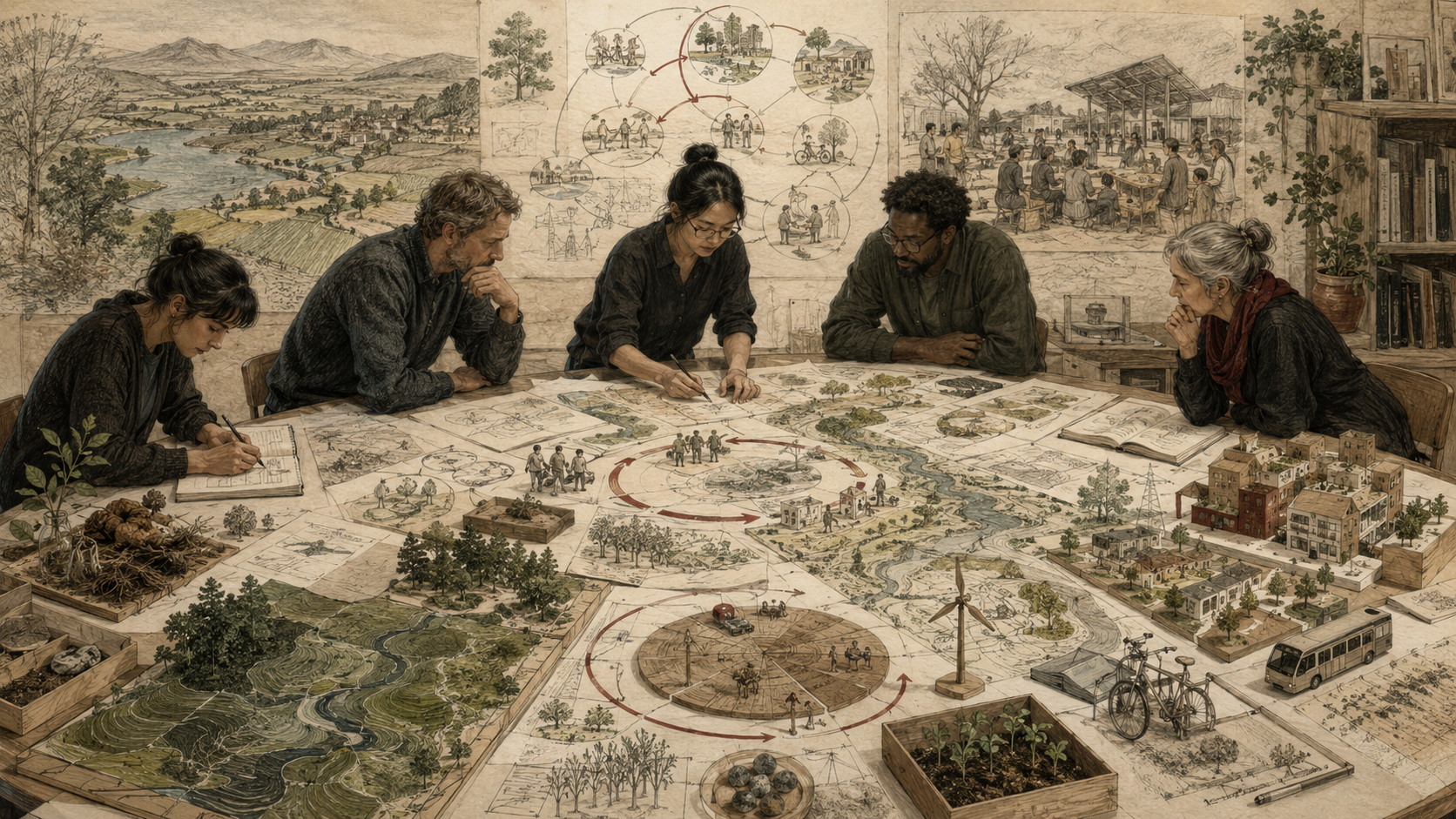
Design thinking for sustainability is most powerful when it links problem framing, insight generation, empathy and stakeholder research, prototyping, testing and validation, iteration and experimentation, implementation and scaling, and design evaluation, learning, and outcome measurement into a more serious account of ecological transition. The goal is not only to imagine better products or services. It is to understand how systems can be redesigned so that ecological goals, human dignity, institutional capacity, and long-term resilience are brought into more durable relation.
What Design Thinking Means for Sustainability
Design thinking for sustainability refers to the use of design inquiry, stakeholder research, systems awareness, iterative prototyping, implementation learning, and outcome evaluation in response to environmental and social challenges that are inseparable from economic and institutional life. It asks not only how to make a product less harmful or a service more efficient, but how to redesign the systems through which energy, materials, information, waste, responsibility, and care move.
That distinction matters because sustainability is often misunderstood as a matter of incremental optimization. Efficiency matters, but many sustainability problems are not simply failures of efficiency. They are failures of system design. They arise from the fact that extraction, production, logistics, building, consumption, repair, disposal, and governance have historically been organized without sufficient regard for ecological resilience, social equity, or intergenerational responsibility. A more efficient destructive system may remain destructive. A cleaner product may still depend on extractive supply chains. A low-carbon technology may still be inaccessible, politically fragile, or dependent on institutions that cannot maintain it.
Design thinking contributes a practical method for investigating how those structures are lived, where interventions may be possible, and how transitions can be made more usable, legible, equitable, and adoptable. It brings sustainability down from the level of abstract aspiration into the realm of services, behaviors, infrastructures, policies, institutions, communities, and everyday routines.
| Design-thinking concern | Sustainability translation | Example question |
|---|---|---|
| Human experience | How people encounter sustainability systems in everyday life. | Is the low-carbon option understandable, affordable, dignified, and usable? |
| Problem framing | How ecological problems are defined, bounded, and translated into designable challenges. | Is this a product problem, a service problem, a policy problem, or a system problem? |
| Stakeholder research | How households, workers, tenants, communities, staff, firms, and institutions experience transition. | Who carries the burden of this sustainability intervention? |
| Systems thinking | How flows, feedback loops, incentives, rules, infrastructures, and delays shape ecological outcomes. | What system structure keeps producing unsustainable behavior? |
| Prototyping | How transition pathways can be tested before large-scale commitment. | Can this circular-service model work under real operational conditions? |
| Implementation learning | How institutions adapt, support, fund, maintain, and govern sustainable change. | What must change for this intervention to survive beyond a pilot? |
| Outcome measurement | How ecological, social, behavioral, and institutional effects are evaluated over time. | Did the intervention reduce harm without shifting burdens unfairly? |
In this sense, design thinking for sustainability is not merely a creative method. It is an applied learning discipline for ecological transition. It asks how people and institutions can move from awareness to action, from action to adoption, from adoption to durability, and from durability to accountable system change.
Why Design Thinking Matters for Sustainability
Design thinking matters for sustainability because the transition to more responsible systems is rarely achieved by scientific knowledge alone. Ecological diagnosis is essential, but societies also need pathways of adoption. Technologies must be used. Infrastructures must be navigated. Policies must be understood. Institutions must be willing to learn. Households, organizations, cities, supply chains, and governments must be able to function differently in practice, not only in theory.
This is where design thinking becomes valuable. It helps translate sustainability goals into interventions that can be tested, revised, and implemented in the world as it actually exists. It also helps expose why well-intentioned sustainability initiatives often fail: because they misread behavior, underestimate institutional inertia, ignore unequal burdens, assume technical feasibility is enough, or treat adoption as a communication problem rather than a system-design problem.
| Common sustainability failure | How it appears | Design-thinking contribution |
|---|---|---|
| Technical optimism | A technically sound intervention fails because people cannot use, afford, trust, or maintain it. | Study lived experience, service pathways, adoption barriers, and support needs. |
| Behavioral simplification | Institutions assume people will change behavior once informed. | Examine defaults, norms, incentives, friction, identity, habit, and infrastructure. |
| Institutional inertia | A promising sustainability model cannot survive procurement, funding, staffing, or governance constraints. | Prototype implementation conditions, not only user-facing artifacts. |
| Equity blindness | Aggregate environmental gains conceal unequal costs for low-income, marginalized, or overburdened communities. | Measure differential burdens, access, trust, cost, and participation. |
| Green branding | Sustainability is reduced to messaging, aesthetics, or consumer appeal. | Reconnect design claims to material flows, ecological outcomes, and accountability. |
| Scale failure | A pilot works under protected conditions but fails when expanded. | Use staged implementation, evaluation, feedback loops, and context-sensitive adaptation. |
The central contribution of design thinking is not that it makes sustainability “user-friendly” in a shallow sense. Its deeper contribution is that it makes transition visible as a design problem. It reveals the human, institutional, behavioral, and operational conditions that determine whether ecological knowledge becomes real change.
The Sustainability Challenge
Sustainable development is often described as the effort to align environmental integrity, economic life, and social well-being across time. But that alignment is difficult because modern societies are structured by material throughput, fossil energy, globalized production, financial incentives, path dependence, inequality, and institutional habits built during periods that did not adequately account for ecological limits. Sustainability therefore requires more than better products. It requires transitions in how systems are organized and what they are organized for.
Climate disruption, biodiversity loss, freshwater stress, pollution, land degradation, soil depletion, toxic exposure, ocean acidification, and carbon dependence are not isolated technical puzzles. They are system-level conditions produced through interacting political, economic, infrastructural, cultural, behavioral, and ecological processes. Design thinking matters here because it offers a way to investigate those processes in situated, practical terms rather than only at the level of abstract strategy.
| Sustainability challenge | System drivers | Design implication |
|---|---|---|
| Climate disruption | Energy systems, buildings, transport, land use, industrial processes, consumption, finance, and policy. | Design low-carbon systems that are usable, affordable, governable, and scalable. |
| Biodiversity loss | Land conversion, pollution, agriculture, extraction, habitat fragmentation, invasive species, and climate stress. | Design restoration, land-use, supply-chain, and governance interventions that reduce pressure on living systems. |
| Waste and material throughput | Linear production, planned obsolescence, weak repair systems, disposal incentives, and consumer norms. | Design circular services, repair cultures, reuse systems, material tracking, and reverse logistics. |
| Water stress | Climate variability, agriculture, infrastructure, pollution, over-extraction, governance fragmentation, and inequality. | Design conservation, monitoring, allocation, reuse, and community-trust systems. |
| Urban vulnerability | Heat, flooding, housing precarity, transport dependence, infrastructure age, and uneven public investment. | Design climate-adaptive urban systems that connect resilience with equity and accessibility. |
| Institutional inertia | Procurement rules, short political cycles, risk aversion, siloed agencies, and weak accountability. | Prototype governance, funding, evidence, and implementation pathways alongside technical interventions. |
The sustainability challenge is therefore not only a scientific or technical challenge. It is also a challenge of translation, institutional design, behavioral systems, public trust, democratic legitimacy, and long-term learning. Design thinking belongs in sustainability work because it helps ask how ecological transition becomes lived, governed, funded, maintained, and evaluated.
Planetary Boundaries and System Constraints
One of the most important developments in sustainability research has been the articulation of planetary boundaries: the idea that human societies operate within a finite Earth system characterized by biophysical thresholds and destabilization risks. Once these limits are taken seriously, sustainability can no longer be understood simply as cleaner growth or marginal efficiency improvement. It becomes a problem of redesigning the systems through which value, energy, materials, waste, land, water, and responsibility are organized.
Design thinking can help translate ecological constraints into practical innovation questions. Instead of asking only how to make a particular product more efficient, designers can ask how an entire service, supply chain, urban system, institutional process, procurement model, or governance structure might operate within a narrower ecological envelope. This is why design thinking and systems thinking are so closely related in sustainability work. Ecological limits become visible only when flows, feedback loops, dependencies, delays, and unintended consequences are examined at system scale.
| Boundary-oriented question | Design translation | Possible artifact |
|---|---|---|
| What ecological threshold or pressure is relevant? | Define the material, energy, water, land, biodiversity, pollution, or carbon pressure at stake. | Ecological constraint brief. |
| Where does the pressure originate? | Map the system of extraction, production, use, waste, governance, and behavior. | Material-flow or service-system map. |
| Who experiences the transition? | Identify households, workers, communities, staff, suppliers, regulators, and future maintainers. | Stakeholder and burden map. |
| What must become easier or more supported? | Redesign the practical conditions under which lower-impact behavior becomes possible. | Journey map, service blueprint, or support model. |
| What must become accountable? | Define evidence, monitoring, governance, and decision rights. | Learning agenda and evaluation framework. |
| What risks must not be displaced? | Track hidden ecological, social, labor, privacy, or community harms. | Risk and unintended-consequence register. |
Planetary-boundary thinking gives sustainability design its seriousness. It prevents sustainability from becoming a vague preference for greener aesthetics. It asks whether design work is contributing to a real reduction in ecological pressure, a real improvement in resilience, or a real transformation in the systems that reproduce harm. Design thinking then helps determine how those transformations can be made operational, usable, and socially legitimate.
Human-Centered Sustainability
Many sustainability initiatives fail because they are technically plausible but socially fragile. A system may be optimized for emissions reduction while remaining confusing, inaccessible, unaffordable, stigmatizing, or burdensome to the people expected to use it. Design thinking responds by asking how sustainability interventions are actually encountered in everyday life. How do people navigate transit systems, energy retrofits, recycling infrastructures, water restrictions, food systems, building codes, public reporting interfaces, repair services, circular-economy platforms, or low-carbon alternatives? Where do inconvenience, cost, distrust, stigma, complexity, and time pressure become barriers?
This human-centered approach does not reduce sustainability to consumer preference. Rather, it recognizes that transitions succeed or fail through use. Households, workers, tenants, commuters, municipalities, frontline staff, suppliers, community organizations, and public agencies all experience sustainability systems differently. Without understanding those experiences, sustainability interventions often remain technically admirable but operationally weak.
| Stakeholder group | Possible sustainability burden | Design question |
|---|---|---|
| Households | Higher upfront costs, confusing incentives, time-consuming choices, limited control over housing or transport. | How can sustainable choices be made affordable, clear, supported, and realistic? |
| Tenants | Limited authority to retrofit, exposure to energy burden, vulnerability to green gentrification. | How can sustainability improve living conditions without displacement? |
| Workers | Job disruption, retraining needs, safety concerns, low-quality transition work. | How can transition pathways protect dignity, skill, income, and labor rights? |
| Communities | Unequal exposure to pollution, infrastructure neglect, weak participation, historical distrust. | How can local knowledge, consent, and accountability shape sustainability design? |
| Public agencies | Fragmented responsibilities, procurement constraints, limited data, political pressure. | What governance and evidence structures make sustainable implementation durable? |
| Businesses | Supply-chain complexity, investment risk, regulatory uncertainty, operational disruption. | How can circular, low-carbon, or regenerative models fit real production systems? |
| Future generations | Deferred ecological costs, infrastructure lock-in, weakened resilience. | How should long-term harms and obligations be represented in current design decisions? |
Human-centered sustainability is therefore not a retreat from ecological seriousness. It is one condition for ecological seriousness. A transition that people cannot use, trust, afford, maintain, or govern is unlikely to endure. A transition that hides burdens is likely to reproduce injustice. A transition that ignores institutional realities is likely to remain symbolic. Design thinking helps reveal these failure points before they become locked into policy, infrastructure, or investment.
Design Thinking and Behavioral Change
Sustainability transitions often require behavioral change, but behavior does not change in a vacuum. It is shaped by social norms, defaults, incentives, infrastructures, identities, time constraints, habits, information environments, peer expectations, price signals, and institutional trust. Design thinking supports sustainability transitions by examining how those conditions structure action. It asks whether a system makes sustainable behavior easier or harder, clearer or more obscure, more dignified or more burdensome.
This is why design thinking connects naturally to social psychology and behavioral economics. Research on social norms, prosocial behavior, collective action, defaults, friction, commitment devices, present bias, and status quo bias helps explain why some interventions diffuse and others do not. Durable sustainability depends not only on what is technically possible, but on what becomes socially intelligible, institutionally supported, and behaviorally durable over time.
| Behavioral condition | Sustainability relevance | Design response |
|---|---|---|
| Defaults | People often remain with the default option even when alternatives exist. | Make lower-impact choices the easy, normal, and supported path where ethically appropriate. |
| Friction | Small barriers can prevent adoption of otherwise desirable sustainable behavior. | Reduce steps, confusion, waiting, paperwork, switching costs, and cognitive burden. |
| Trust | People may reject sustainability programs if institutions are not trusted. | Design transparency, participation, appeal, privacy, and accountability into the system. |
| Social norms | Behavior spreads through visible expectations, peer behavior, and collective identity. | Make sustainable practices socially legible without shaming or coercion. |
| Present bias | Immediate costs often outweigh future benefits in decision-making. | Reduce upfront burden and make near-term benefits tangible. |
| Identity | People adopt behaviors that fit their sense of belonging and dignity. | Frame sustainability through community, care, responsibility, competence, and local meaning. |
| Infrastructure | Behavior is constrained by what the built environment makes possible. | Design physical, digital, and institutional environments that support lower-impact action. |
Behavioral design for sustainability should not be manipulative. The aim is not to nudge people into compliance while leaving structural constraints intact. The stronger aim is to redesign conditions so that ecologically responsible behavior is materially possible, socially supported, and institutionally trustworthy. Behavior change must be connected to system change, or it becomes a way of shifting responsibility downward to individuals while preserving unsustainable structures.
System Innovation, Circular Design, and Regenerative Thinking
Sustainability challenges rarely arise from single products alone. They arise from systems of extraction, production, logistics, use, repair, disposal, and replacement. That is why design thinking increasingly intersects with circular economy design, regenerative design, material stewardship, service-system redesign, product-service systems, repair infrastructure, reuse logistics, and long-term maintenance cultures. The aim is no longer merely to make a product less harmful in isolation. It is to redesign systems so that waste is reduced, materials are kept in use longer, regenerative processes are supported, and ecological damage is not simply displaced elsewhere.
This enlarges the meaning of design. The question becomes not just what artifact should exist, but what flows should exist around it, what infrastructures sustain it, what afterlife it has, and what ecological costs remain hidden beneath convenience. In this sense, design thinking for sustainability is broader than conventional innovation. It is concerned with transition pathways, circular material logic, maintenance systems, repair cultures, governance, and long-horizon resilience.
| Design approach | Primary question | Sustainability contribution |
|---|---|---|
| Eco-design | How can the product reduce environmental harm? | Improves material selection, energy use, durability, and end-of-life impacts. |
| Circular design | How can materials remain in use and waste be reduced? | Supports reuse, repair, refurbishment, remanufacturing, sharing, and reverse logistics. |
| Product-service systems | Can value be delivered through service rather than ownership? | Can reduce material throughput when incentives support longevity and maintenance. |
| Regenerative design | How can design support renewal of ecological and social systems? | Moves beyond harm reduction toward restoration, resilience, and reciprocity. |
| Transition design | How can societies move from current systems to preferred futures? | Links long-term visions to near-term experiments, policies, infrastructures, and social learning. |
| Service-system design | How do people and institutions experience the system over time? | Connects circular and sustainable models to adoption, support, trust, and operational viability. |
Circular and regenerative design also require caution. Circularity claims can become superficial if they ignore energy use, labor conditions, rebound effects, toxic material flows, or the fact that some systems should be reduced rather than endlessly circulated. Regenerative language can become symbolic if it is not tied to measurable restoration, community governance, ecological knowledge, and long-term stewardship. Design thinking helps only when it keeps these claims grounded in evidence, use, and accountability.
Urban Systems and Sustainable Infrastructure
Cities provide one of the clearest contexts in which design thinking and sustainability intersect. Urban systems combine transportation, housing, energy, public space, buildings, water, waste, food access, climate adaptation, digital infrastructure, public health, and social inequality in dense and interdependent form. A change in one domain often has consequences across many others. Transit redesign may affect emissions, land use, health, employment access, school access, social inclusion, and neighborhood displacement simultaneously. Building-material choices may affect carbon intensity, affordability, resilience, embodied emissions, and extractive pressure.
Design thinking becomes useful here because it allows planners, institutions, and communities to test interventions in relation to actual urban experience. It can help make infrastructure more legible, more equitable, and more usable while remaining attentive to larger systemic effects. Sustainability in cities is not only a technical infrastructure problem. It is also a design problem of access, coordination, behavior, governance, institutional learning, and public trust.
| Urban domain | Sustainability challenge | Design-thinking contribution |
|---|---|---|
| Transportation | Car dependence, emissions, congestion, unequal access, unsafe streets. | Prototype mobility hubs, transit information, safe routes, multimodal services, and accessibility improvements. |
| Housing | Energy burden, retrofits, affordability, displacement, climate vulnerability. | Design tenant-centered retrofit pathways, financing support, communication, and protections against green displacement. |
| Buildings | Operational energy, embodied carbon, materials, maintenance, indoor health. | Connect technical performance with occupant experience, procurement, maintenance, and lifecycle learning. |
| Water | Flooding, scarcity, stormwater, aging pipes, contamination, unequal exposure. | Design community-facing water resilience systems, monitoring interfaces, and maintenance workflows. |
| Public space | Heat, biodiversity loss, social exclusion, underinvestment. | Co-design green infrastructure, cooling interventions, shade, safety, and ecological restoration. |
| Waste | Low diversion, confusing rules, contamination, weak reuse systems. | Design clearer sorting, repair services, reuse logistics, and feedback systems. |
| Governance | Siloed agencies, fragmented data, short-term budgets, uneven participation. | Design cross-agency learning loops, public accountability, and implementation governance. |
Urban sustainability also reveals the political nature of design. A bike lane, retrofit program, flood-control project, repair hub, cooling center, or circular waste system is not merely an artifact. It is an intervention into land value, access, labor, race, class, mobility, time, trust, and public responsibility. Design thinking becomes serious when it treats these realities as part of the design context rather than as external constraints.
Prototyping, Experimentation, and Transition Design
Prototyping is especially important in sustainability work because many interventions involve substantial uncertainty. Governments, companies, universities, nonprofits, neighborhoods, and communities may need to test energy systems, low-carbon mobility solutions, repair models, circular-service concepts, food-distribution interventions, green procurement practices, water-conservation programs, building-retrofit pathways, or ecosystem-restoration approaches before large-scale commitment occurs. These prototypes and pilots make the transition visible. They allow institutions to learn from use rather than relying solely on forecasts, slogans, or strategy documents.
That is why sustainability design depends so heavily on prototyping, testing and validation, iteration and experimentation, and implementation and scaling. Ecological ambition without operational learning is rarely enough. The challenge is not only to imagine better systems, but to build transition pathways through which those systems become workable.
| Prototype type | What it tests | Example sustainability use |
|---|---|---|
| Behavioral prototype | Whether people understand, trust, and adopt a new practice. | Testing enrollment, incentives, and reminders for household energy reduction. |
| Service prototype | Whether a sustainable service pathway works across touchpoints. | Testing a repair, reuse, or retrofit navigation service. |
| Infrastructure pilot | Whether a physical or digital system works under local conditions. | Testing neighborhood mobility hubs, composting systems, or water monitoring stations. |
| Policy prototype | Whether a rule, incentive, or administrative process works in practice. | Testing green procurement standards or retrofit financing rules. |
| Governance prototype | Whether decision rights, participation, and accountability structures function. | Testing community climate-adaptation review boards or circular-economy partnerships. |
| Transition pathway prototype | Whether multiple interventions can be sequenced over time. | Testing a staged building decarbonization program across finance, workforce, materials, and tenant protections. |
The strongest sustainability prototypes do not test only desirability. They test feasibility, equity, ecological performance, operational burden, institutional adoption, governance, and long-term learning. A prototype that people like but that produces little ecological benefit is not enough. A prototype that produces ecological benefit but is inaccessible or unjust is not enough. A prototype that works only because of exceptional staff attention or temporary funding may not be scalable. Sustainability prototyping must therefore be practical, ethical, and systems-aware at the same time.
Implementation, Scaling, and Institutional Adoption
Implementation is often the stage at which sustainability efforts falter. An intervention may appear compelling in principle yet fail when it collides with procurement rules, weak incentives, fragmented governance, cost structures, legacy infrastructure, political opposition, uneven public trust, data gaps, workforce shortages, or burdens shifted onto already constrained populations. This is one reason sustainability cannot be treated as a branding exercise or a purely technical field. Institutional adoption matters.
Design thinking becomes valuable here because it pays attention to friction. It asks whether the system can actually be navigated, whether the intervention fits organizational reality, whether support structures exist, whether staff can maintain it, whether governance is clear, whether accountability is real, and whether the burdens of transition are being distributed fairly. Sustainability succeeds not only when the right ideas exist, but when the systems around them can absorb and sustain change.
Workforce capacityImplementation may fail without trained workers and maintainers.Design training, certification, scheduling, maintenance, and labor-quality supports.
| Implementation constraint | How it affects sustainability | Design response |
|---|---|---|
| Procurement rules | Can block circular, local, low-carbon, or repair-oriented alternatives. | Prototype procurement criteria, supplier requirements, lifecycle-cost tools, and decision workflows. |
| Financing | Upfront costs may prevent long-term ecological savings. | Design financing pathways, incentives, subsidies, shared-savings models, and tenant protections. |
| Data fragmentation | Institutions may lack the evidence needed to monitor outcomes. | Design data governance, measurement, dashboards, and accountability loops. |
| Public trust | Communities may resist interventions associated with displacement, surveillance, or broken promises. | Design participation, transparency, appeal, local accountability, and co-governance. |
| Legacy infrastructure | Existing systems may constrain low-carbon transition pathways. | Design phased retrofits, compatibility layers, fallback processes, and transition sequencing. |
| Institutional silos | Environmental goals may be split across agencies, departments, or budget lines. | Design cross-functional ownership, shared metrics, and governance routines. |
Implementation also changes what counts as success. A sustainability intervention is not successful merely because it launches, attracts attention, or performs well in a pilot. It succeeds when it produces durable ecological improvement, remains usable and equitable, can be governed under ordinary conditions, and generates evidence that allows institutions to learn and adapt over time.
Methods and Measurement in Sustainability Design
Sustainability design requires stronger methods and clearer measurement if it is to remain more than aspiration. Some outcomes can be quantified directly: emissions, waste reduction, energy intensity, material retention, reuse rates, water consumption, access metrics, cost, maintenance burden, and reliability. But other outcomes require qualitative and mixed-method assessment: whether a system is understandable, whether burdens have been redistributed unfairly, whether adoption is durable, whether trust has improved, whether governance is legitimate, and whether the intervention remains usable across unequal social conditions.
That is why serious sustainability design often depends on combining life-cycle reasoning, service research, stakeholder inquiry, systems mapping, pilot testing, behavioral evidence, implementation review, and iterative evaluation. Not everything that matters can be expressed in a single number, but neither can sustainability rely on rhetoric alone. Good design requires an account of what improvement means, how it will be observed, and whose experience defines success.
| Measurement domain | Possible indicators | Interpretive caution |
|---|---|---|
| Ecological performance | Emissions, energy use, water use, waste, material retention, biodiversity indicators, pollution reduction. | Ecological gains may be displaced across supply chains or hidden lifecycle stages. |
| Adoption | Enrollment, usage, repeat participation, sustained behavior, switching rates, completion. | Adoption may reflect lack of alternatives rather than true value or consent. |
| Usability | Comprehension, task success, support need, time, confidence, accessibility. | Usability improvements do not guarantee ecological significance. |
| Equity | Access by income, geography, language, disability, race, tenure status, burden level, or vulnerability. | Aggregate sustainability gains can conceal unequal transition burdens. |
| Burden | Cost, time, administrative steps, maintenance labor, caregiving work, staff workload, informal support. | Burden may shift from institutions to households, workers, or communities. |
| Institutional durability | Funding, ownership, governance, maintenance, staffing, procurement fit, policy alignment. | Early success may depend on temporary attention or exceptional champions. |
| Trust and legitimacy | Perceived fairness, transparency, complaint themes, participation quality, community confidence. | Low complaints may signal low trust or weak access to accountability. |
| Learning | Assumptions revised, design changes made, risks identified, evidence used in decisions. | Measurement creates little value if evidence does not change action. |
Measurement should also avoid the trap of sustainability theater. A dashboard can make ecological performance visible, but visibility is not accountability. A metric can show progress, but progress depends on what is being measured, who is missing, and whether hidden harms are included. Design evaluation should therefore integrate quantitative metrics with qualitative evidence, community review, lifecycle reasoning, and governance structures that can act on findings.
Ethics, Power, and Unequal Sustainability Burdens
Sustainability transitions are never neutral. They involve questions of who pays, who benefits, who bears inconvenience, whose labor is invisibly expanded, whose land is protected, whose environments are treated as expendable, and whose future is counted. Design thinking for sustainability therefore has to confront ethics and power directly. A system may reduce emissions while increasing surveillance. A circular strategy may depend on poorly paid repair labor. A low-carbon transition may remain inaccessible to those without capital, mobility, time, property ownership, or institutional support.
Serious design practice must ask not only whether an intervention is sustainable in aggregate terms, but for whom it is sustainable, under what conditions, and with what consequences for justice, dignity, distribution, and democratic legitimacy. Without that attention, sustainability design risks becoming technically impressive but politically and morally thin.
| Ethical question | Sustainability risk | Design response |
|---|---|---|
| Who pays? | Costs may fall on households, tenants, workers, municipalities, or communities with the least capacity. | Map cost distribution and design financing, subsidies, protections, and shared benefits. |
| Who benefits? | Environmental gains may improve property values while displacing vulnerable residents. | Pair sustainability interventions with anti-displacement and community-benefit protections. |
| Who does the work? | Maintenance, repair, sorting, caregiving, or compliance labor may be invisible or underpaid. | Measure labor burden and design fair workforce, maintenance, and support systems. |
| Who is monitored? | Efficiency systems may create surveillance, data extraction, or unequal enforcement. | Design privacy, consent, transparency, appeal, and data governance safeguards. |
| Who participates? | Public engagement may exclude those most affected by climate, pollution, or infrastructure harms. | Design participation around access, language, trust, timing, compensation, and local authority. |
| Who is blamed? | Individual behavior may be blamed while structural drivers remain unchanged. | Frame behavior within infrastructure, policy, affordability, habit, and institutional responsibility. |
| Who is protected over time? | Short-term gains may neglect intergenerational harm and ecological irreversibility. | Build long-horizon evaluation and stewardship into design governance. |
Power is not external to sustainability design. It is embedded in land use, infrastructure, data, finance, regulation, property, labor, procurement, and public authority. Design thinking becomes ethically serious only when it treats these structures as part of the design problem. Otherwise, it risks making unjust systems more usable rather than making sustainable systems more just.
The Limits of Design Thinking in Sustainability
Design thinking offers valuable tools for sustainability, but it cannot resolve ecological crisis on its own. Environmental problems are shaped by political economy, legal structure, capital allocation, state capacity, international inequality, corporate power, infrastructure lock-in, and the fact that many institutions continue to depend on extractive models of value creation. Human-centered design cannot by itself dismantle fossil dependence, reverse biodiversity collapse, overcome entrenched asymmetries in global power, or substitute for law, regulation, public investment, and democratic accountability.
Its limitations become most obvious when it is used to soften structural issues into matters of preference, messaging, or interface. A sustainability initiative may be well designed at the level of user experience while leaving the underlying system fundamentally unchanged. A recycling app may be useful but irrelevant to upstream overproduction. A low-carbon product may be attractive while leaving extractive supply chains intact. A consumer-facing campaign may shift responsibility onto individuals while policy and industry structures remain untouched.
| Misuse of design thinking | How it weakens sustainability | Stronger alternative |
|---|---|---|
| Green branding | Makes sustainability appear present without changing material systems. | Connect claims to lifecycle evidence, governance, and measurable ecological outcomes. |
| Interface reductionism | Treats sustainability as a usability problem while ignoring production, policy, and infrastructure. | Map the broader system of flows, incentives, rules, and consequences. |
| Consumer individualism | Shifts responsibility to individual choice while structural drivers remain unchanged. | Design supportive systems, public policy, defaults, infrastructure, and institutional accountability. |
| Pilot theater | Produces impressive demonstrations that do not scale or endure. | Test implementation, governance, maintenance, financing, and equity from the beginning. |
| Stakeholder tokenism | Uses participation for legitimacy without shifting decision power. | Design meaningful participation, compensation, transparency, and decision pathways. |
| Metric narrowness | Optimizes visible metrics while hiding displacement, rebound, or lifecycle harms. | Use mixed methods, lifecycle evidence, community review, and unintended-consequence monitoring. |
For that reason, design thinking is strongest when it remains connected to ecological science, systems analysis, law, regulation, finance, infrastructure planning, labor justice, public policy, and governance. It should not be the whole theory of sustainability. It should be one disciplined practice within a larger architecture of ecological responsibility.
AI-Assisted Sustainability Design and Its Limits
AI-assisted tools can support sustainability design by helping teams synthesize research, model scenarios, analyze energy or material data, compare intervention portfolios, detect patterns in service feedback, generate simulations, support lifecycle inventories, map stakeholder concerns, and draft evaluation documentation. Used carefully, these tools can make complex evidence easier to inspect and compare.
However, AI-assisted sustainability design also carries risks. Models may make weak evidence appear precise. Automated summaries may flatten community knowledge or minority experiences. Optimization tools may prioritize measurable variables while ignoring dignity, justice, local meaning, labor, trust, or ecological uncertainty. AI systems may also carry their own material footprint through energy use, data centers, hardware supply chains, water consumption, and computational demand. Sustainability design cannot treat AI as immaterial.
| AI-assisted use | Potential value | Required safeguard |
|---|---|---|
| Research synthesis | Clusters themes across interviews, reports, complaints, or stakeholder submissions. | Review against raw evidence and preserve contradiction, severe cases, and minority concerns. |
| Scenario modeling | Compares possible sustainability pathways under uncertainty. | Make assumptions explicit and avoid presenting speculative outputs as forecasts. |
| Lifecycle analysis support | Helps organize material, energy, emissions, and supply-chain data. | Validate data quality, boundaries, and missing lifecycle stages. |
| Portfolio prioritization | Helps compare interventions across ecology, feasibility, equity, and risk. | Keep weights transparent and subject to governance review. |
| Operational monitoring | Detects drift, waste, energy spikes, service failures, or emerging risks. | Use human review before acting on patterns that affect people or communities. |
| Community feedback analysis | Surfaces recurring concerns across public comments or service channels. | Do not replace direct participation, trust-building, or deliberation. |
| Automation of sustainability reporting | Speeds documentation and evidence summaries. | Require traceability, uncertainty statements, and independent verification. |
AI is most useful when it strengthens traceability, comparison, and disciplined inquiry. It is most dangerous when it becomes a shortcut around ecological expertise, community participation, governance, and ethical judgment. Sustainability design should use AI as an assistive tool within accountable systems of evidence, not as a substitute for human and institutional responsibility.
Cross-Pillar Connections
Design thinking for sustainability sits at the intersection of several knowledge areas. From design thinking, it draws on stakeholder research, framing, experimentation, prototyping, implementation, and evaluation. From systems inquiry, it draws on feedback loops, leverage points, stocks and flows, institutional constraints, and structural interdependence. From sustainable development, it draws on ecological limits, resilience, equity, and the challenge of organizing prosperity within a finite Earth system.
It also connects directly to social psychology and behavioral economics. Sustainability depends on how responsibility is perceived, how group norms shift, how collective action forms, how people respond to defaults and incentives, and how institutions either support or discourage pro-environmental behavior. Concepts such as diffusion of responsibility, the bystander effect, social identity theory, status quo bias, present bias, loss aversion, and social norms help explain why sustainability problems can persist even when their seriousness is widely recognized.
| Related field | Connection to sustainability design |
|---|---|
| Systems thinking | Clarifies flows, feedback loops, leverage points, delays, and unintended consequences. |
| Behavioral economics | Explains how defaults, incentives, friction, habits, and bounded rationality shape adoption. |
| Social psychology | Explains norms, collective action, responsibility, identity, trust, and group behavior. |
| Environmental monitoring systems | Provides data infrastructures for observing ecological conditions, risks, and intervention effects. |
| Data systems and analytics | Supports measurement, dashboards, lifecycle data, uncertainty analysis, and decision support. |
| Artificial intelligence systems | Raises questions about optimization, automation, energy use, evidence synthesis, and governance. |
| Institutions and governance | Determines how sustainability decisions are authorized, funded, maintained, contested, and evaluated. |
| Stewardship and ethics | Frames sustainability as responsibility to human communities, nonhuman life, and future generations. |
Across these areas, the central lesson is that sustainability cannot be reduced to a single discipline. It requires ecological knowledge, institutional capacity, social trust, behavioral realism, public accountability, technical skill, and moral seriousness. Design thinking contributes when it helps these forms of knowledge become actionable without losing sight of human experience and ecological limits.
Mathematical Lens: Modeling Sustainable Design Under Ecological Constraint
Design thinking for sustainability is not reducible to formulas, but formal models can clarify the trade-offs institutions are already making. One useful abstraction is to treat a sustainability concept \(i\) as a candidate intervention evaluated across several dimensions:
V_i = w_u U_i + w_f F_i + w_e E_i + w_c C_i – w_r R_i
\]
Interpretation: A sustainability concept gains value when usability, feasibility, ecological benefit, and circularity improve, and loses value when implementation risk rises.
Here \(U_i\) represents stakeholder usability, \(F_i\) feasibility, \(E_i\) ecological benefit, \(C_i\) circularity or long-term material stewardship, and \(R_i\) implementation risk. The weights \(w_u, w_f, w_e, w_c,\) and \(w_r\) express institutional priorities. The value of this model is not that it captures the whole meaning of sustainability. It does not. Its value is that it forces hidden priorities into the open. An organization that gives very low weight to ecological benefit while emphasizing ease of implementation is making a strategic choice, whether it says so plainly or not.
Iterative sustainability learning can also be represented across prototype rounds \(t\). Let intervention quality depend on changes in adoption \(A_t\), friction \(F_t\), and ecological impact reduction \(G_t\):
\Delta Q_t = \alpha (A_t – A_{t-1}) – \beta (F_t – F_{t-1}) + \gamma (G_t – G_{t-1})
\]
Interpretation: A sustainability design improves when adoption rises, friction falls, and ecological impact reduction increases.
This expresses an important sustainability principle: a design improves not only when it becomes easier to use, but when it produces better ecological performance without collapsing adoption. Sustainability transitions are often fragile precisely because these goals move together uneasily. A system that is ecologically superior but impossible to adopt will fail in practice; a system that is highly usable but ecologically trivial will fail in substance.
A portfolio approach is also useful. If each sustainability concept has probability \(p_i\) of successful implementation, expected portfolio value may be expressed as:
E(P) = \sum_{i=1}^{n} p_i V_i
\]
Interpretation: Expected sustainability portfolio value depends on the value of each intervention and the probability that it can be implemented successfully.
This matters because some experiments are valuable even when they do not scale directly. They may expose hidden bottlenecks, reveal social resistance, identify more realistic transition pathways, or prevent institutions from committing prematurely to brittle solutions. In that sense, design thinking for sustainability connects productively to systems modeling, evaluation, decision analysis, and adaptive governance while remaining human-centered and context-sensitive.
R Workflow: Sustainability Concept Prioritization Across Ecological Trade-Offs
The R workflow below evaluates a portfolio of sustainability concepts across usability, feasibility, ecological benefit, circularity, equity, durability, and implementation risk. It then tests how rankings shift under different strategic priorities, making trade-offs more explicit and less dependent on vague sustainability rhetoric.
# Install packages if needed.
# install.packages(c("tidyverse", "scales"))

library(tidyverse)
library(scales)

# -------------------------------------------------------------------
# Example sustainability concept portfolio.
# Each concept is scored on design, ecological, and institutional dimensions.
# Higher risk means greater implementation penalty.
# -------------------------------------------------------------------

concepts <- tibble(
  concept = c(
    "Building Retrofit Service Model",
    "Reusable Packaging Loop",
    "Neighborhood Mobility Hub",
    "Repair and Refurbishment Platform",
    "Community Solar Enrollment Service",
    "Circular Procurement Toolkit",
    "Urban Heat Resilience Network",
    "Water Reuse Participation Model"
  ),
  concept_type = c(
    "service_model",
    "circular_system",
    "urban_infrastructure",
    "repair_platform",
    "energy_access",
    "institutional_toolkit",
    "climate_resilience",
    "water_system"
  ),
  usability = c(8.1, 7.6, 8.4, 7.9, 8.2, 7.3, 8.0, 7.7),
  feasibility = c(7.4, 7.8, 6.9, 7.5, 7.2, 8.1, 6.8, 7.0),
  ecological_benefit = c(8.8, 8.5, 8.2, 8.0, 8.7, 7.9, 8.6, 8.1),
  circularity = c(7.9, 9.1, 7.1, 8.8, 7.0, 8.7, 7.2, 7.6),
  equity = c(7.6, 7.2, 8.4, 7.8, 8.8, 7.4, 8.7, 8.1),
  durability = c(8.0, 8.2, 7.8, 7.9, 8.1, 8.0, 8.4, 7.7),
  risk = c(4.1, 4.6, 5.0, 4.2, 4.8, 3.9, 5.1, 4.7),
  evidence_quality = c(0.76, 0.73, 0.70, 0.75, 0.72, 0.78, 0.71, 0.69),
  stakeholder_coverage = c(0.72, 0.68, 0.74, 0.70, 0.78, 0.66, 0.80, 0.73)
)

# -------------------------------------------------------------------
# Weighted sustainability value function.
# This makes design trade-offs explicit and auditable.
# -------------------------------------------------------------------

score_concepts <- function(data, wu, wf, weco, wc, weq, wd, wr) {
  data %>%
    mutate(
      evidence_strength =
        0.55 * evidence_quality +
        0.45 * stakeholder_coverage,
      sustainability_value =
        wu * usability +
        wf * feasibility +
        weco * ecological_benefit +
        wc * circularity +
        weq * equity +
        wd * durability -
        wr * risk,
      evidence_adjusted_value =
        sustainability_value * (0.75 + 0.25 * evidence_strength),
      learning_priority =
        0.30 * risk +
        0.25 * (1 - evidence_quality) * 10 +
        0.25 * (1 - stakeholder_coverage) * 10 +
        0.20 * (10 - ecological_benefit)
    ) %>%
    arrange(desc(sustainability_value))
}

# -------------------------------------------------------------------
# Strategic weighting scenarios.
# These reflect different organizational orientations.
# -------------------------------------------------------------------

scenarios <- tribble(
  ~scenario,                ~wu,  ~wf,  ~weco, ~wc,  ~weq, ~wd,  ~wr,
  "Balanced",               0.16, 0.16, 0.24, 0.16, 0.14, 0.08, 0.06,
  "Feasibility-first",      0.15, 0.32, 0.18, 0.12, 0.10, 0.08, 0.05,
  "Ecology-first",          0.12, 0.12, 0.42, 0.12, 0.10, 0.08, 0.04,
  "Circularity-first",      0.12, 0.12, 0.18, 0.38, 0.10, 0.06, 0.04,
  "Equity-sensitive",       0.12, 0.12, 0.22, 0.12, 0.34, 0.04, 0.04,
  "Durability-first",       0.12, 0.14, 0.20, 0.14, 0.10, 0.26, 0.04,
  "Risk-sensitive",         0.14, 0.16, 0.22, 0.14, 0.12, 0.08, 0.14
)

# -------------------------------------------------------------------
# Evaluate all concepts under each scenario.
# -------------------------------------------------------------------

scenario_results <- scenarios %>%
  rowwise() %>%
  do(
    score_concepts(
      concepts,
      wu = .$wu,
      wf = .$wf,
      weco = .$weco,
      wc = .$wc,
      weq = .$weq,
      wd = .$wd,
      wr = .$wr
    ) %>%
      mutate(scenario = .$scenario)
  ) %>%
  ungroup()

# Rank concepts within each scenario.
ranked_results <- scenario_results %>%
  group_by(scenario) %>%
  arrange(desc(sustainability_value), .by_group = TRUE) %>%
  mutate(rank = row_number()) %>%
  ungroup()

print(ranked_results)

# -------------------------------------------------------------------
# Rank stability across strategic priorities.
# -------------------------------------------------------------------

rank_stability <- ranked_results %>%
  group_by(concept, concept_type) %>%
  summarize(
    mean_rank = mean(rank),
    best_rank = min(rank),
    worst_rank = max(rank),
    rank_range = worst_rank - best_rank,
    mean_sustainability_value = mean(sustainability_value),
    mean_evidence_adjusted_value = mean(evidence_adjusted_value),
    mean_learning_priority = mean(learning_priority),
    .groups = "drop"
  ) %>%
  arrange(mean_rank, rank_range)

print(rank_stability)

# -------------------------------------------------------------------
# Visualize ranking behavior across different strategic weights.
# -------------------------------------------------------------------

ggplot(ranked_results, aes(x = concept, y = sustainability_value, group = scenario)) +
  geom_point(size = 3) +
  geom_line(aes(color = scenario), linewidth = 1) +
  coord_flip() +
  labs(
    title = "Sustainability Concept Value Across Strategic Weighting Scenarios",
    x = "Concept",
    y = "Weighted Sustainability Value"
  ) +
  theme_minimal(base_size = 12)

# -------------------------------------------------------------------
# Count how often each concept ranks first.
# -------------------------------------------------------------------

top_rank_summary <- ranked_results %>%
  filter(rank == 1) %>%
  count(concept, name = "times_ranked_first") %>%
  arrange(desc(times_ranked_first))

print(top_rank_summary)

# -------------------------------------------------------------------
# Export results for reporting or dashboard use.
# -------------------------------------------------------------------

write_csv(ranked_results, "sustainability_design_concept_prioritization.csv")
write_csv(rank_stability, "sustainability_design_rank_stability.csv")
write_csv(top_rank_summary, "sustainability_design_top_rank_summary.csv")
This workflow is helpful because it shows how sustainability rankings depend on what the institution truly values. A concept that looks strongest under a circularity-first strategy may not look strongest when feasibility, equity, durability, or risk dominates. Making those differences visible is part of serious sustainability governance.
Python Workflow: Uncertainty Analysis for Sustainability Prototypes
The Python workflow below extends the same design-value logic with Monte Carlo simulation. Instead of assuming that concept scores are known with certainty, it models uncertainty across usability, feasibility, ecological benefit, circularity, equity, durability, and risk. This helps estimate which interventions remain strong when evidence is incomplete and assumptions are contested.
# Install packages if needed:
# pip install pandas numpy matplotlib scipy

import numpy as np
import pandas as pd
import matplotlib.pyplot as plt

# ---------------------------------------------------------------------
# Example sustainability concept portfolio.
# ---------------------------------------------------------------------

concepts = pd.DataFrame({
    "concept": [
        "Building Retrofit Service Model",
        "Reusable Packaging Loop",
        "Neighborhood Mobility Hub",
        "Repair and Refurbishment Platform",
        "Community Solar Enrollment Service",
        "Circular Procurement Toolkit",
        "Urban Heat Resilience Network",
        "Water Reuse Participation Model"
    ],
    "concept_type": [
        "service_model",
        "circular_system",
        "urban_infrastructure",
        "repair_platform",
        "energy_access",
        "institutional_toolkit",
        "climate_resilience",
        "water_system"
    ],
    "usability": [8.1, 7.6, 8.4, 7.9, 8.2, 7.3, 8.0, 7.7],
    "feasibility": [7.4, 7.8, 6.9, 7.5, 7.2, 8.1, 6.8, 7.0],
    "ecological_benefit": [8.8, 8.5, 8.2, 8.0, 8.7, 7.9, 8.6, 8.1],
    "circularity": [7.9, 9.1, 7.1, 8.8, 7.0, 8.7, 7.2, 7.6],
    "equity": [7.6, 7.2, 8.4, 7.8, 8.8, 7.4, 8.7, 8.1],
    "durability": [8.0, 8.2, 7.8, 7.9, 8.1, 8.0, 8.4, 7.7],
    "risk": [4.1, 4.6, 5.0, 4.2, 4.8, 3.9, 5.1, 4.7],
    "evidence_quality": [0.76, 0.73, 0.70, 0.75, 0.72, 0.78, 0.71, 0.69],
    "stakeholder_coverage": [0.72, 0.68, 0.74, 0.70, 0.78, 0.66, 0.80, 0.73]
})

# ---------------------------------------------------------------------
# Baseline sustainability design weights.
# ---------------------------------------------------------------------

weights = {
    "usability": 0.16,
    "feasibility": 0.16,
    "ecological_benefit": 0.24,
    "circularity": 0.16,
    "equity": 0.14,
    "durability": 0.08,
    "risk": 0.06
}

# ---------------------------------------------------------------------
# Weighted score function.
# Higher risk reduces final value.
# ---------------------------------------------------------------------

def compute_sustainability_value(df, weights_dict):
    result = df.copy()

    result["evidence_strength"] = (
        0.55 * result["evidence_quality"] +
        0.45 * result["stakeholder_coverage"]
    )

    result["sustainability_value"] = (
        weights_dict["usability"] * result["usability"] +
        weights_dict["feasibility"] * result["feasibility"] +
        weights_dict["ecological_benefit"] * result["ecological_benefit"] +
        weights_dict["circularity"] * result["circularity"] +
        weights_dict["equity"] * result["equity"] +
        weights_dict["durability"] * result["durability"] -
        weights_dict["risk"] * result["risk"]
    )

    result["evidence_adjusted_value"] = (
        result["sustainability_value"] *
        (0.75 + 0.25 * result["evidence_strength"])
    )

    result["learning_priority"] = (
        0.30 * result["risk"] +
        0.25 * (1 - result["evidence_quality"]) * 10 +
        0.25 * (1 - result["stakeholder_coverage"]) * 10 +
        0.20 * (10 - result["ecological_benefit"])
    )

    return result.sort_values("sustainability_value", ascending=False)

baseline_results = compute_sustainability_value(concepts, weights)

print("Baseline concept ranking:")
print(
    baseline_results[
        [
            "concept",
            "concept_type",
            "sustainability_value",
            "evidence_adjusted_value",
            "learning_priority"
        ]
    ]
)

# ---------------------------------------------------------------------
# Monte Carlo simulation.
# We allow each score to vary around current estimates.
# This approximates uncertainty in early-stage evaluation.
# ---------------------------------------------------------------------

np.random.seed(42)
n_simulations = 10000
simulation_winners = []
simulation_records = []

score_columns = [
    "usability",
    "feasibility",
    "ecological_benefit",
    "circularity",
    "equity",
    "durability",
    "risk"
]

for simulation_id in range(n_simulations):
    simulated = concepts.copy()

    for col in score_columns:
        simulated[col] = np.random.normal(
            loc=concepts[col],
            scale=0.6
        ).clip(1, 10)

    simulated_results = compute_sustainability_value(simulated, weights)
    winner = simulated_results.iloc[0]["concept"]
    simulation_winners.append(winner)

    simulated_results = simulated_results.reset_index(drop=True)

    for rank, row in simulated_results.iterrows():
        simulation_records.append({
            "simulation_id": simulation_id,
            "concept": row["concept"],
            "concept_type": row["concept_type"],
            "sustainability_value": row["sustainability_value"],
            "evidence_adjusted_value": row["evidence_adjusted_value"],
            "learning_priority": row["learning_priority"],
            "rank": rank + 1
        })

# ---------------------------------------------------------------------
# Estimate the probability each concept ranks first.
# ---------------------------------------------------------------------

winner_summary = (
    pd.Series(simulation_winners)
    .value_counts(normalize=True)
    .rename("probability_ranked_first")
    .reset_index()
)

winner_summary.columns = ["concept", "probability_ranked_first"]
winner_summary["probability_ranked_first"] *= 100

print("\nProbability each concept ranks first:")
print(winner_summary)

# ---------------------------------------------------------------------
# Rank stability under uncertainty.
# ---------------------------------------------------------------------

simulation_df = pd.DataFrame(simulation_records)

rank_stability = (
    simulation_df
    .groupby(["concept", "concept_type"])
    .agg(
        mean_sustainability_value=("sustainability_value", "mean"),
        sd_sustainability_value=("sustainability_value", "std"),
        mean_evidence_adjusted_value=("evidence_adjusted_value", "mean"),
        mean_learning_priority=("learning_priority", "mean"),
        median_rank=("rank", "median"),
        mean_rank=("rank", "mean"),
        best_rank=("rank", "min"),
        worst_rank=("rank", "max")
    )
    .reset_index()
    .sort_values(["median_rank", "mean_rank"])
)

print("\nRank stability:")
print(rank_stability)

# ---------------------------------------------------------------------
# Random-weight sensitivity.
# This tests how conclusions change when priorities shift.
# ---------------------------------------------------------------------

criteria = [
    "usability",
    "feasibility",
    "ecological_benefit",
    "circularity",
    "equity",
    "durability",
    "risk"
]

n_weight_samples = 10000
random_weight_winners = []

for _ in range(n_weight_samples):
    sampled = np.random.dirichlet(np.ones(len(criteria)))
    sampled_weights = dict(zip(criteria, sampled))

    sampled_results = compute_sustainability_value(concepts, sampled_weights)
    random_weight_winners.append(sampled_results.iloc[0]["concept"])

weight_sensitivity = (
    pd.Series(random_weight_winners)
    .value_counts(normalize=True)
    .rename("probability_winning_under_random_weights")
    .reset_index()
)

weight_sensitivity.columns = [
    "concept",
    "probability_winning_under_random_weights"
]

weight_sensitivity["probability_winning_under_random_weights"] *= 100

print("\nWeight sensitivity:")
print(weight_sensitivity)

# ---------------------------------------------------------------------
# Plot concept robustness under uncertainty.
# ---------------------------------------------------------------------

plt.figure(figsize=(10, 6))
plt.bar(winner_summary["concept"], winner_summary["probability_ranked_first"])
plt.xticks(rotation=20, ha="right")
plt.ylabel("Probability of Ranking First (%)")
plt.title("Robustness of Sustainability Prototypes Under Uncertainty")
plt.tight_layout()
plt.show()

# ---------------------------------------------------------------------
# Export summaries for reporting or portfolio review.
# ---------------------------------------------------------------------

baseline_results.to_csv("baseline_sustainability_design_scores.csv", index=False)
winner_summary.to_csv("sustainability_prototype_uncertainty_results.csv", index=False)
rank_stability.to_csv("sustainability_prototype_rank_stability.csv", index=False)
weight_sensitivity.to_csv("sustainability_prototype_weight_sensitivity.csv", index=False)
simulation_df.to_csv("sustainability_prototype_simulation_records.csv", index=False)
This workflow is especially valuable because it discourages false certainty. Sustainability decisions are often made under incomplete information and contested assumptions. A concept that appears strongest in a static scoring table may be much less robust once uncertainty is introduced. Showing that explicitly supports better judgment.
GitHub Repository
The companion repository provides a reproducible technical workspace for exploring the modeling, simulation, documentation, and implementation ideas associated with this article. The article folder is organized for multi-language design research and includes folders for Python, R, Julia, C++, Fortran, C, Rust, Go, SQL, notebooks, documentation, raw data, processed data, and outputs.
Complete Code Repository
This repository folder contains companion materials for modeling sustainability design concepts, ecological trade-offs, circularity, equity, adoption, feasibility, durability, implementation risk, uncertainty, and transition learning across multiple technical environments.
The repository structure is designed to support reproducible sustainability design research rather than isolated code examples. The language-specific folders allow the same intervention-prioritization logic to be explored across statistical, scientific, systems, and database workflows. The documentation and data folders help preserve assumptions, provenance, lifecycle evidence, stakeholder evidence, system maps, ecological indicators, transition hypotheses, evaluation notes, and learning artifacts so that sustainability design judgments remain traceable.
| Folder | Purpose |
|---|---|
python/ |
Sustainability concept scoring, Monte Carlo uncertainty analysis, rank stability, sensitivity testing, and reproducible decision-support workflows. |
r/ |
Scenario analysis, ecological trade-off comparison, concept ranking, visualization, and evaluation-review outputs. |
julia/ |
Numerical modeling, simulation, transition-pathway analysis, and high-performance exploratory workflows. |
cpp/, c/, rust/, go/ |
Systems-oriented examples, command-line scoring tools, validation utilities, and reproducible implementation components. |
fortran/ |
Scientific-computing examples for numerical modeling and legacy-compatible analytical workflows. |
sql/ |
Structured sustainability schemas, concept-value tables, analytical queries, scoring views, and reproducible summaries. |
notebooks/ |
Exploratory analysis, teaching materials, interactive demonstrations, and sustainability-design review workflows. |
docs/ |
Method notes, model cards, data dictionaries, reproducibility guidance, lifecycle notes, transition-design protocols, and validation documentation. |
data/raw/ |
Original or synthetic source data used for sustainability design examples. |
data/processed/ |
Cleaned, transformed, model-ready, or scored sustainability design data outputs. |
outputs/ |
Generated figures, tables, reports, uncertainty results, sustainability-value diagnostics, and model outputs. |
Conclusion
Design thinking for sustainability matters because ecological transition is never only a matter of better technology or more urgent rhetoric. It is a matter of how systems are understood, how problems are framed, how interventions are made usable, how institutions learn, how burdens are distributed, and how societies navigate change under conditions of ecological constraint. Sustainability science helps clarify the scale and seriousness of ecological limits. Design thinking helps build the pathways through which those limits can be taken seriously in practice.
Its strongest contribution lies in connecting human experience to system redesign. It helps reveal why sustainability fails when transitions are confusing, inaccessible, inequitable, politically thin, or detached from daily life. It also helps show that durable change depends on experimentation, implementation learning, serious attention to friction, and disciplined evaluation rather than aspiration alone. In this respect, design thinking becomes one part of a broader effort to make ecological transition governable, adoptable, and institutionally real.
The field is weakened when it is reduced to green branding, lifestyle messaging, or minor interface optimization. It is strongest when treated as a rigorous practice of inquiry that sits alongside ecological science, systems thinking, governance, regulation, public investment, labor justice, and ethical reflection. In that sense, design thinking for sustainability is not merely about making sustainable options more appealing. It is about redesigning the systems through which human prosperity and ecological stability can be brought into more durable relation.
A mature sustainability-design practice does not ask whether an intervention is elegant in isolation. It asks whether the intervention reduces ecological pressure, strengthens resilience, protects dignity, distributes burdens fairly, survives institutional reality, and remains accountable over time. That is a much harder standard. It is also the standard sustainability requires.
Related articles
- What Is Design Thinking?
- Human-Centered Problem Solving
- Empathy and Stakeholder Research in Design Thinking
- Problem Framing in Design Thinking
- Insight Generation in Design Thinking
- Prototyping in Design Thinking
- Testing and Validation in Design Thinking
- Iteration and Experimentation in Design Thinking
- Implementation and Scaling in Design Thinking
- Design Evaluation, Learning, and Outcome Measurement
- Design Thinking and Systems Thinking
- Design Thinking in Public Policy
- Design Thinking and Organizational Innovation
Further reading
- Bhamra, T. and Lofthouse, V. (2016) Design for Sustainability: A Practical Approach. London: Routledge. Available at: https://www.routledge.com/Design-for-Sustainability-A-Practical-Approach/Bhamra-Lofthouse/p/book/9780566087042.
- Ceschin, F. and Gaziulusoy, İ. (2016) ‘Evolution of design for sustainability: From product design to design for system innovations and transitions’, Design Studies, 47, pp. 118–163. Available at: https://doi.org/10.1016/j.destud.2016.09.002.
- Ellen MacArthur Foundation (no date) The Circular Economy: Introduction and Overview. Available at: https://www.ellenmacarthurfoundation.org/topics/circular-economy-introduction/overview.
- Ellen MacArthur Foundation (no date) Circular Economy Principles. Available at: https://www.ellenmacarthurfoundation.org/circular-economy-principles.
- Gaziulusoy, A.İ. (2015) ‘A critical review of approaches available for design and innovation teams through the perspective of sustainability science and system innovation theories’, Journal of Cleaner Production, 107, pp. 366–377. Available at: https://doi.org/10.1016/j.jclepro.2015.01.012.
- Irwin, T. (2015) ‘Transition Design: A proposal for a new area of design practice, study, and research’, Design and Culture, 7(2), pp. 229–246. Available at: https://doi.org/10.1080/17547075.2015.1051829.
- Manzini, E. (2015) Design, When Everybody Designs: An Introduction to Design for Social Innovation. Cambridge, MA: MIT Press. Available at: https://mitpress.mit.edu/9780262028608/design-when-everybody-designs/.
- Meadows, D.H. (1999) Leverage Points: Places to Intervene in a System. The Sustainability Institute. Available at: https://donellameadows.org/archives/leverage-points-places-to-intervene-in-a-system/.
- Meadows, D.H. (2008) Thinking in Systems: A Primer. White River Junction, VT: Chelsea Green. Available at: https://www.chelseagreen.com/product/thinking-in-systems/.
- Rockström, J. et al. (2009) ‘A safe operating space for humanity’, Nature, 461, pp. 472–475. Available at: https://doi.org/10.1038/461472a.
- Sachs, J.D. (2015) The Age of Sustainable Development. New York: Columbia University Press. Available at: https://www.jeffreysachs.org/books/the-age-of-sustainable-development.
- UNEP (2009) Design for Sustainability: A Step-by-Step Approach. Available at: https://www.unep.org/resources/report/design-sustainability-step-step-approach.
- UNEP (2023) Building Materials and the Climate: Constructing a New Future. Available at: https://www.unep.org/resources/report/building-materials-and-climate-constructing-new-future.
References
- Bhamra, T. and Lofthouse, V. (2016) Design for Sustainability: A Practical Approach. London: Routledge. Available at: https://www.routledge.com/Design-for-Sustainability-A-Practical-Approach/Bhamra-Lofthouse/p/book/9780566087042.
- Ceschin, F. and Gaziulusoy, İ. (2016) ‘Evolution of design for sustainability: From product design to design for system innovations and transitions’, Design Studies, 47, pp. 118–163. Available at: https://doi.org/10.1016/j.destud.2016.09.002.
- Ellen MacArthur Foundation (no date) The Circular Economy: Introduction and Overview. Available at: https://www.ellenmacarthurfoundation.org/topics/circular-economy-introduction/overview.
- Ellen MacArthur Foundation (no date) Circular Economy Principles. Available at: https://www.ellenmacarthurfoundation.org/circular-economy-principles.
- Gaziulusoy, A.İ. (2015) ‘A critical review of approaches available for design and innovation teams through the perspective of sustainability science and system innovation theories’, Journal of Cleaner Production, 107, pp. 366–377. Available at: https://doi.org/10.1016/j.jclepro.2015.01.012.
- Irwin, T. (2015) ‘Transition Design: A proposal for a new area of design practice, study, and research’, Design and Culture, 7(2), pp. 229–246. Available at: https://doi.org/10.1080/17547075.2015.1051829.
- Liedtka, J. and Ogilvie, T. (2011) Designing for Growth: A Design Thinking Tool Kit for Managers. New York: Columbia University Press. Available at: https://cup.columbia.edu/book/designing-for-growth/9780231158381/.
- Manzini, E. (2015) Design, When Everybody Designs: An Introduction to Design for Social Innovation. Cambridge, MA: MIT Press. Available at: https://mitpress.mit.edu/9780262028608/design-when-everybody-designs/.
- Meadows, D.H. (1999) Leverage Points: Places to Intervene in a System. The Sustainability Institute. Available at: https://donellameadows.org/archives/leverage-points-places-to-intervene-in-a-system/.
- Meadows, D.H. (2008) Thinking in Systems: A Primer. White River Junction, VT: Chelsea Green. Available at: https://www.chelseagreen.com/product/thinking-in-systems/.
- Rockström, J. et al. (2009) ‘A safe operating space for humanity’, Nature, 461, pp. 472–475. Available at: https://doi.org/10.1038/461472a.
- Sachs, J.D. (2015) The Age of Sustainable Development. New York: Columbia University Press. Available at: https://www.jeffreysachs.org/books/the-age-of-sustainable-development.
- Stockholm Resilience Centre (no date) Planetary Boundaries. Available at: https://www.stockholmresilience.org/research/planetary-boundaries.html.
- UNEP (2009) Design for Sustainability: A Step-by-Step Approach. Available at: https://www.unep.org/resources/report/design-sustainability-step-step-approach.
- UNEP (2023) Building Materials and the Climate: Constructing a New Future. Available at: https://www.unep.org/resources/report/building-materials-and-climate-constructing-new-future.