
Last Updated May 20, 2026
Social comparison theory describes the psychological process through which individuals evaluate their abilities, opinions, identity, status, worth, and life circumstances by comparing themselves to other people, groups, institutions, or reference standards. First articulated by Leon Festinger in 1954, the theory begins from a deceptively simple premise: people have a drive to evaluate themselves, but many of the things they care about most cannot be measured in isolation.
People often want to know whether they are competent, successful, attractive, ethical, respected, productive, intelligent, healthy, secure, admired, or behind. Yet many of these judgments lack stable objective standards. In the absence of clear measures, people turn toward others. They compare themselves to peers, coworkers, classmates, family members, public figures, professional competitors, digital feeds, institutional rankings, and imagined reference groups. Through these comparisons, the self becomes socially legible.
The importance of social comparison theory is that it treats self-evaluation as relational rather than purely internal. Individuals do not simply look inward and discover who they are. They interpret themselves through comparison with others: those who seem ahead, those who seem behind, those who seem similar, and those who represent the standards of a group or institution. Social comparison therefore shapes motivation, self-esteem, identity, aspiration, envy, reassurance, shame, relative deprivation, institutional competition, and the perceived norms of social life.
Main Library
Publications
Article Map
Social Psychology
Related Topic
Behavioral Economics
Related Topic
Cognitive Psychology
Related Topic
Institutions & Governance
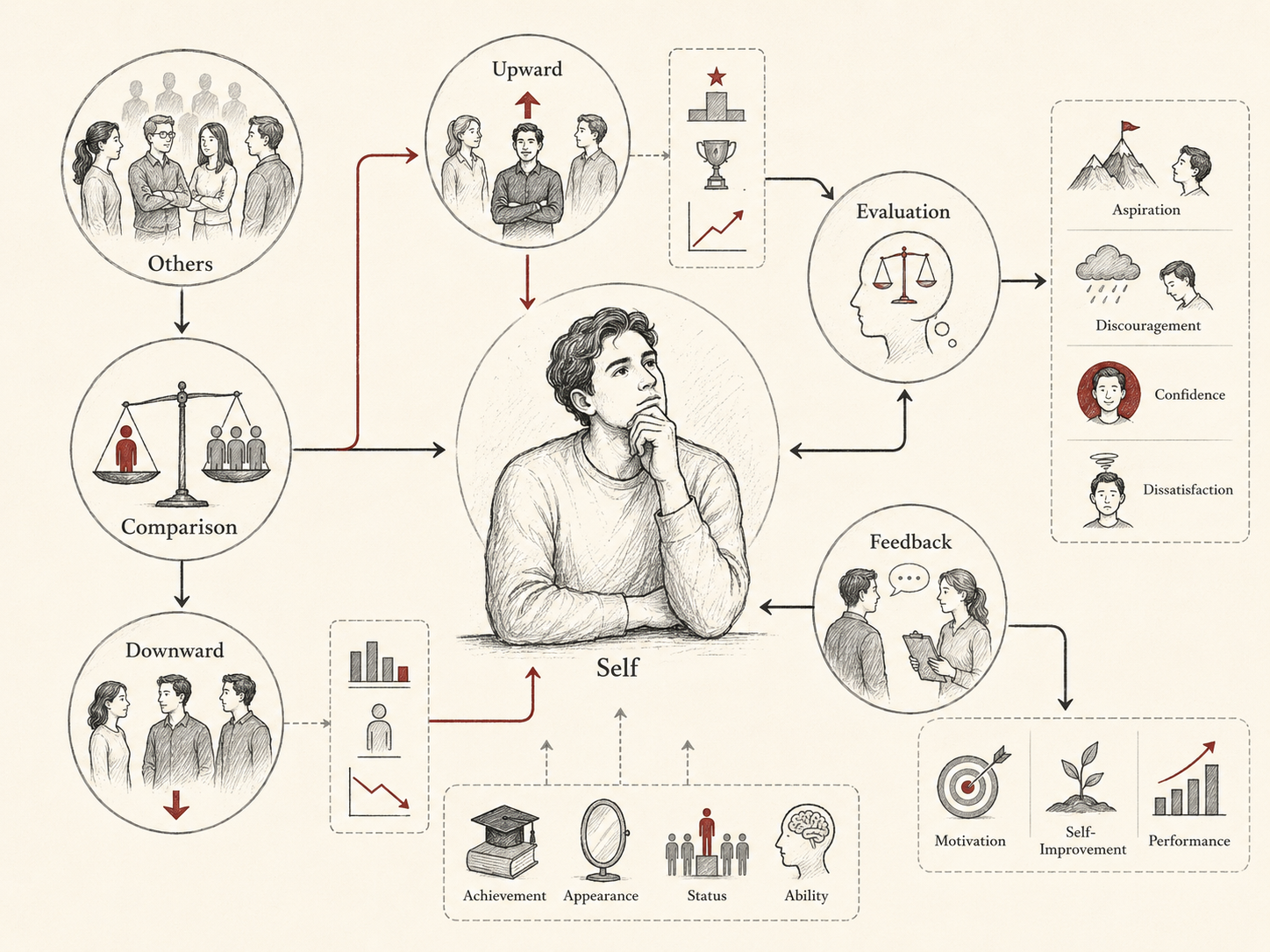
Social comparison theory connects closely to social cognition, self-serving bias, cognitive dissonance theory, heuristics and biases, social norms, group polarization, social identity theory, and collective action and social change. Together, these frameworks show that self-understanding is never purely private. It is formed through reference points, group expectations, social hierarchies, feedback systems, and institutions that define what counts as success, failure, normality, aspiration, and worth.
What is social comparison theory?
Social comparison theory explains how people evaluate themselves by comparing their opinions, abilities, attributes, outcomes, and social standing with others. The theory begins from the recognition that self-knowledge often depends on reference points. A test score, salary, promotion, award, physical ability, social media metric, health outcome, or moral reputation means something partly because it is interpreted relative to other people or accepted standards.
In some domains, objective standards are available. A person can measure a race time, exam score, blood pressure reading, or income amount. But even objective measures become psychologically meaningful through comparison. A salary may feel high or low depending on peer compensation. A grade may feel impressive or disappointing depending on class distribution. A promotion may feel validating or inadequate depending on the pace of advancement in a profession.
In other domains, objective standards are weak or ambiguous. There is no simple absolute measure of whether a person is respected, attractive, morally good, professionally successful, socially admired, or living well. Under those conditions, people rely heavily on social reference points. They look sideways, upward, downward, backward, and outward to interpret themselves.
Social comparison is therefore not an occasional error in judgment. It is one of the central processes through which people construct self-evaluation in a social world. The question is not whether people compare, but how comparison targets are selected, which domains matter, what emotional meanings are attached to comparison gaps, and how institutions amplify or reduce comparison pressure.
Theoretical foundations
Festinger proposed that individuals possess a fundamental motivation to evaluate their opinions and abilities accurately. Accurate self-evaluation matters because people need to understand what they believe, what they can do, what is possible, what is normal, and how to act in uncertain environments.
The theory rests on several key propositions. First, people have a drive to evaluate opinions and abilities. Second, when objective standards are unavailable, they compare themselves with others. Third, comparisons are most useful when the comparison target is relevant or similar. Fourth, social comparison affects opinion formation, ability assessment, affiliation, competition, and group dynamics.
Festinger’s framework was historically important because it placed self-evaluation inside social life. The individual was not treated as an isolated evaluator. Instead, people were understood as members of groups who use others as standards for judging themselves. This made social comparison theory a bridge between social cognition, group processes, motivation, identity, and interpersonal influence.
Later research expanded the theory far beyond the original formulation. Social comparison came to include upward and downward comparison, self-enhancement, coping, envy, inspiration, relative deprivation, social comparison orientation, digital comparison, organizational benchmarking, and institutional rankings. The original theory became not only a single theory but the foundation of an entire field.
Mechanisms of social comparison
Social comparison operates through several psychological mechanisms that shape how individuals interpret information about themselves and others.
- Reference selection: People choose or notice comparison targets that seem relevant to the domain being evaluated.
- Similarity assessment: People often compare themselves with others who seem similar in background, ability, age, role, status, or opportunity.
- Gap estimation: People estimate the distance between their own standing and the reference target’s standing.
- Attainability judgment: People evaluate whether the comparison target’s position is reachable.
- Identity relevance: Comparison has stronger effects when the domain matters to the self-concept.
- Affective interpretation: The comparison gap may produce envy, inspiration, pride, shame, discouragement, reassurance, resentment, or gratitude.
- Motivational adjustment: Comparisons can increase effort, reduce effort, change goals, or shift the domain of aspiration.
- Norm inference: People infer what is normal, expected, or valued by observing others.
These mechanisms show that social comparison is not merely observational. It actively shapes motivation, identity, and expectation. What a person takes to be possible, normal, admirable, embarrassing, or disappointing often depends on the comparison group through which the judgment is made.
Social comparison also depends on selective attention. People do not compare themselves with everyone equally. They compare with those who are visible, similar, prestigious, threatening, envied, admired, proximate, algorithmically presented, institutionally ranked, or socially meaningful. In modern life, comparison targets are not simply chosen by the individual; they are also curated by organizations, schools, workplaces, media systems, platforms, and ranking institutions.
Formalizing social comparison
Social comparison can be represented as a process in which self-evaluation depends on both an internal self-assessment and an external comparison reference. Let \(S_i\) represent an individual’s perceived standing on dimension \(i\), and let \(R_i\) represent the relevant comparison reference:
G_i=S_i-R_i
\]
Interpretation: The comparison gap \(G_i\) is positive when the self is evaluated as exceeding the reference and negative when the self is evaluated as falling below it.
Self-evaluation can then be represented as a function of multiple weighted comparison domains:
E=\sum_{i=1}^{n}w_i f(S_i-R_i)
\]
Interpretation: Overall self-evaluation depends on comparison gaps across domains, weighted by the importance \(w_i\) of each domain to identity.
Upward and downward comparison can be expressed directionally:
U_i=\max(0,R_i-S_i)
\]
Interpretation: Upward comparison pressure \(U_i\) increases when the reference target is perceived as above the self.
D_i=\max(0,S_i-R_i)
\]
Interpretation: Downward comparison reassurance \(D_i\) increases when the self is perceived as above the reference target.
The emotional effect of comparison can be represented as a function of upward pressure, downward reassurance, attainability, similarity, and identity relevance:
A_i=\alpha U_i-\beta D_i+\delta T_i+\lambda V_i+\theta I_i
\]
Interpretation: Affective response \(A_i\) depends on upward comparison, downward comparison, perceived attainability \(T_i\), similarity \(V_i\), and identity relevance \(I_i\).
At the group level, social comparison can be connected to social identity:
E_{self}=\gamma E_{personal}+(1-\gamma)E_{group}
\]
Interpretation: Self-evaluation may depend partly on personal standing and partly on perceived group standing, with \(\gamma\) representing the weight placed on personal identity.
Relative deprivation can be represented as comparison-based disadvantage plus grievance:
RD_i=(R_i-S_i)\times L_i\times Q_i
\]
Interpretation: Relative deprivation increases when a person perceives a disadvantage gap, believes the standard is legitimate or deserved \(L_i\), and experiences grievance or resentment \(Q_i\).
These models are simplified, but they clarify the logic of comparison. A comparison does not automatically produce distress or motivation. Its effect depends on direction, size, relevance, similarity, attainability, fairness, repetition, and the social meaning of the reference group.
Upward, downward, and lateral comparison
Upward comparison
Upward comparison occurs when individuals compare themselves with those perceived as better off, more successful, more skilled, more attractive, more respected, more productive, healthier, wealthier, or higher in status. Upward comparison can be motivating when the target seems attainable, relevant, and instructive. A slightly more advanced peer may provide evidence that improvement is possible.
But upward comparison can also be painful. When the target seems unreachable, highly curated, structurally advantaged, or unrelated to the self’s real circumstances, the comparison may produce envy, shame, discouragement, resentment, or chronic inadequacy. The same upward comparison can inspire one person and demoralize another depending on attainability, similarity, identity relevance, and emotional context.
Downward comparison
Downward comparison occurs when individuals compare themselves with those perceived as worse off. Downward comparison can protect self-esteem, provide reassurance, reduce anxiety, or help people cope with difficulty. Someone experiencing illness, failure, or insecurity may feel less alone or less threatened when comparing themselves with someone facing more severe difficulties.
Downward comparison can also become ethically complicated. It may produce gratitude or resilience, but it may also encourage contempt, complacency, distancing, or moral superiority. In institutional settings, downward comparison may allow organizations or governments to avoid deeper reform by pointing to worse alternatives.
Lateral comparison
Lateral comparison occurs when people compare themselves with similar others. These comparisons are often especially informative because similar peers provide a plausible benchmark. A worker may compare salary with coworkers, a student with classmates, a researcher with scholars in the same field, or a parent with other parents in the same community.
Lateral comparison can stabilize norms. It helps people decide what is typical, fair, expected, or achievable. But it can also intensify competition, resentment, and status anxiety when peers become constant reference points.
Individuals rarely rely on only one form of comparison. They move dynamically among upward, downward, and lateral comparison depending on goals, threat, mood, domain, identity, and the social environment.
Assimilation, contrast, and attainability
One of the most important developments after Festinger was the recognition that upward comparison does not have one fixed psychological effect. A person may respond to a superior comparison target through either assimilation or contrast.
Assimilation occurs when the comparison target seems connected to the self. The person thinks, in effect, “I could become more like that.” In this case, upward comparison may inspire motivation, learning, goal-setting, and self-improvement.
Contrast occurs when the comparison target seems distant, unreachable, or fundamentally different. The person thinks, in effect, “That shows how far behind I am.” In this case, upward comparison may lower self-evaluation, increase envy, and reduce motivation.
Attainability is therefore central. A comparison target only slightly ahead may be motivating. A target far ahead, structurally advantaged, artificially curated, or unrealistic may be discouraging. Similarity also matters. People are more likely to learn from comparison targets they perceive as relevant to their own circumstances.
This helps explain why comparison effects vary so widely. The same high-achieving peer, influencer, colleague, or institution can inspire one observer and demoralize another. The psychological outcome depends on how the comparison is interpreted: as possibility, threat, evidence of failure, unfair advantage, aspirational model, or irrelevant spectacle.
Social comparison and identity formation
Social comparison plays a major role in identity formation. Individuals define themselves in relation to others within their social environment. Professional status, educational attainment, lifestyle choices, moral reputation, political commitments, health behaviors, and cultural identity all emerge partly through comparative processes.
People ask questions such as:
- Am I doing well compared with my peers?
- Am I behind others my age?
- Am I successful in my profession?
- Am I a good parent, student, citizen, worker, friend, or leader?
- Am I living up to the norms of my group?
- Do people like me belong here?
- Does my group receive the standing it deserves?
These questions are not merely personal. They connect the self to reference groups. People may seek out groups that reinforce favorable comparison, distance themselves from groups that threaten a desired identity, or reinterpret comparison standards to preserve self-worth.
Social comparison also connects to group identity. People compare not only themselves as individuals, but their groups. A person may evaluate their school, profession, nation, class, religion, political group, or community relative to other groups. When group standing becomes self-relevant, comparison can become a source of pride, resentment, defensiveness, collective action, or intergroup conflict.
For that reason, identity is not merely introspective. It is relationally produced. Much of what the self takes itself to be depends on who counts as the relevant other.
Social comparison and self-esteem
The relationship between social comparison and self-esteem is complex. Upward comparisons can encourage growth when the comparison target seems attainable and similar. Observing a slightly more successful peer may increase effort and sharpen aspiration. Upward comparison can also provide information about strategies, standards, and possible futures.
But repeated exposure to elevated or unattainable standards can undermine well-being. Persistent upward comparison with idealized targets may produce dissatisfaction, diminished confidence, self-surveillance, or a sense of chronic inadequacy. This is especially likely when the comparison domain is identity-relevant, the gap appears large, and the comparison target appears unrealistically perfect.
Downward comparison can temporarily protect self-esteem by highlighting relative advantage. A person may feel more competent, fortunate, healthy, or secure by comparing themselves with someone worse off. But heavy reliance on downward comparison may also reduce motivation or encourage defensive self-protection rather than genuine growth.
Self-esteem effects therefore depend on context. Comparison can be informative, motivating, reassuring, threatening, humiliating, or distorting. It is not inherently harmful or beneficial. Its consequences depend on comparison direction, target selection, attainability, identity relevance, emotional regulation, repeated exposure, and the broader system that defines the comparison standard.
Motivation, achievement, and aspiration
Social comparison shapes motivation because it helps people interpret what is possible. A comparison target may function as evidence that a goal is attainable, a warning that one is falling behind, a model for improvement, or a source of discouragement.
Upward comparison can increase motivation when three conditions are present. First, the target must seem relevant. Second, the target’s standing must seem attainable. Third, the comparison must provide usable information about how improvement might occur. In such cases, comparison can support learning, effort, and persistence.
Upward comparison can reduce motivation when the gap seems too large or unfair. If the target appears to benefit from inherited advantage, manipulated visibility, institutional favoritism, or unrealistic curation, the comparison may generate resentment or resignation rather than effort.
Downward comparison may protect motivation by reducing despair, but it may also encourage complacency. Lateral comparison can calibrate effort by showing what similar others are doing. In organizational contexts, comparison with peers can increase performance, but it can also generate unhealthy competition, secrecy, burnout, or dissatisfaction when evaluation systems are perceived as unfair.
Motivational effects therefore depend on whether comparison is experienced as a roadmap, a threat, a judgment, a norm, a humiliation, or a sign of possibility.
Relative deprivation and perceived injustice
Social comparison becomes politically and institutionally consequential when it produces relative deprivation. Relative deprivation occurs when individuals or groups perceive themselves as worse off than a relevant comparison standard and interpret that disadvantage as unfair, illegitimate, or undeserved.
This is not simply the same as objective poverty or disadvantage. A person or group may tolerate hardship when no relevant comparison makes the hardship feel unjust. Conversely, a person or group may experience acute grievance when comparison reveals that similar others receive more recognition, rights, pay, safety, dignity, or opportunity.
Relative deprivation links social comparison to resentment, protest, workplace conflict, intergroup hostility, and collective action. People ask not only “What do I have?” but “What do I have compared with what people like me should have?” That comparison can become a moral claim.
In this way, social comparison theory helps explain why inequality is often experienced relationally. Absolute conditions matter, but perceived fairness depends heavily on comparison standards. Salary, rank, representation, security, recognition, and institutional treatment become meaningful through reference groups.
Relative deprivation also helps connect this article to collective action and social change. When comparison gaps become shared, politicized, and morally interpreted, private dissatisfaction can become collective grievance.
Social comparison in organizations
Social comparison processes operate extensively within organizations and professional environments. Employees routinely evaluate their performance relative to colleagues, teams, industry norms, professional peers, salary bands, promotion timelines, recognition systems, and informal status hierarchies.
Even when absolute compensation or status is high, perceived inequality relative to peers can generate dissatisfaction, resentment, disengagement, or turnover. People often care not only about what they receive, but whether what they receive seems fair compared with relevant others.
Organizational comparison appears in many forms:
- salary comparison;
- promotion comparison;
- performance review comparison;
- recognition and award comparison;
- workload comparison;
- remote versus in-office comparison;
- leadership access comparison;
- status comparison between departments;
- benchmarking against industry peers;
- informal prestige comparison.
Organizations often attempt to manage comparison through structured evaluation systems, compensation transparency, standardized promotion criteria, peer benchmarking, and performance dashboards. These systems can improve fairness when designed well, but they can also intensify surveillance, competition, and status anxiety.
Social comparison therefore helps explain why institutional fairness is experienced relationally. People ask not only “What do I have?” but “How does what I have compare, and is the comparison legitimate?”
Digital media and amplified comparison
Digital communication platforms have dramatically expanded the scale, frequency, and intensity of social comparison. Social media environments present curated representations of success, lifestyle, attractiveness, productivity, consumption, relationships, travel, fitness, creativity, expertise, and public recognition. These representations create continuous opportunities for comparison.
Digital comparison differs from ordinary comparison in several ways. First, comparison targets are abundant and constantly available. Second, targets are often selectively curated. Third, metrics such as likes, follows, views, shares, rankings, badges, and comments make social evaluation visible. Fourth, algorithms may repeatedly present content that intensifies comparison pressure. Fifth, the comparison field is no longer limited to local peers; individuals compare themselves to highly selected, professionally optimized, or structurally advantaged targets.
This can distort perceptions of normal life. People may compare their ordinary experience with another person’s edited highlight sequence. They may treat exceptional outcomes as typical. They may infer that everyone else is more productive, attractive, successful, socially connected, or fulfilled.
Digital comparison is not uniformly harmful. Online spaces can also provide inspiration, learning, solidarity, identity affirmation, health information, professional modeling, and connection. The consequences depend on how platforms are used, what content is encountered, whether comparison is active or passive, whether targets seem attainable, and whether users have strong tendencies toward comparison.
A research-grade account must therefore avoid simplistic claims that social media causes comparison harm in all cases. The better question is how digital systems structure comparison exposure, which users are most vulnerable, what domains are made salient, and how curated metrics reshape self-evaluation.
Social comparison and social norms
Social comparison contributes to the formation and maintenance of social norms. By observing others, individuals infer what attitudes, practices, achievements, appearances, values, and behaviors are typical, admired, expected, or rewarded within a group.
Norms are often learned comparatively. A student learns what counts as strong performance by comparing with classmates. A worker learns what counts as productivity by comparing with coworkers. A community member learns what counts as acceptable behavior by observing neighbors. A professional learns the pace of advancement by observing peers.
This means social comparison is not only a tool for self-evaluation. It is also a mechanism through which collective standards are stabilized and transmitted. People adjust behavior not only because they are explicitly instructed, but because they observe what others do and infer what is normal.
Comparison-driven norm perception can support cooperation, learning, and shared standards. But it can also produce conformity pressure, status anxiety, arms races, and distorted expectations. If everyone compares upward to curated extremes, the perceived norm can become unrealistic. If organizations benchmark against competitors without questioning the value of the benchmark, they may reproduce harmful industry standards.
Social comparison therefore helps explain how norms become personally meaningful. Standards do not float above people. They are internalized through repeated comparison with socially relevant others.
Institutional and systems-level dynamics
Although social comparison theory began as a theory of individual psychology, comparison also operates at institutional scale. Organizations, universities, industries, cities, and states evaluate themselves relative to perceived peers. Rankings, benchmarks, scorecards, indices, dashboards, audits, league tables, and competitive metrics create institutional comparison systems.
Governments compare economic growth, educational outcomes, health performance, defense capacity, innovation, climate targets, and social indicators. Companies compare market share, revenue growth, valuation, productivity, reputation, and talent retention. Universities compare rankings, research output, admissions selectivity, fundraising, and prestige.
These institutional comparisons shape strategy and resource allocation. A university may chase rankings. A company may imitate competitors. A government may adopt policies to improve standing in international indices. A city may pursue redevelopment strategies because peer cities appear more competitive.
Institutional comparison can be useful when it supports learning, accountability, and improvement. But it can also distort priorities when institutions optimize for rank rather than public value. Metrics can narrow attention, incentivize gaming, and create reputational anxiety. The comparison target can begin to define the mission.
Social comparison theory therefore provides insight not only into personal identity, but into institutional behavior. Institutions, like individuals, often ask: Where do we stand, compared with whom, by which standard, and what must we do to avoid falling behind?
Ethical and interpretive cautions
Social comparison theory should not be reduced to the claim that comparison is bad. Comparison can support learning, aspiration, solidarity, calibration, coping, fairness recognition, and institutional improvement. People often need comparison to understand their circumstances.
Several cautions are necessary:
- Do not treat all upward comparison as harmful.
- Do not treat all downward comparison as healthy.
- Do not ignore attainability, similarity, and identity relevance.
- Do not assume digital comparison effects are uniform across users.
- Do not reduce relative deprivation to envy; it may reflect legitimate injustice.
- Do not treat institutional benchmarks as neutral simply because they are numerical.
- Do not ignore power in determining whose standards become comparison standards.
- Do not confuse self-improvement with endless optimization under unrealistic norms.
Social comparison can illuminate inequality, but it can also reproduce hierarchy. It can motivate growth, but it can also generate shame. It can build norms, but it can also enforce conformity. It can improve institutions, but it can also create metric-driven distortion.
The strongest use of the theory therefore asks not only whether comparison occurs, but who defines the reference group, what values the comparison rewards, whether the standard is attainable, and whether the comparison produces learning, dignity, resentment, or harm.
Measurement, data, and research design
Social comparison research uses experiments, surveys, experience-sampling methods, diary studies, social media studies, organizational data, vignette experiments, longitudinal designs, and computational simulations.
Key variables include:
- comparison type;
- comparison direction;
- comparison domain;
- reference group;
- perceived self-standing;
- perceived reference standing;
- comparison gap;
- attainability;
- similarity;
- identity relevance;
- social comparison orientation;
- self-evaluation before and after comparison;
- motivation;
- envy;
- inspiration;
- discouragement;
- reassurance;
- self-esteem;
- perceived fairness;
- relative deprivation;
- norm perception;
- digital exposure;
- response time.
Strong research designs should distinguish comparison direction from emotional effect. Upward comparison may produce inspiration or discouragement. Downward comparison may produce reassurance or complacency. Lateral comparison may produce calibration or competition. Researchers should therefore measure mediators such as attainability, similarity, identity relevance, perceived fairness, and comparison orientation.
Digital comparison research should distinguish passive exposure from active comparison seeking. Organizational comparison research should distinguish useful benchmarking from status anxiety. Relative deprivation research should distinguish envy from perceived injustice.
Because comparison is often repeated, longitudinal designs are especially valuable. A single comparison may have modest effects, while repeated comparison can reshape self-esteem, motivation, expectation, and perceived norms over time.
R code for social comparison research
The following R workflow models self-evaluation change, motivation, envy, inspiration, relative deprivation, self-esteem, and response time as functions of comparison type, comparison gap, attainability, similarity, identity relevance, and social comparison orientation.
# Install packages if needed:
# pak::pak(c("tidyverse", "lme4", "lmerTest", "emmeans", "broom.mixed", "performance"))

library(tidyverse)
library(lme4)
library(lmerTest)
library(emmeans)
library(broom.mixed)
library(performance)

# Expected columns:
# participant, site_id, condition, trial, comparison_type,
# comparison_domain, reference_group, self_standing, reference_standing,
# comparison_gap, attainability, similarity, identity_relevance,
# social_comparison_orientation, self_eval_pre, self_eval_post,
# motivation_score, envy, inspiration, discouragement, reassurance,
# self_esteem, perceived_fairness, relative_deprivation,
# norm_perception, digital_exposure, response_time_ms

dat <- read_csv("social_comparison_trials.csv") %>%
  mutate(
    participant = factor(participant),
    site_id = factor(site_id),
    condition = factor(condition),
    comparison_type = factor(comparison_type),
    comparison_domain = factor(comparison_domain),
    reference_group = factor(reference_group),
    self_eval_change = self_eval_post - self_eval_pre,
    log_response_time = log(response_time_ms)
  )

# -----------------------------
# 1. Descriptive summary
# -----------------------------

comparison_summary <- dat %>%
  group_by(condition, comparison_type) %>%
  summarise(
    n = n(),
    participants = n_distinct(participant),
    mean_gap = mean(comparison_gap, na.rm = TRUE),
    mean_attainability = mean(attainability, na.rm = TRUE),
    mean_similarity = mean(similarity, na.rm = TRUE),
    mean_identity_relevance = mean(identity_relevance, na.rm = TRUE),
    mean_self_eval_change = mean(self_eval_change, na.rm = TRUE),
    mean_motivation = mean(motivation_score, na.rm = TRUE),
    mean_envy = mean(envy, na.rm = TRUE),
    mean_inspiration = mean(inspiration, na.rm = TRUE),
    mean_discouragement = mean(discouragement, na.rm = TRUE),
    mean_reassurance = mean(reassurance, na.rm = TRUE),
    mean_self_esteem = mean(self_esteem, na.rm = TRUE),
    mean_relative_deprivation = mean(relative_deprivation, na.rm = TRUE),
    mean_norm_perception = mean(norm_perception, na.rm = TRUE),
    mean_digital_exposure = mean(digital_exposure, na.rm = TRUE),
    .groups = "drop"
  )

print(comparison_summary)

# -----------------------------
# 2. Self-evaluation change model
# -----------------------------

eval_model <- lmer(
  self_eval_change ~
    comparison_type * attainability +
    comparison_gap +
    similarity +
    identity_relevance +
    social_comparison_orientation +
    condition +
    comparison_domain +
    (1 | participant) +
    (1 | site_id),
  data = dat,
  REML = FALSE
)

summary(eval_model)
emmeans(eval_model, ~ comparison_type)

# -----------------------------
# 3. Motivation model
# -----------------------------

motivation_model <- lmer(
  motivation_score ~
    comparison_type * attainability +
    comparison_gap +
    similarity +
    identity_relevance +
    inspiration +
    discouragement +
    condition +
    comparison_domain +
    (1 | participant) +
    (1 | site_id),
  data = dat,
  REML = FALSE
)

summary(motivation_model)

# -----------------------------
# 4. Envy and inspiration models
# -----------------------------

envy_model <- lmer(
  envy ~
    comparison_gap +
    attainability +
    similarity +
    identity_relevance +
    social_comparison_orientation +
    digital_exposure +
    condition +
    comparison_domain +
    (1 | participant) +
    (1 | site_id),
  data = dat,
  REML = FALSE
)

inspiration_model <- lmer(
  inspiration ~
    comparison_type * attainability +
    comparison_gap +
    similarity +
    identity_relevance +
    condition +
    comparison_domain +
    (1 | participant) +
    (1 | site_id),
  data = dat,
  REML = FALSE
)

summary(envy_model)
summary(inspiration_model)

# -----------------------------
# 5. Relative deprivation model
# -----------------------------

relative_deprivation_model <- lmer(
  relative_deprivation ~
    comparison_gap +
    attainability +
    identity_relevance +
    perceived_fairness +
    condition +
    reference_group +
    (1 | participant) +
    (1 | site_id),
  data = dat,
  REML = FALSE
)

summary(relative_deprivation_model)

# -----------------------------
# 6. Self-esteem model
# -----------------------------

self_esteem_model <- lmer(
  self_esteem ~
    self_eval_post +
    envy +
    inspiration +
    discouragement +
    reassurance +
    relative_deprivation +
    condition +
    (1 | participant) +
    (1 | site_id),
  data = dat,
  REML = FALSE
)

summary(self_esteem_model)

# -----------------------------
# 7. Response-time model
# -----------------------------

rt_model <- lmer(
  log_response_time ~
    comparison_type * identity_relevance +
    comparison_gap +
    attainability +
    relative_deprivation +
    social_comparison_orientation +
    condition +
    (1 | participant) +
    (1 | site_id),
  data = dat %>% filter(response_time_ms >= 150),
  REML = FALSE
)

summary(rt_model)

# -----------------------------
# 8. Export outputs
# -----------------------------

write_csv(comparison_summary, "social_comparison_summary.csv")

write_csv(
  tidy(eval_model, effects = "fixed", conf.int = TRUE),
  "social_comparison_self_evaluation_coefficients.csv"
)

write_csv(
  tidy(motivation_model, effects = "fixed", conf.int = TRUE),
  "social_comparison_motivation_coefficients.csv"
)

write_csv(
  tidy(relative_deprivation_model, effects = "fixed", conf.int = TRUE),
  "social_comparison_relative_deprivation_coefficients.csv"
)

# -----------------------------
# 9. Visualization
# -----------------------------

ggplot(dat, aes(x = attainability, y = self_eval_change, color = comparison_type)) +
  geom_point(alpha = 0.30) +
  geom_smooth(method = "lm", se = FALSE) +
  labs(
    title = "Attainability and social comparison effects",
    x = "Attainability",
    y = "Self-evaluation change"
  ) +
  theme_minimal()
This workflow treats comparison type as only one part of the model. It also estimates how comparison effects depend on attainability, similarity, identity relevance, comparison gap, social comparison orientation, and emotional mediators such as envy, inspiration, discouragement, and reassurance.
Python code for social comparison research
The Python workflow below parallels the R analysis and adds a simple simulation of repeated digital comparison exposure over time.
import numpy as np
import pandas as pd
import statsmodels.formula.api as smf
import matplotlib.pyplot as plt

# Expected columns:
# participant, site_id, condition, trial, comparison_type,
# comparison_domain, reference_group, self_standing, reference_standing,
# comparison_gap, attainability, similarity, identity_relevance,
# social_comparison_orientation, self_eval_pre, self_eval_post,
# motivation_score, envy, inspiration, discouragement, reassurance,
# self_esteem, perceived_fairness, relative_deprivation,
# norm_perception, digital_exposure, response_time_ms

df = pd.read_csv("social_comparison_trials.csv")

categorical_cols = [
    "participant", "site_id", "condition",
    "comparison_type", "comparison_domain", "reference_group"
]

for col in categorical_cols:
    df[col] = df[col].astype("category")

df["self_eval_change"] = df["self_eval_post"] - df["self_eval_pre"]
df["log_response_time"] = np.log(df["response_time_ms"])

# -----------------------------
# 1. Descriptive summary
# -----------------------------

comparison_summary = (
    df.groupby(["condition", "comparison_type"], observed=True)
    .agg(
        n=("self_eval_change", "size"),
        participants=("participant", "nunique"),
        mean_gap=("comparison_gap", "mean"),
        mean_attainability=("attainability", "mean"),
        mean_similarity=("similarity", "mean"),
        mean_identity_relevance=("identity_relevance", "mean"),
        mean_self_eval_change=("self_eval_change", "mean"),
        mean_motivation=("motivation_score", "mean"),
        mean_envy=("envy", "mean"),
        mean_inspiration=("inspiration", "mean"),
        mean_discouragement=("discouragement", "mean"),
        mean_reassurance=("reassurance", "mean"),
        mean_relative_deprivation=("relative_deprivation", "mean"),
        mean_digital_exposure=("digital_exposure", "mean"),
    )
    .reset_index()
)

print(comparison_summary)

# -----------------------------
# 2. Self-evaluation change model
# -----------------------------

eval_model = smf.ols(
    "self_eval_change ~ comparison_type * attainability "
    "+ comparison_gap + similarity + identity_relevance "
    "+ social_comparison_orientation + condition + comparison_domain",
    data=df,
)

eval_result = eval_model.fit(
    cov_type="cluster",
    cov_kwds={"groups": df["participant"]},
)

print(eval_result.summary())

# -----------------------------
# 3. Motivation model
# -----------------------------

motivation_model = smf.ols(
    "motivation_score ~ comparison_type * attainability "
    "+ comparison_gap + similarity + identity_relevance "
    "+ inspiration + discouragement + condition + comparison_domain",
    data=df,
)

motivation_result = motivation_model.fit(
    cov_type="cluster",
    cov_kwds={"groups": df["participant"]},
)

print(motivation_result.summary())

# -----------------------------
# 4. Envy and inspiration models
# -----------------------------

envy_model = smf.ols(
    "envy ~ comparison_gap + attainability + similarity "
    "+ identity_relevance + social_comparison_orientation "
    "+ digital_exposure + condition + comparison_domain",
    data=df,
)

envy_result = envy_model.fit(
    cov_type="cluster",
    cov_kwds={"groups": df["participant"]},
)

print(envy_result.summary())

inspiration_model = smf.ols(
    "inspiration ~ comparison_type * attainability "
    "+ comparison_gap + similarity + identity_relevance "
    "+ condition + comparison_domain",
    data=df,
)

inspiration_result = inspiration_model.fit(
    cov_type="cluster",
    cov_kwds={"groups": df["participant"]},
)

print(inspiration_result.summary())

# -----------------------------
# 5. Relative deprivation model
# -----------------------------

relative_deprivation_model = smf.ols(
    "relative_deprivation ~ comparison_gap + attainability "
    "+ identity_relevance + perceived_fairness "
    "+ condition + reference_group",
    data=df,
)

relative_deprivation_result = relative_deprivation_model.fit(
    cov_type="cluster",
    cov_kwds={"groups": df["participant"]},
)

print(relative_deprivation_result.summary())

# -----------------------------
# 6. Repeated digital comparison simulation
# -----------------------------

def simulate_digital_exposure(n_people=1000, days=30, seed=42):
    rng = np.random.default_rng(seed)

    baseline_self_eval = rng.uniform(4.5, 7.0, n_people)
    comparison_orientation = rng.uniform(0, 10, n_people)
    self_eval = baseline_self_eval.copy()

    records = []

    for day in range(1, days + 1):
        digital_exposure = rng.gamma(shape=2.0, scale=1.2, size=n_people)
        upward_gap = np.maximum(
            0,
            rng.normal(2.0 + 0.20 * digital_exposure, 1.0, n_people)
        )
        attainability = np.clip(
            rng.normal(4.5 - 0.25 * digital_exposure, 1.0, n_people),
            0,
            10
        )

        inspiration = np.clip(
            0.30 * upward_gap * attainability / 10
            + rng.normal(0, 0.4, n_people),
            0,
            10
        )

        discouragement = np.clip(
            0.28 * upward_gap * np.maximum(0, 5 - attainability) / 5
            + 0.05 * digital_exposure
            + rng.normal(0, 0.4, n_people),
            0,
            10
        )

        self_eval = np.clip(
            self_eval
            - 0.04 * upward_gap * comparison_orientation / 10
            + 0.05 * inspiration
            - 0.05 * discouragement,
            0,
            10
        )

        records.append(pd.DataFrame({
            "day": day,
            "participant": np.arange(1, n_people + 1),
            "digital_exposure": digital_exposure,
            "upward_gap": upward_gap,
            "attainability": attainability,
            "inspiration": inspiration,
            "discouragement": discouragement,
            "comparison_orientation": comparison_orientation,
            "self_eval": self_eval,
        }))

    simulation = pd.concat(records, ignore_index=True)

    daily_summary = (
        simulation.groupby("day")
        .agg(
            mean_digital_exposure=("digital_exposure", "mean"),
            mean_upward_gap=("upward_gap", "mean"),
            mean_attainability=("attainability", "mean"),
            mean_inspiration=("inspiration", "mean"),
            mean_discouragement=("discouragement", "mean"),
            mean_self_eval=("self_eval", "mean"),
        )
        .reset_index()
    )

    return simulation, daily_summary

simulation, daily_summary = simulate_digital_exposure()

print(daily_summary.head())

# -----------------------------
# 7. Visualization
# -----------------------------

fig, ax = plt.subplots(figsize=(8, 5))

for comparison_type, group in df.groupby("comparison_type", observed=True):
    ax.scatter(
        group["attainability"],
        group["self_eval_change"],
        alpha=0.30,
        label=comparison_type
    )

ax.set_xlabel("Attainability")
ax.set_ylabel("Self-evaluation change")
ax.set_title("Attainability and social comparison effects")
ax.legend()
plt.tight_layout()
plt.show()

# -----------------------------
# 8. Export summaries
# -----------------------------

comparison_summary.to_csv("social_comparison_summary.csv", index=False)
daily_summary.to_csv("digital_comparison_daily_summary.csv", index=False)
simulation.to_csv("digital_comparison_simulation.csv", index=False)
This Python workflow supports both experimental analysis and repeated-exposure simulation. It estimates comparison effects on self-evaluation, motivation, envy, inspiration, and relative deprivation, then simulates how repeated digital exposure can influence self-evaluation over time when comparison targets are frequent and upward gaps appear unattainable.
Research data architecture
Social comparison research often depends on relational data: participants, sites, comparison conditions, comparison domains, reference groups, self-evaluation measures, motivation outcomes, affective responses, norm perceptions, digital exposures, and repeated observations over time. Rather than embedding database code directly in the WordPress article body, the companion GitHub repository includes the full SQL schema and example queries for researchers who want to reproduce or extend the data model.
The research data model is designed to support questions such as:
- How do upward, downward, and lateral comparisons differ in their effects on self-evaluation?
- When does upward comparison increase motivation rather than discouragement?
- How does attainability moderate comparison outcomes?
- Which comparison domains are most identity-relevant?
- How do social comparison orientation and digital exposure interact?
- How does relative deprivation emerge from perceived comparison gaps?
- How do organizational benchmarks shape motivation, perceived fairness, and status anxiety?
- How can repeated comparison exposure be modeled without flattening longitudinal dynamics?
The GitHub repository contains the full database schema, example analytical queries, validation logic, and reproducible data workflow. Keeping executable SQL in GitHub avoids WordPress hosting restrictions while preserving the research-grade infrastructure for readers who want to inspect or reuse the model.
View the SQL research data architecture in GitHub.
GitHub repository
The companion repository provides reusable code and research scaffolding for studying social comparison theory, including workflows for upward comparison, downward comparison, attainability, similarity, identity relevance, self-evaluation change, motivation, envy, inspiration, discouragement, relative deprivation, digital exposure, organizational benchmarking, and repeated comparison dynamics.
Complete Code Repository
Access the full companion repository for this article, including reproducible analysis materials and multi-language code workflows for social comparison research.
Alternative perspectives and extensions
Later research extended Festinger’s framework in several directions. Self-evaluation maintenance theory examines how people respond when close others outperform them in domains that matter to the self. Social identity theory extends comparison from individuals to groups, showing how people compare their group’s standing with that of other groups. Relative deprivation theory examines how perceived comparison disadvantage can become grievance, anger, and political motivation.
Research on social comparison orientation shows that people differ in how strongly they tend to compare themselves with others. Some individuals are more comparison-sensitive, making them more vulnerable to repeated comparison exposure or more responsive to comparison-based motivation.
Digital media research has further extended the field by showing how platforms intensify comparison exposure, especially when feeds present curated and highly selective representations of success, appearance, lifestyle, productivity, and social approval.
Organizational and institutional research broadens the theory again by showing that comparison is not only interpersonal. Institutions benchmark themselves against peers, rankings, competitors, and performance indicators. Social comparison theory therefore helps explain individual self-evaluation and institutional strategy within the same general logic of reference-based judgment.
Why social comparison theory matters
Social comparison theory remains one of the foundational frameworks in social psychology because it explains how individuals construct self-knowledge within social environments. Rather than evaluating themselves in isolation, people interpret their abilities, beliefs, identities, and life circumstances through comparison with others.
The theory matters because comparison is everywhere. It appears in schools, workplaces, families, politics, digital platforms, professional identity, status systems, health behavior, consumer culture, and institutional rankings. It shapes ambition, envy, motivation, self-esteem, resentment, norm perception, and fairness judgments.
Its deeper insight is that the self is relationally organized. People do not only ask who they are. They ask who they are compared with others, according to which standards, in which domains, and under what conditions of visibility, fairness, and attainability.
Understanding social comparison is therefore essential for analyzing identity, motivation, inequality, digital well-being, organizational behavior, and the social architecture of aspiration. It shows that comparison can educate, inspire, and orient people, but it can also distort, shame, exhaust, and mislead them. The task is not to eliminate comparison, but to understand and design the conditions under which comparison supports learning, dignity, fairness, and human development rather than endless self-surveillance.
Related articles
- Social Psychology
- Social Cognition
- Cognitive Dissonance Theory
- Self-Serving Bias
- Heuristics and Biases
- Social Norms in Social Psychology
- Social Identity Theory
- Group Polarization in Social Psychology
- Collective Action and Social Change
- Behavioral Economics
- Cognitive Psychology
- Institutions & Governance
Further reading
- American Psychological Association (2001) ‘The science of social comparison’, Monitor on Psychology. Available at: https://www.apa.org/monitor/nov01/socialcomparison.
- Buunk, A.P. and Gibbons, F.X. (2007) ‘Social comparison: The end of a theory and the emergence of a field’, Organizational Behavior and Human Decision Processes, 102(1), pp. 3–21. Available at: https://doi.org/10.1016/j.obhdp.2006.09.007.
- Collins, R.L. (1996) ‘For better or worse: The impact of upward social comparison on self-evaluations’, Psychological Bulletin, 119(1), pp. 51–69.
- Festinger, L. (1954) ‘A theory of social comparison processes’, Human Relations, 7(2), pp. 117–140. Available at: https://doi.org/10.1177/001872675400700202.
- Gibbons, F.X. and Buunk, B.P. (1999) ‘Individual differences in social comparison: Development of a scale of social comparison orientation’, Journal of Personality and Social Psychology, 76(1), pp. 129–142. PubMed record available at: https://pubmed.ncbi.nlm.nih.gov/9972558/.
- Smith, H.J. et al. (2012) ‘Relative deprivation: A theoretical and meta-analytic review’, Personality and Social Psychology Review, 16(3), pp. 203–232. Available at: https://doi.org/10.1177/1088868311430825.
- Suls, J. and Wheeler, L. (eds.) (2000) Handbook of Social Comparison: Theory and Research. New York: Kluwer Academic/Plenum.
- Verduyn, P. et al. (2020) ‘Social comparison on social networking sites’, Current Opinion in Psychology, 36, pp. 32–37. Available at: https://doi.org/10.1016/j.copsyc.2020.04.002.
- Wills, T.A. (1981) ‘Downward comparison principles in social psychology’, Psychological Bulletin, 90(2), pp. 245–271.
- Wood, J.V. (1989) ‘Theory and research concerning social comparisons of personal attributes’, Psychological Bulletin, 106(2), pp. 231–248.
References
- American Psychological Association (2001) ‘The science of social comparison’, Monitor on Psychology. Available at: https://www.apa.org/monitor/nov01/socialcomparison.
- Buunk, A.P. and Gibbons, F.X. (2007) ‘Social comparison: The end of a theory and the emergence of a field’, Organizational Behavior and Human Decision Processes, 102(1), pp. 3–21. Available at: https://doi.org/10.1016/j.obhdp.2006.09.007.
- Collins, R.L. (1996) ‘For better or worse: The impact of upward social comparison on self-evaluations’, Psychological Bulletin, 119(1), pp. 51–69.
- Festinger, L. (1954) ‘A theory of social comparison processes’, Human Relations, 7(2), pp. 117–140. Available at: https://doi.org/10.1177/001872675400700202.
- Gibbons, F.X. and Buunk, B.P. (1999) ‘Individual differences in social comparison: Development of a scale of social comparison orientation’, Journal of Personality and Social Psychology, 76(1), pp. 129–142. PubMed record available at: https://pubmed.ncbi.nlm.nih.gov/9972558/.
- Smith, H.J. et al. (2012) ‘Relative deprivation: A theoretical and meta-analytic review’, Personality and Social Psychology Review, 16(3), pp. 203–232. Available at: https://doi.org/10.1177/1088868311430825.
- Suls, J. and Wheeler, L. (eds.) (2000) Handbook of Social Comparison: Theory and Research. New York: Kluwer Academic/Plenum.
- Verduyn, P. et al. (2020) ‘Social comparison on social networking sites’, Current Opinion in Psychology, 36, pp. 32–37. Available at: https://doi.org/10.1016/j.copsyc.2020.04.002.
- Wills, T.A. (1981) ‘Downward comparison principles in social psychology’, Psychological Bulletin, 90(2), pp. 245–271.
- Wood, J.V. (1989) ‘Theory and research concerning social comparisons of personal attributes’, Psychological Bulletin, 106(2), pp. 231–248.