
Last Updated June 11, 2026
Stories are not only sequences of events. They are systems of agents, goals, constraints, settings, causes, consequences, conflicts, expectations, memories, transformations, and interpretations. A story becomes meaningful because its parts interact.
Narrative Systems and Story Structure Modeling examines how stories can be modeled without reducing them to rigid formula. It treats story structure as a dynamic system: characters act within worlds, events change states, choices alter possibilities, conflicts create pressure, audiences track information, and meanings emerge from relations among parts.
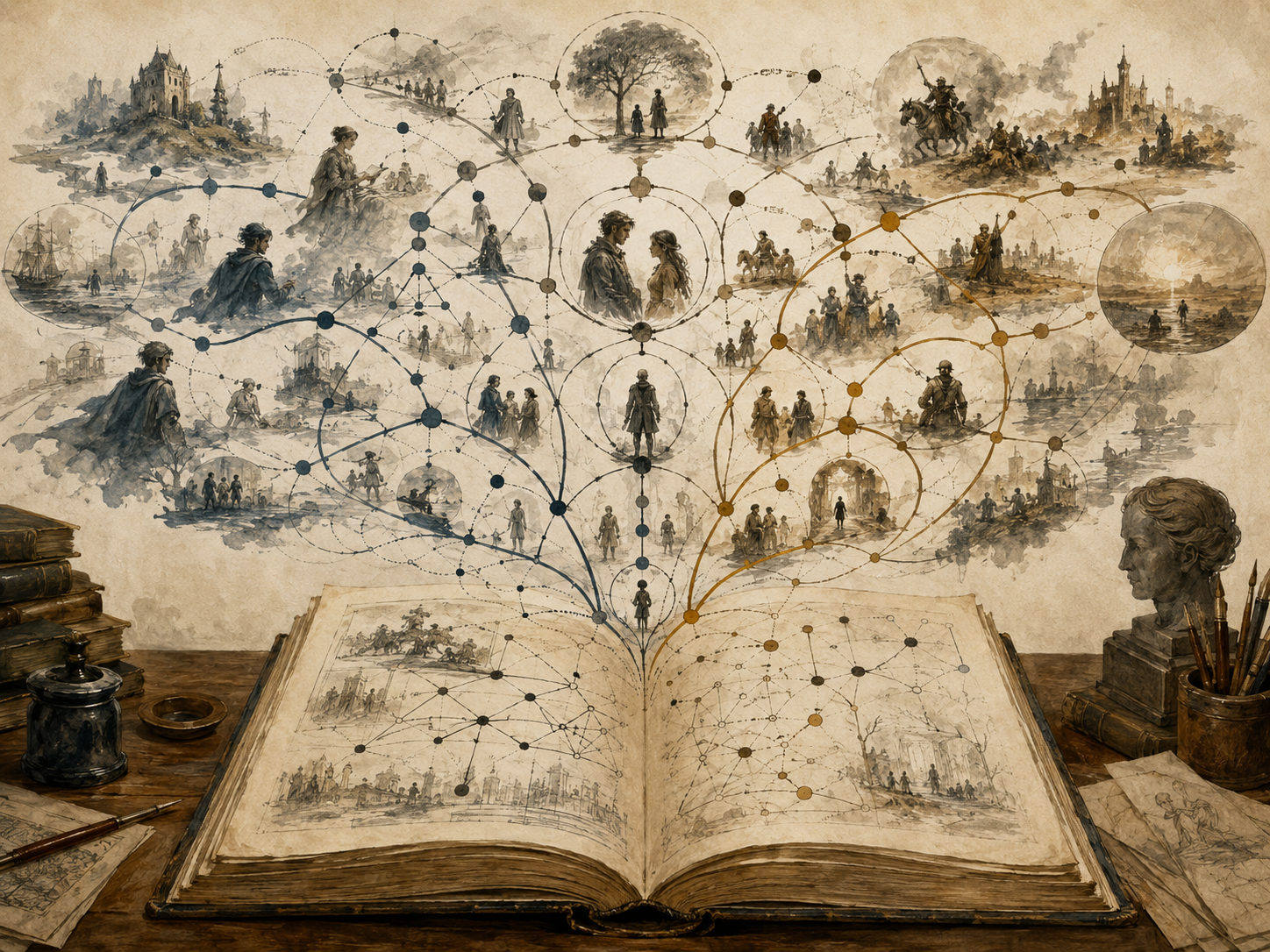
Story structure is often misunderstood as a recipe. But the strongest narrative models do not simply tell writers where to place a twist, climax, reversal, or ending. They help analysts understand how a story holds together: what changes, why it changes, who causes it, what constraints matter, what information the audience receives, what possibilities close, what possibilities open, and what meaning emerges from the system.
Why Narrative Systems Matter
Narrative systems matter because stories rarely work through isolated parts. A character matters because of goals, relationships, constraints, memories, conflicts, and decisions. An event matters because it changes a situation. A setting matters because it defines possibilities. A reversal matters because it reorders what the audience thought was true. An ending matters because it changes the meaning of what came before.
A systems view helps explain how stories produce coherence. It asks how components interact over time. It asks how small changes can create large consequences. It asks how a story’s structure distributes attention, agency, uncertainty, power, and responsibility.
This is especially useful for complex stories: novels with multiple timelines, serialized television, transmedia storyworlds, games, myths, legal narratives, public testimony, organizational narratives, institutional histories, political stories, and AI-generated plots. In each case, the story is not just a line of events. It is a structured field of relations.
| Systems question | Storytelling use | Risk if ignored |
|---|---|---|
| What are the system components? | Identifies characters, events, places, rules, objects, conflicts, and institutions. | The analysis treats story as theme without structure. |
| What changes over time? | Tracks transformation, escalation, reversal, decline, or repair. | The story becomes a list of scenes rather than a process. |
| What causes what? | Clarifies agency, consequence, and coherence. | Events feel arbitrary or merely episodic. |
| What constraints matter? | Shows rules, limits, stakes, costs, and pressures. | Choice becomes abstract or weightless. |
| What feedback loops operate? | Explains repetition, escalation, learning, resistance, or collapse. | Patterns are mistaken for coincidence. |
| What does the audience know? | Models suspense, irony, surprise, mystery, and recognition. | Structure is confused with chronology. |
Narrative systems thinking helps storytellers and analysts see stories as organized transformations, not just expressive sequences.
Story Structure vs. Story Formula
Story structure is not the same as story formula. Structure describes how parts relate. Formula prescribes a fixed pattern. Structure asks what a story is doing. Formula tells a story what it should do before listening to it.
Formula can be useful as a teaching tool, drafting aid, or diagnostic shortcut. Three-act structure, five-act structure, hero’s journey models, Proppian functions, dramatic arcs, beat sheets, quest structures, and escalation patterns can help identify movement. But when formula becomes the master frame, it can flatten stories that organize meaning differently.
A narrative systems approach treats models as instruments, not laws. A model should help reveal relations, not force every story into the same shape. It should be tested against the story’s medium, genre, culture, historical context, audience, and ethical stakes.
| Structure | Formula | Governance question |
|---|---|---|
| Describes relations among story parts. | Prescribes a preferred sequence. | Is the model explaining the story or controlling it? |
| Allows multiple forms of causality and time. | Often assumes linear progression. | Does the story actually work linearly? |
| Can adapt to genre, medium, and culture. | Often travels as a universal template. | What context does the formula erase? |
| Tracks transformation and consequence. | Often tracks expected beats. | Are beats meaningful or merely present? |
| Encourages interpretation. | Encourages compliance. | Does the model improve judgment? |
| Can reveal complexity. | Can reduce complexity. | What does the model fail to see? |
Structure becomes useful when it supports interpretation. Formula becomes dangerous when it replaces interpretation.
Narrative as a System
A narrative system is a set of interdependent story elements that produce change over time. These elements may include characters, goals, conflicts, institutions, environments, objects, memories, secrets, rules, events, audience knowledge, and narrative voice.
The system has boundaries. A short story may define its system around a single conflict. A myth may define its system around cosmic order. A novel may define its system around a family, city, institution, or historical moment. A game may define its system through rules, spaces, quests, resources, and player actions. A public narrative may define its system around collective identity, crisis, and action.
The system also has dynamics. Events alter relationships. Decisions change possibilities. Information shifts audience interpretation. Pressure builds through conflict. Feedback loops repeat and escalate. The storyworld responds to action. Characters learn, fail, adapt, or resist.
| System element | Narrative function | Example question |
|---|---|---|
| Agents | Act, desire, decide, resist, interpret, or suffer consequences. | Who can change the system? |
| States | Define conditions before and after events. | What has changed? |
| Rules | Limit what can happen. | What is possible, forbidden, costly, or required? |
| Events | Trigger change. | Which events transform the story state? |
| Feedback | Creates loops of escalation, learning, punishment, or repair. | What consequences return to shape later action? |
A systems model does not remove artistry. It gives artistry a map of relations, pressures, and consequences.
Story Units: Events, Agents, and States
A story can be modeled through units. The most basic units are events, agents, and states.
An event is a change: someone arrives, learns, leaves, loses, chooses, reveals, betrays, remembers, destroys, repairs, recognizes, or transforms. An agent is a figure capable of action or influence: a person, group, animal, deity, institution, machine, system, environment, or symbolic force. A state is the condition of the storyworld before or after an event: safe or unsafe, hidden or revealed, united or divided, powerful or vulnerable, innocent or compromised, open or closed.
This model is useful because it separates description from transformation. Not every scene changes the story state. Some scenes deepen context, mood, characterization, or theme. But structural scenes usually alter conditions, relations, knowledge, or possibility.
| Unit | Definition | Structural question |
|---|---|---|
| Event | An occurrence that changes the story system. | What changes because this happens? |
| Agent | A person or force capable of action, influence, or interpretation. | Who or what drives change? |
| State | A condition of the storyworld at a given point. | What is true now that was not true before? |
| Goal | A desired state pursued by an agent. | What does the agent want to make true? |
| Constraint | A limit, rule, cost, obstacle, or dependency. | What prevents easy change? |
| Transition | The movement from one state to another. | How does the story cross from before to after? |
Story structure emerges when events transform states through agents acting under constraints.
Causality and Consequence
Causality is one of the central forces of narrative coherence. Audiences usually expect events to matter. Even when a story is fragmented, experimental, nonlinear, or ambiguous, readers and viewers often search for causal relations: because this happened, that became possible; because this was hidden, that choice was made; because someone acted, someone else responded.
Narrative causality is not always simple. A story may include direct causes, delayed causes, mistaken causes, hidden causes, systemic causes, moral consequences, symbolic consequences, and accidental events that become meaningful later. A mystery often withholds causes. A tragedy may reveal that earlier actions created later catastrophe. A political story may show how institutions create conditions no single person controls.
Causality also carries ethical weight. Stories assign responsibility through causal structure. If a story explains harm only through individual weakness, it may hide systems. If it explains harm only through systems, it may hide agency. Responsible narrative modeling asks how causality distributes responsibility.
| Causal type | How it works | Interpretive risk |
|---|---|---|
| Direct cause | One action produces an immediate effect. | May oversimplify complex systems. |
| Delayed cause | Earlier action creates later consequence. | May be missed if chronology is fragmented. |
| Hidden cause | Cause is concealed until recognition or revelation. | Can manipulate if not fairly prepared. |
| Systemic cause | Institutions, rules, environments, or histories produce conditions. | May reduce agency if too totalizing. |
| Misread cause | Characters or audiences assign cause incorrectly. | Can reproduce harmful blame if not corrected. |
| Symbolic cause | Events are linked through meaning rather than mechanics. | Can become vague if no interpretive frame exists. |
Causality is a story’s responsibility map. It tells audiences what the story believes makes change happen.
Characters as Agents
Characters are not only personalities. In a systems model, characters are agents who pursue goals, interpret situations, face constraints, form relationships, carry memory, and change the story state. Their importance depends not only on how interesting they are, but on what kinds of change they can produce or prevent.
A character may act directly, influence others, reveal information, embody a conflict, disrupt a system, preserve a norm, resist change, transmit memory, or serve as a node connecting otherwise separate storylines. Some stories center individual agency. Others center collective agency, institutional agency, divine agency, environmental agency, or distributed agency.
Character modeling is especially useful for complex narratives. It helps distinguish protagonist from focal character, narrator from agent, symbolic figure from decision-maker, and central viewpoint from central structural force.
| Character role | System function | Modeling question |
|---|---|---|
| Protagonist | Organizes major movement of desire, conflict, or transformation. | What system state are they trying to change? |
| Antagonist | Blocks, redirects, or contests change. | What constraint do they represent? |
| Witness | Observes, remembers, testifies, or interprets. | What knowledge do they preserve? |
| Messenger | Transfers information across boundaries. | What changes when information moves? |
| Threshold figure | Controls passage between states, worlds, or identities. | What transition do they authorize or block? |
| Collective agent | Acts as group, institution, crowd, family, or community. | How does agency operate beyond the individual? |
Character modeling should not flatten persons into functions. It should show how agency, relation, and transformation interact.
Storyworlds and System Boundaries
A storyworld is the imagined world in which narrative events make sense. It includes places, histories, social norms, physical laws, institutions, technologies, customs, languages, conflicts, memories, and possibilities. Even realistic stories build storyworlds by selecting which parts of reality matter.
System boundaries define what belongs inside the story’s active world. A family drama may place the household inside the boundary and the wider economy outside, unless financial pressure becomes a major driver. A myth may include gods, ancestors, animals, landforms, and cosmic order inside the boundary. A science fiction narrative may include technology, ecology, government, and species relations. A legal narrative may include evidence, procedure, testimony, and institutional rules.
Boundary choices shape meaning. If a story excludes structural causes, it may overemphasize individual failure. If it excludes interior life, it may overemphasize external action. If it excludes community memory, it may misread personal choice.
| Boundary choice | Story effect | Risk |
|---|---|---|
| Individual boundary | Focuses on personal desire, choice, and transformation. | May hide social or institutional causes. |
| Family boundary | Shows kinship, inheritance, obligation, and memory. | May obscure political or economic systems. |
| Institutional boundary | Shows rules, roles, incentives, and constraints. | May underrepresent interior experience. |
| Ecological boundary | Shows environment, nonhuman agency, and interdependence. | May reduce human conflict if handled abstractly. |
| Cosmic boundary | Connects story to sacred order, fate, or metaphysics. | May be misread if ritual or theological context is ignored. |
| Platform boundary | Includes algorithms, metrics, audience behavior, and visibility systems. | May reduce story to content circulation. |
Storyworld modeling asks what conditions make the story possible and what boundaries shape its meaning.
Temporal Architecture
Narrative time is not only chronology. Stories can begin in the middle, loop backward, withhold causes, repeat events, move through memory, jump across generations, compress years, expand moments, or create parallel timelines. Temporal architecture is the structure of time as the story presents and organizes it.
A systems model distinguishes story time from discourse time. Story time is the chronological sequence of events in the storyworld. Discourse time is the order, pace, and arrangement through which the audience receives those events. Meaning often emerges from the gap between them.
Temporal structure shapes suspense, irony, recognition, trauma, memory, causality, and interpretation. A delayed revelation can transform earlier scenes. A repeated memory can show unresolved harm. A nonlinear structure can model fragmented experience. A slow scene can create moral attention. A time jump can show consequence.
| Temporal device | System function | Effect |
|---|---|---|
| Flashback | Reintroduces prior causes or memories. | Reframes present action. |
| Flashforward | Shows future consequence or possibility. | Creates anticipation or dread. |
| Loop | Repeats situations with variation. | Models learning, entrapment, trauma, or ritual time. |
| Delay | Withholds information or consequence. | Builds suspense, mystery, or recognition. |
| Compression | Summarizes long periods quickly. | Shows change at scale. |
| Expansion | Slows a moment into detailed attention. | Marks significance, perception, or ethical weight. |
Temporal modeling helps explain how stories make time meaningful rather than merely sequential.
Conflict, Pressure, and Feedback
Conflict is often described as opposition, but in narrative systems it is better understood as pressure. Conflict creates force within the story system. It pushes agents to act, reveals values, exposes constraints, escalates choices, and tests whether the system can change.
Conflict can be interpersonal, internal, institutional, ecological, spiritual, political, technological, moral, epistemic, or structural. A story may have several conflicts operating at different scales. A character may face an immediate interpersonal conflict while also navigating a larger institutional system. A community may face environmental pressure that reshapes family, politics, economy, and memory.
Feedback loops occur when consequences return to influence later action. A lie produces suspicion, which produces more lies. A public performance produces reputation, which changes future opportunities. A failed policy produces resistance, which produces harsher enforcement, which produces more resistance. Feedback makes stories dynamic.
| Conflict type | System pressure | Feedback question |
|---|---|---|
| Interpersonal | Desires, loyalties, secrets, or values collide. | How does one response change the next interaction? |
| Internal | A character is divided by fear, desire, memory, or obligation. | What pattern repeats until recognition occurs? |
| Institutional | Rules, roles, incentives, or procedures constrain action. | How do systems reward or punish behavior? |
| Ecological | Environment, scarcity, disaster, or nonhuman systems create pressure. | How do human actions return through environmental consequence? |
| Moral | Competing goods or responsibilities collide. | What costs recur after each compromise? |
| Epistemic | Characters lack, misread, or contest knowledge. | How does misinformation shape later choices? |
Conflict modeling shows that tension is not merely emotional. It is structural pressure moving through a system.
Networks, Relationships, and Social Structure
Many stories are networks. Characters connect through kinship, friendship, rivalry, debt, secrecy, power, mentorship, obligation, betrayal, affection, law, institution, geography, or memory. Plot often moves because information, conflict, trust, objects, or authority travels through these networks.
Network modeling can reveal which characters connect otherwise separate groups, which relationships carry tension, which institutions structure action, which figures are isolated, and which events redistribute power. In ensemble stories, network structure may be more important than individual protagonist movement.
Networks can also show hidden structure. A story may appear to follow one character while actually organizing itself around a family system, political network, criminal network, workplace hierarchy, community memory, or platform audience.
| Network concept | Narrative meaning | Example question |
|---|---|---|
| Node | Character, institution, place, object, or event. | What entities organize the story? |
| Edge | Relationship, exchange, conflict, influence, or information flow. | How are entities connected? |
| Bridge | Node connecting otherwise separate groups. | Who carries information across boundaries? |
| Centrality | Structural importance within the network. | Who matters because of position, not only screen time? |
| Cluster | Group with dense internal relations. | Which social worlds shape the plot? |
| Isolation | Weak or severed relation. | How does exclusion shape agency or knowledge? |
Network modeling helps reveal story structure when causality moves through relation rather than a single plot line.
Plot Models and Structural Patterns
Plot models are useful when they are treated as comparative tools rather than universal laws. Aristotle’s ideas about action, reversal, recognition, and consequence; Propp’s folktale functions; three-act and five-act models; hero’s journey patterns; quest structures; tragedy models; mystery structures; romance structures; and procedural structures all help describe different forms of movement.
A systems approach asks what kind of structure the model captures. Does it model causality? Role functions? Emotional intensity? Knowledge distribution? Ritual passage? Moral reversal? Genre expectation? Audience suspense? Transformation? Social restoration? Failure? Repetition?
No single model captures all stories. Propp’s morphology is powerful for certain folktale structures but should not be treated as a universal theory of all narrative. Three-act structure can clarify dramatic pacing but may distort oral, serial, cyclical, episodic, or interactive stories. Hero models can clarify transformation but may erase collective, tragic, comic, or non-heroic forms.
| Model | Best at showing | Risk |
|---|---|---|
| Aristotelian action | Causal unity, reversal, recognition, and consequence. | May overprivilege dramatic closure. |
| Proppian morphology | Folktale functions and role sequences. | May be overextended beyond its corpus. |
| Three-act structure | Setup, complication, and resolution. | May simplify complex temporal or episodic forms. |
| Hero’s journey | Threshold, trial, transformation, and return. | May impose individual heroic development. |
| Network model | Relations, influence, centrality, and social structure. | May underread language, style, and interiority. |
| State-transition model | System change across events. | May overformalize ambiguity or symbolism. |
A good structural model clarifies what kind of order the story creates. A bad one mistakes one order for all order.
State Change and Transformation
Narrative structure often turns on state change. A story begins with one condition and ends with another. The transformation may involve knowledge, power, identity, relationship, moral order, social position, territory, memory, or possibility.
State change can be external or internal. External state changes include a kingdom restored, a crime solved, a family reunited, a community displaced, a law passed, a war begun, a system collapsed, or a secret revealed. Internal state changes include recognition, grief, maturity, guilt, courage, delusion, faith, doubt, or moral compromise.
Not all stories produce positive transformation. Some show decline, repetition, entrapment, corruption, unresolved tension, cyclical return, or failed repair. A systems model should therefore track direction without assuming progress.
| Transformation type | State before | State after |
|---|---|---|
| Recognition | Misunderstanding, concealment, or ignorance. | Knowledge, revelation, or painful clarity. |
| Restoration | Disorder, loss, exile, or division. | Repair, return, reunion, or renewed order. |
| Corruption | Integrity, innocence, or restraint. | Compromise, guilt, domination, or decay. |
| Liberation | Constraint, captivity, silence, or dependence. | Agency, speech, escape, or new relation. |
| Collapse | Stability, denial, or fragile order. | Failure, rupture, disaster, or exposure. |
| Repetition | Pattern established. | Pattern continues, intensifies, or becomes visible. |
State change gives narrative structure its test: what has become true by the end that was not true at the beginning?
Audience Information and Narrative Knowledge
Narrative systems include audiences. A story controls what audiences know, when they know it, how confident they are, and how their interpretation changes. This is one reason story structure cannot be reduced to chronological events.
A mystery withholds causes. A tragedy may let the audience know more than the character. A thriller restricts information to create suspense. A comedy may depend on mistaken knowledge. A memoir may slowly reinterpret memory. A legal narrative may test evidence. A political narrative may control public interpretation by framing causes and consequences.
Audience knowledge can be modeled as an information system. Each scene changes the audience’s belief state. It confirms, complicates, contradicts, or reframes prior knowledge. A twist is not just a surprise. It is a restructuring of the audience’s model of the storyworld.
| Knowledge device | Audience effect | Structural question |
|---|---|---|
| Suspense | Audience anticipates uncertain outcome. | What future state is feared or desired? |
| Mystery | Audience lacks key causal information. | What past cause must be reconstructed? |
| Dramatic irony | Audience knows more than a character. | How does unequal knowledge create tension? |
| Unreliable narration | Audience questions the telling. | What signals undermine trust? |
| Recognition | Audience or character reinterprets prior events. | What new knowledge changes the system? |
| Ambiguity | Audience must hold multiple interpretations. | What uncertainty is meaningful rather than accidental? |
Story structure is partly the management of knowledge across time.
Computational Narrative Modeling
Computational narrative modeling uses formal methods to represent, analyze, generate, or compare stories. Methods may include event extraction, character networks, causal graphs, sentiment trajectories, topic models, state machines, planning systems, story grammars, knowledge graphs, sequence models, embeddings, and large language models.
These methods can support analysis. They can reveal recurring structures, map character relations, compare variants, detect plot states, identify narrative arcs, model suspense, analyze causality, organize corpora, and produce governance queues for human review. But computational models have limits. They often simplify language, culture, ambiguity, irony, performance, genre, and ethics.
A computational model is not the story. It is a representation of selected features. The most important question is not whether the model is sophisticated, but whether it is appropriate to the interpretive task.
| Computational method | Can help model | Limit |
|---|---|---|
| Event extraction | Actions and changes across text. | May miss implicit, symbolic, or emotional events. |
| Character network | Relationships, centrality, clusters, and bridges. | May treat all interactions as equivalent. |
| Causal graph | Cause, consequence, dependency, and responsibility. | May oversimplify ambiguous causality. |
| Sentiment trajectory | Emotional movement across scenes. | May mistake tone, irony, or genre convention. |
| State machine | Transitions among story conditions. | May flatten memory, style, and symbolic meaning. |
| Language model | Pattern generation and summarization. | May imitate structure without understanding or source accountability. |
Computational narrative modeling is strongest when it makes assumptions visible and keeps interpretation human.
AI and Story Structure Modeling
AI tools can outline stories, classify plot types, summarize arcs, generate character profiles, propose causal chains, detect themes, map relationships, produce branching pathways, and create beat sheets. These tools can support drafting and analysis when used carefully.
But AI also intensifies the risks of formula. It may generate familiar structures because they are common in training data. It may turn cultural traditions into generic archetypes. It may confuse plausibility with coherence. It may fill gaps with invented causes. It may produce emotionally smooth stories that lack ethical, cultural, or causal depth.
AI can also make story modeling look more objective than it is. A generated chart, score, or structure may appear analytical even when it reflects prompt assumptions, dataset bias, genre templates, or hallucinated evidence. Responsible use requires source tracing, model limitations, human review, and attention to what the model cannot see.
| AI story modeling use | Possible benefit | Risk |
|---|---|---|
| Outline generation | Quickly explores possible structures. | Defaults to generic beats and formula. |
| Arc classification | Organizes story movement for review. | Overlabels complex structures. |
| Character modeling | Tracks goals, conflicts, and relations. | Reduces characters to functions or stereotypes. |
| Causal mapping | Clarifies event dependencies. | Invents or oversimplifies causality. |
| Comparative modeling | Compares patterns across corpora. | Flattens cultural difference and archive bias. |
| Story generation | Produces prototypes for human revision. | Creates fluent but shallow narrative systems. |
AI should help model story structure, not become the authority that decides what story structure is.
Ethics of Narrative Modeling
Narrative modeling is ethical because models shape interpretation. A model decides what counts as a component, event, relation, cause, agent, conflict, or transformation. These choices can reveal meaning, but they can also erase it.
A model that focuses only on individual decisions may hide institutions. A model that focuses only on plot beats may hide language, voice, culture, and power. A model that treats all stories as hero journeys may erase collective, tragic, cyclical, non-Western, experimental, or sacred forms. A model that turns testimony into data may strip dignity from lived experience.
Ethical modeling requires fit, transparency, limits, and review. It should state what it models and what it does not. It should preserve context. It should avoid pretending that quantified structure is objective truth. It should respect stories that resist modeling.
| Ethical issue | Question | Warning sign |
|---|---|---|
| Model fit | Does this model suit the story’s genre, medium, culture, and purpose? | The model is applied because it is familiar, not because it fits. |
| Context preservation | What does the model leave out? | Language, performance, culture, or power vanish. |
| Agency allocation | Who or what is allowed to cause change? | Systems or people are erased from responsibility. |
| Formula drift | Does modeling become prescription? | The model tells the story what it must become. |
| Datafication | Are stories being reduced to extractable signals? | Testimony, grief, culture, or memory becomes dataset material. |
| Review | Who checks the model’s assumptions? | Scores are trusted without human interpretation. |
A narrative model is responsible when it helps readers see more clearly while admitting what it cannot see.
Examples of Narrative Systems Analysis
The examples below show how story structure modeling can clarify narrative without forcing formula.
Family novel
Weak: The story is summarized as a protagonist’s personal growth.
Stronger: The model maps inheritance, secrets, kinship ties, economic pressure, memory, and delayed consequences.
Why it works: It treats the family as a narrative system.
Legal narrative
Weak: The story is treated as competing emotional accounts.
Stronger: The model separates testimony, evidence, causality, motive, timeline, uncertainty, and institutional procedure.
Why it works: It shows how narrative assigns responsibility.
Serialized television
Weak: The story is judged by episode-by-episode plot twists.
Stronger: The model tracks season arcs, recurring conflicts, character-state change, world memory, and continuity pressure.
Why it works: It reads long-form structure as cumulative system behavior.
Interactive game
Weak: The story is analyzed only through cutscenes.
Stronger: The model includes rules, quests, player agency, state changes, failure, replay, world systems, and choice consequences.
Why it works: It recognizes procedural structure.
Mythic cycle
Weak: The story is forced into a single hero model.
Stronger: The model tracks cosmic order, ritual repetition, genealogy, place, taboo, transformation, and collective memory.
Why it works: It preserves cultural and structural difference.
AI-generated plot
Weak: The plot is accepted because it has recognizable beats.
Stronger: The workflow audits causality, state change, character agency, world rules, formula drift, stereotype risk, and human review.
Why it works: It distinguishes fluent sequence from coherent narrative system.
Narrative systems analysis asks how story parts interact to produce change, meaning, and consequence.
Mathematics, Computation, and Modeling
Narrative modeling should not reduce story to equations, but mathematical notation can help make assumptions explicit.
A narrative coherence score can estimate whether story components support each other:
N_c = \frac{C_a + S_t + A_g + W_r + T_m + E_q}{6}
\]
Interpretation: Narrative coherence \(N_c\) averages causal alignment \(C_a\), state-transition clarity \(S_t\), agent-goal fit \(A_g\), world-rule consistency \(W_r\), temporal mapping \(T_m\), and evidence quality \(E_q\).
A formula-drift risk score can estimate when modeling becomes template enforcement:
F_d = B_tw_b + U_mw_u + C_lw_c + G_fw_g + M_ow_m + (1 – J_r)w_j
\]
Interpretation: Formula drift \(F_d\) rises with beat-template dependence \(B_t\), universal model claims \(U_m\), context loss \(C_l\), genre flattening \(G_f\), model overconfidence \(M_o\), and weak judgment review \(J_r\).
A causal responsibility balance score can test whether a story overassigns change to individuals or systems:
R_b = 1 – |I_a – S_a|
\]
Interpretation: Responsibility balance \(R_b\) is highest when individual agency \(I_a\) and systemic agency \(S_a\) are both visible where appropriate. A low score suggests one side may be erasing the other.
An AI story-structure risk score can estimate when generated modeling threatens interpretation:
A_r = P_hw_p + C_iw_c + S_tw_s + F_gw_f + B_cw_b + (1 – H_r)w_h
\]
Interpretation: AI story-structure risk \(A_r\) rises with plot hallucination \(P_h\), causal invention \(C_i\), stereotype tendency \(S_t\), formula generation \(F_g\), biased corpus \(B_c\), and weak human review \(H_r\).
| Modeling task | Governance question | Example output |
|---|---|---|
| Narrative coherence audit | Do causality, state change, agents, world rules, time, and evidence align? | Narrative coherence score. |
| Formula-drift audit | Is the model explaining structure or imposing a template? | Formula-drift risk score. |
| Causal responsibility audit | Does the story balance individual and systemic agency? | Responsibility balance score. |
| Network audit | Which relationships, bridges, clusters, and institutions organize the story? | Character-system network profile. |
| State-transition audit | What changes from beginning to end? | Story-state transition map. |
| AI audit | Does generated structure invent causality, rely on formula, or hide bias? | AI story-structure risk score. |
Mathematical modeling is useful when it clarifies assumptions and governance needs; it is harmful when it pretends that structure alone can explain meaning.
Python Workflow: Narrative Systems Governance Audit
The Python workflow below follows the advanced Catalyst Canvas standard: typed records, config-driven scoring, validation, governance notes, Canvas-card exports, CSV outputs, JSON outputs, markdown governance queues, and review priorities. The companion repository version includes the shared `python/catalyst_canvas/` layer plus article-specific data for narrative coherence, formula-drift risk, responsibility balance, network strength, state-transition clarity, and AI story-structure risk.
# run_narrative_systems_governance_audit.py
from __future__ import annotations

from dataclasses import dataclass
from pathlib import Path
import csv
import json
from hashlib import sha256
from statistics import mean
from typing import Any


ARTICLE_ROOT = Path(__file__).resolve().parents[1]
OUTPUTS = ARTICLE_ROOT / "outputs"


@dataclass(frozen=True)
class NarrativeSystemsGovernanceRecord:
    item: str
    modeling_context: str
    causal_alignment: float
    state_transition_clarity: float
    agent_goal_fit: float
    world_rule_consistency: float
    temporal_mapping: float
    evidence_quality: float
    beat_template_dependence: float
    universal_model_claims: float
    context_loss: float
    genre_flattening: float
    model_overconfidence: float
    judgment_review: float
    individual_agency_visibility: float
    systemic_agency_visibility: float
    network_mapping: float
    relationship_specificity: float
    constraint_visibility: float
    feedback_loop_clarity: float
    plot_hallucination: float
    causal_invention: float
    stereotype_tendency: float
    formula_generation: float
    biased_corpus: float
    human_review: float
    public_consequence: float
    owner: str = "editorial"
    status: str = "active"
    notes: str = ""


@dataclass(frozen=True)
class NarrativeSystemsGovernanceConfig:
    article_title: str = "Narrative Systems and Story Structure Modeling"
    article_slug: str = "narrative-systems-and-story-structure-modeling"
    medium_threshold: float = 0.45
    high_threshold: float = 0.62
    allowed_statuses: tuple[str, ...] = ("active", "archive", "review", "revise")


def validate_score(value: float, field_name: str) -> None:
    if value < 0 or value > 1:
        raise ValueError(f"{field_name} must be between 0 and 1.")


def validate_record(record: NarrativeSystemsGovernanceRecord, config: NarrativeSystemsGovernanceConfig) -> None:
    if not record.item.strip():
        raise ValueError("item is required.")
    if not record.modeling_context.strip():
        raise ValueError("modeling_context is required.")
    if record.status not in config.allowed_statuses:
        raise ValueError(f"Invalid status: {record.status}")

    for field_name, value in record.__dict__.items():
        if isinstance(value, float):
            validate_score(value, field_name)


def narrative_coherence(record: NarrativeSystemsGovernanceRecord) -> float:
    return mean([
        record.causal_alignment,
        record.state_transition_clarity,
        record.agent_goal_fit,
        record.world_rule_consistency,
        record.temporal_mapping,
        record.evidence_quality,
    ])


def formula_drift_risk(record: NarrativeSystemsGovernanceRecord) -> float:
    return min(
        1.0,
        record.beat_template_dependence * 0.18
        + record.universal_model_claims * 0.18
        + record.context_loss * 0.18
        + record.genre_flattening * 0.16
        + record.model_overconfidence * 0.16
        + (1 - record.judgment_review) * 0.14,
    )


def responsibility_balance(record: NarrativeSystemsGovernanceRecord) -> float:
    return max(0.0, 1 - abs(record.individual_agency_visibility - record.systemic_agency_visibility))


def network_system_strength(record: NarrativeSystemsGovernanceRecord) -> float:
    return mean([
        record.network_mapping,
        record.relationship_specificity,
        record.constraint_visibility,
        record.feedback_loop_clarity,
        record.agent_goal_fit,
        record.world_rule_consistency,
    ])


def ai_story_structure_risk(record: NarrativeSystemsGovernanceRecord) -> float:
    return min(
        1.0,
        record.plot_hallucination * 0.18
        + record.causal_invention * 0.18
        + record.stereotype_tendency * 0.18
        + record.formula_generation * 0.18
        + record.biased_corpus * 0.16
        + (1 - record.human_review) * 0.12,
    )


def governance_priority_score(record: NarrativeSystemsGovernanceRecord, config: NarrativeSystemsGovernanceConfig) -> float:
    score = (
        formula_drift_risk(record) * 0.22
        + ai_story_structure_risk(record) * 0.22
        + (1 - narrative_coherence(record)) * 0.18
        + (1 - responsibility_balance(record)) * 0.12
        + (1 - network_system_strength(record)) * 0.12
        + record.public_consequence * 0.14
    )

    if record.status == "revise":
        score = max(score, config.high_threshold)
    elif record.status == "review":
        score = max(score, config.medium_threshold)

    return min(1.0, max(0.0, score))


def review_priority(record: NarrativeSystemsGovernanceRecord, config: NarrativeSystemsGovernanceConfig) -> str:
    score = governance_priority_score(record, config)
    if score >= config.high_threshold:
        return "high"
    if score >= config.medium_threshold:
        return "medium"
    return "standard"


def card_id(record: NarrativeSystemsGovernanceRecord, config: NarrativeSystemsGovernanceConfig) -> str:
    raw = f"{config.article_slug}|{record.item}|{record.modeling_context}"
    return sha256(raw.encode("utf-8")).hexdigest()[:16]


def governance_note(record: NarrativeSystemsGovernanceRecord, config: NarrativeSystemsGovernanceConfig) -> str:
    priority = review_priority(record, config)
    notes = []

    if priority == "high":
        notes.append("High-priority narrative systems governance review required.")
    elif priority == "medium":
        notes.append("Medium-priority story structure review recommended.")
    else:
        notes.append("Standard editorial review sufficient.")

    if narrative_coherence(record) < 0.65:
        notes.append("Narrative coherence is limited; strengthen causal alignment, state transitions, agent-goal fit, world rules, temporal mapping, and evidence.")
    if formula_drift_risk(record) >= 0.55:
        notes.append("Formula-drift risk is elevated; review beat-template dependence, universal model claims, context loss, genre flattening, overconfidence, and judgment review.")
    if responsibility_balance(record) < 0.55:
        notes.append("Responsibility balance is weak; review whether individual or systemic agency is being erased.")
    if network_system_strength(record) < 0.65:
        notes.append("Network/system strength is limited; review relationships, constraints, feedback loops, agents, and world rules.")
    if ai_story_structure_risk(record) >= 0.55:
        notes.append("AI story-structure risk is elevated; review plot hallucination, causal invention, stereotype tendency, formula generation, corpus bias, and human review.")
    if record.notes:
        notes.append(record.notes)

    return " ".join(notes)


def canvas_card(record: NarrativeSystemsGovernanceRecord, config: NarrativeSystemsGovernanceConfig) -> dict[str, Any]:
    return {
        "schema_version": "1.0.0",
        "card_id": card_id(record, config),
        "card_type": "narrative_systems_governance",
        "article_title": config.article_title,
        "article_slug": config.article_slug,
        "item": record.item,
        "modeling_context": record.modeling_context,
        "scores": {
            "narrative_coherence": round(narrative_coherence(record), 4),
            "formula_drift_risk": round(formula_drift_risk(record), 4),
            "responsibility_balance": round(responsibility_balance(record), 4),
            "network_system_strength": round(network_system_strength(record), 4),
            "ai_story_structure_risk": round(ai_story_structure_risk(record), 4),
            "governance_priority_score": round(governance_priority_score(record, config), 4),
        },
        "review": {
            "priority": review_priority(record, config),
            "owner": record.owner,
            "status": record.status,
            "governance_note": governance_note(record, config),
        },
    }


def write_csv(path: Path, rows: list[dict[str, Any]]) -> None:
    path.parent.mkdir(parents=True, exist_ok=True)
    fieldnames = list(rows[0].keys())
    with path.open("w", encoding="utf-8", newline="") as handle:
        writer = csv.DictWriter(handle, fieldnames=fieldnames)
        writer.writeheader()
        writer.writerows(rows)


def write_json(path: Path, payload: Any) -> None:
    path.parent.mkdir(parents=True, exist_ok=True)
    path.write_text(json.dumps(payload, indent=2), encoding="utf-8")


def write_markdown_queue(path: Path, rows: list[dict[str, Any]]) -> None:
    path.parent.mkdir(parents=True, exist_ok=True)
    lines = [
        "# Narrative Systems Governance Queue",
        "",
        "| Item | Context | Coherence | Formula drift | Responsibility balance | AI risk | Priority | Owner |",
        "|---|---|---:|---:|---:|---:|---|---|",
    ]

    for row in rows:
        lines.append(
            f"| {row['item']} | {row['modeling_context']} | "
            f"{row['narrative_coherence']} | {row['formula_drift_risk']} | "
            f"{row['responsibility_balance']} | {row['ai_story_structure_risk']} | "
            f"{row['review_priority']} | {row['owner']} |"
        )

    path.write_text("\n".join(lines) + "\n", encoding="utf-8")


def main() -> None:
    config = NarrativeSystemsGovernanceConfig()

    records = [
        NarrativeSystemsGovernanceRecord(
            "Family-system narrative model",
            "modeling kinship, secrets, inheritance, memory, and delayed consequence",
            0.82, 0.78, 0.80, 0.76, 0.74, 0.78,
            0.34, 0.28, 0.32, 0.30, 0.34, 0.82,
            0.72, 0.78,
            0.84, 0.82, 0.76, 0.80,
            0.22, 0.26, 0.30, 0.28, 0.34, 0.88,
            0.82,
            "editorial", "active",
            "Strong narrative systems model; maintain attention to causality, relationships, and feedback."
        ),
        NarrativeSystemsGovernanceRecord(
            "Template-driven hero outline",
            "forcing a complex community story into universal individual transformation beats",
            0.44, 0.50, 0.46, 0.40, 0.48, 0.44,
            0.92, 0.88, 0.82, 0.78, 0.84, 0.38,
            0.74, 0.26,
            0.42, 0.38, 0.44, 0.36,
            0.54, 0.62, 0.70, 0.86, 0.72, 0.44,
            0.88,
            "governance", "revise",
            "Escalate; template capture erases collective agency, system constraints, and genre/context specificity."
        ),
        NarrativeSystemsGovernanceRecord(
            "AI-generated plot map",
            "machine-produced story structure with invented causal links and generic character functions",
            0.38, 0.42, 0.40, 0.36, 0.46, 0.34,
            0.84, 0.82, 0.76, 0.74, 0.86, 0.30,
            0.50, 0.36,
            0.38, 0.34, 0.36, 0.32,
            0.90, 0.86, 0.78, 0.88, 0.82, 0.26,
            0.90,
            "governance", "revise",
            "Escalate; AI model invents causality and relies on formula generation without adequate human review."
        ),
    ]

    rows = []
    cards = []

    for record in records:
        validate_record(record, config)
        cards.append(canvas_card(record, config))
        rows.append({
            "item": record.item,
            "modeling_context": record.modeling_context,
            "narrative_coherence": round(narrative_coherence(record), 4),
            "formula_drift_risk": round(formula_drift_risk(record), 4),
            "responsibility_balance": round(responsibility_balance(record), 4),
            "network_system_strength": round(network_system_strength(record), 4),
            "ai_story_structure_risk": round(ai_story_structure_risk(record), 4),
            "governance_priority_score": round(governance_priority_score(record, config), 4),
            "review_priority": review_priority(record, config),
            "owner": record.owner,
            "status": record.status,
            "governance_note": governance_note(record, config),
        })

    priority_order = {"high": 3, "medium": 2, "standard": 1}
    rows = sorted(
        rows,
        key=lambda row: (
            priority_order.get(str(row["review_priority"]), 0),
            float(row["governance_priority_score"]),
        ),
        reverse=True,
    )

    queue = [row for row in rows if row["review_priority"] != "standard"]
    queue_cards = [card for card in cards if card["review"]["priority"] != "standard"]

    write_csv(OUTPUTS / "tables" / "narrative_systems_governance_audit.csv", rows)
    write_csv(OUTPUTS / "tables" / "narrative_systems_governance_queue.csv", queue)
    write_json(OUTPUTS / "json" / "narrative_systems_governance_canvas_cards.json", cards)
    write_json(OUTPUTS / "json" / "narrative_systems_governance_queue.json", queue_cards)
    write_markdown_queue(OUTPUTS / "markdown" / "narrative_systems_governance_queue.md", queue)

    print("Narrative systems governance audit complete.")


if __name__ == "__main__":
    main()
This workflow helps distinguish responsible story structure modeling from formula drift, weak causality, responsibility imbalance, shallow networks, and AI-generated plot overconfidence.
R Workflow: Story Structure Diagnostics
The R workflow below provides a portable base R diagnostic for narrative coherence, formula-drift risk, responsibility balance, network-system strength, and AI story-structure risk.
# narrative_systems_governance_diagnostics.R
# Base R workflow for Narrative Systems and Story Structure Modeling.

args <- commandArgs(trailingOnly = FALSE)
file_arg <- grep("^--file=", args, value = TRUE)

if (length(file_arg) > 0) {
  script_path <- normalizePath(sub("^--file=", "", file_arg[1]), mustWork = TRUE)
  article_root <- normalizePath(file.path(dirname(script_path), ".."), mustWork = TRUE)
} else {
  article_root <- getwd()
}

setwd(article_root)

tables_dir <- file.path(article_root, "outputs", "tables")
figures_dir <- file.path(article_root, "outputs", "figures")
dir.create(tables_dir, recursive = TRUE, showWarnings = FALSE)
dir.create(figures_dir, recursive = TRUE, showWarnings = FALSE)

records <- data.frame(
  item = c(
    "Family-system narrative model",
    "Template-driven hero outline",
    "AI-generated plot map"
  ),
  modeling_context = c(
    "modeling kinship, secrets, inheritance, memory, and delayed consequence",
    "forcing a complex community story into universal individual transformation beats",
    "machine-produced story structure with invented causal links and generic character functions"
  ),
  causal_alignment = c(0.82, 0.44, 0.38),
  state_transition_clarity = c(0.78, 0.50, 0.42),
  agent_goal_fit = c(0.80, 0.46, 0.40),
  world_rule_consistency = c(0.76, 0.40, 0.36),
  temporal_mapping = c(0.74, 0.48, 0.46),
  evidence_quality = c(0.78, 0.44, 0.34),
  beat_template_dependence = c(0.34, 0.92, 0.84),
  universal_model_claims = c(0.28, 0.88, 0.82),
  context_loss = c(0.32, 0.82, 0.76),
  genre_flattening = c(0.30, 0.78, 0.74),
  model_overconfidence = c(0.34, 0.84, 0.86),
  judgment_review = c(0.82, 0.38, 0.30),
  individual_agency_visibility = c(0.72, 0.74, 0.50),
  systemic_agency_visibility = c(0.78, 0.26, 0.36),
  network_mapping = c(0.84, 0.42, 0.38),
  relationship_specificity = c(0.82, 0.38, 0.34),
  constraint_visibility = c(0.76, 0.44, 0.36),
  feedback_loop_clarity = c(0.80, 0.36, 0.32),
  plot_hallucination = c(0.22, 0.54, 0.90),
  causal_invention = c(0.26, 0.62, 0.86),
  stereotype_tendency = c(0.30, 0.70, 0.78),
  formula_generation = c(0.28, 0.86, 0.88),
  biased_corpus = c(0.34, 0.72, 0.82),
  human_review = c(0.88, 0.44, 0.26),
  public_consequence = c(0.82, 0.88, 0.90),
  owner = c("editorial", "governance", "governance"),
  status = c("active", "revise", "revise"),
  stringsAsFactors = FALSE
)

records$narrative_coherence <- rowMeans(records[, c(
  "causal_alignment",
  "state_transition_clarity",
  "agent_goal_fit",
  "world_rule_consistency",
  "temporal_mapping",
  "evidence_quality"
)])

records$formula_drift_risk <- pmin(
  1,
  records$beat_template_dependence * 0.18 +
    records$universal_model_claims * 0.18 +
    records$context_loss * 0.18 +
    records$genre_flattening * 0.16 +
    records$model_overconfidence * 0.16 +
    (1 - records$judgment_review) * 0.14
)

records$responsibility_balance <- pmax(
  0,
  1 - abs(records$individual_agency_visibility - records$systemic_agency_visibility)
)

records$network_system_strength <- rowMeans(records[, c(
  "network_mapping",
  "relationship_specificity",
  "constraint_visibility",
  "feedback_loop_clarity",
  "agent_goal_fit",
  "world_rule_consistency"
)])

records$ai_story_structure_risk <- pmin(
  1,
  records$plot_hallucination * 0.18 +
    records$causal_invention * 0.18 +
    records$stereotype_tendency * 0.18 +
    records$formula_generation * 0.18 +
    records$biased_corpus * 0.16 +
    (1 - records$human_review) * 0.12
)

records$governance_priority_score <- pmin(
  1,
  records$formula_drift_risk * 0.22 +
    records$ai_story_structure_risk * 0.22 +
    (1 - records$narrative_coherence) * 0.18 +
    (1 - records$responsibility_balance) * 0.12 +
    (1 - records$network_system_strength) * 0.12 +
    records$public_consequence * 0.14
)

records$review_priority <- ifelse(
  records$status == "revise" | records$governance_priority_score >= 0.62,
  "high",
  ifelse(
    records$status == "review" | records$governance_priority_score >= 0.45,
    "medium",
    "standard"
  )
)

records <- records[order(records$governance_priority_score, decreasing = TRUE), ]

write.csv(records, file.path(tables_dir, "narrative_systems_governance_diagnostics.csv"), row.names = FALSE)
write.csv(records[records$review_priority != "standard", ], file.path(tables_dir, "narrative_systems_governance_queue.csv"), row.names = FALSE)

png(file.path(figures_dir, "narrative_coherence_scores.png"), width = 1200, height = 700)
barplot(
  records$narrative_coherence,
  names.arg = records$item,
  las = 2,
  ylab = "Narrative coherence",
  main = "Narrative Coherence"
)
grid()
dev.off()

png(file.path(figures_dir, "formula_drift_risk_scores.png"), width = 1200, height = 700)
barplot(
  records$formula_drift_risk,
  names.arg = records$item,
  las = 2,
  ylab = "Formula-drift risk",
  main = "Formula-Drift Risk"
)
grid()
dev.off()

print(records[, c(
  "item",
  "modeling_context",
  "narrative_coherence",
  "formula_drift_risk",
  "responsibility_balance",
  "ai_story_structure_risk",
  "review_priority"
)])
This workflow helps distinguish coherent story modeling from template capture, weak causality, responsibility imbalance, and AI structure overconfidence.
GitHub Repository
The companion repository for this article supports narrative systems and story structure modeling as a Catalyst Canvas-ready module. It includes advanced additive `python/catalyst_canvas/` governance infrastructure, article-specific narrative systems data, config-driven scoring, validation, governance notes, Canvas card generation, CSV/JSON/markdown exporters, CLI workflows, smoke tests, unit tests, R diagnostics, SQL structures, documentation, and reusable story-structure modeling templates.
Complete Code Repository
Companion repository for the article, including advanced Catalyst Canvas-ready code for narrative coherence, formula-drift risk, responsibility balance, network-system strength, AI story-structure risk, JSON exports, Canvas cards, governance queues, and reproducible research workflows.
articles/narrative-systems-and-story-structure-modeling/
├── canvas/
│   ├── canvas_manifest.json
│   ├── input_schema.json
│   ├── output_schema.json
│   ├── catalyst_canvas_config.json
│   ├── catalyst_canvas_manifest.json
│   ├── catalyst_canvas_cards.json
│   └── catalyst_canvas_governance_queue.json
├── html/
├── css/
├── php/
├── java/
├── python/
│   ├── catalyst_canvas/
│   │   ├── __init__.py
│   │   ├── __main__.py
│   │   ├── cli.py
│   │   ├── models.py
│   │   ├── scoring.py
│   │   ├── validation.py
│   │   ├── governance.py
│   │   └── exporters.py
│   ├── narrative_systems_governance_canvas/
│   │   ├── __init__.py
│   │   ├── models.py
│   │   ├── scoring.py
│   │   ├── validation.py
│   │   ├── governance.py
│   │   └── exporters.py
│   ├── tests/
│   │   ├── test_catalyst_canvas.py
│   │   └── test_narrative_systems_governance_canvas.py
│   ├── run_catalyst_canvas_audit.py
│   └── run_narrative_systems_governance_audit.py
├── r/
│   ├── narrative_systems_governance_diagnostics.R
│   └── run_all_narrative_systems_governance_workflows.R
├── sql/
│   ├── canvas_schema.sql
│   └── canvas_queries.sql
├── docs/
│   ├── article_notes.md
│   ├── modeling_principles.md
│   ├── why_narrative_systems_matter.md
│   ├── story_structure_vs_story_formula.md
│   ├── narrative_as_a_system.md
│   ├── story_units_events_agents_and_states.md
│   ├── causality_and_consequence.md
│   ├── characters_as_agents.md
│   ├── storyworlds_and_system_boundaries.md
│   ├── temporal_architecture.md
│   ├── conflict_pressure_and_feedback.md
│   ├── networks_relationships_and_social_structure.md
│   ├── plot_models_and_structural_patterns.md
│   ├── state_change_and_transformation.md
│   ├── audience_information_and_narrative_knowledge.md
│   ├── computational_narrative_modeling.md
│   ├── ai_and_story_structure_modeling.md
│   ├── ethics_of_narrative_modeling.md
│   ├── ethical_risk.md
│   ├── responsible_use.md
│   ├── governance_notes.md
│   └── catalyst_canvas_upgrade_notes.md
├── data/
│   ├── narrative_systems_governance_claims.csv
│   ├── narrative_coherence_notes.csv
│   ├── formula_drift_notes.csv
│   ├── responsibility_balance_notes.csv
│   ├── ai_story_structure_risk_notes.csv
│   └── catalyst_canvas_assessment.csv
├── outputs/
│   ├── figures/
│   ├── json/
│   ├── markdown/
│   └── tables/
├── notebooks/
├── shared/
│   ├── schemas/
│   ├── narrative-templates/
│   ├── story-archetypes/
│   ├── character-models/
│   ├── plot-structures/
│   ├── rhetorical-frameworks/
│   ├── cultural-memory/
│   ├── narrative-systems-governance/
│   └── governance/
├── tests/
└── README.md
Related Articles
- Storytelling in Comparative Perspective
- Rhetorical Moves and the Ethics of Persuasive Story
- Plot, Action, and Narrative Coherence
- Conflict, Tension, and the Logic of Narrative Movement
- Reversal, Recognition, and Transformation
- Games, Interactivity, and Branching Narrative
A Practical Method for Modeling Story Structure
1. Define the modeling purpose
Ask whether the model is for interpretation, drafting, comparison, teaching, governance, computation, or revision.
2. Identify the story system
Name the agents, events, states, settings, rules, conflicts, relationships, institutions, memories, and audience information.
3. Set system boundaries
Decide what belongs inside the active storyworld and what remains background context.
4. Map state changes
Track what changes from beginning to end: knowledge, power, identity, relation, order, memory, or possibility.
5. Map causality
Identify direct, delayed, hidden, systemic, symbolic, and misread causes.
6. Model agency
Ask who or what can produce change: individuals, collectives, institutions, environments, technologies, gods, platforms, or systems.
7. Track time and knowledge
Separate story chronology from presentation order, pacing, suspense, mystery, irony, and recognition.
8. Map relationships and networks
Identify bridges, clusters, central figures, isolated nodes, institutions, and information paths.
9. Test model fit
Ask whether the chosen structure clarifies the story or forces it into formula.
10. Audit AI and computational outputs
Check for plot hallucination, invented causality, generic beats, stereotype, missing context, and weak human review.
The method treats story modeling as disciplined interpretation, not mechanical reduction.
Common Pitfalls
Several pitfalls appear when narrative systems are modeled too mechanically.
- Formula capture: Forcing stories into familiar beat sheets before understanding their own structure.
- Plot-only modeling: Ignoring voice, language, setting, relation, performance, and audience knowledge.
- Causality simplification: Treating complex systems as single causes.
- Agency erasure: Overemphasizing individuals while hiding systems, or overemphasizing systems while hiding choice.
- Character functionalism: Reducing characters to roles rather than agents with memory, relation, and interiority.
- World-rule neglect: Ignoring the rules, constraints, and boundaries that define possible action.
- Network overconfidence: Treating centrality, frequency, or connection count as interpretation by itself.
- Computational reduction: Treating extracted events, sentiment arcs, or graphs as the story itself.
- AI structure fluency: Mistaking a polished generated outline for a coherent narrative system.
- Ethical blindness: Modeling testimony, culture, trauma, or public memory as data without governance.
The central pitfall is mistaking model clarity for story truth.
Why Narrative Modeling Requires Judgment
Narrative systems and story structure modeling can clarify how stories work. It can show how events cause change, how characters act under constraint, how worlds define possibility, how time controls interpretation, how networks carry conflict, and how audiences update knowledge. It can help writers revise, teachers explain, researchers compare, institutions govern, and computational systems analyze.
But narrative modeling also has limits. A model is not the story. It is a disciplined simplification. It highlights some relations and excludes others. It can reveal structure, but it can also impose formula. It can clarify causality, but it can also invent or overstate it. It can support ethical review, but it can also turn lived experience into extractable pattern.
The strongest narrative models remain humble. They make assumptions visible. They preserve context. They allow multiple forms of agency. They distinguish structure from formula. They invite human interpretation. They let stories resist the model.
Story structure is not a cage. It is a way of seeing how meaning moves through a system.
Further Reading
- Abbott, H.P. (2021) The Cambridge Introduction to Narrative. 3rd edn. Cambridge: Cambridge University Press.
- Bal, M. (2017) Narratology: Introduction to the Theory of Narrative. 4th edn. Toronto: University of Toronto Press.
- Chatman, S. (1978) Story and Discourse: Narrative Structure in Fiction and Film. Ithaca: Cornell University Press.
- Chen, J. et al. (2024) ‘The causal structure and computational value of narratives’, Trends in Cognitive Sciences. Available at: https://pmc.ncbi.nlm.nih.gov/articles/PMC11305923/
- Genette, G. (1980) Narrative Discourse: An Essay in Method. Ithaca: Cornell University Press.
- Herman, D. (2002) Story Logic: Problems and Possibilities of Narrative. Lincoln: University of Nebraska Press. Available at: https://books.google.com/books/about/Story_Logic.html?id=6jAy0Yml51gC
- Herman, D. (2013) Storytelling and the Sciences of Mind. Cambridge, MA: MIT Press. Available at: https://direct.mit.edu/books/monograph/2225/Storytelling-and-the-Sciences-of-Mind
- Jahn, M. (2021) Narratology: A Guide to the Theory of Narrative. University of Cologne. Available at: https://www.uni-koeln.de/~ame02/pppn.htm
- Min, S. and Park, J. (2016) ‘Mapping Out Narrative Structures and Dynamics Using Networks and Textual Information’. Available at: https://arxiv.org/abs/1604.03029
- Propp, V. (1968) Morphology of the Folktale. 2nd edn. Austin: University of Texas Press. Available at: https://utpress.utexas.edu/9780292783768/
- Ryan, M.-L. (1991) Possible Worlds, Artificial Intelligence, and Narrative Theory. Bloomington: Indiana University Press.
- Ryan, M.-L. (2022) A New Anatomy of Storyworlds: What Is, What If, As If. Columbus: The Ohio State University Press. Available at: https://ohiostatepress.org/books/titles/9780814215081.html
References
- Abbott, H.P. (2021) The Cambridge Introduction to Narrative. 3rd edn. Cambridge: Cambridge University Press.
- Bal, M. (2017) Narratology: Introduction to the Theory of Narrative. 4th edn. Toronto: University of Toronto Press.
- Chatman, S. (1978) Story and Discourse: Narrative Structure in Fiction and Film. Ithaca: Cornell University Press.
- Chen, J. et al. (2024) ‘The causal structure and computational value of narratives’, Trends in Cognitive Sciences. Available at: https://pmc.ncbi.nlm.nih.gov/articles/PMC11305923/
- Forster, E.M. (1927) Aspects of the Novel. London: Edward Arnold.
- Genette, G. (1980) Narrative Discourse: An Essay in Method. Ithaca: Cornell University Press.
- Herman, D. (2002) Story Logic: Problems and Possibilities of Narrative. Lincoln: University of Nebraska Press. Available at: https://books.google.com/books/about/Story_Logic.html?id=6jAy0Yml51gC
- Herman, D. (2013) Storytelling and the Sciences of Mind. Cambridge, MA: MIT Press. Available at: https://direct.mit.edu/books/monograph/2225/Storytelling-and-the-Sciences-of-Mind
- Jahn, M. (2021) Narratology: A Guide to the Theory of Narrative. University of Cologne. Available at: https://www.uni-koeln.de/~ame02/pppn.htm
- Min, S. and Park, J. (2016) ‘Mapping Out Narrative Structures and Dynamics Using Networks and Textual Information’. Available at: https://arxiv.org/abs/1604.03029
- Propp, V. (1968) Morphology of the Folktale. 2nd edn. Austin: University of Texas Press. Available at: https://utpress.utexas.edu/9780292783768/
- Ryan, M.-L. (1991) Possible Worlds, Artificial Intelligence, and Narrative Theory. Bloomington: Indiana University Press.
- Ryan, M.-L. (2022) A New Anatomy of Storyworlds: What Is, What If, As If. Columbus: The Ohio State University Press. Available at: https://ohiostatepress.org/books/titles/9780814215081.html
- Vijayaraghavan, P. and Roy, D. (2023) ‘M-SENSE: Modeling Narrative Structure in Short Personal Narratives Using Protagonist’s Mental Representations’. Available at: https://arxiv.org/abs/2302.09418