
Last Updated June 11, 2026
National narratives are stories about belonging, memory, identity, sacrifice, loss, conflict, responsibility, and future. They tell people who “we” are, where “we” came from, what “we” have endured, what “we” owe, and what “we” must defend, repair, remember, or become. These stories are not only found in official speeches. They live in monuments, museums, textbooks, holidays, flags, maps, archives, school rituals, public apologies, historical commissions, oral histories, family memory, media systems, and digital platforms.
National Narratives and the Politics of Memory examines how nations remember, forget, commemorate, dispute, teach, archive, and revise the past. It treats national memory as powerful and contested: collective memory can create solidarity and responsibility, but it can also erase violence, simplify conflict, sanctify state power, marginalize minority memory, or convert history into myth. The article asks how national stories shape public judgment and how memory politics can be governed responsibly.
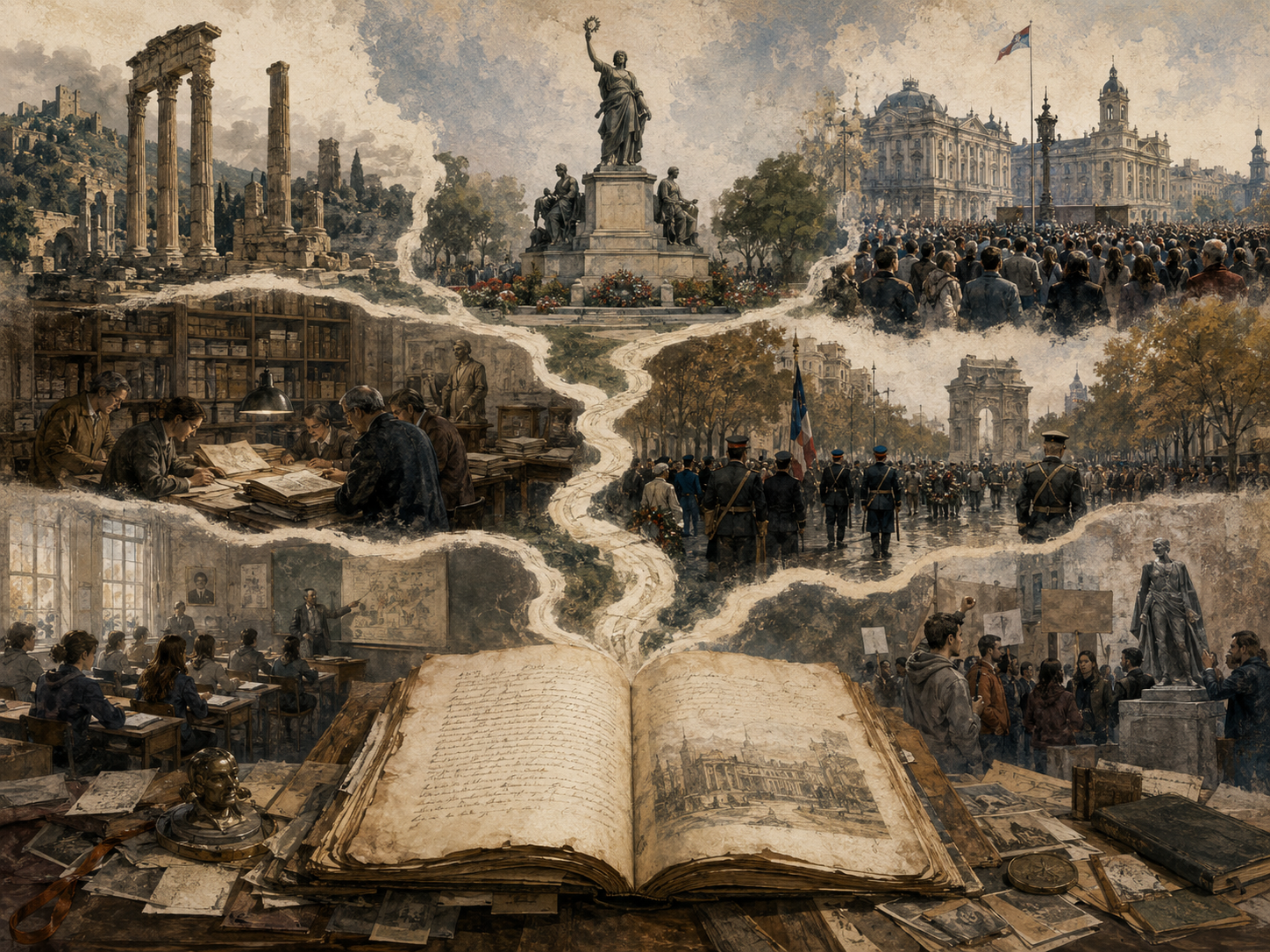
This article does not assume that national memory is automatically false or automatically noble. Nations need shared memory to create responsibility across generations. But memory becomes political because every act of public remembrance selects, orders, honors, omits, and interprets. The ethical question is not whether nations tell stories, but whether those stories remain accountable to evidence, plurality, harm, dignity, and revision.
Why National Narratives Matter
National narratives matter because nations are not experienced only through law, territory, citizenship, or institutions. They are experienced through stories of origin, struggle, sacrifice, belonging, betrayal, renewal, promise, and destiny. These stories help people understand what membership means and what responsibilities may follow from it.
A national narrative can create solidarity across strangers. It can connect generations who never meet. It can preserve warnings about violence, oppression, failure, and repair. It can support democratic responsibility by reminding citizens that public life has a history and that institutions are inherited, contested, and changeable.
The same narrative power can also distort public judgment. A national story may turn history into a moral drama with innocent heroes and permanent enemies. It may present the nation as victim, savior, chosen people, wounded body, unfinished promise, or sacred inheritance. These forms can support responsibility, but they can also justify resentment, exclusion, denial, or violence.
| National narrative function | Constructive use | Risk |
|---|---|---|
| Belonging | Creates civic identity and shared responsibility. | Defines outsiders or minorities as less national. |
| Memory | Preserves historical lessons and public obligations. | Selectively remembers glory while forgetting harm. |
| Legitimacy | Explains why institutions deserve trust. | Sanctifies state power beyond criticism. |
| Education | Teaches civic history and public responsibility. | Turns textbooks into national mythmaking. |
| Commemoration | Honors sacrifice, grief, and public inheritance. | Uses ritual to close debate. |
| Future | Imagines common purpose and repair. | Promises renewal through purification or exclusion. |
National narratives are powerful because they link memory to membership.
Nation as Imagined Community
A nation is partly a political and legal structure, but it is also an imagined community. Most members of a nation will never meet one another, yet they can imagine themselves as connected through language, history, territory, institutions, symbols, media, ritual, conflict, and memory.
This imagination is not inherently false. It is a social and narrative achievement. A nation becomes thinkable through maps, newspapers, schools, archives, ceremonies, laws, borders, public holidays, military memory, memorial sites, museums, and shared media. These forms help produce a sense of simultaneous belonging among people who live separate lives.
The political problem is that imagined community can become imagined sameness. National narratives may suggest that one language, one religion, one ethnicity, one founding group, one historical wound, one heroic struggle, or one cultural memory represents the whole nation. Responsible national storytelling must distinguish shared civic belonging from enforced memory.
| Narrative device | How it imagines the nation | Governance question |
|---|---|---|
| Map | Makes territory visible as a single whole. | Whose land, borders, displacement, and claims are hidden? |
| Newspaper or media feed | Creates shared public time. | Whose events become national events? |
| School curriculum | Teaches common history. | Does common memory allow critical inquiry? |
| Flag or anthem | Condenses belonging into symbol and ritual. | Can dissent coexist with respect? |
| National holiday | Repeats a story through calendar time. | What counter-memories appear on the same date? |
| Founding myth | Gives the nation a beginning and purpose. | Who is absent from the founding imagination? |
The nation is imagined through narrative forms that make strangers feel historically connected.
Collective Memory and National Identity
Collective memory is not the sum of private memories. It is socially organized memory. Groups remember through families, schools, rituals, institutions, museums, monuments, archives, media, songs, anniversaries, and public language. National identity depends on these shared frameworks of remembering.
Collective memory is selective. A nation remembers some events as foundational and treats others as marginal, shameful, local, foreign, or irrelevant. It names certain figures as heroes, martyrs, founders, liberators, reformers, victims, traitors, or enemies. It turns dates into public markers and places into memory sites.
The politics of memory emerges because groups within the same nation often remember differently. A war may be remembered as liberation by one group and occupation by another. A founder may be honored by one public and condemned by another. A monument may be heritage for some and humiliation for others. A national holiday may feel like belonging to one group and erasure to another.
| Memory layer | National role | Conflict point |
|---|---|---|
| Family memory | Transfers stories across generations. | May conflict with official history. |
| School memory | Creates civic literacy and shared references. | May reproduce simplified master narratives. |
| Commemorative memory | Repeats public meaning through ritual. | May freeze one interpretation. |
| Archival memory | Preserves evidence for later review. | May reflect state power or preservation bias. |
| Minority memory | Preserves experiences excluded from national myth. | May be treated as divisive rather than corrective. |
| Digital memory | Circulates remembrance through platforms and search. | May amplify conflict or flatten context. |
National identity becomes responsible when collective memory remains plural enough to tell the truth.
Memory, History, and Myth
Memory, history, and myth are related but not identical. Memory is lived, inherited, emotional, partial, and socially situated. History is a disciplined reconstruction of the past through evidence, method, argument, interpretation, and revision. Myth is a meaning-making story that may condense identity, moral order, destiny, or collective purpose.
National narratives often blend all three. A public commemoration may draw on archival history, living memory, and mythic symbolism. A textbook may combine evidence-based history with national framing. A monument may claim to preserve history while functioning as mythic civic instruction.
The ethical problem is not that national stories contain meaning. The problem is when myth replaces evidence, when memory refuses historical correction, or when history is treated as betrayal because it complicates national pride.
| Mode | Primary function | Public risk |
|---|---|---|
| Memory | Preserves lived or inherited meaning. | Can become selective, defensive, or exclusive. |
| History | Tests claims through evidence and method. | Can become inaccessible or detached from public meaning. |
| Myth | Condenses collective identity and moral order. | Can sanctify power or turn conflict into destiny. |
| Archive | Preserves records and evidence. | Can reflect state selection or silence. |
| Commemoration | Turns memory into public ritual. | Can settle debate too quickly. |
| Education | Transfers civic memory across generations. | Can convert national identity into official doctrine. |
A mature national narrative lets memory, history, and myth correct one another.
Sites of Memory: Monuments, Museums, Archives, and Rituals
National memory is anchored in sites. A site of memory may be a monument, battlefield, grave, museum, archive, school, public square, border, prison, ruin, memorial wall, capital building, national park, holiday, song, document, photograph, trial record, or digital archive.
Sites of memory matter because they give abstract national stories material form. They tell people where to stand, what to look at, whom to honor, what to mourn, and what to consider historically important. They are not neutral. Their placement, design, funding, labels, inscriptions, omissions, and rituals shape public interpretation.
A monument can honor sacrifice, but it can also preserve domination. A museum can educate, but it can also curate innocence. An archive can enable accountability, but it can also hide through classification, metadata, access restrictions, or selective preservation.
| Memory site | Public function | Critical question |
|---|---|---|
| Monument | Makes selected memory visible in public space. | Who is honored, and who must live with that honor? |
| Museum | Curates objects and interpretation. | Does the exhibit invite complexity or national innocence? |
| Archive | Preserves evidence and records. | Who controls selection, description, and access? |
| Holiday | Repeats memory through calendar ritual. | What alternative memories attach to the date? |
| Battlefield or memorial | Places sacrifice in landscape. | Does mourning become justification? |
| Digital collection | Expands access to memory materials. | Does search make selected memory appear complete? |
Sites of memory turn the national past into public space, public ritual, and public authority.
Textbooks and Civic Education
School is one of the most important institutions of national memory. Textbooks, curricula, exams, classroom rituals, maps, timelines, portraits, field trips, and civic ceremonies teach students not only what happened, but what counts as nationally meaningful.
History education can give students the tools to understand evidence, causation, conflict, responsibility, and change. It can help young people ask how national institutions developed, how rights expanded or contracted, how violence occurred, how communities resisted, and how public memory changes.
It can also flatten history into a master narrative. A textbook may overemphasize national progress, heroism, unity, and destiny while minimizing colonization, racial violence, class conflict, gender exclusion, religious conflict, regional inequality, forced migration, or minority experience. In that case, civic education becomes memory management rather than historical education.
| Educational element | Responsible use | Risk |
|---|---|---|
| Timeline | Shows sequence, causation, and change. | Turns history into inevitable national progress. |
| Textbook | Provides shared civic knowledge. | Centers a simplified national master story. |
| Primary source | Teaches evidence and interpretation. | Can be selected to confirm official memory. |
| Map | Shows territory and political change. | Naturalizes borders or erases displacement. |
| Civic ceremony | Creates shared belonging. | Makes dissent appear unpatriotic. |
| Exam standard | Creates accountability for learning. | Rewards memorized national doctrine over inquiry. |
Civic education is strongest when it teaches students how to examine national memory, not merely repeat it.
Heroic Memory and Sacrifice
National narratives often rely on heroic memory. Heroes condense values into figures. They give citizens faces, names, acts, and stories through which courage, sacrifice, resistance, service, invention, reform, or martyrdom can be remembered.
Heroic memory can be valuable. It can preserve examples of moral courage and public service. It can help communities remember that institutions and rights are not abstract; they were built, defended, challenged, and repaired by people under pressure.
But heroic memory has limits. It can reduce collective labor to a single figure. It can hide complicity, contradiction, or harm. It can make the nation appear innocent because its heroes are foregrounded and its victims are backgrounded. It can also demand reverence where analysis is needed.
Sacrifice stories require special care. A nation may honor war dead, martyrs, victims, or public servants, but sacrifice can be used to prevent criticism. The fact that people suffered for a nation does not automatically justify everything done in the nation’s name.
| Heroic-memory pattern | Value | Risk |
|---|---|---|
| Founder hero | Personifies origin and public purpose. | Erases collaborators, contradictions, and exclusions. |
| Military hero | Honors courage and sacrifice. | Turns mourning into militarized legitimacy. |
| Resistance hero | Preserves struggle against injustice. | Can simplify movements into individual greatness. |
| Martyr | Marks suffering and witness. | Can glorify suffering or demand unquestioned loyalty. |
| Reformer | Shows change is possible. | Can make reform appear complete too quickly. |
| National victim | Preserves wound and injustice. | Can turn victimhood into permanent innocence. |
Heroic memory should inspire responsibility, not replace historical complexity.
Trauma, Loss, and Public Mourning
National memory often forms around loss. War, genocide, slavery, colonization, forced migration, famine, terrorism, state violence, civil conflict, disaster, assassination, and public tragedy become part of national story. Public mourning can preserve dignity, grief, warning, and collective responsibility.
Trauma memory is politically powerful because it can define national identity around injury. A nation may tell itself that it survived catastrophe, was betrayed, was humiliated, was liberated, was reborn, or must never allow certain harms again.
These narratives can support justice and prevention. They can also become dangerous when trauma is mobilized to justify revenge, militarization, exclusion, denial of others’ suffering, or permanent emergency. The ethical task is to remember harm truthfully without turning memory into entitlement to harm others.
| Mourning practice | Constructive role | Risk |
|---|---|---|
| Memorial ceremony | Creates public space for grief and recognition. | Can become ritual closure without repair. |
| Survivor testimony | Preserves lived memory and warning. | Can be consumed as spectacle. |
| National day of remembrance | Repeats public obligation across generations. | May exclude other losses from national attention. |
| Truth commission | Builds public record after harm. | Can substitute narrative acknowledgment for justice. |
| School lesson | Transfers warning and evidence. | Can simplify causes into moral lesson alone. |
| Public monument | Makes loss visible. | Can freeze victimhood into identity. |
National mourning becomes responsible when grief is connected to truth, prevention, and repair.
Selective Forgetting and Erasure
Nations remember by forgetting. Some forgetting is unavoidable; no public narrative can contain every event. But selective forgetting becomes political when it protects power, innocence, territorial claims, national myths, or institutional legitimacy.
Erasure can occur through silence, euphemism, textbook omission, archive restriction, monument placement, museum framing, renaming, destruction of records, dismissal of testimony, or repetition of a single master narrative. It can also occur through overgeneralization: a nation may say “we all suffered” in a way that hides who caused harm and who bore its cost.
Erasure is not only a past-tense problem. It shapes present belonging. Groups whose memory is excluded from national story may be treated as peripheral, ungrateful, foreign, disruptive, or divisive when they ask for recognition.
| Forgetting pattern | How it works | Governance response |
|---|---|---|
| Textbook omission | Leaves certain harms or groups outside the national story. | Review curriculum for evidence, plurality, and affected memory. |
| Commemorative saturation | Repeats heroic memory until alternatives disappear. | Audit monuments, holidays, and public rituals. |
| Archive silence | Records are absent, restricted, mislabeled, or under-described. | Improve preservation, metadata, access, and community archives. |
| Victimhood monopolization | One group’s suffering becomes the only recognized wound. | Make room for multiple histories without false equivalence. |
| National innocence story | Harm is blamed on outsiders or isolated exceptions. | Trace institutions, laws, incentives, and complicity. |
| Reconciliation shortcut | Unity is demanded before truth or repair. | Separate symbolic unity from material justice. |
Selective forgetting protects national comfort by making certain memories harder to speak.
Countermemory and Contested Belonging
Countermemory names forms of remembrance that challenge official national story. It may come from Indigenous communities, formerly colonized groups, enslaved peoples’ descendants, migrants, refugees, religious minorities, regional communities, political dissidents, workers, women’s movements, disability communities, LGBTQ communities, survivors, veterans, or displaced communities.
Countermemory is often described as divisive because it interrupts a settled story. But it may be more accurate to say that countermemory reveals that the story was never settled for everyone. It challenges the assumption that one national memory can stand for all national experience.
Responsible national storytelling does not treat countermemory as an enemy of belonging. It treats it as a test of whether national belonging is broad enough to include truth. The goal is not endless fragmentation, but a more mature public memory that can hold conflict without denying shared civic responsibility.
| Countermemory form | What it challenges | Public value |
|---|---|---|
| Community archive | Official record selection. | Preserves memory outside state control. |
| Alternative commemoration | Dominant holidays or monuments. | Marks losses and struggles excluded from national ritual. |
| Oral history | Elite or written-only memory. | Preserves lived experience and local interpretation. |
| Protest at memory site | Sanctified public space. | Reopens debate about honor and harm. |
| Curriculum revision | Master narrative in education. | Improves historical literacy and plural memory. |
| Artistic intervention | Fixed symbolic order. | Makes suppressed memory visible through form. |
Countermemory is not memory against the nation; it can be memory demanding a more truthful nation.
Memory Laws, Commissions, and State Power
States often intervene in memory. They create holidays, name public places, fund museums, authorize memorials, open or close archives, regulate school curricula, establish truth commissions, pass recognition laws, criminalize denial of certain atrocities, or punish interpretations judged hostile to national dignity.
Some state memory work is necessary. Public institutions have responsibilities to preserve records, recognize harms, educate citizens, and prevent denial of atrocities. But state memory also carries risk. When the state defines acceptable history too narrowly, historical inquiry may become political loyalty testing. When national dignity becomes the highest value, evidence may be subordinated to reputation.
Truth commissions, archival release, memorial reform, and public inquiries can support accountability when they preserve evidence, include affected communities, and lead to repair. They become performative when they produce symbolic closure without institutional change.
| State memory tool | Constructive use | Risk |
|---|---|---|
| Public archive | Preserves records for accountability and research. | Can restrict access or protect state reputation. |
| Truth commission | Builds record after harm. | May substitute testimony for justice. |
| Memorial law | Recognizes victims and public responsibility. | Can freeze authorized interpretation. |
| Curriculum standard | Supports civic education. | Can enforce patriotic doctrine. |
| Monument policy | Shapes public commemorative space. | Can preserve dominant memory under neutrality claims. |
| Official apology | Names wrongdoing and commitment to repair. | Can close debate without material change. |
State memory is legitimate only when it remains open to evidence, critique, and the people whose histories it names.
Media Platforms and Digital Memory
National memory now circulates through social media, search engines, documentaries, podcasts, short videos, digital archives, online encyclopedias, livestreamed ceremonies, comment threads, recommendation feeds, and AI-generated summaries. Public memory is no longer produced only by state institutions, schools, museums, or historians.
Digital memory can democratize remembrance. It can make archives accessible, preserve testimony, connect diasporas, document state violence, challenge official narratives, and allow marginalized groups to produce countermemory without waiting for institutional permission.
It can also intensify distortion. Platforms reward emotionally clear, shareable, conflict-driven memory. Historical images circulate without context. Rumor becomes archive-like. Edited clips become proof. Algorithmic repetition can turn one version of the past into perceived consensus. Digital attention can elevate some memories while burying others.
Online encyclopediaCreates shared public reference.Can reflect edit wars, source gaps, or dominant languages.
| Digital memory form | Potential value | Risk |
|---|---|---|
| Digital archive | Expands access to records. | Selected records may appear complete. |
| Social media commemoration | Enables participatory remembrance. | Can simplify history into symbolic performance. |
| Viral image | Makes memory emotionally immediate. | Can detach image from context and evidence. |
| Recommendation feed | Circulates memory materials at scale. | Can amplify outrage, nostalgia, or grievance. |
| Search engine | Helps retrieve historical materials. | Ranking can shape what counts as remembered. |
Digital memory expands participation while making context, verification, and governance more important.
AI and National Memory
AI systems can summarize archives, generate historical timelines, answer questions about national history, draft museum labels, produce educational materials, create commemorative speeches, translate testimony, cluster oral histories, and generate public-facing memory content.
These capabilities can support access and research. They can help people find records, compare narratives, discover omissions, and analyze memory patterns across large bodies of text. But AI can also smooth conflict, hallucinate continuity, flatten minority memory, amplify dominant-language archives, erase uncertainty, reproduce textbook bias, or generate authoritative-sounding national stories from incomplete sources.
AI memory governance requires source transparency, provenance, uncertainty labeling, archival coverage checks, affected-community review, human historical oversight, and refusal rules for sacred, restricted, traumatic, or contested materials. AI should not become an official memory machine that produces confidence where evidence is incomplete.
| AI memory use | Possible benefit | Risk |
|---|---|---|
| Archive summarization | Helps navigate large record sets. | Smooths contradiction or omits marginal records. |
| Curriculum drafting | Supports teacher preparation. | Reproduces national master narratives. |
| Commemorative speech writing | Organizes public ritual language. | Generates formulaic unity without truth. |
| Testimony translation | Expands access across languages. | Loses nuance, trauma context, or cultural meaning. |
| Historical Q&A | Provides accessible entry points. | Creates false certainty from contested evidence. |
| Image generation | Supports visual education. | Produces stereotypes, false scenes, or symbolic misuse. |
AI should help national memory become more accountable, not more efficiently mythic.
Ethics of National Memory
The ethics of national memory begins with the recognition that public remembrance affects living people. Memory shapes citizenship, dignity, public space, education, policy, identity, grief, and trust. It can honor the dead, protect the vulnerable, and warn the future. It can also humiliate, erase, manipulate, or justify harm.
Responsible national memory is neither propaganda nor self-condemnation. It is disciplined public honesty. It can honor real achievement while naming violence. It can build shared civic identity while admitting plural histories. It can mourn victims without turning victimhood into entitlement. It can teach pride without demanding innocence.
A national narrative becomes ethical when it remains open to records, testimony, complexity, and revision. It becomes dangerous when it treats correction as disloyalty.
| Ethical principle | Question | Warning sign |
|---|---|---|
| Truthfulness | Does the story remain accountable to evidence? | Documents or testimony are dismissed as anti-national. |
| Plurality | Can multiple communities recognize themselves in the memory? | One group’s experience becomes the whole nation. |
| Proportionality | Does the narrative match the scale of events? | Every disagreement becomes existential threat. |
| Dignity | Are victims, opponents, minorities, and outsiders humanized? | Groups are remembered only as enemies or obstacles. |
| Accountability | Does memory lead to responsibility? | Commemoration replaces repair. |
| Revision | Can new evidence change the story? | National memory is treated as sacred and closed. |
Ethical national memory protects belonging by making room for truth.
Examples of National Memory Analysis
The examples below show how national narratives can be examined without reducing memory politics to partisan reflex.
National founding holiday
Weak: The holiday is treated as simple celebration.
Stronger: The analysis asks what founding event is remembered, who is included in the founding “we,” what violence or exclusion is omitted, and what obligations follow.
Why it works: It treats celebration as a memory structure.
Contested monument
Weak: The debate is framed as heritage versus erasure.
Stronger: The analysis asks who built the monument, when, why, where, under what political conditions, and how different publics experience it.
Why it works: It reads public space as narrative power.
School textbook chapter
Weak: The chapter is judged only by factual accuracy.
Stronger: The analysis asks which events receive narrative weight, which groups receive agency, and whether students learn evidence or doctrine.
Why it works: It treats curriculum as memory governance.
Public apology
Weak: The apology is treated as closure.
Stronger: The analysis asks whether the apology names responsibility, releases records, includes affected testimony, and connects to repair.
Why it works: It separates narrative recognition from accountability.
Digital commemoration
Weak: A viral memorial post is treated as public consensus.
Stronger: The analysis checks source context, image provenance, platform incentives, omitted memory, and emotional framing.
Why it works: It treats digital circulation as part of memory politics.
AI-generated national history summary
Weak: The summary is accepted because it sounds neutral.
Stronger: The workflow audits sources, archive coverage, uncertainty, minority memory, disputed terms, and correction pathways.
Why it works: It prevents automation from hardening official memory.
National memory analysis asks what kind of public life a story makes possible.
Mathematics, Computation, and Modeling
National narratives should not be reduced to numbers, but structured diagnostics can help identify memory risk, representational gaps, and governance priorities.
A national-memory plurality score can estimate whether public memory includes multiple groups, sources, time periods, and perspectives:
M_p = \frac{G_r + S_d + T_v + A_c + C_m + D_s}{6}
\]
Interpretation: Memory plurality \(M_p\) averages group representation \(G_r\), source diversity \(S_d\), testimony visibility \(T_v\), archive coverage \(A_c\), countermemory inclusion \(C_m\), and dissent space \(D_s\).
A national-myth risk score can estimate when national storytelling is becoming closed or defensive:
N_r = H_cw_h + I_sw_i + E_ow_e + V_mw_v + P_sw_p + (1 – R_c)w_r
\]
Interpretation: National-myth risk \(N_r\) rises with hero compression \(H_c\), innocence story \(I_s\), exclusion omission \(E_o\), victimhood monopoly \(V_m\), purity symbolism \(P_s\), and weak revision capacity \(R_c\).
A memory-accountability score can estimate whether remembrance connects to evidence and responsibility:
A_m = \frac{E_v + P_r + R_a + T_c + C_x + J_r}{6}
\]
Interpretation: Memory accountability \(A_m\) averages evidence visibility \(E_v\), provenance reliability \(P_r\), record access \(R_a\), testimony care \(T_c\), contextual explanation \(C_x\), and repair linkage \(J_r\).
An AI-memory risk score can estimate whether automated systems are intensifying national memory distortion:
A_r = S_dw_s + C_lw_c + D_bw_d + U_ew_u + O_mw_o + (1 – H_r)w_h
\]
Interpretation: AI-memory risk \(A_r\) rises with summary dependence \(S_d\), context loss \(C_l\), dominant-archive bias \(D_b\), uncertainty erasure \(U_e\), omission of minority memory \(O_m\), and weak human review \(H_r\).
| Modeling task | Governance question | Example output |
|---|---|---|
| Memory plurality audit | Whose memory appears in the national story? | Memory-plurality score. |
| National myth audit | Is the narrative becoming defensive, innocent, or closed? | National-myth risk score. |
| Accountability audit | Does public memory connect to evidence, testimony, context, and repair? | Memory-accountability score. |
| Curriculum audit | Do textbooks teach inquiry or master narrative repetition? | Curriculum memory-balance report. |
| Commemoration audit | What does public space honor, omit, or normalize? | Monument and ritual review queue. |
| AI memory audit | Is automation smoothing conflict or erasing minority memory? | AI-memory risk warning. |
Computation should help memory become more accountable, not turn contested history into a simplified score.
Python Workflow: National Memory Governance Audit
The Python workflow below follows the advanced Catalyst Canvas standard: typed records, config-driven scoring, validation, governance notes, Canvas-card exports, CSV outputs, JSON outputs, markdown governance queues, and review priorities. The companion repository version includes the shared `python/catalyst_canvas/` layer plus article-specific data for national memory plurality, myth risk, accountability, curriculum framing, commemoration risk, digital circulation, and AI-mediated memory.
# run_national_memory_governance_audit.py
from __future__ import annotations

from dataclasses import dataclass
from pathlib import Path
import csv
import json
from hashlib import sha256
from statistics import mean
from typing import Any


ARTICLE_ROOT = Path(__file__).resolve().parents[1]
OUTPUTS = ARTICLE_ROOT / "outputs"


@dataclass(frozen=True)
class NationalMemoryGovernanceRecord:
    item: str
    claim_context: str
    group_representation: float
    source_diversity: float
    testimony_visibility: float
    archive_coverage: float
    countermemory_inclusion: float
    dissent_space: float
    hero_compression: float
    innocence_story: float
    exclusion_omission: float
    victimhood_monopoly: float
    purity_symbolism: float
    revision_capacity: float
    evidence_visibility: float
    provenance_reliability: float
    record_access: float
    testimony_care: float
    contextual_explanation: float
    repair_linkage: float
    curriculum_balance: float
    monument_context: float
    platform_context: float
    summary_dependence: float
    context_loss: float
    dominant_archive_bias: float
    uncertainty_erasure: float
    omission_of_minority_memory: float
    human_review: float
    public_consequence: float
    owner: str = "editorial"
    status: str = "active"
    notes: str = ""


@dataclass(frozen=True)
class NationalMemoryGovernanceConfig:
    article_title: str = "National Narratives and the Politics of Memory"
    article_slug: str = "national-narratives-and-the-politics-of-memory"
    medium_threshold: float = 0.45
    high_threshold: float = 0.62
    allowed_statuses: tuple[str, ...] = ("active", "archive", "review", "revise")


def validate_score(value: float, field_name: str) -> None:
    if value < 0 or value > 1:
        raise ValueError(f"{field_name} must be between 0 and 1.")


def validate_record(record: NationalMemoryGovernanceRecord, config: NationalMemoryGovernanceConfig) -> None:
    if not record.item.strip():
        raise ValueError("item is required.")
    if not record.claim_context.strip():
        raise ValueError("claim_context is required.")
    if record.status not in config.allowed_statuses:
        raise ValueError(f"Invalid status: {record.status}")

    for field_name, value in record.__dict__.items():
        if isinstance(value, float):
            validate_score(value, field_name)


def memory_plurality(record: NationalMemoryGovernanceRecord) -> float:
    return mean([
        record.group_representation,
        record.source_diversity,
        record.testimony_visibility,
        record.archive_coverage,
        record.countermemory_inclusion,
        record.dissent_space,
    ])


def national_myth_risk(record: NationalMemoryGovernanceRecord) -> float:
    return min(
        1.0,
        record.hero_compression * 0.17
        + record.innocence_story * 0.18
        + record.exclusion_omission * 0.18
        + record.victimhood_monopoly * 0.15
        + record.purity_symbolism * 0.14
        + (1 - record.revision_capacity) * 0.18,
    )


def memory_accountability(record: NationalMemoryGovernanceRecord) -> float:
    return mean([
        record.evidence_visibility,
        record.provenance_reliability,
        record.record_access,
        record.testimony_care,
        record.contextual_explanation,
        record.repair_linkage,
    ])


def public_memory_infrastructure(record: NationalMemoryGovernanceRecord) -> float:
    return mean([
        record.curriculum_balance,
        record.monument_context,
        record.platform_context,
        record.archive_coverage,
        record.record_access,
        record.dissent_space,
    ])


def ai_memory_risk(record: NationalMemoryGovernanceRecord) -> float:
    return min(
        1.0,
        record.summary_dependence * 0.18
        + record.context_loss * 0.18
        + record.dominant_archive_bias * 0.18
        + record.uncertainty_erasure * 0.16
        + record.omission_of_minority_memory * 0.16
        + (1 - record.human_review) * 0.14,
    )


def governance_priority_score(record: NationalMemoryGovernanceRecord, config: NationalMemoryGovernanceConfig) -> float:
    score = (
        national_myth_risk(record) * 0.30
        + ai_memory_risk(record) * 0.20
        + (1 - memory_plurality(record)) * 0.18
        + (1 - memory_accountability(record)) * 0.14
        + (1 - public_memory_infrastructure(record)) * 0.08
        + record.public_consequence * 0.10
    )

    if record.status == "revise":
        score = max(score, config.high_threshold)
    elif record.status == "review":
        score = max(score, config.medium_threshold)

    return min(1.0, max(0.0, score))


def review_priority(record: NationalMemoryGovernanceRecord, config: NationalMemoryGovernanceConfig) -> str:
    score = governance_priority_score(record, config)
    if score >= config.high_threshold:
        return "high"
    if score >= config.medium_threshold:
        return "medium"
    return "standard"


def card_id(record: NationalMemoryGovernanceRecord, config: NationalMemoryGovernanceConfig) -> str:
    raw = f"{config.article_slug}|{record.item}|{record.claim_context}"
    return sha256(raw.encode("utf-8")).hexdigest()[:16]


def governance_note(record: NationalMemoryGovernanceRecord, config: NationalMemoryGovernanceConfig) -> str:
    priority = review_priority(record, config)
    notes = []

    if priority == "high":
        notes.append("High-priority national-memory governance review required.")
    elif priority == "medium":
        notes.append("Medium-priority review recommended before reuse.")
    else:
        notes.append("Standard editorial review sufficient.")

    if national_myth_risk(record) >= 0.55:
        notes.append("National-myth risk is elevated; review hero compression, innocence story, exclusion omission, victimhood monopoly, purity symbolism, and weak revision capacity.")
    if memory_plurality(record) < 0.65:
        notes.append("Memory plurality is limited; strengthen group representation, source diversity, testimony visibility, archive coverage, countermemory inclusion, and dissent space.")
    if memory_accountability(record) < 0.65:
        notes.append("Memory accountability is limited; strengthen evidence visibility, provenance, record access, testimony care, context, and repair linkage.")
    if ai_memory_risk(record) >= 0.55:
        notes.append("AI-memory risk is elevated; review summary dependence, context loss, dominant-archive bias, uncertainty erasure, omission of minority memory, and human review.")
    if record.notes:
        notes.append(record.notes)

    return " ".join(notes)


def canvas_card(record: NationalMemoryGovernanceRecord, config: NationalMemoryGovernanceConfig) -> dict[str, Any]:
    return {
        "schema_version": "1.0.0",
        "card_id": card_id(record, config),
        "card_type": "national_memory_governance",
        "article_title": config.article_title,
        "article_slug": config.article_slug,
        "item": record.item,
        "claim_context": record.claim_context,
        "scores": {
            "memory_plurality": round(memory_plurality(record), 4),
            "national_myth_risk": round(national_myth_risk(record), 4),
            "memory_accountability": round(memory_accountability(record), 4),
            "public_memory_infrastructure": round(public_memory_infrastructure(record), 4),
            "ai_memory_risk": round(ai_memory_risk(record), 4),
            "governance_priority_score": round(governance_priority_score(record, config), 4),
        },
        "review": {
            "priority": review_priority(record, config),
            "owner": record.owner,
            "status": record.status,
            "governance_note": governance_note(record, config),
        },
    }


def write_csv(path: Path, rows: list[dict[str, Any]]) -> None:
    path.parent.mkdir(parents=True, exist_ok=True)
    fieldnames = list(rows[0].keys())
    with path.open("w", encoding="utf-8", newline="") as handle:
        writer = csv.DictWriter(handle, fieldnames=fieldnames)
        writer.writeheader()
        writer.writerows(rows)


def write_json(path: Path, payload: Any) -> None:
    path.parent.mkdir(parents=True, exist_ok=True)
    path.write_text(json.dumps(payload, indent=2), encoding="utf-8")


def write_markdown_queue(path: Path, rows: list[dict[str, Any]]) -> None:
    path.parent.mkdir(parents=True, exist_ok=True)
    lines = [
        "# National Memory Governance Queue",
        "",
        "| Item | Context | Plurality | Myth risk | Accountability | AI risk | Priority | Owner |",
        "|---|---|---:|---:|---:|---:|---|---|",
    ]

    for row in rows:
        lines.append(
            f"| {row['item']} | {row['claim_context']} | "
            f"{row['memory_plurality']} | {row['national_myth_risk']} | "
            f"{row['memory_accountability']} | {row['ai_memory_risk']} | "
            f"{row['review_priority']} | {row['owner']} |"
        )

    path.write_text("\n".join(lines) + "\n", encoding="utf-8")


def main() -> None:
    config = NationalMemoryGovernanceConfig()

    records = [
        NationalMemoryGovernanceRecord(
            "Founding holiday public narrative",
            "origin celebration and selective memory audit",
            0.52, 0.58, 0.42, 0.50, 0.34, 0.40,
            0.84, 0.78, 0.82, 0.66, 0.70, 0.42,
            0.60, 0.62, 0.56, 0.48, 0.54, 0.38,
            0.50, 0.46, 0.52,
            0.54, 0.62, 0.70, 0.66, 0.72, 0.48,
            0.90,
            "editorial", "review",
            "Review founding innocence, missing countermemory, and repair linkage."
        ),
        NationalMemoryGovernanceRecord(
            "Contested monument review",
            "public space commemoration and countermemory audit",
            0.68, 0.72, 0.74, 0.70, 0.78, 0.72,
            0.62, 0.58, 0.56, 0.50, 0.46, 0.76,
            0.78, 0.76, 0.72, 0.80, 0.78, 0.68,
            0.70, 0.82, 0.74,
            0.42, 0.46, 0.48, 0.44, 0.40, 0.78,
            0.92,
            "ethics review", "review",
            "Preserve contextual interpretation, affected-community voice, and dissent space."
        ),
        NationalMemoryGovernanceRecord(
            "AI-generated national history summary",
            "automated memory synthesis and dominant archive bias audit",
            0.38, 0.44, 0.34, 0.42, 0.28, 0.30,
            0.72, 0.80, 0.84, 0.70, 0.66, 0.34,
            0.46, 0.44, 0.38, 0.34, 0.40, 0.28,
            0.36, 0.34, 0.30,
            0.94, 0.88, 0.86, 0.82, 0.90, 0.32,
            0.88,
            "governance", "revise",
            "Escalate; AI summary may smooth conflict and omit minority memory."
        ),
    ]

    rows = []
    cards = []

    for record in records:
        validate_record(record, config)
        cards.append(canvas_card(record, config))
        rows.append({
            "item": record.item,
            "claim_context": record.claim_context,
            "memory_plurality": round(memory_plurality(record), 4),
            "national_myth_risk": round(national_myth_risk(record), 4),
            "memory_accountability": round(memory_accountability(record), 4),
            "public_memory_infrastructure": round(public_memory_infrastructure(record), 4),
            "ai_memory_risk": round(ai_memory_risk(record), 4),
            "governance_priority_score": round(governance_priority_score(record, config), 4),
            "review_priority": review_priority(record, config),
            "owner": record.owner,
            "status": record.status,
            "governance_note": governance_note(record, config),
        })

    priority_order = {"high": 3, "medium": 2, "standard": 1}
    rows = sorted(
        rows,
        key=lambda row: (
            priority_order.get(str(row["review_priority"]), 0),
            float(row["governance_priority_score"]),
        ),
        reverse=True,
    )

    queue = [row for row in rows if row["review_priority"] != "standard"]
    queue_cards = [card for card in cards if card["review"]["priority"] != "standard"]

    write_csv(OUTPUTS / "tables" / "national_memory_governance_audit.csv", rows)
    write_csv(OUTPUTS / "tables" / "national_memory_governance_queue.csv", queue)
    write_json(OUTPUTS / "json" / "national_memory_governance_canvas_cards.json", cards)
    write_json(OUTPUTS / "json" / "national_memory_governance_queue.json", queue_cards)
    write_markdown_queue(OUTPUTS / "markdown" / "national_memory_governance_queue.md", queue)

    print("National memory governance audit complete.")


if __name__ == "__main__":
    main()
This workflow helps identify when national narratives support plural accountability and when they drift toward myth, erasure, or automated memory distortion.
R Workflow: National Narrative Diagnostics
The R workflow below provides a portable base R diagnostic for memory plurality, national-myth risk, memory accountability, public memory infrastructure, and AI-memory risk.
# national_memory_governance_diagnostics.R
# Base R workflow for National Narratives and the Politics of Memory.

args <- commandArgs(trailingOnly = FALSE)
file_arg <- grep("^--file=", args, value = TRUE)

if (length(file_arg) > 0) {
  script_path <- normalizePath(sub("^--file=", "", file_arg[1]), mustWork = TRUE)
  article_root <- normalizePath(file.path(dirname(script_path), ".."), mustWork = TRUE)
} else {
  article_root <- getwd()
}

setwd(article_root)

tables_dir <- file.path(article_root, "outputs", "tables")
figures_dir <- file.path(article_root, "outputs", "figures")
dir.create(tables_dir, recursive = TRUE, showWarnings = FALSE)
dir.create(figures_dir, recursive = TRUE, showWarnings = FALSE)

records <- data.frame(
  item = c(
    "Founding holiday public narrative",
    "Contested monument review",
    "AI-generated national history summary"
  ),
  claim_context = c(
    "origin celebration and selective memory audit",
    "public space commemoration and countermemory audit",
    "automated memory synthesis and dominant archive bias audit"
  ),
  group_representation = c(0.52, 0.68, 0.38),
  source_diversity = c(0.58, 0.72, 0.44),
  testimony_visibility = c(0.42, 0.74, 0.34),
  archive_coverage = c(0.50, 0.70, 0.42),
  countermemory_inclusion = c(0.34, 0.78, 0.28),
  dissent_space = c(0.40, 0.72, 0.30),
  hero_compression = c(0.84, 0.62, 0.72),
  innocence_story = c(0.78, 0.58, 0.80),
  exclusion_omission = c(0.82, 0.56, 0.84),
  victimhood_monopoly = c(0.66, 0.50, 0.70),
  purity_symbolism = c(0.70, 0.46, 0.66),
  revision_capacity = c(0.42, 0.76, 0.34),
  evidence_visibility = c(0.60, 0.78, 0.46),
  provenance_reliability = c(0.62, 0.76, 0.44),
  record_access = c(0.56, 0.72, 0.38),
  testimony_care = c(0.48, 0.80, 0.34),
  contextual_explanation = c(0.54, 0.78, 0.40),
  repair_linkage = c(0.38, 0.68, 0.28),
  curriculum_balance = c(0.50, 0.70, 0.36),
  monument_context = c(0.46, 0.82, 0.34),
  platform_context = c(0.52, 0.74, 0.30),
  summary_dependence = c(0.54, 0.42, 0.94),
  context_loss = c(0.62, 0.46, 0.88),
  dominant_archive_bias = c(0.70, 0.48, 0.86),
  uncertainty_erasure = c(0.66, 0.44, 0.82),
  omission_of_minority_memory = c(0.72, 0.40, 0.90),
  human_review = c(0.48, 0.78, 0.32),
  public_consequence = c(0.90, 0.92, 0.88),
  owner = c("editorial", "ethics review", "governance"),
  status = c("review", "review", "revise"),
  stringsAsFactors = FALSE
)

records$memory_plurality <- rowMeans(records[, c(
  "group_representation",
  "source_diversity",
  "testimony_visibility",
  "archive_coverage",
  "countermemory_inclusion",
  "dissent_space"
)])

records$national_myth_risk <- pmin(
  1,
  records$hero_compression * 0.17 +
    records$innocence_story * 0.18 +
    records$exclusion_omission * 0.18 +
    records$victimhood_monopoly * 0.15 +
    records$purity_symbolism * 0.14 +
    (1 - records$revision_capacity) * 0.18
)

records$memory_accountability <- rowMeans(records[, c(
  "evidence_visibility",
  "provenance_reliability",
  "record_access",
  "testimony_care",
  "contextual_explanation",
  "repair_linkage"
)])

records$public_memory_infrastructure <- rowMeans(records[, c(
  "curriculum_balance",
  "monument_context",
  "platform_context",
  "archive_coverage",
  "record_access",
  "dissent_space"
)])

records$ai_memory_risk <- pmin(
  1,
  records$summary_dependence * 0.18 +
    records$context_loss * 0.18 +
    records$dominant_archive_bias * 0.18 +
    records$uncertainty_erasure * 0.16 +
    records$omission_of_minority_memory * 0.16 +
    (1 - records$human_review) * 0.14
)

records$governance_priority_score <- pmin(
  1,
  records$national_myth_risk * 0.30 +
    records$ai_memory_risk * 0.20 +
    (1 - records$memory_plurality) * 0.18 +
    (1 - records$memory_accountability) * 0.14 +
    (1 - records$public_memory_infrastructure) * 0.08 +
    records$public_consequence * 0.10
)

records$review_priority <- ifelse(
  records$status == "revise" | records$governance_priority_score >= 0.62,
  "high",
  ifelse(
    records$status == "review" | records$governance_priority_score >= 0.45,
    "medium",
    "standard"
  )
)

records <- records[order(records$governance_priority_score, decreasing = TRUE), ]

write.csv(records, file.path(tables_dir, "national_memory_governance_diagnostics.csv"), row.names = FALSE)
write.csv(records[records$review_priority != "standard", ], file.path(tables_dir, "national_memory_governance_queue.csv"), row.names = FALSE)

png(file.path(figures_dir, "memory_plurality_scores.png"), width = 1200, height = 700)
barplot(
  records$memory_plurality,
  names.arg = records$item,
  las = 2,
  ylab = "Memory plurality",
  main = "National Memory Plurality"
)
grid()
dev.off()

png(file.path(figures_dir, "national_myth_risk_scores.png"), width = 1200, height = 700)
barplot(
  records$national_myth_risk,
  names.arg = records$item,
  las = 2,
  ylab = "National myth risk",
  main = "National Myth Risk"
)
grid()
dev.off()

print(records[, c(
  "item",
  "claim_context",
  "memory_plurality",
  "national_myth_risk",
  "memory_accountability",
  "ai_memory_risk",
  "review_priority"
)])
This workflow helps identify when national memory supports plural accountability and when it becomes selective, mythic, or automated.
GitHub Repository
The companion repository for this article supports national memory governance analysis as a Catalyst Canvas-ready module. It includes advanced additive `python/catalyst_canvas/` governance infrastructure, article-specific national-memory data, config-driven scoring, validation, governance notes, Canvas card generation, CSV/JSON/markdown exporters, CLI workflows, smoke tests, unit tests, R diagnostics, SQL structures, documentation, and reusable national narrative review templates.
Complete Code Repository
Companion repository for the article, including advanced Catalyst Canvas-ready code for national narratives, collective memory, monuments, archives, textbooks, countermemory, public commemoration, AI-mediated memory risk, JSON exports, Canvas cards, governance queues, and reproducible research workflows.
articles/national-narratives-and-the-politics-of-memory/
├── canvas/
│   ├── canvas_manifest.json
│   ├── input_schema.json
│   ├── output_schema.json
│   ├── catalyst_canvas_config.json
│   ├── catalyst_canvas_manifest.json
│   ├── catalyst_canvas_cards.json
│   └── catalyst_canvas_governance_queue.json
├── html/
├── css/
├── php/
├── java/
├── python/
│   ├── catalyst_canvas/
│   │   ├── __init__.py
│   │   ├── __main__.py
│   │   ├── cli.py
│   │   ├── models.py
│   │   ├── scoring.py
│   │   ├── validation.py
│   │   ├── governance.py
│   │   └── exporters.py
│   ├── national_memory_governance_canvas/
│   │   ├── __init__.py
│   │   ├── models.py
│   │   ├── scoring.py
│   │   ├── validation.py
│   │   ├── governance.py
│   │   └── exporters.py
│   ├── tests/
│   │   ├── test_catalyst_canvas.py
│   │   └── test_national_memory_governance_canvas.py
│   ├── run_catalyst_canvas_audit.py
│   └── run_national_memory_governance_audit.py
├── r/
│   ├── national_memory_governance_diagnostics.R
│   └── run_all_national_memory_governance_workflows.R
├── sql/
│   ├── canvas_schema.sql
│   └── canvas_queries.sql
├── docs/
│   ├── article_notes.md
│   ├── modeling_principles.md
│   ├── nation_as_imagined_community.md
│   ├── collective_memory_and_national_identity.md
│   ├── memory_history_and_myth.md
│   ├── sites_of_memory.md
│   ├── textbooks_and_civic_education.md
│   ├── heroic_memory_and_sacrifice.md
│   ├── trauma_loss_and_public_mourning.md
│   ├── selective_forgetting_and_erasure.md
│   ├── countermemory_and_contested_belonging.md
│   ├── memory_laws_commissions_and_state_power.md
│   ├── media_platforms_and_digital_memory.md
│   ├── ai_and_national_memory.md
│   ├── ethical_risk.md
│   ├── responsible_use.md
│   ├── governance_notes.md
│   └── catalyst_canvas_upgrade_notes.md
├── data/
│   ├── national_memory_governance_claims.csv
│   ├── memory_plurality_notes.csv
│   ├── national_myth_risk_notes.csv
│   ├── memory_accountability_notes.csv
│   ├── ai_memory_risk_notes.csv
│   └── catalyst_canvas_assessment.csv
├── outputs/
│   ├── figures/
│   ├── json/
│   ├── markdown/
│   └── tables/
├── notebooks/
├── shared/
│   ├── schemas/
│   ├── narrative-templates/
│   ├── story-archetypes/
│   ├── character-models/
│   ├── plot-structures/
│   ├── rhetorical-frameworks/
│   ├── cultural-memory/
│   ├── national-memory-governance/
│   └── governance/
├── tests/
└── README.md
Related Articles
- Origin Stories, Legitimacy, and Institutional Memory
- Storytelling in Religion, Politics, and Public Life
- Law, Evidence, and Narrative Responsibility
- Public Narrative and Social Change
- Postcolonial Storytelling and the Politics of Narrative Form
- Indigenous Storytelling, Place, and Relational Memory
A Practical Method for Reading National Narratives
National narratives should be read as memory systems that connect identity, evidence, public space, education, and power.
1. Identify the national “we”
Ask who belongs in the story, who speaks for the nation, and who appears as outsider, threat, guest, victim, founder, or citizen.
2. Identify the memory site
Determine whether the story appears in a monument, textbook, holiday, museum, archive, speech, map, law, ceremony, platform, or AI summary.
3. Name the narrative pattern
Look for origin, sacrifice, humiliation, liberation, decline, betrayal, renewal, innocence, victimhood, destiny, or repair.
4. Compare memory with evidence
Review records, testimony, archives, historical scholarship, provenance, and affected-community accounts.
5. Track omissions
Ask which harms, groups, regions, languages, religions, classes, or communities are missing or minimized.
6. Analyze public space
Ask what monuments, museums, names, buildings, and rituals make visible or invisible.
7. Audit curriculum
Evaluate whether civic education teaches inquiry, evidence, and plurality or repeats a national master story.
8. Listen for countermemory
Treat contested memory as evidence of unfinished public truth, not merely as divisiveness.
9. Check platform effects
Ask how digital circulation changes emotional intensity, context, verification, and memory access.
10. Audit AI use
Check whether automated summaries smooth conflict, omit minority memory, erase uncertainty, or privilege dominant archives.
The method treats national memory as a public responsibility, not a possession of the state or a single majority.
Common Pitfalls
Several pitfalls appear when national narratives are accepted too quickly.
- National innocence: The nation is remembered as fundamentally pure, with harms treated as exceptions.
- Founder worship: Complex histories are reduced to heroic individuals.
- Victimhood monopoly: One group’s suffering becomes the only recognized national wound.
- Textbook certainty: Civic education becomes repetition of master narrative rather than historical inquiry.
- Monument neutrality: Public commemorations are treated as apolitical heritage.
- Archive blindness: Official records are treated as complete despite selection, silence, and access limits.
- Countermemory dismissal: Minority or dissenting memory is labeled divisive rather than corrective.
- Unity shortcut: Reconciliation is demanded before truth, accountability, or repair.
- Digital decontextualization: historical images, clips, and claims circulate without provenance.
- AI smoothing: Automated summaries create coherent-sounding national memory by erasing conflict, uncertainty, and omitted voices.
The central pitfall is treating national memory as something to protect from evidence rather than something strengthened by truth.
Why National Memory Must Remain Contestable
National narratives are necessary and dangerous. They give people a sense of inheritance, connection, obligation, and shared future. They help strangers imagine themselves as a public. They preserve grief, sacrifice, achievement, struggle, warning, and hope across generations.
But national memory becomes ethically dangerous when it closes. A closed national story treats criticism as betrayal, minority memory as threat, archives as reputation risk, and historical correction as humiliation. It turns public memory into loyalty testing.
A responsible national narrative does not abandon belonging. It deepens belonging by making room for truth. It teaches citizens that a nation is not weakened by remembering more honestly. It is weakened when it must forget in order to remain proud.
National memory should remain contestable because democracy, justice, and historical responsibility require the ability to ask again: Who is included? Who was harmed? What was forgotten? What records exist? What must be repaired? What future becomes possible when a nation can remember without innocence?
Further Reading
- Anderson, B. (2016) Imagined Communities: Reflections on the Origin and Spread of Nationalism. Revised edn. London: Verso. Available at: https://www.versobooks.com/products/1126-imagined-communities
- Assmann, A. (2008) ‘Transformations between History and Memory’, Social Research, 75(1), pp. 49–72. Available at: https://www.jstor.org/stable/40972052
- Assmann, J. (2011) Cultural Memory and Early Civilization: Writing, Remembrance, and Political Imagination. Cambridge: Cambridge University Press. Available at: https://www.cambridge.org/core/books/cultural-memory-and-early-civilization/8A55B1264062B7397D27C96599C0D56D
- Gillis, J.R. (ed.) (1994) Commemorations: The Politics of National Identity. Princeton: Princeton University Press. Available at: https://www.jstor.org/stable/j.ctv39x64g
- Grever, M. and Van der Vlies, T. (2017) ‘Why national narratives are perpetuated: A literature review on new insights from history textbook research’, London Review of Education, 15(2), pp. 286–301. Available at: https://journals.uclpress.co.uk/lre/article/2822/
- Halbwachs, M. (1992) On Collective Memory. Edited and translated by L.A. Coser. Chicago: University of Chicago Press. Available at: https://press.uchicago.edu/ucp/books/book/chicago/O/bo3619875.html
- Mälksoo, M. (2023) ‘Politics of memory: A conceptual introduction’, in Handbook on the Politics of Memory. Cheltenham: Edward Elgar. Available at: https://www.elgaronline.com/edcollchap/book/9781800372535/book-part-9781800372535-6.xml
- Nora, P. (1989) ‘Between Memory and History: Les Lieux de Mémoire’, Representations, 26, pp. 7–24. Available at: https://www.jstor.org/stable/2928520
- Olick, J.K., Vinitzky-Seroussi, V. and Levy, D. (eds) (2011) The Collective Memory Reader. Oxford: Oxford University Press.
- Renan, E. (1882) ‘What Is a Nation?’. Internet Modern History Sourcebook, Fordham University. Available at: https://sourcebooks.fordham.edu/mod/1882Renan-nation-eng.asp
- Ricoeur, P. (2004) Memory, History, Forgetting. Chicago: University of Chicago Press.
- Wagoner, B. (ed.) (2022) National Memories: Constructing Identity in Populist Times. Oxford: Oxford University Press. Available at: https://academic.oup.com/book/44547
- White, H. (1987) The Content of the Form: Narrative Discourse and Historical Representation. Baltimore: Johns Hopkins University Press. Available at: https://press.jhu.edu/books/title/2540/content-form
- Yasseri, T., Gildersleve, P. and David, L. (2022) ‘Collective Memory in the Digital Age’. Available at: https://arxiv.org/abs/2207.01042
References
- Anderson, B. (2016) Imagined Communities: Reflections on the Origin and Spread of Nationalism. Revised edn. London: Verso. Available at: https://www.versobooks.com/products/1126-imagined-communities
- Assmann, A. (2008) ‘Transformations between History and Memory’, Social Research, 75(1), pp. 49–72. Available at: https://www.jstor.org/stable/40972052
- Assmann, J. (2011) Cultural Memory and Early Civilization: Writing, Remembrance, and Political Imagination. Cambridge: Cambridge University Press. Available at: https://www.cambridge.org/core/books/cultural-memory-and-early-civilization/8A55B1264062B7397D27C96599C0D56D
- Candia, C. (2022) ‘Quantifying Collective Memories’. Available at: https://arxiv.org/abs/2203.05627
- Gellwitzki, C.N.L. (2025) ‘The New Age of Myth: Political Narratives and the Reconstitution of World Order’, International Organization. Available at: https://www.cambridge.org/core/journals/international-organization/article/new-age-of-myth-political-narratives-and-the-reconstitution-of-world-order/165309F74E32FF153A36D3A0CC6058A8
- Gillis, J.R. (ed.) (1994) Commemorations: The Politics of National Identity. Princeton: Princeton University Press. Available at: https://www.jstor.org/stable/j.ctv39x64g
- Graus, D., Odijk, D. and de Rijke, M. (2017) ‘The Birth of Collective Memories: Analyzing Emerging Entities in Text Streams’. Available at: https://arxiv.org/abs/1701.04039
- Grever, M. and Van der Vlies, T. (2017) ‘Why national narratives are perpetuated: A literature review on new insights from history textbook research’, London Review of Education, 15(2), pp. 286–301. Available at: https://journals.uclpress.co.uk/lre/article/2822/
- Halbwachs, M. (1992) On Collective Memory. Edited and translated by L.A. Coser. Chicago: University of Chicago Press. Available at: https://press.uchicago.edu/ucp/books/book/chicago/O/bo3619875.html
- Mälksoo, M. (2023) ‘Politics of memory: A conceptual introduction’, in Handbook on the Politics of Memory. Cheltenham: Edward Elgar. Available at: https://www.elgaronline.com/edcollchap/book/9781800372535/book-part-9781800372535-6.xml
- Maurantonio, N. (2014) ‘The Politics of Memory’, University of Richmond Scholarship Repository. Available at: https://scholarship.richmond.edu/rhetoric-faculty-publications/49/
- Mitchell, K. (2003) ‘Monuments, Memorials, and the Politics of Memory’, Urban Geography, 24(5), pp. 442–459. Available at: https://www.tandfonline.com/doi/abs/10.2747/0272-3638.24.5.442
- Nora, P. (1989) ‘Between Memory and History: Les Lieux de Mémoire’, Representations, 26, pp. 7–24. Available at: https://www.jstor.org/stable/2928520
- Ocasio, W., Mauskapf, M. and Steele, C.W.J. (2016) ‘History, Society, and Institutions: The Role of Collective Memory in the Emergence and Evolution of Societal Logics’, Academy of Management Review, 41(4), pp. 676–699. Available at: https://journals.aom.org/doi/10.5465/amr.2014.0183
- Olick, J.K., Vinitzky-Seroussi, V. and Levy, D. (eds) (2011) The Collective Memory Reader. Oxford: Oxford University Press.
- Renan, E. (1882) ‘What Is a Nation?’. Internet Modern History Sourcebook, Fordham University. Available at: https://sourcebooks.fordham.edu/mod/1882Renan-nation-eng.asp
- Ricoeur, P. (2004) Memory, History, Forgetting. Chicago: University of Chicago Press.
- Rudolf, D.B. (2022) ‘Stories You Cannot Defeat! Political Myths as Cultural Memory and Legitimation Strategy’, Zeitschrift für Vergleichende Politikwissenschaft, 16, pp. 35–56. Available at: https://link.springer.com/article/10.1007/s12286-022-00520-0
- Sumartojo, S. (2015) ‘National Identity and Commemorative Space: Connections to the Nation through Time and Site’, Memory Studies, 8(3), pp. 348–357. Available at: https://research.monash.edu/en/publications/national-identity-and-commemorative-space-connections-to-the-nati/
- Wagoner, B. (ed.) (2022) National Memories: Constructing Identity in Populist Times. Oxford: Oxford University Press. Available at: https://academic.oup.com/book/44547
- White, H. (1987) The Content of the Form: Narrative Discourse and Historical Representation. Baltimore: Johns Hopkins University Press. Available at: https://press.jhu.edu/books/title/2540/content-form
- Yasseri, T., Gildersleve, P. and David, L. (2022) ‘Collective Memory in the Digital Age’. Available at: https://arxiv.org/abs/2207.01042