
Last Updated June 11, 2026
Paul Ricoeur’s theory of narrative time begins with a problem: human beings live in time, but time is difficult to grasp directly. We experience memory, expectation, waiting, action, suffering, interruption, repetition, regret, promise, and change. Yet lived time does not arrive as a neat sequence. Narrative gives temporal experience form.
Paul Ricoeur and Narrative Time examines Ricoeur’s account of how stories configure time, action, identity, memory, and meaning. It explains why Ricoeur brings Augustine’s reflections on time into conversation with Aristotle’s theory of plot, why emplotment matters, how his threefold model of mimesis works, and why narrative identity becomes one of the major consequences of his theory.
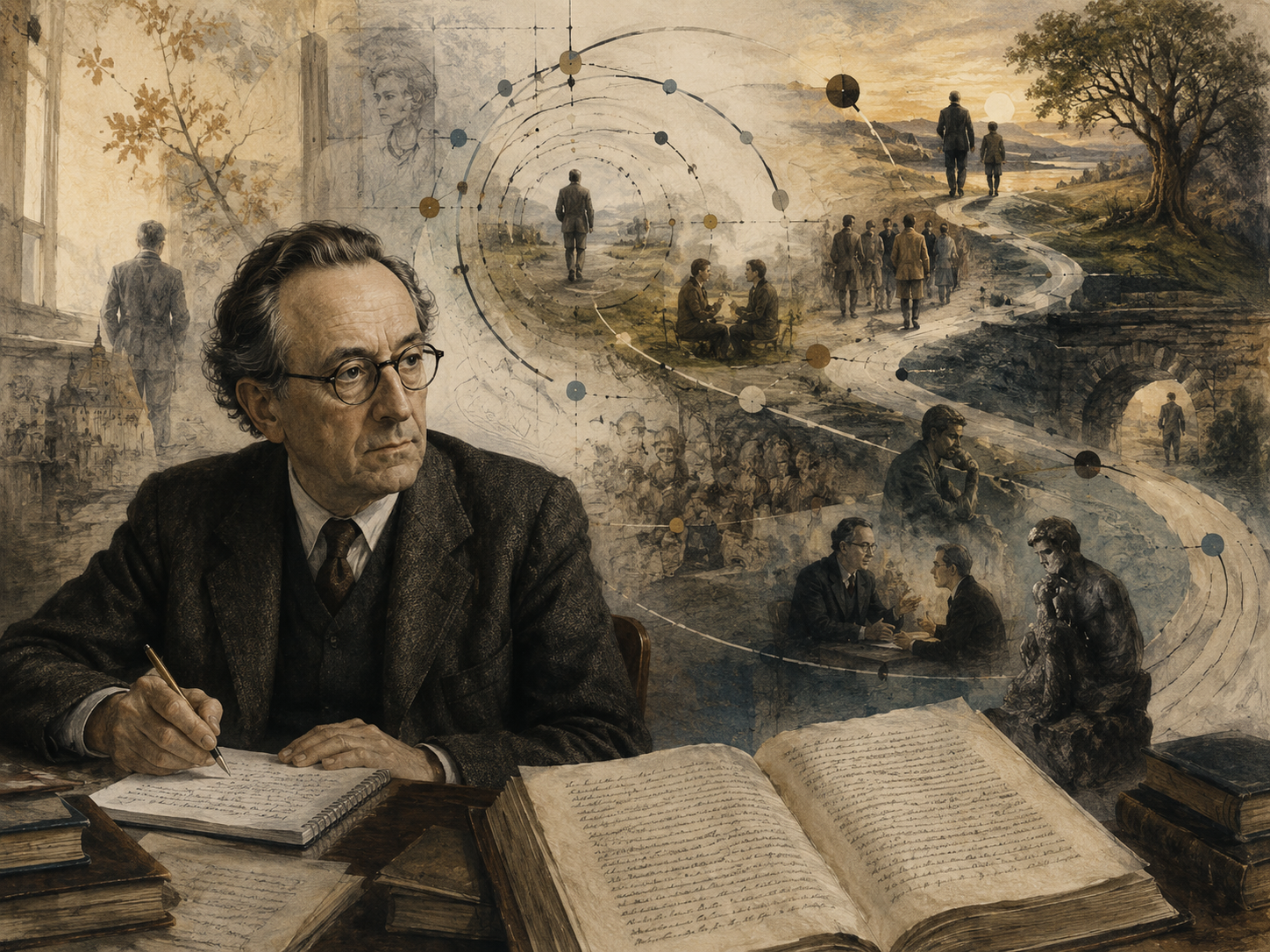
This article treats Ricoeur’s theory as a bridge between philosophy and storytelling. Narrative is not merely a way to report events after they happen. It is a way to configure action into a meaningful temporal whole. Stories gather beginnings, middles, endings, memories, expectations, disruptions, reversals, promises, and consequences into forms that can be understood, interpreted, questioned, and retold.
Why Ricoeur Matters for Storytelling
Paul Ricoeur matters for storytelling because he gives narrative theory a philosophical depth that purely structural analysis can miss. Narratology explains how stories are organized. Ricoeur asks why narrative organization matters for human time, action, identity, memory, and ethical understanding.
For Ricoeur, stories do not simply decorate experience. They help make temporal experience intelligible. Human life is not encountered as raw sequence alone. It is lived through projects, memories, promises, failures, hopes, interruptions, and unfinished meanings. Narrative gathers these temporal fragments into plots that can be interpreted.
Ricoeur’s work is especially valuable for a storytelling series because it connects narrative form with lived experience. A story has structure, but that structure is not merely technical. It mediates between action and reflection, event and meaning, time and identity, history and imagination, memory and responsibility.
| Ricoeurian concern | Storytelling question | Why it matters |
|---|---|---|
| Time | How does story make temporal experience intelligible? | Stories organize memory, expectation, sequence, and change. |
| Plot | How are events configured into a meaningful whole? | Plot turns happenings into consequence and significance. |
| Action | How do human actions become interpretable? | Narrative links intention, context, conflict, outcome, and responsibility. |
| Identity | How does a self become understandable across time? | Narrative identity connects continuity and change. |
| Memory | How is the past interpreted and carried forward? | Stories preserve, revise, contest, and transmit memory. |
| Ethics | How do stories shape responsibility? | Narrative form influences blame, recognition, repair, and judgment. |
Ricoeur matters because he shows that storytelling is not only a cultural practice. It is one of the ways human beings understand time.
The Problem of Time
Time is difficult because it is both familiar and elusive. Everyone lives in time, but time is hard to define. The past is no longer present. The future has not yet arrived. The present passes even as we try to name it. Human beings nevertheless remember, anticipate, promise, plan, regret, wait, hope, fear, and act.
Ricoeur’s theory begins from this tension. Lived time is not simply clock time. It includes memory, expectation, duration, interruption, repetition, anticipation, mourning, delay, and narrative return. A life does not feel like a stopwatch. It feels like unfolding meaning.
Narrative helps with this problem because it configures time. A story can begin after the beginning. It can return to the past. It can anticipate the future. It can compress years into a sentence and expand a moment into a chapter. It can make an event meaningful only after later events reveal its significance. Narrative gives temporal experience a form that can be followed.
| Temporal difficulty | Human experience | Narrative response |
|---|---|---|
| The past is absent | Memory, archive, testimony, regret, inheritance. | Narrative makes the absent past present for interpretation. |
| The future is uncertain | Expectation, hope, fear, promise, planning. | Narrative organizes anticipation and consequence. |
| The present passes | Action, attention, interruption, decision. | Narrative situates present action within before and after. |
| Life is unfinished | Identity changes, projects remain open. | Narrative gives provisional coherence without final certainty. |
| Events are dispersed | Experience arrives in fragments. | Plot configures fragments into a meaningful whole. |
| Meaning changes later | Retrospection alters interpretation. | Narrative allows later events to refigure earlier ones. |
Ricoeur’s problem is not whether time exists. His problem is how human beings understand temporal existence.
Augustine and Lived Time
Ricoeur turns to Augustine because Augustine gives one of the classic philosophical accounts of the difficulty of time. Augustine asks what time is and finds that it becomes strange as soon as one tries to explain it. The past is gone, the future is not yet, and the present seems to vanish.
The importance of Augustine for Ricoeur is not simply theological. Augustine helps describe the inner experience of time. Human beings hold the past in memory, attend to the present, and anticipate the future. Time is therefore experienced through a stretching or distension of the soul: memory, attention, and expectation.
Narrative responds to this distension by giving temporal experience a form. A story gathers what has happened, what is happening, and what may happen into a structured relation. It does not eliminate the mystery of time. It makes time humanly intelligible.
| Augustinian concern | Ricoeurian use | Storytelling implication |
|---|---|---|
| Memory | The past remains present as remembered. | Stories organize what is carried from the past. |
| Attention | The present is experienced as active focus. | Stories shape what matters now. |
| Expectation | The future is present as anticipation. | Stories organize promise, fear, suspense, and hope. |
| Distension | The self is stretched across past, present, and future. | Narrative gathers temporal dispersion. |
| Difficulty of definition | Time resists simple conceptual capture. | Narrative offers configuration rather than final definition. |
| Interior temporality | Time is lived, not merely measured. | Stories express lived duration and remembered meaning. |
Augustine gives Ricoeur the problem of lived time; narrative becomes one response to that problem.
Aristotle and Plot
Ricoeur also turns to Aristotle because Aristotle gives him a theory of plot. In the Poetics, plot is not just sequence. It is the arrangement of actions into a whole. A good plot has unity, consequence, reversal, recognition, and intelligible movement.
Ricoeur uses Aristotle to show how narrative gives temporal experience structure. Human action is messy, dispersed, and open-ended. Plot configures action. It selects, orders, connects, and transforms events into a meaningful whole. This process is what Ricoeur calls emplotment.
The power of Aristotle for Ricoeur is that plot does not merely imitate action by copying it. Plot reworks action into intelligible form. It gives events a beginning, middle, and end. It makes accidents appear as consequences, conflicts appear as movements, and isolated actions appear as parts of a larger configuration.
| Aristotelian concept | Ricoeurian significance | Storytelling use |
|---|---|---|
| Plot | Arrangement of actions into a whole. | Turns events into meaningful sequence. |
| Action | Human doing as narratable material. | Links intention, conflict, consequence, and responsibility. |
| Unity | The plot holds together as a configuration. | Prevents events from remaining merely scattered. |
| Reversal | Events change direction and meaning. | Shows how later turns refigure earlier action. |
| Recognition | Characters or audiences come to know differently. | Connects time with understanding. |
| Completion | The story creates a bounded whole. | Allows retrospective interpretation. |
Aristotle gives Ricoeur the grammar of plot; Augustine gives him the mystery of time.
Time and Narrative
Ricoeur’s central claim is that time becomes human time through narrative, and narrative becomes meaningful through its relation to time. This does not mean that stories solve time once and for all. It means that narrative mediates between lived temporal experience and intelligible form.
In Time and Narrative, Ricoeur develops this claim across history, fiction, phenomenology, hermeneutics, and narrative theory. Historical narrative and fictional narrative both configure time, though they do so differently. History remains bound to evidence and reference. Fiction explores possible worlds, imagined action, and temporal experience. Both show how narrative form shapes temporal understanding.
This is one reason Ricoeur remains so important for storytelling. He refuses to reduce narrative to ornament, entertainment, or technique. Narrative is a mode of temporal understanding. It is one of the ways human beings interpret action, suffering, memory, history, identity, and possibility.
| Dimension | Ricoeurian claim | Why it matters |
|---|---|---|
| Human time | Time is experienced through memory, action, and expectation. | Stories organize lived temporality. |
| Narrative form | Plot configures dispersed events into a whole. | Stories make temporal experience followable. |
| History | Historical narrative interprets past action under evidentiary constraint. | History is not raw chronology; it is configured explanation. |
| Fiction | Fiction explores possible temporal worlds. | Imagined stories can disclose real structures of experience. |
| Interpretation | Readers refigure the narrative through reception. | Story meaning changes as it is received and applied. |
| Identity | The self is understood narratively across time. | Identity includes continuity, change, and reinterpretation. |
Ricoeur’s phrase “narrative time” names the meeting point between lived time and plotted meaning.
Emplotment
Emplotment is one of Ricoeur’s most important concepts. It refers to the process by which events, actions, motives, accidents, conflicts, and outcomes are configured into a meaningful narrative whole. Emplotment is not merely ordering events chronologically. It is the act of making events intelligible as part of a story.
A plot gathers heterogeneous elements. It brings together agents, goals, obstacles, settings, causes, chances, consequences, promises, failures, and recognitions. These elements do not automatically form a story. Emplotment makes them belong together.
Emplotment also changes the meaning of events. An event may seem accidental when it occurs, but later become significant because the plot reconfigures it. A promise may seem minor until a later betrayal reveals its importance. A loss may seem meaningless until memory, action, or repair gives it narrative weight. Ricoeur’s theory helps explain this retrospective power.
| Emplotment task | How it works | Review question |
|---|---|---|
| Selection | Chooses which events matter. | What is included or excluded? |
| Configuration | Connects events into a meaningful whole. | What makes these events belong together? |
| Mediation | Links individual events with larger patterns. | How does the particular become significant? |
| Retrospection | Later events refigure earlier ones. | How does the ending change the beginning? |
| Concordance | Creates order, unity, and intelligibility. | What coherence does the plot produce? |
| Discordance | Preserves disruption, chance, conflict, and suffering. | What resists smooth coherence? |
Emplotment turns time into narrative meaning while preserving the tension between order and disruption.
Ricoeur’s Threefold Mimesis
Ricoeur’s model of threefold mimesis is a way of describing how narrative moves from lived action to plotted text to interpreted world. It is one of his most useful frameworks for storytellers, readers, researchers, and editors.
Mimesis1 refers to the prefigured world of action. Before a story is told, human action already has structures: agents, goals, norms, symbols, conflicts, institutions, and temporal expectations. Stories do not begin from nothing. They arise from a world that is already meaningful.
Mimesis2 refers to configuration. This is the level of plot. The narrative arranges actions and events into a structured whole.
Mimesis3 refers to refiguration. The reader or audience receives the narrative and brings it back into lived understanding. A story can change how someone interprets time, action, memory, responsibility, or identity.
| Stage | Meaning | Storytelling question |
|---|---|---|
| Mimesis1 | Prefiguration: the world of action before narrative configuration. | What practical world makes the story possible? |
| Mimesis2 | Configuration: plot organizes events into a meaningful whole. | How are actions configured into narrative form? |
| Mimesis3 | Refiguration: the audience interprets the story and returns it to life. | How does the story reshape understanding? |
| Action world | Norms, symbols, roles, institutions, motives, and conflicts. | What background knowledge does the story assume? |
| Text world | The plotted arrangement of events. | What structure gives the story coherence? |
| Reader world | The transformed horizon of interpretation. | What does the story make newly thinkable? |
Threefold mimesis shows that narrative is not trapped inside the text. It moves from life, through story, back into life.
Configuration and Refiguration
Configuration and refiguration are crucial because they show that narrative meaning is not fixed at the level of events alone. Configuration happens when the story arranges events into plot. Refiguration happens when the audience receives the story and interprets life differently because of it.
A historical narrative, for example, configures past events into an account. That account may later refigure public memory. A memoir configures lived experience into narrative form. Readers may then understand their own memories differently. A policy story configures a problem, cause, intervention, and outcome. Citizens may then see responsibility differently.
This movement from configuration to refiguration is why storytelling can be powerful and dangerous. A story can clarify. It can also distort. It can open responsibility. It can also close it prematurely. It can deepen memory. It can also simplify it. Ricoeur’s theory helps us ask how narrative form returns to the world.
| Process | What happens | Ethical question |
|---|---|---|
| Configuration | Events are arranged into plot. | What coherence is being created? |
| Refiguration | The audience interprets life through the story. | How does the story change understanding? |
| Public memory | A story reshapes how a community remembers. | Whose memory becomes official? |
| Identity formation | A person interprets selfhood through narrative. | Does the story allow change and complexity? |
| Institutional use | An organization turns history into mission. | Does the plot hide responsibility? |
| Political use | A public story configures crisis and response. | Does refiguration produce judgment or manipulation? |
The ethical force of narrative lies partly in what happens after the story is received.
Narrative Identity
Narrative identity is one of the most influential consequences of Ricoeur’s theory. A person is not identical over time in the way an object is identical. Human identity includes both sameness and change. People remain themselves while changing, remembering differently, making promises, breaking promises, suffering, acting, repenting, and beginning again.
Narrative helps make this possible. A life story connects events across time without pretending that the self is static. It allows continuity and transformation to coexist. It can hold childhood, loss, decision, failure, obligation, and hope in one interpretive arc.
Ricoeur’s narrative identity is not simplistic autobiography. It does not mean that everyone needs a neat life story. It means that self-understanding often takes narrative form. The self becomes interpretable through stories told, received, revised, and contested.
| Identity issue | Ricoeurian insight | Storytelling implication |
|---|---|---|
| Continuity | A self persists across time. | Life stories connect dispersed events. |
| Change | A self transforms through action and suffering. | Narrative allows development and revision. |
| Promise | Keeping one’s word creates identity through time. | Stories track commitment and responsibility. |
| Memory | The past is interpreted, not simply stored. | Identity depends on remembered meaning. |
| Recognition | The self is understood with and before others. | Identity includes relation and witness. |
| Revision | Stories can be retold under new understanding. | Identity remains open to reinterpretation. |
Narrative identity is not a fixed script. It is an interpretive way of holding continuity and change together.
Memory, History, and Fiction
Ricoeur’s work helps distinguish memory, history, and fiction without isolating them completely. Memory is lived and claimed. History is disciplined by evidence, archives, method, and public accountability. Fiction is freed from factual reference in order to explore possible worlds, imagined action, and temporal meaning.
All three are narrative in different ways. Memory tells the past from within lived experience. History reconstructs and interprets the past under evidentiary constraint. Fiction configures possible action and possible worlds. Each can illuminate time. Each can also distort it.
Ricoeur’s approach is valuable because it resists two extremes. It does not reduce history to fiction, but it also does not treat history as raw fact without narrative configuration. It does not dismiss fiction as unreal, because fiction can disclose structures of human time, action, and identity. It does not treat memory as infallible, because memory requires interpretation and sometimes correction.
| Mode | Relation to time | Risk |
|---|---|---|
| Memory | The past as remembered and claimed. | Distortion, nostalgia, trauma, selective recall. |
| History | The past reconstructed through evidence and method. | False neutrality, archive bias, overconfidence. |
| Fiction | Possible worlds that disclose temporal experience. | Formula, escapism, irresponsible analogy. |
| Testimony | Memory offered before others. | Witness extraction or frame control. |
| Archive | Traces of the past preserved for interpretation. | Silence, exclusion, institutional power. |
| Public narrative | Collective memory configured for civic meaning. | Mythmaking, erasure, political manipulation. |
Ricoeur helps us see memory, history, and fiction as different but related ways of configuring time.
Action, Suffering, and Agency
Ricoeur’s narrative theory is not only about texts. It is about human action. Stories configure what people do, what happens to them, what they intend, what they suffer, what they cause, and what they undergo. Action and suffering belong together because human beings are both agents and patients.
This distinction matters ethically. A story that only emphasizes agency may blame people for conditions they did not choose. A story that only emphasizes suffering may erase action, resistance, and responsibility. Ricoeur’s framework allows narrative to hold doing and undergoing together.
Narrative time also matters for agency because responsibility unfolds across time. Promises are made and kept later. Harm is caused and recognized later. Repair may begin long after injury. Forgiveness, justice, accountability, and memory all depend on temporal interpretation.
| Dimension | Narrative question | Ethical importance |
|---|---|---|
| Action | Who acts, intends, chooses, or intervenes? | Clarifies agency and responsibility. |
| Suffering | Who undergoes harm, loss, or constraint? | Prevents agency language from blaming victims. |
| Consequence | What follows from action over time? | Connects events to accountability. |
| Promise | What commitments bind past, present, and future? | Shows identity through responsibility. |
| Recognition | What becomes understood later? | Allows retrospective moral learning. |
| Repair | What response is required after harm? | Distinguishes closure from justice. |
Narrative time gives action and suffering a structure of consequence.
Public Memory and Institutions
Ricoeur’s theory is useful for public memory and institutional storytelling because institutions also configure time. Nations, courts, universities, companies, religious bodies, movements, and civic organizations tell stories about founding, crisis, mission, reform, loss, renewal, and responsibility.
These stories are not neutral. They select beginnings, name turning points, assign causes, distribute blame, mark progress, and define what counts as repair. A public institution may tell a story of continuity while hiding rupture. It may tell a story of renewal while avoiding accountability. It may tell a story of destiny while erasing excluded groups.
A Ricoeurian analysis asks how institutions configure time and how those configurations refigure public understanding. It asks what memories become official, what events become turning points, what harms are narrated as past, and what obligations remain open.
| Institutional narrative | Temporal configuration | Governance question |
|---|---|---|
| Founding story | Defines origin and mission. | What does the origin story omit? |
| Crisis story | Marks rupture and turning point. | Who caused the crisis, and who suffered? |
| Reform story | Frames action as renewal. | Is repair material or symbolic? |
| Legacy story | Connects past achievement to present legitimacy. | What counter-memories challenge the legacy? |
| Progress story | Configures time as improvement. | Who is asked to accept premature closure? |
| Accountability story | Links past harm to future responsibility. | What obligations remain unfinished? |
Institutions govern not only through policies, but through stories about time.
Ricoeur and Narratology
Ricoeur’s theory overlaps with narratology, but it is not identical to narratology. Narratology often analyzes structure: narrator, focalization, sequence, levels, time, discourse, and character function. Ricoeur asks how narrative structure mediates lived time, action, memory, identity, and interpretation.
This makes Ricoeur especially useful after a general article on narratology. Narratology gives vocabulary for how narrative is built. Ricoeur gives a philosophical account of why narrative structure matters. He asks what stories do to time, how plots configure action, and how readers return from narrative into life.
A strong storytelling framework can use both. Narratology helps identify form. Ricoeur helps interpret the temporal, ethical, and existential significance of that form.
| Approach | Main emphasis | Useful question |
|---|---|---|
| Narratology | Structural grammar of narrative. | How is the story organized? |
| Ricoeur | Hermeneutics of time, action, and identity. | How does narrative make temporal experience intelligible? |
| Classical plot theory | Unity, action, reversal, recognition. | What makes the plot whole? |
| Hermeneutics | Interpretation and refiguration. | How does the story change understanding? |
| Ethical narrative analysis | Responsibility, memory, recognition, repair. | How does narrative form shape judgment? |
| Computational modeling | Structured indicators and reproducible analysis. | What assumptions can be made auditable? |
Narratology explains narrative grammar; Ricoeur explains why narrative grammar matters for temporal human life.
Ethics of Narrative Time
Narrative time has ethical consequences. A story can rush through harm and linger over redemption. It can delay responsibility. It can make suffering seem necessary because a later good appears to justify it. It can frame injustice as a past event even when its effects continue. It can declare closure before repair exists.
A Ricoeurian approach asks how time is configured ethically. What is treated as past? What remains present? What future is promised? Who is asked to wait? Who is told to move on? Who controls the ending? Who benefits from the plot’s coherence?
This is especially important in public storytelling. Institutions often use narrative time to manage reputation. A scandal becomes “a difficult chapter.” A reform becomes “a new era.” A harm becomes “behind us.” A community’s demand for justice becomes “dwelling in the past.” Narrative time can therefore become a tool of evasion unless it is reviewed carefully.
| Temporal risk | How it appears | Responsible response |
|---|---|---|
| Premature closure | The story ends before repair exists. | Keep unresolved obligations visible. |
| Redemptive shortcut | Later good is used to justify earlier harm. | Do not turn suffering into plot fuel. |
| Erased continuity | Ongoing consequences are narrated as past. | Track effects across time. |
| Delayed accountability | Responsibility is postponed indefinitely. | Name obligations and owners. |
| Nostalgic origin | The past is idealized as pure beginning. | Include counter-memory and omitted actors. |
| Future manipulation | A promised future silences present critique. | Distinguish hope from deferral. |
The ethics of narrative time asks whether a story’s temporal form serves truth, responsibility, and repair.
Examples of Ricoeurian Analysis
The examples below show how Ricoeur’s theory can be applied without turning narrative time into a rigid formula.
Memoir
Weak: The memoir is treated as a sequence of life events.
Stronger: The analysis asks how the memoir configures memory, regret, promise, identity, and retrospective meaning.
Why it works: It reads life story as narrative identity in formation.
Historical narrative
Weak: History is treated as chronology.
Stronger: The analysis asks how evidence is configured into plot, explanation, turning point, and public memory.
Why it works: It respects historical method while recognizing narrative form.
Institutional reform story
Weak: A crisis-and-renewal story is accepted at face value.
Stronger: The analysis asks whether the institution’s plot creates premature closure or real accountability.
Why it works: It treats refiguration as a governance issue.
Trauma testimony
Weak: Testimony is expected to follow linear sequence.
Stronger: The analysis allows memory, interruption, repetition, silence, and delayed understanding to shape narrative time.
Why it works: It protects witness dignity and avoids forcing coherence.
Public policy narrative
Weak: Policy is described as problem, intervention, outcome.
Stronger: The analysis asks how the plot defines causes, deadlines, responsibility, and future promise.
Why it works: It makes temporal assumptions visible.
Fictional plot
Weak: Plot is summarized as what happens.
Stronger: The analysis asks how emplotment connects action, chance, reversal, recognition, and ending.
Why it works: It reads plot as temporal configuration.
Ricoeurian analysis is strongest when it links narrative form to temporal understanding and ethical consequence.
Mathematics, Computation, and Modeling
Ricoeur’s theory should not be reduced to numbers. His concepts are philosophical and interpretive. Still, computation can help make narrative-time assumptions visible. A model can audit whether an analysis has considered configuration, refiguration, memory, expectation, action, suffering, identity, and ethical risk.
A narrative-time configuration score can estimate how clearly a story organizes temporal experience:
T_c = \frac{M_m + A_t + P_l + C_f + R_g + E_n}{6}
\]
Interpretation: Narrative-time configuration \(T_c\) averages memory mapping \(M_m\), anticipation \(A_t\), plot logic \(P_l\), configuration \(C_f\), refiguration \(R_g\), and ending function \(E_n\).
An emplotment score can estimate how strongly events have been configured into meaningful relation:
E_p = \frac{S_e + C_a + R_r + C_o + D_s + W_h}{6}
\]
Interpretation: Emplotment \(E_p\) averages event selection \(S_e\), causal articulation \(C_a\), reversal-recognition relation \(R_r\), concordance \(C_o\), discordance \(D_s\), and whole-plot coherence \(W_h\).
A narrative-identity readiness score can estimate whether a story responsibly handles continuity and change:
I_n = \frac{C_t + C_h + P_r + M_r + A_g + R_s}{6}
\]
Interpretation: Narrative identity readiness \(I_n\) averages continuity \(C_t\), change \(C_h\), promise responsibility \(P_r\), memory revision \(M_r\), agency \(A_g\), and relational recognition \(R_s\).
A temporal-governance risk score can estimate whether a narrative’s time structure requires deeper review:
G_t = P_cw_p + R_sw_r + E_cw_e + D_aw_d + N_ow_n + (1 – U_n)w_u
\]
Interpretation: Temporal governance risk \(G_t\) rises with premature closure \(P_c\), redemptive shortcut \(R_s\), erased continuity \(E_c\), delayed accountability \(D_a\), nostalgic origin \(N_o\), and weak uncertainty marking \(U_n\).
| Modeling task | Interpretive question | Example output |
|---|---|---|
| Configuration audit | How are events gathered into temporal meaning? | Narrative-time configuration score. |
| Emplotment audit | How does plot mediate action, chance, and consequence? | Emplotment profile. |
| Refiguration audit | How might reception reshape understanding? | Audience-impact and governance note. |
| Identity audit | How does the story hold continuity and change? | Narrative-identity readiness score. |
| Memory audit | What past is carried, revised, omitted, or contested? | Memory-context table. |
| Governance audit | Does temporal structure create ethical risk? | Canvas card and governance queue. |
Computational modeling can support Ricoeurian analysis only when it remains subordinate to interpretation, evidence, and ethical review.
Python Workflow: Narrative Time Canvas Audit
The Python workflow below follows the advanced Catalyst Canvas standard: typed records, config-driven scoring, validation, governance notes, Canvas-card exports, CSV outputs, JSON outputs, markdown governance queues, and strict review priorities. The companion repository version includes the shared `python/catalyst_canvas/` layer plus article-specific data for Ricoeur, narrative time, emplotment, refiguration, and narrative identity.
# run_ricoeur_narrative_time_canvas_audit.py
from __future__ import annotations

from dataclasses import dataclass
from pathlib import Path
import csv
import json
from hashlib import sha256
from statistics import mean
from typing import Any


ARTICLE_ROOT = Path(__file__).resolve().parents[1]
OUTPUTS = ARTICLE_ROOT / "outputs"


@dataclass(frozen=True)
class NarrativeTimeRecord:
    item: str
    claim_context: str
    memory_mapping: float
    anticipation: float
    plot_logic: float
    configuration: float
    refiguration: float
    ending_function: float
    event_selection: float
    causal_articulation: float
    reversal_recognition: float
    concordance: float
    discordance: float
    whole_plot_coherence: float
    continuity: float
    change: float
    promise_responsibility: float
    memory_revision: float
    agency: float
    relational_recognition: float
    premature_closure: float
    redemptive_shortcut: float
    erased_continuity: float
    delayed_accountability: float
    nostalgic_origin: float
    uncertainty_notes: float
    source_context: float
    counterexamples: float
    method_limits: float
    owner: str = "editorial"
    status: str = "active"
    notes: str = ""


@dataclass(frozen=True)
class NarrativeTimeConfig:
    article_title: str = "Paul Ricoeur and Narrative Time"
    article_slug: str = "paul-ricoeur-and-narrative-time"
    medium_threshold: float = 0.45
    high_threshold: float = 0.62
    allowed_statuses: tuple[str, ...] = ("active", "archive", "review", "revise")


def validate_score(value: float, field_name: str) -> None:
    if value < 0 or value > 1:
        raise ValueError(f"{field_name} must be between 0 and 1.")


def validate_record(record: NarrativeTimeRecord, config: NarrativeTimeConfig) -> None:
    if not record.item.strip():
        raise ValueError("item is required.")
    if not record.claim_context.strip():
        raise ValueError("claim_context is required.")
    if record.status not in config.allowed_statuses:
        raise ValueError(f"Invalid status: {record.status}")

    for field_name, value in record.__dict__.items():
        if isinstance(value, float):
            validate_score(value, field_name)


def narrative_time_configuration(record: NarrativeTimeRecord) -> float:
    return mean([
        record.memory_mapping,
        record.anticipation,
        record.plot_logic,
        record.configuration,
        record.refiguration,
        record.ending_function,
    ])


def emplotment_strength(record: NarrativeTimeRecord) -> float:
    return mean([
        record.event_selection,
        record.causal_articulation,
        record.reversal_recognition,
        record.concordance,
        record.discordance,
        record.whole_plot_coherence,
    ])


def narrative_identity_readiness(record: NarrativeTimeRecord) -> float:
    return mean([
        record.continuity,
        record.change,
        record.promise_responsibility,
        record.memory_revision,
        record.agency,
        record.relational_recognition,
    ])


def interpretation_readiness(record: NarrativeTimeRecord) -> float:
    return mean([
        record.source_context,
        record.counterexamples,
        record.method_limits,
        record.uncertainty_notes,
        record.configuration,
        record.refiguration,
    ])


def temporal_governance_risk(record: NarrativeTimeRecord) -> float:
    return min(
        1.0,
        record.premature_closure * 0.20
        + record.redemptive_shortcut * 0.18
        + record.erased_continuity * 0.18
        + record.delayed_accountability * 0.18
        + record.nostalgic_origin * 0.14
        + (1 - record.uncertainty_notes) * 0.12,
    )


def governance_priority_score(record: NarrativeTimeRecord, config: NarrativeTimeConfig) -> float:
    score = (
        temporal_governance_risk(record) * 0.40
        + (1 - interpretation_readiness(record)) * 0.28
        + record.delayed_accountability * 0.16
        + record.premature_closure * 0.16
    )

    if record.status == "revise":
        score = max(score, config.high_threshold)
    elif record.status == "review":
        score = max(score, config.medium_threshold)

    return min(1.0, max(0.0, score))


def review_priority(record: NarrativeTimeRecord, config: NarrativeTimeConfig) -> str:
    score = governance_priority_score(record, config)
    if score >= config.high_threshold:
        return "high"
    if score >= config.medium_threshold:
        return "medium"
    return "standard"


def card_id(record: NarrativeTimeRecord, config: NarrativeTimeConfig) -> str:
    raw = f"{config.article_slug}|{record.item}|{record.claim_context}"
    return sha256(raw.encode("utf-8")).hexdigest()[:16]


def governance_note(record: NarrativeTimeRecord, config: NarrativeTimeConfig) -> str:
    priority = review_priority(record, config)
    risk = temporal_governance_risk(record)
    readiness = interpretation_readiness(record)

    notes = []

    if priority == "high":
        notes.append("High-priority narrative-time governance review required.")
    elif priority == "medium":
        notes.append("Medium-priority review recommended before reuse.")
    else:
        notes.append("Standard editorial review sufficient.")

    if risk >= 0.55:
        notes.append("Temporal governance risk is elevated; review premature closure, redemptive shortcut, erased continuity, delayed accountability, and nostalgic origin.")
    if readiness < 0.60:
        notes.append("Interpretation readiness is limited; strengthen source context, counterexamples, method limits, and uncertainty notes.")
    if record.notes:
        notes.append(record.notes)

    return " ".join(notes)


def canvas_card(record: NarrativeTimeRecord, config: NarrativeTimeConfig) -> dict[str, Any]:
    return {
        "schema_version": "1.0.0",
        "card_id": card_id(record, config),
        "card_type": "ricoeur_narrative_time",
        "article_title": config.article_title,
        "article_slug": config.article_slug,
        "item": record.item,
        "claim_context": record.claim_context,
        "scores": {
            "narrative_time_configuration": round(narrative_time_configuration(record), 4),
            "emplotment_strength": round(emplotment_strength(record), 4),
            "narrative_identity_readiness": round(narrative_identity_readiness(record), 4),
            "temporal_governance_risk": round(temporal_governance_risk(record), 4),
            "interpretation_readiness": round(interpretation_readiness(record), 4),
            "governance_priority_score": round(governance_priority_score(record, config), 4),
        },
        "review": {
            "priority": review_priority(record, config),
            "owner": record.owner,
            "status": record.status,
            "governance_note": governance_note(record, config),
        },
    }


def write_csv(path: Path, rows: list[dict[str, Any]]) -> None:
    path.parent.mkdir(parents=True, exist_ok=True)
    fieldnames = list(rows[0].keys())
    with path.open("w", encoding="utf-8", newline="") as handle:
        writer = csv.DictWriter(handle, fieldnames=fieldnames)
        writer.writeheader()
        writer.writerows(rows)


def write_json(path: Path, payload: Any) -> None:
    path.parent.mkdir(parents=True, exist_ok=True)
    path.write_text(json.dumps(payload, indent=2), encoding="utf-8")


def write_markdown_queue(path: Path, rows: list[dict[str, Any]]) -> None:
    path.parent.mkdir(parents=True, exist_ok=True)
    lines = [
        "# Ricoeur Narrative Time Governance Queue",
        "",
        "| Item | Context | Time configuration | Emplotment | Identity | Risk | Readiness | Priority | Owner |",
        "|---|---|---:|---:|---:|---:|---:|---|---|",
    ]

    for row in rows:
        lines.append(
            f"| {row['item']} | {row['claim_context']} | "
            f"{row['narrative_time_configuration']} | {row['emplotment_strength']} | "
            f"{row['narrative_identity_readiness']} | {row['temporal_governance_risk']} | "
            f"{row['interpretation_readiness']} | {row['review_priority']} | {row['owner']} |"
        )

    path.write_text("\n".join(lines) + "\n", encoding="utf-8")


def main() -> None:
    config = NarrativeTimeConfig()

    records = [
        NarrativeTimeRecord(
            "Threefold mimesis",
            "prefiguration configuration refiguration audit",
            0.84, 0.82, 0.88, 0.94, 0.92, 0.80,
            0.84, 0.82, 0.78, 0.86, 0.76, 0.88,
            0.78, 0.82, 0.74, 0.76, 0.78, 0.80,
            0.30, 0.28, 0.34, 0.36, 0.32, 0.82,
            0.86, 0.80, 0.82,
            "editorial", "active",
            "Core Ricoeurian concept suitable for Canvas reuse."
        ),
        NarrativeTimeRecord(
            "Institutional reform narrative",
            "crisis renewal and accountability plot audit",
            0.76, 0.84, 0.86, 0.82, 0.78, 0.88,
            0.78, 0.84, 0.72, 0.80, 0.70, 0.82,
            0.72, 0.76, 0.70, 0.68, 0.74, 0.66,
            0.74, 0.68, 0.72, 0.80, 0.62, 0.64,
            0.72, 0.70, 0.66,
            "governance", "revise",
            "Escalate when renewal creates premature closure or delayed accountability."
        ),
        NarrativeTimeRecord(
            "Memoir and narrative identity",
            "memory continuity change and selfhood audit",
            0.90, 0.78, 0.82, 0.86, 0.84, 0.80,
            0.76, 0.72, 0.70, 0.78, 0.82, 0.80,
            0.88, 0.90, 0.82, 0.86, 0.84, 0.82,
            0.36, 0.42, 0.38, 0.40, 0.34, 0.80,
            0.84, 0.82, 0.80,
            "ethics review", "review",
            "Review memory revision, identity complexity, and false coherence."
        ),
    ]

    rows = []
    cards = []

    for record in records:
        validate_record(record, config)
        cards.append(canvas_card(record, config))
        rows.append({
            "item": record.item,
            "claim_context": record.claim_context,
            "narrative_time_configuration": round(narrative_time_configuration(record), 4),
            "emplotment_strength": round(emplotment_strength(record), 4),
            "narrative_identity_readiness": round(narrative_identity_readiness(record), 4),
            "temporal_governance_risk": round(temporal_governance_risk(record), 4),
            "interpretation_readiness": round(interpretation_readiness(record), 4),
            "governance_priority_score": round(governance_priority_score(record, config), 4),
            "review_priority": review_priority(record, config),
            "owner": record.owner,
            "status": record.status,
            "governance_note": governance_note(record, config),
        })

    priority_order = {"high": 3, "medium": 2, "standard": 1}
    rows = sorted(
        rows,
        key=lambda row: (
            priority_order.get(str(row["review_priority"]), 0),
            float(row["governance_priority_score"]),
        ),
        reverse=True,
    )

    queue = [row for row in rows if row["review_priority"] != "standard"]
    queue_cards = [card for card in cards if card["review"]["priority"] != "standard"]

    write_csv(OUTPUTS / "tables" / "ricoeur_narrative_time_audit.csv", rows)
    write_csv(OUTPUTS / "tables" / "ricoeur_narrative_time_governance_queue.csv", queue)
    write_json(OUTPUTS / "json" / "ricoeur_narrative_time_canvas_cards.json", cards)
    write_json(OUTPUTS / "json" / "ricoeur_narrative_time_governance_queue.json", queue_cards)
    write_markdown_queue(OUTPUTS / "markdown" / "ricoeur_narrative_time_governance_queue.md", queue)

    print("Ricoeur narrative time Canvas audit complete.")


if __name__ == "__main__":
    main()
This workflow treats Ricoeur’s theory as an interpretive governance model for time, plot, memory, identity, and responsibility.
R Workflow: Narrative Time Diagnostics
The R workflow below provides a portable base R diagnostic for Ricoeurian narrative-time analysis. It calculates narrative-time configuration, emplotment strength, narrative-identity readiness, temporal-governance risk, interpretation readiness, and review priority.
# ricoeur_narrative_time_diagnostics.R
# Base R workflow for Paul Ricoeur and Narrative Time.

args <- commandArgs(trailingOnly = FALSE)
file_arg <- grep("^--file=", args, value = TRUE)

if (length(file_arg) > 0) {
  script_path <- normalizePath(sub("^--file=", "", file_arg[1]), mustWork = TRUE)
  article_root <- normalizePath(file.path(dirname(script_path), ".."), mustWork = TRUE)
} else {
  article_root <- getwd()
}

setwd(article_root)

tables_dir <- file.path(article_root, "outputs", "tables")
figures_dir <- file.path(article_root, "outputs", "figures")
dir.create(tables_dir, recursive = TRUE, showWarnings = FALSE)
dir.create(figures_dir, recursive = TRUE, showWarnings = FALSE)

records <- data.frame(
  item = c(
    "Threefold mimesis",
    "Institutional reform narrative",
    "Memoir and narrative identity"
  ),
  claim_context = c(
    "prefiguration configuration refiguration audit",
    "crisis renewal and accountability plot audit",
    "memory continuity change and selfhood audit"
  ),
  memory_mapping = c(0.84, 0.76, 0.90),
  anticipation = c(0.82, 0.84, 0.78),
  plot_logic = c(0.88, 0.86, 0.82),
  configuration = c(0.94, 0.82, 0.86),
  refiguration = c(0.92, 0.78, 0.84),
  ending_function = c(0.80, 0.88, 0.80),
  event_selection = c(0.84, 0.78, 0.76),
  causal_articulation = c(0.82, 0.84, 0.72),
  reversal_recognition = c(0.78, 0.72, 0.70),
  concordance = c(0.86, 0.80, 0.78),
  discordance = c(0.76, 0.70, 0.82),
  whole_plot_coherence = c(0.88, 0.82, 0.80),
  continuity = c(0.78, 0.72, 0.88),
  change = c(0.82, 0.76, 0.90),
  promise_responsibility = c(0.74, 0.70, 0.82),
  memory_revision = c(0.76, 0.68, 0.86),
  agency = c(0.78, 0.74, 0.84),
  relational_recognition = c(0.80, 0.66, 0.82),
  premature_closure = c(0.30, 0.74, 0.36),
  redemptive_shortcut = c(0.28, 0.68, 0.42),
  erased_continuity = c(0.34, 0.72, 0.38),
  delayed_accountability = c(0.36, 0.80, 0.40),
  nostalgic_origin = c(0.32, 0.62, 0.34),
  uncertainty_notes = c(0.82, 0.64, 0.80),
  source_context = c(0.86, 0.72, 0.84),
  counterexamples = c(0.80, 0.70, 0.82),
  method_limits = c(0.82, 0.66, 0.80),
  owner = c("editorial", "governance", "ethics review"),
  status = c("active", "revise", "review"),
  stringsAsFactors = FALSE
)

records$narrative_time_configuration <- rowMeans(records[, c(
  "memory_mapping",
  "anticipation",
  "plot_logic",
  "configuration",
  "refiguration",
  "ending_function"
)])

records$emplotment_strength <- rowMeans(records[, c(
  "event_selection",
  "causal_articulation",
  "reversal_recognition",
  "concordance",
  "discordance",
  "whole_plot_coherence"
)])

records$narrative_identity_readiness <- rowMeans(records[, c(
  "continuity",
  "change",
  "promise_responsibility",
  "memory_revision",
  "agency",
  "relational_recognition"
)])

records$interpretation_readiness <- rowMeans(records[, c(
  "source_context",
  "counterexamples",
  "method_limits",
  "uncertainty_notes",
  "configuration",
  "refiguration"
)])

records$temporal_governance_risk <- pmin(
  1,
  records$premature_closure * 0.20 +
    records$redemptive_shortcut * 0.18 +
    records$erased_continuity * 0.18 +
    records$delayed_accountability * 0.18 +
    records$nostalgic_origin * 0.14 +
    (1 - records$uncertainty_notes) * 0.12
)

records$governance_priority_score <- pmin(
  1,
  records$temporal_governance_risk * 0.40 +
    (1 - records$interpretation_readiness) * 0.28 +
    records$delayed_accountability * 0.16 +
    records$premature_closure * 0.16
)

records$review_priority <- ifelse(
  records$status == "revise" | records$governance_priority_score >= 0.62,
  "high",
  ifelse(
    records$status == "review" | records$governance_priority_score >= 0.45,
    "medium",
    "standard"
  )
)

records <- records[order(records$governance_priority_score, decreasing = TRUE), ]

write.csv(records, file.path(tables_dir, "ricoeur_narrative_time_diagnostics.csv"), row.names = FALSE)
write.csv(records[records$review_priority != "standard", ], file.path(tables_dir, "ricoeur_narrative_time_governance_queue.csv"), row.names = FALSE)

png(file.path(figures_dir, "narrative_time_configuration_scores.png"), width = 1200, height = 700)
barplot(
  records$narrative_time_configuration,
  names.arg = records$item,
  las = 2,
  ylab = "Narrative-time configuration",
  main = "Ricoeur Narrative-Time Configuration"
)
grid()
dev.off()

png(file.path(figures_dir, "temporal_governance_risk_scores.png"), width = 1200, height = 700)
barplot(
  records$temporal_governance_risk,
  names.arg = records$item,
  las = 2,
  ylab = "Temporal governance risk",
  main = "Temporal Governance Risk"
)
grid()
dev.off()

print(records[, c(
  "item",
  "claim_context",
  "narrative_time_configuration",
  "emplotment_strength",
  "narrative_identity_readiness",
  "temporal_governance_risk",
  "interpretation_readiness",
  "review_priority"
)])
This workflow supports structured Ricoeurian analysis while preserving the interpretive limits of computational scoring.
GitHub Repository
The companion repository for this article supports Ricoeurian narrative-time analysis as a Catalyst Canvas-ready module. It includes advanced additive `python/catalyst_canvas/` governance infrastructure, article-specific narrative-time data, config-driven scoring, validation, governance notes, Canvas card generation, CSV/JSON/markdown exporters, CLI workflows, smoke tests, unit tests, R diagnostics, SQL structures, documentation, and reusable narrative-time templates.
Complete Code Repository
Companion repository for the article, including advanced Catalyst Canvas-ready code for narrative time, emplotment, threefold mimesis, refiguration, narrative identity, temporal-governance review, JSON exports, Canvas cards, and reproducible research workflows.
articles/paul-ricoeur-and-narrative-time/
├── canvas/
│   ├── canvas_manifest.json
│   ├── input_schema.json
│   ├── output_schema.json
│   ├── catalyst_canvas_config.json
│   ├── catalyst_canvas_manifest.json
│   ├── catalyst_canvas_cards.json
│   └── catalyst_canvas_governance_queue.json
├── html/
├── css/
├── php/
├── java/
├── python/
│   ├── catalyst_canvas/
│   │   ├── __init__.py
│   │   ├── __main__.py
│   │   ├── cli.py
│   │   ├── models.py
│   │   ├── scoring.py
│   │   ├── validation.py
│   │   ├── governance.py
│   │   └── exporters.py
│   ├── ricoeur_narrative_time_canvas/
│   │   ├── __init__.py
│   │   ├── models.py
│   │   ├── scoring.py
│   │   ├── validation.py
│   │   ├── governance.py
│   │   └── exporters.py
│   ├── tests/
│   │   ├── test_catalyst_canvas.py
│   │   └── test_ricoeur_narrative_time_canvas.py
│   ├── run_catalyst_canvas_audit.py
│   └── run_ricoeur_narrative_time_canvas_audit.py
├── r/
│   ├── ricoeur_narrative_time_diagnostics.R
│   └── run_all_ricoeur_narrative_time_workflows.R
├── sql/
│   ├── canvas_schema.sql
│   └── canvas_queries.sql
├── docs/
│   ├── article_notes.md
│   ├── modeling_principles.md
│   ├── augustine_and_lived_time.md
│   ├── aristotle_and_plot.md
│   ├── time_and_narrative.md
│   ├── emplotment.md
│   ├── threefold_mimesis.md
│   ├── narrative_identity.md
│   ├── temporal_governance_risk.md
│   ├── responsible_use.md
│   ├── governance_notes.md
│   └── catalyst_canvas_upgrade_notes.md
├── data/
│   ├── ricoeur_narrative_time_claims.csv
│   ├── emplotment_notes.csv
│   ├── threefold_mimesis_notes.csv
│   ├── narrative_identity_notes.csv
│   ├── temporal_governance_notes.csv
│   └── catalyst_canvas_assessment.csv
├── outputs/
│   ├── figures/
│   ├── json/
│   ├── markdown/
│   └── tables/
├── notebooks/
├── shared/
│   ├── schemas/
│   ├── narrative-templates/
│   ├── story-archetypes/
│   ├── character-models/
│   ├── plot-structures/
│   ├── rhetorical-frameworks/
│   ├── cultural-memory/
│   ├── narrative-time/
│   └── governance/
├── tests/
└── README.md
Related Articles
- Narratology and the Grammar of Story
- Narrative Identity and the Story of the Self
- Memory, Trauma, and Fragmented Narrative
- Autobiography, Memoir, and Life-Writing
- Plot, Action, and Narrative Coherence
- Beginnings, Endings, and Narrative Closure
A Practical Method for Analyzing Narrative Time
1. Identify the temporal problem
Ask what kind of time the story is trying to make intelligible: memory, expectation, trauma, promise, history, loss, waiting, reform, return, or identity.
2. Map the prefigured world
Before the story is told, identify the world of action: norms, roles, conflicts, institutions, symbols, goals, and obligations.
3. Analyze emplotment
Ask how events are selected, arranged, connected, delayed, and made meaningful.
4. Identify concordance and discordance
Look for the tension between coherence and disruption. A strong plot does not erase difficulty; it configures it.
5. Track refiguration
Ask how the story might change the audience’s understanding of time, responsibility, memory, or identity.
6. Examine narrative identity
Ask how the story holds continuity and change together across time.
7. Review memory and history
Distinguish memory, history, testimony, archive, and fiction. Do not collapse them into one category.
8. Audit temporal ethics
Check for premature closure, redemptive shortcut, erased continuity, delayed accountability, nostalgic origin, and weak uncertainty marking.
9. Include counter-memory
Ask whose temporal experience challenges the dominant plot.
10. State interpretive limits
Describe what the Ricoeurian reading clarifies and what it cannot determine on its own.
The method treats narrative time as an interpretive and ethical structure, not merely a sequence of events.
Common Pitfalls
Several pitfalls appear when Ricoeur’s theory is handled too quickly.
- Reducing Ricoeur to plot: Emplotment matters, but Ricoeur’s concern is time, action, identity, and interpretation.
- Ignoring Augustine: Ricoeur’s theory depends on the difficulty of lived time, not only literary structure.
- Ignoring Aristotle: Plot is the mechanism that configures temporal experience.
- Flattening threefold mimesis: Mimesis1, mimesis2, and mimesis3 are not generic beginning, middle, and end.
- Over-smoothing discordance: Narrative coherence should not erase suffering, chance, conflict, or unresolved harm.
- Forcing life into neat story: Narrative identity is not a demand that every life become a tidy autobiography.
- Collapsing history into fiction: Ricoeur recognizes narrative configuration, but historical narrative remains accountable to evidence.
- Using redemption too quickly: A later good should not justify earlier harm.
- Declaring closure too early: Narrative endings can hide unfinished responsibility.
- Letting institutions control time: Reform stories must be checked for delayed accountability and erased continuity.
The central pitfall is treating narrative time as elegant coherence when Ricoeur’s theory also preserves rupture, memory, uncertainty, and responsibility.
Why Narrative Time Still Matters
Narrative time still matters because human beings do not live only by chronology. They live through memory, promise, expectation, regret, grief, waiting, action, suffering, return, recognition, and responsibility. Stories help configure those temporal experiences into forms that can be understood and questioned.
Paul Ricoeur gives storytelling theory a profound philosophical claim: narrative mediates between lived time and intelligible meaning. Plot does not merely arrange events. It configures temporal experience. It gathers discordant elements into provisional coherence. It allows the past to be interpreted, the future to be imagined, and the present to become meaningful in relation to both.
But narrative time is also ethically risky. Stories can close too soon, redeem too easily, erase ongoing harm, delay accountability, or turn institutional self-protection into renewal. Ricoeur’s theory is therefore not only useful for literature. It matters for memoir, history, law, public memory, policy, organizational storytelling, trauma testimony, and civic life.
Narrative time matters because stories help people ask: What happened? What did it mean? What still matters now? What future is promised? What remains unfinished? And what responsibility follows from telling time this way?
Further Reading
- Aristotle (1996) Poetics. Translated by M. Heath. London: Penguin Classics.
- Augustine (1991) Confessions. Translated by H. Chadwick. Oxford: Oxford University Press.
- Dowling, W.C. (2011) Ricoeur on Time and Narrative: An Introduction to Temps et récit. Notre Dame: University of Notre Dame Press.
- Genette, G. (1980) Narrative Discourse: An Essay in Method. Ithaca: Cornell University Press.
- Kearney, R. (2004) On Paul Ricoeur: The Owl of Minerva. Aldershot: Ashgate.
- Pellauer, D. (2022) Paul Ricoeur. Stanford Encyclopedia of Philosophy. Available at: https://plato.stanford.edu/entries/ricoeur/
- Ricoeur, P. (1984) Time and Narrative, Volume 1. Translated by K. McLaughlin and D. Pellauer. Chicago: University of Chicago Press.
- Ricoeur, P. (1985) Time and Narrative, Volume 2. Translated by K. McLaughlin and D. Pellauer. Chicago: University of Chicago Press.
- Ricoeur, P. (1988) Time and Narrative, Volume 3. Translated by K. Blamey and D. Pellauer. Chicago: University of Chicago Press.
- Ricoeur, P. (1992) Oneself as Another. Translated by K. Blamey. Chicago: University of Chicago Press.
References
- Aristotle (1996) Poetics. Translated by M. Heath. London: Penguin Classics.
- Atkins, K. (2003) Paul Ricoeur (1913–2005). Internet Encyclopedia of Philosophy. Available at: https://iep.utm.edu/ricoeur/
- Augustine (1991) Confessions. Translated by H. Chadwick. Oxford: Oxford University Press.
- Dowling, W.C. (2011) Ricoeur on Time and Narrative: An Introduction to Temps et récit. Notre Dame: University of Notre Dame Press.
- Genette, G. (1980) Narrative Discourse: An Essay in Method. Ithaca: Cornell University Press.
- Kearney, R. (2004) On Paul Ricoeur: The Owl of Minerva. Aldershot: Ashgate.
- Pellauer, D. (2022) Paul Ricoeur. Stanford Encyclopedia of Philosophy. Available at: https://plato.stanford.edu/entries/ricoeur/
- Ricoeur, P. (1984) Time and Narrative, Volume 1. Translated by K. McLaughlin and D. Pellauer. Chicago: University of Chicago Press.
- Ricoeur, P. (1985) Time and Narrative, Volume 2. Translated by K. McLaughlin and D. Pellauer. Chicago: University of Chicago Press.
- Ricoeur, P. (1988) Time and Narrative, Volume 3. Translated by K. Blamey and D. Pellauer. Chicago: University of Chicago Press.
- Ricoeur, P. (1992) Oneself as Another. Translated by K. Blamey. Chicago: University of Chicago Press.