
Last Updated June 10, 2026
Oral tradition is one of the oldest and most durable forms of storytelling. Long before stories were printed, archived, broadcast, streamed, or modeled as data, they were spoken, sung, chanted, remembered, performed, repeated, adapted, and carried by communities across generations. Oral tradition is not simply speech before writing. It is a living system of memory, performance, authority, variation, and cultural continuity.
Oral Tradition, Performance, and Collective Memory examines storytelling as an embodied and communal practice. It explains how oral narratives preserve knowledge, transmit values, organize identity, adapt to changing conditions, and keep cultural memory alive. The article also shows why oral tradition should not be treated as primitive, fixed, or merely informal. Oral traditions are structured, artful, social, adaptive, and deeply connected to place, ritual, audience, authority, and responsibility.
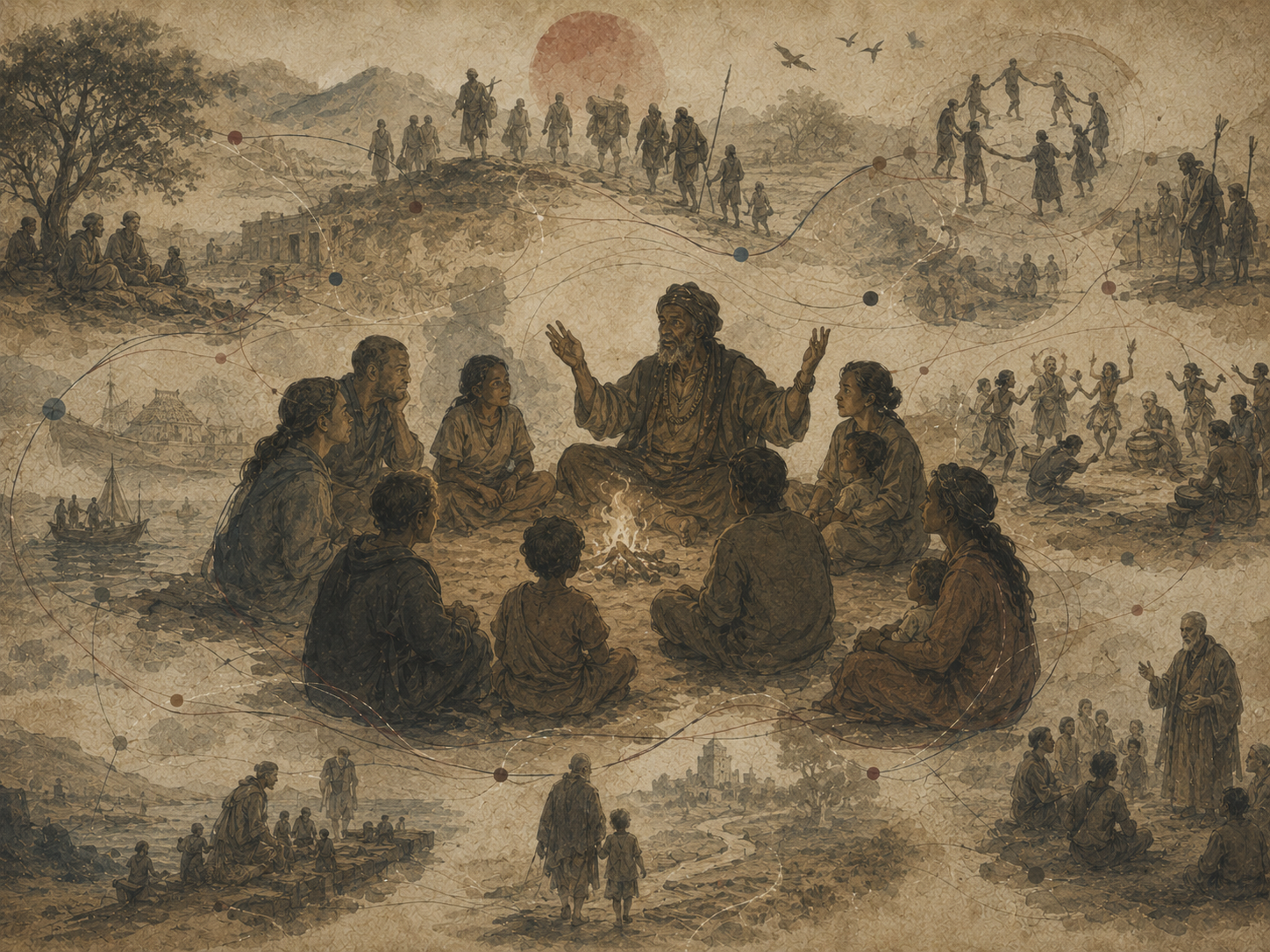
This article treats oral tradition as a narrative system. It examines performance, memory, repetition, variation, formula, audience participation, ritual context, authority, collective identity, historical transmission, preservation, documentation, and ethical responsibility. It also includes computational workflows for auditing oral-tradition structures, performance contexts, transmission patterns, memory functions, documentation risks, consent concerns, and Catalyst Canvas-ready governance outputs.
Why Oral Tradition Matters
Oral tradition matters because stories do not begin as isolated texts. They often begin as social acts: a voice addressing listeners, a song performed at a gathering, a proverb spoken in judgment, a chant embedded in ritual, a myth retold in relation to place, a family memory repeated across generations, or an epic performed with pattern, formula, and variation.
Oral tradition preserves more than entertainment. It can carry historical memory, ecological knowledge, moral instruction, spiritual meaning, social norms, genealogies, law, identity, humor, warning, grief, resistance, and collective orientation. A story may teach how to act, where one belongs, what ancestors endured, what dangers matter, what values are honored, and what responsibilities continue.
This does not mean oral traditions are simple containers of unchanged information. They are living practices. They endure through repetition, but also through variation. They preserve memory by adapting it to new situations, audiences, and performers. Oral tradition is therefore both conservative and creative: it keeps stories recognizable while allowing them to remain alive.
| Function | What oral tradition carries | Why it matters |
|---|---|---|
| Memory | Events, ancestors, places, origins, losses, victories, and warnings. | Communities remember through repeated performance. |
| Identity | Belonging, lineage, social roles, shared values, and group history. | Stories help people know who they are together. |
| Knowledge | Environmental, historical, ritual, ethical, and practical knowledge. | Story becomes a medium of instruction and survival. |
| Authority | Rules, obligations, legitimacy, precedent, and inherited wisdom. | Speech can carry social force and responsibility. |
| Adaptation | New circumstances, crises, migrations, and social change. | Tradition remains living rather than frozen. |
| Performance | Voice, gesture, rhythm, audience response, timing, and place. | Meaning happens in the act of telling. |
Oral tradition matters because it shows storytelling as a living relationship among memory, performance, community, and responsibility.
Oral Tradition Is Not the Absence of Writing
Oral tradition is often misunderstood as what societies have before writing. That framing is too narrow. Oral tradition is not simply the absence of written text. It is a distinct mode of cultural organization, memory, performance, and knowledge transmission. Many communities with writing also maintain powerful oral traditions. Oral and written forms often coexist, influence each other, and move across media.
A written transcript of an oral performance is not the same as the performance itself. The transcript may preserve words, but it cannot fully preserve timing, voice, gesture, place, audience response, emotional atmosphere, ritual frame, improvisation, or social authority. When oral tradition is reduced to text, the analyst may mistake a record of performance for the living practice.
This distinction matters for storytelling studies. Oral tradition helps us see that stories are not only objects. They are events. A tale told at a ritual, a proverb spoken in a dispute, a song performed at a funeral, or an epic sung before listeners is not merely content. It is a social act embedded in time, place, relation, and consequence.
| Misunderstanding | More accurate view | Why the distinction matters |
|---|---|---|
| Oral tradition is pre-literacy. | Oral tradition can coexist with writing, print, recording, and digital media. | It avoids treating oral cultures as earlier or lesser. |
| Oral tradition is informal. | Oral forms can be highly structured, governed, and artful. | It recognizes skill, method, and cultural authority. |
| Oral stories are unstable versions of texts. | Variation can be part of the tradition’s strength. | It values adaptive memory rather than only fixed form. |
| Recording preserves the tradition. | Recording preserves one trace of one performance. | It prevents archive from replacing community practice. |
| Oral tradition belongs to the past. | Oral tradition continues in ritual, family, performance, radio, podcasting, platforms, and public life. | It shows orality as contemporary and dynamic. |
| Anyone can retell the story freely. | Some traditions have protocols, permissions, roles, and restrictions. | It respects ownership, consent, and cultural governance. |
Oral tradition is not a lesser form of storytelling. It is a different architecture of memory, performance, and social meaning.
Performance as Composition
In oral tradition, performance is often not just delivery. It can be composition. A storyteller, singer, chanter, or performer may draw on inherited patterns, formulas, motifs, rhythms, images, names, episodes, gestures, and audience cues to create a version of the story in the moment of telling.
This does not mean the performer invents everything from nothing. Oral performance usually depends on tradition: known plots, repeated phrases, formulaic structures, ritual expectations, genre conventions, social roles, and remembered sequences. But each performance may vary according to audience, occasion, skill, memory, social context, time available, moral emphasis, humor, grief, or political pressure.
Performance therefore challenges a text-centered idea of authorship. In oral tradition, the story may not belong to a single author in the modern literary sense. It may belong to a community, lineage, ritual office, performer tradition, family, or place. The performer’s artistry appears in the handling of inherited material, not necessarily in inventing a wholly original plot.
| Performance element | Role in oral composition | Analytic question |
|---|---|---|
| Formula | Reusable phrase, line, image, rhythm, or pattern. | What repeated forms support memory and performance? |
| Motif | Recognizable story element that can recur across versions. | What stays recognizable across tellings? |
| Episode | Modular narrative unit that can be expanded, shortened, or rearranged. | How does the performer manage sequence? |
| Audience response | Feedback that shapes timing, emphasis, and elaboration. | How does the audience participate in meaning? |
| Occasion | Social or ritual setting that frames performance. | Why is this story told here and now? |
| Embodiment | Voice, gesture, posture, rhythm, breath, song, and movement. | What meaning is carried beyond words? |
Performance as composition means oral tradition is not merely remembered text. It is remembered structure brought alive in a specific social moment.
Memory as Social Practice
Oral tradition depends on memory, but not memory as a private storage device. Memory in oral tradition is social, patterned, performed, repeated, corrected, contested, and renewed. A community remembers by telling, listening, responding, teaching, repeating, and recognizing when a performance belongs to the tradition.
Memory is supported by structure. Rhythm, repetition, formula, parallelism, genealogy, place names, ritual sequence, call and response, melody, image, and episode all help stories remain transmissible. These structures do not simply make stories easier to remember. They shape how the story thinks. A repeated line can mark value. A genealogy can organize belonging. A place name can anchor history. A chant can carry obligation.
Collective memory is not the same as perfect recall. Communities remember selectively. They emphasize some events, omit others, reshape others, and interpret the past through present needs. This selectivity does not make collective memory meaningless. It makes it a field of cultural interpretation that requires care, context, and comparison.
| Memory support | How it works | Story function |
|---|---|---|
| Repetition | Important lines, actions, or scenes recur. | Builds memory, emphasis, and ritual force. |
| Rhythm | Sound pattern supports recall and performance. | Connects memory with voice and body. |
| Formula | Reusable language supports composition and continuity. | Creates recognizable tradition. |
| Place | Memory is anchored to landscape, route, dwelling, shrine, or territory. | Connects story to belonging and orientation. |
| Genealogy | Names and relations organize time and identity. | Preserves lineage, obligation, and authority. |
| Audience correction | Listeners recognize errors, omissions, or departures. | Memory becomes communal governance. |
Oral memory is not merely internal. It is distributed across voice, body, audience, place, ritual, and social recognition.
Repetition, Formula, and Variation
Repetition is often central to oral tradition. Repeated phrases, refrains, epithets, narrative sequences, call-and-response patterns, rhythms, and motifs help stories survive performance. Repetition also creates expectation. Listeners recognize a pattern and anticipate how it may return, intensify, or change.
Formula is not laziness. Formula is a technique of composition, memory, rhythm, and recognition. A repeated phrase can help a singer maintain meter. A recurring scene can help a storyteller structure a long narrative. A standard opening can mark genre. A ritual phrase can authorize speech. A repeated proverb can condense social knowledge.
Variation is equally important. Oral traditions survive because they can change while remaining recognizable. A performer may adapt emphasis, detail, length, humor, imagery, moral lesson, or local reference. Different versions can coexist. Variation allows the tradition to respond to new conditions without breaking continuity.
| Feature | Stabilizing function | Adaptive function |
|---|---|---|
| Repeated phrase | Preserves recognizable language. | Can shift tone through new context. |
| Formulaic episode | Supports long-form performance. | Can be expanded or shortened. |
| Motif | Connects versions across time. | Can be reinterpreted for new situations. |
| Proverb | Condenses social judgment. | Can be applied flexibly in different disputes. |
| Song or chant | Preserves rhythm and communal participation. | Can change with occasion or performer. |
| Opening and closing formulas | Signal genre and performance frame. | Can be personalized or localized. |
Oral tradition works through the tension between stability and change. Repetition keeps the story recognizable. Variation keeps it alive.
Storytellers, Audiences, and Communities
Oral storytelling is relational. A performance involves a teller, an audience, a setting, a tradition, and a social purpose. The audience is not always passive. Listeners may respond, correct, anticipate, sing, repeat, laugh, mourn, challenge, witness, or authorize the performance.
The storyteller’s role may vary. Some tellers are elders, specialists, singers, ritual experts, griots, bards, healers, historians, family members, comedians, teachers, witnesses, or community leaders. Some traditions are widely shared; others are restricted by age, gender, season, status, initiation, kinship, or ceremonial responsibility.
Community matters because oral tradition often depends on recognition. A story belongs to a tradition when listeners know how to hear it. They recognize its forms, values, limits, and occasions. They may also recognize when a teller has changed something meaningfully or improperly. In this sense, oral storytelling is governed by shared knowledge.
| Participant | Role | Governance question |
|---|---|---|
| Storyteller | Performs, remembers, interprets, adapts, and carries tradition. | What authority or responsibility does the teller hold? |
| Audience | Listens, responds, validates, remembers, and participates. | How does audience response shape performance? |
| Community | Maintains continuity, protocols, value, and recognition. | Who can authorize a telling? |
| Apprentice | Learns through listening, repetition, correction, and practice. | How is knowledge transmitted responsibly? |
| Witness | Carries testimony or memory into public recognition. | How is testimony protected from exploitation? |
| Researcher or recorder | Documents or interprets a performance. | Who controls the record and its use? |
Oral tradition is not just a story moving from mouth to ear. It is a social relationship organized around memory, authority, and participation.
Major Genres of Oral Tradition
Oral tradition includes many forms. Myths, legends, folktales, epics, proverbs, riddles, chants, prayers, songs, genealogies, ritual speech, laments, jokes, praise poetry, origin stories, place stories, and historical accounts all belong to different oral systems. Each genre has its own expectations, authority, performance conditions, and truth claims.
A myth may explain origins, sacred order, or the relation between humans and more-than-human forces. A legend may connect history, place, and memory. A folktale may teach through repetition, pattern, trickster logic, or social inversion. An epic may preserve heroic memory and communal identity through long-form performance. A proverb may condense practical judgment into portable language.
Genre matters because not every oral form should be read the same way. A riddle does not function like a genealogy. A ritual chant does not function like a joke. A myth does not function like a courtroom testimony. The analyst must ask what kind of oral form is being performed and what kind of truth it claims.
| Genre | Common function | Analytic caution |
|---|---|---|
| Myth | Explains origins, sacred relations, cosmic order, or cultural meaning. | Do not reduce myth to false explanation. |
| Legend | Links memory, place, event, and communal interpretation. | Distinguish historical trace from narrative elaboration. |
| Folktale | Uses pattern, motif, humor, wonder, and moral testing. | Attend to variation across tellings. |
| Epic | Preserves heroic memory, conflict, identity, and public value. | Analyze performance, formula, and audience context. |
| Proverb | Condenses social judgment into memorable speech. | Meaning depends on situation and speaker. |
| Ritual speech | Performs obligation, transition, blessing, mourning, or authority. | Do not detach words from ceremonial context. |
Oral tradition is not one genre. It is a field of performed forms, each with distinct rules, uses, and responsibilities.
Collective Memory and Cultural Continuity
Collective memory is memory held, shaped, and transmitted through social groups. It is not only what individuals remember. It is what communities organize, repeat, authorize, contest, and carry forward. Oral tradition is one of the major ways collective memory becomes active.
Collective memory can preserve origin, migration, loss, injustice, triumph, kinship, place, ritual, and obligation. It can also shape identity by telling people what belongs to “us,” what has happened to “us,” what “we” must not forget, and what responsibilities continue because of the past. In this sense, oral tradition often links memory with moral and social order.
But collective memory is selective. It may preserve some events and silence others. It may authorize some voices and exclude others. It may stabilize identity while also simplifying complexity. It may protect a community from erasure or become a tool of power. Responsible analysis asks how collective memory is formed, who carries it, who benefits from it, who is left out, and how it changes over time.
| Collective memory element | How oral tradition supports it | Risk |
|---|---|---|
| Origin memory | Stories explain how a people, place, practice, or obligation began. | Origins may be simplified or politicized. |
| Historical memory | Events are carried through testimony, song, legend, or genealogy. | Memory may be mistaken for complete record. |
| Place memory | Landscape becomes storied and remembered. | Place may be detached from living community. |
| Trauma memory | Loss and harm are carried through repeated telling or silence. | Retelling may expose or exploit pain. |
| Ritual memory | Performance renews continuity across generations. | Documentation may flatten sacred context. |
| Counter-memory | Suppressed histories survive outside official records. | Power may absorb counter-memory without repair. |
Collective memory gives oral tradition historical and ethical weight. It makes storytelling a way of carrying the past into communal life.
Place, Ritual, and Embodiment
Oral tradition is often inseparable from place, ritual, and body. Some stories belong to specific landscapes, waters, roads, mountains, homes, shrines, burial grounds, gathering places, or routes of migration. Some stories belong to specific times, seasons, ceremonies, initiations, mourning practices, festivals, or rites of passage.
Embodiment matters because oral tradition is performed through the body. Breath, rhythm, gesture, posture, facial expression, song, silence, movement, and call-and-response can all carry meaning. A transcript may capture words, but it rarely captures the full embodied event.
Ritual context also matters. A story told in a ceremonial setting may not function like the same words quoted in an article or archive. The performance may mark transition, invoke authority, repair relation, mourn the dead, teach the young, renew obligation, or connect human life with sacred order. Removing the story from ritual can change its meaning.
| Context | Story function | Documentation risk |
|---|---|---|
| Place | Anchors memory to landscape and belonging. | Story may be detached from land and community. |
| Ritual | Performs obligation, transition, healing, or continuity. | Words may be archived without ceremonial meaning. |
| Body | Voice, gesture, rhythm, and silence carry meaning. | Transcript may erase embodied knowledge. |
| Season | Timing governs when stories may be told. | Recording may ignore temporal protocols. |
| Audience | Listeners help shape performance and recognition. | Archive may remove participation. |
| Material objects | Instruments, masks, textiles, tools, or spaces support memory. | Objects may be separated from story practice. |
Oral tradition is not only verbal. It is placed, embodied, timed, and socially performed.
Authority, Transmission, and Change
Oral tradition depends on transmission, but transmission is not always open, equal, or unrestricted. Some stories may be told by anyone. Others may require training, age, initiation, kinship, ceremonial role, gendered responsibility, seasonal timing, or permission. Authority matters because stories can carry law, ritual, sacred knowledge, historical memory, and social power.
Transmission occurs through listening, imitation, correction, apprenticeship, repetition, participation, and performance. A younger teller may learn by hearing a story many times before performing it. A community may correct mistakes or recognize when variation is appropriate. Knowledge may be transmitted through family, ritual institutions, guilds, schools, performance groups, or informal gatherings.
Change is part of transmission. A tradition that cannot change may become brittle. But change is not automatically legitimate. A responsible analysis asks who has the authority to alter a story, what kinds of variation are allowed, what changes violate protocol, and how communities negotiate continuity and adaptation.
| Transmission element | How it works | Governance question |
|---|---|---|
| Apprenticeship | Knowledge is learned through repeated exposure and correction. | Who teaches, and who is authorized to learn? |
| Community recognition | Listeners validate whether the telling belongs to the tradition. | Who can recognize legitimacy? |
| Restricted knowledge | Some stories are limited by role, season, status, or ceremony. | What should not be recorded or published? |
| Improvisation | Performer adapts within inherited structures. | What variation is acceptable? |
| Correction | Community or elders respond to error or misuse. | How is accuracy governed? |
| Revitalization | Tradition is renewed after disruption, suppression, or migration. | Who controls revival and representation? |
Authority in oral tradition is not merely about who speaks. It is about who may carry, change, record, translate, publish, and interpret the story.
Documentation, Preservation, and Archive Risk
Documentation can help preserve oral traditions, especially when communities face displacement, language loss, forced assimilation, political violence, ecological change, or generational rupture. Recordings, transcripts, translations, metadata, community archives, and educational materials can support continuity and access.
But documentation also creates risk. A recording can remove a performance from its context. A transcript can freeze one version as if it were authoritative. A translation can alter meaning. An archive can expose restricted knowledge. A researcher can extract cultural material without returning benefit. A public platform can circulate sacred, painful, or private material beyond community control.
Preservation should not mean turning living tradition into static content. Responsible preservation supports the people and practices that carry the tradition. It asks who requested the documentation, who controls access, what protocols apply, who benefits, what should remain private, and how future use will be governed.
| Preservation practice | Potential value | Risk |
|---|---|---|
| Audio recording | Preserves voice, rhythm, tone, and timing. | May circulate beyond consent. |
| Video recording | Captures gesture, setting, and performance context. | May expose ritual or private elements. |
| Transcript | Supports study, teaching, translation, and search. | May erase performance and variation. |
| Translation | Expands access across languages. | May alter culturally specific meaning. |
| Digital archive | Supports preservation and discoverability. | May remove control from source communities. |
| Community archive | Can preserve with local governance. | Requires resources, training, and long-term support. |
The archive should serve the tradition and its communities. It should not replace them.
Oral Tradition Across Media
Oral tradition does not disappear when media change. It moves, adapts, and reappears in writing, theater, radio, film, music, television, podcasts, spoken-word performance, video platforms, social media, games, and digital archives. Each medium preserves some features and transforms others.
Writing can stabilize a version but reduce performance variation. Audio can preserve voice but not always audience interaction. Video can capture gesture but may frame performance for outsiders. Podcasts can revive conversational storytelling but also reshape audience and intimacy. Social media can circulate oral forms rapidly, but context collapse may distort meaning. Digital archives can preserve endangered materials, but access must be governed.
Modern storytelling often blends oral and digital forms. A podcast may use oral testimony. A video platform may circulate family memory. A live performance may become a recorded clip. A traditional story may be adapted into a game. The question is not whether these forms remain “purely oral.” The question is how memory, performance, authority, consent, and community control change as stories move across media.
| Medium | What it preserves | What it changes |
|---|---|---|
| Writing | Words, sequence, and searchable record. | Reduces voice, gesture, and performance variability. |
| Audio | Voice, rhythm, pause, tone, and sound. | May detach performance from place and audience. |
| Video | Gesture, setting, performer, and embodied action. | Frames performance through camera and editing. |
| Radio and podcasting | Spoken intimacy and serial listening. | Creates mediated audience and production structure. |
| Social platforms | Rapid circulation and participatory remix. | Creates context collapse and ownership risk. |
| Digital archive | Long-term storage and discoverability. | Requires access protocols and community governance. |
Oral tradition across media is not simply preservation. It is transformation under new conditions of access, circulation, and power.
The Ethics of Oral Tradition
The ethics of oral tradition are central because oral stories often carry communal memory, sacred knowledge, testimony, trauma, place-based identity, ecological knowledge, family history, and cultural authority. Not every story should be extracted, translated, published, commercialized, digitized, or reused freely.
Ethical questions begin with ownership and permission. Who owns the story? Is ownership individual, communal, ancestral, ceremonial, or place-based? Who has authority to grant permission? Are there seasonal, gendered, ritual, age-based, or initiation-based restrictions? Is the story public, private, sacred, sensitive, or restricted?
Ethics also include benefit and accountability. Who benefits from recording or publishing the story? Does the community receive copies, credit, control, compensation, or decision-making power? Are recordings stored safely? Can access be revoked? Are translations reviewed? Is context preserved? Are living people protected? Are harms, grief, or sacred materials being turned into content for outsiders?
| Ethical issue | Risk | Responsible practice |
|---|---|---|
| Consent | Recording or sharing without permission. | Use clear, ongoing, informed consent processes. |
| Ownership | Treating communal tradition as free content. | Follow community protocols and attribution norms. |
| Restricted knowledge | Publishing sacred, private, or sensitive material. | Respect access limits and non-public status. |
| Translation | Losing meaning, tone, or cultural specificity. | Use collaborative review and contextual notes. |
| Archive access | Exposing material beyond intended audiences. | Use tiered permissions and community control. |
| Extraction | Researcher gains while community loses control. | Share benefit, governance, credit, and resources. |
Ethical oral-tradition work asks not only “Can this be recorded?” but “Who has the right to decide what happens to this story?”
Examples of Oral Tradition, Performance, and Memory
The examples below show how oral tradition can be analyzed without reducing performance to text alone.
Epic performance
Weak: The epic is treated as a fixed text with one correct version.
Stronger: The analysis tracks formula, performer, audience, occasion, variation, and long-form composition.
Why it works: Performance becomes part of the story’s structure.
Family memory
Weak: A repeated family story is treated as a simple factual record.
Stronger: The analysis distinguishes historical claim, emotional truth, omission, repetition, and identity work.
Why it works: Memory is treated as social and interpretive.
Proverb in dispute
Weak: The proverb is interpreted as a detached saying.
Stronger: The analysis asks who speaks it, when, to whom, and with what social force.
Why it works: Meaning depends on situation.
Ritual chant
Weak: The chant is translated as ordinary text.
Stronger: The analysis considers ritual setting, voice, repetition, timing, role, restriction, and embodiment.
Why it works: Performance context is preserved.
Community archive
Weak: Recordings are uploaded publicly without access review.
Stronger: The archive uses permissions, metadata, community governance, and restricted access where needed.
Why it works: Preservation does not override protocol.
Digital storytelling revival
Weak: A traditional story is remixed for visibility without community authority.
Stronger: Adaptation is guided by permission, context, benefit, and cultural review.
Why it works: Innovation remains accountable to tradition.
Oral tradition analysis should preserve the relationship among teller, audience, memory, performance, and community authority.
Mathematics, Computation, and Modeling
Oral tradition cannot be reduced to formulas, but modeling can help make transmission, performance, memory, variation, and governance questions explicit. A computational workflow can audit whether an oral-tradition item is being analyzed as a living practice rather than as detached content.
A performance-context score can estimate whether the analysis preserves the social event of telling:
P_c = \frac{T_r + A_r + O_c + E_b + S_p + C_f}{6}
\]
Interpretation: Performance context \(P_c\) averages teller role \(T_r\), audience response \(A_r\), occasion clarity \(O_c\), embodiment \(E_b\), setting/place \(S_p\), and cultural frame \(C_f\).
A transmission integrity score can estimate whether continuity and variation are responsibly represented:
T_i = \frac{L_c + V_t + M_s + G_p + A_p + R_c}{6}
\]
Interpretation: Transmission integrity \(T_i\) averages lineage clarity \(L_c\), variation tracking \(V_t\), memory supports \(M_s\), governance protocol \(G_p\), authority permission \(A_p\), and record context \(R_c\).
A collective-memory function score can estimate how strongly an oral tradition supports communal memory:
M_f = \frac{O_m + P_m + I_m + H_m + R_m + F_m}{6}
\]
Interpretation: Memory function \(M_f\) averages origin memory \(O_m\), place memory \(P_m\), identity memory \(I_m\), historical memory \(H_m\), ritual memory \(R_m\), and future obligation \(F_m\).
An archive-risk score can estimate whether documentation or reuse may be ethically unsafe:
R_a = C_lw_c + S_kw_s + E_rw_e + O_rw_o + X_rw_x + (1 – G_c)w_g
\]
Interpretation: Archive risk \(R_a\) rises with consent limits \(C_l\), sacred or restricted knowledge \(S_k\), exposure risk \(E_r\), ownership risk \(O_r\), extraction risk \(X_r\), and weak governance control \(G_c\).
| Modeling task | Narrative question | Example output |
|---|---|---|
| Performance-context audit | Is the performance event preserved in the analysis? | Performance context score. |
| Transmission audit | How are continuity, variation, and authority represented? | Transmission integrity table. |
| Memory-function audit | What kind of collective memory does the story carry? | Collective memory function score. |
| Variation map | What changes across versions or performances? | Variation and motif table. |
| Documentation audit | What is lost or changed when performance becomes record? | Archive context report. |
| Ethical governance audit | Who controls recording, translation, access, and reuse? | Oral tradition governance queue. |
Computation can help organize review questions, but it must remain subordinate to community protocols, cultural expertise, consent, and human interpretation.
Python Workflow: Oral Tradition Audit
The Python workflow below evaluates oral-tradition items by teller role, audience response, occasion clarity, embodiment, setting/place, cultural frame, lineage clarity, variation tracking, memory supports, governance protocol, authority permission, record context, origin memory, place memory, identity memory, historical memory, ritual memory, future obligation, consent limits, restricted knowledge, exposure risk, ownership risk, extraction risk, and governance control. The companion repository version extends this into a Catalyst Canvas-ready module with schemas, package-style Python, tests, JSON exports, Canvas cards, markdown governance queues, and reusable oral-tradition templates.
# oral_tradition_audit.py
# Dependency-light workflow for auditing oral tradition, performance, and collective memory.

from __future__ import annotations

from dataclasses import dataclass
from pathlib import Path
import csv
import json
from statistics import mean

ARTICLE_ROOT = Path(__file__).resolve().parents[1]
OUTPUTS = ARTICLE_ROOT / "outputs"
TABLES = OUTPUTS / "tables"
JSON_DIR = OUTPUTS / "json"
MARKDOWN = OUTPUTS / "markdown"


@dataclass
class OralTraditionItem:
    item: str
    tradition_type: str
    teller_role: float
    audience_response: float
    occasion_clarity: float
    embodiment: float
    setting_place: float
    cultural_frame: float
    lineage_clarity: float
    variation_tracking: float
    memory_supports: float
    governance_protocol: float
    authority_permission: float
    record_context: float
    origin_memory: float
    place_memory: float
    identity_memory: float
    historical_memory: float
    ritual_memory: float
    future_obligation: float
    consent_limits: float
    restricted_knowledge: float
    exposure_risk: float
    ownership_risk: float
    extraction_risk: float
    governance_control: float
    community_sensitivity: float
    public_consequence: float
    owner: str
    status: str

    def performance_context(self) -> float:
        return mean([
            self.teller_role,
            self.audience_response,
            self.occasion_clarity,
            self.embodiment,
            self.setting_place,
            self.cultural_frame,
        ])

    def transmission_integrity(self) -> float:
        return mean([
            self.lineage_clarity,
            self.variation_tracking,
            self.memory_supports,
            self.governance_protocol,
            self.authority_permission,
            self.record_context,
        ])

    def memory_function(self) -> float:
        return mean([
            self.origin_memory,
            self.place_memory,
            self.identity_memory,
            self.historical_memory,
            self.ritual_memory,
            self.future_obligation,
        ])

    def archive_risk(self) -> float:
        return min(
            1.0,
            self.consent_limits * 0.18
            + self.restricted_knowledge * 0.22
            + self.exposure_risk * 0.18
            + self.ownership_risk * 0.18
            + self.extraction_risk * 0.14
            + (1 - self.governance_control) * 0.10,
        )

    def governance_priority_score(self) -> float:
        return min(
            1.0,
            self.archive_risk() * 0.35
            + self.community_sensitivity * 0.25
            + self.public_consequence * 0.20
            + (1 - self.transmission_integrity()) * 0.20,
        )

    def review_priority(self) -> str:
        risk = self.archive_risk()
        priority = self.governance_priority_score()
        transmission = self.transmission_integrity()

        if self.status == "revise" or risk >= 0.55 or priority >= 0.62 or transmission < 0.55:
            return "high"
        if self.status == "review" or risk >= 0.40 or priority >= 0.48 or transmission < 0.68:
            return "medium"
        return "standard"


def write_csv(path: Path, rows: list[dict[str, object]]) -> None:
    path.parent.mkdir(parents=True, exist_ok=True)
    if not rows:
        raise ValueError(f"No rows to write: {path}")
    with path.open("w", encoding="utf-8", newline="") as handle:
        writer = csv.DictWriter(handle, fieldnames=list(rows[0].keys()))
        writer.writeheader()
        writer.writerows(rows)


def write_json(path: Path, payload: object) -> None:
    path.parent.mkdir(parents=True, exist_ok=True)
    path.write_text(json.dumps(payload, indent=2), encoding="utf-8")


def write_markdown_queue(path: Path, rows: list[dict[str, object]]) -> None:
    path.parent.mkdir(parents=True, exist_ok=True)
    lines = [
        "# Oral Tradition Governance Queue",
        "",
        "| Item | Type | Performance context | Transmission integrity | Memory function | Archive risk | Priority | Owner |",
        "|---|---|---:|---:|---:|---:|---|---|",
    ]

    for row in rows:
        lines.append(
            f"| {row['item']} | {row['tradition_type']} | "
            f"{row['performance_context']} | {row['transmission_integrity']} | "
            f"{row['memory_function']} | {row['archive_risk']} | "
            f"{row['review_priority']} | {row['owner']} |"
        )

    path.write_text("\n".join(lines) + "\n", encoding="utf-8")


def main() -> None:
    items = [
        OralTraditionItem(
            "Epic performance",
            "oral epic",
            0.92, 0.82, 0.86, 0.88, 0.74, 0.86,
            0.82, 0.88, 0.90, 0.70, 0.68, 0.72,
            0.74, 0.60, 0.84, 0.78, 0.66, 0.62,
            0.28, 0.30, 0.34, 0.42, 0.32, 0.72,
            0.76, 0.64,
            "editorial", "active"
        ),
        OralTraditionItem(
            "Ritual chant documentation",
            "ritual speech",
            0.86, 0.74, 0.92, 0.94, 0.88, 0.90,
            0.76, 0.58, 0.84, 0.82, 0.74, 0.46,
            0.68, 0.82, 0.72, 0.64, 0.94, 0.78,
            0.72, 0.88, 0.82, 0.76, 0.70, 0.48,
            0.96, 0.82,
            "cultural review", "review"
        ),
        OralTraditionItem(
            "Community place story",
            "place memory",
            0.78, 0.72, 0.80, 0.70, 0.94, 0.86,
            0.78, 0.74, 0.82, 0.78, 0.76, 0.70,
            0.80, 0.96, 0.88, 0.74, 0.62, 0.76,
            0.38, 0.42, 0.46, 0.52, 0.40, 0.76,
            0.88, 0.70,
            "community archive", "active"
        ),
        OralTraditionItem(
            "Platform remix of traditional story",
            "digital adaptation",
            0.44, 0.50, 0.34, 0.38, 0.30, 0.42,
            0.28, 0.36, 0.42, 0.22, 0.18, 0.30,
            0.44, 0.38, 0.40, 0.30, 0.22, 0.28,
            0.82, 0.76, 0.80, 0.88, 0.90, 0.20,
            0.92, 0.86,
            "platform review", "revise"
        ),
        OralTraditionItem(
            "Family memory story",
            "family oral history",
            0.68, 0.76, 0.70, 0.62, 0.66, 0.72,
            0.64, 0.70, 0.74, 0.58, 0.62, 0.66,
            0.62, 0.58, 0.82, 0.70, 0.42, 0.56,
            0.34, 0.24, 0.42, 0.36, 0.28, 0.74,
            0.72, 0.52,
            "research", "active"
        ),
    ]

    rows = []

    for item in items:
        rows.append({
            "item": item.item,
            "tradition_type": item.tradition_type,
            "performance_context": round(item.performance_context(), 3),
            "transmission_integrity": round(item.transmission_integrity(), 3),
            "memory_function": round(item.memory_function(), 3),
            "archive_risk": round(item.archive_risk(), 3),
            "governance_priority_score": round(item.governance_priority_score(), 3),
            "review_priority": item.review_priority(),
            "owner": item.owner,
            "status": item.status,
        })

    priority_order = {"high": 3, "medium": 2, "standard": 1}
    rows = sorted(
        rows,
        key=lambda row: (
            priority_order.get(str(row["review_priority"]), 0),
            float(row["archive_risk"])
        ),
        reverse=True,
    )

    governance_queue = [
        row for row in rows
        if row["review_priority"] != "standard"
    ]

    write_csv(TABLES / "oral_tradition_audit.csv", rows)
    write_csv(TABLES / "oral_tradition_governance_queue.csv", governance_queue)

    write_json(JSON_DIR / "oral_tradition_canvas_cards.json", rows)
    write_json(JSON_DIR / "oral_tradition_governance_queue.json", governance_queue)

    write_markdown_queue(MARKDOWN / "oral_tradition_governance_queue.md", governance_queue)

    print("Oral tradition audit complete.")


if __name__ == "__main__":
    main()
This workflow helps identify whether an oral-tradition analysis preserves performance context, transmission integrity, collective memory function, and ethical governance.
R Workflow: Performance and Memory Diagnostics
The R workflow below creates a synthetic oral-tradition dataset, calculates performance context, transmission integrity, memory function, archive risk, governance priority, and review priority, then exports summary tables and base R plots. It is intentionally portable and uses only base R.
# oral_tradition_diagnostics.R
# Base R workflow for oral tradition, performance, and collective memory.

args <- commandArgs(trailingOnly = FALSE)
file_arg <- grep("^--file=", args, value = TRUE)

if (length(file_arg) > 0) {
  script_path <- normalizePath(sub("^--file=", "", file_arg[1]), mustWork = TRUE)
  article_root <- normalizePath(file.path(dirname(script_path), ".."), mustWork = TRUE)
} else {
  article_root <- getwd()
}

setwd(article_root)

tables_dir <- file.path(article_root, "outputs", "tables")
figures_dir <- file.path(article_root, "outputs", "figures")
dir.create(tables_dir, recursive = TRUE, showWarnings = FALSE)
dir.create(figures_dir, recursive = TRUE, showWarnings = FALSE)

items <- data.frame(
  item = c(
    "Epic performance",
    "Ritual chant documentation",
    "Community place story",
    "Platform remix of traditional story",
    "Family memory story"
  ),
  tradition_type = c(
    "oral epic",
    "ritual speech",
    "place memory",
    "digital adaptation",
    "family oral history"
  ),
  teller_role = c(0.92, 0.86, 0.78, 0.44, 0.68),
  audience_response = c(0.82, 0.74, 0.72, 0.50, 0.76),
  occasion_clarity = c(0.86, 0.92, 0.80, 0.34, 0.70),
  embodiment = c(0.88, 0.94, 0.70, 0.38, 0.62),
  setting_place = c(0.74, 0.88, 0.94, 0.30, 0.66),
  cultural_frame = c(0.86, 0.90, 0.86, 0.42, 0.72),
  lineage_clarity = c(0.82, 0.76, 0.78, 0.28, 0.64),
  variation_tracking = c(0.88, 0.58, 0.74, 0.36, 0.70),
  memory_supports = c(0.90, 0.84, 0.82, 0.42, 0.74),
  governance_protocol = c(0.70, 0.82, 0.78, 0.22, 0.58),
  authority_permission = c(0.68, 0.74, 0.76, 0.18, 0.62),
  record_context = c(0.72, 0.46, 0.70, 0.30, 0.66),
  origin_memory = c(0.74, 0.68, 0.80, 0.44, 0.62),
  place_memory = c(0.60, 0.82, 0.96, 0.38, 0.58),
  identity_memory = c(0.84, 0.72, 0.88, 0.40, 0.82),
  historical_memory = c(0.78, 0.64, 0.74, 0.30, 0.70),
  ritual_memory = c(0.66, 0.94, 0.62, 0.22, 0.42),
  future_obligation = c(0.62, 0.78, 0.76, 0.28, 0.56),
  consent_limits = c(0.28, 0.72, 0.38, 0.82, 0.34),
  restricted_knowledge = c(0.30, 0.88, 0.42, 0.76, 0.24),
  exposure_risk = c(0.34, 0.82, 0.46, 0.80, 0.42),
  ownership_risk = c(0.42, 0.76, 0.52, 0.88, 0.36),
  extraction_risk = c(0.32, 0.70, 0.40, 0.90, 0.28),
  governance_control = c(0.72, 0.48, 0.76, 0.20, 0.74),
  community_sensitivity = c(0.76, 0.96, 0.88, 0.92, 0.72),
  public_consequence = c(0.64, 0.82, 0.70, 0.86, 0.52),
  owner = c("editorial", "cultural review", "community archive", "platform review", "research"),
  status = c("active", "review", "active", "revise", "active"),
  stringsAsFactors = FALSE
)

items$performance_context <- rowMeans(items[, c(
  "teller_role",
  "audience_response",
  "occasion_clarity",
  "embodiment",
  "setting_place",
  "cultural_frame"
)])

items$transmission_integrity <- rowMeans(items[, c(
  "lineage_clarity",
  "variation_tracking",
  "memory_supports",
  "governance_protocol",
  "authority_permission",
  "record_context"
)])

items$memory_function <- rowMeans(items[, c(
  "origin_memory",
  "place_memory",
  "identity_memory",
  "historical_memory",
  "ritual_memory",
  "future_obligation"
)])

items$archive_risk <- pmin(
  1,
  items$consent_limits * 0.18 +
    items$restricted_knowledge * 0.22 +
    items$exposure_risk * 0.18 +
    items$ownership_risk * 0.18 +
    items$extraction_risk * 0.14 +
    (1 - items$governance_control) * 0.10
)

items$governance_priority_score <- pmin(
  1,
  items$archive_risk * 0.35 +
    items$community_sensitivity * 0.25 +
    items$public_consequence * 0.20 +
    (1 - items$transmission_integrity) * 0.20
)

items$review_priority <- ifelse(
  items$status == "revise" | items$archive_risk >= 0.55 | items$governance_priority_score >= 0.62 | items$transmission_integrity < 0.55,
  "high",
  ifelse(
    items$status == "review" | items$archive_risk >= 0.40 | items$governance_priority_score >= 0.48 | items$transmission_integrity < 0.68,
    "medium",
    "standard"
  )
)

items <- items[order(items$archive_risk, decreasing = TRUE), ]

write.csv(
  items,
  file.path(tables_dir, "oral_tradition_diagnostics.csv"),
  row.names = FALSE
)

governance_queue <- items[items$review_priority != "standard", ]

write.csv(
  governance_queue,
  file.path(tables_dir, "oral_tradition_governance_queue.csv"),
  row.names = FALSE
)

png(file.path(figures_dir, "performance_context_scores.png"), width = 1200, height = 700)
barplot(
  items$performance_context,
  names.arg = items$item,
  las = 2,
  ylab = "Performance context",
  main = "Performance Context Scores"
)
grid()
dev.off()

png(file.path(figures_dir, "archive_risk_scores.png"), width = 1200, height = 700)
barplot(
  items$archive_risk,
  names.arg = items$item,
  las = 2,
  ylab = "Archive risk",
  main = "Archive Risk Scores"
)
grid()
dev.off()

print(items[, c(
  "item",
  "tradition_type",
  "performance_context",
  "transmission_integrity",
  "memory_function",
  "archive_risk",
  "governance_priority_score",
  "review_priority"
)])
This workflow turns oral tradition, performance, and collective memory into a reviewable editorial artifact. It helps identify whether documentation or reuse requires deeper community, cultural, or ethical review.
GitHub Repository
The companion repository for this article supports oral tradition, performance, and collective memory as a Catalyst Canvas-ready analysis module. It includes performance-context audits, transmission-integrity scoring, collective-memory function analysis, variation maps, archive-risk checks, consent and ownership review, JSON schemas, package-style Python, R workflows, SQL structures, Canvas cards, markdown governance queues, synthetic datasets, documentation, and reusable oral-tradition templates.
Complete Code Repository
Companion repository for the article, including Catalyst Canvas-ready code for oral tradition, performance context, transmission integrity, collective memory, variation, archive risk, consent review, governance queues, JSON exports, Canvas cards, and reproducible research workflows.
articles/oral-tradition-performance-and-collective-memory/
├── canvas/
│   ├── canvas_manifest.json
│   ├── input_schema.json
│   ├── output_schema.json
│   ├── canvas_cards.json
│   └── governance_queue.json
├── html/
├── css/
├── php/
├── java/
├── python/
│   ├── oral_tradition_canvas/
│   │   ├── __init__.py
│   │   ├── __main__.py
│   │   ├── cli.py
│   │   ├── models.py
│   │   ├── scoring.py
│   │   ├── validation.py
│   │   ├── governance.py
│   │   └── exporters.py
│   ├── tests/
│   │   └── test_oral_tradition_canvas.py
│   └── run_oral_tradition_canvas_audit.py
├── r/
│   ├── oral_tradition_diagnostics.R
│   └── run_all_oral_tradition_workflows.R
├── sql/
│   ├── canvas_schema.sql
│   └── canvas_queries.sql
├── docs/
│   ├── article_notes.md
│   ├── modeling_principles.md
│   ├── oral_tradition.md
│   ├── performance_context.md
│   ├── collective_memory.md
│   ├── archive_risk.md
│   └── governance_notes.md
├── data/
│   ├── oral_tradition_items.csv
│   ├── performance_contexts.csv
│   ├── transmission_patterns.csv
│   ├── collective_memory_functions.csv
│   ├── archive_risks.csv
│   └── oral_tradition_governance_notes.csv
├── outputs/
│   ├── figures/
│   ├── json/
│   ├── markdown/
│   └── tables/
├── notebooks/
├── shared/
│   ├── schemas/
│   ├── narrative-templates/
│   ├── story-archetypes/
│   ├── character-models/
│   ├── plot-structures/
│   ├── rhetorical-frameworks/
│   ├── cultural-memory/
│   ├── oral-tradition/
│   └── governance/
├── tests/
└── README.md
Related Articles
- Beginnings, Endings, and Narrative Closure
- Folktale Structure and Vladimir Propp’s Morphology
- Myths, Legends, Folktales, and Epics
- Storytelling as Intangible Cultural Heritage
- Performance, Memory, and Variation in Oral Storytelling
- Proverb, Song, Chant, and Ritual Speech
A Practical Method for Analyzing Oral Tradition
1. Identify the oral form
Determine whether the material is myth, legend, folktale, epic, proverb, song, chant, testimony, genealogy, ritual speech, or another oral form.
2. Identify the performance context
Ask who tells, who listens, where the performance occurs, when it occurs, and what occasion frames it.
3. Separate performance from transcript
Document what is preserved in words and what may be lost: voice, gesture, timing, place, audience response, and ritual frame.
4. Track repetition and variation
Identify formulas, motifs, repeated phrases, scenes, openings, closings, and points of variation across versions.
5. Map transmission
Ask how the story is learned, corrected, authorized, repeated, adapted, and passed on.
6. Analyze memory function
Identify whether the story carries origin memory, place memory, historical memory, ritual memory, identity memory, or future obligation.
7. Review authority and protocol
Ask who has permission to tell, hear, record, translate, publish, or adapt the story.
8. Evaluate documentation risk
Review whether recording, transcription, translation, or archiving changes meaning or exposes restricted material.
9. Identify ownership and benefit
Ask who controls the story, who benefits from its use, and how the source community is credited or compensated.
10. Add governance notes
Document consent, access levels, cultural protocols, archive restrictions, community review, and reuse limits.
This method treats oral tradition as living cultural infrastructure, not as raw story material.
Common Pitfalls
Several pitfalls appear when oral tradition is misunderstood.
- Treating oral tradition as primitive: Oral tradition is not a lesser stage before writing. It is a distinct system of performance and memory.
- Reducing performance to text: A transcript cannot fully preserve voice, gesture, audience, timing, place, or ritual frame.
- Assuming one correct version: Variation can be part of the tradition rather than a defect.
- Ignoring audience participation: Listeners may validate, correct, join, or shape the performance.
- Confusing memory with perfect record: Collective memory is meaningful, selective, and socially organized.
- Publishing restricted knowledge: Some stories require permission, protocols, or limited access.
- Extracting without benefit: Researchers, platforms, or publishers should not gain control while communities lose it.
- Freezing living tradition: Preservation should support practice, not turn tradition into static content.
- Ignoring translation loss: Meaning may depend on sound, rhythm, language, gesture, and cultural context.
- Romanticizing authenticity: Living traditions adapt. Change is not automatically corruption.
The central pitfall is treating oral tradition as content instead of relationship, performance, memory, and governance.
Why Oral Tradition Still Matters
Oral tradition still matters because storytelling is not only a written, published, or digital practice. Stories live in voices, bodies, gatherings, rituals, families, communities, songs, places, and memories. They are carried not only by pages and platforms, but by people who remember, perform, adapt, protect, and transmit meaning.
Oral tradition reminds us that stories are events as well as artifacts. They happen between teller and audience. They carry cultural memory through repetition and variation. They connect identity to place, history to performance, and memory to responsibility. They also require ethical care because stories can belong to communities, carry restricted knowledge, or preserve painful memory.
The future of storytelling will not be purely textual or digital. It will continue to depend on oral practices: testimony, conversation, performance, public speech, family memory, ritual language, podcasting, spoken word, community archives, and live storytelling. To understand storytelling fully, we must understand oral tradition as one of its deepest foundations.
Further Reading
- Bauman, R. (1986) Story, Performance, and Event: Contextual Studies of Oral Narrative. Cambridge: Cambridge University Press.
- Finnegan, R. (1992) Oral Traditions and the Verbal Arts: A Guide to Research Practices. London: Routledge.
- Foley, J.M. (1995) The Singer of Tales in Performance. Bloomington: Indiana University Press.
- Halbwachs, M. (1992) On Collective Memory. Edited and translated by L.A. Coser. Chicago: University of Chicago Press. Available at: https://press.uchicago.edu/ucp/books/book/chicago/O/bo3619875.html
- Lord, A.B. (2019) The Singer of Tales. 3rd edn. Edited by D.F. Elmer. Cambridge, MA: Harvard University Press. Available at: https://www.hup.harvard.edu/books/9780674975736
- Ong, W.J. (2012) Orality and Literacy: The Technologizing of the Word. 30th anniversary edn. London: Routledge. Available at: https://www.routledge.com/Orality-and-Literacy-30th-Anniversary-Edition/Ong/p/book/9780415538381
- Portelli, A. (1991) The Death of Luigi Trastulli and Other Stories: Form and Meaning in Oral History. Albany: State University of New York Press.
- UNESCO (n.d.) Oral Traditions and Expressions Including Language as a Vehicle of the Intangible Cultural Heritage. Available at: https://ich.unesco.org/en/oral-traditions-and-expressions-00053
- UNESCO (n.d.) What Is Intangible Cultural Heritage? Available at: https://ich.unesco.org/en/what-is-intangible-heritage-00003
- Vansina, J. (1985) Oral Tradition as History. Madison: University of Wisconsin Press. Available at: https://www.jstor.org/stable/jj.36106057
References
- Bauman, R. (1986) Story, Performance, and Event: Contextual Studies of Oral Narrative. Cambridge: Cambridge University Press.
- Finnegan, R. (1992) Oral Traditions and the Verbal Arts: A Guide to Research Practices. London: Routledge.
- Foley, J.M. (1995) The Singer of Tales in Performance. Bloomington: Indiana University Press.
- Halbwachs, M. (1992) On Collective Memory. Edited and translated by L.A. Coser. Chicago: University of Chicago Press. Available at: https://press.uchicago.edu/ucp/books/book/chicago/O/bo3619875.html
- Lord, A.B. (2019) The Singer of Tales. 3rd edn. Edited by D.F. Elmer. Cambridge, MA: Harvard University Press. Available at: https://www.hup.harvard.edu/books/9780674975736
- Ong, W.J. (2012) Orality and Literacy: The Technologizing of the Word. 30th anniversary edn. London: Routledge. Available at: https://www.routledge.com/Orality-and-Literacy-30th-Anniversary-Edition/Ong/p/book/9780415538381
- Portelli, A. (1991) The Death of Luigi Trastulli and Other Stories: Form and Meaning in Oral History. Albany: State University of New York Press.
- UNESCO (n.d.) Oral Traditions and Expressions Including Language as a Vehicle of the Intangible Cultural Heritage. Available at: https://ich.unesco.org/en/oral-traditions-and-expressions-00053
- UNESCO (n.d.) What Is Intangible Cultural Heritage? Available at: https://ich.unesco.org/en/what-is-intangible-heritage-00003
- Vansina, J. (1985) Oral Tradition as History. Madison: University of Wisconsin Press. Available at: https://www.jstor.org/stable/jj.36106057