
Last Updated June 10, 2026
Reversal and recognition are among the most powerful movements in storytelling because they change what an action means. A story may move through conflict, tension, and consequence, but it often becomes memorable when a condition turns, a hidden relation becomes visible, a character understands something differently, or an audience is forced to reinterpret what came before.
Reversal, Recognition, and Transformation examines how stories change direction and meaning. It explains reversal as a shift in situation, recognition as a shift in knowledge, and transformation as the deeper change that follows when action, identity, relationship, value, or consequence is altered. The article builds from Aristotle’s account of reversal and recognition in complex plots, then extends the discussion across modern narrative theory, public storytelling, memory, ethics, media, and knowledge systems.
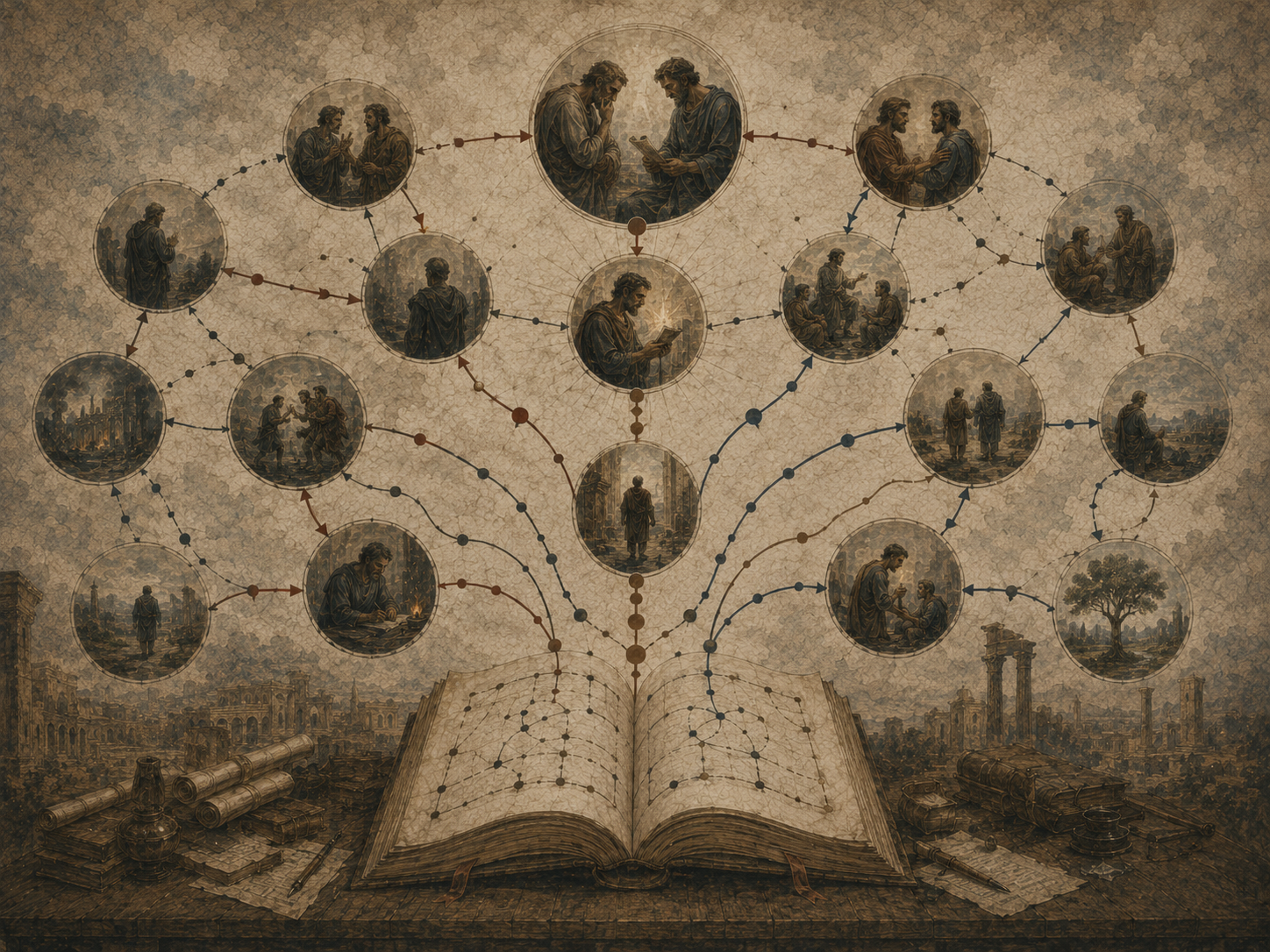
This article explains why reversal and recognition are not merely twists. A reversal changes the direction or condition of the story. A recognition changes what characters or audiences know. Transformation occurs when those changes alter identity, relationship, value, responsibility, or future possibility. The article also includes computational workflows for auditing reversal preparation, recognition clarity, transformation depth, consequence persistence, twist risk, false recognition, closure pressure, and Catalyst Canvas-ready governance outputs.
Why Reversal and Recognition Matter
Reversal and recognition matter because stories do not simply move forward. They turn. They reveal. They force reinterpretation. A reversal changes the direction of action. A recognition changes the meaning of action. Together, they can transform what a character, community, narrator, institution, or audience understands.
A reversal may turn success into danger, victory into loss, secrecy into exposure, safety into vulnerability, loyalty into betrayal, or certainty into doubt. A recognition may reveal identity, motive, cause, guilt, kinship, responsibility, false memory, hidden evidence, or the true consequence of an earlier action. Transformation follows when the story cannot return to its previous state.
These movements are powerful because they reorganize time. Earlier scenes now mean something different. What seemed accidental becomes consequential. What seemed minor becomes central. What seemed resolved becomes unstable. What seemed known becomes questionable. Reversal and recognition make stories dynamic not only because they surprise, but because they change the interpretive structure of the whole.
| Movement | Core change | Story effect |
|---|---|---|
| Reversal | The situation turns in an unexpected but meaningful direction. | Action changes course. |
| Recognition | Something previously hidden, misunderstood, or misread becomes known. | Meaning changes. |
| Transformation | Identity, relation, value, responsibility, or future possibility is altered. | The story enters a new state. |
| Reinterpretation | Earlier events are understood differently. | The audience revises the story mentally. |
| Consequence | The turn or recognition affects what happens next. | The change becomes structural. |
| Accountability | Knowledge creates responsibility. | Ethical stakes become visible. |
Reversal and recognition matter because they show that narrative meaning can change after the fact.
Aristotle and Complex Plot
In Aristotle’s account of tragedy, reversal and recognition are central to complex plot. A simple plot moves through a change of fortune without reversal or recognition. A complex plot includes a turning of the situation, a discovery, or both. These elements are powerful because they belong to the arrangement of action, not merely to ornament or spectacle.
A reversal changes the direction of events. A recognition changes ignorance into knowledge. In the strongest cases, the two are connected: the moment of knowing also turns the action. A character discovers who someone is, what has happened, what they have done, what they have misunderstood, or what consequence now follows. The story does not simply add new information; it reorganizes the whole action.
Aristotle’s framework remains useful because it treats reversal and recognition as structural elements. They are not tricks added at the end. They are built into the logic of the plot. The audience experiences shock, pity, fear, relief, grief, or understanding because the turn and discovery arise from the story’s own action.
| Aristotelian term | General meaning | Modern storytelling use |
|---|---|---|
| Peripeteia | Reversal or change in the direction of action. | A decisive turn in situation, fortune, pressure, or expectation. |
| Anagnorisis | Recognition or movement from ignorance to knowledge. | A discovery that changes identity, responsibility, relation, or interpretation. |
| Complex plot | A plot involving reversal, recognition, or both. | A structure in which change and discovery reshape the story. |
| Whole action | The plot as an organized unity of beginning, middle, and end. | A narrative whose parts affect one another structurally. |
| Probability or necessity | Events should follow intelligibly from the plot. | Surprise should still feel earned. |
| Emotional effect | Pity and fear arise through structured action. | Emotion comes from meaningful consequence, not shock alone. |
The enduring lesson is that a powerful reversal or recognition belongs to the structure of action.
What Reversal Means
A reversal is a turn in the story’s conditions. It changes direction, pressure, fortune, expectation, power, relation, or possibility. The story was moving one way; now it must move differently. Reversal can be sudden or gradual, external or internal, personal or institutional, visible or hidden.
A reversal does not have to be a shock twist. It may be a quiet turn: a person who seemed safe realizes they are exposed; an institution that seemed legitimate loses authority; a relationship that seemed stable becomes fragile; a memory that seemed settled becomes contested; a victory reveals a deeper loss. The essential feature is that the story’s direction has changed.
Strong reversal depends on preparation. The audience may not predict the turn, but the turn should feel connected to prior action. Weak reversal feels arbitrary. It changes the story because the author needs a surprise, not because the story has generated a turn. Strong reversal changes the story because pressure, action, ignorance, desire, or consequence has reached a turning point.
| Reversal type | What turns? | Example question |
|---|---|---|
| Fortune reversal | Success becomes loss, safety becomes danger, ascent becomes collapse. | What changes in the actor’s condition? |
| Power reversal | Authority shifts from one actor or institution to another. | Who can now act, speak, decide, or judge? |
| Moral reversal | An apparently right action reveals harm or compromise. | What value is now under pressure? |
| Knowledge reversal | Earlier assumptions are overturned. | What did the story invite us to misread? |
| Relational reversal | Ally becomes threat, stranger becomes kin, rival becomes helper. | How does relation change the plot? |
| Systemic reversal | A stable system crosses a threshold into instability. | What hidden accumulation has become visible? |
Reversal is not simply surprise. It is a meaningful turn in narrative conditions.
What Recognition Means
Recognition is the movement from not knowing to knowing. It may involve identity, cause, motive, relation, guilt, danger, kinship, betrayal, evidence, memory, responsibility, or self-understanding. Recognition changes the meaning of what has already happened and alters what can happen next.
Recognition is powerful because it connects knowledge with consequence. A character discovers who they are. A witness realizes what they saw. A community understands that an official story was incomplete. A narrator recognizes their own role in harm. An audience learns that a scene had a hidden meaning. In each case, knowledge changes the story’s structure.
Recognition can be private or public. It can happen within a character, between characters, across a community, in a legal process, within an institution, or in the audience. It can arrive suddenly as a revelation or gradually as a pattern becomes visible. It can liberate, accuse, shame, repair, complicate, or wound.
| Recognition object | What becomes known? | Possible consequence |
|---|---|---|
| Identity | Who someone is, was, or has become. | Kinship, responsibility, betrayal, belonging, exile. |
| Cause | What produced the current condition. | Accountability, grief, strategy, revision. |
| Motive | Why an action occurred. | Sympathy, suspicion, judgment, reinterpretation. |
| Evidence | What proof, trace, document, or testimony reveals. | Public knowledge, legal pressure, institutional change. |
| Memory | What was forgotten, repressed, distorted, or denied. | Identity and past action are reinterpreted. |
| Self | What the actor recognizes about their own role, desire, error, or responsibility. | Transformation becomes possible or resisted. |
Recognition changes narrative meaning because knowledge is never neutral once consequence follows.
Transformation After Recognition
Transformation is the deeper change that follows reversal or recognition. A story may reveal a fact, but transformation occurs only if the fact changes action, identity, relation, value, responsibility, or future possibility. Recognition without transformation can feel inert. Reversal without transformation can feel like spectacle.
Transformation may be personal. A character becomes unable to live under a prior illusion. It may be relational. Two people now understand each other differently. It may be institutional. An organization must respond to evidence. It may be cultural. A community revises a shared memory. It may be ethical. A person becomes accountable for what they now know.
Transformation does not have to mean improvement. Stories often confuse transformation with positive growth. But transformation can be tragic, ambiguous, incomplete, failed, resisted, or morally troubling. A person may become more honest but more isolated. A community may recognize harm but refuse repair. An institution may acknowledge wrongdoing without changing practice. Transformation is the altered state that recognition makes unavoidable, not necessarily a happy resolution.
| Transformation level | What changes? | Possible risk |
|---|---|---|
| Personal | Self-understanding, desire, fear, guilt, courage, identity. | Growth may be made too neat. |
| Relational | Trust, loyalty, care, betrayal, kinship, obligation. | Repair may be rushed. |
| Moral | Responsibility, judgment, duty, accountability. | Recognition may be treated as enough. |
| Institutional | Policy, authority, legitimacy, procedure, transparency. | Acknowledgment may replace reform. |
| Cultural | Memory, myth, official story, public meaning. | Counter-memory may be absorbed without justice. |
| Formal | Structure, voice, sequence, point of view, genre expectation. | The turn may feel clever but empty. |
Transformation is the test of whether reversal and recognition truly matter to the story.
Reversal Is Not Just a Twist
Modern storytelling often treats reversal as a twist. A twist surprises the audience. A reversal changes the structure of action. Sometimes a twist is also a reversal, but not always. A twist may be clever without being meaningful. A reversal must alter the story’s direction, pressure, consequence, or interpretation.
The difference matters. A story can produce surprise by hiding information unfairly, introducing a random event, reversing a character’s motive without preparation, or revealing a fact that changes little. That may shock the audience, but it may not deepen the story. Strong reversal feels surprising and inevitable in retrospect. It makes earlier scenes matter more.
A reversal should be tested by consequence. What changes after the turn? What action is now impossible? What value is newly exposed? What relationship has shifted? What earlier scene must be reread? What responsibility now exists? If the answer is “nothing,” the reversal may be only a twist.
| Surface twist | Structural reversal | Diagnostic question |
|---|---|---|
| Surprises the audience. | Changes the direction of action. | What becomes impossible or newly necessary? |
| May rely on withheld information. | Emerges from prior pressure or action. | Was the turn prepared fairly? |
| May be detachable. | Affects the whole plot. | Would the story be structurally different without it? |
| May prioritize cleverness. | Prioritizes consequence. | What changes after the turn? |
| May close interpretation. | Often opens deeper reinterpretation. | What earlier material now means something different? |
| May be emotionally manipulative. | Earns emotion through structure. | Is the emotion grounded in action? |
A twist asks, “Did you see that coming?” A reversal asks, “What does this change?”
Earned Surprise and Prepared Change
Earned surprise is one of the central pleasures of narrative. The audience did not fully predict the change, but when it arrives, it feels connected to what came before. The story has prepared the turn through action, motif, tension, omission, contradiction, pattern, character, or unresolved pressure.
Preparation does not mean obvious foreshadowing. Heavy foreshadowing can make recognition feel mechanical. Preparation means that the turn belongs to the story’s logic. A hidden motive has left traces. A relationship has contained tension. A system has accumulated stress. A detail ignored earlier becomes meaningful later. A character’s choice reveals a deeper pattern.
Earned surprise depends on balance. Too little preparation makes reversal arbitrary. Too much preparation makes it predictable. Too much concealment makes recognition feel unfair. Too much explanation makes the discovery feel dead. Strong narrative design lets the audience experience both surprise and retrospective clarity.
| Preparation device | How it supports reversal or recognition | Risk |
|---|---|---|
| Motif | A recurring image or action gathers meaning. | May become too obvious. |
| Contradiction | A small inconsistency signals hidden pressure. | May feel like continuity error if unmanaged. |
| Omission | Missing information creates interpretive space. | May become unfair concealment. |
| Parallel scene | A later scene mirrors and changes an earlier one. | May become decorative repetition. |
| Delayed consequence | An earlier action matters later. | May be forgotten if not tracked. |
| Point of view limit | The audience knows only what the narrator or character can know. | May become manipulation if the limit is inconsistent. |
Earned surprise lets a story change direction without breaking trust.
Recognition and Identity
Recognition often changes identity. A character discovers who they are, who someone else is, what role they have played, or what story they have been living inside. Identity recognition can be dramatic, quiet, liberating, devastating, or ambiguous.
Identity recognition is not limited to family revelation or hidden lineage. A person may recognize that they have become like someone they feared. A community may recognize itself in a suppressed history. A narrator may recognize their own unreliability. A witness may recognize their responsibility to speak. A person may recognize that a long-held self-story no longer fits.
These moments matter because identity is narrative. People and communities understand themselves through stories of origin, continuity, wound, duty, belonging, exile, transformation, and future. Recognition changes identity by changing the story through which the self or group becomes intelligible.
| Identity recognition | What changes? | Story consequence |
|---|---|---|
| Hidden identity | A person’s relation, origin, or role is revealed. | Kinship, duty, guilt, or belonging changes. |
| Self-recognition | A person sees their own motive, error, fear, or desire. | Action becomes accountable. |
| Role recognition | A person understands their place in a system or history. | Agency and responsibility shift. |
| Collective recognition | A group sees itself differently. | Public memory or identity changes. |
| Misrecognized identity | A false identity or role is exposed. | The prior story loses legitimacy. |
| Refused recognition | A person or group refuses what has become visible. | Transformation is blocked or deferred. |
Recognition changes identity when it changes the story someone can truthfully tell about themselves.
Recognition and Relationships
Recognition also changes relationships. A person recognizes a friend as betrayer, a stranger as kin, a rival as mirror, a parent as vulnerable, a victim as witness, a leader as accountable, or an institution as untrustworthy. Once relation changes, action changes.
Relational recognition is powerful because people do not act in isolation. Loyalty, trust, obligation, resentment, dependency, love, rivalry, and care shape narrative movement. A recognition that changes relation often changes what choices are possible. A confession can break trust but create accountability. A discovery can transform anger into grief. A betrayal can turn intimacy into danger. A recognition of shared vulnerability can turn conflict into solidarity.
Relational recognition should not be rushed. Stories often use recognition to force reconciliation. But recognition does not automatically repair harm. Someone may understand the truth and still be unable to forgive. A public institution may recognize harm and still fail accountability. A relationship may become more honest and more painful at the same time.
| Relational recognition | Before | After |
|---|---|---|
| Ally becomes threat | Trust organizes action. | Suspicion reorganizes action. |
| Stranger becomes kin | Distance shapes relation. | Obligation or belonging emerges. |
| Rival becomes mirror | Opposition defines identity. | Similarity complicates judgment. |
| Victim becomes witness | Harm remains private or unheard. | Story enters public accountability. |
| Authority becomes suspect | Institutional trust is assumed. | Evidence and legitimacy are questioned. |
| Self becomes accountable | The actor sees themselves as outside the harm. | The actor recognizes their role in consequence. |
Recognition changes relationships when knowledge alters trust, obligation, distance, or responsibility.
Public and Institutional Recognition
Recognition is not only personal. Public stories often turn on institutional recognition: a court recognizes evidence, a government recognizes harm, a community recognizes injustice, a company recognizes responsibility, an archive recognizes omitted voices, or a public recognizes that an official narrative no longer holds.
Institutional recognition can be powerful, but it can also be performative. A public statement may acknowledge harm without changing policy. A report may reveal evidence without producing accountability. A memorial may recognize suffering while avoiding responsibility. A brand may recognize social concern while preserving the same behavior. Recognition must be connected to consequence.
Public recognition often changes legitimacy. Once a hidden pattern becomes visible, the institution cannot credibly return to the previous story. The public may demand explanation, repair, reform, testimony, transparency, or resignation. A story of recognition becomes transformative only when the new knowledge changes what the institution, community, or public is obligated to do.
| Public recognition form | What becomes visible? | Governance question |
|---|---|---|
| Legal recognition | Evidence, responsibility, harm, or rights. | Does recognition produce legal consequence? |
| Institutional acknowledgment | Failure, omission, misconduct, or harm. | Does acknowledgment lead to reform? |
| Historical recognition | Suppressed memory or counter-history. | Who controls the revised narrative? |
| Public testimony | Lived experience enters public record. | Is testimony protected from exploitation? |
| Scientific recognition | A pattern, risk, or causal relation becomes clearer. | How is uncertainty communicated? |
| Civic recognition | A public problem becomes undeniable. | What action follows recognition? |
Public recognition becomes meaningful when acknowledgment is joined to accountability.
Memory, Trauma, and Delayed Recognition
Recognition is often delayed. A person may understand an event only years later. A community may recognize harm only after witnesses speak. A family may reinterpret a silence after a document appears. A survivor may recover fragments without ever receiving complete closure. Memory does not always move in clean sequence.
Trauma narratives often complicate recognition. The truth may not arrive as a single clear revelation. It may appear through fragments, sensory return, contradiction, repetition, silence, avoidance, or partial knowledge. A story about trauma should not force recognition into a neat therapeutic arc unless that is ethically and formally justified.
Delayed recognition can be powerful because it shows how time changes meaning. An action that once seemed minor becomes central. A memory that seemed isolated becomes part of a pattern. A silence becomes evidence. A childhood scene becomes legible only in adulthood. The past has not changed, but the story through which the past is understood has transformed.
| Delayed recognition pattern | How it works | Ethical caution |
|---|---|---|
| Fragmented memory | Knowledge arrives in incomplete pieces. | Do not force complete coherence. |
| Retrospective meaning | Later experience changes earlier interpretation. | Avoid claiming certainty beyond evidence. |
| Witness recognition | Private memory becomes public testimony. | Respect consent, context, and dignity. |
| Archive recognition | Documents reveal what memory alone could not prove. | Recognize archive bias and omissions. |
| Pattern recognition | Repeated incidents become visible as a structure. | Avoid overgeneralizing from isolated examples. |
| Refused recognition | A person or institution denies what is visible. | Show refusal as action with consequence. |
Delayed recognition shows that narrative transformation often depends on time, memory, and the conditions under which truth can be faced.
Media, Form, and Recognition Design
Different media design reversal and recognition differently. A novel can control interior knowledge, narration, memory, and delayed explanation. Theater can make recognition visible through embodied performance, staging, gesture, and speech. Film can use framing, editing, sound, flashback, perspective, and visual motif. Games can design recognition through player choice, branching consequence, environmental clues, and delayed feedback.
Form matters because recognition is not only a plot event. It is an experience of interpretation. The audience may recognize something before a character does. A character may recognize something the audience has missed. A game player may discover that earlier choices produced later consequences. A documentary audience may recognize a pattern across testimony, archive, and image.
Media also shape ethical risk. A visual reveal can become spectacle. A game twist can make players feel implicated without enough context. A documentary recognition can overstate certainty through editing. A public platform can turn recognition into outrage before verification. Responsible design asks how the medium produces knowledge and what consequences follow.
| Medium | Recognition tool | Risk |
|---|---|---|
| Novel | Interior narration, memory, withheld perspective, retrospective structure. | Unreliable narration may become unfair manipulation. |
| Theater | Speech, staging, encounter, embodied revelation. | Recognition may become overly declarative. |
| Film | Editing, framing, sound, motif, visual disclosure. | Reveal may prioritize spectacle over meaning. |
| Documentary | Testimony, archive, sequence, juxtaposition. | Editing may imply unsupported causality. |
| Game | Choice consequence, branching feedback, environmental discovery. | Player implication may be forced or unclear. |
| Digital platform | Viral evidence, clip circulation, collective interpretation. | Context collapse may create false recognition. |
Recognition design depends on how a medium controls knowledge, timing, perspective, and consequence.
Failed Reversals and False Recognition
Not every reversal works. Not every recognition is true. Stories can fail when turns are arbitrary, discoveries are unsupported, transformations are too neat, or new information violates the trust built by the narrative. A failed reversal feels imposed. A false recognition feels persuasive but wrong.
False recognition is especially important in public storytelling. Audiences may recognize a pattern that is not actually supported. A viral clip may seem to reveal the whole truth while hiding context. A political story may offer a simple villain. A personal story may transform complex experience into a neat lesson. A conspiracy narrative may produce intense recognition by connecting unrelated fragments.
Failed reversals and false recognitions show why narrative power must be governed. Stories can make a wrong interpretation feel meaningful. They can turn coincidence into causality, suspicion into certainty, emotion into evidence, and closure into truth. Responsible storytelling asks whether recognition is earned, evidenced, contextual, and accountable.
| Failure mode | How it appears | Revision question |
|---|---|---|
| Arbitrary reversal | The story turns without preparation. | What prior pressure makes the turn necessary? |
| Shock twist | The reveal surprises but changes little. | What consequence follows? |
| False recognition | The story offers certainty without evidence. | What supports the new interpretation? |
| Over-neat transformation | A person or institution changes too quickly. | What would real consequence require? |
| Manipulated point of view | The audience is deceived unfairly. | Was the knowledge limit consistent? |
| Closure substitution | Recognition is treated as repair. | What accountability remains after acknowledgment? |
A reversal or recognition fails when it changes attention without changing meaning responsibly.
The Ethics of Recognition
Recognition is ethically charged because knowing changes responsibility. Once a person, institution, community, or audience recognizes harm, evidence, relation, or complicity, the story cannot remain morally unchanged. Recognition asks: what must be done now that this is known?
Stories sometimes treat recognition as enough. A character realizes they were wrong, and the story implies repair. An institution admits failure, and the story implies accountability. A public discovers injustice, and the story implies progress. But recognition without consequence can become moral theater. It allows the emotional experience of revelation without the work of transformation.
The ethics of recognition require attention to evidence, consent, power, representation, and aftermath. Who is being recognized? Who is doing the recognizing? Does recognition restore agency or appropriate someone’s story? Does revelation protect or expose vulnerable people? Does public recognition lead to repair, or does it convert pain into narrative material?
| Ethical question | Why it matters | Responsible practice |
|---|---|---|
| Who benefits from recognition? | Recognition can center the observer rather than the harmed person. | Track whose agency increases. |
| What evidence supports recognition? | Revelation can feel persuasive even when unsupported. | Distinguish proof, testimony, memory, and interpretation. |
| What happens after acknowledgment? | Recognition without consequence can become symbolic only. | Connect recognition to action, repair, or honest limits. |
| Who is exposed? | Revelation can endanger vulnerable people. | Review consent, privacy, and context. |
| What remains unresolved? | Transformation may be incomplete. | Name remaining harm, uncertainty, and accountability. |
| Is recognition being forced? | Stories can demand a single interpretation too aggressively. | Preserve ambiguity where uncertainty matters. |
Ethical recognition is not only the moment of seeing. It is the responsibility that follows seeing.
Examples of Reversal, Recognition, and Transformation
The examples below show how reversal and recognition can be analyzed across story forms without reducing them to twist mechanics.
Tragic recognition
Weak: A character learns a hidden fact at the end, but nothing changes except shock.
Stronger: The recognition reveals the true meaning of prior action and makes responsibility unavoidable.
Why it works: Knowledge transforms the whole action.
Institutional reversal
Weak: A company issues an apology and the story treats the problem as solved.
Stronger: The apology reveals a reversal in legitimacy, but the story tracks whether governance changes.
Why it works: Recognition is tied to accountability.
Memory recognition
Weak: A memory returns as a convenient explanation.
Stronger: Fragments accumulate until the character can reinterpret the past without pretending complete certainty.
Why it works: Delayed recognition respects memory’s complexity.
Relational reversal
Weak: A trusted ally suddenly becomes a villain without preparation.
Stronger: Earlier actions now reveal divided loyalty or hidden pressure.
Why it works: The reversal is surprising but retrospectively coherent.
Public evidence reveal
Weak: A single document is treated as total proof.
Stronger: The document changes the public story while preserving uncertainty and further inquiry.
Why it works: Recognition deepens responsibility rather than ending interpretation.
Game consequence
Weak: A late twist tells the player their choices mattered without showing how.
Stronger: The world changes based on earlier actions, making recognition experiential.
Why it works: Transformation is built into system feedback.
Reversal and recognition work best when they change not only what happens next, but what everything before now means.
Mathematics, Computation, and Modeling
Reversal, recognition, and transformation cannot be reduced to formulas, but modeling can help make structural questions explicit. A computational workflow can audit whether a reversal is prepared, whether recognition is supported, whether transformation has consequence, and whether a reveal creates ethical risk.
A reversal integrity score can estimate whether a turn is structurally earned:
R_i = \frac{P_t + C_l + S_c + E_s + A_f + K_r}{6}
\]
Interpretation: Reversal integrity \(R_i\) averages preparation trace \(P_t\), causal linkage \(C_l\), state change \(S_c\), earned surprise \(E_s\), action fit \(A_f\), and knowledge reorientation \(K_r\).
A recognition clarity score can estimate whether a discovery changes meaning responsibly:
C_r = \frac{E_v + I_s + M_r + R_l + U_c}{5}
\]
Interpretation: Recognition clarity \(C_r\) averages evidence visibility \(E_v\), interpretive support \(I_s\), meaning revision \(M_r\), relation linkage \(R_l\), and uncertainty clarity \(U_c\).
A transformation depth score can estimate whether reversal or recognition changes the story’s state:
T_d = \frac{I_c + A_c + R_c + V_c + F_p + G_a}{6}
\]
Interpretation: Transformation depth \(T_d\) averages identity change \(I_c\), action consequence \(A_c\), relationship change \(R_c\), value change \(V_c\), future possibility \(F_p\), and governance accountability \(G_a\).
A recognition-risk score can estimate when a reveal may be ethically or structurally unsafe:
R_r = F_rw_f + A_tw_a + C_pw_c + E_ow_e + (1 – U_c)w_u
\]
Interpretation: Recognition risk \(R_r\) rises with false recognition \(F_r\), arbitrary twist \(A_t\), closure pressure \(C_p\), evidence omission \(E_o\), and low uncertainty clarity \(U_c\).
| Modeling task | Narrative question | Example output |
|---|---|---|
| Reversal integrity audit | Is the turn prepared, consequential, and structurally necessary? | Reversal integrity score. |
| Recognition clarity audit | Does the discovery responsibly change meaning? | Recognition clarity table. |
| Transformation audit | Does recognition alter identity, relation, value, or future possibility? | Transformation depth score. |
| Retrospective coherence audit | Do earlier scenes gain meaning after the reveal? | Reinterpretation map. |
| Closure pressure audit | Does recognition pretend to resolve what remains unresolved? | Closure-risk warning. |
| Ethical recognition audit | Does the reveal expose, exploit, oversimplify, or falsely certify? | Recognition governance queue. |
Computation can help editors and researchers inspect the logic of reversal and recognition. It should not replace interpretive, ethical, cultural, historical, or community judgment.
Python Workflow: Reversal and Recognition Audit
The Python workflow below evaluates story items by preparation trace, causal linkage, state change, earned surprise, action fit, knowledge reorientation, evidence visibility, interpretive support, meaning revision, relation linkage, uncertainty clarity, identity change, action consequence, relationship change, value change, future possibility, governance accountability, false recognition, arbitrary twist, closure pressure, and evidence omission. The companion repository version extends this into a Catalyst Canvas-ready module with schemas, package-style Python, tests, JSON exports, Canvas cards, markdown governance queues, and reusable reversal-recognition templates.
# reversal_recognition_audit.py
# Dependency-light workflow for auditing reversal, recognition, and transformation.

from __future__ import annotations

from dataclasses import dataclass
from pathlib import Path
import csv
import json
from statistics import mean

ARTICLE_ROOT = Path(__file__).resolve().parents[1]
OUTPUTS = ARTICLE_ROOT / "outputs"
TABLES = OUTPUTS / "tables"
JSON_DIR = OUTPUTS / "json"
MARKDOWN = OUTPUTS / "markdown"


@dataclass
class ReversalRecognitionItem:
    item: str
    story_type: str
    preparation_trace: float
    causal_linkage: float
    state_change: float
    earned_surprise: float
    action_fit: float
    knowledge_reorientation: float
    evidence_visibility: float
    interpretive_support: float
    meaning_revision: float
    relation_linkage: float
    uncertainty_clarity: float
    identity_change: float
    action_consequence: float
    relationship_change: float
    value_change: float
    future_possibility: float
    governance_accountability: float
    false_recognition: float
    arbitrary_twist: float
    closure_pressure: float
    evidence_omission: float
    audience_sensitivity: float
    public_consequence: float
    owner: str
    status: str

    def reversal_integrity(self) -> float:
        return mean([
            self.preparation_trace,
            self.causal_linkage,
            self.state_change,
            self.earned_surprise,
            self.action_fit,
            self.knowledge_reorientation,
        ])

    def recognition_clarity(self) -> float:
        return mean([
            self.evidence_visibility,
            self.interpretive_support,
            self.meaning_revision,
            self.relation_linkage,
            self.uncertainty_clarity,
        ])

    def transformation_depth(self) -> float:
        return mean([
            self.identity_change,
            self.action_consequence,
            self.relationship_change,
            self.value_change,
            self.future_possibility,
            self.governance_accountability,
        ])

    def recognition_risk(self) -> float:
        return min(
            1.0,
            self.false_recognition * 0.25
            + self.arbitrary_twist * 0.25
            + self.closure_pressure * 0.20
            + self.evidence_omission * 0.20
            + (1 - self.uncertainty_clarity) * 0.10,
        )

    def governance_priority_score(self) -> float:
        return min(
            1.0,
            self.recognition_risk() * 0.35
            + self.audience_sensitivity * 0.20
            + self.public_consequence * 0.25
            + (1 - self.recognition_clarity()) * 0.20,
        )

    def review_priority(self) -> str:
        risk = self.recognition_risk()
        priority = self.governance_priority_score()
        integrity = self.reversal_integrity()
        transformation = self.transformation_depth()

        if self.status == "revise" or risk >= 0.55 or priority >= 0.62 or integrity < 0.55 or transformation < 0.50:
            return "high"
        if self.status == "review" or risk >= 0.40 or priority >= 0.48 or integrity < 0.68:
            return "medium"
        return "standard"


def write_csv(path: Path, rows: list[dict[str, object]]) -> None:
    path.parent.mkdir(parents=True, exist_ok=True)
    if not rows:
        raise ValueError(f"No rows to write: {path}")
    with path.open("w", encoding="utf-8", newline="") as handle:
        writer = csv.DictWriter(handle, fieldnames=list(rows[0].keys()))
        writer.writeheader()
        writer.writerows(rows)


def write_json(path: Path, payload: object) -> None:
    path.parent.mkdir(parents=True, exist_ok=True)
    path.write_text(json.dumps(payload, indent=2), encoding="utf-8")


def write_markdown_queue(path: Path, rows: list[dict[str, object]]) -> None:
    path.parent.mkdir(parents=True, exist_ok=True)
    lines = [
        "# Reversal and Recognition Governance Queue",
        "",
        "| Item | Type | Reversal integrity | Recognition clarity | Transformation depth | Risk | Priority | Owner |",
        "|---|---|---:|---:|---:|---:|---|---|",
    ]

    for row in rows:
        lines.append(
            f"| {row['item']} | {row['story_type']} | "
            f"{row['reversal_integrity']} | {row['recognition_clarity']} | "
            f"{row['transformation_depth']} | {row['recognition_risk']} | "
            f"{row['review_priority']} | {row['owner']} |"
        )

    path.write_text("\n".join(lines) + "\n", encoding="utf-8")


def main() -> None:
    items = [
        ReversalRecognitionItem(
            "Tragic recognition",
            "tragic plot",
            0.86, 0.84, 0.88, 0.82, 0.80, 0.90,
            0.82, 0.84, 0.88, 0.78, 0.76,
            0.82, 0.86, 0.76, 0.84, 0.72, 0.70,
            0.22, 0.26, 0.38, 0.24,
            0.76, 0.72,
            "editorial", "active"
        ),
        ReversalRecognitionItem(
            "Institutional acknowledgment",
            "public narrative",
            0.70, 0.68, 0.74, 0.66, 0.64, 0.72,
            0.76, 0.72, 0.70, 0.66, 0.58,
            0.52, 0.62, 0.58, 0.66, 0.60, 0.48,
            0.40, 0.34, 0.78, 0.46,
            0.90, 0.86,
            "governance", "review"
        ),
        ReversalRecognitionItem(
            "Shock twist ending",
            "twist fiction",
            0.42, 0.38, 0.56, 0.52, 0.40, 0.58,
            0.46, 0.42, 0.50, 0.44, 0.54,
            0.38, 0.44, 0.36, 0.42, 0.40, 0.32,
            0.58, 0.86, 0.56, 0.50,
            0.62, 0.50,
            "structure review", "revise"
        ),
        ReversalRecognitionItem(
            "Delayed memory recognition",
            "memory narrative",
            0.76, 0.70, 0.68, 0.74, 0.72, 0.82,
            0.70, 0.80, 0.86, 0.76, 0.82,
            0.78, 0.66, 0.74, 0.80, 0.70, 0.62,
            0.24, 0.30, 0.34, 0.28,
            0.86, 0.72,
            "research", "active"
        ),
        ReversalRecognitionItem(
            "Viral false recognition",
            "platform narrative",
            0.48, 0.42, 0.62, 0.46, 0.44, 0.58,
            0.36, 0.40, 0.52, 0.38, 0.32,
            0.44, 0.48, 0.42, 0.50, 0.46, 0.34,
            0.88, 0.72, 0.82, 0.84,
            0.92, 0.90,
            "platform review", "revise"
        ),
    ]

    rows = []

    for item in items:
        rows.append({
            "item": item.item,
            "story_type": item.story_type,
            "reversal_integrity": round(item.reversal_integrity(), 3),
            "recognition_clarity": round(item.recognition_clarity(), 3),
            "transformation_depth": round(item.transformation_depth(), 3),
            "recognition_risk": round(item.recognition_risk(), 3),
            "governance_priority_score": round(item.governance_priority_score(), 3),
            "review_priority": item.review_priority(),
            "owner": item.owner,
            "status": item.status,
        })

    priority_order = {"high": 3, "medium": 2, "standard": 1}
    rows = sorted(
        rows,
        key=lambda row: (
            priority_order.get(str(row["review_priority"]), 0),
            float(row["recognition_risk"])
        ),
        reverse=True,
    )

    governance_queue = [
        row for row in rows
        if row["review_priority"] != "standard"
    ]

    write_csv(TABLES / "reversal_recognition_audit.csv", rows)
    write_csv(TABLES / "reversal_recognition_governance_queue.csv", governance_queue)

    write_json(JSON_DIR / "reversal_recognition_canvas_cards.json", rows)
    write_json(JSON_DIR / "reversal_recognition_governance_queue.json", governance_queue)

    write_markdown_queue(MARKDOWN / "reversal_recognition_governance_queue.md", governance_queue)

    print("Reversal and recognition audit complete.")


if __name__ == "__main__":
    main()
This workflow helps identify whether reversal and recognition are earned, meaningful, consequential, and ethically responsible, or whether they require review for arbitrary twist logic, false recognition, weak transformation, closure pressure, or evidence omission.
R Workflow: Transformation Diagnostics
The R workflow below creates a synthetic reversal-recognition dataset, calculates reversal integrity, recognition clarity, transformation depth, recognition risk, governance priority, and review priority, then exports summary tables and base R plots. It is intentionally portable and uses only base R.
# reversal_recognition_diagnostics.R
# Base R workflow for reversal, recognition, and transformation.

args <- commandArgs(trailingOnly = FALSE)
file_arg <- grep("^--file=", args, value = TRUE)

if (length(file_arg) > 0) {
  script_path <- normalizePath(sub("^--file=", "", file_arg[1]), mustWork = TRUE)
  article_root <- normalizePath(file.path(dirname(script_path), ".."), mustWork = TRUE)
} else {
  article_root <- getwd()
}

setwd(article_root)

tables_dir <- file.path(article_root, "outputs", "tables")
figures_dir <- file.path(article_root, "outputs", "figures")
dir.create(tables_dir, recursive = TRUE, showWarnings = FALSE)
dir.create(figures_dir, recursive = TRUE, showWarnings = FALSE)

items <- data.frame(
  item = c(
    "Tragic recognition",
    "Institutional acknowledgment",
    "Shock twist ending",
    "Delayed memory recognition",
    "Viral false recognition"
  ),
  story_type = c(
    "tragic plot",
    "public narrative",
    "twist fiction",
    "memory narrative",
    "platform narrative"
  ),
  preparation_trace = c(0.86, 0.70, 0.42, 0.76, 0.48),
  causal_linkage = c(0.84, 0.68, 0.38, 0.70, 0.42),
  state_change = c(0.88, 0.74, 0.56, 0.68, 0.62),
  earned_surprise = c(0.82, 0.66, 0.52, 0.74, 0.46),
  action_fit = c(0.80, 0.64, 0.40, 0.72, 0.44),
  knowledge_reorientation = c(0.90, 0.72, 0.58, 0.82, 0.58),
  evidence_visibility = c(0.82, 0.76, 0.46, 0.70, 0.36),
  interpretive_support = c(0.84, 0.72, 0.42, 0.80, 0.40),
  meaning_revision = c(0.88, 0.70, 0.50, 0.86, 0.52),
  relation_linkage = c(0.78, 0.66, 0.44, 0.76, 0.38),
  uncertainty_clarity = c(0.76, 0.58, 0.54, 0.82, 0.32),
  identity_change = c(0.82, 0.52, 0.38, 0.78, 0.44),
  action_consequence = c(0.86, 0.62, 0.44, 0.66, 0.48),
  relationship_change = c(0.76, 0.58, 0.36, 0.74, 0.42),
  value_change = c(0.84, 0.66, 0.42, 0.80, 0.50),
  future_possibility = c(0.72, 0.60, 0.40, 0.70, 0.46),
  governance_accountability = c(0.70, 0.48, 0.32, 0.62, 0.34),
  false_recognition = c(0.22, 0.40, 0.58, 0.24, 0.88),
  arbitrary_twist = c(0.26, 0.34, 0.86, 0.30, 0.72),
  closure_pressure = c(0.38, 0.78, 0.56, 0.34, 0.82),
  evidence_omission = c(0.24, 0.46, 0.50, 0.28, 0.84),
  audience_sensitivity = c(0.76, 0.90, 0.62, 0.86, 0.92),
  public_consequence = c(0.72, 0.86, 0.50, 0.72, 0.90),
  owner = c("editorial", "governance", "structure review", "research", "platform review"),
  status = c("active", "review", "revise", "active", "revise"),
  stringsAsFactors = FALSE
)

items$reversal_integrity <- rowMeans(items[, c(
  "preparation_trace",
  "causal_linkage",
  "state_change",
  "earned_surprise",
  "action_fit",
  "knowledge_reorientation"
)])

items$recognition_clarity <- rowMeans(items[, c(
  "evidence_visibility",
  "interpretive_support",
  "meaning_revision",
  "relation_linkage",
  "uncertainty_clarity"
)])

items$transformation_depth <- rowMeans(items[, c(
  "identity_change",
  "action_consequence",
  "relationship_change",
  "value_change",
  "future_possibility",
  "governance_accountability"
)])

items$recognition_risk <- pmin(
  1,
  items$false_recognition * 0.25 +
    items$arbitrary_twist * 0.25 +
    items$closure_pressure * 0.20 +
    items$evidence_omission * 0.20 +
    (1 - items$uncertainty_clarity) * 0.10
)

items$governance_priority_score <- pmin(
  1,
  items$recognition_risk * 0.35 +
    items$audience_sensitivity * 0.20 +
    items$public_consequence * 0.25 +
    (1 - items$recognition_clarity) * 0.20
)

items$review_priority <- ifelse(
  items$status == "revise" | items$recognition_risk >= 0.55 | items$governance_priority_score >= 0.62 | items$reversal_integrity < 0.55 | items$transformation_depth < 0.50,
  "high",
  ifelse(
    items$status == "review" | items$recognition_risk >= 0.40 | items$governance_priority_score >= 0.48 | items$reversal_integrity < 0.68,
    "medium",
    "standard"
  )
)

items <- items[order(items$recognition_risk, decreasing = TRUE), ]

write.csv(
  items,
  file.path(tables_dir, "reversal_recognition_diagnostics.csv"),
  row.names = FALSE
)

governance_queue <- items[items$review_priority != "standard", ]

write.csv(
  governance_queue,
  file.path(tables_dir, "reversal_recognition_governance_queue.csv"),
  row.names = FALSE
)

png(file.path(figures_dir, "reversal_integrity_scores.png"), width = 1200, height = 700)
barplot(
  items$reversal_integrity,
  names.arg = items$item,
  las = 2,
  ylab = "Reversal integrity",
  main = "Reversal Integrity Scores"
)
grid()
dev.off()

png(file.path(figures_dir, "recognition_risk_scores.png"), width = 1200, height = 700)
barplot(
  items$recognition_risk,
  names.arg = items$item,
  las = 2,
  ylab = "Recognition risk",
  main = "Recognition Risk Scores"
)
grid()
dev.off()

print(items[, c(
  "item",
  "story_type",
  "reversal_integrity",
  "recognition_clarity",
  "transformation_depth",
  "recognition_risk",
  "governance_priority_score",
  "review_priority"
)])
This workflow turns reversal and recognition into a reviewable editorial artifact. It helps identify whether a story has earned surprise, clear recognition, meaningful transformation, and ethical accountability.
GitHub Repository
The companion repository for this article supports reversal, recognition, and transformation as a Catalyst Canvas-ready analysis module. It includes reversal-integrity audits, recognition-clarity diagnostics, transformation-depth scoring, retrospective coherence maps, ethical recognition-risk scoring, JSON schemas, package-style Python, R workflows, SQL structures, Canvas cards, markdown governance queues, synthetic datasets, documentation, and reusable reversal-recognition templates.
Complete Code Repository
Companion repository for the article, including Catalyst Canvas-ready code for reversal integrity, recognition clarity, transformation depth, earned surprise, retrospective reinterpretation, ethical recognition risk, governance queues, JSON exports, Canvas cards, and reproducible research workflows.
articles/reversal-recognition-and-transformation/
├── canvas/
│   ├── canvas_manifest.json
│   ├── input_schema.json
│   ├── output_schema.json
│   ├── canvas_cards.json
│   └── governance_queue.json
├── html/
├── css/
├── php/
├── java/
├── python/
│   ├── reversal_recognition_canvas/
│   │   ├── __init__.py
│   │   ├── __main__.py
│   │   ├── cli.py
│   │   ├── models.py
│   │   ├── scoring.py
│   │   ├── validation.py
│   │   ├── governance.py
│   │   └── exporters.py
│   ├── tests/
│   │   └── test_reversal_recognition_canvas.py
│   └── run_reversal_recognition_canvas_audit.py
├── r/
│   ├── reversal_recognition_diagnostics.R
│   └── run_all_reversal_recognition_workflows.R
├── sql/
│   ├── canvas_schema.sql
│   └── canvas_queries.sql
├── docs/
│   ├── article_notes.md
│   ├── modeling_principles.md
│   ├── reversal.md
│   ├── recognition.md
│   ├── transformation.md
│   ├── recognition_risk.md
│   └── governance_notes.md
├── data/
│   ├── reversal_recognition_items.csv
│   ├── reversal_patterns.csv
│   ├── recognition_events.csv
│   ├── transformation_paths.csv
│   ├── recognition_risks.csv
│   └── recognition_governance_notes.csv
├── outputs/
│   ├── figures/
│   ├── json/
│   ├── markdown/
│   └── tables/
├── notebooks/
├── shared/
│   ├── schemas/
│   ├── narrative-templates/
│   ├── story-archetypes/
│   ├── character-models/
│   ├── plot-structures/
│   ├── rhetorical-frameworks/
│   ├── cultural-memory/
│   ├── reversal-recognition/
│   └── governance/
├── tests/
└── README.md
Related Articles
- Aristotle and the Earliest Theory of Plot
- Plot, Action, and Narrative Coherence
- Conflict, Tension, and the Logic of Narrative Movement
- Voice, Perspective, and Point of View
- Beginnings, Endings, and Narrative Closure
- Memory, Trauma, and Fragmented Narrative
A Practical Method for Analyzing Reversal and Recognition
1. Identify the turn
Ask what changes direction: fortune, power, relation, knowledge, safety, legitimacy, or possibility.
2. Identify the recognition
Ask what becomes known: identity, motive, cause, responsibility, evidence, memory, or self-understanding.
3. Test preparation
Look for prior traces, motifs, contradictions, pressures, or omissions that make the turn earned.
4. Test consequence
Ask what changes after the reversal or recognition. If nothing changes, the moment may be ornamental.
5. Map retrospective meaning
Ask which earlier scenes must now be reread differently.
6. Evaluate transformation
Assess whether identity, action, relationship, value, future possibility, or governance accountability changes.
7. Review point of view
Ask who knows what, when they know it, and whether the audience is treated fairly.
8. Identify ethical risk
Look for false recognition, arbitrary twist logic, evidence omission, forced closure, exposure risk, or exploitation.
9. Check accountability
Ask whether recognition leads to action, repair, refusal, honest suspension, or named consequence.
10. Add governance notes
Document review owner, evidence limits, representation concerns, public consequence, and revision recommendations.
This method treats reversal and recognition as structural and ethical movements, not as surprise mechanics alone.
Common Pitfalls
Several pitfalls appear when reversal and recognition are misunderstood.
- Reducing reversal to a twist: Surprise alone is not enough. The turn must change the story’s conditions.
- Withholding information unfairly: Recognition should emerge from consistent knowledge limits, not manipulation.
- Making the reveal arbitrary: A reversal should be prepared by prior pressure, action, motif, or contradiction.
- Treating recognition as repair: Knowing harm occurred does not automatically repair harm.
- Forcing transformation: Characters, institutions, and communities do not always change cleanly after recognition.
- Creating false recognition: Stories can make unsupported interpretations feel meaningful.
- Overexplaining the discovery: Recognition can lose force if the story explains every implication too heavily.
- Ignoring delayed recognition: Some truths become legible only through time, memory, or repeated evidence.
- Using trauma as reveal material: Pain should not be treated as a twist designed for audience shock.
- Closing too neatly: Transformation may require aftermath, ambiguity, refusal, or unfinished accountability.
The central pitfall is confusing the audience’s surprise with the story’s transformation.
Why Transformation Matters
Transformation matters because reversal and recognition are incomplete without consequence. A story can turn sharply and reveal dramatically, but if nothing changes in action, identity, relation, value, responsibility, or future possibility, the movement remains shallow. Transformation is the test of narrative significance.
A reversal changes direction. A recognition changes knowledge. A transformation changes the condition of the story. Together, these movements create some of storytelling’s most powerful effects: tragedy, revelation, accountability, self-knowledge, public reckoning, moral complication, relational repair, or unresolved responsibility.
The strongest stories do not use reversal and recognition merely to surprise. They use them to reorganize meaning. They make the past newly visible, the present unstable, and the future ethically charged. A powerful recognition does not simply say, “Now I know.” It asks, “Now that this is known, what must change?”
Further Reading
- Aristotle (1995) Poetics. In Poetics. Longinus: On the Sublime. Demetrius: On Style. Translated by S. Halliwell. Cambridge, MA: Harvard University Press. Available at: https://www.hup.harvard.edu/books/9780674995635
- Aristotle (n.d.) Poetics. Translated by S.H. Butcher. The Internet Classics Archive. Available at: https://classics.mit.edu/Aristotle/poetics.1.1.html
- Brooks, P. (1992) Reading for the Plot: Design and Intention in Narrative. Cambridge, MA: Harvard University Press. Available at: https://books.google.com/books/about/Reading_for_the_Plot.html?id=pofL1Hyfvc8C
- Chatman, S. (1978) Story and Discourse: Narrative Structure in Fiction and Film. Ithaca: Cornell University Press. Available at: https://www.cornellpress.cornell.edu/book/9780801491863/story-and-discourse/
- Herman, D. (2009) Basic Elements of Narrative. Malden, MA: Wiley-Blackwell.
- Kermode, F. (1967) The Sense of an Ending: Studies in the Theory of Fiction. Oxford: Oxford University Press.
- Polkinghorne, D.E. (1988) Narrative Knowing and the Human Sciences. Albany: State University of New York Press.
- Ricoeur, P. (1984) Time and Narrative, Volume 1. Translated by K. McLaughlin and D. Pellauer. Chicago: University of Chicago Press. Available at: https://press.uchicago.edu/ucp/books/book/chicago/T/bo5962044.html
- Rimmon-Kenan, S. (2002) Narrative Fiction: Contemporary Poetics. 2nd edn. London: Routledge.
- Ryan, M.-L. (1991) Possible Worlds, Artificial Intelligence, and Narrative Theory. Bloomington: Indiana University Press.
References
- Aristotle (1995) Poetics. In Poetics. Longinus: On the Sublime. Demetrius: On Style. Translated by S. Halliwell. Cambridge, MA: Harvard University Press. Available at: https://www.hup.harvard.edu/books/9780674995635
- Aristotle (n.d.) Poetics. Translated by S.H. Butcher. The Internet Classics Archive. Available at: https://classics.mit.edu/Aristotle/poetics.1.1.html
- Brooks, P. (1992) Reading for the Plot: Design and Intention in Narrative. Cambridge, MA: Harvard University Press. Available at: https://books.google.com/books/about/Reading_for_the_Plot.html?id=pofL1Hyfvc8C
- Chatman, S. (1978) Story and Discourse: Narrative Structure in Fiction and Film. Ithaca: Cornell University Press. Available at: https://www.cornellpress.cornell.edu/book/9780801491863/story-and-discourse/
- Herman, D. (2009) Basic Elements of Narrative. Malden, MA: Wiley-Blackwell.
- Kermode, F. (1967) The Sense of an Ending: Studies in the Theory of Fiction. Oxford: Oxford University Press.
- Polkinghorne, D.E. (1988) Narrative Knowing and the Human Sciences. Albany: State University of New York Press.
- Ricoeur, P. (1984) Time and Narrative, Volume 1. Translated by K. McLaughlin and D. Pellauer. Chicago: University of Chicago Press. Available at: https://press.uchicago.edu/ucp/books/book/chicago/T/bo5962044.html
- Rimmon-Kenan, S. (2002) Narrative Fiction: Contemporary Poetics. 2nd edn. London: Routledge.
- Ryan, M.-L. (1991) Possible Worlds, Artificial Intelligence, and Narrative Theory. Bloomington: Indiana University Press.