
Last Updated June 10, 2026
Storytelling does not only explain isolated events. It builds architecture for meaning over time. A story connects what happened before, what is happening now, what may happen next, and what an audience is asked to remember. It gives experience structure across sequence, memory, identity, continuity, rupture, repetition, revision, and future possibility.
Storytelling and the Architecture of Meaning Over Time examines how stories organize temporal experience. It explains how narrative creates continuity between past, present, and future; how stories preserve memory while allowing reinterpretation; how meaning changes when events are repeated, revised, institutionalized, forgotten, or reactivated; and how storytelling systems shape cultural memory, personal identity, organizational learning, and public understanding across long periods.
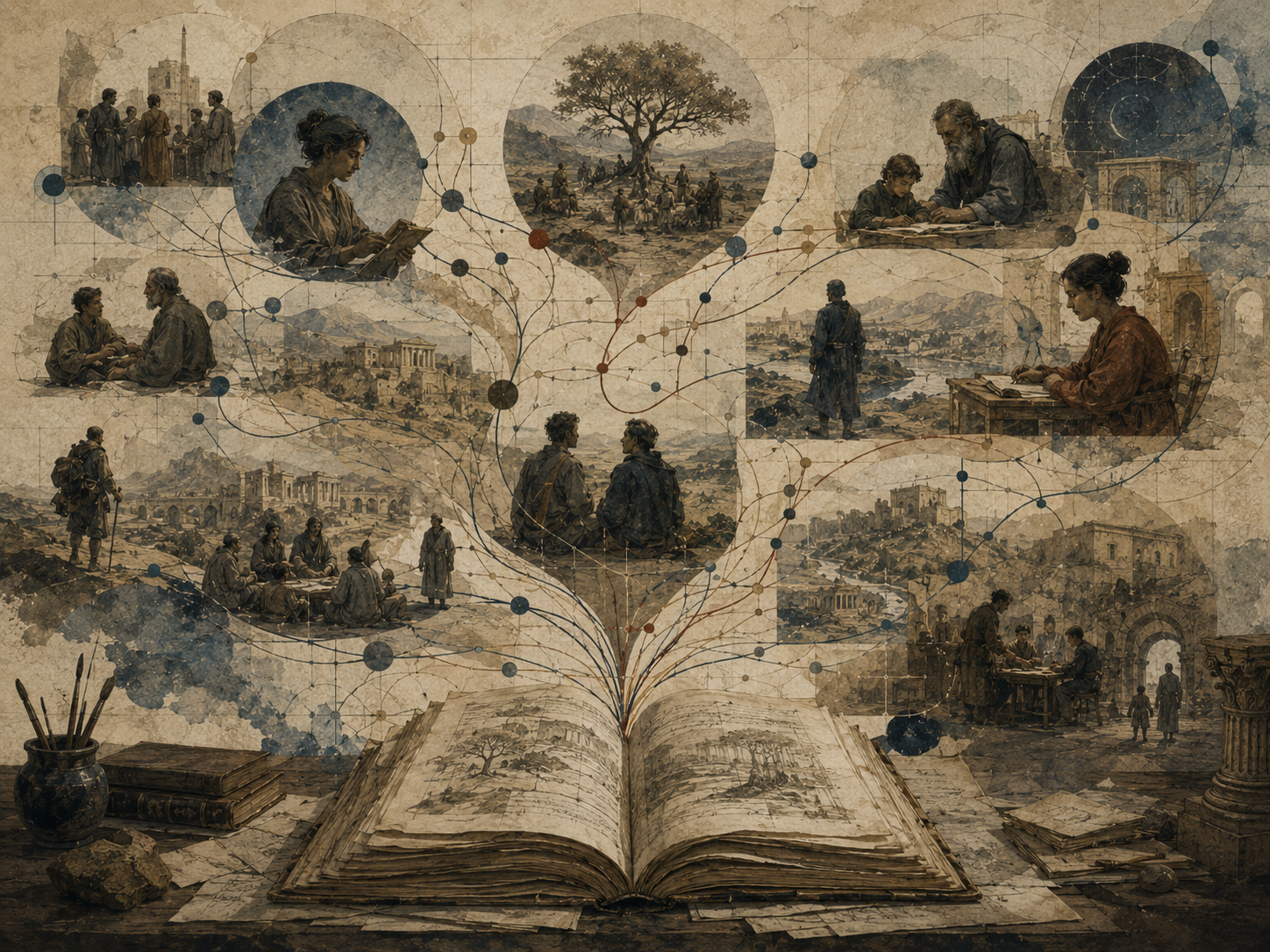
This article treats storytelling as temporal architecture. It looks at how stories hold events together across duration, how narrative meaning accumulates, how communities remember and reinterpret the past, how institutions maintain or distort founding stories, and how long-form content systems can use storytelling to build coherent knowledge over time. It also includes computational workflows for auditing temporal coherence, memory layers, narrative drift, revision pressure, meaning continuity, and Catalyst Canvas-ready governance outputs.
What Meaning Architecture Means
Meaning architecture is the structure through which events, memories, interpretations, values, identities, and future expectations are connected across time. A single event does not automatically mean the same thing forever. Its meaning changes as it is remembered, repeated, archived, disputed, forgotten, reinterpreted, dramatized, institutionalized, or connected to later events.
Storytelling builds this architecture by arranging experience into temporal relationships. It asks what came before, what changed, what persisted, what returned, what was lost, what was repaired, and what remains unfinished. A story gives events more than sequence. It gives them position within a larger pattern of meaning.
This is why storytelling is central to personal life, cultural memory, institutions, education, religion, politics, media, and knowledge systems. Stories allow people to say: this is where we came from, this is what happened, this is what it meant then, this is what it means now, and this is what it may require of us next.
| Architecture element | Narrative function | Example question |
|---|---|---|
| Origin | Frames where meaning begins. | Why does the story start here? |
| Sequence | Organizes events into temporal order. | What happened before and after? |
| Continuity | Connects past identity to present identity. | What has remained recognizable? |
| Rupture | Marks change, crisis, loss, or transformation. | What broke the prior pattern? |
| Repetition | Makes meaning durable through recurrence. | What is retold, ritualized, or remembered? |
| Revision | Allows meaning to change under new evidence or need. | What must be reinterpreted? |
| Projection | Links present meaning to possible futures. | What future does this story make imaginable? |
Storytelling becomes architecture when it does not merely describe events, but builds the relationships that allow meaning to persist, change, and remain intelligible over time.
Story and Temporal Order
Story gives temporal order to experience. Human life unfolds through time, but time alone does not create meaning. Events can occur in sequence without becoming understandable. Narrative turns temporal succession into interpreted order by identifying beginnings, developments, turning points, delays, consequences, and endings.
This is why the same events can produce different stories. A community conflict might be told as a sudden rupture, a long-developing injustice, a failure of leadership, a breakdown of trust, or a necessary turning point. Each version arranges time differently. Each version assigns meaning to different moments.
Temporal order is never neutral. The choice of where a story begins shapes what counts as cause. The choice of where it ends shapes whether the story feels resolved. The choice of which events to connect shapes what the audience remembers. Storytelling is therefore an architecture of sequence and emphasis.
| Temporal decision | Meaning effect | Risk |
|---|---|---|
| Starting point | Defines the origin of the story’s meaning. | Starting too late may hide deeper causes. |
| Ordering | Connects events into a pathway of understanding. | Order may imply causality too strongly. |
| Emphasis | Highlights certain events as decisive. | Other events may disappear. |
| Turning point | Marks the moment meaning changes. | Change may be exaggerated or personalized. |
| Ending | Creates closure, warning, continuation, or uncertainty. | Ending too early may hide consequences. |
| Retelling | Reactivates meaning for a later audience. | Later needs may reshape the past too aggressively. |
Temporal order is one of storytelling’s most powerful tools. It lets people understand time as development, but it must be handled carefully because sequence can become interpretation before the audience notices.
Past, Present, and Future in Narrative
A story does not only connect past events. It connects past, present, and future. The past provides memory and origin. The present provides interpretation and urgency. The future provides possibility, warning, hope, obligation, or uncertainty. Narrative meaning emerges from the relationship among all three.
The past is never simply behind the story. It is activated by present questions. A historical event may become newly meaningful when a community faces similar conflict, when an institution reexamines its founding, when a family confronts inherited trauma, or when a society debates public memory. The present asks new questions of the past.
The future also changes narrative meaning. A story of crisis may become a warning. A story of survival may become a source of responsibility. A story of failure may become a reform agenda. A story of injustice may become a demand for repair. In this sense, storytelling is not only retrospective. It is projective.
| Temporal layer | Story function | Meaning question |
|---|---|---|
| Past | Provides memory, origin, loss, inheritance, and prior action. | What has been carried forward? |
| Present | Provides interpretation, conflict, urgency, and point of view. | Why does this story matter now? |
| Future | Provides possibility, warning, obligation, hope, or fear. | What future does the story open or close? |
| Retrospect | Looks backward to understand how meaning developed. | What do later events reveal about earlier ones? |
| Anticipation | Looks forward through scenario, expectation, promise, or risk. | What might happen if the pattern continues? |
| Return | Revisits earlier memory under new conditions. | What must be remembered differently? |
Storytelling builds meaning over time by allowing the past to be interpreted in the present and projected into the future.
Memory, Repetition, and Revision
Meaning becomes durable through memory, repetition, and revision. A story that is never repeated may still matter, but it is less likely to become part of identity, culture, institution, or public understanding. Repetition gives stories social life. It allows them to become shared reference points.
Repetition can preserve meaning, but it can also harden meaning. A story repeated too often without review can become myth, slogan, institutional self-protection, political grievance, or inherited simplification. The more familiar a story becomes, the less people may examine how it was built.
Revision is therefore essential. Stories need to be revisited as new evidence, new audiences, new harms, new responsibilities, and new contexts emerge. A healthy storytelling system does not preserve meaning by freezing it. It preserves meaning by allowing responsible reinterpretation.
| Temporal process | Constructive role | Distortion risk |
|---|---|---|
| Memory | Preserves experience and makes it available for interpretation. | May select some events while omitting others. |
| Repetition | Makes meaning durable and socially recognizable. | May turn interpretation into unquestioned assumption. |
| Ritualization | Embeds story in repeated practice or ceremony. | May detach story from critical reflection. |
| Archiving | Preserves records for later retrieval. | May preserve without context or access. |
| Revision | Allows meaning to change responsibly. | May be resisted as betrayal or revisionism. |
| Forgetting | Can release overload or create space for change. | May erase harm, accountability, or cultural memory. |
A strong architecture of meaning does not simply preserve stories. It builds the conditions under which stories can be remembered, questioned, and responsibly revised.
Continuity and Rupture
Stories help people understand continuity and rupture. Continuity allows a person, community, institution, or culture to say: despite change, something remains connected. Rupture marks the moments when prior meaning breaks, fails, or must be reassembled.
Both are necessary. A story with only continuity may become denial. It may pretend that nothing important changed. A story with only rupture may become fragmentation. It may make identity, memory, or trust impossible to sustain. Meaning over time depends on how continuity and rupture are held together.
This is especially important in stories of migration, trauma, institutional reform, political transition, ecological loss, technological change, and cultural survival. These stories often ask how something can remain itself after major change. Narrative becomes the bridge between what was, what broke, and what can still be carried forward.
| Narrative pattern | Meaning function | Example |
|---|---|---|
| Continuity | Shows persistence across change. | A community maintains practices across generations. |
| Rupture | Marks a break in prior meaning. | A crisis exposes institutional failure. |
| Recovery | Rebuilds meaning after disruption. | A family reinterprets loss through memory and care. |
| Reform | Changes an institution while preserving purpose. | An organization revises its mission after failure. |
| Return | Revisits origin, place, memory, or obligation. | A displaced person returns to a changed homeland. |
| Transformation | Shows identity altered through time. | A movement changes public understanding of justice. |
Storytelling builds meaning over time by explaining not only what changed, but what change did to continuity.
Identity Over Time
Identity depends on time. A person or community does not understand itself only through present traits. It understands itself through remembered pasts, interpreted changes, inherited stories, future hopes, and unresolved tensions. Storytelling gives identity a temporal form.
A personal identity story may connect childhood, loss, education, relationships, work, migration, failure, recovery, or vocation. A community identity story may connect place, language, ritual, struggle, shared memory, and future responsibility. An institutional identity story may connect founding purpose, crisis, reform, and public trust.
Identity stories can support coherence, but they can also restrict possibility. A person may become trapped inside a story of failure or destiny. A community may suppress internal difference to preserve a single origin story. An institution may use continuity to avoid accountability. The architecture of identity over time must therefore allow both continuity and revision.
| Identity question | Story function | Governance concern |
|---|---|---|
| Where did we come from? | Creates origin and inheritance. | Origin stories may exclude competing memories. |
| What changed us? | Names rupture, learning, loss, or transformation. | Change may be simplified into one turning point. |
| What remains continuous? | Preserves coherence across time. | Continuity may hide harm or conflict. |
| What must be repaired? | Connects memory to responsibility. | Repair may be symbolic without material change. |
| What future do we imagine? | Projects identity forward. | Future stories may become unrealistic or exclusionary. |
| Who gets to tell the story? | Defines authority and voice. | Dominant narrators may silence others. |
Identity over time is not merely discovered. It is narrated, contested, revised, and maintained.
Cultural Memory and Shared Meaning
Cultural memory is one of the clearest examples of meaning architecture over time. Communities remember through stories, rituals, monuments, archives, songs, commemorations, family accounts, school curricula, public holidays, legal records, religious traditions, media, and digital platforms. These forms do not simply preserve the past. They shape how the past becomes meaningful in the present.
Cultural memory is selective. Some events become central. Others remain marginal, private, disputed, suppressed, or forgotten. A society may repeatedly remember victory and neglect suffering. It may commemorate sacrifice and avoid complicity. It may preserve official memory while communities maintain counter-memory.
Storytelling is central because shared memory needs form. A public memory often requires characters, events, places, symbols, sequence, conflict, moral meaning, and repetition. But responsible cultural memory also requires critique. It must ask who is remembered, who is forgotten, who benefits from the dominant story, and what forms of repair are necessary.
| Cultural memory form | Meaning-over-time function | Risk |
|---|---|---|
| Commemoration | Reactivates memory through repeated public attention. | May preserve simplified or selective memory. |
| Archive | Makes records available for future interpretation. | May preserve unequal or incomplete records. |
| Ritual | Embeds story in repeated communal practice. | May discourage reinterpretation. |
| Education | Transmits memory across generations. | May turn contested history into tidy narrative. |
| Counter-memory | Challenges official versions of the past. | May face exclusion, suppression, or fragmentation. |
| Digital memory | Circulates memory through platforms, archives, and networks. | May amplify decontextualized fragments. |
Cultural memory shows why storytelling is never only about the past. It shapes what communities believe they owe to the present and future.
Institutional Stories and Long-Term Meaning
Institutions depend on stories over time. A university, nonprofit, government agency, company, newsroom, archive, court, hospital, research institute, or civic organization often explains itself through a founding story, mission story, reform story, crisis story, or public-service story. These stories create continuity across leadership changes, policy shifts, staff turnover, and public scrutiny.
Institutional stories can be useful. They preserve purpose, transmit norms, explain decisions, teach new members, and create accountability. But they can also become defensive. An institution may repeat a founding story while ignoring present harm. It may describe reform while avoiding evidence of failure. It may claim continuity while changing its values in practice.
An architecture of institutional meaning must therefore include revision mechanisms. Institutions need ways to update their stories when evidence changes, when communities are harmed, when missions drift, when language becomes outdated, or when old narratives no longer support public trust.
| Institutional story | Positive function | Failure mode |
|---|---|---|
| Founding story | Explains origin, purpose, and legitimacy. | May become mythic or exclude inconvenient history. |
| Mission story | Connects work to public value. | May become slogan without practice. |
| Crisis story | Explains what went wrong and what changed. | May minimize responsibility. |
| Reform story | Connects failure to learning and improvement. | May claim transformation before it is proven. |
| Legacy story | Preserves accumulated identity and contribution. | May resist necessary change. |
| Future story | Projects purpose into coming conditions. | May become aspiration without governance. |
Institutional storytelling is strongest when it preserves continuity without protecting institutions from accountability.
Media and Temporal Scale
Different media organize meaning over different time scales. Oral tradition may preserve meaning through repetition and performance across generations. Manuscripts and print can stabilize meaning as records. Film and broadcast can create shared public memory at scale. Digital platforms can accelerate circulation while making meaning more unstable, fragmented, searchable, remixable, and algorithmically shaped.
Media do not only carry stories. They change how stories last. A printed book may preserve a stable text but limit participation. A live performance may create strong shared meaning but leave fragile records. A digital platform may preserve traces while weakening context. A long-form article series may build durable knowledge if it is maintained through links, metadata, updates, and archives.
Understanding storytelling over time therefore requires attention to medium, storage, circulation, retrieval, repetition, and decay. Meaning architecture depends on the systems that keep stories available and interpretable.
| Medium | Temporal strength | Temporal risk |
|---|---|---|
| Oral performance | Strong communal memory and adaptive repetition. | Fragile if performance context disappears. |
| Manuscript | Durable textual preservation. | Restricted access and institutional control. |
| Wide reproduction and stable circulation. | Canon formation and market filtering. | |
| Film and broadcast | Shared public memory through image, sound, and event. | Rights, format decay, and archival incompleteness. |
| Digital platforms | Searchability, networked circulation, and rapid reactivation. | Context collapse, algorithmic visibility, and platform instability. |
| Content libraries | Structured pathways across long-form knowledge. | Broken links, outdated references, and narrative drift. |
A story’s meaning over time depends not only on what it says, but on the medium that preserves, repeats, modifies, and retrieves it.
Storytelling in Knowledge Architecture
Knowledge architecture depends on meaning over time. A research library, article series, curriculum, documentation system, archive, or public knowledge platform must do more than store information. It must guide audiences through sequence, context, development, application, critique, and future inquiry.
Storytelling helps knowledge systems maintain temporal coherence. Foundational articles define the field. Historical articles explain development. Methods articles show how ideas become practice. Case studies test concepts under pressure. Ethics articles examine consequences. Future articles open unresolved questions. The entire series becomes a narrative architecture of learning.
This is especially important for large content systems. Without temporal architecture, content libraries become archives of disconnected posts. With temporal architecture, they become guided systems of understanding. The audience can see what came before, what belongs next, how topics relate, and why the sequence matters.
| Knowledge architecture layer | Temporal meaning function | Example |
|---|---|---|
| Article map | Shows the sequence of learning over time. | Foundation, history, methods, applications, ethics, future directions. |
| Series context | Locates each article inside the larger temporal system. | Readers know where the article belongs. |
| Internal links | Connect prior, current, and future understanding. | Links become narrative pathways. |
| Footer navigation | Creates continuity across the series. | Previous, article map, next. |
| GitHub repository | Preserves method and reproducible outputs over time. | Code, data, tests, governance queues, output manifests. |
| Metadata | Maintains discoverability and content memory. | Slug, tags, excerpt, title, category, update status. |
A content system becomes a knowledge system when it builds meaning across time rather than merely publishing information over time.
Narrative Governance and Drift
Narratives drift. A story that begins as careful interpretation can become slogan, myth, brand language, institutional memory, or inherited assumption. Over time, details are dropped, evidence ages, links break, source context changes, and audiences bring new questions. Meaning architecture requires governance because meaning does not maintain itself.
Narrative governance is the practice of maintaining stories responsibly over time. It includes checking whether the story still matches evidence, whether key terms have drifted, whether new articles have changed the sequence, whether cultural context remains visible, whether sources remain appropriate, and whether the story still supports understanding without distortion.
Governance also requires a distinction between preservation and revision. Not every change is an improvement. Some changes erase memory. Some updates flatten complexity. Some revisions make a story more marketable but less truthful. Narrative governance should ask what must be preserved, what must be revised, and what must remain open.
| Governance concern | Meaning-over-time question | Review artifact |
|---|---|---|
| Narrative drift | Has the story changed meaning without review? | Drift audit log. |
| Source age | Are references still current and appropriate? | Reference review queue. |
| Link decay | Do pathways still connect the right articles? | Internal-link audit. |
| Memory omission | What has been forgotten or excluded? | Omission and counter-memory notes. |
| Representation risk | Who is being narrated, simplified, or silenced? | Representation review checklist. |
| Revision pressure | What new evidence or context requires reinterpretation? | Revision priority queue. |
A serious storytelling system must include maintenance. Otherwise, meaning over time becomes meaning by accident.
Limits and Distortions
Storytelling creates meaning over time, but it can also distort time. It can make the past seem more coherent than it was. It can turn later outcomes into evidence that earlier events were inevitable. It can make traditions seem timeless, institutions seem consistent, and identities seem fixed. It can make change look like destiny.
One major risk is retrospective illusion. After an outcome happens, a story may arrange prior events as if the outcome was always visible. Another risk is continuity bias: the desire to make an identity, institution, or culture appear more stable than it has actually been. A third risk is nostalgia, which selects a past that serves present needs while ignoring conflict, exclusion, or harm.
Storytelling over time must therefore be self-critical. It should make room for contingency, uncertainty, rupture, forgotten evidence, competing memories, and alternative futures. Meaning architecture should not become a prison of inherited interpretation.
| Distortion | How it affects meaning over time | Corrective practice |
|---|---|---|
| Retrospective illusion | Makes outcomes appear inevitable. | Recover uncertainty at the time events occurred. |
| Continuity bias | Makes identity appear more stable than it was. | Document rupture, conflict, and change. |
| Nostalgia | Selects a comforting past. | Compare memory with evidence and omitted perspectives. |
| Mythic simplification | Turns complex history into symbolic certainty. | Separate symbolic meaning from historical evidence. |
| Closure pressure | Ends the story before consequences are resolved. | Distinguish narrative ending from real-world repair. |
| Archive bias | Treats preserved records as the whole past. | Ask what was never archived or made visible. |
Storytelling gives time meaning, but responsible storytelling must resist making time too tidy.
Examples of Meaning Architecture Over Time
The examples below show how storytelling structures meaning across time in personal, cultural, institutional, and knowledge-system contexts.
Personal identity
Weak: My life changed because one event happened.
Stronger: One event became meaningful through earlier patterns, later choices, memory, loss, and reinterpretation.
Why it works: It treats identity as temporal architecture rather than a single turning point.
Cultural memory
Weak: This is what the community remembers.
Stronger: This is the dominant remembered version, shaped by repetition, omission, ritual, archive, and counter-memory.
Why it works: It keeps memory open to critique and repair.
Institutional reform
Weak: The institution learned from the crisis.
Stronger: The institution claims reform; the story must be tested against evidence, governance changes, accountability, and long-term practice.
Why it works: It separates reform narrative from verified transformation.
Article series
Weak: Publish related topics as they come up.
Stronger: Build a sequence from foundations to history, methods, examples, ethics, and future directions.
Why it works: The series becomes a learning architecture over time.
Public memory
Weak: A commemoration proves shared agreement.
Stronger: A commemoration reveals what a society chooses to repeat, what it omits, and what remains contested.
Why it works: It treats public memory as constructed and revisable.
Future narrative
Weak: This is where the story is heading.
Stronger: This is one possible future implied by current patterns, assumptions, choices, and uncertainties.
Why it works: It separates projection from inevitability.
Meaning architecture is strongest when it preserves continuity while making room for evidence, change, revision, and unresolved questions.
Mathematics, Computation, and Modeling
Storytelling and meaning over time cannot be reduced to equations, but computational models can help audit temporal coherence, memory durability, revision pressure, narrative drift, and governance priority. These models make assumptions visible. They do not determine what a story means.
A temporal meaning coherence score can average the main dimensions of meaning architecture:
T_c = \frac{O + S + C + R + F + G}{6}
\]
Interpretation: Temporal coherence \(T_c\) averages origin clarity \(O\), sequence clarity \(S\), continuity support \(C\), rupture recognition \(R\), future projection \(F\), and governance visibility \(G\).
A memory durability score can estimate how strongly a story is preserved over time:
M_d = \frac{P + A + R_p + C_x + T}{5}
\]
Interpretation: Memory durability \(M_d\) averages preservation \(P\), archive support \(A\), repetition \(R_p\), context retention \(C_x\), and transmission strength \(T\).
A narrative drift risk score can combine weak evidence, old sources, broken links, low context retention, and high repetition:
D_r = (1 – E_s)w_e + S_aw_s + L_bw_l + (1 – C_x)w_c + R_pw_r
\]
Interpretation: Drift risk \(D_r\) rises when evidence strength \(E_s\) and context retention \(C_x\) are low, while source age \(S_a\), link breakage \(L_b\), and repetition pressure \(R_p\) are high.
A revision priority score can combine drift risk, public consequence, representation risk, and article-map dependency:
P_v = D_rw_d + A_cw_a + R_sw_r + M_aw_m
\]
Interpretation: Revision priority \(P_v\) combines drift risk \(D_r\), audience consequence \(A_c\), representation risk \(R_s\), and map dependency \(M_a\).
| Modeling task | Temporal question | Example output |
|---|---|---|
| Temporal coherence audit | Does the story connect origin, sequence, rupture, continuity, and future? | Coherence score and missing-layer report. |
| Memory durability audit | How strongly is the story preserved and transmitted? | Memory durability table. |
| Drift audit | Has the story changed meaning without review? | Narrative drift risk queue. |
| Revision audit | Which story needs reinterpretation first? | Revision priority queue. |
| Continuity audit | Does the story overstate stability? | Continuity-bias flag. |
| Archive audit | What supports or weakens long-term retrieval? | Archive and context-retention report. |
Computation is most useful when it helps editors and researchers ask better questions about how stories preserve, revise, and distort meaning over time.
Python Workflow: Meaning Architecture Audit
The Python workflow below evaluates story systems by origin clarity, sequence clarity, continuity support, rupture recognition, memory durability, archive support, context retention, future projection, evidence strength, drift risk, and revision priority. The companion repository version extends this into a Catalyst Canvas-ready module with schemas, package-style Python, tests, JSON exports, Canvas cards, markdown governance queues, and reusable meaning-architecture templates.
# meaning_architecture_audit.py
# Dependency-light workflow for auditing storytelling and meaning over time.

from __future__ import annotations

from dataclasses import dataclass
from pathlib import Path
import csv
import json
from statistics import mean

ARTICLE_ROOT = Path(__file__).resolve().parents[1]
OUTPUTS = ARTICLE_ROOT / "outputs"
TABLES = OUTPUTS / "tables"
JSON_DIR = OUTPUTS / "json"
MARKDOWN = OUTPUTS / "markdown"


@dataclass
class MeaningArchitectureItem:
    item: str
    story_type: str
    origin_clarity: float
    sequence_clarity: float
    continuity_support: float
    rupture_recognition: float
    future_projection: float
    governance_visibility: float
    preservation: float
    archive_support: float
    repetition_strength: float
    context_retention: float
    transmission_strength: float
    evidence_strength: float
    source_age: float
    link_breakage: float
    audience_consequence: float
    representation_risk: float
    map_dependency: float
    owner: str
    status: str

    def temporal_coherence(self) -> float:
        return mean([
            self.origin_clarity,
            self.sequence_clarity,
            self.continuity_support,
            self.rupture_recognition,
            self.future_projection,
            self.governance_visibility,
        ])

    def memory_durability(self) -> float:
        return mean([
            self.preservation,
            self.archive_support,
            self.repetition_strength,
            self.context_retention,
            self.transmission_strength,
        ])

    def drift_risk(self) -> float:
        return min(
            1.0,
            (1 - self.evidence_strength) * 0.25
            + self.source_age * 0.20
            + self.link_breakage * 0.20
            + (1 - self.context_retention) * 0.20
            + self.repetition_strength * 0.15,
        )

    def revision_priority_score(self) -> float:
        return min(
            1.0,
            self.drift_risk() * 0.40
            + self.audience_consequence * 0.20
            + self.representation_risk * 0.20
            + self.map_dependency * 0.20,
        )

    def review_priority(self) -> str:
        score = self.revision_priority_score()
        if self.status == "revise" or score >= 0.50:
            return "high"
        if self.status == "review" or score >= 0.35:
            return "medium"
        return "standard"


def write_csv(path: Path, rows: list[dict[str, object]]) -> None:
    path.parent.mkdir(parents=True, exist_ok=True)
    if not rows:
        raise ValueError(f"No rows to write: {path}")
    with path.open("w", encoding="utf-8", newline="") as handle:
        writer = csv.DictWriter(handle, fieldnames=list(rows[0].keys()))
        writer.writeheader()
        writer.writerows(rows)


def write_json(path: Path, payload: object) -> None:
    path.parent.mkdir(parents=True, exist_ok=True)
    path.write_text(json.dumps(payload, indent=2), encoding="utf-8")


def write_markdown_queue(path: Path, rows: list[dict[str, object]]) -> None:
    path.parent.mkdir(parents=True, exist_ok=True)
    lines = [
        "# Meaning Architecture Governance Queue",
        "",
        "| Item | Type | Temporal coherence | Memory durability | Drift risk | Revision priority | Owner |",
        "|---|---|---:|---:|---:|---|---|",
    ]

    for row in rows:
        lines.append(
            f"| {row['item']} | {row['story_type']} | "
            f"{row['temporal_coherence']} | {row['memory_durability']} | "
            f"{row['drift_risk']} | {row['review_priority']} | {row['owner']} |"
        )

    path.write_text("\n".join(lines) + "\n", encoding="utf-8")


def main() -> None:
    items = [
        MeaningArchitectureItem(
            "Storytelling and the Architecture of Meaning Over Time",
            "series framework",
            0.88, 0.86, 0.82, 0.78, 0.84, 0.86,
            0.78, 0.80, 0.76, 0.82, 0.80,
            0.82, 0.12, 0.08, 0.76, 0.34, 0.92,
            "content systems", "active"
        ),
        MeaningArchitectureItem(
            "Institutional founding story",
            "institutional memory",
            0.82, 0.74, 0.88, 0.42, 0.70, 0.58,
            0.80, 0.76, 0.88, 0.52, 0.74,
            0.56, 0.62, 0.30, 0.84, 0.68, 0.78,
            "governance", "review"
        ),
        MeaningArchitectureItem(
            "Public commemoration narrative",
            "cultural memory",
            0.78, 0.70, 0.82, 0.54, 0.66, 0.52,
            0.84, 0.78, 0.92, 0.48, 0.82,
            0.58, 0.56, 0.22, 0.88, 0.74, 0.72,
            "archive", "review"
        ),
        MeaningArchitectureItem(
            "Crisis reform narrative",
            "organizational learning",
            0.72, 0.76, 0.62, 0.84, 0.70, 0.64,
            0.66, 0.62, 0.70, 0.58, 0.68,
            0.60, 0.48, 0.26, 0.92, 0.66, 0.70,
            "editorial", "revise"
        ),
        MeaningArchitectureItem(
            "Digital platform memory",
            "networked memory",
            0.66, 0.68, 0.54, 0.70, 0.76, 0.44,
            0.58, 0.50, 0.86, 0.36, 0.88,
            0.52, 0.42, 0.44, 0.86, 0.72, 0.64,
            "platform", "review"
        ),
    ]

    rows = []

    for item in items:
        rows.append({
            "item": item.item,
            "story_type": item.story_type,
            "origin_clarity": item.origin_clarity,
            "sequence_clarity": item.sequence_clarity,
            "continuity_support": item.continuity_support,
            "rupture_recognition": item.rupture_recognition,
            "future_projection": item.future_projection,
            "governance_visibility": item.governance_visibility,
            "memory_durability": round(item.memory_durability(), 3),
            "temporal_coherence": round(item.temporal_coherence(), 3),
            "drift_risk": round(item.drift_risk(), 3),
            "revision_priority_score": round(item.revision_priority_score(), 3),
            "review_priority": item.review_priority(),
            "owner": item.owner,
            "status": item.status,
        })

    rows = sorted(rows, key=lambda row: row["revision_priority_score"], reverse=True)

    governance_queue = [
        row for row in rows
        if row["review_priority"] != "standard"
    ]

    write_csv(TABLES / "meaning_architecture_audit.csv", rows)
    write_csv(TABLES / "meaning_architecture_governance_queue.csv", governance_queue)

    write_json(JSON_DIR / "meaning_architecture_canvas_cards.json", rows)
    write_json(JSON_DIR / "meaning_architecture_governance_queue.json", governance_queue)

    write_markdown_queue(MARKDOWN / "meaning_architecture_governance_queue.md", governance_queue)

    print("Meaning architecture audit complete.")


if __name__ == "__main__":
    main()
This workflow helps identify which stories are temporally coherent, which are durable, and which are at risk of narrative drift or revision pressure.
R Workflow: Meaning Architecture Diagnostics
The R workflow below creates a synthetic meaning-architecture dataset, calculates temporal coherence, memory durability, drift risk, and revision priority, then exports summary tables and base R plots. It is intentionally portable and uses only base R.
# meaning_architecture_diagnostics.R
# Base R workflow for storytelling and meaning over time.

args <- commandArgs(trailingOnly = FALSE)
file_arg <- grep("^--file=", args, value = TRUE)

if (length(file_arg) > 0) {
  script_path <- normalizePath(sub("^--file=", "", file_arg[1]), mustWork = TRUE)
  article_root <- normalizePath(file.path(dirname(script_path), ".."), mustWork = TRUE)
} else {
  article_root <- getwd()
}

setwd(article_root)

tables_dir <- file.path(article_root, "outputs", "tables")
figures_dir <- file.path(article_root, "outputs", "figures")
dir.create(tables_dir, recursive = TRUE, showWarnings = FALSE)
dir.create(figures_dir, recursive = TRUE, showWarnings = FALSE)

items <- data.frame(
  item = c(
    "Storytelling and the Architecture of Meaning Over Time",
    "Institutional founding story",
    "Public commemoration narrative",
    "Crisis reform narrative",
    "Digital platform memory"
  ),
  story_type = c(
    "series framework",
    "institutional memory",
    "cultural memory",
    "organizational learning",
    "networked memory"
  ),
  origin_clarity = c(0.88, 0.82, 0.78, 0.72, 0.66),
  sequence_clarity = c(0.86, 0.74, 0.70, 0.76, 0.68),
  continuity_support = c(0.82, 0.88, 0.82, 0.62, 0.54),
  rupture_recognition = c(0.78, 0.42, 0.54, 0.84, 0.70),
  future_projection = c(0.84, 0.70, 0.66, 0.70, 0.76),
  governance_visibility = c(0.86, 0.58, 0.52, 0.64, 0.44),
  preservation = c(0.78, 0.80, 0.84, 0.66, 0.58),
  archive_support = c(0.80, 0.76, 0.78, 0.62, 0.50),
  repetition_strength = c(0.76, 0.88, 0.92, 0.70, 0.86),
  context_retention = c(0.82, 0.52, 0.48, 0.58, 0.36),
  transmission_strength = c(0.80, 0.74, 0.82, 0.68, 0.88),
  evidence_strength = c(0.82, 0.56, 0.58, 0.60, 0.52),
  source_age = c(0.12, 0.62, 0.56, 0.48, 0.42),
  link_breakage = c(0.08, 0.30, 0.22, 0.26, 0.44),
  audience_consequence = c(0.76, 0.84, 0.88, 0.92, 0.86),
  representation_risk = c(0.34, 0.68, 0.74, 0.66, 0.72),
  map_dependency = c(0.92, 0.78, 0.72, 0.70, 0.64),
  owner = c("content systems", "governance", "archive", "editorial", "platform"),
  status = c("active", "review", "review", "revise", "review"),
  stringsAsFactors = FALSE
)

items$temporal_coherence <- rowMeans(items[, c(
  "origin_clarity",
  "sequence_clarity",
  "continuity_support",
  "rupture_recognition",
  "future_projection",
  "governance_visibility"
)])

items$memory_durability <- rowMeans(items[, c(
  "preservation",
  "archive_support",
  "repetition_strength",
  "context_retention",
  "transmission_strength"
)])

items$drift_risk <- pmin(
  1,
  (1 - items$evidence_strength) * 0.25 +
    items$source_age * 0.20 +
    items$link_breakage * 0.20 +
    (1 - items$context_retention) * 0.20 +
    items$repetition_strength * 0.15
)

items$revision_priority_score <- pmin(
  1,
  items$drift_risk * 0.40 +
    items$audience_consequence * 0.20 +
    items$representation_risk * 0.20 +
    items$map_dependency * 0.20
)

items$review_priority <- ifelse(
  items$status == "revise" | items$revision_priority_score >= 0.50,
  "high",
  ifelse(
    items$status == "review" | items$revision_priority_score >= 0.35,
    "medium",
    "standard"
  )
)

items <- items[order(items$revision_priority_score, decreasing = TRUE), ]

write.csv(
  items,
  file.path(tables_dir, "meaning_architecture_diagnostics.csv"),
  row.names = FALSE
)

governance_queue <- items[items$review_priority != "standard", ]

write.csv(
  governance_queue,
  file.path(tables_dir, "meaning_architecture_governance_queue.csv"),
  row.names = FALSE
)

png(file.path(figures_dir, "temporal_meaning_coherence.png"), width = 1200, height = 700)
barplot(
  items$temporal_coherence,
  names.arg = items$item,
  las = 2,
  ylab = "Temporal coherence",
  main = "Temporal Meaning Coherence"
)
grid()
dev.off()

png(file.path(figures_dir, "narrative_drift_risk.png"), width = 1200, height = 700)
barplot(
  items$drift_risk,
  names.arg = items$item,
  las = 2,
  ylab = "Narrative drift risk",
  main = "Narrative Drift Risk"
)
grid()
dev.off()

print(items[, c(
  "item",
  "story_type",
  "temporal_coherence",
  "memory_durability",
  "drift_risk",
  "revision_priority_score",
  "review_priority"
)])
This workflow turns meaning over time into a reviewable editorial artifact. It helps identify which stories need stronger context, updated sources, better links, clearer rupture recognition, or governance review.
GitHub Repository
The companion repository for this article supports storytelling as a Catalyst Canvas-ready meaning-architecture module. It includes temporal coherence audits, memory durability scoring, narrative drift risk, revision priority queues, continuity and rupture diagnostics, archive and context-retention analysis, JSON schemas, package-style Python, R workflows, SQL structures, Canvas cards, markdown governance queues, synthetic datasets, documentation, and reusable meaning-over-time templates.
Complete Code Repository
Companion repository for the article, including Catalyst Canvas-ready code for storytelling and meaning over time, temporal coherence, cultural memory, institutional narrative, narrative drift, revision governance, JSON exports, Canvas cards, and reproducible research workflows.
articles/storytelling-and-the-architecture-of-meaning-over-time/
├── canvas/
│   ├── canvas_manifest.json
│   ├── input_schema.json
│   ├── output_schema.json
│   ├── canvas_cards.json
│   └── governance_queue.json
├── html/
├── css/
├── php/
├── java/
├── python/
│   ├── meaning_architecture_canvas/
│   │   ├── __init__.py
│   │   ├── __main__.py
│   │   ├── cli.py
│   │   ├── models.py
│   │   ├── scoring.py
│   │   ├── validation.py
│   │   ├── governance.py
│   │   └── exporters.py
│   ├── tests/
│   │   └── test_meaning_architecture_canvas.py
│   └── run_meaning_architecture_canvas_audit.py
├── r/
│   ├── meaning_architecture_diagnostics.R
│   └── run_all_meaning_architecture_workflows.R
├── sql/
│   ├── canvas_schema.sql
│   └── canvas_queries.sql
├── docs/
│   ├── article_notes.md
│   ├── modeling_principles.md
│   ├── temporal_coherence.md
│   ├── narrative_drift.md
│   └── governance_notes.md
├── data/
│   ├── meaning_architecture_items.csv
│   ├── memory_layers.csv
│   ├── continuity_rupture_map.csv
│   ├── narrative_drift_flags.csv
│   ├── revision_priorities.csv
│   └── temporal_governance_notes.csv
├── outputs/
│   ├── figures/
│   ├── json/
│   ├── markdown/
│   └── tables/
├── notebooks/
├── shared/
│   ├── schemas/
│   ├── narrative-templates/
│   ├── story-archetypes/
│   ├── character-models/
│   ├── plot-structures/
│   ├── rhetorical-frameworks/
│   ├── cultural-memory/
│   ├── meaning-architecture/
│   └── governance/
├── tests/
└── README.md
Related Articles
- What Is Storytelling?
- Why Storytelling Matters in Human Culture
- Storytelling as a Content Framework
- The History of Storytelling from Oral Tradition to Modern Media
- Story as a Mode of Human Understanding
- Narrative Identity and the Story of the Self
A Practical Method for Analyzing Meaning Over Time
1. Identify the origin frame
Ask where the story begins and what that starting point makes visible or invisible.
2. Map the temporal sequence
List the major events, transitions, repetitions, delays, turning points, and consequences.
3. Identify continuity claims
Ask what the story says has persisted across time and whether that continuity is supported.
4. Identify rupture claims
Ask what the story says changed, broke, failed, or required reinterpretation.
5. Examine memory layers
Distinguish lived memory, recorded memory, public memory, institutional memory, cultural memory, and digital memory.
6. Test repetition
Ask what is repeated, ritualized, commemorated, linked, quoted, archived, or taught.
7. Audit revision pressure
Look for new evidence, omitted perspectives, outdated language, changed context, or unresolved harm.
8. Evaluate future projection
Ask what future the story imagines, warns against, promises, or makes impossible.
9. Check governance supports
Review sources, links, metadata, article maps, archives, update logs, and representation notes.
10. Name what remains unresolved
Preserve ambiguity where the story should not force closure.
This method treats meaning over time as something designed, maintained, contested, and revised rather than passively inherited.
Common Pitfalls
Several pitfalls appear when storytelling builds meaning over time without enough discipline.
- Starting too late: A story may hide earlier causes, conditions, and responsibilities.
- Ending too early: Narrative closure may appear before consequences or repair are complete.
- Overstating continuity: Institutions and communities may claim stable identity while ignoring rupture.
- Overstating rupture: Crisis stories may erase older continuities, traditions, or responsibilities.
- Confusing repetition with truth: A repeated story can become familiar without becoming accurate.
- Treating archives as neutral: Preserved records reflect power, access, collection, and classification decisions.
- Ignoring narrative drift: Stories change meaning over time even when the same words are repeated.
- Using nostalgia as evidence: Comforting memories may select the past too narrowly.
- Confusing future projection with inevitability: A future story should not pretend to be destiny.
- Publishing without maintenance: Long-term meaning requires link audits, source reviews, metadata, and revision governance.
The central pitfall is assuming that meaning over time maintains itself. It does not. Meaning must be preserved, questioned, revised, and governed.
Why Meaning Needs Temporal Architecture
Meaning needs temporal architecture because human beings do not live only in the present. People inherit memory, reinterpret the past, act under present conditions, and imagine futures. Stories connect these layers. They help people understand what has persisted, what changed, what was lost, what returned, what must be repaired, and what might still become possible.
Storytelling is therefore one of the central ways people build meaning over time. It supports personal identity, cultural memory, institutional continuity, public reasoning, education, and knowledge architecture. It allows communities and individuals to connect past experience to present interpretation and future responsibility.
But temporal meaning must remain open to evidence and revision. Stories can preserve memory, but they can also freeze myth. They can create continuity, but they can also hide rupture. They can imagine futures, but they can also manufacture inevitability. The best storytelling architectures preserve meaning without making it rigid.
Further Reading
- Bruner, J. (1986) Actual Minds, Possible Worlds. Cambridge, MA: Harvard University Press. Available at: https://www.hup.harvard.edu/books/9780674003668
- Carr, D. (1986) Time, Narrative, and History. Bloomington: Indiana University Press.
- Halbwachs, M. (1992) On Collective Memory. Edited and translated by L.A. Coser. Chicago: University of Chicago Press. Available at: https://press.uchicago.edu/ucp/books/book/chicago/O/bo3619875.html
- McAdams, D.P. (2013) ‘Narrative Identity’, Current Directions in Psychological Science, 22(3), pp. 233–238. Available at: https://www.jstor.org/stable/44319052
- Polkinghorne, D.E. (1988) Narrative Knowing and the Human Sciences. Albany: State University of New York Press. Available at: https://www.jstor.org/stable/jj.18253133
- Ricoeur, P. (1984) Time and Narrative, Volume 1. Translated by K. McLaughlin and D. Pellauer. Chicago: University of Chicago Press. Available at: https://press.uchicago.edu/ucp/books/book/chicago/T/bo5962044.html
- Ricoeur, P. (1988) Time and Narrative, Volume 3. Translated by K. Blamey and D. Pellauer. Chicago: University of Chicago Press. Available at: https://press.uchicago.edu/ucp/books/book/chicago/T/bo3711629.html
- Turner, M. (1996) The Literary Mind: The Origins of Thought and Language. Oxford: Oxford University Press. Available at: https://global.oup.com/academic/product/the-literary-mind-9780195126679
- White, H. (1987) The Content of the Form: Narrative Discourse and Historical Representation. Baltimore: Johns Hopkins University Press.
References
- Bruner, J. (1986) Actual Minds, Possible Worlds. Cambridge, MA: Harvard University Press. Available at: https://www.hup.harvard.edu/books/9780674003668
- Carr, D. (1986) Time, Narrative, and History. Bloomington: Indiana University Press.
- Halbwachs, M. (1992) On Collective Memory. Edited and translated by L.A. Coser. Chicago: University of Chicago Press. Available at: https://press.uchicago.edu/ucp/books/book/chicago/O/bo3619875.html
- McAdams, D.P. (2013) ‘Narrative Identity’, Current Directions in Psychological Science, 22(3), pp. 233–238. Available at: https://www.jstor.org/stable/44319052
- Polkinghorne, D.E. (1988) Narrative Knowing and the Human Sciences. Albany: State University of New York Press. Available at: https://www.jstor.org/stable/jj.18253133
- Ricoeur, P. (1984) Time and Narrative, Volume 1. Translated by K. McLaughlin and D. Pellauer. Chicago: University of Chicago Press. Available at: https://press.uchicago.edu/ucp/books/book/chicago/T/bo5962044.html
- Ricoeur, P. (1988) Time and Narrative, Volume 3. Translated by K. Blamey and D. Pellauer. Chicago: University of Chicago Press. Available at: https://press.uchicago.edu/ucp/books/book/chicago/T/bo3711629.html
- Turner, M. (1996) The Literary Mind: The Origins of Thought and Language. Oxford: Oxford University Press. Available at: https://global.oup.com/academic/product/the-literary-mind-9780195126679
- White, H. (1987) The Content of the Form: Narrative Discourse and Historical Representation. Baltimore: Johns Hopkins University Press.