
Last Updated June 9, 2026
Storytelling matters in human culture because people do not live by information alone. Human beings remember, teach, belong, judge, grieve, celebrate, persuade, and imagine through stories. Across oral tradition, ritual, myth, family memory, religion, law, education, politics, literature, film, digital media, and everyday conversation, storytelling gives experience a form that can be shared across time.
Why Storytelling Matters in Human Culture examines story as memory, teaching, identity, moral imagination, cultural transmission, social coordination, and public meaning. It explains why stories are not merely entertainment or decoration, but one of the central ways human communities preserve knowledge, organize values, interpret conflict, transmit belonging, and imagine possible futures. The article also considers the risks of storytelling when narrative becomes exclusion, manipulation, propaganda, stereotype, mythic simplification, or institutional self-protection.
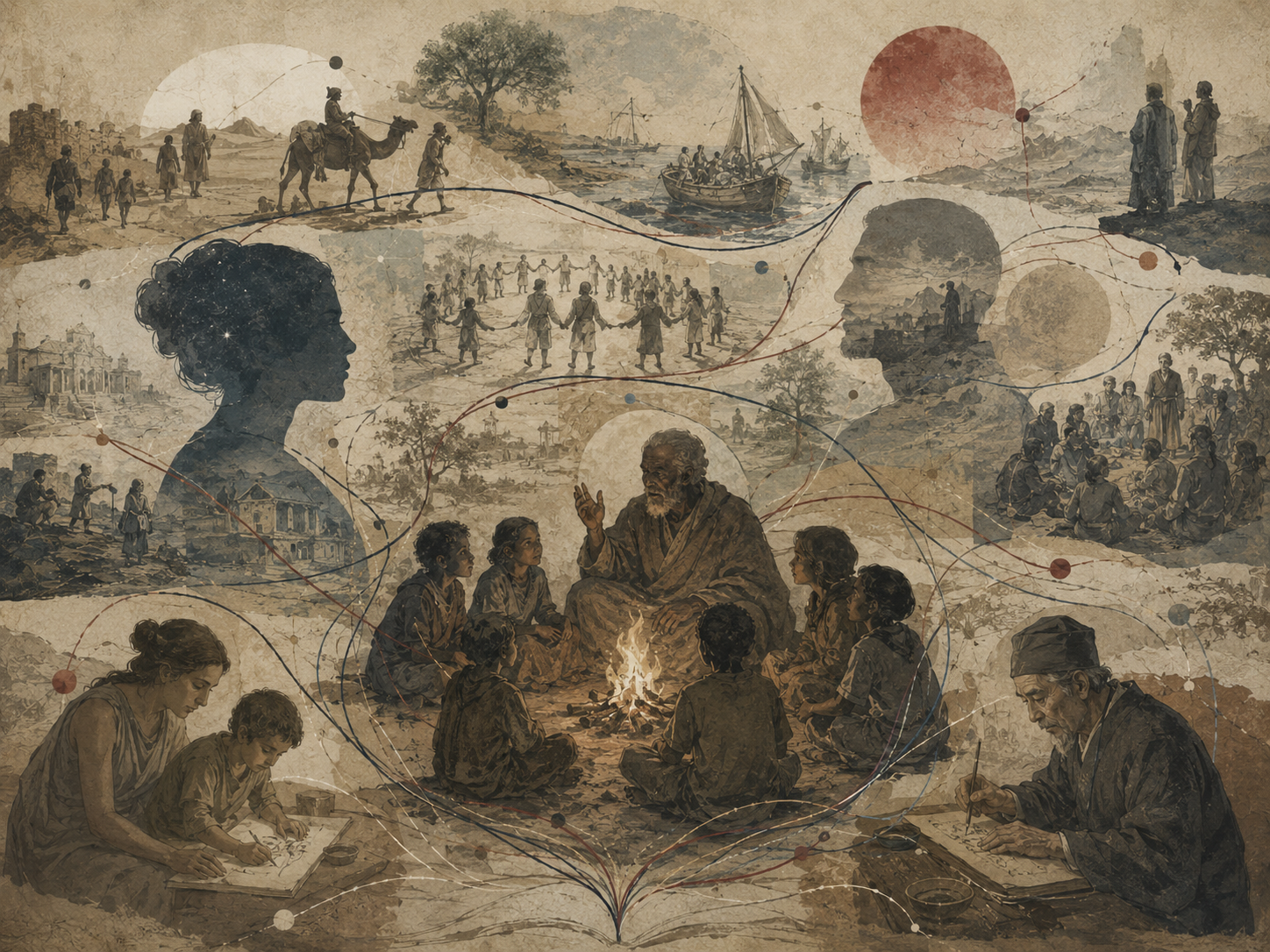
This article explains why storytelling remains central to human culture even in societies saturated with data, images, platforms, analytics, archives, and automated media. It examines story as a cultural technology: a way of organizing time, preserving memory, teaching conduct, forming identity, coordinating groups, transmitting values, confronting suffering, and imagining change. It also includes computational workflows for auditing cultural story functions, memory transmission, teaching value, identity formation, ethical risk, and Catalyst Canvas-ready governance queues for narrative systems.
Why Storytelling Matters
Storytelling matters because culture is not sustained by facts alone. Facts can be recorded, counted, archived, and transmitted, but stories help people understand why facts matter, how events are connected, who is affected, what should be remembered, and what kind of action or judgment follows. Story gives cultural life a temporal and moral shape.
Human beings use stories to organize experience into meaningful patterns. A story can hold memory, emotion, value, causality, identity, and expectation together. It can transform scattered events into a shared account. It can make danger memorable, make a rule concrete, make suffering visible, make belonging emotionally real, or make a future imaginable.
This is why storytelling appears across nearly every sphere of human life. Families tell stories about ancestors, migration, work, loss, humor, and survival. Communities tell stories about origin, place, duty, conflict, and repair. Religious traditions tell stories about creation, covenant, exile, revelation, sacrifice, transformation, judgment, and return. Public institutions tell stories about legitimacy, purpose, failure, reform, and continuity. Political movements tell stories about injustice, agency, solidarity, urgency, and hope.
| Cultural need | Storytelling response | Why it matters |
|---|---|---|
| Memory | Stories preserve events, values, warnings, and relationships in repeatable form. | Culture needs continuity across generations. |
| Teaching | Stories turn abstract rules into memorable situations. | People learn more easily when conduct is placed in context. |
| Identity | Stories connect personal and collective experience across time. | People understand themselves through remembered and anticipated narratives. |
| Belonging | Stories create shared references, origins, symbols, and commitments. | Groups need ways to recognize who they are together. |
| Moral judgment | Stories dramatize choices, consequences, harms, duties, and responsibilities. | Ethical understanding often requires concrete human situations. |
| Imagination | Stories let people explore possible worlds, futures, dangers, and alternatives. | Culture changes partly through what it can imagine. |
Storytelling matters because it joins memory to meaning. Without stories, cultures may still store information, but they lose one of the main ways information becomes intelligible, teachable, emotionally durable, and publicly consequential.
Story as Cultural Memory
Storytelling is one of culture’s main memory systems. A culture remembers through archives, monuments, rituals, names, songs, images, ceremonies, law, education, and public institutions, but story gives memory sequence, scene, voice, conflict, and meaning. It helps communities remember not only that something happened, but how it should be understood.
Cultural memory is never a neutral container. It is shaped by selection, repetition, authority, omission, interpretation, and conflict. The stories a society repeats can preserve wisdom and solidarity, but they can also silence suffering, justify power, simplify history, or exclude people from belonging. The cultural importance of story therefore lies not only in preservation but also in interpretation.
A family story about migration may preserve courage and hardship. A national story about founding may preserve ideals while minimizing conquest, exclusion, or violence. A religious story may preserve sacred orientation and ethical obligation. An institutional story may preserve purpose while obscuring failure. A social movement story may preserve injustice and collective agency that official memory tried to erase.
| Memory function | How story performs it | Interpretive question |
|---|---|---|
| Preservation | Keeps events, teachings, names, places, and symbols available across time. | What does this culture choose to remember? |
| Transmission | Passes memory through repetition, performance, education, ritual, and media. | How is the story carried forward? |
| Interpretation | Explains why remembered events matter. | What meaning is attached to the memory? |
| Omission | Leaves some experiences outside the shared account. | Whose memory is missing or minimized? |
| Contest | Creates struggle over how the past should be narrated. | Who has the authority to tell the story? |
| Repair | Allows silenced or harmed groups to recover memory and claim recognition. | What kind of justice does memory require? |
Story matters in cultural memory because it makes the past active. It tells people what should be carried forward, what should be mourned, what should be celebrated, what should be questioned, and what must not be forgotten.
Story as Teaching
Stories teach by placing knowledge inside situations. A rule may tell people what to do, but a story shows why the rule exists, what happens when it is ignored, how it feels to face a difficult choice, and what consequences may follow. This is why stories are used in childhood learning, religious instruction, moral education, law, leadership, public health, professional training, organizational culture, and community memory.
A story can teach practical knowledge: where danger lies, how to behave toward strangers, what seasons require, how to repair a relationship, how pride becomes risk, or how trust can be broken. It can also teach interpretive knowledge: what courage looks like, what betrayal means, why mercy is difficult, how power corrupts, how grief changes people, or why obligations continue across generations.
Teaching through story is powerful because it integrates cognition, memory, emotion, and imagination. The learner is not only told a principle. The learner is invited to inhabit a situation, follow action over time, recognize stakes, and interpret consequences.
| Teaching function | Storytelling mechanism | Example |
|---|---|---|
| Memory aid | Uses sequence, image, repetition, and character to make knowledge memorable. | A folktale teaches caution through a recurring danger. |
| Practical instruction | Embeds conduct inside a concrete situation. | A family story explains what to do during crisis. |
| Moral reasoning | Shows values under pressure rather than as abstract slogans. | A parable dramatizes mercy, judgment, pride, or responsibility. |
| Social learning | Models roles, expectations, obligations, and consequences. | A community story teaches hospitality or taboo. |
| Professional learning | Transmits judgment through cases, failures, and exemplary practice. | A medical, legal, engineering, or leadership case teaches decision risk. |
Story-based teaching is not automatically responsible. A story can teach prejudice, fatalism, obedience to unjust authority, or simplified blame. The cultural power of story as teaching makes it necessary to ask what is being taught, who benefits from the lesson, and whether the lesson remains ethically defensible.
Story and Moral Imagination
Storytelling matters because it develops moral imagination. Moral imagination is the ability to consider the experience, suffering, motives, constraints, and possibilities of people other than oneself. Stories allow audiences to encounter situations they have not lived through directly. They can widen attention beyond the immediate self.
A story can make a distant problem concrete. It can turn a statistic into a life, a policy into a consequence, an institution into a set of human relationships, or a moral rule into a difficult decision. Literature, testimony, parable, memoir, film, theater, oral tradition, and public narrative can all invite audiences to imagine what an action means from another position.
Moral imagination does not mean automatic agreement. A responsible story does not simply tell the audience what to feel. It creates conditions for recognition, judgment, discomfort, empathy, and reflection. It can reveal the limits of easy moral certainty by showing conflicting duties, incomplete knowledge, unequal power, and unintended consequences.
| Moral function | How story supports it | Risk if misused |
|---|---|---|
| Empathy | Invites attention to another person’s experience. | Emotion may replace evidence or become sentimental consumption. |
| Judgment | Shows choices and consequences in context. | The story may manipulate blame through selective framing. |
| Recognition | Makes ignored suffering or dignity visible. | Representation may become tokenistic or exploitative. |
| Responsibility | Links action to harm, repair, obligation, and accountability. | The story may offer false closure without repair. |
| Complexity | Shows competing values and uncertain consequences. | The story may simplify conflict into heroes and villains. |
Stories help cultures practice moral attention. They can expand compassion, but they can also direct sympathy unevenly. They can help people recognize harm, but they can also make some lives seem more narratable, valuable, or grievable than others. Moral imagination therefore requires narrative ethics, not just narrative power.
Story and Identity
Storytelling matters because identity is temporal. People and groups understand themselves through accounts of where they came from, what they have endured, what they value, what they regret, what they hope for, and what kind of future they believe is possible. Identity is not only a label. It is often a story about continuity and change.
Personal identity relies on narrative interpretation. A person may understand life through a story of recovery, exile, vocation, failure, migration, survival, awakening, service, rupture, or reinvention. These stories help organize memory and aspiration. They also influence what people believe they can do next.
Collective identity works similarly. Communities tell stories of origin, land, ancestors, migration, struggle, sacrifice, resistance, covenant, reform, or renewal. These narratives help define belonging and obligation. They can sustain cultural continuity under pressure, especially when communities face displacement, colonization, assimilation, war, diaspora, or institutional erasure.
| Identity layer | Storytelling role | Caution |
|---|---|---|
| Personal identity | Connects memory, conflict, aspiration, and self-interpretation. | No person should be reduced to one narrative arc. |
| Family identity | Preserves kinship, humor, trauma, obligation, and continuity. | Family stories may silence conflict or enforce narrow roles. |
| Community identity | Creates shared memory, place, practice, and belonging. | Community stories can exclude internal difference. |
| Institutional identity | Explains founding, purpose, reform, and legitimacy. | Official stories may hide failure or power. |
| National identity | Frames origin, sacrifice, achievement, crisis, and destiny. | National stories can erase minority histories or justify violence. |
Identity stories can sustain people, but they can also trap them. A culture may give people scripts that define who counts, who leads, who belongs, who obeys, who is dangerous, or who must sacrifice. Storytelling matters because identity is built through narrative, and narrative identity always carries ethical and political stakes.
Story and Belonging
Belonging is partly narrative. People feel connected when they share memories, references, symbols, rituals, places, struggles, jokes, songs, losses, heroes, warnings, and hopes. Storytelling helps create the emotional and symbolic fabric through which people recognize one another as part of a shared world.
This does not mean belonging is always healthy. The same stories that create solidarity can also create boundaries. They can define insiders and outsiders. They can protect a vulnerable group from erasure, but they can also justify exclusion, hierarchy, or suspicion. The cultural question is not whether stories create belonging, but what kind of belonging they create.
A community may tell stories that invite responsibility and hospitality. Another may tell stories that encourage fear and purity. A movement may tell stories that bring people into collective action. An institution may tell stories that ask members to serve a common mission. A nation may tell stories that encourage civic care, or stories that turn difference into threat.
| Belonging function | Storytelling practice | Possible danger |
|---|---|---|
| Shared origin | Stories explain how a group began. | Origins may be mythologized to exclude complexity. |
| Shared memory | Stories preserve common experiences and references. | Memory may become selective or coercive. |
| Shared ritual | Stories are repeated through ceremony, song, holiday, or performance. | Ritual repetition may hide changing conditions. |
| Shared obligation | Stories explain what members owe one another. | Obligation may be used to suppress dissent. |
| Shared future | Stories imagine what the group can become. | Future narratives may become propaganda or false promise. |
Storytelling matters because belonging requires more than membership. It requires a felt relationship to memory, meaning, place, people, and possibility. Stories help build that relationship, but they also determine who is invited to share it.
Story and Social Coordination
Stories help people coordinate action. A group that shares a story about what is happening, why it matters, who is involved, what is at stake, and what should be done can act together more easily than a group with only disconnected facts. Storytelling provides shared orientation.
This is why stories matter in organizations, movements, institutions, professions, and public life. An organization may use story to explain strategy, change, failure, recovery, and purpose. A public-health campaign may use story to make risk understandable. A social movement may use story to connect private suffering to public injustice. A profession may use case narratives to transmit judgment. A research field may narrate discovery, error, revision, and method.
Story can coordinate attention, but it can also coordinate misunderstanding. A bad story can make the wrong problem seem central, identify the wrong enemy, simplify causality, or push action before evidence is sufficient. A responsible cultural story coordinates people without closing down inquiry.
| Coordination need | Storytelling contribution | Governance question |
|---|---|---|
| Shared problem definition | Explains what issue requires attention. | Has the problem been framed accurately? |
| Shared stakes | Shows why the issue matters. | Whose stakes are visible? |
| Shared agency | Identifies who can act and how. | Does the story assign agency responsibly? |
| Shared timing | Creates urgency, patience, or review rhythm. | Is urgency justified by evidence? |
| Shared direction | Connects action to purpose or future possibility. | Does the story allow revision? |
Storytelling matters in human culture because social action depends on shared interpretation. A story can become a bridge between experience and coordinated response.
Story and Emotion
Stories matter because culture is emotional as well as intellectual. People do not only think through stories. They feel through them. Stories organize grief, hope, fear, pride, shame, anger, humor, love, awe, and longing. They help communities process experiences that would otherwise remain overwhelming or disconnected.
A story can make grief bearable by giving loss a place in memory. It can make fear useful by turning danger into warning. It can make hope durable by linking present struggle to future possibility. It can make shame visible, anger intelligible, or joy shareable. Through story, emotion becomes culturally communicable.
Emotional force is one reason storytelling is so powerful, but it is also one reason storytelling is risky. A story can mobilize compassion, but it can also mobilize panic, hatred, scapegoating, or resentment. Emotion can deepen understanding, but it can also overpower evidence. The ethical question is not whether stories should move people, but whether they move people responsibly.
| Emotion | Cultural role of story | Risk |
|---|---|---|
| Grief | Gives loss a shareable form. | May impose closure before mourning is complete. |
| Fear | Makes danger memorable. | May create panic, suspicion, or scapegoating. |
| Hope | Links struggle to possibility. | May become false reassurance. |
| Anger | Names harm and demands attention. | May simplify causality or dehumanize opponents. |
| Pride | Creates dignity and continuity. | May become triumphalism or denial. |
| Compassion | Invites care for another’s experience. | May become sentimental or selective. |
Storytelling matters because emotion is part of cultural memory and public judgment. A culture’s stories teach people not only what to know, but what to feel about what they know.
Story and Public Life
Public life depends on stories. Political communities tell stories about origin, law, crisis, progress, decline, responsibility, sacrifice, threat, reform, and future direction. These stories shape public trust, civic identity, policy debate, institutional legitimacy, and collective action.
Public storytelling can support democratic reasoning when it connects experience to evidence, makes hidden harms visible, includes affected voices, and invites accountable action. It can help people understand why a public issue matters and who is affected by it. It can connect policy to lived consequence.
But public storytelling can also undermine public reason. Propaganda, conspiracy narratives, scapegoating myths, manipulated victim stories, and institutional self-justifying narratives can distort evidence and mobilize people through fear or resentment. Public narratives often compete not only over facts, but over meaning: what the facts are said to prove, who is blamed, and what future is made imaginable.
| Public narrative type | Cultural function | Risk |
|---|---|---|
| Origin story | Explains political or institutional beginnings. | May erase violence, conflict, or exclusion. |
| Crisis story | Defines what is wrong and why action is urgent. | May exaggerate threat or suppress complexity. |
| Reform story | Links failure to correction and renewal. | May promise change without accountability. |
| Victim story | Makes harm visible and morally urgent. | May be appropriated or selectively applied. |
| Progress story | Places current action in a larger arc of improvement. | May hide unresolved injustice. |
| Decline story | Frames the present as loss from a better past. | May romanticize exclusionary or inaccurate memory. |
Storytelling matters in public life because people rarely act on data alone. They act when facts are placed inside a story about stakes, responsibility, possibility, and collective meaning.
Oral Tradition and Cultural Transmission
Oral tradition demonstrates why storytelling matters before and beyond written text. Spoken stories, songs, chants, proverbs, riddles, prayers, genealogies, epic poems, legends, myths, ritual speech, and performance traditions carry knowledge through memory, repetition, variation, and embodied presence. UNESCO identifies oral traditions and expressions as ways of passing on knowledge, cultural and social values, and collective memory.
Oral storytelling is not a primitive version of writing. It is a distinct cultural practice with its own forms of memory, authority, artistry, adaptation, and community participation. A story may change across performances while preserving recognizable structure, motif, value, or lesson. Variation is often part of the tradition, not a failure of preservation.
Oral traditions also remind us that storytelling belongs to communities, not only authors. A tale may be carried by tellers, listeners, elders, performers, ritual specialists, families, and audiences. Meaning emerges through event, occasion, voice, response, setting, and relationship.
| Oral storytelling feature | Cultural value | Analytical caution |
|---|---|---|
| Performance | Voice, gesture, rhythm, audience, and setting shape meaning. | Do not treat the written transcript as the whole story. |
| Repetition | Supports memory and cultural continuity. | Repeated forms may carry layered meanings. |
| Variation | Allows adaptation across tellers and occasions. | Do not assume one version is the only authentic version. |
| Communal authority | Stories may belong to a tradition rather than an individual author. | Respect cultural ownership and permission. |
| Embodied memory | Knowledge is carried through practice, sound, movement, and presence. | Documentation should not strip context from performance. |
Oral tradition shows that storytelling is not merely content. It is a living relationship among memory, performance, community, and cultural continuity.
Story Across Media
Storytelling matters because it adapts to new media while preserving older cultural functions. Speech, ritual, manuscript, print, theater, radio, film, television, games, social platforms, podcasts, archives, and interactive systems all change how stories are produced, circulated, remembered, and interpreted.
Each medium changes the cultural life of story. Writing extends preservation and complexity. Print expands circulation. Theater intensifies embodied presence. Film combines image, sound, editing, and duration. Television develops long-form serial attachment. Games introduce agency and branching consequence. Digital platforms accelerate participation, remix, fragmentation, algorithmic distribution, and audience feedback.
The cultural importance of story therefore grows, rather than disappears, under media change. People still use stories to understand themselves, but the forms and incentives change. Platform culture may reward emotional intensity, speed, simplicity, and shareability. Archives may preserve stories at scale while detaching them from living context. Interactive media may make audiences participants in narrative consequence.
| Medium | Cultural affordance | Risk |
|---|---|---|
| Oral performance | Community presence, variation, memory, and response. | Loss of context when recorded or extracted. |
| Writing and print | Durability, complexity, revision, and broad circulation. | Authority may become detached from living tradition. |
| Theater | Embodied scene, audience presence, and public emotion. | Performance may intensify stereotypes or spectacle. |
| Film and television | Visual sequence, editing, sound, and mass reception. | Images may naturalize simplified narratives. |
| Games | Agency, systems, worldbuilding, and consequence. | Choice may be framed as freedom while options remain constrained. |
| Digital platforms | Participation, remix, speed, network effects, and visibility. | Algorithms may reward outrage, simplification, or narrative distortion. |
Storytelling matters in human culture because media change does not eliminate the need for meaning. It changes the conditions under which meaning is made, shared, contested, and governed.
Storytelling and Power
Storytelling matters because stories distribute power. A story can define who is heroic, who is dangerous, who is innocent, who is responsible, who belongs, who is forgotten, and who must change. Narrative form can legitimize authority, challenge authority, or make authority seem natural.
Power appears in who gets to tell the story, whose language is used, whose evidence counts, which events are treated as beginnings, which harms are named, and which endings are made available. A dominant institution may tell a story of progress while those harmed by the same institution tell a story of extraction, erasure, or abandonment. A nation may tell a story of unity while communities within it tell stories of exclusion. A corporation may tell a story of innovation while workers, users, or ecosystems tell different stories about cost.
Storytelling can also be a tool of resistance. Counter-memory, testimony, oral history, documentary, protest narrative, postcolonial writing, Indigenous storytelling, community archives, and public witness can challenge official accounts. These forms matter because they recover experience that dominant narratives often suppress.
| Power question | Why it matters | Analytical use |
|---|---|---|
| Who tells the story? | Authority shapes interpretation. | Identify narrator, institution, community, or platform. |
| Who is represented? | Visibility shapes dignity and recognition. | Map whose experience is centered or marginalized. |
| Who is missing? | Omission shapes memory and responsibility. | Look for silenced people, causes, harms, and contexts. |
| What beginning is chosen? | Beginnings shape causality and blame. | Ask what happened before the official start. |
| What ending is offered? | Endings shape closure and action. | Ask whether the story resolves what remains unresolved. |
Storytelling matters because power is narrative as well as material. Whoever controls the story often controls the horizon of interpretation.
The Ethical Risks of Storytelling
Because stories shape memory, identity, emotion, and action, they carry ethical risk. A story can make people care, but it can also make them care selectively. It can make harm visible, but it can also turn harm into spectacle. It can organize justice, but it can also organize blame, fear, exclusion, and violence.
One risk is simplification. Stories often require selection, but selection can distort causality. A complex social problem may be reduced to one villain, one heroic solution, or one emotional scene. Another risk is appropriation. A storyteller may use another person’s suffering, culture, or memory without consent or context. A third risk is manipulation. Emotional narrative can overpower evidence, especially when repeated through media systems that reward intensity.
Ethical storytelling does not require emotionless communication. It requires responsible form. It asks whether the story is truthful enough, contextual enough, representative enough, and accountable enough for the work it is being asked to do.
| Ethical risk | How it appears | Corrective practice |
|---|---|---|
| False causality | Events are arranged to imply a cause not supported by evidence. | Document assumptions and distinguish sequence from causation. |
| Appropriation | A story uses cultural memory or personal suffering without permission or context. | Seek consent, attribution, cultural guidance, and interpretive limits. |
| Stereotype | People are reduced to roles, symbols, threats, or lessons. | Represent complexity, agency, and internal diversity. |
| Sentimentalism | Emotion substitutes for accountability or evidence. | Connect feeling to context, fact, and responsibility. |
| Propaganda | Narrative is used to enforce belief, fear, loyalty, or scapegoating. | Expose framing, sources, omissions, and consequences. |
| False closure | The story resolves harm that remains unresolved in reality. | Name what remains open, contested, or unrepaired. |
Stories matter because they are powerful. The ethical task is to make that power accountable.
Examples of Strong and Weak Cultural Storytelling Analysis
The examples below show how analysis improves when storytelling is treated as cultural work rather than merely engaging communication.
Cultural memory
Weak: This story preserves the past.
Stronger: This story preserves one version of the past while selecting certain events, omitting others, and assigning cultural meaning to memory.
Why it works: It recognizes memory as active interpretation.
Teaching
Weak: Stories teach lessons.
Stronger: Stories teach by placing values, rules, risks, and consequences inside memorable situations.
Why it works: It explains how storytelling teaches.
Belonging
Weak: Stories bring people together.
Stronger: Stories can create belonging by sharing memory and symbols, but they can also define outsiders.
Why it works: It includes both solidarity and exclusion.
Identity
Weak: Identity is a story.
Stronger: People and groups often interpret identity through stories, but identity should not be reduced to a single narrative arc.
Why it works: It avoids narrative reduction.
Public life
Weak: Political stories persuade voters.
Stronger: Public narratives frame crisis, blame, legitimacy, agency, and future direction.
Why it works: It identifies the cultural work of political storytelling.
Ethics
Weak: A powerful story is a good story.
Stronger: A powerful story still requires evidence, context, representation care, and accountability.
Why it works: It separates emotional force from ethical quality.
Strong cultural storytelling analysis asks what a story preserves, teaches, legitimizes, excludes, repairs, or makes imaginable.
Mathematics, Computation, and Modeling
Storytelling cannot be reduced to mathematics, but computational modeling can help researchers and analysts examine cultural story functions. A model can audit how strongly a story supports memory, teaching, identity, belonging, moral imagination, social coordination, and ethical governance. These models should be used as interpretive aids, not replacements for cultural expertise.
A cultural story value score can average major cultural functions:
V_c = \frac{M + T + I + B + E + S}{6}
\]
Interpretation: Cultural story value \(V_c\) averages memory function \(M\), teaching function \(T\), identity function \(I\), belonging function \(B\), ethical reflection \(E\), and social coordination \(S\).
A transmission strength score can combine repetition, medium durability, community use, and interpretive continuity:
T_s = \frac{R + D + C + K}{4}
\]
Interpretation: Transmission strength \(T_s\) averages repetition \(R\), durability \(D\), community use \(C\), and continuity of cultural knowledge \(K\).
A narrative risk score can combine persuasive intensity, low evidence strength, low representation care, and high audience consequence:
R_n = P_iw_p + (1 – E_s)w_e + (1 – V_r)w_v + A_cw_a
\]
Interpretation: Narrative risk \(R_n\) increases when persuasive intensity \(P_i\) and audience consequence \(A_c\) are high while evidence strength \(E_s\) and representation care \(V_r\) are low.
A cultural review priority score can combine low cultural context, low source transparency, high narrative risk, and high public impact:
P_c = w_rR_n + w_x(1 – X_c) + w_s(1 – S_t) + w_iI_p
\]
Interpretation: Cultural review priority \(P_c\) rises when narrative risk \(R_n\) is high, cultural context \(X_c\) is weak, source transparency \(S_t\) is weak, and public impact \(I_p\) is high.
| Modeling task | Cultural question | Example output |
|---|---|---|
| Memory function audit | What does the story preserve or omit? | Memory role table, omission notes, cultural context field. |
| Teaching value audit | What lesson, rule, warning, or interpretive pattern is transmitted? | Teaching function score, lesson taxonomy. |
| Identity function audit | How does the story shape personal or collective identity? | Identity layer map, belonging score. |
| Transmission audit | How is the story carried across time or media? | Transmission strength score, medium history. |
| Ethical risk audit | Where might the story distort, exclude, appropriate, or manipulate? | Governance risk score, review queue. |
| Public impact audit | How might audiences act or judge after receiving the story? | Audience consequence score, public reasoning note. |
Computational storytelling audits are most useful when they make interpretive assumptions visible. They should help editors, researchers, educators, and analysts ask better questions, not pretend that cultural meaning can be mechanically scored.
Python Workflow: Cultural Story Function Audit
The Python workflow below evaluates cultural storytelling items by memory function, teaching value, identity function, belonging function, moral imagination, social coordination, transmission strength, source transparency, representation care, persuasive intensity, audience consequence, and governance priority. The companion repository version extends this into a Catalyst Canvas-ready module with schemas, package-style Python, tests, JSON exports, Canvas cards, markdown governance queues, and reusable cultural-story data contracts.
# cultural_story_function_audit.py
# Dependency-light workflow for cultural storytelling and narrative governance.

from __future__ import annotations

from dataclasses import dataclass
from pathlib import Path
import csv
import json
from statistics import mean

ARTICLE_ROOT = Path(__file__).resolve().parents[1]
OUTPUTS = ARTICLE_ROOT / "outputs"
TABLES = OUTPUTS / "tables"
JSON_DIR = OUTPUTS / "json"
MARKDOWN = OUTPUTS / "markdown"


@dataclass
class CulturalStoryItem:
    item: str
    story_type: str
    cultural_context: str
    memory_function: float
    teaching_value: float
    identity_function: float
    belonging_function: float
    moral_imagination: float
    social_coordination: float
    transmission_strength: float
    source_transparency: float
    representation_care: float
    persuasive_intensity: float
    audience_consequence: float
    public_impact: float
    owner: str
    status: str

    def cultural_value_score(self) -> float:
        return mean([
            self.memory_function,
            self.teaching_value,
            self.identity_function,
            self.belonging_function,
            self.moral_imagination,
            self.social_coordination,
        ])

    def transmission_score(self) -> float:
        return mean([
            self.transmission_strength,
            self.source_transparency,
            self.memory_function,
            self.cultural_context_score(),
        ])

    def cultural_context_score(self) -> float:
        return 0.85 if len(self.cultural_context.strip()) >= 20 else 0.45

    def narrative_risk(self) -> float:
        return min(
            1.0,
            self.persuasive_intensity * 0.25
            + (1 - self.source_transparency) * 0.25
            + (1 - self.representation_care) * 0.30
            + self.audience_consequence * 0.20,
        )

    def review_priority_score(self) -> float:
        return min(
            1.0,
            self.narrative_risk() * 0.45
            + (1 - self.cultural_context_score()) * 0.20
            + (1 - self.source_transparency) * 0.15
            + self.public_impact * 0.20,
        )

    def review_priority(self) -> str:
        if self.status == "revise" or self.review_priority_score() >= 0.50:
            return "high"
        if self.status == "review" or self.review_priority_score() >= 0.35:
            return "medium"
        return "standard"


def write_csv(path: Path, rows: list[dict[str, object]]) -> None:
    path.parent.mkdir(parents=True, exist_ok=True)
    if not rows:
        raise ValueError(f"No rows to write: {path}")
    with path.open("w", encoding="utf-8", newline="") as handle:
        writer = csv.DictWriter(handle, fieldnames=list(rows[0].keys()))
        writer.writeheader()
        writer.writerows(rows)


def write_json(path: Path, payload: object) -> None:
    path.parent.mkdir(parents=True, exist_ok=True)
    path.write_text(json.dumps(payload, indent=2), encoding="utf-8")


def write_markdown_queue(path: Path, rows: list[dict[str, object]]) -> None:
    path.parent.mkdir(parents=True, exist_ok=True)
    lines = [
        "# Cultural Storytelling Governance Queue",
        "",
        "| Item | Story type | Cultural value | Narrative risk | Priority | Owner | Status |",
        "|---|---|---:|---:|---|---|---|",
    ]

    for row in rows:
        lines.append(
            f"| {row['item']} | {row['story_type']} | "
            f"{row['cultural_value_score']} | {row['narrative_risk']} | "
            f"{row['review_priority']} | {row['owner']} | {row['status']} |"
        )

    path.write_text("\n".join(lines) + "\n", encoding="utf-8")


def main() -> None:
    items = [
        CulturalStoryItem(
            "Oral tradition teaching story",
            "oral tradition",
            "Community-based story used to transmit memory and conduct across generations.",
            0.88, 0.86, 0.78, 0.82, 0.76, 0.70, 0.90,
            0.72, 0.78, 0.42, 0.60, 0.68, "archive", "active"
        ),
        CulturalStoryItem(
            "Family migration memory",
            "family narrative",
            "Intergenerational account of migration hardship adaptation work and belonging.",
            0.84, 0.74, 0.86, 0.82, 0.78, 0.64, 0.76,
            0.68, 0.70, 0.50, 0.72, 0.62, "research", "review"
        ),
        CulturalStoryItem(
            "Public crisis narrative",
            "public narrative",
            "Urgent story framing a public crisis responsibility and collective action.",
            0.70, 0.78, 0.72, 0.74, 0.68, 0.88, 0.66,
            0.54, 0.50, 0.90, 0.92, 0.88, "communications", "revise"
        ),
        CulturalStoryItem(
            "Institutional origin story",
            "institutional narrative",
            "Founding story explaining purpose continuity reform and public trust.",
            0.76, 0.68, 0.80, 0.72, 0.62, 0.74, 0.70,
            0.60, 0.58, 0.66, 0.76, 0.80, "editorial", "review"
        ),
        CulturalStoryItem(
            "Moral imagination case",
            "teaching narrative",
            "Case narrative used to examine duty harm accountability and repair.",
            0.72, 0.88, 0.70, 0.64, 0.90, 0.68, 0.66,
            0.76, 0.82, 0.52, 0.70, 0.66, "education", "active"
        ),
    ]

    rows = []

    for item in items:
        rows.append({
            "item": item.item,
            "story_type": item.story_type,
            "cultural_context": item.cultural_context,
            "memory_function": item.memory_function,
            "teaching_value": item.teaching_value,
            "identity_function": item.identity_function,
            "belonging_function": item.belonging_function,
            "moral_imagination": item.moral_imagination,
            "social_coordination": item.social_coordination,
            "transmission_strength": item.transmission_strength,
            "source_transparency": item.source_transparency,
            "representation_care": item.representation_care,
            "persuasive_intensity": item.persuasive_intensity,
            "audience_consequence": item.audience_consequence,
            "public_impact": item.public_impact,
            "cultural_value_score": round(item.cultural_value_score(), 3),
            "transmission_score": round(item.transmission_score(), 3),
            "narrative_risk": round(item.narrative_risk(), 3),
            "review_priority_score": round(item.review_priority_score(), 3),
            "review_priority": item.review_priority(),
            "owner": item.owner,
            "status": item.status,
        })

    rows = sorted(rows, key=lambda row: row["review_priority_score"], reverse=True)

    write_csv(TABLES / "cultural_story_function_audit.csv", rows)
    write_json(JSON_DIR / "cultural_story_canvas_cards.json", rows)

    governance_queue = [
        row for row in rows
        if row["review_priority"] != "standard"
    ]

    write_csv(TABLES / "cultural_story_governance_queue.csv", governance_queue)
    write_json(JSON_DIR / "cultural_story_governance_queue.json", governance_queue)
    write_markdown_queue(MARKDOWN / "cultural_story_governance_queue.md", governance_queue)

    print("Cultural storytelling function audit complete.")


if __name__ == "__main__":
    main()
This workflow helps researchers and editors identify stories with strong cultural value, weak cultural context, high persuasive pressure, low source transparency, or representation risks that require review before publication or reuse.
R Workflow: Storytelling Culture Diagnostics
The R workflow below creates a synthetic cultural-storytelling dataset, calculates cultural value, transmission strength, narrative risk, review priority, and governance status, then exports summary tables and base R plots. It is intentionally portable and uses only base R.
# storytelling_culture_diagnostics.R
# Base R workflow for cultural storytelling diagnostics and governance.

args <- commandArgs(trailingOnly = FALSE)
file_arg <- grep("^--file=", args, value = TRUE)

if (length(file_arg) > 0) {
  script_path <- normalizePath(sub("^--file=", "", file_arg[1]), mustWork = TRUE)
  article_root <- normalizePath(file.path(dirname(script_path), ".."), mustWork = TRUE)
} else {
  article_root <- getwd()
}

setwd(article_root)

tables_dir <- file.path(article_root, "outputs", "tables")
figures_dir <- file.path(article_root, "outputs", "figures")
dir.create(tables_dir, recursive = TRUE, showWarnings = FALSE)
dir.create(figures_dir, recursive = TRUE, showWarnings = FALSE)

items <- data.frame(
  item = c(
    "Oral tradition teaching story",
    "Family migration memory",
    "Public crisis narrative",
    "Institutional origin story",
    "Moral imagination case"
  ),
  story_type = c(
    "oral tradition",
    "family narrative",
    "public narrative",
    "institutional narrative",
    "teaching narrative"
  ),
  memory_function = c(0.88, 0.84, 0.70, 0.76, 0.72),
  teaching_value = c(0.86, 0.74, 0.78, 0.68, 0.88),
  identity_function = c(0.78, 0.86, 0.72, 0.80, 0.70),
  belonging_function = c(0.82, 0.82, 0.74, 0.72, 0.64),
  moral_imagination = c(0.76, 0.78, 0.68, 0.62, 0.90),
  social_coordination = c(0.70, 0.64, 0.88, 0.74, 0.68),
  transmission_strength = c(0.90, 0.76, 0.66, 0.70, 0.66),
  source_transparency = c(0.72, 0.68, 0.54, 0.60, 0.76),
  representation_care = c(0.78, 0.70, 0.50, 0.58, 0.82),
  persuasive_intensity = c(0.42, 0.50, 0.90, 0.66, 0.52),
  audience_consequence = c(0.60, 0.72, 0.92, 0.76, 0.70),
  public_impact = c(0.68, 0.62, 0.88, 0.80, 0.66),
  owner = c("archive", "research", "communications", "editorial", "education"),
  status = c("active", "review", "revise", "review", "active"),
  stringsAsFactors = FALSE
)

items$cultural_value_score <- rowMeans(items[, c(
  "memory_function",
  "teaching_value",
  "identity_function",
  "belonging_function",
  "moral_imagination",
  "social_coordination"
)])

items$transmission_score <- rowMeans(items[, c(
  "transmission_strength",
  "source_transparency",
  "memory_function"
)])

items$narrative_risk <- pmin(
  1,
  items$persuasive_intensity * 0.25 +
    (1 - items$source_transparency) * 0.25 +
    (1 - items$representation_care) * 0.30 +
    items$audience_consequence * 0.20
)

items$review_priority_score <- pmin(
  1,
  items$narrative_risk * 0.45 +
    (1 - items$source_transparency) * 0.20 +
    (1 - items$representation_care) * 0.15 +
    items$public_impact * 0.20
)

items$review_priority <- ifelse(
  items$status == "revise" | items$review_priority_score >= 0.50,
  "high",
  ifelse(
    items$status == "review" | items$review_priority_score >= 0.35,
    "medium",
    "standard"
  )
)

items <- items[order(items$review_priority_score, decreasing = TRUE), ]

write.csv(
  items,
  file.path(tables_dir, "storytelling_culture_diagnostics.csv"),
  row.names = FALSE
)

governance_queue <- items[items$review_priority != "standard", ]

write.csv(
  governance_queue,
  file.path(tables_dir, "storytelling_culture_governance_queue.csv"),
  row.names = FALSE
)

png(file.path(figures_dir, "cultural_story_value_score.png"), width = 1200, height = 700)
barplot(
  items$cultural_value_score,
  names.arg = items$item,
  las = 2,
  ylab = "Cultural story value score",
  main = "Cultural Story Value"
)
grid()
dev.off()

png(file.path(figures_dir, "narrative_risk_score.png"), width = 1200, height = 700)
barplot(
  items$narrative_risk,
  names.arg = items$item,
  las = 2,
  ylab = "Narrative risk score",
  main = "Narrative Risk in Cultural Storytelling"
)
grid()
dev.off()

print(items[, c(
  "item",
  "story_type",
  "cultural_value_score",
  "transmission_score",
  "narrative_risk",
  "review_priority_score",
  "review_priority"
)])
This workflow turns cultural storytelling analysis into a reviewable governance artifact. It helps identify where stories require stronger source transparency, fuller cultural context, better representation care, or clearer limits on persuasive framing.
GitHub Repository
The companion repository for this article supports storytelling in human culture as a Catalyst Canvas-ready narrative-systems module. It includes cultural story function audits, memory transmission scoring, teaching-value diagnostics, identity and belonging analysis, moral-imagination indicators, ethical risk scoring, JSON schemas, package-style Python, R workflows, SQL structures, Canvas cards, markdown governance queues, synthetic datasets, documentation, and reusable cultural-memory templates.
Complete Code Repository
Companion repository for the article, including Catalyst Canvas-ready code for cultural storytelling audits, memory transmission, teaching value, identity formation, belonging, ethical risk, JSON exports, Canvas cards, and reproducible research workflows.
articles/why-storytelling-matters-in-human-culture/
├── canvas/
│   ├── canvas_manifest.json
│   ├── input_schema.json
│   ├── output_schema.json
│   ├── canvas_cards.json
│   └── governance_queue.json
├── html/
├── css/
├── php/
├── java/
├── python/
│   ├── cultural_story_canvas/
│   │   ├── __init__.py
│   │   ├── __main__.py
│   │   ├── cli.py
│   │   ├── models.py
│   │   ├── scoring.py
│   │   ├── validation.py
│   │   ├── governance.py
│   │   └── exporters.py
│   ├── tests/
│   │   └── test_cultural_story_canvas.py
│   └── run_cultural_story_canvas_audit.py
├── r/
│   ├── storytelling_culture_diagnostics.R
│   └── run_all_storytelling_culture_workflows.R
├── sql/
│   ├── canvas_schema.sql
│   └── canvas_queries.sql
├── docs/
│   ├── article_notes.md
│   ├── modeling_principles.md
│   └── governance_notes.md
├── data/
│   ├── cultural_story_items.csv
│   ├── cultural_memory_functions.csv
│   ├── teaching_functions.csv
│   ├── identity_belonging_functions.csv
│   └── ethical_story_risks.csv
├── outputs/
│   ├── figures/
│   ├── json/
│   ├── markdown/
│   └── tables/
├── notebooks/
├── shared/
│   ├── schemas/
│   ├── narrative-templates/
│   ├── story-archetypes/
│   ├── character-models/
│   ├── plot-structures/
│   ├── rhetorical-frameworks/
│   ├── cultural-memory/
│   └── governance/
├── tests/
└── README.md
Related Articles
- What Is Storytelling?
- Storytelling as a Content Framework
- The History of Storytelling from Oral Tradition to Modern Media
- Oral Tradition, Performance, and Collective Memory
- Myth, Ritual, and the Symbolic Work of Story
- Storytelling and the Ethics of Representation
A Practical Method for Analyzing Why Stories Matter
1. Identify the cultural setting
Name the community, institution, medium, occasion, tradition, or audience in which the story operates.
2. Define the memory function
Ask what the story preserves, repeats, repairs, contests, or omits.
3. Identify the teaching function
Ask what practical knowledge, moral lesson, warning, role, or interpretive pattern the story transmits.
4. Map identity and belonging
Ask how the story defines selfhood, group membership, obligation, origin, place, or shared future.
5. Examine moral imagination
Ask whose experience the story helps audiences imagine and whose experience remains outside the frame.
6. Analyze social coordination
Ask what action, judgment, loyalty, reform, resistance, or responsibility the story encourages.
7. Track transmission
Ask how the story moves across speech, ritual, writing, archive, image, performance, media, or platform.
8. Evaluate power and omission
Ask who tells the story, who benefits, who is missing, and what alternative stories exist.
9. Assess ethical risk
Look for appropriation, stereotype, false causality, manipulation, sentimentalism, or false closure.
10. Add governance metadata
Document sources, cultural context, evidence limits, representation cautions, review owner, and revision needs.
This method helps researchers, educators, editors, and analysts treat stories as cultural systems rather than isolated pieces of content.
Common Pitfalls
Several mistakes appear when storytelling is discussed too casually in relation to human culture.
- Reducing storytelling to entertainment: Stories also organize memory, identity, teaching, public life, ethics, and cultural continuity.
- Assuming stories are always good: Stories can humanize, but they can also distort, manipulate, exclude, and dehumanize.
- Confusing emotional force with truth: A moving story may still be inaccurate or ethically irresponsible.
- Ignoring oral tradition: Spoken, performed, repeated, and varied stories are foundational cultural systems, not lesser versions of written texts.
- Treating culture as static: Stories preserve continuity, but they also change across time, tellers, media, and conditions.
- Forgetting power: Narrative authority determines whose memory becomes public and whose experience is dismissed.
- Flattening cultural difference: Comparing stories across traditions requires care, context, and humility.
- Overusing universal templates: Not every story is heroic, linear, redemptive, individualist, or resolved.
- Ignoring omission: Cultural stories often matter as much for what they leave out as for what they include.
- Letting computation replace interpretation: Narrative scores can support review, but cultural meaning requires human judgment.
The central pitfall is treating storytelling as a technique rather than a cultural system with memory, power, emotion, identity, and ethical consequence.
Why Storytelling Remains Culturally Necessary
Storytelling remains culturally necessary because human beings need more than records, rules, datasets, and declarations. They need ways to connect experience to memory, memory to meaning, meaning to identity, identity to responsibility, and responsibility to action. Stories do that work across families, communities, institutions, religions, nations, movements, media, and personal life.
Stories help cultures remember, teach, belong, judge, mourn, imagine, and change. They transmit knowledge across generations. They make moral difficulty concrete. They allow people to recognize themselves and others in time. They help groups coordinate action and preserve continuity under pressure.
But storytelling is powerful enough to require discipline. A culture’s stories can clarify or distort, include or exclude, heal or manipulate, humanize or dehumanize. The reason storytelling matters is also the reason storytelling must be interpreted carefully. Human culture lives through stories, but it must also learn to govern them responsibly.
Further Reading
- Booth, W.C. (1988) The Company We Keep: An Ethics of Fiction. Berkeley: University of California Press. Available at: https://www.ucpress.edu/book/9780520062108/the-company-we-keep
- Boyd, B. (2009) On the Origin of Stories: Evolution, Cognition, and Fiction. Cambridge, MA: Belknap Press of Harvard University Press. Available at: https://www.hup.harvard.edu/books/9780674057111
- Bruner, J. (1986) Actual Minds, Possible Worlds. Cambridge, MA: Harvard University Press. Available at: https://www.hup.harvard.edu/books/9780674003668
- Fisher, W.R. (1987) Human Communication as Narration: Toward a Philosophy of Reason, Value, and Action. Columbia, SC: University of South Carolina Press. Available at: https://uscpress.com/Human-Communication-as-Narration
- Nussbaum, M.C. (1995) Poetic Justice: The Literary Imagination and Public Life. Boston: Beacon Press. Available at: https://www.beacon.org/Poetic-Justice-P313.aspx
- Ong, W.J. (2012) Orality and Literacy: The Technologizing of the Word. 30th anniversary edn. London: Routledge. Available at: https://www.routledge.com/Orality-and-Literacy-30th-Anniversary-Edition/Ong/p/book/9780415538381
- Ricoeur, P. (1984) Time and Narrative, Volume 1. Translated by K. McLaughlin and D. Pellauer. Chicago: University of Chicago Press. Available at: https://press.uchicago.edu/ucp/books/book/chicago/T/bo5962044.html
- UNESCO (n.d.) Oral traditions and expressions including language as a vehicle of the intangible cultural heritage. Paris: UNESCO. Available at: https://ich.unesco.org/en/oral-traditions-and-expressions-00053
- Vansina, J. (1985) Oral Tradition as History. Madison, WI: University of Wisconsin Press.
- Zipes, J. (2012) The Irresistible Fairy Tale: The Cultural and Social History of a Genre. Princeton, NJ: Princeton University Press.
References
- Booth, W.C. (1988) The Company We Keep: An Ethics of Fiction. Berkeley: University of California Press. Available at: https://www.ucpress.edu/book/9780520062108/the-company-we-keep
- Boyd, B. (2009) On the Origin of Stories: Evolution, Cognition, and Fiction. Cambridge, MA: Belknap Press of Harvard University Press. Available at: https://www.hup.harvard.edu/books/9780674057111
- Bruner, J. (1986) Actual Minds, Possible Worlds. Cambridge, MA: Harvard University Press. Available at: https://www.hup.harvard.edu/books/9780674003668
- Fisher, W.R. (1987) Human Communication as Narration: Toward a Philosophy of Reason, Value, and Action. Columbia, SC: University of South Carolina Press. Available at: https://uscpress.com/Human-Communication-as-Narration
- Labov, W. and Waletzky, J. (1967) ‘Narrative Analysis: Oral Versions of Personal Experience’, in Helm, J. (ed.) Essays on the Verbal and Visual Arts. Seattle: University of Washington Press, pp. 12–44. Available at: https://archive.yiddish.nu/items/show/313
- National Storytelling Network (n.d.) What Is Storytelling? Available at: https://storynet.org/what-is-storytelling/
- Nussbaum, M.C. (1995) Poetic Justice: The Literary Imagination and Public Life. Boston: Beacon Press. Available at: https://www.beacon.org/Poetic-Justice-P313.aspx
- Ong, W.J. (2012) Orality and Literacy: The Technologizing of the Word. 30th anniversary edn. London: Routledge. Available at: https://www.routledge.com/Orality-and-Literacy-30th-Anniversary-Edition/Ong/p/book/9780415538381
- Ricoeur, P. (1984) Time and Narrative, Volume 1. Translated by K. McLaughlin and D. Pellauer. Chicago: University of Chicago Press. Available at: https://press.uchicago.edu/ucp/books/book/chicago/T/bo5962044.html
- UNESCO (n.d.) Oral traditions and expressions including language as a vehicle of the intangible cultural heritage. Paris: UNESCO. Available at: https://ich.unesco.org/en/oral-traditions-and-expressions-00053