
Last Updated May 21, 2026
Social identity theory explains how people derive part of their sense of self from membership in social groups, and how those memberships shape perception, emotion, judgment, trust, cooperation, conflict, and collective action. It is one of the central frameworks in modern social psychology because it shows that group membership is not merely a label added to an otherwise individual self. It can become part of the self.
Developed by Henri Tajfel and later expanded with John Turner and others, social identity theory transformed the study of intergroup relations. It showed that bias does not always require deep historical hatred, direct material competition, or abnormal personality. Under some conditions, the mere act of categorizing people into groups can produce ingroup favoritism, outgroup distance, status comparison, and differential allocation of trust or reward.
A serious treatment of social identity theory must therefore move beyond the simple claim that people “identify with groups.” The deeper issue is how social categories become psychologically meaningful, how group membership becomes tied to self-evaluation, how comparison produces status anxiety or pride, how norms define appropriate behavior, how leaders become prototypical representatives of the group, and how identity can generate both solidarity and exclusion.
Main Library
Publications
Article Map
Social Psychology
Related Topic
Stewardship & Ethics
Related Topic
Behavioral Economics
Related Topic
Institutions & Governance
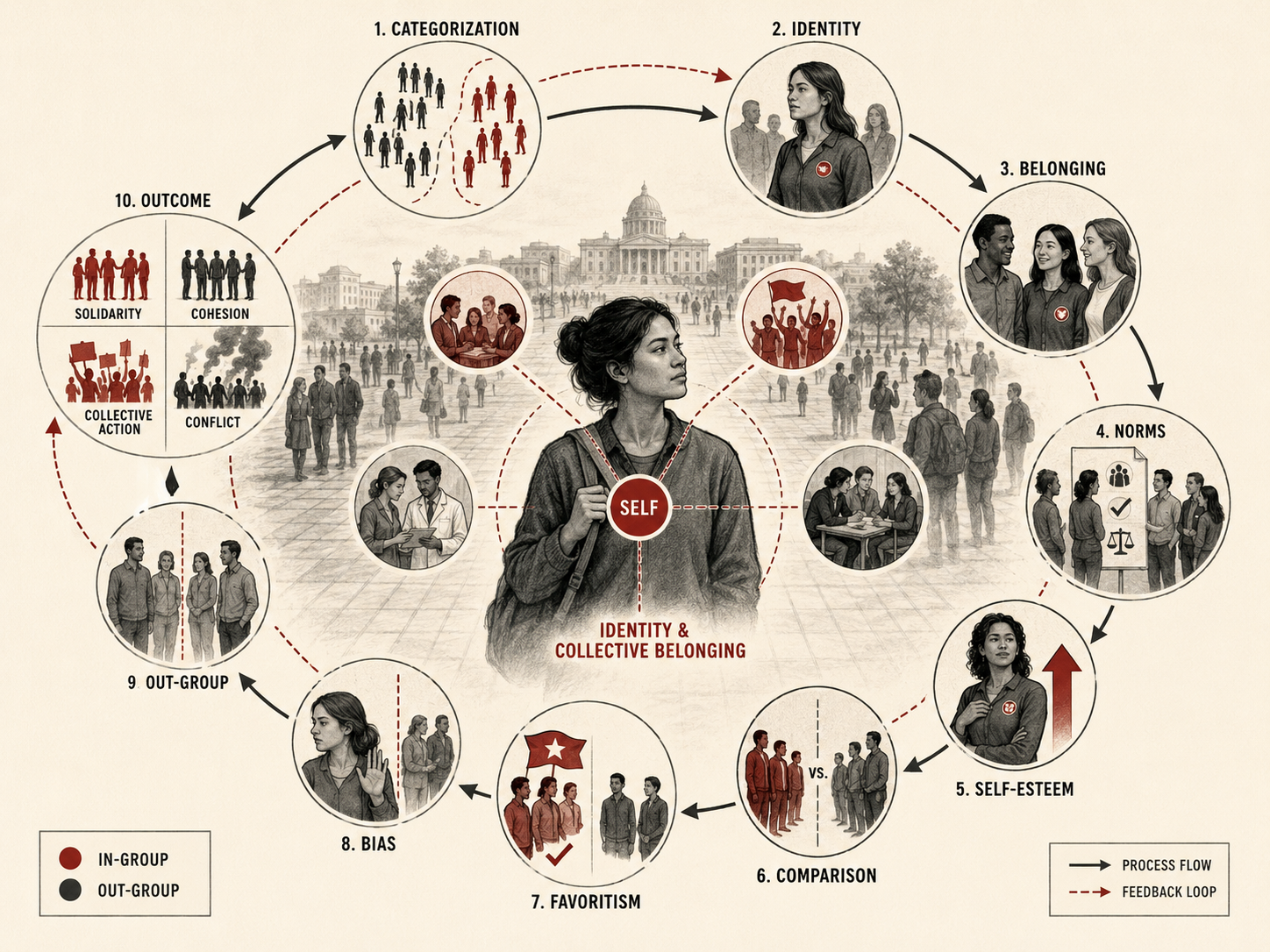
Social identity theory remains central to research in social psychology and related disciplines including political psychology, sociology, organizational behavior, communication studies, conflict studies, leadership research, and collective-action theory. Its enduring importance lies in showing that identity is social, comparative, institutional, and political. People do not only ask, “Who am I?” They also ask, “Who are we?” “Who are they?” “What is our standing?” “What is owed to us?” and “What must we do together?”
This article connects directly to stereotypes, prejudice, and discrimination, in-group bias, conformity and social influence, group polarization and collective judgment, groupthink, intergroup conflict, collective action and social change, obedience, authority, and social power, and Institutions & Governance. Together these frameworks explain how group membership becomes belief, emotion, behavior, conflict, solidarity, and institutional life.
What is social identity theory?
Social identity theory explains how people define themselves partly through membership in social groups. These groups may include nationality, ethnicity, religion, gender, class, profession, political affiliation, organization, neighborhood, movement, fandom, language community, disability identity, or digital community.
The theory begins with a simple but powerful claim: the self is not only personal. People do not understand themselves solely as unique individuals with private traits and preferences. They also understand themselves as members of “we” categories. Those categories carry meaning, value, emotion, norms, memory, obligation, and social standing.
Social identity differs from personal identity. Personal identity refers to qualities that distinguish one person from others as an individual. Social identity refers to qualities derived from group membership. A person may act as a unique individual in one setting, as a professional in another, as a citizen in another, as a partisan in another, and as a member of a marginalized or privileged group in another.
The theory also emphasizes comparison. Groups gain meaning in relation to other groups. An ingroup is not evaluated in isolation. It is compared with relevant outgroups. That comparison can produce pride, grievance, defensiveness, solidarity, rivalry, shame, anger, or collective action.
Social identity theory therefore helps explain why group membership can become a powerful force in social life. When identity is salient, people may trust ingroup members more, follow ingroup norms, defend the group’s reputation, derogate outgroups, respond strongly to threat, or mobilize collectively for recognition, rights, status, or justice.
Why social identity theory matters
Social identity theory matters because group membership shapes perception and behavior in ways that cannot be explained by individual personality alone. People may evaluate the same information differently depending on whether it comes from an ingroup or outgroup. They may trust a leader who appears to represent “us.” They may resist evidence that threatens the group’s status. They may sacrifice personal advantage for collective dignity. They may join collective action when the group is treated unjustly.
The theory is especially important because it explains how intergroup bias can arise without deep ideological hatred. Bias may emerge from categorization, comparison, and the desire for positive group distinctiveness. A person can favor the ingroup not because they consciously hate the outgroup, but because the ingroup is part of the self.
This does not mean that identity processes are always harmful. Social identity can produce solidarity, courage, mutual aid, belonging, social movements, professional ethics, democratic participation, and resistance to oppression. People often need group identity to survive, organize, remember, and demand justice.
The same mechanisms can also produce exclusion, polarization, moral boundary drawing, sectarianism, nationalism, institutional rivalry, and prejudice. The central question is not whether social identity is good or bad. It is what kind of identity is being formed, under what conditions, with what norms, against which outgroups, and with what relationship to power.
Social identity theory therefore gives social psychology a bridge between self and society. It explains how social structure becomes self-understanding and how self-understanding becomes collective behavior.
Origins of social identity theory
Social identity theory was developed by Henri Tajfel and later expanded with John Turner in the 1970s. Tajfel’s work emerged from efforts to understand the psychological roots of intergroup prejudice, discrimination, and collective violence after the Second World War.
Tajfel rejected explanations that reduced prejudice entirely to abnormal personality or direct economic competition. Those explanations captured some cases, but not all. Tajfel wanted to understand why group boundaries themselves could generate bias, even when groups were arbitrary, newly formed, or materially meaningless.
This led to the minimal group paradigm, in which participants were assigned to groups based on trivial or arbitrary criteria. Despite the absence of meaningful history, direct conflict, or face-to-face interaction, participants often allocated rewards in ways that favored their own group.
The theoretical implication was profound. Intergroup bias can arise from categorization itself. Once people are divided into “us” and “them,” group membership can acquire motivational force. The ingroup becomes a source of positive identity, and comparison with outgroups becomes psychologically meaningful.
In collaboration with Turner, Tajfel developed a broader account of intergroup conflict in which social categorization, social identification, and social comparison produce the motivation for positive distinctiveness. This framework became one of the most influential theories in social psychology.
The three core processes of social identity
Social identity theory is often organized around three linked processes:
- Social categorization — people classify themselves and others into social groups.
- Social identification — people adopt group membership as part of self-concept.
- Social comparison — people evaluate their group relative to relevant outgroups.
These processes are not separate stages that always occur in a fixed order. They are mutually reinforcing. Categorization creates group boundaries. Identification gives those boundaries personal and emotional significance. Comparison gives them evaluative and status meaning.
When these processes combine, group membership can shape judgment, trust, emotion, behavior, and memory. People may interpret ambiguous behavior more favorably when it comes from the ingroup, see outgroups as more homogeneous, treat ingroup norms as moral standards, and experience group success or failure as self-relevant.
The theory’s power lies in showing how group identity can become active even in ordinary settings. A classroom, workplace, election, protest, conflict, sports event, online forum, religious gathering, policy debate, or organizational meeting can all make different identities salient.
Because people hold multiple identities, the same person may respond differently depending on which identity is activated. A person may act as a professional in one context, a partisan in another, a parent in another, a citizen in another, and a member of a marginalized community in another.
Social identity is therefore layered, dynamic, and context-sensitive.
Social categorization
Social categorization is the process of classifying people into groups. It helps people navigate complex social environments by simplifying information. Categories provide expectations about roles, norms, relationships, obligations, and likely behavior.
Common social categories include nationality, profession, political affiliation, religion, race, ethnicity, gender, class, age, disability, language, region, organization, and movement membership. These categories are not all the same. Some are chosen, some imposed, some visible, some hidden, some protected by law, some stigmatized, and some connected to long histories of violence or exclusion.
Categorization has cognitive consequences. It can increase perceived similarity within groups and perceived difference between groups. It can make group boundaries appear more natural or fixed than they are. It can encourage people to interpret individuals as representatives of a category rather than as complex persons.
Categorization also has political consequences. Social categories are often shaped by institutions: censuses, laws, schools, immigration systems, labor markets, religious authorities, medical classification, housing systems, and media representation. Categories are not simply mental shortcuts. They are often historically produced and institutionally enforced.
Social identity theory begins with categorization, but a serious account must ask who creates categories, who benefits from them, who is harmed by them, and how people resist or reinterpret the categories imposed on them.
Social identification
Social identification occurs when group membership becomes part of self-concept. People do not merely know that they belong to a group; they experience the group as meaningful to who they are.
Identification may involve pride, loyalty, obligation, shame, grief, anger, hope, solidarity, responsibility, or belonging. It may shape language, dress, ritual, memory, political commitment, ethical norms, and emotional response to group events.
Identification can be strong or weak, chosen or imposed, stable or situational. A person may strongly identify with a religious community, profession, political movement, nation, diaspora, union, university, neighborhood, or marginalized community. Another identity may remain dormant until threat, celebration, crisis, discrimination, or collective memory makes it salient.
Identification also shapes norm-following. When a group is part of the self, its norms may feel personally important. People may conform to ingroup expectations not simply because they fear punishment, but because the group defines what it means to be “one of us.”
This is why social identity is central to conformity and social influence. People are often most influenced by groups they identify with. The relevant question is not merely “What does the majority think?” It is “Whose majority matters to the self?”
Social comparison
Social comparison is the process of evaluating the ingroup relative to relevant outgroups. Groups are not valued in isolation. Their meaning often depends on comparative standing: higher or lower status, more or less legitimate, more or less moral, more or less competent, more or less authentic, more or less deserving.
Comparison can produce positive distinctiveness. People often want their group to be seen as valuable, respected, moral, competent, brave, authentic, chosen, oppressed, modern, traditional, rational, faithful, patriotic, progressive, or otherwise superior on a valued dimension.
When comparisons favor the ingroup, group members may experience pride and self-esteem. When comparisons threaten the ingroup, members may respond with defensiveness, reinterpretation, social creativity, mobility attempts, collective action, or hostility toward the outgroup.
The relevant outgroup matters. A professional group may compare itself to another profession. A political group may compare itself to opposing parties. A marginalized group may compare its treatment to dominant groups. A nation may compare itself to rival nations. A department may compare itself to another department within the same institution.
Social comparison therefore links identity to status. People care about what their group is, but also about where it stands.
The minimal group experiments
Tajfel’s minimal group experiments are among the most influential demonstrations in social psychology. Participants were assigned to groups using trivial criteria, such as preferences for abstract paintings or arbitrary classifications. The groups had no history, no direct conflict, no meaningful shared culture, and no face-to-face interaction.
Despite this minimal basis for identity, participants often favored the ingroup when allocating rewards. They sometimes preferred distributions that maximized the difference between ingroup and outgroup rewards, even when that did not maximize absolute ingroup gain.
This finding was powerful because it showed that intergroup bias does not always require realistic competition or explicit hostility. The simple creation of an ingroup-outgroup distinction can produce differential treatment.
The minimal group paradigm should not be overread. Real-world groups are not minimal. They have histories, institutions, inequalities, memories, trauma, and material interests. But that is precisely why the minimal group findings are so important. If arbitrary categories can produce bias, then socially meaningful categories embedded in power and history can become even more consequential.
The minimal group experiments do not prove that all group identity is dangerous. They show that group boundaries can become evaluative very quickly. That insight remains foundational for understanding prejudice, polarization, organizational rivalry, nationalism, and collective conflict.
Ingroup favoritism and outgroup bias
Social identity theory explains several common patterns of intergroup behavior. Ingroup favoritism refers to the tendency to evaluate, trust, reward, cooperate with, or protect members of one’s own group more than comparable outgroup members. Outgroup bias refers to more negative evaluation, suspicion, distancing, or exclusion of members of other groups.
These processes are related but not identical. Ingroup favoritism can occur without intense outgroup hatred. People may give the benefit of the doubt to ingroup members, interpret ingroup mistakes more generously, or allocate opportunities within familiar networks without consciously intending to harm outsiders.
Outgroup bias becomes more likely when groups are perceived as threatening, immoral, inferior, dangerous, illegitimate, or competitive. It can involve fear, contempt, disgust, resentment, suspicion, dehumanization, or moral exclusion.
Brewer’s influential distinction between “ingroup love” and “outgroup hate” remains useful here. Some forms of bias arise because people preferentially support their own group, while other forms involve active hostility toward outgroups. The two can overlap, but they are analytically distinct.
This matters for institutional analysis. Many unequal outcomes are produced not only by direct hostility, but by ingroup favoritism: hiring through familiar networks, mentoring people who feel culturally similar, trusting those who share the same background, or defining professionalism around dominant-group norms.
Ingroup favoritism can reproduce inequality even when it feels like loyalty, comfort, trust, or common sense.
Self-esteem, collective self-esteem, and positive distinctiveness
Social identity theory argues that group membership contributes to self-evaluation. People often seek a positive social identity because the group is part of the self. When the group is valued, the self can feel valued. When the group is devalued, the self may experience threat, shame, anger, or resistance.
This does not mean that all identity behavior is reducible to individual self-esteem. Later research has complicated simple self-esteem interpretations. But the broader point remains important: group value matters because people experience group membership as self-relevant.
Positive distinctiveness refers to the motivation to see the ingroup as positively differentiated from relevant outgroups. This may occur through status competition, moral comparison, cultural pride, symbolic distinction, or claims to authenticity, competence, sacrifice, victimhood, purity, achievement, tradition, or justice.
Positive distinctiveness can be healthy when it supports dignity, cultural survival, solidarity, and resistance to domination. It can be harmful when it depends on degrading outgroups, denying shared humanity, or justifying hierarchy.
For marginalized communities, positive social identity can be protective. Groups that have been stigmatized may build counter-narratives, collective memory, mutual recognition, and pride as forms of resistance. In such cases, identity affirmation is not merely psychological comfort. It is a response to social devaluation.
The meaning of positive distinctiveness therefore depends on power. Pride among a subordinated group and supremacy among a dominant group are not equivalent social phenomena.
Status, legitimacy, permeability, and identity strategies
Social identity theory pays close attention to status relations between groups. When people belong to a lower-status group, their response depends partly on whether they see the hierarchy as legitimate, stable, and permeable.
Permeability refers to whether individuals believe they can move from one group or status position to another. If boundaries are permeable, people may pursue individual mobility. If boundaries are impermeable, they may pursue collective strategies.
Legitimacy refers to whether the status hierarchy is seen as fair or justified. If inequality is viewed as legitimate, it may be accepted or internalized. If it is viewed as illegitimate, it may produce anger, resistance, and collective action.
Stability refers to whether the hierarchy appears durable or changeable. If status relations seem stable, groups may seek social creativity by redefining comparison dimensions. If change seems possible, collective action may become more likely.
Classic identity strategies include:
- individual mobility, when people try to leave or distance themselves from a lower-status group;
- social creativity, when groups redefine comparison dimensions to preserve positive identity;
- social competition, when groups directly challenge the hierarchy.
These strategies are deeply political. They help explain why some people assimilate, some reinterpret group meaning, and some organize for structural change. They also show why social identity theory belongs in conversations about inequality, recognition, and institutional power.
Self-categorization theory and identity salience
Self-categorization theory, developed by Turner and colleagues, extends social identity theory by explaining how different identities become active in different contexts. People have multiple possible self-categorizations: individual, relational, professional, political, national, religious, cultural, organizational, and more. Which one becomes salient depends on context.
Identity salience is shaped by fit and accessibility. A category becomes salient when it helps make sense of the situation and when it is readily available in memory or social context. An identity may become active because of threat, conflict, leadership, ritual, symbols, group norms, public debate, institutional classification, or digital reinforcement.
When a social identity becomes salient, people may depersonalize in a technical sense: they see themselves less as unique individuals and more as interchangeable members of the group. This does not mean they lose personhood. It means that group norms and prototypes become more relevant to self-definition.
Self-categorization theory helps explain why behavior can shift across situations. The same person may be cooperative across one group boundary and hostile across another. They may reason as a scientist in one setting, a partisan in another, a parent in another, and a citizen in another.
This dynamic quality is crucial. Social identity is not a fixed switch. It is contextually organized self-understanding.
Prototypicality, norms, and leadership
Social identity theory has strongly influenced leadership research. From a social identity perspective, leaders are persuasive not only because of personal traits, formal authority, or strategic skill. They are persuasive when they are seen as representing “who we are.”
Prototypicality refers to how well someone embodies the defining qualities of the group. A prototypical leader appears to express the group’s values, norms, grievances, aspirations, and boundaries. Such leaders may be trusted because they are perceived as “one of us.”
This helps explain why leadership is context-dependent. A person who appears charismatic to one group may appear threatening or illegitimate to another. Leadership depends on identity fit. The leader’s power is partly rooted in the follower’s sense of shared identity.
Group norms also matter. When people identify strongly with a group, they are more likely to follow norms defined as ingroup norms. This can support ethical conduct, solidarity, and cooperation. It can also support exclusion, conformity, groupthink, polarization, or hostility if those are framed as group-defining behaviors.
The question for institutions is therefore not only who leads, but how leadership defines the group. Does leadership expand the moral boundaries of “we,” or narrow them? Does it make dissent compatible with belonging, or define dissent as betrayal?
Social identity and collective action
Social identity theory is central to the study of collective action. People are more likely to act collectively when they identify with a group, perceive injustice toward that group, believe the group can be effective, and experience group-based emotion such as anger, moral outrage, hope, or solidarity.
The social identity model of collective action emphasizes that protest, organizing, resistance, and movement participation are not only individual cost-benefit calculations. They are identity-based acts. People act because “we” are harmed, “we” deserve dignity, “we” can change conditions, and “we” are responsible to one another.
This framework helps explain civil rights movements, labor movements, anti-colonial movements, feminist movements, disability-rights movements, religious movements, indigenous sovereignty struggles, climate movements, democracy movements, and many forms of community organizing.
Collective action can also take harmful forms when identity is organized around exclusion, domination, grievance against vulnerable groups, conspiracy, authoritarian loyalty, or supremacist ideology. Social identity does not determine moral direction. It provides the psychological basis for acting as a group.
The ethical and political question is what the group identity is organized to do: protect dignity, demand justice, preserve hierarchy, exclude outsiders, defend democracy, suppress difference, or transform institutions.
Applications in politics and polarization
Political identity is one of the most visible applications of social identity theory. Party affiliation, ideology, nation, religion, race, region, class, and movement identity can all shape how people interpret political information.
When politics becomes identity-based, disagreement is not only about policy. It becomes a struggle over group meaning, moral worth, status, belonging, and threat. People may distrust information from outgroups, reinterpret facts to protect ingroup narratives, and treat compromise as betrayal.
Political polarization is intensified when identities align. If party, religion, region, race, class, media ecosystem, and moral worldview increasingly overlap, political disagreement becomes social separation. Outgroup members are no longer just people with different preferences. They become symbols of threat.
Social identity theory helps explain why fact correction alone often fails in polarized settings. Information is filtered through trust, group norms, source identity, and perceived threat. A claim from the outgroup may be rejected not because it is unintelligible, but because accepting it would weaken the ingroup’s moral or political position.
Democratic life therefore depends partly on cross-cutting identities, institutional trust, protected pluralism, and civic norms that make disagreement compatible with shared belonging.
Applications in organizations and institutions
Organizations are full of social identities: departments, professions, teams, ranks, unions, locations, disciplines, leadership groups, frontline workers, technical specialists, administrators, and organizational subcultures. These identities shape trust, conflict, communication, cooperation, and resistance.
Social identity theory helps explain why organizations often struggle with silos. People may identify more strongly with their department, profession, or team than with the larger institution. They may trust ingroup expertise, discount outgroup warnings, protect local status, or interpret cross-functional criticism as threat.
Leadership also depends on identity. Leaders who appear to represent the group can mobilize cooperation. Leaders who appear imposed by an outgroup, detached from frontline identity, or hostile to valued norms may face resistance even when they hold formal authority.
Organizational change often fails because it treats identity as secondary. A restructuring, merger, strategy shift, or technology change may threaten professional identity, local autonomy, status hierarchy, or group meaning. If these identity stakes are ignored, resistance may be misread as irrational opposition.
Healthy institutions build superordinate identities without erasing subgroup dignity. They create shared purpose while preserving voice, expertise, and local belonging. The goal is not to eliminate group identity, but to organize it toward cooperation and accountability.
Marginalized identities, power, and recognition
Social identity theory is especially important for understanding marginalized identities. For groups that have been stigmatized, excluded, colonized, racialized, criminalized, disabled, displaced, or denied recognition, identity can become a site of survival and resistance.
Dominant institutions often pressure marginalized people to assimilate, hide, explain, perform respectability, or distance themselves from their communities. Social identity can offer an alternative: collective pride, memory, dignity, mutual aid, political organization, and refusal of imposed shame.
At the same time, marginalized identities are not abstract psychological categories. They are shaped by law, violence, land, labor, language, religion, embodiment, citizenship, family, surveillance, and material inequality. A serious account of social identity must therefore avoid treating all groups as interchangeable.
Ingroup pride among a marginalized community is not the same as supremacy among a dominant group. Outgroup distrust among a community that has experienced institutional harm is not the same as exclusionary hatred from a group defending privilege. Power matters.
Social identity theory becomes stronger when it is connected to historical injustice and lived experience. It explains how people are shaped by group membership, but it must also ask who had the power to define the group, impose the category, stigmatize the identity, or deny recognition.
Social identity in digital environments
Digital communication platforms have created new environments for social identity. Online communities organize around politics, fandom, profession, religion, health, nationality, conspiracy, activism, gaming, lifestyle, grievance, and shared values. These identities can produce support, learning, creativity, and solidarity. They can also intensify polarization and outgroup hostility.
Digital platforms amplify identity through visibility, repetition, metrics, recommendation systems, and social proof. Likes, shares, follower counts, trending labels, hashtags, algorithmic feeds, and group-specific language can all make identity more salient.
Identity-aligned content can create a powerful sense of belonging. It can also narrow the range of acceptable opinion. When people repeatedly encounter ingroup-confirming content and outgroup-threatening narratives, identity boundaries can harden.
Algorithmic systems do not create social identity from nothing, but they can reinforce it. Recommendation systems may learn that identity-based outrage, threat, pride, or conflict increases engagement. Over time, this can make group boundaries more visible, emotionally charged, and behaviorally consequential.
Digital identity research should therefore connect social psychology to platform governance. The question is not only how users identify, but how technical systems rank, reward, and intensify identity-based signals.
Formalizing social identity theory
Social identity theory can be represented as a model in which self-evaluation depends partly on personal identity and partly on group-based identity. Let total self-evaluation be \(E\), personal identity value \(P\), and group-based identity value \(G\):
E=\alpha P+(1-\alpha)G
\]
Interpretation: Self-evaluation combines personal identity and social identity. As social identity becomes more salient, the group-based component receives more weight.
Group-based identity value can be represented as a comparative function:
G=f(S_{in}-S_{out})
\]
Interpretation: Group identity value depends partly on the perceived status difference between ingroup and relevant outgroup.
Social categorization can be represented as a mapping from a person to a group label:
c_i \rightarrow g_k
\]
Interpretation: Person \(i\) is categorized into group \(g_k\), making group norms and comparisons psychologically relevant.
Ingroup favoritism can be expressed as a differential allocation:
B=R_{in}-R_{out}
\]
Interpretation: Bias \(B\) is the difference between resources, trust, or reward allocated to ingroup and outgroup members.
Identity salience can be modeled as context-dependent:
S_g=f(C,N,T,P_r)
\]
Interpretation: Group identity salience \(S_g\) depends on contextual cues \(C\), norm strength \(N\), threat \(T\), and perceived prototypicality \(P_r\).
Collective action can be modeled as a function of identity, injustice, efficacy, and group-based emotion:
P(A_i=1)=\operatorname{logit}^{-1}(\beta_0+\beta_1ID_i+\beta_2J_i+\beta_3E_i+\beta_4\Anger_i)
\]
Interpretation: Collective action becomes more likely when identity strength, perceived injustice, group efficacy, and anger are high.
These formalizations do not replace the theory’s social and historical richness. They make its logic operational for research: identity salience, comparison, norms, threat, legitimacy, permeability, and collective action can be measured, modeled, and tested.
Theoretical extensions and developments
Social identity theory has generated a large family of related approaches. Self-categorization theory explains how different levels of identity become salient. Social identity leadership research explains why leaders gain influence when they represent the group prototype. The social identity model of collective action explains how identity, injustice, efficacy, and emotion produce mobilization.
Other extensions examine social identity in organizations, health, political polarization, crowds, leadership, communication, digital platforms, and intergroup reconciliation. The theory has also influenced work on common ingroup identity, identity fusion, moral conviction, identity threat, and collective narcissism.
These developments share a core insight: group membership is psychologically active. It shapes what people perceive, whom they trust, what they remember, what they feel, which norms they follow, and what actions they consider necessary.
The extensions also reveal an important tension. Social identity can support cooperation across difference when a broader inclusive identity is built. But it can also erase subgroup histories if superordinate identity is imposed too quickly. A common identity that ignores inequality may feel like unity to dominant groups and silencing to marginalized groups.
Good theory therefore requires moral and institutional care. The goal is not simply to create bigger “we” categories, but to build forms of belonging that preserve truth, justice, memory, and equal dignity.
Limits and interpretive cautions
Social identity theory is powerful, but it must be used carefully.
- Do not treat group identity as inherently irrational or dangerous.
- Do not assume all groups are equivalent regardless of power, history, or institutional position.
- Do not confuse ingroup pride among marginalized communities with supremacy among dominant groups.
- Do not reduce structural conflict to psychological categorization alone.
- Do not assume intergroup bias always involves explicit hatred.
- Do not ignore material interests, law, political economy, violence, and institutional design.
- Do not treat identity as fixed, singular, or internally homogeneous.
- Do not treat superordinate identity as automatically liberating; it can also erase difference.
- Do not interpret outgroup distrust without considering histories of harm.
- Do not treat digital identity dynamics as purely user-driven when platforms shape visibility and reinforcement.
The theory is strongest when it is connected to power and history. Social identity processes help explain how group boundaries become meaningful, but real groups are formed within unequal societies. Categories are not only cognitive. They are legal, political, economic, cultural, and historical.
Social identity theory should therefore deepen the study of belonging, not flatten it. It should explain both the dangers of exclusionary identity and the necessity of collective identity for dignity, resistance, and social change.
Social identity in the architecture of social influence
Within the broader architecture of social influence, social identity theory explains why group norms and affiliations exert such powerful effects on behavior. Conformity explains alignment with group expectations. Group polarization explains how discussion can intensify group positions. Groupthink explains how cohesive decision groups suppress dissent. Social identity theory explains why those group pressures matter to the self.
Social identity also connects to stereotypes and prejudice, because group comparison shapes evaluation of ingroups and outgroups. It connects to implicit bias, because repeated group associations can become automatic. It connects to obedience and authority, because leaders and institutions gain power when they are perceived as representing “us.” It connects to collective action, because shared identity turns private grievance into collective mobilization.
The theory’s central contribution is to show that individual behavior cannot be understood apart from the groups through which identity and meaning are constructed. People do not only act as isolated decision makers. They act as members of groups, bearers of memory, defenders of status, participants in institutions, and agents of collective possibility.
Social identity is therefore one of the bridges between psychology and social order. It links selfhood to power, belonging to conflict, and recognition to action.
Measurement, data, and research design
Research on social identity theory can use minimal-group experiments, identity-salience manipulations, surveys, vignette studies, intergroup evaluation tasks, trust-allocation tasks, public-goods games, collective-action measures, organizational field studies, political surveys, digital trace data, and network simulations.
Key variables include:
- participant, session, group, scenario, site, and institutional identifiers;
- identity category;
- ingroup and outgroup labels;
- identity strength;
- identity salience;
- self-categorization;
- prototypicality;
- group norm strength;
- collective self-esteem;
- ingroup evaluation;
- outgroup evaluation;
- ingroup favoritism;
- outgroup distance;
- status comparison;
- perceived threat;
- perceived legitimacy;
- perceived permeability;
- group efficacy;
- perceived injustice;
- group-based anger;
- social mobility orientation;
- social creativity orientation;
- collective action intention;
- trust allocation;
- reward allocation gap;
- response time;
- digital identity exposure;
- algorithmic identity reinforcement;
- cross-cutting contact.
Strong designs should distinguish identity strength from identity salience. A person may strongly identify with a group, but that identity may not be active in a particular moment. Conversely, a situation may temporarily make an identity salient even when long-term identification is moderate.
Research should also distinguish ingroup favoritism from outgroup hostility. Preferential trust in the ingroup is not the same as active hatred of the outgroup, though the two can combine under threat.
When studying real social groups, researchers must account for power and history. Minimal-group results are useful for isolating categorization, but real groups exist within institutions, memory, inequality, and political struggle.
R code for social identity research
The following R workflow models identity salience, ingroup favoritism, outgroup evaluation, trust allocation, collective action, response time, and digital identity reinforcement.
# Install packages if needed:
# pak::pak(c("tidyverse", "lme4", "lmerTest", "emmeans", "broom.mixed", "performance"))

library(tidyverse)
library(lme4)
library(lmerTest)
library(emmeans)
library(broom.mixed)
library(performance)

# Expected columns:
# participant, session_id, group_id, scenario_id, site_id,
# institution_context, condition, trial, identity_category,
# ingroup_label, outgroup_label, identity_strength,
# identity_salience, self_categorization, prototypicality,
# group_norm_strength, collective_self_esteem,
# ingroup_evaluation, outgroup_evaluation, ingroup_favoritism,
# outgroup_distance, status_comparison, perceived_threat,
# perceived_legitimacy, perceived_permeability,
# group_efficacy, perceived_injustice, anger,
# social_mobility_orientation, social_creativity_orientation,
# collective_action_intention, trust_allocation,
# reward_allocation_gap, response_time_ms,
# digital_identity_exposure, algorithmic_identity_reinforcement,
# cross_cutting_contact

dat <- read_csv("social_identity_trials.csv") %>%
  mutate(
    participant = factor(participant),
    session_id = factor(session_id),
    group_id = factor(group_id),
    scenario_id = factor(scenario_id),
    site_id = factor(site_id),
    institution_context = factor(institution_context),
    condition = factor(condition),
    identity_category = factor(identity_category),
    ingroup_label = factor(ingroup_label),
    outgroup_label = factor(outgroup_label),
    log_response_time = log(response_time_ms),
    identity_activation_index = (
      identity_strength +
      identity_salience +
      self_categorization +
      group_norm_strength
    ) / 4,
    outgroup_bias_index = (
      ingroup_favoritism / 10 +
      outgroup_distance +
      perceived_threat -
      cross_cutting_contact
    ) / 3,
    collective_action_index = (
      identity_strength +
      perceived_injustice +
      group_efficacy +
      anger
    ) / 4,
    digital_identity_reinforcement_index = (
      digital_identity_exposure +
      algorithmic_identity_reinforcement -
      cross_cutting_contact
    ) / 2
  )

summary_table <- dat %>%
  group_by(condition, institution_context) %>%
  summarise(
    n = n(),
    participants = n_distinct(participant),
    mean_identity_activation = mean(identity_activation_index, na.rm = TRUE),
    mean_ingroup_favoritism = mean(ingroup_favoritism, na.rm = TRUE),
    mean_outgroup_distance = mean(outgroup_distance, na.rm = TRUE),
    mean_collective_action = mean(collective_action_intention, na.rm = TRUE),
    mean_trust_allocation = mean(trust_allocation, na.rm = TRUE),
    mean_reward_gap = mean(reward_allocation_gap, na.rm = TRUE),
    mean_digital_reinforcement = mean(digital_identity_reinforcement_index, na.rm = TRUE),
    .groups = "drop"
  )

print(summary_table)

favoritism_model <- lmer(
  ingroup_favoritism ~
    identity_strength +
    identity_salience +
    self_categorization +
    group_norm_strength +
    perceived_threat +
    status_comparison +
    cross_cutting_contact +
    condition +
    institution_context +
    (1 | participant) +
    (1 | scenario_id),
  data = dat,
  REML = FALSE
)

summary(favoritism_model)
emmeans(favoritism_model, ~ condition)

outgroup_model <- lmer(
  outgroup_evaluation ~
    identity_salience +
    outgroup_distance +
    perceived_threat +
    perceived_legitimacy +
    cross_cutting_contact +
    condition +
    institution_context +
    (1 | participant) +
    (1 | scenario_id),
  data = dat,
  REML = FALSE
)

summary(outgroup_model)

trust_model <- lmer(
  trust_allocation ~
    identity_salience +
    identity_strength +
    prototypicality +
    group_norm_strength +
    outgroup_distance +
    condition +
    institution_context +
    (1 | participant) +
    (1 | scenario_id),
  data = dat,
  REML = FALSE
)

summary(trust_model)

collective_action_model <- lmer(
  collective_action_intention ~
    identity_strength +
    perceived_injustice +
    group_efficacy +
    anger +
    perceived_legitimacy +
    perceived_permeability +
    condition +
    institution_context +
    (1 | participant) +
    (1 | scenario_id),
  data = dat,
  REML = FALSE
)

summary(collective_action_model)

response_time_model <- lmer(
  log_response_time ~
    identity_salience +
    perceived_threat +
    outgroup_distance +
    perceived_permeability +
    condition +
    institution_context +
    (1 | participant) +
    (1 | scenario_id),
  data = dat %>% filter(response_time_ms >= 150),
  REML = FALSE
)

summary(response_time_model)

condition_summary <- dat %>%
  group_by(condition) %>%
  summarise(
    n = n(),
    mean_identity_salience = mean(identity_salience, na.rm = TRUE),
    mean_ingroup_favoritism = mean(ingroup_favoritism, na.rm = TRUE),
    mean_outgroup_distance = mean(outgroup_distance, na.rm = TRUE),
    mean_collective_action = mean(collective_action_intention, na.rm = TRUE),
    .groups = "drop"
  )

write_csv(summary_table, "social_identity_summary.csv")
write_csv(condition_summary, "social_identity_condition_summary.csv")
write_csv(
  tidy(favoritism_model, effects = "fixed", conf.int = TRUE),
  "social_identity_favoritism_coefficients.csv"
)

ggplot(
  condition_summary,
  aes(x = reorder(condition, mean_ingroup_favoritism), y = mean_ingroup_favoritism, group = 1)
) +
  geom_line() +
  geom_point() +
  coord_flip() +
  labs(
    title = "Mean ingroup favoritism by condition",
    x = "Condition",
    y = "Mean ingroup favoritism"
  ) +
  theme_minimal()
This workflow supports social identity research by separating identity strength, identity salience, self-categorization, prototypicality, group norms, ingroup favoritism, outgroup distance, perceived threat, legitimacy, permeability, collective action, trust allocation, and response time.
Python code for social identity research
The Python workflow below parallels the R analysis and adds a digital identity-polarization simulation for studying algorithmic reinforcement, cross-cutting contact, and bridging institutions.
import numpy as np
import pandas as pd
import statsmodels.formula.api as smf
import matplotlib.pyplot as plt

# Expected columns:
# participant, session_id, group_id, scenario_id, site_id,
# institution_context, condition, trial, identity_category,
# ingroup_label, outgroup_label, identity_strength,
# identity_salience, self_categorization, prototypicality,
# group_norm_strength, collective_self_esteem,
# ingroup_evaluation, outgroup_evaluation, ingroup_favoritism,
# outgroup_distance, status_comparison, perceived_threat,
# perceived_legitimacy, perceived_permeability,
# group_efficacy, perceived_injustice, anger,
# social_mobility_orientation, social_creativity_orientation,
# collective_action_intention, trust_allocation,
# reward_allocation_gap, response_time_ms,
# digital_identity_exposure, algorithmic_identity_reinforcement,
# cross_cutting_contact

df = pd.read_csv("social_identity_trials.csv")

for col in [
    "participant",
    "session_id",
    "group_id",
    "scenario_id",
    "site_id",
    "institution_context",
    "condition",
    "identity_category",
    "ingroup_label",
    "outgroup_label",
]:
    df[col] = df[col].astype("category")

df["log_response_time"] = np.log(df["response_time_ms"])

df["identity_activation_index"] = (
    df["identity_strength"]
    + df["identity_salience"]
    + df["self_categorization"]
    + df["group_norm_strength"]
) / 4

df["outgroup_bias_index"] = (
    df["ingroup_favoritism"] / 10
    + df["outgroup_distance"]
    + df["perceived_threat"]
    - df["cross_cutting_contact"]
) / 3

df["collective_action_index"] = (
    df["identity_strength"]
    + df["perceived_injustice"]
    + df["group_efficacy"]
    + df["anger"]
) / 4

df["digital_identity_reinforcement_index"] = (
    df["digital_identity_exposure"]
    + df["algorithmic_identity_reinforcement"]
    - df["cross_cutting_contact"]
) / 2

summary_table = (
    df.groupby(["condition", "institution_context"], observed=True)
    .agg(
        n=("participant", "size"),
        participants=("participant", "nunique"),
        mean_identity_activation=("identity_activation_index", "mean"),
        mean_ingroup_favoritism=("ingroup_favoritism", "mean"),
        mean_outgroup_distance=("outgroup_distance", "mean"),
        mean_collective_action=("collective_action_intention", "mean"),
        mean_trust_allocation=("trust_allocation", "mean"),
        mean_reward_gap=("reward_allocation_gap", "mean"),
        mean_digital_reinforcement=("digital_identity_reinforcement_index", "mean"),
    )
    .reset_index()
)

print(summary_table)

favoritism_model = smf.ols(
    "ingroup_favoritism ~ identity_strength + identity_salience "
    "+ self_categorization + group_norm_strength "
    "+ perceived_threat + status_comparison + cross_cutting_contact "
    "+ condition + institution_context",
    data=df
)

favoritism_result = favoritism_model.fit(
    cov_type="cluster",
    cov_kwds={"groups": df["participant"]}
)

print(favoritism_result.summary())

outgroup_model = smf.ols(
    "outgroup_evaluation ~ identity_salience + outgroup_distance "
    "+ perceived_threat + perceived_legitimacy + cross_cutting_contact "
    "+ condition + institution_context",
    data=df
)

outgroup_result = outgroup_model.fit(
    cov_type="cluster",
    cov_kwds={"groups": df["participant"]}
)

print(outgroup_result.summary())

trust_model = smf.ols(
    "trust_allocation ~ identity_salience + identity_strength "
    "+ prototypicality + group_norm_strength + outgroup_distance "
    "+ condition + institution_context",
    data=df
)

trust_result = trust_model.fit(
    cov_type="cluster",
    cov_kwds={"groups": df["participant"]}
)

print(trust_result.summary())

collective_action_model = smf.ols(
    "collective_action_intention ~ identity_strength + perceived_injustice "
    "+ group_efficacy + anger + perceived_legitimacy "
    "+ perceived_permeability + condition + institution_context",
    data=df
)

collective_action_result = collective_action_model.fit(
    cov_type="cluster",
    cov_kwds={"groups": df["participant"]}
)

print(collective_action_result.summary())

rt_df = df[df["response_time_ms"] >= 150].copy()

response_time_model = smf.ols(
    "log_response_time ~ identity_salience + perceived_threat "
    "+ outgroup_distance + perceived_permeability "
    "+ condition + institution_context",
    data=rt_df
)

response_time_result = response_time_model.fit(
    cov_type="cluster",
    cov_kwds={"groups": rt_df["participant"]}
)

print(response_time_result.summary())

def simulate_identity_polarization(
    agents=600,
    steps=40,
    seed=42
):
    rng = np.random.default_rng(seed)
    rows = []

    scenarios = [
        "baseline",
        "identity_threat",
        "algorithmic_reinforcement",
        "cross_cutting_contact",
        "bridging_institutions",
    ]

    for scenario in scenarios:
        positions = rng.normal(0, 1, agents)
        identity_strength = rng.uniform(0.2, 0.8, agents)

        for step in range(1, steps + 1):
            if scenario == "identity_threat":
                reinforcement, contact = 0.06, 0.01
            elif scenario == "algorithmic_reinforcement":
                reinforcement, contact = 0.08, 0.005
            elif scenario == "cross_cutting_contact":
                reinforcement, contact = 0.025, 0.055
            elif scenario == "bridging_institutions":
                reinforcement, contact = 0.020, 0.075
            else:
                reinforcement, contact = 0.030, 0.025

            group_signal = np.sign(positions)

            positions = (
                positions
                + reinforcement * identity_strength * group_signal
                - contact * positions
                + rng.normal(0, 0.05, agents)
            )

            rows.append({
                "scenario": scenario,
                "step": step,
                "mean_position": np.mean(positions),
                "position_variance": np.var(positions),
                "polarization_index": np.mean(np.abs(positions)),
                "reinforcement": reinforcement,
                "cross_cutting_contact": contact,
            })

    return pd.DataFrame(rows)

simulation = simulate_identity_polarization()

condition_summary = (
    df.groupby("condition", observed=True)
    .agg(
        mean_identity_salience=("identity_salience", "mean"),
        mean_ingroup_favoritism=("ingroup_favoritism", "mean"),
        mean_outgroup_distance=("outgroup_distance", "mean"),
        mean_collective_action=("collective_action_intention", "mean"),
    )
    .reset_index()
)

fig, ax = plt.subplots(figsize=(8, 5))

ordered = condition_summary.sort_values("mean_ingroup_favoritism")
ax.plot(
    ordered["mean_ingroup_favoritism"],
    ordered["condition"].astype(str),
    marker="o"
)

ax.set_xlabel("Mean ingroup favoritism")
ax.set_ylabel("Condition")
ax.set_title("Mean ingroup favoritism by condition")
plt.tight_layout()
plt.show()

summary_table.to_csv("social_identity_summary.csv", index=False)
condition_summary.to_csv("social_identity_condition_summary.csv", index=False)
simulation.to_csv("identity_polarization_simulation.csv", index=False)
This Python workflow supports social identity research by modeling identity salience, ingroup favoritism, outgroup evaluation, trust allocation, collective action, response time, digital identity reinforcement, cross-cutting contact, and simulated polarization.
Research data architecture
Social identity research often depends on relational data: participants, groups, scenarios, institutions, identity categories, ingroup and outgroup labels, identity strength, identity salience, self-categorization, prototypicality, group norms, collective self-esteem, ingroup evaluation, outgroup evaluation, ingroup favoritism, outgroup distance, status comparison, perceived threat, legitimacy, permeability, group efficacy, perceived injustice, anger, collective action, trust allocation, reward allocation, digital identity exposure, algorithmic reinforcement, and cross-cutting contact.
The companion GitHub repository includes a full SQL schema and example analytical queries for researchers who want to reproduce, inspect, or extend the data model. Keeping executable SQL in GitHub avoids WordPress hosting restrictions while preserving the technical infrastructure for readers who want to use the article as a reproducible research workflow.
The research data model supports questions such as:
- Does identity salience increase ingroup favoritism?
- Does cross-cutting contact reduce outgroup distance?
- Does identity threat increase reward-allocation gaps?
- Does perceived illegitimacy increase collective action intention?
- Does perceived permeability increase social mobility orientation?
- Does group efficacy predict collective action beyond perceived injustice?
- Does algorithmic identity reinforcement increase outgroup distance?
- Does prototypicality predict trust allocation?
- Does status comparison predict collective self-esteem?
- Do bridging institutions reduce polarization in simulated identity networks?
View the SQL research data architecture in GitHub.
GitHub repository
The companion repository provides reusable code and research scaffolding for studying social identity theory, social categorization, identity salience, ingroup favoritism, outgroup distance, status comparison, collective action, digital identity reinforcement, and identity-polarization dynamics.
Complete Code Repository
Access the full companion repository for this article, including reproducible analysis materials and multi-language code workflows for social identity research.
Why social identity theory matters for social psychology
Social identity theory matters because it shows that the self is social. People do not only act as isolated individuals. They act as members of groups, bearers of collective memory, defenders of status, followers of norms, participants in institutions, and agents of collective action.
Tajfel’s work transformed social psychology by demonstrating that group categorization can produce bias even under minimal conditions. Later developments showed that identity also shapes leadership, conformity, polarization, organizational life, collective action, digital belonging, and resistance to injustice.
The theory’s power lies in its range. It explains why group boundaries matter, why ingroups are trusted, why outgroups are stereotyped, why status comparisons are emotionally charged, why leaders must represent “us,” why marginalized communities build pride, why political conflict becomes moralized, and why people act collectively for group dignity and change.
Read alongside stereotypes, prejudice, and discrimination, in-group bias, conformity and social influence, group polarization and collective judgment, groupthink, intergroup conflict, collective action and social change, Behavioral Economics, and Institutions & Governance, social identity theory becomes more than a theory of group bias. It becomes a framework for understanding belonging, recognition, solidarity, exclusion, and social power.
Related articles
- Social Psychology
- Stereotypes, Prejudice, and Discrimination
- In-Group Bias
- Implicit Bias
- Conformity and Social Influence
- Group Polarization and Collective Judgment
- Groupthink in Social Psychology
- Intergroup Conflict
- Collective Action and Social Change
- Obedience, Authority, and Social Power
- Behavioral Economics
- Institutions & Governance
- Stewardship & Ethics
Further reading
- Brewer, M.B. (1999) ‘The psychology of prejudice: Ingroup love and outgroup hate?’, Journal of Social Issues, 55(3), pp. 429–444. Available at: https://doi.org/10.1111/0022-4537.00126.
- Ellemers, N., Spears, R. and Doosje, B. (2002) ‘Self and social identity’, Annual Review of Psychology, 53, pp. 161–186. Available at: https://doi.org/10.1146/annurev.psych.53.100901.135228.
- Haslam, S.A., Reicher, S.D. and Platow, M.J. (2011) The New Psychology of Leadership: Identity, Influence and Power. New York: Psychology Press.
- Hogg, M.A. and Abrams, D. (1988) Social Identifications: A Social Psychology of Intergroup Relations and Group Processes. London: Routledge.
- Hogg, M.A. and Terry, D.J. (2000) ‘Social identity and self-categorization processes in organizational contexts’, Academy of Management Review, 25(1), pp. 121–140. Available at: https://doi.org/10.5465/amr.2000.2791606.
- Hornsey, M.J. (2008) ‘Social identity theory and self-categorization theory: A historical review’, Social and Personality Psychology Compass, 2(1), pp. 204–222. Available at: https://doi.org/10.1111/j.1751-9004.2007.00066.x.
- Tajfel, H. (1969) ‘Cognitive aspects of prejudice’, Journal of Social Issues, 25(4), pp. 79–97. Available at: https://doi.org/10.1111/j.1540-4560.1969.tb00620.x.
- Tajfel, H. (1970) ‘Experiments in intergroup discrimination’, Scientific American, 223(5), pp. 96–102. Available at: https://doi.org/10.1038/scientificamerican1170-96.
- Tajfel, H. (ed.) (1978) Social Identity and Intergroup Relations. Cambridge: Cambridge University Press.
- Tajfel, H. and Turner, J.C. (1979) ‘An integrative theory of intergroup conflict’, in Austin, W.G. and Worchel, S. (eds.) The Social Psychology of Intergroup Relations. Monterey, CA: Brooks/Cole, pp. 33–47. Available at: https://alnap.cdn.ngo/media/documents/tajfel-turner-1979-compressed.pdf.
- Turner, J.C., Hogg, M.A., Oakes, P.J., Reicher, S.D. and Wetherell, M.S. (1987) Rediscovering the Social Group: A Self-Categorization Theory. Oxford: Basil Blackwell.
- van Zomeren, M., Postmes, T. and Spears, R. (2008) ‘Toward an integrative social identity model of collective action: A quantitative research synthesis of three socio-psychological perspectives’, Psychological Bulletin, 134(4), pp. 504–535. Available at: https://doi.org/10.1037/0033-2909.134.4.504.
References
- Brewer, M.B. (1999) ‘The psychology of prejudice: Ingroup love and outgroup hate?’, Journal of Social Issues, 55(3), pp. 429–444. Available at: https://doi.org/10.1111/0022-4537.00126.
- Ellemers, N., Spears, R. and Doosje, B. (2002) ‘Self and social identity’, Annual Review of Psychology, 53, pp. 161–186. Available at: https://doi.org/10.1146/annurev.psych.53.100901.135228.
- Haslam, S.A., Reicher, S.D. and Platow, M.J. (2011) The New Psychology of Leadership: Identity, Influence and Power. New York: Psychology Press.
- Hogg, M.A. and Abrams, D. (1988) Social Identifications: A Social Psychology of Intergroup Relations and Group Processes. London: Routledge.
- Hogg, M.A. and Terry, D.J. (2000) ‘Social identity and self-categorization processes in organizational contexts’, Academy of Management Review, 25(1), pp. 121–140. Available at: https://doi.org/10.5465/amr.2000.2791606.
- Hornsey, M.J. (2008) ‘Social identity theory and self-categorization theory: A historical review’, Social and Personality Psychology Compass, 2(1), pp. 204–222. Available at: https://doi.org/10.1111/j.1751-9004.2007.00066.x.
- Tajfel, H. (1969) ‘Cognitive aspects of prejudice’, Journal of Social Issues, 25(4), pp. 79–97. Available at: https://doi.org/10.1111/j.1540-4560.1969.tb00620.x.
- Tajfel, H. (1970) ‘Experiments in intergroup discrimination’, Scientific American, 223(5), pp. 96–102. Available at: https://doi.org/10.1038/scientificamerican1170-96.
- Tajfel, H. (ed.) (1978) Social Identity and Intergroup Relations. Cambridge: Cambridge University Press.
- Tajfel, H. and Turner, J.C. (1979) ‘An integrative theory of intergroup conflict’, in Austin, W.G. and Worchel, S. (eds.) The Social Psychology of Intergroup Relations. Monterey, CA: Brooks/Cole, pp. 33–47. Available at: https://alnap.cdn.ngo/media/documents/tajfel-turner-1979-compressed.pdf.
- Turner, J.C., Hogg, M.A., Oakes, P.J., Reicher, S.D. and Wetherell, M.S. (1987) Rediscovering the Social Group: A Self-Categorization Theory. Oxford: Basil Blackwell.
- van Zomeren, M., Postmes, T. and Spears, R. (2008) ‘Toward an integrative social identity model of collective action: A quantitative research synthesis of three socio-psychological perspectives’, Psychological Bulletin, 134(4), pp. 504–535. Available at: https://doi.org/10.1037/0033-2909.134.4.504.