
Last Updated May 21, 2026
Stereotypes, prejudice, and discrimination are foundational concepts in social psychology because they explain how social categories become beliefs, emotions, behaviors, institutional practices, and unequal outcomes. Stereotypes organize expectations about groups. Prejudice attaches evaluation and affect to those groups. Discrimination turns group-based judgment into action, exclusion, differential treatment, or institutional disadvantage.
These processes are often discussed as if they were personal flaws located only inside individual minds. That is too narrow. Stereotypes and prejudice emerge through cognition, culture, history, identity, power, social norms, media representation, institutional design, and material conflict. They can be explicit or implicit, hostile or paternalistic, individual or structural, deliberate or routinized, interpersonal or bureaucratic.
A serious treatment of stereotypes and prejudice must therefore move across levels of analysis. It must explain how categorization simplifies perception, how social identity organizes loyalty, how threat and competition intensify hostility, how institutions reproduce unequal treatment, how stereotype threat enters performance settings, and how contact, accountability, power-sharing, and structural reform can reduce harm.
Main Library
Publications
Article Map
Social Psychology
Related Topic
Stewardship & Ethics
Related Topic
Behavioral Economics
Related Topic
Institutions & Governance
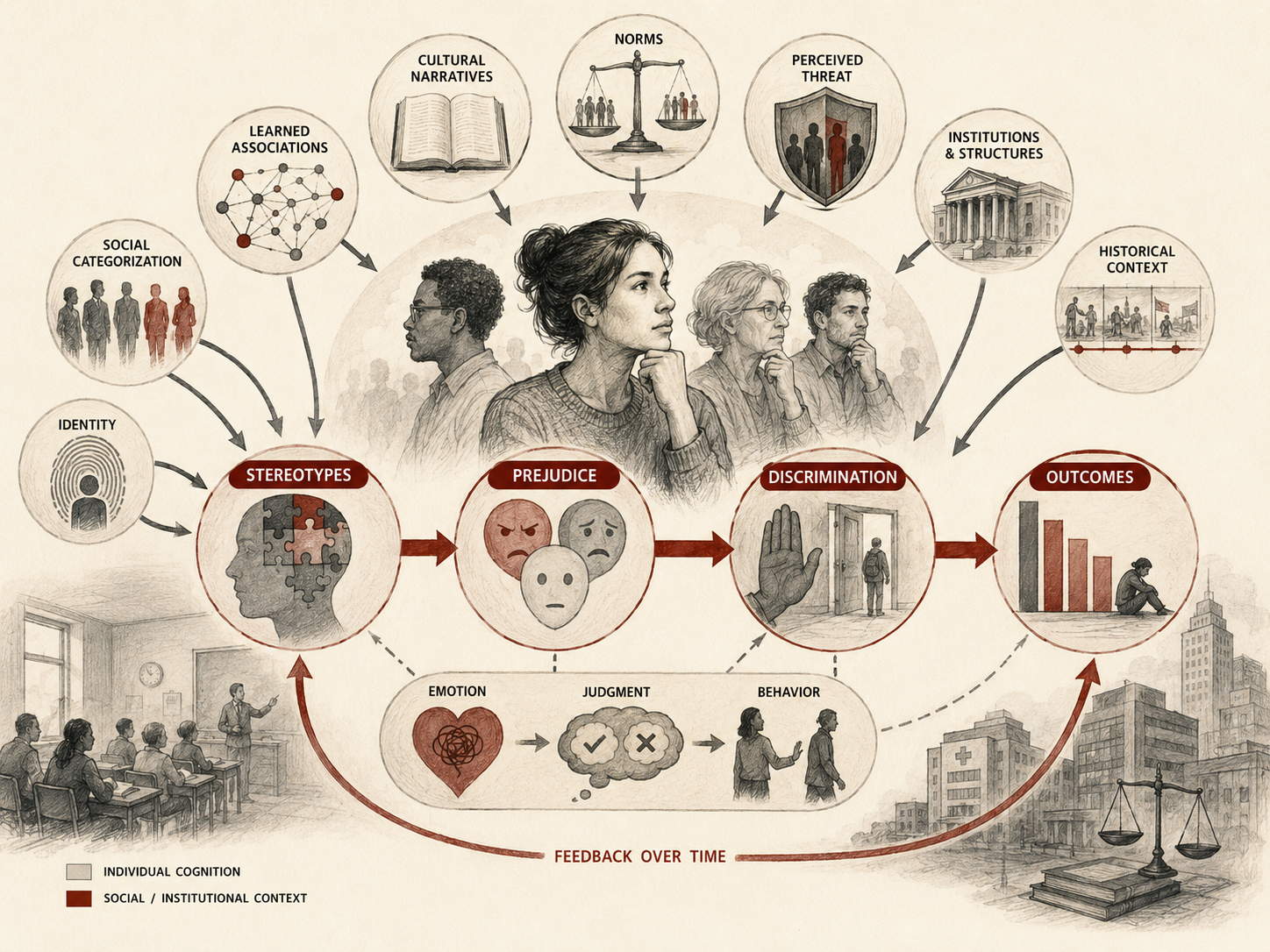
The significance of this topic lies in its breadth. Stereotypes and prejudice are not marginal distortions of otherwise neutral perception. They are among the central mechanisms through which social categories become evaluative, moralized, and behaviorally consequential. They help explain everyday social perception, institutional exclusion, intergroup conflict, public stigma, discriminatory policy, stereotype threat, and the reproduction of hierarchy across generations.
This article connects directly to social cognition, implicit bias, heuristics and biases, social identity theory, in-group bias, intergroup conflict, contact hypothesis, conformity and social influence, moral disengagement, and Institutions & Governance. Together these frameworks explain how group boundaries become cognitive, emotional, political, and institutional boundaries.
Definitions: stereotypes, prejudice, and discrimination
Although often used interchangeably in everyday language, stereotypes, prejudice, and discrimination refer to distinct but interconnected processes.
- Stereotypes are cognitive beliefs, associations, or expectations about members of social groups.
- Prejudice refers to evaluative attitudes toward a group, often involving negative affect, aversion, resentment, contempt, fear, pity, envy, or moral suspicion.
- Discrimination involves behavior, decision-making, policy, or institutional practice that disadvantages members of a group.
The distinction matters because inequality is not reducible to one psychological variable. A person may know a stereotype without endorsing it. A person may feel prejudice without acting on it. A discriminatory institution may produce unequal outcomes even when individual decision makers do not consciously endorse prejudiced beliefs.
Stereotypes are cognitive. Prejudice is evaluative and affective. Discrimination is behavioral and institutional. In real life, they often reinforce one another. A stereotype can justify prejudice. Prejudice can motivate discrimination. Discrimination can create social conditions that appear to confirm stereotypes.
For example, if an institution excludes a group from educational opportunity, members of that group may later be stereotyped as less qualified. The stereotype then appears to justify the exclusion that helped produce the inequality. This circular structure is one reason stereotypes are so durable.
A serious analysis must therefore ask not only what people believe about groups, but how those beliefs are learned, whose interests they serve, how they are attached to emotion, and where they become embedded in decision systems.
Why stereotypes and prejudice matter
Stereotypes and prejudice matter because they shape how people are seen before they speak, how their behavior is interpreted, how their competence is judged, how their pain is believed, how their threat is imagined, how their mistakes are explained, and how their opportunities are distributed.
They are powerful precisely because they often operate through ordinary perception. The same action may be interpreted differently depending on who performs it. Assertiveness may be read as leadership in one person and aggression in another. Curiosity may be read as intelligence in one student and disruption in another. Distress may be read as pain in one patient and exaggeration in another. Poverty may be read as structural disadvantage for one group and moral failure for another.
Stereotypes and prejudice also matter because they are cumulative. One biased judgment may seem small. Repeated across classrooms, clinics, workplaces, courts, platforms, housing markets, public agencies, and media systems, group-based judgment can become a patterned inequality.
They also affect democratic life. Prejudice can define who is treated as fully belonging, who is imagined as dangerous, who is seen as deserving, who receives sympathy, who is blamed for structural problems, and whose suffering is treated as politically urgent.
The study of stereotypes and prejudice therefore belongs at the center of social psychology. It connects perception to power, identity to inequality, and cognition to institutional life.
Cognitive foundations of stereotyping
Stereotypes arise partly from the same cognitive mechanisms that make social perception efficient. Human beings rely on categorization to manage complexity. Categorization reduces informational overload by grouping objects, events, and people into meaningful classes.
When categorization is applied to people, however, it can exaggerate perceived similarity within groups and perceived difference between groups. Group boundaries become psychologically sharper than the underlying variation warrants. This is why stereotyping is closely connected to social cognition and heuristics and biases.
Several cognitive processes are especially important:
- categorical perception, which sharpens perceived boundaries between groups;
- outgroup homogeneity bias, which makes members of other groups seem more similar to one another than they are;
- illusory correlation, which leads people to overestimate the association between group membership and distinctive behavior;
- availability, which makes vivid or repeated examples feel more common than they are;
- confirmation bias, which gives more weight to stereotype-consistent information;
- attribution bias, which explains behavior differently depending on group membership.
These mechanisms do not imply that stereotyping is harmless or inevitable in a moral sense. They show that stereotypes are built from ordinary cognitive tools operating in unequal social worlds. The same mind that organizes complexity can also reproduce distortion when categories are socially loaded.
For this reason, combating stereotypes requires more than telling individuals to avoid generalization. It requires changing the environments that repeatedly teach certain group-attribute associations and the institutions that allow those associations to shape outcomes.
Social identity and group categorization
Henri Tajfel’s work on social categorization and social identity transformed the study of prejudice. Social identity theory argues that people derive part of their self-concept from membership in social groups. Once group membership becomes self-relevant, evaluations of the group become connected to self-esteem, belonging, loyalty, and status.
Tajfel’s minimal-group experiments showed that even arbitrary group assignments can produce ingroup favoritism. Participants assigned to meaningless groups still tended to allocate benefits in ways that favored their own group. These findings suggested that intergroup bias does not require ancient hatred, deep ideological belief, or direct material conflict. Categorization itself can create asymmetry.
This does not mean that all prejudice is merely cognitive. It means that group boundaries can become psychologically meaningful very quickly, especially when they are attached to status, resources, threat, history, or moral identity.
Social identity processes help explain why stereotypes are often defended. A stereotype about an outgroup may serve an ingroup function: preserving superiority, justifying privilege, explaining inequality, protecting moral identity, or stabilizing group boundaries. Prejudice can therefore become identity-protective.
Social identity also helps explain why appeals to evidence alone may fail. When a stereotype is tied to group identity, correcting it may feel like a threat to belonging, status, or moral worldview. Reducing prejudice often requires changing identity meanings and group norms, not only presenting facts.
Stereotype content: warmth, competence, status, and competition
Stereotypes are not only positive or negative. They have content. The stereotype content model, associated with Susan Fiske and colleagues, argues that many group stereotypes organize around two central dimensions: warmth and competence.
Warmth concerns perceived intent: is this group seen as friendly, trustworthy, cooperative, threatening, hostile, or morally safe? Competence concerns perceived capacity: is this group seen as capable, intelligent, skilled, powerful, organized, or effective?
This framework helps explain ambivalent stereotypes. Some groups may be stereotyped as warm but incompetent, producing paternalistic attitudes such as pity. Others may be stereotyped as competent but cold, producing envy or suspicion. Groups seen as both warm and competent may receive admiration, while groups seen as both cold and incompetent may receive contempt.
The model also links stereotypes to social structure. Perceived status tends to predict competence judgments, while perceived competition tends to predict warmth judgments. In other words, stereotypes are not arbitrary. They often rationalize existing hierarchies and group relations.
This is important because some stereotypes appear positive on the surface but still constrain people. A group stereotyped as warm but incompetent may be liked yet excluded from authority. A group stereotyped as competent but cold may be respected yet distrusted. A supposedly flattering stereotype can still become a cage.
Stereotype content therefore connects cognition to hierarchy. It shows how social position becomes translated into psychological expectation.
Implicit bias and automatic associations
Modern research emphasizes that many stereotypes operate automatically and outside conscious awareness. Implicit bias refers to automatic associations linking social categories with evaluations, traits, emotions, or expected behaviors.
These associations can influence perception and judgment even when individuals consciously reject prejudice. A person may sincerely endorse equality while still having automatic associations shaped by repeated exposure to unequal cultural narratives.
Implicit bias matters because it shows how stereotypes can operate below the level of deliberate intent. Bias does not need to be consciously endorsed in order to influence attention, interpretation, memory, and decision-making.
At the same time, implicit bias should not be treated as a complete explanation for discrimination. It is one mechanism among many. Explicit hostility, structural exclusion, legal inequality, economic hierarchy, segregation, algorithmic systems, and institutional incentives also matter.
The strongest interpretation links implicit bias to decision conditions. Automatic associations are more likely to shape outcomes under time pressure, ambiguity, cognitive load, fatigue, weak accountability, and unstructured discretion. They are less likely to shape outcomes when institutions require clear criteria, structured review, documentation, accountability, and opportunities for correction.
Implicit bias research therefore reinforces a broader lesson: individual cognition and institutional design cannot be separated.
Mechanisms that maintain stereotypes
Stereotypes are resilient because several psychological and social mechanisms help maintain them over time.
- Confirmation bias leads people to notice and remember stereotype-consistent information more readily.
- Subtyping allows people to preserve a stereotype by treating counterexamples as exceptions.
- Attribution bias explains stereotype-consistent behavior as typical and counter-stereotypic behavior as unusual.
- Selective exposure limits contact with information that would challenge the stereotype.
- Normative reinforcement makes stereotypes socially acceptable within certain groups or institutions.
- Media repetition makes some group-attribute associations feel familiar and therefore plausible.
- Institutional feedback loops create outcomes that seem to confirm the original stereotype.
- Moral justification frames unequal treatment as deserved, natural, efficient, lawful, or necessary.
Cognitive dissonance theory helps explain why stereotypes can survive contradictory evidence. When people encounter a counterexample, they may experience tension between the stereotype and the new information. Instead of revising the stereotype, they may reinterpret the evidence, dismiss the case as exceptional, question the credibility of the source, or create a subcategory that preserves the broader belief.
This is why isolated counterexamples rarely dismantle entrenched stereotypes. Durable change often requires repeated disconfirming experience, meaningful contact, norm change, institutional accountability, and alternative narratives powerful enough to reorganize expectation.
Stereotypes persist not because people never encounter evidence against them, but because social cognition contains mechanisms for protecting existing categories from revision.
Prejudice, affect, and moralized judgment
Prejudice is not only a belief. It is an evaluative and emotional orientation toward a group. It may involve fear, disgust, contempt, resentment, envy, pity, anger, suspicion, dehumanization, or moral condemnation.
This affective dimension matters because emotion energizes action. A stereotype may describe what a group is supposedly like. Prejudice adds emotional force: the group is dangerous, dirty, inferior, arrogant, undeserving, invasive, threatening, backward, immoral, or corrupting.
Prejudice often becomes moralized. A group is not merely disliked; it is imagined as violating sacred values, social order, purity, tradition, merit, law, family, nation, religion, civilization, or morality. Moralized prejudice is especially dangerous because it can make exclusion feel righteous.
Different prejudices have different emotional profiles. Some are organized around fear and threat. Others around disgust and contamination. Others around envy, resentment, or status anxiety. Others around paternalistic pity. These emotions lead to different behavioral tendencies: avoidance, exclusion, surveillance, punishment, exploitation, assimilation pressure, or patronizing control.
Understanding prejudice therefore requires studying both cognition and emotion. People do not merely hold propositions about groups. They feel, fear, resent, desire distance from, or justify power over them.
Intergroup conflict, threat, and competition
Not all prejudice can be explained through cognitive simplification alone. Realistic conflict theory argues that intergroup hostility can emerge from perceived competition over resources such as jobs, housing, political power, territory, status, safety, or institutional access.
Muzafer Sherif’s Robbers Cave studies demonstrated that hostility between groups can emerge rapidly when competition over valued goals is introduced. The same research tradition also showed that cooperation around superordinate goals can reduce hostility and build coordination.
Threat can be material, symbolic, or status-based. Material threat concerns resources. Symbolic threat concerns values, norms, religion, language, culture, or identity. Status threat concerns perceived loss of dominance or recognition. These forms often overlap.
Prejudice is especially likely to intensify when leaders, media systems, or institutions frame outgroups as competitors for scarce resources or as threats to moral order. Political rhetoric can transform economic insecurity into intergroup blame. Institutional scarcity can make unequal treatment appear necessary. Moral panic can turn stereotype into public policy.
Intergroup conflict research therefore links psychology to political economy. People do not form prejudices only in their heads. They form them within social arrangements that distribute fear, scarcity, status, and blame.
The contact hypothesis
One of the most influential proposals for reducing prejudice is Gordon Allport’s contact hypothesis. The basic idea is that meaningful interaction between members of different groups can reduce prejudice, especially when the contact occurs under supportive conditions.
Allport emphasized several conditions that make contact more likely to reduce prejudice:
- equal status between groups in the contact situation;
- cooperative interaction rather than competition;
- shared goals;
- institutional support for equality and cooperation.
Later meta-analytic research has broadly supported the conclusion that intergroup contact is associated with reduced prejudice, while also showing that contact quality and institutional context matter. Mere exposure is not enough. Contact that reinforces hierarchy, humiliation, tokenism, surveillance, or unequal power can fail or even backfire.
Contact can reduce prejudice through several pathways: increased knowledge, reduced anxiety, empathy, perspective-taking, friendship, changed group norms, and redefinition of group boundaries. But contact is not a substitute for structural reform. People cannot be expected to solve institutional inequality through interpersonal warmth alone.
The strongest contact interventions combine meaningful relationship with equality, cooperation, shared work, and institutional backing. Contact works best when it changes both perception and the social conditions under which groups meet.
Structural and institutional dimensions
Although stereotypes often operate through individual cognition, prejudice and discrimination frequently operate at structural levels. Institutions organize categories, rules, procedures, records, access, discretion, incentives, and authority. These systems can reproduce inequality even when no single decision maker experiences themselves as prejudiced.
Structural dimensions include:
- housing segregation;
- school funding inequality;
- labor-market exclusion;
- differential policing;
- healthcare access disparities;
- media representation;
- language hierarchies;
- citizenship and immigration status;
- religious stigma;
- disability exclusion;
- gendered labor expectations;
- algorithmic classification;
- bureaucratic burden.
Institutions can also encode stereotypes into apparently neutral criteria. “Professionalism,” “fit,” “risk,” “merit,” “readiness,” “compliance,” “culture,” “safety,” or “quality” may appear objective while being interpreted through group-based expectations.
This is why a serious psychology of prejudice must connect to institutional analysis. Individual attitudes matter, but so do the systems through which attitudes are aggregated, normalized, rewarded, hidden, or challenged.
The question is not only whether people hold stereotypes. The question is where stereotypes have power.
Discrimination as behavior and institutional practice
Discrimination is the behavioral or institutional expression of unequal treatment. It may involve direct exclusion, unequal evaluation, harsher punishment, lower credibility, reduced access, differential surveillance, selective enforcement, unequal mentoring, or denial of opportunity.
Discrimination may be intentional or unintentional, explicit or subtle, interpersonal or structural. A hiring manager may consciously exclude a group. A committee may unconsciously undervalue candidates with certain names or backgrounds. A policy may disadvantage a group even if every administrator applies it consistently.
Audit studies have been especially important for showing discrimination in practice. By holding qualifications constant while varying group cues, researchers can test whether otherwise similar people receive different treatment. Such designs have revealed how discrimination can operate in hiring, housing, policing, lending, and public services.
Discrimination also occurs through cumulative disadvantage. A person may face small disadvantages at many stages: fewer callbacks, less mentoring, more scrutiny, harsher discipline, lower expectations, weaker networks, and less benefit of the doubt. Each stage may appear minor, but together they shape life chances.
This is why discrimination should not be studied only as dramatic exclusion. It is often ordinary, bureaucratic, polite, procedural, and cumulative.
Stereotype threat and performance
Stereotype threat occurs when awareness of a negative stereotype about one’s group creates pressure in an evaluative setting. Claude Steele and Joshua Aronson’s foundational work showed that stereotype threat can impair performance by making group-based expectation psychologically active during a task.
The mechanism is not lack of ability. Stereotype threat can consume working memory, increase anxiety, heighten self-monitoring, reduce confidence, and change task engagement. The person must perform the task while also managing the burden of not confirming a stereotype.
This shifted prejudice research in an important direction. Stereotypes do not only influence how dominant groups judge marginalized groups. They can enter the performance environment itself. A classroom, exam, interview, workplace, clinic, or public setting can become psychologically loaded when group-based expectations are salient.
Stereotype threat also shows why representation and identity safety matter. Cues that signal belonging, fairness, respect, and high standards with support can reduce threat. Cues that signal exclusion, tokenism, surveillance, or low expectations can intensify it.
Institutional settings therefore shape performance. A test score, interview result, or evaluation may reflect not only individual preparation, but also the social meaning of the environment in which performance occurs.
Intersectionality and compounded stereotyping
Stereotypes do not operate on single categories in isolation. People are perceived through intersecting categories of race, gender, class, religion, disability, sexuality, nationality, language, age, body size, caste, immigration status, and other social positions.
Intersectionality matters because stereotypes attached to one category can change when combined with another. The stereotype of a Black woman is not simply the sum of stereotypes about Black people and women. The stereotype of a Muslim woman, disabled worker, older immigrant, poor rural person, queer student, or formerly incarcerated parent may involve distinct assumptions produced by overlapping systems of power.
Compounded stereotyping can also produce invisibility. Groups that do not fit dominant prototypes may be overlooked in research, policy, and public discourse. For example, if gender discrimination is implicitly imagined around white women and racial discrimination around men of color, women of color may be misrecognized or excluded from both frames.
This has methodological implications. Research that treats group categories as simple variables may miss important patterns. Serious study should consider intersectional designs, subgroup analysis, qualitative evidence, and the lived experience of people positioned at multiple margins.
Intersectionality deepens, rather than replaces, social psychology. It reminds researchers that group perception is structured by power and that real people occupy more than one category at a time.
Media, language, and cultural transmission
Stereotypes are learned through cultural repetition. Media, language, schooling, humor, advertising, political rhetoric, law, religious discourse, family narratives, entertainment, search systems, and news framing all teach associations between groups and traits.
Representation matters not only because people want to see themselves included, but because repeated representation shapes expectation. Who is shown as intelligent, dangerous, beautiful, foreign, criminal, professional, dependent, violent, innocent, patriotic, threatening, or worthy of care?
Language is especially powerful. Labels can naturalize hierarchy. Metaphors can make groups appear like disease, invasion, burden, threat, or contamination. Passive voice can hide agents of harm. Bureaucratic categories can make exclusion appear neutral.
Digital systems intensify cultural transmission. Search results, recommendation systems, image generation tools, automated moderation, trending topics, and engagement metrics can reproduce group associations at scale. Algorithmic systems may appear neutral while amplifying historically biased data and culturally loaded patterns.
Changing stereotypes therefore requires changing cultural production, not merely correcting individual errors. The stories a society repeats become the associations its members inherit.
Formalizing stereotypes and prejudice
Stereotypes and prejudice can be represented as related but distinct layers of social evaluation. Let \(S_g\) denote a stereotype structure associated with group \(g\), \(P_g\) the affective evaluation attached to that group, and \(D_g\) the behavioral or institutional discrimination directed toward it:
D_g=f(S_g,P_g,I)
\]
Interpretation: Discrimination toward group \(g\) is shaped by stereotype content, prejudice, and institutional context \(I\).
At the cognitive level, stereotype strength can be represented as the association between a group and an attribute:
A(g,a)
\]
Interpretation: \(A(g,a)\) represents the accessibility or strength of association between group \(g\) and attribute \(a\).
Illusory correlation can be expressed as an overestimation error:
IC=\hat{P}(a \mid g)-P(a \mid g)
\]
Interpretation: Illusory correlation occurs when the perceived probability of an attribute given group membership exceeds the observed probability.
Prejudice can be modeled as a weighted evaluation:
P_g=\alpha S_g+\beta T_g+\gamma N_g-\delta C_g
\]
Interpretation: Prejudice is shaped by stereotype strength \(S_g\), perceived threat \(T_g\), normative climate \(N_g\), and contact quality \(C_g\).
Stereotype threat can be expressed as a reduction in effective performance under evaluative pressure:
Perf_i^*=Perf_i-\lambda ST_i+\theta IS_i
\]
Interpretation: Observed performance may decline with stereotype-threat salience \(ST_i\) and improve with identity-safety cues \(IS_i\).
At the systems level, repeated small disparities can accumulate over time:
Ineq_{t+1}=Ineq_t+\sum_{k=1}^{n}d_k
\]
Interpretation: Institutional inequality can increase when many small discriminatory increments \(d_k\) accumulate across decisions.
This formal framing makes one point clear: stereotypes, prejudice, and discrimination are linked, but not identical. The relationship depends on emotion, context, power, norms, institutional discretion, and decision architecture.
Strategies for reducing prejudice
Social psychologists have identified several strategies for reducing prejudice, though the strength and durability of interventions vary. The most promising approaches combine individual learning with institutional support.
- Meaningful intergroup contact can reduce prejudice when contact involves equal status, cooperation, shared goals, and institutional support.
- Perspective-taking can reduce dehumanization and increase empathy when used carefully and not imposed as a burden on marginalized people.
- Counter-stereotypical exposure can weaken automatic associations by repeatedly presenting alternative group-attribute pairings.
- Common ingroup identity can reduce intergroup hostility when it does not erase subgroup identities or histories of injustice.
- Structured decision-making can reduce discrimination by limiting unstructured discretion.
- Accountability can encourage more careful evaluation when decision makers must justify judgments.
- Norm change can reduce prejudice when communities redefine what is acceptable, admirable, or shameful.
- Institutional reform can reduce unequal outcomes by changing rules, incentives, monitoring, and power relations.
Awareness training can help, but it is insufficient by itself. Training that does not change decision systems may become symbolic. Institutions need rubrics, audits, appeal mechanisms, transparent criteria, representative leadership, protected dissent, and accountability for outcomes.
Prejudice reduction is most durable when people encounter different groups under conditions that also change status, cooperation, trust, and institutional support. Goodwill matters, but goodwill without structure is fragile.
Power, inequality, and marginalized communities
Stereotypes and prejudice do not affect all groups equally. Their consequences depend on power. A stereotype held by someone with institutional authority can shape employment, discipline, care, housing, legal treatment, immigration status, education, and public safety.
Marginalized communities often live under the accumulated burden of others’ assumptions. They may be expected to disprove stereotypes repeatedly, manage others’ discomfort, perform respectability, educate those who misunderstand them, and remain calm in the face of unequal treatment.
Prejudice also changes form depending on social acceptability. When open hostility becomes publicly disapproved, bias may become coded through language such as culture, merit, security, civility, fit, neighborhood character, taxpayer burden, parental concern, professionalism, or risk. These terms may be legitimate in some contexts, but they can also function as socially acceptable carriers of prejudice.
A serious analysis must therefore foreground marginalized voices and historical injustice. The issue is not only how dominant groups perceive others. It is how those perceptions shape the lives, opportunities, dignity, safety, and political standing of people who must live under them.
Research should not treat marginalized people only as objects of bias. They are interpreters, resisters, theorists, organizers, professionals, community builders, and knowledge producers. Their experience is not supplementary; it is central evidence for understanding how prejudice operates in the world.
Stereotypes and prejudice in the architecture of social influence
Within the broader architecture of social influence, stereotypes and prejudice occupy a central position. Social cognition explains the cognitive structures through which people perceive others. Social identity theory explains why group boundaries matter to the self. Implicit bias explains how associations may operate automatically. In-group bias explains how trust and favoritism become selectively distributed.
Stereotypes and prejudice connect these processes to concrete intergroup outcomes. They help explain how social categories become evaluative, how evaluative differences become emotionally charged, and how those attitudes become behaviorally and institutionally consequential.
They also connect to conformity, because group norms can define which prejudices are acceptable. They connect to obedience, authority, and social power, because institutions decide which stereotypes become policy or enforcement. They connect to moral disengagement, because people often justify harm by depicting groups as less deserving, less innocent, or less fully human.
Seen in this broader framework, stereotypes and prejudice are not marginal distortions of otherwise neutral social life. They are central processes through which group boundaries become moral, political, and institutional boundaries.
Limits and interpretive cautions
Stereotypes and prejudice are powerful concepts, but they must be used carefully.
- Do not treat stereotypes as always inaccurate; some group beliefs may reflect perceived patterns, but they can still be overgeneralized, misused, or unjustly applied to individuals.
- Do not reduce prejudice to ignorance alone; prejudice can serve identity, status, material, political, and institutional functions.
- Do not assume discrimination requires conscious hatred.
- Do not treat implicit bias as a complete explanation for inequality.
- Do not confuse individual attitudes with institutional outcomes.
- Do not use stereotype-threat findings to blame marginalized groups for performance gaps.
- Do not treat contact as automatically beneficial; contact conditions matter.
- Do not ignore intersectionality and within-group diversity.
- Do not overlook power, law, history, and political economy.
- Do not frame prejudice reduction as the responsibility of marginalized people.
The best use of these concepts is diagnostic and accountable. They help identify how group-based belief, affect, and practice are produced, maintained, and challenged. They should deepen analysis of inequality, not replace structural explanation with individual psychology.
Stereotypes and prejudice are never merely about what one person thinks of another. They are about how societies organize belonging, credibility, threat, dignity, and power.
Measurement, data, and research design
Research on stereotypes, prejudice, and discrimination can use surveys, experiments, vignette studies, implicit measures, audit studies, field experiments, longitudinal designs, institutional records, qualitative interviews, text analysis, media analysis, and computational simulations.
Key variables include:
- participant, session, group, scenario, site, and institutional identifiers;
- target group and evaluator group;
- stereotype strength;
- warmth and competence ratings;
- prejudice ratings;
- perceived threat;
- perceived competition;
- perceived status;
- social distance;
- contact quality and quantity;
- institutional support;
- stereotype threat salience;
- identity safety;
- implicit association score;
- explicit attitude score;
- discrimination tendency;
- behavioral outcome;
- performance score;
- response time;
- structured criteria;
- accountability;
- decision stage;
- cumulative disparity.
Strong research should distinguish stereotype content, prejudice, discrimination, and institutional outcome. It should use design strategies that make causal inference plausible where causal claims are made. It should avoid treating marginalized groups as homogeneous and should include intersectional analysis where possible.
Audit studies are especially useful for measuring discrimination because they can hold qualifications constant while varying group cues. Stereotype-content studies are useful for mapping warmth, competence, status, and competition. Contact studies should measure contact quality, not merely frequency. Stereotype-threat studies should measure threat salience, identity safety, anxiety, working-memory load, and task framing.
Institutional research should connect psychological variables to decision architecture. The key question is not only whether prejudice exists, but where it becomes consequential.
R code for stereotypes and prejudice research
The following R workflow models prejudice, discrimination tendency, stereotype content, contact support, stereotype threat, identity safety, response time, and behavioral outcomes. It is designed for ethical, simulated, or properly approved research, not for stigmatizing real groups.
# Install packages if needed:
# pak::pak(c("tidyverse", "lme4", "lmerTest", "emmeans", "broom.mixed", "performance"))

library(tidyverse)
library(lme4)
library(lmerTest)
library(emmeans)
library(broom.mixed)
library(performance)

# Expected columns:
# participant, session_id, group_id, scenario_id, site_id,
# institution_context, condition, trial, target_group,
# evaluator_group, stereotype_strength, warmth_rating,
# competence_rating, prejudice_rating, perceived_threat,
# perceived_competition, perceived_status, social_distance,
# contact_quality, contact_quantity, institutional_support,
# stereotype_threat_salience, identity_safety, implicit_score,
# explicit_attitude, discrimination_tendency, behavioral_outcome,
# performance_score, response_time_ms, structured_criteria,
# accountability

dat <- read_csv("stereotypes_prejudice_trials.csv") %>%
  mutate(
    participant = factor(participant),
    session_id = factor(session_id),
    group_id = factor(group_id),
    scenario_id = factor(scenario_id),
    site_id = factor(site_id),
    institution_context = factor(institution_context),
    condition = factor(condition),
    target_group = factor(target_group),
    evaluator_group = factor(evaluator_group),
    log_response_time = log(response_time_ms),
    contact_support_index = (
      contact_quality + contact_quantity + institutional_support
    ) / 3,
    threat_competition_index = (
      perceived_threat + perceived_competition
    ) / 2,
    decision_structure_index = (
      structured_criteria + accountability
    ) / 2,
    stereotype_content_asymmetry = competence_rating - warmth_rating
  )

summary_table <- dat %>%
  group_by(condition, institution_context) %>%
  summarise(
    n = n(),
    participants = n_distinct(participant),
    mean_stereotype_strength = mean(stereotype_strength, na.rm = TRUE),
    mean_prejudice = mean(prejudice_rating, na.rm = TRUE),
    mean_discrimination = mean(discrimination_tendency, na.rm = TRUE),
    mean_behavioral_outcome = mean(behavioral_outcome, na.rm = TRUE),
    mean_performance = mean(performance_score, na.rm = TRUE),
    mean_contact_support = mean(contact_support_index, na.rm = TRUE),
    mean_threat_competition = mean(threat_competition_index, na.rm = TRUE),
    mean_decision_structure = mean(decision_structure_index, na.rm = TRUE),
    .groups = "drop"
  )

print(summary_table)

prejudice_model <- lmer(
  prejudice_rating ~
    stereotype_strength +
    perceived_threat +
    perceived_competition +
    contact_quality +
    contact_quantity +
    institutional_support +
    implicit_score +
    explicit_attitude +
    condition +
    institution_context +
    (1 | participant) +
    (1 | scenario_id),
  data = dat,
  REML = FALSE
)

summary(prejudice_model)
emmeans(prejudice_model, ~ condition)

discrimination_model <- lmer(
  discrimination_tendency ~
    stereotype_strength +
    prejudice_rating +
    perceived_threat +
    implicit_score +
    explicit_attitude +
    structured_criteria +
    accountability +
    institutional_support +
    condition +
    institution_context +
    (1 | participant) +
    (1 | scenario_id),
  data = dat,
  REML = FALSE
)

summary(discrimination_model)

performance_model <- lmer(
  performance_score ~
    stereotype_threat_salience +
    identity_safety +
    institutional_support +
    condition +
    institution_context +
    (1 | participant) +
    (1 | scenario_id),
  data = dat,
  REML = FALSE
)

summary(performance_model)

warmth_model <- lmer(
  warmth_rating ~
    perceived_competition +
    perceived_threat +
    contact_quality +
    institutional_support +
    condition +
    institution_context +
    (1 | participant) +
    (1 | scenario_id),
  data = dat,
  REML = FALSE
)

summary(warmth_model)

competence_model <- lmer(
  competence_rating ~
    perceived_status +
    perceived_competition +
    stereotype_strength +
    condition +
    institution_context +
    (1 | participant) +
    (1 | scenario_id),
  data = dat,
  REML = FALSE
)

summary(competence_model)

response_time_model <- lmer(
  log_response_time ~
    stereotype_strength +
    prejudice_rating +
    perceived_threat +
    stereotype_threat_salience +
    structured_criteria +
    condition +
    institution_context +
    (1 | participant) +
    (1 | scenario_id),
  data = dat %>% filter(response_time_ms >= 250),
  REML = FALSE
)

summary(response_time_model)

condition_summary <- dat %>%
  group_by(condition) %>%
  summarise(
    n = n(),
    mean_prejudice = mean(prejudice_rating, na.rm = TRUE),
    mean_discrimination = mean(discrimination_tendency, na.rm = TRUE),
    mean_contact_support = mean(contact_support_index, na.rm = TRUE),
    mean_threat_competition = mean(threat_competition_index, na.rm = TRUE),
    .groups = "drop"
  )

write_csv(summary_table, "stereotypes_prejudice_summary.csv")
write_csv(condition_summary, "stereotypes_prejudice_condition_summary.csv")
write_csv(
  tidy(prejudice_model, effects = "fixed", conf.int = TRUE),
  "stereotypes_prejudice_model_coefficients.csv"
)

ggplot(
  condition_summary,
  aes(x = reorder(condition, mean_prejudice), y = mean_prejudice, group = 1)
) +
  geom_line() +
  geom_point() +
  coord_flip() +
  labs(
    title = "Mean prejudice rating by condition",
    x = "Condition",
    y = "Mean prejudice rating"
  ) +
  theme_minimal()
This workflow supports stereotypes and prejudice research by separating stereotype strength, prejudice rating, perceived threat, contact quality, institutional support, implicit association, explicit attitude, discrimination tendency, stereotype threat, identity safety, and structured decision support.
Python code for stereotypes and prejudice research
The Python workflow below parallels the R analysis and adds a cumulative institutional-disparity simulation to show how repeated small decision differences can become structurally consequential.
import numpy as np
import pandas as pd
import statsmodels.formula.api as smf
import matplotlib.pyplot as plt

# Expected columns:
# participant, session_id, group_id, scenario_id, site_id,
# institution_context, condition, trial, target_group,
# evaluator_group, stereotype_strength, warmth_rating,
# competence_rating, prejudice_rating, perceived_threat,
# perceived_competition, perceived_status, social_distance,
# contact_quality, contact_quantity, institutional_support,
# stereotype_threat_salience, identity_safety, implicit_score,
# explicit_attitude, discrimination_tendency, behavioral_outcome,
# performance_score, response_time_ms, structured_criteria,
# accountability

df = pd.read_csv("stereotypes_prejudice_trials.csv")

for col in [
    "participant",
    "session_id",
    "group_id",
    "scenario_id",
    "site_id",
    "institution_context",
    "condition",
    "target_group",
    "evaluator_group",
]:
    df[col] = df[col].astype("category")

df["log_response_time"] = np.log(df["response_time_ms"])

df["contact_support_index"] = (
    df["contact_quality"]
    + df["contact_quantity"]
    + df["institutional_support"]
) / 3

df["threat_competition_index"] = (
    df["perceived_threat"]
    + df["perceived_competition"]
) / 2

df["decision_structure_index"] = (
    df["structured_criteria"]
    + df["accountability"]
) / 2

df["stereotype_content_asymmetry"] = (
    df["competence_rating"] - df["warmth_rating"]
)

summary_table = (
    df.groupby(["condition", "institution_context"], observed=True)
    .agg(
        n=("participant", "size"),
        participants=("participant", "nunique"),
        mean_stereotype_strength=("stereotype_strength", "mean"),
        mean_prejudice=("prejudice_rating", "mean"),
        mean_discrimination=("discrimination_tendency", "mean"),
        mean_behavioral_outcome=("behavioral_outcome", "mean"),
        mean_performance=("performance_score", "mean"),
        mean_contact_support=("contact_support_index", "mean"),
        mean_threat_competition=("threat_competition_index", "mean"),
        mean_decision_structure=("decision_structure_index", "mean"),
    )
    .reset_index()
)

print(summary_table)

prejudice_model = smf.ols(
    "prejudice_rating ~ stereotype_strength + perceived_threat "
    "+ perceived_competition + contact_quality + contact_quantity "
    "+ institutional_support + implicit_score + explicit_attitude "
    "+ condition + institution_context",
    data=df
)

prejudice_result = prejudice_model.fit(
    cov_type="cluster",
    cov_kwds={"groups": df["participant"]}
)

print(prejudice_result.summary())

discrimination_model = smf.ols(
    "discrimination_tendency ~ stereotype_strength + prejudice_rating "
    "+ perceived_threat + implicit_score + explicit_attitude "
    "+ structured_criteria + accountability + institutional_support "
    "+ condition + institution_context",
    data=df
)

discrimination_result = discrimination_model.fit(
    cov_type="cluster",
    cov_kwds={"groups": df["participant"]}
)

print(discrimination_result.summary())

performance_model = smf.ols(
    "performance_score ~ stereotype_threat_salience "
    "+ identity_safety + institutional_support "
    "+ condition + institution_context",
    data=df
)

performance_result = performance_model.fit(
    cov_type="cluster",
    cov_kwds={"groups": df["participant"]}
)

print(performance_result.summary())

warmth_model = smf.ols(
    "warmth_rating ~ perceived_competition + perceived_threat "
    "+ contact_quality + institutional_support "
    "+ condition + institution_context",
    data=df
)

warmth_result = warmth_model.fit(
    cov_type="cluster",
    cov_kwds={"groups": df["participant"]}
)

print(warmth_result.summary())

competence_model = smf.ols(
    "competence_rating ~ perceived_status + perceived_competition "
    "+ stereotype_strength + condition + institution_context",
    data=df
)

competence_result = competence_model.fit(
    cov_type="cluster",
    cov_kwds={"groups": df["participant"]}
)

print(competence_result.summary())

rt_df = df[df["response_time_ms"] >= 250].copy()

response_time_model = smf.ols(
    "log_response_time ~ stereotype_strength + prejudice_rating "
    "+ perceived_threat + stereotype_threat_salience "
    "+ structured_criteria + condition + institution_context",
    data=rt_df
)

response_time_result = response_time_model.fit(
    cov_type="cluster",
    cov_kwds={"groups": rt_df["participant"]}
)

print(response_time_result.summary())

def simulate_cumulative_disparity(
    decisions=10000,
    seed=42
):
    rng = np.random.default_rng(seed)
    rows = []

    scenarios = [
        "unstructured_discretion",
        "threat_salience",
        "structured_criteria",
        "accountability",
        "contact_and_structure",
    ]

    for scenario in scenarios:
        cumulative = 0.0

        for decision in range(1, decisions + 1):
            if scenario == "unstructured_discretion":
                disparity = rng.normal(0.020, 0.055)
            elif scenario == "threat_salience":
                disparity = rng.normal(0.035, 0.065)
            elif scenario == "structured_criteria":
                disparity = rng.normal(0.006, 0.035)
            elif scenario == "accountability":
                disparity = rng.normal(0.008, 0.038)
            else:
                disparity = rng.normal(0.002, 0.030)

            cumulative += disparity

            if decision % 100 == 0:
                rows.append({
                    "scenario": scenario,
                    "decision": decision,
                    "decision_disparity": disparity,
                    "cumulative_disparity": cumulative,
                })

    return pd.DataFrame(rows)

simulation = simulate_cumulative_disparity()

condition_summary = (
    df.groupby("condition", observed=True)
    .agg(
        mean_prejudice=("prejudice_rating", "mean"),
        mean_discrimination=("discrimination_tendency", "mean"),
        mean_contact_support=("contact_support_index", "mean"),
        mean_threat_competition=("threat_competition_index", "mean"),
    )
    .reset_index()
)

fig, ax = plt.subplots(figsize=(8, 5))

ordered = condition_summary.sort_values("mean_prejudice")
ax.plot(
    ordered["mean_prejudice"],
    ordered["condition"].astype(str),
    marker="o"
)

ax.set_xlabel("Mean prejudice rating")
ax.set_ylabel("Condition")
ax.set_title("Mean prejudice rating by condition")
plt.tight_layout()
plt.show()

summary_table.to_csv("stereotypes_prejudice_summary.csv", index=False)
condition_summary.to_csv("stereotypes_prejudice_condition_summary.csv", index=False)
simulation.to_csv("cumulative_institutional_disparity_simulation.csv", index=False)
This Python workflow supports stereotypes and prejudice research by modeling stereotype strength, prejudice, discrimination tendency, stereotype threat, contact support, decision structure, and cumulative institutional disparity.
Research data architecture
Stereotypes and prejudice research often depends on relational data: participants, groups, scenarios, institutions, target categories, evaluator categories, stereotype strength, warmth, competence, perceived threat, perceived competition, perceived status, contact quality, institutional support, stereotype threat, implicit association, explicit attitude, discrimination tendency, behavioral outcome, performance, response time, decision structure, and accountability.
The companion GitHub repository includes a full SQL schema and example analytical queries for researchers who want to reproduce, inspect, or extend the data model. Keeping executable SQL in GitHub avoids WordPress hosting restrictions while preserving the technical infrastructure for readers who want to use the article as a reproducible research workflow.
The research data model supports questions such as:
- Does stereotype strength predict prejudice after controlling for perceived threat?
- Does perceived competition predict lower warmth ratings?
- Does perceived status predict competence ratings?
- Does contact quality reduce prejudice more strongly than contact quantity?
- Does institutional support strengthen the effect of contact?
- Does stereotype threat reduce performance under evaluative pressure?
- Does identity safety buffer stereotype-threat effects?
- Do structured criteria reduce discrimination tendency?
- Does implicit association predict discrimination beyond explicit attitude?
- How do repeated small disparities accumulate across institutional decisions?
View the SQL research data architecture in GitHub.
GitHub repository
The companion repository provides reusable code and research scaffolding for studying stereotypes, prejudice, discrimination, stereotype content, intergroup contact, stereotype threat, implicit-explicit bias, and cumulative institutional inequality.
Complete Code Repository
Access the full companion repository for this article, including reproducible analysis materials and multi-language code workflows for stereotypes, prejudice, and discrimination research.
Why stereotypes and prejudice matter for social psychology
Stereotypes, prejudice, and discrimination matter because they show how social categories become consequential. A category is not merely a label. It can shape attention, expectation, credibility, fear, sympathy, evaluation, access, punishment, care, and opportunity.
The study of stereotypes reveals how cognition organizes group perception. The study of prejudice reveals how evaluation and emotion attach to groups. The study of discrimination reveals how belief and affect become behavior, policy, and institutional practice.
The deepest lesson is that bias is not only a problem of individual hostility. It is also a problem of social learning, group identity, cultural repetition, institutional discretion, threat politics, structural inequality, and cumulative decision-making.
Read alongside social cognition, implicit bias, social identity theory, in-group bias, intergroup conflict, contact hypothesis, moral disengagement, Behavioral Economics, and Institutions & Governance, stereotypes and prejudice become more than attitudes. They become a framework for understanding how societies distribute recognition, suspicion, dignity, opportunity, and power.
Related articles
- Social Psychology
- Social Cognition
- Implicit Bias
- Heuristics and Biases
- Social Identity Theory
- In-Group Bias
- Intergroup Conflict
- Contact Hypothesis
- Conformity and Social Influence
- Moral Disengagement
- Behavioral Economics
- Institutions & Governance
- Stewardship & Ethics
Further reading
- Allport, G.W. (1954) The Nature of Prejudice. Reading, MA: Addison-Wesley. Available at: https://archive.org/details/natureofprejudic00allprich.
- Devine, P.G. (1989) ‘Stereotypes and prejudice: Their automatic and controlled components’, Journal of Personality and Social Psychology, 56(1), pp. 5–18. Available at: https://doi.org/10.1037/0022-3514.56.1.5.
- Dovidio, J.F. and Gaertner, S.L. (2004) ‘Aversive racism’, in Zanna, M.P. (ed.) Advances in Experimental Social Psychology, 36, pp. 1–52. Available at: https://doi.org/10.1016/S0065-2601(04)36001-6.
- Fiske, S.T., Cuddy, A.J.C., Glick, P. and Xu, J. (2002) ‘A model of (often mixed) stereotype content: Competence and warmth respectively follow from perceived status and competition’, Journal of Personality and Social Psychology, 82(6), pp. 878–902. Available at: https://doi.org/10.1037/0022-3514.82.6.878.
- Greenwald, A.G. and Banaji, M.R. (1995) ‘Implicit social cognition: Attitudes, self-esteem, and stereotypes’, Psychological Review, 102(1), pp. 4–27. Available at: https://doi.org/10.1037/0033-295X.102.1.4.
- Pager, D. (2003) ‘The mark of a criminal record’, American Journal of Sociology, 108(5), pp. 937–975. Available at: https://doi.org/10.1086/374403.
- Pettigrew, T.F. and Tropp, L.R. (2006) ‘A meta-analytic test of intergroup contact theory’, Journal of Personality and Social Psychology, 90(5), pp. 751–783. Available at: https://doi.org/10.1037/0022-3514.90.5.751.
- Sherif, M. (1966) Group Conflict and Co-operation: Their Social Psychology. London: Routledge & Kegan Paul.
- Steele, C.M. and Aronson, J. (1995) ‘Stereotype threat and the intellectual test performance of African Americans’, Journal of Personality and Social Psychology, 69(5), pp. 797–811. Available at: https://doi.org/10.1037/0022-3514.69.5.797.
- Tajfel, H. (1969) ‘Cognitive aspects of prejudice’, Journal of Social Issues, 25(4), pp. 79–97. Available at: https://doi.org/10.1111/j.1540-4560.1969.tb00620.x.
- Tajfel, H. and Turner, J.C. (1979) ‘An integrative theory of intergroup conflict’, in Austin, W.G. and Worchel, S. (eds.) The Social Psychology of Intergroup Relations. Monterey, CA: Brooks/Cole, pp. 33–47.
References
- Allport, G.W. (1954) The Nature of Prejudice. Reading, MA: Addison-Wesley. Available at: https://archive.org/details/natureofprejudic00allprich.
- Devine, P.G. (1989) ‘Stereotypes and prejudice: Their automatic and controlled components’, Journal of Personality and Social Psychology, 56(1), pp. 5–18. Available at: https://doi.org/10.1037/0022-3514.56.1.5.
- Dovidio, J.F. and Gaertner, S.L. (2004) ‘Aversive racism’, in Zanna, M.P. (ed.) Advances in Experimental Social Psychology, 36, pp. 1–52. Available at: https://doi.org/10.1016/S0065-2601(04)36001-6.
- Fiske, S.T., Cuddy, A.J.C., Glick, P. and Xu, J. (2002) ‘A model of (often mixed) stereotype content: Competence and warmth respectively follow from perceived status and competition’, Journal of Personality and Social Psychology, 82(6), pp. 878–902. Available at: https://doi.org/10.1037/0022-3514.82.6.878.
- Greenwald, A.G. and Banaji, M.R. (1995) ‘Implicit social cognition: Attitudes, self-esteem, and stereotypes’, Psychological Review, 102(1), pp. 4–27. Available at: https://doi.org/10.1037/0033-295X.102.1.4.
- Pager, D. (2003) ‘The mark of a criminal record’, American Journal of Sociology, 108(5), pp. 937–975. Available at: https://doi.org/10.1086/374403.
- Pettigrew, T.F. and Tropp, L.R. (2006) ‘A meta-analytic test of intergroup contact theory’, Journal of Personality and Social Psychology, 90(5), pp. 751–783. Available at: https://doi.org/10.1037/0022-3514.90.5.751.
- Sherif, M. (1966) Group Conflict and Co-operation: Their Social Psychology. London: Routledge & Kegan Paul.
- Steele, C.M. and Aronson, J. (1995) ‘Stereotype threat and the intellectual test performance of African Americans’, Journal of Personality and Social Psychology, 69(5), pp. 797–811. Available at: https://doi.org/10.1037/0022-3514.69.5.797.
- Tajfel, H. (1969) ‘Cognitive aspects of prejudice’, Journal of Social Issues, 25(4), pp. 79–97. Available at: https://doi.org/10.1111/j.1540-4560.1969.tb00620.x.
- Tajfel, H. and Turner, J.C. (1979) ‘An integrative theory of intergroup conflict’, in Austin, W.G. and Worchel, S. (eds.) The Social Psychology of Intergroup Relations. Monterey, CA: Brooks/Cole, pp. 33–47.