
Last Updated May 21, 2026
Attribution theory explains how people infer the causes of behavior, success, failure, harm, conflict, cooperation, and social outcomes. Within social psychology, attribution theory asks how observers decide whether an action reflects an internal disposition, an external situation, a stable cause, a temporary condition, a controllable choice, an uncontrollable constraint, an intention, an accident, or a wider institutional system.
The theory matters because people rarely see causes directly. They see behavior, outcomes, context, fragments of evidence, social cues, and prior expectations. From those fragments, they construct explanations. Those explanations shape blame, sympathy, punishment, trust, forgiveness, responsibility, motivation, policy preference, institutional legitimacy, and moral judgment.
A serious treatment of attribution theory must therefore move beyond the simple distinction between “internal” and “external” causes. Attribution is also about power, culture, social position, institutional visibility, ambiguity, responsibility, controllability, stereotypes, hostile intent, and the unequal tendency to explain some people’s suffering as personal failure while explaining others’ behavior through circumstance. Attribution theory is not only a theory of social inference. It is a theory of how societies decide who is responsible, who deserves help, who deserves punishment, and whose context is allowed to matter.
Main Library
Publications
Article Map
Social Psychology
Related Topic
Stewardship & Ethics
Related Topic
Behavioral Economics
Related Topic
Institutions & Governance
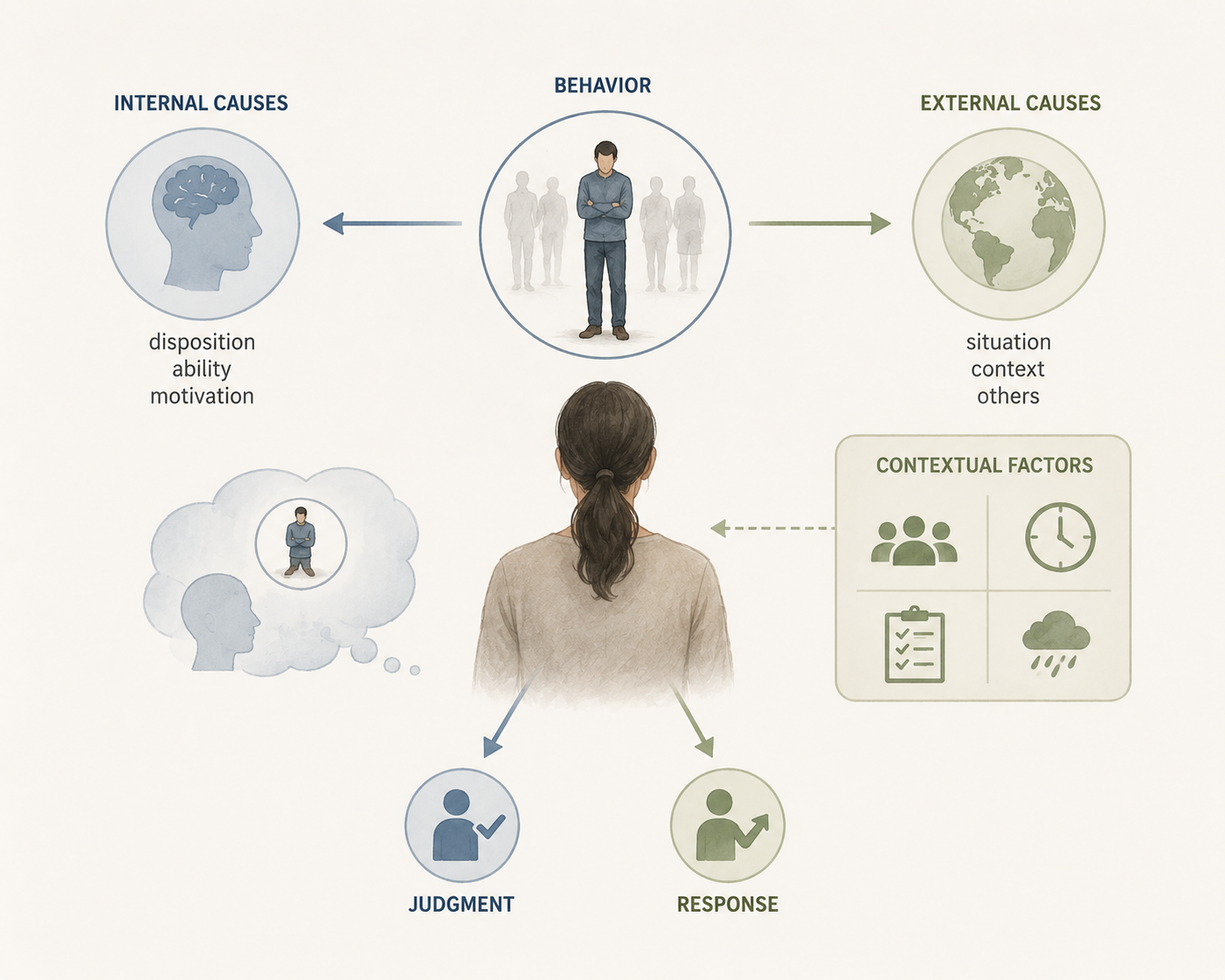
Attribution theory belongs at the center of social cognition because social life depends on causal interpretation. When someone succeeds, fails, harms, helps, resists, complies, disrupts, or remains silent, observers ask why. Did the person choose? Were they constrained? Did they intend harm? Were they under pressure? Did they have alternatives? Was the outcome produced by ability, effort, character, role, system design, culture, accident, or structural inequality?
This article connects directly to fundamental attribution error, self-serving bias, heuristics and biases, cognitive dissonance theory, stereotypes, prejudice, and discrimination, moral disengagement, prosocial behavior, obedience, authority, and social power, Behavioral Economics, and Institutions & Governance. Together these frameworks explain why causal explanation is never merely descriptive. It organizes moral and social response.
What is attribution theory?
Attribution theory is the study of how people explain the causes of behavior and events. It asks how individuals infer why someone acted, why an outcome occurred, why a person succeeded or failed, why harm happened, and who or what should be held responsible.
The basic problem is that causes are rarely visible. People observe behavior, but they do not directly observe motives, intentions, effort, ability, pressure, background conditions, fear, role constraints, institutional rules, social incentives, or structural disadvantage. They infer those causes from incomplete evidence.
Attribution theory therefore examines the interpretive work people perform between observation and judgment. A person sees a late employee and infers laziness, overwork, caregiving pressure, transportation breakdown, workplace burnout, or unfair scheduling. A juror hears evidence and infers intention, negligence, coercion, accident, or incapacity. A teacher sees poor performance and infers low effort, weak preparation, learning barriers, anxiety, discrimination, or lack of support.
These explanations shape response. If a cause is seen as internal, stable, and controllable, observers are more likely to assign responsibility and punishment. If a cause is seen as external, unstable, or uncontrollable, observers may respond with sympathy, support, patience, or system-level reform.
Attribution theory therefore helps explain not only how people think, but how they allocate moral and social consequences.
Why attribution theory matters
Attribution theory matters because causal explanation is one of the foundations of social life. People cannot respond to behavior without interpreting what caused it. The same action can produce different reactions depending on the attribution attached to it.
If someone fails an exam, the response differs if the failure is attributed to lack of effort, low ability, poor instruction, illness, stereotype threat, poverty, language barriers, exhaustion, or an unfair test. If someone commits harm, the response differs if the harm is attributed to intent, negligence, coercion, mental incapacity, institutional pressure, or self-defense. If a community experiences poverty, the response differs if poverty is attributed to personal irresponsibility, labor-market structure, racial exclusion, colonial extraction, policy design, disability, caregiving burden, or regional disinvestment.
Attribution shapes emotion. Internal and controllable causes often produce anger and blame. External and uncontrollable causes often produce sympathy and help. Stable causes shape expectations about the future. Unstable causes leave more room for change.
Attribution also shapes institutions. Schools, courts, hospitals, workplaces, welfare systems, police departments, newsrooms, and political systems all depend on causal stories. They decide who failed, who is dangerous, who deserves help, who deserves punishment, who needs training, who needs accommodation, who is credible, and whose suffering is treated as structural rather than personal.
Because attribution affects responsibility, it is also a site of power. Dominant groups often have their context recognized. Marginalized groups often have their behavior reduced to disposition. Attribution theory helps make those asymmetries visible.
Historical origins
The intellectual foundations of attribution theory are most closely associated with Fritz Heider, whose The Psychology of Interpersonal Relations framed people as intuitive or naïve psychologists. Heider argued that ordinary social perception involves causal interpretation: people naturally try to make sense of why others act as they do.
Heider’s work emphasized the distinction between personal causation and environmental causation. People interpret action by asking whether it reflects something about the person or something about the surrounding situation. This basic distinction remains foundational, but later research showed that attribution is more complex than a simple person-versus-situation choice.
Edward Jones and Keith Davis developed correspondent inference theory, which examined how observers infer stable dispositions from intentional behavior. Harold Kelley developed the covariation model, which treated attribution as a process of integrating information about consensus, distinctiveness, and consistency. Bernard Weiner extended attribution theory into motivation and emotion, especially in achievement settings.
Later research examined attribution bias, culture, actor-observer asymmetry, self-serving explanation, hostile attribution, intergroup attribution, responsibility judgment, and institutional blame. Over time, attribution theory became a broad research tradition linking social cognition, motivation, morality, culture, and social systems.
The theory’s continuing importance lies in the fact that causal explanation remains central to every domain of social judgment.
The core problem: how people infer causes
Attribution theory begins with a simple problem: behavior is visible, but causes are not. People must infer cause from cues.
Those cues may include:
- what the actor did;
- whether the behavior was intentional;
- whether the actor had a choice;
- whether others behaved similarly;
- whether the actor behaves this way in many settings;
- whether the behavior is repeated over time;
- whether the situation imposed constraints;
- whether the outcome was positive or negative;
- whether the target is self, other, ingroup, or outgroup;
- whether the observer already has stereotypes or expectations;
- whether institutional causes are visible or hidden.
Attribution is therefore an inferential process under uncertainty. Observers use available evidence, but they also use prior beliefs, cultural models, emotional reactions, group identities, and social narratives.
This makes attribution powerful and dangerous. Causal explanation can help people respond wisely, but it can also justify punishment, stigma, inequality, denial, and moral distancing when the explanation is biased or incomplete.
The central question is not simply “What caused the behavior?” It is also: What causes are visible? What causes are ignored? Who gets context? Who gets blamed? Who benefits from a dispositional explanation? Who benefits from a structural one?
Internal and external attribution
The most familiar distinction in attribution theory is between internal and external attribution.
Internal attribution, also called dispositional attribution, explains behavior through characteristics of the actor: personality, motive, intention, morality, ability, effort, preference, character, attitude, or stable trait.
External attribution, also called situational attribution, explains behavior through context: pressure, role demands, institutional rules, social norms, incentives, coercion, opportunity, task difficulty, resource scarcity, discrimination, environmental conditions, or accident.
The distinction is useful, but it can be misleading if treated too rigidly. Real behavior is often interactional. A person’s action may reflect both motive and constraint, both effort and opportunity, both character and institution, both choice and context. Internal and external causes are not always opposites.
For example, a worker may perform poorly because of low motivation, unclear instructions, chronic understaffing, health strain, hostile supervision, poor training, or a mismatch between role and skill. A student may fail because of low preparation, weak instruction, housing instability, disability, anxiety, language barriers, caregiving responsibility, or unfair assessment design.
Attribution theory becomes most useful when it resists simplistic blame. It asks how observers weight causes, why some causes become salient, and how responsibility changes when context is made visible.
Stability, controllability, and responsibility
Beyond internal and external causation, attribution theory also distinguishes causes by stability and controllability.
Stability refers to whether a cause is enduring or temporary. Ability is often treated as stable. Effort may be treated as variable. Task difficulty may be stable across people or temporary in a particular case. Illness, crisis, fatigue, or lack of preparation may be unstable.
Controllability refers to whether the actor could reasonably control the cause. Effort is often treated as controllable. Disability, structural exclusion, illness, coercion, and many forms of environmental constraint may be less controllable or uncontrollable.
These dimensions matter because they shape moral response. A controllable cause is more likely to produce blame. An uncontrollable cause is more likely to produce sympathy. A stable cause shapes future expectation. An unstable cause suggests change may be possible.
Attribution research therefore helps explain why the same failure can produce anger, pity, help, punishment, resignation, or renewed effort. If failure is attributed to laziness, punishment may seem justified. If failure is attributed to lack of support, intervention may seem justified. If failure is attributed to fixed inability, expectations may fall. If failure is attributed to strategy or preparation, persistence may continue.
Responsibility judgment depends on more than causality. People also ask whether the actor intended the act, had a choice, could foresee consequences, had alternatives, and controlled the relevant cause.
Heider and naïve psychology
Heider’s foundational contribution was to treat ordinary people as causal interpreters of social life. People do not simply register behavior. They organize behavior into meaningful explanations.
Heider’s “naïve psychology” does not mean foolish psychology. It means everyday causal reasoning: the informal theories people use to explain action, intention, ability, effort, desire, pressure, obligation, and outcome.
This insight remains important because people must make social judgments in everyday life. They cannot wait for complete evidence before deciding whether to trust someone, forgive someone, challenge someone, help someone, hire someone, punish someone, or change a system. Attribution is part of ordinary social navigation.
At the same time, naïve psychology can be wrong. People may overread character, ignore constraints, moralize poverty, blame victims, excuse authorities, distrust outgroups, or misread silence as consent. Everyday causal inference is necessary, but not automatically fair.
Heider’s framework therefore opens the central tension of attribution theory: people need causal explanations to act, but those explanations are shaped by limited evidence, perspective, culture, and power.
Jones and Davis: correspondent inference
Jones and Davis developed correspondent inference theory to explain how observers infer stable dispositions from behavior. A correspondent inference occurs when an observer concludes that an action corresponds to an actor’s underlying trait, intention, or character.
Observers are especially likely to make correspondent inferences when behavior appears intentional, freely chosen, socially unexpected, and distinctive in its effects. If a person acts against role expectations or social pressure, observers may treat the action as especially revealing of character.
This theory helps explain why intentionality and choice matter so much in social judgment. A harmful act judged as accidental produces one kind of attribution. The same act judged as intentional produces a very different response.
Correspondent inference is useful because behavior can reveal something about disposition. But it is also risky because observers often underestimate role constraints, social pressure, unequal choices, and hidden context.
For example, a worker who appears deferential may be responding to hierarchy. A student who appears disengaged may be managing anxiety. A protester who appears angry may be responding to repeated injustice. A defendant who appears emotionally flat may be traumatized. A patient who appears “noncompliant” may lack transportation, money, trust, or language access.
The question is not whether dispositions exist. They do. The question is whether observers infer them too quickly from behavior that situations can also explain.
Kelley’s covariation model
Kelley’s covariation model treats attribution as a process of examining how behavior covaries across persons, situations, and time. The model emphasizes three cues:
- Consensus: Do other people behave the same way in this situation?
- Distinctiveness: Does this actor behave this way only in this situation, or across many situations?
- Consistency: Does this actor behave this way repeatedly in the same situation over time?
If consensus is high, distinctiveness is high, and consistency is high, observers are more likely to attribute behavior to the situation or stimulus. If consensus is low, distinctiveness is low, and consistency is high, observers are more likely to attribute behavior to the person.
For example, if many students fail the same exam, a student fails only that exam, and the pattern repeats whenever that instructor gives exams, a situational attribution becomes more plausible. If only one student fails many exams repeatedly while others perform well, a dispositional or individual-level attribution becomes more plausible.
Kelley’s model matters because it shows that attribution can be evidence-sensitive. Observers are not always irrational. They can integrate patterned information. But in everyday life, the needed information is often missing. People may not know consensus, distinctiveness, or consistency. They may see only one behavior and fill in the rest with assumptions.
Institutional systems can improve attribution by making covariation visible: comparative data, historical patterns, base rates, audit trails, and contextual indicators can prevent premature blame.
Weiner’s attributional theory of motivation and emotion
Bernard Weiner extended attribution theory into achievement, motivation, emotion, and responsibility. His work showed that explanations for success and failure influence expectation, persistence, pride, shame, anger, pity, and helping behavior.
In achievement settings, people often explain outcomes through ability, effort, task difficulty, luck, strategy, support, or constraint. These causes differ in locus, stability, and controllability. A student who attributes failure to low ability may lose confidence. A student who attributes failure to insufficient strategy or effort may remain more motivated. A teacher who attributes failure to laziness may punish. A teacher who attributes failure to barriers may support.
Weiner’s model is important because it links attribution to emotion. Controllable failure often produces anger. Uncontrollable hardship often produces sympathy. Stable causes shape future expectations. Controllable causes shape responsibility judgments.
This framework extends beyond school. Public views about poverty, unemployment, illness, addiction, disability, migration, crime, and institutional failure are deeply attributional. If hardship is attributed to personal irresponsibility, punitive policy becomes more likely. If hardship is attributed to structural constraint, support and reform become more likely.
Attribution theory therefore connects motivation to social ethics. How societies explain failure shapes how they respond to people who suffer it.
Attribution biases
Attribution processes are useful, but they are vulnerable to systematic bias. These biases are not random mistakes. They are recurring asymmetries in how people explain behavior across self and other, ingroup and outgroup, success and failure, power and vulnerability.
Major attribution biases include:
- fundamental attribution error, the tendency to overemphasize dispositional causes and underemphasize situational causes when explaining others’ behavior;
- correspondence bias, the tendency to infer enduring dispositions from behavior even when the situation explains the behavior;
- self-serving bias, the tendency to explain success internally and failure externally;
- actor-observer asymmetry, the tendency to explain one’s own behavior more situationally and others’ behavior more dispositionally;
- hostile attribution bias, the tendency to infer hostile intent from ambiguous behavior;
- ultimate attribution error, the tendency to explain ingroup and outgroup behavior in asymmetrical ways that favor the ingroup.
These biases matter because they shape moral judgment. Attribution bias can turn context into character, hardship into blame, resistance into deviance, social inequality into personal failure, and institutional harm into individual weakness.
Attribution bias is especially harmful when applied unequally. Some groups are routinely granted context, complexity, and benefit of the doubt. Others are treated as if behavior transparently reveals character. That asymmetry is one of the ethical stakes of attribution theory.
Fundamental attribution error and correspondence bias
The fundamental attribution error refers to the tendency to overestimate the role of personal disposition and underestimate the role of situation when explaining another person’s behavior.
Correspondence bias is closely related. It refers to the tendency to infer that behavior corresponds to stable disposition even when the behavior can be explained by situational constraints.
These biases occur partly because the actor is perceptually salient. The person is visible; the situation is background. Observers may notice behavior more readily than constraints, incentives, fear, role pressure, institutional rules, or historical context.
For example, a person who misses a deadline may be judged irresponsible before workload, caregiving responsibilities, unclear instructions, illness, understaffing, or conflicting demands are considered. A poor community may be judged as lacking discipline before policy, labor markets, housing, health, schooling, debt, segregation, and environmental exposure are considered.
The bias is not only cognitive. It can be political. Dispositional explanation often protects existing be political. Dispositional explanation often protects existing systems by locating the cause of suffering in the person who suffers. Situational explanation can threaten institutions by revealing that behavior and outcomes are shaped by conditions.
A fairer attributional practice asks: What context is missing? What constraints are invisible? What system benefits from making this look like personal failure?
Self-serving bias and actor-observer asymmetry
The self-serving bias describes the tendency to attribute success to internal causes and failure to external causes. People often explain good outcomes through ability, effort, wisdom, or character, while explaining bad outcomes through bad luck, unfairness, difficulty, or other people.
This bias helps protect self-esteem. It can preserve confidence after failure. But it can also distort learning. If success is always personal and failure is always external, people may avoid responsibility, ignore feedback, and repeat mistakes.
Actor-observer asymmetry is related but distinct. Actors often explain their own behavior situationally because they directly experience context, pressure, uncertainty, and constraint. Observers often explain the same behavior dispositionally because they see the person more than the situation.
For example, when I am late, I know about traffic, sleep, caregiving, deadlines, or transit delays. When someone else is late, I may see only lateness. My own context is vivid; theirs is invisible.
In institutional settings, actor-observer asymmetry can become hierarchical. Managers may explain workers’ mistakes as attitude problems while workers experience unrealistic workload, unclear priorities, low staffing, or broken systems. Institutions may blame frontline workers for failures produced by policy design.
Attribution theory therefore helps reveal why perspective matters. People explain differently depending on whether they stand inside or outside the situation.
Hostile attribution bias
Hostile attribution bias is the tendency to interpret ambiguous behavior as intentionally hostile. It is especially important in aggression research, conflict studies, intergroup relations, policing, schools, and online communication.
When hostile attribution bias is active, ambiguous actions are read as threats. A bump becomes disrespect. Silence becomes contempt. A mistake becomes sabotage. A disagreement becomes attack. A facial expression becomes evidence of hostility.
This bias can escalate conflict because the observer responds not to the ambiguous event itself, but to the inferred hostile intention. Once hostile intent is assumed, retaliation can feel justified. The other party then responds defensively, confirming the original suspicion.
Hostile attribution bias is not evenly distributed or socially neutral. It can be shaped by trauma, prior conflict, discrimination, threat sensitivity, group stereotypes, media narratives, and institutional training. In policing, school discipline, border enforcement, and intergroup conflict, hostile attribution can have severe consequences when ambiguous behavior is interpreted through racialized, classed, religious, or political threat frames.
Reducing hostile attribution bias requires more than individual calm. It requires ambiguity awareness, context gathering, de-escalation training, accountability, stereotype interruption, and institutional procedures that slow down threat interpretation in high-stakes settings.
Culture, agency, and models of personhood
Attribution is shaped by culture. Different societies and communities vary in how they understand selfhood, agency, obligation, context, role, family, fate, morality, and social responsibility.
Research on cultural variation often finds that more individualistic contexts place stronger emphasis on personal disposition, while more interdependent contexts more readily incorporate relationship, role, situation, and context. This distinction should be used carefully. Cultures are not simple binaries, and people within any society vary. But the broader insight remains important: attribution reflects social models of personhood.
If a society teaches that people are primarily autonomous individuals, observers may more readily explain outcomes through choice, effort, talent, discipline, and character. If a society emphasizes relational obligation, role, hierarchy, interdependence, or circumstance, observers may be more likely to explain behavior through social context.
Cultural attribution also matters for moral judgment. What counts as choice, coercion, responsibility, shame, duty, face, loyalty, excuse, or accountability can vary across social worlds.
A serious attribution theory must therefore avoid treating one cultural model of agency as universal. It should ask how causal explanation is shaped by language, institution, religion, family structure, political economy, law, and social memory.
Power, inequality, and marginalized context
Attribution is deeply connected to power. One of the most important questions in social life is whose behavior is granted context.
Dominant groups are often treated as individuals with complexity. Their wrongdoing may be explained through stress, misunderstanding, poor judgment, mental health, youth, pressure, or circumstance. Marginalized groups are often treated as representatives of categories. Their behavior may be explained through culture, character, pathology, criminality, dependency, deficiency, or threat.
This attributional asymmetry can reproduce inequality. Poverty is attributed to laziness rather than labor markets, housing costs, disability, debt, exclusion, caregiving, or policy. Protest is attributed to disorder rather than grievance. School difficulty is attributed to low effort rather than unequal resources. Health nonadherence is attributed to irresponsibility rather than access barriers. Migration is attributed to opportunism rather than war, extraction, climate pressure, or economic restructuring.
Attribution theory therefore has a moral and political edge. It reveals how explanation can conceal structure. When systems disappear from the causal story, individuals carry blame for conditions they did not create.
Foregrounding marginalized voices requires attributional humility. It means asking people what constraints they face, what histories shape their options, what institutions define their choices, and what forms of context have been routinely denied to them.
Institutions, blame, and system visibility
Institutions are attribution machines. They classify causes, assign responsibility, record explanations, and attach consequences. A school decides whether a student is defiant or unsupported. A hospital decides whether a patient is noncompliant or structurally blocked. A workplace decides whether a failure is individual underperformance or system overload. A court decides whether harm reflects intent, negligence, coercion, or circumstance.
Institutional attribution often favors visible actors over invisible systems. Frontline workers, students, patients, defendants, migrants, and service recipients are visible. Policy design, staffing ratios, resource constraints, data systems, leadership decisions, historical inequality, and administrative burden are less visible.
This creates a predictable risk: individual blame substitutes for system learning. If a hospital treats every error as a bad worker, it may ignore workflow design. If a school treats every behavior issue as defiance, it may ignore trauma, disability, racism, or classroom structure. If a company treats burnout as low resilience, it may ignore workload and leadership failure.
Institutions need attributional infrastructure: incident review, system mapping, decision logs, root-cause analysis, protected dissent, appeal processes, contextual data, and accountability for policy design. These practices do not eliminate individual responsibility. They prevent institutions from using individual responsibility to hide system responsibility.
A learning institution asks not only “Who caused this?” but “What conditions made this more likely?”
Law, punishment, and responsibility
Attribution theory is central to law because legal judgment depends on causal explanation. Courts must distinguish intention, recklessness, negligence, accident, coercion, incapacity, self-defense, structural context, and harm.
Legal responsibility involves more than whether an outcome occurred. It asks whether the actor caused the outcome, intended the act, had knowledge, had alternatives, could control the relevant behavior, and could foresee consequences.
Attribution biases can affect legal judgment. Jurors may overinfer disposition from behavior, underweight situational constraint, interpret ambiguous conduct through stereotypes, or treat demeanor as evidence of guilt or remorse. Sentencing can be shaped by whether defendants are seen as dangerous, redeemable, irresponsible, coerced, mentally ill, socially disadvantaged, or morally corrupt.
Attribution is also important in victim-blaming. Observers may explain harm by focusing on what the victim did or failed to do, because this preserves a sense that the world is controllable. If victims can be blamed, observers can feel safer. This attributional move is psychologically protective but morally dangerous.
Fair legal reasoning requires disciplined attribution: evidence, context, intent, constraint, proportionality, and awareness of bias. It must resist the temptation to turn social position into presumed character.
Education, achievement, and motivation
Attribution theory has major importance in education. Students, teachers, parents, and institutions constantly explain success and failure.
A student who attributes failure to fixed low ability may disengage. A student who attributes failure to strategy, preparation, support, or effort may persist. A teacher who attributes underperformance to laziness may punish. A teacher who attributes underperformance to barriers may intervene.
Weiner’s attributional theory helps explain why stability and controllability matter. If failure is stable and uncontrollable, future expectations fall. If failure is unstable and controllable, motivation may continue.
Educational attribution is also shaped by inequality. Students from marginalized communities may have their struggles attributed to family culture, motivation, or ability rather than resource gaps, discrimination, tracking, school funding, language access, disability support, stereotype threat, or institutional design.
Good educational practice requires attributional care. It asks what the student can control, what the teacher can change, what the institution must support, and what structural barriers must be addressed. The goal is not to remove agency, but to locate agency honestly within conditions.
Attribution can either close a student’s future or reopen it.
Organizations and workplace judgment
Organizations depend on attribution. Managers explain performance, employees explain leadership, teams explain failure, and institutions explain misconduct.
Workplace attribution often becomes biased because organizational context is unevenly visible. Leaders may see missed targets and infer poor motivation. Workers may see unclear strategy, under-resourcing, broken tools, unrealistic timelines, or conflicting priorities. Each perspective has access to different evidence.
Performance management is especially attributional. A manager may attribute low performance to skill, effort, attitude, role mismatch, training, workload, disability, burnout, bias, unclear expectations, or system design. The attribution determines the intervention: coaching, discipline, accommodation, staffing, redesign, termination, or policy change.
Attribution also shapes organizational learning. After failure, blame-oriented cultures seek culprits. Learning cultures seek causes. Blame may be appropriate when there is misconduct, negligence, or harm. But if blame becomes the default explanation, system causes remain hidden.
Healthy organizations build attributional discipline: evidence-based review, context gathering, worker voice, root-cause analysis, psychological safety, documentation, and clear distinction between accountability and scapegoating.
Attribution theory therefore belongs inside organizational governance, not only individual psychology.
Intergroup attribution and conflict
Attribution is central to intergroup relations. People often explain ingroup and outgroup behavior asymmetrically.
Positive ingroup behavior may be attributed to character, values, morality, or competence. Negative ingroup behavior may be attributed to circumstance, exception, misunderstanding, or provocation. Positive outgroup behavior may be attributed to luck, strategy, manipulation, or exception. Negative outgroup behavior may be attributed to culture, nature, ideology, or moral deficiency.
This pattern reinforces prejudice and conflict. It allows groups to preserve positive identity while interpreting outgroups through suspicion. It also makes reconciliation harder because each side treats its own violence as reactive and the other side’s violence as revealing.
Attribution is especially dangerous in polarized politics, ethnic conflict, sectarian conflict, nationalism, war, and online communities. Ambiguous actions are interpreted through prior threat narratives. Harm by ingroup members is contextualized. Harm by outgroup members is essentialized.
Reducing intergroup conflict requires changing attributional habits. People need exposure to context, shared institutions, cross-cutting identities, credible testimony, historical truth, and mechanisms for distinguishing responsibility from collective dehumanization.
Attribution theory helps explain why conflict is not only about what happened. It is also about what each side thinks the event reveals about “who they are.”
Formalizing attribution theory
Attribution can be represented as inference over competing causal hypotheses. Let \(x\) represent observed behavior, and let \(h_D\) and \(h_S\) represent dispositional and situational explanations:
P(h \mid x)=\frac{P(x \mid h)P(h)}{P(x)}
\]
Interpretation: Attribution depends on current evidence \(x\), the likelihood of that evidence under a causal hypothesis \(h\), and the observer’s prior expectations.
A simple disposition-situation weighting model can be written as:
A=\omega_DD+\omega_SS
\]
Interpretation: The final attribution \(A\) depends on dispositional evidence \(D\), situational evidence \(S\), and the weights assigned to each. Correspondence bias can be understood as excessive weighting of \(D\) relative to \(S\).
Kelley-style covariation reasoning can be represented through consensus, distinctiveness, and consistency:
P(h_S \mid x)=g(C_n,D_s,K_s)
\]
Interpretation: Situational attribution becomes more likely when consensus \(C_n\), distinctiveness \(D_s\), and consistency \(K_s\) support a situational explanation.
Responsibility judgment can be modeled as a function of intentionality, choice, controllability, harm, and constraint:
R=f(I,Ch,Co,H,-S)
\]
Interpretation: Responsibility \(R\) rises with intentionality \(I\), choice \(Ch\), controllability \(Co\), and harm \(H\), and falls when situational constraint \(S\) is strong.
Achievement expectation can be modeled as depending on the perceived stability of the attributed cause:
E_{t+1}=E_t+\alpha(St-E_t)
\]
Interpretation: Future expectation \(E_{t+1}\) is updated from current expectation \(E_t\) based on perceived cause stability \(St\). Stable causes shift expectations more strongly.
These models are not replacements for social interpretation. They clarify the variables that attribution research can measure: evidence, prior expectations, situational visibility, controllability, intentionality, stability, and responsibility.
Limits and interpretive cautions
Attribution theory is powerful, but it must be used carefully.
- Do not reduce complex behavior to a single cause.
- Do not treat internal and external causes as mutually exclusive in all cases.
- Do not confuse causality with responsibility.
- Do not confuse responsibility with punishment.
- Do not treat controllability as obvious without examining real constraints.
- Do not ignore culture, role, history, and institutional structure.
- Do not use attribution theory to excuse harm automatically.
- Do not use attribution theory to blame individuals for structural conditions.
- Do not treat marginalized communities’ behavior as disposition while granting context only to dominant groups.
- Do not assume that “system cause” and “individual agency” are opposites.
The strongest attribution analysis is multicausal. It asks how personal agency, situational pressure, institutional design, culture, history, and power interact.
Attribution theory should make judgment more careful, not more mechanical. It should widen the causal field before blame is assigned.
Attribution theory in the architecture of social influence
Within the broader architecture of social influence, attribution theory explains how people construct causes from behavior. Social cognition explains how people perceive and interpret others. Heuristics and biases explain the shortcuts that shape judgment. Cognitive dissonance theory explains how people defend coherence after contradiction. Attribution theory explains how people decide why something happened and who should answer for it.
Attribution also connects to moral disengagement. People can reduce responsibility by attributing harm to necessity, authority, victim behavior, or impersonal systems. It connects to stereotypes, prejudice, and discrimination, because group categories shape causal interpretation. It connects to prosocial behavior, because help often depends on whether need is attributed to controllable or uncontrollable causes.
Attribution theory also connects to Institutions & Governance. Institutions do not merely respond to causes. They produce official causes through reports, classifications, investigations, disciplinary systems, legal categories, performance metrics, and policy narratives.
The theory’s continuing value lies in showing that explanation is never neutral. Causal stories shape social response. They determine whether a society blames, helps, punishes, repairs, reforms, excuses, or learns.
Measurement, data, and research design
Attribution research can use vignette experiments, ambiguous-behavior tasks, covariation designs, achievement feedback studies, responsibility judgment tasks, hostile-attribution measures, cross-cultural comparison, legal simulations, organizational case reviews, education interventions, intergroup conflict studies, and institutional audits.
Key variables include:
- participant, session, group, scenario, site, and institutional identifiers;
- behavior domain;
- target type;
- self-other perspective;
- outcome valence;
- ambiguity level;
- intentionality;
- perceived choice;
- perceived effort;
- perceived ability;
- situational constraint;
- consensus;
- distinctiveness;
- consistency;
- internal attribution;
- external attribution;
- stability rating;
- controllability rating;
- responsibility rating;
- blame rating;
- sympathy rating;
- anger rating;
- punishment support;
- help support;
- achievement expectation;
- hostile attribution score;
- attributional complexity;
- cultural agency orientation;
- response time.
Strong attribution research should measure multiple causal dimensions separately. Internality is not the same as controllability. Stability is not the same as responsibility. Intentionality is not the same as harm. Situational constraint does not always eliminate agency.
Research should also avoid assuming that attribution is purely individual. In many settings, institutions structure what causes are visible. A decision system that hides workload, policy history, resource constraints, and discrimination will make dispositional blame easier.
Good attribution research therefore measures both judgment and context.
R code for attribution research
The following R workflow models internal attribution, external attribution, responsibility judgment, hostile attribution, achievement expectation, and response time.
# Install packages if needed:
# pak::pak(c("tidyverse", "lme4", "lmerTest", "emmeans", "broom.mixed", "performance"))

library(tidyverse)
library(lme4)
library(lmerTest)
library(emmeans)
library(broom.mixed)
library(performance)

# Expected columns:
# participant, session_id, group_id, scenario_id, site_id,
# institution_context, behavior_domain, target_type, self_other,
# outcome_valence, condition, trial, ambiguity_level,
# intentionality, perceived_choice, perceived_effort, perceived_ability,
# situational_constraint, consensus, distinctiveness, consistency,
# attribution_internal, attribution_external, stability_rating,
# controllability_rating, responsibility_rating, blame_rating,
# sympathy_rating, anger_rating, punishment_support, help_support,
# achievement_expectation, hostile_attribution_score,
# attributional_complexity, cultural_agency_orientation, response_time_ms

dat <- read_csv("attribution_trials.csv") %>%
  mutate(
    participant = factor(participant),
    session_id = factor(session_id),
    group_id = factor(group_id),
    scenario_id = factor(scenario_id),
    site_id = factor(site_id),
    institution_context = factor(institution_context),
    behavior_domain = factor(behavior_domain),
    target_type = factor(target_type),
    self_other = factor(self_other),
    outcome_valence = factor(outcome_valence),
    condition = factor(condition),
    log_response_time = log(response_time_ms),
    disposition_bias_index = attribution_internal - attribution_external,
    covariation_situation_index = (consensus + distinctiveness + consistency) / 3,
    responsibility_inference_index = (
      intentionality +
      perceived_choice +
      controllability_rating -
      situational_constraint
    ) / 3,
    system_visible_attribution_index = attribution_external + 2 * attributional_complexity
  )

summary_table <- dat %>%
  group_by(condition, target_type, outcome_valence) %>%
  summarise(
    n = n(),
    participants = n_distinct(participant),
    mean_internal = mean(attribution_internal, na.rm = TRUE),
    mean_external = mean(attribution_external, na.rm = TRUE),
    mean_responsibility = mean(responsibility_rating, na.rm = TRUE),
    mean_blame = mean(blame_rating, na.rm = TRUE),
    mean_sympathy = mean(sympathy_rating, na.rm = TRUE),
    mean_punishment = mean(punishment_support, na.rm = TRUE),
    mean_help = mean(help_support, na.rm = TRUE),
    mean_hostile = mean(hostile_attribution_score, na.rm = TRUE),
    .groups = "drop"
  )

print(summary_table)

internal_model <- lmer(
  attribution_internal ~
    ambiguity_level +
    intentionality +
    perceived_choice +
    perceived_effort +
    perceived_ability +
    situational_constraint +
    consensus +
    distinctiveness +
    consistency +
    target_type +
    outcome_valence +
    condition +
    (1 | participant) +
    (1 | scenario_id),
  data = dat,
  REML = FALSE
)

summary(internal_model)

external_model <- lmer(
  attribution_external ~
    ambiguity_level +
    situational_constraint +
    consensus +
    distinctiveness +
    consistency +
    intentionality +
    perceived_choice +
    attributional_complexity +
    target_type +
    outcome_valence +
    condition +
    (1 | participant) +
    (1 | scenario_id),
  data = dat,
  REML = FALSE
)

summary(external_model)

responsibility_model <- lmer(
  responsibility_rating ~
    attribution_internal +
    attribution_external +
    intentionality +
    perceived_choice +
    controllability_rating +
    situational_constraint +
    outcome_valence +
    condition +
    (1 | participant) +
    (1 | scenario_id),
  data = dat,
  REML = FALSE
)

summary(responsibility_model)
emmeans(responsibility_model, ~ target_type + outcome_valence)

hostile_model <- lmer(
  hostile_attribution_score ~
    ambiguity_level +
    target_type +
    outcome_valence +
    situational_constraint +
    attributional_complexity +
    condition +
    (1 | participant) +
    (1 | scenario_id),
  data = dat,
  REML = FALSE
)

summary(hostile_model)

achievement_model <- lmer(
  achievement_expectation ~
    perceived_effort +
    perceived_ability +
    stability_rating +
    controllability_rating +
    situational_constraint +
    outcome_valence +
    condition +
    (1 | participant) +
    (1 | scenario_id),
  data = dat,
  REML = FALSE
)

summary(achievement_model)

response_time_model <- lmer(
  log_response_time ~
    ambiguity_level +
    attribution_internal +
    attribution_external +
    attributional_complexity +
    target_type +
    condition +
    (1 | participant) +
    (1 | scenario_id),
  data = dat %>% filter(response_time_ms >= 150),
  REML = FALSE
)

summary(response_time_model)

condition_summary <- dat %>%
  group_by(condition) %>%
  summarise(
    n = n(),
    mean_internal = mean(attribution_internal, na.rm = TRUE),
    mean_external = mean(attribution_external, na.rm = TRUE),
    mean_responsibility = mean(responsibility_rating, na.rm = TRUE),
    mean_blame = mean(blame_rating, na.rm = TRUE),
    mean_help = mean(help_support, na.rm = TRUE),
    .groups = "drop"
  )

write_csv(summary_table, "attribution_summary.csv")
write_csv(condition_summary, "attribution_condition_summary.csv")
write_csv(
  tidy(responsibility_model, effects = "fixed", conf.int = TRUE),
  "attribution_responsibility_coefficients.csv"
)

ggplot(
  condition_summary,
  aes(x = reorder(condition, mean_responsibility), y = mean_responsibility, group = 1)
) +
  geom_line() +
  geom_point() +
  coord_flip() +
  labs(
    title = "Mean responsibility judgment by attribution condition",
    x = "Condition",
    y = "Mean responsibility judgment"
  ) +
  theme_minimal()
This workflow supports attribution research by separating internal attribution, external attribution, ambiguity, intentionality, choice, effort, ability, situational constraint, covariation cues, controllability, responsibility, blame, help, hostile attribution, and response time.
Python code for attribution research
The Python workflow below parallels the R analysis and adds an institutional blame simulation for studying actor salience, system visibility, accountability, and learning quality.
import numpy as np
import pandas as pd
import statsmodels.formula.api as smf
import matplotlib.pyplot as plt

# Expected columns:
# participant, session_id, group_id, scenario_id, site_id,
# institution_context, behavior_domain, target_type, self_other,
# outcome_valence, condition, trial, ambiguity_level,
# intentionality, perceived_choice, perceived_effort, perceived_ability,
# situational_constraint, consensus, distinctiveness, consistency,
# attribution_internal, attribution_external, stability_rating,
# controllability_rating, responsibility_rating, blame_rating,
# sympathy_rating, anger_rating, punishment_support, help_support,
# achievement_expectation, hostile_attribution_score,
# attributional_complexity, cultural_agency_orientation, response_time_ms

df = pd.read_csv("attribution_trials.csv")

for col in [
    "participant",
    "session_id",
    "group_id",
    "scenario_id",
    "site_id",
    "institution_context",
    "behavior_domain",
    "target_type",
    "self_other",
    "outcome_valence",
    "condition",
]:
    df[col] = df[col].astype("category")

df["log_response_time"] = np.log(df["response_time_ms"])

df["disposition_bias_index"] = (
    df["attribution_internal"] - df["attribution_external"]
)

df["covariation_situation_index"] = (
    df["consensus"] + df["distinctiveness"] + df["consistency"]
) / 3

df["responsibility_inference_index"] = (
    df["intentionality"]
    + df["perceived_choice"]
    + df["controllability_rating"]
    - df["situational_constraint"]
) / 3

df["system_visible_attribution_index"] = (
    df["attribution_external"] + 2 * df["attributional_complexity"]
)

summary_table = (
    df.groupby(["condition", "target_type", "outcome_valence"], observed=True)
    .agg(
        n=("participant", "size"),
        participants=("participant", "nunique"),
        mean_internal=("attribution_internal", "mean"),
        mean_external=("attribution_external", "mean"),
        mean_responsibility=("responsibility_rating", "mean"),
        mean_blame=("blame_rating", "mean"),
        mean_sympathy=("sympathy_rating", "mean"),
        mean_punishment=("punishment_support", "mean"),
        mean_help=("help_support", "mean"),
        mean_hostile=("hostile_attribution_score", "mean"),
    )
    .reset_index()
)

print(summary_table)

internal_model = smf.ols(
    "attribution_internal ~ ambiguity_level + intentionality "
    "+ perceived_choice + perceived_effort + perceived_ability "
    "+ situational_constraint + consensus + distinctiveness + consistency "
    "+ target_type + outcome_valence + condition",
    data=df
)

internal_result = internal_model.fit(
    cov_type="cluster",
    cov_kwds={"groups": df["participant"]}
)

print(internal_result.summary())

external_model = smf.ols(
    "attribution_external ~ ambiguity_level + situational_constraint "
    "+ consensus + distinctiveness + consistency + intentionality "
    "+ perceived_choice + attributional_complexity "
    "+ target_type + outcome_valence + condition",
    data=df
)

external_result = external_model.fit(
    cov_type="cluster",
    cov_kwds={"groups": df["participant"]}
)

print(external_result.summary())

responsibility_model = smf.ols(
    "responsibility_rating ~ attribution_internal + attribution_external "
    "+ intentionality + perceived_choice + controllability_rating "
    "+ situational_constraint + outcome_valence + condition",
    data=df
)

responsibility_result = responsibility_model.fit(
    cov_type="cluster",
    cov_kwds={"groups": df["participant"]}
)

print(responsibility_result.summary())

hostile_model = smf.ols(
    "hostile_attribution_score ~ ambiguity_level + target_type "
    "+ outcome_valence + situational_constraint "
    "+ attributional_complexity + condition",
    data=df
)

hostile_result = hostile_model.fit(
    cov_type="cluster",
    cov_kwds={"groups": df["participant"]}
)

print(hostile_result.summary())

achievement_model = smf.ols(
    "achievement_expectation ~ perceived_effort + perceived_ability "
    "+ stability_rating + controllability_rating "
    "+ situational_constraint + outcome_valence + condition",
    data=df
)

achievement_result = achievement_model.fit(
    cov_type="cluster",
    cov_kwds={"groups": df["participant"]}
)

print(achievement_result.summary())

rt_df = df[df["response_time_ms"] >= 150].copy()

response_time_model = smf.ols(
    "log_response_time ~ ambiguity_level + attribution_internal "
    "+ attribution_external + attributional_complexity "
    "+ target_type + condition",
    data=rt_df
)

response_time_result = response_time_model.fit(
    cov_type="cluster",
    cov_kwds={"groups": rt_df["participant"]}
)

print(response_time_result.summary())

def simulate_institutional_blame(steps=80, seed=42):
    rng = np.random.default_rng(seed)
    rows = []

    scenarios = [
        "low_system_visibility",
        "high_system_visibility",
        "accountability_review",
        "individual_blame_culture",
        "systems_learning_culture",
    ]

    for scenario in scenarios:
        individual_blame = 0.65
        system_attribution = 0.35

        for step in range(1, steps + 1):
            if scenario == "low_system_visibility":
                actor_salience, system_visibility, accountability = 0.85, 0.20, 0.25
            elif scenario == "high_system_visibility":
                actor_salience, system_visibility, accountability = 0.45, 0.75, 0.55
            elif scenario == "accountability_review":
                actor_salience, system_visibility, accountability = 0.45, 0.80, 0.85
            elif scenario == "individual_blame_culture":
                actor_salience, system_visibility, accountability = 0.90, 0.15, 0.20
            else:
                actor_salience, system_visibility, accountability = 0.35, 0.90, 0.90

            blame_pressure = (
                actor_salience
                - system_visibility
                - 0.35 * accountability
            )

            individual_blame = np.clip(
                individual_blame
                + 0.05 * blame_pressure
                + rng.normal(0, 0.025),
                0,
                1
            )

            system_attribution = np.clip(
                system_attribution
                + 0.05 * (
                    system_visibility
                    + accountability
                    - actor_salience
                )
                + rng.normal(0, 0.025),
                0,
                1
            )

            learning_quality = np.clip(
                0.25
                + 0.45 * system_attribution
                + 0.25 * accountability
                - 0.25 * individual_blame,
                0,
                1
            )

            rows.append({
                "scenario": scenario,
                "step": step,
                "individual_blame": individual_blame,
                "system_attribution": system_attribution,
                "learning_quality": learning_quality,
                "actor_salience": actor_salience,
                "system_visibility": system_visibility,
                "accountability": accountability,
            })

    return pd.DataFrame(rows)

simulation = simulate_institutional_blame()

condition_summary = (
    df.groupby("condition", observed=True)
    .agg(
        mean_internal=("attribution_internal", "mean"),
        mean_external=("attribution_external", "mean"),
        mean_responsibility=("responsibility_rating", "mean"),
        mean_blame=("blame_rating", "mean"),
        mean_help=("help_support", "mean"),
    )
    .reset_index()
)

fig, ax = plt.subplots(figsize=(8, 5))

ordered = condition_summary.sort_values("mean_responsibility")
ax.plot(
    ordered["mean_responsibility"],
    ordered["condition"].astype(str),
    marker="o"
)

ax.set_xlabel("Mean responsibility judgment")
ax.set_ylabel("Condition")
ax.set_title("Mean responsibility judgment by attribution condition")
plt.tight_layout()
plt.show()

summary_table.to_csv("attribution_summary.csv", index=False)
condition_summary.to_csv("attribution_condition_summary.csv", index=False)
simulation.to_csv("institutional_blame_simulation.csv", index=False)
This Python workflow supports attribution research by modeling dispositional attribution, situational attribution, covariation cues, responsibility, blame, sympathy, hostile attribution, achievement expectation, response time, and institutional blame dynamics.
Research data architecture
Attribution research often depends on relational data: participants, sessions, groups, scenarios, institutions, behavior domains, target types, actor-observer perspective, outcome valence, ambiguity, intentionality, perceived choice, effort, ability, situational constraint, consensus, distinctiveness, consistency, internal attribution, external attribution, stability, controllability, responsibility, blame, sympathy, anger, punishment, help, achievement expectation, hostile attribution, attributional complexity, cultural agency orientation, and response time.
The companion GitHub repository includes a full SQL schema and example analytical queries for researchers who want to reproduce, inspect, or extend the data model. Keeping executable SQL in GitHub avoids WordPress hosting restrictions while preserving the technical infrastructure for readers who want to use the article as a reproducible research workflow.
The research data model supports questions such as:
- Does situational constraint reduce dispositional attribution?
- Do consensus, distinctiveness, and consistency increase external attribution?
- Does perceived controllability mediate responsibility judgment?
- Does internal attribution increase blame and punishment support?
- Does external attribution increase sympathy and help support?
- Does ambiguity increase hostile attribution?
- Do outgroup targets receive stronger dispositional blame under negative outcomes?
- Does attributional complexity reduce hostile attribution?
- Does system visibility shift judgment from individual blame to institutional causation?
- Does accountability improve learning quality after institutional failure?
View the SQL research data architecture in GitHub.
GitHub repository
The companion repository provides reusable code and research scaffolding for studying attribution theory, causal explanation, dispositional attribution, situational attribution, covariation reasoning, responsibility judgment, hostile attribution bias, achievement attribution, and institutional blame.
Complete Code Repository
Access the full companion repository for this article, including reproducible analysis materials and multi-language code workflows for attribution theory research.
Why attribution theory matters for social psychology
Attribution theory matters because social judgment depends on causal explanation. People do not merely observe behavior. They explain it. Those explanations shape responsibility, sympathy, anger, blame, punishment, help, trust, motivation, and institutional response.
The theory’s central insight is that causal explanation is not neutral. It is shaped by perspective, evidence, visibility, culture, motivation, identity, and power. Some people are interpreted through context; others are reduced to disposition. Some harms are treated as system failures; others are treated as individual defects. Some failures invite support; others invite punishment.
Attribution theory helps explain why people overread character, underread situation, protect themselves through self-serving explanation, infer hostility from ambiguity, and assign responsibility based on controllability and perceived intent. It also helps explain why institutions often blame visible actors while hiding system design.
Read alongside fundamental attribution error, self-serving bias, heuristics and biases, cognitive dissonance theory, stereotypes, prejudice, and discrimination, moral disengagement, Behavioral Economics, and Institutions & Governance, attribution theory becomes more than a theory of explanation. It becomes a framework for understanding how societies distribute responsibility, dignity, blame, and repair.
Related articles
- Social Psychology
- Social Cognition
- Fundamental Attribution Error
- Self-Serving Bias
- Heuristics and Biases
- Cognitive Dissonance Theory
- Moral Disengagement
- Stereotypes, Prejudice, and Discrimination
- Prosocial Behavior
- Obedience, Authority, and Social Power
- Behavioral Economics
- Institutions & Governance
- Stewardship & Ethics
Further reading
- American Psychological Association (n.d.) ‘Attribution theory’, APA Dictionary of Psychology. Available at: https://dictionary.apa.org/attribution-theory.
- American Psychological Association (n.d.) ‘Fundamental attribution error’, APA Dictionary of Psychology. Available at: https://dictionary.apa.org/fundamental-attribution-error.
- Fiske, S.T. and Taylor, S.E. (2021) Social Cognition: From Brains to Culture. 5th edn. London: Sage.
- Gilbert, D.T. and Malone, P.S. (1995) ‘The correspondence bias’, Psychological Bulletin, 117(1), pp. 21–38. Available at: https://doi.org/10.1037/0033-2909.117.1.21.
- Heider, F. (1958) The Psychology of Interpersonal Relations. New York: Wiley. Available at: https://cipra.cl/biblioteca/heider/1958-FritzHeider-ThePsychologyofInterpersonalRelations.pdf.
- Jones, E.E. and Davis, K.E. (1965) ‘From acts to dispositions: The attribution process in person perception’, in Berkowitz, L. (ed.) Advances in Experimental Social Psychology, 2, pp. 219–266. Available at: https://doi.org/10.1016/S0065-2601(08)60107-0.
- Kelley, H.H. and Michela, J.L. (1980) ‘Attribution theory and research’, Annual Review of Psychology, 31, pp. 457–501. Available at: https://doi.org/10.1146/annurev.ps.31.020180.002325.
- Malle, B.F. (2022) ‘Attribution theories: How people make sense of behavior’, in The Cambridge Handbook of Social Theory. Available at: https://research.clps.brown.edu/SocCogSci/Publications/Pubs/Malle%20%282022%29%20Attribution%20theories.pdf.
- Ross, L. (1977) ‘The intuitive psychologist and his shortcomings: Distortions in the attribution process’, Advances in Experimental Social Psychology, 10, pp. 173–220. Available at: https://doi.org/10.1016/S0065-2601(08)60357-3.
- Weiner, B. (1985) ‘An attributional theory of achievement motivation and emotion’, Psychological Review, 92(4), pp. 548–573. Available at: https://doi.org/10.1037/0033-295X.92.4.548.
- Weiner, B. (1995) Judgments of Responsibility: A Foundation for a Theory of Social Conduct. New York: Guilford Press. Available at: https://www.guilford.com/books/Judgments-of-Responsibility/Bernard-Weiner/9780898628432.
References
- American Psychological Association (n.d.) ‘Attribution theory’, APA Dictionary of Psychology. Available at: https://dictionary.apa.org/attribution-theory.
- American Psychological Association (n.d.) ‘Fundamental attribution error’, APA Dictionary of Psychology. Available at: https://dictionary.apa.org/fundamental-attribution-error.
- Fiske, S.T. and Taylor, S.E. (2021) Social Cognition: From Brains to Culture. 5th edn. London: Sage.
- Gilbert, D.T. and Malone, P.S. (1995) ‘The correspondence bias’, Psychological Bulletin, 117(1), pp. 21–38. Available at: https://doi.org/10.1037/0033-2909.117.1.21.
- Heider, F. (1958) The Psychology of Interpersonal Relations. New York: Wiley. Available at: https://cipra.cl/biblioteca/heider/1958-FritzHeider-ThePsychologyofInterpersonalRelations.pdf.
- Jones, E.E. and Davis, K.E. (1965) ‘From acts to dispositions: The attribution process in person perception’, in Berkowitz, L. (ed.) Advances in Experimental Social Psychology, 2, pp. 219–266. Available at: https://doi.org/10.1016/S0065-2601(08)60107-0.
- Kelley, H.H. and Michela, J.L. (1980) ‘Attribution theory and research’, Annual Review of Psychology, 31, pp. 457–501. Available at: https://doi.org/10.1146/annurev.ps.31.020180.002325.
- Malle, B.F. (2022) ‘Attribution theories: How people make sense of behavior’. Available at: https://research.clps.brown.edu/SocCogSci/Publications/Pubs/Malle%20%282022%29%20Attribution%20theories.pdf.
- Ross, L. (1977) ‘The intuitive psychologist and his shortcomings: Distortions in the attribution process’, Advances in Experimental Social Psychology, 10, pp. 173–220. Available at: https://doi.org/10.1016/S0065-2601(08)60357-3.
- Weiner, B. (1985) ‘An attributional theory of achievement motivation and emotion’, Psychological Review, 92(4), pp. 548–573. Available at: https://doi.org/10.1037/0033-295X.92.4.548.
- Weiner, B. (1995) Judgments of Responsibility: A Foundation for a Theory of Social Conduct. New York: Guilford Press. Available at: https://www.guilford.com/books/Judgments-of-Responsibility/Bernard-Weiner/9780898628432.