
Last Updated June 4, 2026
Food, water, and land-use futures examine how societies may feed populations, govern freshwater systems, steward land, protect ecosystems, and adapt to climate stress under conditions of deep uncertainty, ecological constraint, technological change, demographic pressure, and unequal power. These systems are not separate policy domains. Food depends on water, soil, energy, biodiversity, labor, infrastructure, markets, finance, land tenure, public health, climate stability, and governance. Water depends on climate, watersheds, land cover, agriculture, infrastructure, pollution control, institutions, and upstream-downstream cooperation. Land use determines where food is grown, where people live, where ecosystems persist, where carbon is stored, where infrastructure expands, and where future conflict over development, conservation, extraction, and survival may intensify.
The future of food, water, and land is therefore a systems problem. Agricultural productivity cannot be treated separately from soil health. Irrigation cannot be treated separately from groundwater depletion. Land restoration cannot be treated separately from livelihoods, Indigenous rights, biodiversity, carbon, and food security. Urban expansion cannot be treated separately from farmland loss, watershed pressure, habitat fragmentation, and infrastructure demand. Climate adaptation cannot be treated separately from who controls land, who has water rights, who bears drought risk, and who can afford food during disruption.
The central challenge is this: food, water, and land-use futures emerge from the interaction of ecological limits, human need, technological capacity, institutional design, political economy, and justice. Futures thinking helps decision-makers explore these interactions without reducing them to a single forecast, production target, technology pathway, or sustainability slogan. It allows societies to ask what pathways remain viable under climate change, biodiversity loss, groundwater stress, soil degradation, supply-chain disruption, population change, and contested development priorities.
This article examines food, water, and land-use futures through social-ecological systems, climate risk, agricultural transition, water stress, land governance, soil health, biodiversity, food security, technology, infrastructure, political economy, justice, conflict, adaptation, planetary limits, and reproducible computational workflows for comparing scenarios and stress pathways.
Main Library
Publications
Article Map
Futures Thinking
Related Topic
Systems Thinking
Related Topic
Resilience Thinking
Related Topic
Environmental Monitoring
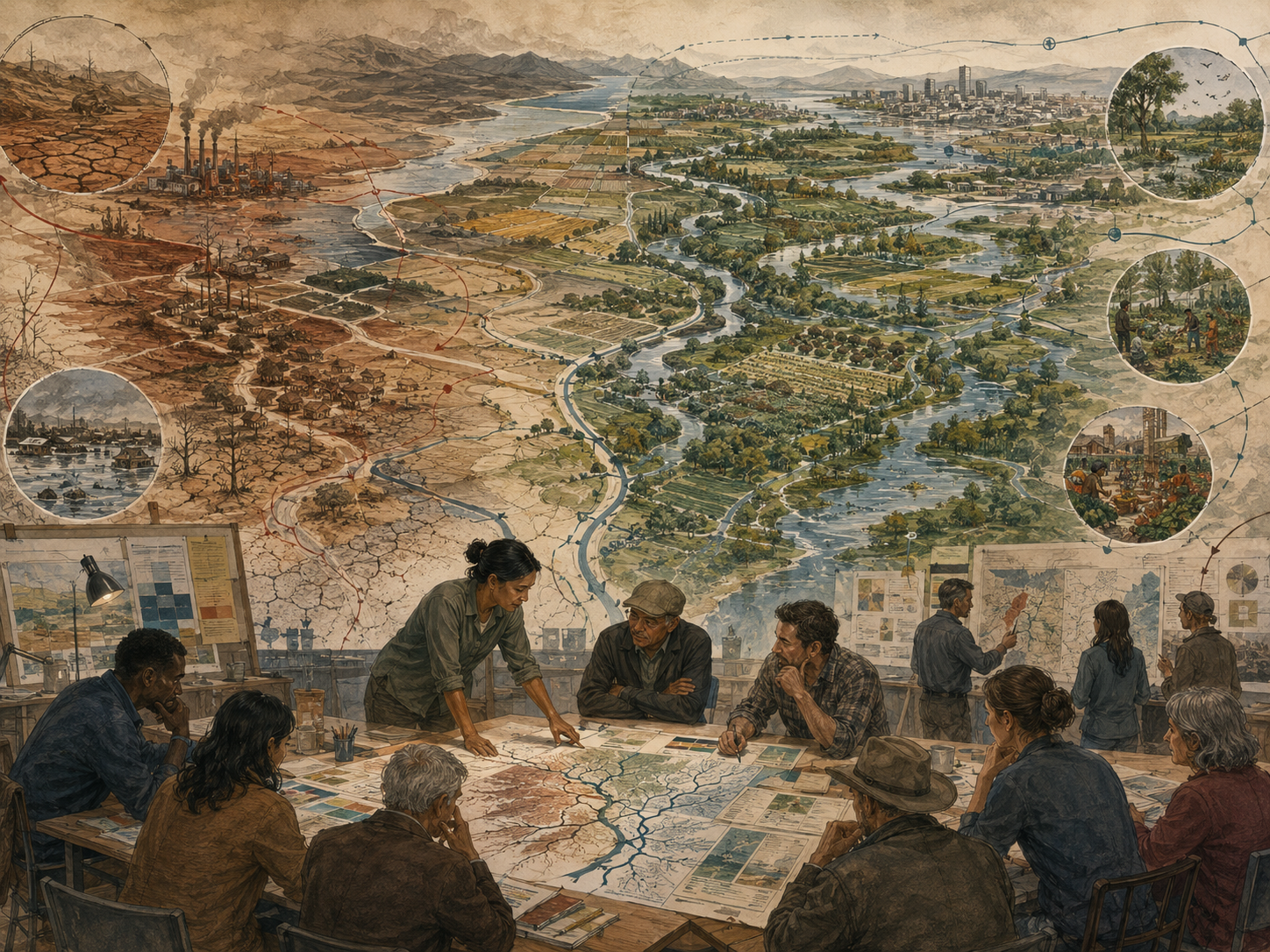
Food, Water, and Land as Coupled Systems
Food, water, and land-use systems are coupled social-ecological systems. Their behavior emerges from interaction among biophysical processes, human institutions, markets, infrastructure, technology, cultural practices, property regimes, and ecological feedback. A field is not merely a production site. It is part of a watershed, soil system, labor system, market system, climate system, biodiversity system, land-tenure system, and political economy. A river is not merely a water supply. It is a living ecological corridor, irrigation source, flood system, energy system, transport corridor, cultural landscape, and site of competing rights and responsibilities.
This means food security cannot be reduced to yield. Water security cannot be reduced to supply volume. Land-use planning cannot be reduced to zoning or acreage. Each domain affects the others. Expanding irrigation can increase food production while depleting aquifers. Expanding cropland can reduce forests, carbon storage, biodiversity, and watershed stability. Intensifying agriculture can raise output while degrading soil, polluting water, increasing fertilizer dependency, and reducing long-term resilience. Conservation can protect ecosystems while creating conflict if it displaces local livelihoods or ignores Indigenous governance.
The future of food, water, and land depends on whether societies can manage flows, rights, risks, and ecological regeneration across connected systems.
| System | Depends On | Shapes | Failure Risk |
|---|---|---|---|
| Food systems | Water, soil, biodiversity, labor, energy, climate, infrastructure, markets, finance. | Nutrition, livelihoods, land demand, emissions, trade, public health, political stability. | Food insecurity, price shocks, malnutrition, farmer distress, supply disruption. |
| Water systems | Climate, watersheds, aquifers, land cover, infrastructure, governance, upstream behavior. | Agriculture, energy, cities, ecosystems, sanitation, industry, health, migration. | Scarcity, flooding, contamination, conflict, ecosystem collapse, public health crisis. |
| Land systems | Tenure, soil, markets, settlement, infrastructure, policy, ecology, cultural practice. | Food production, biodiversity, carbon, housing, migration, extraction, conservation. | Degradation, dispossession, fragmentation, habitat loss, conflict, emissions. |
| Ecological systems | Habitat, water quality, soil, climate stability, biodiversity, nutrient cycles. | Pollination, carbon storage, water regulation, disease ecology, food resilience. | Biodiversity loss, feedback acceleration, weakened resilience, ecosystem-service decline. |
| Institutional systems | Law, enforcement, legitimacy, participation, monitoring, finance, knowledge. | Rights, allocation, adaptation, land-use decisions, restoration, conflict resolution. | Capture, inequity, weak enforcement, fragmentation, maladaptation. |
A coupled-systems view also reveals why isolated solutions often fail. A water project can worsen land conflict. A food-security strategy can accelerate groundwater depletion. A conservation policy can become unjust if it excludes communities. A market-efficiency strategy can make supply chains more fragile. A technology intervention can increase dependence on data platforms, expensive inputs, proprietary systems, or extractive finance.
Food System Futures
Food system futures are shaped by population change, dietary shifts, climate stress, agricultural productivity, soil health, water availability, seed systems, fertilizer dependency, labor conditions, land access, biodiversity, trade, storage, logistics, energy prices, geopolitical disruption, public policy, and household purchasing power. Food is both a biological necessity and a political-economic system. It is produced by ecosystems and labor, moved through infrastructure, priced through markets, governed through institutions, and experienced through culture, health, and inequality.
Food futures are often discussed through the language of production gaps and yield increases, but production is only one dimension. A world may produce enough calories while still producing hunger because of poverty, conflict, distribution failure, waste, land dispossession, commodity speculation, weak public protection, or supply-chain disruption. Food systems can become more productive while becoming more ecologically fragile. They can become more technologically advanced while increasing dependence on proprietary inputs, data platforms, or energy-intensive infrastructure.
A serious food future must therefore evaluate production, access, nutrition, ecological integrity, labor, resilience, and justice together.
| Food Futures Dimension | Core Question | Risk if Narrowly Managed |
|---|---|---|
| Production | Can agriculture produce sufficient food under changing climate and ecological conditions? | Yield gains may mask soil degradation, water depletion, and input dependency. |
| Access | Can people afford and physically obtain adequate food? | Aggregate supply can coexist with hunger and malnutrition. |
| Nutrition | Does the system support healthy diets rather than only calories or commodities? | Food abundance can coexist with diet-related disease and micronutrient deficiency. |
| Resilience | Can food systems absorb shocks from climate, conflict, disease, energy, or trade disruption? | Efficient supply chains may fail under correlated shocks. |
| Ecology | Does food production regenerate soil, water, biodiversity, and carbon systems? | Short-term output can undermine long-term productive capacity. |
| Labor and livelihoods | Are farmers, workers, fishers, pastoralists, and food workers protected? | Cheap food can depend on precarious labor and rural distress. |
Food system futures will likely involve plural pathways rather than one universal model. Industrial agriculture, agroecology, regenerative practices, precision agriculture, controlled-environment farming, regional food systems, smallholder farming, pastoral systems, fisheries, aquaculture, urban agriculture, public procurement, and food-sovereignty movements will all shape different contexts. The strategic question is not which model should dominate everywhere, but which combinations produce nutrition, resilience, ecological integrity, fair livelihoods, and democratic accountability under specific conditions.
Water Futures and Hydrological Stress
Water futures are defined by uneven distribution, climate variability, infrastructure condition, pollution, competing uses, groundwater depletion, flood risk, ecosystem needs, and governance capacity. Water is both a local resource and a basin-scale system. Its future depends on upstream land use, rainfall patterns, snowpack, aquifer recharge, storage infrastructure, irrigation demand, urban growth, industrial use, sanitation, watershed protection, and political agreements across boundaries.
Water stress is not only scarcity. It includes too little water, too much water, polluted water, poorly timed water, inaccessible water, unaffordable water, and water governed without legitimacy. Drought and flood can occur in the same region over time. Groundwater extraction can maintain current production while silently reducing future capacity. Urban water systems can serve wealthy districts while peripheral settlements rely on unsafe or expensive sources. Rivers can be treated as extraction channels while ecosystems lose the flows necessary for survival.
Water futures require hydrological realism and institutional fairness. Without both, societies may confuse engineering control with water security.
| Water Futures Pressure | Systemic Meaning | Governance Implication |
|---|---|---|
| Groundwater depletion | Current irrigation or urban supply relies on nonrenewable or slowly recharging reserves. | Aquifer governance, demand management, recharge protection, and crop-choice reform become essential. |
| Drought | Climate variability reduces water availability for agriculture, cities, energy, and ecosystems. | Allocation rules must be explicit before crisis. |
| Flooding | Extreme precipitation, land-cover change, drainage systems, and settlement patterns amplify risk. | Watershed planning, floodplain protection, green infrastructure, and managed retreat may be required. |
| Water pollution | Agriculture, industry, mining, sewage, and runoff degrade public health and ecosystems. | Pollution control must be integrated with land use and enforcement. |
| Urban water inequality | Infrastructure access and affordability vary across neighborhoods and settlements. | Water security must include justice, not only supply capacity. |
| Transboundary water conflict | Rivers and aquifers cross political boundaries. | Cooperation, data sharing, treaties, and basin institutions become central. |
Water is also deeply connected to energy and food. Irrigation increases food production but can intensify energy demand and aquifer decline. Hydropower depends on river flows and competes with ecological and agricultural needs. Desalination can expand supply but requires energy, finance, and brine management. Water reuse can improve resilience but depends on public trust, treatment systems, and regulatory capacity. Water futures therefore demand integrated planning across food, energy, land, climate, and public health.
Land-Use Change and Ecological Transformation
Land-use futures determine the spatial pattern of agriculture, forests, cities, infrastructure, conservation, extraction, energy systems, migration, and ecological survival. Land is finite, but human demands on land are expanding and intensifying. Food production competes with urbanization, energy infrastructure, mining, biodiversity conservation, carbon storage, flood protection, cultural landscapes, and Indigenous sovereignty. Land-use decisions therefore encode long-term choices about what societies value, protect, sacrifice, and extract.
Land-use change is one of the central mechanisms through which human systems transform ecosystems. Deforestation, wetland drainage, grassland conversion, soil degradation, mining, road expansion, urban sprawl, monoculture, and fragmented habitat reduce biodiversity, alter hydrology, release carbon, and weaken ecological resilience. At the same time, land restoration, agroforestry, regenerative farming, rewilding, wetland protection, urban greening, watershed management, and Indigenous stewardship can strengthen ecological functions and long-term resilience.
Land-use futures are not simply planning futures. They are moral, ecological, economic, and political futures.
| Land-Use Pathway | Potential Benefit | Systemic Risk |
|---|---|---|
| Agricultural expansion | Increases production area and rural economic activity. | Deforestation, habitat loss, emissions, land conflict, water stress. |
| Agricultural intensification | Raises output per unit land. | Input dependency, pollution, soil degradation, biodiversity loss. |
| Urban expansion | Supports housing, jobs, infrastructure, and services. | Farmland loss, sprawl, floodplain development, habitat fragmentation. |
| Conservation and restoration | Protects biodiversity, carbon, water regulation, and ecosystem services. | Can become unjust if communities are excluded or displaced. |
| Renewable energy siting | Supports decarbonization and energy transition. | Land conflict, habitat disruption, mineral demand, local opposition. |
| Extractive land use | Supplies minerals, fuels, timber, and materials. | Pollution, dispossession, ecological degradation, long-term liability. |
A futures approach to land use must ask not only how much land is needed, but what kind of land, governed by whom, for what purpose, with what ecological consequences, and with what distribution of benefits and burdens. Land is never empty. Even when maps show “available” land, that land may hold communities, livelihoods, sacred meaning, biodiversity, water functions, carbon storage, or future resilience capacity.
Soil Health and Productive Capacity
Soil is one of the least visible foundations of food, water, climate, and land-use futures. Healthy soils store carbon, retain water, cycle nutrients, support microbial life, sustain plant growth, reduce erosion, buffer drought, filter pollutants, and support long-term agricultural productivity. Degraded soils reduce yields, increase input dependency, increase runoff, weaken drought resilience, and undermine future food security.
Soil degradation is often slow, cumulative, and politically underweighted because its decline may be hidden until productivity, water retention, or erosion reach visible thresholds. The financial and policy systems surrounding agriculture often reward short-term output while failing to value soil regeneration. This creates a futures problem: societies may meet present production targets while consuming the biological foundation of future production.
Soil health is not an agronomic detail. It is a long-term resilience variable for food security, water regulation, carbon storage, and ecological stability.
| Soil Function | Systemic Role | Risk When Degraded |
|---|---|---|
| Water retention | Buffers drought, reduces runoff, supports crop resilience. | Greater irrigation demand, flood runoff, crop stress. |
| Nutrient cycling | Supports plant growth and reduces external input dependence. | Fertilizer dependency, pollution, yield instability. |
| Carbon storage | Contributes to climate regulation and soil structure. | Carbon loss, soil erosion, reduced fertility. |
| Biological activity | Supports microbial ecosystems and plant health. | Reduced resilience, disease vulnerability, lower productivity. |
| Erosion control | Maintains topsoil and watershed stability. | Land degradation, sedimentation, reduced long-term productivity. |
| Pollution buffering | Filters and transforms contaminants. | Water pollution and ecological stress. |
Soil futures depend on cropping systems, grazing practices, tillage, cover crops, agroforestry, compost, nutrient management, land tenure, farmer incentives, public extension systems, monitoring, and market design. A society that treats soil as a disposable substrate rather than a living system is reducing its future options.
Climate Stress and Compound Risk
Climate change reshapes food, water, and land-use futures by altering temperature, precipitation, drought, flood, heat stress, evapotranspiration, wildfire, pest pressure, disease ecology, glacier melt, snowpack, growing seasons, and extreme-event frequency. Climate stress rarely acts alone. It interacts with soil degradation, weak infrastructure, poverty, conflict, market volatility, debt, water rights, land tenure, and institutional capacity.
Compound risk occurs when multiple pressures converge. A drought can reduce crop yields, raise food prices, increase groundwater pumping, reduce hydropower output, intensify energy demand, increase farmer debt, trigger migration, weaken public budgets, and increase political instability. A flood can destroy crops, contaminate water, damage roads, displace communities, interrupt markets, spread disease, and degrade soils. Heat can reduce labor productivity, increase irrigation demand, stress livestock, damage crops, and raise cooling energy needs.
The most dangerous futures are not defined by one hazard, but by interacting hazards moving through already unequal and fragile systems.
| Climate Stress | Food Impact | Water Impact | Land Impact |
|---|---|---|---|
| Drought | Yield decline, livestock stress, food price pressure. | Scarcity, aquifer pumping, hydropower stress. | Vegetation loss, erosion, wildfire risk. |
| Flooding | Crop loss, storage damage, supply disruption. | Contamination, sewer overflow, infrastructure damage. | Soil erosion, landslides, settlement exposure. |
| Extreme heat | Crop stress, labor risk, livestock mortality. | Higher demand, evaporation, water-quality stress. | Heat islands, vegetation stress, fire risk. |
| Wildfire | Farm damage, smoke impacts, livestock disruption. | Watershed damage, ash contamination, treatment burden. | Forest loss, soil damage, erosion, habitat change. |
| Sea-level rise | Coastal agriculture loss, salinization. | Saltwater intrusion, flood risk. | Coastal land loss, displacement, wetland migration pressure. |
| Pest and disease shifts | Crop and livestock vulnerability. | Can interact with water quality and sanitation. | Ecological imbalance and biodiversity stress. |
Climate futures also affect where food can be produced and what production systems remain viable. Regions that are productive today may face water stress, heat stress, wildfire, salinization, or pest pressure. Other regions may see longer growing seasons but still face soil, infrastructure, ecological, and social constraints. Climate adaptation must therefore include land-use planning, crop diversification, water governance, early warning, seed systems, insurance reform, public finance, and protection for vulnerable producers and consumers.
Supply Chains, Markets, and Food Security
Food, water, and land-use futures are embedded in global and regional supply chains. Seeds, fertilizer, fuel, machinery, irrigation equipment, food commodities, animal feed, cold chains, storage, shipping, ports, processing facilities, retail systems, financial contracts, and humanitarian supply networks shape whether food reaches people reliably and affordably. Market integration can increase availability and lower costs under stable conditions, but it can also transmit shocks rapidly across regions.
Food insecurity is not only a production problem. It can result from conflict, poverty, price volatility, speculation, debt, trade disruption, logistics failure, currency crisis, climate shock, weak public reserves, inadequate safety nets, or unequal market power. A region may export food while local communities face hunger. A country may depend on imports that become unaffordable during currency depreciation or geopolitical disruption. A household may live near food abundance but lack income, transport, or rights.
Food security futures depend on resilience across production, distribution, affordability, nutrition, public protection, and political stability.
| Supply-Chain Element | Function | Future Vulnerability |
|---|---|---|
| Input systems | Seeds, fertilizer, feed, machinery, fuel, irrigation equipment. | Price shocks, import dependency, proprietary control, energy volatility. |
| Storage and processing | Preserves food, reduces loss, creates market access. | Energy dependence, infrastructure gaps, concentration, contamination risk. |
| Transport and logistics | Moves food across farms, cities, regions, and borders. | Fuel shocks, port disruption, conflict, climate damage, chokepoints. |
| Trade systems | Balance regional surplus and deficit. | Export bans, price volatility, dependency, geopolitical leverage. |
| Retail and distribution | Connects food supply to households. | Food deserts, market concentration, affordability gaps. |
| Public protection | Safety nets, school meals, reserves, humanitarian response. | Austerity, weak targeting, emergency overload, political neglect. |
Future-ready food systems need both global coordination and local resilience. Regional food systems, public reserves, diversified trade, resilient logistics, reduced food loss, nutrition-sensitive policy, anti-poverty protections, farmer support, and accountable markets all matter. Efficiency alone is not food security if the system cannot absorb shocks or protect vulnerable households.
Technology and Agricultural Transition
Technology will shape food, water, and land-use futures through precision agriculture, remote sensing, environmental monitoring, AI-assisted planning, irrigation optimization, drought-resistant crops, soil sensors, satellite imagery, climate analytics, water reuse, desalination, controlled-environment agriculture, alternative proteins, improved storage, cold chains, digital extension, and land-use modeling. These tools can improve measurement, reduce waste, target inputs, monitor ecological stress, strengthen early warning, and support adaptation.
Yet technology is not neutral. It can deepen dependency, concentrate power, raise costs, exclude smallholders, intensify surveillance, create proprietary data systems, and shift risk onto farmers or communities. A sensor network does not solve weak water rights. AI forecasting does not solve land dispossession. Drought-resistant seeds do not solve poverty, soil degradation, or political conflict. Vertical farming does not replace the land, labor, water, culture, and ecology embedded in wider food systems.
Technology matters most when embedded in accountable institutions, fair access, ecological literacy, and public-interest governance.
| Technology Area | Potential Contribution | Risk if Poorly Governed |
|---|---|---|
| Precision agriculture | Targets water, fertilizer, pesticides, and monitoring. | High cost, data extraction, platform dependency, exclusion of smallholders. |
| Remote sensing | Tracks land cover, crop stress, water use, drought, and deforestation. | Surveillance, enforcement bias, data gaps, weak ground truth. |
| Climate-resilient crops | Improves tolerance to heat, drought, pests, or salinity. | Seed dependency, genetic narrowing, unequal access, regulatory conflict. |
| Water reuse and desalination | Expands supply under scarcity. | Energy demand, cost, brine disposal, affordability issues. |
| Controlled-environment agriculture | Reduces some climate exposure and land pressure. | Energy intensity, capital cost, narrow crop range, unequal scaling. |
| AI and decision systems | Supports forecasting, allocation, scenario analysis, and early warning. | False precision, opaque models, bias, overreliance on technical dashboards. |
Technology should be assessed through ecological, social, and institutional questions: Who owns the data? Who can afford the system? What energy and material inputs does it require? Does it reduce vulnerability or shift it elsewhere? Does it strengthen public capacity or private dependency? Does it support farmers, communities, and ecosystems—or primarily investors and vendors?
Governance, Rights, and Institutional Capacity
Food, water, and land-use futures depend heavily on governance. Rights to land, water, seeds, forests, fisheries, grazing, mobility, and participation determine who can adapt, who bears risk, and who benefits from transition. Institutions shape allocation rules, conservation policy, agricultural support, pollution control, groundwater extraction, land tenure, food safety, public procurement, disaster response, market regulation, and conflict resolution.
Weak governance can make ecological stress more dangerous. Unclear water rights can intensify drought conflict. Insecure land tenure can discourage long-term soil restoration. Corruption can redirect irrigation or land projects toward powerful actors. Fragmented agencies can manage food, water, land, climate, and biodiversity separately even though they are physically connected. Centralized policy can ignore local knowledge. Market-led systems can treat land and water as assets while neglecting public value and ecological responsibility.
Institutional capacity is itself a resource system. Without legitimate, adaptive, and accountable governance, technical solutions cannot produce durable food, water, or land security.
| Governance Domain | Futures Role | Failure Mode |
|---|---|---|
| Land tenure | Shapes investment, stewardship, rights, displacement, and conflict. | Insecurity, land grabbing, exclusion, short-term extraction. |
| Water rights and allocation | Determines who receives water under normal and drought conditions. | Overuse, conflict, inequity, ecological depletion. |
| Watershed governance | Coordinates upstream-downstream land, water, flood, and ecosystem decisions. | Fragmented planning and unmanaged externalities. |
| Agricultural policy | Shapes crops, inputs, markets, insurance, subsidies, and farmer livelihoods. | Monoculture, input dependency, farmer distress, ecological harm. |
| Food security institutions | Protect access during price shocks, conflict, disaster, and poverty. | Hunger despite food availability. |
| Environmental regulation | Controls pollution, land conversion, habitat loss, and degradation. | Weak enforcement, ecological decline, health burden. |
| Participatory governance | Includes farmers, communities, Indigenous peoples, workers, and affected groups. | Loss of legitimacy, resistance, injustice, poor local fit. |
Future-ready governance must be adaptive because environmental conditions, demographic patterns, technologies, and markets will change. Institutions need monitoring, public accountability, conflict-resolution capacity, fiscal support, local knowledge, scientific capability, and the ability to revise rules before systems cross dangerous thresholds.
Justice, Livelihoods, and Contested Land Futures
Food, water, and land-use futures are deeply contested because they involve rights, livelihoods, survival, culture, identity, sovereignty, and unequal power. Land is never merely a production input. It can be home, inheritance, sacred space, commons, habitat, territory, asset, speculative vehicle, carbon sink, conservation target, or source of extraction. Water is never merely a commodity. It is life support, public health, ecological flow, cultural relation, and political right.
Justice requires asking whose food security matters, whose water access is protected, whose land is taken, whose labor is cheapened, whose knowledge counts, whose ecosystems are sacrificed, and whose future is considered expendable. Many land-use futures can appear sustainable from an aggregate perspective while reproducing dispossession or inequality. Large-scale conservation can become exclusionary. Carbon markets can create land pressure. Biofuel expansion can compete with food. Renewable energy siting can provoke land conflicts. Agricultural modernization can displace small producers.
A food, water, and land-use future is not just if it protects ecosystems while abandoning people, or feeds markets while dispossessing communities.
| Justice Dimension | Core Question | Why It Matters |
|---|---|---|
| Food justice | Who has reliable access to nutritious, culturally appropriate food? | Food systems can produce abundance while maintaining hunger and poor nutrition. |
| Water justice | Who has safe, affordable, reliable water and sanitation? | Water insecurity reflects infrastructure, poverty, rights, and governance failures. |
| Land justice | Who controls land, who is displaced, and whose tenure is protected? | Land governance determines livelihoods, identity, adaptation, and power. |
| Labor justice | Who performs agricultural, food-processing, logistics, and care work under what conditions? | Cheap food often depends on undervalued or precarious labor. |
| Indigenous and community rights | Are Indigenous sovereignty and local stewardship respected? | Ecological protection is strongest when rooted in rights and consent. |
| Intergenerational justice | Are soils, aquifers, forests, and ecosystems maintained for future people? | Short-term extraction can consume long-term survival capacity. |
Justice also strengthens resilience. Communities with secure rights, local knowledge, social trust, public support, and political voice are better able to adapt. Conversely, dispossession, poverty, exclusion, and weak rights increase vulnerability even where technical resources exist. Food, water, and land-use futures must therefore be evaluated through both ecological integrity and human dignity.
Core Dimensions of Food, Water, and Land-Use Futures
Food, water, and land-use futures can be evaluated across several interacting dimensions. These dimensions should not be treated separately. Food production depends on water, soil, labor, land, biodiversity, and climate. Water security depends on watersheds, infrastructure, governance, demand, and pollution control. Land-use decisions affect carbon, habitat, food systems, settlement, infrastructure, and cultural rights. A strong future is not merely high-yield, water-efficient, or conservation-oriented. It is regenerative, equitable, resilient, nutritious, ecologically grounded, and institutionally capable.
1. Food Security and Nutrition
Food security and nutrition concern whether people have stable access to sufficient, safe, healthy, culturally appropriate food. This includes production, affordability, distribution, public protection, and nutrition quality.
2. Water Security and Basin Resilience
Water security includes availability, quality, reliability, affordability, sanitation, ecosystem flows, groundwater sustainability, drought resilience, flood management, and basin-scale cooperation.
3. Soil Health and Agricultural Capacity
Soil health and agricultural capacity include fertility, structure, organic matter, erosion control, microbial life, water retention, nutrient cycling, and the long-term viability of production systems.
4. Land-Use Governance and Rights
Land-use governance and rights include tenure security, Indigenous sovereignty, zoning, conservation, restoration, settlement, infrastructure siting, agricultural policy, and conflict resolution.
5. Biodiversity and Ecosystem Integrity
Biodiversity and ecosystem integrity support pollination, pest regulation, carbon storage, water cycling, soil formation, habitat connectivity, disease regulation, and long-term resilience.
6. Climate Adaptation and Risk Reduction
Climate adaptation includes crop diversification, water management, heat resilience, floodplain protection, drought planning, early warning, seed systems, insurance reform, and social protection.
7. Livelihoods, Labor, and Rural Capacity
Livelihoods, labor, and rural capacity concern farmer viability, food-worker protections, pastoralist rights, fisheries, rural infrastructure, extension systems, market access, and community resilience.
8. Institutional Learning and Monitoring
Institutional learning and monitoring include environmental data, public extension, participatory governance, adaptive rules, early warning systems, transparent allocation, and accountability across food, water, and land systems.
| Dimension | Core Question | Failure if Ignored |
|---|---|---|
| Food security | Can people reliably access nutritious food? | Hunger persists despite production gains. |
| Water security | Can water systems support people, agriculture, cities, and ecosystems? | Scarcity, flooding, contamination, conflict, and ecosystem decline. |
| Soil health | Is the biological foundation of production being regenerated? | Yield instability, erosion, input dependency, and long-term degradation. |
| Land rights | Who controls land and who is protected from dispossession? | Conflict, exclusion, land grabbing, and unjust transition. |
| Biodiversity | Do landscapes sustain living systems and ecological functions? | Loss of pollination, pest regulation, carbon storage, and resilience. |
| Climate adaptation | Can systems adjust to drought, heat, flood, pests, and volatility? | Repeated shocks become humanitarian, economic, and ecological crises. |
| Livelihoods | Are producers and workers able to live with dignity? | Rural distress, labor exploitation, migration pressure, and social instability. |
| Institutional learning | Can governance systems monitor, learn, and adapt before thresholds are crossed? | Rules remain static while ecological conditions change. |
Food, water, and land-use futures are strongest when production, access, ecological regeneration, water governance, land rights, climate adaptation, livelihoods, and institutional learning reinforce one another.
Scenario Planning for Food, Water, and Land Systems
Food, water, and land-use systems are exposed to deep uncertainty: climate pathways, rainfall patterns, groundwater decline, food prices, conflict, migration, technological adoption, land politics, public finance, ecological thresholds, and institutional performance. This makes them natural domains for Scenario Planning. Scenario planning does not predict one future. It helps decision-makers test assumptions across multiple plausible futures and identify strategies that remain robust under stress.
Backcasting is also important. If a society wants a future with healthy diets, resilient farms, restored watersheds, secure water access, healthy soils, protected biodiversity, and fair land rights, it must ask what decisions are needed now. Those decisions may involve public procurement, watershed restoration, land reform, crop diversification, irrigation governance, soil monitoring, farmer support, regional food infrastructure, early warning systems, and climate adaptation finance.
Food, water, and land-use foresight is strongest when it connects scenarios to budgets, institutions, rights, monitoring, and implementation.
| Foresight Tool | Use in Food-Water-Land Systems | Example |
|---|---|---|
| Scenario planning | Explores alternative climate, production, water, market, and governance futures. | Drought-and-price-shock scenario for food security planning. |
| Backcasting | Starts from desired resilient landscapes and works backward. | Designing a watershed restoration and nutrition-security pathway. |
| Stress testing | Tests food, water, and land systems under severe but plausible shocks. | Heat wave plus crop failure plus export ban plus currency shock. |
| Systems mapping | Identifies feedbacks, dependencies, and unintended consequences. | Mapping irrigation, groundwater, crop choice, debt, and farmer vulnerability. |
| Early warning | Tracks signals of ecological, market, water, and food-security stress. | Soil moisture, groundwater, food prices, vegetation, malnutrition, conflict signals. |
| Participatory foresight | Includes farmers, Indigenous peoples, workers, communities, and local institutions. | Co-designing land restoration and water allocation rules with affected groups. |
The goal is not to imagine abstract futures, but to strengthen present decision-making. Food, water, and land-use foresight should influence agricultural policy, water allocation, land-use planning, infrastructure, disaster preparedness, conservation, public health, trade strategy, and social protection.
Food, Water, and Land-Use Scenarios
Food, water, and land-use futures can unfold across multiple pathways. These scenarios are not predictions. They are structured contexts for testing assumptions about production, water, climate, ecology, land rights, technology, markets, and governance.
| Scenario | Description | Systemic Risk | Strategic Opportunity |
|---|---|---|---|
| Regenerative Food-Water-Land Transition | Agriculture, water governance, soil restoration, biodiversity protection, and livelihoods are aligned. | Requires sustained public finance, institutional capacity, and market redesign. | Builds long-term resilience and ecological regeneration. |
| High-Yield Degradation Pathway | Production rises through intensification while soils, water, biodiversity, and farmer viability decline. | Short-term food gains produce long-term fragility. | Redirect intensification toward soil, water, and biodiversity safeguards. |
| Water Scarcity and Allocation Conflict | Drought, groundwater depletion, urban demand, and irrigation pressure intensify competition. | Food insecurity, rural distress, ecosystem loss, and political conflict. | Basin governance, demand management, crop transition, and water justice. |
| Climate Shock Food Crisis | Extreme weather, supply-chain disruption, price volatility, and weak safety nets converge. | Hunger, malnutrition, migration, unrest, and humanitarian overload. | Public reserves, early warning, social protection, diversified food systems. |
| Land Financialization and Dispossession | Land becomes increasingly governed by speculative capital, carbon markets, or large-scale acquisition. | Displacement, land conflict, exclusion, and loss of local stewardship. | Land rights, public value safeguards, Indigenous sovereignty, tenure protection. |
| Technology-Intensive Controlled System | Precision agriculture, AI, sensors, controlled environments, and water technologies expand. | Data extraction, capital dependency, energy burden, unequal access. | Public-interest technology, open standards, farmer support, accountability. |
| Watershed Restoration and Local Resilience | Regional systems invest in wetlands, forests, soil, floodplains, local food infrastructure, and community governance. | Coordination complexity and slow returns. | Reduced flood risk, water quality gains, biodiversity recovery, local resilience. |
Scenario analysis reveals that food, water, and land-use futures are not only environmental futures. They are governance, justice, technology, market, livelihood, and public-health futures.
Strategic Questions
Food, water, and land-use futures analysis should guide strategic questions for governments, farmers, water agencies, planners, researchers, Indigenous governments, civil society, food businesses, public health institutions, conservation organizations, and communities. These questions reveal hidden assumptions about production, climate, rights, ecology, finance, and institutional capacity.
| Strategic Question | What It Reveals | Why It Matters |
|---|---|---|
| What future does this food strategy assume? | Assumptions about climate, water, trade, labor, soil, technology, and access. | Food policy fails when production assumptions are disconnected from ecological reality. |
| Is water use within renewable limits? | Groundwater dependence, basin stress, irrigation pressure, and demand growth. | Current abundance may be borrowed from future scarcity. |
| What land-use tradeoffs are being hidden? | Conflicts among food, housing, conservation, energy, carbon, extraction, and rights. | Land decisions define long-term ecological and social pathways. |
| Who controls land and water? | Power relations, tenure security, rights, exclusion, and governance legitimacy. | Adaptation depends on rights and control. |
| Are soils regenerating or being consumed? | Long-term productive capacity and ecological resilience. | Short-term yield can mask future decline. |
| What happens under simultaneous shocks? | Compound risk across drought, price, conflict, trade, disease, and infrastructure failure. | Resilience requires planning beyond single hazards. |
| Who becomes vulnerable if prices rise? | Household food access, social protection, nutrition risk, and inequality. | Food security is an access problem as well as a production problem. |
| What early signals show system stress? | Groundwater decline, soil loss, vegetation stress, food prices, malnutrition, conflict, migration. | Monitoring enables action before crisis becomes irreversible. |
Food, water, and land-use futures work is strongest when it connects ecological monitoring, public finance, rights, livelihoods, infrastructure, climate adaptation, and justice into one integrated field of decision-making.
Limitations and Failure Modes
Food, water, and land-use futures analysis has limits. Biophysical systems are complex, data may be incomplete, local conditions vary dramatically, and institutions may lack the capacity or legitimacy to act on foresight. Models can understate informal systems, Indigenous knowledge, household behavior, power relations, political conflict, land tenure, labor conditions, and ecological thresholds. Aggregate indicators can hide hunger, water insecurity, dispossession, and biodiversity loss.
There is also the danger of technocratic simplification. Food futures can become yield forecasts. Water futures can become infrastructure plans. Land-use futures can become maps. Sustainability futures can become carbon accounting. Each of these may be useful, but each can become misleading if detached from rights, justice, ecology, governance, and lived vulnerability.
| Failure Mode | Problem | Corrective Practice |
|---|---|---|
| Yield tunnel vision | Food futures focus only on production volume. | Include nutrition, access, livelihoods, soil, water, and resilience. |
| Water supply bias | Water policy expands supply without managing demand or rights. | Use basin governance, allocation rules, demand management, and water justice. |
| Land-as-empty-space framing | Maps treat land as available without recognizing people, rights, ecology, and culture. | Use tenure, Indigenous sovereignty, local knowledge, and ecological functions. |
| Technology solutionism | Digital or biotech tools are treated as substitutes for governance and equity. | Assess access, ownership, energy, data rights, and public-interest safeguards. |
| Conservation without justice | Protection displaces or excludes communities. | Use rights-based conservation, consent, co-governance, and livelihood protection. |
| Aggregate resilience | System-level metrics hide unequal vulnerability. | Use spatial, class, gender, livelihood, and rights-based analysis. |
| Scenario theater | Foresight is not linked to policy, budgets, monitoring, or institutions. | Connect scenarios to implementation, finance, and accountability. |
| Short-term extraction | Markets reward immediate output while degrading future capacity. | Value regeneration, maintenance, stewardship, and intergenerational responsibility. |
The purpose of food, water, and land-use foresight is not to make resource futures look manageable on paper. It is to help societies act responsibly before ecological, social, and institutional thresholds close off humane options.
Mathematical Lens: Coupled Resource Stress and Resilience
A coupled food-water-land stress index can be represented conceptually as:
S_t = \alpha F_t + \beta W_t + \gamma L_t + \delta C_t
\]
Interpretation: \(S_t\) is total system stress at time \(t\), \(F_t\) is food-system stress, \(W_t\) is water stress, \(L_t\) is land-use stress, and \(C_t\) is climate stress. The coefficients represent the relative importance of each stress pathway in a given region.
Food-system resilience can be represented as the relationship between production, access, and shock exposure:
R^F_t = P_t + A_t – X_t
\]
Interpretation: \(R^F_t\) is food-system resilience, \(P_t\) is production capacity, \(A_t\) is access capacity, and \(X_t\) is shock exposure. A system with high production but weak access or high shock exposure may remain food insecure.
Water security can be represented as a balance between renewable supply, demand, quality, and ecological flow needs:
Q_t = R_t – D_t – P_t – E_t
\]
Interpretation: \(Q_t\) is water security balance, \(R_t\) is renewable water availability, \(D_t\) is human demand, \(P_t\) is pollution burden, and \(E_t\) is ecological flow requirement. Treating ecological flows as optional can create false estimates of water security.
Land-use pressure can be modeled as competing demand across uses:
U_t = A_t + H_t + I_t + E_t + K_t
\]
Interpretation: \(U_t\) is total land-use pressure, \(A_t\) is agricultural demand, \(H_t\) is housing and settlement demand, \(I_t\) is infrastructure demand, \(E_t\) is extraction or energy demand, and \(K_t\) is conservation or ecological restoration demand. The equation makes tradeoffs visible rather than assuming land is unlimited.
A robustness score across futures can be represented as:
B_k = \min(P_{k1}, P_{k2}, \dots, P_{kn})
\]
Interpretation: \(B_k\) is the robustness of strategy \(k\), and \(P_{ks}\) is its performance under scenario \(s\). A strong food-water-land strategy should avoid catastrophic failure under drought, price shocks, land conflict, supply disruption, and ecological stress.
These equations are conceptual tools. They are not complete predictive models. Their purpose is to make assumptions explicit: food, water, and land-use futures depend on interacting stress, production, access, renewable water, demand, pollution, ecological flows, competing land demands, and robustness across uncertain futures.
Computational Modeling for Food, Water, and Land-Use Futures
Computational modeling can help compare food, water, and land-use futures, test stress pathways, identify tradeoffs, and make assumptions transparent. It should not be used to create false precision or to hide political choices behind technical language. Its value lies in clarifying relationships among production, water availability, land pressure, ecological integrity, governance, vulnerability, and adaptation capacity.
A professional food-water-land futures workflow may include:
- System profiles: food production capacity, water security, soil health, land-rights security, biodiversity integrity, climate exposure, governance capacity, and livelihood resilience.
- Scenario records: regenerative transition, high-yield degradation, water conflict, climate shock food crisis, land financialization, technology-intensive systems, and watershed restoration.
- Risk indicators: groundwater decline, food price volatility, soil erosion, drought exposure, flood exposure, land conflict, malnutrition risk, and biodiversity loss.
- Strategy options: soil restoration, crop diversification, irrigation reform, public food reserves, watershed restoration, land-tenure protection, agroecology, early warning, and social protection.
- Outputs: system resilience scores, fragility rankings, risk-priority tables, adaptation strategy comparisons, stress simulations, and reproducibility reports.
Food-water-land modeling should support public judgment, ecological monitoring, community accountability, and adaptive governance—not replace local knowledge, farmer experience, Indigenous stewardship, or democratic decision-making.
Advanced R Workflow: Comparing Food-Water-Land System Profiles
The R workflow below compares stylized food-water-land futures across production capacity, water security, soil health, biodiversity, governance capacity, climate exposure, market vulnerability, and justice capacity. It illustrates how these systems can be evaluated as coupled resilience profiles rather than isolated sectors.
# ------------------------------------------------------------
# R Workflow: Comparing Food-Water-Land System Profiles
# Purpose:
#   Build stylized profiles for food, water, and land-use futures
#   across production, water, soil, biodiversity, governance,
#   climate exposure, market vulnerability, and justice.
#
# Optional dependency:
#   install.packages(c("tidyverse"))
# ------------------------------------------------------------

library(tidyverse)

systems <- tibble(
  future_type = c(
    "Regenerative Food-Water-Land Transition",
    "High-Yield Degradation Pathway",
    "Water Scarcity and Allocation Conflict",
    "Climate Shock Food Crisis",
    "Land Financialization and Dispossession",
    "Watershed Restoration and Local Resilience"
  ),
  production_capacity = c(0.72, 0.86, 0.58, 0.42, 0.62, 0.68),
  water_security = c(0.76, 0.44, 0.28, 0.38, 0.50, 0.82),
  soil_health = c(0.82, 0.32, 0.48, 0.42, 0.46, 0.78),
  biodiversity_integrity = c(0.78, 0.30, 0.42, 0.40, 0.38, 0.84),
  governance_capacity = c(0.76, 0.50, 0.36, 0.40, 0.34, 0.72),
  climate_exposure = c(0.42, 0.58, 0.74, 0.88, 0.56, 0.46),
  market_vulnerability = c(0.38, 0.62, 0.70, 0.86, 0.78, 0.44),
  justice_capacity = c(0.80, 0.42, 0.34, 0.38, 0.24, 0.76)
)

systems <- systems %>%
  mutate(
    food_water_land_resilience =
      0.14 * production_capacity +
      0.16 * water_security +
      0.15 * soil_health +
      0.14 * biodiversity_integrity +
      0.14 * governance_capacity -
      0.12 * climate_exposure -
      0.08 * market_vulnerability +
      0.15 * justice_capacity,

    food_water_land_fragility =
      0.16 * climate_exposure +
      0.15 * market_vulnerability +
      0.14 * (1 - water_security) +
      0.13 * (1 - soil_health) +
      0.12 * (1 - biodiversity_integrity) +
      0.12 * (1 - governance_capacity) +
      0.10 * (1 - justice_capacity) +
      0.08 * (1 - production_capacity),

    profile_class = case_when(
      food_water_land_resilience >= 0.42 & food_water_land_fragility < 0.48 ~ "Stronger regenerative resilience",
      food_water_land_fragility >= 0.62 ~ "High systemic fragility",
      TRUE ~ "Mixed or transitional pathway"
    )
  ) %>%
  arrange(desc(food_water_land_resilience))

print(systems)

systems_long <- systems %>%
  select(
    future_type,
    production_capacity,
    water_security,
    soil_health,
    biodiversity_integrity,
    governance_capacity,
    climate_exposure,
    market_vulnerability,
    justice_capacity
  ) %>%
  pivot_longer(
    cols = -future_type,
    names_to = "dimension",
    values_to = "value"
  )

ggplot(systems_long, aes(x = dimension, y = value, fill = future_type)) +
  geom_col(position = "dodge") +
  coord_flip() +
  labs(
    title = "Food-Water-Land Futures Dimensions",
    x = "Dimension",
    y = "Value",
    fill = "Future Type"
  ) +
  theme_minimal(base_size = 12)

ggplot(systems, aes(x = reorder(future_type, food_water_land_resilience), y = food_water_land_resilience)) +
  geom_col() +
  coord_flip() +
  labs(
    title = "Food-Water-Land Resilience Profile",
    x = "Future Type",
    y = "Resilience Score"
  ) +
  theme_minimal(base_size = 12)

ggplot(systems, aes(x = food_water_land_resilience, y = food_water_land_fragility, label = future_type)) +
  geom_point(size = 3) +
  geom_text(nudge_y = 0.02, size = 3) +
  labs(
    title = "Food-Water-Land Resilience vs Fragility",
    x = "Resilience",
    y = "Fragility"
  ) +
  theme_minimal(base_size = 12)

dir.create("outputs", showWarnings = FALSE)
write_csv(systems, "outputs/food_water_land_futures_profiles.csv")
This workflow illustrates why food, water, and land-use futures should be evaluated through production, water, soil, biodiversity, governance, climate exposure, market vulnerability, and justice—not production volume alone.
Advanced Python Workflow: Simulating Resource Stress Pathways
The Python workflow below simulates stylized food-water-land trajectories under climate stress, water depletion, soil degradation, market volatility, and adaptive governance. It is useful for showing how systems can diverge over time depending on regeneration, governance, vulnerability, and ecological capacity.
# ------------------------------------------------------------
# Python Workflow: Simulating Food-Water-Land Stress Pathways
# Purpose:
#   Compare stylized futures under climate stress, water depletion,
#   soil degradation, market volatility, and adaptive governance.
#
# Optional dependencies:
#   pip install pandas numpy matplotlib
# ------------------------------------------------------------

from pathlib import Path

import numpy as np
import pandas as pd
import matplotlib.pyplot as plt

OUTPUT_DIR = Path("outputs")
OUTPUT_DIR.mkdir(exist_ok=True)

time_steps = np.arange(1, 41)

scenarios = [
    {
        "scenario": "Regenerative Transition",
        "production": 0.72,
        "water_security": 0.76,
        "soil_health": 0.82,
        "biodiversity": 0.78,
        "governance": 0.76,
        "justice": 0.80,
        "climate_exposure": 0.42,
        "market_vulnerability": 0.38
    },
    {
        "scenario": "High-Yield Degradation",
        "production": 0.86,
        "water_security": 0.44,
        "soil_health": 0.32,
        "biodiversity": 0.30,
        "governance": 0.50,
        "justice": 0.42,
        "climate_exposure": 0.58,
        "market_vulnerability": 0.62
    },
    {
        "scenario": "Water Conflict Future",
        "production": 0.58,
        "water_security": 0.28,
        "soil_health": 0.48,
        "biodiversity": 0.42,
        "governance": 0.36,
        "justice": 0.34,
        "climate_exposure": 0.74,
        "market_vulnerability": 0.70
    },
    {
        "scenario": "Watershed Restoration",
        "production": 0.68,
        "water_security": 0.82,
        "soil_health": 0.78,
        "biodiversity": 0.84,
        "governance": 0.72,
        "justice": 0.76,
        "climate_exposure": 0.46,
        "market_vulnerability": 0.44
    }
]

def simulate_pathway(
    production,
    water_security,
    soil_health,
    biodiversity,
    governance,
    justice,
    climate_exposure,
    market_vulnerability,
    initial_resilience=1.0
):
    resilience = np.zeros(len(time_steps))
    resource_stress = np.zeros(len(time_steps))
    adaptive_capacity = np.zeros(len(time_steps))

    resilience[0] = initial_resilience

    resource_stress[0] = (
        0.20 * climate_exposure
        + 0.16 * market_vulnerability
        + 0.16 * (1 - water_security)
        + 0.14 * (1 - soil_health)
        + 0.12 * (1 - biodiversity)
        + 0.12 * (1 - governance)
        + 0.10 * (1 - justice)
    )

    adaptive_capacity[0] = (
        0.18 * governance
        + 0.18 * justice
        + 0.16 * water_security
        + 0.16 * soil_health
        + 0.14 * biodiversity
        + 0.10 * production
        + 0.08 * (1 - climate_exposure)
    )

    for t in range(1, len(time_steps)):
        shock = 0.18 if (t + 1) % 8 == 0 else 0.06

        regeneration = (
            0.18 * soil_health
            + 0.18 * water_security
            + 0.16 * biodiversity
            + 0.16 * governance
            + 0.14 * justice
            + 0.10 * production
            + 0.08 * (1 - market_vulnerability)
        )

        resource_stress[t] = np.clip(
            resource_stress[t - 1]
            + 0.05 * shock
            + 0.04 * climate_exposure
            + 0.03 * market_vulnerability
            - 0.04 * water_security
            - 0.03 * soil_health
            - 0.03 * governance
            - 0.02 * justice,
            0,
            1.6
        )

        adaptive_capacity[t] = np.clip(
            adaptive_capacity[t - 1]
            + 0.03 * governance
            + 0.03 * justice
            + 0.02 * soil_health
            + 0.02 * biodiversity
            - 0.03 * shock,
            0,
            1.6
        )

        resilience[t] = np.clip(
            resilience[t - 1]
            + 0.06 * regeneration
            + 0.04 * adaptive_capacity[t]
            - shock
            - 0.06 * resource_stress[t],
            0,
            1.8
        )

    return resilience, resource_stress, adaptive_capacity

rows = []

for scenario in scenarios:
    resilience, stress, capacity = simulate_pathway(
        scenario["production"],
        scenario["water_security"],
        scenario["soil_health"],
        scenario["biodiversity"],
        scenario["governance"],
        scenario["justice"],
        scenario["climate_exposure"],
        scenario["market_vulnerability"]
    )

    for t, r, s, c in zip(time_steps, resilience, stress, capacity):
        rows.append({
            "scenario": scenario["scenario"],
            "time": t,
            "food_water_land_resilience": r,
            "resource_stress": s,
            "adaptive_capacity": c
        })

df = pd.DataFrame(rows)

summary = (
    df.groupby("scenario")
    .agg(
        final_resilience=("food_water_land_resilience", "last"),
        mean_resilience=("food_water_land_resilience", "mean"),
        mean_resource_stress=("resource_stress", "mean"),
        final_adaptive_capacity=("adaptive_capacity", "last")
    )
    .reset_index()
    .sort_values("final_resilience", ascending=False)
)

print(summary)

plt.figure(figsize=(10, 6))
for scenario_name in df["scenario"].unique():
    subset = df[df["scenario"] == scenario_name]
    plt.plot(subset["time"], subset["food_water_land_resilience"], label=scenario_name)

plt.xlabel("Time Step")
plt.ylabel("Food-Water-Land Resilience")
plt.title("Food-Water-Land Resilience Under Repeated Stress")
plt.legend()
plt.tight_layout()
plt.savefig(OUTPUT_DIR / "food_water_land_resilience_paths.png", dpi=150)
plt.close()

plt.figure(figsize=(10, 6))
for scenario_name in df["scenario"].unique():
    subset = df[df["scenario"] == scenario_name]
    plt.plot(subset["time"], subset["resource_stress"], label=scenario_name)

plt.xlabel("Time Step")
plt.ylabel("Resource Stress")
plt.title("Resource Stress Across Food-Water-Land Futures")
plt.legend()
plt.tight_layout()
plt.savefig(OUTPUT_DIR / "food_water_land_resource_stress_paths.png", dpi=150)
plt.close()

df.to_csv(OUTPUT_DIR / "food_water_land_stress_pathways.csv", index=False)
summary.to_csv(OUTPUT_DIR / "food_water_land_stress_summary.csv", index=False)
This workflow illustrates how food, water, and land-use futures can be modeled as dynamic resource pathways rather than static sector categories. Systems with stronger soil health, water security, biodiversity, governance, and justice maintain higher resilience under repeated stress.
GitHub Repository
The companion repository for this article contains computational examples for food, water, and land-use futures, coupled resource systems, water stress, soil health, biodiversity, land governance, food security, climate adaptation, justice, scenario comparison, and reproducible foresight workflows.
Complete Code Repository
The companion code includes Python, R, Julia, SQL, Rust, Go, C++, Fortran, C, documentation, synthetic datasets, outputs, and notebook placeholders for applied food, water, and land-use futures workflows.
Why This Matters
Food, water, and land-use futures matter because they define the material conditions of survival. They determine whether societies can feed people, sustain ecosystems, govern scarcity, protect livelihoods, adapt to climate stress, and maintain public legitimacy under pressure. These systems are not optional sectors of sustainability. They are the biological and territorial foundation of human life.
Without futures thinking, food policy can chase yield while degrading soil and water. Water policy can expand supply while ignoring rights and depletion. Land-use policy can optimize maps while erasing communities and ecosystems. Climate adaptation can protect assets while exposing vulnerable people. Technology can increase efficiency while deepening dependency. Markets can move food while leaving hunger intact. Conservation can protect landscapes while excluding the people who have stewarded them.
Food, water, and land-use futures force societies to confront the difference between extraction and regeneration.
A regenerative future does not mean romanticizing the past or rejecting technology. It means designing systems that maintain the ecological conditions of production, protect water and soil, support healthy diets, defend rights, strengthen livelihoods, reduce vulnerability, and adapt before thresholds are crossed. It means recognizing that abundance without access is not food security, water supply without justice is not water security, and land management without rights is not sustainability.
The future of food, water, and land will be shaped by climate change, demographic shifts, technology, finance, public policy, ecological thresholds, and political conflict. But it will also be shaped by choices: whether land is governed as a living system or a speculative asset; whether water is treated as a shared life-support system or an extractive commodity; whether food systems prioritize nutrition and resilience or only throughput and profit; whether restoration includes justice or becomes another form of enclosure.
The question is not only how societies will use land, water, and food systems. It is what kind of future those uses will make possible.
Related Articles
- Futures Thinking
- Infrastructure Futures
- Planetary Boundaries and Future Pathways
- Climate Futures and Environmental Change
- Futures Thinking and Sustainability
- Urban Futures
- Economic Futures and Global Development
- Geopolitical Futures
- Futures Thinking and Risk Analysis
- Scenario Planning
- Backcasting and Strategic Planning
- Systems Thinking
- Resilience Thinking
- Environmental Monitoring Systems
Further Reading
- Food and Agriculture Organization of the United Nations (FAO) (no date) Food and Agriculture Data. Available at: https://www.fao.org/faostat/.
- Food and Agriculture Organization of the United Nations (FAO) (no date) Land & Water. Available at: https://www.fao.org/land-water/.
- Food and Agriculture Organization of the United Nations (FAO) (no date) The State of Food Security and Nutrition in the World. Available at: https://www.fao.org/publications/sofi/.
- Intergovernmental Panel on Climate Change (IPCC) (2019) Climate Change and Land. Available at: https://www.ipcc.ch/srccl/.
- Intergovernmental Science-Policy Platform on Biodiversity and Ecosystem Services (IPBES) (no date) Global Assessment Report on Biodiversity and Ecosystem Services. Available at: https://ipbes.net/global-assessment.
- United Nations Convention to Combat Desertification (UNCCD) (no date) Global Land Outlook. Available at: https://www.unccd.int/resources/global-land-outlook.
- UN-Water (no date) Water Facts. Available at: https://www.unwater.org/water-facts.
- World Resources Institute (WRI) (no date) Aqueduct Water Risk Atlas. Available at: https://www.wri.org/aqueduct.
- Rockström, J. et al. (2009) ‘A safe operating space for humanity’, Nature, 461, pp. 472–475. Available at: https://www.nature.com/articles/461472a.
- Ostrom, E. (1990) Governing the Commons: The Evolution of Institutions for Collective Action. Cambridge: Cambridge University Press.
References
- Food and Agriculture Organization of the United Nations (FAO) (no date) FAOSTAT. Available at: https://www.fao.org/faostat/.
- Food and Agriculture Organization of the United Nations (FAO) (no date) Land & Water. Available at: https://www.fao.org/land-water/.
- Food and Agriculture Organization of the United Nations (FAO) (no date) The State of Food Security and Nutrition in the World. Available at: https://www.fao.org/publications/sofi/.
- Gleick, P.H. (1993) ‘Water and conflict: Fresh water resources and international security’, International Security, 18(1), pp. 79–112.
- Intergovernmental Panel on Climate Change (IPCC) (2019) Climate Change and Land. Geneva: IPCC. Available at: https://www.ipcc.ch/srccl/.
- Intergovernmental Panel on Climate Change (IPCC) (2022) Climate Change 2022: Impacts, Adaptation and Vulnerability. Cambridge: Cambridge University Press. Available at: https://www.ipcc.ch/report/ar6/wg2/.
- Intergovernmental Science-Policy Platform on Biodiversity and Ecosystem Services (IPBES) (2019) Global Assessment Report on Biodiversity and Ecosystem Services. Bonn: IPBES. Available at: https://ipbes.net/global-assessment.
- Ostrom, E. (1990) Governing the Commons: The Evolution of Institutions for Collective Action. Cambridge: Cambridge University Press.
- Pretty, J. (2008) ‘Agricultural sustainability: Concepts, principles and evidence’, Philosophical Transactions of the Royal Society B, 363(1491), pp. 447–465.
- Rockström, J. et al. (2009) ‘A safe operating space for humanity’, Nature, 461, pp. 472–475. Available at: https://www.nature.com/articles/461472a.
- Steffen, W. et al. (2015) ‘Planetary boundaries: Guiding human development on a changing planet’, Science, 347(6223). Available at: https://www.science.org/doi/10.1126/science.1259855.
- United Nations Convention to Combat Desertification (UNCCD) (no date) Global Land Outlook. Available at: https://www.unccd.int/resources/global-land-outlook.
- UN-Water (no date) Water Facts. Available at: https://www.unwater.org/water-facts.
- World Resources Institute (WRI) (no date) Aqueduct Water Risk Atlas. Available at: https://www.wri.org/aqueduct.