
Last Updated June 1, 2026
Social change rarely unfolds as a simple sequence of cause and effect. Ideas spread unevenly. Institutions resist and adapt. Movements grow through networks, identity, strategy, moral language, resources, repression, opportunity, and memory. Policy reforms produce counter-mobilization. Technologies reshape behavior and then are reshaped by the people using them. Communities learn, improvise, fragment, reorganize, and persist. The social world is not a machine waiting for the right lever. It is a complex adaptive system.
Complex Adaptive Systems and Social Change examines how social transformation emerges from many interacting agents: people, institutions, communities, organizations, technologies, norms, laws, markets, media systems, infrastructure, ecosystems, and political authorities. It asks why change can appear slow and then accelerate suddenly, why resistance is normal, why local action can scale through networks, why unintended consequences appear, why institutional memory matters, and why justice-oriented change requires systems thinking rather than linear planning alone.
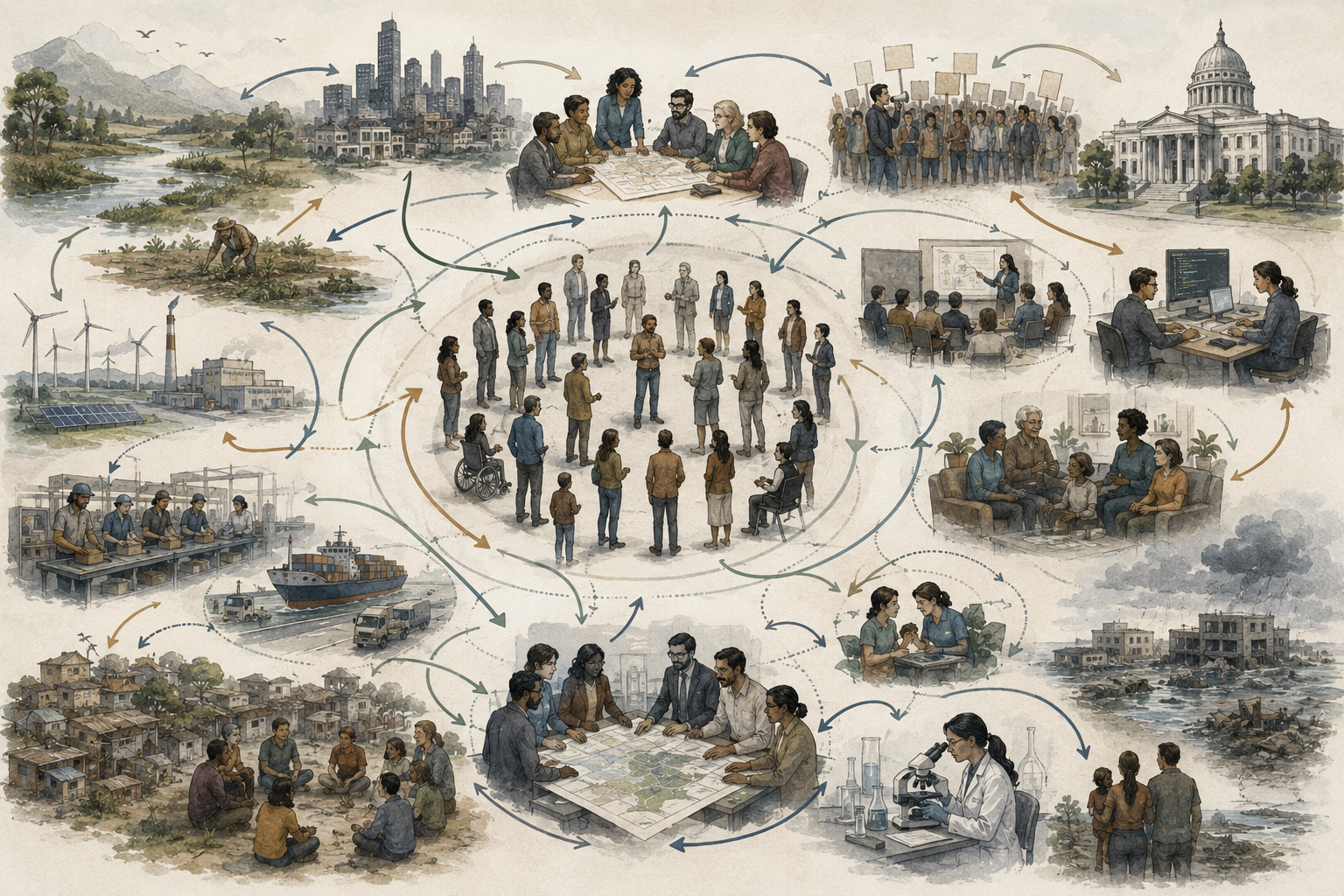
This article explains social change through the lens of complex adaptive systems. It examines adaptive agents, local rules, emergent patterns, social networks, tipping dynamics, institutional resistance, policy feedback, collective action, movement ecology, technology, governance, power, justice, and transformation. The central argument is that social change is not simply implemented from above or willed from below. It emerges through interaction across many levels of a system. Responsible change work therefore requires strategy, humility, feedback, participation, institutional learning, and attention to unequal power.
Why Complex Adaptive Systems Matter for Social Change
Complex adaptive systems matter for social change because social systems respond to intervention. People learn. Institutions defend themselves. Movements adapt strategy. Opponents counter-mobilize. Technologies change incentives. Policies reshape constituencies. Narratives alter legitimacy. Markets reallocate resources. Communities build memory. Public trust rises or falls. Every intervention enters a system that is already moving.
A linear model of social change imagines a problem, a solution, a plan, implementation, and an outcome. This model can be useful for bounded tasks, but it fails when systems are adaptive. A reform may produce backlash. A campaign may shift public opinion but not institutional behavior. A technology may expand access while creating surveillance or dependency. A policy may help one group while creating administrative burden for another. A movement may win symbolic recognition while deeper power structures remain intact. Complex systems produce second-order effects.
Social change often involves multiple scales at once. Individual beliefs matter, but so do social networks, organizational routines, legal rules, economic incentives, media systems, public infrastructure, historical memory, and ecological constraints. A change that succeeds at one scale can fail at another. A local innovation may not scale because institutions resist it. A national policy may fail because local implementation is weak. A cultural shift may occur faster than law. A legal reform may occur before norms change. Systems thinking helps connect these layers.
| Linear-change assumption | Complex-adaptive reality | Systems-thinking implication |
|---|---|---|
| Good solutions scale automatically. | Scaling changes context, incentives, and resistance. | Study adaptation, governance capacity, and local conditions. |
| Information changes behavior directly. | Beliefs are shaped by identity, trust, networks, incentives, and experience. | Work through trusted relationships and structural conditions. |
| Policy implementation is a technical step. | Institutions interpret, delay, reshape, or resist policy. | Design for feedback, accountability, and implementation capacity. |
| Opposition is an obstacle outside the system. | Opposition is part of the adaptive system. | Anticipate counter-adaptation and system defense. |
| Success can be measured by one outcome. | Change produces distributional, temporal, and second-order effects. | Evaluate outcomes across groups, time horizons, and system levels. |
| Transformation is a final state. | Systems keep adapting after change occurs. | Build learning institutions and long-term stewardship. |
Complex adaptive systems thinking does not mean social change is impossible. It means change must be designed as an adaptive process rather than a fixed blueprint. It must include experimentation, feedback, coalition building, institutional redesign, public legitimacy, resilience, and repair. It must identify leverage points while recognizing that systems respond to pressure.
The goal is not perfect prediction. It is better navigation.
What a Complex Adaptive System Is
A complex adaptive system is a system made of many interacting agents that learn, respond, adapt, and produce emergent patterns. The system’s behavior cannot be fully understood by examining isolated parts because interaction changes the outcome. Agents may be individuals, households, organizations, agencies, firms, communities, movements, technologies, institutions, or states. Their behavior is shaped by rules, incentives, norms, beliefs, resources, information, constraints, and relationships.
In a complex adaptive system, agents do not merely follow instructions. They interpret their environment. They learn from experience. They imitate others. They resist pressure. They exploit opportunities. They change strategy. They form alliances. They exit, comply, evade, organize, innovate, or defend the status quo. The system evolves because the agents inside it are adaptive.
\text{Complex Adaptive System} = \text{Agents} + \text{Interactions} + \text{Rules} + \text{Feedback} + \text{Adaptation}
\]
Interpretation: A complex adaptive system emerges when interacting agents adapt under rules, incentives, constraints, and feedback.
Social systems are complex adaptive systems because human beings and institutions make meaning. They do not respond only to material incentives. They respond to identity, legitimacy, dignity, trust, fear, hope, memory, belonging, narratives, and perceived fairness. A policy that looks rational on paper may fail if people do not trust the institution behind it. A reform that improves averages may generate resistance if affected groups experience it as disrespectful or threatening. A movement may grow when people recognize shared grievance and possibility.
Complex adaptive systems are not chaotic in the everyday sense of random disorder. They often produce patterns: norms, institutions, markets, traditions, hierarchies, segregation, cooperation, conflict, trust, polarization, innovation, or reform. These patterns are structured, but they are not always centrally designed. They emerge from repeated interactions over time.
Systems thinking helps analyze those patterns without assuming they are fixed. It asks what local rules produce system-level outcomes, what feedback loops reinforce them, what agents are adapting, what forms of power shape the system, and what interventions could shift the pattern toward justice, resilience, and public value.
Social Change as Emergence
Social change is emergent when large-scale transformation arises from many smaller interactions. A norm changes when enough people behave differently, speak differently, organize differently, or interpret legitimacy differently. A movement grows when local networks connect into broader coalitions. A public issue becomes politically urgent when stories, events, institutions, media attention, and organized pressure converge. A new practice becomes normal when repeated adoption shifts expectations.
Emergence does not mean change is accidental. Organizing, leadership, strategy, institutions, and resources matter. But even planned change becomes emergent because it moves through adaptive systems. A campaign message is interpreted by different audiences. A policy is implemented by different agencies. A technology is used in ways designers did not expect. A local innovation spreads through imitation, translation, and modification. The outcome is not simply the plan. It is the plan interacting with the system.
\text{Social Pattern}_{t+1} = f(\text{Local Action}_t, \text{Network Response}_t, \text{Institutional Reaction}_t, \text{Feedback}_t)
\]
Interpretation: Future social patterns emerge from local action, network response, institutional reaction, and feedback over time.
Emergent change can be constructive or destructive. Solidarity can emerge. So can panic. Mutual aid can emerge. So can scapegoating. Public trust can grow. So can conspiracy belief. Democratic participation can expand. So can authoritarian mobilization. Systems thinking does not romanticize emergence. It asks what conditions produce beneficial emergence and what conditions produce harmful cascades.
Emergence also changes how we understand responsibility. When social harm emerges through many interactions, responsibility may be distributed across rules, institutions, incentives, platforms, histories, and power structures. This does not erase accountability. It deepens it. A society that repeatedly produces racialized harm, economic exclusion, ecological damage, gendered violence, digital manipulation, or institutional distrust cannot treat those patterns as isolated incidents. Emergent harm demands structural diagnosis.
For social change, emergence means strategy must work with pattern formation. It must ask how small actions connect, how narratives spread, how trust is built, how institutions react, how opposition adapts, and how new practices become durable.
Agents, Rules, and Adaptation
Social systems are shaped by agents operating under rules. Rules may be formal, such as laws, regulations, budgets, contracts, property rights, voting systems, school policies, policing practices, procurement rules, and workplace procedures. Rules may also be informal, such as norms, expectations, habits, professional cultures, status hierarchies, gender roles, racialized assumptions, institutional routines, and shared narratives. Agents adapt to both.
People and institutions rarely respond to policy exactly as designed. They interpret incentives. They look for loopholes. They comply symbolically. They resist quietly. They overperform metrics. They game measurement systems. They form coalitions. They shift blame. They learn from one another. They become more capable or more defensive. This adaptive behavior is why social systems often produce unintended consequences.
Rules shape adaptation by making some behaviors easier, safer, more legitimate, more profitable, or more visible than others. A workplace that rewards hours over outcomes produces different adaptation than one that rewards learning and cooperation. A public agency that punishes mistakes may hide problems. A platform that rewards outrage may encourage polarizing content. A school accountability system that rewards test scores may narrow teaching. A housing market structured around exclusionary zoning produces different choices than one organized around affordability and access.
A_{i,t+1} = A_{i,t} + \Delta(\text{Rules}, \text{Incentives}, \text{Information}, \text{Trust}, \text{Power})
\]
Interpretation: Agent behavior changes over time in response to rules, incentives, information, trust, and power.
Adaptation is not always free. People with more resources often adapt more easily. Wealthy households can move, hire lawyers, buy private services, or absorb shocks. Powerful firms can lobby, automate, restructure, or shift costs. Vulnerable communities may be forced to adapt to harm they did not create: pollution, eviction, surveillance, unsafe work, climate risk, administrative burden, or infrastructure failure. The burden of adaptation is therefore an ethical issue.
Systems thinking asks what behavior the rules reward, who has room to adapt, who is forced to absorb risk, and what new rules would support dignity, fairness, learning, and resilience.
Networks, Diffusion, and Thresholds
Social change spreads through networks. People are influenced by family, friends, peers, coworkers, institutions, media, religious communities, schools, unions, professional associations, neighborhoods, online platforms, and trusted leaders. Ideas, practices, emotions, tactics, and norms diffuse unevenly because networks are uneven. Some nodes are hubs. Some are bridges. Some communities are tightly clustered. Some groups are isolated. Some voices are trusted across boundaries.
Diffusion depends on credibility, repetition, identity, usefulness, cost, risk, visibility, and institutional support. A practice spreads when people see others adopting it, believe it is legitimate, and have the capacity to act. A norm changes when enough people expect others to behave differently. A movement grows when individuals who once felt isolated recognize shared grievance and collective possibility.
Thresholds matter because people often change behavior when they believe enough others are changing too. One person may speak publicly only after several others do. A workplace norm may shift when enough employees stop accepting a harmful practice. A policy idea may become viable after coalitions, evidence, public attention, and crisis converge. A social system can appear stable until thresholds are crossed, then change rapidly.
\text{Adoption}_{i,t+1} =
\begin{cases}
1, & \text{if } \frac{\text{Adopting Neighbors}_{i,t}}{\text{Neighbors}_{i}} \geq \theta_i \\
0, & \text{otherwise}
\end{cases}
\]
Interpretation: A threshold model represents adoption as more likely when enough connected agents have already adopted a behavior, belief, or practice.
Networks can also block change. Echo chambers, institutional silos, segregation, professional gatekeeping, disinformation networks, fear, and distrust can limit diffusion. A reform that spreads in one network may fail to reach another. A movement may be strong inside activist communities but weak in institutions. A public-health message may spread through official channels but fail in communities with low institutional trust. Network structure shapes social possibility.
Systems thinking asks where change is diffusing, where it is blocked, which bridges matter, which trusted messengers can cross boundaries, what thresholds may be near, and how network structure distributes power.
Feedback Loops in Social Transformation
Social change is driven by feedback loops. Some loops reinforce change. Others stabilize the status quo. A movement gains visibility, visibility attracts participants, participation increases legitimacy, legitimacy attracts allies, and allies increase pressure. This is a reinforcing loop. But institutions may respond with delay, co-optation, repression, symbolic reform, or procedural barriers. These are balancing or counteracting loops.
Feedback also shapes public belief. People may support an idea when they see it gaining legitimacy. Institutions may adopt a practice when peers adopt it. Media attention may create the perception of momentum, which produces more attention. Policy success can create constituencies that defend the policy. Policy failure can create distrust that makes future reform harder. Feedback links outcomes to future capacity.
\text{Momentum}_{t+1} = \text{Momentum}_t + \text{Visibility}_t + \text{Participation}_t – \text{Resistance}_t
\]
Interpretation: Social-change momentum grows through visibility and participation but can be reduced by resistance, fatigue, repression, or institutional delay.
| Feedback loop | How it works | Possible consequence |
|---|---|---|
| Movement visibility loop | More visibility attracts more participants and allies. | Momentum grows, but backlash may also increase. |
| Trust loop | Reliable institutions increase cooperation; cooperation improves outcomes. | Trust can become self-reinforcing. |
| Distrust loop | Institutional harm reduces trust; low trust weakens participation and compliance. | Public response becomes harder even when policy is sound. |
| Policy feedback loop | Policies create constituencies, expectations, administrative routines, and political incentives. | Reforms can become durable or difficult to reverse. |
| Backlash loop | Visible change mobilizes threatened groups. | Opposition adapts and may slow or reverse reform. |
| Learning loop | Experimentation produces feedback, which improves strategy. | Adaptive capacity grows over time. |
Feedback loops explain why timing matters. A reform introduced before trust exists may fail. A message delivered after a crisis may travel farther. A movement may grow after a triggering event makes hidden harm visible. A policy may become durable when beneficiaries organize to defend it. Systems thinking asks which loops are currently dominant and what interventions might shift loop dominance.
Social change is not only about pushing harder. It is about changing the feedback structure that determines what grows, what stabilizes, what adapts, and what fades.
Resistance, Counter-Adaptation, and System Defense
Complex adaptive systems defend existing patterns. This does not always happen through a single conspiracy or central command. It often happens because many actors benefit from the current arrangement, fear uncertainty, depend on existing routines, or interpret change as threat. Institutions can resist through delay, procedural complexity, symbolic compliance, budget constraints, jurisdictional fragmentation, metric manipulation, or selective enforcement.
Resistance is not always irrational. People may resist because reforms are poorly designed, imposed without participation, or harmful in practice. Communities may resist institutions they do not trust. Workers may resist technology that surveils or deskills them. Local groups may resist policy framed as progress but experienced as displacement. Systems thinking does not treat all resistance as illegitimate. It asks what resistance reveals about trust, power, burden, and design.
Counter-adaptation occurs when opponents learn from change efforts. Firms adapt to regulation. Platforms adapt to oversight. Political actors adapt narratives. Institutions create loopholes. Bad actors adapt to moderation systems. Privileged groups adapt to preserve advantage. If reform does not anticipate counter-adaptation, early gains can be reversed or absorbed.
\text{Net Change} = \text{Reform Pressure} – \text{System Defense} + \text{Learning Capacity}
\]
Interpretation: Durable change depends on reform pressure, the strength of system defense, and the capacity of reform actors and institutions to learn.
System defense can also appear as co-optation. Institutions may adopt the language of change while preserving underlying power. Corporations may use sustainability rhetoric while continuing harmful practices. Agencies may create participation processes without shifting authority. Organizations may adopt diversity statements without changing promotion, pay, workload, or governance. Platforms may create safety dashboards while maintaining incentives that amplify harm.
Systems thinking requires distinguishing symbolic change from structural change. It asks what rules, resources, incentives, relationships, and accountability mechanisms actually changed. It also asks who can enforce the change after attention moves elsewhere.
Institutions, Memory, and Path Dependence
Institutions carry memory. Laws, budgets, buildings, data systems, professional routines, administrative categories, infrastructure, jurisdictional boundaries, and cultural expectations all preserve past decisions. This memory shapes what future change is possible. Path dependence means that systems become easier to move along some trajectories than others because past investments and routines create constraints.
Path dependence explains why social change cannot be understood only by present attitudes. Housing segregation reflects past policy, lending, zoning, violence, infrastructure, and wealth accumulation. Public distrust reflects lived histories of harm, neglect, exclusion, and broken promises. Climate vulnerability reflects past land use, industrial systems, energy choices, and unequal exposure. Organizational culture reflects accumulated incentives, leadership behavior, stories, and habits. The past is not background. It is active structure.
S_{t+1} = f(S_t, H_t, I_t, R_t)
\]
Interpretation: A future social state depends on the current state, historical memory, institutional structure, and reinforcing routines.
Institutional memory can support learning when it preserves evidence, accountability, and public understanding. It can also preserve injustice when harmful categories and routines become normal. A system may continue producing unequal outcomes not because every actor intends harm, but because old structures remain embedded in budgets, maps, data, rules, infrastructure, and professional practice.
Change requires institutional memory to be examined, not erased. A reform that ignores history may misdiagnose the problem. A community that has experienced repeated harm may not trust a new initiative simply because the current leadership promises improvement. Repair requires remembering what happened, acknowledging who was harmed, and changing the structures that made harm repeatable.
Systems thinking treats memory as a design question. What should the institution remember? What should it stop reproducing? What lessons should be made public? What harms require repair? What routines must be redesigned so the past does not continue under new language?
Technology, Media, and Attention Systems
Technology and media systems shape social change by structuring attention, coordination, information, identity, and legitimacy. Platforms can help movements organize, document harm, share knowledge, raise funds, build solidarity, and challenge official narratives. They can also amplify misinformation, harassment, surveillance, outrage, burnout, and manipulation. Digital systems are not neutral channels. They are adaptive environments with incentives.
Attention systems influence what society perceives as urgent. A problem may exist for decades before becoming publicly visible. A video, disaster, report, court case, strike, scandal, or testimony can change attention rapidly. But attention can also fade quickly. Movements and institutions must therefore convert attention into organization, policy, resources, memory, and accountability. Visibility alone is not transformation.
Digital platforms also create feedback loops. Content that receives engagement receives more distribution. Creators adapt to metrics. Opponents adapt to narratives. Institutions respond to reputational pressure. Misinformation can spread faster than correction. Public discourse can become reactive. Complex social change now occurs inside attention systems that are themselves complex adaptive systems.
\text{Social Attention}_{t+1} = f(\text{Events}_t, \text{Media}_t, \text{Platform Ranking}_t, \text{Network Sharing}_t, \text{Institutional Response}_t)
\]
Interpretation: Public attention changes through events, media framing, platform ranking, network sharing, and institutional response.
Technology also changes power. Surveillance tools can monitor activists. Algorithmic systems can shape access to work, housing, credit, education, healthcare, and public benefits. Digital infrastructure can expand participation or deepen exclusion. Generative AI can support research and communication while also producing misinformation, labor disruption, and epistemic confusion. Social change strategies must therefore analyze technology as part of the system, not only as a communication tool.
Systems thinking asks how attention is produced, who controls distribution, what incentives shape visibility, what harms are amplified, what communities are exposed, and how digital tools can support accountable, durable, justice-oriented change rather than short-lived reaction.
Movements, Coalitions, and Collective Action
Social movements are complex adaptive systems. They include individuals, organizations, leaders, informal networks, narratives, tactics, resources, identities, opponents, institutions, media systems, legal structures, and historical memory. They grow through interaction. They change strategy. They split and recombine. They learn from success and failure. They create new language, new expectations, and new political possibilities.
Collective action depends on more than shared grievance. People need a sense that action is possible, legitimate, meaningful, and connected to others. They need trust, coordination, resources, roles, protection, and pathways for participation. Movements often build these through repeated interaction: meetings, mutual aid, training, storytelling, public action, legal support, research, art, digital communication, and institutional pressure.
Coalitions matter because social problems cross boundaries. Climate justice connects energy, housing, labor, health, transportation, land, race, and public finance. Housing justice connects zoning, wages, transit, tenant rights, finance, public housing, homelessness, and land value. Public health connects care, labor, trust, housing, education, environment, and policy. Coalitions allow systems problems to be addressed across silos, but they also require negotiation across different priorities, identities, and strategies.
\text{Collective Capacity} = f(\text{Trust}, \text{Coordination}, \text{Resources}, \text{Narrative}, \text{Strategy}, \text{Protection})
\]
Interpretation: Collective action capacity grows when trust, coordination, resources, shared narrative, strategy, and protection are strong.
Movements can also face internal complexity. Rapid growth can create coordination problems. Visibility can attract repression or co-optation. Different groups may disagree over tactics. Funding can change incentives. Media attention can privilege certain voices. Online mobilization can create participation without durable organization. Systems thinking helps movements ask not only how to mobilize, but how to learn, govern, sustain, and remain accountable.
Durable social change often requires movement energy and institutional change together. Movements create pressure, imagination, legitimacy, and accountability. Institutions translate some demands into policy, resources, and enforcement. Without movements, institutions may not change. Without institutions, movement victories may not become durable public systems. The relationship is tense but necessary.
Policy Feedback and Governance Learning
Policies do not merely solve problems. They reshape politics, institutions, expectations, incentives, identities, and future possibilities. This is policy feedback. A policy can create beneficiaries who defend it. It can create administrative burdens that reduce trust. It can create markets that resist reform. It can change how people understand rights, citizenship, responsibility, or public obligation. Policy becomes part of the system it tries to govern.
Governance learning occurs when institutions use feedback to improve. This requires monitoring, evaluation, public participation, transparency, institutional memory, and willingness to revise. Governance learning fails when agencies hide failure, punish dissent, ignore communities, rely on narrow metrics, or treat implementation as compliance rather than adaptation.
Policy feedback can be positive or negative. A public program that reliably improves life can build trust and support for public action. A program that is punitive, confusing, or inaccessible can create distrust and stigma. A climate policy that lowers costs and improves health can build support. A poorly designed transition that burdens workers or communities can create backlash. A transportation policy that improves access can change land use and opportunity. A policy that ignores displacement can produce new injustice.
\text{Policy Outcome}_{t+1} = f(\text{Design}_t, \text{Implementation}_t, \text{Public Response}_t, \text{Institutional Learning}_t)
\]
Interpretation: Policy outcomes depend on design, implementation, public response, and institutional learning over time.
Systems thinking helps governance move beyond one-time reform. It asks whether policies create learning loops. Are outcomes monitored? Are affected communities heard? Are errors corrected? Are administrative burdens reduced? Are benefits distributed fairly? Are unintended consequences identified early? Are agencies allowed to revise course? Are lessons preserved after leadership changes?
Good governance in complex adaptive systems is not rigid control. It is accountable adaptation. Institutions need enough stability to protect rights and enough flexibility to learn from reality.
Transformation, Resilience, and Justice
Transformation occurs when a system changes its structure, not only its surface behavior. A society does not transform simply because a metric improves temporarily. Transformation changes rules, relationships, power, infrastructure, institutions, norms, and feedback loops. It alters what the system tends to reproduce.
Resilience and transformation are connected but not identical. Resilience can mean preserving essential functions during disturbance. But resilience can also preserve unjust systems if the goal is simply to keep the current structure alive. Justice-oriented transformation asks whether the system should return to its prior state or move toward a different one. A community harmed by pollution does not need resilience only in the sense of endurance. It needs structural change that removes the harm.
Social change requires asking what should be stabilized and what should be transformed. Public health, dignity, ecological integrity, democratic accountability, and care should be protected. Exploitation, exclusion, domination, preventable harm, and ecological destruction should not be made resilient. Systems thinking helps distinguish resilience for life from resilience for power.
\text{Just Transformation} = \text{Structural Change} + \text{Repair} + \text{Participation} + \text{Accountability}
\]
Interpretation: Justice-oriented transformation requires structural change, repair for harm, meaningful participation, and accountability.
Transformation also requires imagination. Systems reproduce themselves partly because alternatives are hard to see. Movements, artists, educators, researchers, communities, and public institutions all help expand the horizon of possibility. New narratives can change what people believe is normal, legitimate, or achievable. But imagination must be connected to structure. A compelling vision needs institutions, resources, laws, infrastructures, practices, and feedback systems that make it durable.
Justice-oriented systems change therefore combines critique, imagination, design, organizing, governance, and repair. It asks not only how to disrupt the current pattern, but how to build a better one that can learn, adapt, and endure.
Ethics: Power, Responsibility, and the Burden of Adaptation
Complex adaptive systems analysis has ethical stakes because adaptation is not equally distributed. Powerful actors often adapt by shifting costs. Firms may shift environmental costs to communities. Institutions may shift administrative burdens to applicants. Platforms may shift moderation trauma to workers. Climate risk may be shifted to poorer regions and future generations. Public agencies may shift failure onto households by requiring them to navigate fragmented systems. The ability to adapt can itself be a form of privilege.
Systems thinking should not become a language for neutral description alone. Social systems are structured by power. Some agents have more authority, wealth, data, legal protection, mobility, voice, and capacity to shape rules. Others are forced to respond to conditions they did not choose. A serious analysis of complex adaptive systems must ask who designs the system, who benefits from it, who is harmed by it, and who is expected to adapt.
Ethical social change asks:
- Who has power to define the problem?
- Who has power to change the rules?
- Who benefits from current system behavior?
- Who bears the burden of adaptation?
- Whose knowledge is treated as legitimate?
- Who is excluded from feedback channels?
- What harms are normalized as background conditions?
- What histories must be remembered for repair to be possible?
- What forms of resistance reveal legitimate distrust?
- What would accountability require if harm is emergent rather than individually intended?
Responsibility in complex systems is not limited to direct intent. If an institution repeatedly produces harmful outcomes, it has a responsibility to examine and redesign the structures that produce them. If a platform repeatedly amplifies harm, it cannot claim neutrality. If a policy repeatedly burdens vulnerable people, it cannot claim fairness because the text is formally equal. Emergent harm still requires repair.
Ethical systems thinking combines humility and responsibility. Humility recognizes uncertainty, adaptation, and unintended consequences. Responsibility insists that uncertainty cannot become an excuse for inaction, denial, or impunity.
Examples Across Complex Social Change Systems
Complex adaptive systems appear across movements, institutions, policy reform, technology, climate action, public health, and cultural change. The examples below show how social change emerges through feedback, adaptation, networks, resistance, and governance.
Public-health behavior change
Health behavior changes through trust, access, social norms, institutional reliability, misinformation, workplace policy, care systems, and lived experience. Information alone is rarely enough.
Climate justice movements
Climate action involves science, energy systems, labor, land, housing, transportation, finance, public health, Indigenous rights, intergenerational responsibility, and political power.
Housing reform
Housing change emerges through zoning, land value, tenant power, public finance, transit, neighborhood politics, construction capacity, speculation, and anti-displacement policy.
Technology governance
AI and platform governance must account for data, incentives, labor, users, institutions, vendors, feedback loops, public trust, and regulatory adaptation.
Workplace culture change
Organizational change depends on incentives, leadership behavior, workload, psychological safety, informal norms, promotion systems, documentation, and institutional memory.
Educational reform
Education systems adapt through teachers, students, families, testing, funding, curriculum, technology, inequality, professional culture, and policy feedback.
Democratic renewal
Democratic systems depend on trust, participation, media, institutions, rights, representation, public capacity, social solidarity, and accountability for concentrated power.
Environmental restoration
Restoration requires ecological feedback, community participation, land governance, scientific monitoring, long-term stewardship, and repair of historical harm.
Across these examples, social change requires more than a correct idea. It requires changing the relationships, incentives, feedback loops, and institutions that determine what the system reproduces.
Mathematics, Computation, and Modeling
Complex adaptive social systems can be explored through agent-based models, diffusion models, threshold models, network analysis, feedback simulations, scenario analysis, causal loop diagrams, institutional process maps, and participatory modeling. These tools do not predict society with certainty. Their purpose is to clarify assumptions, make feedback visible, test scenarios, and support better strategic reasoning.
A simple agent adaptation rule can be represented as:
b_{i,t+1} = b_{i,t} + \alpha(S_{i,t} – b_{i,t})
\]
Interpretation: Agent behavior \(b_i\) adapts toward a perceived social signal \(S_i\) at learning rate \(\alpha\).
A diffusion process can be represented as:
A_{t+1} = A_t + \beta A_t(1 – A_t) – \gamma R_t
\]
Interpretation: Adoption \(A\) can grow through diffusion while resistance \(R\) slows or redirects change.
A social-change momentum index can be represented as:
M = w_nN + w_tT + w_rR + w_iI + w_lL – w_bB
\]
Interpretation: Momentum can combine network reach, trust, resources, institutional openings, learning capacity, and backlash pressure.
A governance learning index can be represented as:
GL = w_fF + w_pP + w_eE + w_mM + w_aA
\]
Interpretation: Governance learning can combine feedback quality, participation, evaluation, institutional memory, and adaptive authority.
| Modeling approach | Social-change question | Example output |
|---|---|---|
| Agent-based modeling | How do local rules and adaptation produce emergent social patterns? | Adoption, polarization, cooperation, fragmentation, or movement growth scenarios. |
| Network diffusion | How do ideas, norms, or practices spread through relationships? | Adoption curves, bridge nodes, blocked communities, threshold effects. |
| Feedback simulation | Which loops reinforce or stabilize the system? | Momentum, backlash, trust, learning, fatigue, and policy feedback trajectories. |
| Scenario analysis | How might different strategies perform under uncertainty? | Baseline, reform, backlash, coalition, governance, and transformation pathways. |
| Participatory modeling | How do affected communities understand the system? | Shared maps, local knowledge, contested assumptions, legitimacy gaps. |
| Institutional process mapping | Where do reforms slow, fail, or become distorted? | Implementation bottlenecks, accountability gaps, administrative burden points. |
Models of social change must be used carefully. They can clarify patterns, but they can also simplify power, history, meaning, and lived experience. A good model should make assumptions visible, invite challenge, include affected knowledge, and support judgment rather than replace it.
Python Workflow: Social Diffusion, Adaptive Agents, and Transformation Scenarios
The Python workflow for this article models social change as an adaptive diffusion system. It uses only the Python standard library so it can run without external dependencies. The workflow compares four scenarios: fragmented baseline, high backlash, coalition learning, and accountable transformation. It simulates adoption, trust, resistance, institutional response, learning capacity, and transformation momentum over time.
# complex_adaptive_social_change_model.py
# Dependency-light professional workflow for complex adaptive systems and social change.
# Purpose: simulate social diffusion, adaptive agents, backlash, trust, institutional response, and transformation momentum.
# Uses only Python standard library.

from dataclasses import dataclass
import csv
import os
from statistics import mean

OUTPUT_TABLES = "outputs/tables"

@dataclass
class SocialChangeScenario:
    name: str
    periods: int
    initial_adoption: float
    network_reach: float
    trust_level: float
    resource_capacity: float
    institutional_openness: float
    backlash_pressure: float
    learning_capacity: float
    participation_quality: float
    equity_alignment: float
    media_amplification: float

def ensure_outputs() -> None:
    os.makedirs(OUTPUT_TABLES, exist_ok=True)

def clamp(value: float, low: float = 0.0, high: float = 100.0) -> float:
    return max(low, min(high, value))

def run_scenario(scenario: SocialChangeScenario) -> list[dict]:
    adoption = scenario.initial_adoption
    trust = scenario.trust_level * 100.0
    resistance = scenario.backlash_pressure * 55.0
    institutional_response = scenario.institutional_openness * 35.0
    movement_capacity = scenario.resource_capacity * 45.0
    learning = scenario.learning_capacity * 45.0
    rows = []

    for period in range(scenario.periods + 1):
        diffusion_gain = (
            scenario.network_reach * adoption * (100.0 - adoption) / 100.0 * 0.075
            + scenario.media_amplification * 2.1
            + trust * 0.018
            + movement_capacity * 0.022
        )

        resistance_growth = (
            adoption * scenario.backlash_pressure * 0.042
            + scenario.media_amplification * scenario.backlash_pressure * 1.4
            - scenario.participation_quality * 1.2
            - scenario.equity_alignment * 1.0
        )

        resistance = clamp(resistance + resistance_growth - learning * 0.018)

        institutional_response = clamp(
            institutional_response
            + adoption * scenario.institutional_openness * 0.035
            + movement_capacity * 0.025
            + scenario.participation_quality * 1.1
            - resistance * 0.020
        )

        learning = clamp(
            learning
            + scenario.learning_capacity * 1.8
            + scenario.participation_quality * 1.4
            + institutional_response * 0.018
            - resistance * 0.010
        )

        trust = clamp(
            trust
            + institutional_response * 0.030
            + scenario.equity_alignment * 1.8
            + scenario.participation_quality * 1.4
            - resistance * 0.035
        )

        movement_capacity = clamp(
            movement_capacity
            + adoption * 0.025
            + trust * 0.020
            + scenario.resource_capacity * 1.5
            - resistance * 0.014
        )

        adoption = clamp(
            adoption
            + diffusion_gain
            + institutional_response * 0.018
            + learning * 0.016
            - resistance * 0.030
        )

        transformation_momentum = clamp(
            adoption * 0.28
            + trust * 0.18
            + institutional_response * 0.20
            + learning * 0.16
            + movement_capacity * 0.12
            + scenario.equity_alignment * 12.0
            - resistance * 0.22
        )

        legitimacy_index = clamp(
            trust * 0.32
            + scenario.participation_quality * 22.0
            + scenario.equity_alignment * 24.0
            + institutional_response * 0.18
            - resistance * 0.15
        )

        rows.append({
            "period": period,
            "scenario": scenario.name,
            "adoption_index": round(adoption, 3),
            "trust_index": round(trust, 3),
            "resistance_index": round(resistance, 3),
            "institutional_response_index": round(institutional_response, 3),
            "movement_capacity_index": round(movement_capacity, 3),
            "learning_capacity_index": round(learning, 3),
            "legitimacy_index": round(legitimacy_index, 3),
            "transformation_momentum": round(transformation_momentum, 3)
        })

    return rows

def write_csv(path: str, rows: list[dict]) -> None:
    if not rows:
        return
    with open(path, "w", newline="", encoding="utf-8") as handle:
        writer = csv.DictWriter(handle, fieldnames=list(rows[0].keys()))
        writer.writeheader()
        writer.writerows(rows)

def summarize(rows: list[dict]) -> list[dict]:
    scenarios = sorted(set(row["scenario"] for row in rows))
    summary = []

    for scenario_name in scenarios:
        subset = [row for row in rows if row["scenario"] == scenario_name]
        final = subset[-1]
        average_momentum = mean(row["transformation_momentum"] for row in subset)
        peak_resistance = max(row["resistance_index"] for row in subset)
        final_legitimacy = final["legitimacy_index"]
        final_adoption = final["adoption_index"]

        summary.append({
            "scenario": scenario_name,
            "final_adoption_index": final_adoption,
            "final_legitimacy_index": final_legitimacy,
            "final_transformation_momentum": final["transformation_momentum"],
            "average_transformation_momentum": round(average_momentum, 3),
            "peak_resistance_index": round(peak_resistance, 3),
            "final_institutional_response_index": final["institutional_response_index"],
            "final_learning_capacity_index": final["learning_capacity_index"],
            "diagnostic": (
                "transformational pathway" if final_adoption >= 70 and final_legitimacy >= 60 else
                "contested change requiring deeper coalition and governance learning" if peak_resistance >= 55 else
                "limited diffusion pathway"
            )
        })

    return summary

def validate(rows: list[dict]) -> list[str]:
    errors = []
    bounded_fields = [
        "adoption_index",
        "trust_index",
        "resistance_index",
        "institutional_response_index",
        "movement_capacity_index",
        "learning_capacity_index",
        "legitimacy_index",
        "transformation_momentum"
    ]

    for row in rows:
        for field in bounded_fields:
            if row[field] < -0.001 or row[field] > 100.001:
                errors.append(f"{field} outside 0-100 range in {row['scenario']} period {row['period']}.")

    return errors

def main() -> None:
    ensure_outputs()

    scenarios = [
        SocialChangeScenario(
            name="Fragmented baseline",
            periods=48,
            initial_adoption=14.0,
            network_reach=0.32,
            trust_level=0.42,
            resource_capacity=0.30,
            institutional_openness=0.24,
            backlash_pressure=0.38,
            learning_capacity=0.28,
            participation_quality=0.30,
            equity_alignment=0.34,
            media_amplification=0.28
        ),
        SocialChangeScenario(
            name="High backlash environment",
            periods=48,
            initial_adoption=18.0,
            network_reach=0.46,
            trust_level=0.38,
            resource_capacity=0.42,
            institutional_openness=0.30,
            backlash_pressure=0.78,
            learning_capacity=0.34,
            participation_quality=0.32,
            equity_alignment=0.36,
            media_amplification=0.64
        ),
        SocialChangeScenario(
            name="Coalition learning strategy",
            periods=48,
            initial_adoption=18.0,
            network_reach=0.62,
            trust_level=0.54,
            resource_capacity=0.58,
            institutional_openness=0.52,
            backlash_pressure=0.42,
            learning_capacity=0.70,
            participation_quality=0.68,
            equity_alignment=0.66,
            media_amplification=0.48
        ),
        SocialChangeScenario(
            name="Accountable transformation pathway",
            periods=48,
            initial_adoption=20.0,
            network_reach=0.70,
            trust_level=0.62,
            resource_capacity=0.68,
            institutional_openness=0.68,
            backlash_pressure=0.34,
            learning_capacity=0.82,
            participation_quality=0.82,
            equity_alignment=0.84,
            media_amplification=0.42
        )
    ]

    all_rows = []
    for scenario in scenarios:
        all_rows.extend(run_scenario(scenario))

    validation_errors = validate(all_rows)
    if validation_errors:
        raise ValueError("Validation failed:\n" + "\n".join(validation_errors))

    summary_rows = summarize(all_rows)

    write_csv(os.path.join(OUTPUT_TABLES, "complex_adaptive_social_change_timeseries.csv"), all_rows)
    write_csv(os.path.join(OUTPUT_TABLES, "complex_adaptive_social_change_summary.csv"), summary_rows)

    with open(os.path.join(OUTPUT_TABLES, "validation_report.txt"), "w", encoding="utf-8") as handle:
        handle.write("Validation passed.\n")
        handle.write("Bounded indicators, adoption, resistance, legitimacy, learning, and transformation outputs completed.\n")

    print("\nComplex adaptive social change scenario summary:")
    for row in summary_rows:
        print(
            f"{row['scenario']}: final adoption={row['final_adoption_index']}, "
            f"momentum={row['final_transformation_momentum']}, "
            f"diagnostic={row['diagnostic']}"
        )

if __name__ == "__main__":
    main()
This workflow shows how social change depends on diffusion, trust, backlash, institutional response, participation quality, equity alignment, and learning capacity. The model is synthetic, but it provides a professional structure for thinking about transformation as an adaptive process rather than a one-time campaign.
A fuller repository version can add optional pandas and matplotlib workflows for richer dashboards, Excel workbooks, sensitivity analysis, network diffusion scenarios, coalition diagnostics, and governance learning scorecards while preserving this standard-library script as the default smoke-tested workflow.
R Workflow: Social Change Indicators, Adoption Tables, and Scenario Visualization
The R workflow for this article uses base R so it can run without additional package dependencies. It reads the Python-generated social-change outputs, creates diagnostic summaries, exports scenario tables, and produces plots for adoption, trust, resistance, institutional response, learning capacity, legitimacy, and transformation momentum.
# complex_adaptive_social_change_diagnostics.R
# Base R workflow for complex adaptive systems and social change.
# Purpose: summarize adoption, resistance, trust, learning, legitimacy, and transformation scenarios.

tables_dir <- "outputs/tables"
figures_dir <- "outputs/figures"

if (!dir.exists(figures_dir)) {
  dir.create(figures_dir, recursive = TRUE)
}

timeseries_path <- file.path(tables_dir, "complex_adaptive_social_change_timeseries.csv")
summary_path <- file.path(tables_dir, "complex_adaptive_social_change_summary.csv")

if (!file.exists(timeseries_path)) {
  stop("Missing complex_adaptive_social_change_timeseries.csv. Run the Python workflow first.")
}

social <- read.csv(timeseries_path, stringsAsFactors = FALSE)

last_by_scenario <- do.call(
  rbind,
  lapply(split(social, social$scenario), function(df) df[nrow(df), ])
)

avg_momentum <- aggregate(transformation_momentum ~ scenario, data = social, FUN = mean)
peak_resistance <- aggregate(resistance_index ~ scenario, data = social, FUN = max)
final_adoption <- last_by_scenario[, c("scenario", "adoption_index")]
final_legitimacy <- last_by_scenario[, c("scenario", "legitimacy_index")]
final_learning <- last_by_scenario[, c("scenario", "learning_capacity_index")]

names(avg_momentum)[2] <- "average_transformation_momentum"
names(peak_resistance)[2] <- "peak_resistance_index"
names(final_adoption)[2] <- "final_adoption_index"
names(final_legitimacy)[2] <- "final_legitimacy_index"
names(final_learning)[2] <- "final_learning_capacity_index"

diagnostics <- Reduce(
  function(x, y) merge(x, y, by = "scenario"),
  list(avg_momentum, peak_resistance, final_adoption, final_legitimacy, final_learning)
)

diagnostics$diagnostic <- ifelse(
  diagnostics$final_adoption_index >= 70 &
    diagnostics$final_legitimacy_index >= 60,
  "transformational pathway",
  ifelse(
    diagnostics$peak_resistance_index >= 55,
    "contested change requiring deeper coalition and governance learning",
    "limited diffusion pathway"
  )
)

write.csv(diagnostics, summary_path, row.names = FALSE)
print(diagnostics)

plot_metric <- function(metric, y_label, title, output_name) {
  png(file.path(figures_dir, output_name), width = 1200, height = 700)
  scenarios <- unique(social$scenario)
  plot(
    NA,
    xlim = range(social$period),
    ylim = range(social[[metric]], na.rm = TRUE),
    xlab = "Period",
    ylab = y_label,
    main = title
  )
  for (scenario_name in scenarios) {
    subset_data <- social[social$scenario == scenario_name, ]
    lines(subset_data$period, subset_data[[metric]], lwd = 2)
  }
  legend("topleft", legend = scenarios, lwd = 2, cex = 0.8, bty = "n")
  grid()
  dev.off()
}

plot_metric(
  metric = "adoption_index",
  y_label = "Adoption index",
  title = "Social Adoption by Scenario",
  output_name = "social_adoption_trajectories.png"
)

plot_metric(
  metric = "trust_index",
  y_label = "Trust index",
  title = "Trust by Social Change Scenario",
  output_name = "social_trust_trajectories.png"
)

plot_metric(
  metric = "resistance_index",
  y_label = "Resistance index",
  title = "Resistance by Scenario",
  output_name = "social_resistance_trajectories.png"
)

plot_metric(
  metric = "institutional_response_index",
  y_label = "Institutional response index",
  title = "Institutional Response by Scenario",
  output_name = "institutional_response_trajectories.png"
)

plot_metric(
  metric = "learning_capacity_index",
  y_label = "Learning capacity index",
  title = "Learning Capacity by Scenario",
  output_name = "learning_capacity_trajectories.png"
)

plot_metric(
  metric = "legitimacy_index",
  y_label = "Legitimacy index",
  title = "Legitimacy by Social Change Scenario",
  output_name = "legitimacy_trajectories.png"
)

plot_metric(
  metric = "transformation_momentum",
  y_label = "Transformation momentum",
  title = "Transformation Momentum by Scenario",
  output_name = "transformation_momentum_trajectories.png"
)

final_table <- last_by_scenario[, c(
  "scenario",
  "adoption_index",
  "trust_index",
  "resistance_index",
  "institutional_response_index",
  "movement_capacity_index",
  "learning_capacity_index",
  "legitimacy_index",
  "transformation_momentum"
)]

write.csv(
  final_table,
  file.path(tables_dir, "complex_adaptive_social_change_final_diagnostics.csv"),
  row.names = FALSE
)

print(final_table)
This R workflow helps interpret social change as behavior over time. It shows whether adoption grows with legitimacy, whether resistance overwhelms momentum, whether institutional response strengthens learning, and whether transformation becomes durable. The default version remains portable and dependency-light.
A fuller version can add package-based dashboards, uncertainty analysis, network diffusion visualizations, threshold sensitivity, coalition comparison, and public-value scorecards through an optional advanced analysis environment. The base R workflow remains the stable reproducible layer.
GitHub Repository
The companion repository for this article should help readers model social change through adaptive agents, diffusion, trust, resistance, institutional response, coalition learning, legitimacy, policy feedback, and transformation momentum using synthetic datasets and reproducible workflows.
Complete Code RepositoryCompanion repository for the article, including complex adaptive social-change simulations, diffusion and threshold models, coalition-learning diagnostics, resistance and backlash scenarios, governance-learning indicators, Python and R workflow scripts, synthetic datasets, documentation assets, and multi-language scaffolds for systems analysis.
articles/complex-adaptive-systems-and-social-change/
├── python/
│   ├── complex_adaptive_social_change_model.py
│   ├── social_diffusion_threshold_scenarios.py
│   ├── coalition_learning_diagnostics.py
│   ├── backlash_resistance_model.py
│   ├── governance_learning_index.py
│   ├── transformation_momentum_score.py
│   └── export_social_change_outputs.py
├── r/
│   ├── complex_adaptive_social_change_diagnostics.R
│   ├── adoption_trajectory_visualization.R
│   ├── resistance_legitimacy_tables.R
│   ├── coalition_learning_plots.R
│   ├── transformation_momentum_summary.R
│   └── export_social_change_tables.R
├── julia/
│   ├── nonlinear_social_diffusion_model.jl
│   ├── threshold_adoption_sensitivity.jl
│   └── transformation_dynamics.jl
├── sql/
│   ├── schema_agents.sql
│   ├── schema_network_edges.sql
│   ├── schema_social_signals.sql
│   ├── schema_policy_events.sql
│   ├── schema_institutional_responses.sql
│   ├── schema_resistance_events.sql
│   ├── schema_learning_cycles.sql
│   ├── schema_model_runs.sql
│   └── schema_outputs.sql
├── rust/
│   └── social_change_scenario_validator.rs
├── go/
│   └── social_diffusion_runner.go
├── cpp/
│   ├── efficient_threshold_diffusion_scan.cpp
│   └── coalition_momentum_solver.cpp
├── fortran/
│   └── recurrence_social_diffusion_model.f90
├── c/
│   └── low_level_social_diffusion_kernel.c
├── docs/
│   ├── modeling_principles.md
│   ├── article_notes.md
│   ├── complex_adaptive_social_change_framework.md
│   ├── diffusion_and_threshold_guide.md
│   ├── governance_learning_notes.md
│   ├── python_workflow.md
│   ├── r_workflow.md
│   ├── diagnostic_questions.md
│   ├── ethics_and_power_analysis.md
│   ├── assumptions_and_limitations.md
│   └── responsible_use.md
├── data/
│   ├── synthetic_agents.csv
│   ├── synthetic_network_edges.csv
│   ├── synthetic_social_signals.csv
│   ├── synthetic_policy_events.csv
│   ├── synthetic_institutional_responses.csv
│   ├── synthetic_resistance_events.csv
│   ├── synthetic_learning_cycles.csv
│   ├── synthetic_model_runs.csv
│   └── synthetic_outputs.csv
├── outputs/
│   ├── README.md
│   ├── figures/
│   └── tables/
└── notebooks/
    ├── python_complex_adaptive_social_change_walkthrough.ipynb
    └── r_social_change_diagnostics_visualization_placeholder.ipynb
This repository structure supports the article’s central argument: social change should be analyzed through adaptive agents, network diffusion, feedback loops, resistance, institutional memory, governance learning, legitimacy, participation, equity, and transformation momentum. The python/ folder supports dependency-light simulation and diagnostics. The r/ folder supports visualization and interpretive summaries. The julia folder supports nonlinear social diffusion. The sql folder defines schemas for social-change systems data. The lower-level language folders provide scaffolds for threshold diffusion scanning, coalition momentum solving, recurrence modeling, and low-level social diffusion simulation.
A Practical Method for Complex Social Change Diagnosis
Complex social change diagnosis requires moving from isolated interventions to adaptive system analysis. The method below can support movement strategy, public policy, institutional reform, technology governance, climate action, public-health change, and justice-oriented transformation.
1. Define the change system
Clarify the system being changed: institution, policy regime, cultural norm, infrastructure system, platform, market, community, governance structure, or social movement field.
2. Identify agents and roles
Map affected communities, institutions, movement actors, opponents, intermediaries, funders, media, regulators, firms, workers, and public agencies.
3. Map formal and informal rules
Identify laws, policies, budgets, incentives, norms, routines, professional cultures, narratives, and power structures that shape behavior.
4. Trace feedback loops
Identify loops of trust, distrust, visibility, backlash, policy feedback, institutional learning, participation, fatigue, and resistance.
5. Analyze network diffusion
Ask how ideas, practices, tactics, and norms spread; identify bridge nodes, trusted messengers, blocked communities, and threshold dynamics.
6. Anticipate counter-adaptation
Identify how opponents, institutions, markets, platforms, or privileged groups may adapt to preserve existing patterns.
7. Examine path dependence
Ask how history, infrastructure, law, data, trauma, institutional memory, and prior reforms shape current possibility.
8. Build learning capacity
Create feedback channels, public evaluation, community participation, documentation, institutional memory, and strategy revision.
9. Evaluate distributional effects
Ask who benefits, who is burdened, who is asked to adapt, whose knowledge counts, and whose harm is treated as acceptable.
10. Design for durable transformation
Shift rules, resources, relationships, institutions, accountability, and feedback loops so the system reproduces a better pattern over time.
Common Pitfalls
Social-change strategy can fail when complex adaptive systems are treated as simple implementation environments. Several patterns are especially common.
- Assuming information is enough: people respond through trust, identity, incentives, networks, lived experience, and institutional memory, not information alone.
- Ignoring counter-adaptation: powerful actors, institutions, and opponents often learn and adapt to preserve existing patterns.
- Confusing visibility with transformation: attention can create opportunity, but durable change requires organization, policy, resources, and accountability.
- Overlooking implementation systems: reforms fail when agencies lack capacity, trust, authority, or incentives to carry them out.
- Treating resistance as irrational: resistance may reveal distrust, poor design, unequal burden, or legitimate fear of harm.
- Neglecting institutional memory: current patterns often reproduce past decisions, trauma, exclusion, infrastructure, and administrative routines.
- Designing for averages: social change must be evaluated across groups, places, vulnerabilities, and time horizons.
- Making injustice resilient: resilience should protect life, dignity, ecology, and public value, not stabilize harmful systems.
The deeper mistake is treating social change as a linear project rather than an adaptive transformation of rules, relationships, feedback loops, institutions, power, and public imagination.
Why Social Change Requires Systems Thinking
Social change requires systems thinking because social systems respond. People adapt to policy. Institutions defend routines. Movements learn. Opponents counter-mobilize. Technologies reshape attention. Public trust changes behavior. Historical memory shapes legitimacy. Networks determine how ideas spread. Rules determine what actions are rewarded. Power determines who can change the rules and who is forced to live with them.
A complex adaptive view does not make change impossible. It makes change more realistic. It shows why simple plans fail, why symbolic reform is insufficient, why backlash must be anticipated, why local knowledge matters, why implementation is political, why feedback must be continuous, and why justice requires structural repair. It also shows why small actions can matter when they connect to networks, narratives, institutions, and thresholds.
Systems thinking changes the question from “How do we implement a solution?” to “How do we shift the pattern the system reproduces?” That question leads to deeper work: changing rules, incentives, relationships, governance, narratives, resource flows, accountability mechanisms, and feedback loops. It also requires humility, because social systems are uncertain; and responsibility, because uncertainty does not erase harm.
Durable social transformation is not only disruption. It is learning, repair, institution-building, public trust, coalition, imagination, and stewardship. Complex adaptive systems remind us that justice is not achieved by pulling one lever. It is built by changing the conditions through which society adapts, remembers, responds, and becomes capable of something better.
Related Articles
- What Is Systems Thinking?
- Emergence, Adaptation, and Complexity
- Networks, Dependencies, and Cascade Risk
- Systems Thinking in Governance and Public Institutions
- Systems Thinking in AI and Technology
- Platforms, Feedback Loops, and Digital Systems
- Intelligent Infrastructure as a System
- Jay Forrester and the Origins of System Dynamics
Further Reading
- Holland, John H. Complexity: A Very Short Introduction. Oxford University Press.
- Miller, John H. and Page, Scott E. Complex Adaptive Systems: An Introduction to Computational Models of Social Life. Princeton University Press.
- Page, Scott E. Diversity and Complexity. Princeton University Press.
- Ostrom, Elinor. Governing the Commons: The Evolution of Institutions for Collective Action. Cambridge University Press.
- Tilly, Charles and Tarrow, Sidney. Contentious Politics. Oxford University Press.
- McAdam, Doug, Tarrow, Sidney and Tilly, Charles. Dynamics of Contention. Cambridge University Press.
- Pierson, Paul. Politics in Time: History, Institutions, and Social Analysis. Princeton University Press.
- Meadows, Donella H. Thinking in Systems: A Primer. Chelsea Green Publishing.
- Sterman, John D. Business Dynamics: Systems Thinking and Modeling for a Complex World. Irwin/McGraw-Hill.
- Westley, Frances, Zimmerman, Brenda and Patton, Michael Quinn. Getting to Maybe: How the World Is Changed. Vintage Canada.
References
- Holland, J.H. (2014) Complexity: A Very Short Introduction. Oxford: Oxford University Press. Available at: https://global.oup.com/academic/product/complexity-a-very-short-introduction-9780199662548
- McAdam, D., Tarrow, S. and Tilly, C. (2001) Dynamics of Contention. Cambridge: Cambridge University Press. Available at: https://www.cambridge.org/core/books/dynamics-of-contention/2E5E4A7B21B5370D94A8B8A9925E9387
- Meadows, D.H. (2008) Thinking in Systems: A Primer. White River Junction, VT: Chelsea Green Publishing. Available at: https://www.chelseagreen.com/product/thinking-in-systems/
- Miller, J.H. and Page, S.E. (2007) Complex Adaptive Systems: An Introduction to Computational Models of Social Life. Princeton, NJ: Princeton University Press. Available at: https://press.princeton.edu/books/paperback/9780691127026/complex-adaptive-systems
- Ostrom, E. (1990) Governing the Commons: The Evolution of Institutions for Collective Action. Cambridge: Cambridge University Press.
- Page, S.E. (2010) Diversity and Complexity. Princeton, NJ: Princeton University Press. Available at: https://press.princeton.edu/books/paperback/9780691137674/diversity-and-complexity
- Pierson, P. (2004) Politics in Time: History, Institutions, and Social Analysis. Princeton, NJ: Princeton University Press. Available at: https://press.princeton.edu/books/paperback/9780691117157/politics-in-time
- Sterman, J.D. (2000) Business Dynamics: Systems Thinking and Modeling for a Complex World. Boston: Irwin/McGraw-Hill.
- Tilly, C. and Tarrow, S. (2015) Contentious Politics. 2nd edn. Oxford: Oxford University Press. Available at: https://global.oup.com/academic/product/contentious-politics-9780190255053
- Westley, F., Zimmerman, B. and Patton, M.Q. (2006) Getting to Maybe: How the World Is Changed. Toronto: Vintage Canada.