
Last Updated June 1, 2026
Events are visible. Patterns are repeated. Structures are generative. Systems thinking begins when explanation moves from the surface of what happened to the deeper question of why similar things keep happening across time, place, and circumstance. A single event can demand attention, but an event rarely explains itself. To understand a system, one must ask what recurring pattern the event belongs to and what structure makes that pattern more likely.
This distinction is one of the foundations of systems thinking. Events are the incidents, crises, outcomes, failures, achievements, shocks, and disruptions that appear in daily life. Patterns are the trends and repetitions that connect events across time. Structures are the relationships, rules, incentives, resources, constraints, feedback loops, delays, mental models, and power arrangements that generate those patterns. Structural explanation does not deny individual action. It asks how action is shaped, enabled, constrained, repeated, rewarded, punished, normalized, and reproduced by the system in which it occurs.
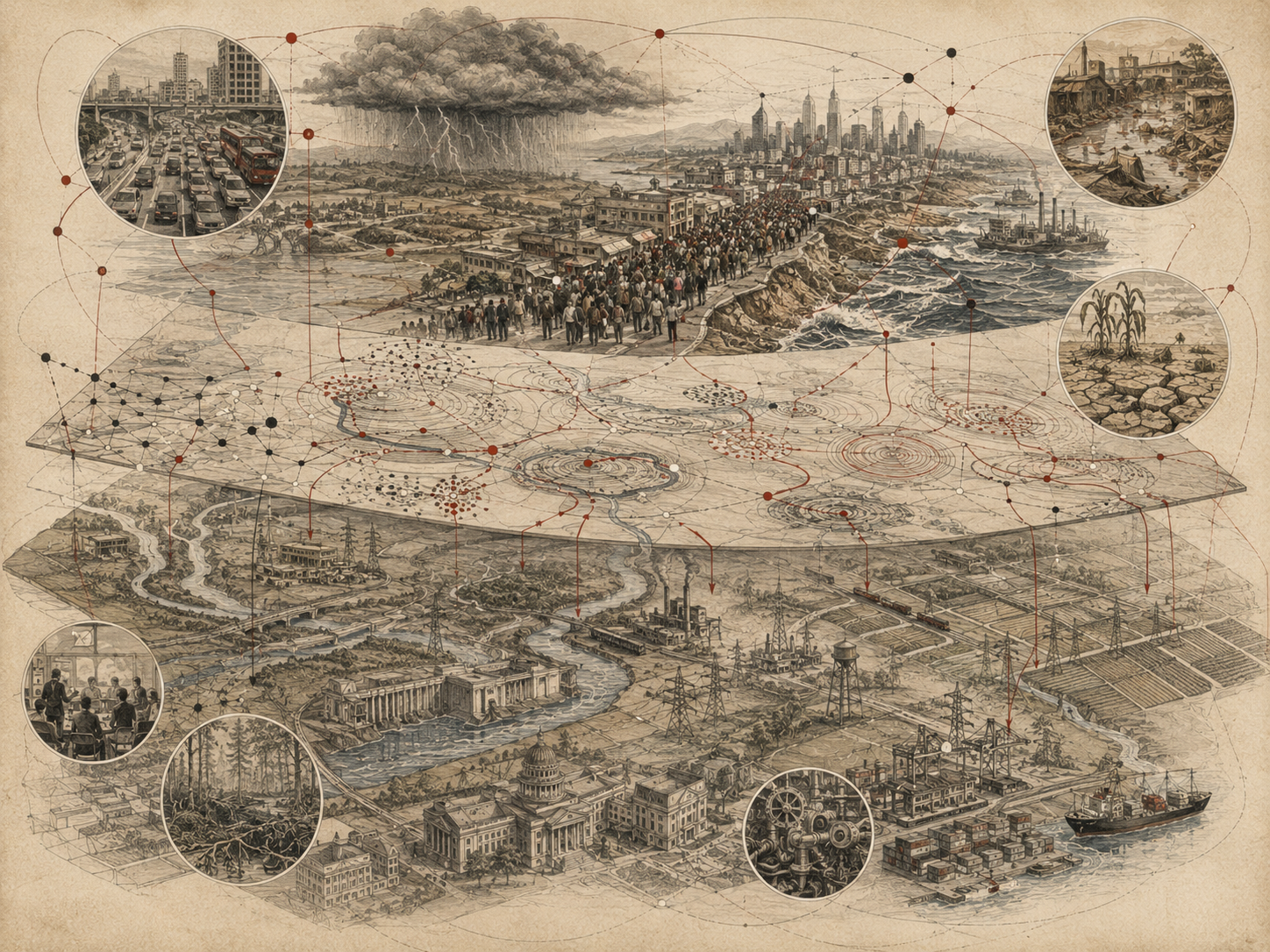
Many institutions fail because they remain trapped at the event level. They react to the latest crisis, latest metric, latest complaint, latest scandal, latest shortage, latest outage, latest conflict, or latest political pressure. Event response is necessary, but it is not sufficient. A hospital can respond to overcrowding without understanding the pattern of demand, staffing, discharge delay, insurance rules, housing insecurity, and public-health fragility that produces overcrowding. A city can repair a flooded street without understanding the pattern of development, drainage capacity, climate exposure, maintenance backlog, and land-use incentives that produces repeated flooding. An organization can discipline an employee without understanding the workload, communication, incentive, and leadership structure that repeatedly produces the same failure.
Structural explanation is the bridge between systems thinking and responsible action. It asks what must be understood before an intervention can be trusted. It also asks whether the system is being explained honestly. The event level is often politically convenient because it narrows attention to the most visible incident or actor. The structural level is more demanding because it reveals relationships, histories, incentives, and forms of responsibility that may be distributed across the system itself.
Events, Patterns, and Structures
Systems thinking often begins with a layered distinction among events, patterns, and structures. The event is the thing that happened. The pattern is the behavior repeated across time. The structure is the arrangement that makes the pattern likely. This distinction helps prevent a common error: mistaking the most recent or dramatic incident for the deepest cause.
An event might be a bridge closure, a missed deadline, a school suspension, a data breach, a patient readmission, a sudden shortage, a flood, a workplace conflict, a failed product launch, or a public-health outbreak. At the event level, the question is immediate: What happened? Who was involved? What damage occurred? What response is required now?
A pattern connects events across time. The question becomes: Has this happened before? Is it increasing or decreasing? Does it occur in particular places, groups, seasons, departments, technologies, neighborhoods, or institutions? What trend does the event reveal? At this level, the event becomes evidence of system behavior.
A structure explains why the pattern persists. The question becomes: What relationships, rules, incentives, constraints, resources, delays, feedback loops, and assumptions keep producing this pattern? Structural explanation studies the conditions that make repeated outcomes intelligible.
| Level of explanation | Primary question | Typical response | Systems-thinking limitation |
|---|---|---|---|
| Event | What happened? | Respond, repair, punish, report, contain, explain the incident. | May treat a symptom as a cause. |
| Pattern | What keeps happening? | Track trends, compare cases, identify recurrence, map behavior over time. | May describe repetition without explaining why it persists. |
| Structure | What makes the pattern likely? | Analyze relationships, incentives, feedback, boundaries, rules, resources, power, and mental models. | Requires deeper evidence, broader accountability, and more complex intervention. |
The distinction does not mean that events are unimportant. Events matter. People experience systems through events: a missed bus, a denied claim, a flooded basement, a hospital delay, a lost job, a harmful algorithmic decision, a school closure, a service failure. Systems thinking does not look past those experiences. It treats them as signals. The event is often where harm becomes visible. The deeper question is whether the event is exceptional or structurally produced.
The movement from event to pattern to structure is therefore not a rejection of immediate experience. It is a disciplined attempt to understand why experience takes the form it does.
The Event Level: What Happened?
The event level is the most visible level of system behavior. It is where organizations, media, governments, managers, and citizens often focus because events are concrete. A train derails. A hospital runs out of beds. A city experiences flooding. A company misses a deadline. A school reports rising absenteeism. A platform spreads harmful content. A regulatory agency discovers contamination. A public institution loses trust after a scandal.
Event-level analysis is necessary because immediate action is often required. Systems thinking is not an argument against response. When a bridge fails, people must be protected. When water is contaminated, distribution systems must be secured. When a patient is harmed, the harm must be addressed. When a cybersecurity breach occurs, containment is urgent. Responsible systems thinking begins with the reality of the event, not with abstraction.
The problem begins when event response becomes the whole explanation. Event-level thinking often produces narrow questions: Who made the mistake? Which component failed? Which department owns the issue? Which rule was violated? What message should be released? What repair is needed? These questions can be valid, but they are incomplete when the same type of event keeps recurring.
Event-level explanation has several advantages. It is fast. It is actionable. It identifies immediate damage. It can assign responsibility. It can mobilize resources. But it also has limits:
- It may focus on the nearest actor rather than the deeper arrangement.
- It may reward crisis response while neglecting prevention.
- It may hide patterns by treating each incident as unique.
- It may encourage blame without learning.
- It may create solutions that suppress symptoms while preserving causes.
Event-level thinking is especially tempting in institutions because institutions are often measured by their ability to respond visibly. A press conference, investigation, disciplinary action, emergency repair, task force, new policy, or public statement can create the appearance of action. Yet if the underlying structure remains intact, similar events may return. The system has not learned; it has merely absorbed the event.
Systems thinking therefore asks event-level questions, but refuses to stop there.
The Pattern Level: What Keeps Happening?
The pattern level connects events across time. A pattern may appear as a trend, cycle, repetition, distribution, concentration, fluctuation, seasonality, or recurring failure mode. Pattern recognition is the point at which systems thinking begins to separate itself from incident management.
A single outage is an event. Monthly outages concentrated in the same infrastructure segment are a pattern. A single resignation is an event. Rising turnover among experienced staff across several quarters is a pattern. One flooded street is an event. Repeated flooding in the same low-income neighborhoods after moderate storms is a pattern. One delayed permit is an event. A permit process that predictably delays small applicants while large firms navigate it easily is a pattern.
Patterns matter because they reveal behavior over time. Systems are dynamic. They have histories. They accumulate conditions. They produce trajectories. Without pattern recognition, decision-makers are often trapped in the present tense, responding to the latest visible symptom while missing the system’s direction of travel.
\text{Pattern} = \{E_1, E_2, E_3, \ldots, E_n\} \text{ organized across time, location, or condition}
\]
Interpretation: A pattern is not merely a list of events. It is a meaningful recurrence or distribution that suggests the system is producing similar outcomes under related conditions.
At the pattern level, analysis begins to ask:
- Is the problem increasing, decreasing, stabilizing, or oscillating?
- Where does it occur most often?
- Who experiences it most intensely?
- Which conditions precede it?
- Which indicators move together?
- What is delayed, accumulated, or displaced?
- What repeats even when individual people change?
Pattern analysis introduces time into explanation. It shows whether the system is improving, worsening, cycling, drifting, or resisting change. A stable average may hide widening inequality. A short-term improvement may hide long-term depletion. A visible decline in one metric may reflect displacement into another part of the system. A sudden crisis may be the late-stage expression of a long pattern of accumulation.
This is why systems thinkers often use behavior-over-time graphs. A behavior-over-time graph does not need to be mathematically complex. It simply asks how a key condition changes over time. Trust, capacity, cost, emissions, backlog, risk, stress, demand, inequality, biodiversity, attendance, maintenance, and response time can all be treated as system behaviors. Once behavior is visible, deeper explanation becomes possible.
Yet pattern recognition alone is not enough. A trend can tell us what is happening. It does not automatically tell us why. Structural explanation is the next step.
The Structural Level: What Makes the Pattern Likely?
Structural explanation asks why a pattern persists. It looks beneath recurring events to the arrangement of relationships that generates them. In systems thinking, structure does not mean only physical structure. It includes rules, incentives, information flows, decision rights, resource distribution, institutional routines, measurement systems, technologies, boundaries, norms, authority, feedback loops, and mental models.
A structure is generative. It does not merely sit underneath events. It actively shapes what actions are likely, what information is available, what choices are rewarded, what harms are ignored, and what outcomes recur. To explain structurally is to identify how the system is organized to produce its behavior.
For example, repeated employee burnout may be structurally produced by understaffing, unclear priorities, constant availability expectations, weak management boundaries, incentive systems that reward overwork, lack of recovery time, poor process design, and cultural narratives that equate exhaustion with commitment. A burnout event might be treated as an individual health problem. A burnout pattern might be measured through absenteeism, turnover, and engagement scores. A structural explanation asks why the organization repeatedly converts human capacity into depletion.
Similarly, repeated infrastructure failure may be structurally produced by deferred maintenance, fragmented funding, political incentives that reward new construction over repair, climate exposure, aging assets, procurement constraints, weak inspection cycles, and unequal public visibility. The event is a failure. The pattern is recurrence. The structure is the set of arrangements that makes recurrence likely.
| Structural element | Systems question | Example |
|---|---|---|
| Rules | What formal constraints shape behavior? | Eligibility rules, procurement requirements, performance standards, compliance procedures. |
| Incentives | What behavior is rewarded or punished? | Short-term output targets, budget rules, promotion criteria, platform engagement metrics. |
| Information flows | Who knows what, when, and with what accuracy? | Delayed reporting, hidden complaints, fragmented data systems, inaccessible dashboards. |
| Resources | What capacities are available or missing? | Staffing, funding, maintenance capacity, technical infrastructure, local knowledge. |
| Authority | Who can decide, intervene, veto, or delay? | Centralized approval, weak local control, fragmented jurisdiction, unaccountable ownership. |
| Feedback | How do consequences return to influence the system? | Trust erosion, demand escalation, backlog growth, public pressure, regulatory backlash. |
| Mental models | What assumptions define the problem? | Deficit narratives, market-only thinking, technological solutionism, blame-based management. |
Structural explanation also helps distinguish between proximate cause and system cause. A proximate cause may be the immediate trigger. A system cause is the deeper arrangement that made the trigger consequential. A spark may start a fire, but fire risk depends on fuel load, weather, land management, building design, emergency capacity, infrastructure location, and climate conditions. A spark matters. It is not the whole explanation.
To think structurally is to ask why a system is vulnerable to certain triggers, why certain actors repeatedly face certain outcomes, and why similar reforms fail despite repeated attempts.
Mental Models Beneath Structure
Many systems diagrams stop at visible structure: rules, resources, relationships, workflows, and feedback loops. But systems are also shaped by mental models. A mental model is an underlying assumption about how the world works, what matters, who is credible, what counts as evidence, what success means, and what kinds of intervention are considered legitimate.
Mental models matter because they influence the structures that institutions build. If a public system defines poverty primarily as individual failure, it will design different policies than if it defines poverty as a condition shaped by wages, housing, education, health, discrimination, geography, family care burdens, and public investment. If an organization defines workers as replaceable labor inputs, it will build different systems than if it defines them as knowledge-bearing participants. If a technology platform defines attention as the main measure of value, it will build different feedback loops than if it defines public trust, safety, or democratic resilience as core performance concerns.
Structural explanation therefore requires interpretive explanation. The visible system often expresses an invisible theory. The way a system measures success reveals what it values. The way it allocates resources reveals whose needs count. The way it assigns blame reveals its theory of responsibility. The way it collects data reveals what it considers knowable. The way it handles complaints reveals who has voice.
Donella Meadows famously described the power of paradigms and goals as among the deepest leverage points in systems. This insight matters because changing a rule may not change the system if the mental model remains intact. A school can adopt new language about inclusion while preserving disciplinary structures that exclude. A company can announce wellbeing priorities while maintaining incentives that reward overload. A government can publish equity statements while using budget formulas that reproduce unequal capacity. A platform can describe itself as empowering users while monetizing extraction, dependency, and surveillance.
Structural explanation must therefore ask:
- What assumptions shaped the system’s design?
- What does the system treat as normal?
- What does it treat as failure?
- Whose knowledge is recognized?
- Whose burden is hidden?
- Which outcomes are measured, and which are ignored?
- What story does the system tell about the people affected by it?
Events expose symptoms. Patterns reveal recurrence. Structures explain production. Mental models reveal why the structure was built and maintained.
From Linear Cause to Structural Causality
Ordinary explanation often relies on linear causality: A caused B. Linear causality is useful in many situations. A switch turns on a light. A broken pipe causes a leak. A missing file delays a process. A contaminated ingredient causes illness. But complex systems often require structural causality. In structural causality, outcomes are produced by interacting conditions rather than a single isolated cause.
Structural causality is not vague causality. It is disciplined attention to how multiple causal forces interact. A system can produce an outcome through feedback, accumulation, threshold effects, information delay, institutional rules, resource constraints, and actor adaptation. The causal pathway may not be visible in one event. It becomes visible through repeated behavior.
For example, a student missing school may have an immediate explanation: illness, transportation failure, family obligation, disciplinary exclusion, or disengagement. A structural explanation asks how those immediate reasons are distributed. Are absences concentrated where housing is unstable? Where public transit is weak? Where asthma rates are high because of environmental exposure? Where students provide sibling care? Where disciplinary policy removes students from class? Where schools lack counselors? The cause is not one thing. The pattern emerges from interacting conditions.
Structural causality often includes:
- Distributed causation: no single actor fully controls the outcome.
- Recursive causation: effects return to shape causes.
- Delayed causation: consequences appear long after the initial action.
- Conditional causation: a cause matters only under certain system conditions.
- Threshold causation: gradual pressure produces sudden change after a boundary is crossed.
- Institutional causation: rules, incentives, and norms organize repeated behavior.
- Interpretive causation: assumptions shape what actors notice, value, and do.
O_t = f(R_t, I_t, C_t, F_t, D_t, M_t)
\]
Interpretation: A system outcome \(O_t\) at time \(t\) can be understood as a function of relationships \(R_t\), incentives \(I_t\), constraints \(C_t\), feedback \(F_t\), delays \(D_t\), and mental models \(M_t\). This is a conceptual model, not a claim that all systems can be reduced to one formula.
This shift changes accountability. In a linear frame, responsibility is often assigned to the last visible actor before failure. In a structural frame, responsibility may include designers, policymakers, funders, managers, regulators, institutional norms, measurement systems, and inherited arrangements. Structural causality asks how the system organized the conditions under which individual action took place.
That does not eliminate individual responsibility. It contextualizes it. A nurse, teacher, engineer, driver, analyst, caseworker, or employee can still make consequential choices. But when similar failures repeat across many individuals, the explanation cannot remain individual forever. At some point, recurrence becomes evidence of structure.
Time, Accumulation, and Recurrence
Patterns become visible through time. Structural explanation therefore requires temporal thinking. Many systems problems are misdiagnosed because decision-makers focus on the incident that finally made the problem visible rather than the accumulation that made the incident possible.
Accumulation is central to systems thinking. Public trust accumulates or erodes. Maintenance backlog accumulates. Debt accumulates. Ecological damage accumulates. Institutional memory accumulates or disappears. Worker fatigue accumulates. Carbon accumulates. Soil fertility accumulates or depletes. Risk accumulates. Social grievance accumulates. Knowledge accumulates. So does neglect.
A crisis may appear sudden because the threshold is crossed suddenly. But the underlying stock may have been changing for years. A building collapse can reflect decades of deferred maintenance. A legitimacy crisis can reflect years of ignored complaints. A public-health emergency can reflect long-term underinvestment. A supply-chain disruption can reveal years of optimization that removed redundancy. A climate disaster can reveal historical patterns of land use, exposure, emissions, inequality, and infrastructure fragility.
S_{t+1} = S_t + I_t – O_t
\]
Interpretation: A stock \(S\) changes through inflows \(I\) and outflows \(O\). Structural explanation asks what is accumulating, what is depleting, and why the flows are organized as they are.
Recurrence is not always obvious. A system may produce similar outcomes through different surface events. A city may experience heat deaths, flood damage, and respiratory illness as separate events, while the underlying pattern may involve unequal exposure to environmental risk. An organization may experience missed deadlines, rework, conflict, and turnover as separate events, while the underlying pattern may involve overloaded teams and unclear decision rights. A public agency may experience long wait times, case errors, and public frustration as separate events, while the underlying pattern may involve inadequate staffing, fragmented data, outdated technology, and policy complexity.
Temporal analysis asks whether the system is learning or merely cycling. A learning system detects patterns and changes structure. A reactive system absorbs events and returns to the same arrangement. A failing system may become skilled at crisis response while remaining structurally incapable of prevention.
Systems thinking therefore treats time as evidence. The longer a pattern persists, the more seriously structural explanation must be considered.
Feedback Loops and Repeated Outcomes
Feedback loops are central to structural explanation because they help explain why patterns persist, intensify, stabilize, or resist change. A feedback loop occurs when the consequences of an action return to influence the conditions that produced the action. Feedback gives systems memory. It allows outcomes to shape future behavior.
A reinforcing feedback loop amplifies change. Success can produce more success. Failure can produce more failure. Trust can increase cooperation, which improves performance, which builds more trust. Distrust can reduce cooperation, which weakens performance, which deepens distrust. Wealth can increase access to opportunity, which increases wealth. Disadvantage can reduce access to opportunity, which deepens disadvantage. Backlog can increase delay, which increases demand pressure, which increases backlog.
A balancing feedback loop resists change. It pushes the system toward a goal, limit, norm, or equilibrium. A thermostat regulates temperature. A budget constraint limits spending. A regulator imposes corrective pressure. A community response may reduce harmful behavior. A safety mechanism can stabilize a process. But balancing loops can also preserve unjust or ineffective systems. A bureaucracy may resist reform because new practices threaten existing authority. A political system may absorb pressure without changing underlying distribution. A workplace culture may normalize overwork by rewarding those who adapt to it.
| Feedback dynamic | Pattern produced | Structural explanation |
|---|---|---|
| Reinforcing advantage | Success compounds over time. | Resources, reputation, access, and information flow toward already-advantaged actors. |
| Reinforcing decline | Failure increases the likelihood of future failure. | Loss of capacity, trust, funding, or knowledge weakens future performance. |
| Balancing control | The system resists deviation. | Rules, norms, budgets, or authority structures push behavior back toward a reference point. |
| Delayed correction | The system overcorrects or responds too late. | Information delays separate action from consequence. |
| Policy resistance | Interventions produce weaker results than expected. | Actors adapt, evade, compensate, or shift burdens elsewhere. |
Feedback loops are especially important for explaining why interventions fail. An intervention may address the event while activating feedback that preserves the pattern. A city may expand roads to reduce congestion, but easier driving can increase car dependence and eventually restore congestion. An organization may add meetings to improve coordination, but more meetings can reduce focused work, increasing delays and generating demand for still more coordination. A school may increase punitive discipline to improve order, but exclusion can reduce learning time, deepen disengagement, and increase the very behavior being punished.
Structural explanation asks what feedback loops are already operating and what feedback loops an intervention might create.
Examples Across Systems
The event-pattern-structure distinction becomes clearer when applied across domains. Different systems have different materials, actors, constraints, and stakes, but the logic of explanation remains similar. The visible event is only the starting point. The pattern shows recurrence. The structure explains production.
Public health
An event might be a spike in emergency-room visits. A pattern might show recurring spikes during heat waves in specific neighborhoods. A structural explanation would examine housing quality, tree canopy, energy costs, chronic illness, occupational exposure, transportation, public cooling centers, language access, historical disinvestment, and emergency-response capacity. The heat event matters, but vulnerability is structurally distributed.
Infrastructure
An event might be a water-main break. A pattern might show repeated breaks in aging sections of the network. A structural explanation would examine maintenance backlog, pipe age, funding cycles, procurement rules, climate stress, inspection frequency, political incentives, and unequal investment. The break is immediate; the structure may include decades of deferred care.
Education
An event might be a student suspension. A pattern might show disproportionate suspensions among particular groups. A structural explanation would examine disciplinary rules, classroom support, implicit bias, disability accommodation, school funding, counselor access, neighborhood stress, teacher workload, and institutional culture.
Organizations
An event might be a failed project. A pattern might show repeated delays across cross-functional teams. A structural explanation would examine unclear decision rights, overloaded calendars, dependency bottlenecks, incentive conflict, weak documentation, leadership churn, and unrealistic planning assumptions.
Technology platforms
An event might be the spread of harmful content. A pattern might show repeated amplification of sensational or polarizing material. A structural explanation would examine recommendation systems, engagement incentives, moderation capacity, advertiser economics, user behavior, data extraction, platform governance, and political context.
Climate and ecological systems
An event might be a flood, drought, wildfire, crop failure, or species collapse. A pattern might show increasing frequency, severity, or geographical concentration. A structural explanation would examine emissions, land use, ecological degradation, water management, development incentives, regulatory capacity, insurance markets, infrastructure design, and unequal exposure.
Across these examples, systems thinking does not eliminate immediate response. It deepens it. Better response requires understanding whether the event is an anomaly or an expression of the system’s normal operation.
Ethics, Power, and Structural Responsibility
Structural explanation is ethically important because event-level explanation often assigns responsibility too narrowly. It focuses on the last visible actor, the most immediate decision, or the most dramatic incident. This can be useful when individual misconduct is real. But it can also hide deeper responsibility when systems are designed in ways that repeatedly expose certain people to harm.
Structural harm is often normalized because it is distributed. No single actor may feel fully responsible. A family faces eviction because rent is unaffordable, wages are low, legal support is limited, housing supply is constrained, public assistance is inadequate, and property markets reward displacement. A worker burns out because staffing is lean, deadlines are unrealistic, digital tools intensify pace, performance systems reward availability, and leadership treats overload as dedication. A community experiences environmental harm because zoning, enforcement, industrial siting, political power, and historical inequality concentrate exposure.
In such cases, event-level explanation can become a moral failure. It can blame the person experiencing the system’s effects while ignoring the structure that distributes those effects. Systems thinking asks not only what happened, but to whom it keeps happening, under what conditions, and who benefits from the arrangement.
Power matters because structures are not neutral. Rules are designed. Metrics are chosen. Budgets are allocated. Boundaries are drawn. Technologies are deployed. Risks are accepted. Harms are externalized. Some actors have the authority to define problems; others are forced to live inside those definitions. A systems analysis that ignores power may describe complexity while missing domination, exclusion, extraction, or institutional neglect.
Structural responsibility includes several forms:
- Design responsibility: responsibility for the rules, tools, and processes that shape outcomes.
- Governance responsibility: responsibility for oversight, accountability, and correction.
- Measurement responsibility: responsibility for what is counted, ignored, rewarded, or hidden.
- Resource responsibility: responsibility for capacity, maintenance, staffing, funding, and access.
- Interpretive responsibility: responsibility for the narratives used to explain system behavior.
- Repair responsibility: responsibility to change structures once recurring harm is known.
Systems thinking is therefore not morally neutral. It can be used technocratically, but at its best it expands accountability. It refuses explanations that isolate harm from the arrangements that produce it. It asks whether repeated suffering is being misread as repeated accident.
Mathematics, Computation, and Modeling
Patterns, events, and structural explanation can be studied qualitatively through narrative, interviews, process mapping, case comparison, institutional analysis, and stakeholder inquiry. They can also be studied quantitatively through time-series analysis, stock-flow modeling, network analysis, causal-loop diagrams, scenario modeling, and simulation. The point is not to reduce social reality to numbers. The point is to make recurrence, accumulation, delay, and structure more visible.
A simple event record can be represented as:
E_i = (t_i, l_i, a_i, o_i, c_i)
\]
Interpretation: Each event \(E_i\) can be described by time \(t_i\), location \(l_i\), actors \(a_i\), outcome \(o_i\), and conditions \(c_i\). Pattern analysis begins when many events are compared across these dimensions.
A pattern can then be represented as behavior over time:
y_t = \alpha + \beta t + \epsilon_t
\]
Interpretation: A simple trend model asks whether an observed system behavior \(y_t\) changes over time. The slope \(\beta\) does not explain the system by itself, but it helps show whether the pattern is moving, stabilizing, or worsening.
Structural modeling asks how variables influence one another. A network representation can define variables as nodes and causal relationships as edges:
G = (V, E)
\]
Interpretation: In a systems network, \(V\) represents variables or actors, and \(E\) represents relationships among them. The structure of connections can reveal pathways, bottlenecks, dependencies, and feedback loops.
For stock-flow behavior, the basic form remains:
S_{t+1} = S_t + I_t – O_t
\]
Interpretation: Many recurring patterns are produced by accumulation. The current stock \(S_t\) reflects previous inflows and outflows, which may be shaped by rules, incentives, capacity, and delay.
Computational examples can support structural explanation in several ways. Python can simulate feedback loops, stock-flow behavior, and causal networks. R can compare scenarios, visualize patterns, and summarize event distributions. Julia can model nonlinear dynamics. SQL can organize system variables, event records, causal relationships, scenarios, indicators, and model runs. Rust, Go, C++, Fortran, and C can provide diagnostics, efficient network routines, and low-level recurrence or simulation examples.
| Analytical layer | Core question | Useful method |
|---|---|---|
| Event data | What happened, where, when, and to whom? | Incident logs, case records, categorical coding, descriptive statistics. |
| Pattern analysis | What keeps happening over time? | Time-series charts, distribution analysis, recurrence mapping, cohort comparison. |
| Structural mapping | What relationships generate the pattern? | Causal-loop diagrams, network models, process maps, institutional analysis. |
| Feedback modeling | How do consequences return to influence causes? | Reinforcing and balancing loop simulation. |
| Scenario testing | How might the system behave under different assumptions? | Scenario comparison, sensitivity analysis, synthetic simulation. |
| Governance review | Who can change the structure? | Authority mapping, accountability analysis, stakeholder review. |
Models should clarify inquiry, not replace it. A model can reveal assumptions, test consequences, compare scenarios, and expose feedback. But it can also hide power, lived experience, historical injustice, and local knowledge if treated as complete. Good structural explanation uses models as disciplined aids to judgment, not substitutes for judgment.
Python Workflow: Event, Pattern, and Structure Diagnostics
The Python workflow below turns the article’s event-pattern-structure distinction into a small reproducible model. It compares four scenarios: an event-only response, a pattern-recognition approach, a structural-redesign approach, and a learning-and-repair system. The script uses only the Python standard library, writes CSV outputs relative to the article folder, and is designed as a clear starting point for companion repository work.
# structural_explanation_workflow.py
# Dependency-light workflow for event, pattern, and structural explanation.
# Writes outputs relative to the article root.

from __future__ import annotations

from dataclasses import dataclass
from pathlib import Path
import csv
from statistics import mean

ARTICLE_ROOT = Path(__file__).resolve().parents[1]
TABLES = ARTICLE_ROOT / "outputs" / "tables"


@dataclass
class Scenario:
    name: str
    event_response: float
    pattern_visibility: float
    structural_redesign: float
    feedback_quality: float
    learning_capacity: float
    power_accountability: float
    harm_exposure: float
    delay_pressure: float


def clamp(value: float, low: float = 0.0, high: float = 100.0) -> float:
    return max(low, min(high, value))


def run_scenario(scenario: Scenario, periods: int = 36) -> list[dict[str, object]]:
    recurrence_stock = scenario.harm_exposure * 55.0
    structural_insight = scenario.pattern_visibility * 38.0
    response_capacity = scenario.event_response * 42.0
    trust_stock = 44.0
    rows: list[dict[str, object]] = []

    for period in range(periods + 1):
        pattern_signal = clamp(
            recurrence_stock * 0.38
            + scenario.pattern_visibility * 22.0
            + scenario.feedback_quality * 16.0
            - scenario.delay_pressure * 8.0
        )

        structural_insight = clamp(
            structural_insight
            + pattern_signal * 0.08
            + scenario.learning_capacity * 2.0
            + scenario.power_accountability * 1.4
            - scenario.delay_pressure * 0.7
        )

        symptom_suppression = clamp(
            scenario.event_response * 16.0
            + response_capacity * 0.12
            - max(0.0, recurrence_stock - 55.0) * 0.08
        )

        structural_change = clamp(
            scenario.structural_redesign * 24.0
            + structural_insight * 0.20
            + scenario.power_accountability * 15.0
            + scenario.feedback_quality * 9.0
        )

        recurrence_pressure = clamp(
            scenario.harm_exposure * 18.0
            + scenario.delay_pressure * 14.0
            + max(0.0, 55.0 - structural_change) * 0.18
            - symptom_suppression * 0.10
            - structural_change * 0.16
        )

        recurrence_stock = clamp(
            recurrence_stock
            + recurrence_pressure * 0.22
            - structural_change * 0.12
            - scenario.learning_capacity * 1.2
        )

        response_capacity = clamp(
            response_capacity
            + scenario.event_response * 1.2
            + scenario.feedback_quality * 1.6
            + scenario.learning_capacity * 1.4
            - recurrence_stock * 0.03
        )

        trust_stock = clamp(
            trust_stock
            + scenario.power_accountability * 2.0
            + structural_change * 0.06
            + scenario.feedback_quality * 1.1
            - recurrence_stock * 0.05
        )

        structural_explanation_score = clamp(
            structural_insight * 0.28
            + structural_change * 0.30
            + pattern_signal * 0.16
            + trust_stock * 0.12
            + response_capacity * 0.08
            - recurrence_stock * 0.12
        )

        rows.append({
            "period": period,
            "scenario": scenario.name,
            "pattern_signal": round(pattern_signal, 3),
            "structural_insight": round(structural_insight, 3),
            "symptom_suppression": round(symptom_suppression, 3),
            "structural_change": round(structural_change, 3),
            "recurrence_pressure": round(recurrence_pressure, 3),
            "recurrence_stock": round(recurrence_stock, 3),
            "response_capacity": round(response_capacity, 3),
            "trust_stock": round(trust_stock, 3),
            "structural_explanation_score": round(structural_explanation_score, 3),
        })

    return rows


def write_csv(path: Path, rows: list[dict[str, object]]) -> None:
    path.parent.mkdir(parents=True, exist_ok=True)
    if not rows:
        raise ValueError(f"No rows to write: {path}")
    with path.open("w", newline="", encoding="utf-8") as handle:
        writer = csv.DictWriter(handle, fieldnames=list(rows[0].keys()))
        writer.writeheader()
        writer.writerows(rows)


def summarize(rows: list[dict[str, object]]) -> list[dict[str, object]]:
    output: list[dict[str, object]] = []
    for scenario_name in sorted({row["scenario"] for row in rows}):
        subset = [row for row in rows if row["scenario"] == scenario_name]
        final = subset[-1]
        avg_recurrence = mean(float(row["recurrence_stock"]) for row in subset)
        avg_structural = mean(float(row["structural_change"]) for row in subset)
        avg_score = mean(float(row["structural_explanation_score"]) for row in subset)

        if float(final["structural_explanation_score"]) >= 65 and float(final["recurrence_stock"]) <= 35:
            diagnostic = "structural explanation supports durable redesign"
        elif avg_recurrence >= 55:
            diagnostic = "recurring harm remains structurally produced"
        elif avg_structural >= 55:
            diagnostic = "partial structural learning with remaining recurrence risk"
        else:
            diagnostic = "event response dominates structural explanation"

        output.append({
            "scenario": scenario_name,
            "final_structural_explanation_score": final["structural_explanation_score"],
            "final_recurrence_stock": final["recurrence_stock"],
            "final_structural_change": final["structural_change"],
            "final_trust_stock": final["trust_stock"],
            "average_recurrence_stock": round(avg_recurrence, 3),
            "average_structural_change": round(avg_structural, 3),
            "average_structural_explanation_score": round(avg_score, 3),
            "diagnostic": diagnostic,
        })

    return output


def main() -> None:
    scenarios = [
        Scenario("Event-only response", 0.78, 0.22, 0.18, 0.24, 0.22, 0.18, 0.72, 0.68),
        Scenario("Pattern recognition", 0.68, 0.64, 0.34, 0.48, 0.46, 0.34, 0.60, 0.56),
        Scenario("Structural redesign", 0.58, 0.72, 0.72, 0.66, 0.68, 0.62, 0.42, 0.42),
        Scenario("Learning and repair system", 0.52, 0.80, 0.84, 0.78, 0.82, 0.78, 0.30, 0.34),
    ]

    rows: list[dict[str, object]] = []
    for scenario in scenarios:
        rows.extend(run_scenario(scenario))

    write_csv(TABLES / "structural_explanation_timeseries.csv", rows)
    write_csv(TABLES / "structural_explanation_summary.csv", summarize(rows))

    print("Structural explanation workflow complete.")
    print(TABLES / "structural_explanation_timeseries.csv")


if __name__ == "__main__":
    main()
The workflow is intentionally simple enough to inspect. It shows how event response can suppress symptoms without reducing recurrence, while structural redesign and learning capacity improve the structural-explanation score over time. The model is synthetic and illustrative; it is meant to support disciplined inquiry, not replace stakeholder evidence, professional judgment, or affected-community knowledge.
R Workflow: Pattern Visualization and Structural Summary
The R workflow reads the Python-generated time-series output, creates scenario summaries, and exports base R plots for recurrence, structural change, trust, and the structural-explanation score. It uses only base R so it remains portable across simple local environments.
# structural_explanation_diagnostics.R
# Base R workflow for pattern visualization and structural summary.

args <- commandArgs(trailingOnly = FALSE)
file_arg <- grep("^--file=", args, value = TRUE)

if (length(file_arg) > 0) {
  script_path <- normalizePath(sub("^--file=", "", file_arg[1]), mustWork = TRUE)
  article_root <- normalizePath(file.path(dirname(script_path), ".."), mustWork = TRUE)
} else {
  article_root <- getwd()
}

setwd(article_root)

tables_dir <- file.path(article_root, "outputs", "tables")
figures_dir <- file.path(article_root, "outputs", "figures")

if (!dir.exists(tables_dir)) {
  dir.create(tables_dir, recursive = TRUE)
}

if (!dir.exists(figures_dir)) {
  dir.create(figures_dir, recursive = TRUE)
}

timeseries_path <- file.path(tables_dir, "structural_explanation_timeseries.csv")

if (!file.exists(timeseries_path)) {
  stop(paste("Missing", timeseries_path, "Run the Python workflow first."))
}

data <- read.csv(timeseries_path, stringsAsFactors = FALSE)

last_by_scenario <- do.call(
  rbind,
  lapply(split(data, data$scenario), function(df) df[nrow(df), ])
)

avg_recurrence <- aggregate(recurrence_stock ~ scenario, data = data, FUN = mean)
avg_change <- aggregate(structural_change ~ scenario, data = data, FUN = mean)
avg_score <- aggregate(structural_explanation_score ~ scenario, data = data, FUN = mean)

names(avg_recurrence)[2] <- "average_recurrence_stock"
names(avg_change)[2] <- "average_structural_change"
names(avg_score)[2] <- "average_structural_explanation_score"

final_fields <- last_by_scenario[, c(
  "scenario",
  "recurrence_stock",
  "structural_change",
  "trust_stock",
  "structural_explanation_score"
)]

names(final_fields) <- c(
  "scenario",
  "final_recurrence_stock",
  "final_structural_change",
  "final_trust_stock",
  "final_structural_explanation_score"
)

summary_table <- Reduce(
  function(x, y) merge(x, y, by = "scenario"),
  list(avg_recurrence, avg_change, avg_score, final_fields)
)

summary_table$diagnostic <- ifelse(
  summary_table$final_structural_explanation_score >= 65 &
    summary_table$final_recurrence_stock <= 35,
  "structural explanation supports durable redesign",
  ifelse(
    summary_table$average_recurrence_stock >= 55,
    "recurring harm remains structurally produced",
    ifelse(
      summary_table$average_structural_change >= 55,
      "partial structural learning with remaining recurrence risk",
      "event response dominates structural explanation"
    )
  )
)

write.csv(
  summary_table,
  file.path(tables_dir, "structural_explanation_r_summary.csv"),
  row.names = FALSE
)

plot_metric <- function(metric, label, file_name) {
  png(file.path(figures_dir, file_name), width = 1200, height = 700)
  scenarios <- unique(data$scenario)
  plot(
    NA,
    xlim = range(data$period),
    ylim = range(data[[metric]], na.rm = TRUE),
    xlab = "Period",
    ylab = label,
    main = paste(label, "by Scenario")
  )
  for (scenario_name in scenarios) {
    subset_data <- data[data$scenario == scenario_name, ]
    lines(subset_data$period, subset_data[[metric]], lwd = 2)
  }
  legend("topleft", legend = scenarios, lwd = 2, cex = 0.8, bty = "n")
  grid()
  dev.off()
}

plot_metric("recurrence_stock", "Recurrence stock", "recurrence_stock_trajectories.png")
plot_metric("structural_change", "Structural change", "structural_change_trajectories.png")
plot_metric("trust_stock", "Trust stock", "trust_stock_trajectories.png")
plot_metric("structural_explanation_score", "Structural explanation score", "structural_explanation_score_trajectories.png")

print(summary_table)
This workflow supports the article’s central methodological claim: recurrence should be examined over time, not only as an isolated event. The R outputs help readers see whether structural change is reducing recurrence or whether the system remains trapped in event response.
GitHub Repository
The companion repository for this article should help readers move from event records to pattern analysis and structural explanation. It should include synthetic datasets, causal-edge tables, feedback examples, stock-flow simulations, scenario comparisons, and documentation that explains the modeling assumptions behind each workflow.
Complete Code Repository
Companion repository for the article, including event-pattern datasets, structural causal maps, feedback-loop examples, stock-flow simulations, scenario comparisons, resilience diagnostics, documentation notes, and multi-language scaffolds for systems analysis.
articles/patterns-events-and-structural-explanation/
├── python/
│   ├── structural_explanation_workflow.py
│   ├── event_pattern_analysis.py
│   ├── structural_causal_map.py
│   ├── feedback_loop_examples.py
│   ├── stock_flow_simulation.py
│   ├── scenario_comparison.py
│   ├── validation_checks.py
│   └── run_all_structural_explanation_workflows.py
├── r/
│   ├── structural_explanation_diagnostics.R
│   ├── pattern_visualization.R
│   ├── event_distribution_summary.R
│   ├── delay_behavior_visualization.R
│   ├── scenario_comparison.R
│   └── run_all_structural_explanation_workflows.R
├── julia/
│   ├── dynamic_systems_examples.jl
│   └── nonlinear_feedback_examples.jl
├── sql/
│   ├── schema_events.sql
│   ├── schema_system_variables.sql
│   ├── schema_causal_relationships.sql
│   ├── schema_scenarios.sql
│   ├── schema_indicators.sql
│   └── schema_model_runs.sql
├── rust/
│   └── systems_diagnostics_cli.rs
├── go/
│   └── causal_network_pathways.go
├── cpp/
│   ├── efficient_network_examples.cpp
│   └── feedback_simulation.cpp
├── fortran/
│   └── recurrence_dynamic_systems.f90
├── c/
│   └── stock_flow_utilities.c
├── docs/
│   ├── modeling_principles.md
│   ├── article_notes.md
│   ├── assumptions_and_limitations.md
│   └── responsible_use.md
├── data/
│   ├── synthetic_events.csv
│   ├── synthetic_system_variables.csv
│   ├── synthetic_causal_edges.csv
│   ├── synthetic_scenarios.csv
│   └── synthetic_indicators.csv
├── outputs/
│   ├── figures/
│   └── tables/
└── notebooks/
    ├── python_event_pattern_walkthrough.ipynb
    └── r_pattern_visualization_placeholder.ipynb
This repository structure supports the central argument of the article. The data/ folder separates event records, system variables, causal edges, scenarios, and indicators. The python/ and r/ folders support event-pattern analysis, visualization, causal summaries, and scenario comparison. The julia/ folder provides dynamic-system examples. The sql/ folder gives the workflow a database structure for storing events, variables, causal relationships, scenarios, indicators, and model runs. The lower-level language folders provide scaffolds for efficient diagnostics, recurrence, and network analysis.
A Practical Method for Structural Explanation
Structural explanation can be practiced as a disciplined sequence of inquiry. The goal is not to eliminate uncertainty. The goal is to avoid premature explanation. A systems thinker does not jump from event to blame, from pattern to slogan, or from diagnosis to intervention without examining the structure that produces recurrence.
- Record the event accurately. Begin with the immediate facts: what happened, when, where, who was affected, what was damaged, delayed, lost, exposed, or changed, and what response was required. Event accuracy matters because structural explanation built on poor event data becomes unreliable.
- Ask whether the event belongs to a pattern. Search for recurrence across places, populations, assets, workflows, or time periods. Ask whether frequency or severity is increasing and whether similar events are being classified under different labels.
- Define the behavior over time. Select the system behavior that needs explanation, such as delay, cost, backlog, trust, turnover, emissions, outage frequency, demand, exposure, absenteeism, failure rate, or capacity.
- Identify candidate structures. List the rules, incentives, resources, constraints, information flows, feedback loops, authority relationships, technologies, norms, and mental models that might generate the pattern.
- Map feedback and accumulation. Ask what reinforces the pattern: failure reducing capacity, backlog creating delay, distrust reducing cooperation, or accumulated neglect increasing future vulnerability.
- Examine boundaries and exclusions. Ask whether the system boundary is hiding causes or harms. Look for shifted costs, absent stakeholders, short time horizons, and excluded environmental, social, labor, or historical conditions.
- Compare stakeholder interpretations. Include frontline workers, affected communities, technical experts, administrators, and decision-makers where appropriate. Different positions in the system reveal different structural evidence.
- Test intervention logic. Ask how the proposed intervention changes incentives, feedback, capacity, information, authority, rules, resources, or mental models. If it only suppresses the event, recurrence may continue.
- Monitor for unintended effects. Watch for displacement, backlash, overcorrection, burden shifting, gaming, inequity, and delayed consequences because systems adapt after intervention.
This method helps turn systems thinking from a concept into a practice. It is not enough to say that problems are systemic. The task is to show how they are systemic.
Common Pitfalls
Structural explanation is powerful, but it can be misused. Systems thinking should make explanation more disciplined, not more vague. Several pitfalls are common.
- Calling something systemic without showing the system: The word “systemic” is often used as a synonym for large, serious, or widespread. A structural explanation should specify relationships: variables, rules, feedback loops, incentives, and evidence of recurrence.
- Ignoring events because structure matters: Some systems discussions move too quickly to abstraction. Events are where people experience harm. Structural explanation should deepen attention to events, not erase them.
- Confusing correlation with structure: A pattern may show that two variables move together, but structural explanation requires a plausible mechanism: a pathway, delay, condition, feedback loop, or institutional relationship.
- Using structure to avoid responsibility: “The system caused it” can become an excuse. Serious systems thinking asks who designed, maintained, benefited from, ignored, or failed to change the structure.
- Blaming individuals for structurally repeated outcomes: Institutions may repeatedly blame frontline workers, residents, students, patients, users, or local managers for outcomes generated by rules, constraints, incentives, and resource scarcity.
- Assuming one structural cause explains everything: Structural explanation is not a search for one hidden master cause. It often requires multiple interacting causes that are specific enough to guide action but broad enough to represent real dynamics.
- Replacing judgment with diagrams: Causal-loop diagrams, network maps, and models are useful tools, but a polished diagram can still be wrong, incomplete, biased, or politically convenient.
The deeper pitfall is treating systems language as a substitute for causal clarity. Used carefully, structural explanation can show why problems recur and where intervention must change the system rather than only the event.
Why Structural Explanation Matters
Structural explanation matters because many serious problems survive event-level solutions. A crisis is addressed, but the pattern returns. A mistake is punished, but the conditions remain. A metric improves briefly, but the underlying behavior persists. A policy is announced, but the system adapts around it. A reform changes language while preserving structure.
Systems thinking helps break this cycle by teaching analysts and decision-makers to move through levels of explanation. Events ask for response. Patterns ask for learning. Structures ask for redesign. Mental models ask for deeper reflection about the assumptions that make certain structures seem natural, efficient, inevitable, or legitimate.
This way of thinking is especially important in a world shaped by ecological instability, institutional distrust, technological acceleration, infrastructure fragility, inequality, public-health complexity, and governance failure. The most urgent problems are rarely isolated events. They are patterns produced by systems. They demand explanation at the level where recurrence is generated.
To ask “what happened?” is necessary. To ask “what keeps happening?” is wiser. To ask “what structure makes this likely?” is where systems thinking begins to become transformative.
Related Articles
- What Is Systems Thinking?
- Wholes, Parts, and Interdependence
- System Boundaries and Problem Framing
- Causality in Systems Thinking
- Systems Thinking and Levels of Analysis
- Feedback Loops and System Behavior
- Behavior Over Time and Structural Explanation
- Dynamic Complexity and Policy Resistance
Further Reading
- Meadows, Donella H. Thinking in Systems: A Primer. Chelsea Green Publishing.
- Senge, Peter M. The Fifth Discipline: The Art and Practice of the Learning Organization. Doubleday/Currency.
- Sterman, John D. Business Dynamics: Systems Thinking and Modeling for a Complex World. Irwin/McGraw-Hill.
- Forrester, Jay W. Industrial Dynamics. MIT Press.
- Checkland, Peter. Systems Thinking, Systems Practice. John Wiley & Sons.
- Argyris, Chris and Schön, Donald A. Organizational Learning: A Theory of Action Perspective. Addison-Wesley.
- Holland, John H. Hidden Order: How Adaptation Builds Complexity. Addison-Wesley.
References
- Argyris, C. and Schön, D.A. (1978) Organizational Learning: A Theory of Action Perspective. Reading, MA: Addison-Wesley.
- Checkland, P. (1981) Systems Thinking, Systems Practice. Chichester: John Wiley & Sons.
- Forrester, J.W. (1961) Industrial Dynamics. Cambridge, MA: MIT Press.
- Holland, J.H. (1995) Hidden Order: How Adaptation Builds Complexity. Reading, MA: Addison-Wesley.
- Meadows, D.H. (2008) Thinking in Systems: A Primer. White River Junction, VT: Chelsea Green Publishing. Available at: https://www.chelseagreen.com/product/thinking-in-systems/
- MIT OpenCourseWare (2013) Introduction to System Dynamics. Massachusetts Institute of Technology. Available at: https://ocw.mit.edu/courses/15-871-introduction-to-system-dynamics-fall-2013/
- Senge, P.M. (1990) The Fifth Discipline: The Art and Practice of the Learning Organization. New York: Doubleday/Currency.
- Sterman, J.D. (2000) Business Dynamics: Systems Thinking and Modeling for a Complex World. Boston: Irwin/McGraw-Hill.