
Last Updated May 30, 2026
Mathematics often begins with the recognition of pattern. A sequence repeats, a shape transforms without losing its identity, a relationship appears across different examples, or a hidden order emerges from apparent complexity. Yet mathematical thinking does not stop at noticing pattern. It asks what kind of structure the pattern reveals, what remains invariant, what can be generalized, and what form of proof or explanation can turn intuition into knowledge.
This article examines the relationship between patterns, structure, and the mathematical imagination. Pattern gives mathematics its first image of order. Structure gives that order a durable form. Imagination allows the thinker to move beyond immediate examples toward abstraction, analogy, conjecture, formalization, and proof. Together, these practices make mathematics more than calculation: they make it a disciplined form of creative reasoning.
The mathematical imagination is not fantasy detached from rigor. It is the capacity to see what is not yet explicitly stated: a hidden symmetry, a possible generalization, a useful representation, a counterexample, an invariant, a recursive rule, or a proof pathway. It is imagination disciplined by structure.
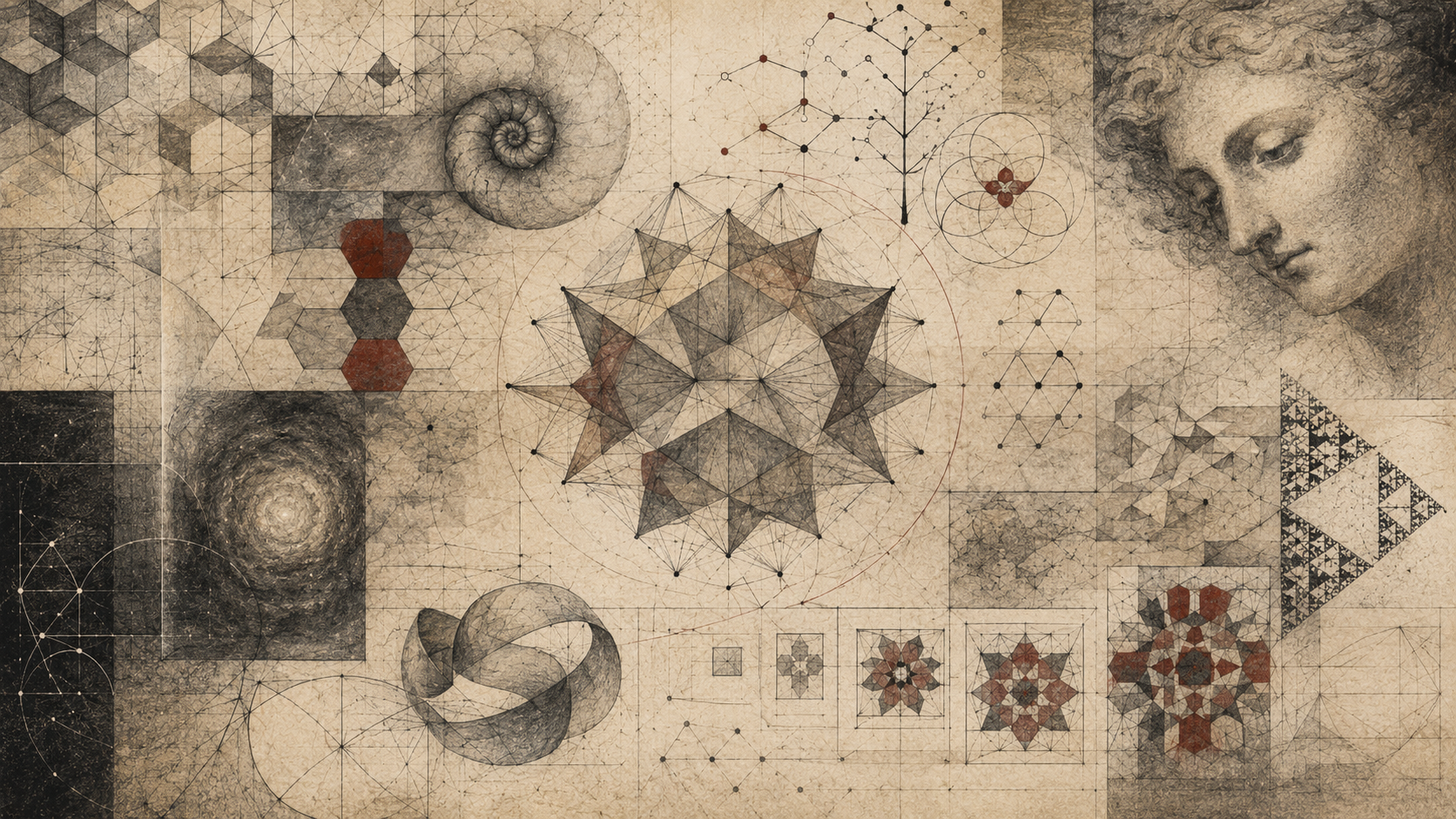
Pattern as the Beginning of Mathematical Thought
Pattern is often the first doorway into mathematics. A child sees that two groups of objects can be matched one-to-one. A student notices that the sum of consecutive odd numbers forms perfect squares. A geometer recognizes repeated angles, symmetries, or proportional relationships. A number theorist studies residues, cycles, divisibility, and primes. A topologist notices what remains unchanged when an object is stretched, bent, or continuously deformed.
But a mathematical pattern is not merely a pleasing repetition. It is a possible clue to structure. The same visible pattern may have different explanations, and the same structure may appear in many different visual forms. Mathematical thinking begins when the mind asks what the pattern means, what rule might generate it, and whether the apparent regularity is accidental, partial, necessary, or general.
1+3+5+\cdots+(2n-1)=n^2
\]
This identity can be seen as a pattern in numbers, a geometric fact about square arrays, an inductive theorem, or a statement about the relationship between arithmetic growth and spatial structure. The mathematical imagination does not choose only one of these views. It moves among them. It asks how each representation reveals something different.
| Pattern | Possible Structure | Mathematical Question |
|---|---|---|
| Repeated terms | Sequence, recurrence, periodicity | What rule generates the pattern? |
| Balanced shape | Symmetry group, transformation, invariant | What transformations preserve the object? |
| Stable quantity | Invariant, conservation, equivalence | What remains unchanged? |
| Network of relations | Graph, order, dependency, topology | How are the parts connected? |
| Growth behavior | Function, limit, asymptotic class | What happens as scale increases? |
Pattern recognition is powerful, but it is also dangerous when it becomes overconfidence. Many false conjectures begin with patterns that hold for early cases. Mathematical thinking must therefore move from pattern to structure, from appearance to explanation, and from conjecture to proof.
From Pattern to Structure
Structure is what gives mathematical pattern its durability. A pattern may be observed; a structure can be defined, analyzed, transformed, generalized, and proved. Structure answers the question: what relationships make this pattern possible?
For example, the visible pattern of even and odd numbers is grounded in divisibility by two. The pattern of parallel lines in Euclidean geometry is grounded in axioms about space. The pattern of repeated behavior in a sequence may be grounded in a recurrence relation. The pattern of symmetry in a polygon may be grounded in a group of transformations. The pattern of dependency in a proof may be grounded in a directed graph.
G=(V,E)
\]
A graph is a simple but powerful example of structure. Once a set of objects is represented as vertices and their relationships as edges, new questions become possible. Is the graph connected? Does it contain cycles? Which nodes are central? Can it be colored? Does it admit a topological order? What paths connect one object to another? A graph turns scattered relationships into a structure that can be reasoned about.
This transition from pattern to structure is one of the great moves of mathematical thought. It allows the thinker to stop asking only “what do I see?” and begin asking “what form of relation explains what I see?”
| Observed Pattern | Structural Form | Mathematical Consequence |
|---|---|---|
| Repeated numerical behavior | Recurrence relation | Supports induction, closed forms, and asymptotic analysis |
| Visual balance | Symmetry group | Reveals transformations that preserve identity |
| Stable relation under change | Invariant | Enables classification and proof |
| Part-whole organization | Hierarchy, lattice, category, graph | Clarifies dependency and abstraction |
| Similar forms across fields | Isomorphism or analogy | Transfers insight from one domain to another |
Structure is also what allows mathematics to travel. A pattern in arithmetic may become a theorem in algebra. A diagram in geometry may become a transformation in linear algebra. A problem about networks may become a question in graph theory, topology, probability, or category theory. The mathematical imagination recognizes when different situations share a common structure.
The Mathematical Imagination
The mathematical imagination is the ability to see beyond the given example without abandoning rigor. It asks what else might be true, what a pattern might become under generalization, what hidden structure might explain a phenomenon, and what kind of representation would make a problem intelligible.
This kind of imagination is not opposed to logic. It precedes, accompanies, and is disciplined by logic. A mathematician may first sense that a theorem should be true before knowing how to prove it. A diagram may suggest a relationship before a formal argument exists. A sequence may invite a conjecture. A computational experiment may reveal a pattern. But mathematical imagination becomes mathematical knowledge only when the idea is tested, refined, formalized, or proved.
There are several forms of mathematical imagination:
| Form of Imagination | Description | Example |
|---|---|---|
| Visual imagination | Seeing spatial relations, transformations, and diagrams | Imagining how a shape changes under rotation or deformation |
| Structural imagination | Recognizing hidden organization beneath examples | Seeing a group structure behind symmetries |
| Symbolic imagination | Using notation to manipulate possible worlds | Exploring a general recurrence before computing examples |
| Analogical imagination | Transferring insight from one domain to another | Using graph ideas to understand proof dependencies |
| Counterfactual imagination | Testing what happens when assumptions change | Asking whether a theorem survives without compactness or continuity |
The mathematical imagination therefore depends on both freedom and constraint. It must be free enough to generate conjectures, representations, and analogies. It must be constrained enough to respect definitions, assumptions, proof, and counterexample. The creative act in mathematics is not unbounded invention. It is the disciplined discovery of form.
Symmetry, Invariance, and Transformation
Symmetry is one of the clearest bridges between pattern and structure. A figure has symmetry when it can be transformed in some way while preserving an essential property. A square can be rotated by ninety degrees and still occupy the same form. An equation may remain true under substitution. A physical law may remain invariant under translation. A graph may preserve adjacency under relabeling of vertices.
In mathematics, symmetry is not merely aesthetic. It is a structural fact about transformations. The question is not only whether something looks balanced, but what operations preserve it.
f(x)=f(-x)
\]
This equation expresses even symmetry for a function. The graph may appear visually balanced across the vertical axis, but the mathematical structure is the invariance of the function under the transformation \(x \mapsto -x\). The imagination sees the visual pattern; the structure names the transformation; the proof shows whether the invariance holds.
Invariance is closely related. An invariant is something that remains unchanged under a specified transformation. Invariants are central to classification and proof. They allow mathematicians to show that two objects are different even when they appear similar, or that a process cannot reach a certain state because some quantity is preserved along the way.
| Mathematical Setting | Transformation | Possible Invariant |
|---|---|---|
| Geometry | Rotation, reflection, translation | Distance, angle, area |
| Topology | Continuous deformation | Connectedness, compactness, Euler characteristic |
| Algebra | Isomorphism | Operation structure, identity, inverse behavior |
| Graph theory | Relabeling of vertices | Adjacency, degree sequence, connectivity |
| Dynamical systems | Time evolution | Conserved quantities, fixed points, attractors |
The search for invariants is one of the most powerful habits of mathematical thinking. It asks: beneath change, what stays the same?
Analogy and Transfer Across Domains
Analogy is another major engine of mathematical imagination. It allows a thinker to recognize that two different situations may share a common structure. A problem in geometry may resemble a problem in algebra. A recurrence may resemble a dynamical system. A proof dependency network may resemble a directed acyclic graph. A family tree, a theorem library, and a build system may all share dependency structures.
Good mathematical analogy is not superficial resemblance. It depends on structural correspondence. The question is not whether two things look alike, but whether relations in one system correspond meaningfully to relations in another.
A \cong B
\]
The notation of isomorphism expresses a precise kind of structural sameness. Two objects may be different in appearance, naming, or representation, yet equivalent in structure. This is one reason mathematics can unify apparently separate domains. It sees sameness beneath difference.
Analogy can guide discovery, but it can also mislead. A transferred idea may work only under certain assumptions. A structural similarity may fail at the boundary. A model may import features that do not belong. Mathematical thinking therefore treats analogy as generative but not final. Analogy suggests; proof decides.
| Analogical Move | Potential Insight | Risk |
|---|---|---|
| Sequence as dynamical system | Reveals iteration, stability, convergence | May overstate continuity in a discrete setting |
| Proof as graph | Reveals dependency, ordering, modularity | May hide explanatory meaning inside edges |
| Geometry as algebra | Enables symbolic manipulation of spatial relations | May obscure visual intuition |
| Computation as experiment | Generates conjectures and searches cases | May be mistaken for proof |
| Model as world | Clarifies selected relationships | May confuse abstraction with reality |
Mathematical imagination uses analogy as a bridge. Mathematical rigor tests whether the bridge can bear weight.
Representation and the Shape of Understanding
Mathematical ideas become thinkable through representation. A pattern may be written as a sequence, drawn as a diagram, encoded as a graph, expressed as a function, represented by a matrix, formalized in logic, or simulated computationally. Each representation emphasizes certain features and hides others.
The choice of representation is therefore not merely a matter of communication. It shapes the thought itself. A difficult problem may become simple when represented differently. A hidden structure may become visible through the right notation. A proof may become clearer when dependency is made explicit. A numerical pattern may become geometric when arranged spatially.
| Representation | What It Reveals | What It May Hide |
|---|---|---|
| Sequence | Order, growth, recurrence, periodicity | Spatial or relational structure |
| Diagram | Shape, symmetry, intuition, transformation | Formal dependency or boundary cases |
| Equation | General relation and symbolic manipulation | Concrete examples or visual meaning |
| Graph | Connectivity, dependency, paths, cycles | Quantitative magnitude unless encoded |
| Matrix | Linear transformation, state update, algebraic structure | Qualitative interpretation for non-specialists |
| Formal proof | Rigor, dependency, verifiability | Motivation and conceptual elegance if poorly presented |
Mathematical maturity includes representational flexibility. The thinker learns not only to solve within one representation, but to ask whether another representation would reveal the structure more clearly. This flexibility is central to research, teaching, modeling, and proof.
Counterexample and the Discipline of Imagination
The mathematical imagination generates possibilities, but counterexample disciplines them. A counterexample is not a failure of mathematical thought; it is one of its most important instruments. It shows where a conjecture is too broad, where an assumption is missing, or where intuition has overreached.
A universal claim can be undone by a single valid counterexample. This gives mathematical reasoning a distinctive severity. No number of confirming cases can prove a universal theorem by pattern alone, but one counterexample can refute it. This is why mathematical imagination must include the ability to search for failure.
\forall x\, P(x) \quad \text{is false if there exists } x \text{ such that } \neg P(x).
\]
Counterexamples also deepen understanding. They show why hypotheses matter. A theorem may require continuity, compactness, finiteness, commutativity, differentiability, connectedness, or independence. Removing one condition may cause the conclusion to fail. A good counterexample teaches the architecture of a theorem by revealing which beams are load-bearing.
| Conjectural Habit | Counterexample Question | Mathematical Benefit |
|---|---|---|
| Generalizing from examples | Does this fail in a small edge case? | Prevents premature theorem-making |
| Trusting a diagram | Does the argument survive degeneracy? | Separates visual intuition from proof |
| Assuming smoothness | What if the function is continuous but not differentiable? | Clarifies analytic hypotheses |
| Assuming finite behavior | What changes in infinite cases? | Reveals hidden compactness or convergence assumptions |
| Assuming structural sameness | Is the analogy actually an isomorphism? | Distinguishes resemblance from equivalence |
In this sense, mathematical imagination is not simply the imagination of what might be true. It is also the imagination of what might go wrong.
A Mathematical Lens: Pattern, Graph, and Invariant
A useful computational lens for this article is the movement from pattern to graph to invariant. A pattern may first appear as a sequence or table. A graph may then represent the relationships among objects, transformations, or proof dependencies. An invariant may identify what remains stable across change.
Consider a simple graph:
G=(V,E),\qquad V=\{1,2,3,4\}
\]
If the edges form a cycle, the graph has a structure that persists under relabeling. The vertices may be renamed, but the cycle structure remains. The visual pattern can change, but the adjacency structure remains invariant. This is a small example of a large mathematical habit: identify the form beneath the representation.
Similarly, a proof can be represented as a graph. Definitions support lemmas; lemmas support propositions; propositions support theorems. Some dependency structures are linear, while others branch, converge, or reveal hidden modularity. Once proof is represented as a graph, new mathematical and computational questions become possible: does the proof dependency network contain cycles? Which lemmas are central? Which assumptions support many results? Which theorem depends on which definitions?
The companion repository for this article uses this lens to connect sequence analysis, graph structure, invariants, and proof architecture. The aim is not to replace mathematical judgment with code, but to create computational artifacts that make mathematical structure easier to inspect.
| Stage | Mathematical Object | Computational Form | Reasoning Use |
|---|---|---|---|
| Pattern | Sequence, symmetry, recurrence | Table, array, generated data | Suggests conjectures |
| Structure | Graph, group, relation, transformation | Adjacency list, matrix, schema | Organizes relationships |
| Invariant | Stable property under transformation | Computed feature or symbolic property | Supports classification and proof |
| Proof | Justified dependency chain | Proof graph, formal object, theorem metadata | Establishes durable knowledge |
Pattern begins the inquiry. Structure organizes it. Invariance strengthens it. Proof completes it.
Computational Companion Examples
The companion repository for this article should extend the mathematical-thinking codebase with examples focused on pattern detection, structural representation, graph invariants, symmetry, and analogy. The examples below are intentionally compact for the article page; the repository can expand them into richer professional workflows.
Python: Pattern to Graph to Invariant
from dataclasses import dataclass
from collections import Counter

@dataclass(frozen=True)
class Graph:
    vertices: tuple[str, ...]
    edges: tuple[tuple[str, str], ...]

    def degree_sequence(self) -> tuple[int, ...]:
        counts = Counter()
        for a, b in self.edges:
            counts[a] += 1
            counts[b] += 1
        return tuple(sorted((counts[v] for v in self.vertices), reverse=True))

cycle_4 = Graph(
    vertices=("a", "b", "c", "d"),
    edges=(("a", "b"), ("b", "c"), ("c", "d"), ("d", "a"))
)

renamed_cycle_4 = Graph(
    vertices=("w", "x", "y", "z"),
    edges=(("w", "x"), ("x", "y"), ("y", "z"), ("z", "w"))
)

print(cycle_4.degree_sequence())
print(renamed_cycle_4.degree_sequence())
print(cycle_4.degree_sequence() == renamed_cycle_4.degree_sequence())
R: Pattern Tables and Structural Features
sequence_features <- function(values) {
  data.frame(
    index = seq_along(values) - 1,
    value = values,
    first_difference = c(NA, diff(values)),
    parity = values %% 2,
    mod_3 = values %% 3
  )
}

odd_sum_squares <- function(n) {
  cumulative <- cumsum(seq(1, by = 2, length.out = n))
  data.frame(
    n = 1:n,
    cumulative_odd_sum = cumulative,
    square = (1:n)^2,
    invariant_identity_holds = cumulative == (1:n)^2
  )
}

print(sequence_features(c(1, 1, 2, 3, 5, 8, 13, 21)))
print(odd_sum_squares(10))
Julia: Transformations and Invariants
function degree_sequence(vertices, edges)
    counts = Dict(v => 0 for v in vertices)
    for (a, b) in edges
        counts[a] += 1
        counts[b] += 1
    end
    return sort(collect(values(counts)), rev=true)
end

vertices_a = ["a", "b", "c", "d"]
edges_a = [("a", "b"), ("b", "c"), ("c", "d"), ("d", "a")]

vertices_b = ["w", "x", "y", "z"]
edges_b = [("w", "x"), ("x", "y"), ("y", "z"), ("z", "w")]

println(degree_sequence(vertices_a, edges_a))
println(degree_sequence(vertices_b, edges_b))
println(degree_sequence(vertices_a, edges_a) == degree_sequence(vertices_b, edges_b))
SQL: Pattern, Structure, and Invariant Metadata
CREATE TABLE mathematical_object (
  object_id TEXT PRIMARY KEY,
  name TEXT NOT NULL,
  object_type TEXT NOT NULL,
  description TEXT NOT NULL
);

CREATE TABLE transformation (
  transformation_id TEXT PRIMARY KEY,
  name TEXT NOT NULL,
  domain TEXT NOT NULL,
  description TEXT NOT NULL
);

CREATE TABLE invariant (
  invariant_id TEXT PRIMARY KEY,
  name TEXT NOT NULL,
  applies_to TEXT NOT NULL,
  description TEXT NOT NULL
);

CREATE TABLE object_invariant (
  object_id TEXT NOT NULL,
  invariant_id TEXT NOT NULL,
  evidence_note TEXT NOT NULL,
  PRIMARY KEY (object_id, invariant_id),
  FOREIGN KEY (object_id) REFERENCES mathematical_object(object_id),
  FOREIGN KEY (invariant_id) REFERENCES invariant(invariant_id)
);
Haskell: Typed Patterns, Structures, and Invariants
Haskell is useful in this article because mathematical imagination depends on careful distinctions: a visible pattern is not the same as a structure, an invariant is not the same as a proof, and an analogy is not the same as an isomorphism. Algebraic data types make these distinctions explicit. They allow a computational scaffold to represent mathematical objects, transformations, invariants, and review questions without flattening everything into plain text.
{-# OPTIONS_GHC -Wall #-}

module Main where

data PatternKind
  = Sequential
  | Symmetric
  | Relational
  | Recursive
  | Geometric
  deriving (Eq, Show)

data StructureKind
  = Sequence
  | Graph
  | Group
  | Function
  | Relation
  deriving (Eq, Show)

data EvidenceStatus
  = Observed
  | Conjectured
  | Computed
  | Proved
  | Refuted
  | RequiresReview
  deriving (Eq, Show)

data MathematicalRecord = MathematicalRecord
  { recordName :: String
  , patternKind :: PatternKind
  , structureKind :: StructureKind
  , evidenceStatus :: EvidenceStatus
  , invariantClaim :: String
  , reviewQuestion :: String
  } deriving (Eq, Show)

records :: [MathematicalRecord]
records =
  [ MathematicalRecord
      "sum of consecutive odd numbers"
      Sequential
      Sequence
      Proved
      "the nth partial sum forms n squared"
      "Has the observed numerical pattern been justified geometrically, algebraically, or by induction?"
  , MathematicalRecord
      "four-cycle graph under vertex relabeling"
      Relational
      Graph
      Computed
      "degree sequence and cycle structure remain stable under relabeling"
      "Does the computed invariant distinguish the structure, or are stronger invariants needed?"
  , MathematicalRecord
      "square rotations"
      Symmetric
      Group
      Proved
      "the square is preserved under rotations by multiples of 90 degrees"
      "Which transformations preserve the object, and do they form a group?"
  , MathematicalRecord
      "recursive sequence"
      Recursive
      Function
      Conjectured
      "local update rule generates global pattern"
      "What proof would show that the recurrence has the claimed general behavior?"
  ]

main :: IO ()
main = do
  putStrLn "Pattern, structure, and invariant review:"
  mapM_ print records
This Haskell treatment strengthens the computational layer by making the article’s conceptual distinctions type-aware. A mathematical object can be marked as observed, conjectured, computed, proved, refuted, or requiring review. That matters because computational exploration often reveals structure before proof arrives. Haskell helps preserve the difference between discovery, representation, invariant-checking, and proof.
The repository folder can build these examples into a more complete professional scaffold: graph-invariant checks, symmetry metadata, typed Haskell records, example and counterexample catalogs, proof dependency notes, visualization outputs, and reproducible cross-language demonstrations.
GitHub Repository
The companion repository for this article is designed as a reproducible mathematical-thinking workspace focused on pattern recognition, structural representation, graph invariants, symmetry, analogy, and proof-oriented abstraction.
Complete Code Repository
Companion article folder with Python, R, Julia, SQL, Haskell, Rust, Go, C++, Fortran, and C examples for professional mathematical exploration of pattern, structure, invariance, graph reasoning, sequence analysis, typed mathematical records, and mathematical imagination.
Imagination, Abstraction, and Responsibility
Mathematical imagination is powerful because it allows the mind to move beyond immediate appearance. It sees common structure across different situations, creates models, compresses complexity, and discovers relationships that ordinary perception may miss. But this same power requires responsibility. Abstraction can clarify, but it can also erase. A model can reveal structure, but it can also hide the human, ecological, historical, or institutional realities that do not fit its chosen variables.
This is especially important when mathematical patterns are applied outside pure mathematics. In social systems, economic systems, environmental models, artificial intelligence, public policy, and risk assessment, the recognition of pattern may lead to classification, prediction, ranking, intervention, or control. The mathematical imagination must therefore remain aware of what its abstractions include, what they exclude, and what consequences follow from treating a model as authoritative.
Responsible mathematical imagination keeps several questions in view:
- What structure is being modeled?
- What has been left outside the model?
- Which assumptions make the pattern appear?
- Who is affected by the interpretation?
- What would count as a counterexample or failure case?
- Where does mathematical precision exceed real-world validity?
The point is not to weaken mathematics, but to practice it more honestly. The best mathematical thinking combines creative abstraction with disciplined humility. It uses imagination to see structure, and responsibility to remember that not every structure is the whole truth.
Why Patterns and Structure Matter
Patterns and structure matter because they allow mathematics to organize experience without being trapped by surface appearances. They make it possible to move from scattered examples to general laws, from visual intuition to proof, from local observations to abstract systems, and from isolated problems to reusable methods.
They also matter because many modern systems are structured mathematically. Algorithms detect patterns. Models represent systems. Networks encode relations. Metrics classify behavior. Simulations explore possible futures. Proof assistants formalize arguments. Machine learning systems search for statistical regularities. Scientific theories depend on mathematical structures that connect observation, explanation, and prediction.
To understand such systems, one must understand how patterns are recognized, how structures are built, how representations shape reasoning, and how imagination can both reveal and distort. Mathematical thinking is therefore not merely a school subject or technical specialty. It is a form of disciplined perception.
The mathematical imagination sees that a sequence may hide a recurrence, a diagram may hide a theorem, a theorem may hide a structure, and a structure may travel across domains. It teaches the mind to ask: what is the form beneath the appearance? What remains unchanged? What follows? What fails? What can be proved?
Patterns begin as glimpses of order. Structure makes that order intelligible. Imagination carries the mind toward what might be true. Proof determines what must be true.
Related Articles
- What Is Mathematical Thinking? Pattern, Proof, Architecture, and Reason
- Abstraction and the Power of Generalization
- Mathematics as the Science of Patterns
- Proof and the Logic of Mathematical Justification
- Logic and the Structure of Formal Inference
- Symbols, Language, and Mathematical Representation
- Conjecture, Creativity, and Mathematical Discovery
- Geometry and the Visual Mind in Mathematics
- Graphs, Networks, and Discrete Structure
- Mathematical Thinking and Visual Proof
- Mathematical Thinking and Scientific Modeling
Further Reading
- Pólya, G. (1945) How to Solve It: A New Aspect of Mathematical Method. Princeton: Princeton University Press. Available at: https://press.princeton.edu/books/paperback/9780691164076/how-to-solve-it
- Lakatos, I. (1976) Proofs and Refutations: The Logic of Mathematical Discovery. Cambridge: Cambridge University Press. Available at: https://www.cambridge.org/core/books/proofs-and-refutations/3B5BDF18C7A5F4E7D4B30F06E4E5A0F1
- Hadamard, J. (1945) The Psychology of Invention in the Mathematical Field. Princeton: Princeton University Press. Available at: https://press.princeton.edu/books/paperback/9780691029313/the-psychology-of-invention-in-the-mathematical-field
- Courant, R. and Robbins, H. (1996) What Is Mathematics? An Elementary Approach to Ideas and Methods. 2nd edn. Oxford: Oxford University Press. Available at: https://global.oup.com/academic/product/what-is-mathematics-9780195105193
- Devlin, K. (2012) Introduction to Mathematical Thinking. Stanford University / Coursera course materials and related publications. Available at: https://web.stanford.edu/~kdevlin/
References
- Courant, R. and Robbins, H. (1996) What Is Mathematics? An Elementary Approach to Ideas and Methods. 2nd edn. Oxford: Oxford University Press. Available at: https://global.oup.com/academic/product/what-is-mathematics-9780195105193
- Devlin, K. (2012) Introduction to Mathematical Thinking. Stanford University / Coursera course and related materials. Available at: https://web.stanford.edu/~kdevlin/
- Hadamard, J. (1945) The Psychology of Invention in the Mathematical Field. Princeton: Princeton University Press. Available at: https://press.princeton.edu/books/paperback/9780691029313/the-psychology-of-invention-in-the-mathematical-field
- Hardy, G.H. (1940) A Mathematician’s Apology. Cambridge: Cambridge University Press. Available at: https://www.cambridge.org/core/books/mathematicians-apology/6F0C29793C928E41F9A7E5C3E7A413C3
- Lakatos, I. (1976) Proofs and Refutations: The Logic of Mathematical Discovery. Cambridge: Cambridge University Press. Available at: https://www.cambridge.org/core/books/proofs-and-refutations/3B5BDF18C7A5F4E7D4B30F06E4E5A0F1
- Mac Lane, S. (1998) Categories for the Working Mathematician. 2nd edn. New York: Springer. Available at: https://link.springer.com/book/10.1007/978-1-4757-4721-8
- Pólya, G. (1945) How to Solve It: A New Aspect of Mathematical Method. Princeton: Princeton University Press. Available at: https://press.princeton.edu/books/paperback/9780691164076/how-to-solve-it