
Last Updated May 6, 2026
Business as usual and sustainable development represent two fundamentally different assumptions about how economies should grow, what prosperity is for, and whether development can remain viable under conditions of ecological overshoot, social inequality, and systemic risk. The difference is not cosmetic. It is a conflict between two models of long-run order: one extends familiar patterns of extraction, fossil-energy dependence, uneven urbanization, and unequal distribution while hoping that incremental adjustment will contain their side effects; the other begins from the premise that economic systems are embedded in social systems and, ultimately, in the Earth system itself.
Business as usual remains politically attractive because it is associated with real achievements: industrialization, scientific progress, agricultural transformation, modern medicine, transport, communications, and rising material welfare. Yet the same development pathway has also intensified carbon emissions, biodiversity loss, resource throughput, pollution, infrastructure lock-in, and social fracture. The central issue is therefore not whether the incumbent model has delivered benefits. It has. The issue is whether those benefits can be sustained if the underlying growth system continues to destabilize the environmental, social, and institutional conditions on which prosperity depends.
Main Library
Publications
Article Map
Sustainable Development
Related Topic
Economic Systems
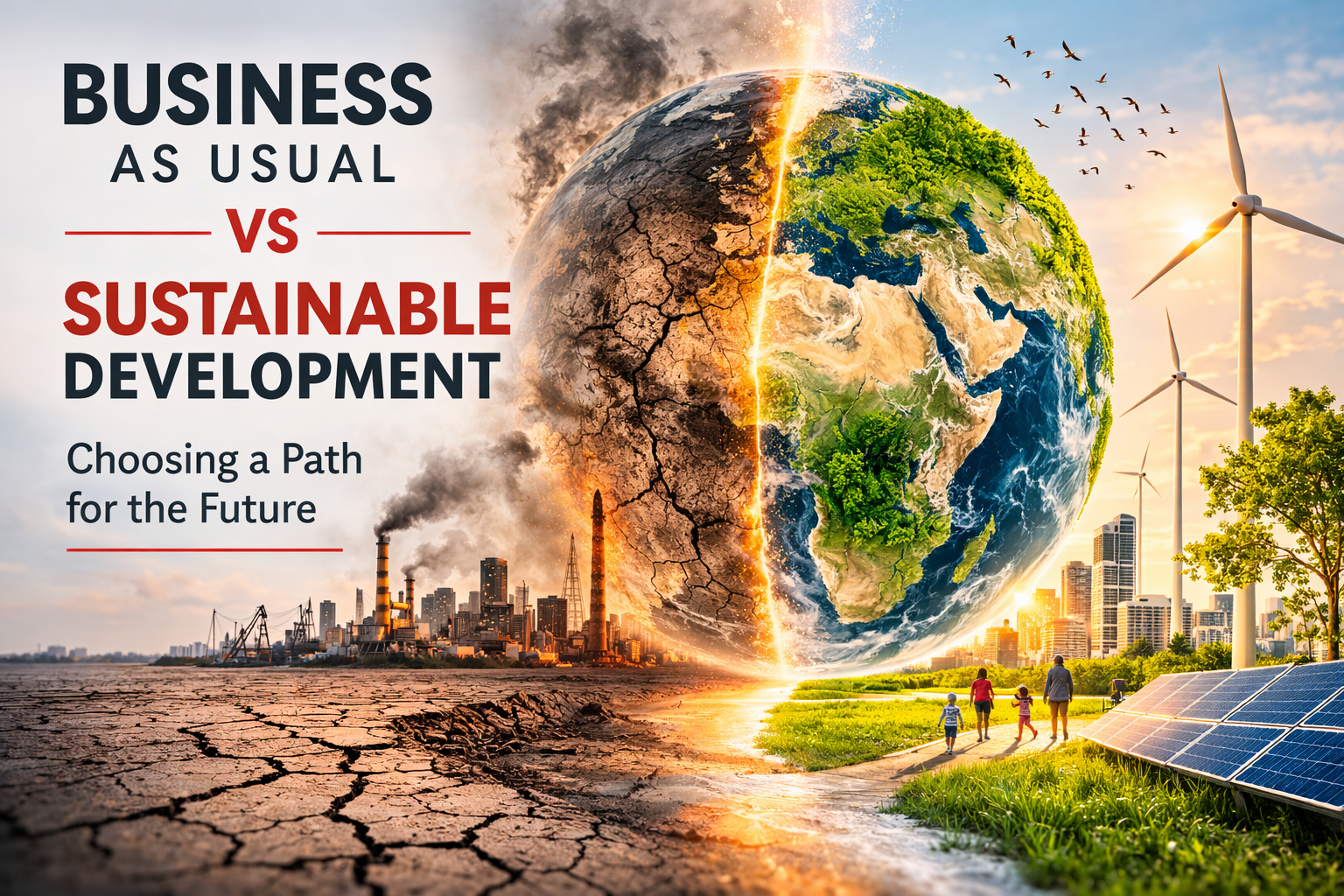
This article argues that the contrast between business as usual and sustainable development is best understood as a conflict between two theories of growth. One assumes that the short-run logic of expansion can continue with limited correction. The other insists that long-run prosperity requires redesign: decarbonized energy, more inclusive distribution, resilient food and water systems, better urban form, lower material pressure, and governance capable of coordinating across time horizons and policy domains.
Sustainable development is therefore not a softer version of business as usual. It is a more demanding developmental framework that treats ecological and social stability as conditions of durable prosperity rather than as optional supplements to it. The question is not whether development should continue, but which developmental logic can sustain human wellbeing under real ecological, institutional, and distributive constraints.
Why Business as Usual Appears Attractive
The appeal of business as usual rests on historical memory. Modern growth has generated striking improvements in income, life expectancy, agricultural productivity, mobility, communications, technological capacity, and access to goods and services. For many policymakers, firms, investors, and households, this record creates a strong presumption in favor of continuity. If the current model helped produce material abundance, reduce mortality, and expand consumption possibilities, then preserving its core structure can seem prudent rather than reckless.
It is also attractive because its institutions already exist. Energy systems, urban layouts, transport corridors, subsidy structures, capital markets, labor arrangements, legal frameworks, and consumer habits are deeply shaped by the incumbent model. Business as usual does not require societies to imagine a completely different operating system. It allows them to continue with infrastructures, investment patterns, technologies, professional routines, and political coalitions that are already in place. That institutional inertia lowers the short-run cost of continuity even when long-run costs are rising.
There is a further reason for its persistence: many of its harms are delayed, dispersed, or externalized. Environmental degradation does not always appear on corporate balance sheets or within quarterly political cycles. Social fracture may accumulate slowly before becoming politically visible. Infrastructure lock-in can remain hidden until future adjustment becomes far more expensive. A growth path can therefore appear successful in the short term while increasing the probability of later instability. Business as usual often survives not because it is truly sustainable, but because its contradictions are temporally deferred or geographically displaced.
Business as usual also benefits from narrative familiarity. It promises that established patterns of growth can continue if supplemented by efficiency gains, technological innovation, market adjustment, voluntary commitments, and selective regulation. In this story, the basic architecture of production, consumption, finance, and infrastructure remains intact while problems are treated as manageable side effects. That story is politically powerful because it minimizes disruption. It tells societies that they can preserve current expectations while gradually reducing damage.
The difficulty is that many contemporary sustainability problems are not marginal side effects. They are structural consequences of development pathways organized around high throughput, fossil-energy dependence, unequal exposure, and short-term return. The appeal of business as usual therefore cannot be dismissed, but it must be interpreted critically. Its strongest argument is continuity; its deepest weakness is that continuity increasingly reproduces the risks it claims to manage.
The Structural Limits of Business as Usual
The structural problem with business as usual is that it increasingly depends on drawing down the very systems on which prosperity depends. High-carbon energy, resource-intensive production, land conversion, pollution-heavy industry, fragmented urban growth, and unequal distribution can all generate output in the near term. But they also weaken the ecological and social conditions that support long-run development. This produces a contradiction at the center of the incumbent model: short-run economic success may intensify long-run systemic fragility.
That contradiction is visible across multiple domains. Fossil-energy dependence raises climate risk. Unsustainable agriculture weakens soils, freshwater systems, biodiversity, and rural livelihoods. Sprawling urbanization increases emissions, congestion, land pressure, and infrastructure inefficiency. Pollution damages health and productivity. Unequal distribution undermines legitimacy and social cohesion. Weak public goods reduce resilience. These are not isolated problems sitting beside an otherwise healthy growth model. They are signals that the development pathway itself is increasingly misaligned with the conditions required for durable prosperity.
The language of sustainable development emerged precisely because of this misalignment. The 2030 Agenda’s insistence that the Goals are integrated and indivisible reflects the recognition that environmental, social, economic, and institutional conditions can no longer be governed as if they were separate compartments. Once growth begins to destabilize climate, biodiversity, health, public trust, and inclusion, business as usual ceases to be merely familiar. It becomes a structurally risk-generating model.
This does not mean that every existing institution, technology, or market practice must be discarded. Sustainable development is not a fantasy of beginning again from zero. The problem is not continuity as such, but continuity without transformation. Some existing systems can be repurposed, improved, or redirected. Others must be phased out. Still others require redesign at the level of incentives, infrastructure, law, finance, and public purpose. The structural limit of business as usual is that it treats transformation as optional when many systems now require it as a condition of future viability.
The most important distinction, then, is between growth that creates capacity and growth that consumes capacity. Growth can support health systems, education, infrastructure, housing, public revenue, research, and adaptation. But growth can also erode ecological stability, deepen inequality, create unsustainable debt, and lock societies into fragile material systems. Sustainable development asks which kind of growth is being produced, under what institutional arrangements, and with what consequences across time.
Environmental Risk and Planetary Overshoot
The environmental critique of business as usual is not a secondary moral complaint. It is a systems-level argument that human economies now operate at scales capable of altering Earth-system conditions. Carbon emissions destabilize climate. Nutrient loading disrupts aquatic systems. Land conversion weakens biodiversity, carbon storage, and local livelihoods. Industrial pollutants circulate through air, water, soil, and food systems. These are not marginal externalities. They are signs that the metabolism of the global economy is straining the biophysical systems that make long-run development possible.
Climate change remains the clearest example. Continued heavy reliance on fossil fuels raises the likelihood of heat stress, floods, wildfires, droughts, agricultural disruption, infrastructure damage, health burdens, and rising adaptation costs. These outcomes are not external to development. They alter the viability of development itself by increasing the cost of maintaining food systems, cities, public health, insurance, fiscal stability, and territorial security.
The same logic applies beyond climate. Ecosystems provide pollination, freshwater regulation, soil stability, fisheries, coastal protection, disease regulation, and resilience buffering. When they are weakened, economies do not simply lose “nature” in the abstract. They lose part of the operating substrate of agriculture, health, settlement, infrastructure, and social order. Business as usual therefore appears increasingly untenable not because it fails to grow, but because it grows by degrading the conditions of its own continuation.
Planetary-boundaries research sharpens this concern by showing that sustainable development must be interpreted against the stability requirements of Earth-system processes. Boundary transgression is not simply an environmental warning. It is a development warning. If climate, freshwater, biosphere integrity, land systems, nutrient cycles, oceans, and pollution systems move into dangerous states, then development itself becomes more fragile. The background conditions of prosperity become less predictable and more costly to maintain.
The environmental risk of business as usual is therefore not only cumulative damage. It is delayed systemic feedback. Development pathways generate pressures; those pressures destabilize environmental systems; environmental instability then returns as social, economic, institutional, and fiscal risk. Sustainable development differs from business as usual because it treats this feedback as central rather than peripheral.
Inequality, Instability, and Social Fracture
The prevailing development pathway is also constrained by its distributive effects. Growth that is highly unevenly shared can coincide with rising resentment, institutional distrust, territorial exclusion, and visible disparity between privilege and deprivation. A society may become wealthier in aggregate while becoming less cohesive and less governable in practice. Under those conditions, prosperity becomes politically fragile.
This is one of the article’s most important distinctions. The contrast between business as usual and sustainable development is not only ecological. It is also social. Business as usual often treats inequality as a manageable by-product of expansion. Sustainable development treats broad inclusion as a condition of durable progress. If large groups remain excluded from healthcare, education, infrastructure, stable work, clean environments, secure housing, and political recognition, the developmental system loses legitimacy even when output continues to rise.
Inequality also shapes exposure to environmental harm. Poor communities, racialized populations, Indigenous peoples, informal workers, migrants, rural communities, and low-income urban neighborhoods often face higher burdens from pollution, heat stress, flood risk, weak infrastructure, insecure land tenure, and limited adaptation capacity. Business as usual tends to treat these harms as localized problems. A sustainable-development lens treats them as evidence of systemic failure: the benefits of development and the burdens of risk are being distributed through unequal structures of power.
That is why sustainable development must be judged not only by total growth, but by whether its benefits are broadly distributed and institutionally secured. A model that produces affluence for some while leaving others exposed to insecure housing, polluted environments, weak public services, precarious work, or declining opportunity may look successful in macroeconomic terms while becoming socially corrosive. This is not an accidental problem that can be solved after growth. It is part of what determines whether growth is stable enough to endure.
The inequality problem also matters for transition. Climate policy, industrial reform, urban redesign, and energy transformation can generate real social costs if poorly designed. Workers, regions, and low-income households can be harmed by abrupt transitions even when the environmental goal is justified. Sustainable development therefore requires transition policy that is materially fair, institutionally credible, and attentive to distribution. A transition that appears technically efficient but socially punitive may strengthen opposition and weaken long-run legitimacy.
What Sustainable Development Requires
Sustainable development is not a vague aspiration to act more responsibly. It is a demanding framework for systemic redesign. At minimum, it requires that development satisfy three conditions together: it must improve human wellbeing, broaden social inclusion, and remain within ecological limits. Governance is the enabling condition that makes those three possible in practice. This immediately changes the meaning of progress. Growth is no longer judged only by how much output it generates, but by whether it produces resilient prosperity under real social, institutional, and biophysical constraints.
This implies a different developmental logic. Energy systems must decarbonize. Food systems must remain productive without exhausting soil, water, biodiversity, and rural livelihoods. Urban systems must be designed for public transport, efficient buildings, healthier mobility, and more inclusive access to housing and services. Public institutions must be capable of planning beyond short-term extraction. Finance must be directed toward long-run resilience rather than only short-run return. Markets still matter, but they can no longer be treated as sufficient coordinating devices in domains where long-term public goods and systemic risks are at stake.
The 2030 Agenda encodes this broader logic by balancing the economic, social, and environmental dimensions of development and by pairing goals with targets, indicators, and review systems. The point is not to stop development. It is to redefine what counts as successful development under conditions of interdependence, finite ecological capacity, and delayed consequences. Sustainable development therefore changes the evaluative question from “how much growth?” to “what kind of growth, for whom, at what ecological cost, under what institutions, and with what future consequences?”
Sustainable development also requires sequencing. Some interventions must happen quickly because delay increases risk: decarbonization, ecosystem protection, adaptation planning, and pollution control become more expensive when postponed. Other interventions require sustained institution-building: education, health systems, local governance, public finance, statistical capacity, and infrastructure maintenance. A sustainable-development approach must therefore manage urgency and durability together.
Finally, sustainable development requires public legitimacy. Technical design alone cannot carry transformation if people experience it as unfair, opaque, or externally imposed. Durable transition requires voice, accountability, social protection, labor-market support, community participation, and credible public benefits. Sustainable development is not only a systems framework. It is a public project.
Technology, Cities, and System Design
One of the most important differences between business as usual and sustainable development appears in the question of design. Business as usual often adopts new technologies without fundamentally reworking the systems into which they are inserted. Sustainable development instead treats technology as part of wider redesign. The relevant question is not whether innovation increases output alone, but whether it supports lower emissions, healthier cities, more efficient infrastructure, ecological resilience, and broader access to opportunity.
Cities are especially important because an increasing share of humanity lives in urban areas, and urban form powerfully shapes energy demand, transport emissions, land use, public health, housing access, and quality of life. A city built around sprawl, congestion, high-emission buildings, and car dependency locks in unsustainable patterns. A city organized around public transport, clean electricity, walkability, cycling, efficient buildings, green infrastructure, and inclusive land use can reduce pressure while expanding health and access. The distinction is not “green lifestyle” versus ordinary urban life. It is one of systemic design.
The same principle applies in agriculture, industry, and energy. Renewable power, smart grids, efficient materials, climate-resilient crops, industrial electrification, circular material systems, and better water management are most significant when they alter the underlying logic of production and settlement rather than merely softening the edge of existing models. Sustainable development rests not just on cleaner inputs, but on a different architecture of coordination.
Technology therefore cannot be treated as an automatic substitute for governance. New tools can reduce pressure, but they can also shift burdens elsewhere. Electric vehicles can reduce tailpipe emissions while increasing mineral demand. Digital infrastructure can improve efficiency while increasing energy use, surveillance risk, or exclusion. Precision agriculture can improve resource use while deepening dependence on proprietary platforms. Sustainable development requires technological assessment that includes institutions, distribution, ecological effects, and long-run system behavior.
System design is the central issue. Business as usual asks how existing systems can become slightly cleaner or more efficient. Sustainable development asks whether those systems are organized around the right goals, incentives, infrastructures, and forms of public accountability. That is the difference between incremental adjustment and structural transformation.
Governance and the Transition from Business as Usual to Sustainable Development
The transition away from business as usual will not occur automatically because incumbent systems are reinforced by infrastructure, vested interests, subsidy structures, political short-termism, regulatory habits, professional routines, and institutional path dependence. Fossil-fuel dependence, unequal urban development, environmentally harmful production models, and weak social protection are not temporary errors waiting to be corrected by better information. They are embedded systems supported by capital, law, politics, and everyday dependence.
That is why sustainable development is fundamentally a governance challenge as much as a technological one. It requires policy frameworks capable of directing investment, regulating externalities, protecting public goods, supporting workers and communities, and coordinating across sectors and borders. Climate policy, biodiversity conservation, urban planning, public health, food systems, trade, finance, and industrial strategy can no longer be managed as isolated silos. The integrated nature of the SDGs reflects exactly this recognition.
Governance also requires the ability to manage transition risk. Decarbonization can create stranded assets and regional disruption. Urban reform can create displacement if housing policy is weak. Conservation can produce injustice if land rights are ignored. Industrial policy can support green manufacturing while reproducing labor or extraction harms if accountability is weak. Sustainable development therefore requires institutions capable of managing trade-offs in public, not hiding them behind technocratic language.
International cooperation is also essential. Emissions, biodiversity decline, supply-chain risk, technological diffusion, debt vulnerability, and climate adaptation cross borders. A viable transition depends on knowledge sharing, climate finance, multilateral coordination, technology access, and institutions capable of supporting collective action under unequal conditions. Business as usual persists partly because its harms are globally shared while many of its gains remain nationally, locally, or privately captured. Sustainable development has to reverse that mismatch through governance design.
But governance must be legitimate, not merely strong. Institutions that can impose transition without participation may achieve narrow targets while creating social resistance and injustice. Institutions that promise participation without capacity may produce consultation without transformation. Sustainable development requires both capacity and accountability: institutions that can act, learn, coordinate, finance, regulate, and remain answerable to the people most affected by the transition.
Finance, Investment, and Incentives
Business as usual is sustained not only by infrastructure and habits, but by finance. Capital flows, subsidies, credit systems, insurance markets, procurement rules, tax incentives, and investor expectations shape which development pathways become cheap, credible, and politically durable. If financial systems continue to reward fossil expansion, land conversion, short-term extraction, and speculative gains while underfinancing public goods, adaptation, social protection, and ecosystem resilience, then sustainability commitments will remain structurally weak.
Sustainable development therefore requires a different allocation of investment. Energy grids, public transport, water systems, sanitation, housing, education, healthcare, ecosystem restoration, climate adaptation, digital public infrastructure, and resilient food systems all require long-term finance. Many of these investments generate public value that is not fully captured through short-term private return. That creates a governance challenge: societies must build institutions that can direct capital toward long-run public purpose rather than only toward immediate profitability.
The incentive problem is equally important. Business as usual often persists because harmful activities are underpriced, public goods are underprovided, and future costs are discounted. Pollution, carbon emissions, biodiversity loss, public-health burdens, and infrastructure neglect can be treated as external to the decision-making system even though they become real costs elsewhere. Sustainable development requires incentives that make hidden costs visible and public value investable.
Yet finance must also be interpreted through justice. Low-income countries and vulnerable communities cannot be expected to finance transition on the same terms as wealthy societies that accumulated benefits through high-carbon development. Debt burdens, high borrowing costs, weak fiscal space, and climate vulnerability all shape what transition is possible. Sustainable finance must therefore include grants, concessional finance, debt reform, technology access, and institutional support where needed. Otherwise, the language of transition risks becoming another way to impose costs on those least responsible for the problem.
The financial transition is not a side topic. It is one of the mechanisms through which business as usual either reproduces itself or becomes open to transformation. Sustainable development becomes real only when investment systems begin to align with long-run social and ecological viability.
Justice, Transition, and Public Legitimacy
The transition from business as usual to sustainable development is often described through technical categories: emissions pathways, energy systems, adaptation finance, efficiency gains, circular materials, and indicator frameworks. These are essential, but incomplete. Transition is also a social and political process. It changes jobs, prices, land use, public budgets, infrastructure priorities, community identities, and regional futures. If those changes are handled unjustly, sustainable development can lose legitimacy even when its long-run goals are necessary.
Justice matters because business as usual has produced unequal benefits and unequal harms. Some communities have gained wealth from extractive or high-emission systems; others have borne pollution, displacement, unsafe work, insecure housing, or climate vulnerability. A transition that ignores this history can reproduce injustice under green language. For example, clean-energy supply chains can deepen extraction burdens if mining, labor rights, Indigenous land rights, and environmental safeguards are weak. Urban climate policy can worsen exclusion if green redevelopment raises housing costs or displaces low-income residents.
A just transition requires more than compensation after harm occurs. It requires early participation, transparent planning, social protection, worker retraining, regional investment, rights protection, and public institutions capable of distributing both costs and benefits fairly. It also requires recognizing forms of knowledge that business as usual often marginalizes: local ecological knowledge, community experience, labor knowledge, Indigenous stewardship traditions, and the lived expertise of those exposed to environmental risk.
Public legitimacy is not an optional political convenience. It is part of transition capacity. People are more likely to support difficult changes when institutions are trusted, benefits are visible, burdens are fairly shared, and decisions are open to contestation. A sustainable-development transition that fails to build legitimacy may generate backlash, delay, and reversal. In that sense, justice is not a soft addition to systems transformation. It is one of the conditions that allows transformation to endure.
Sustainable development therefore differs from business as usual not only in its environmental ambition, but in its theory of public life. It treats people not merely as consumers, workers, or beneficiaries of growth, but as participants in the design of the systems that shape their futures.
Why the Distinction Matters Now
The distinction between business as usual and sustainable development matters because the present decade is no longer one in which continuity can be assumed to be safe. Official SDG reporting continues to show that progress is uneven, too slow, and vulnerable to reversal across multiple domains. Climate disruption, biodiversity loss, debt stress, inequality, conflict, public-health vulnerability, and institutional mistrust do not describe a world where incremental adjustment is enough. They describe a world in which current development trajectories are misaligned with stated global goals.
That makes this article more than a conceptual contrast. It is an argument about historical direction. Business as usual is not neutral continuity. It is the extension of a particular growth regime whose ecological and social contradictions are becoming harder to absorb. Sustainable development is not anti-growth stagnation. It is an attempt to redesign growth so that prosperity, inclusion, ecological stability, and institutional capacity can coexist more durably.
Ultimately, the choice is not between growth and no growth, but between a model of growth that increasingly undermines its own future and a model of growth that seeks to align economic dynamism with the environmental and social conditions required for civilization to endure. That is what gives the distinction its importance inside the sustainable development pillar. It clarifies that the issue is not whether development continues, but which developmental logic governs the future.
The distinction also matters because delay narrows the field of possible action. The longer high-carbon infrastructure, ecological degradation, inequality, weak public goods, and fragmented governance persist, the harder and more expensive transition becomes. Business as usual often appears less disruptive in the present because it postpones disruption. Sustainable development appears more demanding because it brings deferred costs into the open and attempts to govern them before they become crisis conditions.
The deeper question is therefore one of honesty. Business as usual asks societies to trust that familiar systems can continue despite growing evidence of stress. Sustainable development asks societies to face the full cost of continuity and redesign development before instability becomes harder to reverse. That is why the distinction matters now: the future is no longer a distant abstraction. It is already arriving through heat, debt, inequality, infrastructure strain, ecological loss, and public distrust.
Mathematical Lens
The contrast between business as usual and sustainable development can be represented as a difference in how growth relates to long-run system viability. Let \(D\) denote development quality, \(Y\) economic output, \(I\) social inclusion, \(E\) ecological integrity, and \(G\) governance capacity. A simple conceptual form is:
D = \alpha Y + \beta I + \gamma E + \delta G
\]
Interpretation: Durable development depends on economic output, but also on social inclusion, ecological integrity, and governance capacity.
Business as usual overweights \(Y\) while treating degradation in \(I\), \(E\), and \(G\) as manageable externalities. Sustainable development treats all four as jointly constitutive of durable prosperity.
We can also express business-as-usual fragility as:
R_b = \lambda C + \mu Q + \nu S
\]
Interpretation: Business-as-usual fragility rises when ecological stress, inequality, and systemic coordination failure accumulate together.
In this formulation, \(C\) is carbon and ecological stress, \(Q\) is inequality and exclusion, and \(S\) is systemic coordination failure. Higher \(R_b\) means a development pathway is producing greater long-run instability even if short-run output is rising.
Finally, transition capacity can be represented as:
V = \theta T + \kappa P + \rho A
\]
Interpretation: Transition capacity depends on technological redesign, public-policy coordination, and institutional ability to align investment with long-run goals.
Here, \(T\) is technological redesign capacity, \(P\) is public-policy coordination, and \(A\) is institutional ability to align investment with long-run goals. This helps clarify why sustainable development is a systems-governance project rather than a moral add-on to ordinary growth.
| Term | Meaning | Interpretive role |
|---|---|---|
| \(D\) | Development quality | Represents whether development produces durable prosperity rather than short-run output alone. |
| \(Y\) | Economic output | Represents production, income, employment, investment, and fiscal capacity. |
| \(I\) | Social inclusion | Represents distribution, access to public goods, social protection, dignity, and participation. |
| \(E\) | Ecological integrity | Represents climate stability, biodiversity, freshwater security, pollution control, and Earth-system viability. |
| \(G\) | Governance capacity | Represents public institutions capable of coordination, implementation, accountability, and long-run planning. |
| \(R_b\) | Business-as-usual fragility | Represents the risk that incumbent development pathways undermine their own future conditions. |
| \(V\) | Transition capacity | Represents the ability to move from incumbent systems toward sustainable development pathways. |
The equations are conceptual rather than predictive. Their value is to make visible the central distinction: business as usual treats ecological and social damage as secondary to output, while sustainable development treats ecological integrity, inclusion, and governance capacity as part of development itself.
Advanced Python Workflow: Business as Usual vs Sustainable Development Risk Scoring
This Python workflow models the contrast between an incumbent development pathway and a sustainable transition pathway. It combines fossil dependence, inequality pressure, ecological stress, infrastructure lock-in, and governance readiness to estimate whether a territory remains trapped in business-as-usual dynamics or is better positioned for sustainable development.
from __future__ import annotations

import pandas as pd
import numpy as np

INPUT_FILE = "business_as_usual_vs_sustainable_development_panel.csv"
OUTPUT_FILE = "business_as_usual_vs_sustainable_development_scores.csv"


def load_data(path: str) -> pd.DataFrame:
    """
    Load a territory-level business-as-usual versus transition dataset.

    All *_index columns should be normalized to [0, 1].
    Higher values should mean more of the named property.

    Examples:
      - fossil_dependence_index: higher = stronger fossil dependence
      - urban_lock_in_index: higher = stronger infrastructure lock-in
      - public_goods_inclusion_index: higher = stronger inclusion capacity
      - governance_transition_capacity_index: higher = stronger transition governance
    """
    df = pd.read_csv(path)

    required_columns = [
        "territory_name",
        "country_or_region",
        "territory_type",
        "fossil_dependence_index",
        "resource_throughput_pressure_index",
        "urban_lock_in_index",
        "inequality_pressure_index",
        "public_goods_inclusion_index",
        "ecological_stress_index",
        "governance_transition_capacity_index",
        "clean_technology_adoption_index",
        "sustainable_development_alignment_index",
    ]

    missing = [col for col in required_columns if col not in df.columns]

    if missing:
        raise ValueError(f"Missing required columns: {missing}")

    return df


def validate_indices(df: pd.DataFrame) -> pd.DataFrame:
    """Validate that all *_index fields are complete and normalized to [0, 1]."""
    index_columns = [col for col in df.columns if col.endswith("_index")]

    for col in index_columns:
        if df[col].isna().any():
            raise ValueError(f"Column '{col}' contains missing values.")

        if ((df[col] < 0) | (df[col] > 1)).any():
            raise ValueError(f"Column '{col}' contains values outside [0, 1].")

    return df


def compute_scores(df: pd.DataFrame) -> pd.DataFrame:
    """
    Compute business-as-usual pressure, sustainable transition capacity,
    and business-as-usual risk scores.

    Business-as-usual pressure rises with fossil dependence, resource throughput,
    urban lock-in, inequality pressure, ecological stress, weak public goods,
    weak governance capacity, and weak sustainable-development alignment.

    Sustainable transition capacity rises with inclusion, governance capacity,
    clean-technology adoption, lower fossil dependence, lower lock-in,
    and sustainable-development alignment.
    """
    df = df.copy()

    df["business_as_usual_pressure_score"] = (
        0.16 * df["fossil_dependence_index"] +
        0.14 * df["resource_throughput_pressure_index"] +
        0.12 * df["urban_lock_in_index"] +
        0.12 * df["inequality_pressure_index"] +
        0.16 * df["ecological_stress_index"] +
        0.10 * (1 - df["public_goods_inclusion_index"]) +
        0.10 * (1 - df["governance_transition_capacity_index"]) +
        0.10 * (1 - df["sustainable_development_alignment_index"])
    ).clip(lower=0, upper=1)

    df["sustainable_transition_capacity_score"] = (
        0.20 * df["public_goods_inclusion_index"] +
        0.18 * df["governance_transition_capacity_index"] +
        0.18 * df["clean_technology_adoption_index"] +
        0.16 * (1 - df["fossil_dependence_index"]) +
        0.14 * (1 - df["urban_lock_in_index"]) +
        0.14 * df["sustainable_development_alignment_index"]
    ).clip(lower=0, upper=1)

    df["business_as_usual_risk_score"] = (
        0.50 * df["business_as_usual_pressure_score"] +
        0.30 * (1 - df["sustainable_transition_capacity_score"]) +
        0.20 * df["ecological_stress_index"]
    ).clip(lower=0, upper=1)

    df["risk_band"] = np.select(
        [
            df["business_as_usual_risk_score"] >= 0.80,
            df["business_as_usual_risk_score"] >= 0.60,
            df["business_as_usual_risk_score"] >= 0.40,
        ],
        [
            "Extreme business-as-usual risk",
            "High business-as-usual risk",
            "Moderate business-as-usual risk",
        ],
        default="Lower business-as-usual risk",
    )

    return df


def build_summary(df: pd.DataFrame) -> pd.DataFrame:
    """Return a ranked summary table for review or reporting."""
    columns = [
        "territory_name",
        "country_or_region",
        "territory_type",
        "business_as_usual_pressure_score",
        "sustainable_transition_capacity_score",
        "business_as_usual_risk_score",
        "risk_band",
    ]

    summary = df[columns].copy()

    summary = summary.sort_values(
        by=[
            "business_as_usual_risk_score",
            "business_as_usual_pressure_score",
            "sustainable_transition_capacity_score",
        ],
        ascending=[False, False, True],
    ).reset_index(drop=True)

    return summary


def main() -> None:
    df = load_data(INPUT_FILE)
    df = validate_indices(df)
    scored = compute_scores(df)
    summary = build_summary(scored)

    summary.to_csv(OUTPUT_FILE, index=False)

    print("Business as usual vs sustainable development scoring complete.")
    print(summary.to_string(index=False))


if __name__ == "__main__":
    main()
This workflow is intentionally transparent. It does not claim that transition risk can be reduced to a single objective score. Instead, it makes the diagnosis visible: fossil dependence, resource throughput, lock-in, inequality, ecological stress, inclusion, governance capacity, clean-technology adoption, and sustainable-development alignment are treated as distinct components. The purpose is to support structured comparison, sensitivity testing, and public reasoning about where business-as-usual pressures remain strongest.
Advanced R Workflow: System Transition Pressure, Inclusion, and Ecological Constraint
This R workflow compares territories across fossil dependence, urban lock-in, inequality pressure, inclusion capacity, ecological stress, and sustainable-development alignment. It is designed to show where business-as-usual pressures remain structurally high and where transition capacity is stronger.
library(readr)
library(dplyr)

input_file <- "business_as_usual_vs_sustainable_development_country_panel.csv"
output_file <- "system_transition_pressure_inclusion_ecological_constraint_summary.csv"

sd_df <- read_csv(input_file, show_col_types = FALSE)

required_cols <- c(
  "territory_name",
  "country_or_region",
  "territory_type",
  "fossil_dependence_index",
  "resource_throughput_pressure_index",
  "urban_lock_in_index",
  "inequality_pressure_index",
  "public_goods_inclusion_index",
  "ecological_stress_index",
  "governance_transition_capacity_index",
  "clean_technology_adoption_index",
  "sustainable_development_alignment_index"
)

missing_cols <- setdiff(required_cols, names(sd_df))

if (length(missing_cols) > 0) {
  stop(paste("Missing required columns:", paste(missing_cols, collapse = ", ")))
}

index_cols <- names(sd_df)[grepl("_index$", names(sd_df))]

invalid_index_cols <- index_cols[
  vapply(
    sd_df[index_cols],
    function(x) any(is.na(x) | x < 0 | x > 1),
    logical(1)
  )
]

if (length(invalid_index_cols) > 0) {
  stop(
    paste(
      "Index columns must be complete and normalized to [0, 1]:",
      paste(invalid_index_cols, collapse = ", ")
    )
  )
}

sd_df <- sd_df %>%
  mutate(
    business_as_usual_proxy = (
      fossil_dependence_index +
      resource_throughput_pressure_index +
      urban_lock_in_index +
      inequality_pressure_index +
      ecological_stress_index +
      (1 - public_goods_inclusion_index) +
      (1 - governance_transition_capacity_index) +
      (1 - clean_technology_adoption_index) +
      (1 - sustainable_development_alignment_index)
    ) / 9,
    transition_capacity = (
      governance_transition_capacity_index +
      clean_technology_adoption_index +
      sustainable_development_alignment_index
    ) / 3,
    risk_band = case_when(
      business_as_usual_proxy >= 0.75 ~ "Extreme business-as-usual risk",
      business_as_usual_proxy >= 0.55 ~ "High business-as-usual risk",
      business_as_usual_proxy >= 0.35 ~ "Moderate business-as-usual risk",
      TRUE ~ "Lower business-as-usual risk"
    )
  )

summary_df <- sd_df %>%
  group_by(country_or_region, territory_type) %>%
  summarise(
    avg_business_as_usual_proxy = mean(business_as_usual_proxy, na.rm = TRUE),
    avg_transition_capacity = mean(transition_capacity, na.rm = TRUE),
    avg_fossil_dependence = mean(fossil_dependence_index, na.rm = TRUE),
    avg_resource_throughput_pressure = mean(resource_throughput_pressure_index, na.rm = TRUE),
    avg_urban_lock_in = mean(urban_lock_in_index, na.rm = TRUE),
    avg_inequality_pressure = mean(inequality_pressure_index, na.rm = TRUE),
    avg_public_goods_inclusion = mean(public_goods_inclusion_index, na.rm = TRUE),
    avg_ecological_stress = mean(ecological_stress_index, na.rm = TRUE),
    observations = n(),
    .groups = "drop"
  ) %>%
  mutate(
    regional_risk_band = case_when(
      avg_business_as_usual_proxy >= 0.75 ~ "Extreme business-as-usual risk",
      avg_business_as_usual_proxy >= 0.55 ~ "High business-as-usual risk",
      avg_business_as_usual_proxy >= 0.35 ~ "Moderate business-as-usual risk",
      TRUE ~ "Lower business-as-usual risk"
    )
  ) %>%
  arrange(desc(avg_business_as_usual_proxy))

write_csv(summary_df, output_file)

cat("Exported:", output_file, "\n")
print(summary_df)
This workflow helps distinguish incumbent pressure from transition readiness. A territory may show strong output growth while remaining heavily exposed to fossil dependence, resource throughput, inequality, ecological stress, and urban lock-in. Conversely, a territory with strong governance capacity, public-goods inclusion, clean-technology adoption, and development alignment may be better positioned to move beyond business-as-usual dynamics. The workflow therefore treats sustainability transition as a systems problem, not merely a branding or technology-adoption problem.
GitHub Repository
Complete Code Repository
The full code distribution for this article, including transition-risk scoring workflows, system-redesign diagnostics, SQL materials, optional monitoring support tooling, supporting documentation, and repository structure, is available on GitHub.
Related Articles
- The Brundtland Definition and Its Legacy
- What Is Sustainable Development? Meaning, Systems, and Long-Run Viability
- Growth, Limits, and the Problem of Overshoot
- Sustainable Development as a Systems Problem
- Trade-Offs, Synergies, and Policy Coherence
- Planetary Boundaries and Sustainable Development
- Climate Change as a Development Constraint
- Urbanization, Housing, and Basic Services
- Why Institutions Matter for Sustainable Development
- Sustainable Finance and Development Investment
Further Reading
- United Nations (2015) Transforming our world: the 2030 Agenda for Sustainable Development. New York: United Nations. Available at: https://sdgs.un.org/2030agenda
- United Nations Statistics Division (2025) The Sustainable Development Goals Report 2025. New York: United Nations. Available at: https://unstats.un.org/sdgs/report/2025/
- IPCC (2023) Climate Change 2023: Synthesis Report. Geneva: Intergovernmental Panel on Climate Change. Available at: https://www.ipcc.ch/report/ar6/syr/
- Sachs, J.D. (2015) The Age of Sustainable Development. New York: Columbia University Press. Available at: https://cup.columbia.edu/book/the-age-of-sustainable-development/9780231173155
- Meadows, D.H., Meadows, D.L., Randers, J. and Behrens, W.W. (1972) The Limits to Growth. New York: Universe Books. Available at: https://www.clubofrome.org/publication/the-limits-to-growth/
- Raworth, K. (2017) Doughnut Economics: Seven Ways to Think Like a 21st-Century Economist. London: Random House Business. Available at: https://www.penguin.co.uk/books/436418/doughnut-economics-by-raworth-kate/9781847941398
- Sen, A. (1999) Development as Freedom. Oxford: Oxford University Press. Available at: https://global.oup.com/academic/product/development-as-freedom-9780192893307
- Rockström, J. et al. (2009) ‘A safe operating space for humanity’, Nature, 461, pp. 472–475. Available at: https://www.nature.com/articles/461472a
- Steffen, W. et al. (2015) ‘Planetary Boundaries: Guiding Human Development on a Changing Planet’, Science, 347(6223). Available at: https://www.science.org/doi/10.1126/science.1259855
- Richardson, K. et al. (2023) ‘Earth beyond six of nine planetary boundaries’, Science Advances, 9(37), eadh2458. Available at: https://www.science.org/doi/10.1126/sciadv.adh2458
References
- United Nations (2015) Transforming our world: the 2030 Agenda for Sustainable Development. New York: United Nations. Available at: https://sdgs.un.org/2030agenda
- United Nations (n.d.) National strategies and SDG integration. New York: United Nations. Available at: https://sdgs.un.org/topics/national-sustainable-development-strategies
- United Nations Statistics Division (2025) The Sustainable Development Goals Report 2025. New York: United Nations. Available at: https://unstats.un.org/sdgs/report/2025/
- United Nations Development Programme (2025) Human Development Report 2025: A Matter of Choice: People and Possibilities in the Age of AI. New York: UNDP. Available at: https://hdr.undp.org/content/human-development-report-2025
- IPCC (2023) Climate Change 2023: Synthesis Report. Geneva: Intergovernmental Panel on Climate Change. Available at: https://www.ipcc.ch/report/ar6/syr/
- Rockström, J. et al. (2009) ‘A safe operating space for humanity’, Nature, 461, pp. 472–475. Available at: https://www.nature.com/articles/461472a
- Steffen, W. et al. (2015) ‘Planetary Boundaries: Guiding Human Development on a Changing Planet’, Science, 347(6223). Available at: https://www.science.org/doi/10.1126/science.1259855
- Richardson, K. et al. (2023) ‘Earth beyond six of nine planetary boundaries’, Science Advances, 9(37), eadh2458. Available at: https://www.science.org/doi/10.1126/sciadv.adh2458
- Stockholm Resilience Centre (n.d.) Planetary boundaries. Stockholm: Stockholm University. Available at: https://www.stockholmresilience.org/research/planetary-boundaries.html
- Meadows, D.H., Meadows, D.L., Randers, J. and Behrens, W.W. (1972) The Limits to Growth. New York: Universe Books. Available at: https://www.clubofrome.org/publication/the-limits-to-growth/
- Sachs, J.D. (2015) The Age of Sustainable Development. New York: Columbia University Press. Available at: https://cup.columbia.edu/book/the-age-of-sustainable-development/9780231173155
- Raworth, K. (2017) Doughnut Economics: Seven Ways to Think Like a 21st-Century Economist. London: Random House Business. Available at: https://www.penguin.co.uk/books/436418/doughnut-economics-by-raworth-kate/9781847941398
- Sen, A. (1999) Development as Freedom. Oxford: Oxford University Press. Available at: https://global.oup.com/academic/product/development-as-freedom-9780192893307
- Ostrom, E. (2009) ‘A general framework for analyzing sustainability of social-ecological systems’, Science, 325(5939), pp. 419–422. Available at: https://www.science.org/doi/10.1126/science.1172133