
Last Updated May 6, 2026
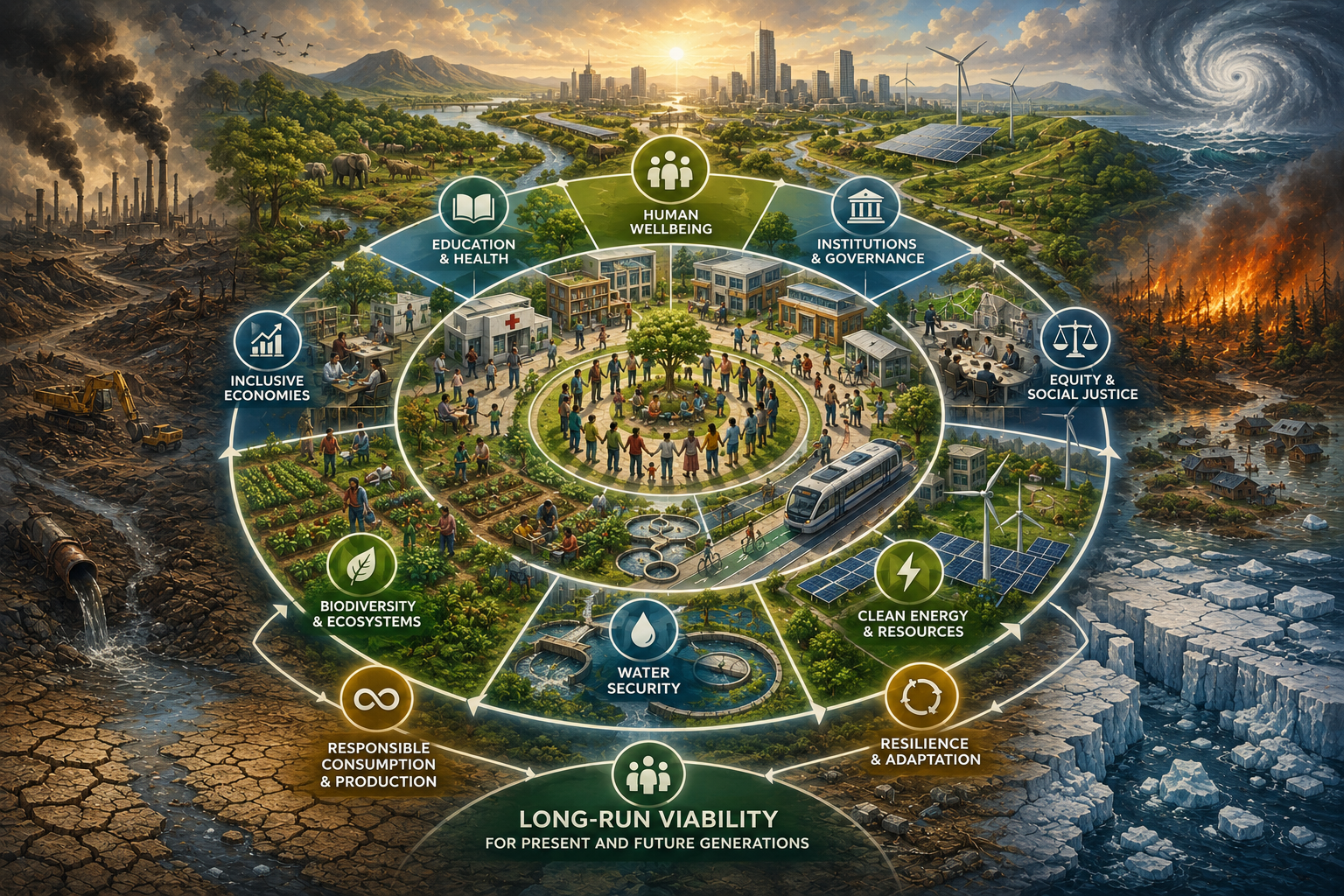
Sustainable development is most clearly understood through the interaction of four dimensions: economic prosperity, social inclusion, environmental sustainability, and accountable governance. These are not separate policy compartments that can be optimized one at a time. They are interdependent conditions of long-run human flourishing. Economies generate resources, employment, productive capacity, and public revenue. Social systems determine how opportunities, risks, burdens, and rights are distributed. Environmental systems provide the ecological foundations of life and production. Governance shapes whether societies can coordinate action, manage conflict, provide public goods, enforce rights, and plan across time.
This framing matters because sustainable development is often discussed too vaguely. It can be reduced to environmental responsibility alone, treated as a synonym for inclusive growth, or broadened so much that it loses practical clarity. A four-dimensions approach helps solve that problem. It provides a compact conceptual map that shows what sustainable development must hold together at once: material prosperity, social legitimacy, ecological viability, and institutional capacity.
The 2030 Agenda gives this systems view an official global language by describing the Sustainable Development Goals as integrated and indivisible, balancing the economic, social, and environmental dimensions of development. Governance, although not always named as a fourth formal dimension in the same way, is the institutional condition through which those dimensions become actionable. Without public capacity, law, coordination, accountability, and legitimacy, prosperity may become extractive, inclusion may remain rhetorical, environmental commitments may remain unenforced, and long-term development goals may collapse under short-term pressure.
The point is not that every dimension always advances smoothly with the others. In practice, development involves trade-offs, tensions, unequal outcomes, and political conflict. Growth can widen inequality. Environmental protection can become unjust if basic needs remain unmet or if affected communities are excluded from decision-making. Institutions can exist formally while failing to deliver services fairly. But precisely because these dimensions interact, sustainable development is best seen not as a single policy goal, but as a structured way of thinking about how societies endure. The four dimensions provide one of the clearest conceptual entry points into the wider sustainable development field.
Main Library
Publications
Article Map
Sustainable Development
Related Topic
Planetary Boundaries
Sustainable Development as Framework and Vision
Sustainable development can be understood in two complementary ways. First, it is an analytical framework for understanding the interaction among economic systems, social structures, environmental conditions, and political institutions. It resists the temptation to study these domains in isolation. Economic systems influence environmental pressures. Institutions shape who is included and excluded. Ecological change alters social stability and development opportunity. Public finance determines whether social goals can be implemented. Infrastructure shapes both prosperity and ecological risk. This systems orientation is one of the strongest reasons the four-dimensions model remains useful.
Second, sustainable development is a normative vision of what a good society should seek to become. It asks what kind of prosperity is worth pursuing, whether human progress is broadly shared, whether environmental conditions remain viable for future generations, and whether institutions are trustworthy enough to govern shared life. This normative dimension matters because development is never merely technical. It always contains judgments about what should count as progress, whose wellbeing should matter, which risks are acceptable, and which harms should not be displaced onto others.
Taken together, these two meanings make sustainable development both descriptive and aspirational. It is descriptive because it helps explain why isolated policy thinking often fails. It is aspirational because it sets a standard: societies should become more prosperous, more inclusive, more ecologically responsible, and more institutionally capable over time. The four-dimensions framework gives that aspiration a clearer structure.
This structure is especially useful because sustainable development has to speak across multiple audiences. Economists, planners, ecologists, public administrators, engineers, community organizers, legal scholars, development practitioners, and policymakers often enter the field through different doors. The four dimensions provide a shared map. They do not answer every question, but they clarify what must not be forgotten.
Why Four Dimensions Matter
The four dimensions matter because development is multidimensional by nature. Economic prosperity without social inclusion can produce exclusion and instability. Social inclusion without material capacity may lack the resources needed for durable public goods. Environmental sustainability without institutional capacity may remain rhetorical. Governance without ecological or distributive justice may manage systems efficiently while preserving unfairness or fragility. Each dimension is necessary, but none is sufficient on its own.
This is why a four-dimensions model is useful as a conceptual primer. It is simple enough to orient readers quickly, but strong enough to show that sustainable development is not reducible to one concern. The SDG architecture reinforces this intuition. The 2030 Agenda treats development as universal, integrated, and indivisible. The Sustainable Development Goals Report 2025 also emphasizes that progress remains uneven and too slow, with gains in some areas but continuing pressures from poverty, hunger, conflict, climate disruption, inequality, and debt. A dimensional framework helps explain why progress is difficult: development systems do not move in one direction at once.
The value of this framework is therefore pedagogical as well as analytical. It gives readers a way to understand how the rest of the series fits together. Poverty, inequality, urbanization, law, climate, institutions, planetary boundaries, finance, infrastructure, and technology are not separate themes floating around sustainable development. They are specific expressions of the four dimensions and of the interactions among them.
The four dimensions also make it easier to identify false success. A country may show strong growth while degrading ecosystems. A city may build infrastructure while displacing poor residents. A development project may reduce emissions while excluding local communities from land decisions. A government may publish ambitious sustainability plans while lacking the administrative capacity or public trust to implement them. The four-dimensions framework helps ask whether progress in one domain is being purchased through damage in another.
Economic Prosperity
Economic prosperity remains essential to sustainable development because societies need material capacity to reduce deprivation, expand infrastructure, support public health, improve education, widen opportunity, and finance public goods. Productive economies can generate employment, tax revenue, investment, technological capability, and institutional capacity. Where poverty remains severe, growth and structural transformation still matter. Sustainable development does not reject prosperity. It treats prosperity as indispensable.
But prosperity in this framework is not identical to raw output alone. Economic growth must be judged by how it is generated, who benefits, and whether it weakens the ecological and institutional conditions of future wellbeing. That is why sustainable development differs from a narrower growth paradigm. The issue is not simply whether economies grow, but whether growth becomes broadly developmental rather than narrowly accumulative.
Economic prosperity includes productivity, decent work, infrastructure, innovation, fiscal capacity, industrial upgrading, and long-run productive capability. It also includes the discipline of asking whether prosperity is resilient, socially legitimate, and consistent with long-horizon viability. A development pathway that increases GDP while locking a society into ecological overshoot, debt distress, labor precarity, or extreme inequality may appear successful in the short run while becoming fragile over time.
Prosperity must also be understood territorially. National growth may conceal regional inequality. Cities may concentrate opportunity while rural communities experience underinvestment. Export sectors may expand while domestic public goods remain weak. A sustainable development framework therefore asks how prosperity is distributed across regions, classes, genders, generations, and ecosystems.
Economic prosperity belongs in the framework because sustainable development cannot be reduced to restraint. It is about building durable conditions for flourishing, not merely limiting harm. But the prosperity dimension becomes sustainable only when it is joined to inclusion, ecological responsibility, and institutions capable of governing development over time.
Social Inclusion
Social inclusion is the second dimension because development that excludes large parts of the population is neither just nor durable. A society may generate wealth while leaving major groups without access to health, education, secure work, housing, political recognition, legal protection, or basic services. Under those conditions, growth may continue in aggregate even as legitimacy erodes and inequality hardens.
Inclusion therefore concerns distribution, but it also concerns membership. It asks whether women and men, rural and urban populations, different classes, regions, racialized communities, Indigenous peoples, disabled people, migrants, informal workers, and historically marginalized groups can participate in and benefit from development. Inclusion is not only about receiving benefits after development occurs. It is about having agency in the systems that define development priorities in the first place.
Social inclusion matters because exclusion creates fragility. When prosperity is visibly concentrated, social trust weakens, political conflict becomes easier to intensify, and development becomes harder to sustain across time. Exclusion also produces cumulative disadvantage: poor housing affects health; poor health affects education and work; weak education limits political voice; lack of voice allows further exclusion. Sustainable development therefore requires not only more wealth, but broader access to the conditions under which people can live with dignity and capability.
This dimension also prevents sustainability from becoming socially punitive. Environmental policies can fail if they impose costs on people already living with deprivation. Climate transition can become unjust if workers, regions, and low-income communities absorb the burdens while wealthier groups retain the benefits of high-consumption systems. Sustainable development requires social inclusion because transition without justice can deepen instability, resentment, and institutional mistrust.
At its strongest, social inclusion links welfare, dignity, rights, and participation. It asks not only whether people survive, but whether they have real opportunities to live, learn, work, belong, participate, and shape the futures being built around them.
Environmental Sustainability
Environmental sustainability is the third dimension because economic and social life depend on functioning ecosystems, stable climate conditions, biodiversity, soils, water systems, oceans, forests, and the absorptive capacity of the biosphere. These are not external amenities sitting beside development. They are part of the physical basis of development itself. If they are degraded beyond critical thresholds, long-run prosperity becomes more expensive, more fragile, and in some cases less possible.
This dimension includes climate stability, biodiversity protection, freshwater security, pollution control, land stewardship, ocean health, soil conservation, circular material use, and more efficient resource systems. It asks whether production and consumption remain compatible with the long-run conditions of habitability and resilience. That question has become increasingly urgent as Earth-system science has clarified how human activity now operates at planetary scale.
Environmental sustainability matters inside this framework because it prevents sustainable development from collapsing into a present-tense account of welfare. It introduces temporal discipline. Development must improve life now without hollowing out the ecological basis of life later. That does not mean halting development. It means organizing development differently.
The environmental dimension also requires attention to unequal exposure. Pollution, flood risk, heat stress, water insecurity, food-system disruption, toxic land use, and climate vulnerability often fall hardest on people with the least political power. Environmental harm is therefore not only ecological; it is social and institutional. The environmental dimension cannot be separated from inclusion and governance.
Sustainable development must also distinguish between efficiency and sufficiency. Efficiency improvements can reduce resource intensity, but they may be overwhelmed by rising total consumption if systems keep expanding material throughput. A serious environmental dimension therefore asks not only whether technologies are cleaner, but whether development pathways remain within ecological limits over time.
Governance, Institutions, and Public Capacity
Governance is the fourth dimension because none of the other three can be secured reliably without institutions capable of coordinating action, resolving conflict, managing public goods, enforcing rights, and sustaining legitimacy. Governance includes public administration, legal systems, transparency, accountability, policy coordination, fiscal capacity, regulatory competence, public participation, and the practical ability to implement collective goals across time.
This dimension is often underestimated because governance can appear procedural compared with the more visible goals of prosperity, inclusion, and ecological protection. But in practice it is decisive. Weak institutions can undermine development even where resources exist. Corruption can divert investment. Administrative failure can weaken service delivery. Poor coordination can make environmental goals and social policy conflict unnecessarily. Courts, regulators, statistical agencies, local governments, planning bodies, public utilities, and finance ministries all shape whether sustainable development becomes real or remains symbolic.
Governance also matters because sustainable development involves long time horizons, trade-offs, and uncertainty. Societies need institutions capable of acting beyond short-term impulses and narrow sectoral silos. That makes governance not just a managerial dimension, but a structural one. Sustainable development requires public systems that can learn, adjust, correct, and remain accountable under changing conditions.
Accountability is central. Institutions that can deliver infrastructure but silence affected communities may produce development without justice. Institutions that invite participation but cannot deliver services may produce legitimacy without capacity. Sustainable development requires both: capable institutions and accountable institutions. It requires public systems that can act, but also systems that can be contested, reviewed, corrected, and trusted.
Governance also connects local and global scales. A municipal government may determine whether housing, water, transit, and waste systems function. A national government may determine tax policy, industrial strategy, energy systems, and social protection. International institutions influence finance, trade, debt, climate commitments, data standards, and development cooperation. Sustainable development therefore depends on governance across levels, not only on national policy alone.
Interaction, Trade-Offs, and Systems Thinking
The greatest value of the four-dimensions model lies in how it makes interaction visible. Economic policy affects social inclusion. Social exclusion alters political legitimacy. Governance quality influences environmental enforcement. Ecological stress feeds back into economic and social risk. Sustainable development is not a checklist where each dimension can be solved independently. It is a systems problem.
This systems view is crucial because real development always involves tensions and trade-offs. A strategy that raises output may worsen emissions. A policy that protects ecosystems may create short-run distributional conflicts unless it is designed carefully. A government may formally adopt sustainability goals while lacking the administrative capacity to implement them. Recognizing these interactions does not weaken the framework. It is what makes the framework realistic.
Systems thinking also helps explain why apparent solutions can create new problems. Expanding irrigation can increase agricultural output while depleting groundwater. Building highways can increase mobility while accelerating sprawl and emissions. Subsidizing energy can reduce household hardship while weakening fiscal capacity or encouraging inefficient use. Digital systems can improve service delivery while increasing surveillance or excluding people without connectivity. The four dimensions help identify these feedbacks before they become locked into infrastructure, law, finance, and everyday life.
This is also where the article becomes genuinely useful inside the series. It does not need to duplicate the deeper historical, legal, climate, or Earth-system articles. Its purpose is to give readers a conceptual grid through which those later articles can be read. The four dimensions work as a map of the field rather than as a substitute for the field.
The most important insight is that balance does not mean equal attention at every moment. A society facing extreme deprivation may need urgent investment in health, food, housing, and infrastructure. A society facing ecological overshoot may need rapid transformation of energy, land, and consumption systems. A society facing corruption or institutional collapse may need governance reform before policy commitments can become credible. The four dimensions do not prescribe a universal sequence. They show what must be held in view.
Justice, Power, and Unequal Vulnerability
A four-dimensions framework becomes stronger when it recognizes that development is shaped by power. Economic prosperity is not distributed automatically. Social inclusion is often contested. Environmental costs are frequently displaced onto people with less political influence. Governance institutions can protect the public interest, but they can also be captured by elites, corporations, parties, militaries, or external creditors. Sustainable development therefore cannot be understood only as coordination among neutral systems. It must also be understood as a struggle over whose lives, lands, labor, futures, and knowledge count.
This matters because many of the communities most exposed to environmental harm and development failure have contributed least to the systems producing that harm. Poor communities, Indigenous peoples, colonized and formerly colonized societies, racialized communities, low-income urban neighborhoods, informal workers, migrants, small farmers, women performing unpaid care labor, and future generations often bear costs generated elsewhere. Their vulnerability is not only ecological. It is institutional, economic, historical, and political.
Each of the four dimensions has a justice question. The economic dimension asks who benefits from production and accumulation. The social dimension asks who is included, recognized, protected, and empowered. The environmental dimension asks who bears pollution, climate risk, land loss, water insecurity, and ecological degradation. The governance dimension asks who has voice, remedy, representation, and the power to challenge decisions.
This is why sustainable development must be factual and evidence-based without pretending to be morally neutral. The field is concerned with truth, but also with responsibility. It asks whether institutions can make development accountable to the people most affected by it, not only to those who finance, measure, or administer it. Without that attention to justice and power, the four dimensions can become a tidy diagram rather than a serious framework for human and ecological survival.
Measurement Across the Four Dimensions
The four dimensions also raise a measurement problem. Economic prosperity is often measured through GDP, income, productivity, employment, investment, and fiscal capacity. Social inclusion can be measured through poverty, inequality, health, education, gender equality, housing, access to services, and political participation. Environmental sustainability can be measured through emissions, biodiversity, water stress, land use, pollution, resource intensity, and ecological thresholds. Governance can be measured through institutional quality, corruption, rule of law, public service delivery, fiscal transparency, participation, and administrative capacity.
But measurement must be handled carefully. A single indicator cannot capture the full meaning of any dimension. GDP can rise while inequality worsens. School enrollment can increase while learning remains poor. Renewable energy can expand while mining pressures intensify elsewhere. Governance indicators can miss local knowledge, informal institutions, or the lived experience of exclusion. Sustainable development measurement therefore requires dashboards, disaggregation, qualitative interpretation, and institutional judgment.
Composite indicators can be useful, but they can also conceal trade-offs. A combined sustainable-development score may make comparison easier, but it can hide whether a high score comes from prosperity, inclusion, ecology, or governance. For that reason, the most useful measurement systems should preserve dimensional visibility. They should show where dimensions reinforce one another and where they diverge.
Measurement also has political consequences. What gets measured often gets funded, regulated, reported, or rewarded. What remains unmeasured may remain invisible. A four-dimensions framework therefore helps ask whether the evidence base itself is balanced. Are ecological harms measured with the same seriousness as economic gains? Are marginalized groups visible in the data? Are governance failures tracked alongside policy announcements? Are future risks represented, or are they discounted away?
In this sense, measurement is not only a technical task. It is part of the governance of sustainable development itself.
Why This Framework Matters for the Rest of the Series
The four-dimensions framework matters because it clarifies how the rest of the sustainable development series is organized. Articles on growth, poverty, infrastructure, finance, work, and jobs largely deepen the economic dimension. Articles on inequality, capability, poverty geography, gender, housing, health, education, and urban exclusion deepen the social dimension. Articles on climate, freshwater, biodiversity, planetary boundaries, pollution, land systems, and overshoot deepen the environmental dimension. Articles on institutions, law, state capacity, corruption, participation, and policy coordination deepen the governance dimension.
At the same time, many of the strongest articles in the series sit precisely at the intersections among dimensions. Climate is not only environmental; it is also economic, social, and institutional. Poverty is not only social; it is also ecological and infrastructural. Governance is never only procedural; it shapes all three substantive dimensions. Infrastructure is economic, social, ecological, and political at once. The four-part model therefore gives readers a way to move through the series without mistaking any one dimension for the whole.
That is why this article has a distinct function. As a general-definition article, it would overlap too much with broader foundation pieces. As a four-dimensions framework article, it becomes a conceptual bridge. It helps readers understand why sustainable development is not a single topic, but a structured field of relationships among prosperity, inclusion, ecology, and governance.
The framework also helps keep later debates grounded. Arguments about degrowth, green growth, climate finance, biodiversity protection, industrial policy, AI governance, urban planning, food systems, or resilience often become polarized because one dimension is allowed to dominate the others. The four-dimensions approach does not eliminate disagreement, but it provides a disciplined way to ask what each position sees clearly and what it risks ignoring.
Mathematical Lens
The four dimensions of sustainable development can be expressed as a problem of jointly maintaining prosperity, inclusion, ecological viability, and institutional capacity. Let \(S\) denote sustainable-development quality, \(E_p\) economic prosperity, \(S_i\) social inclusion, \(E_v\) environmental viability, and \(G\) governance capacity. A simple conceptual form is:
S = \alpha E_p + \beta S_i + \gamma E_v + \delta G
\]
Interpretation: Sustainable development quality depends on economic prosperity, social inclusion, environmental viability, and governance capacity rather than on one dominant metric alone.
We can also express dimensional imbalance risk as:
R_d = \lambda P + \mu X + \nu F
\]
Interpretation: Dimensional risk rises when prosperity is not matched by inclusion, when production generates ecological stress, or when governance failures prevent correction.
In this formulation, \(P\) is prosperity without inclusion, \(X\) is ecological stress from production, and \(F\) is governance failure. Higher \(R_d\) means a society may still show visible gains while becoming less sustainable overall.
Finally, systems-coherence capacity can be represented as:
V = \theta C + \kappa T + \rho L
\]
Interpretation: Long-run viability depends on cross-sector coordination, temporal policy discipline, and institutional legitimacy.
Here, \(C\) is cross-sector coordination, \(T\) is long-term policy discipline, and \(L\) is institutional legitimacy. This helps clarify why sustainable development is not only about outcomes, but about the relationships among the systems that generate them.
| Term | Meaning | Interpretive role |
|---|---|---|
| \(E_p\) | Economic prosperity | Represents productive capacity, employment, income, infrastructure, and fiscal resources. |
| \(S_i\) | Social inclusion | Represents access, dignity, participation, rights, equality, and shared opportunity. |
| \(E_v\) | Environmental viability | Represents ecological integrity, climate stability, resource security, and boundary awareness. |
| \(G\) | Governance capacity | Represents institutional ability to coordinate, regulate, deliver, learn, and remain accountable. |
| \(R_d\) | Dimensional imbalance risk | Represents the danger that visible gains in one dimension are undermined by failures in another. |
| \(V\) | Systems-coherence capacity | Represents the ability to coordinate across sectors and sustain legitimate long-term action. |
The equations are conceptual rather than predictive. Their value is that they make visible a central principle of sustainable development: the dimensions must be evaluated together. A society with high output but weak inclusion, ecological stress, and institutional failure is not simply “less sustainable” in a decorative sense. It is structurally fragile.
Advanced Python Workflow: Four-Dimensional Sustainable Development Risk Scoring
This Python workflow translates the framework into a transparent dimensional-balance model. It estimates where prosperity, inclusion, environment, and governance are misaligned, which is useful for comparing whether development gains are becoming more coherent or more fragile.
from __future__ import annotations

import pandas as pd
import numpy as np

INPUT_FILE = "four_dimensions_sustainable_development_panel.csv"
OUTPUT_FILE = "four_dimensions_sustainable_development_scores.csv"


def load_data(path: str) -> pd.DataFrame:
    """
    Load a territory-level sustainable development dataset.

    All *_index columns should be normalized to [0, 1].
    Higher values should mean more of the named property.

    Examples:
      - economic_prosperity_index: higher = stronger prosperity
      - social_inclusion_index: higher = stronger inclusion
      - environmental_sustainability_index: higher = stronger ecological performance
      - good_governance_index: higher = stronger governance
      - ecological_stress_index: higher = more stress
      - institutional_failure_index: higher = more failure
    """
    df = pd.read_csv(path)

    required_columns = [
        "territory_name",
        "country_or_region",
        "territory_type",
        "economic_prosperity_index",
        "social_inclusion_index",
        "environmental_sustainability_index",
        "good_governance_index",
        "inequality_pressure_index",
        "ecological_stress_index",
        "institutional_failure_index",
        "long_run_alignment_index",
    ]

    missing = [col for col in required_columns if col not in df.columns]

    if missing:
        raise ValueError(f"Missing required columns: {missing}")

    return df


def validate_indices(df: pd.DataFrame) -> pd.DataFrame:
    """Validate that all *_index fields are complete and normalized to [0, 1]."""
    index_columns = [col for col in df.columns if col.endswith("_index")]

    for col in index_columns:
        if df[col].isna().any():
            raise ValueError(f"Column '{col}' contains missing values.")

        if ((df[col] < 0) | (df[col] > 1)).any():
            raise ValueError(f"Column '{col}' contains values outside [0, 1].")

    return df


def compute_scores(df: pd.DataFrame) -> pd.DataFrame:
    """
    Compute pressure, balance, and four-dimensional risk scores.

    The model separates:
      - dimensional pressure: weakness or stress across dimensions
      - dimensional balance: positive alignment across the four core dimensions
      - risk: high pressure plus low balance plus institutional failure
    """
    df = df.copy()

    df["dimensional_pressure_score"] = (
        0.18 * (1 - df["economic_prosperity_index"]) +
        0.18 * (1 - df["social_inclusion_index"]) +
        0.18 * (1 - df["environmental_sustainability_index"]) +
        0.18 * (1 - df["good_governance_index"]) +
        0.10 * df["inequality_pressure_index"] +
        0.10 * df["ecological_stress_index"] +
        0.08 * df["institutional_failure_index"]
    ).clip(lower=0, upper=1)

    df["dimensional_balance_score"] = (
        0.24 * df["economic_prosperity_index"] +
        0.24 * df["social_inclusion_index"] +
        0.24 * df["environmental_sustainability_index"] +
        0.18 * df["good_governance_index"] +
        0.10 * df["long_run_alignment_index"]
    ).clip(lower=0, upper=1)

    df["four_dimensions_risk_score"] = (
        0.50 * df["dimensional_pressure_score"] +
        0.30 * (1 - df["dimensional_balance_score"]) +
        0.20 * df["institutional_failure_index"]
    ).clip(lower=0, upper=1)

    df["risk_band"] = np.select(
        [
            df["four_dimensions_risk_score"] >= 0.80,
            df["four_dimensions_risk_score"] >= 0.60,
            df["four_dimensions_risk_score"] >= 0.40,
        ],
        [
            "Extreme dimensional-fragility risk",
            "High dimensional-fragility risk",
            "Moderate dimensional-fragility risk",
        ],
        default="Lower dimensional-fragility risk",
    )

    return df


def build_summary(df: pd.DataFrame) -> pd.DataFrame:
    """Return a ranked summary table for reporting."""
    columns = [
        "territory_name",
        "country_or_region",
        "territory_type",
        "dimensional_pressure_score",
        "dimensional_balance_score",
        "four_dimensions_risk_score",
        "risk_band",
    ]

    return (
        df[columns]
        .sort_values(
            by=[
                "four_dimensions_risk_score",
                "dimensional_pressure_score",
                "dimensional_balance_score",
            ],
            ascending=[False, False, True],
        )
        .reset_index(drop=True)
    )


def main() -> None:
    df = load_data(INPUT_FILE)
    df = validate_indices(df)
    scored = compute_scores(df)
    summary = build_summary(scored)

    summary.to_csv(OUTPUT_FILE, index=False)

    print("Four dimensions scoring complete.")
    print(summary.to_string(index=False))


if __name__ == "__main__":
    main()
This workflow is intentionally interpretable. It does not hide the model behind machine-learning opacity. The weights are visible, the indices are named, and the output separates pressure from balance. In real use, the scoring system should be tested through sensitivity analysis, expert review, and participatory interpretation with affected communities. The goal is not to produce a final truth score, but to create a reproducible structure for asking whether development is becoming more balanced or more fragile across dimensions.
Advanced R Workflow: Dimensional Balance, Governance, and Long-Run Viability
This R workflow compares territories across the four dimensions and summarizes where development is most imbalanced. It works well for showing where apparent success in one dimension is not matched by the others.
library(readr)
library(dplyr)

input_file <- "four_dimensions_sustainable_development_country_panel.csv"
output_file <- "dimensional_balance_governance_long_run_viability_summary.csv"

sd_df <- read_csv(input_file, show_col_types = FALSE)

required_cols <- c(
  "territory_name",
  "country_or_region",
  "territory_type",
  "economic_prosperity_index",
  "social_inclusion_index",
  "environmental_sustainability_index",
  "good_governance_index",
  "inequality_pressure_index",
  "ecological_stress_index",
  "institutional_failure_index",
  "long_run_alignment_index"
)

missing_cols <- setdiff(required_cols, names(sd_df))

if (length(missing_cols) > 0) {
  stop(paste("Missing required columns:", paste(missing_cols, collapse = ", ")))
}

index_cols <- names(sd_df)[grepl("_index$", names(sd_df))]

invalid_index_cols <- index_cols[
  vapply(
    sd_df[index_cols],
    function(x) any(is.na(x) | x < 0 | x > 1),
    logical(1)
  )
]

if (length(invalid_index_cols) > 0) {
  stop(
    paste(
      "Index columns must be complete and normalized to [0, 1]:",
      paste(invalid_index_cols, collapse = ", ")
    )
  )
}

sd_df <- sd_df %>%
  mutate(
    four_dimensions_proxy = (
      (1 - economic_prosperity_index) +
      (1 - social_inclusion_index) +
      (1 - environmental_sustainability_index) +
      (1 - good_governance_index) +
      inequality_pressure_index +
      ecological_stress_index +
      institutional_failure_index +
      (1 - long_run_alignment_index)
    ) / 8,
    dimensional_balance = (
      economic_prosperity_index +
      social_inclusion_index +
      environmental_sustainability_index +
      good_governance_index
    ) / 4,
    risk_band = case_when(
      four_dimensions_proxy >= 0.75 ~ "Extreme dimensional-fragility risk",
      four_dimensions_proxy >= 0.55 ~ "High dimensional-fragility risk",
      four_dimensions_proxy >= 0.35 ~ "Moderate dimensional-fragility risk",
      TRUE ~ "Lower dimensional-fragility risk"
    )
  )

summary_df <- sd_df %>%
  group_by(country_or_region, territory_type) %>%
  summarise(
    avg_four_dimensions_proxy = mean(four_dimensions_proxy, na.rm = TRUE),
    avg_dimensional_balance = mean(dimensional_balance, na.rm = TRUE),
    avg_economic_prosperity = mean(economic_prosperity_index, na.rm = TRUE),
    avg_social_inclusion = mean(social_inclusion_index, na.rm = TRUE),
    avg_environmental_sustainability = mean(environmental_sustainability_index, na.rm = TRUE),
    avg_good_governance = mean(good_governance_index, na.rm = TRUE),
    avg_inequality_pressure = mean(inequality_pressure_index, na.rm = TRUE),
    avg_ecological_stress = mean(ecological_stress_index, na.rm = TRUE),
    avg_institutional_failure = mean(institutional_failure_index, na.rm = TRUE),
    observations = n(),
    .groups = "drop"
  ) %>%
  mutate(
    regional_risk_band = case_when(
      avg_four_dimensions_proxy >= 0.75 ~ "Extreme dimensional-fragility risk",
      avg_four_dimensions_proxy >= 0.55 ~ "High dimensional-fragility risk",
      avg_four_dimensions_proxy >= 0.35 ~ "Moderate dimensional-fragility risk",
      TRUE ~ "Lower dimensional-fragility risk"
    )
  ) %>%
  arrange(desc(avg_four_dimensions_proxy))

write_csv(summary_df, output_file)

cat("Exported:", output_file, "\n")
print(summary_df)
This workflow corrects a common modeling problem: it does not let strength in one dimension erase weakness in another. A territory with strong economic performance but weak inclusion, ecological stress, and institutional failure will still show dimensional fragility. That is the point of the four-dimensions model. It protects analysis from mistaking partial success for sustainable development as a whole.
GitHub Repository
Complete Code Repository
The full code distribution for this article, including dimensional-balance scoring workflows, systems-alignment diagnostics, SQL materials, optional monitoring support tooling, supporting documentation, and repository structure, is available on GitHub.
Related Articles
- What Is Sustainable Development? Meaning, Systems, and Long-Run Viability
- The Brundtland Definition and Its Legacy
- The 2030 Agenda and the Logic of the SDGs
- From Economic Growth to Human Development
- Why Institutions Matter for Sustainable Development
- Business as Usual vs Sustainable Development
- Planetary Boundaries and Sustainable Development
- Trade-Offs, Synergies, and Policy Coherence
Further Reading
- United Nations (2015) Transforming our world: the 2030 Agenda for Sustainable Development. New York: United Nations. Available at: https://sdgs.un.org/2030agenda
- United Nations Statistics Division (2025) The Sustainable Development Goals Report 2025. New York: United Nations. Available at: https://unstats.un.org/sdgs/report/2025/
- United Nations Development Programme (2025) Human Development Report 2025: A Matter of Choice: People and Possibilities in the Age of AI. New York: UNDP. Available at: https://hdr.undp.org/content/human-development-report-2025
- World Commission on Environment and Development (1987) Our Common Future. Oxford: Oxford University Press. Available at: https://www.un-documents.net/our-common-future.pdf
- Sachs, J.D. (2015) The Age of Sustainable Development. New York: Columbia University Press. Available at: https://cup.columbia.edu/book/the-age-of-sustainable-development/9780231173155/
- Sen, A. (1999) Development as Freedom. Oxford: Oxford University Press. Available at: https://global.oup.com/academic/product/development-as-freedom-9780192893307
- Raworth, K. (2017) Doughnut Economics: Seven Ways to Think Like a 21st-Century Economist. London: Random House Business. Available at: https://www.penguin.co.uk/books/436418/doughnut-economics-by-raworth-kate/9781847941398
References
- United Nations (2015) Transforming our world: the 2030 Agenda for Sustainable Development. New York: United Nations. Available at: https://sdgs.un.org/2030agenda
- United Nations Statistics Division (2025) The Sustainable Development Goals Report 2025. New York: United Nations. Available at: https://unstats.un.org/sdgs/report/2025/
- United Nations Development Programme (2025) Human Development Report 2025: A Matter of Choice: People and Possibilities in the Age of AI. New York: UNDP. Available at: https://hdr.undp.org/content/human-development-report-2025
- World Commission on Environment and Development (1987) Our Common Future. Oxford: Oxford University Press. Available at: https://www.un-documents.net/our-common-future.pdf
- Sachs, J.D. (2015) The Age of Sustainable Development. New York: Columbia University Press. Available at: https://cup.columbia.edu/book/the-age-of-sustainable-development/9780231173155/
- Sen, A. (1999) Development as Freedom. Oxford: Oxford University Press. Available at: https://global.oup.com/academic/product/development-as-freedom-9780192893307
- Raworth, K. (2017) Doughnut Economics: Seven Ways to Think Like a 21st-Century Economist. London: Random House Business. Available at: https://www.penguin.co.uk/books/436418/doughnut-economics-by-raworth-kate/9781847941398
- Ostrom, E. (1990) Governing the Commons. Cambridge: Cambridge University Press. Available at: https://doi.org/10.1017/CBO9780511807763