
Last Updated May 28, 2026
Environmental monitoring systems are essential for understanding climate change, urban resilience, air quality, local ecological risk, and the everyday conditions that shape human and ecological wellbeing. A Raspberry Pi environmental data hub can collect sensor data from distributed monitoring stations and provide continuous observations of environmental conditions relevant to climate action, sustainable cities, community-scale environmental intelligence, and responsible infrastructure planning.
Climate policy depends on reliable environmental information. Governments, researchers, cities, schools, watershed groups, public-health agencies, and community organizations rely on observation systems to track temperature trends, humidity, atmospheric pressure, particulate pollution, rainfall patterns, heat exposure, ecological stress, and infrastructure vulnerability. Without measurement infrastructure, climate risk becomes difficult to quantify and even harder to govern.
Large-scale climate and environmental monitoring networks remain essential, but smaller embedded systems can complement them by expanding the geographic reach of environmental sensing. Low-cost computing platforms such as the Raspberry Pi make it possible to deploy local environmental monitoring hubs capable of collecting, processing, storing, visualizing, and transmitting environmental data near the place where conditions are changing.
This project upgrades a simple Raspberry Pi sensor build into a more complete environmental data infrastructure prototype. It combines sensing, edge computing, local storage, optional API integration, data-quality checks, analytics, and responsible-use guidance. The result is not a certified weather station, regulatory air-quality monitor, or official climate observation system. It is a reproducible prototype for learning how distributed environmental monitoring systems work and why they matter.
Main Library
Publications
Project Series
Raspberry Pi Projects
Related Topic
Environmental Monitoring
Related Topic
Climate Boundary
Related Topic
Infrastructure Systems
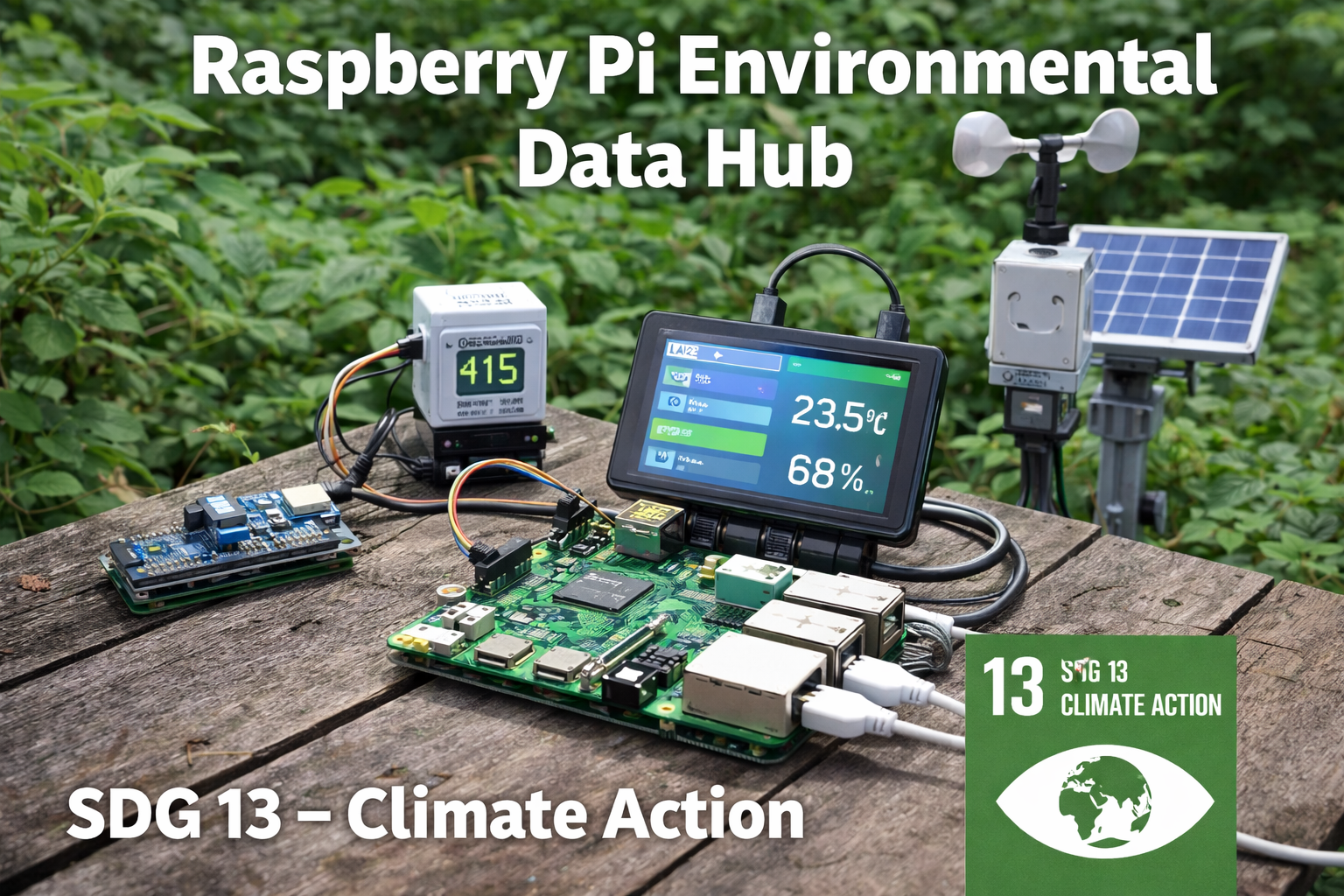
This project also connects to broader site areas, including Environmental Monitoring Systems, Intelligent Infrastructure Systems, Climate Change as a Planetary Boundary, Atmospheric Aerosol Loading and Regional Planetary Risk, Sustainable Development Goals Within Planetary Boundaries, and Planetary Boundaries. In that wider context, this Raspberry Pi build is not only a maker project. It is a small prototype of the local data infrastructure needed for climate resilience, neighborhood-scale monitoring, and environmental decision support.
Abstract
This project presents a prototype Raspberry Pi environmental data hub built around edge computing, environmental sensing, local data storage, optional cloud export, and lightweight environmental analytics. The system aggregates readings from sensors such as the BME280 and optional particulate matter monitors, stores observations locally, and provides a platform for long-term climate and environmental monitoring.
From an engineering perspective, the build demonstrates a compact edge-monitoring architecture that combines sensing, local processing, time-series storage, external data integration, and analytics. From a sustainability perspective, it illustrates how distributed environmental measurement can support climate resilience, urban environmental analysis, public awareness, and SDG-aligned monitoring infrastructure.
The system is intentionally limited. It does not replace certified meteorological stations, regulatory air-quality monitors, official public-health systems, or institutional climate observation networks. Its value is educational and methodological: it shows how local sensing can become structured environmental data and how that data can support interpretation when it is validated, maintained, documented, and connected to broader climate context.
SDG Alignment: Climate Action, Sustainable Cities, Health, Infrastructure, and Water Systems
This project aligns most directly with SDG 13: Climate Action and SDG 11: Sustainable Cities and Communities. Climate action requires observing environmental conditions, identifying changes, understanding exposure, and building the data infrastructure needed for adaptation. Sustainable cities require local information about air quality, heat, humidity, pressure, pollution, rainfall, and environmental stress at the scale of neighborhoods, schools, infrastructure corridors, and public spaces.
The project also relates to SDG 3: Good Health and Well-Being, SDG 9: Industry, Innovation and Infrastructure, and SDG 6: Clean Water and Sanitation when the data hub is extended to air quality, infrastructure monitoring, rainfall, watershed, or flood applications.
| Sustainable Development Goal | How the Project Relates | Project-Level Mechanism |
|---|---|---|
| SDG 13: Climate Action | Supports local climate observation, climate-risk awareness, adaptation planning, and environmental data literacy. | Temperature, humidity, pressure, and optional air-quality time series collected through a local edge node. |
| SDG 11: Sustainable Cities and Communities | Relates to urban heat, air quality, neighborhood-scale exposure, infrastructure resilience, and local environmental awareness. | Community-scale monitoring stations that can detect local variation in urban environmental conditions. |
| SDG 3: Good Health and Well-Being | Connects to public-health awareness where monitoring includes heat exposure, humidity stress, and particulate pollution. | Environmental readings that can support screening, education, and local awareness of exposure conditions. |
| SDG 9: Industry, Innovation and Infrastructure | Demonstrates distributed sensing, edge computing, local storage, dashboards, and resilient data infrastructure. | Raspberry Pi-based environmental monitoring node with sensor interfaces, logging, and analytics. |
| SDG 6: Clean Water and Sanitation | Relates indirectly when the hub is extended to rainfall, flood, watershed, or water-quality monitoring. | Reusable edge-computing architecture for freshwater and hydrological sensing extensions. |
The strongest SDG connection is SDG 13. Climate action cannot be limited to national averages or abstract climate commitments. It requires local observation systems that help communities understand how climate stress appears in lived environments: heat exposure, humidity, rainfall variability, stagnant air, smoke events, pressure changes, flood precursors, and other measurable signals.
The connection to SDG 11 is equally important. Cities are uneven environmental landscapes. A single metropolitan average may hide differences between shaded and unshaded blocks, industrial corridors and residential streets, schoolyards and parks, waterfronts and heat-trapping pavement. A Raspberry Pi environmental hub can help reveal those local differences when deployed carefully and interpreted responsibly.
The connection to SDG 3 should be framed with caution. Environmental exposure affects health, but this prototype does not provide medical guidance or official public-health warnings. It can support environmental awareness, classroom learning, local monitoring, and screening, especially when air-quality sensors or heat-index calculations are added.
The connection to SDG 9 comes through infrastructure. Environmental monitoring is part of the measurement layer of resilient infrastructure. Sensors, edge devices, local databases, dashboards, maintenance records, and validation workflows all help infrastructure become more observable and responsive.
Because the Sustainable Development Goals are broad public frameworks, it is important not to overclaim. This project is not a certified climate station, official public warning system, regulatory monitor, or public-health instrument. Its contribution is narrower and still valuable: it teaches the architecture of distributed environmental monitoring and shows how local sensing can support better environmental visibility.
Connections to Other Site Areas
This Raspberry Pi environmental data hub belongs to a wider body of work on monitoring systems, data infrastructure, and environmental intelligence. It connects directly to Environmental Monitoring Systems, where field sensors, air-quality stations, water sensors, weather instruments, and environmental telemetry become tools for understanding ecological and public-health conditions.
It also connects to Intelligent Infrastructure Systems. The Raspberry Pi acts as an edge node that can sense conditions, store observations, run basic analytics, and connect to dashboards or cloud systems. That pattern is central to infrastructure that becomes more adaptive, transparent, and responsive over time.
At the planetary-boundary level, the project connects to Climate Change as a Planetary Boundary and Atmospheric Aerosol Loading and Regional Planetary Risk. Local temperature, humidity, pressure, and particulate data cannot describe the whole Earth system, but they can make climate stress, heat exposure, and air-quality variation visible at the scale where people live.
The project also supports the broader development logic explored in Sustainable Development Goals Within Planetary Boundaries. Sustainable development requires measurement systems that can link local conditions with larger climate, infrastructure, and ecological trends.
Why a Raspberry Pi Environmental Data Hub Matters
Climate change is fundamentally a measurement problem as well as a governance, justice, energy, infrastructure, and ecological problem. To understand what is changing, communities and researchers need consistent observations across time and place.
Large scientific networks remain essential, but many important environmental dynamics occur at local scales that national networks cannot easily capture. Heat islands, neighborhood air-quality variation, watershed microclimates, building-level exposure, schoolyard heat, and localized flood conditions may vary dramatically over short distances.
A Raspberry Pi environmental data hub matters because it demonstrates how small, affordable edge devices can expand environmental visibility. That visibility helps support better adaptation, stronger public infrastructure, more grounded environmental education, and more transparent local decision-making.
The value of the project is not that it replaces professional climate stations or regulatory air-quality equipment. Its value is that it demonstrates the architecture of distributed environmental data infrastructure: sensors, local computing, time-series storage, validation, analytics, and optional external data integration.
It also teaches a central lesson of environmental monitoring: raw readings are not knowledge by themselves. Environmental data becomes meaningful when it is timestamped, documented, calibrated, compared, maintained, interpreted, and connected to the physical conditions being measured.
System Overview
The environmental data hub uses a Raspberry Pi as a local processing node that reads sensor data, stores time-series observations, and optionally exports results to dashboards or cloud systems.
The system can include:
- BME280 environmental sensor for temperature, humidity, and pressure
- PM2.5 air-quality sensor for particulate monitoring
- local storage through CSV, SQLite, or InfluxDB
- optional network connectivity through Wi-Fi, Ethernet, or LoRa
- optional integration with dashboards, APIs, and climate datasets
- optional analytics for anomaly detection, rolling averages, and event classification
In practical terms, the system functions as a local climate and environmental monitoring station that can collect data continuously while also supporting lightweight analytics at the edge. This distinguishes it from a simple microcontroller sensor project: the Raspberry Pi can manage files, databases, Python libraries, network calls, dashboards, scheduled jobs, and local analysis workflows.
System Requirements
An environmental data hub becomes useful only when its requirements are explicit. It must collect readings, preserve metadata, store data reliably, remain maintainable, and avoid being mistaken for a certified monitoring network.
| Requirement | Design Target | Reason |
|---|---|---|
| Environmental sensing | Measure temperature, humidity, pressure, and optional particulate matter | Provides a baseline view of local climate and air-quality conditions |
| Reliable timekeeping | Store UTC timestamps with each reading | Time-series analysis depends on consistent temporal records |
| Local storage | Use CSV, SQLite, or time-series storage | Allows operation even when network connectivity is unavailable |
| Metadata capture | Record sensor ID, location ID, units, and quality flags | Preserves context needed for interpretation and reuse |
| Validation workflow | Compare readings against reference devices or known conditions | Prevents uncritical trust in unvalidated sensor data |
| Maintainability | Support logging checks, restart behavior, and periodic inspection | Long-running field systems fail without maintenance |
| Responsible interpretation | Frame readings as prototype environmental observations | Clarifies that the system is not a regulatory or public-health instrument |
These requirements make the project more than a sensor demo. They turn it into a small environmental data infrastructure node with a clear measurement purpose and a realistic scope of use.
Bill of Materials
- Raspberry Pi 4, Raspberry Pi 5, or Raspberry Pi Zero 2 W
- BME280 environmental sensor
- PM2.5 air-quality sensor, optional but useful for urban monitoring
- MicroSD card with adequate endurance for logging
- stable power supply or solar-assisted power system
- optional LoRa, Wi-Fi, or Ethernet connectivity
- weather-resistant ventilated enclosure for longer deployments
- radiation shield or shaded ventilated housing for outdoor temperature measurements
- mounting hardware for indoor, rooftop, classroom, or sheltered outdoor placement
The BME280 is widely used in environmental monitoring because it provides temperature, humidity, and pressure sensing in a compact package. The PM2.5 sensor adds air-quality measurement capability that is especially relevant for urban resilience, public-health awareness, and environmental justice monitoring.
For field-oriented deployments, enclosure quality matters as much as sensor selection. A sensor in direct sun, a sealed hot box, a wet enclosure, or a poorly ventilated housing may report the conditions of the enclosure rather than the surrounding environment.
Engineering Specifications
| Parameter | Reference Design |
|---|---|
| Compute platform | Raspberry Pi 4, Raspberry Pi 5, or Raspberry Pi Zero 2 W |
| Primary sensor | BME280 for temperature, humidity, and pressure |
| Secondary sensor | PM2.5 air-quality sensor, optional |
| Interfaces | I2C, SPI, UART, USB, or GPIO depending on sensor selection |
| Storage options | CSV, SQLite, InfluxDB, or external database export |
| Output options | Console, local database, dashboard, cloud export, API integration |
| Analytics options | Rolling averages, anomaly detection, threshold flags, local baseline comparison |
| Deployment mode | Edge environmental monitoring node |
| Target scope | Educational, prototype, and experimental climate observation |
The reference design is modular. The BME280 can serve as the base sensor, while additional sensors can be added for air quality, rainfall, soil conditions, water quality, flood monitoring, solar-energy monitoring, or other environmental applications in the broader Raspberry Pi series.
System Architecture
The Raspberry Pi acts as a local processing node that collects environmental data, stores observations, and optionally forwards results to dashboards or cloud platforms.
Environmental Sensors → I2C / SPI / UART / USB Interface → Raspberry Pi → Local Database → Visualization Dashboard → Cloud Data ExportAt a systems level, the environmental data hub can be understood as five layers:
- Sensing layer: temperature, humidity, pressure, particulate matter, rainfall, soil, or water-quality sensors.
- Acquisition layer: Raspberry Pi interfaces such as I2C, SPI, UART, USB, or GPIO.
- Storage layer: CSV files, SQLite databases, or time-series databases.
- Analytics layer: rolling averages, anomaly detection, threshold alerts, and cross-comparison with external data.
- Communication layer: dashboards, API exports, local web servers, or cloud platforms.
This architecture allows the Raspberry Pi to function as a small environmental monitoring station capable of supporting long-term climate observation, local analytics, and future automation workflows.
It also creates a reusable pattern for the rest of the Raspberry Pi sustainability engineering series. The same monitoring architecture can support urban air quality, irrigation control, biodiversity camera traps, water-quality monitoring, solar microgrid monitoring, climate early warning, and flood monitoring.
Measurement Principle: Local Environmental Conditions as Time-Series Data
The BME280 produces measurements of temperature, humidity, and atmospheric pressure. These values are useful individually, but they become much more powerful when recorded over time as a structured time series.
Temperature can reveal daily cycles, seasonal patterns, heat exposure, enclosure artifacts, or local microclimates. Humidity can help interpret heat stress, air-mass changes, condensation risk, and sensor-enclosure behavior. Pressure can provide meteorological context and may help identify weather-system changes when interpreted with other data.
When PM2.5 sensing is added, the hub can observe particulate pollution events associated with traffic, wildfire smoke, combustion, construction, stagnant air, or local activity. PM sensors must be interpreted carefully because low-cost sensors are affected by humidity, airflow, particle composition, calibration, and placement.
The measurement principle is therefore not simply “read sensors.” It is: collect environmental signals, timestamp them, store them with units and metadata, validate them against references where possible, and interpret them in relation to physical context.
Mathematical Lens: From Sensor Readings to Environmental Intelligence
The environmental data hub can be understood as a time-series measurement and interpretation system. It converts sensor readings into a sequence of observations that can be averaged, compared, flagged, and contextualized.
\bar{x}_t=\frac{1}{n}\sum_{i=t-n+1}^{t}x_i
\]
Interpretation: A rolling average smooths short-term sensor noise and helps reveal recent environmental trends.
Rolling averages are useful for temperature, humidity, pressure, PM2.5, and other environmental variables. They reduce momentary spikes while preserving changes over time.
z_t=\frac{x_t-\mu}{\sigma}
\]
Interpretation: A standard score compares a current reading with a baseline mean \(\mu\) and standard deviation \(\sigma\).
A simple z-score can help identify values that are unusual relative to a local baseline. This does not prove a climate event, but it can flag local anomalies for review.
\Delta x_t=x_t-x_{t-1}
\]
Interpretation: Change between consecutive readings helps identify rapid environmental shifts.
Rate-of-change logic is useful for identifying sudden temperature increases, pressure drops, humidity shifts, particulate spikes, or sensor failures.
C_t =
\begin{cases}
\text{review}, & x_t > T_{\mathrm{high}} \\
\text{normal}, & T_{\mathrm{low}} \leq x_t \leq T_{\mathrm{high}} \\
\text{review}, & x_t < T_{\mathrm{low}} \end{cases} \]
Interpretation: Threshold classification can flag readings that fall outside a defined reference range.
Thresholds should be chosen carefully. A classroom demonstration can use simple reference thresholds, but public-health, climate-risk, or regulatory thresholds require validated instruments and authoritative standards.
The mathematical lens shows why the Raspberry Pi is useful. The device is not only reading sensors. It can transform local readings into rolling baselines, anomaly flags, environmental summaries, dashboards, and decision-support signals while keeping the raw data available for review.
Connecting the BME280 Sensor
The BME280 communicates with the Raspberry Pi using the I2C interface.
- VCC → Raspberry Pi 3.3V
- GND → Raspberry Pi Ground
- SDA → GPIO 2
- SCL → GPIO 3
Once connected, the Raspberry Pi can query the sensor to retrieve environmental readings. Verify that I2C is enabled on the Raspberry Pi before attempting to run the monitoring script.
On Raspberry Pi OS, I2C can usually be enabled through raspi-config:
sudo raspi-config
# Interface Options → I2C → Enable
You can then check whether the BME280 appears on the I2C bus:
sudo apt update
sudo apt install -y i2c-tools

i2cdetect -y 1
Most BME280 modules appear at I2C address 0x76 or 0x77. If no device appears, check wiring, power voltage, I2C settings, and whether the sensor board uses the expected address.
Software Environment and Dependencies
The project uses Python because the Raspberry Pi ecosystem has strong support for sensor libraries, data logging, databases, HTTP requests, and dashboard tools.
A typical setup includes:
sudo apt update
sudo apt install -y python3-pip python3-venv i2c-tools sqlite3

python3 -m venv .venv
source .venv/bin/activate

pip install adafruit-circuitpython-bme280 adafruit-blinka requests pandas
For deployments that run continuously, the monitoring script can later be wrapped in a systemd service, scheduled through cron, or managed with a process supervisor. For first testing, run the scripts manually so errors remain visible.
Because environmental data may accumulate over months or years, storage management should be planned early. Raw logs, SQLite databases, dashboard files, and API caches should be backed up, rotated, or archived according to the importance of the project.
Python Code for Reading Environmental Data
The following Python example reads temperature, humidity, and pressure from a BME280 sensor. It includes comments, error handling, and reusable function structure so it can later be extended into a logging or dashboard system.
"""
Raspberry Pi Environmental Data Hub
BME280 Sensor Reader

Reads:
- temperature in degrees Celsius
- relative humidity in percent
- atmospheric pressure in hectopascals

This script is intended for educational and prototype monitoring.
It should be validated before long-term environmental interpretation.
"""

import time
from dataclasses import dataclass

import board
import busio
import adafruit_bme280


@dataclass
class EnvironmentalReading:
    """Structured container for one environmental observation."""
    temperature_c: float
    humidity_percent: float
    pressure_hpa: float


def initialize_bme280() -> adafruit_bme280.Adafruit_BME280_I2C:
    """
    Initialize the BME280 sensor over I2C.

    The Raspberry Pi uses board.SCL and board.SDA for the I2C bus.
    Make sure I2C is enabled before running this script.
    """
    i2c = busio.I2C(board.SCL, board.SDA)
    sensor = adafruit_bme280.Adafruit_BME280_I2C(i2c)

    # Optional: adjust sea-level pressure for more accurate altitude estimates.
    # sensor.sea_level_pressure = 1013.25

    return sensor


def read_environment(sensor: adafruit_bme280.Adafruit_BME280_I2C) -> EnvironmentalReading:
    """
    Read environmental values from the BME280 sensor.

    Returns a structured EnvironmentalReading object so the values can be
    logged, displayed, analyzed, or exported.
    """
    return EnvironmentalReading(
        temperature_c=sensor.temperature,
        humidity_percent=sensor.humidity,
        pressure_hpa=sensor.pressure,
    )


def print_reading(reading: EnvironmentalReading) -> None:
    """Print one formatted environmental reading."""
    print(
        f"Temperature: {reading.temperature_c:.2f} C | "
        f"Humidity: {reading.humidity_percent:.2f}% | "
        f"Pressure: {reading.pressure_hpa:.2f} hPa"
    )


def main() -> None:
    """Main monitoring loop."""
    sensor = initialize_bme280()

    print("Raspberry Pi Environmental Data Hub")
    print("Reading BME280 environmental data...")
    print("-----------------------------------")

    while True:
        try:
            reading = read_environment(sensor)
            print_reading(reading)
        except Exception as exc:
            print(f"Sensor read error: {exc}")

        time.sleep(10)


if __name__ == "__main__":
    main()
This script is intentionally simple. It verifies the sensing layer before adding database logging, external API calls, analytics, dashboards, or service automation.
Logging Environmental Data with SQLite
Environmental monitoring systems typically log observations so that long-term trends can be analyzed. For small deployments, environmental data can be stored locally using CSV or, more robustly, in a lightweight SQLite database.
The following example creates a SQLite database table and inserts timestamped environmental readings.
"""
SQLite Logger for Raspberry Pi Environmental Data Hub

Stores timestamped environmental observations in a local SQLite database.
This provides a lightweight time-series record that can later be analyzed
with Python, R, SQL, or visualization tools.
"""

import sqlite3
from datetime import datetime, timezone
from pathlib import Path


DATABASE_PATH = Path("environment_data.db")


def create_connection(db_path: Path = DATABASE_PATH) -> sqlite3.Connection:
    """Create and return a SQLite database connection."""
    return sqlite3.connect(db_path)


def initialize_database(conn: sqlite3.Connection) -> None:
    """Create the sensor_data table if it does not already exist."""
    cursor = conn.cursor()

    cursor.execute("""
        CREATE TABLE IF NOT EXISTS sensor_data (
            id INTEGER PRIMARY KEY AUTOINCREMENT,
            timestamp_utc TEXT NOT NULL,
            temperature_c REAL NOT NULL,
            humidity_percent REAL NOT NULL,
            pressure_hpa REAL NOT NULL,
            sensor_id TEXT DEFAULT 'bme280_01',
            location_id TEXT DEFAULT 'prototype_station',
            quality_flag TEXT DEFAULT 'unchecked',
            notes TEXT DEFAULT ''
        )
    """)

    conn.commit()


def log_environmental_reading(
    conn: sqlite3.Connection,
    temperature_c: float,
    humidity_percent: float,
    pressure_hpa: float,
    sensor_id: str = "bme280_01",
    location_id: str = "prototype_station",
    quality_flag: str = "unchecked",
    notes: str = "",
) -> None:
    """Insert one environmental reading into the SQLite database."""
    cursor = conn.cursor()

    timestamp_utc = datetime.now(timezone.utc).isoformat()

    cursor.execute("""
        INSERT INTO sensor_data (
            timestamp_utc,
            temperature_c,
            humidity_percent,
            pressure_hpa,
            sensor_id,
            location_id,
            quality_flag,
            notes
        )
        VALUES (?, ?, ?, ?, ?, ?, ?, ?)
    """, (
        timestamp_utc,
        temperature_c,
        humidity_percent,
        pressure_hpa,
        sensor_id,
        location_id,
        quality_flag,
        notes,
    ))

    conn.commit()


def read_recent_observations(conn: sqlite3.Connection, limit: int = 10) -> list[tuple]:
    """Return the most recent observations for quick inspection."""
    cursor = conn.cursor()

    cursor.execute("""
        SELECT timestamp_utc, temperature_c, humidity_percent, pressure_hpa, quality_flag
        FROM sensor_data
        ORDER BY timestamp_utc DESC
        LIMIT ?
    """, (limit,))

    return cursor.fetchall()


if __name__ == "__main__":
    conn = create_connection()
    initialize_database(conn)

    # Example reading. Replace these values with live BME280 sensor readings.
    log_environmental_reading(
        conn=conn,
        temperature_c=24.8,
        humidity_percent=51.2,
        pressure_hpa=1009.6,
        quality_flag="demo",
        notes="example inserted reading",
    )

    for row in read_recent_observations(conn):
        print(row)

    conn.close()
Over time, this dataset becomes a time-series record of local environmental conditions that can be analyzed using Python, R, SQL, or visualization tools. The addition of quality flags and notes makes the data more useful because it preserves context about sensor status, test conditions, maintenance, or suspected errors.
Environmental Data Model
A monitoring hub becomes more useful when the data model is clear. Environmental readings should not be stored as isolated numbers without context. Each record should include time, place, sensor identity, variable name, units, quality status, and notes.
| Field | Example | Purpose |
|---|---|---|
| timestamp_utc | 2026-05-28T09:15:00Z | Creates a consistent time reference for analysis |
| location_id | school_roof_01 | Identifies the monitoring location |
| sensor_id | bme280_01 | Links readings to a specific device |
| variable | temperature_c | Names the measured quantity |
| value | 24.8 | Stores the measured or calculated reading |
| unit | °C | Preserves the unit needed for interpretation |
| quality_flag | valid | Marks readings as valid, suspect, missing, demo, or calibration-needed |
| notes | sensor cleaned after dust event | Captures field context and maintenance history |
Consistent metadata allows a simple Raspberry Pi project to become a reusable environmental dataset. It also supports later integration with dashboards, climate datasets, public maps, quality-control scripts, and research workflows.
Integrating Global Climate Datasets with Local Monitoring
Environmental sensing systems become more useful when local observations can be compared with broader regional and global climate data. A Raspberry Pi monitoring station can measure specific local conditions, while global datasets provide the larger context needed to interpret those measurements.
Examples of climate and environmental data sources that can be paired with local sensing include:
- NASA Earthdata
- NOAA National Centers for Environmental Information
- Copernicus Climate Data Store
- World Meteorological Organization
This integration helps transform a simple monitoring station into a context-aware environmental observation platform. Local sensing can reveal what is happening at a specific place; global and regional datasets help interpret whether that pattern reflects a local anomaly, regional event, or broader climate signal.
Local data should not be forced to agree with global datasets. Differences may be meaningful. A neighborhood sensor may reveal a heat island, shaded microclimate, industrial corridor, smoke plume, building effect, or enclosure artifact. The interpretive task is to understand why local readings differ from broader baselines, not to assume one automatically invalidates the other.
Example: Retrieving Climate Metadata from NOAA
The following example illustrates how a Raspberry Pi system could retrieve dataset metadata from NOAA’s climate data APIs using Python. It is written as scaffolding rather than a full application; real deployments should handle credentials securely and cache API responses appropriately.
"""
NOAA API Metadata Example

Retrieves available climate datasets from NOAA's Climate Data Online API.

Before using:
- Request an API token from NOAA.
- Store the token as an environment variable rather than hard-coding it.
- Review NOAA API documentation for rate limits and dataset-specific queries.
"""

import os
import requests


NOAA_DATASETS_URL = "https://www.ncdc.noaa.gov/cdo-web/api/v2/datasets"


def get_noaa_token() -> str:
    """
    Retrieve NOAA API token from environment variable.

    Set the token before running:
    export NOAA_API_TOKEN="your_token_here"
    """
    token = os.getenv("NOAA_API_TOKEN")

    if not token:
        raise RuntimeError(
            "NOAA_API_TOKEN environment variable is not set. "
            "Store your NOAA API token before running this script."
        )

    return token


def fetch_noaa_datasets() -> dict:
    """Fetch dataset metadata from the NOAA API."""
    headers = {
        "token": get_noaa_token()
    }

    response = requests.get(NOAA_DATASETS_URL, headers=headers, timeout=20)
    response.raise_for_status()

    return response.json()


def print_dataset_names(data: dict) -> None:
    """Print dataset names returned by the NOAA API."""
    results = data.get("results", [])

    if not results:
        print("No datasets returned.")
        return

    for dataset in results:
        print(dataset.get("name", "Unnamed dataset"))


if __name__ == "__main__":
    try:
        noaa_data = fetch_noaa_datasets()
        print_dataset_names(noaa_data)
    except requests.RequestException as exc:
        print(f"NOAA request failed: {exc}")
    except RuntimeError as exc:
        print(exc)
This type of integration allows environmental monitoring systems to enrich locally collected sensor data with broader climate information. API calls should be rate-limited, cached, and logged so the system remains stable if the network is unavailable.
Combining Local Sensing with Global Climate Intelligence
Environmental monitoring is most powerful when local measurements and global datasets reinforce one another.
Local sensors provide detailed observations about specific locations, while global datasets provide context about broader environmental trends. When both sources are combined, monitoring systems can produce more meaningful insights about environmental conditions.
For example:
- a local temperature sensor might detect unusually high temperatures
- regional climate datasets may show that the area is experiencing a broader heatwave
- local humidity and air-quality readings may reveal whether the event is accompanied by stagnant air or particulate pollution
- analytics running on the Raspberry Pi could classify the event as a local environmental anomaly
- dashboard notes could distinguish verified trends from readings still needing validation
This layered approach — combining embedded sensing, edge computing, local analytics, and global climate datasets — represents an important architecture for next-generation environmental monitoring systems.
Still, the distinction between observation and attribution must remain clear. A Raspberry Pi station can detect local changes. It cannot, by itself, attribute a specific event to climate change, determine legal compliance, issue official warnings, or validate public-health exposure. Its role is to support observation, screening, learning, and context-rich interpretation.
Extending the System with Environmental Analytics
A Raspberry Pi environmental data hub can support lightweight environmental analytics beyond raw data collection. Potential extensions include:
- anomaly detection for sudden environmental shifts
- forecast-triggered alerts
- pollution event classification
- time-series smoothing and sensor validation
- cross-comparison between local and regional climate data
- rolling heat-index or exposure indicators
- dashboard-based neighborhood monitoring
The following simple Python example calculates rolling averages and flags unusually high temperature readings relative to a recent local baseline.
"""
Simple Environmental Anomaly Detection

This example uses recent local observations to compute a rolling baseline.
It flags readings that exceed the baseline by a configurable threshold.

This is not a climate attribution method. It is a lightweight local
monitoring heuristic for prototype environmental dashboards.
"""

from collections import deque
from statistics import mean


class RollingTemperatureMonitor:
    """Tracks a rolling temperature baseline and flags simple anomalies."""

    def __init__(self, window_size: int = 24, anomaly_threshold_c: float = 5.0):
        self.window_size = window_size
        self.anomaly_threshold_c = anomaly_threshold_c
        self.recent_temperatures = deque(maxlen=window_size)

    def add_reading(self, temperature_c: float) -> dict:
        """
        Add a temperature reading and return baseline/anomaly diagnostics.

        A larger system could store this output in SQLite or publish it to
        a dashboard.
        """
        if len(self.recent_temperatures) == 0:
            baseline = temperature_c
        else:
            baseline = mean(self.recent_temperatures)

        anomaly_score = temperature_c - baseline
        is_anomaly = anomaly_score >= self.anomaly_threshold_c

        self.recent_temperatures.append(temperature_c)

        return {
            "temperature_c": temperature_c,
            "baseline_c": baseline,
            "anomaly_score_c": anomaly_score,
            "is_anomaly": is_anomaly,
        }


if __name__ == "__main__":
    monitor = RollingTemperatureMonitor(window_size=6, anomaly_threshold_c=4.0)

    sample_temperatures = [22.1, 22.4, 22.8, 23.0, 22.7, 23.2, 29.5]

    for temp in sample_temperatures:
        result = monitor.add_reading(temp)
        print(result)
These additions move the system from simple sensing toward practical environmental intelligence. The important point is not to overclaim what the device can do, but to show how environmental observations can become structured data, and how structured data can support interpretation.
GitHub Repository
The article body includes the core implementation logic so the build remains readable. The full repository expands the project into a reproducible prototype package, including Python environmental monitoring scripts, sensor setup documentation, SQLite logging examples, deployment notes, example datasets, and climate API integration scaffolding.
Complete Code Repository
The full code distribution for this project, including Python environmental monitoring scripts, sensor setup documentation, SQLite logging examples, deployment notes, example datasets, and climate API integration scaffolding, is available on GitHub.
The repository contains the complete prototype build materials:
- Python environmental monitoring scripts
- sensor setup documentation
- database and logging examples
- deployment notes
- example environmental datasets
- integration examples for climate APIs
Repository Structure
raspberry-pi-environmental-data-hub/

README.md
LICENSE

requirements.txt

src/
  read_environment.py
  log_environment.py
  noaa_api_example.py
  environmental_analytics.py

docs/
  setup_guide.md
  deployment_notes.md
  sensor_notes.md
  data_model.md

data/
  example_environment_data.csv

hardware/
Engineers can clone the repository, fork the design, or download the complete project using GitHub’s Download ZIP feature. All materials are released under the MIT License to support reuse in research, education, and prototype engineering work.
Engineering Notes
A few technical considerations are especially important in this build:
- Edge resilience: local data storage reduces dependence on constant network connectivity.
- Sensor interface choice: I2C, SPI, UART, and USB each introduce tradeoffs in expandability, reliability, and wiring complexity.
- Data model: time-series storage becomes increasingly important as observations accumulate over long intervals.
- Remote deployment: power supply, enclosure design, ventilation, and connectivity strategy matter as much as code.
- Contextual interpretation: isolated local data is useful, but local-plus-global context is more powerful.
- Maintenance: long-running sensor stations need periodic inspection, calibration checks, and storage monitoring.
- Sensor placement: location, airflow, sunlight exposure, mounting height, and enclosure design strongly affect readings.
- Data governance: site IDs, location metadata, ownership, privacy, and access rules should be considered before publishing data.
These considerations make the project more than a simple sensor demo. It becomes a prototype environmental data infrastructure node.
Deployment Scope and Data-Quality Considerations
This prototype is designed for educational, experimental, and early-stage environmental monitoring. It should not be treated as a certified weather station, regulatory air-quality monitor, official climate observation system, public-health instrument, or emergency warning platform.
Data quality depends on sensor placement, enclosure design, airflow, shading, humidity exposure, power stability, calibration, and maintenance. A sensor placed in direct sunlight may report heat exposure rather than ambient air temperature. A particulate sensor near a roadway may represent traffic exposure rather than neighborhood background conditions. A sensor inside a poorly ventilated box may measure enclosure conditions rather than outdoor air.
These constraints do not make the system unhelpful. They define the appropriate scope of interpretation: local observation, trend detection, educational monitoring, prototype analytics, and environmental awareness.
Responsible data use also requires uncertainty. Dashboards should identify prototype status, data gaps, sensor maintenance, calibration limitations, and whether readings are validated or still provisional. Environmental monitoring becomes more trustworthy when uncertainty is visible rather than hidden.
Failure Modes and Practical Risks
A useful environmental data hub article should explain not only how the system works, but how it can fail. Field monitoring systems often fail quietly, producing numbers that look precise even when they are degraded.
- Direct sunlight bias: temperature readings may reflect solar heating of the enclosure rather than ambient air.
- Poor ventilation: a sealed or stagnant enclosure can distort temperature and humidity readings.
- Humidity interference: moisture can affect particulate readings, electronics, and sensor lifespan.
- Power instability: weak power supplies can cause reboots, corrupted logs, or missing data.
- I2C communication failure: loose wiring, long cables, or incorrect configuration can interrupt sensor readings.
- Clock errors: incorrect system time can damage time-series interpretation.
- Database growth: long-running logs can fill storage if not managed.
- Sensor drift: readings may change over time even when environmental conditions do not.
- False authority: dashboards can make prototype data appear more official than it is.
- Misinterpretation: local anomalies may be mistaken for regional climate patterns without context.
These risks do not make the project unusable. They make validation and maintenance essential. A monitoring system should include procedures for checking sensor behavior, inspecting logs, reviewing anomalies, and documenting changes to hardware or placement.
Validation and Testing
To bring this project closer to engineering-grade documentation, validation should include:
- verify that the Raspberry Pi can communicate with the BME280 over I2C
- confirm that temperature, humidity, and pressure readings are plausible under known conditions
- compare readings against a nearby thermometer, hygrometer, or weather source where possible
- test local logging to CSV or SQLite over repeated intervals
- validate PM2.5 integration if that sensor is included
- verify API connectivity for external climate datasets where used
- evaluate system stability during extended logging runs
- check that timestamps, units, location metadata, and quality flags remain consistent
- inspect enclosure effects by comparing sheltered, shaded, and exposed placements
- document maintenance events, sensor cleaning, firmware changes, and hardware relocation
If the system behaves inconsistently, the issue may be related to wiring, power stability, interface configuration, enclosure conditions, sensor placement, timekeeping, software libraries, or storage behavior rather than to the environmental logic of the platform itself.
Example Validation Record
| Test | Expected Result | Observed Result | Likely Issue | Action |
|---|---|---|---|---|
| I2C scan | BME280 appears at 0x76 or 0x77 | Device visible at 0x76 | None | Proceed to reading test |
| Indoor comparison | Temperature close to reference thermometer | Pi reading 1.8°C high | Sensor near heat source | Move sensor away from board heat |
| Outdoor shaded test | Stable readings under ventilation | Humidity spikes after rain | Moisture exposure | Improve enclosure ventilation |
| Extended logging | No gaps over 24 hours | Two gaps after reboot | Power instability | Improve power supply and restart service |
A validation record like this helps separate environmental signal from engineering artifact. That distinction is essential if the data will be used beyond a short classroom demonstration.
Suggested Performance Metrics
For a more rigorous evaluation, the hub can be assessed using several simple metrics:
- sensor stability: consistency of repeated readings under unchanged conditions
- logging reliability: whether observations are stored without loss over long runs
- uptime: how consistently the station continues operating without intervention
- data completeness: whether the station captures the expected number of observations over time
- timestamp integrity: whether records preserve consistent time references
- context integration: whether local and external climate data can be combined reliably
- maintenance burden: how often the system requires inspection, rebooting, recalibration, or storage cleanup
- enclosure performance: whether housing protects the electronics without distorting readings
- analytics usefulness: whether rolling averages and anomaly flags support meaningful review
Even simple tracking of these metrics improves the project’s usefulness as an environmental monitoring system. A data hub should be evaluated not only by whether it produces readings, but by whether it produces reliable, interpretable, maintainable observations.
Field Deployment, Enclosure, Power, and Maintenance
Field deployment is often the difference between a working prototype and a useful monitoring system. Environmental data hubs fail through moisture, overheating, insects, dust, loose connectors, corrosion, weak power, poor airflow, clock errors, storage limits, and unmaintained logs.
Responsible deployment should address:
- weather-resistant enclosure design
- proper ventilation for atmospheric sensors
- radiation shielding or shaded placement for temperature readings
- stable power supply or solar-assisted battery sizing
- safe cable routing and strain relief
- database backup and storage rotation
- system restart behavior after power loss
- maintenance schedules and inspection records
- sensor cleaning and periodic validation
- clear documentation of sensor location and movement
Maintenance is not a minor operational detail. It is part of the measurement system. A neglected Raspberry Pi station can continue logging data that looks precise while gradually losing reliability. Long-running deployments should therefore include maintenance logs, quality flags, and periodic comparison against reference sources where possible.
Environmental Data Infrastructure and Climate Policy
Climate policy depends on more than models and targets. It also depends on measurement systems that make environmental conditions visible at the scales where people actually live.
Distributed sensing helps cities, communities, schools, researchers, and public institutions build a more grounded understanding of environmental conditions. This matters for climate adaptation, air-quality planning, urban heat analysis, flood preparedness, school safety, public infrastructure design, and environmental justice.
In that sense, the project reflects a broader insight: environmental governance becomes stronger when observation systems are more distributed, transparent, and accessible. Better data does not automatically produce better policy, but weak data makes better policy much harder.
Still, environmental data infrastructure should not shift responsibility away from institutions onto individuals or communities. Community monitoring can reveal problems, but public agencies, utilities, regulators, and infrastructure operators remain responsible for acting on serious environmental risks. The best monitoring systems support accountability rather than replacing it.
Environmental Data Infrastructure and the Future of Climate Monitoring
The future of climate monitoring will likely depend on hybrid systems that combine:
- large scientific observation networks
- local embedded sensors
- edge analytics
- machine learning
- shared data platforms
- community-based monitoring
- public dashboards and decision-support tools
Raspberry Pi-class systems are especially useful for experimenting with these architectures because they are affordable, flexible, and capable of integrating sensing, storage, network communication, and analytics into a single edge device.
The long-term challenge is not merely collecting more data. It is building monitoring systems that are accurate enough to be useful, transparent enough to be trusted, maintained enough to remain reliable, and accessible enough to support communities facing real climate and environmental risks.
In future versions, this project could connect to additional sensors, distributed node networks, map-based dashboards, time-series databases, LoRa gateways, air-quality correction models, climate APIs, and automated data-quality checks. Each extension should strengthen the system’s interpretability rather than simply adding complexity.
Reproducibility
All code, documentation, and supporting build materials necessary to reproduce the prototype are included in the project repository. The design intentionally relies on widely available sensors, Raspberry Pi hardware, and open-source software libraries so that it can be rebuilt in classrooms, labs, makerspaces, and independent environmental monitoring projects.
The system is intended as a reference implementation rather than a certified scientific observation node. Engineers adapting it for long-term deployment should validate power systems, enclosure resilience, data integrity, sensor maintenance, location metadata, and connectivity under local operating conditions.
For the rest of this project series, reproducibility should mean more than making code available. Each article should include a clear bill of materials, setup instructions, validation notes, data model, known failure modes, test procedure, responsible-use framing, and realistic statement of appropriate scope.
Conclusion
Building a Raspberry Pi environmental data hub demonstrates how edge computing and embedded sensing can support climate monitoring at local scales. By combining environmental sensors, local storage, optional API integration, and lightweight analytics, the system creates a flexible platform for environmental observation.
Although relatively compact, the design illustrates a broader sustainability principle: climate resilience depends on environmental visibility. When local conditions can be measured clearly and compared with larger patterns, communities are better positioned to understand environmental change, document local risks, and support better decisions.
For classrooms, makerspaces, environmental labs, community monitoring projects, and early-stage climate infrastructure experiments, this Raspberry Pi data hub offers a practical foundation for understanding how local sensing, edge computing, and environmental data systems can work together.
The deeper lesson is not simply that a Raspberry Pi can read a sensor. The deeper lesson is that environmental monitoring requires infrastructure: calibrated sensors, stable power, metadata, validation, storage, analytics, maintenance, and responsible interpretation. When those layers are treated seriously, even a small edge device can demonstrate the logic of more intelligent climate and environmental monitoring systems.
Related Articles and Site Areas
- Raspberry Pi Sustainability Engineering Series
- Raspberry Pi Urban Air Quality and Heat Island Monitor
- Environmental Monitoring Systems
- Intelligent Infrastructure Systems
- Climate Change as a Planetary Boundary
- Atmospheric Aerosol Loading and Regional Planetary Risk
- Sustainable Development Goals Within Planetary Boundaries
- Planetary Boundaries
Further Reading
- Adafruit (n.d.) Adafruit BME280 Humidity, Barometric Pressure, and Temperature Sensor Breakout. Available at: https://learn.adafruit.com/adafruit-bme280-humidity-barometric-pressure-temperature-sensor-breakout
- Adafruit (n.d.) CircuitPython on Raspberry Pi. Available at: https://learn.adafruit.com/circuitpython-on-raspberrypi-linux
- Copernicus Climate Data Store (n.d.) Climate Data Store. Available at: https://cds.climate.copernicus.eu/
- NASA Earthdata (n.d.) Earthdata. Available at: https://www.earthdata.nasa.gov/
- NOAA National Centers for Environmental Information (n.d.) Climate Data Online. Available at: https://www.ncei.noaa.gov/cdo-web/
- Raspberry Pi Foundation (n.d.) Raspberry Pi Documentation. Available at: https://www.raspberrypi.com/documentation/
- United Nations (n.d.) Sustainable Development Goal 13: Climate Action. Available at: https://sdgs.un.org/goals/goal13
- U.S. Environmental Protection Agency (n.d.) Air Sensor Toolbox. Available at: https://www.epa.gov/air-sensor-toolbox
- World Meteorological Organization (n.d.) WMO Integrated Global Observing System. Available at: https://wmo.int/activities/wmo-integrated-global-observing-system-wigos
References
- Adafruit (n.d.) Adafruit BME280 Humidity, Barometric Pressure, and Temperature Sensor Breakout. Available at: https://learn.adafruit.com/adafruit-bme280-humidity-barometric-pressure-temperature-sensor-breakout
- Adafruit (n.d.) CircuitPython on Raspberry Pi. Available at: https://learn.adafruit.com/circuitpython-on-raspberrypi-linux
- Copernicus Climate Data Store (n.d.) Climate Data Store. Available at: https://cds.climate.copernicus.eu/
- NASA Earthdata (n.d.) Earthdata. Available at: https://www.earthdata.nasa.gov/
- NOAA National Centers for Environmental Information (n.d.) Climate Data Online. Available at: https://www.ncei.noaa.gov/cdo-web/
- Raspberry Pi Foundation (n.d.) Raspberry Pi Documentation. Available at: https://www.raspberrypi.com/documentation/
- United Nations (n.d.) The 17 Sustainable Development Goals. Available at: https://sdgs.un.org/goals
- United Nations (n.d.) Sustainable Development Goal 3: Good Health and Well-Being. Available at: https://sdgs.un.org/goals/goal3
- United Nations (n.d.) Sustainable Development Goal 6: Clean Water and Sanitation. Available at: https://sdgs.un.org/goals/goal6
- United Nations (n.d.) Sustainable Development Goal 9: Industry, Innovation and Infrastructure. Available at: https://sdgs.un.org/goals/goal9
- United Nations (n.d.) Sustainable Development Goal 11: Sustainable Cities and Communities. Available at: https://sdgs.un.org/goals/goal11
- United Nations (n.d.) Sustainable Development Goal 13: Climate Action. Available at: https://sdgs.un.org/goals/goal13
- U.S. Environmental Protection Agency (n.d.) Air Sensor Toolbox. Available at: https://www.epa.gov/air-sensor-toolbox
- World Meteorological Organization (n.d.) WMO Integrated Global Observing System. Available at: https://wmo.int/activities/wmo-integrated-global-observing-system-wigos