
Last Updated May 10, 2026
Human–AI interaction and interface design concern how artificial intelligence systems are presented, interpreted, supervised, corrected, trusted, contested, and used by human beings in real contexts of work, judgment, and decision-making. AI systems do not act in the world merely because a model produces an output. Their practical effects depend on how those outputs move through interfaces, prompts, explanations, confidence displays, alerts, controls, feedback pathways, workflows, institutional expectations, and human mental models.
A technically strong model can still fail if people misunderstand its limits, accept outputs too readily, reject useful recommendations prematurely, or lack meaningful ways to correct, override, escalate, or contest the system. Human–AI interaction therefore sits at the center of responsible AI deployment. It asks how people form expectations about AI systems, how they interpret uncertainty, how they decide when to rely on a recommendation, how they recover from errors, and how interface design shapes trust, attention, cognitive workload, accessibility, and accountability.
The central argument is that interface design is not a cosmetic layer placed on top of AI capability. It is part of the AI system itself. The interface determines what users notice, what they misunderstand, what they can challenge, what they can correct, what they trust, and what becomes institutionally actionable. Human-centered AI expands the question further by asking whether systems are designed around actual users, affected stakeholders, work contexts, accessibility needs, power relationships, institutional constraints, and foreseeable harms.
Main Library
Publications
Article Map
Artificial Intelligence Systems
Related Topic
Data Systems & Analytics
Related Topic
Institutions & Governance
Related Topic
Risk & Resilience
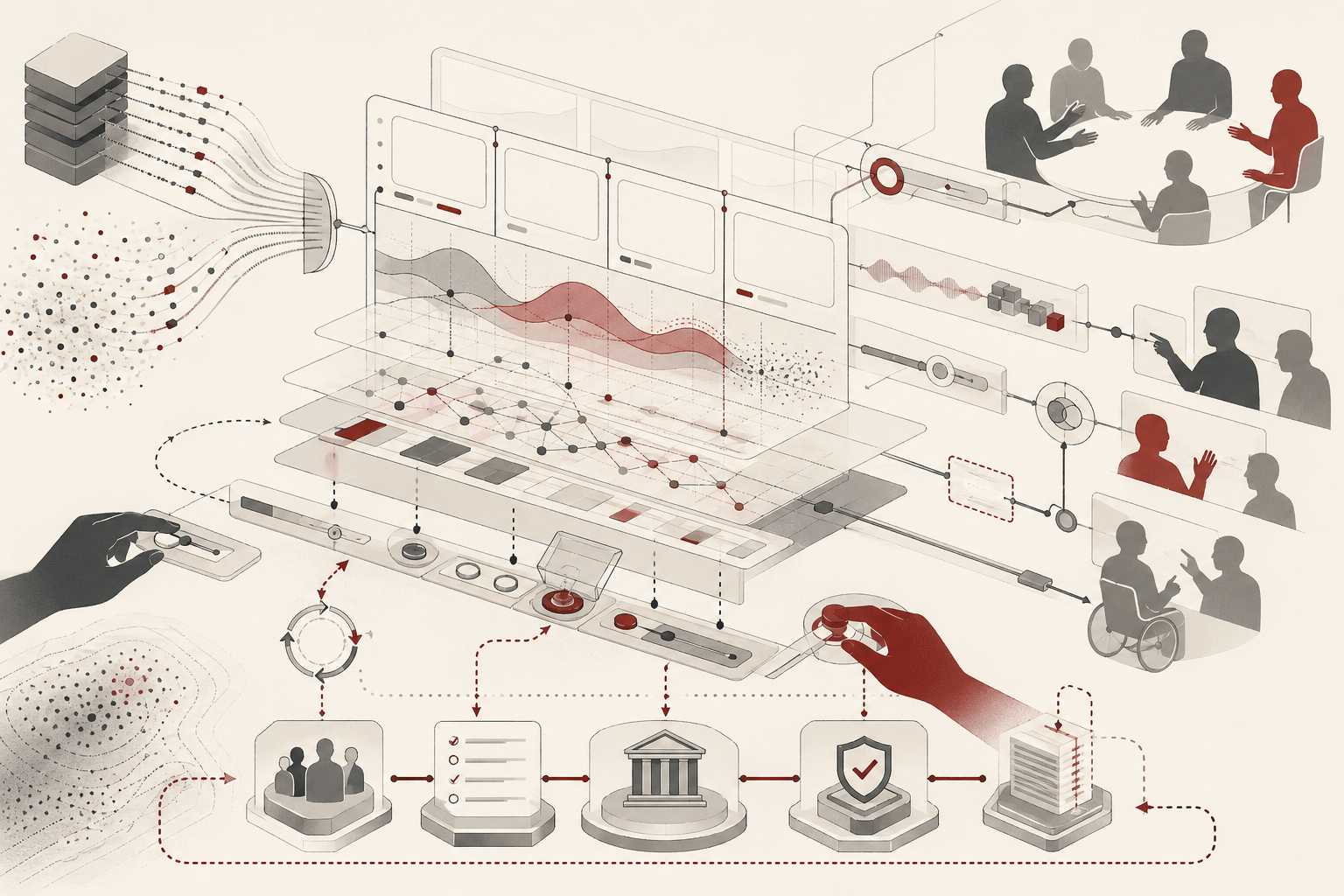
This article develops Human–AI Interaction and Interface Design as an advanced article within the Artificial Intelligence Systems knowledge series. It explains human-centered AI, human-computer interaction, mental models, cognitive work, trust calibration, automation bias, algorithm aversion, explanation design, uncertainty communication, prompt-based interaction, supervision, delegation, contestability, accessibility, organizational workflow, and sociotechnical evaluation. Selected Python and R examples appear here, while the full GitHub repository contains expanded computational scaffolding for user-reliance diagnostics, interaction logging, interface-risk analysis, scenario-based evaluation, SQL metadata, design-review checklists, governance documentation, and advanced Jupyter notebooks.
Why Human–AI Interaction Matters
Human–AI interaction matters because AI systems become consequential through use. A model output does not automatically become a good decision. It passes through a human-facing environment where users interpret confidence, read explanations, compare recommendations with domain knowledge, respond to alerts, accept suggestions, override outputs, escalate cases, or ignore the system entirely. The quality of the human-AI interface therefore shapes not only user experience, but system performance, safety, fairness, accountability, and institutional trust.
This is especially important because many AI systems are probabilistic, adaptive, generative, or partially opaque. They may produce plausible but wrong answers. They may behave differently under distribution shift. They may express confidence poorly. They may fail silently. They may influence users through fluency, speed, authority, default presentation, and institutional endorsement. Human–AI interaction design must therefore help users understand system capability, limitation, evidence, uncertainty, and proper use.
The central question is not only whether an AI system is accurate, but whether people can use it appropriately. That includes knowing when to rely on it, when to question it, how to correct it, how to seek additional evidence, how to contest outcomes, and how to integrate AI support into real workflows. Human–AI interaction is where model behavior becomes human judgment, and where interface design becomes operational governance.
Model\ Output \neq Human\ Judgment
\]
Interpretation: A model output becomes consequential only after it is interpreted, trusted, questioned, ignored, corrected, escalated, or acted on by people inside a workflow.
| Interaction Layer | Core Question | Failure if Ignored | Responsible Design Response |
|---|---|---|---|
| Presentation | How is the AI output shown to the user? | Users mistake uncertainty, ranking, or suggestion for final authority. | Use clear labels, uncertainty cues, and task-specific framing. |
| Interpretation | What does the user believe the system is doing? | Users form incorrect mental models of AI capability. | Clarify system scope, limits, evidence, and failure modes. |
| Reliance | When does the user follow the AI? | Overreliance, underreliance, rubber-stamping, or misuse. | Design for calibrated trust and appropriate escalation. |
| Correction | Can users correct, override, or improve outputs? | Errors repeat and users work around the system. | Provide feedback, override, appeal, and correction mechanisms. |
| Workflow | How does AI fit into real work? | Model performance does not translate into better decisions. | Map decisions, roles, timing, authority, and review points. |
| Governance | Who is accountable when interaction fails? | Responsibility diffuses across model, interface, user, vendor, and institution. | Log outputs, decisions, overrides, appeals, and incident responses. |
Note: Human–AI interaction is a system layer where technical capability becomes interpreted, acted on, and governed.
Human–AI interaction is therefore inseparable from responsible AI. A system cannot be considered safe, trustworthy, or accountable if the people expected to use it cannot understand it, contest it, correct it, or recognize when it is failing.
Foundations of Human–AI Interaction
Human–AI interaction sits at the intersection of human-computer interaction, decision support, cognitive ergonomics, organizational design, interface design, psychology, and sociotechnical systems research. It begins from the observation that AI systems are not isolated models. They are interactive systems embedded in human contexts. Their risks and benefits emerge from the interaction among technical capability, user behavior, interface design, organizational incentives, domain constraints, and downstream consequences.
This means interface design is not a cosmetic layer. It is part of system behavior. A model with the same accuracy may produce different outcomes depending on whether outputs are framed as suggestions, warnings, probabilities, rankings, summaries, or final decisions. A confidence score may help an expert calibrate reliance but confuse a novice. A dashboard may support deliberation or accelerate automation bias. A chatbot may invite exploration but also create misplaced confidence. A review workflow may support accountability or become a rubber stamp.
A human–AI system can be represented as:
S_{\mathrm{HAI}}=(M,I,U,C,W,G)
\]
Interpretation: A human–AI system includes a model \(M\), interface \(I\), user \(U\), context \(C\), workflow \(W\), and governance structure \(G\).
| Component | Role | Interaction Risk | Design Responsibility |
|---|---|---|---|
| Model | Produces predictions, rankings, recommendations, summaries, or generated outputs. | May be wrong, uncertain, biased, brittle, or out of scope. | Validate, monitor, calibrate, document, and govern model behavior. |
| Interface | Presents outputs, explanations, controls, alerts, and uncertainty. | May mislead users through framing, defaults, or missing context. | Design for clarity, correction, accessibility, and calibrated reliance. |
| User | Interprets, accepts, rejects, revises, escalates, or contests outputs. | May overtrust, undertrust, misunderstand, or lack authority. | Support user agency, expertise, and differentiated needs. |
| Context | Defines stakes, domain, environment, uncertainty, and constraints. | Model assumptions may not match real conditions. | Make context, scope, and limits explicit. |
| Workflow | Connects AI output to action, review, documentation, and feedback. | Human review may become symbolic or overloaded. | Map decision points, escalation, override, and accountability. |
| Governance | Assigns ownership, review, audit, incident response, and remedy. | Failures cannot be corrected or assigned responsibility. | Create lifecycle evidence and accountable review processes. |
Note: Effective performance is distributed across model quality, interface design, user judgment, workflow context, and governance.
The interface determines what users see, what they can do, what they can correct, and what they are likely to trust. In practice, the effective performance of the system is distributed across model quality, interface design, human judgment, and organizational context.
Effective\ AI\ Performance = Model\ Quality \times Interaction\ Quality
\]
Interpretation: A high-performing model can still produce poor outcomes if the interface causes misunderstanding, overreliance, weak correction, or poor workflow integration.
HCI Theory, Mental Models, and Cognitive Work
Classic human-computer interaction provides an essential foundation through the concept of mental models. Users interact with systems based on what they believe the system is doing, what it can do, what it cannot do, and how it will respond to their actions. When the system’s actual behavior and the user’s mental model diverge, confusion, misuse, overreliance, underreliance, and error become more likely.
A user mental model can be represented as:
M_u=g(I,O,F,E)
\]
Interpretation: A user’s mental model \(M_u\) is shaped by interface cues \(I\), observed outputs \(O\), feedback \(F\), and explanations \(E\).
This matters in AI because users often infer capability from fluency, speed, confidence, visual polish, or institutional endorsement. A generated answer may appear knowledgeable even when it is unsupported. A ranking may appear objective even when it reflects biased training data or platform incentives. A confidence score may appear to express truth even when it is poorly calibrated. A recommendation may appear authoritative because it is integrated into official workflow software.
| User Assumption | Possible Reality | Risk | Interface Response |
|---|---|---|---|
| “The system understands this case.” | The model may be matching patterns without contextual understanding. | Users overinterpret model output as reasoning. | Show evidence, scope, and limitations. |
| “Confidence means correctness.” | Confidence may be uncalibrated or valid only under tested conditions. | High-confidence errors become persuasive. | Use calibration information and uncertainty cues. |
| “The output is neutral.” | The system may reflect training data, objectives, and institutional incentives. | Users ignore embedded bias or optimization goals. | Disclose objective, data limits, and evaluation results. |
| “Human review means safety.” | Review may be rushed, underpowered, or symbolic. | Rubber-stamp oversight replaces meaningful judgment. | Give reviewers time, authority, and evidence. |
| “The model has current knowledge.” | The model may lack current retrieval, source access, or update awareness. | Users rely on stale or unsupported outputs. | Show source dates, retrieval status, and freshness indicators. |
Note: Good AI interfaces help users form accurate mental models of capability, limitation, uncertainty, and appropriate use.
Human–AI interface design must therefore support accurate mental models. It should clarify what the system is doing, what evidence supports the output, what uncertainty remains, what the user should verify, what the system cannot know, and what kinds of errors are possible. Good AI interfaces help users reason about the system rather than merely react to its outputs.
Interface\ Cues \rightarrow Mental\ Model \rightarrow Reliance
\]
Interpretation: Users rely on AI according to what the interface leads them to believe about the system, not only according to the system’s actual performance.
Human-Centered AI and Human Factors
Human-centered AI aims to develop systems that are useful, usable, accessible, safe, and accountable in relation to human needs and contexts. It shifts the design problem away from model capability alone toward the lived conditions of use: who uses the system, who is affected by it, what tasks it supports, what decisions it influences, what errors are costly, what constraints users face, and what forms of review or remedy are available.
Human factors are especially important because AI systems often operate under uncertainty, time pressure, workload, fatigue, organizational hierarchy, and competing incentives. A system designed for idealized use may fail under real conditions. A clinician may have limited time to inspect an explanation. A benefits worker may face pressure to process cases quickly. A maintenance planner may need to coordinate work orders, budgets, and asset risk. A teacher may use AI support while balancing student privacy, assessment integrity, and differentiated learning needs.
Human-centered AI should therefore include:
- user research across direct users and affected stakeholders;
- task analysis and workflow mapping;
- accessibility and inclusion review;
- interface testing with realistic scenarios;
- measurement of overreliance, underreliance, workload, and recovery;
- feedback and correction mechanisms;
- contestability and remedy pathways;
- post-deployment monitoring of interaction behavior.
| Commitment | Design Question | Evidence Needed | Governance Function |
|---|---|---|---|
| Usefulness | Does the AI support a real human task? | Task analysis, user research, workflow observation. | Prevents technology-driven deployment without purpose. |
| Usability | Can users understand and act on the system? | Usability testing, comprehension testing, error recovery analysis. | Improves responsible use and reduces confusion. |
| Accessibility | Can different users access and understand the interface? | Accessibility audit, assistive technology testing, language review. | Reduces exclusion and unequal accountability. |
| Safety | Can users detect, recover from, and escalate failures? | Scenario testing, incident simulations, override logs. | Supports prevention and correction of harm. |
| Accountability | Who owns decisions, errors, appeals, and corrections? | Governance charter, audit logs, review records. | Prevents responsibility diffusion. |
| Contestability | Can affected people challenge outcomes? | Appeal process, correction pathway, remedy records. | Turns explanation into procedural accountability. |
Note: Human-centered AI treats usability, safety, accessibility, and accountability as system requirements rather than optional interface features.
The goal is not to make AI interfaces feel friendly. The goal is to make AI systems understandable, usable, contestable, and accountable within real human and institutional environments.
Human\ Centered\ AI = Users + Affected\ People + Workflows + Governance
\]
Interpretation: Human-centered AI must account for direct users, affected stakeholders, real work conditions, institutional responsibility, and remedy.
Design Guidelines for Human–AI Interaction
One of the most influential practical contributions to the field is the set of human-AI interaction guidelines developed by Amershi and colleagues. These guidelines emphasize the full interaction lifecycle: setting expectations, making system capabilities clear, showing contextually relevant information, supporting efficient correction, mitigating failure, helping users understand why the system may err, and supporting feedback over time.
These guidelines remain useful because AI systems behave differently from traditional deterministic software. A conventional application often follows clearly specified rules. AI systems may infer, recommend, rank, summarize, or generate probabilistic outputs. They may also change over time or respond differently to subtle variations in prompt, data, or context. This means interface design must communicate uncertainty, scope, recoverability, and error conditions more carefully.
A useful design principle is:
I_{\mathrm{good}} \rightarrow M_u \approx M_s
\]
Interpretation: A good interface helps the user’s mental model \(M_u\) approximate the system’s actual behavior model \(M_s\).
| Design Principle | Practical Meaning | Risk Addressed | Example Interface Feature |
|---|---|---|---|
| Set expectations | Tell users what the AI can and cannot do. | Inflated mental models and misuse. | Capability summary, scope notice, onboarding guidance. |
| Show uncertainty | Communicate confidence, ambiguity, and limits. | False certainty and automation bias. | Risk bands, confidence warnings, source-quality indicators. |
| Support correction | Allow users to revise, override, or report errors. | Repeated errors and hidden failures. | Correction button, override rationale, feedback capture. |
| Make reasoning inspectable | Expose evidence, explanation, or decision trace where needed. | Opaque outputs and weak contestability. | Source panel, rationale view, model-card link. |
| Manage workload | Reduce unnecessary cognitive burden. | Alert fatigue and superficial review. | Prioritized warnings, progressive disclosure, concise summaries. |
| Enable escalation | Route uncertain or consequential cases to review. | Weak outputs become final decisions. | Escalation trigger, review queue, human approval gate. |
| Record interaction evidence | Log outputs, explanations, user decisions, and feedback. | Failures cannot be reconstructed. | Audit trail, override log, incident record. |
Note: Human–AI guidelines help prevent epistemic failure: the user believing the system does something different from what it actually does.
Human–AI guidelines therefore do more than improve usability. They help prevent epistemic failure: the user believing the system does something different from what it actually does. In responsible AI systems, interface design should help users understand not only what the system recommends, but how strongly the recommendation is supported, when it may be wrong, and what responsible action should follow.
Good\ AI\ Design = Guidance + Correction + Escalation + Evidence
\]
Interpretation: Responsible interfaces help users understand outputs, correct errors, escalate uncertainty, and preserve evidence for review.
Calibrated Trust, Reliance, and Misuse
One of the central challenges in human–AI interaction is calibrated trust. The goal is not maximal trust. The goal is appropriate reliance. Users should rely on the system when evidence supports reliance, question it when uncertainty is high, override it when domain knowledge contradicts it, and escalate it when consequences are serious.
Reliance can be represented as:
R_u=P(d=\hat{y})
\]
Interpretation: User reliance \(R_u\) can be approximated as the probability that the user decision \(d\) follows the AI output \(\hat{y}\).
A reliance gap can be written as:
G_R=\left|R_u-W_s\right|
\]
Interpretation: Reliance gap \(G_R\) measures the distance between observed user reliance \(R_u\) and actual system warrant \(W_s\).
Overtrust and undertrust are both failures. Overtrust creates automation bias and uncritical dependence. Undertrust causes useful systems to be ignored even when they perform well. Interface design shapes both. Polished visual design, authoritative language, default acceptance buttons, and hidden uncertainty can increase unwarranted reliance. Poor explanations, lack of transparency, past failures, or weak institutional legitimacy can produce excessive skepticism.
| Reliance Pattern | Description | Likely Cause | Design Response |
|---|---|---|---|
| Calibrated reliance | User follows AI when warrant is strong and questions it when warrant is weak. | Clear evidence, uncertainty, task fit, and meaningful control. | Maintain monitoring and feedback loops. |
| Overreliance | User accepts AI output when it is wrong, uncertain, or out of scope. | Automation bias, false certainty, defaults, time pressure. | Add uncertainty cues, friction, review triggers, and source checks. |
| Underreliance | User rejects useful AI support. | Algorithm aversion, poor explanation, distrust, workflow mismatch. | Improve transparency, training, correction, and evidence visibility. |
| Selective reliance | User follows AI only when it confirms prior beliefs. | Confirmation bias and weak review culture. | Use disagreement prompts and override rationale fields. |
| Institutional overreliance | Organization treats AI output as official truth. | Policy pressure, productivity metrics, unclear accountability. | Separate recommendation, decision, review, and ownership. |
Note: The goal is not maximum AI acceptance. The goal is reliance that tracks evidence, uncertainty, stakes, and human responsibility.
Calibrated trust requires technical evidence, interface clarity, user education, and governance. Users need to know what the system is good at, where it fails, what confidence means, what evidence supports an output, and when review is required.
Maximum\ Trust \neq Appropriate\ Reliance
\]
Interpretation: Responsible AI systems should not maximize user acceptance. They should align reliance with system warrant, uncertainty, and consequence.
Automation Bias and Algorithm Aversion
Human–AI interaction is shaped by two opposing pathologies. Automation bias describes the tendency to over-rely on automated suggestions and neglect contradictory information or independent verification. Algorithm aversion describes cases where users avoid algorithms after observing errors, even when the algorithm remains more accurate than unaided human judgment.
The design challenge is symmetrical. A system should not encourage blind compliance, but it should also not make useful AI support so opaque, confusing, or alienating that users reject it. Appropriate reliance requires user agency, evidence, feedback, correction, and proportional oversight.
Automation bias is especially dangerous when AI outputs are presented as final answers, when users are overloaded, when explanations are shallow, when the system appears authoritative, or when organizational incentives reward speed over review. Algorithm aversion is more likely when users see errors without understanding limits, when systems cannot be corrected, when local expertise is ignored, or when the interface makes the user feel displaced rather than supported.
A simple decision-support model can be written as:
d=U(\hat{y},e,c,h)
\]
Interpretation: User decision \(d\) depends on AI output \(\hat{y}\), explanation \(e\), context \(c\), and human expertise \(h\).
| Interaction Problem | Behavior | System Risk | Mitigation |
|---|---|---|---|
| Automation bias | User accepts AI output too readily. | Errors pass through nominal human review. | Use uncertainty display, cognitive forcing, evidence checks, and review triggers. |
| Algorithm aversion | User rejects AI after seeing errors. | Useful decision support is ignored. | Make limits clear, allow correction, and show performance evidence. |
| Authority bias | User treats institutional AI as official truth. | Recommendation becomes de facto decision. | Separate AI recommendation from accountable human decision. |
| Default bias | User follows the preselected AI option. | Interface nudges replace judgment. | Use neutral defaults and require rationale for high-stakes acceptance. |
| Complacency | User stops monitoring because the system usually works. | Rare failures go undetected. | Use periodic review, anomaly alerts, and escalation drills. |
Note: The same AI system can produce overreliance in one context and underreliance in another. Design must support calibrated judgment.
The point is that the output alone does not determine the decision. The interface mediates how the output is interpreted, trusted, challenged, or ignored.
Output + Interface + Context \rightarrow Reliance\ Behavior
\]
Interpretation: User reliance emerges from model output, interface framing, task context, expertise, workload, and institutional incentives.
Cognitive Load, Attention, and Interface Burden
Human–AI systems redistribute cognitive work. They may reduce search costs, summarize complexity, identify patterns, draft content, rank alternatives, or surface anomalies. But they may also create new burdens: verifying outputs, interpreting uncertainty, reading explanations, checking sources, correcting mistakes, managing alerts, and deciding when the system is out of scope.
This matters because overloaded users often shift from verification to superficial acceptance. In safety-critical and decision-support environments, high workload and alert fatigue can turn nominal human oversight into a formality. If a user receives too many alerts, too many explanations, too many confidence indicators, or too many unclear recommendations, the system may degrade decision quality even while appearing informative.
Cognitive burden can be represented as:
B_c = b(T,E,A,U)
\]
Interpretation: Cognitive burden \(B_c\) depends on task complexity \(T\), explanation load \(E\), alert frequency \(A\), and user capacity \(U\).
| Cognitive Task | AI May Reduce | AI May Add | Design Response |
|---|---|---|---|
| Search | Finding relevant records, documents, or patterns. | Checking whether retrieved material is relevant and current. | Show source quality, freshness, and retrieval scope. |
| Interpretation | Summarizing complex information. | Assessing whether the summary is faithful. | Provide source-linked explanations and comparison views. |
| Decision support | Prioritizing cases or ranking options. | Determining when to override or escalate. | Use risk bands, escalation cues, and rationale fields. |
| Monitoring | Flagging anomalies or risks. | Managing alerts and false positives. | Tune thresholds and prioritize alerts by severity. |
| Correction | Learning from user feedback. | Making users document corrections repeatedly. | Make feedback lightweight, structured, and reviewable. |
| Accountability | Logging decision evidence. | Creating documentation burden. | Automate audit trails without hiding responsibility. |
Note: AI does not simply reduce cognitive work. It redistributes cognitive work across users, interfaces, workflows, and governance systems.
Good interface design should reduce unnecessary burden while preserving meaningful review. It should simplify without concealing. It should prioritize without coercing. It should alert without overwhelming. It should explain without burying the user in irrelevant technical detail.
Less\ Information \neq Less\ Risk
\]
Interpretation: Interfaces should reduce unnecessary burden while preserving the evidence, uncertainty, and controls needed for responsible human judgment.
Explanations, Transparency, and Communicative Design
Explanations in AI interfaces are not merely technical disclosures. They are communicative devices that help users decide whether to rely on, contest, revise, or escalate a system output. An explanation may include feature importance, evidence, counterfactuals, examples, uncertainty, source documents, rule traces, model limitations, or process summaries.
An explanation can be represented as:
e=E(f_\theta,x,\hat{y},c)
\]
Interpretation: Explanation \(e\) is generated from the model \(f_\theta\), input \(x\), output \(\hat{y}\), and context \(c\).
Explanation quality depends on purpose. A developer may need debugging information. A user may need actionable guidance. A reviewer may need evidence and traceability. An affected person may need a contestable explanation. A regulator may need documentation of design, evaluation, and oversight. One-size-fits-all explanations are rarely sufficient.
A useful explanation-quality expression is:
Q_e=w_1F_e+w_2U_e+w_3A_e+w_4S_e
\]
Interpretation: Explanation quality \(Q_e\) combines fidelity \(F_e\), usefulness \(U_e\), actionability \(A_e\), and stability \(S_e\).
| Explanation Type | What It Provides | Useful For | Failure Mode |
|---|---|---|---|
| Evidence explanation | Records, sources, examples, or documents supporting an output. | Review, contestability, source inspection. | Retrieved evidence may not actually support the conclusion. |
| Feature explanation | Inputs that influenced the model output. | Debugging, expert review, model diagnostics. | Feature importance may be mistaken for causal explanation. |
| Counterfactual explanation | What would need to change for a different output. | Appeal, correction, actionability. | Suggested changes may be unrealistic or unfair. |
| Uncertainty explanation | Confidence, ambiguity, range, or out-of-scope warning. | Reliance calibration and escalation. | Users may misunderstand numbers or ignore warnings. |
| Process explanation | How data, model, workflow, and review produced the result. | Governance, audit, institutional accountability. | May be too complex for frontline use. |
| Rule explanation | Policies, thresholds, or constraints applied. | Compliance, safety, and procedural review. | Rules may appear complete while exceptions are missing. |
Note: Explanation design should be role-specific, task-specific, evidence-aware, and connected to correction or review.
Explanations can also mislead. They may appear plausible without being faithful to the model. They may increase trust without improving understanding. They may overload users. They may conceal uncertainty. Human–AI interface design must therefore treat explanation as an evaluated interaction feature, not a decorative add-on.
Explanation\ Theater \neq Understanding
\]
Interpretation: Explanations are useful only when they improve faithful understanding, responsible action, contestability, or governance.
Prompt-Based Interaction and Generative Interfaces
Generative AI has made prompt-based interaction a central form of human–AI interaction. In prompt-based systems, users do not merely click commands; they negotiate with model behavior through instructions, examples, constraints, revisions, and feedback. The interface becomes conversational, iterative, and interpretive.
This creates new design challenges. Users may not know what the model can access, what it remembers, whether it has current information, how it handles ambiguity, or how much of its output is grounded in evidence. Prompt interfaces can make AI feel more capable than it is because language fluency is easily mistaken for understanding. They can also blur the boundary between tool, collaborator, search engine, writer, analyst, and decision aid.
A prompt-based interaction loop can be represented as:
p_t \rightarrow \hat{y}_t \rightarrow r_t \rightarrow p_{t+1}
\]
Interpretation: Prompt \(p_t\) produces output \(\hat{y}_t\), user response \(r_t\), and revised prompt \(p_{t+1}\).
| Challenge | Why It Matters | Risk | Design Response |
|---|---|---|---|
| Ambiguous intent | Users may not specify task, source, audience, or constraint clearly. | System produces plausible but misaligned output. | Ask clarifying questions or expose structured controls. |
| Hidden capability limits | Users may assume current knowledge, memory, or reasoning ability. | Outputs are overtrusted. | Show tool access, source status, and model limitations. |
| Fluency bias | Generated text often sounds confident. | Users mistake style for accuracy. | Use source inspection, uncertainty notes, and verification prompts. |
| Revision opacity | Users may not know why changes occur across iterations. | Prompting becomes trial-and-error rather than controlled design. | Provide change summaries and editable constraints. |
| Authority ambiguity | The system may feel like collaborator, agent, or decision-maker. | Responsibility becomes unclear. | Clarify advisory role, user responsibility, and review obligations. |
| Evidence gaps | Generated answers may not be grounded in sources. | Unsupported outputs enter decisions. | Require citations, retrieval, or explicit evidence flags for high-stakes use. |
Note: Prompt-based interaction makes AI flexible, but it also increases the need for grounding, verification, revision control, and role clarity.
Good generative interfaces should support grounding, revision, source inspection, uncertainty, editable outputs, and clear boundaries between suggestion and authority. They should also make it easy to correct the system without encouraging users to believe the model has stable intent, memory, or understanding beyond its actual design.
Fluency \neq Grounding
\]
Interpretation: A fluent generated answer may still lack evidence, current information, domain validity, or institutional authority.
Interface Failure Modes
Several interface failure modes recur across human–AI systems. These failures show why “human in the loop” is not enough. Human oversight must be designed, supported, measured, and governed. A user cannot provide meaningful oversight without information, time, authority, and a usable path for correction.
| Failure Mode | Description | Likely Consequence | Governance Response |
|---|---|---|---|
| False certainty | Confidence displays or fluent language make uncertain outputs appear authoritative. | Users overtrust weak outputs. | Use calibrated uncertainty, warnings, and source evidence. |
| Hidden scope limits | Users do not know when the system is outside its validated domain. | AI is used in inappropriate contexts. | Show scope boundaries and out-of-distribution alerts. |
| Explanation theater | Explanations appear informative but do not improve understanding or fidelity. | Transparency becomes persuasive decoration. | Evaluate explanation usefulness and fidelity. |
| Rubber-stamp oversight | Human review exists formally but users lack time, authority, or information to challenge outputs. | Human oversight becomes symbolic. | Track review quality, override rates, and reviewer capacity. |
| Alert fatigue | Too many warnings reduce attention and responsiveness. | Important warnings are ignored. | Prioritize alerts by severity and reduce noise. |
| Correction friction | Override, feedback, or appeal mechanisms are hard to find or socially costly. | Errors remain hidden and uncorrected. | Make correction simple, legitimate, and auditable. |
| Default acceptance | Interface defaults nudge users toward accepting AI recommendations. | Acceptance rises without better evidence. | Use neutral defaults and require rationale in high-stakes cases. |
| Responsibility diffusion | Users, developers, vendors, and institutions each assume someone else is accountable. | Failures are not owned or remedied. | Assign system ownership and incident-response responsibility. |
| Accessibility failure | Some users cannot access, understand, or navigate the system. | AI-mediated services exclude vulnerable users. | Conduct accessibility and language-access testing. |
| Feedback sink | User corrections are collected but not reviewed or acted upon. | Users lose trust and repeated errors persist. | Connect feedback to governance review and change management. |
Note: Interface failure modes are not merely design annoyances. They can become safety, fairness, accountability, and governance failures.
A user cannot provide meaningful oversight without information, time, authority, and a usable path for correction. This is why human-in-the-loop language can be misleading. The question is not whether a human is present somewhere in the process, but whether the human can understand, challenge, and alter the process when necessary.
Human\ In\ The\ Loop \neq Meaningful\ Oversight
\]
Interpretation: Oversight is meaningful only when users have evidence, time, authority, correction mechanisms, and institutional support.
Decision Support, Collaboration, Supervision, and Delegation
Human–AI interaction differs by configuration. In decision support, the AI recommends and the human decides. In collaboration, the user and system iteratively shape an output. In supervision, the user monitors system behavior and intervenes when needed. In delegation, the AI acts with limited human intervention under defined conditions. These configurations create different interface requirements and different risk profiles.
A decision-support system should make evidence, uncertainty, and review pathways visible. A collaborative system should support revision, comparison, and user control. A supervisory system should manage alerts, monitoring workload, and intervention timing. A delegated system should define boundaries, escalation triggers, fail-safe conditions, and accountability.
The design question is therefore:
I^*=\arg\min_I \left(H(I)+G_R(I)+B_c(I)\right)
\]
Interpretation: An interface \(I^*\) should reduce harm \(H\), reliance miscalibration \(G_R\), and cognitive burden \(B_c\), while preserving task performance and accountability.
| Configuration | Human Role | AI Role | Key Interface Need |
|---|---|---|---|
| Decision support | Reviews recommendation and makes final decision. | Produces score, summary, ranking, or recommendation. | Evidence, uncertainty, explanation, override, escalation. |
| Collaboration | Iteratively shapes output with the system. | Drafts, suggests, revises, compares, or generates alternatives. | Editable outputs, version comparison, constraints, provenance. |
| Supervision | Monitors system activity and intervenes when needed. | Operates continuously or semi-autonomously. | Alert prioritization, status visibility, intervention controls. |
| Delegation | Sets boundaries and reviews exceptions. | Acts under defined conditions. | Limits, fail-safes, audit logs, escalation triggers. |
| Contestability | Challenges or appeals an AI-influenced outcome. | Provides evidence, explanation, and decision record. | Plain-language reason, correction pathway, review process. |
Note: Different human–AI configurations require different balances among speed, control, explanation, review, and automation.
Different configurations require different balances among speed, control, explanation, review, and automation. A low-stakes writing assistant can tolerate more flexibility and less formal oversight. A high-stakes eligibility, safety, or infrastructure system requires stricter evidence, logging, escalation, and accountability.
Interaction\ Configuration \rightarrow Oversight\ Requirement
\]
Interpretation: The more autonomy, consequence, and uncertainty a system has, the stronger its interface, review, and governance requirements should be.
Evaluation, Reliance Quality, and Decision Outcomes
Traditional model evaluation is not enough for human–AI systems. Measuring human-AI interaction requires scenario-based testing, user studies, workflow analysis, reliance diagnostics, error recovery analysis, accessibility review, and downstream decision evaluation. A system may increase speed while reducing decision quality. It may improve average performance while increasing high-stakes errors. It may reduce workload while encouraging complacency. It may produce high user satisfaction while weakening accountability.
A human–AI evaluation framework should include:
- Task performance: whether the combined human-AI system improves outcomes;
- Error recovery: whether users notice and correct system mistakes;
- Reliance quality: whether users rely appropriately under different levels of system warrant;
- Cognitive workload: whether the interface creates manageable demands;
- Decision quality: whether downstream actions improve rather than merely accelerate;
- Accessibility: whether different user groups can use and contest the system;
- Governance readiness: whether outputs, explanations, overrides, and appeals are logged and reviewable.
| Evaluation Dimension | Metric or Evidence | Why It Matters | Failure if Missing |
|---|---|---|---|
| Task success | Accuracy, completion rate, decision quality, outcome improvement. | Shows whether AI improves the real task. | Model metrics substitute for human-system evidence. |
| Reliance calibration | Overreliance, underreliance, reliance gap. | Shows whether users rely appropriately. | Automation bias and algorithm aversion remain hidden. |
| Error recovery | Error detection, override, correction, escalation rates. | Shows whether users can recover from AI failure. | Incorrect outputs pass through workflow unchecked. |
| Workload | Time, cognitive load, alert fatigue, review burden. | Shows whether oversight is realistic. | Human review becomes superficial. |
| Accessibility | Usability across disability, language, literacy, expertise, and role. | Shows whether the system is inclusive. | AI systems reproduce exclusion. |
| Contestability | Appeal access, correction rates, review outcomes, remedy records. | Shows whether affected people can challenge outcomes. | Explanation exists without accountability. |
| Governance evidence | Logs, decision records, incident reports, audit trails. | Shows whether the system can be reviewed and corrected. | Failures cannot be reconstructed. |
Note: A human-AI system should be evaluated as a system, not as a model plus a screen.
A human-AI system should be evaluated as a system, not as a model plus a screen. NIST’s ARIA work is relevant because it emphasizes how AI risks and impacts materialize under realistic use, where people interact with applications rather than abstract model scores.
System\ Evaluation = Model\ Metrics + Interaction\ Metrics + Outcome\ Metrics
\]
Interpretation: Human–AI evaluation should include technical performance, user behavior, decision outcomes, accessibility, and governance readiness.
Human–AI Interaction in Organizational Systems
Inside organizations, AI interfaces become part of larger systems of work. Dashboards, copilots, triage tools, recommendation systems, chat interfaces, and alerts shape communication, escalation, responsibility, and institutional memory. A well-designed AI interface can support judgment and coordination. A poorly designed one can diffuse responsibility, amplify hidden errors, or normalize overreliance.
Organizational deployment adds several complications. Users may feel pressure to follow AI recommendations because the system is institutionally endorsed. Managers may use AI outputs as performance metrics. Vendors may control interface design while organizations remain responsible for consequences. Frontline users may discover errors but lack authority to change the system. Affected people may experience AI-influenced outcomes without ever seeing the interface that shaped them.
Human–AI interaction is therefore a governance concern. Interface design determines who sees uncertainty, who can override, who can contest, who receives alerts, who is accountable, and which events are logged. In organizations, the interface is often where model governance becomes operational reality.
| Organizational Condition | Interaction Risk | Likely Consequence | Governance Response |
|---|---|---|---|
| Speed pressure | Users accept outputs quickly to meet productivity targets. | Review becomes superficial. | Align incentives with review quality, not only throughput. |
| Vendor-controlled interface | Organization cannot adjust explanation, logging, or escalation. | Governance requirements are not operationalized. | Include interface and audit requirements in procurement. |
| Diffuse responsibility | No one owns AI-influenced decisions. | Errors are blamed on model, user, vendor, or process. | Assign accountable system owners and review duties. |
| Managerial misuse | AI outputs become productivity or performance measures. | Workers are governed by opaque metrics. | Review labor impacts and monitoring policies. |
| Frontline knowledge gap | Users see errors but lack authority to correct the system. | Local expertise is ignored. | Create feedback-to-governance channels. |
| Affected people excluded | People subject to AI outputs never see or contest the interface. | Procedural accountability weakens. | Provide explanation, appeal, and remedy pathways. |
Note: Organizational AI interfaces are not neutral tools. They shape authority, responsibility, labor, review, and institutional memory.
Human–AI interaction inside organizations must therefore be evaluated not only for usability, but also for power, accountability, escalation, contestability, and institutional learning.
Interface = Operational\ Governance
\]
Interpretation: In organizations, the interface determines how AI governance is actually experienced: who sees what, who can act, who can appeal, and what gets recorded.
Accessibility, Inclusion, and Affected Stakeholders
Human–AI interaction must account for more than direct users. A system may be used by one group while affecting another. A caseworker may use an eligibility tool, but applicants experience the outcome. A clinician may use a diagnostic assistant, but patients bear the consequences. A manager may use a productivity system, but workers are evaluated through it. A platform may use recommendation AI, but public discourse is shaped by its interface logic.
User-centered AI must therefore include affected stakeholders, not only operators. Interface design should support accessibility, language access, meaningful explanation, contestability, and remedy. Systems should be tested with users who vary by expertise, disability, literacy, language, cultural context, time pressure, and institutional power.
Accessibility is not an optional interface enhancement. If people cannot understand, use, challenge, or correct an AI-mediated process, the system can reproduce exclusion even if the underlying model appears technically sophisticated. Responsible human–AI interaction design should ask who can use the system, who is affected by it, and who has meaningful power to challenge it.
| Stakeholder Need | Design Requirement | Risk if Ignored | Evidence to Collect |
|---|---|---|---|
| Direct users | Clear workflow, explanation, uncertainty, and controls. | Misuse, overreliance, underreliance, or workarounds. | User testing, interaction logs, override records. |
| Affected people | Plain-language explanation, appeal, correction, and remedy. | AI-influenced outcomes become unchallengeable. | Appeal data, correction records, complaint analysis. |
| Disabled users | Accessible visual, auditory, keyboard, and screen-reader design. | AI-mediated services exclude users. | Accessibility audit and assistive-technology testing. |
| Low-literacy users | Plain-language summaries and human support. | Explanations exist but are not understandable. | Comprehension testing and service-support metrics. |
| Multilingual communities | Language access and culturally appropriate explanation. | Unequal ability to understand or contest outcomes. | Localization testing and language-access review. |
| Frontline workers | Authority to flag errors and influence system improvement. | Local knowledge is lost and errors repeat. | Feedback logs and governance review outcomes. |
Note: Responsible human–AI interaction includes the people who use the system and the people who experience its consequences.
Access + Explanation + Appeal \rightarrow Contestability
\]
Interpretation: Affected people need accessible information and meaningful procedures for challenging AI-influenced outcomes.
Mathematical Lens
An AI model produces an output:
\hat{y}=f_\theta(x)
\]
Interpretation: Model \(f_\theta\) transforms input \(x\) into output \(\hat{y}\).
The interface transforms the output into a human-facing presentation:
z=I(\hat{y},e,u,c)
\]
Interpretation: Interface presentation \(z\) depends on the output, explanation \(e\), uncertainty \(u\), and context \(c\).
The user forms an interpretation:
m_u=G(z,h,p)
\]
Interpretation: User interpretation \(m_u\) depends on the interface presentation \(z\), human expertise \(h\), and prior beliefs \(p\).
The final human decision is:
d=D(m_u,\hat{y},e,c)
\]
Interpretation: Final decision \(d\) depends on user interpretation, AI output, explanation, and decision context.
Reliance can be approximated as:
R_u=P(d=\hat{y})
\]
Interpretation: Reliance measures how often users follow the AI output.
A reliance gap can be written as:
G_R=\left|R_u-W_s\right|
\]
Interpretation: Reliance gap measures divergence between observed reliance and actual system warrant.
A cognitive burden function can be written as:
B_c=b(T,E,A,U)
\]
Interpretation: Cognitive burden depends on task complexity, explanation load, alert frequency, and user capacity.
A human-centered interface objective can be written as:
J=\alpha P+\beta U_s+\gamma C_r-\delta H-\eta G_R-\kappa B_c
\]
Interpretation: A human-centered objective rewards performance \(P\), usability \(U_s\), and contestability \(C_r\), while penalizing harm \(H\), reliance gap \(G_R\), and cognitive burden \(B_c\).
A review rule can be represented as:
Review =
\begin{cases}
1, & G_R \geq \tau_R \\
1, & B_c \geq \tau_B \\
1, & Uncertainty \geq \tau_U \\
1, & HighImpactUse = 1 \\
1, & ContestabilityMissing = 1 \\
0, & \mathrm{otherwise}
\end{cases}
\]
Interpretation: Human–AI systems should trigger review when reliance is miscalibrated, cognitive burden is high, uncertainty is high, use is high impact, or contestability is missing.
This mathematical lens shows that human–AI interaction can be treated as a structured system of model output, interface presentation, user interpretation, reliance, cognitive burden, decision quality, and governance.
Variables and System Interpretation
| Symbol or Term | Meaning | Typical Type | System Interpretation |
|---|---|---|---|
| \(x\) | Input | Record, prompt, image, document, signal, or context. | Information processed by the AI system. |
| \(f_\theta\) | AI model | Parameterized model. | System producing prediction, recommendation, generation, or ranking. |
| \(\hat{y}\) | AI output | Label, score, recommendation, alert, summary, or generated text. | Model result presented through the interface. |
| \(I\) | Interface function | Presentation and interaction layer. | How outputs, explanations, controls, and uncertainty are displayed. |
| \(z\) | Human-facing presentation | Dashboard, message, alert, score, card, chart, or generated response. | What the user actually sees and interacts with. |
| \(e\) | Explanation | Evidence, attribution, rationale, example, source, or trace. | Information intended to help users understand the output. |
| \(u\) | Uncertainty | Confidence score, interval, warning, distribution, or risk band. | Information about confidence, limits, or error likelihood. |
| \(m_u\) | User interpretation | Mental model or situated understanding. | How the user understands the system and output. |
| \(d\) | Decision | Accept, override, escalate, revise, ignore, or contest. | User action after interacting with the AI output. |
| \(R_u\) | User reliance | Probability or observed behavior. | How often users follow the AI output. |
| \(G_R\) | Reliance gap | Diagnostic metric. | Mismatch between observed reliance and system warrant. |
| \(B_c\) | Cognitive burden | Workload measure. | Mental effort required to use, verify, or contest the system. |
| \(C_r\) | Contestability | Governance capability. | Ability to challenge, correct, appeal, or seek review of outputs. |
| \(\tau\) | Review threshold | Governance boundary. | Determines when reliance, uncertainty, burden, or impact requires escalation. |
Note: Human–AI interaction should be evaluated through model behavior, interface behavior, user behavior, workflow context, and governance readiness. A high-performing model can still produce poor outcomes through weak interface design.
Worked Example: Interface Design and Calibrated Reliance
Suppose an AI decision-support system recommends whether a maintenance case should be escalated. The model produces a risk score:
s=f_\theta(x)
\]
Interpretation: The model estimates a risk score \(s\) from the case input \(x\).
The interface presents the score, an explanation, and an uncertainty band:
z=I(s,e,u)
\]
Interpretation: The interface converts score \(s\), explanation \(e\), and uncertainty \(u\) into a human-facing presentation.
The user chooses an action:
d \in \{\mathrm{accept},\mathrm{override},\mathrm{escalate},\mathrm{contest}\}
\]
Interpretation: Human-AI interaction should support multiple responsible actions rather than default acceptance alone.
If the interface hides uncertainty, the user may accept the recommendation too readily. If the interface overcomplicates the explanation, the user may ignore useful information. If the override button exists but is buried or socially costly to use, oversight becomes nominal. If the system logs the decision, explanation, uncertainty, and user action, the organization can review whether reliance was appropriate.
| Case Condition | Interface Signal | Responsible User Action | Governance Record |
|---|---|---|---|
| High risk, strong evidence, high confidence | Urgent review recommendation with evidence summary. | Accept or expedite escalation. | Accepted recommendation and evidence used. |
| High risk, weak evidence, high uncertainty | Warning that model support is limited. | Escalate for expert review. | Escalation trigger and review outcome. |
| Low risk, strong evidence | Routine recommendation with monitoring reminder. | Accept but continue normal monitoring. | Decision record and monitoring status. |
| AI conflicts with expert judgment | Recommendation comparison and override option. | Override or escalate with rationale. | Override reason and follow-up review. |
| Input outside validated scope | Out-of-scope warning and disabled auto-accept. | Do not rely without review. | Scope exception and manual review record. |
| Affected stakeholder contests result | Accessible explanation and appeal pathway. | Review evidence and correct data if needed. | Appeal, correction, and remedy record. |
Note: The design question is not simply “Did the model produce a good score?” It is “Did the interface support appropriate human judgment?”
High\ Stakes + Weak\ Warrant \rightarrow Escalation
\]
Interpretation: When consequences are serious and system warrant is weak, the interface should route the case toward review rather than easy acceptance.
Computational Modeling
Computational modeling can make human–AI interaction more auditable. A user-reliance workflow can compare model correctness with user acceptance. An interface-risk workflow can model how explanation quality, uncertainty clarity, and time pressure influence overreliance and underreliance. A workflow diagnostic can identify whether high-risk cases are escalated properly. A SQL metadata schema can log outputs, explanations, confidence displays, user actions, overrides, contestation events, and review outcomes.
The selected examples below focus on reliance quality and interface-risk diagnostics because they are directly reusable. The GitHub repository extends the same logic into advanced Jupyter notebooks, scenario-based evaluation, interface-risk analysis, user-decision simulation, interaction logging, SQL schemas, design-review checklists, governance documentation, and reproducible outputs.
A mature production workflow would connect these diagnostics to real user-study results, interaction logs, accessibility testing, scenario evaluations, incident records, override rationales, and appeal outcomes. The purpose is not to treat people as passive system components. It is to make interaction behavior visible enough that organizations can redesign interfaces, improve training, change workflows, reduce harm, and preserve accountability.
Python Workflow: Human–AI Interaction and Reliance Diagnostics
Python is useful for simulating human-AI decision behavior, diagnosing reliance quality, and evaluating how interface features affect user decisions. The following workflow generates synthetic interaction data, simulates user acceptance and escalation, identifies overreliance and underreliance, and exports governance-ready diagnostics.
"""
Human-AI Interaction and Interface Design

Python workflow:
- Create synthetic model outputs and interface features.
- Simulate user acceptance and escalation behavior.
- Diagnose overreliance, underreliance, reliance gaps, and interface risk.
- Summarize results by expertise, risk level, and time pressure.
- Export governance-ready interaction diagnostics.

This workflow uses synthetic data for educational purposes.
Production systems should connect similar logic to real interaction logs,
user studies, accessibility testing, override records, and audit trails.
"""

from __future__ import annotations

from pathlib import Path

import numpy as np
import pandas as pd


RANDOM_SEED = 42
rng = np.random.default_rng(RANDOM_SEED)

OUTPUT_DIR = Path("outputs")
OUTPUT_DIR.mkdir(exist_ok=True)


def create_interaction_data(n: int = 1800) -> pd.DataFrame:
    """Create synthetic human-AI interaction data."""
    data = pd.DataFrame(
        {
            "case_id": [f"HIAI-{i:04d}" for i in range(1, n + 1)],
            "model_confidence": rng.beta(5, 2, size=n),
            "explanation_quality": rng.beta(4, 3, size=n),
            "uncertainty_clarity": rng.beta(3.5, 3, size=n),
            "interface_complexity": rng.beta(3, 4, size=n),
            "time_pressure": rng.choice(
                ["low", "medium", "high"],
                size=n,
                p=[0.35, 0.40, 0.25],
            ),
            "user_expertise": rng.choice(
                ["novice", "intermediate", "expert"],
                size=n,
                p=[0.30, 0.45, 0.25],
            ),
            "risk_level": rng.choice(
                ["low", "medium", "high"],
                size=n,
                p=[0.45, 0.35, 0.20],
            ),
        }
    )

    correctness_probability = np.clip(
        0.20 + 0.75 * data["model_confidence"],
        0.02,
        0.98,
    )

    data["model_correct"] = rng.binomial(
        1,
        p=correctness_probability,
        size=n,
    )

    return data


def simulate_user_behavior(data: pd.DataFrame) -> pd.DataFrame:
    """Simulate user acceptance and escalation behavior."""
    simulated = data.copy()

    expertise_adjustment = simulated["user_expertise"].map(
        {
            "novice": 0.10,
            "intermediate": 0.03,
            "expert": -0.04,
        }
    )

    pressure_adjustment = simulated["time_pressure"].map(
        {
            "low": -0.04,
            "medium": 0.03,
            "high": 0.12,
        }
    )

    risk_adjustment = simulated["risk_level"].map(
        {
            "low": 0.06,
            "medium": 0.00,
            "high": -0.10,
        }
    )

    acceptance_probability = (
        0.10
        + 0.48 * simulated["model_confidence"]
        + 0.16 * simulated["explanation_quality"]
        + 0.12 * simulated["uncertainty_clarity"]
        - 0.08 * simulated["interface_complexity"]
        + expertise_adjustment
        + pressure_adjustment
        + risk_adjustment
    )

    simulated["user_accepted_ai"] = rng.binomial(
        1,
        p=np.clip(acceptance_probability, 0.02, 0.98),
        size=len(simulated),
    )

    escalation_probability = (
        0.05
        + 0.20 * simulated["risk_level"].eq("high").astype(int)
        + 0.15 * (simulated["uncertainty_clarity"] < 0.40).astype(int)
        + 0.10 * (simulated["explanation_quality"] < 0.40).astype(int)
        + 0.08 * (simulated["interface_complexity"] > 0.70).astype(int)
    )

    simulated["user_escalated"] = rng.binomial(
        1,
        p=np.clip(escalation_probability, 0.01, 0.80),
        size=len(simulated),
    )

    return simulated


def add_interaction_diagnostics(data: pd.DataFrame) -> pd.DataFrame:
    """Add reliance and interface-risk diagnostics."""
    diagnosed = data.copy()

    diagnosed["overreliance"] = (
        (diagnosed["user_accepted_ai"] == 1)
        & (diagnosed["model_correct"] == 0)
    ).astype(int)

    diagnosed["underreliance"] = (
        (diagnosed["user_accepted_ai"] == 0)
        & (diagnosed["model_correct"] == 1)
    ).astype(int)

    diagnosed["reliance_gap"] = np.abs(
        diagnosed["user_accepted_ai"] - diagnosed["model_correct"]
    )

    diagnosed["high_risk_case"] = diagnosed["risk_level"].eq("high").astype(int)

    diagnosed["expected_escalation"] = (
        (diagnosed["risk_level"].eq("high"))
        | (diagnosed["uncertainty_clarity"] < 0.40)
        | (diagnosed["explanation_quality"] < 0.40)
        | (diagnosed["interface_complexity"] > 0.70)
    ).astype(int)

    diagnosed["missed_escalation"] = (
        (diagnosed["expected_escalation"] == 1)
        & (diagnosed["user_escalated"] == 0)
    ).astype(int)

    diagnosed["interface_risk_score"] = (
        0.25 * diagnosed["reliance_gap"]
        + 0.20 * diagnosed["overreliance"]
        + 0.15 * diagnosed["missed_escalation"]
        + 0.15 * diagnosed["high_risk_case"]
        + 0.10 * (1 - diagnosed["explanation_quality"])
        + 0.10 * (1 - diagnosed["uncertainty_clarity"])
        + 0.05 * diagnosed["interface_complexity"]
    )

    return diagnosed


def summarize_interactions(diagnosed: pd.DataFrame) -> pd.DataFrame:
    """Summarize interaction diagnostics by user expertise, risk, and pressure."""
    return (
        diagnosed.groupby(["user_expertise", "risk_level", "time_pressure"])
        .agg(
            cases=("case_id", "count"),
            accuracy=("model_correct", "mean"),
            acceptance_rate=("user_accepted_ai", "mean"),
            escalation_rate=("user_escalated", "mean"),
            overreliance_rate=("overreliance", "mean"),
            underreliance_rate=("underreliance", "mean"),
            missed_escalation_rate=("missed_escalation", "mean"),
            mean_reliance_gap=("reliance_gap", "mean"),
            mean_explanation_quality=("explanation_quality", "mean"),
            mean_uncertainty_clarity=("uncertainty_clarity", "mean"),
            mean_interface_complexity=("interface_complexity", "mean"),
            mean_interface_risk_score=("interface_risk_score", "mean"),
        )
        .reset_index()
        .sort_values("mean_interface_risk_score", ascending=False)
    )


def create_governance_summary(diagnosed: pd.DataFrame) -> pd.DataFrame:
    """Create portfolio-level governance summary."""
    return pd.DataFrame(
        [
            {
                "cases_reviewed": len(diagnosed),
                "model_accuracy": diagnosed["model_correct"].mean(),
                "acceptance_rate": diagnosed["user_accepted_ai"].mean(),
                "escalation_rate": diagnosed["user_escalated"].mean(),
                "overreliance_rate": diagnosed["overreliance"].mean(),
                "underreliance_rate": diagnosed["underreliance"].mean(),
                "mean_reliance_gap": diagnosed["reliance_gap"].mean(),
                "expected_escalation_cases": int(
                    diagnosed["expected_escalation"].sum()
                ),
                "missed_escalations": int(diagnosed["missed_escalation"].sum()),
                "high_risk_cases": int(diagnosed["high_risk_case"].sum()),
                "mean_explanation_quality": diagnosed[
                    "explanation_quality"
                ].mean(),
                "mean_uncertainty_clarity": diagnosed[
                    "uncertainty_clarity"
                ].mean(),
                "mean_interface_risk_score": diagnosed[
                    "interface_risk_score"
                ].mean(),
            }
        ]
    )


def main() -> None:
    """Run human-AI interaction diagnostics."""
    base_data = create_interaction_data()
    simulated = simulate_user_behavior(base_data)
    diagnosed = add_interaction_diagnostics(simulated)

    interaction_summary = summarize_interactions(diagnosed)
    governance_summary = create_governance_summary(diagnosed)

    diagnosed.to_csv(
        OUTPUT_DIR / "python_human_ai_interaction_synthetic_dataset.csv",
        index=False,
    )

    interaction_summary.to_csv(
        OUTPUT_DIR / "python_human_ai_interaction_diagnostics.csv",
        index=False,
    )

    governance_summary.to_csv(
        OUTPUT_DIR / "python_human_ai_interaction_governance_summary.csv",
        index=False,
    )

    memo = f"""# Human-AI Interaction Governance Memo

Cases reviewed: {int(governance_summary.loc[0, "cases_reviewed"])}
Model accuracy: {governance_summary.loc[0, "model_accuracy"]:.4f}
Acceptance rate: {governance_summary.loc[0, "acceptance_rate"]:.4f}
Escalation rate: {governance_summary.loc[0, "escalation_rate"]:.4f}
Overreliance rate: {governance_summary.loc[0, "overreliance_rate"]:.4f}
Underreliance rate: {governance_summary.loc[0, "underreliance_rate"]:.4f}
Mean reliance gap: {governance_summary.loc[0, "mean_reliance_gap"]:.4f}
Expected escalation cases: {int(governance_summary.loc[0, "expected_escalation_cases"])}
Missed escalations: {int(governance_summary.loc[0, "missed_escalations"])}
High-risk cases: {int(governance_summary.loc[0, "high_risk_cases"])}
Mean explanation quality: {governance_summary.loc[0, "mean_explanation_quality"]:.4f}
Mean uncertainty clarity: {governance_summary.loc[0, "mean_uncertainty_clarity"]:.4f}
Mean interface risk score: {governance_summary.loc[0, "mean_interface_risk_score"]:.4f}

Interpretation:
- Human-AI systems should measure reliance quality, not only model accuracy.
- Overreliance indicates that users accept AI outputs when the model is wrong.
- Underreliance indicates that users reject AI outputs when the model is correct.
- Missed escalations indicate that risky or uncertain cases are not being routed for review.
- Interface risk should be monitored across expertise, risk level, and time pressure.
- Interaction logs should be treated as governance evidence.
"""

    (OUTPUT_DIR / "python_human_ai_interaction_governance_memo.md").write_text(memo)

    print(interaction_summary.head(10))
    print(governance_summary.T)
    print(memo)


if __name__ == "__main__":
    main()
This workflow is synthetic, but the diagnostic logic is real. A human–AI system should not only measure whether the model is accurate. It should measure whether users rely on it appropriately under real interface and workflow conditions, whether high-risk cases are escalated, whether explanation quality improves decision behavior, and whether time pressure changes the quality of review.
R Workflow: Interface Risk and User Decision Diagnostics
R is useful for grouped analysis, human-subject-style summaries, interface-risk diagnostics, and reporting. The following workflow simulates user interaction with an AI recommendation system and summarizes reliance behavior by expertise, risk, and time pressure.
# Human-AI Interaction and Interface Design
# R workflow: interface risk and user decision diagnostics.
#
# This educational workflow simulates:
# - model confidence
# - explanation quality
# - uncertainty clarity
# - interface complexity
# - user expertise
# - time pressure
# - user acceptance and escalation
# - overreliance and underreliance
# - missed escalation and interface-risk diagnostics

set.seed(42)

n <- 1800

interaction_data <- data.frame(
  case_id = paste0("HIAI-", sprintf("%04d", 1:n)),
  model_confidence = rbeta(n, 5, 2),
  explanation_quality = rbeta(n, 4, 3),
  uncertainty_clarity = rbeta(n, 3.5, 3),
  interface_complexity = rbeta(n, 3, 4),
  user_expertise = sample(
    c("novice", "intermediate", "expert"),
    n,
    replace = TRUE,
    prob = c(0.30, 0.45, 0.25)
  ),
  time_pressure = sample(
    c("low", "medium", "high"),
    n,
    replace = TRUE,
    prob = c(0.35, 0.40, 0.25)
  ),
  risk_level = sample(
    c("low", "medium", "high"),
    n,
    replace = TRUE,
    prob = c(0.45, 0.35, 0.20)
  )
)

correct_probability <- pmin(
  pmax(0.20 + 0.75 * interaction_data$model_confidence, 0.02),
  0.98
)

interaction_data$model_correct <- rbinom(
  n,
  size = 1,
  prob = correct_probability
)

expertise_adjustment <- ifelse(
  interaction_data$user_expertise == "novice", 0.10,
  ifelse(interaction_data$user_expertise == "intermediate", 0.03, -0.04)
)

pressure_adjustment <- ifelse(
  interaction_data$time_pressure == "low", -0.04,
  ifelse(interaction_data$time_pressure == "medium", 0.03, 0.12)
)

risk_adjustment <- ifelse(
  interaction_data$risk_level == "low", 0.06,
  ifelse(interaction_data$risk_level == "medium", 0.00, -0.10)
)

acceptance_probability <- 0.10 +
  0.48 * interaction_data$model_confidence +
  0.16 * interaction_data$explanation_quality +
  0.12 * interaction_data$uncertainty_clarity -
  0.08 * interaction_data$interface_complexity +
  expertise_adjustment +
  pressure_adjustment +
  risk_adjustment

acceptance_probability <- pmin(pmax(acceptance_probability, 0.02), 0.98)

interaction_data$user_accepted_ai <- rbinom(
  n,
  size = 1,
  prob = acceptance_probability
)

escalation_probability <- 0.05 +
  0.20 * (interaction_data$risk_level == "high") +
  0.15 * (interaction_data$uncertainty_clarity < 0.40) +
  0.10 * (interaction_data$explanation_quality < 0.40) +
  0.08 * (interaction_data$interface_complexity > 0.70)

escalation_probability <- pmin(pmax(escalation_probability, 0.01), 0.80)

interaction_data$user_escalated <- rbinom(
  n,
  size = 1,
  prob = escalation_probability
)

interaction_data$overreliance <- interaction_data$user_accepted_ai == 1 &
  interaction_data$model_correct == 0

interaction_data$underreliance <- interaction_data$user_accepted_ai == 0 &
  interaction_data$model_correct == 1

interaction_data$reliance_gap <- abs(
  interaction_data$user_accepted_ai - interaction_data$model_correct
)

interaction_data$high_risk_case <- interaction_data$risk_level == "high"

interaction_data$expected_escalation <- interaction_data$risk_level == "high" |
  interaction_data$uncertainty_clarity < 0.40 |
  interaction_data$explanation_quality < 0.40 |
  interaction_data$interface_complexity > 0.70

interaction_data$missed_escalation <- interaction_data$expected_escalation &
  !interaction_data$user_escalated

interaction_data$interface_risk_score <- 0.25 * interaction_data$reliance_gap +
  0.20 * interaction_data$overreliance +
  0.15 * interaction_data$missed_escalation +
  0.15 * interaction_data$high_risk_case +
  0.10 * (1 - interaction_data$explanation_quality) +
  0.10 * (1 - interaction_data$uncertainty_clarity) +
  0.05 * interaction_data$interface_complexity

summary_table <- aggregate(
  cbind(
    model_confidence,
    explanation_quality,
    uncertainty_clarity,
    interface_complexity,
    model_correct,
    user_accepted_ai,
    user_escalated,
    overreliance,
    underreliance,
    reliance_gap,
    missed_escalation,
    interface_risk_score
  ) ~ user_expertise + risk_level + time_pressure,
  data = interaction_data,
  FUN = mean
)

count_table <- aggregate(
  case_id ~ user_expertise + risk_level + time_pressure,
  data = interaction_data,
  FUN = length
)

names(count_table)[4] <- "cases"

summary_table <- merge(
  summary_table,
  count_table,
  by = c("user_expertise", "risk_level", "time_pressure")
)

governance_summary <- data.frame(
  cases_reviewed = nrow(interaction_data),
  model_accuracy = mean(interaction_data$model_correct),
  acceptance_rate = mean(interaction_data$user_accepted_ai),
  escalation_rate = mean(interaction_data$user_escalated),
  overreliance_rate = mean(interaction_data$overreliance),
  underreliance_rate = mean(interaction_data$underreliance),
  mean_reliance_gap = mean(interaction_data$reliance_gap),
  expected_escalation_cases = sum(interaction_data$expected_escalation),
  missed_escalations = sum(interaction_data$missed_escalation),
  high_risk_cases = sum(interaction_data$high_risk_case),
  mean_explanation_quality = mean(interaction_data$explanation_quality),
  mean_uncertainty_clarity = mean(interaction_data$uncertainty_clarity),
  mean_interface_risk_score = mean(interaction_data$interface_risk_score)
)

dir.create("outputs", recursive = TRUE, showWarnings = FALSE)

write.csv(
  interaction_data,
  "outputs/r_human_ai_interaction_synthetic_dataset.csv",
  row.names = FALSE
)

write.csv(
  summary_table,
  "outputs/r_human_ai_interaction_diagnostics.csv",
  row.names = FALSE
)

write.csv(
  governance_summary,
  "outputs/r_human_ai_interaction_governance_summary.csv",
  row.names = FALSE
)

print("Human-AI interaction diagnostics")
print(summary_table)

print("Governance summary")
print(governance_summary)
This workflow helps treat interface design as an evaluable part of the AI system. It asks whether the interaction environment encourages appropriate reliance, escalation, correction, and review rather than merely measuring model accuracy.
GitHub Repository
The article body includes selected computational examples so the conceptual and mathematical argument remains readable. The full repository contains expanded computational infrastructure: advanced Jupyter notebooks, user-reliance simulations, interface-risk diagnostics, scenario-based evaluation workflows, interaction logging schemas, design-review checklists, governance documentation, and reproducible outputs.
From Interface Design to Governed AI Use
Human–AI interaction and interface design show that AI capability becomes consequential only through situated use. A technically strong model can still fail if users misunderstand it, overtrust it, undertrust it, cannot correct it, cannot contest it, or are placed inside workflows that make meaningful oversight impossible. Interface design is therefore one of the main places where AI performance, human judgment, and institutional accountability meet.
The central lesson is that AI systems should be designed for calibrated reliance. Users should understand what the system can do, where it is uncertain, what evidence supports the output, what action is expected, how to override the system, when to escalate, and how affected people can challenge outcomes. Human-centered AI requires usability, but also interpretability, accessibility, governance, and remedy.
The future of human–AI interaction will require more rigorous evaluation. Organizations will need to test not only whether models perform well, but whether users form accurate mental models, use explanations correctly, avoid automation bias, recover from errors, and exercise meaningful oversight. Interface design should therefore be treated as an auditable lifecycle discipline within responsible AI.
Within the Artificial Intelligence Systems knowledge series, this article belongs near Trust, Interpretability, and User-Centered AI Systems, Explainable AI and Model Interpretability, Artificial Intelligence in Decision Support Systems, AI Systems in Organizations and Institutions, AI Governance and Regulatory Systems, Bias, Fairness, and Accountability in Artificial Intelligence, and AI Agents, Tool Use, and Workflow Automation. It provides the interface layer through which AI systems become usable, supervisable, contestable, and accountable.
Related Articles
- Artificial Intelligence Systems
- Trust, Interpretability, and User-Centered AI Systems
- Explainable AI and Model Interpretability
- Artificial Intelligence in Decision Support Systems
- AI Systems in Organizations and Institutions
- AI Governance and Regulatory Systems
- Bias, Fairness, and Accountability in Artificial Intelligence
- Model Validation, Benchmarking, and Generalization Theory
- AI Agents, Tool Use, and Workflow Automation
Further Reading
- Amershi, S. et al. (2019) ‘Guidelines for Human-AI Interaction’, Proceedings of the 2019 CHI Conference on Human Factors in Computing Systems. Available at: https://dl.acm.org/doi/10.1145/3290605.3300233
- NIST (2023) Artificial Intelligence Risk Management Framework (AI RMF 1.0). Available at: https://www.nist.gov/itl/ai-risk-management-framework
- NIST (2025) Assessing Risks and Impacts of AI (ARIA): Pilot Evaluation Report. Available at: https://www.nist.gov/publications/assessing-risks-and-impacts-ai-aria-pilot-evaluation-report
- International Organization for Standardization (2019) ISO 9241-210:2019 Ergonomics of human-system interaction — Human-centred design for interactive systems. Available at: https://www.iso.org/standard/77520.html
- Dietvorst, B.J., Simmons, J.P. and Massey, C. (2015) ‘Algorithm aversion: people erroneously avoid algorithms after seeing them err’, Journal of Experimental Psychology: General, 144(1), pp. 114–126. Available at: https://pubmed.ncbi.nlm.nih.gov/25401381/
- Dzindolet, M.T. et al. (2003) ‘The role of trust in automation reliance’, International Journal of Human-Computer Studies, 58(6), pp. 697–718. Available at: https://www.sciencedirect.com/science/article/abs/pii/S1071581903000387
- Goddard, K., Roudsari, A. and Wyatt, J.C. (2011) ‘Automation bias: a systematic review of frequency, effect mediators, and mitigators’, Journal of the American Medical Informatics Association, 19(1), pp. 121–127. Available at: https://pmc.ncbi.nlm.nih.gov/articles/PMC3240751/
- Staggers, N. and Norcio, A.F. (1993) ‘Mental models: concepts for human-computer interaction research’, International Journal of Man-Machine Studies, 38(4), pp. 587–605. Available at: https://userpages.umbc.edu/~norcio/papers/1993/Staggers-MM-IJMMS.pdf
- Wischnewski, M. et al. (2023) ‘Measuring and Understanding Trust Calibrations for Reliable Human-AI Interaction’, Proceedings of the 2023 CHI Conference on Human Factors in Computing Systems. Available at: https://dl.acm.org/doi/full/10.1145/3544548.3581197
- Buçinca, Z., Malaya, M.B. and Gajos, K.Z. (2021) ‘To Trust or to Think: Cognitive Forcing Functions Can Reduce Overreliance on AI in AI-assisted Decision-making’, Proceedings of the ACM on Human-Computer Interaction. Available at: https://dl.acm.org/doi/10.1145/3449287
References
- Amershi, S. et al. (2019) ‘Guidelines for Human-AI Interaction’, Proceedings of the 2019 CHI Conference on Human Factors in Computing Systems. Available at: https://dl.acm.org/doi/10.1145/3290605.3300233
- Buçinca, Z., Malaya, M.B. and Gajos, K.Z. (2021) ‘To Trust or to Think: Cognitive Forcing Functions Can Reduce Overreliance on AI in AI-assisted Decision-making’, Proceedings of the ACM on Human-Computer Interaction. Available at: https://dl.acm.org/doi/10.1145/3449287
- Dietvorst, B.J., Simmons, J.P. and Massey, C. (2015) ‘Algorithm aversion: people erroneously avoid algorithms after seeing them err’, Journal of Experimental Psychology: General, 144(1), pp. 114–126. Available at: https://pubmed.ncbi.nlm.nih.gov/25401381/
- Dzindolet, M.T. et al. (2003) ‘The role of trust in automation reliance’, International Journal of Human-Computer Studies, 58(6), pp. 697–718. Available at: https://www.sciencedirect.com/science/article/abs/pii/S1071581903000387
- Goddard, K., Roudsari, A. and Wyatt, J.C. (2011) ‘Automation bias: a systematic review of frequency, effect mediators, and mitigators’, Journal of the American Medical Informatics Association, 19(1), pp. 121–127. Available at: https://pmc.ncbi.nlm.nih.gov/articles/PMC3240751/
- International Organization for Standardization (2019) ISO 9241-210:2019 Ergonomics of human-system interaction — Human-centred design for interactive systems. Available at: https://www.iso.org/standard/77520.html
- NIST (2023) Artificial Intelligence Risk Management Framework (AI RMF 1.0). Available at: https://www.nist.gov/itl/ai-risk-management-framework
- NIST (2025) Assessing Risks and Impacts of AI (ARIA): Pilot Evaluation Report. Available at: https://www.nist.gov/publications/assessing-risks-and-impacts-ai-aria-pilot-evaluation-report
- Staggers, N. and Norcio, A.F. (1993) ‘Mental models: concepts for human-computer interaction research’, International Journal of Man-Machine Studies, 38(4), pp. 587–605. Available at: https://userpages.umbc.edu/~norcio/papers/1993/Staggers-MM-IJMMS.pdf
- Wischnewski, M. et al. (2023) ‘Measuring and Understanding Trust Calibrations for Reliable Human-AI Interaction’, Proceedings of the 2023 CHI Conference on Human Factors in Computing Systems. Available at: https://dl.acm.org/doi/full/10.1145/3544548.3581197