
Last Updated May 10, 2026
Large language models and foundation model systems are no longer only natural-language models; they are increasingly becoming general-purpose computational interfaces that connect language, reasoning, retrieval, tools, memory, workflows, governance, and institutional decision-making. A large language model can generate text, summarize documents, write code, classify content, extract information, answer questions, translate language, support tutoring, assist research, draft reports, and coordinate tool use. But once an LLM is embedded in an application, it becomes more than a model. It becomes part of a foundation model system.
A foundation model system includes the base model, tokenizer, context window, prompt architecture, retrieval layer, tool interfaces, orchestration logic, safety filters, evaluation harness, monitoring pipeline, data-governance process, user-feedback loop, incident-response plan, cost controls, and institutional accountability structure. The model generates outputs, but the system determines how inputs are selected, what evidence is retrieved, what tools are invoked, what policies constrain the answer, what users see, what logs are retained, and how failure is detected.
The central argument is that responsible use of large language models requires a systems view. LLMs should not be evaluated only as text generators or benchmark performers. They should be evaluated as components inside sociotechnical systems that shape knowledge access, labor, communication, education, software production, research, public administration, and decision support. Their value depends on how they are trained, adapted, grounded, deployed, monitored, governed, and contested.
Main Library
Publications
Article Map
Artificial Intelligence Systems
Related Topic
Data Systems & Analytics
Related Topic
Institutions & Governance
Related Topic
Risk & Resilience
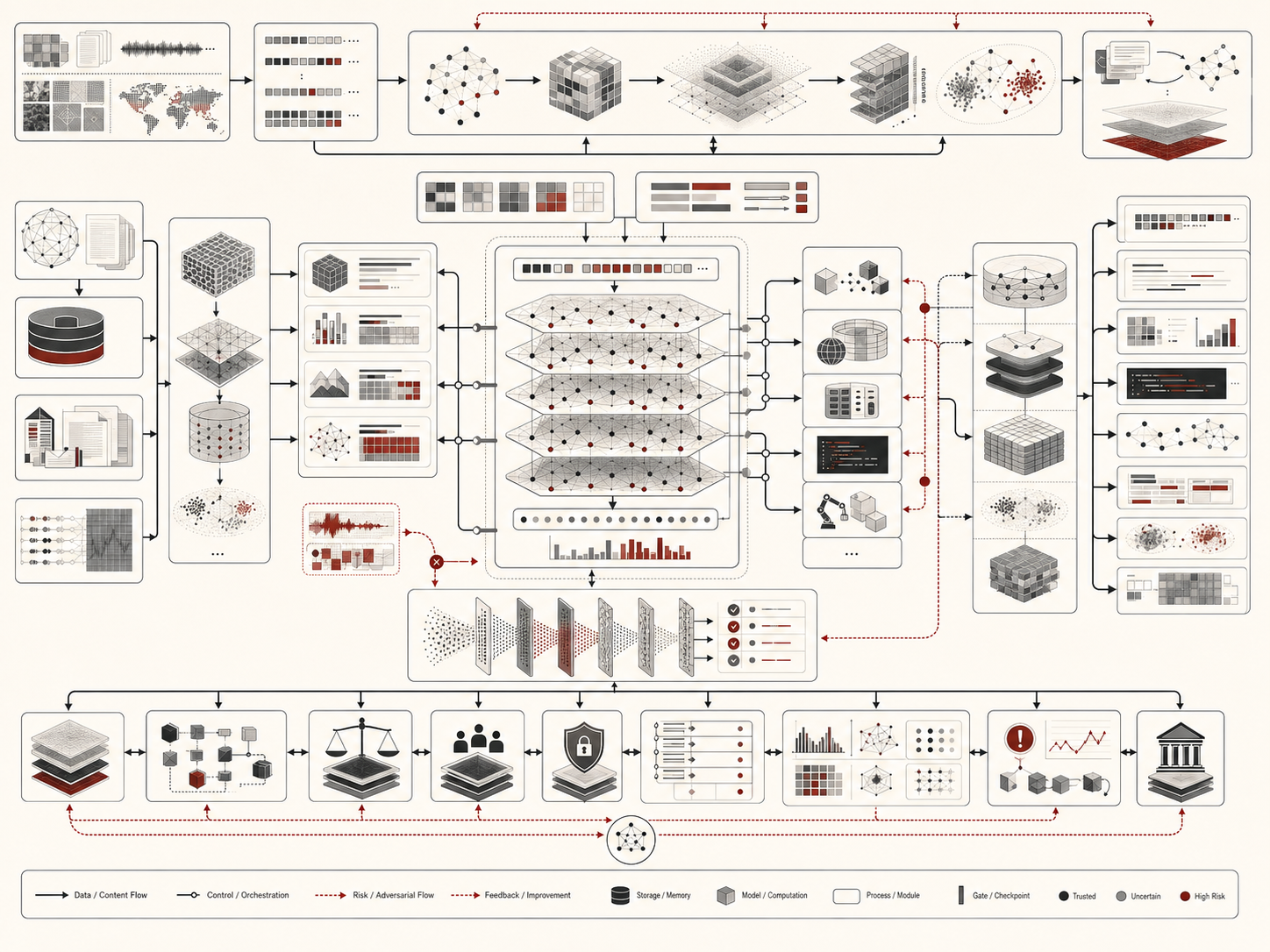
This article develops Large Language Models and Foundation Model Systems as an advanced article within the Artificial Intelligence Systems knowledge series. It explains transformer architecture, attention, tokenization, context windows, pretraining, instruction tuning, alignment, retrieval, grounding, tool use, agentic orchestration, evaluation, cost, latency, hallucination, prompt injection, privacy, systemic risk, monitoring, and institutional accountability. Selected Python and R examples appear here, while the full GitHub repository contains expanded computational scaffolding for LLM evaluation, system-risk scoring, prompt testing, retrieval review, governance summaries, SQL schemas, documentation templates, and reproducible notebooks.
Why Large Language Models Matter
Large language models matter because language is a general interface for human knowledge work. Institutions store policy, law, science, documentation, contracts, code, procedures, research, reports, correspondence, training materials, meeting notes, and decision records in language. A system that can operate across language can therefore touch many forms of work: writing, search, analysis, translation, explanation, summarization, education, planning, coding, and decision support.
Earlier language technologies were often narrow. A sentiment classifier classified sentiment. A translation model translated. A named-entity recognizer extracted entities. A search engine retrieved documents. Large language models changed this pattern by making natural-language prompting a flexible interface. A single model can perform many tasks when prompted, few-shot demonstrated, fine-tuned, retrieved against, or connected to tools.
This flexibility creates both leverage and risk. LLMs can make knowledge work faster, improve access to information, support technical documentation, help users understand complex material, and reduce friction in research and production. But they can also produce fluent falsehoods, amplify bias, leak private information, obscure uncertainty, generate insecure code, enable manipulation, and create overreliance. Their outputs often sound more authoritative than their evidence warrants.
LLMs also matter because they are increasingly becoming interface layers for other systems. A model may not only answer a question. It may retrieve documents, summarize evidence, call a calculator, inspect a dataset, write code, draft an email, invoke an API, create a ticket, query a database, or route a workflow. Once that happens, language generation becomes part of operational infrastructure.
Fluency \neq Truth \neq Authority \neq Accountability
\]
Interpretation: A large language model can produce polished language without guaranteeing factual support, source authority, institutional approval, or responsible use.
The importance of LLMs therefore cannot be measured only by benchmark scores. Their social significance comes from how they are embedded into systems of knowledge, labor, education, governance, automation, software, and public communication. The same model can be a writing assistant, a research interface, a risky automation layer, or a decision-support system depending on the architecture around it.
From Language Models to Foundation Model Systems
A language model estimates patterns in sequences of tokens. A large language model does this at scale using massive datasets, deep neural architectures, extensive compute, and self-supervised training objectives. But the applications people use are rarely just a raw model. They are foundation model systems.
A foundation model system may include:
- a base model or model family;
- a tokenizer and context-management strategy;
- system prompts and task prompts;
- retrieval-augmented generation;
- external tools and APIs;
- memory or user-profile mechanisms;
- safety classifiers and policy filters;
- evaluation datasets and test suites;
- human review and escalation rules;
- logging, monitoring, and incident response;
- cost, latency, and rate-limit controls;
- governance documentation and audit trails.
This distinction is essential. A model may be capable in isolation but unsafe in a workflow. A model may perform well on a benchmark but fail in a domain with missing context, adversarial inputs, ambiguous instructions, or high-stakes consequences. A model may generate plausible answers, while the surrounding system fails to retrieve authoritative evidence or communicate uncertainty. The systems layer determines whether an LLM becomes a useful tool, a fragile demo, or an institutional liability.
| Layer | What It Does | Failure Risk | Governance Question |
|---|---|---|---|
| Base model | Generates text, code, reasoning steps, summaries, or classifications. | Hallucination, bias, unsafe outputs, weak grounding. | What model version is being used and for what purpose? |
| Prompt layer | Frames task instructions, constraints, tone, and output format. | Instruction conflict, brittle prompts, hidden assumptions. | Are prompts documented, tested, and versioned? |
| Retrieval layer | Supplies external evidence and source context. | Stale, irrelevant, restricted, or low-authority sources. | Are sources current, authoritative, permitted, and cited faithfully? |
| Tool layer | Allows the model to calculate, search, query, write, or act. | Unauthorized actions, malformed calls, unsafe execution. | What tools are allowed, and what requires confirmation? |
| Memory layer | Stores prior context, preferences, workflow state, or user history. | Privacy leakage, stale assumptions, inappropriate reuse. | What is retained, why, for how long, and under whose control? |
| Monitoring layer | Tracks quality, safety, cost, latency, failures, and incidents. | Silent degradation or unowned alerts. | Who reviews signals and can intervene? |
| Governance layer | Defines ownership, policies, review, escalation, and accountability. | Diffused responsibility and unmanaged deployment risk. | Who is accountable for system behavior? |
Note: A foundation model system is not only the model. It is the model plus the architecture of context, tools, evidence, memory, monitoring, and governance around it.
Seeing LLMs as foundation model systems also clarifies why deployment is contextual. A model that is acceptable for brainstorming may be unacceptable for legal advice. A model that is useful for internal drafting may be risky for customer-facing commitments. A model that summarizes low-risk documents may require stronger controls when summarizing regulated records, private data, or scientific evidence. Capability is not the same as deployment readiness.
Transformers, Attention, and Sequence Modeling
The modern LLM ecosystem is built largely on transformer architecture. Transformers use attention mechanisms to model relationships among tokens in a sequence. Instead of processing language strictly step by step, attention allows the model to weigh relationships across the context. This makes transformers powerful for language modeling, translation, summarization, code generation, retrieval, multimodal alignment, and many other tasks.
Self-attention allows each token representation to be influenced by other tokens. Multi-head attention allows the model to learn different relationship patterns in parallel. Positional information allows the model to distinguish order. Feedforward layers transform representations. Stacking many layers allows the model to build increasingly complex internal representations of language, context, and task structure.
However, architecture alone does not explain LLM behavior. Data, scale, training objective, optimization, instruction tuning, reinforcement learning from feedback, system prompts, retrieval, tool use, safety policies, and deployment context all shape behavior. An LLM is not merely a transformer. It is a trained artifact embedded in a system.
| Concept | Function | Why It Matters | System-Level Interpretation |
|---|---|---|---|
| Tokenization | Converts text into model-readable units. | Shapes context length, cost, and multilingual behavior. | The model processes tokens, not human concepts directly. |
| Embedding layer | Maps tokens into vector representations. | Allows tokens to be represented numerically. | Starts the transformation from text to learned representation. |
| Self-attention | Models relationships among tokens in context. | Allows long-range dependencies and contextual interpretation. | Enables flexible reasoning-like behavior but not guaranteed truth. |
| Multi-head attention | Learns multiple attention patterns in parallel. | Supports varied relationships among tokens. | Different heads may encode different patterns, but attention is not explanation. |
| Feedforward layers | Transform token representations after attention. | Adds nonlinear representational capacity. | Contributes to internal feature construction. |
| Positional encoding | Provides information about sequence order. | Language depends on order and structure. | Context order and prompt layout can affect output. |
Note: Transformer architecture explains how LLMs process token sequences, but responsible deployment requires evaluating the larger system in which the model operates.
It is also important not to overinterpret internal mechanisms. Attention patterns can be inspected, but they do not always provide faithful explanations of model behavior. A transformer can generate coherent text without grounding every statement in evidence. Architecture enables capability; governance determines whether capability is used responsibly.
Tokens, Context Windows, and Memory
LLMs process tokens, not human concepts directly. Tokenization converts text into units that may represent words, subwords, punctuation, spaces, code fragments, or other text pieces. The model predicts token sequences. This matters because tokenization affects cost, context length, multilingual performance, code behavior, and how efficiently information is represented.
The context window defines how much information the model can condition on at once. A longer context window allows the system to include more instructions, documents, history, examples, and tool outputs. But longer context does not automatically mean better reasoning or perfect memory. The model may still ignore relevant material, overfocus on recent tokens, confuse instructions, or fail to integrate evidence correctly.
Memory is a system design choice. Some LLM applications retain conversation history. Others retrieve prior user preferences, documents, or records. Some memory is explicit and user-controlled. Some is session-level. Some is stored in vector databases or external state. Memory can improve continuity, but it also creates privacy, consent, retention, and governance obligations.
| System Feature | Function | Benefit | Risk |
|---|---|---|---|
| Tokenizer | Splits text into model-readable units. | Enables language and code processing. | Can affect non-English text, rare terms, code, and cost. |
| Context window | Defines the amount of text the model can condition on. | Allows documents, instructions, history, and tool outputs in prompt. | More context can increase confusion, latency, and cost. |
| Conversation history | Maintains session continuity. | Supports coherent multi-turn interaction. | Can preserve stale assumptions or sensitive data. |
| Retrieved memory | Brings prior facts or preferences into context. | Improves personalization or workflow continuity. | Requires consent, retention rules, and access controls. |
| External state | Tracks workflow progress, tool outputs, files, or tasks. | Supports agents and long-running work. | Can become hard to audit without structured records. |
Note: Memory is not only a capability feature. It is a data-governance feature.
Longer\ Context \neq Better\ Judgment
\]
Interpretation: Longer context windows allow more information to be included, but they do not guarantee correct evidence use, stable reasoning, or faithful source interpretation.
A well-designed LLM system should distinguish context from memory and memory from authority. Context may be temporary. Memory may be retained. Authority comes from governance: source quality, permissions, user intent, and review. A model should not treat remembered information as automatically current, correct, or appropriate for a new use.
Pretraining, Instruction Tuning, and Alignment
Pretraining teaches a model broad statistical structure from large corpora. In autoregressive language modeling, the system learns to predict tokens from context. This training can produce broad language competence, factual associations, coding patterns, style imitation, reasoning-like behavior, and task flexibility. But pretraining alone does not guarantee helpfulness, truthfulness, safety, or alignment with user intent.
Instruction tuning adapts a pretrained model to follow natural-language instructions. The model is trained on examples of tasks and desired responses. This can make the model more usable as an assistant, analyst, tutor, or interface. Reinforcement learning from human feedback and related preference-optimization methods can further shape output style, refusal behavior, helpfulness, and safety constraints.
Alignment is not a finished property. A model may behave well in common cases but fail under adversarial prompts, ambiguous tasks, unusual domains, or hidden conflicts among instructions. Alignment also depends on the system layer: system prompts, tool permissions, retrieval sources, policy filters, monitoring, and human oversight. A model aligned for one deployment may be inappropriate for another.
| Stage | Purpose | What It Improves | What It Does Not Guarantee |
|---|---|---|---|
| Pretraining | Learn broad token patterns from large corpora. | General language, coding, factual associations, task flexibility. | Truthfulness, safety, source grounding, or deployment fit. |
| Instruction tuning | Teach the model to follow natural-language tasks. | Usefulness, task framing, assistant-like behavior. | Correctness in specialized or high-stakes domains. |
| Preference optimization | Shape responses using human or AI feedback preferences. | Helpfulness, style, refusal behavior, safety patterns. | Perfect alignment, robustness, or absence of bias. |
| Fine-tuning | Adapt model behavior to a domain or task. | Task-specific performance or style consistency. | General safety or good performance outside fine-tuning scope. |
| Retrieval grounding | Condition outputs on external sources. | Freshness, citation, domain knowledge, auditability. | Claim support unless retrieval and citations are evaluated. |
| System governance | Constrain and monitor deployment behavior. | Accountability, reviewability, risk management. | Safety without active ownership and enforcement. |
Note: Training shapes model behavior, but deployment behavior emerges from the interaction between model, prompts, tools, retrieval, users, and governance.
Alignment should therefore be treated as ongoing system work. It requires evaluation, red teaming, incident review, monitoring, documentation, and deployment boundaries. A model may become safer for general assistance while still requiring strict controls when used for legal, medical, financial, infrastructure, educational, or public-sector workflows.
Retrieval, Grounding, and Knowledge Systems
LLMs generate from learned patterns and current context. They do not automatically know whether a statement is true, current, legally valid, scientifically supported, or institutionally authoritative. Retrieval-augmented generation addresses this by bringing external evidence into the context window.
A retrieval-augmented LLM system typically includes:
- document ingestion;
- chunking and metadata creation;
- embedding generation;
- vector or hybrid search;
- authority and freshness filtering;
- passage selection;
- prompt construction;
- answer generation;
- citation or source display;
- evaluation of retrieval and answer quality.
Grounding is not merely adding documents. Retrieved evidence must be relevant, authoritative, current, and correctly used. If retrieval fails, the model may answer from incomplete or misleading context. If chunking is poor, relevant evidence may be fragmented. If metadata is weak, the system may retrieve semantically similar but low-quality sources. If the prompt does not force source use, the model may ignore evidence. A grounded LLM system is therefore a knowledge architecture problem.
| Grounding Layer | Question | Failure Mode | Control |
|---|---|---|---|
| Source selection | What sources are allowed into the corpus? | Low-quality or obsolete sources shape answers. | Approved source registry and authority levels. |
| Retrieval | Did the system retrieve the right evidence? | Relevant sources are missed or weak passages retrieved. | Recall, precision, reranking, and hybrid search tests. |
| Freshness | Is the evidence current or controlling? | Stale sources appear valid. | Versioning, freshness filters, source retirement. |
| Citation fidelity | Do citations support the attached claims? | Sources are cited for claims they do not support. | Claim-level citation review. |
| Abstention | Does the model admit when evidence is insufficient? | Unsupported answers sound authoritative. | Evidence thresholds and unknown-answer tests. |
| Access control | Is the user allowed to see the retrieved material? | Restricted information leaks through generation. | Retrieval-time permission enforcement. |
Note: Grounding is a system property. It depends on corpus governance, retrieval quality, prompt design, source support, and citation review.
Grounded\ Answer = Relevant\ Evidence + Correct\ Use + Faithful\ Citation
\]
Interpretation: A response is grounded only when the retrieved evidence is relevant, the model uses it correctly, and citations support the claims they accompany.
Grounding also affects user trust. A sourced answer may look more reliable than an unsourced answer, even when the source is weak or misapplied. Responsible LLM systems should avoid citation laundering: the practice of attaching sources to claims they do not actually support. Strong grounding makes evidence visible; weak grounding makes unsupported claims look institutional.
Tools, Agents, and Orchestration Layers
LLMs can be connected to tools: calculators, search engines, databases, code interpreters, calendars, email systems, workflow engines, data-analysis libraries, document stores, APIs, and domain-specific software. Tool use can make LLM systems more capable by allowing them to retrieve, compute, write, transform, execute, and act.
But tool use changes the risk profile. A generated paragraph may be wrong, but a tool-using system may send an email, update a record, run code, query private data, modify a calendar, or trigger an external workflow. This requires permissioning, sandboxing, logging, user confirmation, access control, input validation, and rollback mechanisms.
Agentic systems add additional complexity. They may decompose tasks, plan steps, call tools, observe results, revise plans, and continue until a goal is met. This can be useful for research, automation, coding, and operations. It also introduces risks of runaway loops, tool misuse, hidden state, prompt injection, overbroad permissions, and poor error recovery. In governed environments, autonomy must be bounded by policy and monitoring.
| Layer | Capability | Risk | Governance Control |
|---|---|---|---|
| Read-only tools | Search, retrieve, inspect, summarize, or query. | Source errors, access leakage, weak relevance. | Access filters, provenance, logging. |
| Computation tools | Calculate, transform, run code, simulate, validate. | Unsafe code, hidden assumptions, resource use. | Sandboxing, limits, reproducible outputs. |
| Write tools | Create, update, edit, send, schedule, or file. | Unauthorized changes or irreversible action. | User confirmation, permissions, rollback. |
| Agent loops | Plan, execute, observe, revise, and continue. | Runaway behavior, scope drift, repeated failures. | Step limits, stop rules, escalation, monitoring. |
| Workflow orchestration | Embed model behavior into operational processes. | Automation bias and hidden responsibility. | Human review, audit logs, incident response. |
Note: Once LLMs use tools, governance must cover action authority, not only output quality.
Model\ Output \rightarrow Tool\ Call \rightarrow System\ Consequence
\]
Interpretation: Tool-using LLM systems can convert generated language into external action. This requires stricter permissions, validation, monitoring, and review.
Orchestration design should distinguish drafting from execution. A model may draft an email without sending it, generate a database query without running it, propose a code patch without deploying it, or prepare a workflow update without applying it. These boundaries preserve human judgment and reduce the risk of unintended action.
Evaluation: Capability, Reliability, Safety, and Use-Case Fit
LLM evaluation should be multidimensional. A model can be strong at summarization but weak at citation fidelity. It can write fluent explanations while producing false details. It can pass a benchmark while failing in a specialized institutional workflow. It can be safe in general chat but unsafe when connected to sensitive tools.
| Evaluation Dimension | Question | Example Evidence | Governance Relevance |
|---|---|---|---|
| Task quality | Does the model complete the intended task? | Human review, task success rate, rubric scoring. | Measures usefulness for specific workflows. |
| Factuality | Are claims supported by reliable evidence? | Citation checks, source agreement, factuality audits. | Prevents fluent falsehoods. |
| Grounding | Does the model use retrieved evidence correctly? | Retrieval precision, answer support rate, citation fidelity. | Links responses to reviewable evidence. |
| Robustness | Does performance hold under variations and adversarial inputs? | Prompt perturbation, red teaming, stress tests. | Tests behavior beyond ideal prompts. |
| Safety | Does the system avoid harmful or prohibited outputs? | Safety benchmarks, policy tests, incident logs. | Supports responsible deployment boundaries. |
| Security | Can the system resist prompt injection and tool misuse? | Adversarial retrieval tests, permission tests. | Protects system instructions, data, and tools. |
| Bias and fairness | Are errors or harms unevenly distributed? | Subgroup evaluation, representational audits. | Identifies unequal performance or impact. |
| Calibration | Does confidence match reliability? | Abstention tests, uncertainty review, error analysis. | Prevents overconfident use in uncertain cases. |
| Operational performance | Can the system run within cost and latency limits? | Latency, token cost, throughput, failure rate. | Ensures sustainable and reliable operation. |
| Governance readiness | Is the system documented, monitored, and accountable? | Model card, system card, audit logs, review process. | Connects evaluation to institutional responsibility. |
Note: Evaluation should be conducted at the use-case level. General model benchmarks do not replace deployment-specific system evaluation.
Evaluation should be scenario-specific. A legal assistant, coding assistant, research assistant, customer-support bot, tutoring system, medical summarizer, or public-sector decision-support tool requires different evaluation data and different failure thresholds. General model performance is not a substitute for system-level evaluation.
Evaluation should also include negative cases. A system should be tested when the answer is absent, when the user request is ambiguous, when retrieved sources conflict, when a tool fails, when prompts are adversarial, when the system should refuse, and when human review is required. A system that performs well only under ideal prompts is not deployment-ready.
Cost, Latency, Context, and Infrastructure Constraints
LLM systems are constrained by cost, latency, throughput, memory, context length, and infrastructure reliability. Every request consumes tokens. Longer prompts cost more. Retrieved context adds tokens. Tool calls add latency. Multi-step agentic workflows can multiply cost. High-volume deployments require monitoring, caching, rate limiting, fallback behavior, and service-level planning.
Cost and latency also shape design. A system may use a smaller model for routing and a larger model for final synthesis. It may cache common answers, retrieve only top evidence, summarize context, compress memory, or use structured outputs to reduce retries. It may use batch evaluation offline and stricter controls online. Efficient design is not merely financial; it affects reliability, sustainability, and user trust.
Infrastructure design should include fallback paths. If retrieval fails, the system should not pretend evidence exists. If a tool times out, the system should report the failure. If the model returns unsafe or malformed output, the system should retry, escalate, or stop. LLM systems need observability for prompts, retrieval, tools, outputs, errors, refusals, user feedback, and cost.
| Constraint | Why It Matters | Design Response | Governance Concern |
|---|---|---|---|
| Token cost | Long prompts, retrieval, and outputs increase expense. | Context budgeting, caching, routing, summarization. | Cost should not silently degrade monitoring or quality. |
| Latency | Slow responses reduce usability and workflow reliability. | Model routing, streaming, caching, parallel tool calls. | Latency affects user trust and operational feasibility. |
| Context limits | Only limited information can be included directly. | Retrieval, compression, summarization, structured state. | Important evidence may be omitted. |
| Tool failures | External systems may time out, return errors, or change schemas. | Error handling, retries, fallback, tool validation. | The system must not hallucinate successful tool results. |
| Rate limits | High-volume deployments may exceed provider or infrastructure limits. | Queueing, batching, priority rules, graceful degradation. | Critical workflows need resilience planning. |
| Observability | Teams need visibility into prompts, retrieval, outputs, cost, and failures. | Logs, metrics, traces, dashboards, incident records. | Without observability, failures become invisible. |
Note: Cost and latency are not merely engineering concerns. They influence reliability, access, user trust, and governance capacity.
Operational constraints also shape equity. Expensive systems may be available only to some users. Low-latency tools may be prioritized for high-value workflows. Cost-cutting may reduce retrieval depth, human review, or monitoring. Responsible design should make these tradeoffs explicit rather than hiding them inside system behavior.
Hallucination, Prompt Injection, Data Leakage, and Systemic Risk
LLM risks are not limited to hallucination, although hallucination is central. A model may generate unsupported claims, fabricate citations, misstate policy, invent code behavior, or overgeneralize from weak evidence. The danger is amplified because language can sound confident even when it is wrong.
Prompt injection is a system-level security risk. Malicious or untrusted content can instruct the model to ignore rules, reveal data, manipulate tool calls, or alter behavior. Retrieval-augmented systems are especially exposed because retrieved documents may contain adversarial instructions. Tool-using systems must treat untrusted text as data, not authority.
Data leakage can occur through prompts, logs, training data, memory systems, or tool integrations. Sensitive user information, proprietary documents, credentials, internal records, or regulated data may enter an LLM workflow. Governance requires access controls, retention policies, redaction, logging rules, privacy review, and clear boundaries around training and storage.
Systemic risk arises when many downstream systems depend on similar foundation models, evaluation assumptions, or vendor infrastructure. If many applications share the same base model, defects can propagate widely. Homogenization creates efficiency, but it can also create correlated failure.
| Risk Category | Description | Example | Governance Response |
|---|---|---|---|
| Hallucination | Unsupported or false content presented fluently. | Fabricated policy, citation, code behavior, or fact. | Grounding, citation checks, abstention, human review. |
| Prompt injection | Untrusted text attempts to override instructions. | Retrieved document says to ignore system rules. | Instruction hierarchy, content isolation, tool permissions. |
| Data leakage | Sensitive information is exposed through prompts, logs, memory, or tools. | Private records included in generated output. | Data classification, redaction, access control, retention policy. |
| Unsafe tool use | Model output triggers unauthorized or harmful action. | Sending, deleting, publishing, deploying, or updating without review. | Least privilege, confirmation gates, sandboxing, rollback. |
| Bias and representational harm | System produces uneven errors or stereotypes. | Lower quality across dialects, languages, groups, or contexts. | Subgroup evaluation, domain review, feedback channels. |
| Overreliance | Users treat outputs as more reliable than warranted. | Unverified AI summary accepted as final decision basis. | Uncertainty disclosure, review requirements, training. |
| Systemic dependency | Multiple systems rely on the same model or provider assumptions. | Shared model defect affects many workflows. | Diversity, fallback plans, vendor risk review, monitoring. |
Note: LLM risks often emerge from interactions among model behavior, user reliance, retrieval, tools, memory, and institutional context.
Untrusted\ Text \neq System\ Authority
\]
Interpretation: User prompts, retrieved documents, webpages, emails, and tool outputs should not be allowed to override system policies, access controls, or workflow permissions.
Risk management should focus not only on what the model says, but on what users and systems do with the output. A low-quality answer in a brainstorming context may be low risk. The same answer in a medical, legal, financial, public-sector, infrastructure, or educational context may be high risk. Use context determines consequence.
Governance, Monitoring, and Institutional Accountability
LLM governance should address both model behavior and system behavior. Model-level documentation is necessary but insufficient. Institutions must also document the application layer, retrieval sources, tool permissions, prompt policies, evaluation plan, monitoring signals, escalation procedures, data-retention practices, and human-review responsibilities.
A responsible LLM system should document:
- base model and version;
- intended use and prohibited use;
- system prompt and policy constraints;
- retrieval sources and authority rules;
- tool permissions and confirmation rules;
- data classification and privacy controls;
- evaluation datasets and metrics;
- known limitations and failure modes;
- monitoring signals and incident thresholds;
- human review and escalation paths;
- rollback or model-switching procedures;
- audit logging and retention policy.
Monitoring should include quality, safety, security, cost, latency, retrieval quality, tool failures, refusal patterns, user feedback, and incident reports. The institution deploying the system is responsible for how the model is used. It cannot treat model output as external magic. Once an LLM is embedded in a workflow, it becomes part of institutional action.
LLM\ Governance = Evaluation + Monitoring + Ownership + Intervention
\]
Interpretation: Governance requires more than policies. It requires evidence of performance, visibility into deployment behavior, accountable owners, and authority to restrict, revise, or stop the system.
Institutional accountability also requires contestability. Users and affected parties should have appropriate ways to question, appeal, correct, or challenge outputs where LLM systems influence decisions, access, benefits, services, evaluation, or official communication. Human oversight should be meaningful, not ceremonial. Reviewers need context, evidence, authority, and time.
Governance should also distinguish between model cards and system cards. A model card can describe model training, evaluation, intended use, and limitations. A system card should describe the deployed application: prompts, retrieval, tools, data flows, monitoring, privacy controls, escalation, and operational boundaries. LLM risk often lives in the system layer.
Common Failure Modes
Large language model systems often fail when fluency is mistaken for reliability. A polished response can conceal weak evidence, ambiguous instructions, missing sources, unsupported synthesis, or tool failure. Foundation model systems also fail when organizations treat deployment as a model-selection problem rather than a systems-governance problem.
| Failure Mode | Description | Likely Consequence | Governance Response |
|---|---|---|---|
| Fluency mistaken for truth | The response sounds authoritative despite weak evidence. | Users accept false or unsupported claims. | Require grounding, citation checks, and uncertainty disclosure. |
| Context stuffing | More documents are added without improving evidence use. | Model ignores key material or blends conflicting sources. | Use retrieval evaluation, context budgeting, and source ranking. |
| Generic evaluation | Benchmark performance is substituted for use-case validation. | System fails in real institutional workflows. | Evaluate with domain-specific tasks and failure cases. |
| Unsafe tool permissions | The model has broad authority to act through tools. | Unauthorized sending, editing, querying, or workflow changes. | Apply least privilege, confirmation gates, and audit logs. |
| Memory without governance | System retains context without clear consent or lifecycle rules. | Privacy risk, stale personalization, inappropriate reuse. | Use scoped memory, retention limits, and user controls. |
| Prompt-policy brittleness | Safety depends too heavily on prompt wording. | Adversarial prompts or retrieved text bypass controls. | Use layered controls outside the model. |
| Unowned monitoring | Signals exist but no team has authority to act. | Known failures persist or recur. | Assign owners, thresholds, escalation paths, and pause authority. |
| Responsibility diffusion | Organizations blame the model, vendor, user, or workflow separately. | Accountability becomes unclear after harm. | Document system ownership and institutional responsibility. |
Note: Many LLM failures are not only model failures. They are failures of evidence design, permission design, monitoring, review, and institutional accountability.
These failure modes reinforce the systems argument. LLM deployment is not only about choosing a capable model. It is about designing the surrounding architecture so that evidence, authority, uncertainty, permissions, monitoring, and accountability remain visible.
Limits and Open Problems
Large language models and foundation model systems have important limits. Fluency is not truth: language quality can mask weak evidence or false claims. Context is not comprehension: adding more text to the prompt does not guarantee correct use of evidence. Retrieval can fail silently: a system may retrieve irrelevant, stale, or low-authority sources. Prompt injection is a system risk: untrusted text can attempt to manipulate model behavior or tool use.
Tool use increases consequences. An LLM connected to tools can act, not only answer. Memory creates privacy obligations because retained context and user data require consent, retention controls, and access rules. Evaluation can be too generic: benchmark performance may not predict domain-specific system reliability. Governance cannot be outsourced to the model: institutions remain responsible for the workflows they deploy.
Several open problems remain difficult. How should institutions evaluate open-ended outputs at scale without reducing quality to simplistic scores? How should systems represent uncertainty in ways users actually understand? How should governance handle long-context models that process large amounts of sensitive material? How should systems detect prompt injection hidden in retrieved documents, emails, or webpages? How should organizations evaluate downstream labor, educational, civic, and institutional effects?
Another open problem is dependency. Many organizations may build different products on similar foundation models, cloud infrastructures, and evaluation assumptions. This creates efficiency and standardization, but it also creates correlated risk. If a base model has a systematic failure, or if a vendor changes behavior, many downstream systems can be affected at once.
The goal is not to dismiss LLMs. They are among the most important technologies in modern AI. The goal is to understand them as components within foundation model systems: powerful, flexible, uncertain, and deeply dependent on design choices around retrieval, tools, prompts, evaluation, monitoring, and governance. Responsible deployment requires building systems that make evidence visible, uncertainty reviewable, permissions constrained, failures detectable, and accountability explicit.
Mathematical Lens
A language model estimates the probability of a token sequence by decomposing it into next-token predictions.
P(x_1,\ldots,x_T)
=
\prod_{t=1}^{T}
P(x_t \mid x_1,\ldots,x_{t-1})
\]
Interpretation: The model assigns probability to a sequence by predicting each token from prior context. This is the basic autoregressive language-modeling objective behind many generative LLMs.
Training often minimizes negative log-likelihood over a corpus.
\mathcal{L}(\theta)
=
-\sum_{t=1}^{T}
\log P_{\theta}(x_t \mid x_{<t})
\]
Interpretation: Model parameters \(\theta\) are adjusted so the model assigns higher probability to observed tokens in the training data.
Scaled dot-product attention computes relationships among tokens.
\mathrm{Attention}(Q,K,V)
=
\mathrm{softmax}
\left(
\frac{QK^{T}}{\sqrt{d_k}}
\right)V
\]
Interpretation: Queries \(Q\), keys \(K\), and values \(V\) define how token representations attend to one another. The scaling factor \(\sqrt{d_k}\) stabilizes attention scores.
Generation samples or selects the next token from a probability distribution.
x_{t+1}
\sim
P_{\theta}(\cdot \mid x_{\leq t},c)
\]
Interpretation: The next token is generated from the model’s distribution conditioned on prior tokens and context \(c\), which may include prompts, retrieved documents, tool outputs, or system instructions.
Retrieval-augmented generation conditions the model on external evidence.
\hat{y}
=
F_{\theta}(q,R(q),c)
\]
Interpretation: The model \(F_{\theta}\) answers query \(q\) using retrieved evidence \(R(q)\) and additional context \(c\). Retrieval changes the system from pure generation toward evidence-conditioned generation.
Tool-using systems transform generated decisions into actions.
a_t
\sim
\pi_{\theta}(a_t \mid q,c,s_t,G)
\]
Interpretation: An LLM-driven policy \(\pi_{\theta}\) may select action \(a_t\) given query \(q\), context \(c\), system state \(s_t\), and governance constraints \(G\). Tool use turns language modeling into action selection.
System-level risk depends on model behavior, task context, evidence quality, user reliance, and institutional consequences.
R_{system}
=
\sum_{u \in U}
P(u)\,
L\!\left(
F_{\theta},A,G,u
\right)
\]
Interpretation: System risk \(R_{system}\) depends on use context \(u\), model \(F_{\theta}\), application layer \(A\), governance controls \(G\), and the loss or harm produced in that context.
A review rule can route high-risk outputs or actions to human oversight.
Review =
\begin{cases}
1, & Risk(u) \geq \tau_R \\
1, & Grounding(\hat{y}) \leq \tau_G \\
1, & ActionImpact(a_t) \geq \tau_A \\
1, & PrivacyRisk(c) \geq \tau_P \\
0, & \mathrm{otherwise}
\end{cases}
\]
Interpretation: Human review can be triggered by high use-case risk, weak grounding, high-impact actions, or elevated privacy risk.
Variables and System Interpretation
| Symbol or Term | Meaning | LLM Interpretation | System Relevance |
|---|---|---|---|
| \(x_t\) | Token at position \(t\) | Unit of language, code, punctuation, or text fragment. | Basic object of language-model prediction. |
| \(T\) | Sequence length | Number of tokens in a context or training sequence. | Determines context and compute requirements. |
| \(\theta\) | Model parameters | Learned weights of the LLM. | Encode learned statistical structure. |
| \(Q,K,V\) | Queries, keys, values | Attention matrices derived from token representations. | Enable contextual relationships among tokens. |
| \(d_k\) | Key dimension | Dimensionality used in attention scaling. | Part of transformer architecture. |
| \(c\) | Context | System prompt, user prompt, retrieved evidence, tool output, memory, or policy instruction. | Shapes model behavior at inference time. |
| \(q\) | Query | User question, task request, or system instruction. | Initiates generation or tool workflow. |
| \(R(q)\) | Retrieved evidence | Documents, passages, records, search results, or database rows relevant to \(q\). | Supports grounding and citation. |
| \(A\) | Application layer | Interface, tool router, retrieval pipeline, memory layer, or agent framework. | Turns model output into a user-facing system. |
| \(G\) | Governance controls | Policies, evaluation, monitoring, logging, review, and escalation. | Controls lifecycle risk. |
| \(u\) | Use context | Domain, task, user group, institutional setting, or deployment condition. | Determines risk and required controls. |
| \(R_{system}\) | System risk | Expected harm or loss across use contexts. | Guides deployment limits, review, and monitoring. |
Note: LLM variables should be interpreted through system deployment. The same model output can have different meaning depending on evidence, tools, user reliance, and institutional consequence.
Worked Example: Building a Governed LLM Knowledge Assistant
Consider an organization building an internal knowledge assistant for policy, technical documentation, project records, and research materials. The goal is not only to answer questions, but to answer from approved sources, show evidence, respect permissions, identify uncertainty, and route high-risk requests to human review.
A responsible design would include:
- Define the approved use cases: search, summarization, drafting, explanation, and document navigation.
- Classify documents by sensitivity, authority, freshness, and access permissions.
- Build a retrieval system with metadata, chunking, hybrid search, and source ranking.
- Use prompts that require evidence-grounded answers and uncertainty disclosure.
- Block the model from answering restricted legal, medical, financial, or policy questions without review.
- Evaluate retrieval quality and answer quality on realistic internal queries.
- Test for prompt injection in retrieved documents.
- Log prompts, retrieval results, model outputs, failures, costs, and user feedback according to privacy policy.
- Provide human escalation for sensitive, ambiguous, or high-impact cases.
- Review incidents and update retrieval, prompts, permissions, and evaluation sets over time.
This example shows why LLM deployment is a systems problem. The answer quality depends on the model, but also on data governance, retrieval design, prompt control, permissions, evaluation, monitoring, and institutional accountability.
Suppose the assistant is asked for the organization’s current data-retention policy. It retrieves an archived document, a draft revision, and the currently approved policy. A weak system may summarize all three as if they are equally authoritative. A governed system would identify the approved policy as controlling, label the archived and draft sources, cite only the current policy for operational guidance, and disclose uncertainty if the source record is incomplete.
Prompt + Evidence + Permissions + Monitoring \rightarrow Governed\ Answer
\]
Interpretation: A responsible LLM knowledge assistant depends on more than the base model. It depends on source governance, access control, evaluation, monitoring, and review.
Computational Modeling
Computational modeling can make LLM system governance concrete. An evaluation workflow can score task quality, grounding, factuality, citation fidelity, safety, prompt-injection resistance, privacy controls, latency, cost, tool behavior, and review requirements. A system-risk workflow can identify which use cases require additional controls before deployment. A monitoring workflow can track quality, incidents, refusals, tool failures, retrieval failures, costs, and user feedback over time.
The examples below are intentionally lightweight and educational. They do not replace production evaluation harnesses, red-team procedures, retrieval logs, model cards, system cards, or human review. Their purpose is to show how LLM systems can be evaluated as foundation model systems rather than as isolated text generators.
A mature production system would connect these workflows to real evaluation datasets, prompt versions, retrieval traces, tool-call logs, monitoring pipelines, privacy reviews, user feedback, incident records, and governance documentation. The goal is not merely to score responses. The goal is to determine whether the system can be trusted for a defined use case under defined controls.
Python Workflow: LLM System Evaluation and Governance Review
The following Python workflow simulates an LLM application evaluation portfolio. It scores responses across task quality, grounding, factuality, safety, security, latency, cost, and governance risk. The workflow is dependency-light and designed to be adapted to real evaluation logs.
"""
Large Language Models and Foundation Model Systems

Python workflow:
- Simulate LLM application evaluation records.
- Score quality, grounding, factuality, citation fidelity, safety, and security.
- Estimate cost, latency, retrieval, and tool-use risk.
- Produce governance review flags and summary tables.

This is a simplified workflow. Production LLM systems should connect these
records to actual evaluation datasets, retrieval logs, prompt versions,
tool-call logs, human reviews, privacy reviews, and incident records.
"""

from __future__ import annotations

from pathlib import Path

import numpy as np
import pandas as pd


RANDOM_SEED = 42
rng = np.random.default_rng(RANDOM_SEED)

OUTPUT_DIR = Path("outputs")
OUTPUT_DIR.mkdir(exist_ok=True)


def simulate_llm_evaluations(n: int = 220) -> pd.DataFrame:
    """Create synthetic evaluation records for LLM system responses."""
    use_cases = [
        "knowledge_search",
        "document_summary",
        "code_assistance",
        "policy_explanation",
        "research_synthesis",
        "customer_support",
        "decision_support",
    ]

    risk_levels = ["low", "medium", "high"]

    rows = []

    for i in range(n):
        use_case = rng.choice(use_cases)
        risk_level = rng.choice(risk_levels, p=[0.50, 0.35, 0.15])

        task_quality = rng.uniform(0.55, 0.98)
        grounding_score = rng.uniform(0.35, 0.98)
        factuality_score = rng.uniform(0.45, 0.99)
        citation_fidelity = rng.uniform(0.35, 0.98)
        safety_score = rng.uniform(0.55, 1.00)
        prompt_injection_resistance = rng.uniform(0.40, 0.98)
        privacy_control_score = rng.uniform(0.55, 1.00)
        human_review_score = rng.uniform(0.40, 1.00)
        observability_score = rng.uniform(0.45, 1.00)

        retrieved_sources = int(rng.integers(0, 8))
        tool_calls = int(rng.integers(0, 5))
        input_tokens = int(rng.integers(400, 9000))
        output_tokens = int(rng.integers(100, 1800))
        latency_seconds = float(rng.gamma(shape=2.5, scale=1.2) + 0.15 * tool_calls)

        if use_case in ["decision_support", "policy_explanation"]:
            grounding_score = min(grounding_score, rng.uniform(0.35, 0.90))
            citation_fidelity = min(citation_fidelity, rng.uniform(0.35, 0.92))

        if tool_calls >= 3:
            prompt_injection_resistance = min(
                prompt_injection_resistance,
                rng.uniform(0.40, 0.88),
            )

        rows.append(
            {
                "eval_id": f"LLM-EVAL-{i:03d}",
                "use_case": use_case,
                "risk_level": risk_level,
                "task_quality": float(task_quality),
                "grounding_score": float(grounding_score),
                "factuality_score": float(factuality_score),
                "citation_fidelity": float(citation_fidelity),
                "safety_score": float(safety_score),
                "prompt_injection_resistance": float(prompt_injection_resistance),
                "privacy_control_score": float(privacy_control_score),
                "human_review_score": float(human_review_score),
                "observability_score": float(observability_score),
                "retrieved_sources": retrieved_sources,
                "tool_calls": tool_calls,
                "input_tokens": input_tokens,
                "output_tokens": output_tokens,
                "latency_seconds": latency_seconds,
            }
        )

    return pd.DataFrame(rows)


def score_llm_system(records: pd.DataFrame) -> pd.DataFrame:
    """Score LLM evaluation records for quality and governance risk."""
    scored = records.copy()

    scored["total_tokens"] = scored["input_tokens"] + scored["output_tokens"]

    scored["quality_score"] = (
        0.22 * scored["task_quality"]
        + 0.26 * scored["grounding_score"]
        + 0.26 * scored["factuality_score"]
        + 0.26 * scored["citation_fidelity"]
    )

    scored["security_and_safety_score"] = (
        0.35 * scored["safety_score"]
        + 0.25 * scored["prompt_injection_resistance"]
        + 0.25 * scored["privacy_control_score"]
        + 0.15 * scored["human_review_score"]
    )

    scored["governance_readiness_score"] = (
        0.30 * scored["observability_score"]
        + 0.25 * scored["human_review_score"]
        + 0.20 * scored["privacy_control_score"]
        + 0.15 * scored["citation_fidelity"]
        + 0.10 * scored["grounding_score"]
    )

    scored["operational_cost_index"] = np.clip(
        (scored["total_tokens"] / 10000)
        + (scored["latency_seconds"] / 20)
        + (scored["tool_calls"] / 10),
        0,
        1.5,
    )

    scored["tool_use_risk"] = np.clip(scored["tool_calls"] / 5, 0, 1)

    scored["retrieval_gap_risk"] = np.where(
        scored["retrieved_sources"] == 0,
        0.35,
        np.clip(0.20 - (scored["retrieved_sources"] / 30), 0, 0.20),
    )

    risk_weight = scored["risk_level"].map(
        {
            "low": 0.10,
            "medium": 0.25,
            "high": 0.45,
        }
    )

    scored["llm_system_risk"] = (
        0.22 * (1 - scored["quality_score"])
        + 0.22 * (1 - scored["security_and_safety_score"])
        + 0.18 * (1 - scored["grounding_score"])
        + 0.14 * (1 - scored["governance_readiness_score"])
        + 0.10 * scored["operational_cost_index"]
        + 0.07 * scored["tool_use_risk"]
        + 0.07 * risk_weight
    )

    scored["review_required"] = (
        (scored["llm_system_risk"] > 0.40)
        | (scored["risk_level"].eq("high"))
        | (scored["grounding_score"] < 0.60)
        | (scored["factuality_score"] < 0.65)
        | (scored["citation_fidelity"] < 0.60)
        | (scored["prompt_injection_resistance"] < 0.60)
        | (scored["privacy_control_score"] < 0.70)
        | (scored["human_review_score"] < 0.60)
        | ((scored["tool_calls"] >= 3) & (scored["safety_score"] < 0.80))
    )

    scored["deployment_recommendation"] = np.select(
        [
            scored["llm_system_risk"] > 0.55,
            scored["privacy_control_score"] < 0.70,
            scored["prompt_injection_resistance"] < 0.60,
            scored["citation_fidelity"] < 0.60,
            scored["review_required"],
            scored["quality_score"] > 0.82,
        ],
        [
            "pause_for_system_risk_review",
            "fix_privacy_controls_before_deployment",
            "run_prompt_injection_and_tool_security_review",
            "run_citation_and_grounding_review",
            "approve_only_after_human_review",
            "candidate_for_controlled_deployment",
        ],
        default="continue_evaluation",
    )

    return scored.sort_values("llm_system_risk", ascending=False)


def summarize_by_use_case(scored: pd.DataFrame) -> pd.DataFrame:
    """Summarize quality and risk by use case."""
    return (
        scored.groupby("use_case")
        .agg(
            evaluations=("eval_id", "count"),
            mean_quality_score=("quality_score", "mean"),
            mean_grounding_score=("grounding_score", "mean"),
            mean_factuality_score=("factuality_score", "mean"),
            mean_security_and_safety=("security_and_safety_score", "mean"),
            mean_governance_readiness=("governance_readiness_score", "mean"),
            mean_llm_system_risk=("llm_system_risk", "mean"),
            review_rate=("review_required", "mean"),
            mean_tool_calls=("tool_calls", "mean"),
            mean_total_tokens=("total_tokens", "mean"),
            mean_latency_seconds=("latency_seconds", "mean"),
        )
        .reset_index()
        .sort_values("mean_llm_system_risk", ascending=False)
    )


def summarize_by_risk_level(scored: pd.DataFrame) -> pd.DataFrame:
    """Summarize LLM system quality and review requirements by risk level."""
    return (
        scored.groupby("risk_level")
        .agg(
            evaluations=("eval_id", "count"),
            mean_quality_score=("quality_score", "mean"),
            mean_grounding_score=("grounding_score", "mean"),
            mean_security_and_safety=("security_and_safety_score", "mean"),
            mean_governance_readiness=("governance_readiness_score", "mean"),
            mean_llm_system_risk=("llm_system_risk", "mean"),
            review_rate=("review_required", "mean"),
        )
        .reset_index()
        .sort_values("mean_llm_system_risk", ascending=False)
    )


def main() -> None:
    """Run LLM system evaluation and governance review."""
    records = simulate_llm_evaluations()
    scored = score_llm_system(records)
    use_case_summary = summarize_by_use_case(scored)
    risk_summary = summarize_by_risk_level(scored)

    governance_summary = pd.DataFrame(
        [
            {
                "evaluations_reviewed": len(scored),
                "review_required": int(scored["review_required"].sum()),
                "high_risk_cases": int(scored["risk_level"].eq("high").sum()),
                "low_grounding_cases": int((scored["grounding_score"] < 0.60).sum()),
                "low_citation_fidelity_cases": int(
                    (scored["citation_fidelity"] < 0.60).sum()
                ),
                "prompt_injection_review_cases": int(
                    (scored["prompt_injection_resistance"] < 0.60).sum()
                ),
                "privacy_review_cases": int(
                    (scored["privacy_control_score"] < 0.70).sum()
                ),
                "mean_quality_score": scored["quality_score"].mean(),
                "mean_grounding_score": scored["grounding_score"].mean(),
                "mean_security_and_safety": scored["security_and_safety_score"].mean(),
                "mean_governance_readiness": scored["governance_readiness_score"].mean(),
                "mean_system_risk": scored["llm_system_risk"].mean(),
                "mean_total_tokens": scored["total_tokens"].mean(),
                "mean_latency_seconds": scored["latency_seconds"].mean(),
            }
        ]
    )

    records.to_csv(OUTPUT_DIR / "python_llm_evaluation_records.csv", index=False)
    scored.to_csv(OUTPUT_DIR / "python_llm_system_risk_scores.csv", index=False)

    use_case_summary.to_csv(
        OUTPUT_DIR / "python_llm_use_case_summary.csv",
        index=False,
    )

    risk_summary.to_csv(
        OUTPUT_DIR / "python_llm_risk_summary.csv",
        index=False,
    )

    governance_summary.to_csv(
        OUTPUT_DIR / "python_llm_governance_summary.csv",
        index=False,
    )

    memo = f"""# LLM Foundation Model System Governance Memo

Evaluations reviewed: {int(governance_summary.loc[0, "evaluations_reviewed"])}
Review required: {int(governance_summary.loc[0, "review_required"])}
High-risk cases: {int(governance_summary.loc[0, "high_risk_cases"])}
Low-grounding cases: {int(governance_summary.loc[0, "low_grounding_cases"])}
Low citation-fidelity cases: {int(governance_summary.loc[0, "low_citation_fidelity_cases"])}
Prompt-injection review cases: {int(governance_summary.loc[0, "prompt_injection_review_cases"])}
Privacy review cases: {int(governance_summary.loc[0, "privacy_review_cases"])}
Mean quality score: {governance_summary.loc[0, "mean_quality_score"]:.4f}
Mean grounding score: {governance_summary.loc[0, "mean_grounding_score"]:.4f}
Mean security and safety score: {governance_summary.loc[0, "mean_security_and_safety"]:.4f}
Mean governance readiness: {governance_summary.loc[0, "mean_governance_readiness"]:.4f}
Mean system risk: {governance_summary.loc[0, "mean_system_risk"]:.4f}
Mean total tokens: {governance_summary.loc[0, "mean_total_tokens"]:.2f}
Mean latency seconds: {governance_summary.loc[0, "mean_latency_seconds"]:.2f}

Interpretation:
- LLM systems should be evaluated by use case, not only by general benchmarks.
- Grounding, factuality, citation fidelity, safety, security, and privacy should be reviewed together.
- High-risk use cases require human review and explicit deployment boundaries.
- Token cost, latency, retrieval quality, and tool behavior are system-level governance concerns.
"""

    (OUTPUT_DIR / "python_llm_governance_memo.md").write_text(memo)

    print(governance_summary.T)
    print(use_case_summary)
    print(risk_summary)
    print(scored.head(10))
    print(memo)


if __name__ == "__main__":
    main()
This workflow treats LLM evaluation as foundation-model-system governance. It does not rank responses only by task quality. It also examines grounding, factuality, citation fidelity, safety, prompt-injection resistance, privacy controls, human review, observability, tool use, cost, latency, and system risk. That mirrors the central argument of the article: large language models should be evaluated as deployed systems, not isolated text engines.
R Workflow: LLM Evaluation Summary and Risk Review
The following R workflow summarizes LLM evaluation records by use case, risk level, quality score, grounding score, safety score, and review status. It is designed as a lightweight statistical review layer for LLM system governance.
# Large Language Models and Foundation Model Systems
# R workflow: LLM evaluation summary and risk review.

set.seed(42)

n <- 220

use_cases <- c(
  "knowledge_search",
  "document_summary",
  "code_assistance",
  "policy_explanation",
  "research_synthesis",
  "customer_support",
  "decision_support"
)

risk_levels <- c("low", "medium", "high")

records <- data.frame(
  eval_id = paste0("LLM-EVAL-", sprintf("%03d", 1:n)),
  use_case = sample(use_cases, size = n, replace = TRUE),
  risk_level = sample(
    risk_levels,
    size = n,
    replace = TRUE,
    prob = c(0.50, 0.35, 0.15)
  ),
  task_quality = runif(n, min = 0.55, max = 0.98),
  grounding_score = runif(n, min = 0.35, max = 0.98),
  factuality_score = runif(n, min = 0.45, max = 0.99),
  citation_fidelity = runif(n, min = 0.35, max = 0.98),
  safety_score = runif(n, min = 0.55, max = 1.00),
  prompt_injection_resistance = runif(n, min = 0.40, max = 0.98),
  privacy_control_score = runif(n, min = 0.55, max = 1.00),
  human_review_score = runif(n, min = 0.40, max = 1.00),
  observability_score = runif(n, min = 0.45, max = 1.00),
  input_tokens = sample(400:9000, size = n, replace = TRUE),
  output_tokens = sample(100:1800, size = n, replace = TRUE),
  tool_calls = sample(0:4, size = n, replace = TRUE),
  latency_seconds = rgamma(n, shape = 2.5, scale = 1.2)
)

records$total_tokens <- records$input_tokens + records$output_tokens

records$quality_score <- 0.22 * records$task_quality +
  0.26 * records$grounding_score +
  0.26 * records$factuality_score +
  0.26 * records$citation_fidelity

records$security_and_safety_score <- 0.35 * records$safety_score +
  0.25 * records$prompt_injection_resistance +
  0.25 * records$privacy_control_score +
  0.15 * records$human_review_score

records$governance_readiness_score <- 0.30 * records$observability_score +
  0.25 * records$human_review_score +
  0.20 * records$privacy_control_score +
  0.15 * records$citation_fidelity +
  0.10 * records$grounding_score

records$operational_cost_index <- pmin(
  (records$total_tokens / 10000) +
    (records$latency_seconds / 20) +
    (records$tool_calls / 10),
  1.5
)

records$tool_use_risk <- pmin(records$tool_calls / 5, 1)

records$risk_weight <- ifelse(
  records$risk_level == "low",
  0.10,
  ifelse(records$risk_level == "medium", 0.25, 0.45)
)

records$llm_system_risk <- 0.22 * (1 - records$quality_score) +
  0.22 * (1 - records$security_and_safety_score) +
  0.18 * (1 - records$grounding_score) +
  0.14 * (1 - records$governance_readiness_score) +
  0.10 * records$operational_cost_index +
  0.07 * records$tool_use_risk +
  0.07 * records$risk_weight

records$review_required <- records$llm_system_risk > 0.40 |
  records$risk_level == "high" |
  records$grounding_score < 0.60 |
  records$factuality_score < 0.65 |
  records$citation_fidelity < 0.60 |
  records$prompt_injection_resistance < 0.60 |
  records$privacy_control_score < 0.70 |
  records$human_review_score < 0.60 |
  (records$tool_calls >= 3 & records$safety_score < 0.80)

use_case_summary <- aggregate(
  cbind(
    quality_score,
    grounding_score,
    factuality_score,
    security_and_safety_score,
    governance_readiness_score,
    llm_system_risk,
    review_required,
    total_tokens,
    latency_seconds,
    tool_calls
  ) ~ use_case,
  data = records,
  FUN = mean
)

risk_summary <- aggregate(
  cbind(
    quality_score,
    grounding_score,
    security_and_safety_score,
    governance_readiness_score,
    llm_system_risk,
    review_required
  ) ~ risk_level,
  data = records,
  FUN = mean
)

governance_summary <- data.frame(
  evaluations_reviewed = nrow(records),
  review_required = sum(records$review_required),
  high_risk_cases = sum(records$risk_level == "high"),
  low_grounding_cases = sum(records$grounding_score < 0.60),
  low_citation_fidelity_cases = sum(records$citation_fidelity < 0.60),
  prompt_injection_review_cases = sum(records$prompt_injection_resistance < 0.60),
  privacy_review_cases = sum(records$privacy_control_score < 0.70),
  mean_quality_score = mean(records$quality_score),
  mean_grounding_score = mean(records$grounding_score),
  mean_security_and_safety = mean(records$security_and_safety_score),
  mean_governance_readiness = mean(records$governance_readiness_score),
  mean_system_risk = mean(records$llm_system_risk),
  mean_total_tokens = mean(records$total_tokens),
  mean_latency_seconds = mean(records$latency_seconds)
)

dir.create("outputs", recursive = TRUE, showWarnings = FALSE)

write.csv(records, "outputs/r_llm_evaluation_records.csv", row.names = FALSE)
write.csv(use_case_summary, "outputs/r_llm_use_case_summary.csv", row.names = FALSE)
write.csv(risk_summary, "outputs/r_llm_risk_summary.csv", row.names = FALSE)
write.csv(governance_summary, "outputs/r_llm_governance_summary.csv", row.names = FALSE)

print("Use-case summary")
print(use_case_summary)

print("Risk summary")
print(risk_summary)

print("Governance summary")
print(governance_summary)
This R workflow mirrors the LLM-governance structure in a compact form. It summarizes use-case-level and risk-level patterns so task quality, grounding, factuality, citation fidelity, safety, prompt-injection resistance, privacy controls, human review, observability, tool use, latency, cost, and review status can be interpreted together.
GitHub Repository
The article body includes selected computational examples so the conceptual and mathematical argument remains readable. The full repository can hold expanded workflows for prompt evaluation, retrieval testing, tool-use logs, system-risk scoring, prompt-injection simulation, privacy review, cost analysis, governance dashboards, model cards, system cards, and lifecycle monitoring.
From Language Generation to Accountable Systems
Large language models mark a major shift in artificial intelligence because they turn language into a general interface for computation, knowledge, writing, coding, search, explanation, and workflow support. They can compress enormous amounts of learned structure into a flexible conversational system. But the same flexibility makes them difficult to govern when they are treated as stand-alone intelligence rather than components in designed systems.
The central lesson is that LLMs become trustworthy only through system architecture. A base model generates outputs. A foundation model system decides what context enters the prompt, what evidence is retrieved, what tools are available, what memory is retained, what actions require approval, what outputs are blocked, what incidents are logged, and what humans can contest. Responsibility lives in that larger architecture.
This article also shows why evidence and authority matter. An LLM can produce language that sounds plausible, but institutions need answers that are grounded, current, permitted, reviewable, and accountable. Retrieval systems, citation checks, source registries, monitoring, and human review are not optional extras. They are part of the infrastructure that turns model capability into responsible knowledge work.
The strongest foundation model systems will not be those that simply maximize autonomy or output volume. They will be those that make uncertainty visible, preserve source context, constrain tool authority, protect sensitive data, monitor failures, support contestability, and assign accountability. LLMs are powerful technologies, but their legitimacy depends on the systems built around them.
Within the Artificial Intelligence Systems knowledge series, this article belongs near Self-Supervised Learning and Foundation Models, Representation Learning and Embedding Spaces, Transfer Learning, Fine-Tuning, and Model Adaptation, Retrieval-Augmented Generation and AI Knowledge Systems, AI Agents, Tool Use, and Workflow Automation, Natural Language Processing and Computational Language Systems, Data Governance, Provenance, and Lineage in AI Systems, and AI Governance and Regulatory Systems. It provides the foundation-model-system layer for understanding how language models become applications, workflows, institutions, and risks.
Related Articles
- Artificial Intelligence Systems
- Self-Supervised Learning and Foundation Models
- Representation Learning and Embedding Spaces
- Transfer Learning, Fine-Tuning, and Model Adaptation
- Retrieval-Augmented Generation and AI Knowledge Systems
- Generative AI and Synthetic Content Systems
- Natural Language Processing and Computational Language Systems
- Explainable AI and Model Interpretability
- Data Governance, Provenance, and Lineage in AI Systems
- AI Safety and System Reliability
- Model Validation, Benchmarking, and Generalization Theory
Further Reading
- Vaswani, A. et al. (2017) ‘Attention Is All You Need’. Available at: https://arxiv.org/abs/1706.03762
- Devlin, J., Chang, M.W., Lee, K. and Toutanova, K. (2019) ‘BERT: Pre-training of Deep Bidirectional Transformers for Language Understanding’. Available at: https://arxiv.org/abs/1810.04805
- Brown, T.B. et al. (2020) ‘Language Models are Few-Shot Learners’, Advances in Neural Information Processing Systems. Available at: https://papers.nips.cc/paper/2020/hash/1457c0d6bfcb4967418bfb8ac142f64a-Abstract.html
- Bommasani, R. et al. (2021) ‘On the Opportunities and Risks of Foundation Models’. Available at: https://arxiv.org/abs/2108.07258
- Ouyang, L. et al. (2022) ‘Training language models to follow instructions with human feedback’. Available at: https://arxiv.org/abs/2203.02155
- Liang, P. et al. (2022) ‘Holistic Evaluation of Language Models’. Available at: https://arxiv.org/abs/2211.09110
- Lewis, P. et al. (2020) ‘Retrieval-Augmented Generation for Knowledge-Intensive NLP Tasks’. Available at: https://arxiv.org/abs/2005.11401
- NIST (2023) Artificial Intelligence Risk Management Framework (AI RMF 1.0). Available at: https://www.nist.gov/publications/artificial-intelligence-risk-management-framework-ai-rmf-10
References
- Bommasani, R. et al. (2021) ‘On the Opportunities and Risks of Foundation Models’. Available at: https://arxiv.org/abs/2108.07258
- Brown, T.B. et al. (2020) ‘Language Models are Few-Shot Learners’, Advances in Neural Information Processing Systems. Available at: https://papers.nips.cc/paper/2020/hash/1457c0d6bfcb4967418bfb8ac142f64a-Abstract.html
- Devlin, J., Chang, M.W., Lee, K. and Toutanova, K. (2019) ‘BERT: Pre-training of Deep Bidirectional Transformers for Language Understanding’. Available at: https://arxiv.org/abs/1810.04805
- Lewis, P. et al. (2020) ‘Retrieval-Augmented Generation for Knowledge-Intensive NLP Tasks’. Available at: https://arxiv.org/abs/2005.11401
- Liang, P. et al. (2022) ‘Holistic Evaluation of Language Models’. Available at: https://arxiv.org/abs/2211.09110
- NIST (2023) Artificial Intelligence Risk Management Framework (AI RMF 1.0). Available at: https://www.nist.gov/publications/artificial-intelligence-risk-management-framework-ai-rmf-10
- OpenAI (2023) ‘GPT-4 Technical Report’. Available at: https://arxiv.org/abs/2303.08774
- Ouyang, L. et al. (2022) ‘Training language models to follow instructions with human feedback’. Available at: https://arxiv.org/abs/2203.02155
- Perez, F. and Ribeiro, I. (2022) ‘Ignore Previous Prompt: Attack Techniques For Language Models’. Available at: https://arxiv.org/abs/2211.09527
- Vaswani, A. et al. (2017) ‘Attention Is All You Need’. Available at: https://arxiv.org/abs/1706.03762
- Wei, J. et al. (2022) ‘Chain-of-Thought Prompting Elicits Reasoning in Large Language Models’. Available at: https://arxiv.org/abs/2201.11903