
Last Updated May 5, 2026
Dhu al-Qarnayn stands in the Qur’an as one of the most striking sacred figures beyond prophets. He is remembered not through lineage, priesthood, temple, miracle of birth, or formal prophetic mission, but through power rightly ordered before God. Sūrat al-Kahf presents him as a ruler whom Allah establishes in the land and grants access to means. He travels across vast regions, encounters different peoples, judges between wrongdoing and righteousness, and builds a protective barrier against Gog and Magog. His story is therefore not merely a legend of ancient geography. It is a meditation on sovereignty, justice, infrastructure, moral restraint, sacred geography, and the limits of human power before divine command.
Within the Abrahamic Traditions sequence, Dhu al-Qarnayn belongs to the study of sacred figures beyond prophets: persons whose exact status may be debated, but whose stories become essential for understanding revelation, political ethics, sacred geography, moral testing, and the accountability of power before God. He matters because his story refuses to separate capability from responsibility. He is given means, but those means are not treated as personal entitlement. He reaches frontiers, but the Qur’an does not glorify conquest for its own sake. He builds a barrier, but he refuses to reduce public protection to tribute. He possesses authority, but he attributes success to the mercy of his Lord.
In a sacred-history context, Dhu al-Qarnayn becomes a model for thinking about governance, justice, technology, borderlands, vulnerable communities, public works, and the moral discipline required when human beings are entrusted with unusual capability. His story speaks to rulers, engineers, builders, administrators, institutions, and communities because it asks a question that remains urgent: when Allah gives means, will those means become oppression, vanity, and fear, or will they become justice, protection, mercy, and humility before the Lord of the worlds?
Current Library
Religious Studies
Article Map
Abrahamic Traditions
Related Topic
Religion and Law
Series context: This article is part of the Abrahamic Traditions: Prophecy, Revelation, Law, and Sacred History knowledge series. For the broader category structure, return to the Religious Studies category.
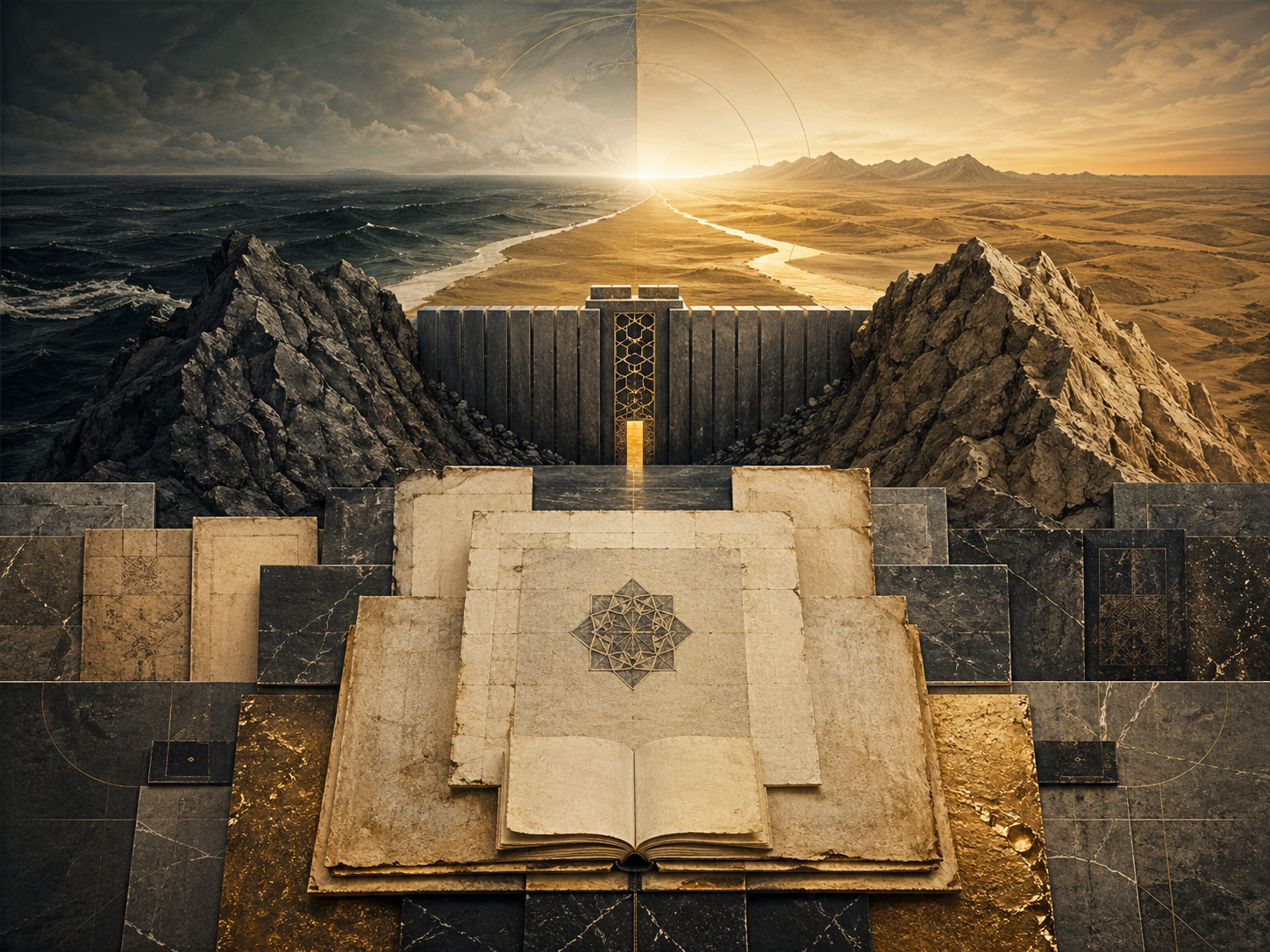
Dhu al-Qarnayn should be read with interpretive restraint and moral seriousness. His identity has been debated for centuries: Alexander the Great, Cyrus the Great, Darius I, South Arabian rulers, legendary world-kings, or an unnamed righteous sovereign whose exact historical identity remains unresolved. Those debates are valuable, but they should not obscure the Qur’an’s central concern. The text does not offer a court biography. It gives a moral narrative about power under God: power that travels, judges, protects, builds, and then refuses to worship itself.
Dhu al-Qarnayn as a Sacred Figure Beyond Prophets
Dhu al-Qarnayn belongs naturally among sacred figures beyond prophets because the Qur’an gives him extraordinary moral significance while leaving many biographical questions unresolved. He is not introduced through a genealogy or a nation. He is not named as a prophet in the explicit manner of Moses, Abraham, Noah, Jesus, or Muhammad. He appears as a ruler endowed with power, means, movement, and responsibility. The Qur’an’s interest is not antiquarian curiosity. It is moral instruction.
His story is especially important because it treats political power as a sacred trust. Dhu al-Qarnayn is not praised merely because he travels far or commands resources. He is remembered because he uses power within a framework of justice, accountability, and mercy. When he encounters a people at the western limit of his journey, he distinguishes between the wrongdoer and the one who believes and does good. When he encounters vulnerable people threatened by Gog and Magog, he does not exploit them. He organizes collective labor and constructs a barrier for protection. When the barrier is complete, he does not glorify himself. He calls it a mercy from his Lord.
This makes him a vital figure for Abrahamic political ethics. His authority is not autonomous. His reach is not self-justifying. His engineering is not detached from moral purpose. His geography is not a playground for domination. Dhu al-Qarnayn shows that sacred history can remember rulers not only as kings or conquerors, but as accountable agents whose power must serve justice.
He also expands the sacred-figures-beyond-prophets arc. Luqman teaches wisdom through moral counsel. Khidr teaches the humility of partial knowledge. The Queen of Sheba teaches political intelligence transformed by recognition of God. Dhu al-Qarnayn teaches what public capability must become when it is placed under divine accountability: not self-display, not empire-worship, not technological vanity, but protection, justice, and humility.
The Qur’an’s silence about his exact identity is therefore not a problem to overcome before the story can matter. It is part of the story’s discipline. The text refuses to let readers turn him only into a historical puzzle. The deeper question is not simply “Who was Dhu al-Qarnayn?” but “What does power become when it remembers God?”
The Qur’anic Setting in Sūrat al-Kahf
The story of Dhu al-Qarnayn appears in Sūrat al-Kahf, verses 18:83–101. This placement matters. Sūrat al-Kahf is a chapter deeply concerned with trial, knowledge, worldly illusion, humility, and divine judgment. It includes the People of the Cave, the parable of the two gardens, the encounter of Moses with the hidden servant associated in later tradition with Khidr, and the account of Dhu al-Qarnayn. These episodes are connected by the problem of human limitation before divine knowledge.
The People of the Cave reveal the limits of worldly persecution and human knowledge of time. The parable of the two gardens exposes the illusion of wealth without gratitude. Moses’ encounter with the hidden servant teaches the limits of human interpretation. Dhu al-Qarnayn’s story then turns to the limits and responsibilities of power. Sūrat al-Kahf therefore moves through several forms of testing: youth under oppression, wealth under illusion, knowledge under limitation, and sovereignty under moral accountability.
The Qur’anic account begins with a question: they ask about Dhu al-Qarnayn. The Prophet is instructed to recite an account of him. The answer does not supply a full biography. It gives a moral narrative. Dhu al-Qarnayn is established in the land and given means. He follows courses. He reaches the setting place of the sun, the rising place of the sun, and a region between two barriers. At each point, the story reveals something about how power should be used when confronting human difference, injustice, vulnerability, and disorder.
Qur’anic Text
وَيَسْأَلُونَكَ عَن ذِي الْقَرْنَيْنِ ۖ قُلْ سَأَتْلُو عَلَيْكُم مِّنْهُ ذِكْرًاAnd they ask you about Dhu al-Qarnayn. Say: I shall recite to you a remembrance of him.Qur’an 18:83. Arabic text with poetic English rendering.
The passage begins not with a full biography, but with a divinely framed remembrance. The Qur’an gives what is needed for moral instruction, not everything curiosity might demand.
The word “remembrance” matters. The story is not merely information. It is sacred memory ordered toward guidance. Dhu al-Qarnayn is remembered because his power becomes a test case in justice. The question asked about him is answered through a narrative of movement, judgment, construction, and humility. The Qur’an teaches by showing power at work across frontiers.
Seen within Sūrat al-Kahf as a whole, Dhu al-Qarnayn is the final major figure in a sequence of trials. The chapter begins with hidden believers protected from persecution, moves through wealth that deceives, knowledge that exceeds human patience, and finally power that must become mercy. This sequence is one reason the Dhu al-Qarnayn story should not be isolated from its Qur’anic setting. It is part of a larger training in humility before Allah.
Name, Identity, and Interpretive Restraint
The name Dhu al-Qarnayn is often translated as “the possessor of two horns,” “the two-horned one,” or more broadly “the one of two qarns.” The meaning of qarn has been interpreted in several ways: horns, ages, generations, extremities, or symbolic markers of power and range. Classical and modern Muslim commentators have offered different explanations. Some associated the name with dominion over east and west. Others connected it with visual imagery, royal symbolism, ancient iconography, or traditions known among earlier communities.
The identity of Dhu al-Qarnayn has been debated for centuries. Some traditions associated him with Alexander the Great, especially because of the widespread Alexander romance traditions in late antique and medieval literature. Others rejected that identification because the historical Alexander was not a Qur’anic monotheist and because the Qur’anic Dhu al-Qarnayn is presented as a righteous servant of God. Other interpreters have proposed Cyrus the Great, Darius I, South Arabian or Himyarite rulers, pre-Alexandrian ancient kings, or symbolic readings that focus less on biography and more on moral function.
A Qur’an-centered reading should proceed with restraint. The Qur’an does not name him Alexander, Cyrus, Darius, or any other historically identifiable ruler. It does not give a dynasty, date, capital city, genealogy, or ethnic origin. The moral purpose of the account is clear even when the historical identity remains disputed. The safest method is to distinguish the Qur’anic figure from later identifications. Reception history matters, but it should not be allowed to overpower the Qur’an’s own emphasis: power, justice, protection, humility, and accountability before Allah.
This restraint is especially important because identity debates can become distractions. If the article becomes only a contest between Alexander, Cyrus, and Darius, the ethical force of the passage weakens. The Qur’an’s primary interest is not the ruler’s museum label. It is the way he uses means. The text shows three encounters and a final confession of mercy. Those elements are the heart of the narrative.
That does not mean historical study is useless. Alexander traditions, Persian imperial imagery, Danielic symbolism, Caucasus frontier legends, South Arabian possibilities, and late antique apocalyptic geography all help explain how readers have understood the figure. But historical comparison should serve the moral reading, not replace it. Dhu al-Qarnayn is first a Qur’anic sign of accountable power.
A Lahore Ahmadiyya Reading: Darius, Derbent, and Moral History
Within the Lahore Ahmadiyya interpretive tradition, Maulana Muhammad Ali offers an important reading of Dhu al-Qarnayn in The Antichrist and Gog and Magog. He identifies Dhu al-Qarnayn not with Alexander the Great, but with Darius I of Persia. His argument draws attention to the two-horned ram in the Book of Daniel, interpreted there in relation to the kings of Media and Persia, and connects Dhu al-Qarnayn’s title with Persian imperial geography, frontier organization, and the strengthening of boundaries toward Armenia, the Caucasus, India, and Central Asia.
Hebrew Bible / Danielic Vision
הָאַיִל אֲשֶׁר־רָאִיתָ בַּעַל הַקְּרָנָיִם מַלְכֵי מָדַי וּפָרָסThe ram that you saw, possessing the two horns, is the kings of Media and Persia.Daniel 8:20. Hebrew text with poetic English rendering.
Maulana Muhammad Ali’s Lahore Ahmadiyya reading draws on the Danielic two-horned ram imagery as part of a rational-historical argument for connecting Dhu al-Qarnayn with Persian imperial power rather than Alexander.
Maulana Muhammad Ali also associates the Qur’anic barrier with the Derbent or Darband wall near the Caspian frontier. In this reading, the narrative is not primarily a fantasy of monstrous peoples or a detached legend of ancient wonders. It is treated as a morally serious account of frontier defense, imperial responsibility, and the use of political power to restrain disorder. This interpretation is valuable because it shows how a Qur’an-centered, rationalist Muslim reading can place Dhu al-Qarnayn within historical geography while still preserving the Qur’an’s ethical focus.
This reading also fits the broader Lahore Ahmadiyya tendency to interpret eschatological and apocalyptic material in historically grounded, morally intelligible, and rational terms. Gog and Magog are not simply treated as monstrous races beyond a magical wall. They become connected to historical forces of corruption, expansive power, and disorder. Dhu al-Qarnayn’s barrier becomes a symbol and possibly a historical memory of public protection at the frontier.
At the same time, this reading should be presented as one interpretive stream among several, not as the article’s only conclusion. Other Muslim, Jewish, Christian, and modern academic discussions have linked Dhu al-Qarnayn with Alexander traditions, Cyrus the Great, South Arabian rulers, or no fixed historical identity at all. The Darius-Derbent interpretation is especially useful for understanding Lahore Ahmadiyya exegesis and its concern for rational sacred history, but the Qur’anic lesson does not depend on establishing one final modern identification.
The value of the Lahore Ahmadiyya reading is therefore twofold. First, it resists a purely legendary or sensational reading of Gog and Magog. Second, it keeps the moral question alive: how should power be used to protect vulnerable peoples and restrain corruption? Whether one accepts the Darius-Derbent identification fully, partially, or cautiously, the ethical reading remains central.
Power, Means, and the Ethics of Capability
The Qur’an states that Dhu al-Qarnayn was established in the land and given means of access to everything. This is one of the most important statements in the narrative. Power is presented as a divine grant, not as self-originating possession. Dhu al-Qarnayn has capability, resources, mobility, knowledge of routes, political authority, and technical capacity. He can move across regions and respond to conditions on the ground.
Qur’anic Text
إِنَّا مَكَّنَّا لَهُ فِي الْأَرْضِ وَآتَيْنَاهُ مِن كُلِّ شَيْءٍ سَبَبًاSurely We established him in the land, and We gave him means to everything.Qur’an 18:84. Arabic text with poetic English rendering.
Dhu al-Qarnayn’s capability is framed as divine gift. The story begins by placing power under God before showing how that power is tested.
Capability is morally dangerous when it becomes self-worship. The ruler who can do many things may begin to imagine that he should do whatever he can. The engineer who can build may forget why building matters. The empire that can reach distant lands may confuse movement with right. The Qur’anic account resists this danger. Dhu al-Qarnayn’s means are tested by encounters. What will he do when he has the power to punish? What will he do when he meets people unlike himself? What will he do when vulnerable people ask for protection? What will he say when his great project succeeds?
The story therefore offers a theology of capability. Power is not condemned in itself. Dhu al-Qarnayn is given power. Means are not condemned in themselves. He uses them. Technology is not condemned. He builds. Movement is not condemned. He travels. What matters is whether power, means, technology, and movement are governed by justice, mercy, and accountability to God.
This makes the passage especially relevant for modern readers. Capability has multiplied: states can surveil, corporations can extract, engineers can automate, militaries can strike from distance, digital systems can classify populations, and infrastructure can shape life for generations. The Qur’anic question remains prior to technique: what moral order governs means? Capability without humility becomes danger. Means without mercy become domination.
Dhu al-Qarnayn is therefore a sacred figure for anyone thinking about political authority, infrastructure, engineering, development, borderlands, and public protection. The Qur’an does not ask whether power exists. It asks whether power remembers its source and serves the vulnerable under God.
The Western Journey: Judgment at the Setting Place
Dhu al-Qarnayn’s first journey brings him to the setting place of the sun, where he finds it setting in a dark or muddy spring, sea, or body of water, depending on translation and interpretation. The language should be handled carefully. The Qur’an speaks from the viewpoint of the traveler’s experience at the edge of his journey, not as a modern astronomical description. Sacred geography often uses human perception to describe the world as encountered: sunrise, sunset, horizon, sea, mountain, barrier, road, and frontier.
At this western limit, Dhu al-Qarnayn finds a people and is given a choice: punish them or treat them with goodness. His response reveals his moral framework. The wrongdoer will be punished and then returned to his Lord, who will punish him with a greater punishment. But the one who believes and does good will receive a good reward, and Dhu al-Qarnayn will speak to him with ease. This is not arbitrary rule. It is moral differentiation.
The scene is important because it shows that justice is not the same as indiscriminate domination. Dhu al-Qarnayn does not treat the whole population as an enemy. He distinguishes wrongdoing from righteousness. He recognizes that earthly justice is not final justice; all are returned to God. His political authority is therefore placed under eschatological accountability. Even when he punishes, his judgment is not ultimate. Allah’s judgment remains beyond his own.
The western journey also raises the problem of frontier judgment. When rulers reach the limits of familiar territory, they may be tempted to treat distant peoples as objects of conquest. Dhu al-Qarnayn’s encounter is framed differently. The issue is moral response: wrongdoing, belief, good action, punishment, ease, and return to God. The frontier does not suspend ethics. Distance does not make people morally disposable.
This is a major point for sacred political thought. Power often becomes most dangerous at the edges: borderlands, colonies, distant provinces, occupied territories, extraction zones, and lands whose people are treated as strangers. The Qur’anic Dhu al-Qarnayn is tested precisely at such edges. His greatness lies not in reaching the horizon, but in keeping justice there.
The Eastern Journey: Exposure, Difference, and Sacred Geography
Dhu al-Qarnayn then follows another course until he reaches the rising place of the sun. There he finds it rising upon a people for whom no covering or shelter from it has been appointed. This scene has often been interpreted geographically, ethnographically, symbolically, or morally. The people appear exposed, living in a condition different from those known to the traveler. The Qur’an does not linger on their customs, names, or political order. It simply marks difference and exposure.
This eastern journey expands the sacred geography of the account. Dhu al-Qarnayn is not a local ruler acting only within familiar borders. He reaches extremes. The west and east frame the scope of his movement. Yet the Qur’an again avoids imperial vanity. The point is not that distance itself sanctifies him. The point is that he encounters the variety of human conditions under the sovereignty of Allah.
The phrase about people without shelter from the sun can also invite reflection on vulnerability. Human communities inhabit different environments. Some live with exposure, heat, harsh geography, or limited protection. A just ruler or traveler should not respond to difference with contempt. The Qur’an does not present Dhu al-Qarnayn mocking, exoticizing, or exploiting them. It simply says that Allah encompassed what was with him in knowledge. Human geography remains inside divine knowledge.
The eastern journey therefore deepens the ethical discipline of travel. To reach another people is not to possess them. To observe difference is not to reduce people to spectacle. To encounter exposure is not to claim superiority. The Qur’an’s restraint may itself be protective. It does not turn the exposed people into ethnographic entertainment. It marks the scene and returns the reader to divine knowledge.
This is important for modern interpretation. Sacred geography should not become exotic geography. The people of the east are not there to satisfy curiosity. They are part of the moral field through which Dhu al-Qarnayn’s capability moves. The text teaches that Allah’s knowledge encompasses what human travelers only partially see.
Between Two Barriers: Vulnerable Peoples and Public Protection
The third journey brings Dhu al-Qarnayn to a place between two barriers or mountains, where he finds a people who can scarcely understand speech. This linguistic detail matters. The people are not easily integrated into his world. They are at a frontier of communication as well as geography. Yet their vulnerability is intelligible. They complain that Gog and Magog cause corruption in the land, and they ask whether they may pay him tribute to build a barrier between them and the threat.
Dhu al-Qarnayn’s response is morally revealing. He does not make tribute the foundation of protection. He says that what his Lord has established him in is better. Instead, he asks for strength or labor, and he will make a barrier. This is one of the most important political moments in the story. The vulnerable people offer payment; he asks for participation. Protection is not reduced to extraction. It becomes a public work built through organized strength.
The scene also shows that justice sometimes requires infrastructure. Moral speech alone is not enough when people are exposed to violence. Dhu al-Qarnayn does not simply exhort the vulnerable to patience. He builds. The Qur’an presents the barrier as a material response to corruption. Iron, molten metal, labor, organization, and engineering become instruments of mercy. Sacred history here includes construction.
This is a remarkably practical moment. The people do not ask for a sermon. They ask for protection. Dhu al-Qarnayn does not respond by exploiting fear. He organizes capacity. The narrative therefore links just governance to public works. A righteous ruler is not only one who judges well, but one who can mobilize means to protect people who cannot protect themselves.
The communication gap also matters. The vulnerable people can scarcely understand speech, yet their need is still heard. A just politics cannot be limited only to those who speak the ruler’s language fluently, belong to his culture, or participate easily in his administrative system. Vulnerability can be morally intelligible even across linguistic difference. Dhu al-Qarnayn’s justice reaches across that gap.
Gog and Magog: Corruption, Threat, and Eschatological Memory
Gog and Magog appear in several Abrahamic and related apocalyptic traditions. In the Qur’an, they are associated with corruption in the land and with an eventual release before the fulfillment of divine promise. The people between the barriers describe them as destructive. Dhu al-Qarnayn’s barrier restrains them for a time, but he also acknowledges that when the promise of his Lord comes, the barrier will be made level. Human protection is real, but not eternal.
This is an important theological point. The barrier works. It protects. It is not dismissed as meaningless. Yet it is also temporary. No human wall, empire, gate, fortification, technology, or political order can defeat the final decree of God. Dhu al-Qarnayn’s work belongs to history, not eternity. It serves mercy for a time. Its eventual failure is not a failure of justice, but a reminder that human achievement remains within divine eschatology.
Gog and Magog should not be handled carelessly. Across history, communities have sometimes used apocalyptic figures to demonize real peoples. That is dangerous. The Qur’anic moral concern is corruption, disorder, and the ultimate accountability of history before Allah. A responsible reading should avoid turning Gog and Magog into ethnic hatred, racial mythology, or political propaganda. The sacred story warns against corruption; it should not become a tool of corruption.
The Qur’an returns to Gog and Magog in Sūrat al-Anbiyāʾ, where their release is associated with the approach of the true promise. This reinforces the eschatological dimension of the story. Gog and Magog are not only a frontier problem. They become part of sacred history’s final moral horizon. The barrier restrains, but it does not cancel the future promise of God.
In Abrahamic comparison, Gog and Magog also appear in Ezekiel and later Jewish, Christian, and Islamic apocalyptic imagination. Those traditions are not identical, but they share a concern with destructive powers, end-time upheaval, and the limits of human order. The Qur’an’s distinctive contribution is to place their restraint within the story of a righteous ruler who builds protective infrastructure and then confesses its temporary status before Allah.
Symbolic Readings of Gog and Magog
Maulana Muhammad Ali reads Gog and Magog through a modern symbolic and historical lens. He connects them with large-scale political, material, and civilizational forces rather than treating them only as monstrous or mythic beings. In his reading, Gog and Magog are related to expansive worldly power, agitation, and material dominance, while Dajjal represents deception, falsehood, and spiritual trial. His interpretation belongs to a wider Lahore Ahmadiyya effort to read eschatological imagery rationally, historically, and morally rather than as fantasy geography alone.
This symbolic approach is useful because it highlights one of the Qur’anic story’s enduring moral concerns: power that becomes corrupt, expansive, and spiritually disordered. It also connects the Dhu al-Qarnayn passage to the broader structure of Sūrat al-Kahf, where spiritual trial, worldly wealth, hidden knowledge, and political power are all tested. In this reading, Gog and Magog are not merely a question of where a wall was located. They become a warning about forces that surge across boundaries and threaten human moral order.
Yet this interpretation must be handled tactfully. Maulana Muhammad Ali’s text was written within a historical context shaped by European imperial power, Christian missionary pressure, Muslim reformist debate, and Lahore Ahmadiyya polemics. Its critique of materialism and imperial domination can be valuable, but the article should not reproduce broad accusations against Christians, Europeans, Jews, or any living people. The Qur’anic text should remain primary: Gog and Magog represent corruption, disorder, and a trial of human history before God. They should not be used as a label of contempt for any community.
Symbolic reading is strongest when it deepens moral seriousness without dissolving the text into vague allegory. Gog and Magog can signify historical forces of disorder, but the Qur’anic story still speaks concretely of vulnerable people, a barrier, and public protection. The symbolic and practical levels should not be set against each other. The story concerns corruption in the land, and corruption can appear as violence, imperial expansion, social disorder, extractive power, spiritual deception, or civilizational arrogance.
A responsible symbolic reading therefore asks: what forces today behave like Gog and Magog by overwhelming boundaries, corrupting order, and threatening vulnerable communities? The answer should be moral rather than ethnic. Greed can be Gog-like. Militarized expansion can be Gog-like. Ecological destruction can be Gog-like. Technological domination without mercy can be Gog-like. The point is not to name an enemy people, but to recognize corruption when power becomes unrestrained.
The Barrier as Just Infrastructure
The barrier is built from blocks or pieces of iron and strengthened with molten metal. The narrative is unusually concrete. It includes materials, labor, coordination, and process. Dhu al-Qarnayn tells the people to bring him pieces of iron; when the space between the two sides is filled, he commands them to blow; when it becomes fire-hot, he pours molten metal upon it. The result is a structure that Gog and Magog cannot scale or pierce.
This technical detail matters because it makes infrastructure part of sacred moral imagination. The Qur’an does not present justice only through prayer, law, or verbal command. It also presents justice through the building of a protective system. The barrier is not a monument to vanity. It is not a palace, idol, or imperial trophy. It is infrastructure for the vulnerable.
In this sense, Dhu al-Qarnayn’s barrier can be read as a model of just engineering. It responds to a real need. It requires cooperation. It uses available materials. It does not exploit the protected community. It is measured by public benefit rather than spectacle. It also remains under divine humility. The builder does not claim mastery over history. He says the barrier is mercy from his Lord.
This is one of the most important reasons the story belongs in a modern knowledge series concerned with institutions, governance, and public responsibility. Infrastructure is never morally neutral. A wall can protect or exclude. A road can connect or extract. A dam can sustain or displace. A digital system can serve or control. A defensive structure can guard the vulnerable or become a monument to fear. Dhu al-Qarnayn’s barrier is morally intelligible because it protects a vulnerable community from corruption and is not built as an idol to power.
The story also highlights collective labor. Dhu al-Qarnayn does not simply perform a miracle while the people remain passive. He asks them to help with strength. This makes the barrier a public work, not only a royal gift. Just infrastructure often requires organized participation: leadership, labor, materials, technical skill, and shared purpose. The ruler provides direction and means; the people contribute strength. Protection becomes a cooperative act.
“This Is a Mercy from My Lord”: Achievement and Humility
After the barrier is built, Dhu al-Qarnayn declares that it is a mercy from his Lord. This is the spiritual climax of the story. A lesser ruler might have claimed glory: my genius, my empire, my wall, my victory, my technology, my frontier. Dhu al-Qarnayn does the opposite. He attributes the achievement to divine mercy.
Qur’anic Text
قَالَ هَٰذَا رَحْمَةٌ مِّن رَّبِّي ۖ فَإِذَا جَاءَ وَعْدُ رَبِّي جَعَلَهُ دَكَّاءَ ۖ وَكَانَ وَعْدُ رَبِّي حَقًّاHe said: This is a mercy from my Lord. But when the promise of my Lord comes, He will make it level, and the promise of my Lord is true.Qur’an 18:98. Arabic text with poetic English rendering.
Dhu al-Qarnayn’s completed infrastructure does not produce self-glorification. He names it mercy, then immediately acknowledges its temporary status before God’s promise.
This statement transforms the meaning of the whole narrative. His journeys are not tourism. His power is not self-made. His judgment is not ultimate. His infrastructure is not an idol. His success is not a claim to divinity. Everything is returned to the Lord. The ruler’s highest wisdom is not only to act justly, but to know that just action is still dependent on God.
The statement also teaches the limits of human achievement. Dhu al-Qarnayn immediately adds that when the promise of his Lord comes, the barrier will be made level, and the promise of his Lord is true. This is humility before eschatology. The barrier is good, but not final. The ruler is powerful, but not sovereign over the end. Infrastructure matters, but salvation is not built from iron and molten metal. Human beings must build responsibly while knowing that all structures remain accountable to God.
This is a difficult discipline for builders and rulers. Success tempts the self toward ownership. A completed project can become a monument to ego. Dhu al-Qarnayn refuses that temptation. He does not deny the work. He does not call the barrier meaningless. He names it mercy. But mercy is not possession. It is received. The achievement is real, yet derivative. It serves, but it does not save.
This is the heart of Qur’anic political humility. A righteous ruler does not abandon the world because only God is ultimate. He builds. But he does not worship what he builds. He protects. But he does not imagine protection can defeat divine decree. He uses means. But he does not forget the Giver of means. This balance makes Dhu al-Qarnayn one of the Qur’an’s strongest figures for ethical capability.
Alexander, Cyrus, Darius, and Later Reception
The identity of Dhu al-Qarnayn has generated enormous reception history. Alexander the Great became one of the most widely discussed identifications because ancient and late antique Alexander traditions often portray him as a world-traveler reaching the edges of the earth and building a barrier against destructive peoples associated with Gog and Magog. In some Jewish, Christian, Syriac, Persian, and Islamic storytelling traditions, Alexander becomes a legendary figure far removed from the historical Macedonian king.
Many Muslim interpreters, however, objected to identifying the Qur’anic Dhu al-Qarnayn with the historical Alexander because Alexander was associated with pagan religious culture, while the Qur’an presents Dhu al-Qarnayn as a righteous servant who recognizes his Lord. For that reason, some modern Muslim thinkers have preferred Cyrus the Great, especially because Cyrus is remembered favorably in relation to the Jews and because ancient royal imagery sometimes included horned symbolism. Maulana Muhammad Ali’s Lahore Ahmadiyya reading instead identifies Dhu al-Qarnayn with Darius I, emphasizing Persian imperial geography, the Danielic ram imagery of Media and Persia, and frontier defense near the Caucasus. Others have proposed South Arabian or Himyarite rulers, or have treated the identity as ultimately undecidable.
A careful article should not pretend the debate is settled when it is not. The historical Alexander, the legendary Alexander, Cyrus, Darius, South Arabian rulers, and the Qur’anic Dhu al-Qarnayn are not the same kind of evidence. The Qur’an gives a moral-theological narrative. Later traditions supply names, legends, and identifications. Modern scholarship compares motifs, texts, inscriptions, geography, and historical possibilities. Each layer should be kept distinct. The Qur’anic lesson does not require certainty about the ruler’s modern biographical identity.
The Alexander tradition is especially important for reception history because it shaped how many late antique and medieval communities imagined world conquest, the edges of the earth, and the barrier against Gog and Magog. But reception influence is not the same as historical identity. A story can share motifs with Alexander legends while the Qur’an reshapes those motifs into a moral account of righteous power under Allah. The Qur’an’s Dhu al-Qarnayn is not celebrated for conquest as self-exaltation. He is remembered for justice, protection, and humility.
The Cyrus and Darius proposals likewise deserve careful handling. They can illuminate Persian royal symbolism, the Danielic two-horned imagery, and imperial geography, but they cannot be presented as if the Qur’an explicitly named either ruler. The interpretive goal should be balance: acknowledge the debate, respect serious Muslim readings including the Lahore Ahmadiyya Darius interpretation, and keep the Qur’an’s moral focus primary.
Abrahamic Sacred Geography and the Edge of the Known World
Dhu al-Qarnayn’s story is also a story of sacred geography. He travels west, east, and to a region between barriers. These movements evoke the edges of the known world, the frontiers of human difference, and the places where order confronts chaos. Sacred geography is not merely mapmaking. It is the interpretation of space through divine meaning.
In Abrahamic traditions, frontiers often become sites of testing. Wilderness, mountain, sea, desert, city, gate, garden, exile, and promised land all carry theological weight. Dhu al-Qarnayn’s geography belongs to this larger symbolic world. The west and east suggest scope. The people without shelter suggest environmental difference. The region between barriers suggests vulnerability at a frontier. Gog and Magog suggest disorder that presses against the boundaries of civilization.
Historical fortifications such as the Caucasus passes, Derbent, Darband, and other frontier walls have often been associated with Gog and Magog traditions in later imagination. These associations help readers understand why mountain passes, gates, iron barriers, and frontier walls became powerful symbols in late antique and medieval geography. But they should not be presented as definitive proof of the Qur’anic location. Sacred geography often gathers historical memory, symbolic structure, and moral teaching into one narrative field.
The geography of the story also has a moral pattern. West, east, and frontier are not merely points on a map. They represent different tests of power. In the west, Dhu al-Qarnayn must judge. In the east, he must encounter difference and exposure. Between the barriers, he must protect vulnerable people from corruption. The geography is therefore pedagogical. Each place asks what capability will become under new conditions.
This pattern matters because sacred geography is not only about holy centers. It is also about edges. The Qur’an’s story takes readers away from familiar sanctuaries and into frontier spaces where moral order must be maintained. God is not only Lord of temple, mosque, city, or homeland. Allah is Lord of the worlds: west, east, mountain pass, exposed land, vulnerable people, and the places where human power reaches its limit.
Political Ethics: Justice without Empire-Worship
Dhu al-Qarnayn’s story offers a powerful account of political ethics. He has authority, but authority is tested by how it treats people at the margins. He has power to punish, but he differentiates wrongdoing from righteousness. He can accept tribute, but he refuses to make payment the basis of protection. He can build a great structure, but he calls it mercy from his Lord. He can claim worldly greatness, but he recognizes divine promise.
This makes the story especially important for thinking about empire. The Qur’an does not glorify expansion for its own sake. Dhu al-Qarnayn’s travel is not narrated as a celebration of domination. The morally important moments are judgment, restraint, public protection, and humility. If he is great, he is great because he orders power toward justice.
The story also challenges rulers who confuse security with exploitation. The vulnerable people ask for protection. Dhu al-Qarnayn does not abandon them, but neither does he turn their fear into a market opportunity. He asks for collective strength and builds a barrier. This is a political ethic of responsibility: those with means must protect without predation, organize without arrogance, and build without idolatry of their own works.
The story also resists the worship of scale. Dhu al-Qarnayn travels widely, but the Qur’an does not praise distance for its own sake. He has access to means, but the text does not praise capability for its own sake. He builds a barrier, but the Qur’an does not praise infrastructure for its own sake. Every great capacity is morally tested. The question is not “How much can he do?” but “What does he do with what Allah has given?”
This makes Dhu al-Qarnayn a counter-image to empire-worship. Empire-worship treats expansion as destiny, conquest as glory, and infrastructure as proof of superiority. Qur’anic political ethics refuses that logic. Power is judged by justice. Public works are judged by mercy. Security is judged by protection of the vulnerable. Achievement is judged by humility before God. The ruler is great only to the extent that his power remains servant-like.
Modern Importance: Infrastructure, Borders, and Moral Capability
Dhu al-Qarnayn’s story has modern significance because contemporary societies are also defined by power, technology, infrastructure, borders, environmental exposure, vulnerable communities, and fear of disorder. Modern states build walls, dams, roads, digital systems, surveillance networks, ports, grids, and defensive structures. The Qur’anic question remains: are these works instruments of justice and mercy, or monuments to fear, exclusion, domination, and pride?
The story does not provide a simple policy blueprint. It does not answer every question about borders, migration, defense, engineering, or public works. But it does provide moral criteria. Power is a trust. Means are accountable. Vulnerable communities should not be exploited. Infrastructure should serve protection, not vanity. Human achievement should be received with humility. No wall is eternal. No system is sovereign over divine judgment.
The story also matters for knowledge and interpretation. Modern readers often rush to identify Dhu al-Qarnayn with a historical figure and then make the article about Alexander, Cyrus, Darius, or ancient geography. Those questions are interesting, but they can distract from the moral power of the passage. The Qur’an gives a ruler whose identity is less important than his conduct. The lesson is not simply who he was. The lesson is what power becomes when governed by justice before God.
For contemporary institutions, the barrier raises hard questions about public protection. A wall can be merciful if it shields vulnerable people from immediate destructive violence. A wall can be unjust if it becomes a tool of exclusion, domination, racialization, dispossession, or fear. The Qur’anic barrier is not a blank endorsement of every modern security project. Its moral conditions matter: vulnerable people request protection, tribute is not exploited, collective labor is organized, corruption is restrained, and the result is attributed to divine mercy rather than national or imperial vanity.
The story also speaks to technological culture. Modern capability often advances faster than moral reflection. Dhu al-Qarnayn’s story reverses that priority. Capability is not enough. Engineering must ask whom it protects, whom it harms, who benefits, who pays, who participates, and whether success produces humility or arrogance. A technological society that can build but cannot ask moral questions has misunderstood the gift of means.
Finally, the story speaks to leadership. Good leadership is not only vision, reach, strategy, or execution. It is the discipline of returning power to God. Dhu al-Qarnayn does not merely complete a project. He interprets the project rightly. “This is a mercy from my Lord” may be the most important leadership sentence in the passage. It prevents accomplishment from becoming idolatry.
Comparative Cautions
Several cautions are necessary. First, Dhu al-Qarnayn should not be reduced to Alexander the Great without qualification. The historical Alexander and the legendary Alexander are not the same figure, and the Qur’anic portrayal differs sharply from pagan imperial self-glorification. Some Muslim interpreters have accepted an Alexander identification through legendary traditions, while others have rejected it strongly.
Second, alternative identifications such as Cyrus the Great, Darius I, or South Arabian rulers should also be presented cautiously. They may illuminate certain motifs, but the Qur’an does not explicitly identify Dhu al-Qarnayn with any of them. The moral text should remain primary.
Third, Gog and Magog should not be used to demonize living peoples. Apocalyptic and symbolic language has often been misused in history. A responsible reading focuses on corruption, disorder, eschatological warning, and divine accountability rather than ethnic, racial, national, or religious speculation.
Fourth, Maulana Muhammad Ali’s Lahore Ahmadiyya reading should be respected without being made exclusive. His interpretation is important for a Qur’an-centered, rationalist Muslim approach to Dhu al-Qarnayn, Darius, Derbent, Dajjal, and Gog and Magog, but it is also shaped by a particular reformist and polemical context. Its insights should be used to deepen the article, not to turn the article into sectarian polemic.
Fifth, the barrier should not be treated as a proof-text for every modern wall or security project. Dhu al-Qarnayn’s barrier protects vulnerable people from destructive aggression, is built without exploitative tribute, depends on collective labor, and is explicitly attributed to divine mercy. Those ethical conditions matter.
Sixth, sacred geography should not be collapsed into modern cartographic certainty. Places such as the Caucasus, Derbent, Central Asia, South Arabia, or other frontier zones may help explain later interpretation, but the Qur’an’s narrative works at a theological and moral level as well as a geographical one.
Seventh, infrastructure should not be romanticized. The Qur’anic barrier is protective, but human construction can also become oppressive. A serious reading must ask what kind of infrastructure is being built, for whom, by whom, with what labor, under what authority, and toward what moral end. Dhu al-Qarnayn’s barrier is not sacred because it is a barrier. It is meaningful because it is mercy-directed protection under God.
Finally, the story should not be stripped of eschatology. Dhu al-Qarnayn’s achievement is real, but temporary. The promise of his Lord is true. Every human structure, however just, remains within time. This does not make building meaningless. It makes humility necessary.
Why This Article Matters
Dhu al-Qarnayn is one of the Qur’an’s great figures of power disciplined by justice. He is established in the land and given means, but he does not treat those means as self-generated entitlement. He travels widely, but the journey is morally tested. He judges, but he remembers return to God. He protects vulnerable people, but he refuses to reduce protection to tribute. He builds, but he calls the result a mercy from his Lord. He succeeds, but he acknowledges that the promise of God will one day level every human structure.
For Abrahamic sacred history, his story is profound. It shows that political authority can be remembered as sacred responsibility rather than mere domination. It shows that infrastructure can be an act of mercy when built for public protection. It shows that geography becomes sacred when human beings encounter difference, vulnerability, and the limits of their own reach. It shows that the greatest danger of power is not only injustice, but forgetfulness of God.
The debate over his identity—Alexander, Cyrus, Darius, a South Arabian ruler, or an unnamed righteous king—should deepen rather than distract from the Qur’anic lesson. Maulana Muhammad Ali’s Lahore Ahmadiyya reading adds an important rationalist and historical layer by connecting Dhu al-Qarnayn with Darius and the Derbent frontier, while also reading Gog and Magog as symbols of expansive material and civilizational power. Yet the Qur’an’s moral focus remains primary: when Allah gives means, those means must become justice, protection, mercy, and humility before the Lord of the worlds.
For the Abrahamic Traditions knowledge series, Dhu al-Qarnayn belongs beside The Queen of Sheba in Biblical and Qur’anic Sacred History, Khidr, Hidden Knowledge, and the Limits of Human Understanding, and Luqman, Wisdom, and Moral Counsel in the Qur’an. The Queen of Sheba teaches power that can learn. Khidr teaches knowledge that exceeds appearances. Luqman teaches wisdom that forms the soul. Dhu al-Qarnayn teaches means that become justice when governed by mercy.
The deepest value of Dhu al-Qarnayn’s story is that it gives a sacred grammar for capability. The ruler, builder, engineer, institution, and community are all asked: what will you do with the means entrusted to you? Will you exploit fear, worship scale, and glorify your own works? Or will you protect the vulnerable, organize public strength, refuse vanity, and call achievement a mercy from your Lord? The Qur’anic answer is clear: power is safest when it remembers that it is not God.
Related Reading
- Abrahamic Traditions: Prophecy, Revelation, Law, and Sacred History
- The Queen of Sheba in Biblical and Qur’anic Sacred History
- Khidr, Hidden Knowledge, and the Limits of Human Understanding
- Luqman, Wisdom, and Moral Counsel in the Qur’an
- Light, Wisdom, and Knowledge in Abrahamic Thought
- Translation Movements in Abrahamic Civilization
- Religion and Law
- Religion and Society
- Institutions and Governance
Further Reading
- Abdel Haleem, M.A.S. (2004) The Qur’an: A New Translation. Oxford: Oxford University Press. Available at: https://global.oup.com/academic/
- Ali, M.M. (1992) The Antichrist and Gog and Magog. Columbus, OH: Ahmadiyya Anjuman Isha‘at Islam Lahore. Available through Lahore Ahmadiyya publications.
- Ali, M.M. (2010) English Translation and Commentary of the Holy Quran. Lahore: Ahmadiyya Anjuman Isha‘at Islam Lahore. Available at: https://www.alahmadiyya.org/quran/english-trans-quran-2010.pdf
- Anderson, A.R. (1932) Alexander’s Gate, Gog and Magog, and the Inclosed Nations. Cambridge, MA: Medieval Academy of America. Available through academic libraries.
- Donzel, E. van and Schmidt, A.B. (2010) Gog and Magog in Early Eastern Christian and Islamic Sources. Leiden: Brill. Available at: https://brill.com/
- Doufikar-Aerts, F. (2010) Alexander Magnus Arabicus: A Survey of the Alexander Tradition through Seven Centuries. Leuven: Peeters. Available at: https://www.peeters-leuven.be/
- Ernst, C.W. (2011) How to Read the Qur’an: A New Guide, with Select Translations. Chapel Hill: University of North Carolina Press. Available at: https://uncpress.org/
- Hoyland, R.G. (2001) Arabia and the Arabs: From the Bronze Age to the Coming of Islam. London: Routledge. Available at: https://www.routledge.com/
- Nasr, S.H. et al. (eds.) (2015) The Study Quran: A New Translation and Commentary. New York: HarperOne. Available at: https://www.harpercollins.com/
- Neuwirth, A. (2019) The Qur’an and Late Antiquity: A Shared Heritage. Oxford: Oxford University Press. Available at: https://global.oup.com/academic/
- Stoneman, R. (2008) Alexander the Great: A Life in Legend. New Haven: Yale University Press. Available at: https://yalebooks.yale.edu/
- Wheeler, B.M. (2002) Moses in the Quran and Islamic Exegesis. London: RoutledgeCurzon. Available at: https://www.routledge.com/
References
- Ahmadiyya Anjuman Lahore Publications (n.d.) The Holy Quran, Chapter 18: Al-Kahf — The Cave. Available at: https://alahmadiyya.org/holy-quran/english-translation-commentary-holy-quran-2010-maulana-muhammad-ali/chapter-18-al-kahf-cave/
- Ahmadiyya Anjuman Lahore Publications (n.d.) The Holy Quran, Chapter 18, Section 11: Dhu-l-Qarnain and Gog and Magog, Verses 18:83–18:101. Available at: https://alahmadiyya.org/holy-quran/english-translation-commentary-holy-quran-2010-maulana-muhammad-ali/chapter-18-al-kahf-cave/section-11-verses-83-to-101-dhu-l-qarnain-gog-magog/
- Ali, M.M. (1992) The Antichrist and Gog and Magog. Columbus, OH: Ahmadiyya Anjuman Isha‘at Islam Lahore.
- Al-Islam.org (n.d.) Surah Al-Kahf, Chapter 18: An Enlightening Commentary into the Light of the Holy Qur’an. Available at: https://al-islam.org/enlightening-commentary-light-holy-quran-vol-9/surah-al-kahf-chapter-18
- Britannica (2026) Alexander the Great. Available at: https://www.britannica.com/biography/Alexander-the-Great
- Britannica (2026) Cyrus the Great. Available at: https://www.britannica.com/biography/Cyrus-the-Great
- Britannica (2026) Darius I. Available at: https://www.britannica.com/biography/Darius-I
- Britannica (2026) Gog and Magog. Available at: https://www.britannica.com/topic/Gog-and-Magog
- IslamicStudies.info (n.d.) Surah Al-Kahf 18:83–101: Towards Understanding the Qur’an. Available at: https://www.islamicstudies.info/tafheem.php?sura=18&to=101&verse=83
- Quran.com (n.d.) Surah Al-Kahf 18:83–101. Available at: https://quran.com/al-kahf/83-101
- Quran.com (n.d.) Surah Al-Kahf 18:83. Available at: https://quran.com/18/83
- Quran.com (n.d.) Surah Al-Kahf 18:84. Available at: https://quran.com/18/84
- Quran.com (n.d.) Surah Al-Kahf 18:98. Available at: https://quran.com/18/98
- Quran.com (n.d.) Surah Al-Anbiya 21:96. Available at: https://quran.com/21/96
- Quran.com (n.d.) Tafsir Ma’arif al-Qur’an on Surah Al-Kahf 18:83. Available at: https://quran.com/18%3A83/tafsirs/en-tafsir-maarif-ul-quran
- Sacred Texts (1896) The History of Alexander the Great, Being the Syriac Version of the Pseudo-Callisthenes. Translated by E.A. Wallis Budge. Available at: https://sacred-texts.com/cla/alex/index.htm
- Sefaria (n.d.) Daniel 8. Available at: https://www.sefaria.org/Daniel.8
- Sefaria (n.d.) Ezekiel 38. Available at: https://www.sefaria.org/Ezekiel.38
- Sefaria (n.d.) Ezekiel 39. Available at: https://www.sefaria.org/Ezekiel.39
- UNESCO World Heritage Centre (n.d.) Citadel, Ancient City and Fortress Buildings of Derbent. Available at: https://whc.unesco.org/en/list/1070/
- Sukdaven, M. and Ahmed, S. (2017) “Is Dhul Qarnayn, Alexander the Great? Reflecting on Muhammad Rāghib al-Ṭabbākh’s Contribution on a Translated Manuscript Discovered in Timbuktu on Dul Qarnayn,” Verbum et Ecclesia, 38(1). Available at: https://verbumetecclesia.org.za/index.php/ve/article/view/1696/3173