
Last Updated May 5, 2026
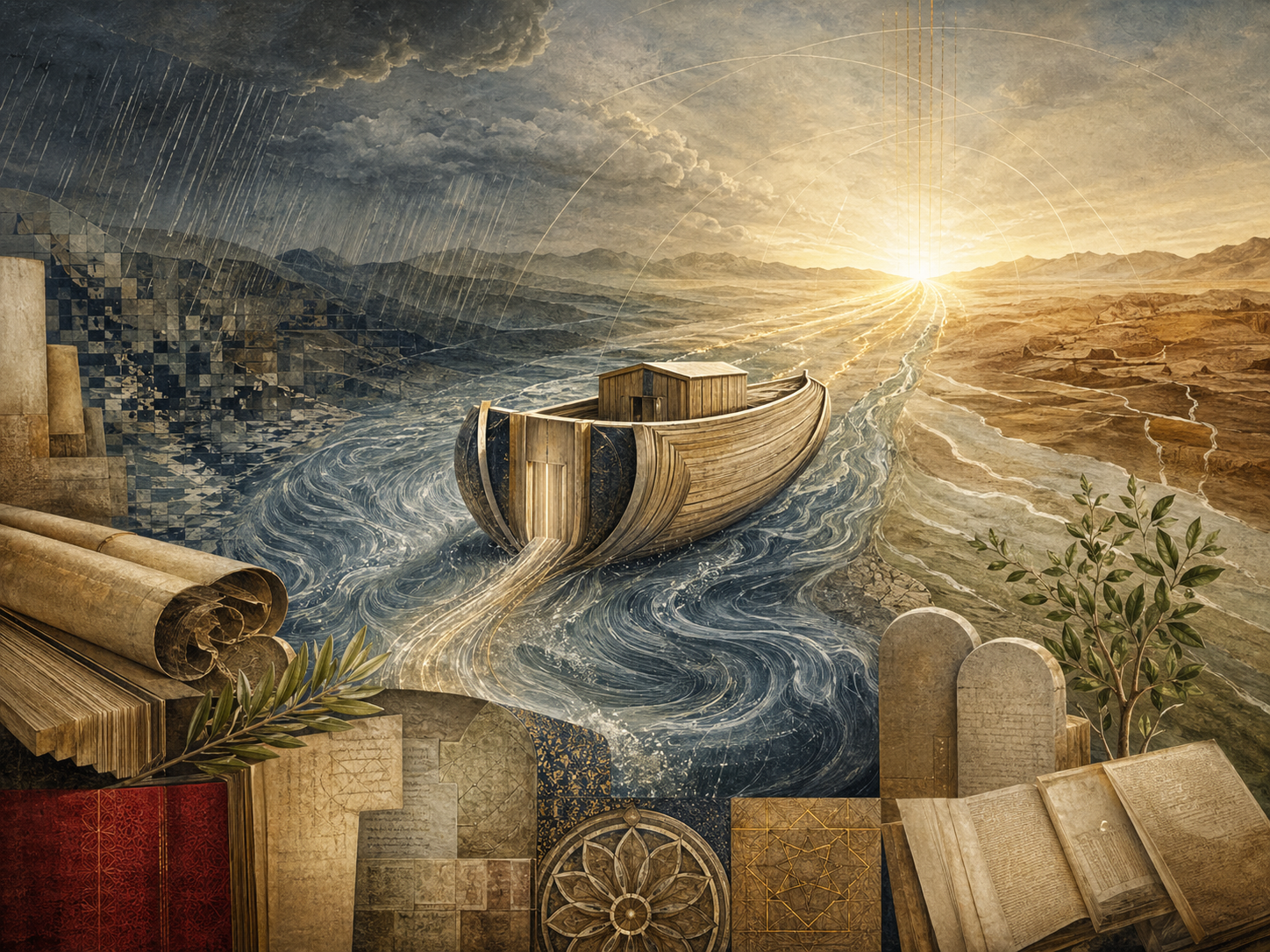
Noah, known in the Qur’an as Nuh, stands in sacred history as a figure of warning, patience, judgment, survival, and moral renewal. Judaism, Christianity, and Islam all remember him as a righteous servant of God who lives at a moment of profound corruption, receives divine warning, builds the ark, and survives the flood. His story is one of the most powerful Abrahamic accounts of judgment and mercy: a world, a people, or a moral order reaches a point of collapse, and God preserves life through obedience, faith, and revelation.
Yet the story of Noah is not merely about catastrophe. It is about prophetic endurance. In the Qur’an, Nuh is not presented simply as a passive survivor of disaster. He is a prophet who struggles to reform his people. He calls them publicly and privately, night and day. He urges them to serve Allah, seek forgiveness, abandon pride, and return to righteousness. The flood comes only after persistent rejection, arrogance, and organized resistance to the truth.
This article reads Noah / Nuh through a Qur’an-centered comparative Abrahamic lens. In this reading, the Qur’anic Noah narrative is not treated as borrowed biblical material, but as moral sacred history. The Qur’an emphasizes Noah’s preaching, the responsibility of his people, the survival of believers, and the destruction of evil and injustice rather than the indiscriminate destruction of life.
The unifying Abrahamic lesson is clear: God does not abandon humanity to corruption. Prophets are sent as warners and reformers. Judgment is not arbitrary violence; it is moral consequence. Survival is not merely biological continuation; it is the preservation of righteousness, faith, and the possibility of renewed life before the One God.
Series context: This article is part of the Abrahamic Traditions: Prophecy, Revelation, Law, and Sacred History knowledge series. For the broader category structure, return to the Religious Studies category.
Hebrew Bible
נֹחַ אִישׁ צַדִּיק תָּמִים הָיָה בְּדֹרֹתָיו אֶת־הָאֱלֹהִים הִתְהַלֶּךְ־נֹחַNoah was a righteous man, whole in his generation; Noah walked with God.Genesis 6:9. Hebrew text with English rendering.
This passage anchors the biblical portrait of Noah. His righteousness is not abstract doctrine; it is a way of walking with God in a generation marked by corruption and violence.
Noah / Nuh as a Shared Abrahamic Figure
Noah is one of the great shared figures of Abrahamic sacred history. He appears before Abraham, Moses, Jesus, and Muhammad, and therefore belongs to the earliest layer of prophetic memory. His story speaks to the human condition before later religious communities take their full historical shape. Noah represents the moment when corruption becomes widespread, divine warning is sent, and survival depends on obedience to guidance.
In the Bible, Noah is remembered as righteous in his generation. He walks with God, receives warning of the flood, builds the ark, preserves his family and living creatures, and emerges into a renewed world. The rainbow becomes a sign of divine covenant and mercy after judgment. In Jewish and Christian memory, Noah is therefore a figure of righteousness, obedience, preservation, covenant, and the fragile rebeginning of human history.
In the Qur’an, Nuh is remembered as one of the earliest and most persistent prophets. His mission is not summarized merely by the ark. It is defined by preaching, warning, reform, rejection, prayer, and deliverance. Nuh calls his people to serve Allah alone, seek forgiveness, and abandon arrogance. His people refuse, cover themselves from his message, and persist in wrongdoing. The flood is then presented as judgment on a people who reject guidance and oppose righteousness.
The shared Abrahamic meaning is not difficult to see. Noah / Nuh teaches that God’s mercy includes warning, that human beings are accountable for corruption, and that survival is not merely the continuation of biological life. It is the preservation of moral possibility through revelation.
Noah also deepens the sequence of early sacred history. Adam reveals human origin, knowledge, temptation, repentance, and guidance. Enoch / Idris reveals truthfulness, patience, wisdom, and spiritual elevation. Noah / Nuh reveals warning, collective corruption, judgment, survival, and moral renewal. Together, these early figures form a sacred anthropology of humanity before God: created, taught, tempted, guided, warned, judged, preserved, and called again into righteousness.
This makes Noah a major figure for thinking about societies, not only individuals. Adam’s story begins with the self before God. Noah’s story shows what happens when corruption becomes public, organized, inherited, and socially defended. The flood is therefore not only a story of water. It is a story of what happens when moral refusal becomes a civilization.
Noah in Genesis
The biblical Noah narrative appears primarily in Genesis 6–9. The earth is described as corrupt and filled with violence. Noah is righteous and blameless in his generation, and he walks with God. God commands him to build an ark because a flood is coming. Noah obeys, enters the ark with his family and the living creatures appointed for preservation, and survives the waters of judgment.
Hebrew Bible
וַתִּשָּׁחֵת הָאָרֶץ לִפְנֵי הָאֱלֹהִים וַתִּמָּלֵא הָאָרֶץ חָמָסAnd the earth was corrupt before God, and the earth was filled with violence.Genesis 6:11. Hebrew text with English rendering.
This verse gives the moral reason for the flood in the Genesis account. The problem is not merely ritual failure or private sin; it is a world filled with corruption and violence.
Genesis presents the flood in cosmic and universal terms. The waters cover the earth, the old world is destroyed, and the ark becomes the vessel through which life passes from judgment into renewal. After the flood, Noah offers sacrifice, and God establishes a covenant, setting the rainbow as a sign that the waters will not again destroy all flesh in the same way.
The biblical account is morally powerful because it links violence, corruption, judgment, obedience, preservation, and covenant. Noah is not saved because the world is harmless. He is saved because he responds faithfully in a world where corruption has become normal. The ark becomes an image of obedience under warning: Noah builds before the waters come.
Jewish and Christian traditions have drawn many meanings from this narrative. Jewish interpretation often reflects on Noah’s righteousness, the generation of the flood, the covenant with all living creatures, and the moral laws associated with the post-flood world. Christian interpretation often reads the ark typologically as a sign of salvation, baptism, church, or divine rescue through judgment.
For a comparative Abrahamic reading, Genesis gives the broad sacred drama: corruption, warning, flood, ark, survival, covenant. The Qur’an gives a more detailed prophetic portrait of Noah’s preaching and moral struggle. The two bodies of scripture do not simply duplicate one another. They preserve different emphases around the same great figure: Genesis concentrates the cosmic flood and covenantal rebeginning; the Qur’an concentrates the prophetic warning and moral responsibility of the people who reject him.
The Genesis account also offers a universal ecological and moral frame. The covenant after the flood is not only with a single tribe, nation, or later religious community. It includes Noah’s descendants and living creatures. This makes the biblical Noah narrative one of the great Abrahamic texts for thinking about divine mercy, creation, animal life, earth, covenant, and the fragile continuity of the world after judgment.
Nuh in the Qur’an
The Qur’an refers to Nuh repeatedly and devotes an entire chapter to his preaching. The Qur’anic account is especially concerned with his prophetic mission. Nuh is not merely an ark-builder. He is a warner, teacher, reformer, and patient servant of Allah.
In Surah Nuh, he says that he called his people night and day, but his call only made them flee further. Whenever he invited them toward forgiveness, they put their fingers in their ears, covered themselves with their garments, persisted in evil, and grew arrogant. He spoke to them openly and privately. He told them to ask forgiveness of their Lord, who is ever forgiving, and promised that divine mercy would bring renewal, provision, and blessing.
Qur’anic Text
قَالَ رَبِّ إِنِّي دَعَوْتُ قَوْمِي لَيْلًا وَنَهَارًا
فَلَمْ يَزِدْهُمْ دُعَائِي إِلَّا فِرَارًا
وَإِنِّي كُلَّمَا دَعَوْتُهُمْ لِتَغْفِرَ لَهُمْ جَعَلُوا أَصَابِعَهُمْ فِي آذَانِهِمْ وَاسْتَغْشَوْا ثِيَابَهُمْ وَأَصَرُّوا وَاسْتَكْبَرُوا اسْتِكْبَارًاHe said: My Lord, I called my people night and day, but my calling only made them flee. Whenever I called them so that You might forgive them, they put their fingers in their ears, wrapped themselves in their garments, persisted, and grew arrogant with great arrogance.Qur’an 71:5–7. Arabic text with English rendering.
This passage is central to the Qur’anic Noah narrative because it makes the flood a response to prolonged moral refusal. Nuh’s people are not destroyed without warning; they actively resist mercy, forgiveness, and reform.
This preaching is crucial. The Bible gives relatively little attention to Noah’s preaching and struggle to reform his people, while the Qur’an gives that mission prominence. In the Qur’anic account, judgment does not arrive without warning. The people are not destroyed because God is impatient. They are judged after long refusal, pride, and organized opposition to righteousness.
The Qur’an also places Nuh within the larger prophetic pattern. He calls his people to worship Allah alone. He asks for no wealth in return. He is rejected by chiefs who dismiss him as a mere mortal followed by the lowly. He persists. His mission reveals the recurring pattern of sacred history: prophets call people to truth, elites resist, the vulnerable often respond, and judgment falls when a people refuses reform.
In this sense, Nuh is one of the earliest examples of prophetic perseverance. His story teaches that truth may be resisted for a long time, but rejection does not nullify revelation. The prophet’s task is faithfulness; the final judgment belongs to God.
The Qur’anic Nuh also clarifies the relation between warning and mercy. He does not begin with destruction. He begins with invitation: worship, forgiveness, renewal, rain, provision, strength, and divine mercy. The tragedy of his people is that they reject the very path that could have spared them. Their judgment is therefore not divine caprice; it is the consequence of refusing mercy when mercy was repeatedly offered.
Prophetic Warning and Patience
Noah’s story is inseparable from patience. He does not warn once and withdraw. He calls repeatedly, publicly and privately, night and day. He faces indifference, ridicule, social rejection, and the arrogance of those who treat revelation as weakness. Yet he continues to preach.
This patience reveals the mercy beneath judgment. A warning is itself a mercy. A prophet is sent before destruction, not after it. The Qur’anic Noah narrative therefore refuses the idea of arbitrary catastrophe. It presents judgment as the last stage of a long moral process in which people are invited again and again to return.
Prophetic patience also exposes the moral character of rejection. Noah’s people do not merely misunderstand. They harden themselves. They refuse to hear. They cover themselves from the message. They follow wealth, status, and inherited forms of power rather than truth. The flood is therefore not the destruction of innocent ignorance. It is judgment on persistent moral refusal.
This prophetic pattern continues across sacred history. Abraham confronts idolatry. Moses confronts Pharaoh. The Hebrew prophets confront injustice and empty ritual. Jesus calls for repentance, mercy, and the kingdom of God. Muhammad calls Arabia and humanity back to worship of the One God, justice, charity, and moral accountability. Noah stands near the beginning of that long line of prophetic warning.
Patience here should not be confused with passivity. Nuh’s patience is active, public, and reforming. He does not retreat into private purity while his society collapses. He speaks, warns, prays, argues, endures, and builds. Prophetic patience is sustained obedience under rejection.
This is why Noah matters for every age of moral crisis. A prophet does not measure truth by public approval. He does not stop warning because the powerful mock him. He does not surrender revelation to elite contempt. Noah’s patience teaches that moral truth may be socially rejected and still remain truth.
Judgment as Moral Consequence
The flood is often imagined primarily as disaster. In sacred history, however, it is judgment. That distinction matters. Disaster may appear meaningless. Judgment has moral structure. It is not random destruction. It is consequence.
In the Qur’anic account, the people of Nuh are judged because of persistent wrongdoing. They reject the truth, follow corrupt leadership, and oppose the righteous. Their destruction is not presented as divine hostility toward life. It is the destruction of a moral order that has become unjust, arrogant, and closed to reform.
A Qur’an-centered reading gives special weight to this point: the divine purpose in the flood is the destruction of evil and injustice, not the destruction of flesh as such. The distinction is essential. The flood is not about God hating creation. It is about God refusing to allow entrenched evil to destroy the possibility of righteousness.
This also helps explain why the ark preserves believers. Survival is not merely about physical safety. It is about preserving the seed of moral renewal. Those who respond to guidance are carried forward. Those who persist in injustice are overwhelmed by the consequences of what they have chosen.
The same principle appears throughout the prophetic tradition. Judgment is not separate from mercy. Judgment clears the way for renewal when corruption has become destructive. Mercy sends the prophet. Mercy gives time. Mercy opens the door of repentance. Judgment comes when that door is knowingly refused.
In this sense, Noah’s flood is not simply a story about divine power. It is a story about moral ecology. Corruption has consequences. Violence spreads. Arrogance hardens. False leadership reproduces itself. Communities can become spiritually uninhabitable. The flood represents the moment when a corrupt order can no longer be preserved without destroying the possibility of righteousness itself.
Judgment as moral consequence should not be used cruelly. It should not become a tool for blaming victims of ordinary disasters or reading every flood, storm, illness, or tragedy as punishment. Sacred judgment in Noah’s story is tied to prophetic warning, persistent rejection, and collective moral corruption. The article’s lesson is not superstition about catastrophe; it is sober reflection on what happens when societies ignore warning and normalize injustice.
The Flood: Universal Cataclysm or Judgment on a People?
One of the major differences between the biblical and Qur’anic flood narratives concerns scope. Genesis is often read as describing a universal flood that destroys all flesh on the earth outside the ark. The Qur’an repeatedly speaks of Nuh being sent to his people. This changes the frame. In the Qur’anic account, the flood is judgment on a particular people who rejected their prophet.
A Qur’an-centered comparative reading emphasizes that the Qur’an contains no necessary statement that the flood covered the whole face of the earth. Rather, it speaks again and again of Noah being sent to his people and of that people’s destruction because they rejected the truth and persisted in evil. This interpretation is also consistent with readings that distinguish the Bible’s universal flood narrative from the Qur’an’s more specific presentation of punishment directed toward Noah’s people.
This interpretation has theological and historical importance. The Qur’anic reading preserves the moral structure of the narrative without requiring a universal destruction of all human civilization and animal life. The flood is still real judgment, but it is judgment directed toward a morally accountable community.
The Qur’anic account also describes the flood in terms of water pouring from the sky and waters flowing from the land. This can be read as an exceptionally severe flood event, not necessarily as a worldwide cataclysm covering all geography. The ark, therefore, is not necessarily a global zoological vessel collecting all species from every continent. It is the vessel of survival for Nuh, those with him, and the provisions needed for their deliverance.
This reading keeps the focus where the Qur’an places it: not on physical impossibility or spectacle, but on moral consequence, prophetic warning, and divine rescue. The most important question is not how large the flood was on a modern map. The most important question is what kind of moral world required judgment and what kind of guidance could carry the righteous through it.
A careful comparative article should therefore acknowledge multiple interpretive positions. Some Jewish and Christian traditions read the flood as universal. Some modern interpreters read it as local, regional, or theological-cosmic language. A Qur’an-centered interpretation can responsibly emphasize judgment on Nuh’s people while still respecting the biblical narrative’s own literary and theological scale.
The key is not to make the flood into a battleground between religion and science. The key is to preserve the sacred meaning: corruption becomes destructive, warning is sent, rejection hardens, judgment comes, and life is carried forward through obedience to God.
The Ark as Survival and Guidance
The ark is one of the strongest symbols in the Noah story. It is the vessel through which life passes through judgment. It is built before the flood, under divine instruction, in obedience to warning. It is therefore not merely a boat. It is an enacted form of trust.
In the Bible, the ark preserves Noah, his family, and living creatures through the waters. In Christian imagination, the ark often becomes a sign of salvation: rescue through judgment, the church borne over destructive waters, or baptism as passage from death into life. In Jewish interpretation, the ark also raises questions about obedience, preservation, covenant, and the responsibilities of righteous life in a corrupt age.
In the Qur’an, the ark carries Nuh, those who believe with him, and what is necessary for survival. This is important. The Qur’anic ark is not simply a family refuge. It is a community of faith. Those who believe are saved; those who reject are not saved by outward association alone.
New Testament
Πίστει χρηματισθεὶς Νῶε περὶ τῶν μηδέπω βλεπομένων εὐλαβηθεὶς κατεσκεύασεν κιβωτὸν εἰς σωτηρίαν τοῦ οἴκου αὐτοῦBy faith Noah, warned concerning things not yet seen, acted with reverence and prepared an ark for the saving of his household.Hebrews 11:7. Greek New Testament with English rendering.
Hebrews interprets the ark through faith before visibility. Noah builds in response to warning before the catastrophe can be seen. The ark is therefore obedience made material.
The ark therefore symbolizes guidance. It is the structure built in response to revelation. It preserves those who trust the warning before the warning becomes visible as catastrophe. Every prophetic tradition contains this pattern: guidance must be followed before judgment makes its truth unavoidable.
For contemporary readers, the ark is a powerful image of moral preparation. A society cannot wait until floodwaters rise to begin building what righteousness requires. Survival depends on responding to guidance early enough for obedience to take form.
The ark also teaches that guidance is not merely intellectual assent. Noah does not simply believe that a flood might come. He builds. His faith becomes labor, structure, discipline, and preparation. In this way, the ark exposes a recurring Abrahamic principle: revelation becomes real in human life when it is obeyed.
The ark is also an image of fragile hope. It is not a palace. It is not an empire. It is not a weapon. It is a vessel of preservation, carrying life through overwhelming conditions. That matters spiritually: God’s rescue may look less like domination and more like endurance, shelter, and faithful passage through danger.
Family, Righteousness, and Accountability
One of the strongest Qur’anic teachings in the Noah story concerns family and righteousness. In Genesis, Noah’s family survives with him. In the Qur’an, one of Nuh’s sons refuses to embark and is drowned. Nuh calls to him, but the son remains apart. When Nuh appeals to God concerning his son, he is told that the son is not truly of his family because he is unrighteous in conduct.
Qur’anic Text
قَالَ يَا نُوحُ إِنَّهُ لَيْسَ مِنْ أَهْلِكَ ۖ إِنَّهُ عَمَلٌ غَيْرُ صَالِحٍHe said: O Noah, he is not of your family; surely his conduct is unrighteous.Qur’an 11:46. Arabic text with English rendering.
This passage is one of the strongest Qur’anic statements about moral kinship. Blood relation to a prophet cannot replace righteousness, faith, and response to guidance.
This is a profound theological statement. Sacred kinship is not merely biological. Family ties do not cancel moral accountability. A prophet’s own son cannot be saved by bloodline if he refuses guidance. Conversely, believers outside the prophet’s immediate family are saved because they respond to truth.
The Qur’anic narrative makes the moral purpose of the story unmistakable: the righteous are saved, not merely the prophet’s biological family, while wrongdoing is not excused even by family connection. Sacred belonging is therefore rooted in righteousness, faith, obedience, and response to guidance.
The lesson belongs deeply to the Abrahamic frame. Abrahamic traditions often wrestle with ancestry, election, covenant, family, and community. Noah’s story insists that sacred belonging cannot be reduced to blood. Righteousness, faith, obedience, and response to guidance matter more than inherited association.
This does not diminish family. It purifies the meaning of family. Sacred family is not a shield against accountability. It is a trust under God. The ark is not nepotism; it is moral survival.
This also makes the story ethically demanding. Religious communities often rely on inherited identity: lineage, tribe, sect, civilization, institution, or historical belonging. Noah’s son warns against false security. Nearness to a prophet in blood, culture, or name cannot substitute for response to guidance.
Covenant, Rainbow, and Renewed World
In Genesis, the flood is followed by covenant. This is one of the most important features of the biblical Noah narrative. Judgment does not end in mere destruction. The world is re-opened under divine promise. Noah leaves the ark, offers sacrifice, and God establishes a covenant not only with Noah, but with his descendants and with every living creature.
The rainbow becomes the sign of that covenant. It is not merely a sentimental image of beauty after storm. It is a theological sign: judgment has occurred, but creation is not abandoned. The post-flood world remains fragile, but it exists under divine mercy. The covenant restrains catastrophe and gives human life a renewed horizon.
Hebrew Bible
אֶת־קַשְׁתִּי נָתַתִּי בֶּעָנָן וְהָיְתָה לְאוֹת בְּרִית בֵּינִי וּבֵין הָאָרֶץMy bow I have set in the cloud, and it shall be a sign of covenant between Me and the earth.Genesis 9:13. Hebrew text with English rendering.
This covenant is striking because it extends beyond one human group. It binds divine mercy to the earth itself and to living creatures, making Noah’s story a foundational text for post-judgment renewal.
This covenantal aftermath is important for a comparative Abrahamic reading. It prevents the flood from being read only as wrath. The story moves from corruption to judgment, but also from judgment to mercy, promise, and renewed moral responsibility. The world after the flood is not innocent, but it is preserved.
In Jewish thought, the Noahide covenant becomes the basis for reflection on a universal moral order beyond Israel. In Christian thought, the flood and ark are often read as signs of salvation through judgment. In Islamic thought, the Qur’anic emphasis falls more heavily on warning, rejection, deliverance, and the moral fate of Nuh’s people. Together, these traditions show that Noah’s story is not only about ending a corrupt order. It is also about the conditions under which a world may begin again.
The covenant with the earth also matters for ecological theology. Noah’s story is not only human-centered. Living creatures are preserved. The earth is addressed. The sign of covenant is placed in the cloud. A world damaged by violence is not discarded by God. It is given a renewed horizon of mercy, restraint, and responsibility.
This gives Noah’s story special relevance for environmental crisis. The flood narrative should not be used simplistically as a prediction model for modern climate change, but it does teach that human corruption and violence are not separate from the fate of the world. Moral disorder and ecological vulnerability belong together in sacred imagination.
Noah and the Vindication of Prophetic Character
The Qur’an-centered method used in this series gives special attention to the dignity of prophets. Where later or parallel traditions may preserve morally difficult episodes, the Qur’an often retells sacred history in a way that protects the prophetic office and draws out the moral purpose of the narrative. Noah is an important example.
In Genesis 9, after the flood, Noah becomes drunk and lies uncovered in his tent. The story then leads to the curse of Canaan, the son of Ham. This episode has been interpreted in many ways within Jewish and Christian traditions, including as a story about shame, dishonor, family disorder, ancient ethnological memory, or the misuse of parental dignity.
The Qur’anic Noah narrative moves differently. It does not compromise Noah’s prophetic dignity after deliverance. Its focus remains on his warning, patience, prayer, deliverance, and the moral judgment of a people who refused guidance. The sacred narrative protects the prophet’s role as a trustworthy bearer of divine warning.
This difference should be handled respectfully. Jewish and Christian readers are not required to accept the Qur’anic framing in order to read Genesis seriously within their own traditions. But from the perspective of this article, the Qur’anic account clarifies the moral center of the story: a prophet is sent to reform, warn, and guide; his dignity serves the purpose of revelation.
Noah’s Qur’anic dignity therefore matters. He is not only a survivor. He is a faithful warner, patient reformer, and servant of Allah whose mission reveals the moral seriousness of sacred history.
This interpretive point also helps prevent the misuse of Noah’s story. The curse of Canaan has had a long and destructive history in some later interpretations, including racist and colonial misuse. A Qur’an-centered reading refuses to make that episode the moral center of Noah’s memory. It restores focus to prophecy, warning, corruption, deliverance, and accountability before God.
Jewish, Christian, Sunni, Shia, and Sufi Perspectives
Jewish tradition remembers Noah as righteous in his generation and as the ancestor of post-flood humanity. The covenant after the flood has universal significance because it is made not only with Noah, but with his descendants and living creatures. Later Jewish teaching also develops the idea of Noahide commandments, a moral framework associated with humanity beyond Israel.
Christian tradition often reads Noah typologically. The ark can represent salvation, baptism, or the church. The flood becomes a sign of judgment, but also of rescue. The New Testament remembers Noah as a preacher or herald of righteousness and as a figure whose obedience contrasts with the unbelief of his age.
Sunni Islamic tradition honors Nuh as one of the great prophets and often includes him among the major messengers of firmness. His long preaching, patience, and endurance become signs of prophetic perseverance. The Qur’anic Nuh calls his people to Allah, seeks no reward, endures rejection, and is delivered with the believers.
Shia perspectives also honor Nuh as a prophet in the chain of divine guidance. His story can be read alongside broader Shia themes of righteous leadership, rejection by arrogant communities, fidelity under pressure, and the survival of truth despite worldly opposition. As in other Islamic readings, his son’s fate underscores that outward association with a righteous household does not replace inner faithfulness.
Sufi perspectives may read the ark, flood, and prophetic warning inwardly as well as historically. The flood can symbolize overwhelming passions, heedlessness, or the destruction of a corrupt inner order. The ark can symbolize guidance, remembrance, the prophetic path, or the vessel of salvation through which the soul passes beyond destructive forces. Such readings should supplement, not erase, the Qur’anic moral narrative.
Across these perspectives, Noah / Nuh remains a shared figure of moral seriousness. He teaches that divine mercy warns before judgment, that righteousness may stand against a corrupt majority, and that survival belongs to those who respond to guidance.
The perspectives differ, but they converge around a core: Noah’s story is not trivial myth. It is sacred instruction about corruption, warning, obedience, preservation, and renewal. Whether read covenantally, typologically, prophetically, legally, mystically, or ethically, Noah asks whether human beings can hear divine warning before their world collapses under the weight of its own disorder.
Noah as Sacred Anthropology
Noah’s story belongs not only to sacred history, but also to sacred anthropology: it reveals something about the human being and human society. Adam shows the human being as created, knowledgeable, tempted, repentant, and in need of guidance. Enoch / Idris shows the human being capable of truthfulness, patience, wisdom, and elevation. Noah shows the human community as morally vulnerable: capable not only of individual sin, but of collective corruption.
This is one of the profound differences between Adam and Noah. Adam’s story reveals the drama of the human self before God. Noah’s story reveals the drama of society before God. Corruption can become collective. Violence can become normal. Elites can resist truth. Public life can become organized around falsehood. When that happens, judgment is not merely personal. It becomes historical.
The flood is therefore a story about what happens when a society refuses warning. It is a story about moral saturation. A culture can absorb so much violence, arrogance, and denial that reform becomes impossible without rupture. Noah’s ark becomes the fragile vessel of a different future — not because it preserves every structure of the old world, but because it carries forward the possibility of righteousness.
This makes Noah especially important for modern readers. The story is not only about ancient waters. It is about the moral flood that follows when societies ignore warning: ecological crisis, violence, propaganda, greed, militarism, injustice, and the refusal to repent. Noah asks whether human communities can hear warning before judgment arrives.
As sacred anthropology, Noah teaches that human beings are not only tempted individually. They are also formed by corrupt orders. Prophetic guidance therefore must address both the heart and the world: inner repentance and public reform, personal faith and social accountability.
Noah also teaches that righteousness is not only private innocence. In a corrupt generation, righteousness requires public obedience. Noah does not merely keep himself pure; he builds the ark. He acts under revelation. He prepares for judgment. He carries life forward. Sacred anthropology therefore includes vocation: the human being is called not only to believe, but to build what guidance requires.
Marginalized Voices and the Lowly Believers
The Qur’anic Noah narrative repeatedly exposes the arrogance of elites. Like many later prophetic stories, it shows leaders dismissing the prophet and looking down on those who follow him. The poor, lowly, or socially marginal are often treated as evidence against the prophet’s truth. The powerful assume that if a message were truly noble, it would first confirm their status.
This is one of the most important social lessons of Noah’s story. Prophetic truth is often recognized by those with less to lose from the collapse of a corrupt order. Those most invested in status, wealth, and inherited authority may be least able to hear warning. Noah’s people do not reject him only because they misunderstand theology. They reject him because accepting him would reorder social value.
In the Qur’an, the lowly believers are not dismissed by God. They are honored through survival. The ark carries those who respond to guidance, not those whose status makes them respectable in the eyes of the old order. This is a recurring Abrahamic reversal: worldly rank does not equal sacred rank.
This matters for a site committed to giving voice to marginalized voices. Noah’s story says that truth may appear first among those whom power ridicules. The poor, displaced, enslaved, colonized, and socially dismissed may hear warning more clearly than those protected by privilege. Their vulnerability does not disqualify them from truth. It may make them more awake to the need for deliverance.
The ark is therefore not only a vessel of survival. It is a critique of elite contempt. It preserves those who believed while the arrogant mocked. It carries forward a moral future from the margins of the old world.
This does not romanticize poverty or marginalization. It does not claim that suffering automatically produces righteousness. It says something more careful: sacred history repeatedly warns that power can harden the heart, while those dismissed by power may become the first witnesses to truth.
Noah’s story also challenges modern societies that ignore the warnings of those most exposed to danger. Climate vulnerability, displacement, poverty, racialized violence, ecological damage, and political collapse are often first experienced by communities with the least institutional power. The prophetic question is whether society will listen before the flood rises.
Why Noah / Nuh Matters Today
Noah / Nuh matters today because the world still faces floods — literal, moral, ecological, political, and spiritual. Societies can become overwhelmed by the consequences of their own corruption. Violence, greed, arrogance, environmental destruction, propaganda, inequality, and contempt for truth can accumulate until they become catastrophic.
The Noah story does not allow people to treat catastrophe as meaningless. It asks what warnings were ignored. It asks who called for reform. It asks whether the powerful dismissed truth because it came from those they considered weak. It asks whether societies covered their ears, followed wealth and status, and refused repentance until consequences became unavoidable.
Noah also matters because he teaches patience without passivity. He does not withdraw into private purity. He speaks. He warns. He calls. He prays. He builds. Prophetic patience is not silence. It is sustained moral action under rejection.
The ark remains one of sacred history’s greatest symbols of survival. But survival is not enough if it means only continuing to exist. The ark preserves the possibility of a different future: a world rebuilt after judgment, a community shaped by guidance, and a renewed moral order under God.
For an Abrahamic reading rooted in unity, the lesson of Noah / Nuh is shared and urgent. The One God sends guidance. Prophets warn. Communities are accountable. Evil and injustice cannot last forever. Mercy opens a path before judgment comes. Those who enter the ark of guidance are carried through the flood toward renewal.
Noah also speaks directly to modern environmental crisis. The story should not be flattened into a climate metaphor, but it does ask a climate-relevant moral question: what happens when a society ignores warnings about destructive conditions it helped create? The answer is not fatalism. The answer is prophetic responsibility: listen, repent, build, preserve life, and reorder society before catastrophe becomes unavoidable.
Finally, Noah matters because he clarifies hope. Hope is not denial of judgment. Hope is the ark built under warning. Hope is obedience before evidence becomes overwhelming. Hope is moral preparation in a corrupt age. Hope is the preservation of life through guidance.
Comparative Cautions
Several cautions are necessary. First, Noah / Nuh should not be reduced to a children’s story about animals and a boat. The narrative concerns corruption, violence, warning, judgment, survival, covenant, and moral renewal.
Second, the biblical and Qur’anic flood narratives should not be treated as identical. Genesis emphasizes cosmic flood, ark, preservation of living creatures, and covenantal rebeginning. The Qur’an emphasizes Nuh’s prophetic preaching, the rejection of his people, deliverance of believers, and moral judgment.
Third, the scope of the flood should be handled carefully. Many Jewish and Christian traditions read Genesis as universal in scope. A Qur’an-centered reading can responsibly emphasize judgment on Nuh’s people without requiring that the Qur’an describe a global flood covering the entire earth.
Fourth, judgment should not be used as a cruel explanation for ordinary suffering or natural disasters. In sacred history, Noah’s flood follows prophetic warning and persistent collective rejection. It should not become a tool for blaming victims.
Fifth, Noah’s family should not be read as automatic salvation by bloodline. The Qur’anic account of Noah’s son teaches that righteousness and response to guidance matter more than biological association with a prophet.
Sixth, the ark should not be reduced to physical survival. It is also a symbol of obedience, guidance, preservation of moral possibility, and trust before judgment becomes visible.
Seventh, the post-flood covenant should be treated as theologically significant. In Genesis, covenant extends to the earth and living creatures, making the renewed world central to the story.
Eighth, morally difficult post-flood material in Genesis should be handled respectfully but carefully. A Qur’an-centered reading preserves Noah’s prophetic dignity and keeps the focus on warning, deliverance, and moral renewal.
Ninth, original-language quotations should be used when they clarify interpretation, not as decoration. Hebrew, Greek, and Arabic passages should support close reading and scholarly authority.
Finally, marginalized voices should not be ignored. The Qur’anic narrative repeatedly exposes elite contempt for lowly believers. Noah’s story warns that truth may be rejected precisely because it gathers those whom power dismisses.
Why This Article Matters
Noah / Nuh matters because he reveals what happens when corruption becomes collective. Adam shows the human being before God. Enoch / Idris shows the possibility of early sacred wisdom and elevation. Noah shows society under warning. His story asks whether communities can hear divine guidance before violence, arrogance, and denial become catastrophic.
This article matters because it reads Noah beyond spectacle. The flood is not merely disaster, the ark is not merely a boat, and Noah is not merely a survivor. The story is about prophetic warning, moral consequence, divine mercy, righteous preservation, and the possibility of renewal after judgment.
For the Abrahamic Traditions knowledge series, this article builds on Adam in the Bible and the Qur’an, Enoch / Idris and Early Sacred Wisdom, What Is Prophecy in the Abrahamic Traditions?, Monotheism, Revelation, and Sacred History, and The Promise of the Abrahamic Frame. It prepares later articles on Abraham, covenant, Moses, Pharaoh, Jesus, Muhammad, prophetic warning, divine judgment, environmental ethics, and sacred renewal.
Seen from the perspective of marginalized voices, Noah matters because his story exposes elite contempt. Those who reject the prophet often dismiss his followers as lowly or socially insignificant. The ark overturns that judgment. It preserves those who respond to truth, not those who command status in the old order.
The final value of Noah’s story is that it holds warning and mercy together. God warns before judgment. Prophets call before collapse. Guidance is offered before consequences become overwhelming. The ark is built before the flood. Noah / Nuh teaches that survival depends not only on being alive, but on hearing, obeying, and carrying righteousness through the waters into a renewed world.
Related Reading
- Adam in the Bible and the Qur’an
- Enoch / Idris and Early Sacred Wisdom
- What Is Prophecy in the Abrahamic Traditions?
- Monotheism, Revelation, and Sacred History
- The Promise of the Abrahamic Frame: One God, Shared Revelation, and Sacred History
- Abraham, Covenant, and Sacred Ancestry
- Abrahamic Traditions: Prophecy, Revelation, Law, and Sacred History
- Foundations of Religion
- Comparative Sacred Themes
- Religion and Ecology
Further Reading
- Armstrong, K. (1996) In the Beginning: A New Interpretation of Genesis. New York: Knopf. Available at: https://www.penguinrandomhouse.com/
- Bucaille, M. (1976) The Bible, The Qur’an and Science: The Holy Scriptures Examined in the Light of Modern Knowledge. Translated by A.D. Pannell. Available at: https://archive.org/details/TheBibleTheQuranAndScience
- Levenson, J.D. (2012) Inheriting Abraham: The Legacy of the Patriarch in Judaism, Christianity, and Islam. Princeton: Princeton University Press. Available at: https://press.princeton.edu/
- Nasr, S.H. et al. (eds.) (2015) The Study Quran: A New Translation and Commentary. New York: HarperOne. Available at: https://www.harpercollins.com/
- Neusner, J., Chilton, B. and Graham, W.A. (eds.) (2002) Three Faiths, One God: The Formative Faith and Practice of Judaism, Christianity, and Islam. Leiden: Brill. Available at: https://brill.com/
- Sarna, N.M. (1989) Genesis: The Traditional Hebrew Text with the New JPS Translation. Philadelphia: Jewish Publication Society. Available at: https://jps.org/
References
- Ali, M.M. (n.d.) History of the Prophets. Lahore: Ahmadiyya Anjuman Isha‘at Islam. Available at: https://www.alahmadiyya.org/books-islam-ahmadiyya/english-books/history-of-the-prophets/
- Ali, M.M. (2010) English Translation of the Holy Quran with Explanatory Notes. Edited by Zahid Aziz. Wembley: Ahmadiyya Anjuman Lahore Publications. Available at: https://www.ahmadiyya.org/quran/english-quran-with-short-commentary.htm
- Bucaille, M. (1976) The Bible, The Qur’an and Science: The Holy Scriptures Examined in the Light of Modern Knowledge. Translated by A.D. Pannell. Available at: https://archive.org/details/TheBibleTheQuranAndScience
- Quran.com (n.d.) Surah Al-A‘raf 7:59–64. Available at: https://quran.com/7/59-64
- Quran.com (n.d.) Surah Yunus 10:71–73. Available at: https://quran.com/10/71-73
- Quran.com (n.d.) Surah Hud 11:25–49. Available at: https://quran.com/11/25-49
- Quran.com (n.d.) Surah Al-Mu’minun 23:23–30. Available at: https://quran.com/23/23-30
- Quran.com (n.d.) Surah Ash-Shu‘ara 26:105–122. Available at: https://quran.com/26/105-122
- Quran.com (n.d.) Surah Al-Ankabut 29:14–15. Available at: https://quran.com/29/14-15
- Quran.com (n.d.) Surah Al-Qamar 54:9–15. Available at: https://quran.com/54/9-15
- Quran.com (n.d.) Surah At-Tahrim 66:10. Available at: https://quran.com/66/10
- Quran.com (n.d.) Surah Nuh 71:1–28. Available at: https://quran.com/71
- Sefaria (n.d.) Genesis 6. Available at: https://www.sefaria.org/Genesis.6
- Sefaria (n.d.) Genesis 7. Available at: https://www.sefaria.org/Genesis.7
- Sefaria (n.d.) Genesis 8. Available at: https://www.sefaria.org/Genesis.8
- Sefaria (n.d.) Genesis 9. Available at: https://www.sefaria.org/Genesis.9
- Sefaria (n.d.) Jewish Texts and Rabbinic Interpretation. Available at: https://www.sefaria.org/texts
- Society of Biblical Literature (n.d.) The Greek New Testament: SBLGNT. Available at: https://sblgnt.com/
- BibleGateway (n.d.) Matthew 24:37–39, New Revised Standard Version Updated Edition. Available at: https://www.biblegateway.com/passage/?search=Matthew%2024%3A37-39&version=NRSVUE
- BibleGateway (n.d.) Hebrews 11:7, New Revised Standard Version Updated Edition. Available at: https://www.biblegateway.com/passage/?search=Hebrews%2011%3A7&version=NRSVUE
- BibleGateway (n.d.) 1 Peter 3:18–22, New Revised Standard Version Updated Edition. Available at: https://www.biblegateway.com/passage/?search=1%20Peter%203%3A18-22&version=NRSVUE
- BibleGateway (n.d.) 2 Peter 2:5, New Revised Standard Version Updated Edition. Available at: https://www.biblegateway.com/passage/?search=2%20Peter%202%3A5&version=NRSVUE
- Sunnah.com (n.d.) Hadith Collections. Available at: https://sunnah.com/
- Al-Islam.org (n.d.) Ahlul Bayt Digital Islamic Library Project. Available at: https://www.al-islam.org/