
Last Updated May 28, 2026
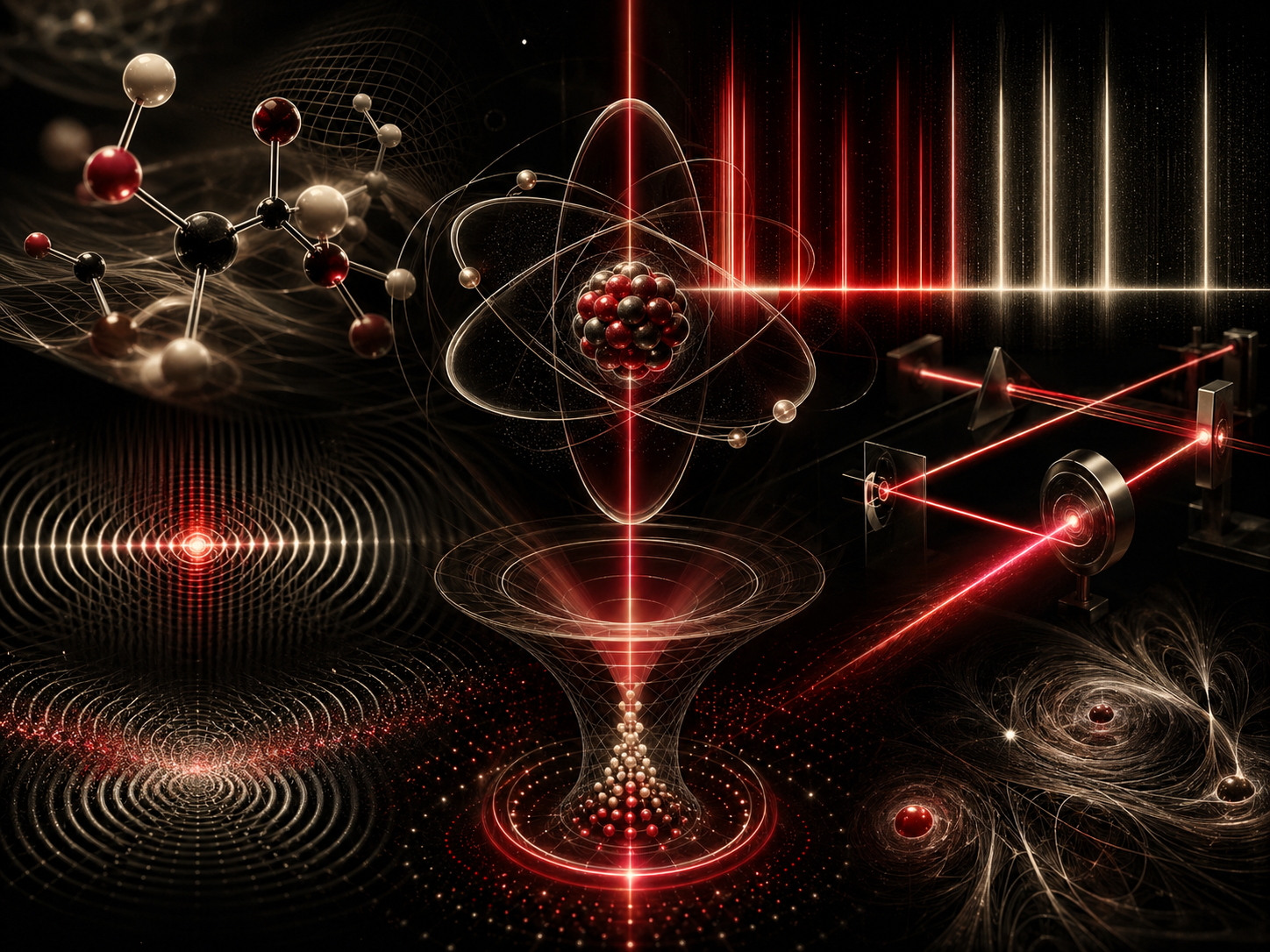
Atomic, molecular, and optical physics studies the quantum structure of matter and light: atoms, molecules, photons, spectra, lasers, optical transitions, precision measurement, cold gases, and the controlled interaction between radiation and matter. It is one of the most experimentally precise and technologically consequential areas of modern physics. Atomic spectra reveal the structure of electronic energy levels. Molecular spectra reveal rotation, vibration, bonding, and internal degrees of freedom. Optical physics explains how light is emitted, absorbed, amplified, interfered, trapped, and measured. Together, these domains form the field commonly called AMO physics.
AMO physics sits at the intersection of quantum mechanics, electromagnetism, statistical physics, spectroscopy, metrology, lasers, quantum optics, and computational physics. It explains why atoms emit discrete spectral lines, how molecules absorb infrared radiation, how lasers produce coherent light, how optical clocks measure time with extraordinary precision, how cold atoms can simulate many-body quantum systems, and how photons can carry quantum information. It is therefore both foundational science and enabling infrastructure for modern measurement, materials analysis, astrophysics, chemistry, medicine, telecommunications, quantum computing, and precision sensing.
This article examines Atomic, Molecular, and Optical Physics as part of the Physics knowledge series, connecting atomic structure, electronic energy levels, the Schrödinger equation, hydrogen-like spectra, the Rydberg formula, angular momentum, selection rules, fine and hyperfine structure, Zeeman and Stark effects, molecular rotation and vibration, spectroscopy, optical transitions, spontaneous and stimulated emission, lasers, Rabi oscillations, density matrices, quantum optics, cold atoms, optical lattices, precision clocks, quantum information, and computational AMO workflows. Selected R and Python workflows appear in the article body, while the companion GitHub repository contains expanded computational resources for hydrogen spectra, molecular rotational spectra, two-level optical dynamics, Rabi oscillations, spectral line fitting, Boltzmann populations, uncertainty propagation, SQL metadata, C/C++/Fortran/Rust examples, and reproducible AMO-physics workflows.
Main Library
Publications
Article Map
Physics
Related Topic
Chemistry
Related Topic
Data Systems & Analytics
Related Topic
Astronomy
Why AMO Physics Matters
Atomic, molecular, and optical physics matters because it provides some of the clearest experimental access to quantum mechanics. The quantization of atomic spectra helped reveal that matter has discrete internal states. Molecular spectra made rotation, vibration, and bonding measurable. Optical spectroscopy allowed physicists to probe energy differences with extraordinary precision. Lasers made coherent, controllable light available as a scientific tool. Cold-atom techniques made it possible to slow, trap, cool, and manipulate matter waves. Quantum optics made the photon itself an experimentally accessible quantum object.
AMO physics is also a measurement science. Spectral lines can identify elements in stars and plasmas. Molecular absorption bands can identify atmospheric gases. Optical clocks can define time with extreme precision. Interferometers can detect tiny phase shifts. Laser cooling can bring atomic gases near absolute zero. Quantum sensors can measure fields, acceleration, rotation, and frequency with remarkable sensitivity. AMO physics therefore links quantum foundations to practical instrumentation.
The field also sits at the center of current quantum technology. Neutral atoms, trapped ions, photons, superconducting microwave interfaces, optical cavities, and cold molecules all contribute to quantum information science, quantum simulation, quantum communication, and precision sensing. AMO systems are valuable because they are often clean, controllable, and well isolated from environmental noise compared with many condensed-matter systems.
For the Physics knowledge series, AMO physics is important because it connects quantum mechanics, electromagnetism, spectroscopy, statistical physics, computational modeling, and technology. It shows how abstract quantum states become measurable spectra, how radiation couples to matter, and how precision experiments transform quantum theory into controlled physical systems.
Atoms, Molecules, and Light as Quantum Systems
Atoms, molecules, and light are quantum systems. An atom has electrons bound by electromagnetic interaction to a nucleus. A molecule has multiple nuclei and electrons, with rotational, vibrational, and electronic degrees of freedom. Light consists of electromagnetic fields that can be treated classically in many contexts but must be quantized when photon statistics, single-photon states, squeezed light, entanglement, or spontaneous emission are central.
The quantum state of an atom or molecule can be represented by a wavefunction or, more generally, by a state vector in Hilbert space. A stationary state satisfies a time-independent Schrödinger equation:
\hat{H}\psi = E\psi
\]
Interpretation: Stationary atomic and molecular states are eigenstates of the Hamiltonian operator.
where \(\hat{H}\) is the Hamiltonian operator, \(\psi\) is the quantum state, and \(E\) is an allowed energy. Optical transitions occur when the system changes between energy levels while absorbing or emitting a photon:
\Delta E = h\nu
\]
Interpretation: A photon’s frequency is tied to the energy difference between quantum states.
where \(h\) is Planck’s constant and \(\nu\) is photon frequency.
The key AMO idea is that microscopic structure becomes visible through light. Atoms and molecules do not emit or absorb all frequencies equally. They interact strongly with radiation at frequencies corresponding to allowed transitions. Spectroscopy is therefore a way of reading quantum structure through electromagnetic signals.
Atomic Structure and Energy Levels
Atomic structure begins with the Coulomb interaction between negatively charged electrons and a positively charged nucleus. In the simplest hydrogenic case, one electron moves in the potential of a nucleus. The energy levels are quantized. For hydrogen, the leading nonrelativistic energy levels are:
E_n
=
-\frac{13.6\ \mathrm{eV}}{n^2}
\]
Interpretation: Hydrogen energy levels are discrete and approach ionization as \(n\) increases.
where \(n\) is the principal quantum number. The negative sign indicates that the electron is bound. As \(n\) increases, the energy approaches zero from below, corresponding to ionization.
Real atoms are more complex. Multi-electron atoms include electron-electron interactions, shielding, exchange effects, spin-orbit coupling, relativistic corrections, hyperfine interactions, and coupling to external fields. Exact analytic solutions are generally impossible, so atomic structure often requires approximation methods, perturbation theory, variational methods, Hartree-Fock approaches, configuration interaction, density-functional ideas, or high-precision numerical calculations.
Atomic energy levels are measured through spectroscopy. Transitions among levels produce absorption or emission lines with characteristic wavelengths. These spectral lines are fingerprints of atomic species and ionization states. This is why atomic spectra are central to astrophysics, plasma diagnostics, laboratory metrology, semiconductor processing, fusion research, and chemical analysis.
Hydrogen, the Rydberg Formula, and Spectral Lines
Hydrogen is foundational because it is the simplest atom and provides the clearest route from quantum theory to spectral measurement. The Rydberg formula gives the wavelengths of hydrogen spectral lines:
\frac{1}{\lambda}
=
R_{\mathrm{H}}
\left(
\frac{1}{n_1^2}
–
\frac{1}{n_2^2}
\right)
\]
Interpretation: The Rydberg formula predicts hydrogen spectral wavelengths from transitions between discrete levels.
where \(n_2>n_1\), \(\lambda\) is the photon wavelength, and \(R_{\mathrm{H}}\) is the hydrogen Rydberg constant adjusted for finite nuclear mass. The series depends on the lower level \(n_1\). The Lyman series terminates at \(n_1=1\), the Balmer series at \(n_1=2\), and the Paschen series at \(n_1=3\).
The Balmer series is historically important because several of its lines lie in the visible region. The transition from \(n_2=3\) to \(n_1=2\) produces the Balmer-alpha line, commonly associated with red hydrogen emission. This line is central in laboratory spectroscopy and astronomy.
The Rydberg formula illustrates several AMO principles at once. Energy levels are discrete. Photon frequency corresponds to energy difference. Wavelengths can be predicted from quantum structure. Spectroscopy can identify matter at a distance. A simple mathematical relation connects laboratory measurement, quantum theory, and astronomical observation.
Angular Momentum, Selection Rules, and Quantum Numbers
Atomic and molecular states are labeled by quantum numbers. In hydrogen-like atoms, the principal quantum number \(n\) labels energy level in the simplest approximation. The orbital angular momentum quantum number \(\ell\) labels orbital angular momentum. The magnetic quantum number \(m_\ell\) labels projection along a chosen axis. Electron spin introduces spin quantum numbers.
Orbital angular momentum has magnitude:
|\mathbf{L}|
=
\sqrt{\ell(\ell+1)}\hbar
\]
Interpretation: Orbital angular momentum magnitude is quantized by \(\ell\).
and projection:
L_z = m_\ell\hbar
\]
Interpretation: The angular momentum projection along a chosen axis is quantized by \(m_\ell\).
Selection rules determine which transitions are allowed or strongly favored. For electric dipole transitions in many atomic contexts, common selection rules include:
\Delta \ell = \pm 1
\]
Interpretation: Electric dipole transitions usually require a one-unit change in orbital angular momentum quantum number.
\Delta m = 0,\ \pm 1
\]
Interpretation: Magnetic quantum number changes depend on angular momentum conservation and light polarization.
These rules arise from angular momentum conservation and the symmetry of the interaction between matter and electromagnetic radiation. They do not mean forbidden transitions never occur. Magnetic dipole, electric quadrupole, multi-photon, weak-interaction, or collision-induced processes can produce transitions that are forbidden in the simplest electric-dipole approximation, but usually with much lower probability.
Selection rules are essential because spectra are not only lists of energy differences. They also depend on transition probabilities, polarization, angular momentum coupling, parity, and the experimental geometry.
Fine Structure, Hyperfine Structure, and Splitting
Fine structure refers to small splittings of atomic energy levels caused by relativistic corrections and spin-orbit coupling. In qualitative terms, the electron’s spin interacts with its orbital motion around the nucleus, modifying energy levels that were degenerate in a simpler model.
Hyperfine structure is even finer. It arises from interactions between electronic magnetic moments and nuclear spin. Because nuclei have magnetic moments and internal angular momentum, atomic energy levels can be split into hyperfine components.
These splittings are not merely theoretical details. Hyperfine transitions are central to atomic clocks. The SI second has historically been defined using a hyperfine transition in cesium-133. Precision spectroscopy of fine and hyperfine structure tests quantum electrodynamics, determines fundamental constants, probes nuclear structure, and supports metrology.
Fine and hyperfine structure also show that “an energy level” is often an approximation. As measurement precision increases, levels reveal substructure. AMO physics is therefore a field where improved precision repeatedly uncovers deeper layers of physical structure.
Zeeman and Stark Effects
External fields alter atomic and molecular energy levels. The Zeeman effect is the splitting or shifting of spectral lines in a magnetic field. The Stark effect is the splitting or shifting of energy levels in an electric field.
A simple magnetic interaction energy can be written schematically as:
\Delta E
=
-\boldsymbol{\mu}\cdot\mathbf{B}
\]
Interpretation: Magnetic energy shifts depend on the interaction between magnetic moment and magnetic field.
where \(\boldsymbol{\mu}\) is a magnetic moment and \(\mathbf{B}\) is magnetic field. Electric fields can shift energies through interactions with electric dipole moments or induced polarization.
These effects are important for several reasons. They reveal angular momentum structure. They allow measurement of magnetic and electric fields. They enable trapping and manipulation of atoms and molecules. They influence spectra in stars, plasmas, and laboratory discharges. They also create practical complications in precision measurement, because uncontrolled external fields can shift transition frequencies.
Modern AMO experiments often use external fields deliberately. Magnetic fields define quantization axes. Optical fields trap atoms. Electric fields polarize molecules. Laser fields dress atomic states. Controlled fields turn atoms and molecules into tunable quantum systems.
Molecular Rotation, Vibration, and Electronic Structure
Molecules have richer structure than atoms because they include multiple nuclei and internal geometry. Molecular spectra include rotational, vibrational, and electronic transitions. Each probes a different scale of motion.
A simple rigid-rotor model has rotational energies:
E_J
=
B J(J+1)
\]
Interpretation: In spectroscopic notation, rigid-rotor energies scale with \(J(J+1)\).
where \(J\) is rotational quantum number and \(B\) is the rotational constant. In SI energy units for a diatomic molecule:
E_J
=
\frac{\hbar^2}{2I}J(J+1)
\]
Interpretation: Rotational energy depends on angular momentum quantum number and moment of inertia.
where \(I\) is moment of inertia. Rotational spectra therefore encode molecular geometry because \(I\) depends on bond length and reduced mass.
A simple harmonic oscillator model for molecular vibration has energies:
E_v
=
\hbar\omega
\left(
v+\frac{1}{2}
\right)
\]
Interpretation: Vibrational energy levels are quantized and include zero-point energy.
where \(v\) is vibrational quantum number and \(\omega\) is angular frequency. Real molecules are anharmonic, and vibrational transitions can reveal bond strength, molecular environment, isotopic substitution, and chemical identity.
Electronic transitions occur at higher energies and often involve changes in electronic configuration. Molecular spectra are therefore layered: rotational structure can appear within vibrational bands, and vibrational structure can appear within electronic transitions. This produces the rich band spectra used in chemistry, atmospheric science, combustion diagnostics, astrophysics, and materials analysis.
Spectroscopy as Physical Measurement
Spectroscopy measures how matter absorbs, emits, scatters, or shifts electromagnetic radiation as a function of wavelength, frequency, energy, polarization, time, or direction. It is one of the most important measurement methods in physics because it connects quantum transitions to observable signals.
The photon energy relation is:
E = h\nu
\]
Interpretation: Photon energy is proportional to frequency through Planck’s constant.
and the wavelength-frequency relation is:
c = \lambda\nu
\]
Interpretation: Light speed equals wavelength times frequency in vacuum.
so photon energy can also be written as:
E = \frac{hc}{\lambda}
\]
Interpretation: Photon energy can be computed directly from wavelength.
Spectroscopy can identify atomic species, molecular bonds, isotope shifts, temperature, density, velocity, magnetic fields, electric fields, chemical composition, plasma state, and astrophysical redshift. Spectral line shapes contain additional information. Natural linewidth, Doppler broadening, pressure broadening, power broadening, and instrumental resolution all shape measured spectra.
A Gaussian line shape often arises from Doppler broadening or instrumental effects, while a Lorentzian line shape often arises from lifetime broadening or damping. Real spectra may require Voigt profiles, which combine Gaussian and Lorentzian broadening.
Spectroscopy is therefore both quantum measurement and inverse problem. The spectrum is observed; the physical structure must be inferred.
Light–Matter Interaction
Light–matter interaction is central to AMO physics. An electromagnetic wave can drive transitions between quantum states when its frequency is near resonance. The interaction depends on frequency, polarization, intensity, phase, selection rules, dipole matrix elements, detuning, linewidth, coherence, and environment.
For an electric dipole transition, the interaction can be represented through a dipole coupling:
\hat{H}_{\mathrm{int}}
=
-\hat{\mathbf{d}}\cdot\mathbf{E}
\]
Interpretation: Electric dipole coupling describes how a quantum dipole interacts with an electric field.
where \(\hat{\mathbf{d}}\) is the electric dipole operator and \(\mathbf{E}\) is the electric field. The transition strength depends on the dipole matrix element:
\langle e|\hat{\mathbf{d}}|g\rangle
\]
Interpretation: The dipole matrix element controls the strength of coupling between ground and excited states.
between ground state \(|g\rangle\) and excited state \(|e\rangle\).
When a light field is near resonance with a two-level transition, it can coherently drive population between states. When the light is far detuned, it can shift energy levels, produce optical dipole forces, or create trapping potentials. When light is quantized, atom-photon interaction leads to quantum optics, spontaneous emission, entanglement, cavity quantum electrodynamics, and nonclassical states of light.
Spontaneous Emission, Stimulated Emission, and Lasers
Atoms and molecules can absorb photons, emit photons spontaneously, or emit photons through stimulated emission. In absorption, radiation promotes a system from a lower energy state to a higher one. In spontaneous emission, an excited state decays by emitting a photon without an external photon triggering the event. In stimulated emission, an incoming photon stimulates an excited system to emit a second photon coherent with the first.
Laser operation depends on stimulated emission and population inversion. In equilibrium, lower energy states are usually more populated than higher states. A laser requires a non-equilibrium condition in which an upper lasing state has sufficient population relative to a lower state. Optical gain then amplifies light.
The acronym laser stands for light amplification by stimulated emission of radiation. Laser light can be highly coherent, monochromatic, directional, and intense. These properties make lasers indispensable in spectroscopy, metrology, communications, medicine, manufacturing, interferometry, microscopy, cooling and trapping, and quantum control.
Lasers transformed AMO physics because they made it possible to address specific transitions with high spectral resolution and controllable fields. They turned atoms and molecules into systems that could be driven, cooled, trapped, interrogated, and manipulated with unprecedented precision.
Two-Level Systems and Rabi Oscillations
A two-level system is one of the simplest models in AMO physics. It consists of a lower state \(|g\rangle\) and an upper state \(|e\rangle\), separated by energy:
\Delta E = \hbar\omega_0
\]
Interpretation: A two-level system has an energy splitting associated with transition angular frequency \(\omega_0\).
A near-resonant oscillating field can drive transitions between the two states. Under ideal coherent driving, the probability of occupying the excited state can oscillate in time. On resonance, a simplified form is:
P_e(t)
=
\sin^2
\left(
\frac{\Omega t}{2}
\right)
\]
Interpretation: On resonance, population oscillates between two states at a rate set by the Rabi frequency.
where \(\Omega\) is the Rabi frequency. With detuning \(\Delta\), the generalized Rabi frequency is:
\Omega_R
=
\sqrt{\Omega^2+\Delta^2}
\]
Interpretation: Detuning modifies the effective oscillation frequency of a driven two-level system.
and the excited-state probability becomes:
P_e(t)
=
\frac{\Omega^2}{\Omega_R^2}
\sin^2
\left(
\frac{\Omega_R t}{2}
\right)
\]
Interpretation: Off resonance, detuning reduces the maximum excitation probability and changes the oscillation frequency.
Rabi oscillations are central to coherent quantum control. They appear in atomic transitions, trapped ions, superconducting qubits, nuclear magnetic resonance, electron spin resonance, and optical spectroscopy. A pulse that transfers the system from ground to excited state is often called a \(\pi\)-pulse. A pulse that creates an equal superposition is a \(\pi/2\)-pulse.
Quantum Optics and Nonclassical Light
Quantum optics studies light as a quantum system. In classical optics, the electromagnetic field is described by continuous waves. In quantum optics, field modes have quantized excitations: photons. The photon number state \(|n\rangle\) contains exactly \(n\) photons in a mode.
Quantum optics studies coherent states, squeezed states, Fock states, entangled photons, antibunching, photon correlations, cavity quantum electrodynamics, parametric down-conversion, single-photon sources, and quantum measurement. These phenomena cannot be fully explained by classical wave theory.
A coherent state is often the quantum state most closely resembling classical laser light. A squeezed state reduces uncertainty in one field quadrature at the expense of increased uncertainty in another. Single-photon states and entangled photon pairs are central to quantum communication and quantum information experiments.
Quantum optics also helps clarify foundational questions. What is a photon? How does measurement affect a quantum field? How do coherence and decoherence appear? How does spontaneous emission arise from coupling to vacuum field modes? AMO physics provides experimental tools for addressing these questions with precision.
Cold Atoms, Optical Traps, and Quantum Control
Cold-atom physics uses lasers, magnetic fields, evaporative cooling, optical traps, and vacuum technology to produce gases at extremely low temperatures. At such temperatures, atomic motion slows, Doppler broadening decreases, matter-wave behavior becomes prominent, and quantum degeneracy can emerge.
Laser cooling uses the momentum carried by photons. When atoms preferentially absorb photons opposing their motion and then re-emit photons in random directions, their average kinetic energy can decrease. Magneto-optical traps combine laser cooling with magnetic field gradients to confine atoms. Optical dipole traps use far-detuned light to create conservative trapping potentials.
At sufficiently low temperatures, bosonic atoms can form Bose–Einstein condensates. Fermionic atoms can form degenerate Fermi gases. Optical lattices can trap atoms in periodic potentials created by interfering laser beams, allowing AMO systems to simulate condensed-matter Hamiltonians in highly controlled settings.
Cold atoms are valuable because they make quantum many-body physics programmable. Interaction strength, dimensionality, lattice geometry, disorder, trapping potential, and internal state structure can often be tuned experimentally. This makes AMO physics central to quantum simulation.
Precision Measurement, Clocks, and Quantum Technologies
AMO physics is one of the engines of precision measurement. Atomic clocks use stable transition frequencies as references. Optical clocks use optical-frequency transitions and can achieve extremely high precision. Interferometers use matter waves or light waves to measure acceleration, rotation, gravity, length, phase, and fields. Magnetometers use atomic spin precession. Spectroscopy tests fundamental constants, searches for symmetry violations, and probes possible physics beyond established models.
Quantum technologies also depend heavily on AMO systems. Trapped ions can serve as qubits with long coherence times and high-fidelity control. Neutral atoms in optical tweezers or lattices can form programmable arrays. Photons can transmit quantum information. Cold atoms can simulate Hubbard models, spin systems, gauge-like fields, and nonequilibrium dynamics. Atomic sensors can detect tiny changes in fields or inertial motion.
The practical significance is broad. AMO physics contributes to timekeeping, GPS, telecommunications, medical imaging, laser surgery, semiconductor manufacturing, environmental sensing, astronomical spectroscopy, gravitational-wave detection, fusion diagnostics, and quantum computing.
Its deeper significance is that it shows quantum mechanics can be engineered. AMO systems are not merely observed; they are prepared, controlled, measured, and used as platforms for new physics.
Measurement, Units, and SI Interpretation
AMO physics is deeply tied to units and constants. Photon energy is measured in joules or electronvolts. Frequency is measured in hertz. Wavelength is measured in meters, nanometers, micrometers, or angstroms depending on context. Spectroscopic wavenumber is often measured in inverse centimeters:
\tilde{\nu} = \frac{1}{\lambda}
\]
Interpretation: Spectroscopic wavenumber is inverse wavelength.
with units such as:
\mathrm{cm^{-1}}
\]
Interpretation: Inverse centimeters are widely used for molecular and optical spectroscopy.
The photon energy relations are:
E = h\nu
\]
Interpretation: Photon energy scales linearly with frequency.
E = \frac{hc}{\lambda}
\]
Interpretation: Photon energy is inversely proportional to wavelength.
where \(h\) is Planck’s constant and \(c\) is the speed of light. Angular frequency is:
\omega = 2\pi\nu
\]
Interpretation: Angular frequency converts cycles per second into radians per second.
and the reduced Planck constant is:
\hbar = \frac{h}{2\pi}
\]
Interpretation: The reduced Planck constant is the natural quantum scale for angular-frequency formulations.
Temperature enters through Boltzmann factors:
e^{-E/(k_B T)}
\]
Interpretation: Boltzmann factors relate energy, temperature, and thermal population.
where \(k_B\) is Boltzmann’s constant. Magnetic fields are measured in tesla. Electric fields are measured in volts per meter. Dipole moments may be expressed in SI units or in debye for molecular contexts.
Unit consistency matters because AMO physics often moves among frequency, wavelength, energy, wavenumber, angular frequency, temperature, and field strength. A spectral transition may be described in nanometers, terahertz, electronvolts, or inverse centimeters. Reproducible AMO computation must document these conversions explicitly.
Mathematical Lens
A mathematics-first view of AMO physics begins with the quantum Hamiltonian. For a nonrelativistic electron in a Coulomb potential:
\hat{H}
=
-\frac{\hbar^2}{2m_e}\nabla^2
–
\frac{e^2}{4\pi\epsilon_0 r}
\]
Interpretation: The hydrogenic Hamiltonian combines kinetic energy with the Coulomb attraction between electron and nucleus.
The stationary Schrödinger equation is:
\hat{H}\psi = E\psi
\]
Interpretation: Atomic and molecular stationary states are Hamiltonian eigenstates.
Hydrogen-like energy levels scale approximately as:
E_n
=
-\frac{R_y}{n^2}
\]
Interpretation: Bound hydrogen-like energy levels scale inversely with \(n^2\).
where \(R_y\) is the Rydberg energy. A transition produces photon energy:
h\nu
=
E_i – E_f
\]
Interpretation: Transition frequency is set by the energy difference between initial and final states.
and wavelength:
\lambda
=
\frac{hc}{E_i-E_f}
\]
Interpretation: Transition wavelength is determined by photon energy.
For molecular rotation:
E_J
=
\frac{\hbar^2}{2I}J(J+1)
\]
Interpretation: Rotational energy levels depend on moment of inertia and rotational quantum number.
For molecular vibration in the harmonic approximation:
E_v
=
\hbar\omega
\left(
v+\frac{1}{2}
\right)
\]
Interpretation: Vibrational levels are quantized and include zero-point energy.
For a driven two-level system:
P_e(t)
=
\frac{\Omega^2}{\Omega^2+\Delta^2}
\sin^2
\left(
\frac{\sqrt{\Omega^2+\Delta^2}\,t}{2}
\right)
\]
Interpretation: Excited-state probability depends on Rabi frequency, detuning, and coherent drive time.
For thermal populations:
\frac{N_i}{N_j}
=
\frac{g_i}{g_j}
\exp
\left[
-\frac{E_i-E_j}{k_B T}
\right]
\]
Interpretation: Thermal population ratios depend on degeneracy and Boltzmann weighting.
This mathematical lens shows that AMO physics is a field of spectra, operators, transitions, probabilities, rates, coherences, fields, and precision constants. The observable signal is often a frequency, wavelength, line shape, phase shift, or population ratio; the underlying structure is quantum mechanical.
Variables, Units, and Physical Interpretation
AMO physics depends on variables that connect quantum structure, radiation, spectroscopy, and measurement. The table below summarizes several central quantities.
| Symbol or Term | Meaning | Typical Unit | Physical Interpretation |
|---|---|---|---|
| \(E\) | Energy | J or eV | Quantum state energy or photon energy |
| \(\nu\) | Frequency | Hz | Oscillation rate of light or transition frequency |
| \(\omega\) | Angular frequency | rad/s | Frequency multiplied by \(2\pi\) |
| \(\lambda\) | Wavelength | m, nm, μm | Spatial period of electromagnetic radiation |
| \(\tilde{\nu}\) | Wavenumber | cm⁻¹ or m⁻¹ | Spectroscopic inverse wavelength |
| \(n\) | Principal quantum number | dimensionless | Labels atomic energy level in hydrogen-like systems |
| \(\ell\) | Orbital angular momentum quantum number | dimensionless | Labels orbital angular momentum state |
| \(J\) | Rotational quantum number | dimensionless | Labels molecular rotational state |
| \(\Omega\) | Rabi frequency | rad/s | Coherent light-driven transition rate scale |
| \(\Delta\) | Detuning | rad/s or Hz | Difference between driving frequency and transition frequency |
| \(\Gamma\) | Decay rate or linewidth | s⁻¹ or Hz | Rate of spontaneous decay or spectral broadening scale |
| \(\mathbf{d}\) | Electric dipole moment | C·m or debye | Controls electric-dipole transition strength |
Note: AMO physics is unit-rich. The same transition may be represented by energy, frequency, wavelength, wavenumber, temperature equivalent, angular frequency, or phase evolution. Clear conversion is part of the science.
Worked Example: Balmer-Alpha Transition
The Balmer-alpha transition in hydrogen corresponds to:
n_2 = 3
\quad \rightarrow \quad
n_1 = 2
\]
Interpretation: Balmer-alpha is the hydrogen transition from \(n=3\) down to \(n=2\).
Using the Rydberg formula:
\frac{1}{\lambda}
=
R_{\mathrm{H}}
\left(
\frac{1}{2^2}
–
\frac{1}{3^2}
\right)
\]
Interpretation: The Balmer-alpha wavelength follows from the Rydberg relation for the \(3\to2\) transition.
Compute the bracketed factor:
\frac{1}{4}
–
\frac{1}{9}
=
\frac{9-4}{36}
=
\frac{5}{36}
\]
Interpretation: The transition factor for Balmer-alpha is \(5/36\).
Therefore:
\frac{1}{\lambda}
=
R_{\mathrm{H}}
\frac{5}{36}
\]
Interpretation: The inverse wavelength is proportional to the hydrogen Rydberg constant.
Using an approximate hydrogen Rydberg value:
R_{\mathrm{H}}
\approx
1.09678\times10^7\ \mathrm{m^{-1}}
\]
Interpretation: The hydrogen Rydberg constant sets the spectral scale.
gives:
\lambda
\approx
\frac{1}{1.09678\times10^7(5/36)}
\]
Interpretation: Solving the inverse-wavelength expression gives the emitted photon wavelength.
\lambda
\approx
6.56\times10^{-7}\ \mathrm{m}
\]
Interpretation: The wavelength is approximately \(6.56\times10^{-7}\) meters.
or:
\lambda
\approx
656\ \mathrm{nm}
\]
Interpretation: Balmer-alpha lies near 656 nm, in the visible red region.
This line lies in the visible red region. Its photon energy is:
E = \frac{hc}{\lambda}
\]
Interpretation: Photon energy is computed from wavelength using \(hc/\lambda\).
Using \(hc \approx 1240\ \mathrm{eV\,nm}\):
E
\approx
\frac{1240}{656}
\ \mathrm{eV}
\approx
1.89\ \mathrm{eV}
\]
Interpretation: The Balmer-alpha photon energy is approximately 1.89 eV.
This worked example shows the basic AMO chain: quantum energy levels determine transition energy; transition energy determines photon wavelength; photon wavelength produces a measurable spectral line.
Computational Modeling
Computational modeling helps turn AMO physics into reproducible workflows. A hydrogenic model can compute spectral transitions. A molecular rotor model can compute rotational energies and thermal populations. A two-level model can simulate Rabi oscillations. A line-shape model can fit spectral data. A Boltzmann model can estimate state populations. A matrix Hamiltonian can represent coupled levels, external-field splitting, or driven dynamics. A metadata system can preserve constants, units, transition assignments, uncertainty, and provenance.
The selected examples below focus on hydrogen spectral lines and molecular rotational populations because they are foundational and readable. The GitHub repository extends the same logic into richer computational resources: Python hydrogen spectra, Rydberg transition tables, two-level Rabi dynamics, spectral line fitting, molecular rotational spectra, Boltzmann populations, Julia AMO calculations, C++ spectral sweeps, Fortran transition tables, SQL AMO metadata, Rust command-line utilities, C examples, documentation, and reproducible sample data.
R Workflow: Boltzmann Population Ratios for Molecular Rotation
R is especially useful for spectroscopy tables, thermal population summaries, and reproducible analysis. The following workflow computes relative rotational populations for a simple rigid rotor using a Boltzmann factor.
# Boltzmann Population Ratios for Molecular Rotation
#
# This workflow computes relative populations for rotational levels
# in a simplified rigid-rotor model:
#
#   E_J = B J (J + 1)
#
# where:
#   J = rotational quantum number
#   B = rotational constant expressed here in cm^-1
#
# The relative thermal population is:
#
#   population_J proportional to (2J + 1) exp[-E_J / (k_B T)]
#
# In spectroscopic units, k_B T can be expressed in cm^-1 using:
#
#   k_B / (h c) ≈ 0.69503476 cm^-1 K^-1
library(tibble)
library(dplyr)
temperature_k <- 300
rotational_constant_cm_inv <- 1.93
boltzmann_cm_inv_per_k <- 0.69503476
rotational_population <- tibble(
  J = 0:30
) %>%
  mutate(
    degeneracy = 2 * J + 1,
    energy_cm_inv =
      rotational_constant_cm_inv * J * (J + 1),
    boltzmann_factor =
      exp(-energy_cm_inv / (boltzmann_cm_inv_per_k * temperature_k)),
    unnormalized_population =
      degeneracy * boltzmann_factor,
    normalized_population =
      unnormalized_population / sum(unnormalized_population)
  )
population_summary <- rotational_population %>%
  summarise(
    temperature_k = temperature_k,
    rotational_constant_cm_inv = rotational_constant_cm_inv,
    most_populated_J = J[which.max(normalized_population)],
    max_population = max(normalized_population),
    mean_J = sum(J * normalized_population)
  )
print(rotational_population)
print(population_summary)
This workflow shows how spectroscopy connects quantum states to thermal populations. Even when rotational energy increases with \(J\), degeneracy also increases, so the most populated rotational level at finite temperature need not be \(J=0\).
Python Workflow: Hydrogen Spectral Lines and Photon Energies
Python is especially useful for numerical spectroscopy, transition tables, unit conversion, line assignment, and reproducible scientific computation. The following workflow computes hydrogenic spectral lines for selected series and converts wavelength to photon energy.
"""
Hydrogen Spectral Lines and Photon Energies
This workflow computes hydrogen spectral wavelengths using the Rydberg formula:
    1 / lambda = R_H (1 / n_lower^2 - 1 / n_upper^2)
It then converts wavelength to photon energy:
    E = h c / lambda
The calculation is an introductory AMO example. High-precision spectroscopy
requires reduced-mass corrections, fine structure, hyperfine structure,
Lamb shifts, isotope shifts, and uncertainty treatment.
"""
import pandas as pd
RYDBERG_HYDROGEN_M_INV = 1.096775834e7
HC_EV_NM = 1239.841984
def wavelength_nm(n_lower: int, n_upper: int) -> float:
    """
    Compute transition wavelength in nanometers.
    The transition is from n_upper to n_lower, with n_upper > n_lower.
    """
    if n_upper <= n_lower:
        raise ValueError("n_upper must be greater than n_lower.")
    inverse_wavelength_m = RYDBERG_HYDROGEN_M_INV * (
        1.0 / n_lower**2 - 1.0 / n_upper**2
    )
    wavelength_m = 1.0 / inverse_wavelength_m
    return wavelength_m * 1.0e9
def photon_energy_ev(wavelength_nm_value: float) -> float:
    """
    Convert photon wavelength in nanometers to photon energy in electronvolts.
    """
    return HC_EV_NM / wavelength_nm_value
def classify_region(wavelength_nm_value: float) -> str:
    """
    Classify approximate electromagnetic spectral region by wavelength.
    """
    if wavelength_nm_value < 10:
        return "extreme_ultraviolet_or_xray"
    if wavelength_nm_value < 400:
        return "ultraviolet"
    if wavelength_nm_value < 700:
        return "visible"
    if wavelength_nm_value < 2500:
        return "near_infrared"
    return "infrared"
def main() -> None:
    """
    Build a transition table for Lyman, Balmer, and Paschen lines.
    """
    series = {
        "Lyman": 1,
        "Balmer": 2,
        "Paschen": 3,
    }
    rows = []
    for series_name, n_lower in series.items():
        for n_upper in range(n_lower + 1, n_lower + 8):
            lambda_nm = wavelength_nm(n_lower, n_upper)
            energy_ev = photon_energy_ev(lambda_nm)
            rows.append(
                {
                    "series": series_name,
                    "n_lower": n_lower,
                    "n_upper": n_upper,
                    "wavelength_nm": lambda_nm,
                    "photon_energy_ev": energy_ev,
                    "spectral_region": classify_region(lambda_nm),
                }
            )
    transitions = pd.DataFrame(rows)
    print("Hydrogen transition table:")
    print(transitions.round(6).to_string(index=False))
    balmer_alpha = transitions[
        (transitions["series"] == "Balmer")
        & (transitions["n_upper"] == 3)
    ]
    print("\nBalmer-alpha transition:")
    print(balmer_alpha.round(6).to_string(index=False))
if __name__ == "__main__":
    main()
This workflow shows how a compact quantum formula becomes a reproducible transition table. The same basic structure can be extended to uncertainty analysis, isotope corrections, database comparison, line matching, or astrophysical redshift estimation.
GitHub Repository
The article body includes only selected computational examples so the conceptual and mathematical argument remains readable. The full repository contains the expanded computational infrastructure: Python hydrogen spectra, Rydberg transition tables, two-level Rabi dynamics, spectral line fitting, molecular rotational spectra, Boltzmann populations, Julia AMO calculations, C++ spectral sweeps, Fortran transition tables, SQL AMO metadata, Rust command-line utilities, C examples, documentation, and reproducible sample data.
From AMO Physics to Modern Quantum Science
Atomic, molecular, and optical physics is one of the central routes from quantum mechanics to experimental control. Quantum theory explains energy levels, angular momentum, transition probabilities, molecular spectra, photon statistics, and coherent state evolution. AMO experiments then use lasers, fields, traps, cavities, vacuum systems, detectors, and frequency standards to prepare and measure those systems with extraordinary precision.
Within the Physics knowledge series, this article belongs after Quantum Mechanics and the Limits of Classical Intuition, Atoms, Molecules, and the Structure of Matter, Electromagnetism and the Unification of Fields, and Light, Waves, and the Physics of Radiation. It shows how quantum matter and electromagnetic radiation become experimentally coupled.
The next conceptual steps are natural. Quantum Fields, Particles, and the Standard Model extends quantum ideas into field theory. Condensed Matter and the Physics of Materials examines many-body quantum matter in solids and materials. Computational Physics and Scientific Simulation provides the numerical infrastructure for solving realistic AMO models.
Related Articles
- Physics
- What Is Physics?
- Measurement, Mathematics, and the Structure of Physical Inquiry
- Mathematical Methods in Physics
- Quantum Mechanics and the Limits of Classical Intuition
- Atoms, Molecules, and the Structure of Matter
- Light, Waves, and the Physics of Radiation
- Electromagnetism and the Unification of Fields
- Quantum Fields, Particles, and the Standard Model
- Condensed Matter and the Physics of Materials
- Computational Physics and Scientific Simulation
- Chemical Bonding and Molecular Structure
- Spectroscopy and the Measurement of Molecular Structure
- Systems Modeling
- Data Systems & Analytics
- Natural Science
Further Reading
- BIPM (2025) The International System of Units: SI Brochure, 9th edition, version 3.02. Available at: https://www.bipm.org/en/publications/si-brochure (Accessed: 25 April 2026).
- Demtröder, W. (2010) Atoms, Molecules and Photons: An Introduction to Atomic-, Molecular- and Quantum Physics, 2nd edn. Berlin: Springer. Available at: https://link.springer.com/book/10.1007/978-3-642-10298-1 (Accessed: 25 April 2026).
- Foot, C.J. (2005) Atomic Physics. Oxford: Oxford University Press. Available at: https://global.oup.com/academic/product/atomic-physics-9780198506966 (Accessed: 25 April 2026).
- Fox, M. (2006) Quantum Optics: An Introduction. Oxford: Oxford University Press. Available at: https://global.oup.com/academic/product/quantum-optics-9780198566731 (Accessed: 25 April 2026).
- Metcalf, H.J. and van der Straten, P. (1999) Laser Cooling and Trapping. New York: Springer. Available at: https://link.springer.com/book/10.1007/978-1-4612-1470-0 (Accessed: 25 April 2026).
- MIT OpenCourseWare (2014) Atomic and Optical Physics I. Available at: https://ocw.mit.edu/courses/8-421-atomic-and-optical-physics-i-spring-2014/ (Accessed: 25 April 2026).
- MIT OpenCourseWare (2013) Atomic and Optical Physics II. Available at: https://ocw.mit.edu/courses/8-422-atomic-and-optical-physics-ii-spring-2013/ (Accessed: 25 April 2026).
- NIST (2026) Atomic Spectra Database. Available at: https://www.nist.gov/pml/atomic-spectra-database (Accessed: 25 April 2026).
- NIST (2026) CODATA Internationally Recommended Values of the Fundamental Physical Constants. Available at: https://physics.nist.gov/cuu/Constants/ (Accessed: 25 April 2026).
- NIST (2026) Quantum Many-Body Physics, Quantum Optics, and Quantum Information. Available at: https://www.nist.gov/programs-projects/quantum-many-body-physics-quantum-optics-and-quantum-information (Accessed: 25 April 2026).
- NSF (2026) Atomic, Molecular and Optical Physics — Experiment. Available at: https://www.nsf.gov/funding/opportunities/atomic-molecular-optical-physics-experiment (Accessed: 25 April 2026).
- Scully, M.O. and Zubairy, M.S. (1997) Quantum Optics. Cambridge: Cambridge University Press. Available at: https://www.cambridge.org/highereducation/books/quantum-optics/34C3C40B38D4D981C07838EBD328E7D7 (Accessed: 25 April 2026).
References
- BIPM (2025) The International System of Units: SI Brochure, 9th edition, version 3.02. Available at: https://www.bipm.org/en/publications/si-brochure (Accessed: 25 April 2026).
- MIT OpenCourseWare (2014) Atomic and Optical Physics I. Available at: https://ocw.mit.edu/courses/8-421-atomic-and-optical-physics-i-spring-2014/ (Accessed: 25 April 2026).
- MIT OpenCourseWare (2013) Atomic and Optical Physics II. Available at: https://ocw.mit.edu/courses/8-422-atomic-and-optical-physics-ii-spring-2013/ (Accessed: 25 April 2026).
- NIST (2026) Atomic Spectra Database. Available at: https://www.nist.gov/pml/atomic-spectra-database (Accessed: 25 April 2026).
- NIST (2026) CODATA Internationally Recommended Values of the Fundamental Physical Constants. Available at: https://physics.nist.gov/cuu/Constants/ (Accessed: 25 April 2026).
- NIST (2026) Quantum Many-Body Physics, Quantum Optics, and Quantum Information. Available at: https://www.nist.gov/programs-projects/quantum-many-body-physics-quantum-optics-and-quantum-information (Accessed: 25 April 2026).
- NSF (2026) Atomic, Molecular and Optical Physics — Experiment. Available at: https://www.nsf.gov/funding/opportunities/atomic-molecular-optical-physics-experiment (Accessed: 25 April 2026).