
Last Updated May 28, 2026
Social media, outrage, and networked moral life belong together because platforms do not merely transmit moral judgment. They reorganize how moral judgment is seen, rewarded, spread, archived, contested, and experienced. In digital environments, people encounter more moralized content, express outrage more publicly, receive immediate social feedback, and participate in large-scale moral evaluation with unprecedented speed and visibility. The result is not simply more communication. It is a transformed moral ecology in which attention, identity, virality, platform design, and network structure shape what becomes morally salient and how people respond.
A serious moral psychology of social media must therefore move beyond the idea that platforms are neutral tools occasionally misused by angry people. Social media changes the incentives of moral expression itself. Outrage becomes emotion, signal, performance, affiliation, warning, punishment, and sometimes currency. Public condemnation can function as accountability, but it can also harden group boundaries, distort norms, intensify dehumanization, reward speed over reflection, and make repair more difficult. Networked moral life is thus morally generative and morally dangerous at once.
This article argues that social media has become one of the central environments in which contemporary moral psychology now unfolds. It shapes moral attention, moral identity, blame, solidarity, public sanction, norm perception, misinformation, collective action, and moral exclusion. To understand moral life today, one must understand not only what people believe, but how platforms organize visibility, reward emotion, amplify identity, distort perceptions of consensus, and turn moral judgment into a public and algorithmically mediated event.
Main Library
Publications
Article Map
Moral Psychology
Related Topic
Social Psychology
Related Topic
Cognitive Psychology
Related Topic
Political Philosophy & Justice
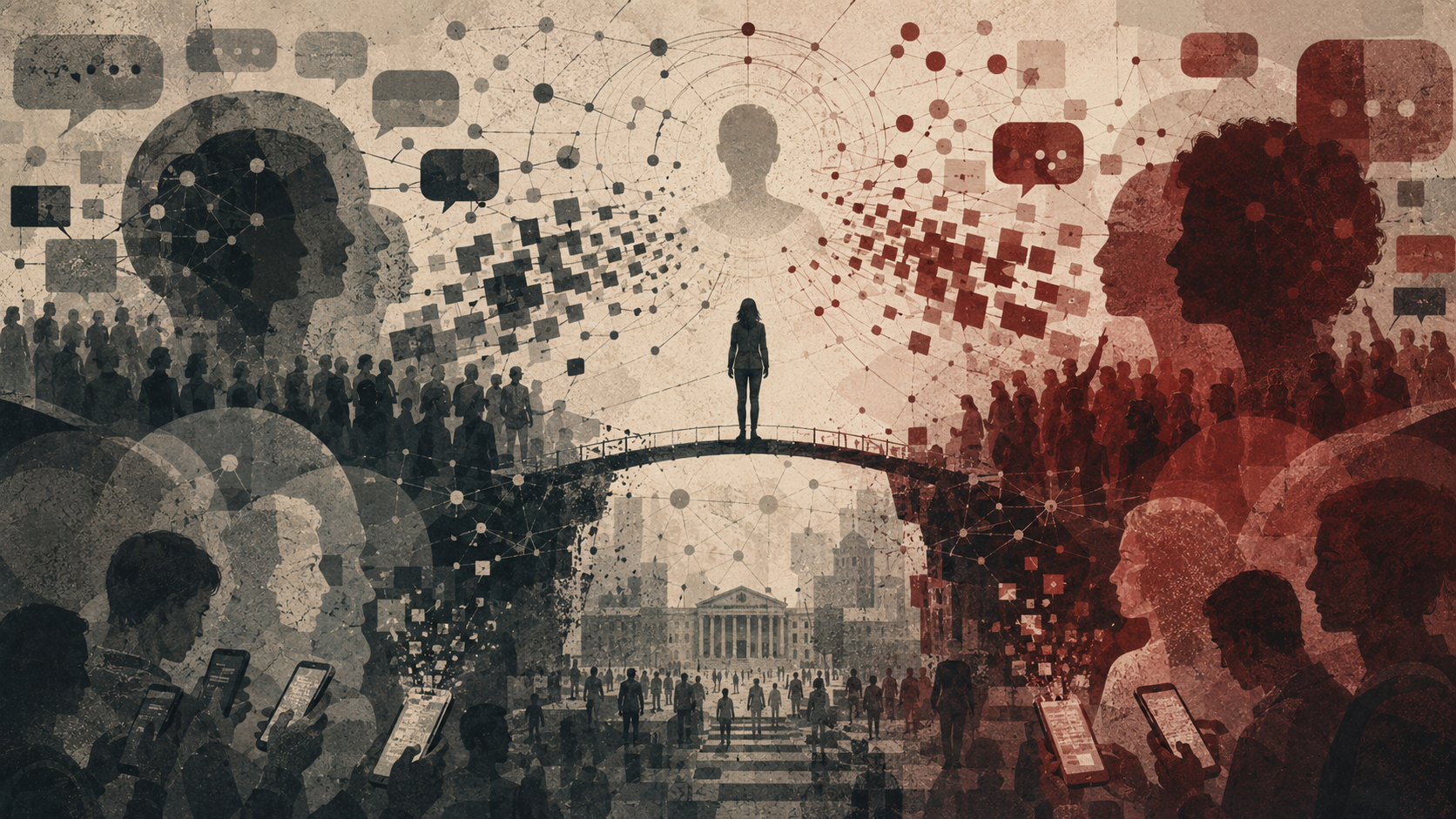
Social media is morally consequential because it changes the conditions under which people notice harm, interpret wrongdoing, assign blame, perform identity, join collective action, and participate in public punishment. A morally charged post can travel far beyond the original audience, gather interpretive layers, invite social sanction, create reputational consequences, and become part of a larger group narrative. The same platforms that expose hidden abuse and mobilize solidarity can also accelerate misinformation, harassment, moral panic, and dehumanizing exclusion.
The central challenge is not whether outrage is good or bad in itself. Outrage can be a morally important signal. It can expose cruelty, draw attention to injustice, and mobilize people who might otherwise remain passive. But outrage becomes dangerous when platform incentives reward escalation over accuracy, public performance over understanding, visibility over proportionality, and punishment over repair. A mature moral psychology of social media must therefore hold two truths together: networked moral life can make injustice visible, and it can also distort moral judgment.
What Social Media, Outrage, and Networked Moral Life Are
Social media refers to digital platforms built around sharing, reaction, visibility, and networked interaction. Outrage, in this context, is a morally charged emotional response to perceived wrongdoing that often motivates condemnation, punishment, distancing, warning, solidarity, or mobilization. Networked moral life refers to the fact that moral judgment on these platforms is no longer only private or interpersonal. It is distributed across audiences, feeds, algorithms, reputational systems, and publics who observe, amplify, reward, contest, archive, and reinterpret moral response.
This means moral life online is not simply morality plus technology. It is morality under conditions of persistence, speed, scale, social feedback, algorithmic selection, and public traceability. A morally charged post is not only seen by a conversation partner. It may be seen by thousands, recirculated, clipped, denounced, celebrated, archived, searched, quoted, remixed, monetized, and fed back into identity and reputation. Moral life becomes simultaneously more public, more quantified, more performative, and more vulnerable to context collapse.
Context collapse is central. In ordinary social life, moral expression is often adapted to audience, relationship, setting, and history. Online, a statement intended for one audience may be interpreted by many others who lack context. A joke may become evidence of character. A mistake may become a public moral event. A private grievance may become a collective accusation. A genuine exposure of harm may become a viral spectacle. Networked moral life therefore changes not only the spread of moral judgment, but the conditions under which moral judgment is understood.
Social media also changes moral temporality. Moral response becomes faster. Condemnation can precede investigation. Solidarity can arise before institutions react. Reparative processes can be overwhelmed by virality. At the same time, digital archives can keep harms visible and prevent institutions from burying abuse. The moral meaning of speed is therefore ambivalent: it can enable urgent accountability, but it can also weaken reflection, proportionality, and care.
| Feature of networked moral life | What changes | Moral-psychological consequence |
|---|---|---|
| Visibility | Moral judgments are performed before audiences | Expression becomes tied to reputation, identity, and social reward. |
| Virality | Content travels far beyond the original context | Local conflicts can become symbolic public events. |
| Persistence | Posts, screenshots, and reactions remain searchable | Past speech and action can become enduring moral evidence. |
| Algorithmic selection | Platforms prioritize content according to engagement signals | Emotionally charged content can become disproportionately visible. |
| Audience feedback | Likes, shares, comments, and follows reward expression | Users learn what kinds of moral performance gain approval. |
| Context collapse | Different audiences interpret the same content simultaneously | Meaning becomes unstable, contested, and reputationally risky. |
Why Social Media Matters for Moral Psychology
Social media matters for moral psychology because it changes both the volume and the structure of moral experience. Review work on social media and morality argues that platforms can act as accelerants for existing moral dynamics, amplifying outrage, status seeking, and intergroup conflict while also enabling accountability and collective action. People are exposed to far more morally relevant content than in many prior media environments, and platform design makes that content especially attention-capturing and socially consequential.
This matters because moral psychology is deeply sensitive to attention, emotion, social reward, and group signaling. When platforms systematically alter those conditions, they also alter how moral life is lived. What feels urgent, punishable, admirable, shareable, or shameful begins to track not only ethical significance, but also visibility, engagement potential, identity alignment, and network reward.
Moral psychology traditionally studies how people perceive harm, assign blame, respond to norm violation, experience guilt or outrage, form moral identity, and act in relation to others. Social media changes each of these. Harm becomes visible through images, testimony, trending topics, and viral documentation. Blame becomes public, collective, and sometimes instantaneous. Norm violation becomes searchable and archivable. Outrage becomes countable through likes, shares, comments, and follower growth. Moral identity becomes performed through public affiliation, denunciation, silence, reposting, and symbolic alignment.
The field also matters because digital environments reveal the social nature of moral judgment. People rarely judge alone online. They judge in view of peers, opponents, institutions, influencers, strangers, and algorithmic feedback. They see what others condemn, learn what gets rewarded, and adjust their own expression accordingly. Networked platforms therefore expose a central truth of moral psychology: moral judgment is not only a private evaluation. It is also a social act.
This does not mean digital morality is fake. Online moral concern can be sincere, courageous, and politically necessary. Many people use platforms to document abuse, support victims, challenge institutions, expose hypocrisy, circulate emergency information, and organize collective action. The problem is not sincerity. The problem is the structure in which sincerity is expressed, rewarded, amplified, and sometimes distorted.
Moral Attention in the Platform Environment
Moral content captures attention, and social media environments intensify this by making dramatic, identity-relevant, and emotionally charged material especially easy to encounter. Users do not simply choose what to care about in isolation. Their attention is shaped by feeds, trending systems, reposts, notifications, recommendation algorithms, influencer networks, group norms, and social cues about what deserves outrage.
Because attention is limited, this creates moral compression. Certain kinds of harms become hypervisible, especially those that can be narrated quickly and emotionally. Other harms remain obscure because they are complex, slow, statistical, technical, geographically distant, institutionally diffuse, or difficult to dramatize. Platformed moral life therefore affects not only how intensely people care, but what they are most likely to care about at all.
Moral attention online is often shaped by vividness. A single video, screenshot, quote, insult, or image may become a moral symbol. The symbol may represent a real pattern of harm, but it may also simplify context. Public attention can then organize around emotionally compressed fragments. This can be valuable when fragments reveal what institutions have hidden. It can be dangerous when fragments substitute for understanding.
Platform environments also encourage serial attention. Users move from outrage to outrage, scandal to scandal, crisis to crisis. This can create moral exhaustion. It can also produce shallow moral activation: intense reaction without sustained responsibility. A person may feel morally engaged because they encounter many injustices, but the speed of the environment can make deeper learning, institutional analysis, and repair harder to sustain.
The politics of moral attention is therefore one of the central questions in digital moral psychology. Who gets seen? Whose pain becomes legible? Which harms are framed as urgent? Which harms are dismissed as exaggeration? Which images are circulated, and by whom? Which forms of suffering are too slow, too ordinary, or too structurally complex to become viral? Social media does not only display the moral world. It helps select it.
| Attention pattern | Platform mechanism | Moral risk | Moral possibility |
|---|---|---|---|
| Hypervisibility | Viral images, clips, screenshots, and trending posts | Context can collapse into symbolic outrage. | Hidden abuse can become publicly undeniable. |
| Invisibility | Slow, technical, or diffuse harms receive less engagement | Structural injustice can remain morally underrecognized. | Specialized communities can build sustained attention. |
| Serial outrage | Constant feed turnover and notification cycles | Users may experience exhaustion or shallow engagement. | Multiple harms can become visible across dispersed publics. |
| Identity filtering | Group-aligned sharing and selective trust | Concern may become uneven across in-groups and out-groups. | Communities can mobilize around neglected experiences. |
| Algorithmic salience | Engagement-based ranking and recommendation | Content may be prioritized for reaction rather than importance. | Important issues can spread quickly when networks respond. |
Outrage as Emotion, Expression, and Signal
Moral outrage online is not just an internal feeling. It is also an expressive act. On social media, outrage can signal moral identity, loyalty to a group, sensitivity to injustice, awareness of what matters, and distance from wrongdoing. A post expressing condemnation can simultaneously register real anger, seek social reinforcement, mark public disapproval, affirm belonging, and perform identity before an audience.
This does not make outrage insincere by default. It means outrage has layered functions. It is emotion, communication, affiliation, warning, boundary-setting, and sometimes reputational performance. Networked moral life is therefore shaped by the fusion of feeling and signaling. People may express outrage because they truly care, because silence would look complicit, because their community expects response, because outrage gains social reward, or because the platform has trained them to convert moral discomfort into visible reaction.
Outrage can be morally valuable. It can interrupt complacency, expose harm, show solidarity with victims, pressure institutions, and signal that certain conduct is unacceptable. Many social movements have depended on public anger against injustice. Outrage can awaken moral attention where polite language has failed.
But outrage can also become morally distorting. It can reward certainty before evidence. It can encourage escalation. It can make nuance appear cowardly. It can turn disagreement into moral accusation. It can transform complex persons into symbols. It can make punishment feel like participation. It can become pleasurable, addictive, or identity-confirming. When outrage is rewarded repeatedly, users may learn to express moral concern in increasingly sharp, theatrical, or punitive forms.
A serious moral psychology of outrage must therefore avoid both dismissiveness and romanticization. Outrage is neither inherently virtuous nor inherently corrupt. Its moral quality depends on what it perceives, whether the perception is accurate, how it is expressed, whether it remains proportionate, whom it protects, whom it endangers, and whether it opens a path toward accountability, repair, or deeper understanding.
Social Learning, Virality, and Moral Amplification
One of the most important insights in recent research is that moral outrage spreads socially. People do not merely react to content individually; they learn from others what kinds of outrage are rewarded, expected, admired, and repeated. Platforms become schools of moral expression as much as channels of information. Users learn the emotional grammar of their networks: what to condemn, how intensely to condemn it, which phrases to use, which targets are acceptable, and what kind of response earns approval.
Virality matters because it magnifies some moral episodes far beyond their local context. Content associated with outrage is often more likely to be shared, commented on, and circulated. Outrage therefore becomes not only a reaction to moral events but a mechanism for selecting which events dominate public consciousness. In networked environments, moral importance and shareability can become entangled.
This produces moral amplification. A post may begin as one person’s expression of harm or anger, but as others quote, share, react, and reinterpret it, the moral meaning can intensify. Each additional layer may add condemnation, sarcasm, context, identity, or counter-outrage. By the time the content becomes viral, it may no longer function as a report about an event. It may function as a symbol in a larger conflict.
Social learning can also normalize forms of expression that users might not have adopted alone. If public contempt receives applause, contempt becomes more available. If dehumanizing jokes circulate without sanction, dehumanization becomes easier. If careful correction receives little attention while explosive accusation spreads, users learn which style travels. The platform becomes a feedback environment in which moral expression is shaped by visible reward.
At the same time, moral amplification can support justice. Testimony that would otherwise be ignored can gain protection through visibility. Abusive institutions can be forced to respond. Marginalized voices can find each other and build collective power. The question is not whether amplification is good or bad in the abstract. The question is what kinds of moral content are amplified, under what conditions, with what safeguards, and toward what forms of action.
Algorithms, Engagement, and the Reward Structure of Outrage
Platforms do not only reflect what users choose. They also shape what is made prominent through engagement-based ranking and feedback. Likes, shares, comments, reactions, follows, quote-posts, watch time, and recommendation systems teach users which kinds of moral expression travel. If outrage draws engagement, then outrage can become structurally advantaged even when no individual designer intends to reward moral escalation as such.
This means outrage is embedded in a reward structure. Users may internalize platform incentives and become more likely to frame issues in ways that attract engagement rather than reflection. A restrained correction may receive little attention. A sharp denunciation may travel. A nuanced institutional analysis may be ignored. A vivid accusation may become viral. Over time, the environment can train moral expression toward salience, speed, and intensity.
Engagement incentives also interact with accuracy. Attention-grabbing content is not necessarily false, but the features that make content engaging are not the same as the features that make content reliable. Novelty, anger, moral clarity, identity affirmation, and dramatic accusation can spread quickly even when context is incomplete. This creates a moral hazard: users may feel they are defending justice while spreading claims they have not verified.
Algorithmic amplification also affects perceived importance. When users repeatedly see a type of content, they may infer that it is socially common, morally urgent, or widely endorsed. Visibility becomes evidence. But visibility is not a neutral sample of reality. It is produced by design, network structure, user behavior, and platform incentives.
A moral psychology of algorithms should therefore ask how systems shape attention and responsibility. Who benefits from engagement? Who bears the cost of viral accusation? How do ranking systems handle outrage, hate, misinformation, harassment, and accountability? What kinds of moral expression become more visible? What kinds become less visible? Platform design is not outside moral psychology. It is part of the environment in which moral judgment now develops.
| Platform incentive | Behavior it may reward | Moral consequence |
|---|---|---|
| Likes and reactions | Fast emotionally legible expression | Moral expression may become optimized for approval. |
| Shares and reposts | Content that feels urgent, shocking, or identity-relevant | Outrage can become a diffusion mechanism. |
| Comments and quote-posts | Conflict, argument, ridicule, and escalation | Attention may flow toward adversarial moral performance. |
| Recommendation systems | Content with high engagement signals | Visibility may detach from importance, accuracy, or proportionality. |
| Follower growth | Consistent moral positioning and audience capture | Users may become locked into public moral personas. |
Identity Performance and Networked Moral Selfhood
Social media makes moral identity unusually public. Users do not only judge events; they present themselves as certain kinds of judges. Outrage, endorsement, silence, sharing, affiliation, correction, and refusal all become part of networked selfhood. A person’s moral identity is increasingly inferred from visible patterns of response: what they post, what they ignore, whom they defend, whom they condemn, and which communities they amplify.
This can support moral courage. People can publicly align with vulnerable communities, challenge powerful actors, or refuse silence in the face of harm. Public moral identity can also help people find others who share commitments and can sustain collective action. In this sense, networked moral selfhood can build solidarity.
But it can also make moral life brittle. When moral identity is tightly bound to public performance, admitting uncertainty, revising one’s view, apologizing, or granting nuance to opponents may feel reputationally costly. Users may fear that hesitation will be interpreted as complicity, that correction will be read as betrayal, or that nuance will be punished by their own group. The networked self becomes vulnerable to moral audience capture.
Moral audience capture occurs when a person’s public moral identity becomes increasingly shaped by the expectations of the audience that rewards them. The user may begin by expressing sincere concern. Over time, they learn which expressions receive approval and which provoke suspicion. Their moral language sharpens. Their targets narrow. Their willingness to revise decreases. The audience becomes a hidden co-author of moral identity.
This does not mean public moral expression is inherently performative in a shallow sense. Moral life has always involved audiences, communities, and reputational accountability. The difference is scale and speed. Social media makes the audience larger, more immediate, more quantifiable, and more persistent. That changes the psychological cost of moral complexity.
Norm Distortion, Pluralistic Ignorance, and False Consensus
One of the most important recent arguments is that social media can distort perceptions of norms. Visible online behavior is not a neutral sample of what people actually believe or endorse. Highly active users, highly emotional posts, extreme positions, provocative framings, and algorithmically favored content can become disproportionately visible. Users may then infer that extreme or punitive norms are more common than they really are.
This can create pluralistic ignorance: people privately hold more moderate or uncertain views but believe that others are more extreme, more punitive, or more morally certain. They may then adjust their own expression to match what they think the group expects. In this way, visible outrage can produce more visible outrage, even when underlying private opinion is more varied.
False consensus works in the opposite direction but reinforces the same problem. Users surrounded by identity-aligned networks may overestimate how widely their moral judgments are shared. They may come to believe that “everyone decent” already agrees, and that dissent reveals ignorance, corruption, prejudice, or malice. The result is a moral public sphere in which people feel surrounded by consensus while actually becoming more isolated from genuine disagreement.
Norm distortion matters because moral behavior is socially responsive. People use visible norms to decide what is safe to say, what is admirable, what is shameful, what deserves punishment, and what counts as belonging. If online norms appear more extreme than offline norms, users may become more extreme in public than they are in private. The public moral world then becomes harsher than the underlying moral community.
This is one reason social media can intensify polarization without changing everyone’s private beliefs. It changes perceived norms. It changes what people think others expect. It changes the cost of dissent. It changes what moral courage and moral cowardice appear to mean. A society can become publicly more polarized because people misread the moral expectations of their own side.
| Norm distortion pattern | Mechanism | Result |
|---|---|---|
| Pluralistic ignorance | People privately disagree with visible norms but think they are alone | Users conform publicly to a harsher perceived standard. |
| False consensus | Homogeneous networks make one view seem universally shared | Dissent appears morally suspect rather than ordinary. |
| Visibility bias | Extreme or emotional content receives disproportionate attention | Users overestimate the prevalence of outrage or extremity. |
| Audience pressure | Public metrics reward group-approved expression | Users learn to perform the norm that travels best. |
| Context collapse | Statements circulate beyond intended audiences | Norms become harder to interpret and easier to weaponize. |
Call-Out Culture, Accountability, and Public Sanction
Public moral sanction online is often discussed under labels such as calling out, shaming, canceling, or accountability. These practices can serve real moral purposes: exposing abuse, documenting harm, amplifying marginalized voices, warning others, pressuring institutions, and challenging the impunity of powerful people. Social media can make visible what institutions would prefer to ignore.
This is especially important for communities whose testimony has historically been dismissed. Public platforms can allow people to bypass gatekeepers, gather corroboration, and force attention to patterns of abuse, discrimination, exploitation, or institutional neglect. In such cases, public moral expression can function as a necessary corrective to silence.
But public sanction online also carries risks. Speed, virality, incomplete context, audience incentives, and reputational cascades can produce disproportionate punishment, flatten complexity, and make repair more difficult. A single moment can be severed from history. A person can become a symbol. A demand for accountability can become a public ritual of humiliation. The crowd may punish before evidence is understood.
The moral difficulty is that accountability and spectacle can look similar at the surface. Both may involve public accusation, emotional intensity, group participation, and reputational consequence. The difference lies in process, proportionality, truthfulness, power, repair, and the treatment of persons as morally complex. Accountability seeks responsibility and change. Spectacle seeks visibility, punishment, or group affirmation.
Public sanction also raises questions of due process in informal spaces. Not every moral wrong belongs in a court. Not every harm has an institution capable of responding. Yet online punishment can be severe without formal safeguards. A mature moral psychology must therefore ask how communities can protect victims, expose harm, and demand accountability while also preserving accuracy, proportionality, and pathways for repair.
Online Hate, Dehumanization, and Moral Exclusion
Social media can also intensify morally exclusionary dynamics. Online hatred is not merely individual pathology. It is often reinforced by networked approval, identity-aligned participation, humor, repetition, in-group status, and the social rewards of cruelty. Users may gain approval from like-minded others by humiliating, threatening, mocking, or dehumanizing targets.
This matters because online outrage does not always remain inside the boundaries of moral protest. It can slide into dehumanization, harassment, humiliation, and the reduction of opponents or targets to symbols of contamination or threat. The networked public can then become a machinery not only of accountability but of moral exclusion.
Dehumanization works by weakening the ordinary restraints that protect people from cruelty. Targets are described as vermin, disease, animals, invaders, parasites, degenerates, traitors, or existential threats. Their suffering becomes less morally salient. Their humiliation becomes entertainment. Their fear becomes deserved. Their rights become technicalities. When this process becomes socially rewarded, moral exclusion can spread quickly.
Online hate is especially dangerous because it can combine anonymity, scale, group reinforcement, and algorithmic circulation. A single user may feel anonymous, but the target may experience a crowd. A phrase that begins as a joke may become a norm. A meme can compress contempt into repeatable form. A network can make cruelty feel communal rather than deviant.
A moral psychology of social media must therefore distinguish outrage against injustice from hatred against persons or groups. The distinction is not always easy, but it is essential. Moral protest can be forceful, angry, and public without becoming dehumanizing. Once public moral life normalizes contempt as identity performance, it becomes harder to preserve dignity, proportionality, and democratic disagreement.
| Online moral dynamic | Possible legitimate function | Dehumanizing risk |
|---|---|---|
| Calling out wrongdoing | Names harm and demands accountability | Can become humiliation without repair. |
| Group outrage | Signals solidarity and moral concern | Can become mob punishment or identity policing. |
| Mockery | Can puncture power or hypocrisy | Can normalize contempt and cruelty. |
| Viral exposure | Can make hidden abuse visible | Can strip context and permanently mark persons. |
| Boundary-setting | Clarifies unacceptable behavior | Can become moral exclusion of entire groups. |
Misinformation, Outrage, and Moralized Sharing
Moralized content is not only emotionally powerful; it is often highly shareable. People may share content not because they have verified it, but because it expresses the right outrage, affirms the right identity, exposes the right enemy, or appears to defend the right victims. Networked moral life can therefore produce sincerity without reliability: users may feel morally engaged while helping spread inaccurate or misleading claims.
This is a serious moral problem because misinformation does not always spread through apathy or cynicism. It can spread through care, indignation, fear, loyalty, and the desire to protect others. A user may share a false claim because it seems to warn the group, defend the vulnerable, expose corruption, or confirm a pattern they already believe. Moral motivation does not guarantee epistemic responsibility.
Outrage can reduce verification. When content feels morally urgent, pausing to check may feel like delay, cowardice, or insufficient solidarity. The social rewards of immediate sharing may overpower the slower disciplines of evidence, context, and correction. In highly polarized settings, fact-checking may also be interpreted as betrayal or enemy alignment.
Algorithmic amplification can worsen this. Content that produces strong reaction may receive broader reach regardless of accuracy. A false claim attached to moral outrage can therefore travel farther than a careful correction. Once widely shared, the claim may remain influential even after correction because it fits an existing moral narrative.
A moral psychology of misinformation must therefore focus on more than cognitive error. It must examine identity, trust, urgency, fear, group loyalty, and the emotional rewards of sharing. The ethical challenge is to build norms in which care includes verification, solidarity includes accuracy, and moral urgency does not excuse epistemic negligence.
Collective Action, Solidarity, and Prosocial Possibility
Social media should not be reduced to toxicity alone. The same systems that amplify outrage and conflict can mobilize collective action, amplify prosocial norms, connect people around moral causes, expose institutional harm, and support communities that have been ignored or silenced. Outrage can motivate protest, petition-sharing, mutual aid, testimony, documentation, and broader public engagement with previously neglected harms.
This means networked moral life is morally ambivalent rather than simply corrupting. Platforms can connect moral concern to action at remarkable scale. They can help people find medical support, legal aid, emergency resources, community defense, labor solidarity, disaster relief, and public accountability. They can allow marginalized voices to speak across institutional barriers.
Digital solidarity can also alter moral imagination. People can encounter testimony from communities they might never meet in person. They can learn the language of harms that were previously invisible to them. They can participate in transnational concern. They can help create pressure for institutions to respond. Networked moral life can widen the circle of attention.
But prosocial possibility depends on structure. Solidarity can become shallow if it remains at the level of performance. Collective action can become fragmented if attention moves too quickly. Mutual aid can be exploited by scammers. Public campaigns can oversimplify complex problems. Visibility can create backlash. The same affordances that enable solidarity also enable distortion.
A mature analysis must therefore ask how social media can support moral action beyond outrage. What design choices encourage accuracy, context, and repair? What community norms distinguish accountability from harassment? What practices help translate attention into durable institutions, policy change, mutual aid, or care? The moral promise of social media lies not in outrage alone, but in whether outrage can be connected to truth, responsibility, and repair.
Mathematical Lens: Modeling Networked Moral Outrage
Networked moral expression can be modeled as a function of outrage intensity, social reward, algorithmic amplification, and group identity. Let \(E_i\) represent the probability that user \(i\) expresses moral outrage publicly:
E_i = \sigma(\alpha O_i + \beta R_i + \gamma A_i + \delta G_i)
\]
Interpretation: Public outrage expression is modeled as a probability shaped by felt outrage, expected social reward, algorithmic amplification, and group-identity salience.
where \(\sigma\) is the logistic transformation, \(O_i\) is felt outrage, \(R_i\) is expected social reward, \(A_i\) is algorithmic amplification likelihood, and \(G_i\) is group-identity salience. The point is not that people express outrage mechanically, but that online expression is shaped by social and platform incentives as well as internal feeling.
Norm distortion can be modeled as:
N_t^{perceived} = N_t^{actual} + \lambda V_t
\]
Interpretation: Perceived norms can diverge from actual underlying norms when visibility bias makes extreme or highly engaging content appear more representative than it is.
where \(N_t^{perceived}\) is the perceived norm at time \(t\), \(N_t^{actual}\) is the offline or underlying norm, and \(V_t\) is visibility bias toward extreme or highly engaging content. This represents how social media can generate pluralistic ignorance and false perceptions of moral consensus.
Virality of moral content can be represented as:
S_i = \theta_1 O_i + \theta_2 M_i + \theta_3 I_i + \theta_4 A_i
\]
Interpretation: Shareability increases with outrage intensity, moral relevance, informational novelty, and algorithmic amplification.
where \(S_i\) is shareability, \(O_i\) is outrage intensity, \(M_i\) is moral relevance, \(I_i\) is informational novelty or interest, and \(A_i\) is amplification potential. This captures why morally charged content can dominate attention even when it is incomplete, misleading, or disproportionate.
A network feedback model can be written as:
O_{t+1} = O_t + \phi S_t + \kappa R_t – \rho C_t
\]
Interpretation: Outrage intensity can grow when shareability and social reward reinforce expression, and can be dampened by context, correction, deliberation, or repair.
where \(O_t\) is outrage intensity over time, \(S_t\) is shareability, \(R_t\) is social reward, and \(C_t\) is contextual correction or deliberative dampening. This simple model clarifies the feedback problem: outrage does not merely express moral perception. In networked environments, outrage can generate more outrage.
| Model term | Meaning | Moral-psychological role |
|---|---|---|
| \(O_i\) | Felt outrage | Internal moral-emotional response to perceived wrongdoing. |
| \(R_i\) | Expected social reward | Likes, approval, belonging, reputation, or audience reinforcement. |
| \(A_i\) | Algorithmic amplification | Platform-driven visibility through ranking or recommendation. |
| \(G_i\) | Group-identity salience | Strength of in-group or moral-community alignment. |
| \(V_t\) | Visibility bias | Distortion between what is visible and what is representative. |
| \(C_t\) | Contextual correction | Evidence, deliberation, institutional process, or repair that dampens escalation. |
R Workflow: Modeling Outrage, Engagement, and Norm Distortion
The following R workflow simulates outrage intensity, expected reward, algorithmic amplification, identity salience, visibility bias, public outrage expression, and perceived norm extremity in a social-media environment. The dataset is synthetic and intended for conceptual demonstration, reproducible teaching, and article-level analytical scaffolding.
# Social Media, Outrage, and Networked Moral Life
# R workflow for synthetic networked moral-outage modeling
# Educational and reproducible research scaffold only.

library(tidyverse)
library(broom)

set.seed(42)

# ------------------------------------------------------------
# 1. Simulate networked moral-expression variables
# ------------------------------------------------------------

n <- 2500

df <- tibble(
  user_id = 1:n,
  outrage_intensity = rnorm(n, 0, 1),
  expected_reward = rnorm(n, 0, 1),
  algorithmic_amplification = rnorm(n, 0, 1),
  group_identity_salience = rnorm(n, 0, 1),
  visibility_bias = rnorm(n, 0, 1),
  contextual_correction = rnorm(n, 0, 1),
  misinformation_susceptibility = rnorm(n, 0, 1),
  cross_group_exposure = rnorm(n, 0, 1)
) %>%
  mutate(
    expression_latent =
      0.35 * outrage_intensity +
      0.30 * expected_reward +
      0.25 * algorithmic_amplification +
      0.25 * group_identity_salience -
      0.15 * contextual_correction +
      rnorm(n, 0, 0.8),

    outrage_expression_prob = plogis(expression_latent),
    outrage_expression = if_else(outrage_expression_prob >= 0.5, 1, 0),

    perceived_norm_extremity =
      0.40 * visibility_bias +
      0.25 * algorithmic_amplification +
      0.20 * outrage_expression -
      0.15 * cross_group_exposure +
      rnorm(n, 0, 0.8),

    moralized_sharing =
      0.30 * outrage_intensity +
      0.25 * group_identity_salience +
      0.25 * misinformation_susceptibility +
      0.20 * expected_reward -
      0.15 * contextual_correction +
      rnorm(n, 0, 0.8)
  )

# ------------------------------------------------------------
# 2. Estimate outrage-expression model
# ------------------------------------------------------------

model_expression <- glm(
  outrage_expression ~ outrage_intensity + expected_reward +
    algorithmic_amplification + group_identity_salience +
    contextual_correction,
  data = df,
  family = binomial()
)

expression_summary <- tidy(model_expression, conf.int = TRUE, exponentiate = TRUE)

# ------------------------------------------------------------
# 3. Estimate norm-distortion model
# ------------------------------------------------------------

model_norm <- lm(
  perceived_norm_extremity ~ visibility_bias + algorithmic_amplification +
    outrage_expression + cross_group_exposure,
  data = df
)

norm_summary <- tidy(model_norm, conf.int = TRUE)

# ------------------------------------------------------------
# 4. Estimate moralized-sharing model
# ------------------------------------------------------------

model_sharing <- lm(
  moralized_sharing ~ outrage_intensity + group_identity_salience +
    misinformation_susceptibility + expected_reward +
    contextual_correction,
  data = df
)

sharing_summary <- tidy(model_sharing, conf.int = TRUE)

# ------------------------------------------------------------
# 5. Prediction grid across outrage and reward
# ------------------------------------------------------------

pred_grid <- expand_grid(
  outrage_intensity = seq(-2, 2, length.out = 100),
  expected_reward = c(-1, 0, 1),
  algorithmic_amplification = 0,
  group_identity_salience = 0,
  contextual_correction = 0
)

pred_grid$predicted_expression <- predict(
  model_expression,
  newdata = pred_grid,
  type = "response"
)

pred_grid <- pred_grid %>%
  mutate(
    reward_label = case_when(
      expected_reward == -1 ~ "Low expected reward",
      expected_reward == 0 ~ "Average expected reward",
      TRUE ~ "High expected reward"
    )
  )

# ------------------------------------------------------------
# 6. Summarize high-amplification cases
# ------------------------------------------------------------

amplification_summary <- df %>%
  mutate(
    amplification_band = ntile(algorithmic_amplification, 4),
    amplification_band = factor(
      amplification_band,
      labels = c("Low", "Lower-middle", "Upper-middle", "High")
    )
  ) %>%
  group_by(amplification_band) %>%
  summarize(
    mean_expression_probability = mean(outrage_expression_prob),
    mean_norm_extremity = mean(perceived_norm_extremity),
    mean_moralized_sharing = mean(moralized_sharing),
    mean_visibility_bias = mean(visibility_bias),
    .groups = "drop"
  )

# ------------------------------------------------------------
# 7. Plot predicted outrage expression
# ------------------------------------------------------------

plot_expression <- ggplot(
  pred_grid,
  aes(x = outrage_intensity, y = predicted_expression)
) +
  geom_line(linewidth = 1) +
  facet_wrap(~ reward_label) +
  labs(
    title = "Predicted Public Outrage Expression on Social Media",
    subtitle = "Social reward changes the likelihood that outrage is publicly expressed",
    x = "Outrage intensity",
    y = "Probability of public expression"
  ) +
  theme_minimal(base_size = 12)

print(plot_expression)

# ------------------------------------------------------------
# 8. Export outputs
# ------------------------------------------------------------

dir.create("outputs", showWarnings = FALSE)
dir.create("outputs/tables", recursive = TRUE, showWarnings = FALSE)
dir.create("outputs/figures", recursive = TRUE, showWarnings = FALSE)

write_csv(df, "outputs/tables/social_media_moral_outrage_simulated_data.csv")
write_csv(expression_summary, "outputs/tables/social_media_outrage_expression_model.csv")
write_csv(norm_summary, "outputs/tables/social_media_norm_distortion_model.csv")
write_csv(sharing_summary, "outputs/tables/social_media_moralized_sharing_model.csv")
write_csv(amplification_summary, "outputs/tables/social_media_amplification_summary.csv")
write_csv(pred_grid, "outputs/tables/social_media_outrage_expression_predictions.csv")

ggsave(
  filename = "outputs/figures/predicted_public_outrage_expression.png",
  plot = plot_expression,
  width = 10,
  height = 6,
  dpi = 300
)
This workflow is useful because it models online outrage as socially and structurally shaped rather than as a pure private emotion. It separates felt outrage, expected reward, algorithmic amplification, group identity, contextual correction, perceived norm extremity, and moralized sharing. That structure reflects the article’s central claim: networked moral life is shaped by the interaction between moral emotion, social feedback, and platform design.
Python Workflow: Simulating Networked Moral Amplification
The Python workflow below simulates how outrage, identity, social reward, visibility bias, algorithmic amplification, contextual correction, and misinformation susceptibility interact in networked moral life. The example uses synthetic data for reproducible demonstration and should not be interpreted as empirical measurement of real users or platforms.
# Social Media, Outrage, and Networked Moral Life
# Python workflow for synthetic networked moral-amplification modeling
# Educational and reproducible research scaffold only.

from pathlib import Path

import numpy as np
import pandas as pd

np.random.seed(42)

# ------------------------------------------------------------
# 1. Set up output folders
# ------------------------------------------------------------

output_tables = Path("outputs/tables")
output_tables.mkdir(parents=True, exist_ok=True)

# ------------------------------------------------------------
# 2. Simulate networked moral-expression variables
# ------------------------------------------------------------

n = 2600

df = pd.DataFrame({
    "user_id": np.arange(1, n + 1),
    "outrage_intensity": np.random.normal(0, 1, n),
    "expected_reward": np.random.normal(0, 1, n),
    "algorithmic_amplification": np.random.normal(0, 1, n),
    "group_identity_salience": np.random.normal(0, 1, n),
    "visibility_bias": np.random.normal(0, 1, n),
    "contextual_correction": np.random.normal(0, 1, n),
    "misinformation_susceptibility": np.random.normal(0, 1, n),
    "cross_group_exposure": np.random.normal(0, 1, n)
})

# ------------------------------------------------------------
# 3. Generate outrage expression and perceived norm extremity
# ------------------------------------------------------------

expression_latent = (
    0.35 * df["outrage_intensity"] +
    0.30 * df["expected_reward"] +
    0.25 * df["algorithmic_amplification"] +
    0.25 * df["group_identity_salience"] -
    0.15 * df["contextual_correction"] +
    np.random.normal(0, 0.8, n)
)

df["outrage_expression_prob"] = 1 / (1 + np.exp(-expression_latent))
df["outrage_expression"] = (df["outrage_expression_prob"] >= 0.5).astype(int)

df["perceived_norm_extremity"] = (
    0.40 * df["visibility_bias"] +
    0.25 * df["algorithmic_amplification"] +
    0.20 * df["outrage_expression"] -
    0.15 * df["cross_group_exposure"] +
    np.random.normal(0, 0.8, n)
)

df["moralized_sharing"] = (
    0.30 * df["outrage_intensity"] +
    0.25 * df["group_identity_salience"] +
    0.25 * df["misinformation_susceptibility"] +
    0.20 * df["expected_reward"] -
    0.15 * df["contextual_correction"] +
    np.random.normal(0, 0.8, n)
)

# ------------------------------------------------------------
# 4. Summarize by outrage-expression quartile
# ------------------------------------------------------------

df["expression_band"] = pd.qcut(
    df["outrage_expression_prob"],
    q=4,
    labels=["Low", "Lower-middle", "Upper-middle", "High"]
)

summary = (
    df.groupby("expression_band", observed=False)
      .agg(
          mean_expression_probability=("outrage_expression_prob", "mean"),
          mean_norm_extremity=("perceived_norm_extremity", "mean"),
          mean_reward=("expected_reward", "mean"),
          mean_amplification=("algorithmic_amplification", "mean"),
          mean_moralized_sharing=("moralized_sharing", "mean")
      )
      .reset_index()
)

print(summary)

# ------------------------------------------------------------
# 5. Scenario grid across outrage and identity
# ------------------------------------------------------------

scenario_rows = []

for outrage in np.linspace(-2, 2, 41):
    for identity in [-1, 0, 1]:
        for correction in [-1, 0, 1]:
            latent = (
                0.35 * outrage +
                0.30 * 0 +
                0.25 * 0 +
                0.25 * identity -
                0.15 * correction
            )

            prob = 1 / (1 + np.exp(-latent))

            scenario_rows.append({
                "outrage_intensity": outrage,
                "group_identity_salience": identity,
                "contextual_correction": correction,
                "predicted_expression_probability": prob
            })

scenario_df = pd.DataFrame(scenario_rows)

print(scenario_df.head(12))

# ------------------------------------------------------------
# 6. Identify high-risk synthetic amplification cases
# ------------------------------------------------------------

high_amplification_cases = (
    df.sort_values(
        ["outrage_expression_prob", "perceived_norm_extremity", "moralized_sharing"],
        ascending=False
    )
    .head(25)
    .reset_index(drop=True)
)

# ------------------------------------------------------------
# 7. Export outputs
# ------------------------------------------------------------

df.to_csv(output_tables / "social_media_moral_outrage_python.csv", index=False)
summary.to_csv(output_tables / "social_media_moral_outrage_summary.csv", index=False)
scenario_df.to_csv(output_tables / "social_media_moral_outrage_scenarios.csv", index=False)
high_amplification_cases.to_csv(
    output_tables / "social_media_moral_outrage_high_amplification_cases.csv",
    index=False
)

print("Synthetic networked moral amplification data written to:", output_tables)
This workflow is useful because it shows how identity and reward can intensify public outrage expression even when the underlying moral event is held constant. It also models perceived norm extremity and moralized sharing as downstream consequences of visibility, amplification, identity, and contextual correction. The point is not to score real users, but to make the moral-psychological structure of networked outrage explicit and reproducible.
In a full article repository, this Python workflow can be extended into notebooks, SQL schema, synthetic datasets, validation notes, network simulations, and additional language examples. R can support statistical modeling and visualization; Python can support simulation and data pipelines; SQL can preserve structured scenario metadata; Julia can support dynamic network modeling; and C, C++, Fortran, Go, and Rust can support reproducible command-line tools, validation utilities, and computational demonstrations.
GitHub Repository
The companion repository for this article provides a reproducible code scaffold for modeling outrage intensity, expected reward, algorithmic amplification, group-identity salience, visibility bias, contextual correction, perceived norm extremity, misinformation susceptibility, moralized sharing, and networked moral amplification.
The repository structure should support a full research workflow rather than a single script. The article folder can include language-specific examples in python, r, julia, sql, c, cpp, fortran, go, and rust, along with data, docs, notebooks, and outputs. This structure makes the article reproducible, inspectable, and extensible for readers who want to move from conceptual argument to analytical demonstration.
Conclusion
Social media, outrage, and networked moral life reveal that morality online is not simply private conscience made visible. It is moral attention and judgment reorganized through platforms that reward salience, identity signaling, sharing, and rapid public evaluation. These systems can amplify outrage, distort perceived norms, intensify intergroup conflict, and encourage the spread of morally charged and sometimes inaccurate content. At the same time, they can enable collective action, visibility for neglected harms, and real public accountability.
The strongest account is therefore double-edged. Social media expands moral participation while also magnifying some of the most combustible features of human moral psychology. It can make hidden harms visible, but it can also make some harms hypervisible while others disappear. It can support accountability, but also spectacle. It can mobilize solidarity, but also dehumanization. It can spread urgent truth, but also moralized misinformation.
The central moral question is not whether people should care less. It is whether digital environments can support forms of care that remain truthful, proportionate, accountable, and reparative. Outrage may be necessary, but outrage alone is not enough. Networked moral life needs context, memory, verification, restraint, courage, solidarity, and institutions capable of responding to harm without turning every moral conflict into a permanent public spectacle.
Understanding networked moral life therefore requires attention not only to what people believe, but to how platforms shape attention, reward expression, distort norms, and turn outrage into a socially and algorithmically amplified form of moral action. In the digital public sphere, moral psychology is no longer confined to private conscience or small-group interaction. It unfolds through feeds, networks, metrics, audiences, algorithms, and archives. That is why social media has become one of the defining moral environments of contemporary life.
Related articles
- Social Identity, Group Life, and Moral Polarization
- Moral Psychology, Propaganda, and Political Polarization
- Moral Disagreement and the Psychology of Pluralism
- Cross-Cultural Moral Psychology
- Hypocrisy, Dehumanization, and the Psychology of Moral Failure
- Responsibility, Blame, and Moral Accountability
- Justice, Fairness, and Distributive Moral Judgment
- Moral Psychology in Organizations and Institutions
Further reading
- Van Bavel, J.J., Robertson, C.E., del Rosario, K., Rasmussen, J. and Rathje, S. (2024) ‘Social Media and Morality’, Annual Review of Psychology, 75, pp. 311–340. Available at: https://www.annualreviews.org/content/journals/10.1146/annurev-psych-022123-110258.
- Robertson, C.E., Bellovary, A.K. and Van Bavel, J.J. (2024) ‘How social media distorts perceptions of norms’, Current Opinion in Psychology, 57, 101820. Available at: https://www.sciencedirect.com/science/article/abs/pii/S2352250X24001313.
- McLoughlin, K.L., Brady, W.J. and Crockett, M.J. (2024) ‘Human-algorithm interactions help explain the spread of misinformation’, Current Opinion in Psychology, 57, 101811. Available at: https://www.sciencedirect.com/science/article/abs/pii/S2352250X23002154.
- Walther, J.B. and McCoy, S. (2022) ‘Social media and online hate’, Current Opinion in Psychology, 45, 101268. Available at: https://www.sciencedirect.com/science/article/abs/pii/S2352250X21002505.
- Gray, K. and Pratt, S. (2025) ‘Morality in Our Mind and Across Cultures and Politics’, Annual Review of Psychology, 76, pp. 663–691. Available at: https://www.annualreviews.org/content/journals/10.1146/annurev-psych-020924-124236.
References
- Gray, K. and Pratt, S. (2025) ‘Morality in Our Mind and Across Cultures and Politics’, Annual Review of Psychology, 76, pp. 663–691. Available at: https://www.annualreviews.org/content/journals/10.1146/annurev-psych-020924-124236.
- McLoughlin, K.L., Brady, W.J. and Crockett, M.J. (2024) ‘Human-algorithm interactions help explain the spread of misinformation’, Current Opinion in Psychology, 57, 101811. Available at: https://www.sciencedirect.com/science/article/abs/pii/S2352250X23002154.
- Robertson, C.E., Bellovary, A.K. and Van Bavel, J.J. (2024) ‘How social media distorts perceptions of norms’, Current Opinion in Psychology, 57, 101820. Available at: https://www.sciencedirect.com/science/article/abs/pii/S2352250X24001313.
- Van Bavel, J.J., Robertson, C.E., del Rosario, K., Rasmussen, J. and Rathje, S. (2024) ‘Social Media and Morality’, Annual Review of Psychology, 75, pp. 311–340. Available at: https://www.annualreviews.org/content/journals/10.1146/annurev-psych-022123-110258.
- Walther, J.B. and McCoy, S. (2022) ‘Social media and online hate’, Current Opinion in Psychology, 45, 101268. Available at: https://www.sciencedirect.com/science/article/abs/pii/S2352250X21002505.