
Last Updated May 28, 2026
Cross-cultural moral psychology studies how moral judgment, norm enforcement, fairness, harm perception, obligation, dignity, purity, cooperation, blame, loyalty, care, and authority vary across societies while also investigating what these differences reveal about shared human capacities. It asks a double question. First, how do moral concerns differ across cultures, traditions, institutions, religions, political communities, and forms of social life? Second, what common cognitive, emotional, developmental, and social processes still underlie these differences? This double question is essential because morality is neither a purely local invention nor a single universal script expressed identically everywhere.
A serious account of cross-cultural moral psychology must therefore resist two temptations at once. One is naive universalism, which assumes that moral cognition works the same way everywhere and that cultural variation is superficial. The other is crude relativism, which assumes that because moral judgments differ across societies, there is no meaningful shared structure to moral life at all. The strongest position is more demanding: moral judgment varies significantly across cultures and politics, yet it is built from overlapping human capacities involving intention, causation, suffering, agency, norm learning, cooperation, social evaluation, and the interpretation of harm.
This article argues that cross-cultural moral psychology matters because it shows how human moral life is both shared and historically situated. People across societies learn norms, evaluate wrongdoing, protect relationships, care about harm, punish betrayal, teach children, enforce obligations, and organize cooperation. Yet they do these things through different institutions, languages, kinship structures, religious worlds, political histories, ecological pressures, legal systems, educational practices, and social hierarchies. Moral diversity is therefore not noise. It is one of the main ways human moral capacities become visible.
Main Library
Publications
Article Map
Moral Psychology
Related Topic
Social Psychology
Related Topic
Cognitive Psychology
Related Topic
Ethics & Moral Philosophy
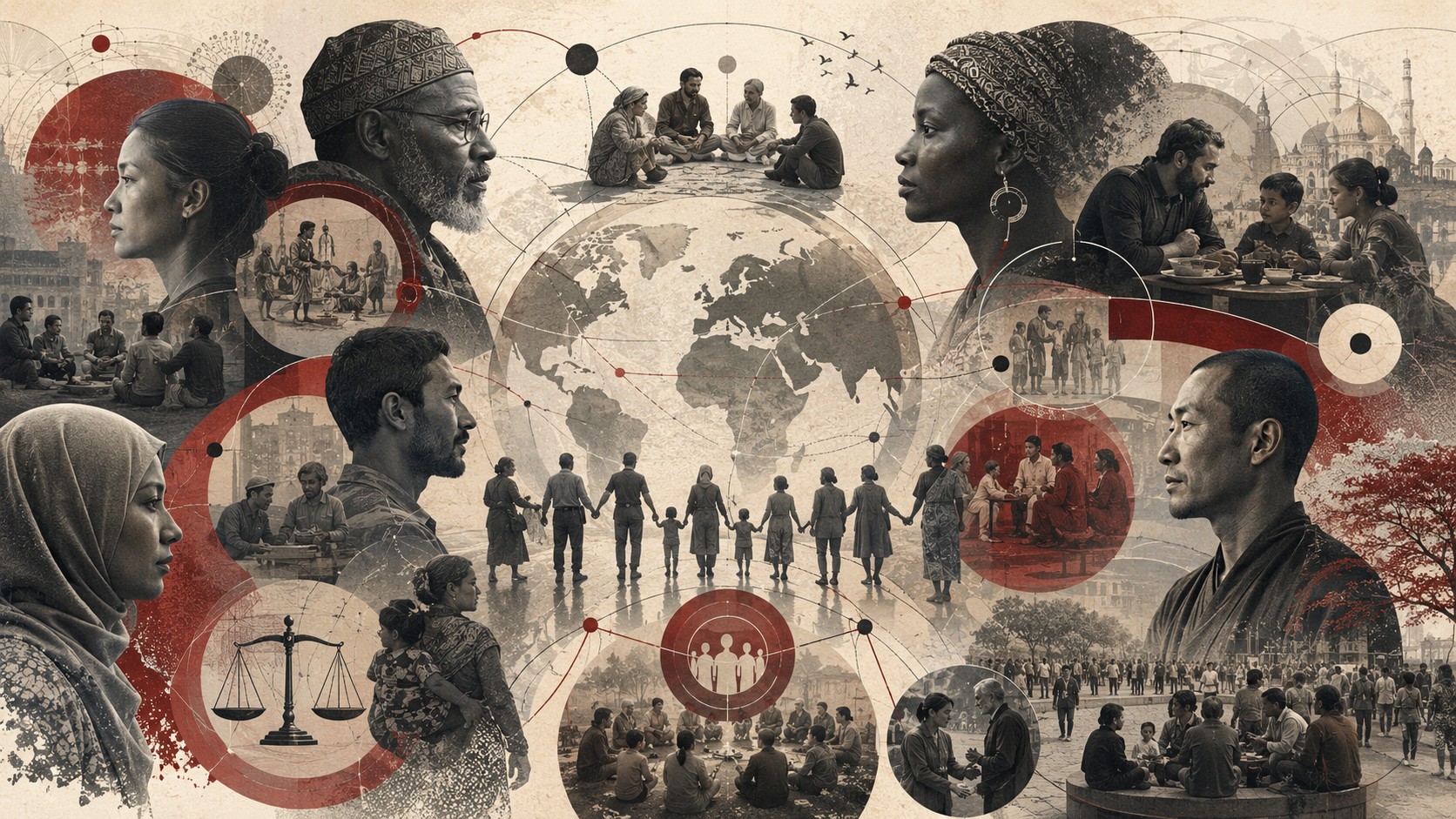
Culture matters because moral life is never learned in abstraction. People become moral agents inside families, neighborhoods, schools, rituals, religions, professions, legal systems, political orders, kinship structures, and institutions that teach what counts as proper conduct, betrayal, dignity, shame, justice, obligation, contamination, respect, or care. These systems shape not only what people believe, but what they notice, what they feel, whom they trust, whom they protect, and which violations appear most serious.
At the same time, cultural variation does not mean moral life is unintelligible across societies. Cross-cultural research remains possible because human beings share enough social and psychological architecture to make comparison meaningful. People learn norms, interpret intention, respond to suffering, regulate cooperation, sanction violations, care about reputation, and organize obligations to others. The question is not whether humans have shared moral capacities. The question is how those capacities are weighted, narrated, institutionalized, and contested across different worlds of life.
What Cross-Cultural Moral Psychology Is
Cross-cultural moral psychology examines how moral cognition, emotion, motivation, judgment, and social regulation vary across cultural settings. It studies differences in how people interpret wrongdoing, distribute blame, learn norms, respond to inequality, enforce cooperation, prioritize obligations, understand dignity, evaluate harm, and define the moral significance of actions and relationships. It is therefore not only a branch of cultural psychology and not only a branch of ethics. It is the empirical and conceptual study of morality as a human phenomenon expressed under culturally variable conditions.
This field is strongest when it avoids treating “culture” as a decorative variable. Culture is not a thin overlay added to otherwise identical moral minds. It shapes what people notice, which relationships they prioritize, how norms are taught, what kinds of harm appear salient, which authorities are trusted, what counts as respect, and how communities interpret contamination, betrayal, dignity, responsibility, family obligation, role duty, freedom, fairness, and social disorder. Culture is not a mask over moral psychology. It is one of the environments through which moral psychology develops.
At the same time, cross-cultural moral psychology does not mean that every moral world is sealed off from every other. Comparison is meaningful because human beings share capacities for learning, imitation, empathy, anger, shame, guilt, norm enforcement, cooperative reasoning, reputation tracking, social belonging, and harm interpretation. Moral diversity is patterned because it is built from capacities that are both shared and culturally organized.
The field therefore sits between universality and difference. It does not ask whether morality is either universal or cultural, as if those were mutually exclusive options. It asks how universal human capacities become culturally specific moral worlds. It asks why some societies emphasize individual rights, others relational obligation, others ritual purity, others authority, others egalitarian reciprocity, and many societies some complex mixture of all of these.
| Question | What cross-cultural moral psychology studies | Why it matters |
|---|---|---|
| What varies? | Moral priorities, norms, sanctions, obligations, authority, fairness, purity, care, loyalty, and dignity | Shows that moral life is shaped by culture, history, institutions, and social organization. |
| What is shared? | Norm learning, harm perception, social evaluation, cooperation, blame, empathy, and reputation sensitivity | Prevents cultural variation from being mistaken for total incomparability. |
| How do children learn morality? | Through instruction, imitation, correction, ritual, story, sanction, and participation | Shows how culture enters moral life early. |
| How are norms enforced? | Through shame, praise, punishment, repair, exclusion, mediation, law, and custom | Reveals that moral rules and enforcement styles can vary separately. |
| How should difference be interpreted? | Through pluralism, contextual analysis, power awareness, and methodological humility | Avoids both naive universalism and careless relativism. |
Why Culture Matters for Morality
Culture matters for morality because moral life is learned, interpreted, and enacted inside social worlds. People do not simply discover moral truth in isolation. They inherit languages of praise and blame, stories of honor and shame, ritualized expectations, religious narratives, institutional practices, family structures, legal orders, economic conditions, gender systems, caste or class relations, and everyday norms about cooperation, sexuality, obligation, hierarchy, care, and authority. These shape not only which actions are evaluated morally, but how those evaluations are felt and justified.
This is one reason moral disagreement across cultures is so instructive. Differences in moral judgment are often not random noise. They reflect differences in moral salience, social organization, and shared understandings of what kinds of threat, violation, disrespect, impurity, betrayal, or obligation matter most. Cross-cultural moral psychology therefore helps reveal both the plasticity and the patterned structure of moral life.
Culture also determines which relationships are morally central. In some contexts, moral life is organized strongly around personal autonomy, consent, and individual harm. In others, moral life is organized more strongly around family duty, intergenerational obligation, elder respect, community reputation, religious law, ritual order, or social harmony. These orientations should not be reduced to stereotypes. Most societies contain multiple moral registers. But cross-cultural research helps show that moral priorities are not always arranged in the same order.
Culture also matters because institutions carry moral meaning. Schools teach what counts as achievement and discipline. Courts teach what counts as responsibility and proof. Religious communities teach what counts as sacred, sinful, forgiven, or obligatory. Markets teach what counts as success and exchange. Families teach who must be cared for and how. States teach citizenship, authority, rights, punishment, and belonging. Moral psychology is therefore shaped by institutions as well as ideas.
| Cultural domain | Moral role | Possible variation |
|---|---|---|
| Family and kinship | Teach care, obligation, loyalty, inheritance, elder respect, and role duty | Societies differ in how strongly family obligation overrides personal preference. |
| Religion and ritual | Define sacred obligations, purity, forgiveness, authority, and ultimate accountability | Moral rules may be grounded in divine command, communal tradition, or spiritual discipline. |
| Law and governance | Formalize rights, punishment, responsibility, evidence, and public order | Legal morality may emphasize individual liberty, public harmony, religious law, or state authority. |
| Economy and labor | Shape fairness, exchange, exploitation, cooperation, and merit | Markets, subsistence systems, welfare states, and informal economies teach different moral expectations. |
| Education | Transmits norms of discipline, autonomy, achievement, cooperation, and citizenship | Schools may foreground individual self-expression, collective duty, obedience, or critical debate. |
Shared Human Capacities and Cultural Variation
The strongest contemporary research suggests that moral judgments vary substantially across cultures and politics while still relying on common psychological building blocks. These include how people represent intention, causation, suffering, agency, norm violation, social relationship, and cooperative order. Moral variation need not imply that moral cognition has no shared structure. It may instead show that common cognitive materials are assembled differently under different social conditions.
This middle position is crucial. If moral psychology were wholly universal in its outputs, cross-cultural research would reveal little more than local ornament. If it were wholly fragmented, meaningful comparison would be nearly impossible. Instead, what often emerges is a layered picture in which human beings share capacities for norm learning, social evaluation, harm perception, reputation, and cooperative regulation, yet differ in how these capacities are organized, weighted, narrated, and institutionalized.
For example, many societies care about harm, but they may disagree about what counts as harm, who is harmed, whether harm is physical, spiritual, relational, reputational, communal, or cosmic, and whether the most serious harm is to an individual, a family, a sacred order, a social role, or a community’s continuity. Similarly, many societies care about fairness, but they may define fair treatment through equality, proportionality, need, merit, age, role, seniority, kinship, or ritual status.
Shared capacities do not produce identical moral worlds because moral cognition is interpretive. People do not merely detect objective moral particles in the environment. They interpret situations through culturally taught schemas: who is acting, who is responsible, what relationship is involved, what norm applies, what history matters, what intention should be inferred, what authority is legitimate, and what kind of response restores order.
| Shared capacity | Common human function | Culturally variable expression |
|---|---|---|
| Harm perception | Detects suffering, injury, threat, vulnerability, or violation | Harm may be construed as physical, emotional, spiritual, relational, reputational, or communal. |
| Fairness sensitivity | Evaluates allocation, reciprocity, cheating, and unequal treatment | Fairness may be based on equality, need, merit, role, kinship, seniority, or contribution. |
| Norm learning | Acquires local expectations and rules of conduct | Norms may be taught through explicit rules, stories, ritual, imitation, shame, praise, or law. |
| Blame attribution | Assigns responsibility for wrongdoing or failure | Blame may emphasize intention, consequence, role duty, negligence, ritual violation, or collective responsibility. |
| Cooperation regulation | Maintains trust, reciprocity, group survival, and shared order | Cooperation may be organized through markets, kinship, religion, state authority, or customary obligation. |
Harm, Fairness, and the Construction of Moral Perception
Recent review work has argued that moral judgments across cultures and politics share a common theme in perceived harm while emphasizing that harm itself is psychologically constructed rather than merely given. This is a useful framework because it explains how cultures can differ morally while still drawing on overlapping human concerns. People may disagree deeply, not because one culture cares about harm and another does not, but because they construe harm differently, extend it to different targets, or connect it to different values such as purity, loyalty, authority, dignity, or sacred order.
Harm is not always limited to direct physical injury. A community may understand harm as humiliation, family dishonor, ritual pollution, betrayal of ancestors, violation of divine command, social fragmentation, loss of face, gendered disrespect, caste insult, civic exclusion, ecological destruction, or injury to communal continuity. Another community may emphasize individual pain, bodily autonomy, psychological trauma, consent, discrimination, or unequal treatment. Both may be reasoning morally about harm, but the object and structure of harm differ.
Fairness works similarly. Many societies display strong concern for reciprocity, cooperation, and unequal treatment, but the standards for what counts as a fair distribution or fair procedure may differ with social expectations about merit, status, family obligation, age, role, need, property, desert, sacrifice, or collective survival. Cross-cultural comparison therefore shows not that fairness is absent in some settings and present in others, but that fairness is interpreted through different institutional and moral vocabularies.
This matters for moral disagreement. When people from different moral worlds argue, they may appear to be debating whether harm or fairness matters. Often they are really debating what harm and fairness mean in context. Is the harm to an individual’s autonomy, to a family’s honor, to a sacred order, to a social role, to civic equality, to a vulnerable body, to a community’s survival, or to the trust that makes cooperation possible? Cross-cultural moral psychology helps make such disagreements intelligible.
| Moral dimension | Possible interpretation | Cross-cultural implication |
|---|---|---|
| Harm | Physical injury, emotional suffering, humiliation, impurity, social disorder, spiritual violation, or communal damage | People may share concern for harm while disagreeing about what harm is. |
| Fairness | Equality, proportionality, need, merit, kinship, reciprocity, role duty, or seniority | Fair treatment may be defined differently depending on social organization. |
| Blame | Based on intention, outcome, negligence, role failure, disrespect, or norm violation | Responsibility judgments vary with assumptions about agency and obligation. |
| Respect | Autonomy, deference, dignity, face, religious reverence, or role recognition | Disrespect may be perceived through different relational and institutional frames. |
| Repair | Apology, punishment, compensation, ritual purification, mediation, forgiveness, or reintegration | Different societies may agree that wrongs require repair but disagree about what repair requires. |
Norms, Learning, and Socialization
Norms are one of the main bridges between culture and morality. Children and adults alike learn which behaviors are expected, prohibited, celebrated, tolerated, or sanctioned through repeated participation in social life. Cross-cultural moral psychology therefore intersects strongly with the study of norm acquisition and application. A society’s moral world is transmitted not only through explicit instruction, but through imitation, correction, ritual, stories, shared emotions, social reward, and the patterned consequences of approval and disapproval.
This means that moral development is never simply individual maturation. It is socialization into a structured world of rules, expectations, and meta-norms about how rules should be taught and enforced. Different cultures can therefore produce different moral profiles not because human nature changes wholesale, but because social learning channels shared capacities through different normative ecologies.
Norm learning also involves emotional training. Children do not only learn that some actions are prohibited; they learn what to feel about them. They learn when shame is appropriate, when guilt matters, when anger is justified, when pride is honorable, when pity is expected, when disgust is morally meaningful, when forgiveness is possible, and when silence is respectful. The emotional grammar of morality is culturally taught.
Socialization also occurs through institutions. Schools teach whether students should challenge authority or defer to it. Religious communities teach which duties are sacred. Legal systems teach what counts as responsibility. Families teach obligations to elders, siblings, spouses, ancestors, children, and kin. Workplaces teach the moral meaning of competence, loyalty, hierarchy, and achievement. Culture is therefore not only transmitted through ideas; it is reproduced through organized practice.
| Socialization pathway | How morality is learned | Possible cultural variation |
|---|---|---|
| Explicit teaching | Rules, prohibitions, explanations, religious instruction, civic education | Some settings emphasize reasoning; others emphasize tradition, authority, or sacred command. |
| Imitation | Children copy elders, peers, siblings, teachers, and ritual participants | Role models differ by family structure, institution, gender, class, and community hierarchy. |
| Sanction | Praise, shame, punishment, correction, exclusion, or reintegration | Societies differ in whether sanction is public, private, punitive, restorative, or indirect. |
| Ritual | Repeated symbolic practice teaches belonging, purity, memory, and obligation | Ritualized moral learning may be central in some communities and weaker in others. |
| Story and memory | Narratives teach heroes, villains, obligations, injuries, and virtues | Moral worlds differ in which histories are remembered, honored, silenced, or contested. |
Individualism, Collectivism, and Moral Priority
One of the classic axes of cross-cultural research concerns the contrast between more individualist and more collectivist orientations. Although this distinction can be overused or simplified, it remains useful when handled carefully. Societies differ in how strongly they emphasize personal autonomy, self-expression, and individual choice versus relational duty, group harmony, role obligation, and coordinated responsibility. These differences can shape how moral dilemmas are framed and which violations appear most urgent.
In some settings, moral judgment may strongly foreground personal rights, consent, individual harm, equal treatment, and freedom from coercion. In others, it may more readily incorporate family duty, communal reputation, role-based obligation, ritual continuity, deference, or the maintenance of social harmony. These are not necessarily mutually exclusive moral worlds. Most societies contain competing moral grammars. But they often produce different priorities when values conflict.
The individualism-collectivism distinction must be used with caution because it can easily become a stereotype. No society is purely individualist or purely collectivist. People everywhere have personal desires and relational obligations. Modern societies are internally plural, and cultural categories often conceal class, gender, region, religion, generation, urban-rural, and institutional differences. Still, the distinction remains useful when treated as a pattern of relative emphasis rather than a fixed civilizational label.
Cross-cultural moral psychology is most effective when it asks how specific social structures organize moral priority. Does the society emphasize nuclear family or extended kin? Is authority religious, bureaucratic, customary, or democratic? Are social safety nets strong or weak? Are elders central to household authority? Is personal mobility high or low? Are reputational networks dense or anonymous? These conditions influence whether autonomy, harmony, loyalty, dignity, fairness, purity, authority, or obligation becomes most salient in moral reasoning.
| Moral priority | More autonomy-centered emphasis | More relational or collectivist emphasis |
|---|---|---|
| Selfhood | Personal choice, self-expression, individual rights | Role, kinship, belonging, duty, relational identity |
| Wrongdoing | Violation of consent, liberty, fairness, or harm to the individual | Violation of role duty, harmony, honor, respect, sacred order, or community continuity |
| Responsibility | Individual agency and personal accountability | Shared obligation, family responsibility, collective reputation, or role-based duty |
| Repair | Apology, compensation, rights protection, procedural justice | Mediation, reintegration, family negotiation, ritual repair, restoration of harmony |
| Virtue | Authenticity, independence, fairness, courage, respect for rights | Loyalty, humility, filial duty, restraint, deference, mutual care |
Close Others, Ingroup Obligation, and Moral Partiality
Cross-cultural work also shows that moral reasoning about close others varies meaningfully across societies. Cultures differ in how people reason about whether close others should be protected, punished, excused, confronted, or reported after wrongdoing. This is an especially important area because it shows that even where people agree that a norm has been violated, they may differ in how they balance loyalty, care, justice, honesty, and group obligation.
In some moral worlds, protecting a close other after wrongdoing may appear corrupt, biased, or unjust because it places relationship above impartial standards. In other moral worlds, refusing to protect a close other may appear cold, disloyal, dishonorable, or morally deficient because relational obligation is treated as a serious moral duty. The question is not simply whether people understand wrongdoing. The question is what other values are activated once wrongdoing is committed by someone close.
This helps explain why some cross-cultural disagreements are not best understood as disputes between morality and immorality, but as disagreements among different moral priorities. One society may see protection of close others as corrupt favoritism; another may see it as morally serious care. One community may praise impartial rule-following; another may regard relational loyalty as a core mark of decency. These are not trivial differences. They affect law, governance, family life, professional ethics, business practice, and public trust.
Moral partiality is not automatically wrong. Every moral life contains some form of special obligation: to children, parents, spouses, friends, patients, students, neighbors, co-religionists, citizens, or the vulnerable. The hard question is when partiality becomes care and when it becomes corruption, exclusion, nepotism, impunity, or injustice. Cross-cultural moral psychology helps clarify why societies draw this line differently.
| Moral issue | Impartiality-centered interpretation | Relationship-centered interpretation |
|---|---|---|
| Protecting a close other | May appear biased, corrupt, or unfair | May appear loyal, caring, and morally required |
| Reporting wrongdoing | May appear responsible and justice-oriented | May appear disloyal or destructive of relational duty |
| Unequal treatment of kin | May appear nepotistic or unjust | May appear natural and obligatory |
| Forgiveness | May require accountability first | May prioritize harmony, reintegration, or relationship preservation |
| Public punishment | May affirm equal standards | May bring dishonor, shame, or social rupture beyond the individual wrongdoer |
Cross-Cultural Development and Childhood Moral Learning
Childhood moral development displays both cross-cultural continuity and variation. Children across societies learn norms early, respond to social expectations, imitate others, and participate in practices of correction and approval. Yet how they interpret and prioritize those norms depends in part on cultural environment. Moral learning is not only the emergence of internal capacities; it is participation in a culturally organized moral world.
This developmental angle matters because it shows that culture enters moral life early. Cross-cultural variation is not only adult ideology layered onto an already-finished moral mind. It is present in the social worlds through which children learn sharing, fairness, deference, sanction, obligation, respect, cooperation, purity, shame, and the scope of concern. Childhood is one of the main places where shared human capacities are directed into local moral forms.
Children may learn different expectations about autonomy and obedience, peer sharing and family obligation, elder respect and self-expression, public shame and private guilt, individual achievement and communal responsibility, direct confrontation and indirect correction. These are not merely behavioral habits. They shape moral attention and interpretation. A child raised to treat direct contradiction of elders as disrespect learns a different moral salience structure than a child raised to treat questioning authority as a sign of independence.
Development also reveals how moral norms are embodied. Children learn through posture, speech, food, ritual, play, labor, caregiving, punishment, apology, storytelling, and observation. They learn who speaks first, who eats first, who apologizes, who obeys, who forgives, who is protected, who is disciplined, and who has standing to correct others. Cross-cultural moral psychology should therefore treat childhood moral learning as situated practice, not only as abstract judgment development.
| Developmental domain | Shared process | Cultural variation |
|---|---|---|
| Norm acquisition | Children learn what is expected and prohibited | Norms may emphasize autonomy, obedience, respect, care, purity, sharing, or role duty. |
| Sanction learning | Children learn consequences of violation | Correction may be direct, indirect, public, private, punitive, restorative, or ritualized. |
| Fairness development | Children learn allocation and reciprocity | Fairness may be taught through equality, need, seniority, effort, or kinship obligation. |
| Authority recognition | Children learn who may command, teach, punish, or forgive | Authority may be parental, elder-based, religious, legal, educational, or peer-mediated. |
| Scope of concern | Children learn who must be cared for or protected | Concern may be organized around family, community, nation, religion, humanity, or all living beings. |
Norm Enforcement, Sanction, and Meta-Norms
Not only norms differ across cultures. Meta-norms differ as well. Meta-norms are shared beliefs about how norms themselves should be enforced, who has standing to sanction, what counts as proportionate response, and whether public correction, private shame, punishment, mediation, exclusion, tolerance, forgiveness, or reintegration is appropriate. Two societies may condemn the same behavior yet differ sharply in how they respond to it.
This is important because moral life is shaped not only by what is prohibited but by culturally patterned views about how wrongs should be addressed. One setting may prefer direct confrontation; another may prefer indirect signaling. One may favor formal punishment; another may favor family mediation. One may treat public shame as necessary accountability; another may treat it as destructive humiliation. One may prioritize reintegration; another may prioritize deterrence.
Norm enforcement is also tied to authority. Who has standing to correct wrongdoing? Parents, elders, peers, religious leaders, courts, teachers, managers, local councils, online publics, or the injured party? A norm may be widely accepted, but enforcement may vary depending on who violates it, who is harmed, who witnesses it, and who has legitimate sanctioning power. Cross-cultural moral psychology therefore needs to study moral order as a system of norms, enforcers, sanctions, and repair practices.
Meta-norms are especially important in digital life, where cultural norms of sanction collide. Online platforms bring together users with different expectations about public correction, satire, shame, insult, restorative dialogue, authority, humor, and proportionality. What one community sees as accountability, another may see as cruelty. What one sees as necessary public pressure, another may see as dishonor or mob behavior. Cross-cultural work on norm enforcement is therefore increasingly important in global digital environments.
| Meta-norm question | Possible answers | Cross-cultural significance |
|---|---|---|
| Who may sanction? | Victims, elders, courts, peers, religious authorities, managers, online publics | Standing to correct wrongdoing varies across institutions and cultures. |
| How public should sanction be? | Private correction, public shame, formal punishment, ritual repair, mediation | Public accountability and public humiliation may be valued differently. |
| What is proportionate? | Warning, apology, compensation, exclusion, punishment, reconciliation | Societies differ in how they balance deterrence, dignity, restoration, and order. |
| What restores the norm? | Confession, apology, compensation, punishment, forgiveness, purification, reintegration | Repair is culturally organized, not merely individually chosen. |
| When is tolerance moral? | As pluralism, patience, mercy, weakness, permissiveness, or disorder | Even tolerance and restraint are morally interpreted through culture. |
Politics, Religion, and Moral Worlds
Cross-cultural moral psychology overlaps strongly with political and religious moral worlds. Political ideologies and religious traditions are among the most powerful carriers of moral structure, especially when they shape views of authority, purity, justice, sacrifice, obligation, community, dignity, sacred law, equality, hierarchy, and historical memory. These frameworks often become part of everyday moral perception rather than remaining abstract doctrines.
This means cross-cultural comparison should not be limited to nation against nation. There are cross-cultural differences within societies, across political subcultures, religious communities, linguistic groups, caste and class formations, diasporas, professions, and institutional worlds. The same city may contain several partially distinct moral cultures, each with its own assumptions about responsibility, respectability, authority, purity, gender, fairness, and the proper ordering of goods.
Religion can shape morality through ritual, law, narrative, discipline, community, authority, sacred texts, embodied practice, and accountability before God or ultimate reality. Political culture can shape morality through ideas of citizenship, sovereignty, rights, nationhood, justice, property, equality, freedom, security, and collective memory. These moral worlds can overlap, conflict, reinforce one another, or generate hybrid forms.
Because religion and politics are often deeply tied to identity, disagreements in these domains can become especially intense. A dispute over policy, ritual, gender, education, law, speech, or public space may be interpreted as a threat not only to preference but to sacred order, national survival, historical justice, communal dignity, or moral truth. Cross-cultural moral psychology helps explain why these conflicts are rarely “just opinions.” They are often conflicts between lived moral worlds.
| Moral world | What it organizes | Possible cross-cultural variation |
|---|---|---|
| Religious tradition | Sacred obligation, purity, authority, mercy, law, forgiveness, ritual, ultimate accountability | Different traditions and communities vary in the relation between law, conscience, ritual, and compassion. |
| Political ideology | Justice, liberty, equality, order, nationhood, rights, property, security | Political subcultures may define dignity, threat, fairness, and freedom differently. |
| Professional culture | Duty, competence, care, confidentiality, loyalty, public trust | Professions differ in whether morality is framed through service, expertise, obedience, or autonomy. |
| Legal culture | Responsibility, evidence, rights, punishment, procedure, legitimacy | Legal systems differ in the moral weight placed on precedent, mediation, restitution, state authority, or religious law. |
| Civic culture | Belonging, participation, public trust, shared responsibility, dissent | Citizenship may be framed through rights, duties, loyalty, pluralism, or national memory. |
Migration, Diaspora, and Hybrid Moral Worlds
Cross-cultural moral psychology should also pay attention to migration, diaspora, and hybrid moral worlds. Many people do not live inside a single neatly bounded culture. They move across languages, legal systems, religions, national histories, family expectations, schools, workplaces, and digital publics. Their moral lives are often shaped by negotiation among multiple normative systems rather than by simple membership in one cultural container.
Migration can produce moral conflict between generations. Parents may emphasize obligations, modesty, deference, religious duty, family reputation, or collective survival learned in one context, while children socialized in another context may emphasize autonomy, consent, peer equality, self-expression, and individual choice. Neither side is simply without morality. They may be organizing moral goods differently under different social conditions.
Diaspora communities may also preserve moral worlds under pressure. Practices that appear conservative or rigid to outsiders may function internally as ways to maintain memory, dignity, kinship, religion, language, and belonging after displacement, marginalization, colonization, war, or migration. At the same time, communities can reproduce harmful norms in the name of preservation. Cross-cultural moral psychology must therefore interpret with care: it should neither romanticize tradition nor dismiss it as irrational.
Hybrid moral worlds are increasingly common in globalized life. A person may navigate Islamic family ethics, American individualist schooling, professional biomedical norms, social-media call-out cultures, immigrant respectability pressures, and secular legal frameworks simultaneously. Moral judgment in such cases is not simply “between cultures.” It is produced through layered moral translation.
| Hybrid condition | Moral tension | Interpretive challenge |
|---|---|---|
| Migration | Norms from one society are lived under another society’s institutions | Avoid treating adaptation as either moral progress or cultural loss by default. |
| Diaspora | Communities preserve identity under displacement or marginalization | Understand preservation without romanticizing harmful practices. |
| Intergenerational conflict | Parents and children inherit different moral environments | Recognize competing goods such as autonomy, duty, belonging, and dignity. |
| Professional integration | Local moral worlds encounter institutional ethics and legal systems | Ask how professional norms translate across cultural expectation. |
| Digital globalization | Local norms collide with global online publics | Different meta-norms of shame, satire, accountability, and respect may clash. |
Colonialism, Power, and the Politics of Comparison
Cross-cultural moral psychology must take power seriously. Cultural comparison has often been entangled with colonialism, racial hierarchy, missionary judgment, imperial administration, economic domination, and the classification of non-Western peoples as morally immature, primitive, irrational, or deficient. A rigorous field must therefore ask not only how cultures differ, but who is doing the comparing, which categories are being imposed, whose moral vocabulary is treated as universal, and whose experiences are reduced to data points.
This is especially important because many psychological measures were developed in Western, educated, industrialized, rich, and democratic settings. Such measures may be useful, but they cannot be assumed to travel without distortion. A concept such as autonomy, harm, fairness, dignity, authority, purity, shame, or responsibility may not map cleanly across languages and institutions. What appears as a difference in moral judgment may sometimes be a difference in translation, context, measure, or the social meaning of the experimental task.
Power also shapes moral worlds themselves. Colonial rule, enslavement, occupation, racial capitalism, caste systems, forced conversion, land dispossession, gender hierarchy, and economic dependency do not merely produce “cultural differences.” They produce histories of violence, resistance, memory, shame, adaptation, and moral reinterpretation. Cross-cultural moral psychology must therefore distinguish cultural variation from variation produced by domination, exclusion, or survival under unequal power.
This does not mean comparison is impossible. It means comparison must be morally and methodologically disciplined. Researchers should avoid treating Western liberal moral assumptions as neutral baselines and everyone else as deviations. They should also avoid romanticizing all local norms as equally beyond criticism. The task is harder: to study moral diversity while remaining attentive to power, history, translation, and the unequal conditions under which moral worlds are formed.
| Risk in comparison | How it distorts understanding | Better practice |
|---|---|---|
| Western baseline bias | Treats one moral vocabulary as universal and others as deviations | Test whether constructs retain meaning across contexts before comparison. |
| Colonial framing | Ranks cultures as mature, backward, rational, irrational, developed, or deficient | Use historically aware, non-hierarchical comparison. |
| Translation flattening | Assumes key terms have equivalent meanings across languages | Combine linguistic, ethnographic, and quantitative interpretation. |
| Power blindness | Mistakes domination, exclusion, or survival strategies for neutral culture | Analyze colonial, economic, racial, caste, gender, and political histories. |
| Romantic relativism | Treats every local norm as morally insulated from critique | Balance interpretive humility with attention to harm, dignity, justice, and power. |
Pluralism, Relativism, and Moral Judgment
Cross-cultural variation naturally raises metaethical questions. Does disagreement across societies support relativism? Does it support pluralism? Does it undermine objectivity? These questions must be handled carefully. The existence of cultural difference does not by itself prove that moral truth is relative to cultures. But it does put pressure on simplistic claims that moral reality is always transparently available in the same form to everyone.
Pluralism is often the more careful conclusion. It allows that multiple values may be real and that different cultures may organize these values differently without making all judgments equally valid. Pluralism can recognize that autonomy, care, loyalty, justice, dignity, piety, harmony, mercy, truth, equality, and responsibility are all morally serious, while also recognizing that they can conflict and that different cultures may prioritize them differently.
Relativism, by contrast, is the stronger view that moral truth or justification is relative to cultural frameworks. Cross-cultural moral psychology can provide evidence relevant to relativist arguments, but it cannot settle metaethics by itself. Empirical variation shows that people judge differently. It does not automatically show that all judgments are equally justified, that no cross-cultural criticism is possible, or that there are no shared standards by which suffering, domination, cruelty, or dignity can be discussed.
At the same time, cross-cultural research can expose where apparent “universal morality” is actually the projection of one group’s assumptions. It can also show where moral condemnation from outside a culture ignores context, translation, power, and the internal complexity of the community being judged. The best approach is neither arrogant universalism nor passive relativism. It is morally serious pluralism: open to shared human claims, attentive to difference, and willing to ask hard questions about power, harm, and dignity.
| Position | Core claim | Strength | Risk |
|---|---|---|---|
| Naive universalism | Morality works the same way everywhere | Recognizes shared human capacities | Can erase cultural difference and impose one moral vocabulary as neutral. |
| Crude relativism | Morality is only local preference or cultural convention | Recognizes deep variation | Can weaken critique of harm, domination, exclusion, or cruelty. |
| Pluralism | Multiple real values may be organized differently across contexts | Explains difference without denying shared moral seriousness | Can become vague if it avoids hard conflicts. |
| Critical universalism | Some moral claims travel across cultures but must be interpreted with humility | Supports critique of severe harm and injustice | Can become imperial if detached from local knowledge and power analysis. |
| Contextual judgment | Moral evaluation must attend to meaning, history, power, and consequence | Combines empirical care with ethical seriousness | Requires slower, more difficult interpretation. |
Methodological Challenges in Cross-Cultural Moral Psychology
This field faces serious methodological challenges. Researchers must avoid assuming that categories developed in one cultural setting can be straightforwardly exported everywhere else. Translation problems, sampling bias, overreliance on Western educated populations, thin experimental stimuli, and measurement non-equivalence can all distort results. Cross-cultural work is strongest when it combines careful local knowledge with comparable measures and when it tests whether ostensibly universal constructs actually retain the same meaning across contexts.
There is also a deeper challenge: comparison itself can flatten the moral worlds being compared. If a study imposes a narrow definition of harm, fairness, or moral violation, it may miss the culturally specific forms through which those categories are lived. A short vignette about a moral dilemma may not capture kinship structure, religious meaning, legal consequence, caste status, gender expectation, family reputation, colonial history, or local ideas of dignity. The best cross-cultural moral psychology therefore requires both empirical rigor and interpretive humility.
Sampling is especially important. Much psychological research has historically relied on narrow populations, especially university students in wealthy Western societies. Such samples are not useless, but they cannot be treated as the default human mind. If theories of morality are based primarily on these populations, they risk mistaking local moral assumptions for universal moral architecture.
Methods must also be plural. Quantitative experiments can identify patterns and test hypotheses. Ethnographic work can reveal meanings that surveys miss. Developmental research can show how children acquire norms. Historical analysis can explain why moral worlds changed. Linguistic work can examine whether key moral terms translate across contexts. Cross-cultural moral psychology is strongest when it does not force one method to carry the entire field.
| Methodological challenge | Why it matters | Improved approach |
|---|---|---|
| Sampling bias | Narrow samples may be mistaken for universal humanity | Use diverse populations and avoid treating one population as baseline. |
| Translation problems | Moral terms may not carry equivalent meaning across languages | Use back-translation, local experts, qualitative validation, and linguistic analysis. |
| Construct equivalence | A measure may not capture the same concept across cultures | Test measurement invariance and interpret local meanings carefully. |
| Thin stimuli | Short vignettes may strip away context that gives moral meaning | Use richer scenarios, local cases, mixed methods, and ethnographic grounding. |
| Researcher positionality | Researchers may impose unexamined assumptions | Collaborate across cultures and make interpretive frames explicit. |
What Cross-Cultural Research Does Not Show
Cross-cultural research does not show that morality is infinitely malleable. Nor does it show that every moral system is merely local preference in disguise. Variation is real, but so are recurring human concerns with harm, trust, reciprocity, norm violation, belonging, responsibility, and the standing of persons in social life. Cross-cultural study therefore complicates both absolutism and relativism rather than simply confirming one of them.
It also does not show that deeper understanding always resolves disagreement. Some cultural conflicts reflect real differences in moral organization that are not easily harmonized. Others reflect power, domination, exclusion, or histories of injury that cannot be dissolved through respectful description alone. The aim of cross-cultural moral psychology is not to turn all conflict into mutual admiration. It is to explain how moral diversity is structured, how shared capacities and different moral worlds interact, and where the limits of translation and coexistence lie.
Cross-cultural research also does not justify treating cultures as internally homogeneous. Every society contains disagreement, hierarchy, dissent, minority traditions, suppressed voices, generational change, class difference, gendered experience, political struggle, and institutional conflict. A norm may be described as “cultural” while being contested by people within that culture. Researchers must therefore ask: whose culture, whose norm, whose interest, whose suffering, and whose authority?
Finally, cross-cultural research does not require moral paralysis. Understanding why a norm exists does not mean endorsing it. Criticizing a harmful norm does not require contempt for a whole culture. The best work makes moral judgment more careful, not less possible. It teaches patience, humility, power awareness, and interpretive discipline while preserving the ability to speak seriously about dignity, harm, justice, and repair.
| Misreading | Why it is wrong | Better conclusion |
|---|---|---|
| “Cultures differ, so morality is arbitrary.” | Variation does not eliminate shared capacities or structured moral concerns. | Morality is culturally organized, not random. |
| “All cultural norms deserve equal respect.” | Some norms produce domination, cruelty, exclusion, or preventable harm. | Interpretive humility can coexist with moral critique. |
| “Universal values are obvious everywhere.” | Values are interpreted through language, institution, history, and power. | Shared values may require translation and contextual understanding. |
| “A culture has one moral view.” | Cultures contain disagreement, hierarchy, dissent, and change. | Study internal diversity and contested authority. |
| “Understanding eliminates conflict.” | Some conflicts involve real value tensions or unequal power. | Understanding improves judgment, but does not erase moral difficulty. |
Mathematical Lens: Modeling Cross-Cultural Moral Variation
Cross-cultural moral judgment can be modeled as a common cognitive base filtered through culturally variable weightings. Let \(J_{ic}\) represent the moral judgment of person \(i\) in cultural context \(c\):
J_{ic} = \alpha_c H_i + \beta_c F_i + \gamma_c L_i + \delta_c A_i + \varepsilon_{ic}
\]
Interpretation: Moral judgment is modeled as a culturally weighted combination of harm perception, fairness sensitivity, loyalty or relational obligation, and authority or norm-order sensitivity. The coefficients vary by cultural context.
where \(H_i\) is harm perception, \(F_i\) is fairness sensitivity, \(L_i\) is loyalty or relational obligation, and \(A_i\) is authority or norm-order sensitivity. The coefficients \(\alpha_c\), \(\beta_c\), \(\gamma_c\), and \(\delta_c\) vary by cultural context, capturing the idea that shared moral capacities can be organized differently across societies.
A norm-learning model can also be written as:
N_i(t+1) = N_i(t) + \lambda S_c + \mu E_i – \rho D_i
\]
Interpretation: Norm internalization changes over time as cultural socialization, reinforcement, sanction, exposure, and individual divergence shape moral learning.
where \(N_i(t)\) is norm internalization over time, \(S_c\) is cultural socialization strength, \(E_i\) is exposure to reinforcement and sanction, and \(D_i\) is developmental resistance, divergence, or alternative moral learning. This represents how local moral worlds are reproduced through learning rather than appearing fully formed.
To model cross-cultural disagreement between persons from different settings \(c_1\) and \(c_2\), we can define:
\Delta J = |J_{ic_1} – J_{jc_2}|
\]
Interpretation: Cross-cultural moral disagreement is represented as the distance between moral judgments made under different cultural weightings, identities, and interpretive frames.
A pluralism-aware model can also represent multiple values as simultaneously active rather than forcing morality into a single dimension:
M_c = \{w_{Hc}, w_{Fc}, w_{Lc}, w_{Ac}, w_{Pc}, w_{Rc}\}
\]
Interpretation: A cultural moral profile can be represented as a vector of value weights, including harm, fairness, loyalty, authority, purity, and relational obligation.
This vector model is useful because cultures often differ not by having entirely different moral ingredients, but by weighting, sequencing, narrating, and institutionalizing overlapping moral concerns differently. It also supports a more careful approach to pluralism: difference is neither total incomparability nor simple sameness.
| Model term | Meaning | Cross-cultural interpretation |
|---|---|---|
| \(H_i\) | Harm perception | Sensitivity to suffering, injury, humiliation, disorder, or violation. |
| \(F_i\) | Fairness sensitivity | Concern with equality, reciprocity, desert, need, or proportionality. |
| \(L_i\) | Loyalty or relational obligation | Concern with kinship, group duty, family protection, or communal belonging. |
| \(A_i\) | Authority or norm-order sensitivity | Concern with hierarchy, role, tradition, ritual order, law, or legitimate command. |
| \(S_c\) | Cultural socialization strength | Intensity and consistency of local norm transmission. |
| \(\Delta J\) | Moral disagreement distance | Difference between judgments produced by distinct cultural weightings or frames. |
| \(M_c\) | Cultural moral profile | Vector representation of how a cultural context weights multiple moral values. |
R Workflow: Modeling Cross-Cultural Moral Profiles
The following R workflow simulates culturally varying weightings of harm, fairness, loyalty, authority, purity, and relational obligation, then estimates how moral judgments differ across contexts. The dataset is synthetic and intended for reproducible article support, not empirical claims about real cultures or populations.
# Cross-Cultural Moral Psychology
# Synthetic R workflow for modeling cross-cultural moral profiles.
# Educational and reproducible research scaffold only.

suppressPackageStartupMessages({
  library(tidyverse)
  library(broom)
})

set.seed(42)

# ------------------------------------------------------------
# 1. Set up output folders
# ------------------------------------------------------------

dir.create("outputs", showWarnings = FALSE)
dir.create("outputs/tables", recursive = TRUE, showWarnings = FALSE)
dir.create("outputs/figures", recursive = TRUE, showWarnings = FALSE)

# ------------------------------------------------------------
# 2. Simulate moral profiles across cultural contexts
# ------------------------------------------------------------

n <- 2400

df <- tibble(
  participant_id = 1:n,
  culture = sample(c("Context_A", "Context_B", "Context_C"), n, replace = TRUE),
  harm_sensitivity = rnorm(n, 0, 1),
  fairness_sensitivity = rnorm(n, 0, 1),
  loyalty_sensitivity = rnorm(n, 0, 1),
  authority_sensitivity = rnorm(n, 0, 1),
  purity_sensitivity = rnorm(n, 0, 1),
  relational_obligation = rnorm(n, 0, 1),
  norm_learning = rnorm(n, 0, 1),
  sanction_expectation = rnorm(n, 0, 1)
) %>%
  mutate(
    moral_judgment = case_when(
      culture == "Context_A" ~
        0.45 * harm_sensitivity +
        0.30 * fairness_sensitivity +
        0.10 * loyalty_sensitivity +
        0.10 * authority_sensitivity +
        0.05 * purity_sensitivity +
        0.10 * relational_obligation +
        0.15 * norm_learning +
        rnorm(n(), 0, 0.8),

      culture == "Context_B" ~
        0.25 * harm_sensitivity +
        0.20 * fairness_sensitivity +
        0.30 * loyalty_sensitivity +
        0.25 * authority_sensitivity +
        0.20 * purity_sensitivity +
        0.25 * relational_obligation +
        0.15 * norm_learning +
        rnorm(n(), 0, 0.8),

      TRUE ~
        0.30 * harm_sensitivity +
        0.25 * fairness_sensitivity +
        0.25 * loyalty_sensitivity +
        0.20 * authority_sensitivity +
        0.15 * purity_sensitivity +
        0.20 * relational_obligation +
        0.15 * norm_learning +
        rnorm(n(), 0, 0.8)
    ),

    norm_enforcement_tendency = plogis(
      0.25 * sanction_expectation +
      0.25 * norm_learning +
      0.20 * authority_sensitivity +
      0.20 * loyalty_sensitivity +
      0.15 * relational_obligation
    )
  )

# ------------------------------------------------------------
# 3. Estimate cultural judgment model
# ------------------------------------------------------------

model_culture <- lm(
  moral_judgment ~ culture + harm_sensitivity + fairness_sensitivity +
    loyalty_sensitivity + authority_sensitivity + purity_sensitivity +
    relational_obligation + norm_learning,
  data = df
)

culture_summary <- tidy(model_culture, conf.int = TRUE)
culture_fit <- glance(model_culture)

print(culture_summary)
print(culture_fit)

# ------------------------------------------------------------
# 4. Estimate norm-enforcement model
# ------------------------------------------------------------

model_enforcement <- lm(
  norm_enforcement_tendency ~ culture + sanction_expectation +
    norm_learning + authority_sensitivity + loyalty_sensitivity +
    relational_obligation,
  data = df
)

enforcement_summary <- tidy(model_enforcement, conf.int = TRUE)

print(enforcement_summary)

# ------------------------------------------------------------
# 5. Summarize by cultural context
# ------------------------------------------------------------

culture_profile_summary <- df %>%
  group_by(culture) %>%
  summarize(
    mean_judgment = mean(moral_judgment),
    mean_harm = mean(harm_sensitivity),
    mean_fairness = mean(fairness_sensitivity),
    mean_loyalty = mean(loyalty_sensitivity),
    mean_authority = mean(authority_sensitivity),
    mean_purity = mean(purity_sensitivity),
    mean_relational_obligation = mean(relational_obligation),
    mean_norm_enforcement = mean(norm_enforcement_tendency),
    .groups = "drop"
  )

print(culture_profile_summary)

# ------------------------------------------------------------
# 6. Prediction grid across harm and culture
# ------------------------------------------------------------

pred_grid <- expand_grid(
  harm_sensitivity = seq(-2, 2, length.out = 100),
  culture = c("Context_A", "Context_B", "Context_C"),
  fairness_sensitivity = 0,
  loyalty_sensitivity = 0,
  authority_sensitivity = 0,
  purity_sensitivity = 0,
  relational_obligation = 0,
  norm_learning = 0
)

pred_grid$predicted_judgment <- predict(
  model_culture,
  newdata = pred_grid
)

# ------------------------------------------------------------
# 7. Plot cultural differences
# ------------------------------------------------------------

plot_cultural_profiles <- ggplot(
  pred_grid,
  aes(x = harm_sensitivity, y = predicted_judgment)
) +
  geom_line(linewidth = 1) +
  facet_wrap(~ culture) +
  labs(
    title = "Predicted Moral Judgment Across Cultural Contexts",
    subtitle = "Shared moral dimensions receive different weights across contexts",
    x = "Harm sensitivity",
    y = "Predicted moral judgment"
  ) +
  theme_minimal(base_size = 12)

print(plot_cultural_profiles)

# ------------------------------------------------------------
# 8. Export outputs
# ------------------------------------------------------------

write_csv(df, "outputs/tables/cross_cultural_moral_profiles_simulated_data.csv")
write_csv(culture_summary, "outputs/tables/cross_cultural_moral_model.csv")
write_csv(culture_fit, "outputs/tables/cross_cultural_moral_model_fit.csv")
write_csv(enforcement_summary, "outputs/tables/cross_cultural_norm_enforcement_model.csv")
write_csv(culture_profile_summary, "outputs/tables/cross_cultural_moral_profile_summary.csv")
write_csv(pred_grid, "outputs/tables/cross_cultural_moral_predictions.csv")

ggsave(
  filename = "outputs/figures/predicted_cross_cultural_moral_judgment.png",
  plot = plot_cultural_profiles,
  width = 10,
  height = 6,
  dpi = 300
)
This workflow is useful because it models cultural variation as structured weighting differences rather than as total incomparability. It also separates moral judgment from norm-enforcement tendency, making visible that societies may differ not only in what they condemn, but in how strongly and through what mechanisms they enforce moral norms.
Python Workflow: Simulating Cross-Cultural Moral Judgment
The Python workflow below simulates moral judgments across different cultural contexts by varying the weights assigned to harm, fairness, loyalty, authority, purity, relational obligation, and norm learning. The example uses synthetic data for reproducible demonstration and should not be interpreted as an assessment of real cultures, nations, religions, or communities.
# Cross-Cultural Moral Psychology
# Python workflow for synthetic cross-cultural moral-judgment modeling.
# Educational and reproducible research scaffold only.

from pathlib import Path

import numpy as np
import pandas as pd

np.random.seed(42)

# ------------------------------------------------------------
# 1. Set up output folders
# ------------------------------------------------------------

output_tables = Path("outputs/tables")
output_tables.mkdir(parents=True, exist_ok=True)

# ------------------------------------------------------------
# 2. Simulate moral profiles across cultural contexts
# ------------------------------------------------------------

n = 2600

df = pd.DataFrame({
    "participant_id": np.arange(1, n + 1),
    "culture": np.random.choice(["Context_A", "Context_B", "Context_C"], size=n),
    "harm_sensitivity": np.random.normal(0, 1, n),
    "fairness_sensitivity": np.random.normal(0, 1, n),
    "loyalty_sensitivity": np.random.normal(0, 1, n),
    "authority_sensitivity": np.random.normal(0, 1, n),
    "purity_sensitivity": np.random.normal(0, 1, n),
    "relational_obligation": np.random.normal(0, 1, n),
    "norm_learning": np.random.normal(0, 1, n),
    "sanction_expectation": np.random.normal(0, 1, n)
})

# ------------------------------------------------------------
# 3. Generate culturally weighted moral judgments
# ------------------------------------------------------------

noise = np.random.normal(0, 0.8, n)

context_a = df["culture"] == "Context_A"
context_b = df["culture"] == "Context_B"

df["moral_judgment"] = np.select(
    [context_a, context_b],
    [
        (
            0.45 * df["harm_sensitivity"] +
            0.30 * df["fairness_sensitivity"] +
            0.10 * df["loyalty_sensitivity"] +
            0.10 * df["authority_sensitivity"] +
            0.05 * df["purity_sensitivity"] +
            0.10 * df["relational_obligation"] +
            0.15 * df["norm_learning"] +
            noise
        ),
        (
            0.25 * df["harm_sensitivity"] +
            0.20 * df["fairness_sensitivity"] +
            0.30 * df["loyalty_sensitivity"] +
            0.25 * df["authority_sensitivity"] +
            0.20 * df["purity_sensitivity"] +
            0.25 * df["relational_obligation"] +
            0.15 * df["norm_learning"] +
            noise
        )
    ],
    default=(
        0.30 * df["harm_sensitivity"] +
        0.25 * df["fairness_sensitivity"] +
        0.25 * df["loyalty_sensitivity"] +
        0.20 * df["authority_sensitivity"] +
        0.15 * df["purity_sensitivity"] +
        0.20 * df["relational_obligation"] +
        0.15 * df["norm_learning"] +
        noise
    )
)

# ------------------------------------------------------------
# 4. Generate norm-enforcement tendency
# ------------------------------------------------------------

enforcement_latent = (
    0.25 * df["sanction_expectation"] +
    0.25 * df["norm_learning"] +
    0.20 * df["authority_sensitivity"] +
    0.20 * df["loyalty_sensitivity"] +
    0.15 * df["relational_obligation"]
)

df["norm_enforcement_tendency"] = 1 / (1 + np.exp(-enforcement_latent))

# ------------------------------------------------------------
# 5. Summarize by culture
# ------------------------------------------------------------

summary = (
    df.groupby("culture")
      .agg(
          mean_judgment=("moral_judgment", "mean"),
          mean_harm=("harm_sensitivity", "mean"),
          mean_fairness=("fairness_sensitivity", "mean"),
          mean_loyalty=("loyalty_sensitivity", "mean"),
          mean_authority=("authority_sensitivity", "mean"),
          mean_purity=("purity_sensitivity", "mean"),
          mean_relational_obligation=("relational_obligation", "mean"),
          mean_norm_enforcement=("norm_enforcement_tendency", "mean")
      )
      .reset_index()
)

print(summary)

# ------------------------------------------------------------
# 6. Scenario grid across harm and authority
# ------------------------------------------------------------

scenario_rows = []

for culture in ["Context_A", "Context_B", "Context_C"]:
    for harm in np.linspace(-2, 2, 25):
        for authority in np.linspace(-2, 2, 25):
            if culture == "Context_A":
                judgment = 0.45 * harm + 0.10 * authority
            elif culture == "Context_B":
                judgment = 0.25 * harm + 0.25 * authority
            else:
                judgment = 0.30 * harm + 0.20 * authority

            scenario_rows.append({
                "culture": culture,
                "harm_sensitivity": harm,
                "authority_sensitivity": authority,
                "predicted_judgment": judgment
            })

scenario_df = pd.DataFrame(scenario_rows)

print(scenario_df.head(12))

# ------------------------------------------------------------
# 7. Identify highest synthetic norm-enforcement cases
# ------------------------------------------------------------

high_enforcement_cases = (
    df.sort_values("norm_enforcement_tendency", ascending=False)
      .head(25)
      .reset_index(drop=True)
)

# ------------------------------------------------------------
# 8. Export outputs
# ------------------------------------------------------------

df.to_csv(output_tables / "cross_cultural_moral_profiles_python.csv", index=False)
summary.to_csv(output_tables / "cross_cultural_moral_summary.csv", index=False)
scenario_df.to_csv(output_tables / "cross_cultural_moral_scenarios.csv", index=False)
high_enforcement_cases.to_csv(
    output_tables / "cross_cultural_moral_high_enforcement_cases.csv",
    index=False
)

print("Synthetic cross-cultural moral judgment data written to:", output_tables)
This workflow is useful because it shows how moral difference can emerge from culturally varying emphasis rather than from a total absence of shared moral dimensions. It also makes space for methodological caution: the simulated contexts are placeholders, not real cultures, and the purpose is to demonstrate model logic rather than classify actual societies.
In a full article repository, this Python workflow can be extended into notebooks, SQL schema, synthetic datasets, validation notes, measurement-equivalence documentation, cross-cultural scenario grids, and additional language examples. R can support statistical modeling and visualization; Python can support simulation and data pipelines; SQL can preserve structured scenario metadata; Julia can support cultural-profile simulations; and C, C++, Fortran, Go, and Rust can support reproducible command-line tools, validation utilities, and computational demonstrations.
GitHub Repository
The companion repository for this article provides a reproducible code scaffold for modeling harm sensitivity, fairness sensitivity, loyalty sensitivity, authority sensitivity, purity sensitivity, relational obligation, norm learning, sanction expectation, moral judgment, norm-enforcement tendency, and cross-cultural moral profile variation.
The repository structure should support a full research workflow rather than a single script. The article folder can include language-specific examples in python, r, julia, sql, c, cpp, fortran, go, and rust, along with data, docs, notebooks, and outputs. This structure makes the article reproducible, inspectable, and extensible for readers who want to move from conceptual argument to analytical demonstration.
Conclusion
Cross-cultural moral psychology shows that morality is both shared and variable. Human beings appear to rely on overlapping capacities for norm learning, social evaluation, cooperation, responsibility, and the interpretation of harm, yet these capacities are organized differently across cultures, institutions, religions, politics, families, and histories. The result is a field in which variation is not noise, and universality is not simplicity.
The strongest view is therefore neither thin universalism nor careless relativism. Culture matters because it shapes moral salience, obligation, sanction, authority, dignity, and the social worlds in which persons become moral agents. But culture does not make comparison meaningless. Cross-cultural moral psychology remains valuable precisely because it helps explain how shared human capacities produce genuinely different moral worlds.
This field also demands humility. Researchers and readers must avoid treating one culture’s moral vocabulary as the universal measure of humanity. They must also avoid treating all local norms as immune from moral critique. Cultures are internally contested, historically shaped, and often marked by unequal power. A morally serious approach asks not only how cultures differ, but whose voices count inside them, who benefits from particular norms, who is harmed, and how dignity, justice, care, and obligation are interpreted by those living within the moral world being studied.
Cross-cultural moral psychology is therefore not a minor specialty. It is central to understanding moral life in a plural world. It helps explain why people disagree deeply, how moral worlds are learned, why translation is difficult, how shared concerns take different forms, and how pluralism can be studied without flattening difference or surrendering moral judgment. In an era of migration, digital globalization, religious diversity, political conflict, and institutional distrust, this field is indispensable for understanding what human morality is and how differently it can be lived.
Related articles
- Moral Disagreement and the Psychology of Pluralism
- Moral Development in Childhood and Adolescence
- Justice, Fairness, and Distributive Moral Judgment
- Prosocial Behavior, Altruism, and Care for Others
- Care, Empathy, and Relational Moral Life
- Personality, Character, and Individual Differences in Moral Life
- Hypocrisy, Dehumanization, and the Psychology of Moral Failure
- Moral Psychology in Organizations and Institutions
Further reading
- Gray, K. and Pratt, S. (2025) ‘Morality in Our Mind and Across Cultures and Politics’, Annual Review of Psychology, 76, pp. 663–691. Available at: https://www.annualreviews.org/content/journals/10.1146/annurev-psych-020924-124236.
- Schmidt, M.F.H. and Rakoczy, H. (2023) ‘Children’s Acquisition and Application of Norms’, Annual Review of Developmental Psychology, 5, pp. 193–215. Available at: https://www.annualreviews.org/content/journals/10.1146/annurev-devpsych-120621-034731.
- Mason, E. (2023) ‘Value Pluralism’, in The Stanford Encyclopedia of Philosophy. Available at: https://plato.stanford.edu/entries/value-pluralism/.
- Gowans, C. (2024) ‘Moral Relativism’, in The Stanford Encyclopedia of Philosophy. Available at: https://plato.stanford.edu/entries/moral-relativism/.
- Baldwin, C.R. et al. (2024) ‘Culture Shapes Moral Reasoning About Close Others’. Available at: https://sites.lsa.umich.edu/emotion-selfcontrol-psych/wp-content/uploads/sites/1322/2025/01/Culture-Shapes-Moral-Reasoning-About-Close-Others.pdf.
- Kenntemich, C. et al. (2025) ‘Cross-cultural differences in online norm-enforcement’, Current Opinion in Psychology. Available at: https://www.sciencedirect.com/science/article/pii/S2451958825003240.
References
- Baldwin, C.R. et al. (2024) ‘Culture Shapes Moral Reasoning About Close Others’. Available at: https://sites.lsa.umich.edu/emotion-selfcontrol-psych/wp-content/uploads/sites/1322/2025/01/Culture-Shapes-Moral-Reasoning-About-Close-Others.pdf.
- Gowans, C. (2024) ‘Moral Relativism’, in The Stanford Encyclopedia of Philosophy. Available at: https://plato.stanford.edu/entries/moral-relativism/.
- Gray, K. and Pratt, S. (2025) ‘Morality in Our Mind and Across Cultures and Politics’, Annual Review of Psychology, 76, pp. 663–691. Available at: https://www.annualreviews.org/content/journals/10.1146/annurev-psych-020924-124236.
- Henrich, J., Heine, S.J. and Norenzayan, A. (2010) ‘The weirdest people in the world?’, Behavioral and Brain Sciences, 33(2–3), pp. 61–83. Available at: https://doi.org/10.1017/S0140525X0999152X.
- Kenntemich, C. et al. (2025) ‘Cross-cultural differences in online norm-enforcement’, Current Opinion in Psychology. Available at: https://www.sciencedirect.com/science/article/pii/S2451958825003240.
- Mason, E. (2023) ‘Value Pluralism’, in The Stanford Encyclopedia of Philosophy. Available at: https://plato.stanford.edu/entries/value-pluralism/.
- Schmidt, M.F.H. and Rakoczy, H. (2023) ‘Children’s Acquisition and Application of Norms’, Annual Review of Developmental Psychology, 5, pp. 193–215. Available at: https://www.annualreviews.org/content/journals/10.1146/annurev-devpsych-120621-034731.