
Last Updated May 28, 2026
Justice and fairness are among the central concerns of moral psychology because they ask how benefits, burdens, opportunities, recognition, respect, risk, punishment, aid, and social standing ought to be distributed among persons. Distributive moral judgment concerns the principles people use when deciding what counts as a fair allocation: equality, equity, need, desert, reciprocity, priority to the worse off, impartiality, compensation, contribution, and other standards that structure judgments about who should get what and why. These questions are never merely abstract. They shape how people divide resources, assign credit, justify inequality, defend policy, respond to poverty, interpret merit, evaluate social welfare, and decide whether institutions are treating people as equals.
A strong account of distributive moral judgment must therefore hold together two levels of analysis. At the normative level, justice concerns the principles that ought to guide the distribution of benefits and burdens in social, economic, legal, civic, and institutional life. At the psychological level, fairness concerns how people actually perceive inequality, react to unfairness, justify distributions, and revise their judgments under changing conditions of merit, need, effort, luck, group membership, historical disadvantage, institutional trust, and personal stake. These levels are not identical, but they constantly interact. People do not reason about justice in a vacuum. They reason through intuition, social learning, self-interest, emotion, ideology, culture, identity, and inherited narratives about what counts as deserved, earned, owed, or unfair.
This article argues that justice, fairness, and distributive moral judgment should be understood as a plural moral field rather than a single simple intuition. Human beings care about equality, merit, need, desert, reciprocity, and respect, but they do not always combine those concerns consistently. A person may favor equality in one context, merit in another, need in another, and priority to the disadvantaged in another. A society may speak the language of equal opportunity while tolerating inherited advantage. An institution may claim meritocracy while ignoring the unequal starting points that shape visible performance. Moral psychology helps explain these tensions by showing how fairness is both a moral capacity and a socially patterned judgment vulnerable to bias, self-interest, ideology, and institutional framing.
Main Library
Publications
Article Map
Moral Psychology
Related Topic
Ethics & Moral Philosophy
Related Topic
Political Philosophy & Justice
Related Topic
Behavioral Economics
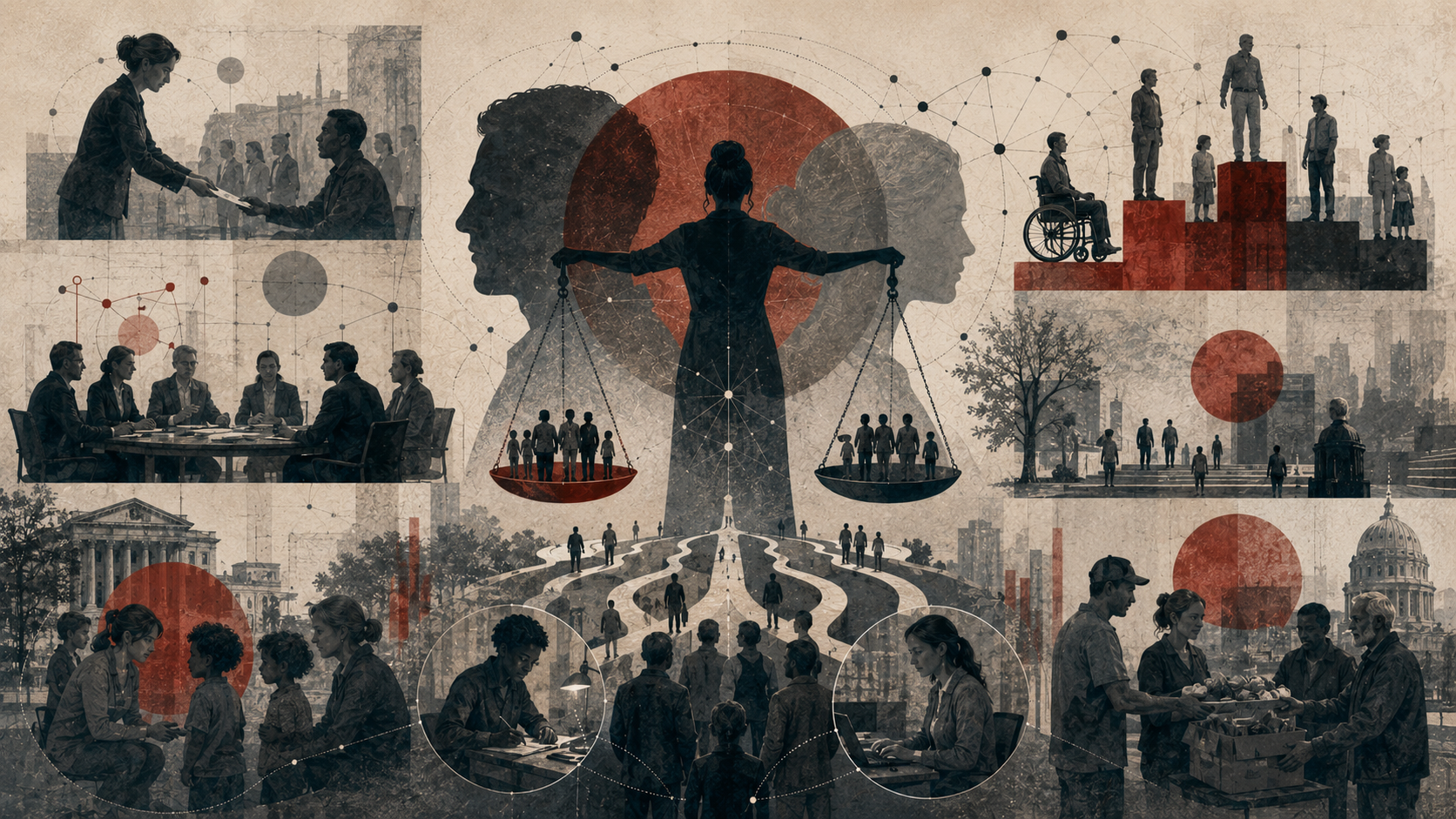
Distribution matters because every society must decide how to allocate goods that people need, value, and contest. Food, land, wages, wealth, health care, education, housing, safety, public risk, time, authority, recognition, legal protection, environmental burden, and political voice are all distributed through families, markets, states, institutions, customs, histories, and policies. These distributions are not morally neutral. They determine whose lives are made easier, whose lives are made precarious, whose needs count, whose labor is recognized, whose suffering is treated as urgent, and whose disadvantages are dismissed as personal failure.
Fairness is therefore one of the places where moral psychology becomes inseparable from political and institutional life. People make fairness judgments when children divide toys, coworkers split tasks, families distribute care responsibilities, universities allocate admissions, employers set wages, governments tax wealth, states design welfare systems, and societies decide whether historical injustice requires repair. Distributive moral judgment links everyday psychology to the deepest questions of social order.
What Justice, Fairness, and Distributive Judgment Are
Justice is the broad moral and political question of what people are owed and how institutions should treat them. It concerns rights, duties, equality, freedom, recognition, procedure, punishment, repair, opportunity, and the ethical structure of common life. Fairness is often the more psychologically immediate register of that question: whether an allocation, rule, procedure, outcome, or burden feels acceptable, balanced, impartial, proportionate, respectful, or legitimate. Distributive moral judgment is the process through which people evaluate the allocation of goods, burdens, opportunities, rewards, risks, status, or responsibilities and decide what principle should govern the distribution.
These concepts overlap but are not identical. Fairness judgments may track genuine moral insight, but they may also be shaped by self-interest, group bias, convention, ideology, local custom, institutional framing, or selective attention. Likewise, a theory of distributive justice may offer a principled standard that many people do not spontaneously endorse. Moral psychology becomes strongest when it keeps the distinction visible between normative justice and empirical fairness while also studying how the two interact.
Distributive moral judgment is not limited to material goods. People also distribute honor, blame, time, care, attention, voice, authority, credibility, opportunity, risk, and respect. A society can be unjust not only because wealth is unequal, but because certain groups are denied standing, credibility, security, political voice, protection, or recognition. Fairness therefore concerns both what people receive and how they are regarded in the process of distribution.
Distributive judgment also operates at several scales. At the interpersonal level, people judge whether a friend contributed enough, whether a child received a fair share, or whether a coworker deserves credit. At the institutional level, people judge wages, admissions, benefits, health care, taxation, housing, legal burden, workplace promotion, public investment, and social welfare. At the historical level, they judge inherited disadvantage, reparative justice, land, colonization, racial inequality, caste, gendered labor, disability access, and intergenerational wealth. Each scale activates fairness, but not always the same fairness principle.
| Concept | Core question | Moral-psychological concern |
|---|---|---|
| Justice | What are persons owed, and how should institutions treat them? | Links moral judgment to rights, institutions, social structure, and public responsibility. |
| Fairness | Does this allocation, procedure, or outcome seem acceptable and legitimate? | Captures people’s lived perception of equality, reciprocity, need, desert, and respect. |
| Distributive judgment | Who should receive what, and according to which principle? | Reveals how people weigh equality, equity, need, merit, desert, and self-interest. |
| Procedural justice | Was the decision process impartial, transparent, consistent, and respectful? | Shows that fair process can shape acceptance of unequal outcomes. |
| Recognition | Whose claims, needs, labor, and standing are treated as morally real? | Shows that distribution is also about dignity, respect, and social visibility. |
Why Distribution Matters Morally
Distribution matters morally because social life is never neutral with respect to who receives advantages, who bears burdens, who is left vulnerable, and whose needs are treated as urgent or marginal. Questions of income, health, education, punishment, recognition, aid, labor, housing, environmental exposure, public safety, and social risk all involve distribution. Even small everyday interactions involve distributive judgment: how credit is assigned, how workloads are shared, how resources are divided, how care is allocated, and how unequal claims are justified.
This is why distributive judgment sits at the boundary of personal morality and political philosophy. It concerns both intimate fairness and large-scale institutions. People reason about fairness when dividing food, splitting work, disciplining children, rewarding effort, or debating tax systems and social welfare. A psychology of justice must therefore move between micro-level and macro-level allocation problems rather than treating them as unrelated.
Distribution also matters because unequal allocation shapes moral agency itself. People who lack food, health care, education, safety, housing, or political voice do not merely receive fewer goods; they face constrained life possibilities. Unequal distribution can affect what people are able to choose, how they are seen by others, whether their labor is valued, whether they can participate in public life, and whether they can protect themselves from exploitation. Distributive injustice therefore becomes a condition that shapes later responsibility, opportunity, achievement, and social trust.
Fairness judgments often become morally intense because distribution is tied to dignity. A person may object not only because they received less, but because the allocation communicates that they matter less. A worker may feel wronged by unequal pay because it signals disrespect for labor. A patient may feel abandoned by unequal health access because it communicates that their life is less protected. A child may object to unfair division because the distribution appears to deny equal concern. Distributive judgment is therefore never only arithmetic. It is moral communication.
| Distribution domain | What is allocated | Why it matters morally |
|---|---|---|
| Economic life | Income, wealth, wages, ownership, security, opportunity | Shapes freedom, vulnerability, power, dignity, and future life chances. |
| Health and care | Treatment, prevention, attention, access, public-health burden | Determines whose suffering is treated as urgent and whose life is protected. |
| Education | Resources, instruction, admissions, support, recognition | Shapes capability, mobility, civic participation, and inherited advantage. |
| Work and institutions | Credit, workload, promotion, risk, authority, pay | Determines whether contribution, need, effort, and dignity are respected. |
| Public risk | Pollution, policing, climate exposure, infrastructure failure, disaster burden | Reveals whose bodies and communities are treated as acceptable sites of harm. |
Distributive Justice as a Normative Problem
In political philosophy, distributive justice concerns the moral principles that should guide the distribution of benefits and burdens generated by economic and social institutions. Classic statements of the problem ask whether justice should prioritize equality, liberty, need, welfare, merit, desert, fair opportunity, social minimums, capabilities, priority to the worse off, or the correction of historical injustice. They also ask whether justice concerns only outcomes or also the structure of the processes that produce those outcomes.
This normative tradition matters for moral psychology because people’s fairness judgments often reflect partial, unstable, or mixed versions of these same principles. Someone may endorse equality in one context, merit in another, and need in a third. A person may believe that effort should be rewarded but also that severe deprivation should be relieved regardless of contribution. Another may believe that equal opportunity matters more than equal outcome, while disagreeing sharply about what equal opportunity actually requires. Psychological work helps explain why distributive intuitions are plural and context-sensitive, even when people speak as if fairness were a single simple idea.
Distributive justice is also a question about institutions, not only individual generosity. Charity can relieve suffering, but justice asks how social arrangements produce need, advantage, dependency, and exclusion in the first place. A fair distribution cannot be evaluated only by looking at final shares. It must also ask how those shares were produced, whether people had meaningful opportunity, whether burdens were imposed without voice, whether some groups were excluded from the system, and whether historical injustices continue to structure present outcomes.
Normative theories of justice therefore provide a vocabulary that moral psychology needs but cannot replace. Psychology can show how people reason about fairness, but it cannot by itself establish which distributive principle is morally correct. Philosophy can clarify principles, but it cannot ignore how actual human beings perceive, resist, distort, rationalize, or institutionalize those principles in practice. A serious treatment of justice must hold both together.
| Normative principle | Core idea | Psychological tension |
|---|---|---|
| Equality | People should receive the same share or equal standing. | People may support equality in principle but resist it when it reduces personal advantage. |
| Equity | People should receive in proportion to contribution, effort, or productivity. | People disagree about what counts as contribution and whether unequal starting points matter. |
| Need | Those who are more vulnerable or deprived should receive priority. | People may support need-based aid while also judging recipients through deservingness narratives. |
| Desert | People should receive what they deserve based on conduct, merit, or responsibility. | People often overestimate individual control and underestimate structural constraint. |
| Priority to the worse off | Justice should give special weight to improving the position of the least advantaged. | People may disagree about whether this is fairness, favoritism, repair, or redistribution. |
| Fair opportunity | Positions and life chances should not be determined by arbitrary birth advantage. | People may endorse opportunity while ignoring the institutional depth required to make it real. |
Fairness as a Psychological Capacity
Fairness is also a psychological capacity: the ability to detect unequal treatment, evaluate distributions, protest disadvantage, recognize reciprocity, compare outcomes, and sometimes reject personally advantageous allocations on principle. Developmental and experimental work suggests that fairness concerns emerge early and become more differentiated over time. Infants, children, adolescents, and adults do not all reason about fairness in the same way, but fairness appears to be a recurring feature of human social cognition rather than a late intellectual add-on.
This does not mean fairness is fully formed from the beginning. The strongest picture is developmental and layered. Early fairness expectations and inequity aversion become reorganized through learning, testimony, culture, institutional experience, moral education, and changing conceptions of equality, effort, need, contribution, and respect. Distributive moral judgment is therefore neither purely innate nor purely imposed. It is a developing human capacity shaped by social worlds.
Fairness psychology also involves emotion. People feel anger at unfairness, resentment when disadvantaged, guilt when advantaged unfairly, pride in generosity, shame in exploitation, and indignation when others are mistreated. These emotions help make fairness motivational. They can move people to protest, share, punish cheaters, compensate victims, or defend norms. But they can also become selective. People may react intensely to unfairness against themselves or their ingroup while remaining indifferent to unfairness affecting distant or stigmatized others.
Fairness is also comparative. People often judge fairness by comparing what they received to what others received, what they contributed, what they expected, what they were promised, and what they believe people like them usually receive. This comparative structure makes fairness sensitive to framing. The same allocation may appear fair or unfair depending on the reference group, the explanation provided, the procedure used, and the social meaning attached to the distribution.
| Psychological feature | Fairness function | Possible distortion |
|---|---|---|
| Inequality detection | Notices when shares, rewards, or burdens differ. | May focus on visible inequality while ignoring hidden structural advantage. |
| Reciprocity tracking | Connects contribution, effort, and return. | May mistake luck, privilege, or inherited advantage for earned contribution. |
| Need recognition | Identifies vulnerability and urgent deprivation. | May be suppressed by deservingness judgments or stigma. |
| Emotional reaction | Motivates protest, sharing, punishment, or repair. | May become selective, self-serving, or group-biased. |
| Reference comparison | Uses expectations and social comparison to judge fairness. | May normalize injustice if unequal baselines are treated as natural. |
Equality, Equity, Need, and Desert
Much of distributive moral judgment can be understood through recurring principles. Equality gives persons the same share or treats them as entitled to the same standing. Equity allocates in proportion to contribution, effort, productivity, sacrifice, or role. Need gives priority to those who lack essentials or are more vulnerable. Desert links allocation to what a person is said to deserve, whether because of effort, conduct, virtue, responsibility, or achievement. Real distributive judgments often involve conflicts among these principles rather than exclusive commitment to just one.
This plurality matters because fairness is not exhausted by equal division. People may favor strict equality when status is at stake, equity when reward follows contribution, and need when survival or serious deprivation is involved. A classroom may divide snacks equally, award grades by performance, and offer extra support to students who are struggling. A society may speak of equal citizenship, reward labor through wages, provide health care based on need, and impose taxes based on ability to pay. Distributive judgment requires deciding not only how much to give, but which principle is fitting to the case.
Equality is morally powerful because it expresses equal standing. It resists hierarchy, privilege, exclusion, and the idea that some people matter less. Equity is morally powerful because it recognizes effort, responsibility, contribution, and proportionality. Need is morally powerful because it recognizes vulnerability and the urgency of deprivation. Desert is morally powerful because it connects distribution to agency, responsibility, and accountability. The difficulty is that each principle can also be distorted. Equality can ignore relevant difference. Equity can reward advantage disguised as effort. Need can be stigmatized as dependency. Desert can become a moralized defense of inequality.
Distributive judgment is therefore a practice of moral fittingness. The question is not simply which principle is always best. The question is which principle is morally appropriate under which conditions, and how competing principles should be balanced when they conflict. That balancing process is one reason fairness disagreements are so durable. People may agree that fairness matters while disagreeing sharply about which fairness principle governs the case.
| Principle | Allocation rule | When it seems compelling | When it may fail |
|---|---|---|---|
| Equality | Give the same share or same standing to each person. | When equal respect, equal citizenship, or equal baseline entitlement is central. | When people have different needs, contributions, risks, or repair claims. |
| Equity | Allocate according to contribution, effort, or productivity. | When people voluntarily contribute different amounts under fair conditions. | When unequal starting points make contribution appear more deserved than it is. |
| Need | Give more to those who are more vulnerable or deprived. | When survival, capability, dignity, or serious harm is at stake. | When need is stigmatized, manipulated, or disconnected from structural analysis. |
| Desert | Allocate according to what people are said to deserve. | When responsibility, effort, wrongdoing, or achievement is morally relevant. | When luck, inherited advantage, exclusion, or social structure are ignored. |
| Priority | Give special weight to improving the position of the worse off. | When inequality leaves some people below conditions of dignity or capability. | When people treat priority as unfair favoritism rather than justice or repair. |
Inequity Aversion and Fairness Reactions
Inequity aversion is one of the central empirical concepts in the psychology of fairness. It refers to negative reactions to unequal outcomes, whether disadvantageous inequality, where the self receives less than another, or advantageous inequality, where the self receives more than another. Work in judgment, decision-making, behavioral economics, and developmental psychology distinguishes these two forms because they do not arise identically and may reflect different layers of fairness concern. Disadvantageous inequity aversion can be partly self-protective, while advantageous inequity aversion is often treated as stronger evidence of fairness-oriented motivation.
This distinction matters because moral psychology must separate resentment at losing from principled opposition to inequality as such. People may reject unfairness when they are disadvantaged but tolerate or rationalize it when it benefits them. A more demanding fairness psychology therefore asks when people are willing to resist inequality even at cost to themselves. The willingness to reject an undeserved advantage reveals a different moral structure from the willingness to protest personal disadvantage.
Inequity aversion also has social functions. It can help regulate cooperation by discouraging exploitation, free riding, unfair advantage, and unequal burden. If people protest unfair distributions, groups may become more stable. But inequity aversion can also be narrow. People may object to inequality in small visible interactions while accepting large structural inequalities as normal. They may be more sensitive to unfairness within their own group than to unfairness across class, race, caste, gender, citizenship, disability, or global position.
Fairness reactions therefore require interpretation. A person rejecting an unequal split may be defending justice, protecting self-interest, enforcing reciprocity, performing moral identity, or responding to a norm violation. A society objecting to redistribution may be defending liberty, protecting advantage, distrusting institutions, or applying desert narratives. Distributive moral psychology asks what principle, emotion, and social meaning are operating in each case.
| Fairness reaction | What it detects | Moral interpretation |
|---|---|---|
| Disadvantageous inequity aversion | The self receives less than another person. | May reflect fairness concern, self-protection, status defense, or resentment. |
| Advantageous inequity aversion | The self receives more than another person. | Often suggests stronger impartial fairness concern or discomfort with undeserved advantage. |
| Third-party fairness concern | Others receive unequal treatment. | Shows fairness concern beyond immediate self-interest, though still shaped by identity and distance. |
| Procedural fairness concern | The process appears biased, opaque, arbitrary, or disrespectful. | Shows that people care about decision-making structure, not only final outcome. |
| Status fairness concern | An allocation communicates lower standing or disrespect. | Shows that fairness is also about dignity and recognition. |
Impartiality, Self-Interest, and Bias
Distributive moral judgment is rarely fully impartial. People tend to evaluate distributions more favorably when they benefit from them and more harshly when they are disadvantaged. This is one of the most important realities for fairness research because it shows that distributive judgment often mixes principle with motivated reasoning. What looks like a theory of justice may, under pressure, become a rationalization of one’s own advantage.
Self-interest bias does not mean people are incapable of fairness. It means impartiality is effortful, fragile, and often contested by personal stake. People may sincerely believe they are applying a neutral principle while unconsciously selecting the principle that favors them. A person who has more may emphasize merit, effort, and desert. A person who has less may emphasize need, equality, or structural unfairness. Neither emphasis is automatically false, but both can become self-protective when used selectively.
This is why philosophical devices such as impartial spectators, veil-of-ignorance reasoning, or original-position thought experiments remain psychologically interesting even when they are normative constructs. They dramatize how much ordinary judgment is shaped by perspective and stake. If people do not know whether they will be rich or poor, healthy or sick, able-bodied or disabled, advantaged or marginalized, they may reason differently about distributive principles. Such devices attempt to reduce the distorting force of self-position.
Bias also operates through group identity. People may interpret benefits to their own group as earned while interpreting benefits to others as favoritism. They may see inequality favoring their group as natural and inequality disadvantaging their group as injustice. They may trust institutions that protect their advantage and distrust institutions that challenge it. Distributive judgment is therefore not only individual self-interest; it is also group-position reasoning.
| Bias source | How it affects distributive judgment | Corrective discipline |
|---|---|---|
| Self-interest | People favor principles that preserve their own advantage. | Ask whether the principle would still seem fair from another position. |
| Group identity | Benefits to the ingroup appear more deserved or legitimate. | Apply consistent standards across groups and examine selective empathy. |
| Status quo bias | Existing distributions appear natural or deserved. | Ask how the distribution was produced and who benefits from treating it as neutral. |
| Deservingness narratives | People explain poverty or privilege through character rather than structure. | Distinguish responsibility, luck, exclusion, inherited advantage, and opportunity. |
| Institutional trust bias | Trusted institutions are assumed to distribute fairly. | Evaluate procedures, outcomes, transparency, and affected communities’ testimony. |
Children, Development, and Distributive Fairness
Developmental research shows that fairness concerns emerge early and become more sophisticated with age. Children come to distinguish and apply distributive principles in increasingly differentiated ways. Preschool-aged children can often take merit into account, even though equal division is often strongly preferred in third-party tasks. Over time, children learn to consider need, effort, contribution, intention, group membership, social norms, testimony, and the meaning of equal respect.
This developmental literature is important because it shows that distributive morality is not simply taught as a finished doctrine. Children actively interpret fairness, revise their judgments, and respond to explanation, stories, correction, and participation in social life. They learn not only that some divisions are equal, but why equal division may be fitting in one case and unfair in another. They learn when effort matters, when need matters, when age matters, when turn-taking matters, and when adult authority is legitimate or arbitrary.
Development also reveals the layered nature of fairness. A young child may object strongly to unequal shares. Later, the same child may learn that unequal shares can be fair when one person contributed more, needs more, or was previously excluded. Later still, adolescents and adults may reason about structural inequality, inherited advantage, historical repair, procedural legitimacy, and social standing. Fairness development therefore moves from simple comparison toward increasingly contextual judgment, though simple comparison never disappears.
Children also learn fairness in unequal worlds. They absorb what adults normalize. If some groups are consistently served first, believed more readily, punished less harshly, paid more, protected more, or treated as more deserving, children learn distributive expectations from practice as well as speech. Developmental fairness psychology must therefore study not only children’s abstract judgments, but the social environments that teach them which inequalities are visible and which are made to seem natural.
| Developmental stage | Common fairness concern | Expanding judgment capacity |
|---|---|---|
| Early childhood | Equal shares, turn-taking, visible inequality | Begins to notice unfair advantage and unequal treatment. |
| Middle childhood | Merit, effort, contribution, rule-following | Begins to distinguish equal division from fair division. |
| Adolescence | Need, identity, group fairness, institutional rules | Can reason more explicitly about social norms, inequality, and legitimacy. |
| Adulthood | Policy, structural inequality, historical responsibility, social welfare | Can integrate institutions, ideology, economics, and moral principle. |
| Lifespan development | Fairness learning across changing roles and responsibilities | Judgment shifts with parenthood, work, civic role, aging, care, and vulnerability. |
Group Membership, Politics, and Fairness
Fairness judgments are shaped by group identity, culture, and politics. People often disagree not only because they have different facts, but because they weight equality, merit, need, liberty, reciprocity, responsibility, and group obligation differently. Political conflict over redistribution is therefore often a conflict among competing fairness models rather than a conflict between fairness and no fairness at all.
Group membership complicates distributive judgment because people may apply more generous or more punitive standards depending on whether recipients are perceived as ingroup members, outgroup members, deserving contributors, free riders, vulnerable dependents, citizens, strangers, victims, competitors, or threats. The same benefit may be interpreted as rightful support when directed toward “people like us” and as unfair favoritism when directed toward “people like them.” Fairness is thus socially patterned, not only individually reasoned.
Politics intensifies these dynamics because distribution is tied to identity and institutional trust. People’s views about taxation, welfare, public health, education, housing, wages, reparations, and social insurance are shaped by beliefs about deservingness, government legitimacy, individual responsibility, structural inequality, national belonging, race, class, gender, religion, immigration, disability, and historical memory. A policy debate is rarely only a technical dispute about resources. It is usually a moral dispute about who counts, who contributes, who deserves, and who owes.
Cross-cultural variation adds another layer. Some moral worlds place stronger emphasis on individual liberty and earned reward. Others place stronger emphasis on family obligation, communal solidarity, social harmony, public responsibility, religious duty, or need-based support. These differences should not be reduced to stereotypes, because every society contains internal disagreement. But they remind us that fairness is not a single universal script applied identically everywhere.
| Social factor | How it shapes fairness | Example distributive tension |
|---|---|---|
| Ingroup membership | Recipients seen as “us” may be judged more deserving or trustworthy. | Aid to one’s own community is seen as solidarity; aid to outsiders is seen as unfair burden. |
| Political ideology | Different ideologies emphasize liberty, equality, desert, hierarchy, need, or tradition differently. | Redistribution is seen as justice by one group and coercive taking by another. |
| Institutional trust | People support distributive policies more when institutions seem legitimate. | Welfare programs may be opposed because of distrust rather than lack of concern for need. |
| Deservingness narratives | Recipients are judged through stories about effort, dependency, virtue, or blame. | Poverty is framed either as structural injustice or individual failure. |
| Historical memory | Past injustice shapes current claims to repair or priority. | Reparative policies are seen as correction by some and unfair preference by others. |
Institutions, Policy, and Distributive Judgment
Distributive moral judgment becomes politically decisive when it moves from small-group allocation to institutional design. Tax systems, wages, health coverage, education funding, welfare programs, workplace compensation, housing policy, climate adaptation, disaster relief, public safety, infrastructure, and public burdens all rely on implicit or explicit distributive principles. Psychological responses to these policies are shaped not only by outcomes but by perceived procedure, legitimacy, deservingness, transparency, group identity, and social meaning.
This is one reason justice and fairness cannot be cleanly separated into “philosophy” and “psychology.” Institutions both reflect and reshape moral judgment. Public policy debates teach citizens what counts as earned, what counts as unfair privilege, which needs are recognized as legitimate, which forms of suffering deserve public response, and whose burdens are treated as private misfortune. A moral psychology of distribution must therefore study both intuitive allocation decisions and the larger institutional narratives that organize them.
Institutions also distribute moral visibility. They decide which data are collected, which harms are counted, which groups are eligible, which burdens are measurable, which claims require documentation, and which forms of need remain hidden. A benefit system may appear fair by applying the same rule to everyone while ignoring unequal access to documentation, transportation, legal knowledge, language, time, or trust. A workplace may appear meritocratic while rewarding those whose prior advantages made visible performance easier. Institutions can therefore make inequality look deserved by filtering which facts enter the fairness judgment.
Distributive policy also depends on procedural fairness. People may accept unequal outcomes more readily when procedures appear transparent, consistent, participatory, and respectful. Conversely, even generous outcomes may provoke distrust if decisions appear arbitrary, corrupt, humiliating, opaque, or politically selective. Institutions must therefore attend not only to who receives what, but how decisions are made and how affected people are treated in the process.
| Institutional domain | Distributive question | Moral-psychological issue |
|---|---|---|
| Taxation | Who should contribute, and according to what capacity? | People weigh public obligation, liberty, merit, distrust, and perceived burden. |
| Health care | Who receives care, prevention, treatment, and protection? | Need-based allocation conflicts with market, merit, citizenship, and cost narratives. |
| Education | How should opportunity and support be distributed? | Equal access may require unequal investment where starting points differ. |
| Workplace compensation | How should pay, promotion, credit, and risk be allocated? | Merit judgments may hide unequal opportunity, bias, care burden, and social capital. |
| Public infrastructure | Which communities receive protection, investment, and repair? | Historical neglect may make equal current allocation insufficient. |
Merit, Desert, and the Problem of Starting Points
Merit and desert are powerful distributive ideas because they seem to connect allocation to agency. People often believe that those who work harder, contribute more, sacrifice more, create more value, or act more responsibly should receive more reward. This intuition is not trivial. It supports accountability, motivation, reciprocity, and recognition of contribution. A social order that ignores effort entirely may appear disrespectful to labor and responsibility.
The difficulty is that visible merit is rarely produced under equal starting conditions. Talent, education, family support, health, safety, wealth, neighborhood, discrimination, disability, social capital, immigration status, nutrition, childhood stress, exposure to violence, and inherited opportunity all shape what people are able to do. When these background conditions disappear from view, advantage can be mistaken for virtue and disadvantage for failure. Desert judgments become morally dangerous when they treat unequal outcomes as if they were produced only by individual choice.
This is one of the most important problems in distributive moral psychology. People often reason from outcomes back to character. Success is interpreted as evidence of merit; poverty is interpreted as evidence of poor effort; authority is interpreted as evidence of competence; low status is interpreted as evidence of deficiency. Such judgments can stabilize inequality by turning social structure into moral biography. A person’s position in the distribution becomes evidence that they deserved that position.
A more serious account does not abandon merit altogether. It asks what conditions make merit meaningful. If people are to be rewarded for contribution, they must have genuine opportunity to develop and express contribution. If desert is to matter, the society must ask how much of visible achievement reflects effort and how much reflects inherited advantage, exclusion, luck, or institutional design. Merit without attention to starting points becomes a moral mask for inequality.
| Merit/desert claim | Why it is morally attractive | Critical question |
|---|---|---|
| Reward effort | Recognizes agency, discipline, sacrifice, and responsibility. | Who had the conditions necessary to convert effort into visible achievement? |
| Reward contribution | Links benefit to value created for others. | Who defines contribution, and which forms of labor are made invisible? |
| Reward skill | Recognizes developed competence and excellence. | Who had access to training, safety, time, mentorship, and opportunity? |
| Assign burden to responsibility | Connects consequence to agency and accountability. | How much control did the person really have over the relevant condition? |
| Protect earned reward | Resists arbitrary taking and disrespect for work. | What portion of reward depends on public goods, inherited advantage, and social cooperation? |
Need, Vulnerability, and Priority to the Worse Off
Need is one of the most morally powerful distributive principles because it responds to vulnerability rather than contribution alone. A person who lacks food, shelter, care, safety, medicine, education, or protection may have a strong moral claim even if they did not earn assistance through contribution. Need-based reasoning recognizes that dignity, life, health, capability, and participation require material and social conditions. Without those conditions, formal equality can become hollow.
Need also challenges narrow meritocracy. If justice concerned only reward for contribution, people with severe disability, illness, childhood deprivation, displacement, old age, caregiving burden, or structural exclusion could be treated as less claim-worthy because they produce less visible market value. Need-based justice rejects that conclusion. It says that moral standing does not depend entirely on productivity. Persons may be owed care because they are persons, because they are vulnerable, because they have been harmed, or because social life is organized through mutual dependence.
Priority to the worse off is related but distinct. It does not merely say that need matters. It says that improving the condition of those who are worst off has special moral urgency. This principle can appear compelling when inequality leaves some people below thresholds of dignity, capability, or secure participation. It can also be politically contested because people may interpret priority as unfair preference, undeserved redistribution, or violation of equal treatment. Moral psychology helps explain why need-based and priority-based claims can be morally compelling to some and threatening to others.
Need judgments are also vulnerable to stigma. People may divide the needy into the deserving and undeserving, the innocent and blameworthy, the hardworking and dependent, the local and foreign, the respectable and suspect. These distinctions can sometimes track morally relevant agency, but they can also reproduce class, racial, gendered, ableist, national, or religious hierarchies. A serious psychology of need must therefore examine not only whether people recognize vulnerability, but whose vulnerability is treated as legitimate.
| Need-based concern | Moral claim | Common distortion |
|---|---|---|
| Basic survival | People need food, shelter, care, medicine, and safety to live with dignity. | Need is treated as personal failure rather than public responsibility. |
| Capability | People need real conditions for agency, learning, work, and participation. | Formal opportunity is mistaken for real opportunity. |
| Vulnerability | Those exposed to greater risk may deserve greater protection. | Vulnerability is stigmatized as weakness, dependency, or irresponsibility. |
| Historical disadvantage | Past injustice may create present claims to repair or priority. | Repair is misread as unfair preference detached from history. |
| Mutual dependence | Human life depends on care, support, and shared institutions. | Productivity is treated as the only basis for social worth. |
Justice, Fairness, and Moral Pluralism
One of the most important lessons of distributive moral psychology is that fairness judgment is plural. People do not rely on a single fairness rule in all contexts, and this may not be a flaw. Different allocation problems may genuinely call for different principles. Equal respect may be primary in one setting, merit in another, need in another, priority to the disadvantaged in another, and repair for historical injustice in another. Moral pluralism therefore helps explain both the richness and the instability of fairness judgments.
At the same time, pluralism creates moral and political difficulty. If multiple principles are plausible, disagreement over distribution may persist even among people acting in good faith. One person may see a policy as equality; another as unfair leveling. One may see aid as need-based justice; another as reward without contribution. One may see reparative distribution as historical accountability; another as present-day unfairness. Moral psychology helps here not by eliminating disagreement, but by clarifying which principles are in conflict and why certain people find some principles more salient than others.
Pluralism also means distributive judgment must be context-sensitive. Equal division may be fair when people have equal claim and no relevant difference. Equity may be fair when people contributed differently under fair conditions. Need may be fair when vulnerability is morally urgent. Desert may be fair when responsibility and opportunity are clear. Priority may be fair when some persons are badly disadvantaged. Repair may be fair when present distributions are shaped by past wrong. A single rule applied blindly can become unjust.
The challenge is that pluralism can be abused. Powerful groups may invoke merit when merit favors them and equality when repair threatens them. Institutions may invoke procedure when outcomes are unequal and outcomes when procedure is challenged. Individuals may invoke desert when others need help and need when they themselves are vulnerable. Pluralism therefore requires intellectual honesty. It must name which principle is being used, why it fits the case, what it obscures, and who benefits from its selection.
| Fairness principle | Fitting context | Pluralist caution |
|---|---|---|
| Equality | When persons have equal claim, equal standing, or equal baseline entitlement. | Equal treatment may be unjust when starting points or needs differ dramatically. |
| Equity | When contribution varies under fair and transparent conditions. | Contribution may reflect unequal opportunity, hidden labor, or inherited advantage. |
| Need | When deprivation, vulnerability, or basic capability is at stake. | Need can be stigmatized or judged through biased deservingness narratives. |
| Desert | When agency, responsibility, effort, or conduct is clearly relevant. | Desert can ignore luck, structure, coercion, and unequal opportunity. |
| Repair | When present distribution is shaped by past or ongoing injustice. | Repair requires historical truth and should not be reduced to symbolic preference. |
What Distributive Judgment Does Not Settle
Distributive judgment does not by itself settle the whole of justice. Questions of liberty, recognition, procedure, rights, domination, punishment, democracy, historical repair, and institutional legitimacy also matter. A distribution may be materially equal but procedurally coercive. A distribution may reward contribution while ignoring background injustice. A distribution may meet basic needs while denying political voice. A society may provide benefits while withholding recognition or dignity. Justice includes distribution, but it is not reducible to distribution alone.
Nor does an intuitive sense of fairness always yield a just outcome. Fairness intuitions can be narrow, biased, status-protective, culturally inherited, self-serving, or inattentive to structural conditions that shape what looks deserved in the first place. People may sincerely feel that an unequal distribution is fair because they have learned to see privilege as merit, poverty as failure, unpaid care as natural, exclusion as tradition, or public responsibility as undeserved transfer. Moral intuition requires examination, not automatic trust.
Distributive judgment also cannot settle empirical questions by itself. A person may endorse need-based allocation but be wrong about who is in need. A person may endorse merit but misunderstand how merit was produced. A person may endorse equal opportunity but underestimate unequal schooling, health, housing, discrimination, or inherited wealth. Moral psychology must therefore work with sociology, economics, history, law, public health, political theory, and institutional analysis. Fairness judgments depend on facts about social conditions.
This is why empirical moral psychology and normative justice theory need each other. Psychology shows how people actually think about fairness, but it cannot by itself determine which distributive principle is morally best. Philosophy offers standards, but it cannot ignore how human beings perceive, resist, or distort those standards in practice. A serious account of distributive justice requires normative clarity, empirical realism, institutional analysis, and moral attention to those most affected by distribution.
| Distributive judgment cannot settle… | Why not? | Additional question needed |
|---|---|---|
| The whole of justice | Justice also involves liberty, rights, recognition, procedure, domination, and repair. | Are people treated as equal moral and political agents? |
| The facts of need or merit | Fairness judgments depend on empirical claims that may be false or incomplete. | What social, historical, and institutional facts shape the distribution? |
| The legitimacy of procedure | A fair-looking outcome may arise from coercive or exclusionary processes. | Who had voice, transparency, appeal, and protection? |
| The meaning of desert | Desert judgments often hide luck, inherited advantage, and structural constraint. | What did the person control, and what did they inherit? |
| The demands of repair | Present shares may be shaped by past injustice. | What history must be acknowledged before fairness can be assessed? |
Mathematical Lens: Modeling Distributive Moral Judgment
Distributive moral judgment can be modeled as the weighted evaluation of competing fairness principles. Let \(J_i\) represent person \(i\)’s distributive judgment regarding a given allocation:
J_i = \alpha E_i + \beta Q_i + \gamma N_i + \delta D_i – \lambda S_i
\]
Interpretation: Distributive judgment is modeled as a weighted combination of equality, equity, need, desert, and self-interest bias. The negative term represents the way self-interest can suppress impartial fairness judgment.
where \(E_i\) is the weight placed on equality, \(Q_i\) on equity or contribution, \(N_i\) on need, \(D_i\) on desert, and \(S_i\) on self-interest bias. This captures the core idea that fairness judgments often combine multiple principles rather than reflecting one pure norm.
Inequity aversion can be modeled as a response to unequal outcomes:
I_i = \theta_1 U_i^{-} + \theta_2 U_i^{+}
\]
Interpretation: Inequity aversion is modeled as a response to disadvantageous inequity and advantageous inequity. A higher weight on advantageous inequity suggests stronger willingness to object to inequality even when it benefits the self.
where \(U_i^{-}\) is disadvantageous inequity and \(U_i^{+}\) is advantageous inequity. If \(\theta_2\) is high, the person is more willing to reject inequality even when it benefits the self, which is often stronger evidence of impartial fairness concern.
A context-sensitive model can represent shifts across cases:
J_{ij} = \alpha_i E_{ij} + \beta_i Q_{ij} + \gamma_i N_{ij} + \delta_i D_{ij} + \varepsilon_{ij}
\]
Interpretation: Distributive judgment varies by context. A person may weight equality, equity, need, and desert differently depending on whether the case emphasizes effort, vulnerability, social status, historical repair, or equal respect.
Institutional distributive legitimacy can also be modeled:
L_g = \omega_1 O_g + \omega_2 P_g + \omega_3 R_g – \omega_4 B_g
\]
Interpretation: Legitimacy rises when outcomes, procedures, recognition, and transparency are strong, and falls when bias, exclusion, or self-serving allocation are high.
where \(L_g\) is perceived distributive legitimacy for group or institution \(g\), \(O_g\) is outcome fairness, \(P_g\) is procedural fairness, \(R_g\) is recognition of standing and need, and \(B_g\) is bias or unequal treatment. This model emphasizes that people judge distributions not only by final shares, but by process and recognition.
| Model term | Meaning | Moral interpretation |
|---|---|---|
| \(E_i\) | Equality weight | Concern for same shares, equal standing, or equal baseline entitlement. |
| \(Q_i\) | Equity weight | Concern for contribution, effort, productivity, or proportionality. |
| \(N_i\) | Need weight | Concern for vulnerability, deprivation, or urgency. |
| \(D_i\) | Desert weight | Concern for responsibility, merit, conduct, or deserved reward. |
| \(S_i\) | Self-interest bias | The degree to which personal advantage distorts impartial judgment. |
| \(U_i^{-}\) | Disadvantageous inequity | Unfairness experienced when the self receives less. |
| \(U_i^{+}\) | Advantageous inequity | Unfairness experienced when the self receives more than another. |
| \(L_g\) | Distributive legitimacy | Overall perceived justice of institutional allocation. |
R Workflow: Modeling Justice, Fairness, and Distributive Preferences
The following R workflow simulates how equality, equity, need, desert, self-interest bias, procedural trust, and group distance shape distributive judgments. The dataset is synthetic and intended for reproducible article support, not empirical claims about real persons, institutions, policies, or communities.
# Justice, Fairness, and Distributive Moral Judgment
# Synthetic R workflow for modeling distributive moral preferences.
# Educational and reproducible research scaffold only.

suppressPackageStartupMessages({
  library(tidyverse)
  library(broom)
})

set.seed(42)

# ------------------------------------------------------------
# 1. Set up output folders
# ------------------------------------------------------------

dir.create("outputs", showWarnings = FALSE)
dir.create("outputs/tables", recursive = TRUE, showWarnings = FALSE)
dir.create("outputs/figures", recursive = TRUE, showWarnings = FALSE)

# ------------------------------------------------------------
# 2. Simulate distributive-judgment structure
# ------------------------------------------------------------

n <- 2400

df <- tibble(
  case_id = 1:n,
  equality_weight = rnorm(n, 0, 1),
  equity_weight = rnorm(n, 0, 1),
  need_weight = rnorm(n, 0, 1),
  desert_weight = rnorm(n, 0, 1),
  priority_worse_off = rnorm(n, 0, 1),
  self_interest_bias = rnorm(n, 0, 1),
  procedural_trust = rnorm(n, 0, 1),
  group_distance = rnorm(n, 0, 1),
  historical_repair_salience = rnorm(n, 0, 1)
) %>%
  mutate(
    distributive_judgment =
      0.30 * equality_weight +
      0.25 * equity_weight +
      0.25 * need_weight +
      0.20 * desert_weight +
      0.25 * priority_worse_off -
      0.35 * self_interest_bias +
      0.20 * procedural_trust -
      0.20 * group_distance +
      0.20 * historical_repair_salience +
      rnorm(n, 0, 0.8),

    support_fair_allocation =
      if_else(distributive_judgment > 0, 1, 0),

    inequity_aversion =
      0.45 * abs(equality_weight) +
      0.30 * need_weight -
      0.25 * self_interest_bias +
      rnorm(n, 0, 0.8)
  )

# ------------------------------------------------------------
# 3. Estimate distributive judgment model
# ------------------------------------------------------------

model_judgment <- lm(
  distributive_judgment ~ equality_weight + equity_weight +
    need_weight + desert_weight + priority_worse_off +
    self_interest_bias + procedural_trust + group_distance +
    historical_repair_salience,
  data = df
)

judgment_summary <- tidy(model_judgment, conf.int = TRUE)
judgment_fit <- glance(model_judgment)

print(judgment_summary)

# ------------------------------------------------------------
# 4. Estimate support model
# ------------------------------------------------------------

model_support <- glm(
  support_fair_allocation ~ equality_weight + equity_weight +
    need_weight + desert_weight + priority_worse_off +
    self_interest_bias + procedural_trust + group_distance +
    historical_repair_salience,
  data = df,
  family = binomial()
)

support_summary <- tidy(
  model_support,
  conf.int = TRUE,
  exponentiate = TRUE
)

support_fit <- glance(model_support)

print(support_summary)

# ------------------------------------------------------------
# 5. Summarize by need sensitivity
# ------------------------------------------------------------

need_summary <- df %>%
  mutate(
    need_group = ntile(need_weight, 4),
    need_group = factor(
      need_group,
      labels = c("Low", "Lower-middle", "Upper-middle", "High")
    )
  ) %>%
  group_by(need_group) %>%
  summarize(
    mean_judgment = mean(distributive_judgment),
    support_rate = mean(support_fair_allocation),
    mean_bias = mean(self_interest_bias),
    mean_priority_worse_off = mean(priority_worse_off),
    mean_historical_repair = mean(historical_repair_salience),
    .groups = "drop"
  )

print(need_summary)

# ------------------------------------------------------------
# 6. Prediction grid across need and self-interest bias
# ------------------------------------------------------------

pred_grid <- expand_grid(
  need_weight = seq(-2, 2, length.out = 100),
  self_interest_bias = c(-1, 0, 1),
  equality_weight = 0,
  equity_weight = 0,
  desert_weight = 0,
  priority_worse_off = 0,
  procedural_trust = 0,
  group_distance = 0,
  historical_repair_salience = 0
)

pred_grid$predicted_support <- predict(
  model_support,
  newdata = pred_grid,
  type = "response"
)

pred_grid <- pred_grid %>%
  mutate(
    bias_label = case_when(
      self_interest_bias == -1 ~ "Low self-interest bias",
      self_interest_bias == 0 ~ "Average self-interest bias",
      TRUE ~ "High self-interest bias"
    )
  )

# ------------------------------------------------------------
# 7. Plot predicted support
# ------------------------------------------------------------

plot_support <- ggplot(
  pred_grid,
  aes(x = need_weight, y = predicted_support)
) +
  geom_line(linewidth = 1) +
  facet_wrap(~ bias_label) +
  labs(
    title = "Predicted Support for Fair Allocation",
    subtitle = "Need sensitivity increases support, but self-interest bias suppresses it",
    x = "Need weight",
    y = "Probability of support"
  ) +
  theme_minimal(base_size = 12)

print(plot_support)

# ------------------------------------------------------------
# 8. Export outputs
# ------------------------------------------------------------

write_csv(df, "outputs/tables/justice_fairness_distributive_judgment_simulated_data.csv")
write_csv(judgment_summary, "outputs/tables/distributive_judgment_model.csv")
write_csv(judgment_fit, "outputs/tables/distributive_judgment_model_fit.csv")
write_csv(support_summary, "outputs/tables/fair_allocation_support_model.csv")
write_csv(support_fit, "outputs/tables/fair_allocation_support_model_fit.csv")
write_csv(need_summary, "outputs/tables/need_group_summary.csv")
write_csv(pred_grid, "outputs/tables/fair_allocation_prediction_grid.csv")

ggsave(
  filename = "outputs/figures/predicted_support_by_need_and_self_interest.png",
  plot = plot_support,
  width = 10,
  height = 6,
  dpi = 300
)
This workflow is useful because it keeps equality, equity, need, desert, priority to the worse off, self-interest, procedure, group distance, and historical repair analytically distinct instead of collapsing fairness into one undifferentiated intuition. It also models why people may support fair allocation more strongly when need is salient, while self-interest bias and group distance can suppress distributive concern.
Python Workflow: Simulating Distributive Moral Judgment Under Competing Principles
The Python workflow below simulates distributive judgments under competing fairness principles and changing self-interest bias. The example uses synthetic data for reproducible demonstration and should not be interpreted as an assessment of real persons, policies, institutions, communities, or political groups.
# Justice, Fairness, and Distributive Moral Judgment
# Python workflow for synthetic distributive moral-judgment modeling.
# Educational and reproducible research scaffold only.

from pathlib import Path

import numpy as np
import pandas as pd

np.random.seed(42)

# ------------------------------------------------------------
# 1. Set up output folders
# ------------------------------------------------------------

output_tables = Path("outputs/tables")
output_tables.mkdir(parents=True, exist_ok=True)

# ------------------------------------------------------------
# 2. Simulate distributive-judgment profiles
# ------------------------------------------------------------

n = 2600

df = pd.DataFrame({
    "case_id": np.arange(1, n + 1),
    "equality_weight": np.random.normal(0, 1, n),
    "equity_weight": np.random.normal(0, 1, n),
    "need_weight": np.random.normal(0, 1, n),
    "desert_weight": np.random.normal(0, 1, n),
    "priority_worse_off": np.random.normal(0, 1, n),
    "self_interest_bias": np.random.normal(0, 1, n),
    "procedural_trust": np.random.normal(0, 1, n),
    "group_distance": np.random.normal(0, 1, n),
    "historical_repair_salience": np.random.normal(0, 1, n)
})

# ------------------------------------------------------------
# 3. Generate distributive judgment and support
# ------------------------------------------------------------

df["distributive_judgment"] = (
    0.30 * df["equality_weight"] +
    0.25 * df["equity_weight"] +
    0.25 * df["need_weight"] +
    0.20 * df["desert_weight"] +
    0.25 * df["priority_worse_off"] -
    0.35 * df["self_interest_bias"] +
    0.20 * df["procedural_trust"] -
    0.20 * df["group_distance"] +
    0.20 * df["historical_repair_salience"] +
    np.random.normal(0, 0.8, n)
)

df["support_fair_allocation"] = (df["distributive_judgment"] > 0).astype(int)

df["inequity_aversion"] = (
    0.45 * np.abs(df["equality_weight"]) +
    0.30 * df["need_weight"] -
    0.25 * df["self_interest_bias"] +
    np.random.normal(0, 0.8, n)
)

# ------------------------------------------------------------
# 4. Summarize by high vs low need sensitivity
# ------------------------------------------------------------

df["need_group"] = np.where(
    df["need_weight"] >= df["need_weight"].median(),
    "Higher need sensitivity",
    "Lower need sensitivity"
)

summary = (
    df.groupby("need_group")
      .agg(
          mean_judgment=("distributive_judgment", "mean"),
          support_rate=("support_fair_allocation", "mean"),
          mean_bias=("self_interest_bias", "mean"),
          mean_priority_worse_off=("priority_worse_off", "mean"),
          mean_historical_repair=("historical_repair_salience", "mean")
      )
      .reset_index()
)

print(summary)

# ------------------------------------------------------------
# 5. Scenario grid across need and self-interest bias
# ------------------------------------------------------------

scenario_rows = []

for need in np.linspace(-2, 2, 41):
    for bias in [-1, 0, 1]:
        for repair in [-1, 0, 1]:
            judgment = (
                0.30 * 0 +
                0.25 * 0 +
                0.25 * need +
                0.20 * 0 +
                0.25 * 0 -
                0.35 * bias +
                0.20 * 0 -
                0.20 * 0 +
                0.20 * repair
            )

            support = 1 / (1 + np.exp(-judgment))

            scenario_rows.append({
                "need_weight": need,
                "self_interest_bias": bias,
                "historical_repair_salience": repair,
                "predicted_judgment": judgment,
                "predicted_support_probability": support
            })

scenario_df = pd.DataFrame(scenario_rows)

print(scenario_df.head(12))

# ------------------------------------------------------------
# 6. Identify high-need, low-support synthetic cases
# ------------------------------------------------------------

high_need_low_support = (
    df[
        (df["need_weight"] > df["need_weight"].quantile(0.75)) &
        (df["support_fair_allocation"] == 0)
    ]
    .sort_values("self_interest_bias", ascending=False)
    .head(25)
    .reset_index(drop=True)
)

# ------------------------------------------------------------
# 7. Export outputs
# ------------------------------------------------------------

df.to_csv(output_tables / "justice_fairness_distributive_judgment_python.csv", index=False)
summary.to_csv(output_tables / "justice_fairness_distributive_summary.csv", index=False)
scenario_df.to_csv(output_tables / "justice_fairness_distributive_scenarios.csv", index=False)
high_need_low_support.to_csv(
    output_tables / "justice_fairness_high_need_low_support_cases.csv",
    index=False
)

print("Synthetic justice, fairness, and distributive judgment outputs written to:", output_tables)
This workflow is useful because it models distributive morality as a contest among principles rather than as one simple fairness score. It also allows self-interest bias, group distance, procedural trust, and historical repair salience to shift judgments even when need is high. That structure is closer to real distributive moral life, where fairness judgments often depend on which principle becomes salient and which social facts are recognized.
In a full article repository, this Python workflow can be extended into notebooks, SQL schema, synthetic datasets, validation notes, distributive-policy scenario grids, inequality-aversion models, and additional language examples. R can support statistical modeling and visualization; Python can support simulation and data pipelines; SQL can preserve structured scenario metadata; Julia can support distributional optimization experiments; and C, C++, Fortran, Go, and Rust can support reproducible command-line tools, validation utilities, and computational demonstrations.
GitHub Repository
The companion repository for this article provides a reproducible code scaffold for modeling equality weight, equity weight, need weight, desert weight, priority to the worse off, self-interest bias, procedural trust, group distance, historical repair salience, distributive judgment, fair-allocation support, and inequity aversion.
This article’s companion repository includes reproducible workflows, synthetic datasets, model documentation, computational examples, and outputs for exploring how distributive moral judgment emerges from competing fairness principles, self-interest bias, procedural legitimacy, group identity, and historical repair claims.
The repository structure should support a full research workflow rather than a single script. The article folder can include language-specific examples in python, r, julia, sql, c, cpp, fortran, go, and rust, along with data, docs, notebooks, and outputs. This structure makes the article reproducible, inspectable, and extensible for readers who want to move from conceptual argument to analytical demonstration.
Conclusion
Justice, fairness, and distributive moral judgment belong together because they concern one of the deepest moral questions in social life: how persons should share benefits, burdens, opportunities, risks, and respect. Philosophical theories of distributive justice clarify the principles that might govern those allocations, while moral psychology shows how human beings actually perceive inequality, react to unfairness, and reason across competing distributive norms.
The strongest account is therefore both normative and empirical. People care about equality, merit, need, desert, reciprocity, and priority to the worse off, but they do so unevenly, contextually, and often under the pressure of self-interest, group identity, institutional trust, cultural learning, and ideology. That is why distributive judgment remains so contested and so central. It is where moral principle, social structure, and human psychology meet most visibly.
A serious treatment of fairness must also confront the problem of starting points. Merit matters, but merit is never produced outside history. Need matters, but need is often judged through stigma. Equality matters, but equal treatment can preserve unequal conditions. Desert matters, but people often overestimate control and underestimate luck, exclusion, and inherited advantage. Repair matters, but repair requires historical truth. Moral psychology helps make these tensions visible by showing how distributive judgment is formed, distorted, defended, and revised.
Distributive moral judgment is therefore not a narrow topic. It is central to families, schools, workplaces, courts, health systems, welfare states, markets, public policy, environmental justice, and democratic life. Every allocation teaches a moral lesson about whose needs count, whose labor matters, whose burdens are seen, and whose future is protected. To study justice and fairness is to study how societies decide what persons are owed and how people come to accept, resist, or transform those decisions.
Related articles
- Moral Judgment and the Psychology of Right and Wrong
- Moral Development in Childhood and Adolescence
- Moral Development Across Adulthood and Aging
- Prosocial Behavior, Altruism, and Care for Others
- Care, Empathy, and Relational Moral Life
- Cross-Cultural Moral Psychology
- Moral Disagreement and the Psychology of Pluralism
- Moral Psychology in Organizations and Institutions
Further reading
- Lamont, J. and Favor, C. (2017) ‘Distributive Justice’, in The Stanford Encyclopedia of Philosophy. Available at: https://plato.stanford.edu/entries/justice-distributive/.
- Miller, C.B. (2015) ‘Distributive Justice and Empirical Moral Psychology’, in The Stanford Encyclopedia of Philosophy. Available at: https://plato.stanford.edu/entries/justice-moral-psych/.
- Lockwood, P.L., van den Bos, W. and Dreher, J.-C. (2025) ‘Moral Learning and Decision-Making Across the Lifespan’, Annual Review of Psychology, 76, pp. 475–500. Available at: https://www.annualreviews.org/content/journals/10.1146/annurev-psych-021324-060611.
- Machery, E. (2022) ‘The Moral/Conventional Distinction’, in The Stanford Encyclopedia of Philosophy. Available at: https://plato.stanford.edu/entries/moral-conventional/.
- Engelmann, J.M. and Tomasello, M. (2019) ‘Children’s Sense of Fairness as Equal Respect’, Trends in Cognitive Sciences, 23(6), pp. 454–463.
- Gray, K. and Pratt, S. (2025) ‘Morality in Our Mind and Across Cultures and Politics’, Annual Review of Psychology, 76, pp. 663–691. Available at: https://www.annualreviews.org/content/journals/10.1146/annurev-psych-020924-124236.
References
- Engelmann, J.M. and Tomasello, M. (2019) ‘Children’s Sense of Fairness as Equal Respect’, Trends in Cognitive Sciences, 23(6), pp. 454–463.
- Gray, K. and Pratt, S. (2025) ‘Morality in Our Mind and Across Cultures and Politics’, Annual Review of Psychology, 76, pp. 663–691. Available at: https://www.annualreviews.org/content/journals/10.1146/annurev-psych-020924-124236.
- Lamont, J. and Favor, C. (2017) ‘Distributive Justice’, in The Stanford Encyclopedia of Philosophy. Available at: https://plato.stanford.edu/entries/justice-distributive/.
- Lockwood, P.L., van den Bos, W. and Dreher, J.-C. (2025) ‘Moral Learning and Decision-Making Across the Lifespan’, Annual Review of Psychology, 76, pp. 475–500. Available at: https://www.annualreviews.org/content/journals/10.1146/annurev-psych-021324-060611.
- Machery, E. (2022) ‘The Moral/Conventional Distinction’, in The Stanford Encyclopedia of Philosophy. Available at: https://plato.stanford.edu/entries/moral-conventional/.
- Miller, C.B. (2015) ‘Distributive Justice and Empirical Moral Psychology’, in The Stanford Encyclopedia of Philosophy. Available at: https://plato.stanford.edu/entries/justice-moral-psych/.