
Last Updated May 28, 2026
Moral disagreement is one of the deepest and most persistent facts of human life. People disagree not only about policies, institutions, punishments, and laws, but about loyalty, purity, dignity, equality, desert, care, freedom, obligation, authority, mercy, fairness, and what it means to treat persons well. These disagreements arise within friendships, families, professions, religious communities, political movements, universities, workplaces, public institutions, and entire civilizations. Moral psychology must therefore explain not only how people make moral judgments, but why sincere, reflective, morally serious people so often arrive at incompatible conclusions.
A strong account of moral disagreement must distinguish pluralism from simpler alternatives. Disagreement is not always proof that morality is unreal, nor is pluralism the same as relativism. Moral pluralism, in one central sense, is the view that there are many moral values and that these values may not always be fully reducible to one master principle. Psychological pluralism adds that people often approach moral life through different saliences, histories, emotions, identities, social positions, and interpretive frameworks. The result is not necessarily chaos. It is a morally crowded world in which more than one value can matter at once and in which conflict among values may be genuine rather than merely mistaken.
This article argues that moral disagreement should be understood as a normal and difficult feature of moral life rather than as an embarrassing exception to it. Some disagreements are caused by ignorance, bias, manipulation, bad faith, domination, or cruelty. But others persist because moral values can conflict, because people notice different morally relevant features of the same case, because communities inherit different moral vocabularies, and because institutions must make collective decisions under conditions of unresolved value conflict. A mature moral psychology of pluralism must therefore study disagreement without romanticizing it, dismissing it, or flattening it into simple error.
Main Library
Publications
Article Map
Moral Psychology
Related Topic
Social Psychology
Related Topic
Political Philosophy & Justice
Related Topic
Ethics & Moral Philosophy
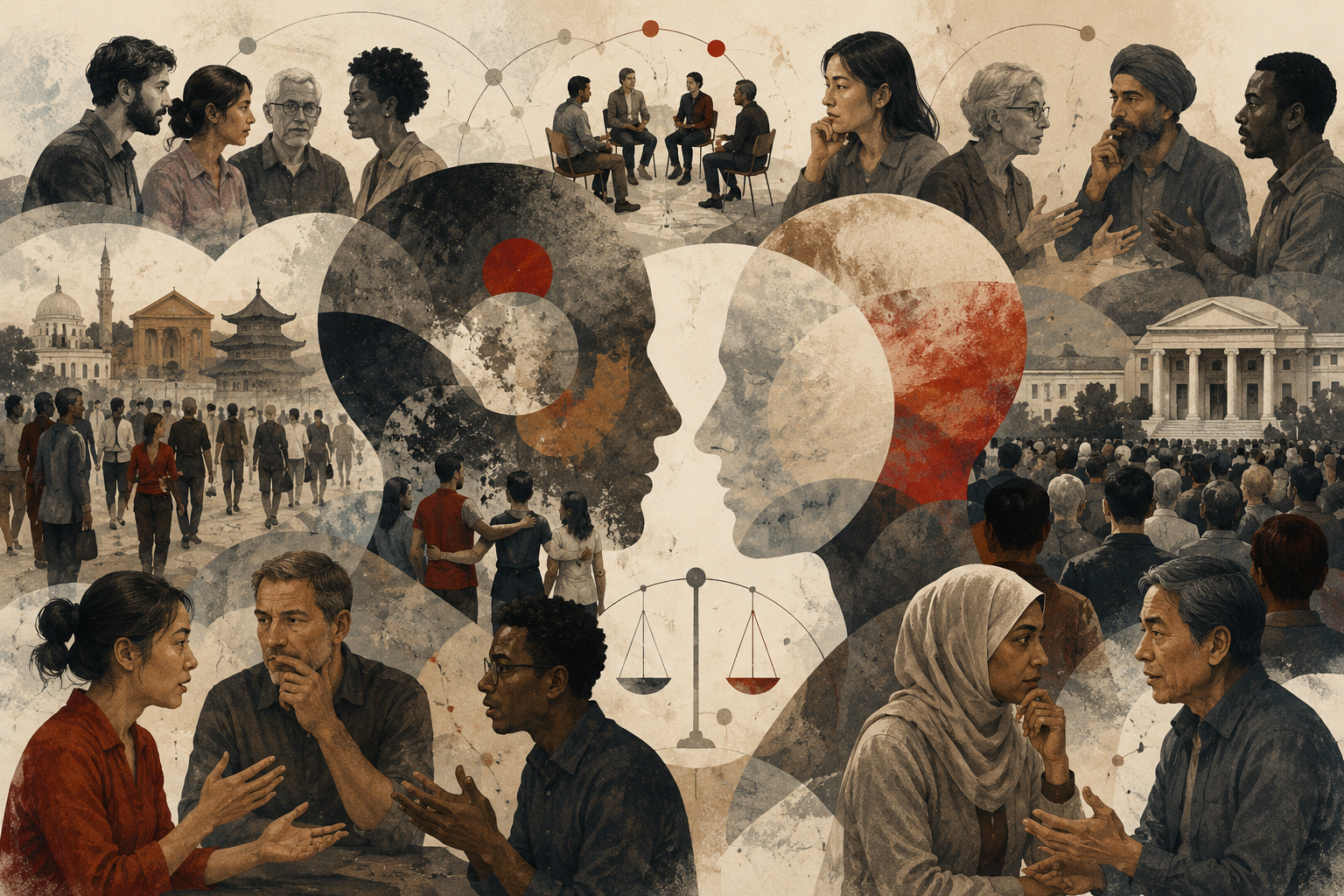
Moral disagreement is not merely an intellectual puzzle. It is a social condition. People must raise children, govern institutions, allocate resources, punish wrongdoing, protect rights, define public goods, care for vulnerable persons, manage religious and cultural difference, and make collective decisions despite durable disagreement about what justice, harm, freedom, equality, authority, loyalty, dignity, and care require. Moral psychology is therefore incomplete if it explains only moral agreement, moral intuition, or individual judgment. It must also explain why moral worlds collide.
Pluralism is difficult because it asks people to hold two truths together. First, moral values matter. Second, more than one moral value may matter at the same time, and those values may conflict. A society that denies the first truth slides toward cynicism or nihilism. A society that denies the second slides toward moral simplification, coercion, or fanaticism. The psychology of pluralism studies how people navigate the space between those dangers.
What Moral Disagreement and Pluralism Are
Moral disagreement occurs when persons or groups hold incompatible judgments about what is right, wrong, permissible, required, admirable, shameful, cruel, fair, unjust, disloyal, impure, disrespectful, merciful, or dignified. Some disagreements concern application: whether a rule fits a case, whether a person intended harm, whether punishment is proportionate, whether a policy violates rights, or whether an exception should be made. Others concern principles themselves: whether loyalty outranks fairness, whether equality outranks merit, whether mercy should override accountability, whether purity or autonomy should guide conduct, or whether one kind of harm is morally weightier than another.
Pluralism, in the moral sense, is not simply the observation that many opinions exist. It is the stronger view that there are many values, goods, or morally relevant considerations, and that these may not always be perfectly ordered by one supreme principle. A pluralist view therefore allows that conflict among values may be real and not always eliminable by better calculation alone. In that sense, pluralism is both a philosophical and a psychological idea: moral life is structured by multiple values, and human beings often experience those values through different histories, priorities, communities, institutions, and forms of social life.
Moral disagreement and pluralism are related, but they are not identical. Disagreement is the observable fact of incompatible judgment. Pluralism is one possible interpretation of why some disagreement persists: not because all sides are equally right, and not because truth is impossible, but because moral life contains multiple serious values that may conflict. Pluralism does not require treating every moral claim as legitimate. It requires recognizing that some conflicts are not solved by pretending that only one value matters.
Psychological pluralism adds another layer. People do not merely rank values in abstract philosophical space. They encounter values through emotion, memory, identity, group belonging, cultural education, institutional trust, trauma, status, religion, political history, profession, and lived experience. A person who has known abandonment may hear “loyalty” differently from someone who has known coercive conformity. A person who has known exclusion may hear “tradition” differently from someone who has known rooted belonging. Moral disagreement is therefore often a conflict among biographies, social locations, and moral vocabularies as well as among principles.
| Concept | Core meaning | Moral-psychological significance |
|---|---|---|
| Moral disagreement | Incompatible judgments about right, wrong, duty, value, harm, or justice | Shows that moral judgment does not reliably converge even under shared social life. |
| Moral pluralism | The view that there are multiple genuine moral values that may conflict | Explains why disagreement may reflect real value tension rather than mere confusion. |
| Psychological pluralism | Variation in moral salience, identity, emotion, and interpretive framing | Explains why people notice and weight moral features differently. |
| Relativism | The view that moral truth or justification is framework-relative in some way | Raises questions about objectivity, tolerance, and the authority of moral judgment. |
| Deep disagreement | Disagreement rooted in different background frameworks, identities, or standards | Shows why some conflicts persist despite facts, arguments, and sincere motives. |
Why Disagreement Matters
Moral disagreement matters because it challenges simple pictures of morality. If all serious moral conflict were merely the result of ignorance, defective reasoning, selfishness, or bad faith, then the path to moral convergence might be relatively straightforward. Provide the facts, improve the arguments, correct the bias, remove the manipulation, and people should eventually agree. But real disagreement often persists even after facts are shared, arguments are heard, and motives are sincere. That persistence raises difficult questions about the nature of moral judgment itself.
It also matters politically and institutionally. Democracies, courts, schools, workplaces, religious communities, professional associations, public agencies, international institutions, universities, families, and digital publics all operate under conditions of moral pluralism. They must decide how to make collective decisions even when participants disagree about justice, harm, equality, freedom, dignity, public obligation, punishment, family duty, speech, sexuality, religion, authority, and the proper scope of state power. Moral disagreement is therefore not a marginal problem. It is one of the normal conditions under which ethical and political life must proceed.
Disagreement also matters because it affects how people see one another. When disagreement is shallow, opponents may remain intelligible. When disagreement is deep, opponents can become morally strange, irrational, corrupt, dangerous, weak, cruel, disloyal, or unworthy of trust. The psychology of disagreement therefore shapes not only beliefs but relationships. It affects whether people can argue without contempt, lose without humiliation, compromise without betrayal, and remain in common institutions without imagining one another as enemies.
Finally, disagreement matters because it can reveal moral complexity. Conflict among values can expose dimensions of a problem that one perspective alone would miss. A debate over punishment may reveal tensions among accountability, deterrence, mercy, repair, dignity, public safety, proportionality, and racial or class inequality. A debate over speech may reveal tensions among truth-seeking, harm prevention, autonomy, equality, power, civility, dissent, and institutional trust. Disagreement is dangerous when it becomes hatred, but it can also be morally instructive when it forces values into view.
| Why disagreement matters | What it reveals | Institutional implication |
|---|---|---|
| It challenges moral simplification | People may disagree sincerely even after reflection | Institutions need procedures for unresolved conflict, not only consensus rituals. |
| It exposes value conflict | Multiple goods may matter at once | Decision-making must acknowledge tradeoffs rather than hide them. |
| It shapes social trust | Opponents can become morally unintelligible | Plural societies need norms that preserve standing amid disagreement. |
| It affects power | Dominant groups may define their own values as neutral | Pluralism must include attention to whose moral language counts. |
| It tests institutions | Courts, schools, professions, and democracies must act without full agreement | Fair procedure, rights protection, and accountability become central. |
Pluralism, Relativism, and Objectivity
Moral pluralism should be distinguished from moral relativism. A pluralist may hold that there are many genuine values and that these values sometimes conflict tragically or resist reduction to a single measure. A relativist, by contrast, typically ties the truth or justification of moral judgments more directly to persons, cultures, groups, practices, or frameworks. The two views can overlap in some discussions, but they are not the same. A person can be a pluralist without thinking that every moral judgment is true only relative to a culture or individual standpoint.
Pluralism also does not automatically deny objectivity. One may believe that several values are objectively important while also holding that they cannot always be harmonized without loss. On such a view, disagreement need not show that “anything goes.” It may instead reveal that human moral life contains multiple legitimate claims that cannot always be made fully consistent. This is one reason pluralism is often more morally demanding than monistic simplification rather than less. It asks people to face conflict without pretending that only one value exists.
Relativism raises a different set of questions. If moral truth or justification is relative to a framework, then moral disagreement across frameworks may be harder to adjudicate by appeal to framework-independent standards. But relativism also comes in many forms. Some versions concern descriptive variation in moral belief. Others concern the truth conditions of moral claims. Still others concern tolerance, authority, or the limits of cross-cultural criticism. Confusing these versions can make public debate about relativism less precise than it needs to be.
Objectivity also comes in degrees and forms. Moral objectivity need not mean that every moral problem has a simple, context-free, easily discoverable answer. It may mean that some reasons, harms, obligations, or values have authority beyond personal preference. It may mean that certain forms of cruelty, domination, exclusion, or dehumanization can be criticized even when they are culturally normalized. The challenge is to preserve the possibility of moral judgment while acknowledging that human beings often encounter moral life through plural values and contested interpretations.
| Position | Core claim | Risk if simplified |
|---|---|---|
| Value pluralism | There are many genuine moral values that may conflict | May be mistaken for “anything goes” if not distinguished from relativism. |
| Relativism | Moral truth or justification is framework-relative in some way | May be treated too broadly, as if all disagreement implies relativism. |
| Objectivism | Some moral claims have authority beyond individual or cultural preference | May become arrogant if detached from context, power, and interpretive humility. |
| Monism | One ultimate value or principle orders morality | May flatten real conflict among serious values. |
| Practical pluralism | Institutions must manage disagreement without always resolving it | May become proceduralism if it ignores substantive injustice. |
Moral Values in Conflict
One of the central insights of pluralism is that moral values can conflict in ways that are not superficial. Care can conflict with justice, mercy with accountability, loyalty with impartiality, liberty with equality, truth-telling with protection, autonomy with belonging, dignity with utility, transparency with privacy, forgiveness with deterrence, and social peace with public truth. These conflicts are not always resolvable by discovering that one side was never really valuable. Sometimes both sides matter, and the conflict lies in the situation rather than only in human confusion.
This matters for moral psychology because people often disagree not over whether morality matters, but over which moral claim should dominate a case. Two people may both care about fairness and compassion yet disagree sharply when one gives greater weight to equality and the other to desert, or when one foregrounds harm and the other authority or communal order. Disagreement can therefore arise from different weightings of real values, not merely from the presence of one moral person and one immoral one.
Value conflict is especially visible in public policy. A law may protect one group’s freedom while burdening another group’s security. A welfare rule may promote consistency while ignoring context. A speech policy may protect dissent while exposing vulnerable groups to harm. A public-health measure may protect collective life while restricting individual liberty. A punishment may affirm accountability while undermining restoration. These are not always conflicts between morality and immorality. They are often conflicts inside morality.
Pluralism does not mean every value claim is equally strong. It means that more than one value can make a genuine claim on judgment. A pluralist analysis still asks which value should prevail in a particular case, what harms are at stake, who bears the burden, which options are available, and whether the conflict is being described honestly. Pluralism makes judgment more demanding, not less necessary.
| Value conflict | What each side protects | Why disagreement persists |
|---|---|---|
| Mercy vs. accountability | Compassion, repair, deterrence, responsibility | People disagree about whether response should prioritize restoration or consequence. |
| Liberty vs. equality | Personal freedom, equal standing, anti-domination, choice | People disagree about whether freedom protects or entrenches unequal power. |
| Loyalty vs. impartiality | Special obligation, fairness, trust, non-corruption | People disagree about when care for close others becomes unjust favoritism. |
| Truth vs. protection | Candor, transparency, safety, dignity, privacy | People disagree about when disclosure harms more than it helps. |
| Pluralism vs. moral limits | Tolerance, coexistence, protection from domination | People disagree about which practices can be accommodated and which must be resisted. |
Psychological Sources of Moral Disagreement
Moral disagreement has multiple psychological sources. People vary in attention, interpretation, memory, emotional salience, identity, trust, threat perception, empathy, disgust, anger, shame, social learning, and background assumptions about what counts as harm or fairness. They also vary in how they construe intentions, causes, victims, responsibility, agency, and the proper scope of moral concern. These differences shape the very materials out of which judgment is formed.
This means disagreement can arise before explicit reasoning begins. Persons do not enter moral argument with a neutral inventory of morally relevant facts. They notice different things. They interpret the same act through different narratives. They perceive different harms, different victims, different duties, and different threats. By the time reasons are exchanged, moral salience may already be structured differently across the parties.
Emotion is especially important. Anger may make injustice vivid. Disgust may make contamination, degradation, or boundary violation salient. Compassion may foreground suffering. Fear may foreground threat. Shame may foreground belonging and social judgment. Guilt may foreground repair. Pride may foreground group loyalty or moral identity. These emotions do not simply interfere with moral judgment; they often help organize it. But they can also narrow perception when they become attached to identity defense or selective concern.
Disagreement also depends on trust. People do not directly verify most facts relevant to moral life. They rely on testimony, institutions, media, experts, family, tradition, clergy, leaders, peers, and communities. When trust networks differ, people may inhabit different moral-information environments. One person’s obvious fact may be another person’s propaganda. One community’s credible witness may be another community’s suspect authority. Moral disagreement then becomes entangled with epistemic disagreement.
| Psychological source | How it shapes disagreement | Example |
|---|---|---|
| Selective salience | Different people notice different moral features first | One person sees harm; another sees disrespect for order. |
| Emotional weighting | Anger, compassion, disgust, fear, or shame make different values vivid | One person feels outrage; another feels threat or contamination. |
| Identity protection | Judgment defends group belonging or self-concept | Criticism of the group is interpreted as attack. |
| Trust divergence | Different sources are treated as credible | Experts, institutions, media, or witnesses are trusted unevenly. |
| Memory and narrative | Past harms shape interpretation of present conflict | A policy is read through a history of exclusion or betrayal. |
Culture, Politics, and Moral Variation
Moral disagreement is deeply shaped by culture and politics. Different societies, traditions, and political subcultures emphasize different moral concerns, tell different stories about harm and legitimacy, and cultivate different expectations about authority, purity, equality, reciprocity, autonomy, care, loyalty, dignity, and obligation. Yet variation does not imply total incommensurability. Distinct moral worlds may still draw on overlapping human capacities for perceiving suffering, agency, intention, causation, norm violation, and social order.
This is one reason cross-cultural moral psychology is so important. It shows that pluralism is not merely a problem of modern ideological polarization. It is a feature of human moral life across different forms of social organization. The same broad human capacities can yield different moral patterns when filtered through different histories, institutions, symbols, religions, languages, kinship structures, political conflicts, and social priorities.
Political variation adds another layer. People may disagree because they differ in ideology, class position, race, religion, migration history, region, profession, gendered experience, institutional trust, or exposure to harm. They may also disagree because political identities organize moral perception. Once moral judgment is tied to a party, movement, or ideological community, disagreement can become self-reinforcing: people defend not only a view but a moral identity.
Cross-cultural and political variation should be interpreted carefully. Differences among groups do not mean every member of a group thinks the same way. Cultures and political communities contain dissent, minority voices, internal struggle, generational change, and unequal power. A serious account of pluralism must therefore avoid two errors: treating groups as morally uniform and treating the dominant group’s moral vocabulary as the neutral measure of all others.
| Source of variation | How it shapes moral disagreement | Interpretive caution |
|---|---|---|
| Culture | Weights autonomy, family, authority, purity, fairness, care, or harmony differently | Cultures are internally diverse and historically changing. |
| Religion | Frames obligation through sacred law, ritual, mercy, sin, purity, or divine accountability | Religious traditions contain multiple interpretive communities. |
| Politics | Links values to identity, institutions, threat, justice, and legitimacy | Ideological groups may share psychological mechanisms while differing substantively. |
| Class and material position | Shapes experience of risk, fairness, opportunity, work, and public policy | Moral language may hide material inequality. |
| Historical memory | Frames present conflicts through injury, betrayal, domination, resistance, or survival | Memory may preserve truth or harden selective narratives. |
Harm, Fairness, Purity, and Different Moral Saliences
Moral disagreement often becomes clearer when one asks what different parties are treating as morally salient. One side may focus on harm and vulnerability. Another may focus on fairness and reciprocal burden. Another may foreground purity, sanctity, loyalty, role duty, family obligation, or disrespect toward inherited norms. Still another may see the central issue as domination, exclusion, humiliation, exploitation, or social degradation. These are not always mutually exclusive concerns, but they rarely enter the conversation with equal strength.
Because moral salience differs, people may speak past one another while using similarly moral language. Each side believes it is seeing the real issue; each may regard the other as evasive, cold, irrational, fanatical, naive, authoritarian, permissive, or cruel. A psychology of pluralism helps explain how this happens without assuming that disagreement must reduce to stupidity or malice. People may literally be organizing the same scene through different moral centers of gravity.
Harm is especially important because many contemporary accounts of moral cognition treat harm perception as central to moral judgment. But harm itself is not always perceived in the same way. People may disagree about whether harm is physical, emotional, spiritual, relational, reputational, communal, ecological, institutional, or symbolic. They may disagree about who is harmed, whether the harm is direct or indirect, and whether a claimed harm is genuine, exaggerated, deserved, or strategically performed. Thus even agreement that “harm matters” does not eliminate disagreement.
Fairness also varies. Some people treat fairness as equality. Others treat it as proportionality, merit, need, desert, reciprocity, role duty, or repair for historical injustice. Purity and sanctity can be moralized through religious, bodily, ecological, sexual, national, or symbolic frames. Loyalty can be a form of care and trust, but also a source of exclusion or impunity. Authority can protect order and responsibility, but also domination. The plural structure of moral salience is one reason disagreement persists.
| Moral salience | What it foregrounds | How disagreement arises |
|---|---|---|
| Harm | Suffering, vulnerability, injury, trauma, exploitation, degradation | People disagree about what counts as harm and whose harm is most urgent. |
| Fairness | Equality, reciprocity, desert, need, proportionality, repair | People disagree about which standard of fairness applies. |
| Purity or sanctity | Contamination, sacred order, symbolic boundaries, bodily or ritual integrity | People disagree about whether such concerns are moral, oppressive, or protective. |
| Loyalty | Belonging, solidarity, family, nation, group responsibility | People disagree about when loyalty becomes bias or betrayal of justice. |
| Authority | Order, role duty, tradition, legitimacy, obedience, continuity | People disagree about when authority is legitimate and when it becomes domination. |
Ingroup Identity and Motivated Reasoning
Disagreement is not only about values. It is also about identity and group attachment. People often defend the moral narratives of groups to which they belong, interpret evidence in ways favorable to allies, and construe opponents’ actions through harsher moral filters. Political disagreement especially can become morally self-sealing when identity organizes what counts as credible harm, legitimate authority, good faith, or fair procedure.
This does not mean all disagreement is reducible to tribalism. But it does mean that moral pluralism is lived through social identities, not merely through abstract thought. The same person may reason differently about similar conduct depending on whether the actor is perceived as “one of us” or “one of them.” Disagreement then becomes not just a clash of principles, but a contest over who counts, whose pain is legible, which sources are trusted, and which community’s moral vocabulary will frame the issue.
Motivated reasoning is especially powerful because it often feels like ordinary good judgment from the inside. People do not usually experience themselves as selectively defending their own side. They experience themselves as being realistic, morally serious, and appropriately suspicious of bad actors. The ingroup receives context; the outgroup receives diagnosis. The ingroup’s failures are exceptions; the outgroup’s failures are revealing. The ingroup’s anger is righteous; the outgroup’s anger is dangerous.
A pluralist moral psychology must therefore be honest about identity. It should not pretend that moral disagreement is merely a seminar-room exchange among disembodied reasoners. People reason as members of families, classes, religions, nations, professions, races, genders, parties, movements, and institutions. Their moral saliences are shaped by belonging. The goal is not to eliminate identity, which would be impossible, but to understand when identity supports moral insight and when it distorts judgment.
| Identity process | How it shapes disagreement | Pluralist risk |
|---|---|---|
| Ingroup favoritism | Allies receive more charitable interpretation | Accountability becomes unevenly applied. |
| Outgroup suspicion | Opponents’ actions are read through hostile motives | Disagreement becomes moralized as bad faith. |
| Selective trust | Group-aligned sources are treated as credible | Shared factual ground weakens. |
| Threat perception | Criticism feels like attack on the group | Correction becomes identity defense. |
| Norm conformity | Members feel pressure to defend group positions | Internal pluralism is suppressed. |
Disagreement Among Sincere People
One of the hardest features of moral disagreement is that it often occurs among sincere people. This matters because it undermines the comforting thought that moral conflict is usually solved once bad motives are removed. Sincere disagreement is disturbing precisely because it suggests that moral division can survive honesty, thoughtfulness, empathy, education, and even shared concern for the good.
That realization can lead in several directions. It may encourage humility, because one sees that moral seriousness does not guarantee convergence. It may encourage pluralism, because one comes to think that multiple moral perspectives may have genuine insight. Or it may intensify conflict, because one concludes that the other side is dangerous precisely while believing itself moral. The psychology of pluralism must account for all three possibilities.
Sincere disagreement is especially challenging when each side experiences itself as protecting a genuine moral good. One person believes they are defending liberty; another believes they are defending equality. One believes they are protecting children; another believes they are protecting dignity. One believes they are respecting tradition; another believes they are resisting domination. One believes they are ensuring accountability; another believes they are practicing mercy. To dismiss all such conflict as stupidity or malice is often psychologically satisfying but morally inadequate.
Recognizing sincerity does not mean suspending judgment. People can sincerely hold false, cruel, or dangerous views. Sincerity is not innocence. But recognizing sincerity does change the nature of engagement. It asks whether disagreement reflects different value weightings, different histories of harm, different trusted authorities, different moral vocabularies, or different social positions. It asks whether persuasion requires more than information. It asks whether institutions need procedures for disagreement that will not disappear.
| Response to sincere disagreement | Strength | Danger |
|---|---|---|
| Humility | Recognizes that one’s own perspective may be partial | Can become avoidance if it refuses judgment. |
| Pluralist interpretation | Sees multiple values operating in conflict | Can become vague if it treats all values as equally applicable. |
| Critical engagement | Preserves moral judgment while listening seriously | Requires patience and discipline under conflict. |
| Dismissal | Identifies genuinely harmful or bad-faith positions quickly | Can misidentify deep disagreement as stupidity or evil. |
| Escalation | Mobilizes against serious danger | Can turn all disagreement into existential threat. |
When Disagreement Is Not Merely Error
Not all disagreement is merely error awaiting correction. Some disagreements arise because moral life genuinely contains competing goods that cannot be ranked by a universally accepted measure. Some arise because institutions force tradeoffs that are morally tragic rather than cleanly solvable. Others arise because different communities have developed partially different but internally meaningful moral vocabularies. Some arise because people occupy different positions in structures of power and therefore experience the same institution differently.
This does not imply that every position in every disagreement is equally defensible. Some views are cruel, incoherent, self-serving, exploitative, dehumanizing, or rooted in domination. But the existence of genuinely difficult disagreement should make us wary of assuming that all moral conflict has the structure of one obviously right side versus one obviously irrational side. Pluralism is, among other things, resistance to that flattening.
Disagreement is not merely error when the conflict remains after relevant facts are clarified, when each side can identify real values at stake, when the values cannot be perfectly reconciled, and when the conflict cannot be resolved without moral loss. For example, truth and reconciliation can conflict with punishment; public health can conflict with liberty; religious freedom can conflict with equality; privacy can conflict with transparency; loyalty to kin can conflict with impartial law. In such cases, disagreement may reveal a real value structure rather than only poor reasoning.
However, pluralism should not become a way of laundering injustice. Some actors invoke “different values” to defend hierarchy, exclusion, abuse, cruelty, or domination. A serious moral psychology must therefore ask both questions: Is this disagreement rooted in genuine value conflict? Or is pluralist language being used to obscure power, harm, or bad faith? The difficulty is that both possibilities are real.
| Type of disagreement | Primary source | Appropriate response |
|---|---|---|
| Factual error | Incorrect belief about what happened | Evidence, correction, investigation, and shared standards of inquiry |
| Value weighting | Different priorities among real goods | Deliberation, tradeoff analysis, institutional decision procedures |
| Framework conflict | Different moral vocabularies or background assumptions | Translation, interpretation, humility, and slow engagement |
| Power conflict | Dominant interests presented as moral principle | Critical analysis, accountability, and attention to marginalized voices |
| Bad faith | Strategic manipulation of moral language | Exposure, boundary-setting, and institutional safeguards |
The Limits of Tolerance and the Problem of Deep Conflict
Pluralism is sometimes mistaken for unlimited tolerance. But the existence of many values does not mean every practice, doctrine, or institution deserves equal acceptance. Moral communities still face the question of what forms of disagreement can be lived with and what forms cross into domination, cruelty, exclusion, violence, or destruction of the conditions of common life. Tolerance itself is a moral value that must sometimes be weighed against protection, justice, equal standing, and the prevention of harm.
This is why deep moral disagreement remains politically difficult even under pluralist assumptions. A pluralist society still has to decide when compromise is possible, when accommodation is appropriate, and when firm resistance is morally required. The psychology of pluralism does not remove conflict. It clarifies why conflict persists even when parties are not simply confused about the existence of morality.
The limits of tolerance are especially visible when one group’s moral world denies another group’s equal standing. A society may tolerate many religious, political, aesthetic, familial, or ethical differences. But it cannot tolerate every practice without undermining the very conditions that make pluralism possible. Practices that deny basic personhood, enforce domination, eliminate dissent, or institutionalize cruelty raise questions that pluralism cannot answer by saying “difference exists.”
Yet the boundary is rarely easy. People disagree about what counts as domination, harm, indoctrination, coercion, discrimination, disrespect, or necessary protection. A policy one group sees as equal recognition another may see as moral disorder. A restriction one group sees as protection another may see as authoritarian control. Tolerance is therefore not an escape from moral judgment. It is one of the most difficult forms of moral judgment.
| Pluralist question | Why it is difficult | Possible institutional response |
|---|---|---|
| What should be tolerated? | People disagree about which practices are merely different and which are harmful | Rights frameworks, public reasoning, and contestable legal standards |
| When is accommodation required? | Accommodation can protect minority conscience or burden vulnerable others | Case-sensitive balancing and transparent justification |
| When is resistance required? | Resistance can protect dignity or become coercive intolerance | Attention to harm, power, equality, and democratic accountability |
| Who decides the boundary? | Dominant groups may define tolerance in self-serving ways | Inclusive institutions and representation of affected communities |
| How should conflict be preserved? | Some conflict is necessary for justice | Protect dissent while limiting dehumanization and violence |
Institutions and the Management of Pluralism
Institutions are among the main mechanisms through which pluralism is managed. Democracies, courts, constitutions, public deliberation, professional codes, schools, universities, civil-service systems, religious councils, civic associations, and procedural norms all function, in part, as ways of living with durable moral disagreement. They do not eliminate conflict, but they can channel it into forms that reduce violence, preserve standing, protect rights, and allow collective action under conditions of unresolved value conflict.
This makes institutional design morally significant. If pluralism is real, then institutions must do more than identify correct outcomes. They must also structure coexistence among citizens and groups who disagree deeply about important goods. Fair procedure, rights protection, voice, accountability, lawful contestation, access to appeal, protection for minorities, and public justification become central not because consensus is easy, but because it is hard.
Institutions also shape whether disagreement becomes learning or domination. A well-designed institution can make dissent legible, preserve reasons, protect vulnerable groups, clarify responsibility, and prevent powerful actors from declaring their own moral vocabulary neutral. A badly designed institution can intensify moral conflict by silencing minority voices, applying rules selectively, hiding tradeoffs, rewarding polarization, or turning procedure into a mask for power.
Pluralist institutions must also be self-correcting. They cannot merely demand trust. They must earn it through accountability, transparency, inclusion, and repair. When institutions are hypocritical, captured, unequal, or indifferent to marginalized communities, appeals to procedure can sound like demands for obedience. The management of pluralism therefore requires both procedural fairness and substantive attention to power.
| Institutional function | Pluralist role | Failure mode |
|---|---|---|
| Fair procedure | Allows decisions without requiring full moral agreement | Procedure becomes a mask for unequal power. |
| Rights protection | Protects vulnerable persons and dissenting minorities | Rights are applied selectively or withdrawn from disliked groups. |
| Public justification | Requires reasons that others can contest | Power acts without explanation or hides behind technical language. |
| Representation | Brings multiple moral experiences into decision-making | Dominant groups define the public good alone. |
| Accountability and repair | Corrects institutional failure and preserves legitimacy | Hypocrisy and unaddressed harm deepen distrust. |
Mathematical Lens: Modeling Moral Disagreement
Moral disagreement can be modeled as divergence in the weighting of multiple moral values. Let \(J_i\) represent the moral judgment of person \(i\) regarding a case:
J_i = \alpha_i H + \beta_i F + \gamma_i L + \delta_i P + \varepsilon_i
\]
Interpretation: Moral judgment is modeled as a weighted combination of perceived harm, fairness, loyalty or group obligation, and purity or sanctity salience. The coefficients vary by person, community, identity, or interpretive framework.
where \(H\) is perceived harm, \(F\) is fairness, \(L\) is loyalty or group obligation, and \(P\) is purity or sanctity salience. The coefficients vary by person, meaning disagreement can arise not because people see entirely different worlds, but because they assign different weights to shared or overlapping moral dimensions.
We can model disagreement between two persons \(i\) and \(j\) as:
D_{ij} = |J_i – J_j|
\]
Interpretation: Moral disagreement is represented as the distance between two persons’ moral judgments. Larger values indicate stronger divergence.
This disagreement distance may increase as background identity, cultural framing, political alignment, trusted authority, or value weighting diverges. But the distance itself does not tell us whether one side is wrong, whether the disagreement is tragic, whether power is distorting the conflict, or whether the disagreement is morally productive. It is a simplified analytic measure, not a substitute for judgment.
A more explicit identity-sensitive model is:
J_i = \alpha_i V_i + \beta_i G_i + \gamma_i S_i
\]
Interpretation: Moral judgment is jointly shaped by value weighting, group identity strength, and situational framing. This captures the idea that pluralism is lived through social identity, not only through abstract reasoning.
where \(V_i\) is value weighting, \(G_i\) is group identity strength, and \(S_i\) is situational framing. A pluralism-aware institutional model can also include procedure and trust:
C_g = \theta_1 R_g + \theta_2 T_g + \theta_3 A_g – \theta_4 X_g
\]
Interpretation: A group’s capacity to manage pluralism rises with rights protection, institutional trust, and accountability, and falls with exclusion pressure, domination, or dehumanizing conflict.
This model is not an empirical claim about any specific society. It is a conceptual scaffold for showing why pluralism is psychological and institutional at once. Moral disagreement may begin in value weighting, but whether it becomes coexistence, domination, polarization, or repair depends on institutional design.
| Model term | Meaning | Interpretive role |
|---|---|---|
| \(H\) | Perceived harm | Captures attention to suffering, vulnerability, injury, degradation, or threat. |
| \(F\) | Fairness | Captures equality, reciprocity, desert, need, or proportionality. |
| \(L\) | Loyalty or group obligation | Captures special duties to family, group, nation, profession, or community. |
| \(P\) | Purity or sanctity salience | Captures sacred order, contamination, symbolic boundaries, or ritual concern. |
| \(G_i\) | Group identity strength | Captures how strongly belonging organizes moral judgment. |
| \(S_i\) | Situational framing | Captures how a case is narrated, categorized, and made morally salient. |
| \(D_{ij}\) | Disagreement distance | Represents the gap between two moral judgments. |
| \(C_g\) | Pluralist capacity | Represents a group or institution’s ability to manage moral difference without domination. |
R Workflow: Modeling Moral Disagreement and Value Pluralism
The following R workflow simulates people with different value weights for harm, fairness, loyalty, and purity, then models disagreement across pairings. It treats disagreement as structured divergence rather than random noise. The dataset is synthetic and intended for reproducible article support, not empirical claims about real persons, parties, cultures, or institutions.
# Moral Disagreement and the Psychology of Pluralism
# Synthetic R workflow for modeling value pluralism and disagreement.
# Educational and reproducible research scaffold only.

suppressPackageStartupMessages({
  library(tidyverse)
  library(broom)
})

set.seed(42)

# ------------------------------------------------------------
# 1. Set up output folders
# ------------------------------------------------------------

dir.create("outputs", showWarnings = FALSE)
dir.create("outputs/tables", recursive = TRUE, showWarnings = FALSE)
dir.create("outputs/figures", recursive = TRUE, showWarnings = FALSE)

# ------------------------------------------------------------
# 2. Simulate moral profiles
# ------------------------------------------------------------

n <- 2400

df <- tibble(
  participant_id = 1:n,
  harm_weight = rnorm(n, 0, 1),
  fairness_weight = rnorm(n, 0, 1),
  loyalty_weight = rnorm(n, 0, 1),
  purity_weight = rnorm(n, 0, 1),
  authority_weight = rnorm(n, 0, 1),
  care_weight = rnorm(n, 0, 1),
  identity_strength = rnorm(n, 0, 1),
  framing_sensitivity = rnorm(n, 0, 1),
  institutional_trust = rnorm(n, 0, 1),
  pluralist_tolerance = rnorm(n, 0, 1)
) %>%
  mutate(
    moral_judgment =
      0.40 * harm_weight +
      0.30 * fairness_weight +
      0.20 * loyalty_weight +
      0.15 * purity_weight +
      0.15 * authority_weight +
      0.25 * care_weight +
      0.25 * identity_strength +
      0.20 * framing_sensitivity +
      rnorm(n, 0, 0.8)
  )

# ------------------------------------------------------------
# 3. Build random pairings to estimate disagreement
# ------------------------------------------------------------

pairs <- tibble(
  i = sample(1:n, 4000, replace = TRUE),
  j = sample(1:n, 4000, replace = TRUE)
) %>%
  filter(i != j) %>%
  mutate(
    judgment_i = df$moral_judgment[i],
    judgment_j = df$moral_judgment[j],
    disagreement = abs(judgment_i - judgment_j),

    value_gap =
      abs(df$harm_weight[i] - df$harm_weight[j]) +
      abs(df$fairness_weight[i] - df$fairness_weight[j]) +
      abs(df$loyalty_weight[i] - df$loyalty_weight[j]) +
      abs(df$purity_weight[i] - df$purity_weight[j]) +
      abs(df$authority_weight[i] - df$authority_weight[j]) +
      abs(df$care_weight[i] - df$care_weight[j]),

    identity_gap = abs(df$identity_strength[i] - df$identity_strength[j]),
    framing_gap = abs(df$framing_sensitivity[i] - df$framing_sensitivity[j]),
    trust_gap = abs(df$institutional_trust[i] - df$institutional_trust[j]),
    pluralist_tolerance_gap = abs(df$pluralist_tolerance[i] - df$pluralist_tolerance[j])
  )

# ------------------------------------------------------------
# 4. Estimate disagreement model
# ------------------------------------------------------------

model_disagreement <- lm(
  disagreement ~ value_gap + identity_gap + framing_gap + trust_gap,
  data = pairs
)

disagreement_summary <- tidy(model_disagreement, conf.int = TRUE)
disagreement_fit <- glance(model_disagreement)

print(disagreement_summary)
print(disagreement_fit)

# ------------------------------------------------------------
# 5. Summarize by disagreement quartile
# ------------------------------------------------------------

disagreement_band_summary <- pairs %>%
  mutate(
    disagreement_band = ntile(disagreement, 4),
    disagreement_band = factor(
      disagreement_band,
      labels = c("Low", "Lower-middle", "Upper-middle", "High")
    )
  ) %>%
  group_by(disagreement_band) %>%
  summarize(
    mean_value_gap = mean(value_gap),
    mean_identity_gap = mean(identity_gap),
    mean_framing_gap = mean(framing_gap),
    mean_trust_gap = mean(trust_gap),
    mean_disagreement = mean(disagreement),
    .groups = "drop"
  )

print(disagreement_band_summary)

# ------------------------------------------------------------
# 6. Prediction grid across value and identity gaps
# ------------------------------------------------------------

pred_grid <- expand_grid(
  value_gap = seq(0, 10, length.out = 100),
  identity_gap = c(0, 1, 2),
  framing_gap = 1,
  trust_gap = 1
)

pred_grid$predicted_disagreement <- predict(
  model_disagreement,
  newdata = pred_grid
)

pred_grid <- pred_grid %>%
  mutate(
    identity_label = case_when(
      identity_gap == 0 ~ "Low identity gap",
      identity_gap == 1 ~ "Moderate identity gap",
      TRUE ~ "High identity gap"
    )
  )

# ------------------------------------------------------------
# 7. Plot disagreement
# ------------------------------------------------------------

plot_disagreement <- ggplot(
  pred_grid,
  aes(x = value_gap, y = predicted_disagreement)
) +
  geom_line(linewidth = 1) +
  facet_wrap(~ identity_label) +
  labs(
    title = "Predicted Moral Disagreement from Value and Identity Differences",
    subtitle = "Disagreement grows as value weighting and identity divergence increase",
    x = "Value gap",
    y = "Predicted disagreement"
  ) +
  theme_minimal(base_size = 12)

print(plot_disagreement)

# ------------------------------------------------------------
# 8. Export outputs
# ------------------------------------------------------------

write_csv(df, "outputs/tables/moral_pluralism_profiles.csv")
write_csv(pairs, "outputs/tables/moral_disagreement_pairs.csv")
write_csv(disagreement_summary, "outputs/tables/moral_disagreement_model.csv")
write_csv(disagreement_fit, "outputs/tables/moral_disagreement_model_fit.csv")
write_csv(disagreement_band_summary, "outputs/tables/moral_disagreement_band_summary.csv")
write_csv(pred_grid, "outputs/tables/moral_disagreement_predictions.csv")

ggsave(
  filename = "outputs/figures/predicted_moral_disagreement.png",
  plot = plot_disagreement,
  width = 10,
  height = 6,
  dpi = 300
)
This workflow is useful because it treats disagreement as a product of value divergence, identity divergence, framing divergence, and trust divergence. It does not assume that disagreement is meaningless noise. It also does not assume that all disagreement is equally defensible. It simply shows how structured psychological differences can generate persistent moral distance.
Python Workflow: Simulating Moral Disagreement Under Competing Moral Saliences
The Python workflow below simulates disagreement by varying how strongly different agents weight harm, fairness, loyalty, purity, authority, and care. It then samples pairwise disagreement and summarizes how value gaps, identity gaps, and trust gaps relate to judgment distance. The example uses synthetic data for reproducible demonstration and should not be interpreted as an assessment of real people or groups.
# Moral Disagreement and the Psychology of Pluralism
# Python workflow for synthetic moral-disagreement modeling.
# Educational and reproducible research scaffold only.

from pathlib import Path

import numpy as np
import pandas as pd

np.random.seed(42)

# ------------------------------------------------------------
# 1. Set up output folders
# ------------------------------------------------------------

output_tables = Path("outputs/tables")
output_tables.mkdir(parents=True, exist_ok=True)

# ------------------------------------------------------------
# 2. Simulate moral profiles
# ------------------------------------------------------------

n = 2600

df = pd.DataFrame({
    "participant_id": np.arange(1, n + 1),
    "harm_weight": np.random.normal(0, 1, n),
    "fairness_weight": np.random.normal(0, 1, n),
    "loyalty_weight": np.random.normal(0, 1, n),
    "purity_weight": np.random.normal(0, 1, n),
    "authority_weight": np.random.normal(0, 1, n),
    "care_weight": np.random.normal(0, 1, n),
    "identity_strength": np.random.normal(0, 1, n),
    "framing_sensitivity": np.random.normal(0, 1, n),
    "institutional_trust": np.random.normal(0, 1, n),
    "pluralist_tolerance": np.random.normal(0, 1, n)
})

# ------------------------------------------------------------
# 3. Generate moral judgments
# ------------------------------------------------------------

df["moral_judgment"] = (
    0.40 * df["harm_weight"] +
    0.30 * df["fairness_weight"] +
    0.20 * df["loyalty_weight"] +
    0.15 * df["purity_weight"] +
    0.15 * df["authority_weight"] +
    0.25 * df["care_weight"] +
    0.25 * df["identity_strength"] +
    0.20 * df["framing_sensitivity"] +
    np.random.normal(0, 0.8, n)
)

# ------------------------------------------------------------
# 4. Sample pairwise disagreements
# ------------------------------------------------------------

pairs_i = np.random.randint(0, n, 4000)
pairs_j = np.random.randint(0, n, 4000)

pairs = pd.DataFrame({
    "i": pairs_i,
    "j": pairs_j
})

pairs = pairs[pairs["i"] != pairs["j"]].copy()

pairs["judgment_i"] = df.iloc[pairs["i"]]["moral_judgment"].values
pairs["judgment_j"] = df.iloc[pairs["j"]]["moral_judgment"].values
pairs["disagreement"] = np.abs(pairs["judgment_i"] - pairs["judgment_j"])

pairs["value_gap"] = (
    np.abs(df.iloc[pairs["i"]]["harm_weight"].values - df.iloc[pairs["j"]]["harm_weight"].values) +
    np.abs(df.iloc[pairs["i"]]["fairness_weight"].values - df.iloc[pairs["j"]]["fairness_weight"].values) +
    np.abs(df.iloc[pairs["i"]]["loyalty_weight"].values - df.iloc[pairs["j"]]["loyalty_weight"].values) +
    np.abs(df.iloc[pairs["i"]]["purity_weight"].values - df.iloc[pairs["j"]]["purity_weight"].values) +
    np.abs(df.iloc[pairs["i"]]["authority_weight"].values - df.iloc[pairs["j"]]["authority_weight"].values) +
    np.abs(df.iloc[pairs["i"]]["care_weight"].values - df.iloc[pairs["j"]]["care_weight"].values)
)

pairs["identity_gap"] = np.abs(
    df.iloc[pairs["i"]]["identity_strength"].values -
    df.iloc[pairs["j"]]["identity_strength"].values
)

pairs["framing_gap"] = np.abs(
    df.iloc[pairs["i"]]["framing_sensitivity"].values -
    df.iloc[pairs["j"]]["framing_sensitivity"].values
)

pairs["trust_gap"] = np.abs(
    df.iloc[pairs["i"]]["institutional_trust"].values -
    df.iloc[pairs["j"]]["institutional_trust"].values
)

# ------------------------------------------------------------
# 5. Summarize by disagreement quartile
# ------------------------------------------------------------

pairs["disagreement_band"] = pd.qcut(
    pairs["disagreement"],
    q=4,
    labels=["Low", "Lower-middle", "Upper-middle", "High"]
)

summary = (
    pairs.groupby("disagreement_band", observed=False)
         .agg(
             mean_value_gap=("value_gap", "mean"),
             mean_identity_gap=("identity_gap", "mean"),
             mean_framing_gap=("framing_gap", "mean"),
             mean_trust_gap=("trust_gap", "mean"),
             mean_disagreement=("disagreement", "mean")
         )
         .reset_index()
)

print(summary)

# ------------------------------------------------------------
# 6. Build scenario grid
# ------------------------------------------------------------

scenario_rows = []

for harm in np.linspace(-2, 2, 25):
    for fairness in np.linspace(-2, 2, 25):
        for loyalty in [-1, 0, 1]:
            judgment = (
                0.40 * harm +
                0.30 * fairness +
                0.20 * loyalty +
                0.15 * 0 +
                0.15 * 0 +
                0.25 * 0
            )

            scenario_rows.append({
                "harm_weight": harm,
                "fairness_weight": fairness,
                "loyalty_weight": loyalty,
                "predicted_judgment": judgment
            })

scenario_df = pd.DataFrame(scenario_rows)

print(scenario_df.head(12))

# ------------------------------------------------------------
# 7. Identify highest-disagreement synthetic pairings
# ------------------------------------------------------------

high_disagreement_pairs = (
    pairs.sort_values("disagreement", ascending=False)
         .head(25)
         .reset_index(drop=True)
)

# ------------------------------------------------------------
# 8. Export outputs
# ------------------------------------------------------------

df.to_csv(output_tables / "moral_pluralism_profiles_python.csv", index=False)
pairs.to_csv(output_tables / "moral_disagreement_pairs_python.csv", index=False)
summary.to_csv(output_tables / "moral_disagreement_summary.csv", index=False)
scenario_df.to_csv(output_tables / "moral_pluralism_scenarios.csv", index=False)
high_disagreement_pairs.to_csv(
    output_tables / "moral_disagreement_high_distance_pairs.csv",
    index=False
)

print("Synthetic moral disagreement outputs written to:", output_tables)
This workflow is useful because it shows how disagreement can emerge from different moral weightings before overt political argument begins. It also shows why pluralism is not simply a matter of “different opinions.” When people vary in harm, fairness, loyalty, purity, authority, care, identity, framing, and trust, the same case can generate genuinely different moral judgments.
In a full article repository, this Python workflow can be extended into notebooks, SQL schema, synthetic datasets, validation notes, value-gap scenarios, institutional-trust scenarios, and additional language examples. R can support statistical modeling and visualization; Python can support simulation and data pipelines; SQL can preserve structured scenario metadata; Julia can support pluralist value-space simulation; and C, C++, Fortran, Go, and Rust can support reproducible command-line tools, validation utilities, and computational demonstrations.
GitHub Repository
The companion repository for this article provides a reproducible code scaffold for modeling harm weighting, fairness weighting, loyalty weighting, purity weighting, authority weighting, care weighting, identity strength, framing sensitivity, institutional trust, moral judgment, disagreement distance, and pluralist value conflict.
The repository structure should support a full research workflow rather than a single script. The article folder can include language-specific examples in python, r, julia, sql, c, cpp, fortran, go, and rust, along with data, docs, notebooks, and outputs. This structure makes the article reproducible, inspectable, and extensible for readers who want to move from conceptual argument to analytical demonstration.
Conclusion
Moral disagreement and the psychology of pluralism show that ethical life is not organized by one single value transparently perceived in the same way by everyone. Human beings live among multiple moral claims, interpret those claims through different social and psychological lenses, and often disagree sincerely about which values should govern a case. That is not always a sign that morality has failed. Sometimes it is a sign that morality is genuinely plural.
The challenge, then, is not to eliminate pluralism by force of simplification, but to understand how disagreement arises, when it reflects real value conflict, when it masks domination or bias, and how institutions can make common life possible under conditions of unresolved difference. A mature moral psychology of pluralism is therefore not a retreat from truth or judgment. It is an effort to think more honestly about the crowded structure of moral life.
This honesty requires several disciplines at once. It requires humility because sincere people may disagree. It requires courage because some positions must still be criticized and resisted. It requires power awareness because dominant groups often present their values as neutral common sense. It requires institutional imagination because plural societies cannot survive by moral feeling alone. And it requires psychological realism because people reason through identity, emotion, trust, memory, and group life as well as through principle.
Pluralism is not weakness. At its best, it is an intellectually and morally demanding way of living with the fact that human moral life contains more than one serious claim. It refuses both cynicism and coercive simplification. It asks how people can preserve judgment without contempt, disagreement without dehumanization, conviction without domination, and common life without pretending that deep moral conflict has disappeared.
Related articles
- Justice, Fairness, and Distributive Moral Judgment
- Responsibility, Blame, and Moral Accountability
- Hypocrisy, Dehumanization, and the Psychology of Moral Failure
- Cross-Cultural Moral Psychology
- Personality, Character, and Individual Differences in Moral Life
- Moral Judgment and the Psychology of Right and Wrong
- Care, Empathy, and Relational Moral Life
- Moral Psychology in Organizations and Institutions
Further reading
- Tersman, F. (2021) ‘Moral Disagreement’, in The Stanford Encyclopedia of Philosophy. Available at: https://plato.stanford.edu/entries/disagreement-moral/.
- Mason, E. (2023) ‘Value Pluralism’, in The Stanford Encyclopedia of Philosophy. Available at: https://plato.stanford.edu/entries/value-pluralism/.
- Gowans, C. (2024) ‘Moral Relativism’, in The Stanford Encyclopedia of Philosophy. Available at: https://plato.stanford.edu/entries/moral-relativism/.
- Gray, K. and Pratt, S. (2025) ‘Morality in Our Mind and Across Cultures and Politics’, Annual Review of Psychology, 76, pp. 663–691. Available at: https://www.annualreviews.org/content/journals/10.1146/annurev-psych-020924-124236.
- Kteily, N.S. and Brandt, M.J. (2025) ‘Ideology: Psychological Similarities and Differences Across the Ideological Spectrum Reexamined’, Annual Review of Psychology, 76, pp. 501–529. Available at: https://www.annualreviews.org/content/journals/10.1146/annurev-psych-020124-115253.
References
- Gowans, C. (2024) ‘Moral Relativism’, in The Stanford Encyclopedia of Philosophy. Available at: https://plato.stanford.edu/entries/moral-relativism/.
- Gray, K. and Pratt, S. (2025) ‘Morality in Our Mind and Across Cultures and Politics’, Annual Review of Psychology, 76, pp. 663–691. Available at: https://www.annualreviews.org/content/journals/10.1146/annurev-psych-020924-124236.
- Kteily, N.S. and Brandt, M.J. (2025) ‘Ideology: Psychological Similarities and Differences Across the Ideological Spectrum Reexamined’, Annual Review of Psychology, 76, pp. 501–529. Available at: https://www.annualreviews.org/content/journals/10.1146/annurev-psych-020124-115253.
- Mason, E. (2023) ‘Value Pluralism’, in The Stanford Encyclopedia of Philosophy. Available at: https://plato.stanford.edu/entries/value-pluralism/.
- Tersman, F. (2021) ‘Moral Disagreement’, in The Stanford Encyclopedia of Philosophy. Available at: https://plato.stanford.edu/entries/disagreement-moral/.