
Last Updated May 28, 2026
Punishment, forgiveness, and moral repair are three distinct responses to wrongdoing. Punishment imposes or supports a burdensome response to wrong, often in the name of condemnation, accountability, deterrence, protection, norm reaffirmation, or justice. Forgiveness is a moral and interpersonal response that may involve forswearing resentment, softening blame, refusing revenge, or choosing not to remain defined by the wrong, but it does not necessarily erase judgment, cancel consequences, or restore trust. Moral repair is broader still: it concerns the work of restoring damaged moral relations, recognition, standing, trust, shared norms, and public intelligibility after wrongdoing has fractured them.
A serious account of wrongdoing must keep these responses analytically separate. Punishment is not identical with repair. Forgiveness is not identical with reconciliation. Repair is not always achieved by either punishment or forgiveness alone. In some cases, punishment may be necessary to recognize the wrong, defend the victim’s standing, and reestablish public norms. In others, punishment may be insufficient, excessive, symbolic, or even harmful if it substitutes sanction for acknowledgment, restitution, apology, transformation, or institutional reform. Forgiveness may be morally powerful, but it can also be misused when victims are pressured to forgive before truth, safety, accountability, or repair has occurred.
This article argues that punishment, forgiveness, and moral repair should be understood as related but non-identical moral responses to harm. Wrongdoing damages persons, relationships, institutions, norms, and shared moral worlds in different ways. A morally serious response must therefore ask several questions at once: What was done? Who was harmed? Who is responsible? What must be acknowledged? What consequences are justified? What can be repaired? What cannot be restored? Who has standing to forgive? What would genuine accountability require? And when does the language of forgiveness or reconciliation become a way of avoiding justice?
Main Library
Publications
Article Map
Moral Psychology
Related Topic
Ethics & Moral Philosophy
Related Topic
Social Psychology
Related Topic
Political Philosophy & Justice
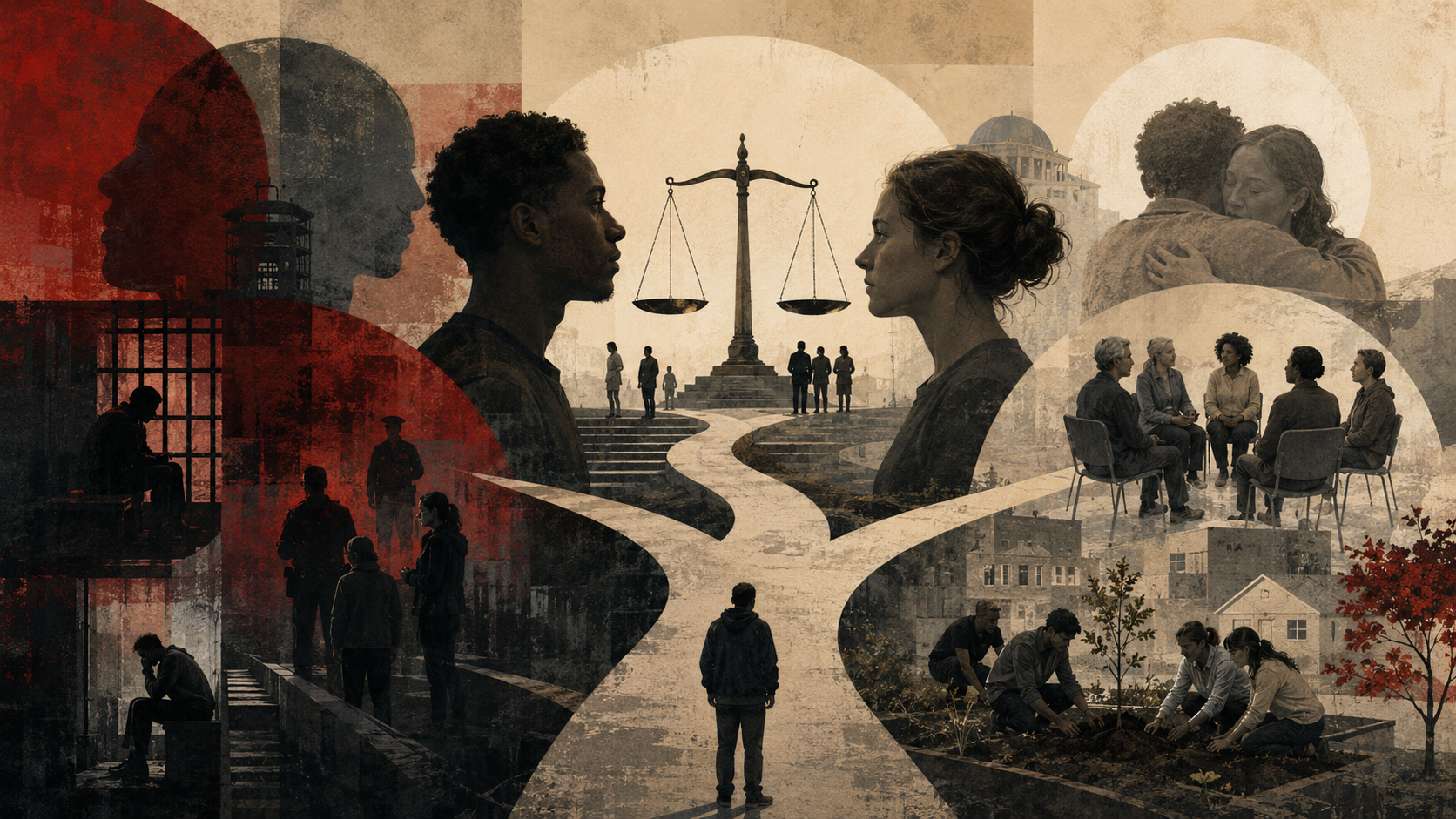
Wrongdoing creates more than a rule violation. It creates a moral rupture. Someone has been harmed, disrespected, exploited, deceived, betrayed, degraded, abandoned, coerced, injured, or made vulnerable. A norm has been broken. A relationship may have been damaged. Public trust may have been weakened. A victim’s standing may have been denied. A community may need reassurance that the wrong is not normal, acceptable, or invisible. The question after wrongdoing is therefore not simply “What penalty should follow?” It is also “What would it take to tell the truth about this wrong, restore moral recognition, protect those harmed, and rebuild the conditions under which trust might become possible again?”
This is why punishment, forgiveness, and moral repair belong together. Punishment addresses wrong through sanction, burden, condemnation, restraint, or accountability. Forgiveness addresses wrong through a transformed moral-emotional stance toward the wrongdoer, though not necessarily through reunion or trust. Repair addresses wrong through the broader work of restoring moral order, relationships, standing, safety, value consensus, and future conditions of accountability. They may overlap, but none should be collapsed into the others.
What Punishment, Forgiveness, and Repair Are
Punishment, in moral, legal, and social terms, concerns an intentionally burdensome response to wrongdoing. It may involve legal penalty, social sanction, exclusion, public condemnation, loss of privilege, restitutionary burden, discipline, or other consequences imposed because a wrong has occurred. Punishment can be justified in different ways: because the wrongdoer deserves it, because it deters future harm, because it protects others, because it communicates condemnation, because it reaffirms violated norms, or because it creates conditions for accountability and repair.
Forgiveness is different. It is not primarily a penalty or a public institution. It is a moral response to wrongdoing in which the person wronged, or sometimes a community, changes the stance they take toward the wrongdoer. Forgiveness may involve releasing certain forms of resentment, refusing revenge, restoring some possibility of human recognition, or no longer letting the wrong dominate the relation. But forgiveness does not necessarily mean forgetting, excusing, reconciling, trusting, or denying that accountability remains necessary.
Moral repair is broader than both punishment and forgiveness. It concerns the work of responding to the damage wrongdoing creates in relationships, standing, trust, self-understanding, shared norms, and public moral reality. Repair may include punishment, but it may also require apology, acknowledgment, restitution, truth-telling, atonement, institutional reform, changed conduct, compensation, memory, public recognition, or renewed conditions of safety. Repair asks not only what should happen to the wrongdoer, but what must be restored, rebuilt, protected, or transformed after harm.
These distinctions matter because wrongdoing often creates multiple moral needs at once. A victim may need recognition. A community may need norm reaffirmation. A wrongdoer may need accountability and a path toward changed life. Observers may need assurance that the wrong is not being normalized. Institutions may need reform. A single response rarely satisfies all of these needs. Punishment, forgiveness, and repair are therefore best understood as separate but interacting parts of post-wrong moral life.
| Response | Primary focus | What it can do | What it cannot guarantee |
|---|---|---|---|
| Punishment | Sanction, accountability, condemnation, deterrence, protection, norm reaffirmation | Marks wrongdoing as serious and imposes consequence. | Does not by itself restore trust, remorse, healing, or transformed relation. |
| Forgiveness | Moral-emotional stance toward the wrongdoer | May release revenge, soften resentment, or permit a new relation to the wrong. | Does not automatically erase blame, restore trust, or cancel accountability. |
| Moral repair | Restoration of damaged moral relations, standing, norms, recognition, and trust | Addresses the broader fracture caused by wrongdoing. | Cannot always return the world to what it was before the harm. |
| Reconciliation | Renewed relationship or civic coexistence after wrong | May rebuild some form of shared life. | Should not be declared before truth, safety, and accountability. |
| Atonement | Active making-amends by the wrongdoer | Connects remorse to acknowledgment, restitution, and changed conduct. | Cannot be reduced to words without transformation. |
Why These Responses Need Separation
These responses need separation because moral language often collapses them too quickly. Some people assume that justice means punishment and that forgiveness weakens justice. Others assume that forgiveness is morally superior and that continued anger, punishment, or boundary-setting reflects moral failure. Still others treat reconciliation as though it can be produced by public ceremony or verbal apology even when those harmed have not been heard, compensated, protected, or respected. Each collapse distorts the moral structure of response to wrongdoing.
Punishment without repair can become empty severity. It may express condemnation while leaving victims unsupported, offenders unchanged, institutions unreformed, and trust unrepaired. Forgiveness without accountability can become premature closure. It may comfort observers or wrongdoers while silencing the person harmed. Repair without truth can become denial. Reconciliation without justice can become pressure on the harmed to accommodate the comfort of the powerful.
Separating these responses also helps clarify moral disagreement. People often argue past one another because they are asking different questions. One person asks whether the wrongdoer deserves punishment. Another asks whether the victim can forgive. Another asks whether the relationship can be restored. Another asks whether public norms have been reaffirmed. Another asks whether the conditions that enabled the wrong have changed. These are related questions, but they are not the same question.
Analytical separation protects moral seriousness. It allows us to say that punishment may be justified and still insufficient; that forgiveness may be meaningful and still not required; that repair may be necessary even where reconciliation is impossible; and that accountability may require structural reform rather than only individual blame. It prevents one moral response from pretending to do the work of all the others.
| Common collapse | Why it is misleading | Better distinction |
|---|---|---|
| Justice equals punishment | Punishment may affirm norms but fail to repair harm. | Justice may require sanction, recognition, restitution, protection, reform, and repair. |
| Forgiveness equals reconciliation | A person may forgive without restoring intimacy, trust, or shared life. | Forgiveness concerns stance; reconciliation concerns renewed relation. |
| Forgiveness cancels accountability | Forgiving does not necessarily erase responsibility or consequences. | Forgiveness and accountability can coexist. |
| Apology equals repair | Words may be sincere, strategic, partial, or empty. | Apology must be connected to truth, amends, restitution, and changed conduct. |
| Public closure equals moral repair | Institutions may declare healing while harmed people remain unsafe or unheard. | Repair requires recognition, accountability, and conditions for trust. |
Punishment as Sanction and Condemnation
Punishment is one of the most visible responses to wrongdoing because it gives public form to condemnation. It says that a wrong has occurred, that the wrongdoer is answerable, and that the community or institution does not treat the violation as acceptable. This expressive dimension matters. When serious wrongdoing receives no sanction, victims and observers may conclude that the wrong is being minimized, normalized, or protected.
Punishment can serve several functions at once. It can impose deserved consequence, deter future wrongdoing, incapacitate dangerous actors, protect vulnerable people, reaffirm norms, communicate blame, restore public confidence, or create conditions for repair. In ordinary moral life, people often combine these functions. They may want punishment because the wrongdoer deserves it, because others must be protected, because future harm must be prevented, because the victim must be recognized, or because the norm must be publicly defended.
This plural structure explains why punishment is psychologically powerful. It does not only concern the offender. It also concerns victims, observers, and the community’s shared sense of moral order. A failure to punish may feel like betrayal because it appears to deny the victim’s standing. Excessive punishment may feel cruel because it exceeds proportion or refuses the wrongdoer’s continuing humanity. Punishment therefore sits at the intersection of accountability, dignity, proportionality, protection, and public meaning.
But because punishment is so visible, it can also become a substitute for deeper moral work. A society may punish harshly while failing to repair victims, address causes, reduce future harm, or transform institutions. A workplace may fire one employee while leaving the incentive structure intact. A government may prosecute a perpetrator while denying broader responsibility. A school may suspend a student while ignoring the conditions that shaped the conflict. Punishment can mark wrong, but it cannot carry the entire burden of justice.
| Function of punishment | What it seeks to accomplish | Moral risk |
|---|---|---|
| Retribution | Imposes deserved consequence for wrongdoing | Can become vengeance if detached from proportion and dignity. |
| Deterrence | Discourages future wrongdoing | Can instrumentalize the offender if future benefit is the only concern. |
| Protection | Restrains harmful actors and safeguards others | Can justify indefinite or excessive control if not limited. |
| Moral communication | Expresses condemnation and reaffirms violated norms | Can become symbolic performance without repair. |
| Public reassurance | Shows victims and observers that the wrong matters | Can prioritize public comfort over victim-centered justice. |
Retributive, Consequentialist, and Mixed Views
Theories of punishment are often organized around retributive, consequentialist, and mixed approaches. Retributive views hold that punishment is justified because wrongdoers deserve it. The wrong itself creates a reason for proportionate sanction. Consequentialist views justify punishment by its beneficial effects, such as deterrence, incapacitation, rehabilitation, or social protection. Mixed views combine backward-looking desert with forward-looking purposes, often insisting that punishment should be deserved and also socially constructive.
This theoretical landscape matters for moral psychology because ordinary punishment judgments often combine these logics. People may say a wrongdoer deserves punishment, but they may also care whether punishment prevents harm, restores victims, teaches norms, expresses condemnation, or protects the community. Everyday moral judgment is rarely pure theory. It often blends desert, deterrence, protection, communication, outrage, fear, empathy, identity, and institutional trust.
Retributive intuitions can be morally important because they resist treating wrongdoers merely as tools for social outcomes. If a person is punished, the punishment should track responsibility and wrongdoing, not merely convenience. Consequentialist concerns are also morally important because punishment that produces only suffering without protection, deterrence, rehabilitation, or repair may be hard to justify. Mixed views recognize that punishment is morally dangerous precisely because it imposes burdens deliberately; it needs both backward-looking and forward-looking constraint.
The tension among these theories appears in practical disputes. Should punishment be reduced if the offender shows remorse? Should harsh punishment be imposed if it deters others but exceeds individual desert? Should rehabilitation matter as much as retribution? Should punishment be public because norms need reaffirmation, or private because humiliation is degrading? Should punishment aim at repair? These questions show why punishment cannot be understood as a single psychological impulse.
| Theory | Central question | Strength | Risk |
|---|---|---|---|
| Retributive | What does the wrongdoer deserve? | Takes responsibility, wrongdoing, and proportion seriously. | Can harden into punitive excess or revenge. |
| Consequentialist | What future goods will punishment produce? | Considers deterrence, protection, rehabilitation, and harm reduction. | Can punish people too harshly for social utility. |
| Communicative | What moral message should punishment express? | Recognizes punishment as public condemnation and norm reaffirmation. | Can become symbolic if not tied to material repair. |
| Restorative | How can response help repair harm and relations? | Centers victims, accountability, acknowledgment, and future relation. | Can be misused if pressure for harmony weakens accountability. |
| Mixed | How can punishment be deserved, limited, and socially constructive? | Balances multiple moral demands. | Can become unstable if principles conflict. |
Punishment as Moral Communication
Punishment often communicates. It tells victims, offenders, observers, and institutions what a community takes seriously. When wrongdoing is punished proportionately and fairly, punishment can express that the wrong was real, that the harmed person matters, that the wrongdoer is responsible, and that the norm remains in force. This communicative dimension is why punishment can feel morally necessary even when it does not repair everything.
But communication depends on credibility. Punishment communicates justice only when it is fair, proportionate, nonselective, and connected to the truth of the wrong. If punishment is arbitrary, discriminatory, excessive, vindictive, hypocritical, or applied only to the powerless, it communicates domination rather than justice. A system that punishes harshly downward while protecting powerful wrongdoers does not reaffirm moral norms; it reveals unequal moral standing.
Punishment can also communicate different things to different audiences. Victims may hear recognition or abandonment. Offenders may hear condemnation, humiliation, or an invitation to accountability. Observers may hear reassurance or fear. Marginalized communities may hear selective enforcement. Institutions may hear closure rather than the need for reform. The same sanction can carry multiple meanings depending on history, power, trust, and context.
This is why punishment must be interpreted socially. A sentence, penalty, suspension, public censure, expulsion, or disciplinary action does not mean the same thing in every institutional environment. Punishment may communicate justice in one context and scapegoating in another. It may restore norm confidence in one setting and deepen distrust in another. Moral psychology must therefore ask not only what punishment is imposed, but how it is understood by those living under the relevant moral order.
| Audience | Possible meaning of punishment | Risk if punishment is distorted |
|---|---|---|
| Victim | “The wrong against you is recognized.” | Punishment may feel empty if safety, repair, or restitution is absent. |
| Wrongdoer | “You are responsible for what you did.” | Punishment may produce shame, denial, resentment, or alienation without accountability. |
| Observers | “This norm still matters.” | Public punishment may become spectacle or moral performance. |
| Institution | “The case has been addressed.” | Sanction may become a substitute for reform. |
| Marginalized groups | “The system applies its standards fairly or unfairly.” | Selective punishment can deepen distrust and moral injury. |
The Limits of Punishment
Punishment has limits because wrongdoing damages more than the balance of penalty and desert. A victim may still feel unseen after the offender is punished. A community may still lack trust. An institution may remain unchanged. The wrongdoer may experience punishment without remorse. The conditions that enabled the harm may persist. A public may feel that something has been done while the deeper work of repair has not begun.
Punishment can also produce new harms. It can be excessive, discriminatory, humiliating, brutalizing, or politically instrumentalized. It can deepen cycles of resentment. It can punish people without helping them understand the wrong. It can prioritize public anger over victim needs. It can express condemnation while refusing to ask why the harm occurred or how similar harm can be prevented. A morally serious view of punishment must therefore recognize both its possible necessity and its possible failure.
The limits of punishment are especially visible in institutional settings. A workplace may discipline one abusive manager while leaving a culture of retaliation intact. A school may punish a student while ignoring unequal treatment or unmet needs. A criminal-justice system may incarcerate individuals while leaving poverty, trauma, racism, mental illness, addiction, or social abandonment untouched. A state may punish atrocity while failing to repair victims, return land, compensate communities, or reform institutions. Punishment may be part of justice, but it is rarely the whole of justice.
Recognizing these limits does not mean abandoning accountability. It means asking what accountability requires beyond sanction. Accountability may include truth-telling, explanation, restitution, changed conduct, institutional reform, victim recognition, public memory, and ongoing responsibility. A punishment-centered society may confuse suffering imposed on wrongdoers with justice achieved. Moral repair requires a broader lens.
| Limit of punishment | Why it matters | Repair-oriented question |
|---|---|---|
| It may not heal victims | Sanction does not automatically restore safety, dignity, or trust. | What do those harmed need to be recognized and protected? |
| It may not change offenders | Burden alone does not guarantee remorse or transformation. | What would accountable change require? |
| It may not reform institutions | Individual punishment can hide structural responsibility. | What conditions made the wrong possible? |
| It may be unequal | Selective enforcement undermines moral legitimacy. | Are powerful and powerless actors held to the same standard? |
| It may become symbolic closure | Public sanction can create the appearance of justice without repair. | What remains unresolved after punishment? |
Forgiveness as a Moral Response
Forgiveness is one of the most morally charged responses to wrongdoing because it concerns how the harmed person or community stands toward the wrongdoer after the wrong has been named. It is not simply forgetting, excusing, pardoning, reconciling, or pretending the injury did not occur. At its strongest, forgiveness is possible only because the wrong remains visible. One cannot forgive what one has denied, trivialized, or reclassified as harmless.
Forgiveness may involve a change in resentment, blame, hostility, desire for revenge, or moral distance. It may allow the victim to refuse ongoing domination by the wrong. It may open a path toward renewed relation, though it need not do so. It may be religious, interpersonal, therapeutic, civic, or moral. It may occur privately or publicly. It may be conditional on acknowledgment and amends, or it may be offered without full repair. But in any form, forgiveness should be distinguished from denial.
The moral difficulty of forgiveness lies in its double aspect. On one hand, forgiveness can be liberating. It can free the harmed person from a relation to the offender organized only by injury. It can open possibilities for peace, mercy, transformation, and renewed human recognition. On the other hand, forgiveness can be misused. It can be demanded too quickly, weaponized against victims, used to protect offenders, or treated as a moral duty imposed on those who have already suffered.
Forgiveness is therefore not morally simple. It may be admirable, but it is not always required. It may be healing, but it is not always safe. It may support repair, but it does not replace accountability. It may coexist with punishment, boundaries, distance, restitution, or refusal to reconcile. A mature moral psychology of forgiveness must protect both the possibility of mercy and the agency of those harmed.
| Forgiveness is not… | Why the distinction matters | Possible better formulation |
|---|---|---|
| Forgetting | Memory may be necessary for safety, truth, and accountability. | Forgiveness can remember without being governed by revenge. |
| Excusing | Excuse reduces or removes blame; forgiveness responds to blameworthy wrong. | Forgiveness names the wrong while changing the victim’s stance. |
| Reconciliation | Renewed relationship requires safety, trust, and mutual transformation. | Forgiveness may occur without renewed closeness. |
| Pardon | Legal or institutional pardon cancels or reduces penalty. | Forgiveness may coexist with consequences. |
| Weakness | Forgiveness can require courage and moral clarity. | Forgiveness may be chosen without denying harm. |
Forgiveness Without Excusing or Forgetting
One of the most important distinctions in this domain is that forgiveness need not imply excuse, forgetting, reconciliation, trust, or restored intimacy. A person may forgive while still believing that punishment is justified. They may forgive while maintaining distance. They may forgive while refusing to return to a relationship. They may forgive while continuing to remember the harm clearly. They may forgive while insisting that the wrongdoer make amends.
This distinction protects forgiveness from sentimental misuse. If forgiveness is treated as forgetting, victims may be told to erase their own knowledge. If forgiveness is treated as excuse, wrongdoing may be minimized. If forgiveness is treated as reconciliation, victims may be pressured back into unsafe or degrading relationships. If forgiveness is treated as the end of accountability, offenders may seek emotional absolution without material change.
Forgiveness without excusing keeps the wrong visible. It says: what happened was wrong, you were responsible, the harm mattered, and yet I am choosing not to relate to you only through vengeance or hatred. Forgiveness without forgetting says: memory remains part of truth, but memory need not become permanent captivity. Forgiveness without reconciliation says: I may release certain forms of resentment without granting you renewed access to me. These distinctions are morally protective.
They are also psychologically important. People harmed by wrongdoing may need different forms of distance, boundary, speech, memory, anger, grief, or repair. Some may find forgiveness meaningful. Others may not. Some may forgive inwardly but not publicly. Others may refuse the language of forgiveness but still refuse revenge. Moral psychology should avoid imposing one emotional script on every person harmed.
| Possible stance | What it preserves | What it refuses |
|---|---|---|
| Forgiveness with accountability | Mercy, moral clarity, and consequence | The false choice between compassion and justice |
| Forgiveness with boundaries | Victim agency and future safety | The assumption that forgiveness requires renewed access |
| Forgiveness with memory | Truth and moral learning | The demand that victims forget or minimize harm |
| Forgiveness without reconciliation | Release from revenge without restored relationship | The idea that forgiveness must recreate intimacy |
| Refusal of revenge without forgiveness | Restraint and dignity | The claim that the only nonviolent response is forgiveness |
When Refusing Forgiveness May Be Understandable
Refusing forgiveness may be understandable when remorse is absent, harm is ongoing, the wrongdoer remains dangerous, repair is insincere, truth has not been told, or pressure to forgive functions mainly to restore the comfort of wrongdoers, bystanders, institutions, or communities. In such cases, refusal may preserve moral protest. It may protect self-respect. It may resist false closure. It may say: the wrong remains unacknowledged, the conditions remain unsafe, and forgiveness would be premature or dishonest.
This point is ethically important because forgiveness is often praised in ways that can become coercive. Victims may be told that healing requires forgiveness, that anger is unhealthy, that moral maturity means letting go, or that community harmony depends on their willingness to move on. Such demands can create a secondary wrong. The person harmed is burdened with repairing the emotional comfort of others while the original wrong remains insufficiently addressed.
Refusal to forgive is not always noble. It can become corrosive, vengeful, rigid, or destructive. But neither is it always pathological. Sometimes continued resentment is a form of moral memory. Sometimes refusal protects the victim from being drawn into false reconciliation. Sometimes anger is evidence that the wrong has not been normalized. The moral question is not simply whether forgiveness has occurred, but whether truth, safety, accountability, and repair are being honored.
A mature moral psychology must therefore make space for multiple responses. Forgiveness may be good. Refusal may be understandable. Boundary-setting may be necessary. Punishment may be justified. Repair may remain possible or impossible. What should be avoided is the moral simplification that treats all refusal as bitterness or all forgiveness as virtue. The reality after wrongdoing is more complex.
| Condition | Why refusal may be understandable | Repair-oriented question |
|---|---|---|
| Ongoing threat | Forgiveness may endanger the person harmed or weaken boundaries. | Has safety been restored? |
| No acknowledgment | The wrongdoer denies or minimizes the wrong. | Has the truth been named? |
| No amends | Words are not connected to repair or changed conduct. | What has been done to address the harm? |
| Institutional pressure | Forgiveness is demanded to protect reputation or restore order. | Whose comfort does forgiveness serve? |
| Severe betrayal | The harm damaged trust at a deep level. | Is restored relation morally possible or appropriate? |
Moral Repair and Restoration
Moral repair is the broadest concept in this cluster because it concerns the restoration of damaged moral relations, recognition, standing, trust, and shared norms after wrongdoing. When a wrong occurs, the world is not merely legally disordered. A person may have been treated as though they did not matter. A relationship may have been betrayed. A community may have learned that its norms are fragile. An institution may have revealed that its stated values do not match its practices. Repair addresses this broader fracture.
Repair may include punishment, but it cannot be reduced to punishment. It may include forgiveness, but it cannot be reduced to forgiveness. Repair often requires truth-telling, acknowledgment, apology, restitution, changed conduct, structural reform, public memory, renewed protection, and credible commitment to nonrepetition. In some cases, repair may require restoring a relationship. In others, it may require ending one. In still others, it may require building a new institutional arrangement because the old one cannot be morally trusted.
Moral repair is also temporal. It does not always happen immediately after apology or sanction. Trust may rebuild slowly or not at all. Recognition may need repetition. Institutions may need to prove over time that they have changed. Victims may need space to determine what repair would mean. Offenders may need to show accountability across conduct, not only words. Repair is therefore less like a switch and more like a process.
The concept of repair also helps explain why wrongdoing can remain morally active long after formal punishment has occurred. A sentence may be completed, but victims may remain unrecognized. A public apology may be issued, but restitution may be absent. A scandal may pass, but institutional practices may remain unchanged. Repair asks what remains broken after visible response. That question is often the beginning of serious justice.
| Dimension of repair | What is damaged | Possible repair practice |
|---|---|---|
| Recognition | The victim’s standing, dignity, or credibility was denied. | Truth-telling, public acknowledgment, apology, validation, testimony |
| Material harm | Resources, safety, health, livelihood, or opportunity were damaged. | Restitution, compensation, protection, access, care, restoration |
| Relational trust | A relationship was betrayed or made unsafe. | Boundary, accountability, changed conduct, mediated dialogue, or separation |
| Norm confidence | The community’s standards were violated or weakened. | Sanction, public explanation, institutional reform, transparent procedure |
| Institutional legitimacy | An organization or public authority failed morally. | Investigation, reform, leadership accountability, reparations, oversight |
Apology, Atonement, and Making Amends
Apology is one of the central practices of moral repair because it connects acknowledgment to responsibility. A genuine apology does not merely express regret that harm occurred. It identifies the wrong, accepts responsibility, recognizes the harmed person’s standing, avoids self-excusing distortion, and opens the door to repair. A weak apology protects the speaker. A strong apology restores moral reality.
Atonement goes further. It concerns the active work of making amends after wrongdoing. Atonement is not reducible to words, emotions, or self-punishment. It requires action directed toward the damaged relation or moral order. This may include restitution, confession, changed behavior, public accountability, repair of material harm, or acceptance of consequence. In serious wrongdoing, atonement may be long and costly because the damage itself is long and costly.
Making amends matters because wrongdoers often seek forgiveness without repair. They may want emotional release without restitution, reconciliation without changed conduct, or public restoration without accountability. Atonement interrupts this shortcut. It says that remorse must become responsibility. The wrongdoer must not merely feel bad or seek absolution; they must participate in the work of addressing what they have damaged.
Apology and atonement also protect forgiveness from becoming cheap. Forgiveness may sometimes be offered without full amends, but repair is strengthened when apology and amends make forgiveness morally intelligible rather than coerced. The harmed person is not asked to carry the entire burden of transformation. The wrongdoer must act. The institution must act. The community must act where community norms, silence, or complicity made the wrong possible.
| Repair practice | What it requires | Failure mode |
|---|---|---|
| Apology | Truthful acknowledgment, responsibility, recognition, and nondefensive speech | Vague regret, self-protection, passive voice, or reputation management |
| Restitution | Material effort to restore losses or compensate harm | Symbolic apology without practical remedy |
| Atonement | Active making-amends through changed conduct and accepted responsibility | Emotional remorse without transformation |
| Repentance | Changed orientation toward the wrong and toward future conduct | Words of remorse followed by repetition |
| Public acknowledgment | Recognition before relevant witnesses or institutions | Private apology used to avoid public accountability |
Punishment and Restorative Justice
Punishment and restorative justice are often treated as opposites, but the relationship is more complicated. Restorative justice centers the harm caused by wrongdoing, the needs of those harmed, the accountability of the wrongdoer, and the repair of damaged relationships or communities where possible. It does not necessarily mean that consequences disappear. The key question is whether the response contributes to meaningful accountability and repair rather than merely imposing suffering.
A restorative approach asks questions that punishment-centered systems may neglect. Who was harmed? What do they need? Who is responsible? What obligations follow from the harm? What can be repaired? What must change to prevent repetition? What role should the community play? What would accountability look like beyond passive suffering under penalty? These questions shift attention from punishment alone to the moral ecology of repair.
Restorative justice can be powerful because it refuses to reduce justice to the state’s imposition of burden. It can give victims voice, require offenders to confront harm, and involve communities in rebuilding norms. But it also has risks. It can be misused if victims are pressured into dialogue, if power imbalances are ignored, if severe wrongdoing is softened for the sake of harmony, or if institutions use restorative language to avoid meaningful consequences.
The strongest view avoids the false binary. Punishment without restoration may be incomplete. Restoration without accountability may be unjust. Some wrongs require sanction. Some require dialogue. Some require restitution. Some require separation. Some require institutional reform. The measure is not whether a response sounds punitive or restorative, but whether it truthfully addresses harm, responsibility, safety, dignity, and future moral order.
| Question | Punishment-centered focus | Restorative focus |
|---|---|---|
| What happened? | Which rule was violated? | Who was harmed, and how? |
| Who is responsible? | Who committed the offense? | Who must answer for the harm and its repair? |
| What should follow? | What penalty is deserved or useful? | What obligations arise from the harm? |
| What does the victim need? | Recognition may be indirect through sanction. | Victim voice, safety, acknowledgment, restitution, and repair are central. |
| What is accountability? | Submission to penalty | Truth, responsibility, changed conduct, and repair-oriented obligation |
Victims, Offenders, and Observers
Justice repair is psychologically plural because wrongdoing affects different parties differently. Victims may need safety, recognition, restitution, voice, validation, or restored standing. Offenders may need accountability, confrontation with harm, pathways to remorse, and conditions for changed conduct. Observers may need reassurance that norms still hold and that wrongdoing will not be ignored or normalized. Institutions may need credibility, reform, and public trust. These needs overlap, but they are not identical.
This plurality explains why post-wrong conflict can be so difficult. A response that satisfies observers may fail victims. A punishment that reassures the public may not repair material harm. A process that enables offender reintegration may feel premature or unsafe to those harmed. A public apology may help an institution’s reputation while leaving victims unheard. A victim’s refusal to forgive may frustrate observers who want closure, but closure may not be theirs to demand.
Victims, offenders, and observers also occupy different moral positions. Victims have special standing because they were harmed. Offenders have responsibility because they caused or contributed to the wrong. Observers have an interest in norms and public trust, but they may also distort repair by demanding spectacle, vengeance, or premature reconciliation. Institutions may claim neutrality while protecting their own authority. Each standpoint must be understood, but not all standpoints carry equal moral authority in every question.
Moral repair requires alignment among these perspectives without erasing their differences. Victims should not be used as instruments of public reassurance. Offenders should not be reduced forever to the worst thing they have done where genuine accountability and transformation are possible. Observers should not be allowed to turn wrongdoing into moral entertainment. Institutions should not declare repair before those harmed have been heard. Repair is difficult because it must coordinate recognition, accountability, safety, and future relation across multiple moral positions.
| Perspective | Likely moral need | Possible distortion |
|---|---|---|
| Victim | Recognition, safety, truth, restitution, restored standing, agency | May be pressured to forgive, reconcile, or provide closure for others. |
| Offender | Accountability, remorse, atonement, path to changed conduct | May seek pardon without truth, consequence, or repair. |
| Observer | Norm reassurance, condemnation of wrong, confidence in justice | May demand punishment for spectacle or closure. |
| Community | Restored norms, repaired trust, prevention of recurrence | May prioritize harmony over victim recognition. |
| Institution | Legitimacy, credibility, reform, public accountability | May protect reputation while performing repair. |
Institutions, Conflict, and Public Repair
At larger scales, punishment, forgiveness, and repair become public and political. Institutions, states, schools, churches, universities, corporations, courts, agencies, professions, and communities all face wrongdoing that cannot be resolved through private apology alone. Institutional harm damages public trust, collective memory, legal legitimacy, civic belonging, and the moral standing of groups. Repair at this scale requires more than interpersonal forgiveness.
Public repair may include investigation, truth commission, public apology, reparations, prosecution, memorialization, institutional reform, leadership accountability, legal change, transparency, community participation, and structural transformation. It may also require a public record of what happened so that denial does not become the foundation of future coexistence. Where wrongdoing is collective, systemic, or historically deep, repair must address the structures that made the harm possible.
Transitional justice makes this especially clear. After conflict, state violence, mass abuse, colonization, racial terror, institutional betrayal, or human-rights violation, the question is not only whether individual wrongdoers should be punished. It is also how a political community can reestablish conditions of trust, rights, memory, accountability, and shared civic order. Forgiveness may occur in some lives, but public repair cannot be built on demanding forgiveness from victims or survivors.
Institutions often fail at repair because they seek closure too quickly. They want the scandal ended, the report filed, the apology accepted, the offender disciplined, and the public reassured. But genuine repair may require the institution to remain accountable over time. It may require changed policies, changed leadership, changed incentives, changed archives, changed training, changed resource allocation, and changed power relations. Moral repair is not public relations. It is institutional transformation under the discipline of truth.
| Scale of wrongdoing | What repair may require | Common failure |
|---|---|---|
| Interpersonal | Apology, acknowledgment, restitution, changed conduct, boundary, forgiveness where appropriate | Pressure for quick reconciliation |
| Organizational | Investigation, sanction, policy change, culture change, leadership accountability | Scapegoating one person while preserving the system |
| Professional | Discipline, public standards, victim recognition, licensing reform, ethics review | Protecting professional reputation over harmed persons |
| Political | Truth, reparations, prosecution, institutional reform, rights protection | Declaring unity without justice |
| Historical | Memory, reparative policy, public acknowledgment, structural transformation | Symbolic apology without material change |
Mathematical Lens: Modeling Punishment, Forgiveness, and Repair
Punishment, forgiveness, and repair can be modeled as distinct but interacting post-wrong responses. Let \(W_i\) represent the severity of wrongdoing in case \(i\). A simplified punishment response can be written as:
P_i = \alpha W_i + \beta R_i + \gamma N_i
\]
Interpretation: Punishment is modeled as increasing with wrongdoing severity, perceived offender responsibility, and perceived need for norm reaffirmation.
where \(P_i\) is punishment response, \(W_i\) is wrongdoing severity, \(R_i\) is perceived offender responsibility, and \(N_i\) is perceived need for norm reaffirmation. This captures the idea that punishment depends not only on bad outcomes, but on responsibility and the social meaning of the wrong.
Forgiveness can be modeled separately:
F_i = \sigma(\delta A_i + \epsilon M_i – \lambda T_i)
\]
Interpretation: Forgiveness probability rises with acknowledgment and amends, and falls when ongoing threat or unresolved harm remains high.
where \(F_i\) is forgiveness probability, \(\sigma\) is the logistic transformation, \(A_i\) is acknowledgment, \(M_i\) is amends or repentance, and \(T_i\) is ongoing threat or unresolved harm. This reflects the idea that forgiveness is constrained by safety, truth, and the wrongdoer’s response to the wrong.
Moral repair can then be modeled as a broader relational and institutional outcome:
R^{*}_i = \theta_1 P_i + \theta_2 F_i + \theta_3 C_i + \theta_4 Q_i
\]
Interpretation: Moral repair is modeled as a broader outcome shaped by punishment, forgiveness, compensation or restitution, and restored shared moral understanding.
where \(R^{*}_i\) is moral repair, \(C_i\) is compensation or restitution, and \(Q_i\) is restoration of shared moral understanding, value consensus, or norm recognition. This model is intentionally simplified, but it makes the central distinction visible: punishment, forgiveness, and repair can move together or apart.
Public repair can also be represented institutionally:
PR_g = \omega_1 T_g + \omega_2 A_g + \omega_3 S_g + \omega_4 I_g – \omega_5 D_g
\]
Interpretation: Public repair rises with truth-telling, accountability, structural reform, and institutional credibility, and falls when denial remains strong.
where \(PR_g\) is public repair in group or institution \(g\), \(T_g\) is truth-telling, \(A_g\) is accountability, \(S_g\) is structural reform, \(I_g\) is institutional credibility, and \(D_g\) is denial. This model captures why large-scale repair cannot be reduced to private forgiveness or isolated punishment.
| Model term | Meaning | Moral interpretation |
|---|---|---|
| \(W_i\) | Wrongdoing severity | How serious the violation is judged to be. |
| \(R_i\) | Offender responsibility | How strongly the wrongdoer is judged answerable. |
| \(N_i\) | Norm reaffirmation need | How strongly the community needs public recognition that the wrong matters. |
| \(A_i\) | Acknowledgment | Whether the wrong is truthfully named and responsibility accepted. |
| \(M_i\) | Amends | Whether remorse becomes concrete action. |
| \(T_i\) | Ongoing threat | Whether the person harmed remains unsafe or the wrong remains unresolved. |
| \(C_i\) | Compensation or restitution | Material effort to address loss or damage. |
| \(Q_i\) | Shared moral understanding | Restored recognition of the norm, the harm, and the victim’s standing. |
R Workflow: Modeling Punishment, Forgiveness, and Moral Repair
The following R workflow simulates wrongdoing severity, offender responsibility, acknowledgment, amends, ongoing threat, restitution, punishment, forgiveness, and moral repair. The dataset is synthetic and intended for reproducible article support, not empirical claims about real victims, offenders, institutions, courts, or communities.
# Punishment, Forgiveness, and Moral Repair
# Synthetic R workflow for modeling post-wrong moral responses.
# Educational and reproducible research scaffold only.

suppressPackageStartupMessages({
  library(tidyverse)
  library(broom)
})

set.seed(42)

# ------------------------------------------------------------
# 1. Set up output folders
# ------------------------------------------------------------

dir.create("outputs", showWarnings = FALSE)
dir.create("outputs/tables", recursive = TRUE, showWarnings = FALSE)
dir.create("outputs/figures", recursive = TRUE, showWarnings = FALSE)

# ------------------------------------------------------------
# 2. Simulate post-wrong response structure
# ------------------------------------------------------------

n <- 2400

df <- tibble(
  case_id = 1:n,
  wrongdoing_severity = rnorm(n, 0, 1),
  offender_responsibility = rnorm(n, 0, 1),
  norm_reaffirmation_need = rnorm(n, 0, 1),
  acknowledgment = rnorm(n, 0, 1),
  amends = rnorm(n, 0, 1),
  ongoing_threat = rnorm(n, 0, 1),
  restitution = rnorm(n, 0, 1),
  institutional_trust = rnorm(n, 0, 1),
  victim_recognition = rnorm(n, 0, 1),
  structural_reform = rnorm(n, 0, 1)
) %>%
  mutate(
    punishment_score =
      0.40 * wrongdoing_severity +
      0.35 * offender_responsibility +
      0.25 * norm_reaffirmation_need +
      rnorm(n, 0, 0.8),

    forgiveness_latent =
      0.35 * acknowledgment +
      0.30 * amends -
      0.40 * ongoing_threat +
      0.15 * victim_recognition +
      rnorm(n, 0, 0.8),

    forgiveness_probability = plogis(forgiveness_latent),
    forgiveness = if_else(forgiveness_probability >= 0.5, 1, 0),

    moral_repair =
      0.20 * punishment_score +
      0.25 * forgiveness_probability +
      0.30 * restitution +
      0.30 * acknowledgment +
      0.25 * victim_recognition +
      0.20 * institutional_trust +
      0.25 * structural_reform -
      0.25 * ongoing_threat +
      rnorm(n, 0, 0.8)
  )

# ------------------------------------------------------------
# 3. Estimate punishment model
# ------------------------------------------------------------

model_punishment <- lm(
  punishment_score ~ wrongdoing_severity + offender_responsibility +
    norm_reaffirmation_need,
  data = df
)

punishment_summary <- tidy(model_punishment, conf.int = TRUE)
punishment_fit <- glance(model_punishment)

print(punishment_summary)

# ------------------------------------------------------------
# 4. Estimate forgiveness model
# ------------------------------------------------------------

model_forgiveness <- glm(
  forgiveness ~ acknowledgment + amends + ongoing_threat + victim_recognition,
  data = df,
  family = binomial()
)

forgiveness_summary <- tidy(
  model_forgiveness,
  conf.int = TRUE,
  exponentiate = TRUE
)

forgiveness_fit <- glance(model_forgiveness)

print(forgiveness_summary)

# ------------------------------------------------------------
# 5. Estimate repair model
# ------------------------------------------------------------

model_repair <- lm(
  moral_repair ~ punishment_score + forgiveness_probability +
    restitution + acknowledgment + victim_recognition +
    institutional_trust + structural_reform + ongoing_threat,
  data = df
)

repair_summary <- tidy(model_repair, conf.int = TRUE)
repair_fit <- glance(model_repair)

print(repair_summary)

# ------------------------------------------------------------
# 6. Summarize by threat level
# ------------------------------------------------------------

threat_summary <- df %>%
  mutate(
    threat_group = ntile(ongoing_threat, 4),
    threat_group = factor(
      threat_group,
      labels = c("Low", "Lower-middle", "Upper-middle", "High")
    )
  ) %>%
  group_by(threat_group) %>%
  summarize(
    mean_punishment = mean(punishment_score),
    mean_forgiveness = mean(forgiveness_probability),
    mean_repair = mean(moral_repair),
    mean_acknowledgment = mean(acknowledgment),
    mean_restitution = mean(restitution),
    .groups = "drop"
  )

print(threat_summary)

# ------------------------------------------------------------
# 7. Prediction grid across acknowledgment and threat
# ------------------------------------------------------------

pred_grid <- expand_grid(
  acknowledgment = seq(-2, 2, length.out = 100),
  ongoing_threat = c(-1, 0, 1),
  amends = 0,
  victim_recognition = 0
)

pred_grid$predicted_forgiveness <- predict(
  model_forgiveness,
  newdata = pred_grid,
  type = "response"
)

pred_grid <- pred_grid %>%
  mutate(
    threat_label = case_when(
      ongoing_threat == -1 ~ "Low ongoing threat",
      ongoing_threat == 0 ~ "Average ongoing threat",
      TRUE ~ "High ongoing threat"
    )
  )

# ------------------------------------------------------------
# 8. Plot predicted forgiveness
# ------------------------------------------------------------

plot_forgiveness <- ggplot(
  pred_grid,
  aes(x = acknowledgment, y = predicted_forgiveness)
) +
  geom_line(linewidth = 1) +
  facet_wrap(~ threat_label) +
  labs(
    title = "Predicted Forgiveness from Acknowledgment and Threat",
    subtitle = "Acknowledgment matters, but unresolved threat sharply constrains forgiveness",
    x = "Acknowledgment",
    y = "Probability of forgiveness"
  ) +
  theme_minimal(base_size = 12)

print(plot_forgiveness)

# ------------------------------------------------------------
# 9. Export outputs
# ------------------------------------------------------------

write_csv(df, "outputs/tables/punishment_forgiveness_moral_repair_simulated_data.csv")
write_csv(punishment_summary, "outputs/tables/punishment_model.csv")
write_csv(punishment_fit, "outputs/tables/punishment_model_fit.csv")
write_csv(forgiveness_summary, "outputs/tables/forgiveness_model.csv")
write_csv(forgiveness_fit, "outputs/tables/forgiveness_model_fit.csv")
write_csv(repair_summary, "outputs/tables/moral_repair_model.csv")
write_csv(repair_fit, "outputs/tables/moral_repair_model_fit.csv")
write_csv(threat_summary, "outputs/tables/threat_group_summary.csv")
write_csv(pred_grid, "outputs/tables/forgiveness_prediction_grid.csv")

ggsave(
  filename = "outputs/figures/predicted_forgiveness_by_acknowledgment_and_threat.png",
  plot = plot_forgiveness,
  width = 10,
  height = 6,
  dpi = 300
)
This workflow is useful because it keeps punishment, forgiveness, and repair analytically distinct while still modeling their interaction. Punishment responds to severity, responsibility, and norm reaffirmation. Forgiveness responds to acknowledgment, amends, threat, and victim recognition. Repair responds to a broader set of variables, including restitution, institutional trust, structural reform, and the reduction of ongoing threat.
Python Workflow: Simulating Responses to Wrongdoing
The Python workflow below simulates sanction, forgiveness, and repair dynamics under changing acknowledgment, threat, restitution, institutional trust, victim recognition, and structural reform conditions. The example uses synthetic data for reproducible demonstration and should not be interpreted as an assessment of real cases, victims, wrongdoers, institutions, or justice systems.
# Punishment, Forgiveness, and Moral Repair
# Python workflow for synthetic post-wrong response modeling.
# Educational and reproducible research scaffold only.

from pathlib import Path

import numpy as np
import pandas as pd

np.random.seed(42)

# ------------------------------------------------------------
# 1. Set up output folders
# ------------------------------------------------------------

output_tables = Path("outputs/tables")
output_tables.mkdir(parents=True, exist_ok=True)

# ------------------------------------------------------------
# 2. Simulate post-wrong conditions
# ------------------------------------------------------------

n = 2600

df = pd.DataFrame({
    "case_id": np.arange(1, n + 1),
    "wrongdoing_severity": np.random.normal(0, 1, n),
    "offender_responsibility": np.random.normal(0, 1, n),
    "norm_reaffirmation_need": np.random.normal(0, 1, n),
    "acknowledgment": np.random.normal(0, 1, n),
    "amends": np.random.normal(0, 1, n),
    "ongoing_threat": np.random.normal(0, 1, n),
    "restitution": np.random.normal(0, 1, n),
    "institutional_trust": np.random.normal(0, 1, n),
    "victim_recognition": np.random.normal(0, 1, n),
    "structural_reform": np.random.normal(0, 1, n)
})

# ------------------------------------------------------------
# 3. Generate punishment, forgiveness, and repair
# ------------------------------------------------------------

df["punishment_score"] = (
    0.40 * df["wrongdoing_severity"] +
    0.35 * df["offender_responsibility"] +
    0.25 * df["norm_reaffirmation_need"] +
    np.random.normal(0, 0.8, n)
)

forgiveness_latent = (
    0.35 * df["acknowledgment"] +
    0.30 * df["amends"] -
    0.40 * df["ongoing_threat"] +
    0.15 * df["victim_recognition"] +
    np.random.normal(0, 0.8, n)
)

df["forgiveness_probability"] = 1 / (1 + np.exp(-forgiveness_latent))
df["forgiveness"] = (df["forgiveness_probability"] >= 0.5).astype(int)

df["moral_repair"] = (
    0.20 * df["punishment_score"] +
    0.25 * df["forgiveness_probability"] +
    0.30 * df["restitution"] +
    0.30 * df["acknowledgment"] +
    0.25 * df["victim_recognition"] +
    0.20 * df["institutional_trust"] +
    0.25 * df["structural_reform"] -
    0.25 * df["ongoing_threat"] +
    np.random.normal(0, 0.8, n)
)

# ------------------------------------------------------------
# 4. Summarize by threat level
# ------------------------------------------------------------

df["threat_group"] = pd.qcut(
    df["ongoing_threat"],
    q=4,
    labels=["Low", "Lower-middle", "Upper-middle", "High"]
)

summary = (
    df.groupby("threat_group", observed=False)
      .agg(
          mean_punishment=("punishment_score", "mean"),
          mean_forgiveness=("forgiveness_probability", "mean"),
          mean_repair=("moral_repair", "mean"),
          mean_acknowledgment=("acknowledgment", "mean"),
          mean_restitution=("restitution", "mean"),
          mean_structural_reform=("structural_reform", "mean")
      )
      .reset_index()
)

print(summary)

# ------------------------------------------------------------
# 5. Scenario grid across acknowledgment and restitution
# ------------------------------------------------------------

scenario_rows = []

for acknowledgment in np.linspace(-2, 2, 41):
    for restitution in [-1, 0, 1]:
        for threat in [-1, 0, 1]:
            forgiveness_probability = 1 / (
                1 + np.exp(-(
                    0.35 * acknowledgment +
                    0.30 * 0 -
                    0.40 * threat +
                    0.15 * 0
                ))
            )

            repair = (
                0.20 * 0 +
                0.25 * forgiveness_probability +
                0.30 * restitution +
                0.30 * acknowledgment +
                0.25 * 0 +
                0.20 * 0 +
                0.25 * 0 -
                0.25 * threat
            )

            scenario_rows.append({
                "acknowledgment": acknowledgment,
                "restitution": restitution,
                "ongoing_threat": threat,
                "predicted_forgiveness_probability": forgiveness_probability,
                "predicted_moral_repair": repair
            })

scenario_df = pd.DataFrame(scenario_rows)

print(scenario_df.head(12))

# ------------------------------------------------------------
# 6. Identify low-repair synthetic cases
# ------------------------------------------------------------

low_repair_cases = (
    df.sort_values("moral_repair", ascending=True)
      .head(25)
      .reset_index(drop=True)
)

# ------------------------------------------------------------
# 7. Export outputs
# ------------------------------------------------------------

df.to_csv(output_tables / "punishment_forgiveness_moral_repair_python.csv", index=False)
summary.to_csv(output_tables / "punishment_forgiveness_moral_repair_summary.csv", index=False)
scenario_df.to_csv(output_tables / "punishment_forgiveness_moral_repair_scenarios.csv", index=False)
low_repair_cases.to_csv(
    output_tables / "punishment_forgiveness_moral_repair_low_repair_cases.csv",
    index=False
)

print("Synthetic punishment, forgiveness, and moral repair outputs written to:", output_tables)
This workflow is useful because it allows sanction, forgiveness, and repair to move independently rather than assuming they always rise or fall together. Punishment can be high while forgiveness remains low. Forgiveness can rise when acknowledgment and amends are strong, but ongoing threat can constrain it. Repair depends on a broader field of conditions, including restitution, institutional trust, victim recognition, and structural reform.
In a full article repository, this Python workflow can be extended into notebooks, SQL schema, synthetic datasets, validation notes, restorative-justice scenario grids, public-repair models, and additional language examples. R can support statistical modeling and visualization; Python can support simulation and data pipelines; SQL can preserve structured scenario metadata; Julia can support dynamic repair simulations; and C, C++, Fortran, Go, and Rust can support reproducible command-line tools, validation utilities, and computational demonstrations.
GitHub Repository
The companion repository for this article provides a reproducible code scaffold for modeling wrongdoing severity, offender responsibility, norm reaffirmation need, acknowledgment, amends, ongoing threat, restitution, institutional trust, victim recognition, structural reform, punishment, forgiveness, and moral repair.
The repository structure should support a full research workflow rather than a single script. The article folder can include language-specific examples in python, r, julia, sql, c, cpp, fortran, go, and rust, along with data, docs, notebooks, and outputs. This structure makes the article reproducible, inspectable, and extensible for readers who want to move from conceptual argument to analytical demonstration.
Conclusion
Punishment, forgiveness, and moral repair are best understood as distinct responses to wrongdoing that can conflict, coexist, or partially support one another. Punishment marks wrongdoing and may help reaffirm norms. Forgiveness can transform the victim’s or community’s stance toward the wrongdoer without erasing the wrong. Moral repair concerns the broader restoration of damaged moral relations and often requires acknowledgment, restitution, apology, changed conduct, and structural reform in addition to any sanction or pardon.
The strongest contemporary picture is therefore neither punitive simplification nor sentimental reconciliation. Wrongdoing damages persons, norms, relationships, institutions, and public moral worlds in different ways. Appropriate response must be sensitive to that complexity. Sometimes punishment is indispensable. Sometimes forgiveness is possible. Sometimes reconciliation is inappropriate. Nearly always, genuine repair demands more than a single act, phrase, penalty, or emotion.
A morally serious response to wrongdoing asks what each response can and cannot do. Punishment may condemn the wrong, but it may not heal the victim. Forgiveness may release certain forms of resentment, but it may not restore trust. Apology may acknowledge the wrong, but it may not repair material harm. Institutional discipline may identify a wrongdoer, but it may not transform the conditions that enabled wrongdoing. Repair begins when these differences are faced honestly.
This is why moral repair is such an important concept. It refuses to let justice become only suffering imposed on the wrongdoer. It refuses to let forgiveness become pressure on the victim. It refuses to let reconciliation become public comfort without truth. It asks what must be restored, what must be changed, what must be remembered, what must be compensated, what must be prevented, and what cannot be made whole. In the aftermath of wrongdoing, that wider field of responsibility is where moral seriousness begins.
Related articles
- Responsibility, Blame, and Moral Accountability
- Justice, Fairness, and Distributive Moral Judgment
- Moral Disengagement and the Psychology of Ethical Failure
- Care, Empathy, and Relational Moral Life
- Prosocial Behavior, Altruism, and Care for Others
- Hypocrisy, Dehumanization, and the Psychology of Moral Failure
- Moral Psychology in Organizations and Institutions
- Moral Injury and the Psychology of Transgression
Further reading
- Boonin, D. and Hanna, N. (2026) ‘Legal Punishment’, in The Stanford Encyclopedia of Philosophy. Available at: https://plato.stanford.edu/entries/legal-punishment/.
- Radzik, L. (2015) ‘Reconciliation’, in The Stanford Encyclopedia of Philosophy. Available at: https://plato.stanford.edu/entries/reconciliation/.
- Warmke, B. (2023) ‘Atonement’, in The Stanford Encyclopedia of Philosophy. Available at: https://plato.stanford.edu/entries/atonement/.
- Okimoto, T.G. (2025) ‘The Social Psychology of Justice Repair’, Annual Review of Psychology, 76. Available at: https://www.annualreviews.org/content/journals/10.1146/annurev-psych-030124-114525.
- Haikola, A. et al. (2025) ‘Justice in Forgiveness’, Journal of Community & Applied Social Psychology. Available at: https://onlinelibrary.wiley.com/doi/full/10.1002/casp.70118.
- Walker, M.U. (2010) Moral Repair: Reconstructing Moral Relations after Wrongdoing. Cambridge: Cambridge University Press. Available at: https://www.cambridge.org/core/books/moral-repair/0BB4F847A9B0B9E0C60AF6F8B46327E2.
References
- Boonin, D. and Hanna, N. (2026) ‘Legal Punishment’, in The Stanford Encyclopedia of Philosophy. Available at: https://plato.stanford.edu/entries/legal-punishment/.
- Haikola, A. et al. (2025) ‘Justice in Forgiveness’, Journal of Community & Applied Social Psychology. Available at: https://onlinelibrary.wiley.com/doi/full/10.1002/casp.70118.
- Okimoto, T.G. (2025) ‘The Social Psychology of Justice Repair’, Annual Review of Psychology, 76. Available at: https://www.annualreviews.org/content/journals/10.1146/annurev-psych-030124-114525.
- Radzik, L. (2015) ‘Reconciliation’, in The Stanford Encyclopedia of Philosophy. Available at: https://plato.stanford.edu/entries/reconciliation/.
- Walker, M.U. (2010) Moral Repair: Reconstructing Moral Relations after Wrongdoing. Cambridge: Cambridge University Press. Available at: https://www.cambridge.org/core/books/moral-repair/0BB4F847A9B0B9E0C60AF6F8B46327E2.
- Warmke, B. (2023) ‘Atonement’, in The Stanford Encyclopedia of Philosophy. Available at: https://plato.stanford.edu/entries/atonement/.