
Last Updated May 29, 2026
The divergence between Jung and Freud marks one of the decisive turning points in the history of modern psychology because it was not merely a personal rupture between two brilliant and difficult men, but a foundational split over the nature of the unconscious, the meaning of symbol, the role of sexuality, the interpretation of religion, the purpose of therapy, and the very horizon of what depth psychology should become. Freud and Jung began in profound intellectual proximity. Jung admired Freud’s discovery that conscious life is not master in its own house, and Freud initially saw in Jung a gifted younger ally who might help establish psychoanalysis beyond the Jewish medical circles of Vienna. Yet what united them at the beginning would eventually make their separation more consequential. Both sought a psychology of depth, but depth meant something increasingly different to each of them.
For Freud, the unconscious remained fundamentally tied to repression, infantile sexuality, conflict, wish, defense, symptom formation, and the return of what consciousness cannot admit. Psychoanalysis was therefore a disciplined science of interpretation grounded in conflict, development, and the labor of making the unconscious conscious. For Jung, the unconscious gradually widened into something more than the repository of repressed wishes and infantile residues. It included symbolic production, mythic recurrence, archetypal imagery, teleological development, compensatory imagination, religious life, and the possibility that the psyche was oriented not only by past conflict but also by future transformation. This widening changed everything.
The break was thus theoretical before it was final. Freud worried that Jung’s thinking endangered the scientific rigor of psychoanalysis by drifting toward mysticism, mythology, and speculative metaphysics. Jung believed Freud’s theory reduced psychic life too narrowly to sexuality, repression, and personal history, failing to account for the symbolic and transpersonal depths of the psyche. Each thought the other had lost something essential. Freud feared dissolution of method. Jung feared reduction of soul. Their divergence therefore became more than disagreement. It created two different lineages of depth psychology with different styles of interpretation, different therapeutic aims, and different visions of human beings.
Main Library
Publications
Article Map
Analytical Psychology
Related Topic
Personality Psychology
Related Topic
Developmental Psychology
Related Topic
Foundations of Religion
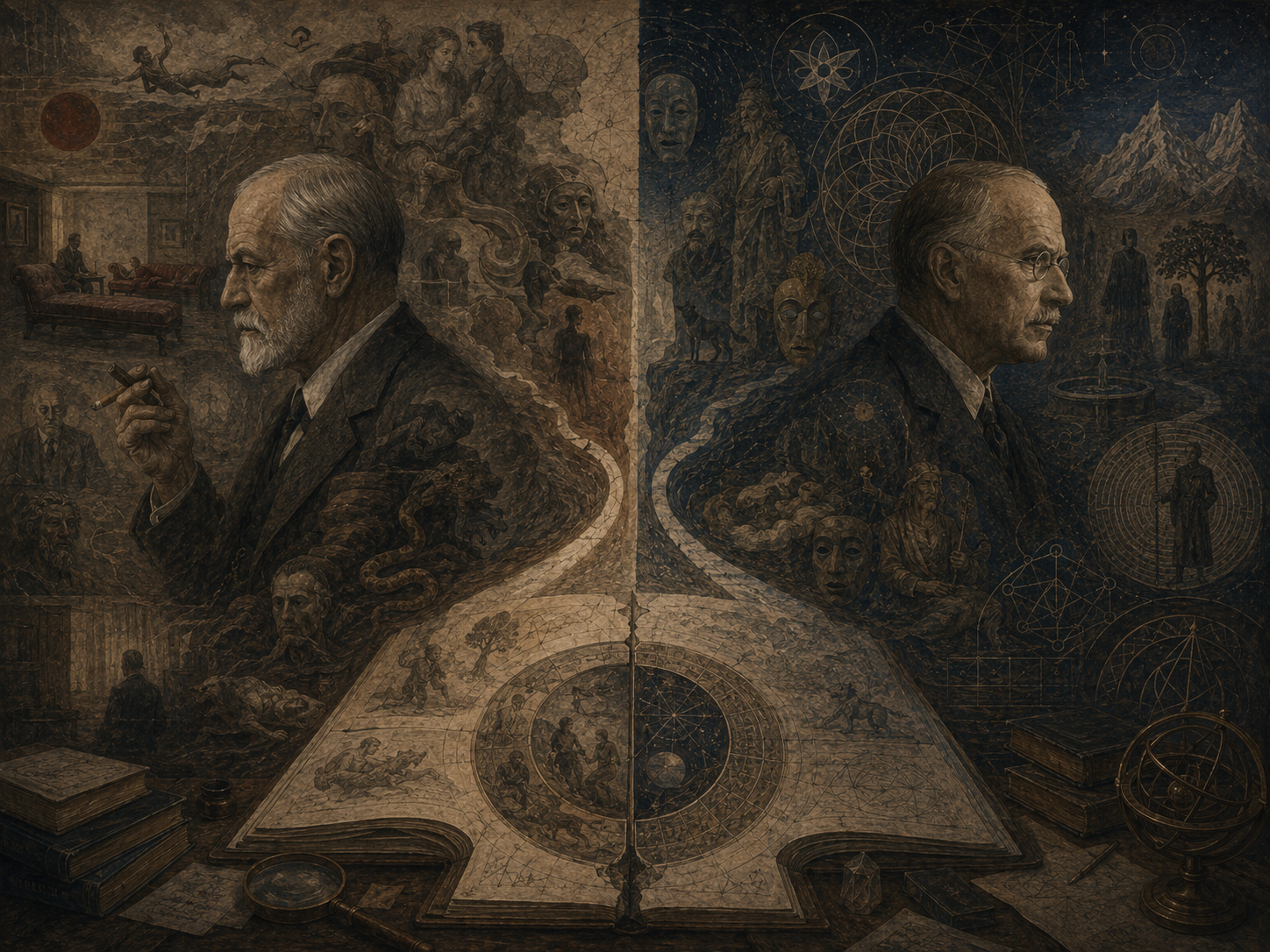
This divergence still matters because many of the major contrasts in twentieth- and twenty-first-century psychotherapy echo it: conflict versus symbol, causality versus teleology, reduction versus amplification, sexuality versus myth, pathology versus individuation, historical reconstruction versus symbolic imagination, demystification versus re-enchantment. These oppositions can be overstated, and both Freud and Jung were more subtle than caricatures allow. Yet the split remains real. Freud and Jung represent not just two thinkers, but two enduring ways of asking what lies beneath conscious life and how that hidden life should be interpreted.
Their disagreement also remains culturally alive because modern life continues to move between Freudian and Jungian questions. When people ask what childhood conflict, repression, defense, or unconscious desire lies beneath a symptom, they are working in a broadly Freudian lineage. When they ask what a dream, image, myth, crisis, or symbolic pattern is trying to disclose about a larger developmental movement, they are working in a broadly Jungian lineage. Modern therapeutic culture often blends these questions, but the distinction still matters. It shapes whether the psyche is interpreted primarily as a field of conflict returning from the past, a symbolic process moving toward transformation, or a complex field that requires both languages.
This article examines Jung and Freud as founders of divergent depth psychologies. It explores their intellectual proximity, the theoretical issues that separated them, their different conceptions of the unconscious, symbol, religion, sexuality, development, and treatment, and the lasting consequences of their split for modern psychology. It treats their divergence not as gossip from the history of ideas, but as a continuing fault line in how modern culture understands the psyche itself.
Why the Jung-Freud Split Matters
The Jung-Freud split matters because it divides modern depth psychology at the point where interpretation itself changes meaning. Freud asks what hidden wish, conflict, defense, or repression underlies a symptom, fantasy, or dream. Jung asks not only what lies behind an image, but what the image itself is trying to say, compensate, or anticipate. Freud tends toward interpretation as uncovering latent causal truth; Jung increasingly tends toward interpretation as symbolic expansion and relation to wider psychic life. These are not minor methodological differences. They shape whole traditions of treatment and thought.
This matters historically and clinically. Freud’s legacy shaped psychoanalysis, psychodynamic therapy, cultural theory, critique of illusion, and the interpretation of desire, repression, symptom, and transference. Jung’s legacy shaped analytical psychology, symbolic and mythic interpretation, religious psychology, archetypal thought, dream work, personality typology, and a broader concern with imagination and individuation. The split therefore continues wherever the psyche is understood either as conflictual hidden history or as symbolic and developmental depth exceeding conscious life in other ways.
The split also matters because it created different moral atmospheres around psychological interpretation. Freud’s interpretive style is often suspicious in the best critical sense. It asks what the ego does not want to know, what wish is disguised, what defense is operating, what childhood conflict returns, and what social or religious ideal may be covering over dependence, guilt, aggression, or desire. Freud’s method is demystifying. It strips away illusion in order to expose the hidden dynamics beneath conscious self-description.
Jung’s interpretive atmosphere is different. It is less suspicious of symbol and more willing to let the image retain dignity. Jung certainly sees danger, shadow, inflation, projection, and pathology. But he is also interested in what an image may be trying to bring into consciousness, how dreams compensate one-sidedness, how mythic motifs reveal psychic patterns, and how symbolic material may support a longer developmental movement. Jung’s method is not primarily demystification. It is symbolic relation.
This distinction continues to shape therapy, culture, and self-understanding. A Freudian question may ask: What is this symptom hiding? A Jungian question may ask: What is this image asking? A Freudian reading may uncover the infantile wish beneath a dream. A Jungian reading may amplify the dream’s imagery and ask how it situates the dreamer within a larger symbolic process. A Freudian critique of religion may expose paternal dependency or illusion. A Jungian interpretation may ask what psychic function religious symbol serves and what happens when that function collapses.
Neither orientation is sufficient by itself. A psychology without suspicion may become naïve, inflated, and overly reverent toward symbols. A psychology without symbolic generosity may become reductive, flattening mystery into mechanism and meaning into disguised wish. The continuing importance of the Jung-Freud divergence lies in the tension between these two needs: the need to expose illusion and the need to honor symbol; the need to recover buried conflict and the need to enter relation with images that may exceed conscious formulation.
The split matters, finally, because it reveals that “the unconscious” was never one settled idea. From the beginning of depth psychology, the unconscious became a contested field. Was it primarily repressed desire? Was it personal history? Was it a symbolic matrix? Was it collective inheritance? Was it a domain of fantasy, defense, or transformation? The Jung-Freud divergence keeps these questions alive because it shows that the unconscious is not only an object of study; it is also shaped by the method used to approach it.
Early Alliance and Mutual Recognition
In the early years, Freud and Jung recognized something vital in one another. Jung, already an accomplished psychiatrist associated with the Burghölzli clinic and the word-association experiments, brought scientific and institutional credibility to Freud’s emerging psychoanalytic movement. Freud saw in Jung not only an intelligent interpreter of the unconscious but also a potential successor who might expand psychoanalysis beyond its Viennese and specifically Jewish intellectual context. Jung, for his part, found in Freud a thinker who had pierced the false transparency of consciousness and revealed hidden layers of psychic life with unprecedented force.
This alliance was therefore intense from the start. Freud and Jung exchanged long letters, collaborated institutionally, traveled together, debated theory, and seemed for a time united against a resistant academic culture. But the emotional intensity of the alliance also made the split more volatile. Their relationship was never purely theoretical. Questions of authority, inheritance, loyalty, ambition, dependence, and independence were present early and would later magnify the intellectual divergence.
Freud needed allies because psychoanalysis was still fragile, controversial, and vulnerable to dismissal by academic medicine. Jung’s position mattered. He was not simply a follower; he was an institutional bridge. His work at the Burghölzli gave psychoanalysis a route into psychiatry and experimental psychology. His word-association studies seemed to provide empirical support for unconscious complexes. His non-Viennese background gave the movement broader legitimacy. For Freud, Jung represented both intellectual promise and strategic necessity.
Jung needed Freud because Freud had named the central discovery around which Jung’s own psychiatric observations were converging: conscious intention is not sovereign. Symptoms, slips, dreams, fantasies, and neurotic formations disclose hidden psychic processes. Jung’s clinical work with psychosis, association experiments, and complexes had already made him attentive to unconscious life. Freud gave that attention a more radical theoretical frame.
Yet the seeds of separation were present inside the alliance. Freud’s psychoanalytic movement required doctrinal coherence and loyalty around the centrality of sexuality. Jung’s temperament and intellectual range made such loyalty difficult. He was drawn to mythology, religion, occult phenomena, spiritual experience, symbolism, and comparative culture in ways Freud regarded with suspicion. Freud wanted to defend psychoanalysis as a rigorous science against accusations of mysticism. Jung wanted depth psychology to expand into symbolic and spiritual territories Freud thought dangerous.
Their relationship also carried strong father-son dynamics, though any such interpretation must be handled carefully. Freud often occupied the role of founder and patriarch, while Jung was positioned as heir and successor. This created pressure. Jung’s intellectual independence could be experienced as betrayal. Freud’s authority could be experienced as constraint. The personal and theoretical dimensions reinforced one another until separation became unavoidable.
The early alliance therefore matters not only because it preceded the break, but because it shows what the break cost. Freud and Jung were not strangers defending unrelated theories. They shared a revolutionary conviction that the psyche had depth. Their disagreement became decisive because it emerged from a shared project and split that project into competing visions.
Different Conceptions of the Unconscious
Their deepest difference concerns the unconscious itself. For Freud, the unconscious is formed through repression. It is populated by wishes, fantasies, conflicts, drives, and memories excluded from consciousness because they are unacceptable or incompatible with psychic stability. The unconscious is therefore historically produced and dynamically conflictual. It is personal in a strong sense, even if its mechanisms are broadly human.
Jung began near this view but gradually widened it. The unconscious remained conflictual and personal, but it was no longer exhausted by repression. It also became symbolic, compensatory, mythopoetic, prospective, and eventually collective. The unconscious could produce images not traceable only to personal history but resonant with myths, religions, fairy tales, and archetypal patterns. Freud’s unconscious is largely retrospective and conflict-bound. Jung’s becomes broader, more symbolic, and more open to development beyond repression alone.
For Freud, unconscious material is largely unconscious because it has been excluded. It is intolerable, defended against, disguised, or incompatible with conscious identity. Dreams, symptoms, slips, jokes, and neurotic repetitions reveal the return of this excluded material. The task of analysis is to bring repressed material into speech, interpretation, and working-through. This does not make Freud simplistic. His unconscious is complex, dynamic, and layered. But it remains organized around conflict, defense, and the return of the repressed.
For Jung, some unconscious material is repressed in this Freudian sense. But not all. The unconscious may also contain undeveloped potentials, symbolic compensations, future-oriented images, inherited forms of imagination, and contents that consciousness has not yet become capable of understanding. A dream may not only disguise a wish; it may correct conscious imbalance, dramatize a neglected truth, or present an image of what the psyche is trying to become. The unconscious is therefore not only a place of buried past. It is also a source of symbolic orientation.
This difference changes the emotional tone of analysis. Freud’s unconscious is suspicious because it hides what consciousness cannot admit. Jung’s unconscious is dangerous but also potentially guiding because it may contain symbolic resources for transformation. Freud’s analyst often asks what has been repressed. Jung’s analyst may also ask what has been neglected, what is compensating conscious one-sidedness, and what image of wholeness is attempting to appear.
| Dimension | Freudian emphasis | Jungian emphasis |
|---|---|---|
| Primary unconscious logic | Repression, wish, defense, conflict | Compensation, symbol, archetype, development |
| Time orientation | Retrospective: the past returns | Retrospective and prospective: the past returns, but the future also presses forward symbolically |
| Source of dream meaning | Latent wish and disguised conflict | Symbolic communication, compensation, archetypal pattern, developmental possibility |
| Unconscious material | Repressed wishes, drives, memories, fantasies | Personal complexes, symbolic images, archetypal patterns, undeveloped potentials |
| Therapeutic task | Make repressed conflict conscious and workable | Relate to unconscious material symbolically and developmentally |
The contrast should not be exaggerated into caricature. Freud understood symbolic complexity, and Jung understood repression and conflict. But their centers of gravity differ. Freud’s unconscious is a drama of conflict and return. Jung’s unconscious is a drama of conflict, image, compensation, and symbolic becoming. This difference structures nearly every other divergence between them.
Sexuality, Libido, and the Question of Psychic Energy
Sexuality is the most famous point of rupture, though not always the best understood. Freud’s theory of libido treated sexuality as foundational to psychic development, conflict, fantasy, and symptom formation, even when sexuality appeared in sublimated, displaced, or transformed form. This did not mean Freud reduced everything crudely to genital acts, but he did insist that sexual desire and infantile erotic life were central explanatory forces in psychic reality.
Jung increasingly rejected this centrality. He reconceived libido as a more general psychic energy rather than specifically sexual energy. This allowed him to interpret religion, symbol, creativity, ambition, myth, and transformation without always routing them back through sexual conflict. Freud regarded this as theoretical retreat and dilution. Jung regarded it as liberation from reductionism. Their divergence over libido is therefore really a divergence over what kind of explanatory depth psychology should seek.
For Freud, sexuality is deep not because every symptom is transparently sexual, but because sexuality is structurally entangled with infancy, dependency, prohibition, fantasy, family conflict, shame, desire, guilt, and repression. Sexuality is not merely adult erotic behavior. It is the developmental field through which the psyche first encounters pleasure, frustration, attachment, rivalry, prohibition, and the limits of satisfaction. Freud’s radical claim was that adult psychic life remains haunted by infantile sexuality in disguised forms.
Jung thought this emphasis narrowed the psyche. In his view, libido could not be reduced to sexual energy because psychic life moves toward many forms of expression: religious longing, creativity, power, symbolic formation, moral development, spiritual crisis, social ambition, and individuation. Sexuality mattered, but it was not the master key. A religious symbol need not be decoded primarily as sublimated sexuality. A mythic image need not be routed back to infantile desire. A dream might express transformation rather than disguised erotic wish.
This disagreement had enormous consequences. Freud’s method tends to look for the hidden erotic and conflictual substrate beneath apparently higher forms. Jung’s method tends to ask how psychic energy transforms across symbolic forms. Freud worries that Jung’s broader libido weakens explanatory precision. Jung worries that Freud’s sexual libido reduces higher cultural and spiritual life to disguised instinct.
The issue remains unresolved because both insights retain force. Sexuality is indeed central to human development, fantasy, repression, identity, shame, intimacy, power, and symptom formation. Freud’s refusal to sentimentalize human desire remains indispensable. At the same time, psychic life cannot be fully explained by sexuality alone. People suffer from loss of meaning, spiritual disorientation, blocked creativity, symbolic impoverishment, moral conflict, and failures of development that do not reduce neatly to sexual conflict. Jung’s widening also remains necessary.
A contemporary view can recognize that sexuality is neither everything nor secondary. It is one of the great organizing forces of psychic life, but not the only one. The Freud-Jung rupture over libido therefore reveals a continuing problem for psychology: how to honor the depth of desire without reducing the whole soul to desire, and how to honor symbolic transformation without becoming evasive about sexuality.
Symbol, Reduction, and Amplification
Freud and Jung also differ sharply in their treatment of symbol. Freud often interprets symbols reductively in the technical sense: the symbol points back to latent wishes, repressed conflicts, or disguised satisfactions. A dream image or symptom is meaningful because it hides something more basic. Jung, by contrast, treats genuine symbols as irreducible mediators of meaning. A symbol does not merely conceal an already known content. It expresses something the psyche does not yet fully grasp conceptually.
This leads to different methods. Freud often interprets by reduction to underlying wish or conflict. Jung often interprets by amplification, surrounding the image with mythic, religious, cultural, and symbolic associations to unfold its wider resonance. Freud moves from image to cause. Jung moves from image to depth of relation. Both are forms of interpretation, but they imagine symbolic truth differently.
Reduction is often misunderstood. In Freud’s work, reduction does not simply mean vulgar simplification. It means tracing manifest content back to latent conflict. A dream image, symptom, joke, or fantasy may be a compromise formation. It says something while hiding something. Interpretation therefore must pierce disguise. The symbol is not taken at face value because psychic life is defensive. What appears noble, absurd, frightening, or random may conceal a wish, fear, guilt, or conflict that consciousness cannot admit directly.
Jung does not reject hidden conflict, but he thinks reduction can become inadequate when applied to all symbols. Some symbols, in his view, are not merely disguises for already known contents. They are living formations through which the psyche tries to represent something not yet conceptually available. A mandala, a divine child, a wise old figure, a shadow creature, a descent into the underworld, or a mysterious center may not be reducible to a repressed wish. It may function as an image of psychic orientation or development.
Amplification therefore works differently from free association alone. It places the image in a wider symbolic field: myth, religion, fairy tale, art, alchemy, ritual, and cultural imagination. The aim is not to prove that the image has one universal meaning, but to let its symbolic possibilities become visible. This method can be profound. It can also become excessive if it overwhelms the dreamer’s personal context or uses erudition to force meaning.
The strongest contemporary approach may need both suspicion and amplification. Some images do conceal repressed wishes, conflicts, and defenses. Others may carry developmental, symbolic, or spiritual meanings not exhausted by reduction. Many do both. A dream may express a personal conflict through an image whose symbolic resonance exceeds the conflict. A symptom may be rooted in repression and also point toward a needed transformation. The choice between Freud and Jung is not always absolute. The difficulty is knowing which method is warranted in a given case.
The Freud-Jung divergence over symbol remains vital because it defines two basic interpretive attitudes: one asks what the image hides; the other asks what the image reveals. A mature depth psychology may need to ask both.
Dream Interpretation in Freud and Jung
Their differences become especially clear in dream theory. Freud treats dreams as wish fulfillments shaped by the dream-work: condensation, displacement, representability, and secondary revision. The dream disguises latent content so that forbidden wishes can achieve distorted expression without waking the dreamer. Interpretation aims to move from manifest content to latent wish.
Jung does not deny disguise or conflict, but he sees dreams less as hidden wish-fulfillment than as spontaneous symbolic products of the psyche that may compensate for conscious one-sidedness, reveal neglected dimensions of life, or anticipate future developmental possibilities. A dream is not always hiding something simpler beneath itself. It may be saying something more complex than waking consciousness can yet formulate. This shift from concealment to symbolic communication marks one of the clearest breaks between them.
For Freud, the dream is a compromise between wish and censorship. The manifest dream is not the real meaning but the distorted surface. Interpretation proceeds through associations that reveal latent thought. The dream-work transforms forbidden wishes into images that can pass through censorship. This is why Freud’s dream theory is linked so closely to repression and infantile desire. Dream interpretation is a privileged route into hidden conflict.
For Jung, the manifest dream image deserves more direct attention. The dream does not simply disguise; it presents. It often speaks in symbolic form because the psyche thinks in images. Jung therefore treats dreams as autonomous symbolic productions that may correct conscious attitudes. If a person is too rational, the dream may bring irrational or instinctual material. If a person is inflated, the dream may humiliate. If a person is despairing, the dream may offer an image of possibility. If consciousness is one-sided, the dream may restore psychic balance.
This difference changes the analyst’s stance. A Freudian interpretation often seeks the latent wish behind the dream. A Jungian interpretation may ask what the dream image is doing, how it relates to conscious life, what symbolic parallels illuminate it, and whether it belongs to a sequence of dreams showing development over time. Freud emphasizes disguise and return. Jung emphasizes compensation and symbolic presentation.
| Dream dimension | Freudian reading | Jungian reading |
|---|---|---|
| Primary function | Disguised wish fulfillment | Symbolic communication, compensation, and development |
| Manifest content | Surface distorted by dream-work | Important symbolic presentation requiring careful attention |
| Interpretive movement | From manifest dream to latent wish | From dream image to symbolic field and conscious compensation |
| Method | Free association and reconstruction of latent content | Associations, amplification, dream sequence, symbolic context |
| Time orientation | Past conflict returns in disguised form | Past conflict, present imbalance, and future possibility may appear together |
Both approaches can be misused. Freudian interpretation can become reductive if every dream is forced back to sexuality or infantile wish. Jungian interpretation can become inflated if every dream is treated as mythic revelation. A disciplined dream psychology should preserve the strengths of both: Freud’s suspicion of disguise and defense, and Jung’s respect for the dream image as symbolic intelligence.
Religion, Myth, and the Sacred
Freud and Jung diverge radically on religion. Freud tends to read religion as illusion, wish-fulfillment, paternal projection, and collective compromise formation. Even when he recognizes its cultural power, he interprets it through dependence, guilt, fear, and unresolved infantile structures. Religion is psychologically intelligible, but largely as error or consolation.
Jung, by contrast, treats religion as psychologically indispensable because it gives symbolic form to numinous experience, moral conflict, transformation, ritual containment, and the psyche’s relation to mystery. He does not simply affirm doctrine, but he refuses to dismiss religion as childish illusion. Myth, ritual, and spiritual experience become essential languages of the soul rather than residues to be explained away. This difference is one of the widest between them because it touches the entire meaning of symbolic life.
Freud’s critique of religion belongs to his broader demystifying project. Religion provides protection, order, and consolation in the face of helplessness, death, guilt, and desire. It can preserve infantile dependence on a magnified father figure. It can also channel aggression, regulate social life, and manage anxiety. Freud’s critique remains powerful because religion can indeed function defensively. It can protect people from uncertainty, displace responsibility, sanctify authority, and disguise human wishes as divine truth.
Jung sees these dangers but thinks Freud’s account is too narrow. Religion, for Jung, is not merely illusion but a symbolic response to numinous experience. The psyche encounters powers, images, and meanings that overwhelm ordinary ego control. Religious traditions provide forms through which those experiences can be held, interpreted, disciplined, and integrated. Without such forms, numinous energy may become inflation, possession, ideology, or psychic fragmentation.
This divergence has lasting consequences. Freudian theory tends to ask what psychological need religion satisfies and what illusion it protects. Jungian theory asks what psychic function religious symbol performs and what happens when modern consciousness loses relation to the sacred. Freud interprets religion as a human construction rooted in wish, guilt, and dependency. Jung interprets religion as a symbolic necessity rooted in the structure and experience of psyche.
The contemporary value of this disagreement is that both critiques are needed. Freud is necessary wherever religion becomes authoritarian, infantilizing, guilt-producing, or evasive. Jung is necessary wherever secular reductionism cannot understand why symbols, rituals, sacred stories, and spiritual experiences remain psychologically powerful. Freud protects critique from reverence. Jung protects reverence from dismissal.
A modern depth psychology need not choose one simplistically. It can ask how religion may be both projection and symbolic mediation, both consolation and discipline, both defense and transformation, both cultural construction and psychological necessity. The Jung-Freud split remains productive because it prevents either religion or its critique from becoming too easy.
Development, History, and Teleology
Freud’s psychology is deeply historical. Symptoms, defenses, and fantasies are understood through developmental past, infantile conflict, and the afterlives of repression. The past remains decisive, even where later change is possible. Jung also takes history seriously, but he adds teleology: the psyche may be oriented not only by what has been repressed, but by what is trying to emerge. Development becomes not just recovery of buried history but relation to future possibility, symbolic becoming, and individuation.
This teleological dimension is one of the most important and controversial features of Jung’s thought. It allows him to interpret dreams and crises as prospective as well as retrospective. Freud is wary of such thinking because it risks speculative inflation. Jung thinks Freud’s stricter historical causality narrows the psyche excessively. Their divergence here concerns time itself: whether the unconscious is mainly sedimented past or also the matrix of becoming.
Freud’s historical method is essential because people are shaped by what happened and by what could not be consciously lived at the time. Childhood, family relations, sexuality, shame, fear, rivalry, loss, and prohibition leave traces. Symptoms are not random. They carry histories. Analysis reconstructs these histories so that what is repeated unconsciously can become thinkable. In this sense, Freud gives modern psychology one of its most powerful accounts of how the past remains active.
Jung adds that the past is not the only source of unconscious meaning. The psyche may also produce images that point toward development not yet realized. A midlife crisis may not simply repeat childhood conflict; it may reveal that an earlier adaptation no longer serves the whole person. A dream may not only disguise a wish; it may present an image of future integration. A symptom may contain historical pain and a blocked developmental demand. Psychic life is therefore not only archaeological but also prospective.
The risk of teleology is that it can romanticize suffering. Not every crisis is meaningful in a redemptive way. Some suffering is traumatic, unjust, destructive, or meaningless in any obvious developmental sense. A Jungian approach becomes problematic when it interprets pain too quickly as a call toward individuation. Freud’s suspicion can protect against such over-spiritualization. Yet Freud’s emphasis on historical causality can also become limiting if it cannot account for transformation, vocation, spiritual crisis, or the emergence of new symbolic life.
A contemporary synthesis might say that psychic life is both historical and emergent. The past shapes the present, but the present also contains possibilities that cannot be reduced to the past. Depth psychology needs memory and imagination, archaeology and teleology, reconstruction and becoming. Freud and Jung stand on opposite sides of this tension, and modern therapy often works in the space between them.
The Personal Unconscious and the Collective Unconscious
Jung’s most decisive departure is the theory of the collective unconscious. Freud’s unconscious, however complex, remains anchored in personal development and universal psychic mechanisms. Jung proposes that beneath the personal unconscious lies a deeper layer structured by archetypal forms shared across humanity. Myths, religions, dream motifs, symbolic recurrences, and imaginal patterns arise not only from personal repression but from this deeper psychic inheritance.
For Freud, this move is too speculative and too far from clinical science. For Jung, it is required by the evidence of symbolic recurrence and the inadequacy of purely personal explanation. The collective unconscious becomes the signature of Jung’s divergence because it changes the scale of depth psychology from personal history alone to civilizational and symbolic inheritance.
The personal unconscious in Jung’s psychology includes forgotten, repressed, subliminal, or undeveloped contents belonging to the individual life. Complexes often form here. In this respect Jung remains close to Freud and to broader psychodynamic thought. The difference is that Jung does not stop there. Some dream images, mythic motifs, and symbolic patterns seem to Jung too large, too recurrent, or too autonomous to be explained by personal biography alone. He therefore posits a collective layer of the psyche.
This theory gives Jungian psychology its breadth. It allows analytical psychology to connect dreams with myth, personal crises with religious symbols, and individual development with recurring human patterns. It also creates major epistemological problems. How is the collective unconscious known? What evidence distinguishes inherited archetypal structure from cultural transmission, shared embodiment, historical diffusion, narrative convention, or retrospective comparison? When does a symbol exceed personal meaning, and how can that be established?
The Freudian critique remains important here. A theory of collective symbolic inheritance can become too easy. When a personal explanation is difficult, the interpreter may invoke archetype. When cultural similarity appears, the interpreter may invoke universality. Freud’s insistence on personal history, sexuality, and conflict can discipline Jungian expansion. It asks whether the symbolic interpretation has moved too quickly away from the patient’s actual life.
Yet Jung’s critique of Freud also remains important. Personal history may not explain everything. People do dream images, figures, and symbolic structures that seem to exceed immediate biography. They may encounter mythic patterns without consciously knowing the myths. They may experience religious or symbolic images that cannot be reduced neatly to childhood material. Even if one rejects the strongest version of the collective unconscious, Jung’s question remains: why does the psyche so often produce symbolic forms that feel larger than personal memory?
The personal and collective unconscious are therefore best understood not as a simple choice, but as competing scales of interpretation. Freud tends to keep interpretation close to personal history and conflict. Jung expands the field toward inherited symbolic pattern and collective imagination. The risk of Freud is reduction; the risk of Jung is overextension. Depth psychology remains most responsible when it knows which scale of interpretation it is using and why.
Therapy, Analysis, and the Aims of Treatment
Their therapeutic aims also differ. Freud’s treatment seeks insight into unconscious conflict, loosening of repression, resolution or better management of neurotic suffering, and the transformation of hysterical misery into ordinary unhappiness. His emphasis is on conflict, interpretation, transference, resistance, and making the unconscious conscious enough that the patient can live with greater freedom from symptom domination.
Jung’s therapy increasingly aims not only at symptom relief but at individuation, symbolic relation to the unconscious, dialogue with dreams and fantasy, less one-sided personality, integration of shadow, revision of persona, and relation to the Self as a wider psychic center. This is not always more humane; it can also be more demanding, more diffuse, and less sharply delimited. But it shows that therapy for Jung becomes as much developmental and existential as symptom-focused.
Freudian analysis is structured around the analytic situation: free association, resistance, transference, interpretation, and working-through. The analyst attends to repetitions in the relationship, disguised wishes, defensive patterns, and the patient’s relation to authority, desire, guilt, and memory. The method is disciplined by suspicion. What appears in the room is not only what it seems. It is also repetition, transfer, displacement, and resistance.
Jungian analysis may use transference, but often gives more explicit attention to dreams, active imagination, symbolic imagery, personal myth, creative expression, religious experience, and developmental one-sidedness. The analyst may ask how the unconscious compensates consciousness, how the patient’s persona has become too narrow, how shadow appears, how symbols evolve across dream sequences, and what form individuation may take in that life.
The therapeutic question differs. Freud asks how the patient can become freer from unconscious conflict and repetition. Jung asks how the patient can become more whole in relation to the larger psyche. Freud’s model is often clearer in cases where symptoms are tied to defense, repression, transference, and developmental conflict. Jung’s model may be especially illuminating in symbolic crisis, midlife transition, spiritual disturbance, creative blockage, and loss of meaning. Both can be clinically valuable. Both can be misused.
Freudian therapy can become overly focused on pathology, suspicion, and past conflict. Jungian therapy can become overly expansive, symbolic, or vague about clinical goals. Freud’s method can underplay spiritual and symbolic meaning. Jung’s method can underplay sexuality, aggression, trauma, and defense. A mature contemporary practice often needs elements of both: clinical discipline and symbolic depth, attention to transference and attention to image, understanding of history and openness to transformation.
The divergence in therapeutic aim remains crucial because it asks what therapy is for. Is it primarily relief from symptoms? Insight into conflict? Increased capacity for love and work? Integration of personality? Relation to symbolic life? Spiritual and existential reorientation? Freud and Jung answer differently, and modern psychotherapy continues to negotiate the territory between them.
Science, Method, and the Problem of Speculation
Freud persistently worried that Jung’s thought drifted away from science into speculative mythology. Jung, in turn, believed Freud’s claims to strict science concealed their own mythologies of sexuality, fatherhood, and causality. Both accusations have force. Freud is more methodologically disciplined in some respects, but also not free of large speculative constructions. Jung is bolder in symbolic interpretation, but often less constrained by evidentiary caution.
This matters because the divergence is also epistemological. Freud wants depth psychology to remain explanatory, demystifying, and conceptually rigorous. Jung wants it to remain open to psyche’s symbolic and numinous dimensions even at the cost of greater speculative risk. Their split is therefore a split over what counts as legitimate psychological knowledge.
Freud’s claim to science was complicated. He sought to establish psychoanalysis as a rigorous psychology grounded in clinical observation, interpretation, and theory. Yet many Freudian concepts are themselves difficult to test in the strictest experimental sense. Freud’s metapsychology includes speculative constructions about drives, psychic agencies, repression, and development. His critics have often noted that psychoanalysis can explain after the fact more easily than it can predict in advance.
Jung’s method is also complicated. He repeatedly described his psychology as empirical, grounded in observation of dreams, fantasies, myths, symbols, and clinical material. Yet his movement toward archetype, synchronicity, alchemy, and the collective unconscious often makes his work difficult to discipline empirically. Jung’s concepts may be powerful as interpretive models, but they sometimes exceed what evidence can securely support. The danger is not that they are meaningless, but that their epistemic status is often unclear.
Freud’s critique of Jung can therefore be reframed as a question of constraint. What prevents interpretation from becoming arbitrary? What makes one symbolic interpretation better than another? What distinguishes psychological insight from metaphysical speculation? Jung’s critique of Freud can be reframed as a question of adequacy. What if strict causal reduction cannot account for symbolic life? What if dreams and religious images are not merely disguises? What if the psyche requires interpretive methods broader than demystification?
Both questions remain necessary. Science without symbolic adequacy becomes narrow. Symbolic interpretation without methodological constraint becomes inflated. A contemporary depth psychology that learns from both Freud and Jung would distinguish empirical claims, clinical hypotheses, hermeneutic interpretations, phenomenological descriptions, and philosophical speculations. It would not pretend that all psychological knowledge has the same evidentiary status.
The problem of speculation is therefore not solved by choosing Freud over Jung or Jung over Freud. Freud’s method guards against interpretive inflation. Jung’s method guards against reductive impoverishment. The challenge is to build a depth psychology that can be both disciplined and deep.
Transference, Authority, and the Human Problem Between Them
The divergence between Freud and Jung was not purely theoretical. Questions of authority, loyalty, succession, and psychic dependence shaped the relationship. Freud often positioned himself as founder and father of the movement, while Jung increasingly resisted remaining a disciple. Jung’s independence threatened Freud institutionally and personally, while Freud’s authority increasingly constrained Jung’s intellectual freedom. Their conflict therefore enacted some of the very themes both studied: transference, ambivalence, rebellion, paternal authority, and the difficulty of separation.
This human dimension matters because ideas do not separate themselves. The theoretical rupture intensified through relationship. Freud and Jung were also, in part, living out incompatible visions of what a psychological movement should be and who would be allowed to define its truth.
Freud had reasons to fear fragmentation. Psychoanalysis was young, controversial, and surrounded by hostile critics. To him, theoretical concessions around sexuality could look like betrayal of the discovery that made psychoanalysis radical. Jung’s widening of libido and growing interest in myth and religion may have seemed not simply like disagreement, but like the dilution of psychoanalysis into a socially acceptable spirituality. From Freud’s perspective, the movement needed protection from drift.
Jung had reasons to resist submission. He was not merely a student repeating Freud’s doctrine. He had his own clinical experience, scientific reputation, symbolic interests, and intellectual temperament. Freud’s authority may have felt increasingly constricting, especially where Freud required loyalty to theoretical positions Jung found too narrow. From Jung’s perspective, fidelity to the psyche required leaving Freud’s system.
Their break therefore reveals something about movements as well as theories. Intellectual schools often organize themselves around founders, successors, orthodoxies, and heresies. The very field that studied transference was not free from transference. The field that studied fathers and sons enacted a drama of father, heir, rebellion, and separation. The field that studied unconscious conflict became shaped by conflict it could not fully contain.
This does not mean the theoretical disagreement was reducible to personal dynamics. It was real. But personal dynamics gave the disagreement emotional force. Freud and Jung were not only arguing over libido, dreams, religion, and symbol. They were also negotiating authority, inheritance, dependency, and differentiation. Their personal rupture therefore becomes part of the history of depth psychology because it dramatizes the difficulty of founding a psychology of the unconscious while remaining subject to unconscious dynamics oneself.
A mature reading of the Freud-Jung split should avoid gossip while not pretending that theory floats above relationship. Their ideas separated through people, institutions, loyalties, and wounds. That human complexity is part of why the split still feels charged.
Lasting Influence on Modern Depth Psychology
Their divergence shaped nearly everything that followed in depth psychology. Freudian traditions continued through ego psychology, object relations, Lacanian thought, relational psychoanalysis, self psychology, attachment-informed psychoanalysis, and broader psychodynamic therapy. Jungian traditions continued through analytical psychology, archetypal psychology, developmental and relational Jungian schools, symbolic interpretation, dream work, personality typology, and religious psychology. Even thinkers who reject both remain shaped by the field they opened.
The split also created enduring contrasts in modern culture: debunking versus meaning, suspicion versus symbol, analysis versus imagination, conflict versus transformation. These contrasts are often overstated, but they remain intelligible because Freud and Jung gave them durable form.
Freud’s influence extends far beyond clinical psychoanalysis. Literary criticism, film theory, social theory, political theory, cultural studies, feminist theory, and everyday language all carry Freudian traces. Repression, denial, projection, narcissism, Oedipal conflict, slips, unconscious desire, and the return of the repressed have become part of modern interpretive culture. Freud made suspicion psychologically sophisticated. He taught modernity to ask what conscious ideals conceal.
Jung’s influence also extends far beyond the clinic. Archetype, shadow, persona, individuation, introversion, extraversion, synchronicity, mythic pattern, active imagination, and symbolic wholeness have shaped spirituality, literature, film, art, leadership discourse, popular psychology, creativity studies, and religious interpretation. Jung made symbolic depth psychologically available. He taught modernity to ask what images, myths, and dreams may reveal.
Post-Freudian developments complicated Freud’s own framework. Object relations, relational psychoanalysis, attachment theory, and contemporary psychodynamic practice moved beyond Freud’s more drive-centered formulations. These traditions often emphasize early relationship, affect regulation, internal objects, intersubjectivity, and the therapeutic relationship in ways that soften some classical Freudian contrasts with Jung.
Post-Jungian developments similarly complicated Jung’s framework. Developmental Jungians, archetypal psychologists, feminist Jungians, relational Jungians, and cultural critics revised or challenged classical Jungian claims about archetypes, gender, universality, and clinical method. Jungian thought itself is not one thing. It is a field of debate.
Still, the original divergence remains structurally important. Freudian descendants often retain stronger attention to transference, defense, repression, sexuality, aggression, and early relational history. Jungian descendants often retain stronger attention to symbol, myth, dream sequence, imagination, individuation, and spiritual or existential crisis. Modern therapy often needs both lineages, even when it no longer names them explicitly.
The lasting influence of Freud and Jung therefore lies not only in their theories, but in the questions they made unavoidable. What does a symptom mean? What does a dream do? What is the relation between desire and symbol? Is religion illusion, symbolic necessity, or both? Is the unconscious personal, collective, or socially inherited? Is therapy a cure, a working-through, a transformation, or a lifelong relation to psychic depth? These questions remain alive because Freud and Jung split the field in ways that have not been fully resolved.
Criticisms and Qualifications
Any sharp contrast between Freud and Jung risks caricature. Freud is not merely a reductive sexual determinist, and Jung is not merely a mystic of archetypes. Freud recognized symbol, ambiguity, culture, religion, literature, fantasy, and the complexity of unconscious life. Jung remained attentive to conflict, pathology, sexuality, and personal history, even when his later work moved toward mythology and archetype. Their differences are real, but their distance should not be turned into melodrama.
Freud’s theory of sexuality is more sophisticated than popular summaries suggest. He did not simply claim that all human life reduces to genital sexuality. His account of infantile sexuality, libido, sublimation, and displacement was an attempt to describe how desire organizes psychic life from the beginning. It may be overextended, but it is not crude in the way caricatures imply.
Jung’s theory of symbol is also more clinically grounded than critics sometimes acknowledge. He did not simply abandon personal history for mysticism. Complexes, trauma, repression, and conflict remained part of his psychology. His later symbolic work grew out of clinical observation, dream interpretation, and the study of psychic disturbance. It may become speculative, but it is not merely decorative myth-making.
The contrast between causality and teleology also needs qualification. Freud’s work includes future-oriented therapeutic aims, and Jung’s work includes causal analysis of complexes and personal history. The difference is not that Freud has no future or Jung has no past. The difference is emphasis. Freud privileges the explanatory power of prior conflict. Jung privileges the symbolic possibility that the psyche may be oriented toward development.
Religion also requires nuance. Freud’s critique of religion is not merely contemptuous. It is part of a broader concern with illusion, dependency, guilt, and civilization. Jung’s respect for religion is not simple belief. It is psychological seriousness about numinous experience and symbolic form. Both accounts can be reductive if applied alone. Freud may reduce religion to wish. Jung may psychologize religion as symbolic function. Each needs critique.
Finally, both traditions face contemporary challenges. Freudian psychoanalysis has had to respond to evidence-based practice, feminist critique, queer theory, trauma research, attachment theory, neuroscience, and changing clinical realities. Jungian psychology has had to respond to questions of evidence, cultural appropriation, gender essentialism, race, coloniality, and overgeneralization. Neither lineage can simply repeat its founder.
Still, the divergence remains foundational. The strongest reading acknowledges both overlap and separation. Freud and Jung share a commitment to depth, unconscious life, dream, symptom, and the limits of conscious mastery. They part over what lies deepest in that depth and how it should be read. That parting continues to structure the field.
Mathematical Lens
The Freudian and Jungian models can be represented as different weighting schemes over psychic variables. Let \(F_t\) represent a Freudian explanatory orientation and \(J_t\) a Jungian explanatory orientation at time \(t\). Let \(R_t\) represent repression dynamics, \(S_t\) sexual-conflict intensity, \(H_t\) historical-developmental causality, \(M_t\) mythic-symbolic amplification, \(C_t\) compensatory symbolism, \(A_t\) archetypal density, and \(P_t\) prospective or teleological development.
F_t = \alpha + \beta_1 R_t + \beta_2 S_t + \beta_3 H_t – \beta_4 M_t + \varepsilon_t
\]
Interpretation: A Freudian orientation places greater explanatory weight on repression, sexual conflict, and developmental history, while treating mythic-symbolic amplification with more caution because it may obscure latent conflict.
J_t = \gamma + \delta_1 C_t + \delta_2 A_t + \delta_3 P_t + \delta_4 M_t – \delta_5 R_t + \eta_t
\]
Interpretation: A Jungian orientation places greater explanatory weight on compensation, archetypal density, prospective development, and symbolic amplification, while resisting reduction of the unconscious to repression alone.
These are not empirical laws. They clarify that the theories differ partly by what they privilege as explanatory load-bearing variables. Freud and Jung can both be understood as depth models, but their central variables differ. Freud’s model centers conflict nodes such as repression, sexuality, defense, wish, symptom, transference, and infantile history. Jung’s model places greater centrality on symbol, myth, compensation, archetype, individuation, and the Self.
A third expression can represent possible integrative tension. Let \(D_t\) represent depth-psychological adequacy, \(K_t\) conflict sensitivity, \(Y_t\) symbolic sensitivity, \(B_t\) biographical specificity, and \(G_t\) developmental openness.
D_t = \lambda_1 K_t + \lambda_2 Y_t + \lambda_3 B_t + \lambda_4 G_t + \mu_t
\]
Interpretation: A more complete depth psychology may require sensitivity to conflict and symbol, biography and development, repression and transformation. Freud and Jung can be read as emphasizing different terms within a larger unresolved equation.
In network terms, Freud’s framework tends to form a conflict-repression cluster, while Jung’s framework forms a symbol-development cluster. The divergence becomes visible not only in individual claims, but in the architecture of explanation itself. The theories do not simply disagree about answers. They organize the psychological field differently.
R Workflow: Simulating Divergent Depth-Psychology Models
The following R workflow sketches a comparative simulation of Freudian and Jungian explanatory orientations across synthetic cases. It is not meant to settle theory, validate either model, or score real patients. It formalizes their different emphases so the divergence becomes analytically visible.
# ============================================================
# Jung, Freud, and the Divergence of Depth Psychologies
# R Workflow: Simulating Divergent Depth-Psychology Models
# ============================================================

# This workflow uses synthetic data for conceptual demonstration.
# It is not a clinical tool, diagnostic instrument, or empirical validation
# of Freudian or Jungian theory.

library(dplyr)
library(ggplot2)
library(lme4)
library(broom.mixed)
library(tidyr)

set.seed(2026)

# ------------------------------------------------------------
# 1. Create synthetic panel data
# ------------------------------------------------------------

n_cases <- 260
n_periods <- 18

panel <- expand.grid(
  case_id = 1:n_cases,
  time = 1:n_periods
) |>
  arrange(case_id, time) |>
  mutate(
    case_type = sample(
      c("neurotic_conflict",
        "symbolic_crisis",
        "midlife_transition",
        "religious_disturbance",
        "trauma_history",
        "creative_block",
        "relational_repetition"),
      size = n(),
      replace = TRUE
    ),
    repression = rnorm(n(), 0, 1),
    sexuality_conflict = rnorm(n(), 0, 1),
    infantile_history = rnorm(n(), 0, 1),
    defense_intensity = rnorm(n(), 0, 1),
    transference_pressure = rnorm(n(), 0, 1),
    mythic_amplification = rnorm(n(), 0, 1),
    compensation = rnorm(n(), 0, 1),
    archetypal_density = rnorm(n(), 0, 1),
    prospective_development = rnorm(n(), 0, 1),
    symbolic_coherence = rnorm(n(), 0, 1),
    individuation_pressure = rnorm(n(), 0, 1)
  )

# ------------------------------------------------------------
# 2. Simulate Freudian explanatory score
# ------------------------------------------------------------

panel <- panel |>
  mutate(
    freudian_score =
      0.66 * repression +
      0.70 * sexuality_conflict +
      0.62 * infantile_history +
      0.58 * defense_intensity +
      0.50 * transference_pressure -
      0.30 * mythic_amplification +
      rnorm(n(), 0, 0.50)
  )

# ------------------------------------------------------------
# 3. Simulate Jungian explanatory score
# ------------------------------------------------------------

panel <- panel |>
  mutate(
    jungian_score =
      0.58 * compensation +
      0.70 * archetypal_density +
      0.62 * prospective_development +
      0.64 * mythic_amplification +
      0.60 * symbolic_coherence +
      0.56 * individuation_pressure -
      0.24 * repression +
      rnorm(n(), 0, 0.50)
  )

# ------------------------------------------------------------
# 4. Simulate possible integrative depth score
# ------------------------------------------------------------

panel <- panel |>
  mutate(
    integrative_depth_score =
      0.48 * repression +
      0.46 * defense_intensity +
      0.44 * transference_pressure +
      0.48 * compensation +
      0.46 * symbolic_coherence +
      0.44 * prospective_development +
      rnorm(n(), 0, 0.50)
  )

# ------------------------------------------------------------
# 5. Fit mixed-effects models
# ------------------------------------------------------------

model_f <- lmer(
  freudian_score ~ repression +
    sexuality_conflict +
    infantile_history +
    defense_intensity +
    transference_pressure +
    mythic_amplification +
    time +
    (1 | case_id),
  data = panel
)

model_j <- lmer(
  jungian_score ~ compensation +
    archetypal_density +
    prospective_development +
    mythic_amplification +
    symbolic_coherence +
    individuation_pressure +
    repression +
    time +
    (1 | case_id),
  data = panel
)

summary(model_f)
summary(model_j)

tidy_f <- broom.mixed::tidy(model_f, effects = "fixed") |>
  mutate(model = "Freudian orientation")

tidy_j <- broom.mixed::tidy(model_j, effects = "fixed") |>
  mutate(model = "Jungian orientation")

model_terms <- bind_rows(tidy_f, tidy_j)
print(model_terms)

# ------------------------------------------------------------
# 6. Summarize model scores by case type
# ------------------------------------------------------------

case_summary <- panel |>
  group_by(case_type) |>
  summarize(
    mean_freudian = mean(freudian_score),
    mean_jungian = mean(jungian_score),
    mean_integrative_depth = mean(integrative_depth_score),
    .groups = "drop"
  )

print(case_summary)

# ------------------------------------------------------------
# 7. Visualize trajectories
# ------------------------------------------------------------

trajectory <- panel |>
  group_by(time) |>
  summarize(
    mean_freudian = mean(freudian_score),
    mean_jungian = mean(jungian_score),
    mean_integrative_depth = mean(integrative_depth_score),
    .groups = "drop"
  ) |>
  pivot_longer(
    cols = c(mean_freudian, mean_jungian, mean_integrative_depth),
    names_to = "model",
    values_to = "score"
  )

ggplot(trajectory, aes(x = time, y = score, linetype = model)) +
  geom_line(linewidth = 1) +
  labs(
    title = "Simulated Divergence of Freudian and Jungian Explanatory Models",
    subtitle = "Synthetic comparison of repression-conflict and symbol-development orientations",
    x = "Time period",
    y = "Mean explanatory score"
  ) +
  theme_minimal()

# ------------------------------------------------------------
# 8. Compare Freudian and Jungian fit by case type
# ------------------------------------------------------------

case_long <- case_summary |>
  pivot_longer(
    cols = c(mean_freudian, mean_jungian, mean_integrative_depth),
    names_to = "model",
    values_to = "mean_score"
  )

ggplot(case_long, aes(x = reorder(case_type, mean_score), y = mean_score, fill = model)) +
  geom_col(position = "dodge") +
  coord_flip() +
  labs(
    title = "Synthetic Model Emphasis by Case Type",
    subtitle = "Different presentations may invite different depth-psychology emphases",
    x = "Case type",
    y = "Mean explanatory score"
  ) +
  theme_minimal()

# ------------------------------------------------------------
# Possible extensions
# ------------------------------------------------------------

# 1. Add symptom outcomes under each model.
# 2. Compare dream interpretation patterns under different assumptions.
# 3. Simulate religion-heavy vs sexuality-heavy case profiles.
# 4. Model overlap rather than contrast alone.
# 5. Add relational post-Freudian and post-Jungian hybrid models.
# 6. Add trauma-informed and attachment-informed variables.
# 7. Estimate where reduction and amplification should be combined.
This workflow makes the divergence visible as different explanatory weightings. Freudian orientation rises where repression, sexuality conflict, infantile history, defense, and transference carry more explanatory load. Jungian orientation rises where compensation, archetypal density, prospective development, mythic amplification, symbolic coherence, and individuation pressure carry more explanatory load. The integrative score suggests that some clinical realities require both conflict sensitivity and symbolic sensitivity.
Python Workflow: Modeling Freudian and Jungian Frameworks as Concept Networks
The following Python workflow models Freud and Jung as two distinct conceptual networks. It allows comparison of which ideas function as central organizing nodes within each framework. It also includes a small bridge network to show where the two lineages overlap around dreams, unconscious life, transference, symbol, and therapy.
# ============================================================
# Jung, Freud, and the Divergence of Depth Psychologies
# Python Workflow: Freudian and Jungian Concept Networks
# ============================================================

# This workflow is a conceptual network demonstration.
# It is not a clinical, diagnostic, or empirical validation tool.

import networkx as nx
import pandas as pd

# ------------------------------------------------------------
# 1. Build Freudian network
# ------------------------------------------------------------

F = nx.DiGraph()

freud_nodes = {
    "repression": "conflict",
    "sexuality": "drive",
    "infantile_history": "development",
    "defense": "conflict",
    "wish": "drive",
    "symptom": "clinical",
    "transference": "clinical",
    "dream_disguise": "dream",
    "latent_content": "dream",
    "resistance": "clinical",
    "working_through": "therapy"
}

for node, node_type in freud_nodes.items():
    F.add_node(node, node_type=node_type, framework="Freud")

freud_edges = [
    ("sexuality", "repression", 0.64),
    ("infantile_history", "symptom", 0.70),
    ("repression", "dream_disguise", 0.62),
    ("wish", "dream_disguise", 0.56),
    ("dream_disguise", "latent_content", 0.52),
    ("defense", "symptom", 0.58),
    ("resistance", "working_through", 0.50),
    ("transference", "working_through", 0.54),
    ("transference", "symptom", 0.44),
    ("repression", "resistance", 0.48)
]

for source, target, weight in freud_edges:
    F.add_edge(source, target, weight=weight)

# ------------------------------------------------------------
# 2. Build Jungian network
# ------------------------------------------------------------

J = nx.DiGraph()

jung_nodes = {
    "compensation": "dream",
    "archetype": "symbol",
    "myth": "symbol",
    "symbol": "symbol",
    "collective_unconscious": "unconscious",
    "individuation": "development",
    "dream_image": "dream",
    "self": "development",
    "shadow": "clinical",
    "persona": "clinical",
    "active_imagination": "therapy",
    "amplification": "method"
}

for node, node_type in jung_nodes.items():
    J.add_node(node, node_type=node_type, framework="Jung")

jung_edges = [
    ("collective_unconscious", "archetype", 0.62),
    ("archetype", "symbol", 0.64),
    ("myth", "symbol", 0.54),
    ("dream_image", "compensation", 0.58),
    ("symbol", "individuation", 0.56),
    ("self", "individuation", 0.66),
    ("shadow", "individuation", 0.48),
    ("persona", "shadow", 0.42),
    ("active_imagination", "individuation", 0.44),
    ("amplification", "symbol", 0.52),
    ("dream_image", "amplification", 0.50)
]

for source, target, weight in jung_edges:
    J.add_edge(source, target, weight=weight)

# ------------------------------------------------------------
# 3. Summarize graph centrality
# ------------------------------------------------------------

def summarize_graph(graph, label):
    degree = nx.degree_centrality(graph)
    in_degree = nx.in_degree_centrality(graph)
    out_degree = nx.out_degree_centrality(graph)
    betweenness = nx.betweenness_centrality(graph, weight="weight")

    return pd.DataFrame({
        "framework": label,
        "node": list(graph.nodes()),
        "node_type": [graph.nodes[n]["node_type"] for n in graph.nodes()],
        "degree_centrality": [degree[n] for n in graph.nodes()],
        "in_degree_centrality": [in_degree[n] for n in graph.nodes()],
        "out_degree_centrality": [out_degree[n] for n in graph.nodes()],
        "betweenness_centrality": [betweenness[n] for n in graph.nodes()]
    })

centrality_df = pd.concat([
    summarize_graph(F, "Freud"),
    summarize_graph(J, "Jung")
], ignore_index=True)

print("Framework centrality comparison")
print(
    centrality_df.sort_values(
        ["framework", "betweenness_centrality", "degree_centrality"],
        ascending=[True, False, False]
    )
)

# ------------------------------------------------------------
# 4. Build bridge network between frameworks
# ------------------------------------------------------------

B = nx.DiGraph()
B.add_nodes_from(F.nodes(data=True))
B.add_nodes_from(J.nodes(data=True))
B.add_edges_from(F.edges(data=True))
B.add_edges_from(J.edges(data=True))

bridge_edges = [
    ("dream_disguise", "dream_image", 0.30),
    ("latent_content", "symbol", 0.24),
    ("transference", "active_imagination", 0.18),
    ("symptom", "shadow", 0.28),
    ("working_through", "individuation", 0.22),
    ("infantile_history", "persona", 0.20),
    ("repression", "compensation", 0.26)
]

for source, target, weight in bridge_edges:
    B.add_edge(source, target, weight=weight, relation="bridge")

bridge_degree = nx.degree_centrality(B)
bridge_betweenness = nx.betweenness_centrality(B, weight="weight")

bridge_df = pd.DataFrame({
    "node": list(B.nodes()),
    "framework": [B.nodes[n].get("framework", "bridge") for n in B.nodes()],
    "node_type": [B.nodes[n].get("node_type", "unknown") for n in B.nodes()],
    "degree_centrality": [bridge_degree[n] for n in B.nodes()],
    "betweenness_centrality": [bridge_betweenness[n] for n in B.nodes()]
}).sort_values(
    ["betweenness_centrality", "degree_centrality"],
    ascending=False
)

print("\nBridge network centrality")
print(bridge_df)

# ------------------------------------------------------------
# 5. Edge summaries
# ------------------------------------------------------------

def edge_table(graph, label):
    rows = []
    for source, target, data in graph.edges(data=True):
        rows.append({
            "framework": label,
            "source": source,
            "target": target,
            "weight": data["weight"]
        })
    return pd.DataFrame(rows)

edges_df = pd.concat([
    edge_table(F, "Freud"),
    edge_table(J, "Jung"),
    pd.DataFrame([
        {
            "framework": "Bridge",
            "source": source,
            "target": target,
            "weight": weight
        }
        for source, target, weight in bridge_edges
    ])
], ignore_index=True)

print("\nConceptual edges")
print(edges_df.sort_values(["framework", "weight"], ascending=[True, False]))

# ------------------------------------------------------------
# Possible extensions
# ------------------------------------------------------------

# 1. Add post-Freudian and post-Jungian branches.
# 2. Connect overlapping nodes such as dream, transference, fantasy, and symptom.
# 3. Compare symbolic and conflictual case types.
# 4. Add relational and developmental revisions.
# 5. Visualize network graphs for publication.
# 6. Add trauma-informed, attachment-informed, and cultural-psychology nodes.
# 7. Model where Freudian reduction and Jungian amplification complement each other.
This network model highlights the structural difference between the two systems: Freud’s framework centers conflict, repression, history, defense, and disguise, while Jung’s centers symbol, archetype, compensation, amplification, and individuation. The divergence becomes visible not only in claims, but in the architecture of explanation itself. The bridge network shows that the two systems need not be treated as mutually exclusive; dreams, symptoms, transference, and symbolic life can be read through both lenses when interpretation remains disciplined.
GitHub Repository
The companion repository extends this article’s comparative argument into reproducible, multi-language research scaffolding. It supports synthetic-data simulation, Freudian and Jungian concept-network modeling, structured documentation, SQL schemas, and reusable workflows for examining how repression, sexuality, infantile history, defense, transference, compensation, archetype, mythic amplification, and individuation function as competing explanatory centers in depth psychology.
| Repository area | Purpose | Use in this article context |
|---|---|---|
python |
Network modeling and tabular analysis | Models Freudian and Jungian frameworks as concept networks with bridge relations |
r |
Simulation, statistical modeling, and visualization | Simulates divergent explanatory scores across synthetic case types |
sql |
Structured data design and query examples | Stores synthetic case variables, Freudian scores, Jungian scores, and integrative depth scores |
julia |
Numerical simulation and scenario analysis | Can extend the divergent-model simulation into dynamic or case-sensitive comparisons |
c, cpp, fortran, go, rust |
Compiled-language examples and computational scaffolds | Provide simple scoring, reproducibility, and systems-modeling examples for depth-psychology comparison |
data, notebooks, outputs, docs |
Inputs, notebooks, generated figures/tables, and documentation | Keep synthetic data, exploratory notebooks, results, method notes, validation plans, and responsible-use documentation organized |
These materials are for synthetic-data research, methods demonstration, conceptual modeling, institutional learning, and reproducible workflows. They are not intended for diagnosis, therapy, psychological assessment, clinical decision-making, employment screening, workplace surveillance, individual performance management, or individual evaluation.
Complete Code Repository
Access the full companion repository for this article, including reproducible analysis materials, synthetic depth-psychology comparison data, Freudian and Jungian concept-network workflows, simulation scripts, and multi-language code scaffolding for analytical psychology research.
Conclusion
Jung and Freud diverged because they came to believe different things about what lies deepest in the psyche. Freud saw the unconscious as fundamentally conflictual, repressed, and historically determined through infantile sexuality, defense, and the return of disguised wish. Jung came to see it as wider, more symbolic, more mythic, more religiously charged, and more open to development beyond repression alone. The result was not a minor dispute but the creation of different depth psychologies.
That divergence still shapes modern thought. Wherever the psyche is read through symptom, repression, sexuality, defense, transference, and demystification, Freud remains present. Wherever it is read through symbol, archetype, myth, compensation, shadow, and individuation, Jung remains present. Their split endures because it names a question that has not been resolved: whether depth is best understood as hidden conflict from the past, symbolic becoming toward the future, or some unstable mixture of both.
The most serious contemporary reading does not need to turn Freud into a reductionist villain or Jung into a mystical liberator. Freud protects psychology from sentimentality, illusion, and symbolic inflation. Jung protects psychology from reductionism, symbolic poverty, and the denial of religious and mythic life. Freud reminds depth psychology that the psyche lies, disguises, defends, repeats, and desires. Jung reminds it that the psyche imagines, compensates, symbolizes, transforms, and reaches for meaning.
Modern psychology continues to live inside their argument because both were partly right and both were incomplete. The unconscious is historical and symbolic, personal and transpersonal, defensive and creative, conflictual and developmental. It returns from the past and also presses toward unrealized possibility. It can be decoded, but it must also be listened to. It can deceive, but it can also disclose. The Freud-Jung split remains foundational because it keeps this tension alive.
The future of depth psychology may not lie in choosing one founder against the other, but in learning when each question is needed. What is repressed? What is defended against? What desire returns? What image compensates? What symbol is forming? What history is being repeated? What future is trying to emerge? The psyche may require all of these questions. Freud and Jung divided them. Contemporary depth psychology inherits the task of holding them together without collapsing their difference.
Related articles
- Analytical Psychology and Personality Theory
- The Personal Unconscious and the Theory of Complexes
- The Collective Unconscious: Meaning, Scope, and Controversy
- Dream Interpretation in Analytical Psychology
- Myth, Symbol, and the Archetypal Imagination
- Individuation and the Development of the Depth Self
- Post-Jungian Developments in Clinical Analytical Psychology
- Analytical Psychology, Symbolism & the Depth Mind
Further reading
- Freud, S. (1961) The Standard Edition of the Complete Psychological Works of Sigmund Freud, Vols. 4–5: The Interpretation of Dreams. London: Hogarth Press.
- Freud, S. (1961) The Standard Edition of the Complete Psychological Works of Sigmund Freud, Vol. 14: On the History of the Psycho-Analytic Movement. London: Hogarth Press.
- Freud, S. (1961) The Standard Edition of the Complete Psychological Works of Sigmund Freud, Vol. 21: The Future of an Illusion. London: Hogarth Press.
- Jung, C.G. (1961) Memories, Dreams, Reflections. New York: Vintage.
- Jung, C.G. (1968) The Structure and Dynamics of the Psyche, trans. R.F.C. Hull. Princeton, NJ: Princeton University Press. Available via Princeton University Press.
- Jung, C.G. (1968) The Archetypes and the Collective Unconscious, trans. R.F.C. Hull. 2nd edn. Princeton, NJ: Princeton University Press. Available via Princeton University Press.
- McGuire, W. (ed.) (1974) The Freud/Jung Letters. Princeton, NJ: Princeton University Press. Available via Princeton University Press.
- Roudinesco, E. (2016) Freud: In His Time and Ours. Cambridge, MA: Harvard University Press.
- Shamdasani, S. (2003) Jung and the Making of Modern Psychology: The Dream of a Science. Cambridge: Cambridge University Press. Available via Cambridge University Press.
References
- Freud, S. (1961) The Standard Edition of the Complete Psychological Works of Sigmund Freud, Vols. 4–5: The Interpretation of Dreams. London: Hogarth Press.
- Freud, S. (1961) The Standard Edition of the Complete Psychological Works of Sigmund Freud, Vol. 14: On the History of the Psycho-Analytic Movement. London: Hogarth Press.
- Freud, S. (1961) The Standard Edition of the Complete Psychological Works of Sigmund Freud, Vol. 21: The Future of an Illusion. London: Hogarth Press.
- Jung, C.G. (1961) Memories, Dreams, Reflections. New York: Vintage.
- Jung, C.G. (1968) The Structure and Dynamics of the Psyche, trans. R.F.C. Hull. Princeton, NJ: Princeton University Press. Available via Princeton University Press.
- Jung, C.G. (1968) The Archetypes and the Collective Unconscious, trans. R.F.C. Hull. 2nd edn. Princeton, NJ: Princeton University Press. Available via Princeton University Press.
- McGuire, W. (ed.) (1974) The Freud/Jung Letters. Princeton, NJ: Princeton University Press. Available via Princeton University Press.
- Roudinesco, E. (2016) Freud: In His Time and Ours. Cambridge, MA: Harvard University Press.
- Samuels, A. (1985) Jung and the Post-Jungians. London: Routledge. Available via Routledge.
- Shamdasani, S. (2003) Jung and the Making of Modern Psychology: The Dream of a Science. Cambridge: Cambridge University Press. Available via Cambridge University Press.