
Last Updated May 29, 2026
Childhood development in Jungian and post-Jungian thought is not understood merely as the accumulation of skills, the gradual acquisition of rational control, or the socialization of a young person into adult norms. It is the early formation of psyche itself: the emergence of ego life from a wider unconscious field, the shaping of affect through relationship, the birth of symbolic play, the formation of complexes, and the child’s first attempts to inhabit a world made of body, image, dependency, fear, fantasy, attachment, language, and meaning. From this perspective, childhood is not a shallow prelude to adult psychology. It is one of the decisive periods in which the later personality begins to take form, not only through remembered events, but through emotional atmosphere, parental unconsciousness, family myth, early fantasy, bodily states, attachment security, trauma, and the symbolic patterns by which the child first learns what reality feels like.
Jung’s own writings on childhood were suggestive rather than systematic. He did not create a developmental psychology comparable to later attachment theory, object relations, infant observation, or contemporary developmental science. Yet his work contains powerful insights into the emerging ego, the significance of the child archetype, the role of parents and family atmosphere, the importance of complexes, and the symbolic intensity of early life. For Jung, consciousness does not simply appear ready-made. It gradually differentiates out of an unconscious background, and the child remains unusually open to the emotional and symbolic fields that surround them. What adults later call personality begins in these early patterns of recognition, fear, dependency, imagination, and adaptation.
Post-Jungian writers expanded this foundation by bringing analytical psychology into dialogue with child analysis, attachment theory, object relations, developmental psychoanalysis, trauma theory, and clinical work with children. They gave greater specificity to the relational conditions under which ego formation, symbolic capacity, affect regulation, and self-cohesion develop. This shifted Jungian developmental thought away from a purely archetypal or symbolic model and toward a more relational understanding of the child’s inner world. The child is not only shaped by universal symbolic patterns; the child is shaped by actual caregivers, actual bodies, actual fears, actual failures of attunement, and actual possibilities for play, recognition, and repair.
Main Library
Publications
Article Map
Analytical Psychology
Related Topic
Developmental Psychology
Related Topic
Personality Psychology
Related Topic
Cognitive Psychology
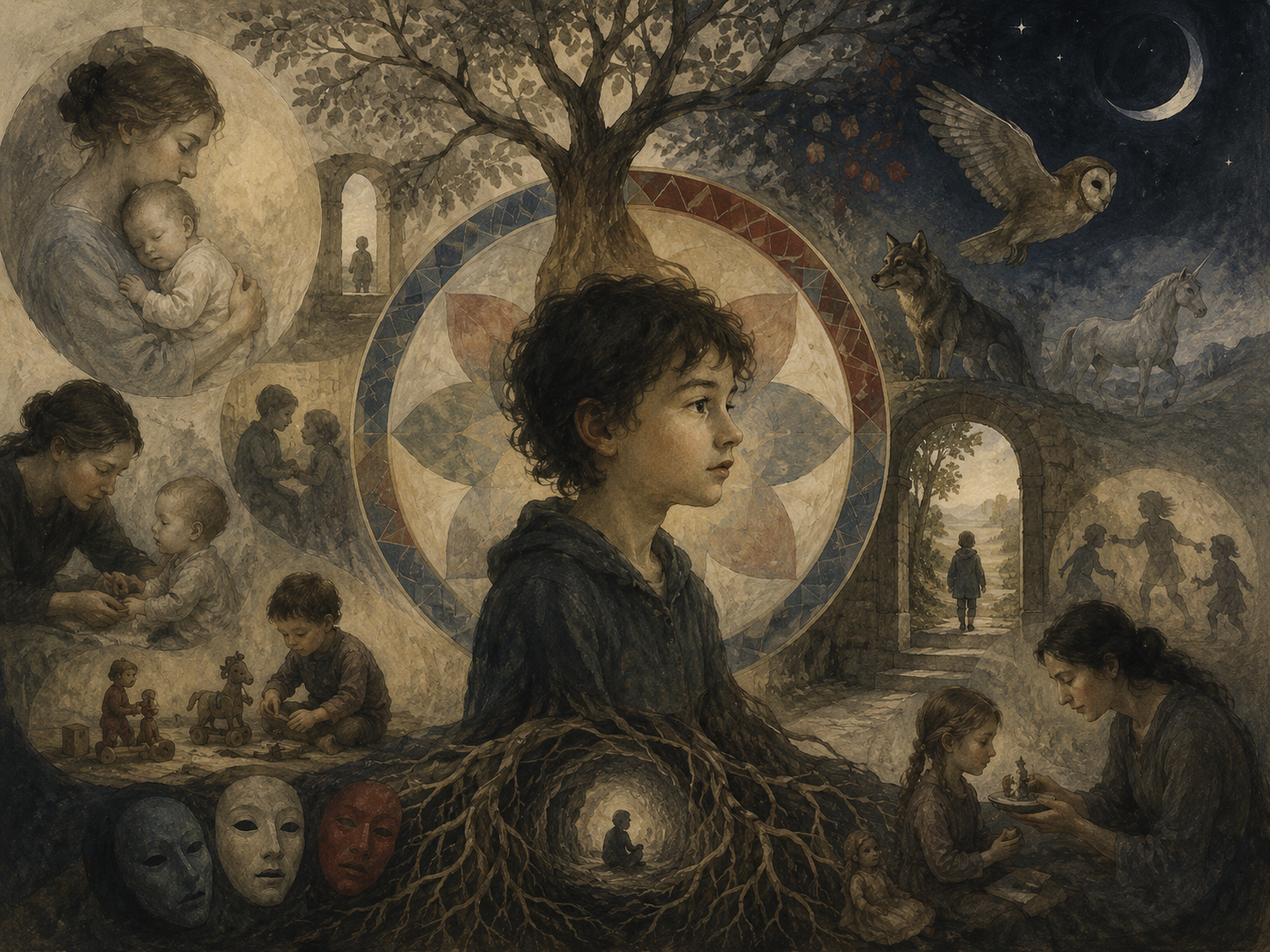
This makes childhood development especially important for a depth psychology of the whole life span. The adult psyche does not simply leave childhood behind. Childhood remains active as complex, memory, fantasy, affective style, attachment expectation, symbolic capacity, bodily attitude, and relational pattern. The adult who struggles with shame, projection, creative inhibition, emotional deadness, dependency fear, spiritual hunger, or rigid persona may be living through structures first shaped in childhood. Later individuation often depends on whether these early formations can be brought into conscious relation rather than repeated unconsciously.
At the same time, a serious Jungian account of childhood must avoid two reductions. It must not reduce the child to behavior alone, as though development were merely skill acquisition, social compliance, or cognitive maturation. But it also must not reduce the child to archetypal symbolism alone, as though every image, fear, dream, or play sequence could be interpreted through universal motifs without careful attention to family, attachment, culture, trauma, and developmental timing. Childhood is symbolic, but it is also concrete. It is imaginal, but it is also relational. It is archetypal, but it is also embodied, historical, and vulnerable.
This article examines childhood development in Jungian and post-Jungian thought, focusing on ego formation, family atmosphere, complexes, symbol and fantasy, play, the child archetype, trauma, attachment, object relations, child analysis, symbolic capacity, and the future personality. It treats childhood not as a merely preliminary stage before adult rationality, but as the formative ground of depth life: the early field in which psyche first learns how to feel, defend, imagine, relate, symbolize, and become.
Why Childhood Matters in Jungian Thought
Childhood matters in Jungian thought because the psyche begins organizing itself long before adult consciousness can explain what is happening. The child is not simply a small rational subject gradually acquiring information. The child lives within a field of dependency, sensory experience, fantasy, attachment, emotional climate, bodily rhythm, prohibition, care, fear, play, family myth, and unconscious communication. The earliest experiences of being held, mirrored, frightened, idealized, neglected, misunderstood, delighted in, or overwhelmed do not remain external events. They become internal patterns through which the child later feels and interprets reality.
This is especially important in analytical psychology because Jung did not understand the unconscious as a later addition to an already formed conscious mind. Consciousness differentiates gradually out of a wider unconscious matrix. The child’s ego is therefore not sovereign from the beginning. It develops within forces larger than itself: parental psyche, family atmosphere, archetypal patterns, bodily need, emotional contagion, play, dream, image, and culture. Childhood is the period when the boundaries among these domains remain porous and intensely formative.
The child’s world is also symbolically rich. Children do not experience reality only as factual arrangement. Rooms become safe or dangerous. Objects become companions or threats. Shadows become presences. Stories become maps of fear and rescue. Animals, monsters, helpers, secret places, repetitive games, drawings, and invented rituals become ways of organizing affect. From a Jungian perspective, this is not childish unreality in a dismissive sense. It is the psyche’s early symbolic intelligence. The child uses image before concept, play before analysis, and enactment before reflective speech.
Childhood also matters because complexes often begin there. A complex is not merely a memory, nor simply a learned belief. It is an emotionally charged organization of experience that binds affect, expectation, image, body, and reaction. Childhood is the period in which such structures may form with lasting intensity because the child is dependent on caregivers and cannot easily step outside the family field. A parent’s absence, rage, shame, idealization, anxiety, depression, unpredictability, or unconscious demand may become part of the child’s psychic architecture. Later adult reactions may carry the force of these early constellations.
Jungian developmental thought also matters because it links childhood to later individuation. The adult’s task is not simply to overcome childhood, but to come into conscious relation with the early patterns that shaped psychic life. A person may need to encounter the wounded child, the divine child, the abandoned child, the creative child, the terrified child, or the compliant child as living psychic realities. These figures are not only memories. They are symbolic forms through which early development continues to shape adult becoming.
Yet childhood should not be idealized. Jungian language sometimes risks romanticizing the child as pure imagination, future possibility, or archetypal renewal. Actual children are vulnerable, dependent, embodied, and exposed to real social and relational conditions. Their symbolic life can be vibrant, but it can also be shaped by trauma, neglect, poverty, disability, racism, illness, family violence, coercive institutions, and cultural displacement. A serious Jungian and post-Jungian account must keep the symbolic child and the actual child in view at the same time.
Childhood matters, then, because it is the early site where psyche learns what kind of world it inhabits. Is the world safe enough to explore? Is feeling tolerable? Is imagination welcomed or shamed? Are caregivers reliable? Is the body a home or a danger? Can anger survive relationship? Can fear be comforted? Can play transform experience? Can inner life be spoken? These questions do not disappear with age. They become the deep grammar of personality and the later work of individuation.
Jung on the Child and the Emerging Psyche
Jung approached the child from several overlapping angles. He wrote about the actual child as a developing person whose consciousness is still emerging; about the child archetype as a symbolic figure of futurity, vulnerability, renewal, and wholeness; and about childhood experiences as sources of complexes that continue into adult life. His account is therefore not a single developmental theory, but a set of insights into how early psychic life forms and how the image of the child remains significant throughout life.
For Jung, the child’s ego is not fully differentiated at the beginning of life. The young child lives close to the unconscious and close to the emotional field of the parents. This does not mean the child has no individuality. Rather, individuality is still developing within a psychic atmosphere that has not yet been sharply separated into inner and outer, self and other, fantasy and reality, personal feeling and family field. The child’s consciousness gradually emerges through relation, frustration, language, memory, bodily experience, and adaptation.
Jung placed special emphasis on parental influence, not only in the obvious sense of behavior and upbringing, but in the deeper sense of unconscious transmission. Children are affected by what parents do, but also by what parents cannot know about themselves. Unlived desires, anxieties, moral rigidity, shame, resentment, marital conflict, emotional deadness, spiritual emptiness, and unresolved complexes may all shape the household atmosphere. The child often lives inside these unspoken psychic conditions before they can be named.
This idea remains clinically powerful. A family may insist that nothing is wrong, while the child’s symptoms, dreams, fears, or play reveal that something in the field is deeply disturbed. A parent may consciously love the child while unconsciously burdening the child with expectation, projection, emotional need, or anxiety. Jung’s sensitivity to the unconscious life of the family helps explain why children sometimes express problems that belong not only to themselves, but to the relational and symbolic atmosphere in which they are developing.
Jung also distinguished between the empirical child and the child as symbol. The child archetype appears in myth, religion, dream, and fantasy as a figure of new life, hidden potential, vulnerability, miraculous birth, threatened future, or emerging wholeness. This symbolic child does not simply represent actual childhood. It represents what is new, fragile, and not yet developed in the psyche. In adult dreams, child figures often appear when a new psychic possibility is emerging or when a neglected part of the personality needs attention.
The child archetype should not be confused with the actual child, however. Actual children require care, protection, developmental understanding, and ethical responsibility. The archetypal child may symbolize renewal, but a real child’s fear, need, disability, trauma, or dependency should not be turned into metaphor too quickly. A mature Jungian approach must hold both levels: the symbolic meaning of child imagery and the concrete reality of child development.
Jung’s limitations are also important. His developmental writings were not systematic, and they do not provide the empirical precision of later developmental psychology. He did not offer a full account of attachment, infant observation, family systems, neurodevelopment, trauma, or child analysis. Later post-Jungians had to expand his work substantially. Still, Jung’s contribution remains valuable because he saw childhood as psychologically deep from the beginning and refused to treat the child’s inner life as merely primitive or pre-rational.
In Jung’s view, the child stands at the beginning of consciousness and at the edge of future possibility. The emerging psyche is not merely learning the world. It is forming a relation to the unconscious, to symbol, to body, to others, and to itself. This makes childhood one of the decisive origins of depth life.
Ego Formation and the Differentiation of Consciousness
One of the central developmental questions in Jungian psychology is how the ego begins to form. The child does not begin life with a fully differentiated center of consciousness. The ego emerges gradually through repeated experiences of bodily continuity, recognition, naming, frustration, memory, relational response, and the growing distinction between self and other. The child learns, slowly and unevenly, that inner image is not identical with outer event, that desire is not the same as actuality, that caregivers are separate beings, and that feelings can be held without becoming the whole world.
Jungian thought describes this process as differentiation. Consciousness separates from the unconscious background without ever becoming independent of it. The child’s ego must become strong enough to orient to reality, but not so rigid that symbolic life is cut off. Healthy development involves both separation and relation: the ego becomes more distinct while remaining connected to affect, imagination, body, and unconscious meaning.
Early ego formation depends on relational support. The child does not simply will an ego into being. The caregiver helps the child organize experience by naming, soothing, mirroring, setting limits, and making feelings survivable. A frightened child learns that fear can be held when someone responds reliably. An angry child learns that anger does not destroy relationship when limits are firm but not humiliating. A playful child learns that imagination can move between inner and outer worlds when play is welcomed. These experiences support ego coherence.
When relational support is weak or frightening, ego formation may become defensive. The child may develop prematurely rigid control, compliance, dissociation, grandiosity, withdrawal, caretaking, or hypervigilance. These adaptations may help the child survive the emotional field but may also limit later symbolic and relational life. A child who must become too adult too early may develop competence at the cost of play. A child who must remain pleasing may lose contact with anger. A child who experiences caregivers as unpredictable may organize around scanning and anticipation rather than exploration.
The differentiation of consciousness also involves the gradual ability to bear ambivalence. A child must learn that the same caregiver can frustrate and love, that the self can feel anger and affection, that fantasy and reality differ, and that disappointment does not mean annihilation. This capacity is not purely cognitive. It depends on affect regulation and relational continuity. In Jungian terms, the ego becomes capable of holding opposites in rudimentary form.
Symbolic capacity is closely related to ego formation. A child who can symbolize can play with experience rather than be possessed by it. A monster can be drawn, named, fought, befriended, or transformed. A separation can be enacted and repaired in play. A fear can become story. Symbolization gives the emerging ego space around affect. Without such symbolic mediation, feelings may remain overwhelming or concretely acted out.
| Developmental function | Jungian meaning | Relational condition | Possible disruption |
|---|---|---|---|
| Ego differentiation | Emergence of a center of consciousness from a wider unconscious field | Recognition, naming, continuity, and reliable response | Fragmentation, confusion, premature rigidity, or weak self-boundaries |
| Affect regulation | Ability to feel without being overwhelmed or dissociated | Soothing, attunement, repair, and tolerable frustration | Flooding, numbness, rage, panic, or shutdown |
| Reality testing | Gradual distinction between image, wish, fear, and outer reality | Secure enough environment for exploration and correction | Literalization, magical fear, excessive control, or dissociation |
| Symbolic play | Transformation of affect into image, story, enactment, and imagination | Permission to play, create, repeat, and experiment safely | Symbolic deadness, compulsive repetition, or concrete acting out |
| Ambivalence tolerance | Capacity to hold love and anger, dependence and separateness, fear and curiosity | Relationships that survive frustration and conflict | Splitting, idealization, devaluation, or chronic shame |
Ego formation is therefore not the triumph of rational consciousness over primitive fantasy. It is the gradual emergence of a reflective center capable of relating to affect, image, body, and relationship. The child becomes more conscious not by abandoning symbolic life, but by learning to hold it within a growing sense of self and world.
Family Atmosphere, Parents, and the Formation of Complexes
Jung and later Jungians gave particular importance to the family atmosphere in the formation of complexes. A family is not only a social unit. It is an emotional and symbolic field. Children develop within patterns of speech, silence, expectation, touch, absence, discipline, shame, idealization, fear, secrecy, religion, class, gender, grief, and inherited story. They absorb not only what is said explicitly, but what is carried affectively. The family’s unconscious life becomes part of the child’s developmental environment.
A complex is an affectively charged cluster of memory, expectation, image, bodily response, and fantasy. In childhood, complexes often form around primary relationships because the child depends so deeply on caregivers for safety, recognition, and orientation. A mother complex, father complex, inferiority complex, abandonment complex, shame complex, achievement complex, or rescue complex may begin as repeated emotional experience that becomes organized into a durable psychic pattern. Later in life, the person may react to present situations with the intensity of early relational history.
The family atmosphere matters because complexes often form through patterns rather than single events. Chronic emotional absence, unpredictable anger, overprotection, perfectionistic demand, parental depression, idealization of the child, covert hostility, role reversal, sibling comparison, religious fear, or unspoken grief may all shape psychic organization. A child may not be able to describe the atmosphere, but the psyche registers it. Later, this atmosphere may become inner weather: anxiety, guilt, compliance, grandiosity, emotional hunger, distrust, or inability to rest.
Jung’s emphasis on the unconscious life of parents remains especially useful. A parent may consciously want the child to flourish while unconsciously needing the child to fulfill an unlived ambition, soothe loneliness, repair a marriage, confirm moral superiority, or remain dependent. The child may become the carrier of parental projection. Such projection can be flattering, burdensome, or devastating. A child praised as special may lose ordinary freedom. A child treated as fragile may become afraid of vitality. A child required to be good may exile anger. A child made responsible for parental feeling may lose access to their own needs.
Complex formation also involves the body. A child does not only remember parental words. They remember tone, posture, timing, facial expression, absence, touch, startle, shame, warmth, and bodily rhythm. The father complex may be a voice in the chest; the mother complex may be a tightening in the stomach; the shame complex may be heat in the face; the abandonment complex may be a sinking in the body before any narrative appears. Complexes are embodied organizations of psychic life.
The family atmosphere also shapes symbolic trust. If imagination is welcomed, the child may learn that inner life can be played with and represented. If fantasy is mocked, punished, or colonized by adult anxiety, the child may retreat from symbolic life or use fantasy defensively. If emotions are named and survived, symbolic capacity grows. If emotions are denied or shamed, the child may learn to split off feeling or express it indirectly through symptom, dream, bodily complaint, or compulsive play.
| Family pattern | Possible complex formation | Later adult expression | Developmental task |
|---|---|---|---|
| Chronic emotional absence | Abandonment or deprivation complex | Fear of need, emotional hunger, distrust of intimacy, withdrawal | Develop capacity to need without shame and relate without collapse |
| Overprotection | Fragility or dependency complex | Anxiety about autonomy, guilt over separation, fear of risk | Differentiate care from control and develop agency |
| Perfectionistic demand | Inferiority or achievement complex | Compulsion to perform, shame around failure, persona rigidity | Separate worth from performance and recover play |
| Parental projection | Special-child, savior, or burden complex | Grandiosity, guilt, caretaking, fear of ordinary life | Withdraw from inherited role and claim ordinary individuality |
| Unspoken family trauma | Fear, secrecy, or vigilance complex | Hypervigilance, symbolic dread, anxiety without clear object | Name inherited atmosphere and distinguish present from past |
| Religious or moral rigidity | Purity, guilt, or shadow complex | Fear of desire, aggression, sexuality, doubt, or ambiguity | Develop moral agency without splitting off instinct or complexity |
Complexes are not destiny, but they are durable. Later development and individuation often require the adult to recognize how early family atmosphere became inner structure. The task is not to blame parents simplistically, nor to deny real injury in the name of maturity. It is to understand how early relational fields become psychic patterns, and how those patterns can gradually become conscious, differentiated, and less possessive.
Symbol, Fantasy, and the Imaginal Life of the Child
Childhood development in the Jungian tradition places unusual emphasis on symbol and fantasy. Children encounter the world through images, stories, games, fears, helpers, monsters, secret places, transitional objects, animals, invented rituals, and repeated scenes of danger and rescue. These forms are not merely decorative. They are developmental instruments. They allow the child to metabolize affect, rehearse agency, represent fear, transform helplessness, and experiment with inner and outer reality.
From this perspective, fantasy is not the opposite of reality. It is one of the child’s ways of approaching reality. A child who plays hospital, battle, family, burial, rescue, school, monster, magic, or hiding may be working symbolically with vulnerability, aggression, caregiving, authority, loss, shame, fear, or separation. The play is not always a direct transcript of experience, but it often reveals how experience is being organized. Fantasy becomes a bridge between raw affect and reflective meaning.
Jungian thought is especially strong in recognizing that fantasy can be prospective. It may not merely repeat what has happened; it may imagine what the child needs to become. A child who repeatedly plays rescue may be representing helplessness, but also imagining agency. A child who draws fierce animals may be expressing fear, but also developing strength. A child who invents invisible companions may be managing loneliness, but also creating an inner world with symbolic support. The psyche imagines ahead of itself.
Symbolic life also helps the child manage opposites. In play, the child can be powerful and vulnerable, parent and baby, monster and hero, destroyer and healer. These shifts allow the psyche to explore positions that ordinary life may not permit. A child who cannot openly express anger may stage battles. A child who fears separation may repeat departures and reunions. A child who feels small may become giant, animal, king, queen, magician, or rescuer. Such play can support integration when it remains flexible and relationally held.
Fantasy may also become defensive. Not all imaginative life is free or transformative. Under trauma, neglect, or chronic anxiety, fantasy may become rigid, repetitive, dissociated, or disconnected from relationship. A child may retreat into fantasy because reality is unbearable. A play sequence may repeat danger without symbolic transformation. A monster may never become speakable. A heroic fantasy may protect against intolerable shame. The clinician, parent, or observer must therefore ask not only what the symbol means, but how the child uses it.
Symbolic expression can take many forms: drawing, storytelling, body movement, voice, sandplay, miniature worlds, music, ritualized play, collecting objects, arranging scenes, and repeated imaginative narratives. Jungian and post-Jungian approaches value these forms because children often speak through symbol before they can speak conceptually. The adult’s task is not to decode every image mechanically, but to respect symbolic form as a serious expression of psychic life.
Fantasy and symbol also protect the dignity of the child’s inner world. A child’s fear of monsters may not be “just imagination.” It may be the symbolic form of vulnerability, household tension, night anxiety, trauma, aggression, or archetypal fear. To dismiss it is to dismiss the child’s psychic reality. To literalize it is also a mistake. The task is to meet the image at the level at which it lives: as meaningful, affective, and developmentally active.
In Jungian and post-Jungian thought, the child’s imaginal life is therefore one of the foundations of later symbolic capacity. Adults who can dream, create, metaphorize, play, reflect, and imagine often draw on early capacities first developed in childhood. When those capacities were injured or shamed, later individuation may require their recovery. The child’s fantasy life is not left behind; it becomes part of the adult’s capacity for meaning.
The Child Archetype and Developmental Potential
Jung’s theory of the child archetype adds a distinctive symbolic layer to developmental thought. The child is not only an empirical stage of life. The child also appears across myth, religion, dream, folklore, fairy tale, and fantasy as an image of new life, threatened possibility, hidden wholeness, divine birth, future renewal, and vulnerability. The miraculous child, divine child, abandoned child, endangered child, royal child, orphan, foundling, or magical child often appears where the psyche is imagining a new beginning under conditions of danger.
This archetypal dimension matters because it allows childhood to be understood symbolically as well as developmentally. The actual child develops in time, through body, attachment, family, culture, and experience. The archetypal child represents what has not yet become, what remains vulnerable, what carries future potential, and what may be threatened by the old order. In adult dreams, child figures often appear when new psychic life is emerging, when something fragile requires protection, or when a lost part of the personality seeks recognition.
The child archetype is powerful because it gathers opposites. The child is weak and powerful, dependent and future-bearing, vulnerable and transformative. In mythic narratives, the child may be born in danger, hidden from destructive authority, abandoned and rescued, or marked by a special destiny. Psychologically, this can symbolize the emergence of a new attitude before the ego is ready to support it. New life begins small. It needs protection from the old structures that would destroy it.
In development, the child archetype can illuminate the sense that childhood is more than current ability. A child is always more than what they can presently perform. They carry potential that has not yet taken shape. Caregivers and societies may honor or distort that potential. A family may protect the child’s becoming, or may force the child into roles that serve adult anxiety. The archetypal child reminds us that development includes futurity: the psyche is always moving toward forms not yet known.
However, the child archetype can also be misused. Adults may project symbolic meaning onto actual children in ways that burden them. A child may become the family’s hope, savior, miracle, proof of goodness, spiritual sign, or vehicle of parental redemption. Such projections can rob the child of ordinary individuality. The archetypal child belongs to symbolic life; the actual child needs freedom to be a child, not a carrier of adult meaning.
There is also a risk of sentimentalizing childhood. The child archetype may be associated with innocence, purity, and renewal, but actual children experience envy, aggression, fear, sexuality in developmental form, rivalry, destructiveness, shame, and ambivalence. A depth psychology of childhood must avoid idealizing children as pure symbols. Children are psychologically complex. Their development includes shadow as well as innocence.
The child archetype is most useful when held with developmental precision. It can help us understand why child images appear in dreams, why play carries future possibility, why vulnerable new attitudes need protection, and why early psychic life remains central to individuation. But it should never replace careful attention to the actual child’s needs, context, safety, and relational world.
The archetypal child therefore links beginning and becoming. It shows that childhood is not only what came first, but also what remains capable of renewal. The child in the psyche is the image of what is still forming, still vulnerable, and still asking for life.
Play, Creativity, and Symbolic Expression
Post-Jungian thought has often stressed the importance of play as a central medium of development. Play is not merely recreation, distraction, or preparation for adult skill. It is one of the principal spaces in which children coordinate inner and outer reality. Through play, the child can approach fear without being swallowed by it, repeat distress in altered form, imagine agency, test roles, transform objects, stage separation and reunion, and give symbolic shape to affects that cannot yet be spoken directly.
Play is developmental because it creates a middle space. A block can become a house, a doll can become a baby, a box can become a cave, a blanket can become safety, a stick can become a sword, and a drawing can become a world. The child knows and does not know that the play is “real.” This in-between quality is crucial. It allows the psyche to experiment with meaning without being trapped in literal actuality. Play gives the child symbolic distance.
Jungian and post-Jungian clinicians often attend closely to symbolic play because children reveal psychic organization through enacted form. A child may repeatedly bury figures, rescue animals, build walls, flood houses, protect babies, attack monsters, hide treasure, imprison characters, or create families where roles shift unpredictably. The adult should not rush to interpretation, but the pattern matters. Repetition, affect, flexibility, rigidity, relational invitation, and transformation all provide clues about how the child is organizing experience.
Creativity is closely related to play. Drawing, storytelling, singing, movement, building, making, and imaginative speech allow the child to externalize inner states. Once inner experience has form, it can be looked at, changed, shared, and related to. This is a basic function of symbolization. The child who draws a monster can place fear outside the body. The child who tells a story can give sequence to confusion. The child who builds a shelter can imagine protection. Creative form makes affect more workable.
Play also supports agency. Children are often powerless in ordinary life. They depend on adults, institutions, schedules, and rules they did not create. In play, the child can reverse roles, become powerful, set conditions, invent outcomes, and repair helplessness symbolically. This does not eliminate real dependency, but it helps the psyche develop a sense of participation. The child is not only acted upon; the child can act within an imaginal field.
At the same time, play can reveal developmental strain. When play becomes rigid, repetitive, joyless, violent without transformation, dissociated, or unable to include the presence of another person, it may indicate distress. A traumatized child may repeat danger rather than transform it. An anxious child may control every detail. A neglected child may create isolated worlds with no relational entry. A shamed child may avoid creative expression. These patterns should be approached with care, not judgment.
Play also has cultural dimensions. The forms of play available to children depend on family resources, cultural traditions, neighborhood safety, disability access, educational structures, digital environments, and adult attitudes toward imagination. Some children are given abundant space for symbolic play; others are prematurely organized around survival, labor, performance, or compliance. A serious developmental account must ask whose childhood has room for play and whose does not.
| Form of play | Developmental function | Possible Jungian reading | Clinical caution |
|---|---|---|---|
| Rescue play | Transforms helplessness into agency and care | Imaginal compensation for vulnerability or fear | May become compulsive if the child feels responsible for others’ survival |
| Monster play | Gives form to fear, aggression, and unknown forces | Early encounter with shadow or archetypal threat | Do not over-amplify if the image is tied to trauma or household danger |
| House or shelter play | Organizes safety, boundaries, family structure, and containment | Symbolic representation of psychic space | Repeated collapse or invasion may indicate anxiety about protection |
| Role reversal | Allows experimentation with power, authority, dependency, and care | Testing persona, parental image, and ego agency | Rigid control of roles may signal fear or relational insecurity |
| Drawing and image-making | Externalizes affect and gives symbolic form to inner states | Image as mediator between unconscious and consciousness | Respect the child’s associations rather than imposing adult interpretation |
Play, creativity, and symbolic expression are therefore not secondary to childhood development. They are among the means by which development occurs. The child becomes more psychologically coherent by creating forms in which inner life can be held, transformed, shared, and gradually understood.
Body, Affect, and Early Psychic Life
Childhood development is embodied from the beginning. Before the child can explain experience, the body already registers safety, hunger, pain, rhythm, warmth, separation, touch, startle, fatigue, and excitement. The earliest psyche is not a mind floating above the body. It is body-psyche: sensation, affect, image, and relation intertwined. Jungian and post-Jungian development must therefore take embodiment seriously.
Affect is one of the primary organizers of early life. The child’s emotional states are often stronger than their capacity to understand them. Fear, delight, rage, shame, longing, jealousy, excitement, and grief may flood the child before reflective containment is possible. Caregivers help metabolize these states by responding with enough attunement, steadiness, and naming. Over time, the child begins to internalize the possibility that affect can be felt without annihilation. This becomes part of ego formation.
When affect is not held, development may become organized around defense. A child overwhelmed by fear may become vigilant. A child shamed for anger may become compliant or secretly aggressive. A child whose sadness is ignored may become numb. A child whose excitement is punished may suppress vitality. These patterns later appear as personality style, complex activation, bodily symptoms, or symbolic inhibition. The body carries what the child could not yet think.
The body also mediates the child’s relation to symbol. A frightening image is not merely mental; it is felt in pulse, breath, muscle, skin, and posture. A safe story may soothe the nervous system. A repeated ritual may regulate the body. A transitional object may carry warmth, smell, and tactile reassurance. Symbolic life is not separate from bodily regulation. The image works because it touches the body.
Post-Jungian developmental thought is strongest when it brings Jung’s symbolic sensitivity into dialogue with the bodily foundations of attachment and affect regulation. The child’s capacity to imagine depends partly on whether the body feels safe enough to play. Chronic hyperarousal, dissociation, illness, sensory overwhelm, or developmental trauma can constrain symbolic exploration. A child who cannot regulate affect may use fantasy defensively or concretely rather than playfully.
Embodiment also matters in relation to shame. Children often experience shame bodily before they can understand it: lowered gaze, heat, collapse, hiding, freezing, or the wish to disappear. If shame becomes chronic, it may organize the ego around concealment. Later adult shadow work often encounters these early bodily states. The person may know rationally that they are safe, yet the body still expects exposure or humiliation. Early shame becomes a bodily complex.
The child’s body is also shaped by culture and power. Gender expectations, racialization, disability, illness, poverty, religious rules, family attitudes toward food and sexuality, and social control of movement all influence how the child experiences embodiment. A Jungian developmental account that ignores these realities risks abstraction. The body is symbolic, but it is also socially treated, disciplined, protected, exposed, and judged.
Body, affect, and early psychic life belong together because the child first becomes a self through felt experience. A secure symbolic life requires more than images. It requires a body that can bear image, affect, and relation. The foundation of depth life is therefore not only dream or myth, but the child’s earliest bodily sense of whether existence can be inhabited.
Trauma, Disruption, and Early Psychic Organization
Childhood development can be deeply altered by trauma, chronic instability, neglect, frightening caregiving, humiliation, family violence, institutional harm, illness, loss, or failures of attunement. Jung did not formulate trauma theory in modern terms, but post-Jungian work has made clear that trauma affects ego formation, symbolic capacity, complex organization, affect regulation, bodily trust, and the child’s ability to distinguish inner from outer reality. Under traumatic conditions, the psyche may organize around survival rather than exploration.
Trauma in childhood is especially consequential because the child’s ego structures are still forming. The child cannot always narrate what has happened, leave the field, challenge adult power, or regulate overwhelming affect. The psyche may respond through dissociation, fantasy retreat, compulsive repetition, bodily symptoms, rigid control, compliance, aggression, withdrawal, or symbolic deadness. These are not moral failures. They are adaptations to conditions that exceeded developmental capacity.
In Jungian terms, trauma may intensify complex formation. A traumatic complex binds affect, image, bodily response, expectation, and defensive reaction around overwhelming experience. Later in life, the person may be seized by states that seem disproportionate to the present because the old complex has been activated. A mild criticism may evoke annihilating shame; separation may evoke terror; authority may evoke helplessness; intimacy may evoke threat. The present becomes the doorway into an earlier psychic field.
Trauma can also damage symbolic capacity. Play may become repetitive rather than transformative. Fantasy may become dissociated rather than exploratory. Dreams may become nightmares. Images may intrude rather than mediate meaning. The child may avoid imagination because inner life feels dangerous. Or the child may live in fantasy because outer reality is unbearable. Both patterns reveal that the symbolic function has been altered by traumatic pressure.
Developmental trauma may be especially subtle because it can arise not only from dramatic events, but from chronic emotional conditions: neglect, misattunement, role reversal, parental depression, coercive control, shame, unpredictable anger, or absence of repair. The child may not remember a single trauma, but may grow up in an atmosphere where selfhood never feels safe. Such children often develop adaptive strategies that later become personality structures: caretaking, perfectionism, emotional withdrawal, vigilance, compliance, dissociation, or premature competence.
Post-Jungian trauma work insists that symbolic interpretation must be paced. A frightening figure in a child’s play may have archetypal resonance, but it may also be linked to actual fear. A dream monster may symbolize shadow, but it may also carry traumatic memory. A dissociated child may produce powerful images that are not yet symbols in a transformative sense. They may be fragments. Clinical work must distinguish symbolic play from traumatic repetition without rigidly separating them.
Healing in childhood often requires restoring conditions for play, safety, and symbolization. The child needs reliable relationship, bodily regulation, protection, attunement, permission to express affect, and symbolic forms that can hold experience without overwhelming it. A traumatized child may begin to heal when play becomes flexible, when frightening images can change, when rescue becomes possible, when the body can settle, and when relationship survives anger, fear, and grief.
Trauma does not eliminate depth life, but it alters the path by which depth can be reached. The child’s psyche may remain symbolically alive even under severe pressure, yet its symbols must be approached with ethical care. Developmental injury should never be romanticized as archetypal initiation. The child first needs safety, protection, and recognition. Meaning can come only after the wound is no longer being ignored.
Post-Jungian Revisions: Attachment, Object Relations, and Development
Later Jungian thinkers revised and expanded the classical model by bringing analytical psychology into dialogue with attachment theory, object relations, child analysis, developmental psychoanalysis, infant observation, affect regulation, and trauma studies. These revisions made childhood development more relationally precise. The child is not shaped by archetypal patterns alone, nor by parental complexes in an abstract sense, but by actual early relationships that determine how safety, separation, imagination, and self-cohesion are lived.
Attachment theory is especially important because it shows how early relationships shape the child’s expectations of care, protection, separation, and return. A securely attached child can use the caregiver as a base for exploration. An anxiously attached child may cling, fear abandonment, or become preoccupied with relational uncertainty. An avoidantly organized child may suppress need and appear prematurely self-sufficient. A disorganized child may experience the caregiver as both safety and danger. These patterns have obvious relevance for later Jungian ideas about complexes, transference, shadow, and individuation.
Object relations theory adds another layer by showing how early relationships become internal objects. The child internalizes not only people, but patterns of relation: soothing or intrusive, reliable or absent, loving or shaming, protective or persecutory. These internal objects later shape fantasy, dream, self-image, and expectation. A Jungian language of complexes can be enriched by object relations because it clarifies how charged internal figures are built through lived relationship.
Post-Jungian thought also revised the meaning of archetype. Some later Jungians moved away from treating archetypes as fixed inherited images and toward understanding archetypal patterns as organizing potentials that require relational and developmental activation. This makes childhood more important, not less. The caregiver relationship becomes one of the fields in which archetypal potentials are embodied, distorted, or humanized. Mother, father, child, helper, devourer, protector, trickster, and shadow are not only mythic figures; they are encountered through actual relational experience.
These revisions also deepen the concept of symbol. Symbolic capacity is not simply given. It develops through attunement, play, affect regulation, and the ability to move between inner and outer reality. A child whose feelings are held can begin to represent them. A child whose feelings are mocked or terrifying may struggle to symbolize. Post-Jungian development therefore asks what relational conditions are necessary for dream, play, metaphor, and imagination to become integrative rather than defensive.
Attachment and object relations also help explain why some adults struggle with Jungian methods such as dream work or active imagination. If early symbolic capacity was damaged, the adult may experience images as overwhelming, dead, literal, or dissociated. Clinical Jungian work then requires developmental repair, not only interpretation. The therapist may need to help build the very capacity to symbolize that classical analysis might otherwise assume.
| Post-Jungian revision | Developmental contribution | Jungian significance |
|---|---|---|
| Attachment theory | Shows how early safety, separation, and return shape relational expectation | Clarifies later complexes, transference patterns, and symbolic trust |
| Object relations | Explains how early relationships become internal figures and relational templates | Deepens understanding of complexes and dream figures |
| Infant observation | Grounds developmental theory in early bodily and relational experience | Prevents archetypal abstraction from floating above actual development |
| Trauma theory | Explains dissociation, fragmentation, and symbolic disruption under overwhelm | Improves clinical caution around dream, fantasy, and active imagination |
| Affect regulation | Shows how emotions become bearable through relational holding | Clarifies how symbolic capacity depends on embodied safety |
| Child analysis | Uses play, image, relationship, and developmentally appropriate interpretation | Shows how symbolic life appears before adult verbal reflection |
Post-Jungian developmental thought is strongest when it does not choose between archetype and relationship. The child develops in both fields. Archetypal patterns give depth and form to psychic life, while actual relationships determine how those patterns are experienced, defended, distorted, and transformed. Childhood development is therefore both symbolic and relational from the beginning.
Michael Fordham and the Developmental Self
Michael Fordham was one of the most important post-Jungian figures in the development of a more systematic Jungian account of childhood. His work brought Jungian ideas into closer relation with child analysis, infant development, and clinical observation. Fordham argued that the self is active from the beginning of life, not merely an adult achievement or late-life goal. This moved Jungian theory toward a more developmental understanding of how psychic organization emerges in infancy and childhood.
Fordham’s emphasis on the child as an individual was significant because it challenged overly romantic or purely archetypal views of childhood. The child is not just a vessel of parental projection or a symbol of future possibility. The child is a developing psyche with its own organization, agency, reactions, and patterns of relation. This view strengthened Jungian developmental thought by taking actual children more seriously.
One of Fordham’s important contributions was his idea that the infant self undergoes processes of deintegration and reintegration. In simplified terms, parts of the self enter relation with the environment and then are reorganized through experience. Development is not merely the ego separating from the unconscious. It is an ongoing process in which the self engages the world, differentiates, and reconstitutes itself. This gives Jungian theory a more dynamic account of early development.
This approach helps bridge Jungian and object-relational thinking. The infant is not a blank slate, but neither is development simply the unfolding of preformed archetypal contents. The infant self is active, relational, and responsive. Caregiving matters profoundly because the environment participates in how the self differentiates and reorganizes. The child becomes an individual through repeated transactions between inner organization and outer relationship.
Fordham’s work also supports a more nuanced view of childhood pathology. Developmental disturbance may occur when the child’s processes of relation and reintegration are disrupted by trauma, misattunement, deprivation, or overwhelming affect. The problem is not only that a bad memory forms, but that psychic organization itself may be affected. Symbolic capacity, ego coherence, and relational trust may all be altered.
For Jungian clinical practice, Fordham’s contribution is crucial because it grounds symbol in development. The child’s play, fantasy, and symptoms are not only archetypal expressions; they are part of the child’s actual developmental organization. The clinician must attend to timing, capacity, relation, and the child’s individuality. Interpretation must be developmentally appropriate. The child’s images matter, but so does the child’s ability to use them.
Fordham also helps later Jungian work avoid treating individuation as something that begins only in adulthood. While adult individuation remains distinct, the foundations of individuality are present from the beginning. The child is already engaged in processes of differentiation, relation, and organization. Later individuation builds upon, revises, and sometimes repairs these early developmental processes.
The developmental self is therefore one of the key post-Jungian bridges between classical analytical psychology and modern developmental thought. It allows Jungian psychology to remain symbolically deep while becoming more precise about infancy, childhood, and the actual conditions under which psychic life becomes organized.
Child Analysis and the Clinical Understanding of Development
Child analysis within Jungian and post-Jungian traditions often relies on symbolic observation rather than direct verbal interpretation alone. Children may not describe conflict in adult conceptual language, but they frequently reveal it through play, imagery, story fragments, bodily tone, repeated scenarios, silence, relational style, and emotional shifts. The clinician must listen with more than the ear. They must observe how the child uses space, objects, figures, repetition, imagination, and the analyst’s presence.
This clinical stance reflects a broader theoretical commitment: the child’s psyche should not be reduced either to literal behavior or to speculative archetypal generalization. Development must be understood where symbol, affect, relationship, body, and emerging ego structure meet. A child who throws figures into a corner, hides animals, rescues babies, buries objects, floods houses, or refuses to speak may be communicating through symbolic action. But the meaning must be approached carefully and relationally, not imposed from above.
Child analysis also requires attention to developmental capacity. A young child cannot use interpretation in the same way as an adult. The work may involve joining play, providing containment, naming affect, tracking symbolic themes, supporting expression, and helping the child create more flexible forms. The analyst may interpret less through explanation and more through presence, timing, play response, and the creation of a reliable symbolic space.
Parents and caregivers are often part of the clinical field. A child’s symptoms may express the child’s own struggle, but they may also carry family tension, parental conflict, trauma, grief, unrealistic expectation, or unspoken anxiety. Jung’s emphasis on the unconscious life of the parents remains important here. Work with the child may require work with the family atmosphere. The child should not be made the sole bearer of a system’s distress.
Clinical work also distinguishes between symbolic play and trauma repetition. A child who repeatedly enacts danger may be trying to master fear symbolically, but may also be trapped in repetition. A flexible play sequence that changes over time suggests symbolization. A rigid, joyless, compulsive sequence may suggest traumatic fixation or anxiety. The clinician attends to whether the play becomes more relational, more varied, more affectively tolerable, and more capable of transformation.
Child analysis also involves ethical restraint. Children are vulnerable to adult interpretation. An analyst who imposes symbolic meaning too strongly can colonize the child’s inner world. The child’s own associations, affective response, and developmental level matter. The analyst must not use Jungian language to override the child’s concrete reality. The first task is to create a safe enough space for the child’s psyche to appear.
In this sense, child analysis is one of the clearest demonstrations of post-Jungian clinical development. It shows that psyche speaks before adult language, that symbol emerges through relation, and that development is observed not only in milestones but in the changing quality of play, affect, imagination, and connection. The child’s symbolic life is serious clinical material because it is one of the ways the child becomes more coherent.
Childhood Development and the Future Personality
Childhood development is foundational for later personality because it shapes how the ego forms, which attitudes and functions become more differentiated, what kinds of complexes organize emotional life, and how symbolic imagination is trusted or constrained. Early experience does not determine destiny in a simplistic way, but it lays down pathways of reaction, defense, fantasy, expectation, and bodily response that later personality development must work through.
This is why Jungian personality theory remains developmental even when discussing adults. The adult personality carries childhood structures forward, not only as memories, but as organizing forms of psyche. A person may not remember early emotional absence, but may live with a deep expectation of abandonment. They may not remember being shamed for anger, but may experience aggression as dangerous. They may not remember parental projection, but may feel compelled to fulfill an inherited role. Childhood lives on as pattern.
The future personality is shaped by what became differentiated and what remained unconscious. A child encouraged to think but not feel may develop intellectual strength and emotional difficulty. A child valued for caretaking may become relationally sensitive but unable to need. A child shamed for dependency may become autonomous but isolated. A child allowed to play, imagine, and feel may retain symbolic flexibility. Jungian development asks not only what skills were learned, but what parts of the psyche were allowed to live.
Complexes formed in childhood can later influence vocation, relationships, spirituality, creativity, and shadow. An achievement complex may drive success while hiding inferiority. A parental complex may shape authority relationships. A rescue complex may organize love. A shame complex may inhibit expression. An abandonment complex may distort intimacy. These complexes are not simply problems to eliminate; they are charged psychic structures that must be understood, differentiated, and gradually brought into relation with consciousness.
Symbolic capacity also carries forward. Adults who can dream deeply, imagine alternatives, create art, engage myth, work with metaphor, and reflect on inner figures often draw on early capacities for play and symbolic trust. Adults whose childhood imagination was mocked, colonized, or disrupted by trauma may find symbolic work difficult or frightening. Later Jungian therapy may then involve not only interpretation of symbols, but restoration of the capacity to symbolize.
Personality is also shaped by early relation to the body. A child who felt safe in the body may later access feeling, desire, and intuition more freely. A child who experienced bodily shame, illness, violation, or chronic dysregulation may develop defensive distance from embodiment. In Jungian terms, this affects the relation between consciousness and instinctual life. The adult’s body may become a site where childhood complexes return.
Childhood development and future personality should therefore be understood probabilistically rather than deterministically. Early patterns matter, but they can be transformed. Later relationships, therapy, creativity, spiritual life, education, community, and conscious reflection can all revise developmental patterns. Individuation does not erase childhood, but it can change the adult’s relation to what childhood formed.
The future personality is not predetermined by childhood, but childhood provides the first architecture. Later development depends on whether that architecture remains rigid, becomes defended, collapses under stress, or can be reworked through conscious relation. In this sense, childhood is both origin and ongoing task.
Development, Symbol, and Individuation
Childhood development and individuation belong together, though they are not the same. Childhood is the phase in which the basic architecture of psyche begins to form: ego differentiation, affect regulation, attachment expectation, complex organization, symbolic capacity, bodily attitude, and early selfhood. Individuation is the later movement through which the person may come into conscious relation with what was formed, excluded, distorted, or left undeveloped. Adult individuation often requires returning to childhood, not to regress, but to understand what still lives there.
The child remains present in the adult psyche as memory, complex, dream image, bodily state, fantasy, vulnerability, creative capacity, and future possibility. A dream of a child may represent an actual childhood wound, an undeveloped part of the personality, a new possibility, a dissociated self-state, or an archetypal image of renewal. Interpretation depends on context. The child image is powerful because it can carry both past and future at once.
Individuation often requires reworking early complexes. The adult may need to distinguish present relationship from parental image, current authority from father complex, intimacy from abandonment expectation, vocation from parental projection, spiritual life from childhood fear, and self-worth from early shame. This is not simple intellectual insight. It involves affect, body, dream, behavior, and relation. The complex must become something the person can relate to, rather than something that possesses them.
Symbolic capacity is one of the bridges between childhood and individuation. The ability to play, imagine, dream, create, and hold metaphor allows the adult to approach early material without being overwhelmed by it. A childhood fear can become an image. A shame state can become a dream figure. A lost capacity can return through art. A rigid complex can loosen through symbolic dialogue. Without symbol, early material may remain concrete, repetitive, or dissociated.
Individuation also involves recovering what childhood could not allow. Some people must reclaim anger. Others must reclaim dependence, solitude, creativity, bodily life, spiritual questioning, erotic vitality, intellectual ambition, or ordinary play. These recoveries are not nostalgic returns to childhood innocence. They are adult integrations of potentials that were blocked, shamed, or undeveloped. The child in the psyche becomes part of future life.
Development and individuation also differ in direction. Childhood development moves toward ego formation and adaptation; individuation moves toward the integration of ego with a wider psychic totality. The first requires enough separation and coherence. The second requires relation to what exceeds the ego: shadow, Self, unconscious, body, symbol, mortality, and otherness. Yet the second depends on the first. Weak ego formation may make depth work destabilizing; rigid ego formation may make depth work resisted. Early development shapes the conditions of later individuation.
The adult does not individuate by becoming childlike in a simplistic sense. They individuate by developing a more conscious relation to the child layers of the psyche: vulnerable, creative, wounded, playful, frightened, hopeful, and undeveloped. The child is not left behind. The child becomes part of the adult’s wholeness when early psychic life can be recognized without being idealized or denied.
Childhood development is therefore not merely an origin story. It is part of the ongoing life of the psyche. Individuation is the later work of bringing those origins into conscious, ethical, symbolic, and embodied relation.
Culture, Family Myth, and the Social Child
Childhood development is never purely private. The child develops within family myth, cultural expectation, social power, language, religion, class, race, gender, disability, migration history, neighborhood safety, educational systems, and institutional structures. A Jungian and post-Jungian account that attends only to the family interior or archetypal imagery risks missing the wider fields that shape the child’s psyche. The child is personal, familial, cultural, and collective from the beginning.
Family myth is one of the earliest symbolic systems the child enters. Every family tells stories about who belongs, who succeeds, who fails, who must be strong, who must not speak, who carries shame, who is special, who is dangerous, what counts as loyalty, and what must never be named. These myths may be explicit or unconscious. The child may become the good one, the difficult one, the gifted one, the sick one, the responsible one, the invisible one, or the replacement for someone lost. Such roles are symbolic, but they are also lived.
Culture shapes the meanings available to the child. A child learns what emotions are acceptable, what bodies are valued, what forms of imagination are honored, what kinds of knowledge matter, what religious symbols carry authority, how gender is performed, how elders are treated, how disability is understood, and whether the world is experienced as welcoming or hostile. These cultural patterns enter dreams, play, shame, aspiration, and self-image.
Social power also shapes development. Children from marginalized communities may grow up with forms of vigilance, code-switching, inherited fear, or premature knowledge that cannot be explained only through family complexes. Racism, poverty, migration stress, war, religious persecution, ableism, or institutional exclusion can become part of the child’s psychic environment. A serious depth psychology must not interpret social injury only as projection or intrapsychic conflict.
Collective trauma can also enter childhood through silence. A family may not speak of displacement, violence, caste, slavery, genocide, war, imprisonment, institutional betrayal, or religious loss, yet the child may feel its atmosphere. Nightmares, anxieties, family prohibitions, emotional absences, or inherited obligations may carry histories that precede the child’s own life. Jungian attention to collective shadow can be helpful here when it remains historically grounded rather than vague.
Religious and mythic traditions can also support childhood development. Ritual, story, sacred time, community, prayer, song, and moral language may give children symbolic containers for fear, gratitude, grief, and belonging. But religious traditions can also carry fear, shame, exclusion, or authoritarian control. The developmental effect depends not only on doctrine, but on how symbols are lived in family and community.
A child’s symbolic life therefore cannot be understood apart from social context. The dragon, mask, ancestor, god, ghost, hero, monster, animal, or sacred object in a child’s imagination may carry personal, familial, cultural, and archetypal meanings at once. The adult interpreter must approach such imagery with humility. Jungian amplification can widen meaning, but it should never override the child’s cultural world or lived social reality.
Culture, family myth, and the social child remind us that childhood development is not only an individual psychological process. It is the formation of psyche within worlds of meaning and power. The child learns not only who they are, but what kind of world they are allowed to imagine themselves inside.
Criticisms and Qualifications
Jungian and post-Jungian developmental thought faces several important criticisms. Classical Jung can appear too unsystematic as a developmental theorist, too reliant on symbolic language, and at times insufficiently precise about actual child development. His writings offer profound insights, but they do not provide the empirical structure of modern developmental psychology. Post-Jungian revisions help address this gap, but they also create theoretical complexity by combining archetypal, relational, psychoanalytic, and developmental models that do not always fit seamlessly together.
One criticism is that Jungian interpretation can over-symbolize childhood. Not every fear, drawing, dream, or play sequence should be treated as archetypal in a strong sense. Some play is ordinary experimentation. Some fear is developmentally typical. Some images come from media, peers, family events, or bodily states. The value of symbolic interpretation depends on timing, context, affect, repetition, and the child’s own associations. A symbolic approach becomes weak when it ignores ordinary developmental reality.
Another criticism is that Jungian language can underemphasize the material conditions of childhood. Poverty, racism, war, disability, illness, housing insecurity, educational inequality, family violence, migration, and institutional failure are not merely psychic symbols. They are real conditions that shape development. A child’s anxiety may not be only a complex; it may be a response to actual insecurity. Depth psychology must include social reality if it is to remain ethically credible.
A third criticism concerns the child archetype. The archetypal child can illuminate renewal and developmental potential, but it can also encourage idealization. Actual children are not pure symbols of innocence or future wholeness. They have aggression, envy, sexuality in developmental form, destructiveness, fear, need, and ambivalence. A mature account must avoid sentimentalizing childhood or projecting adult spiritual fantasies onto children.
A fourth criticism concerns clinical authority. Children are vulnerable to adult interpretation. Analysts, parents, teachers, and researchers can easily impose meaning on a child’s play or speech. Jungian interpretation should therefore be especially cautious in work with children. The child’s developmental level, consent, affect, play autonomy, and relational safety must matter. Interpretation should serve the child’s process, not the adult’s desire to find depth.
Post-Jungian theory also risks becoming too theoretically layered. Attachment, object relations, archetype, complex theory, trauma theory, developmental psychology, and clinical symbolism can enrich one another, but they can also create confusion if distinctions are not maintained. A careful approach asks which level is most relevant in a given situation: developmental milestone, attachment pattern, family atmosphere, trauma response, symbolic image, complex activation, cultural context, or archetypal motif.
These criticisms do not invalidate Jungian and post-Jungian developmental thought. They clarify how it must be used. Its value lies in seeing childhood as emotionally, symbolically, relationally, and unconsciously profound without abandoning developmental restraint. The child is more than behavior, but also more than symbol. The child is a living person whose psyche forms in the difficult meeting of body, relationship, imagination, culture, and history.
Mathematical Lens
Childhood development in a Jungian and post-Jungian frame can be modeled as the interaction of ego differentiation, relational security, symbolic capacity, affect regulation, and complex activation. Let \(E_t\) represent ego differentiation at time \(t\), \(R_t\) relational security, \(S_t\) symbolic capacity, \(A_t\) affect regulation, and \(C_t\) complex activation. A stylized developmental-coherence model may be written as:
D_t = \alpha + \beta_1 E_t + \beta_2 R_t + \beta_3 S_t + \beta_4 A_t – \beta_5 C_t + \varepsilon_t
\]
Interpretation: Developmental coherence increases when ego differentiation, relational security, symbolic capacity, and affect regulation strengthen. It decreases when complex activation becomes intense enough to destabilize the child’s emerging sense of self and world.
This formulation reflects the idea that development is not purely cognitive or behavioral. A child may acquire skills while still struggling with affective coherence, symbolic trust, or relational safety. Developmental coherence depends on how multiple domains coordinate with one another.
A second expression can represent developmental strain or one-sidedness. Let \(W_t\) represent strain produced by discrepancy among ego differentiation, relational security, symbolic capacity, and complex activation.
W_t = (E_t – R_t)^2 + (S_t – R_t)^2 + C_t^2
\]
Interpretation: Developmental strain rises when ego differentiation and symbolic capacity become disconnected from relational security, or when complex activation becomes intense. The model treats disruption as a coordination problem, not merely a deficit in one isolated trait.
A third expression can represent symbolic growth. Let \(P_t\) represent play flexibility, \(M_t\) caregiver mirroring, \(B_t\) bodily regulation, and \(T_t\) traumatic pressure.
S_t = \lambda_1 P_t + \lambda_2 M_t + \lambda_3 B_t – \lambda_4 T_t + \mu_t
\]
Interpretation: Symbolic capacity grows when play is flexible, caregivers mirror affect, and the body is regulated enough to tolerate imagination. Traumatic pressure can reduce symbolic capacity when it turns play into repetition, image into intrusion, or fantasy into dissociation.
In network terms, the child’s psyche can be imagined as a developing graph in which attachment, affect regulation, ego function, symbolic play, bodily safety, and complex formation gradually become linked. Healthy development does not eliminate conflict; it strengthens the system’s capacity to coordinate conflict without collapse. A Jungian and post-Jungian model therefore sees development as increasing relational-symbolic connectivity.
R Workflow: Simulating Early Development, Complex Formation, and Symbolic Capacity
The following R workflow simulates childhood development as a dynamic relation among ego differentiation, relational security, symbolic capacity, affect regulation, complex activation, play flexibility, caregiver mirroring, bodily regulation, and developmental coherence. The data are synthetic and illustrative. They do not represent real children, clinical assessment, diagnosis, treatment recommendation, educational evaluation, or developmental prediction.
# ============================================================
# Childhood Development in Jungian and Post-Jungian Thought
# R Workflow: Early development, complex formation,
# symbolic capacity, and developmental coherence
# ============================================================

# This workflow uses synthetic data for conceptual demonstration.
# It is not a clinical tool, diagnostic instrument, child assessment,
# educational evaluation, treatment recommendation system, or empirical
# validation of Jungian developmental theory.

library(dplyr)
library(ggplot2)
library(lme4)
library(broom.mixed)
library(tidyr)

set.seed(2026)

# ------------------------------------------------------------
# 1. Create synthetic child-period data
# ------------------------------------------------------------

n_children <- 260
n_periods <- 18

child_level <- tibble(
  child_id = 1:n_children,
  baseline_temperament_sensitivity = rnorm(n_children, 0, 1),
  baseline_relational_security = rnorm(n_children, 0, 1),
  baseline_caregiver_mirroring = rnorm(n_children, 0, 1),
  baseline_family_tension = rnorm(n_children, 0, 1),
  developmental_context = sample(
    c(
      "secure_play_field",
      "anxious_attachment_field",
      "overcontrolled_family_field",
      "symbolically_rich_family",
      "trauma_disrupted_field",
      "premature_caretaking_field"
    ),
    size = n_children,
    replace = TRUE
  )
)

panel <- expand.grid(
  child_id = 1:n_children,
  time = 1:n_periods
) |>
  arrange(child_id, time) |>
  left_join(child_level, by = "child_id") |>
  mutate(
    developmental_time = time / max(time),

    relational_security =
      baseline_relational_security +
      0.06 * time -
      0.32 * baseline_family_tension +
      ifelse(developmental_context == "secure_play_field", 0.35, 0) -
      ifelse(developmental_context == "trauma_disrupted_field", 0.42, 0) +
      rnorm(n(), 0, 0.42),

    caregiver_mirroring =
      baseline_caregiver_mirroring +
      0.04 * time -
      0.28 * baseline_family_tension +
      ifelse(developmental_context == "symbolically_rich_family", 0.32, 0) -
      ifelse(developmental_context == "overcontrolled_family_field", 0.26, 0) +
      rnorm(n(), 0, 0.38),

    bodily_regulation =
      0.42 * relational_security +
      0.30 * caregiver_mirroring -
      0.30 * baseline_temperament_sensitivity -
      0.24 * baseline_family_tension +
      0.04 * time +
      rnorm(n(), 0, 0.44),

    play_flexibility =
      0.46 * relational_security +
      0.40 * caregiver_mirroring +
      0.28 * bodily_regulation -
      0.22 * baseline_family_tension +
      ifelse(developmental_context == "symbolically_rich_family", 0.40, 0) -
      ifelse(developmental_context == "trauma_disrupted_field", 0.34, 0) +
      rnorm(n(), 0, 0.45)
  )

# ------------------------------------------------------------
# 2. Simulate ego differentiation and symbolic capacity
# ------------------------------------------------------------

panel <- panel |>
  mutate(
    ego_differentiation =
      0.38 * relational_security +
      0.34 * bodily_regulation +
      0.28 * caregiver_mirroring +
      0.05 * time -
      0.22 * baseline_family_tension +
      rnorm(n(), 0, 0.45),

    symbolic_capacity =
      0.48 * play_flexibility +
      0.36 * caregiver_mirroring +
      0.30 * bodily_regulation +
      0.26 * relational_security -
      0.30 * baseline_family_tension +
      rnorm(n(), 0, 0.46)
  )

# ------------------------------------------------------------
# 3. Simulate complex activation and developmental strain
# ------------------------------------------------------------

panel <- panel |>
  mutate(
    complex_activation =
      0.52 * baseline_family_tension +
      0.36 * baseline_temperament_sensitivity -
      0.34 * relational_security -
      0.28 * caregiver_mirroring -
      0.18 * play_flexibility +
      ifelse(developmental_context == "trauma_disrupted_field", 0.56, 0) +
      ifelse(developmental_context == "premature_caretaking_field", 0.34, 0) +
      rnorm(n(), 0, 0.48),

    affect_regulation =
      0.44 * relational_security +
      0.38 * bodily_regulation +
      0.30 * caregiver_mirroring -
      0.28 * complex_activation +
      rnorm(n(), 0, 0.42),

    developmental_strain =
      (ego_differentiation - relational_security)^2 +
      (symbolic_capacity - relational_security)^2 +
      complex_activation^2
  )

# ------------------------------------------------------------
# 4. Simulate developmental coherence
# ------------------------------------------------------------

panel <- panel |>
  mutate(
    developmental_coherence =
      0.55 * ego_differentiation +
      0.70 * relational_security +
      0.60 * symbolic_capacity +
      0.48 * affect_regulation +
      0.34 * play_flexibility -
      0.50 * complex_activation -
      0.24 * developmental_strain +
      rnorm(n(), 0, 0.55)
  )

# ------------------------------------------------------------
# 5. Estimate mixed-effects model
# ------------------------------------------------------------

model <- lmer(
  developmental_coherence ~ ego_differentiation +
    relational_security +
    symbolic_capacity +
    affect_regulation +
    play_flexibility +
    caregiver_mirroring +
    complex_activation +
    developmental_strain +
    time +
    (1 | child_id),
  data = panel
)

summary(model)

fixed_effects <- broom.mixed::tidy(model, effects = "fixed")
print(fixed_effects)

# ------------------------------------------------------------
# 6. Summarize by developmental context
# ------------------------------------------------------------

context_summary <- panel |>
  group_by(developmental_context) |>
  summarize(
    mean_relational_security = mean(relational_security),
    mean_caregiver_mirroring = mean(caregiver_mirroring),
    mean_play_flexibility = mean(play_flexibility),
    mean_symbolic_capacity = mean(symbolic_capacity),
    mean_complex_activation = mean(complex_activation),
    mean_affect_regulation = mean(affect_regulation),
    mean_developmental_coherence = mean(developmental_coherence),
    .groups = "drop"
  ) |>
  arrange(desc(mean_developmental_coherence))

print(context_summary)

# ------------------------------------------------------------
# 7. Developmental trajectory
# ------------------------------------------------------------

trajectory <- panel |>
  group_by(time) |>
  summarize(
    mean_ego_differentiation = mean(ego_differentiation),
    mean_relational_security = mean(relational_security),
    mean_symbolic_capacity = mean(symbolic_capacity),
    mean_affect_regulation = mean(affect_regulation),
    mean_complex_activation = mean(complex_activation),
    mean_developmental_coherence = mean(developmental_coherence),
    .groups = "drop"
  ) |>
  pivot_longer(
    cols = c(
      mean_ego_differentiation,
      mean_relational_security,
      mean_symbolic_capacity,
      mean_affect_regulation,
      mean_complex_activation,
      mean_developmental_coherence
    ),
    names_to = "measure",
    values_to = "value"
  )

ggplot(trajectory, aes(x = time, y = value, linetype = measure)) +
  geom_line(linewidth = 1) +
  labs(
    title = "Simulated Childhood Developmental Coherence",
    subtitle = "Coherence rises as ego differentiation, relational security, affect regulation, and symbolic capacity strengthen",
    x = "Developmental time",
    y = "Mean synthetic score"
  ) +
  theme_minimal()

# ------------------------------------------------------------
# 8. Context comparison
# ------------------------------------------------------------

context_long <- context_summary |>
  pivot_longer(
    cols = c(
      mean_relational_security,
      mean_play_flexibility,
      mean_symbolic_capacity,
      mean_complex_activation,
      mean_affect_regulation,
      mean_developmental_coherence
    ),
    names_to = "measure",
    values_to = "value"
  )

ggplot(
  context_long,
  aes(x = reorder(developmental_context, value), y = value, fill = measure)
) +
  geom_col(position = "dodge") +
  coord_flip() +
  labs(
    title = "Synthetic Developmental Contexts in Jungian and Post-Jungian Thought",
    subtitle = "Different relational fields show different balances of play, symbolization, affect regulation, complexes, and coherence",
    x = "Developmental context",
    y = "Mean synthetic score"
  ) +
  theme_minimal()

# ------------------------------------------------------------
# Possible extensions
# ------------------------------------------------------------

# 1. Add a trauma shock that temporarily raises complex activation.
# 2. Model caregiver repair as a time-varying relational-security boost.
# 3. Separate maternal, paternal, sibling, and institutional fields.
# 4. Model symbolic play as a mediator between relational security and coherence.
# 5. Estimate nonlinear growth in ego differentiation.
# 6. Compare flexible symbolic play with rigid trauma repetition.
# 7. Add adolescent reorganization as a later developmental phase.
A richer model could distinguish caregiver mirroring, secure base, family tension, trauma events, symbolic play, and cultural context as separate developmental pathways. That would better reflect the post-Jungian insight that ego formation, symbolic capacity, and complex organization emerge through both archetypal potential and concrete relational experience. The purpose is not to quantify childhood reductively, but to clarify the systems logic of early psychic organization.
Python Workflow: Modeling Childhood Development as a Dynamic Jungian Network
The following Python workflow models childhood development as a dynamic network linking relational security, caregiver mirroring, bodily regulation, symbolic play, ego emergence, affect regulation, complex formation, shadow seeds, and future personality. It treats development as growing coordination across domains rather than as a single linear maturity score. The workflow is conceptual and synthetic, not clinical, diagnostic, educational, or predictive.
# ============================================================
# Childhood Development in Jungian and Post-Jungian Thought
# Python Workflow: Dynamic childhood development network
# ============================================================
#
# This workflow is a conceptual network demonstration.
# It is not a clinical, diagnostic, educational-evaluation,
# treatment recommendation, or prediction tool.

from pathlib import Path
import networkx as nx
import pandas as pd
import numpy as np

np.random.seed(2026)

# ------------------------------------------------------------
# 1. Build a simplified child development network
# ------------------------------------------------------------

G = nx.DiGraph()

nodes = {
    "relational_security": {"activation": 0.78, "node_type": "relational_field"},
    "caregiver_mirroring": {"activation": 0.66, "node_type": "relational_field"},
    "bodily_regulation": {"activation": 0.52, "node_type": "regulation"},
    "symbolic_play": {"activation": 0.54, "node_type": "symbolic_capacity"},
    "ego_emergence": {"activation": 0.42, "node_type": "ego_capacity"},
    "affect_regulation": {"activation": 0.44, "node_type": "regulation"},
    "complex_formation": {"activation": 0.38, "node_type": "risk"},
    "family_tension": {"activation": 0.40, "node_type": "risk"},
    "shadow_seed": {"activation": 0.30, "node_type": "depth_potential"},
    "creative_imagination": {"activation": 0.36, "node_type": "symbolic_capacity"},
    "developmental_coherence": {"activation": 0.34, "node_type": "outcome"},
    "future_personality": {"activation": 0.32, "node_type": "outcome"},
}

for node, attrs in nodes.items():
    G.add_node(node, **attrs)

edges = [
    ("relational_security", "ego_emergence", 0.46),
    ("relational_security", "affect_regulation", 0.56),
    ("relational_security", "bodily_regulation", 0.44),
    ("relational_security", "complex_formation", -0.30),

    ("caregiver_mirroring", "symbolic_play", 0.42),
    ("caregiver_mirroring", "ego_emergence", 0.34),
    ("caregiver_mirroring", "affect_regulation", 0.36),

    ("bodily_regulation", "symbolic_play", 0.32),
    ("bodily_regulation", "affect_regulation", 0.42),
    ("bodily_regulation", "developmental_coherence", 0.28),

    ("symbolic_play", "ego_emergence", 0.36),
    ("symbolic_play", "creative_imagination", 0.48),
    ("symbolic_play", "developmental_coherence", 0.40),

    ("ego_emergence", "developmental_coherence", 0.42),
    ("ego_emergence", "future_personality", 0.36),

    ("affect_regulation", "complex_formation", -0.28),
    ("affect_regulation", "developmental_coherence", 0.38),

    ("family_tension", "complex_formation", 0.46),
    ("family_tension", "affect_regulation", -0.24),
    ("family_tension", "symbolic_play", -0.20),

    ("complex_formation", "future_personality", 0.40),
    ("complex_formation", "developmental_coherence", -0.42),

    ("shadow_seed", "future_personality", 0.24),
    ("creative_imagination", "future_personality", 0.34),
    ("developmental_coherence", "future_personality", 0.52),
]

for source, target, weight in edges:
    G.add_edge(source, target, weight=weight)

# ------------------------------------------------------------
# 2. Simulate activation over developmental time
# ------------------------------------------------------------

history = []

for step in range(18):
    developmental_support = np.random.normal(0.66, 0.18)
    environmental_stress = np.random.normal(0.34, 0.12)
    new_activations = {}

    for node in G.nodes():
        incoming = 0.0

        for predecessor in G.predecessors(node):
            incoming += (
                G.nodes[predecessor]["activation"]
                * G[predecessor][node]["weight"]
            )

        base = G.nodes[node]["activation"]
        node_type = G.nodes[node]["node_type"]

        if node_type in {
            "relational_field",
            "regulation",
            "symbolic_capacity",
            "ego_capacity",
            "depth_potential",
            "outcome",
        }:
            updated = base + 0.08 * developmental_support + 0.10 * incoming
        else:
            updated = base + 0.07 * environmental_stress + 0.08 * incoming

        new_activations[node] = max(0.0, min(updated, 3.0))

    # Developmental strengthening of symbolic play and ego emergence.
    new_activations["symbolic_play"] = min(new_activations["symbolic_play"] + 0.018, 3.0)
    new_activations["ego_emergence"] = min(new_activations["ego_emergence"] + 0.020, 3.0)

    # Complex pressure softens when developmental coherence rises.
    new_activations["complex_formation"] *= 0.985

    for node in G.nodes():
        G.nodes[node]["activation"] = new_activations[node]

    history.append({"step": step, **new_activations})

results_df = pd.DataFrame(history)

print("Activation history")
print(results_df)

# ------------------------------------------------------------
# 3. Centrality metrics
# ------------------------------------------------------------

centrality_df = pd.DataFrame(
    {
        "node": list(G.nodes()),
        "node_type": [G.nodes[n]["node_type"] for n in G.nodes()],
        "betweenness": list(nx.betweenness_centrality(G, weight="weight").values()),
        "degree_centrality": list(nx.degree_centrality(G).values()),
        "out_degree": [G.out_degree(n) for n in G.nodes()],
        "in_degree": [G.in_degree(n) for n in G.nodes()],
        "final_activation": [G.nodes[n]["activation"] for n in G.nodes()],
    }
).sort_values(["betweenness", "degree_centrality"], ascending=False)

print("\nNetwork centrality")
print(centrality_df)

# ------------------------------------------------------------
# 4. Inspect inputs to developmental coherence
# ------------------------------------------------------------

coherence_inputs = []

for predecessor in G.predecessors("developmental_coherence"):
    coherence_inputs.append(
        {
            "source": predecessor,
            "source_type": G.nodes[predecessor]["node_type"],
            "weight": G[predecessor]["developmental_coherence"]["weight"],
            "final_activation": G.nodes[predecessor]["activation"],
            "weighted_contribution": (
                G.nodes[predecessor]["activation"]
                * G[predecessor]["developmental_coherence"]["weight"]
            ),
        }
    )

coherence_input_df = pd.DataFrame(coherence_inputs).sort_values(
    "weighted_contribution",
    ascending=False,
)

print("\nInputs to developmental coherence")
print(coherence_input_df)

# ------------------------------------------------------------
# 5. Track developmental balance
# ------------------------------------------------------------

results_df["relational_symbolic_index"] = results_df[
    [
        "relational_security",
        "caregiver_mirroring",
        "symbolic_play",
        "creative_imagination",
    ]
].mean(axis=1)

results_df["ego_regulation_index"] = results_df[
    [
        "ego_emergence",
        "affect_regulation",
        "bodily_regulation",
    ]
].mean(axis=1)

results_df["risk_index"] = results_df[
    [
        "complex_formation",
        "family_tension",
    ]
].mean(axis=1)

results_df["coherence_minus_risk"] = (
    results_df["developmental_coherence"] - results_df["risk_index"]
)

balance_df = results_df[
    [
        "step",
        "relational_symbolic_index",
        "ego_regulation_index",
        "risk_index",
        "relational_security",
        "symbolic_play",
        "ego_emergence",
        "affect_regulation",
        "complex_formation",
        "developmental_coherence",
        "future_personality",
        "coherence_minus_risk",
    ]
]

print("\nDevelopmental balance")
print(balance_df)

# ------------------------------------------------------------
# Possible extensions
# ------------------------------------------------------------

# 1. Add trauma events that spike family_tension and complex_formation.
# 2. Model caregiver repair as a boost to relational_security.
# 3. Add dream, drawing, and play-symbol nodes as observed outputs.
# 4. Compare flexible play networks with rigid trauma-repetition networks.
# 5. Add school, sibling, and cultural-context nodes.
# 6. Model adolescence as a later reorganization of the same network.
# 7. Estimate when symbolic_play begins to reduce complex pressure.
This model reflects a core Jungian and post-Jungian insight: childhood development is not only skill acquisition, but the progressive coordination of attachment, affect regulation, ego emergence, symbolic play, family atmosphere, bodily safety, complex formation, and future personality. The child becomes a person through the shaping of relations among these domains, and those early relations remain active in later symbolic life and individuation.
GitHub Repository
The companion repository extends this article’s argument into reproducible, multi-language research scaffolding. It supports synthetic childhood-development data, developmental-coherence simulation, complex-formation modeling, symbolic-capacity workflows, dynamic child-development network scripts, structured documentation, SQL schemas, and reusable methods for examining how ego differentiation, relational security, caregiver mirroring, bodily regulation, symbolic play, affect regulation, complex activation, family tension, and future personality interact in Jungian and post-Jungian developmental thought.
| Repository area | Purpose | Use in this article context |
|---|---|---|
python |
Dynamic network modeling and tabular analysis | Models childhood development as a network linking relational security, caregiver mirroring, bodily regulation, symbolic play, ego emergence, affect regulation, complexes, and future personality |
r |
Simulation, statistical modeling, and visualization | Simulates developmental coherence, symbolic capacity, complex activation, play flexibility, caregiver mirroring, and affect regulation across time |
sql |
Structured data design and query examples | Stores synthetic childhood-development variables, developmental-coherence scores, relational-symbolic indicators, and complex-activation measures |
julia |
Numerical simulation and scenario analysis | Can extend childhood-development models into nonlinear symbolic growth, trauma-disruption, and caregiver-repair scenarios |
c, cpp, fortran, go, rust |
Compiled-language examples and computational scaffolds | Provide simple scoring, reproducibility, and systems-modeling examples for developmental coherence and symbolic capacity |
data, notebooks, outputs, docs |
Inputs, notebooks, generated figures/tables, and documentation | Keep synthetic data, exploratory notebooks, results, method notes, validation plans, and responsible-use documentation organized |
These materials are for synthetic-data research, methods demonstration, conceptual modeling, symbolic-process analysis, institutional learning, and reproducible workflows. They are not intended for diagnosis, therapy, psychological assessment, educational evaluation, child assessment, clinical decision-making, employment screening, workplace surveillance, individual performance management, or individual evaluation.
Complete Code Repository
Access the full companion repository for this article, including reproducible analysis materials, synthetic childhood-development data, developmental-coherence workflows, complex-formation models, dynamic child-development network scripts, and multi-language code scaffolding for analytical psychology research.
Conclusion
Childhood development in Jungian and post-Jungian thought is psychologically deep from the beginning. It concerns the emergence of consciousness, the formation of complexes, the shaping force of family atmosphere, the symbolic life of play and fantasy, the child’s embodied affective world, and the relational conditions under which the psyche can become more coherent. Jung’s original insights into the child, the family field, and the symbolic life of the psyche remain valuable, but they become stronger when expanded through post-Jungian attention to attachment, object relations, child analysis, trauma, and affect regulation.
The enduring value of this tradition lies in refusing to reduce childhood either to behavior management or to abstract archetypal speculation. Childhood is not only a set of milestones. It is also the period in which the child first learns whether feeling can be held, whether imagination can be trusted, whether relationship survives anger and need, whether the body is safe, whether fear can be transformed, and whether inner life has a place in the world. These are not secondary matters. They become the deep structure of later personality.
Post-Jungian developmental thought also helps correct the limits of classical Jung. It insists that symbolic life does not float above relationship. The child’s capacity for image, play, dream, and metaphor develops through actual experiences of care, mirroring, safety, frustration, trauma, repair, and cultural meaning. Archetypal patterns may give psychic life depth, but relationship gives them human form. Without developmental grounding, archetypal interpretation risks becoming too abstract. Without symbolic depth, developmental theory risks becoming too thin.
The child remains present in the adult psyche as complex, wound, creativity, bodily memory, dream image, play capacity, fear, and future possibility. Later individuation often requires a return to these early formations—not to remain in the past, but to bring the early psyche into conscious relation. The adult may need to recover the capacity to play, to grieve what was not held, to confront inherited complexes, to reclaim symbolic imagination, and to protect the vulnerable new life represented by the inner child.
Childhood is therefore not simply the beginning of life. It is the beginning of depth life. It is where psyche first learns how to become a world, how to defend against a world, how to imagine a world, and how to seek relation within it. A serious Jungian and post-Jungian account of development honors the child as a living person, a symbolic being, and the formative ground of later becoming.
Related articles
- Analytical Psychology and Personality Theory
- Ego, Consciousness, and Psychic Differentiation
- The Personal Unconscious and the Theory of Complexes
- The Self in Jungian Thought: Totality, Center, and Symbol
- Individuation and the Development of the Depth Self
- Dream Interpretation in Analytical Psychology
- Active Imagination and the Practice of Symbolic Dialogue
- Trauma, Dissociation, and the Fragmented Psyche
- Relational and Developmental Jungian Psychotherapy
- Analytical Psychology, Symbolism & the Depth Mind
Further reading
- Bowlby, J. (1969) Attachment and Loss, Volume I: Attachment. New York: Basic Books. Available via Basic Books.
- Fordham, M. (1999) Children as Individuals. London: Routledge. Available via Routledge.
- Jung, C.G. (1968) The Archetypes and the Collective Unconscious, trans. R.F.C. Hull. 2nd edn. Princeton, NJ: Princeton University Press. Available via Princeton University Press.
- Jung, C.G. (1981) The Development of Personality, trans. R.F.C. Hull. Princeton, NJ: Princeton University Press. Available via Princeton University Press.
- Kalsched, D. (1996) The Inner World of Trauma: Archetypal Defences of the Personal Spirit. London: Routledge. Available via Routledge.
- Knox, J. (2003) Archetype, Attachment, Analysis: Jungian Psychology and the Emergent Mind. Hove: Brunner-Routledge. Available via Routledge.
- Samuels, A. (1985) Jung and the Post-Jungians. London: Routledge. Available via Routledge.
- Schore, A.N. (2012) The Science of the Art of Psychotherapy. New York: W.W. Norton. Available via W.W. Norton.
- Winnicott, D.W. (1971) Playing and Reality. London: Tavistock. Available via Routledge.
- Young-Eisendrath, P. and Dawson, T. (eds.) (2008) The Cambridge Companion to Jung. 2nd edn. Cambridge: Cambridge University Press. Available via Cambridge University Press.
References
- Ainsworth, M.D.S., Blehar, M.C., Waters, E. and Wall, S. (1978) Patterns of Attachment: A Psychological Study of the Strange Situation. Hillsdale, NJ: Lawrence Erlbaum.
- Bowlby, J. (1969) Attachment and Loss, Volume I: Attachment. New York: Basic Books. Available via Basic Books.
- Fordham, M. (1985) The Making of an Analyst: A Memoir. London: Free Association Books.
- Fordham, M. (1999) Children as Individuals. London: Routledge. Available via Routledge.
- Jung, C.G. (1966) Two Essays on Analytical Psychology, trans. R.F.C. Hull. 2nd edn. Princeton, NJ: Princeton University Press. Available via Princeton University Press.
- Jung, C.G. (1968) The Archetypes and the Collective Unconscious, trans. R.F.C. Hull. 2nd edn. Princeton, NJ: Princeton University Press. Available via Princeton University Press.
- Jung, C.G. (1981) The Development of Personality, trans. R.F.C. Hull. Princeton, NJ: Princeton University Press. Available via Princeton University Press.
- Kalsched, D. (1996) The Inner World of Trauma: Archetypal Defences of the Personal Spirit. London: Routledge. Available via Routledge.
- Knox, J. (2003) Archetype, Attachment, Analysis: Jungian Psychology and the Emergent Mind. Hove: Brunner-Routledge. Available via Routledge.
- Samuels, A. (1985) Jung and the Post-Jungians. London: Routledge. Available via Routledge.
- Schore, A.N. (2012) The Science of the Art of Psychotherapy. New York: W.W. Norton. Available via W.W. Norton.
- Stein, M. (1998) Jung’s Map of the Soul: An Introduction. Chicago, IL: Open Court. Available via Open Court.
- Winnicott, D.W. (1971) Playing and Reality. London: Tavistock. Available via Routledge.
- Young-Eisendrath, P. and Hall, J.A. (eds.) (1991) Jung’s Self Psychology: A Constructivist Perspective. New York: Guilford Press. Available via Guilford Press.
- Young-Eisendrath, P. and Dawson, T. (eds.) (2008) The Cambridge Companion to Jung. 2nd edn. Cambridge: Cambridge University Press. Available via Cambridge University Press.
- Zinkin, L. (ed.) (1991) The Psychology of the Child Archetype. Boston, MA: Shambhala. Available via Shambhala.