
Last Updated May 21, 2026
Genes, environment, and developmental plasticity belong to one developmental system: human growth does not unfold from DNA alone, nor is it imposed from outside by experience alone, but emerges through the ongoing relation between biological potential, lived context, timing, support, stress, and the capacity of development to change course under differing conditions. Developmental psychology is strongest when it refuses the false choice between heredity and environment as competing, separable causes. Genes matter. Environments matter. But they matter developmentally: through expression, regulation, exposure, timing, care, stress, nutrition, learning, social organization, and the biological responsiveness of the organism across time.
Developmental plasticity is the reason this relation matters so much. A person is not a genetic program unfolding in isolation, and a person is not a blank slate written entirely by the outside world. Development is a process of coaction. Biological differences shape how people respond to environments; environments shape how biological potentials are expressed; timing shapes the strength of exposure; and social systems distribute the conditions under which healthy development is more or less likely. Plasticity is therefore not simply the possibility of change. It is the biological and developmental openness through which lived conditions become part of growth.
Main Library
Publications
Article Map
Developmental Psychology
Related Topic
Biology & Living Systems
Related Topic
Cognitive Psychology
Related Topic
Risk & Resilience
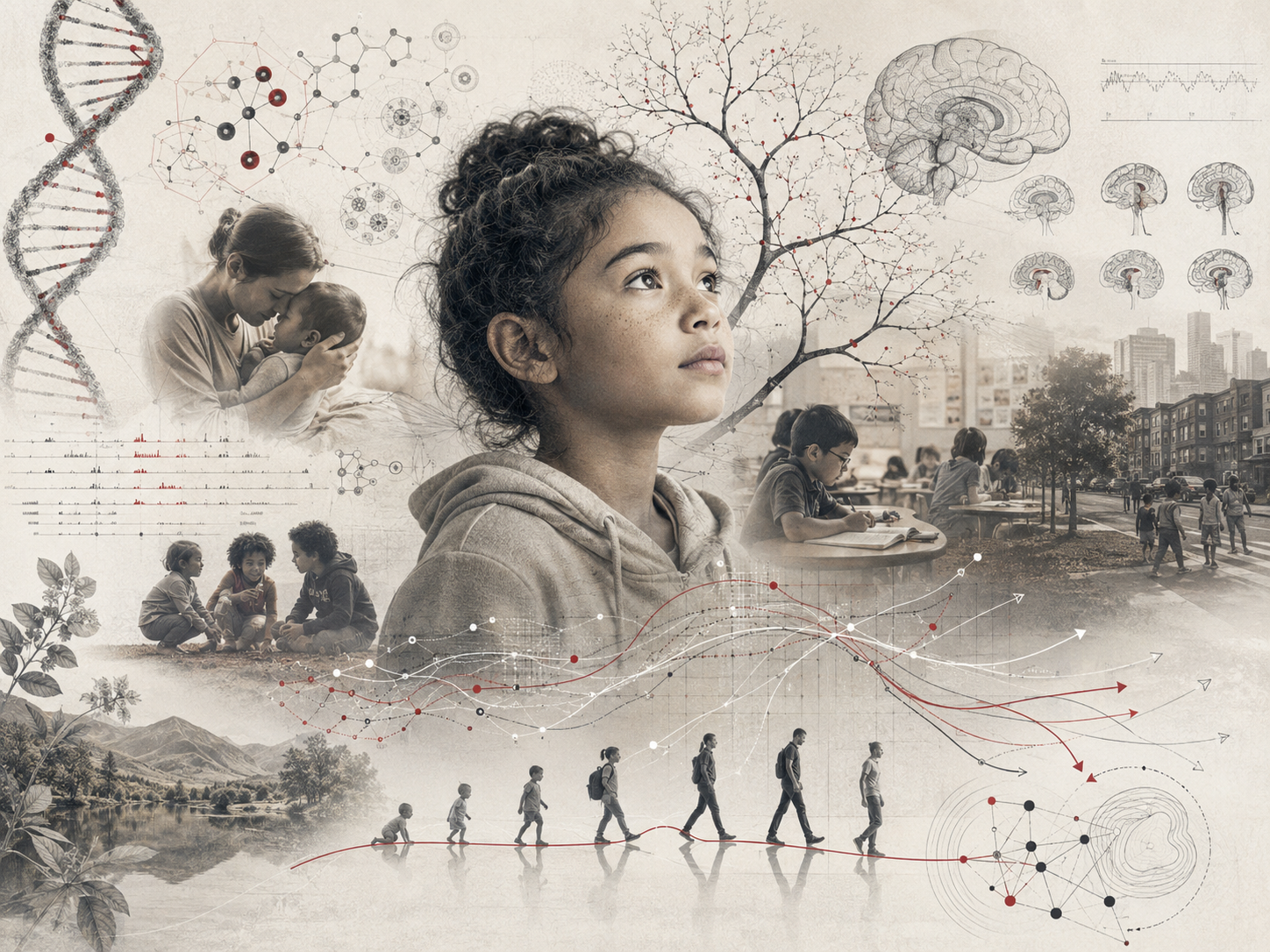
Official and research sources support this broader framing. NIEHS explains gene–environment interaction as the fact that subtle genetic differences can make people respond differently to the same environmental exposure. NIH and NCBI materials on child development describe how environmental influences can become biologically embedded during development. WHO’s work on determinants of health and early childhood development emphasizes that health and developmental outcomes arise through the combined effects of genetics, environment, relationships, and broader social conditions. Together, these sources point toward one of developmental science’s central claims: development is plastic, contingent, embodied, and shaped by the interplay of biology and lived environment over time.
Why This Topic Matters
This topic matters because developmental outcomes are often explained in reductionist ways. Struggle is attributed to “bad environments,” talent to “good genes,” resilience to character, vulnerability to biology, and recovery to willpower, as though these were discrete sources. Developmental science shows a more complex reality. People differ in biological sensitivity. Environments differ in support, risk, safety, nutrition, pollution, stress, learning opportunity, and care. The same experience can have different consequences depending on timing, physiology, prior exposure, social context, and available support.
This matters practically as well as theoretically. If development is plastic, then intervention, prevention, care, education, public health, and policy matter. Better nutrition, safer housing, responsive caregiving, educational opportunity, reduced toxic stress, cleaner environments, and stronger support systems are not superficial influences layered onto a predetermined developmental core. They are part of what development becomes. A child’s developmental pathway can be shaped by whether the surrounding world provides conditions that support healthy expression, recovery, regulation, learning, and participation.
Plasticity also matters because it resists fatalism. Genetic difference does not mean fixed destiny. Early adversity does not mean life is over. Biological sensitivity does not mean inevitable vulnerability. But plasticity should not be romanticized either. Developmental openness means that harmful environments can become biologically and psychologically consequential. A child’s capacity to adapt to adversity can preserve functioning in the short term while carrying later costs. Plasticity is powerful because development responds; it is ethically urgent because development responds to both support and harm.
For developmental psychology, genes, environment, and plasticity are therefore not separate topics. They are part of the same question: how does a human life become organized through biological inheritance, lived conditions, developmental timing, and unequal access to support?
What Genes, Environment, and Plasticity Mean
Genes are not blueprints in the crude sense of fixed instructions that simply unfold over time. They are part of a developmental system in which gene expression, physiological regulation, cellular processes, neural organization, and organismal growth occur in relation to internal and external conditions. A gene does not produce a trait in isolation. It functions within molecular, bodily, relational, ecological, and historical contexts.
Environment is also broader than immediate surroundings. It includes caregiving, family stress, peer life, housing, pollution, nutrition, education, language exposure, sleep, health care, neighborhood safety, discrimination, cultural practice, institutional support, and public policy. Environment is not merely the physical space around the child. It is the total ecology of conditions through which development becomes possible, constrained, supported, or burdened.
Developmental plasticity refers to the capacity of development to take different forms under different conditions. Plasticity allows organisms to adjust to available cues, supports, constraints, and risks. It helps explain why people with similar starting points may diverge, why early experience can matter deeply, why later intervention can still help, and why environments are not external to development but part of the developmental process itself.
These three concepts belong together. Genes provide inherited biological variation and regulatory potential. Environments provide the conditions under which that potential is expressed, redirected, suppressed, burdened, or supported. Plasticity is the responsiveness that links them over time. Human development is not genes plus environment as separate ingredients. It is a dynamic process in which biology and experience become mutually organized.
Beyond the Nature Versus Nurture Debate
The old nature-versus-nurture debate persists because it offers a simple way to think about difference: one either inherits a trait or acquires it. But developmental science has repeatedly shown that this framing is too crude. Development is not the sum of separate hereditary and environmental percentages. It is a process in which biological dispositions and environments continuously interact.
Nature and nurture are not independent causal streams that meet only at the level of outcome. They are entangled throughout development. Gene expression depends on cellular and bodily conditions. Stress physiology responds to experience. Neural pathways are shaped by use, input, expectation, and regulation. Caregiving affects stress response, language exposure affects learning, nutrition affects growth, toxins affect physiology, and institutions shape the environments that children repeatedly encounter.
Moving beyond the debate does not mean heredity is unimportant. It means heredity is developmental. Genes matter through expression, regulation, interaction, and timing. Likewise, environments matter not as abstract forces but as concrete developmental conditions that can support, stress, redirect, or constrain growth. The better question is not whether development comes from genes or environment, but how different developmental systems generate different pathways under different conditions.
The nature-versus-nurture frame also tends to obscure inequality. If outcomes are attributed mainly to nature, social responsibility disappears. If outcomes are attributed only to nurture, families and communities may be blamed for conditions produced by broader systems. A developmental-systems view avoids both errors. It asks how biological sensitivity, social conditions, family life, institutions, and policy together shape developmental possibility.
Genes as Developmental Potential, Not Fixed Destiny
Genes matter, but not as destiny. They contribute to developmental potential, sensitivity, biological organization, temperament, growth patterns, stress response, disease vulnerability, cognitive variation, and many other features of human life. Yet genes operate through regulatory systems that are responsive to context. A genetic influence is not the same thing as an unchangeable outcome.
This distinction matters because public discussion often treats genetics as though it were final explanation. If something is “genetic,” people may assume it is fixed, natural, private, or beyond intervention. Developmental thinking complicates that assumption. Genetic variation can influence sensitivity to stress, learning, nutrition, toxins, or caregiving. But the developmental meaning of that variation depends on the environments in which it is expressed.
For example, a child may be biologically more reactive to stress. In a chaotic or threatening environment, that reactivity may become a vulnerability. In a stable, responsive, well-supported environment, the same sensitivity may be associated with heightened responsiveness to support. A biologically sensitive organism is not simply weak. Sensitivity can amplify both risk and support, depending on context.
Genes therefore belong in developmental psychology, but not as a replacement for environment. They are part of the living system through which environment is registered. The question is not whether genes explain development. The question is how genes participate in developmental processes that are always embodied, contextual, and temporal.
Environment as Developmental Condition
Environment is often treated as background, but developmentally it is constitutive. The conditions a child repeatedly encounters help organize physiology, attention, expectation, language, learning, stress response, self-regulation, and social understanding. Environments do not simply act after development has already happened. They help produce developmental pathways.
Caregiving environments shape early regulation, attachment, language, sleep, exploration, and safety. School environments shape learning, identity, peer belonging, institutional trust, and future orientation. Neighborhood environments shape exposure to safety, pollution, green space, violence, transportation, food access, and social support. Health systems shape diagnosis, prevention, treatment, and family burden. Public policy shapes housing, leave, childcare, nutrition, health care, and educational opportunity.
Because environments are layered, development cannot be reduced to one immediate setting. A caregiver may be responsive but economically strained. A school may be caring but under-resourced. A child may be biologically sensitive and supported at home but exposed to pollution, discrimination, or neighborhood instability. Developmental psychology needs ecological thinking because children grow through overlapping systems.
Environment also includes cultural meaning. Children develop within worlds that interpret behavior, emotion, ability, gender, disability, achievement, family obligation, independence, interdependence, and maturity. These meanings shape what adults notice, what institutions reward, what peers admire, and what children learn to expect of themselves. Environment is not only material. It is relational, symbolic, institutional, and historical.
Gene–Environment Interaction
Gene–environment interaction refers to cases in which the effect of an environmental exposure depends on genotype or biological sensitivity, or the effect of genotype depends on environment. In developmental psychology, this means that the same adversity, enrichment, toxin, caregiving pattern, school experience, or social stressor may not have identical effects across individuals.
The concept is important because it shifts developmental explanation away from simple main effects. It is not enough to say that stress harms development or that support helps development. The magnitude, timing, and form of those effects may vary depending on biological sensitivity, prior development, age, family context, and broader ecology. Some people may be more susceptible to harmful environments. Some may also be more responsive to supportive environments.
Gene–environment interaction also clarifies why averages can mislead. A study may find a modest average effect of an exposure, but that average may conceal stronger effects for some groups and weaker effects for others. Developmental pathways often differ not because one variable matters and another does not, but because variables matter together. Biological sensitivity and environmental condition form a joint system.
This idea should be used carefully. It does not mean that genes determine who deserves support, nor does it mean that some children are biologically doomed. It means that development is specific: different organisms may register the same world differently, and the same organism may develop differently under different conditions. The ethical conclusion is not selective investment, but better environments and more responsive support for varied developmental profiles.
Gene–Environment Correlation
Gene–environment correlation is related to, but distinct from, gene–environment interaction. It refers to the fact that people’s genetic tendencies can become associated with the environments they encounter. This can happen in several ways. Parents provide both genes and environments. Children may evoke responses from others based on temperament or behavior. As children grow older, they may also select environments that fit their interests, abilities, or sensitivities.
This matters because environments are not always randomly assigned. A child who is highly active may receive different adult responses than a quieter child. A child who loves reading may seek book-rich settings. A musically inclined child may be placed in lessons, which then further strengthens musical skill. A child who struggles with regulation may evoke harsher discipline in one environment and more supportive scaffolding in another. Biological tendencies and environments can become coupled over time.
Gene–environment correlation complicates causal interpretation. When children differ in outcomes, it may not be because genes and environment contributed separately. Their developmental histories may reflect reciprocal processes in which inherited tendencies shaped environmental exposure, and environmental exposure shaped the expression and development of those tendencies.
A developmental-systems view treats this reciprocity as normal. Children are not passive recipients of environment. They participate in shaping the responses they receive, even though that participation is always constrained by age, power, family systems, institutions, and social structure. Development is interactive because people and environments change each other.
Biological Embedding and Development
Biological embedding refers to the process by which social and environmental conditions become incorporated into the biology of the developing organism. This is one of the clearest ways developmental science shows that social life becomes biological over time. Experiences do not merely happen to a child and then disappear. Repeated exposure can shape stress physiology, immune functioning, neural development, metabolic regulation, sleep, attention, and emotional regulation.
Biological embedding helps bridge social determinants and biology. Poverty, chronic stress, environmental toxin exposure, caregiving quality, food insecurity, discrimination, neighborhood violence, and educational deprivation are not merely social categories. They can become developmental conditions that affect physiological organization. Conversely, safety, nurturing care, predictable routines, nutrition, clean environments, and stable support can help organize healthier developmental pathways.
This does not mean that every experience leaves a permanent mark or that early adversity is irreversible. Biological embedding is a process, not a sentence. Development remains dynamic, and later environments can still matter. But the concept makes clear why early and repeated conditions deserve attention. Developmental systems carry history forward.
Biological embedding also changes how we think about responsibility. If social conditions become biological, then public health, housing, nutrition, education, and family support are not separate from development. They are part of the biological conditions under which development unfolds.
Epigenetics, Regulation, and the Biology of Experience
Epigenetics is often used too loosely in public discussion, but it is important when handled carefully. In developmental terms, epigenetic processes refer to mechanisms that help regulate gene expression without changing the DNA sequence itself. They are part of how cells and organisms respond to developmental conditions. Some environmental influences may affect regulatory processes in ways that shape physiology and behavior over time.
The value of epigenetic thinking is not that it provides a simple explanation for every developmental outcome. It does not. The value is that it shows why the boundary between biology and experience is porous. Experience can influence biological regulation, and biological regulation can influence how later experience is registered. Development is not an exchange between a fixed genome and an external world; it is a process in which regulatory systems are continually organized through life.
Epigenetic claims should be made cautiously. Not every association between experience and development is epigenetic. Not every epigenetic change has clear behavioral meaning. Not every early mark is permanent. Overstating epigenetics can create a new determinism, as though early experience writes an irreversible biological script. A better developmental account treats epigenetic regulation as one important mechanism among many: neural, hormonal, immune, behavioral, relational, cultural, and institutional.
The deeper point is that experience becomes embodied through multiple pathways. Stress, care, nutrition, sleep, toxins, activity, learning, and social safety all affect the developing organism. Epigenetics is one language for understanding that embodiment, but the broader developmental insight is relational: biology is lived biology.
Developmental Plasticity
Developmental plasticity is the capacity of development to take different forms under different conditions. Plasticity is what allows development to be responsive rather than mechanically fixed. It helps explain why support can redirect trajectories, why adversity can become embodied, why timing matters, why learning remains possible, and why social conditions are developmentally consequential.
Plasticity has two important implications. First, it helps explain divergence. People with similar genetic or early developmental starting points may grow differently under different conditions. Second, it makes intervention meaningful. If development were rigid, support would matter much less. Because development is plastic, care, therapy, education, nutrition, stress reduction, environmental cleanup, disability accommodation, and social policy can alter trajectories.
Plasticity, however, is not infinite flexibility. Organisms have constraints. Developmental windows differ by domain. Some early conditions are difficult to undo. Some harms accumulate. Some supports arrive too late to fully replace what was missed. Plasticity means conditional openness, not unlimited reversibility.
Plasticity is also morally ambivalent. The same developmental responsiveness that allows support to help also allows harm to become consequential. A child can adapt to chronic threat by becoming vigilant, emotionally guarded, or quick to respond defensively. Such adaptation may be functional in one environment and costly in another. Developmental plasticity therefore does not always produce well-being. It produces responsiveness to conditions, including damaging ones.
Differential Susceptibility and Biological Sensitivity
Differential susceptibility and biological sensitivity frameworks deepen the idea of gene–environment interaction. They suggest that some individuals may be more responsive to environmental conditions in both directions: more vulnerable under adversity and more likely to benefit under supportive conditions. This is different from seeing sensitivity only as risk.
This matters because sensitive children are often misunderstood. A child who reacts strongly to stress may be labeled fragile, difficult, dramatic, or poorly regulated. But high sensitivity can also mean strong responsiveness to structure, warmth, predictability, and support. Under one environment, sensitivity may amplify stress; under another, it may amplify growth.
Biological sensitivity may appear through temperament, physiological reactivity, sensory processing, emotional intensity, stress response, or attention to environmental cues. These are not simple virtues or defects. They are developmental profiles that interact with context. A highly reactive child in a punitive environment may develop differently from a highly reactive child in a responsive and structured one.
The ethical implication is important. Differential susceptibility should not be used to ration care only to those deemed most sensitive. Instead, it strengthens the case for environments that are responsive enough to support varied developmental profiles. Because people differ in susceptibility, one-size-fits-all environments will predictably fail some children more than others.
Sensitive Periods, Timing, and Experience
Plasticity is not distributed evenly across time. Some developmental periods are more sensitive than others to particular inputs and constraints. Early childhood is often especially consequential for language, attachment, stress regulation, nutrition, sensory development, and foundational learning. Adolescence is also a period of major plasticity, especially in identity, social learning, reward sensitivity, peer influence, autonomy, and future orientation.
Sensitive-period thinking helps explain why timing matters. The same experience can have different developmental consequences depending on when it occurs. Language exposure in early childhood does not have the same developmental meaning as language exposure later. Chronic stress during early regulatory development may shape physiology differently from stress encountered after stronger coping systems have formed. Support during a transition may be especially powerful because the system is already reorganizing.
At the same time, sensitive periods should not be turned into fatalistic deadlines. The fact that some periods are especially open does not mean later development is closed. Later intervention, learning, therapy, education, relationship repair, disability accommodation, and environmental redesign can still matter. Developmental timing changes probabilities and pathways; it does not end the possibility of change.
A mature developmental psychology holds both truths together: early experience matters profoundly, and later life remains developmentally active. The point of sensitive-period thinking is not despair after missed opportunities. It is better timing, better prevention, and more realistic forms of support across the life course.
Stress, Adversity, and Protection
Adversity is one of the clearest areas where genes, environment, and plasticity converge. Stressful environments do not affect everyone identically, and protective conditions can buffer harm. A biologically sensitive child may be more affected by chronic threat, but also more responsive to stable support. A child exposed to adversity may develop protective adaptations that make sense in context, even if those adaptations become costly later.
Stress is not developmentally uniform. Brief, manageable stress in the presence of support can be part of learning and adaptation. Severe, chronic, unpredictable, or unsupported stress can become toxic to development. The difference often lies not only in the stressor itself, but in duration, intensity, timing, interpretation, and the presence or absence of protective relationships.
Protective environments matter because they alter how stress is processed. Responsive caregiving, safe schools, predictable routines, peer belonging, mental-health support, community resources, and material security can buffer stress and help children recover. Protection does not erase adversity, but it can change its developmental meaning. A child who is supported through difficulty may learn that distress can be survived and repaired. A child who is alone in distress may learn vigilance, mistrust, or withdrawal.
Plasticity should therefore not be used to celebrate adversity. The fact that people can adapt does not mean harmful conditions are acceptable. The ethical lesson is the opposite: because development is plastic, societies are responsible for reducing preventable harm and strengthening protective systems.
Nutrition, Toxins, and Material Conditions
Developmental plasticity is not only psychological or relational. It is also material. Nutrition, sleep, physical safety, environmental toxins, housing quality, air pollution, lead exposure, prenatal conditions, infectious disease, and access to health care all shape developmental pathways. The organism develops through bodies, and bodies develop under material conditions.
Nutrition matters because growth, brain development, immune function, energy regulation, and learning all depend on biological resources. Food insecurity can affect attention, mood, sleep, stress, and school performance. Malnutrition or micronutrient deficiency can shape development in ways that are not reducible to motivation or parenting. Material deprivation becomes developmental because the body must develop under constraint.
Toxins and pollution also demonstrate why environment cannot be treated as abstract. Lead exposure, poor air quality, unsafe water, endocrine disruptors, and other environmental hazards can affect physiology and development. These exposures are not evenly distributed. They are often concentrated by poverty, housing inequality, environmental injustice, weak regulation, and unequal political power.
Material conditions also interact with social conditions. A family may provide warmth and structure while still living in unsafe housing or polluted neighborhoods. A school may support learning while students face hunger or sleep disruption. Developmental science should therefore avoid moralizing outcomes that are partly produced by material environments. Genes and plasticity operate in bodies that need protection, nourishment, and safe conditions.
Learning, Brain Development, and Plasticity
Brain development is one of the most visible domains of plasticity, but it is also one of the easiest to oversimplify. The developing brain is responsive to experience, but that responsiveness does not mean experience writes directly onto the brain in a simple one-to-one way. Neural development is shaped by genetic programs, spontaneous activity, sensory input, caregiving, learning, sleep, stress, nutrition, and repeated use.
Learning changes the organism. Language, reading, music, mathematics, movement, social interaction, emotional regulation, and skilled practice all involve plastic processes. Children become more capable partly because they encounter structured opportunities to practice. Schools, families, peers, and cultural tools provide the repeated activities through which neural and behavioral systems are strengthened.
Experience-expectant and experience-dependent processes are useful distinctions. Some developmental systems expect certain broad inputs, such as sensory stimulation or social interaction, during particular windows. Other forms of learning depend on specific experiences, such as reading instruction, musical practice, or mathematical training. Both forms show how biological systems are prepared for experience without being fully determined before experience occurs.
Brain plasticity also continues beyond childhood, though its form changes. Adolescence, adulthood, and aging all involve learning, adaptation, compensation, and reorganization. The brain remains responsive, but not equally in every domain or at every time. Developmental psychology therefore needs a lifespan view of plasticity: early development is important, but learning and adaptation remain part of human life.
Plasticity Across the Life Course
Although plasticity is often associated with early development, it does not disappear later. People continue to learn, compensate, recover, reorganize, and adapt throughout life. The forms and degrees of plasticity vary by age, domain, health, experience, and context, but developmental change remains possible across the life course.
This matters because early-development research can be misunderstood as fatalism. Early childhood is important, but early childhood is not the whole story. Later relationships, education, therapy, work, community participation, health care, disability accommodation, and environmental change can continue to influence development. Adults can build new skills, revise identity, heal from trauma, change habits, and adapt to new circumstances.
Life-course plasticity also includes vulnerability. Later life can bring stress, illness, social loss, unemployment, caregiving burden, disability, or cognitive change. These conditions can redirect development as surely as support can. Plasticity across the life course therefore includes both opportunity and risk.
A lifespan developmental view asks how plasticity changes form. Early life may be especially open in some domains. Adolescence may be especially open to social and identity-related influences. Adulthood may involve plasticity through expertise, role change, relationship, and recovery. Aging may involve compensation, adaptation, and selective optimization. Plasticity is not one thing. It is a family of developmental capacities that unfold differently across time.
Inequality and the Distribution of Developmental Opportunity
Plasticity has a social meaning because developmental opportunity is unequally distributed. Some children encounter rich language, stable care, good nutrition, clean air, safe housing, responsive schools, medical care, and emotional support. Others encounter pollution, instability, food insecurity, violence, chronic stress, under-resourced schools, delayed diagnosis, and limited access to care. Developmental plasticity unfolds in this unequal landscape.
A developmental account that ignores inequality risks turning plasticity into private responsibility. If development can change, people may be told to change without being given the conditions that make healthy change possible. But plasticity is not simply an individual trait. It is also the degree to which environments provide conditions under which healthy developmental pathways can emerge.
Inequality also shapes biological embedding. Chronic stress, unsafe housing, environmental toxins, educational deprivation, and limited health care can become embodied. These conditions may be mistakenly interpreted as individual difference, family failure, or genetic limitation when they are partly products of unequal developmental environments.
The ethical implication is clear: if development is plastic, then unequal environments are not merely unfair in the present. They shape future developmental possibility. Policies that improve housing, reduce pollution, support caregivers, provide early care, strengthen schools, expand health care, and reduce poverty are developmental interventions. They alter the conditions through which genes and environments interact.
Policy, Care, and the Ethics of Plasticity
Plasticity turns developmental science into a public responsibility. If environments shape biological and psychological development, then developmental outcomes cannot be treated only as private family matters or individual achievements. Care systems, schools, housing policy, food systems, environmental regulation, disability services, mental-health care, and labor policy all help determine the conditions under which children and families develop.
This does not mean that policy replaces caregiving. It means caregiving happens under conditions that policy helps shape. A caregiver’s capacity to provide responsive care is affected by work schedules, income stability, health care, housing, social support, family leave, childcare, neighborhood safety, and access to services. Supporting development means supporting the caregivers and institutions that sustain development.
Plasticity also demands humility. Developmental science should not be used to overpromise simple solutions or to blame families for complex outcomes. A program may help, but not erase structural inequality. Early intervention may matter, but not make later support unnecessary. Biological sensitivity may shape response, but not justify deterministic prediction. Development is open, but not infinitely controllable.
The ethical use of plasticity is therefore preventive, supportive, and institutionally serious. It asks how societies can reduce harmful exposures, strengthen protective environments, and create conditions in which varied children can develop well. Plasticity makes care meaningful. It also makes neglect consequential.
An Analytical Framework for Genes, Environment, and Plasticity
A stylized developmental outcome \(D_{it}\) for individual \(i\) at time \(t\) can be written as a function of biological sensitivity, environmental exposure, their interaction, and residual variation:
D_{it} = \alpha_i + \beta G_i + \gamma E_{it} + \delta(G_i \times E_{it}) + \varepsilon_{it}
\]
Interpretation: Developmental outcomes depend on biological sensitivity \(G_i\), environmental exposure \(E_{it}\), and their interaction. The same exposure may have different effects across individuals because biological sensitivity differs.
To express plasticity and timing, the model can include a developmental timing term:
D_{it} = \alpha_i + \beta G_i + \gamma E_{it} + \theta T_{it} + \delta(G_i \times E_{it} \times T_{it}) + \varepsilon_{it}
\]
Interpretation: Timing \(T_{it}\) matters because the same experience may have different developmental effects depending on when it occurs. Sensitive periods can be represented as changes in the strength of exposure over time.
To model biological embedding more explicitly, an embedded biological state \(B_{it}\) can depend on prior exposure:
B_{it} = \rho B_{i,t-1} + \lambda E_{i,t-1} + \eta_i
\]
Interpretation: Biological state \(B_{it}\) carries part of the developmental history forward. Earlier environments can become incorporated into later physiological organization.
Development can then be modeled as a function of both current environment and embedded biological state:
D_{it} = \alpha_i + \beta B_{it} + \gamma E_{it} + \varepsilon_{it}
\]
Interpretation: Current development reflects both current conditions and accumulated biological organization shaped by earlier experience.
Because developmental opportunity is socially distributed, a multilevel form is often more realistic:
D_{ijt} = \alpha + u_j + \beta G_i + \gamma E_{ijt} + \delta(G_i \times E_{ijt}) + \varepsilon_{ijt}
\]
Interpretation: The term \(u_j\) captures shared neighborhood, school, clinic, household, or policy context. Plasticity unfolds in social ecologies rather than private isolation.
These equations are simplified, but they express the article’s central claim: development is not determined by genes alone or environment alone. It is produced through the dynamic relation among biological sensitivity, environmental condition, timing, accumulated embodiment, and unequal developmental opportunity.
R: Simulating Gene–Environment Interaction and Developmental Plasticity
The following R example simulates children across repeated waves with biological sensitivity, caregiving quality, environmental stress, early exposure, timing-sensitive exposure, biological embedding, and school context shaping developmental outcomes. The data are synthetic and intended for demonstration only.
# Simulating gene-environment interaction and developmental plasticity
# -------------------------------------------------------------------
# This synthetic example models development as a function of biological
# sensitivity, caregiving quality, environmental stress, timing-sensitive
# exposure, biological embedding, and school context across repeated waves.

suppressPackageStartupMessages({
  library(dplyr)
  library(lme4)
  library(ggplot2)
})

set.seed(2026)

n_children = 850
n_waves = 10
n_schools = 36

children = data.frame(
  child_id = 1:n_children,
  school_id = sample(1:n_schools, n_children, replace = TRUE),
  bio_sensitivity = rnorm(n_children, 0, 1),
  caregiving_quality = rnorm(n_children, 0, 1),
  environmental_stress = rnorm(n_children, 0, 1),
  nutritional_support = rnorm(n_children, 0, 0.8),
  early_exposure = rbinom(n_children, 1, 0.40),
  intervention_support = rbinom(n_children, 1, 0.35)
)

school_context = data.frame(
  school_id = 1:n_schools,
  school_support = rnorm(n_schools, 0, 0.6),
  neighborhood_safety = rnorm(n_schools, 0, 0.6),
  service_access = rnorm(n_schools, 0, 0.5)
)

panel_data = children |>
  slice(rep(1:n(), each = n_waves)) |>
  group_by(child_id) |>
  mutate(
    wave = 0:(n_waves - 1),
    timing_weight = exp(-0.30 * wave),
    current_care = rnorm(n_waves, mean = caregiving_quality, sd = 0.55),
    current_stress = rnorm(n_waves, mean = environmental_stress, sd = 0.60),
    current_nutrition = rnorm(n_waves, mean = nutritional_support, sd = 0.45)
  ) |>
  ungroup() |>
  left_join(school_context, by = "school_id") |>
  arrange(child_id, wave)

panel_data = panel_data |>
  group_by(child_id) |>
  mutate(
    embedded_stress = cumsum(current_stress * timing_weight) / (wave + 1),
    embedded_support = cumsum((current_care + current_nutrition + school_support) * timing_weight) / (wave + 1)
  ) |>
  ungroup()

panel_data = panel_data |>
  mutate(
    development_score =
      50 +
      0.55 * wave +
      0.90 * bio_sensitivity +
      1.15 * current_care -
      1.10 * current_stress +
      0.80 * current_nutrition +
      0.75 * school_support +
      0.65 * neighborhood_safety +
      0.60 * service_access +
      0.90 * early_exposure * timing_weight +
      0.85 * intervention_support +
      0.95 * bio_sensitivity * current_care -
      0.90 * bio_sensitivity * current_stress -
      0.70 * embedded_stress +
      0.60 * embedded_support +
      rnorm(n(), 0, 2.4)
  )

model = lmer(
  development_score ~ wave + bio_sensitivity + current_care +
    current_stress + current_nutrition + school_support +
    neighborhood_safety + service_access + early_exposure +
    timing_weight + embedded_stress + embedded_support +
    intervention_support + bio_sensitivity:current_care +
    bio_sensitivity:current_stress +
    (1 + wave | school_id/child_id),
  data = panel_data
)

summary(model)

trajectory_summary = panel_data |>
  group_by(wave, early_exposure) |>
  summarize(
    mean_development = mean(development_score),
    standard_error = sd(development_score) / sqrt(n()),
    .groups = "drop"
  ) |>
  mutate(
    lower = mean_development - 1.96 * standard_error,
    upper = mean_development + 1.96 * standard_error,
    group = ifelse(early_exposure == 1, "Early exposure", "No early exposure")
  )

ggplot(trajectory_summary, aes(x = wave, y = mean_development, linetype = group)) +
  geom_line(linewidth = 1) +
  geom_ribbon(aes(ymin = lower, ymax = upper, group = group), alpha = 0.12) +
  labs(
    title = "Simulated Gene-Environment Interaction and Developmental Plasticity",
    x = "Wave",
    y = "Average development score",
    linetype = "Group"
  ) +
  theme_minimal()

sensitivity_profiles = panel_data |>
  group_by(child_id) |>
  summarize(
    biological_sensitivity = mean(bio_sensitivity),
    average_care = mean(current_care),
    average_stress = mean(current_stress),
    average_embedded_stress = mean(embedded_stress),
    final_development = development_score[wave == max(wave)],
    .groups = "drop"
  ) |>
  mutate(
    profile = case_when(
      biological_sensitivity >= 0 & average_stress >= 0 ~ "higher sensitivity / higher stress",
      biological_sensitivity >= 0 & average_stress < 0 ~ "higher sensitivity / lower stress",
      biological_sensitivity < 0 & average_stress >= 0 ~ "lower sensitivity / higher stress",
      TRUE ~ "lower sensitivity / lower stress"
    )
  )

ggplot(sensitivity_profiles, aes(x = profile, y = final_development)) +
  geom_boxplot() +
  coord_flip() +
  labs(
    title = "Synthetic Final Development by Sensitivity and Stress Profile",
    x = "Profile",
    y = "Final development score"
  ) +
  theme_minimal()

# Analysts can extend this model by:
# 1. modeling explicit neighborhood or clinic clustering;
# 2. separating cognitive, emotional, social, and health outcomes;
# 3. varying sensitive-period timing by developmental domain;
# 4. simulating intervention timing and duration;
# 5. comparing biological embedding under high- and low-support conditions;
# 6. adding environmental toxin or nutrition shocks.
This R workflow treats genes, environment, and plasticity as a dynamic developmental system. It does not ask whether biology or environment “wins.” It asks how biological sensitivity, caregiving, stress, nutrition, timing, support, and institutional context shape trajectories together.
Python: Modeling Biological Sensitivity, Context, and Developmental Change
The following Python example simulates developmental change over time with biological sensitivity, caregiving quality, stress exposure, nutrition, timing-sensitive early experience, embedded stress, school context, and intervention support. It includes prior developmental state to represent path dependence.
# Modeling biological sensitivity, context, and developmental change
# ------------------------------------------------------------------
# This synthetic example models development as a dynamic relation among
# biological sensitivity, caregiving quality, environmental stress,
# nutrition, timing-sensitive early experience, biological embedding,
# school context, intervention support, and prior developmental state.

from __future__ import annotations

import numpy as np
import pandas as pd
import statsmodels.formula.api as smf
import matplotlib.pyplot as plt

np.random.seed(2026)

n_children = 900
n_periods = 10
n_schools = 38

children = pd.DataFrame({
    "child_id": np.arange(1, n_children + 1),
    "school_id": np.random.choice(np.arange(1, n_schools + 1), size=n_children),
    "bio_sensitivity": np.random.normal(0, 1, n_children),
    "caregiving_quality": np.random.normal(0, 1, n_children),
    "environmental_stress": np.random.normal(0, 1, n_children),
    "nutritional_support": np.random.normal(0, 0.8, n_children),
    "early_exposure": np.random.binomial(1, 0.40, n_children),
    "intervention_support": np.random.binomial(1, 0.35, n_children),
})

school_context = pd.DataFrame({
    "school_id": np.arange(1, n_schools + 1),
    "school_support": np.random.normal(0, 0.6, n_schools),
    "neighborhood_safety": np.random.normal(0, 0.6, n_schools),
    "service_access": np.random.normal(0, 0.5, n_schools),
})

panel = children.loc[children.index.repeat(n_periods)].copy()
panel["time"] = np.tile(np.arange(n_periods), n_children)
panel["timing_weight"] = np.exp(-0.30 * panel["time"])

panel = panel.merge(school_context, on="school_id", how="left")

panel["current_care"] = np.random.normal(panel["caregiving_quality"], 0.60, len(panel))
panel["current_stress"] = np.random.normal(panel["environmental_stress"], 0.65, len(panel))
panel["current_nutrition"] = np.random.normal(panel["nutritional_support"], 0.50, len(panel))

panel = panel.sort_values(["child_id", "time"]).reset_index(drop=True)

panel["weighted_stress"] = panel["current_stress"] * panel["timing_weight"]
panel["weighted_support"] = (
    panel["current_care"] +
    panel["current_nutrition"] +
    panel["school_support"]
) * panel["timing_weight"]

panel["embedded_stress"] = (
    panel.groupby("child_id")["weighted_stress"].cumsum() /
    (panel["time"] + 1)
)

panel["embedded_support"] = (
    panel.groupby("child_id")["weighted_support"].cumsum() /
    (panel["time"] + 1)
)

panel["development_score"] = np.nan

for child_id in panel["child_id"].unique():
    subset = panel.loc[panel["child_id"] == child_id].copy()
    previous_score = 50 + np.random.normal(0, 3)

    for idx in subset.index:
        bio = panel.at[idx, "bio_sensitivity"]
        care = panel.at[idx, "current_care"]
        stress = panel.at[idx, "current_stress"]
        nutrition = panel.at[idx, "current_nutrition"]
        early = panel.at[idx, "early_exposure"]
        timing = panel.at[idx, "timing_weight"]
        school = panel.at[idx, "school_support"]
        safety = panel.at[idx, "neighborhood_safety"]
        services = panel.at[idx, "service_access"]
        embedded_stress = panel.at[idx, "embedded_stress"]
        embedded_support = panel.at[idx, "embedded_support"]
        intervention = panel.at[idx, "intervention_support"]
        time = panel.at[idx, "time"]

        current_score = (
            0.70 * previous_score
            + 0.22 * time
            + 0.90 * bio
            + 1.10 * care
            - 1.05 * stress
            + 0.80 * nutrition
            + 0.75 * school
            + 0.65 * safety
            + 0.60 * services
            + 0.85 * early * timing
            + 0.85 * intervention
            + 0.95 * bio * care
            - 0.90 * bio * stress
            - 0.70 * embedded_stress
            + 0.60 * embedded_support
            + np.random.normal(0, 2.3)
        )

        panel.at[idx, "development_score"] = current_score
        previous_score = current_score

panel["lag_score"] = panel.groupby("child_id")["development_score"].shift(1)
regression_data = panel.dropna(subset=["lag_score"]).copy()

model = smf.ols(
    formula="""
    development_score ~ lag_score + time + bio_sensitivity +
    current_care + current_stress + current_nutrition +
    school_support + neighborhood_safety + service_access +
    early_exposure + timing_weight + embedded_stress +
    embedded_support + intervention_support +
    bio_sensitivity:current_care + bio_sensitivity:current_stress
    """,
    data=regression_data,
).fit(cov_type="HC3")

print(model.summary())

trajectory = panel.groupby(["time", "early_exposure"], as_index=False).agg(
    average_development=("development_score", "mean"),
    standard_error=("development_score", lambda x: x.std() / np.sqrt(len(x))),
)

trajectory["lower"] = trajectory["average_development"] - 1.96 * trajectory["standard_error"]
trajectory["upper"] = trajectory["average_development"] + 1.96 * trajectory["standard_error"]
trajectory["group"] = trajectory["early_exposure"].map({
    0: "No early exposure",
    1: "Early exposure",
})

plt.figure(figsize=(8, 5))
for group_name, subset in trajectory.groupby("group"):
    plt.plot(subset["time"], subset["average_development"], marker="o", label=group_name)

plt.xlabel("Time")
plt.ylabel("Average development score")
plt.title("Simulated Genes, Environment, and Developmental Plasticity")
plt.legend()
plt.tight_layout()
plt.show()

profile_summary = panel.groupby("child_id", as_index=False).agg(
    biological_sensitivity=("bio_sensitivity", "mean"),
    average_care=("current_care", "mean"),
    average_stress=("current_stress", "mean"),
    average_embedded_stress=("embedded_stress", "mean"),
    final_development=("development_score", "last"),
)

profile_summary["sensitivity_stress_profile"] = np.select(
    [
        (profile_summary["biological_sensitivity"] >= 0) & (profile_summary["average_stress"] >= 0),
        (profile_summary["biological_sensitivity"] >= 0) & (profile_summary["average_stress"] < 0),
        (profile_summary["biological_sensitivity"] < 0) & (profile_summary["average_stress"] >= 0),
    ],
    [
        "higher sensitivity / higher stress",
        "higher sensitivity / lower stress",
        "lower sensitivity / higher stress",
    ],
    default="lower sensitivity / lower stress",
)

condition_summary = profile_summary.groupby(
    "sensitivity_stress_profile",
    as_index=False,
).agg(
    children=("child_id", "count"),
    average_final_development=("final_development", "mean"),
    average_embedded_stress=("average_embedded_stress", "mean"),
)

print(condition_summary)

# Analysts can extend this framework by:
# 1. introducing explicit neighborhood, school, or clinic random effects;
# 2. modeling epigenetic-like embedded state variables more directly;
# 3. separating cognitive, emotional, social, and health outcomes;
# 4. adding intervention timing and treatment duration;
# 5. comparing different sensitive-period assumptions;
# 6. adding environmental toxin, nutrition, or housing shocks.
The Python workflow makes the developmental claim explicit: biological sensitivity, care, stress, nutrition, timing, institutional support, and accumulated embodiment interact over time. It is a synthetic teaching scaffold, not a clinical, genetic, or policy prediction tool.
GitHub Repository
Complete Code Repository
Access the full companion repository for this article, including reproducible analysis materials and multi-language code workflows for gene–environment interaction, biological sensitivity, developmental timing, biological embedding, stress exposure, caregiving quality, school context, nutrition, intervention support, and developmental plasticity over time.
Conclusion
Genes, environment, and developmental plasticity belong together because development is not fixed in DNA nor written wholly by experience after the fact. It emerges through the coaction of biological sensitivity, environmental condition, developmental timing, accumulated embodiment, and the organism’s capacity to change under those conditions. Genes matter, but they matter developmentally. Environments matter, but they matter through bodies, relationships, institutions, and time.
The strongest developmental psychology therefore rejects both crude genetic determinism and simplistic environmentalism. A human life is shaped by biology, but biology is developmental. It is shaped by environment, but environment becomes internal to development through experience, embodiment, learning, stress, care, and social organization. Developmental plasticity is the concept that holds these truths together: human development is neither fixed fate nor unlimited freedom, but conditional openness within biological, relational, and social worlds.
This is why plasticity has ethical force. If development responds to conditions, then the conditions matter. Caregiving, nutrition, housing, schooling, environmental protection, health care, disability access, and poverty reduction are not only social goods. They are developmental conditions. To understand genes, environment, and plasticity seriously is to understand that human growth is a shared biological and social responsibility.
Related Articles
- What Is Developmental Psychology?
- Nature, Nurture, and the Developmental Question
- Developmental Systems Theory and the Ecology of Human Growth
- Brain Development, Plasticity, and the Developing Nervous System
- Critical Periods, Sensitive Periods, and the Timing of Development
- Prenatal Development and the Earliest Foundations of Life
- Parenting, Family Systems, and Human Development
- Trauma, Adversity, and the Life Course
- Development, Inequality, and the Life Course
- Developmental Psychology knowledge series
Further Reading
- Allen, L.R. and Kelly, B.B. (eds.) (2015) The Interaction of Biology and Environment. Washington, DC: National Academies Press. Available at: https://www.ncbi.nlm.nih.gov/books/NBK310546/.
- Boyce, W.T. (2016) ‘Differential susceptibility of the developing brain to contextual adversity and stress’, Neuropsychopharmacology, 41, pp. 142–162. Available at: https://doi.org/10.1038/npp.2015.294.
- Ellis, B.J. and Boyce, W.T. (2008) ‘Biological sensitivity to context’, Current Directions in Psychological Science, 17(3), pp. 183–187. Available at: https://doi.org/10.1111/j.1467-8721.2008.00571.x.
- Fandakova, Y. and Hartley, C.A. (2020) ‘Mechanisms of learning and plasticity in childhood and adolescence’, Developmental Cognitive Neuroscience, 42, 100764. Available at: https://pmc.ncbi.nlm.nih.gov/articles/PMC7013153/.
- Hochberg, Z. et al. (2011) ‘Developmental plasticity in child growth and maturation’, Frontiers in Endocrinology, 2, 41. Available at: https://pmc.ncbi.nlm.nih.gov/articles/PMC3364458/.
- Lea, A.J. et al. (2018) ‘Developmental plasticity: Bridging research in evolution and human health’, Evolution, Medicine, and Public Health, 2018(1), pp. 162–175. Available at: https://pmc.ncbi.nlm.nih.gov/articles/PMC5798083/.
- Michels, K.B. (2018) ‘Developmental plasticity: Friend or foe?’, Evolution, Medicine, and Public Health, 2018(1), pp. 161–161. Available at: https://pmc.ncbi.nlm.nih.gov/articles/PMC5798073/.
- National Institute of Environmental Health Sciences (n.d.) Gene and Environment Interaction. Available at: https://www.niehs.nih.gov/health/topics/science/gene-env.
- Shonkoff, J.P., Boyce, W.T. and McEwen, B.S. (2009) ‘Neuroscience, molecular biology, and the childhood roots of health disparities’, JAMA, 301(21), pp. 2252–2259. Available at: https://doi.org/10.1001/jama.2009.754.
- World Health Organization (2007) Early Child Development: A Powerful Equalizer. Available at: https://iris.who.int/handle/10665/69729.
- World Health Organization (2024) Determinants of Health. Available at: https://www.who.int/news-room/questions-and-answers/item/determinants-of-health.
References
- Allen, L.R. and Kelly, B.B. (eds.) (2015) The Interaction of Biology and Environment. Washington, DC: National Academies Press. Available at: https://www.ncbi.nlm.nih.gov/books/NBK310546/.
- American Psychological Association (n.d.) Developmental Psychology. Available at: https://www.apa.org/education-career/guide/subfields/developmental.
- American Psychological Association (n.d.) Developmental Psychology. Available at: https://www.apa.org/pubs/journals/dev.
- Belsky, J. and Pluess, M. (2009) ‘Beyond diathesis stress: Differential susceptibility to environmental influences’, Psychological Bulletin, 135(6), pp. 885–908. Available at: https://doi.org/10.1037/a0017376.
- Boyce, W.T. (2016) ‘Differential susceptibility of the developing brain to contextual adversity and stress’, Neuropsychopharmacology, 41, pp. 142–162. Available at: https://doi.org/10.1038/npp.2015.294.
- Ellis, B.J. and Boyce, W.T. (2008) ‘Biological sensitivity to context’, Current Directions in Psychological Science, 17(3), pp. 183–187. Available at: https://doi.org/10.1111/j.1467-8721.2008.00571.x.
- Fandakova, Y. and Hartley, C.A. (2020) ‘Mechanisms of learning and plasticity in childhood and adolescence’, Developmental Cognitive Neuroscience, 42, 100764. Available at: https://pmc.ncbi.nlm.nih.gov/articles/PMC7013153/.
- Hochberg, Z. et al. (2011) ‘Developmental plasticity in child growth and maturation’, Frontiers in Endocrinology, 2, 41. Available at: https://pmc.ncbi.nlm.nih.gov/articles/PMC3364458/.
- Lea, A.J. et al. (2018) ‘Developmental plasticity: Bridging research in evolution and human health’, Evolution, Medicine, and Public Health, 2018(1), pp. 162–175. Available at: https://pmc.ncbi.nlm.nih.gov/articles/PMC5798083/.
- Michels, K.B. (2018) ‘Developmental plasticity: Friend or foe?’, Evolution, Medicine, and Public Health, 2018(1), pp. 161–161. Available at: https://pmc.ncbi.nlm.nih.gov/articles/PMC5798073/.
- National Institute of Environmental Health Sciences (n.d.) Gene and Environment Interaction. Available at: https://www.niehs.nih.gov/health/topics/science/gene-env.
- Puderbaugh, M. and Emmady, P.D. (2023) Neuroplasticity. Treasure Island, FL: StatPearls Publishing. Available at: https://www.ncbi.nlm.nih.gov/books/NBK557811/.
- Shonkoff, J.P., Boyce, W.T. and McEwen, B.S. (2009) ‘Neuroscience, molecular biology, and the childhood roots of health disparities’, JAMA, 301(21), pp. 2252–2259. Available at: https://doi.org/10.1001/jama.2009.754.
- World Health Organization (2007) Early Child Development: A Powerful Equalizer. Geneva: World Health Organization. Available at: https://iris.who.int/handle/10665/69729.
- World Health Organization (2021) Investing in Our Future: A Comprehensive Agenda for the Health and Well-being of Children and Adolescents. Available at: https://iris.who.int/handle/10665/350239.
- World Health Organization (2024) Determinants of Health. Available at: https://www.who.int/news-room/questions-and-answers/item/determinants-of-health.
- Wright, R.O. and Christiani, D.C. (2010) ‘Gene-environment interaction and children’s health and development’, Current Opinion in Pediatrics, 22(2), pp. 197–201. Available at: https://pubmed.ncbi.nlm.nih.gov/20090521/.