
Last Updated May 21, 2026
Adult development is not the end of development but one of its most complex phases: a long psychological process through which human beings revise identity, work, intimacy, responsibility, embodiment, meaning, loss, adaptation, and self-understanding across the life stages of adulthood. Developmental psychology is often publicly associated with childhood and adolescence, as though adulthood were merely the stable aftermath of earlier growth. But adult life is not developmental stasis. It includes profound transitions in role, body, relationship, cognition, vocation, family, health, time perspective, and mortality awareness. Adulthood is therefore not simply what happens after development. It is development under conditions of accumulated history, institutional demand, biological change, social obligation, and growing confrontation with finitude.
A serious account of adult development must move beyond simplistic age brackets and productivity myths. Young adulthood, midlife, and later adulthood are useful terms, but they should not be treated as fixed scripts that every life must follow. Adults do not all marry, parent, work, retire, care, age, or find meaning in the same order. Yet adulthood does bring recurring developmental pressures: to form commitments, sustain relationships, build or survive institutions, manage work and care, inhabit changing bodies, revise identity, and make meaning from irreversible choices. Adult development is therefore best understood as a changing relation among person, body, role, institution, history, and time.
Main Library
Publications
Article Map
Developmental Psychology
Related Topic
Cognitive Psychology
Related Topic
Positive Psychology
Related Topic
Risk & Resilience
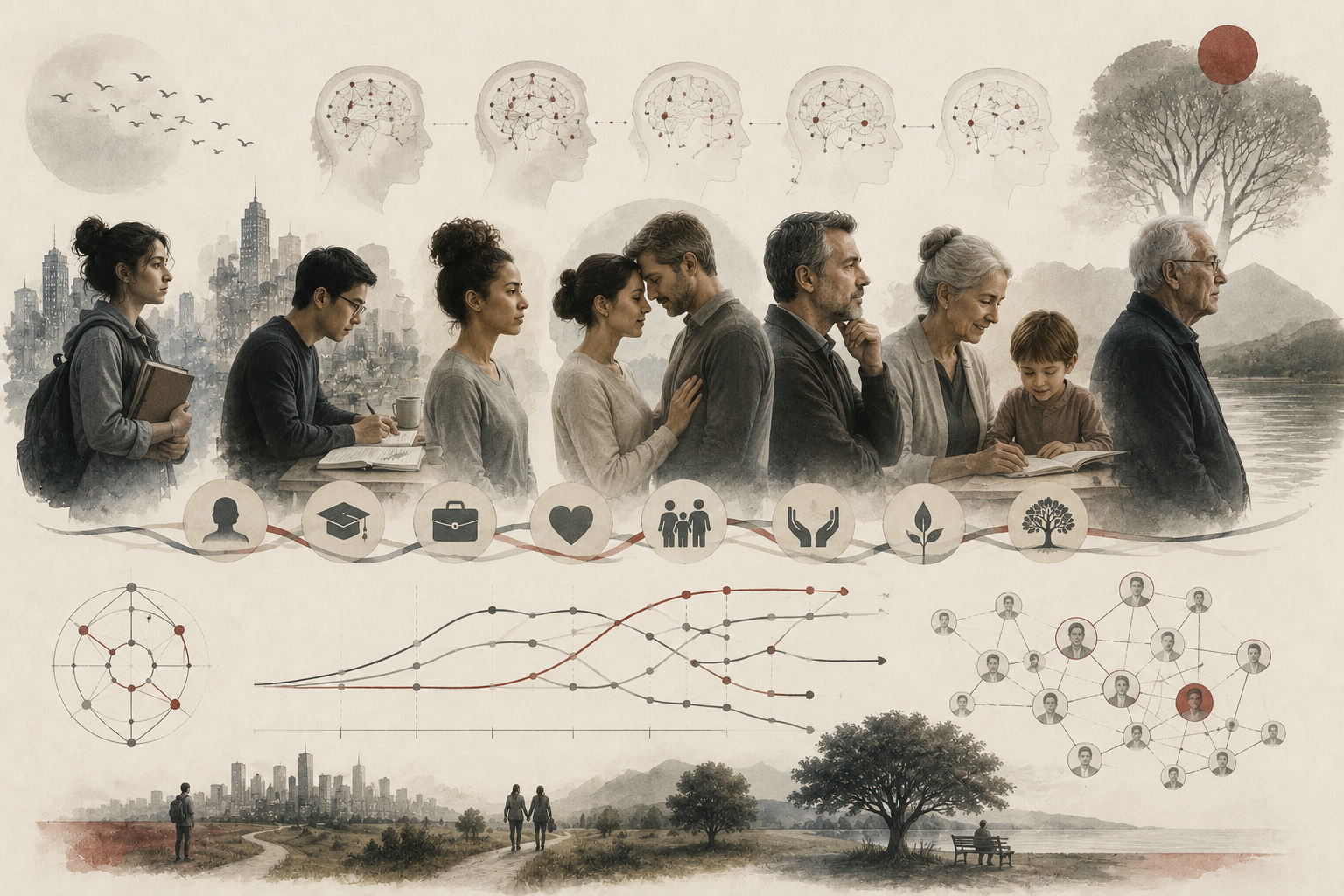
APA defines adulthood as the period after adolescence and notes that it is often divided into young adulthood, middle adulthood, and late adulthood, while developmental psychology itself is defined as the study of human growth and change across the lifespan. WHO’s life-course approach similarly frames adult health, well-being, and healthy aging as part of continuous trajectories rather than isolated episodes. NIA’s work on aging emphasizes biological, behavioral, social, and economic dimensions of later life, while NICHD’s broader human-development mission keeps families, health, and communities within the developmental field. Taken together, these perspectives point toward a stronger conclusion: adulthood is not merely the period after development. It is one of the central arenas where development becomes embodied, institutional, relational, and historical.
Adult development is therefore not only a matter of psychological maturity. It is the study of how people continue to change when life becomes more constrained by obligation, accumulated history, social role, bodily change, and unequal institutions. The adult self is not a finished possession. It is repeatedly revised through intimacy, labor, parenting, care, illness, loss, work, migration, loneliness, disability, faith, civic life, memory, and the shifting meaning of time.
Why Adult Development Matters
Adult development matters because adulthood is where much of human responsibility, attachment, labor, caregiving, loss, ethical self-interpretation, and institutional life occurs. If childhood and adolescence are the periods in which foundational capacities emerge, adulthood is the period in which those capacities are repeatedly tested, reorganized, expanded, and sometimes diminished under real historical pressure. Adults make commitments, form households, become parents or caregivers, sustain or leave institutions, experience success and disappointment, confront bodily change, and begin to live with a more concrete awareness of time. Developmental psychology loses much of its force if it treats these experiences as mere biography rather than development.
Adult life is often culturally imagined as settled. People are expected to know who they are, what they want, how they work, whom they love, and what responsibilities define them. Yet adult lives are rarely so fixed. A person may enter adulthood with one identity and revise it repeatedly through work, marriage, divorce, parenthood, caregiving, disability, unemployment, migration, illness, faith, political awakening, loss, or aging. The adult self is not simply expressed through life events. It is formed and re-formed by them.
Adult development also matters because adulthood is where personal development meets institutional demand most directly. Workplaces, housing markets, health systems, family law, pension systems, schools, immigration regimes, caregiving structures, transportation systems, and social expectations all shape what adulthood becomes. One person’s adult life may be organized around opportunity, education, family stability, and health access. Another’s may be organized around debt, discrimination, precarious work, disability barriers, or caregiving overload. Adult development is therefore never purely private. It is lived inside institutions that distribute burden and possibility unevenly.
A developmental psychology that includes adulthood can better explain how people adapt across decades. It can ask why some people revise identity with flexibility while others become rigid, why social support protects mental health, why work can become purpose or exploitation, why caregiving reorganizes the self, why midlife can deepen responsibility or despair, and why later adulthood can include both vulnerability and wisdom. Adult development matters because adulthood is not the end of becoming. It is becoming under heavier consequence.
What Adult Development Is
Adult development refers to psychological, social, cognitive, emotional, moral, relational, institutional, and embodied change across the adult years. It includes changes in identity, intimacy, vocation, purpose, health, memory, social role, coping, self-concept, meaning-making, generativity, resilience, and adaptation. It also includes the developmental effects of work, family, community, care, disability, inequality, culture, and historical timing.
This definition matters because public discussion often distorts adulthood in two opposite ways. One distortion imagines adulthood as stable maturity: a state one reaches and then inhabits. The other imagines adulthood, especially later adulthood, as little more than deterioration. A serious developmental view rejects both. Adult development includes growth, consolidation, revision, compensation, loss, resilience, and adaptation, often all at once.
Adulthood also changes the temporal structure of development. Childhood is often oriented toward future possibility. Adolescence is often oriented toward identity and transition. Adult life increasingly involves irreversible commitments and accumulated consequences. Choices about education, work, family, housing, health, community, and care build over time. The adult self develops not only by adding new capacities, but by living with the consequences of earlier paths and revising them where possible.
Adult development should therefore be understood as a life-course process rather than a set of isolated stages. Young adulthood, midlife, and later adulthood are not rigid containers. They are heuristic terms for changing developmental pressures. People move through them differently depending on culture, health, gender, class, disability, family structure, social support, work, and historical moment. Adult development is real, but it is not uniform.
Young Adulthood: Intimacy, Work, and Identity
Young adulthood is often culturally associated with independence, vocation, partnership, and the first more durable commitments of adult life. APA’s dictionary gives a rough range of about ages 20 to 35 for young adulthood, but the psychological meaning of this stage is more important than its numerical boundaries. It is a period in which identity begins to be tested under adult conditions: not only who one imagines oneself to be, but who one can sustain oneself as through work, intimacy, responsibility, and social constraint.
This phase is often characterized by tension between exploration and consolidation. Careers begin, relationships deepen or break, friendships are reorganized, and the contrast between ideal futures and actual institutional pathways becomes more concrete. For some, young adulthood is a period of expansion: education, mobility, professional formation, romantic commitment, and widening possibility. For others, it is marked by debt, unstable housing, underemployment, discrimination, family obligation, health stress, or immigration uncertainty. The stage is developmental, but its conditions are unequal.
Identity in young adulthood is no longer only an internal question of self-definition. It becomes attached to economic survival, relational commitment, institutional recognition, and the ability to maintain a life. A young adult may discover that talent does not automatically produce opportunity, that intimacy requires negotiation rather than fantasy, that work can structure identity but also constrain it, and that independence often depends on invisible forms of support.
Intimacy is also developmentally central. Friendships, partnerships, sexual relationships, marriage, cohabitation, parenting, and chosen family may all reorganize the self. To become adult is not simply to become autonomous. It is to learn what forms of dependence, trust, boundary, care, vulnerability, and reciprocity can be sustained. Young adulthood is therefore not just a transition into roles. It is a testing ground for the kind of person one can become in relation to others.
Emerging Adulthood and Historical Change
Research on emerging adulthood has been influential because it highlights how the transition into stable adult roles has become prolonged, uneven, and historically variable in many societies. The idea is not that every person experiences a universal stage called emerging adulthood. Rather, it helps describe a social reality: education, employment, housing, marriage, parenting, and financial independence often occur later or less predictably than in earlier cohorts, especially under conditions of labor-market instability and rising costs of living.
This matters because adulthood is often judged against inherited timelines. A person may be treated as “behind” if they have not married, bought a home, advanced in a career, or formed a stable household by a certain age. But adult timing is historically structured. Economic conditions, student debt, housing markets, healthcare access, cultural norms, family obligation, migration, disability, discrimination, and technological change all shape when and how adult roles become possible.
Emerging adulthood also reveals the limits of stage stereotypes. A twenty-six-year-old caring for siblings, working full time, and supporting parents may be carrying adult responsibility in ways that differ from a peer in graduate school exploring identity and career. A thirty-year-old may be developmentally young in some domains and deeply adult in others. Age does not map neatly onto role, obligation, maturity, or support.
The broader developmental lesson is that adult stages are historically embedded. They are not simply biological sequences. They are shaped by institutions and cohort conditions. A serious psychology of adult development should therefore ask not only how adults mature, but how societies make adult life easier or harder to enter, sustain, and dignify.
Midlife: Responsibility, Revision, and Generativity
Midlife is often described too narrowly as crisis, plateau, or peak. In psychological terms, it is better understood as a period in which accumulated commitments meet revision. Roles may expand: parenting, leadership, care for aging parents, institutional responsibility, financial burden, civic contribution, mentorship, and community stability. At the same time, aspirations may be reevaluated. Success may feel more ambiguous, and time may feel less indefinite. Midlife is often the stage at which adults confront the limits of earlier narratives about mastery, endless opportunity, or linear progress.
Developmental theories of adulthood have often associated midlife with generativity: the concern with guiding, creating, sustaining, or contributing beyond the self. That theme remains useful because it captures something larger than parenting alone. Adults in midlife often become responsible for maintaining worlds they did not entirely choose but now materially support: families, workplaces, communities, institutions, and traditions. Midlife can therefore be expansive and burdened at once.
Midlife also brings a distinctive form of self-assessment. Earlier hopes are no longer purely imagined; they have become partially realized, blocked, abandoned, or transformed. A person may ask whether a career was worth the cost, whether a relationship can be repaired, whether children were given enough, whether a life has become too narrow, whether earlier ambition concealed deeper needs, or whether new meaning is still possible. These questions are developmental because they reorganize identity in relation to time already lived.
The popular phrase “midlife crisis” captures only one possible response to this developmental pressure. Some adults experience crisis, but many experience gradual revision, renewed purpose, intensified care, spiritual reconsideration, or sober acceptance. Midlife is not merely about panic over aging. It is about the recognition that life is no longer infinitely revisable and that what one has built now carries both value and cost.
Later Adulthood: Aging, Meaning, and Adjustment
Later adulthood brings the psychology of aging into clearer view, but aging should not be reduced to loss alone. WHO defines healthy ageing around the development and maintenance of functional ability that enables well-being in older age, and NIA’s public materials similarly emphasize health, activity, adaptation, and well-being rather than a purely deficit-based model. This framing matters because it resists a common cultural distortion that treats later life as nothing but decline.
Later adulthood often includes bereavement, bodily vulnerability, retirement transitions, shrinking roles, sensory change, increased care needs, or cognitive slowing. It can also include perspective, expertise, relational depth, emotional selectivity, adaptation, spiritual seriousness, and new forms of meaning. A serious psychology of life stages should therefore ask not only what is lost, but how adults revise action, expectation, and self-understanding under changing conditions of body and time.
Later life is developmentally distinctive because the relation between capacity and environment becomes increasingly visible. Reduced mobility may be manageable in an accessible neighborhood and devastating in an inaccessible one. Cognitive change may be supported by routines and relationships or intensified by isolation and stigma. Retirement may open purpose or produce dislocation depending on finances, identity, health, and social connection. Aging is biological, but it is lived socially.
Later adulthood also intensifies the work of meaning-making. People may engage in life review, legacy thinking, reconciliation, grief, spiritual reflection, and selective investment in what remains emotionally or morally important. Development continues not because older adults become young again, but because the self must adapt to changing body, shrinking time, accumulated memory, and altered social position.
Body, Time, and Mortality Awareness
One of the deepest features of adult development is changing time consciousness. In childhood, the future often feels expansive without being fully real. In adolescence, the future becomes central to identity but remains open. In adulthood, the future becomes structured by deadlines, responsibilities, biological limits, and eventually mortality. The body changes across adulthood not only in visible aging but in stamina, sleep, fertility, chronic illness risk, pain, cognition, recovery, and vulnerability. These changes alter not only function but self-relation.
Adults increasingly live with awareness that time is not merely passing but being spent. Decisions about partnership, work, care, place, health, and purpose acquire greater gravity because adulthood makes finitude harder to ignore. A person may begin adulthood assuming that many lives remain possible, then gradually realize that every commitment closes some paths while deepening others. This is not only a philosophical fact. It is a developmental pressure.
Embodiment becomes more explicit across the adult years. Young adults may experience the body as an instrument of possibility. Midlife may bring the first signs that the body has limits independent of will. Later adulthood may make bodily dependency, pain, mobility, sensory change, and mortality impossible to ignore. The body is not a background condition. It is part of adult development because it shapes energy, sexuality, care, identity, work, and social participation.
Mortality awareness also changes meaning. The adult self develops in relation to the knowledge that time is finite, even when that knowledge is repressed or deferred. Some people respond with urgency, others with avoidance, gratitude, bitterness, spirituality, repair, or generativity. Adult development includes these changing relations to time because the meaning of a life changes as less of it remains open-ended.
Relationships, Family, and Social Role Across Adulthood
Adult development is relational because adulthood reorganizes intimacy, friendship, marriage, caregiving, parenting, kinship, and social obligation. Relationships in adulthood are often more chosen than early attachments but also more burdened by responsibility. Adults sustain households, raise children, negotiate long-term partnerships, manage separation or widowhood, care for parents, and live with the consequences of earlier relational patterns under changing circumstances.
Family and social relationships influence development throughout adulthood, not only in childhood. Becoming a partner, parent, stepparent, caregiver, grandparent, divorced adult, widowed adult, or socially isolated adult can reorganize identity and daily life. These are not merely status changes. They alter time, emotion, obligation, vulnerability, and meaning.
Friendship also changes across adulthood. Young adulthood may involve expansive peer networks and identity exploration. Midlife often compresses social time under work and family demands. Later adulthood may narrow networks through retirement, bereavement, relocation, disability, or health change, while also deepening the emotional significance of remaining relationships. Developmental psychology should therefore treat social connection as a changing structure, not a stable background variable.
Adult relationships are also sites of moral development. Long-term intimacy requires negotiation, forgiveness, boundary, sacrifice, honesty, and sometimes separation. Parenting and caregiving require responsibility under fatigue and uncertainty. Adult children may need to reinterpret parents as aging people with limitations. Partners may need to renegotiate care, desire, illness, disappointment, and loyalty. Relationships are developmental because they change what the self is asked to become.
Work, Purpose, and Institutional Life
Work is one of the major institutional organizers of adult development. It structures time, identity, status, community, income, stress, aspiration, and self-worth. Adult psychology cannot be separated from the institutions through which adults are recognized and burdened. Paid labor, unpaid care, precarity, unemployment, promotion, stagnation, burnout, and retirement all shape how adulthood is lived. What adulthood means psychologically depends in part on whether work feels like purpose, survival, compromise, exploitation, contribution, or defeat.
Work can stabilize identity by giving adults routines, goals, recognition, and a social place. It can also distort development when it consumes energy, restricts care, produces insecurity, or attaches human worth to productivity. A person may find vocation through work, but may also lose selfhood to work. A developmental psychology of adulthood must therefore ask how labor conditions shape identity, meaning, stress, health, and relationships.
Unpaid work matters just as much. Parenting, elder care, domestic labor, emotional labor, community care, disability support, and household management all organize adult development. These forms of work are often less visible but developmentally profound. They shape time, exhaustion, identity, moral obligation, and social recognition. Adult development becomes distorted when only paid productivity is treated as meaningful work.
Institutional life also includes healthcare, housing, education, finance, law, religion, community organizations, and civic systems. Adults develop through systems that allocate dignity, burden, freedom, and risk unequally. The psychology of adulthood is therefore not only about personality unfolding over time. It is about how persons live inside institutions that recognize, exploit, protect, exclude, or sustain them.
Caregiving, Dependence, and Reciprocity Across Adulthood
Caregiving is one of the most important but often under-theorized dimensions of adult development. Adults give and receive care across the life course: caring for children, partners, parents, siblings, friends, disabled relatives, ill partners, neighbors, or communities. Caregiving reorganizes the self because it changes time, priority, emotion, responsibility, and identity. It can deepen meaning, but it can also produce exhaustion, resentment, grief, financial strain, and isolation.
Adult development is often described in terms of independence, but caregiving reveals that interdependence is a more accurate model. Adults do not become fully self-contained. They become participants in changing systems of dependence and reciprocity. A parent depends on childcare, a worker depends on social infrastructure, a spouse depends on emotional support, an older adult depends on transportation or health care, and caregivers depend on institutions that may or may not support them.
Caregiving also changes across life stages. Young adults may care for children while still building economic stability. Midlife adults may be “sandwiched” between children and aging parents. Later adults may become care recipients, continue as caregivers, or both. These transitions are developmental because they require new forms of identity: from child to parent, from independent adult to caregiver, from caregiver to care recipient, from partner to widow, from private individual to advocate within health systems.
A serious developmental account should therefore treat care as central, not peripheral. Adults develop through the care they give, the care they receive, and the institutions that support or fail those relationships. Care is where adult responsibility becomes embodied.
Inequality, Health, and Unequal Life Stages
Life stages are not lived equally. Adult development is shaped by class, race, disability, gender, caregiving burden, migration status, neighborhood, health access, labor conditions, and exposure to cumulative adversity. Patterns of early adversity can influence adult health and mortality, and life-course frameworks emphasize that development is shaped by biological, psychosocial, environmental, and institutional trajectories across time. Adulthood is not detached from earlier development. It carries forward prior inequality in bodily and social form.
This means adulthood cannot be understood through neutral stage language alone. One adult may experience young adulthood as exploration and professional formation; another as debt, work insecurity, family obligation, and survival. One adult may experience midlife as influence, home ownership, and generativity; another as burnout, displacement, illness, or caregiving overload. One adult may experience later life with healthcare access, social support, and financial security; another through isolation, disability barriers, medical debt, and unmanaged chronic illness.
Health inequality is especially important because adult development is embodied. Chronic stress, environmental exposure, unsafe work, food insecurity, disability barriers, discrimination, lack of preventive care, housing instability, and untreated illness can shape adult functioning and life expectancy. Development is not only psychological. It is lived in bodies exposed to unequal conditions.
Inequality also shapes who is allowed to be seen as developing. Adults under pressure may be judged as irresponsible, immature, or unsuccessful when they are actually navigating constrained opportunities. A developmental psychology that ignores inequality risks turning social structure into personal failure. A stronger account asks how institutions distribute time, health, support, and dignity across adulthood.
Adult Development Beyond Stage Stereotypes
Stage language can be useful, but it becomes misleading when treated as destiny. Not all adults marry, parent, work, retire, or age along the same sequence. Not all lives organize meaning through the same milestones. Stage models help identify recurring developmental patterns, but adulthood is historically variable and socially structured. A serious developmental psychology must therefore distinguish between heuristic life stages and rigid norms about what adulthood ought to look like.
Stage stereotypes can become harmful when they are used to judge lives that do not follow dominant timelines. Adults without children are not developmentally incomplete. Adults who change careers are not necessarily unstable. Adults who live with family are not automatically immature. Adults who receive care are not failures of autonomy. Older adults are not simply declined versions of youth. Human lives are too varied for one normative adult script.
A stronger framework treats adult development as a set of developmental tasks and pressures rather than a compulsory sequence. People must negotiate identity, intimacy, work, care, health, meaning, and time, but they do so in different configurations. The key question is not whether a life matches a timeline. It is how the person adapts, relates, contributes, revises, and sustains meaning within real conditions.
Adult development is real without being uniform. The life stages of adulthood are best understood as changing developmental contexts: young adulthood often intensifies commitment and identity formation; midlife often intensifies responsibility and revision; later adulthood often intensifies adaptation, meaning, and finitude. But the person’s actual developmental pathway depends on history, culture, body, relationship, institution, and chance.
Methods for Studying Adult Development
Studying adult development requires methods that can capture change over long periods, variation among adults, and the social contexts in which adult lives unfold. Cross-sectional studies can compare age groups, but they often confound age with cohort and historical context. Longitudinal studies are essential for understanding within-person change, but they require sustained measurement and attention to attrition, changing life circumstances, and historical period effects.
Sequential designs can help distinguish age, cohort, and period influences. Growth-curve models can represent trajectories of adjustment, health, work, meaning, or relationship quality. Multilevel models can account for adults nested within households, workplaces, communities, cohorts, and health systems. Event-history models can examine transitions such as marriage, divorce, parenthood, job loss, illness, retirement, bereavement, or entry into care. Mixed-methods approaches can combine measurable trajectories with narratives of meaning, identity, and adaptation.
Adult development also requires careful measurement. Work integration, relational support, health burden, generativity, meaning, social connection, role strain, adaptive coping, and psychological well-being are related but distinct. A serious study should specify what kind of adult change is being examined: cognitive, emotional, relational, institutional, embodied, moral, or existential.
Qualitative methods are especially valuable because adult development is not fully visible through standardized scales. Interviews, life histories, narrative analysis, ethnography, and participatory research can show how adults interpret transitions in their own terms. A person’s divorce, illness, caregiving role, retirement, or spiritual shift may have meanings that quantitative measures alone cannot capture. Adult development is both measurable and narratively lived.
An Analytical Framework for Adult Development and Life Stages
A stylized adult-development outcome \(D_{it}\) for individual \(i\) at time \(t\) can be modeled as a function of relational support, institutional integration, health burden, and residual variation:
D_{it} = \alpha_i + \beta_i t + \gamma R_{it} + \delta W_{it} – \lambda H_{it} + \varepsilon_{it}
\]
Interpretation: \( \alpha_i \) is initial adult psychological organization, \( \beta_i \) is developmental change across time, \(R_{it}\) represents relational support or stability, \(W_{it}\) represents work or institutional integration, and \(H_{it}\) represents health burden or constraint.
To capture continuity across adult life stages, prior adjustment can be added:
D_{it} = \rho D_{i,t-1} + \beta_i t + \gamma R_{it} + \delta W_{it} – \lambda H_{it} + \varepsilon_{it}
\]
Interpretation: A larger value of \( \rho \) indicates that prior adaptation strongly conditions later adaptation. Earlier patterns of coping, opportunity, and self-organization often shape how later adult transitions are managed.
To represent stage-specific demands more explicitly, let \(Y_{it}\), \(M_{it}\), and \(O_{it}\) index young adulthood, midlife, and older adulthood:
D_{it} = \alpha_i + \beta_1Y_{it} + \beta_2M_{it} + \beta_3O_{it} + \gamma R_{it} + \delta W_{it} – \lambda H_{it} + \varepsilon_{it}
\]
Interpretation: This does not imply that all adults pass through identical stages. It only expresses the idea that stage-linked contexts can alter developmental priorities, pressures, and supports.
Because adult development unfolds within workplaces, families, neighborhoods, and health systems, a multilevel model is often more realistic:
D_{ijt} = \alpha + u_j + \beta t + \gamma R_{ijt} + \delta W_{ijt} – \lambda H_{ijt} + \varepsilon_{ijt}
\]
Interpretation: \(u_j\) captures contextual effects at the level of family system, workplace, community, care setting, or healthcare environment. Adult development is nested within institutions that shape well-being, burden, and developmental possibility.
To represent adult role load, caregiving, and institutional strain, a broader specification can include role burden \(B_{it}\) and adaptive resources \(A_{it}\):
D_{it} = \rho D_{i,t-1} + \beta t + \gamma R_{it} + \delta W_{it} + \theta A_{it} – \lambda H_{it} – \kappa B_{it} + \varepsilon_{it}
\]
Interpretation: Adult development is shaped by support and opportunity, but also by health burden, caregiving demand, work strain, financial stress, and role overload. Adaptive resources can buffer these pressures.
The point of this framework is not to reduce adulthood to equations. It is to clarify that adult development is relational, embodied, institutional, cumulative, and time-sensitive.
R: Simulating Adult Development, Life Stages, and Adjustment
The following R example simulates adults observed across repeated waves. It includes relational support, work integration, health burden, life-stage grouping, role burden, adaptive resources, and a broad developmental adjustment outcome. The data are synthetic and intended for demonstration only.
# Simulating adult development, life stages, and adjustment
# --------------------------------------------------------
# This synthetic example models adult adjustment as a function of relational
# support, work integration, health burden, role burden, adaptive resources,
# life-stage context, and prior developmental organization.

suppressPackageStartupMessages({
  library(dplyr)
  library(lme4)
  library(ggplot2)
})

set.seed(2026)

n_adults <- 900
n_waves <- 10
n_contexts <- 36

adults <- data.frame(
  id = 1:n_adults,
  context_id = sample(1:n_contexts, n_adults, replace = TRUE),
  baseline_adjustment = rnorm(n_adults, mean = 50, sd = 8),
  relational_support = rnorm(n_adults, mean = 0, sd = 1),
  work_integration = rnorm(n_adults, mean = 0, sd = 1),
  health_burden = rnorm(n_adults, mean = 0, sd = 1),
  adaptive_resources = rnorm(n_adults, mean = 0, sd = 1),
  role_burden = rnorm(n_adults, mean = 0, sd = 1),
  life_stage = sample(
    c("young_adulthood", "midlife", "later_adulthood"),
    size = n_adults,
    replace = TRUE,
    prob = c(0.35, 0.35, 0.30)
  )
)

contexts <- data.frame(
  context_id = 1:n_contexts,
  institutional_support = rnorm(n_contexts, mean = 0, sd = 0.6),
  community_stability = rnorm(n_contexts, mean = 0, sd = 0.5)
)

panel_data <- adults |>
  slice(rep(1:n(), each = n_waves)) |>
  group_by(id) |>
  mutate(
    wave = 0:(n_waves - 1),
    current_relational_support = rnorm(n_waves, mean = relational_support, sd = 0.6),
    current_work_integration = rnorm(n_waves, mean = work_integration, sd = 0.6),
    current_health_burden = rnorm(n_waves, mean = health_burden + 0.03 * wave, sd = 0.6),
    current_adaptive_resources = rnorm(n_waves, mean = adaptive_resources, sd = 0.6),
    current_role_burden = rnorm(n_waves, mean = role_burden, sd = 0.6)
  ) |>
  ungroup() |>
  left_join(contexts, by = "context_id") |>
  mutate(
    young_stage = ifelse(life_stage == "young_adulthood", 1, 0),
    midlife_stage = ifelse(life_stage == "midlife", 1, 0),
    later_stage = ifelse(life_stage == "later_adulthood", 1, 0),
    adjustment_score =
      baseline_adjustment +
      0.55 * wave +
      1.15 * current_relational_support +
      1.05 * current_work_integration +
      0.95 * current_adaptive_resources +
      0.70 * institutional_support +
      0.55 * community_stability -
      1.20 * current_health_burden -
      0.80 * current_role_burden +
      0.75 * young_stage +
      0.55 * midlife_stage +
      0.35 * later_stage +
      0.25 * current_relational_support * current_adaptive_resources +
      rnorm(n(), mean = 0, sd = 2.6)
  )

model <- lmer(
  adjustment_score ~ wave + current_relational_support +
    current_work_integration + current_health_burden +
    current_adaptive_resources + current_role_burden +
    institutional_support + community_stability +
    young_stage + midlife_stage + later_stage +
    current_relational_support:current_adaptive_resources +
    (1 + wave | context_id/id),
  data = panel_data
)

summary(model)

trajectory_summary <- panel_data |>
  group_by(wave, life_stage) |>
  summarize(
    mean_adjustment = mean(adjustment_score),
    standard_error = sd(adjustment_score) / sqrt(n()),
    .groups = "drop"
  ) |>
  mutate(
    lower = mean_adjustment - 1.96 * standard_error,
    upper = mean_adjustment + 1.96 * standard_error
  )

ggplot(trajectory_summary, aes(x = wave, y = mean_adjustment, linetype = life_stage)) +
  geom_line(linewidth = 1) +
  geom_ribbon(aes(ymin = lower, ymax = upper, group = life_stage), alpha = 0.12) +
  labs(
    title = "Simulated Adult Development Across Life Stages",
    x = "Wave",
    y = "Adjustment score",
    linetype = "Life stage"
  ) +
  theme_minimal()

context_summary <- panel_data |>
  group_by(context_id) |>
  summarize(
    institutional_support = mean(institutional_support),
    community_stability = mean(community_stability),
    average_adjustment = mean(adjustment_score),
    average_role_burden = mean(current_role_burden),
    .groups = "drop"
  )

ggplot(context_summary, aes(x = institutional_support, y = average_adjustment)) +
  geom_point() +
  geom_smooth(method = "lm", se = TRUE) +
  labs(
    title = "Synthetic Institutional Support and Adult Adjustment",
    x = "Institutional support",
    y = "Average adjustment score"
  ) +
  theme_minimal()

# Analysts can extend this model by:
# 1. separating work, intimacy, health, and meaning outcomes;
# 2. modeling retirement, caregiving, divorce, bereavement, or illness transitions;
# 3. adding workplace, household, or neighborhood random effects;
# 4. simulating cumulative adversity across adulthood;
# 5. comparing adult trajectories under different support conditions;
# 6. modeling inequality and cumulative advantage across life stages.
This simulation highlights a central developmental point: adult adjustment depends on life stage, but also on relationship, work, health, role burden, adaptive resources, and institutional support rather than chronology alone.
Python: Modeling Life Stages, Support, and Adult Psychological Development
The following Python example simulates adult development over repeated periods using relational support, work integration, health burden, role burden, adaptive resources, institutional support, and life-stage grouping. The outcome can be read as a broad adult developmental-adjustment score.
# Modeling life stages, support, and adult psychological development
# -----------------------------------------------------------------
# This synthetic example models adult adjustment as a dynamic relation among
# relational support, work integration, health burden, adaptive resources,
# role burden, institutional support, life-stage context, and prior adjustment.

from __future__ import annotations

import numpy as np
import pandas as pd
import statsmodels.formula.api as smf
import matplotlib.pyplot as plt

np.random.seed(2026)

n_adults = 950
n_periods = 10
n_contexts = 36

adults = pd.DataFrame({
    "id": np.arange(1, n_adults + 1),
    "context_id": np.random.choice(np.arange(1, n_contexts + 1), size=n_adults),
    "baseline_adjustment": np.random.normal(50, 8, n_adults),
    "relational_support": np.random.normal(0, 1, n_adults),
    "work_integration": np.random.normal(0, 1, n_adults),
    "health_burden": np.random.normal(0, 1, n_adults),
    "adaptive_resources": np.random.normal(0, 1, n_adults),
    "role_burden": np.random.normal(0, 1, n_adults),
    "life_stage": np.random.choice(
        ["young_adulthood", "midlife", "later_adulthood"],
        size=n_adults,
        p=[0.35, 0.35, 0.30],
    ),
})

contexts = pd.DataFrame({
    "context_id": np.arange(1, n_contexts + 1),
    "institutional_support": np.random.normal(0, 0.6, n_contexts),
    "community_stability": np.random.normal(0, 0.5, n_contexts),
})

panel = adults.loc[adults.index.repeat(n_periods)].copy()
panel["time"] = np.tile(np.arange(n_periods), n_adults)
panel = panel.merge(contexts, on="context_id", how="left")

panel["current_relational_support"] = np.random.normal(
    panel["relational_support"], 0.70, len(panel)
)
panel["current_work_integration"] = np.random.normal(
    panel["work_integration"], 0.70, len(panel)
)
panel["current_health_burden"] = np.random.normal(
    panel["health_burden"] + 0.03 * panel["time"], 0.70, len(panel)
)
panel["current_adaptive_resources"] = np.random.normal(
    panel["adaptive_resources"], 0.70, len(panel)
)
panel["current_role_burden"] = np.random.normal(
    panel["role_burden"], 0.70, len(panel)
)

panel["young_stage"] = (panel["life_stage"] == "young_adulthood").astype(int)
panel["midlife_stage"] = (panel["life_stage"] == "midlife").astype(int)
panel["later_stage"] = (panel["life_stage"] == "later_adulthood").astype(int)

panel = panel.sort_values(["id", "time"]).reset_index(drop=True)
panel["adjustment_score"] = np.nan

for person_id in panel["id"].unique():
    person_data = panel.loc[panel["id"] == person_id].copy()
    previous_score = person_data["baseline_adjustment"].iloc[0] + np.random.normal(0, 2)

    for idx in person_data.index:
        time = panel.at[idx, "time"]
        support = panel.at[idx, "current_relational_support"]
        work = panel.at[idx, "current_work_integration"]
        health = panel.at[idx, "current_health_burden"]
        resources = panel.at[idx, "current_adaptive_resources"]
        burden = panel.at[idx, "current_role_burden"]
        institutional = panel.at[idx, "institutional_support"]
        community = panel.at[idx, "community_stability"]
        young = panel.at[idx, "young_stage"]
        midlife = panel.at[idx, "midlife_stage"]
        later = panel.at[idx, "later_stage"]

        current_score = (
            0.70 * previous_score
            + 0.55 * time
            + 1.15 * support
            + 1.05 * work
            + 0.95 * resources
            + 0.70 * institutional
            + 0.55 * community
            - 1.20 * health
            - 0.80 * burden
            + 0.75 * young
            + 0.55 * midlife
            + 0.35 * later
            + 0.25 * support * resources
            + np.random.normal(0, 2.5)
        )

        panel.at[idx, "adjustment_score"] = current_score
        previous_score = current_score

panel["lag_score"] = panel.groupby("id")["adjustment_score"].shift(1)
regression_data = panel.dropna(subset=["lag_score"]).copy()

model = smf.ols(
    formula="""
    adjustment_score ~ lag_score + time + current_relational_support +
    current_work_integration + current_health_burden +
    current_adaptive_resources + current_role_burden +
    institutional_support + community_stability +
    young_stage + midlife_stage + later_stage +
    current_relational_support:current_adaptive_resources
    """,
    data=regression_data,
).fit(cov_type="HC3")

print(model.summary())

trajectory = panel.groupby(["time", "life_stage"], as_index=False).agg(
    average_adjustment=("adjustment_score", "mean"),
    standard_error=("adjustment_score", lambda x: x.std() / np.sqrt(len(x))),
)

trajectory["lower"] = trajectory["average_adjustment"] - 1.96 * trajectory["standard_error"]
trajectory["upper"] = trajectory["average_adjustment"] + 1.96 * trajectory["standard_error"]

plt.figure(figsize=(8, 5))
for group_name, subset in trajectory.groupby("life_stage"):
    plt.plot(subset["time"], subset["average_adjustment"], marker="o", label=group_name)

plt.xlabel("Time")
plt.ylabel("Average adjustment score")
plt.title("Simulated Adult Development and the Psychology of Life Stages")
plt.legend()
plt.tight_layout()
plt.show()

context_summary = panel.groupby("context_id", as_index=False).agg(
    institutional_support=("institutional_support", "mean"),
    community_stability=("community_stability", "mean"),
    average_adjustment=("adjustment_score", "mean"),
    average_role_burden=("current_role_burden", "mean"),
)

print(context_summary.sort_values("average_adjustment", ascending=False).head())

# Analysts can extend this framework by:
# 1. modeling work, intimacy, care, and health separately;
# 2. adding household, workplace, or neighborhood clustering;
# 3. simulating retirement, caregiving, divorce, bereavement, or illness shocks;
# 4. comparing different healthy aging trajectories;
# 5. testing cumulative advantage and disadvantage across adulthood;
# 6. adding qualitative life-history categories for mixed-methods work.
The analytical value of a model like this is that it makes visible a core developmental truth: adulthood remains developmental because support, work, health, role burden, adaptive resources, and institutional context continue to reorganize the self across time.
GitHub Repository
Complete Code Repository
Access the full companion repository for this article, including reproducible analysis materials and multi-language code workflows for adult development, life stages, relational support, work integration, health burden, role burden, adaptive resources, institutional context, and adult psychological adjustment.
Conclusion
Adult development and the psychology of life stages belong together because adulthood is not the suspension of development but one of its most consequential forms. Across young adulthood, midlife, and later adulthood, people revise identity, carry responsibility, confront bodily change, adapt to loss, sustain institutions, and renegotiate meaning under the pressure of time. APA, WHO, NICHD, and NIA all support, in different ways, the larger conclusion that human development is a lifespan process rather than a child-only science.
The strongest developmental psychology therefore treats adulthood neither as fixed maturity nor as mere decline. It is relational, embodied, institutional, historical, and cumulative. It includes growth, loss, care, burden, work, love, illness, adaptation, generativity, and the search for meaning under changing conditions. A person does not stop developing when they become adult. They continue to become through the commitments, institutions, bodies, relationships, and histories that adulthood makes unavoidable.
In that sense, adult development reveals one of the field’s deepest truths: a life does not stop changing once it becomes adult. It changes under heavier responsibility, deeper memory, greater consequence, and clearer awareness of time itself.
Related Articles
- What Is Developmental Psychology?
- Why Developmental Psychology Matters Today
- Lifespan Development from Childhood to Aging
- Lifespan Developmental Psychology and the Baltes Tradition
- Aging, Adaptation, and Development in Later Life
- Wisdom, Meaning, and Development in Later Life
- Adolescence, Identity, and Psychological Transition
- Self-Regulation and Executive Function Across Development
- Moral Development and the Growth of Conscience
- Development, Inequality, and the Life Course
- Developmental Psychology knowledge series
Further Reading
- American Psychological Association (n.d.) APA Handbook of Adult Development and Aging. Available at: https://www.apa.org/pubs/books/apa-handbook-adult-development-aging.
- American Psychological Association (n.d.) Adult Development and Aging, Division 20. Available at: https://www.apa.org/about/division/div20.
- Arnett, J.J. (2000) ‘Emerging adulthood: A theory of development from the late teens through the twenties’, American Psychologist, 55(5), pp. 469–480. Available at: https://doi.org/10.1037/0003-066X.55.5.469.
- Baltes, P.B. (1987) ‘Theoretical propositions of life-span developmental psychology: On the dynamics between growth and decline’, Developmental Psychology, 23(5), pp. 611–626. Available at: https://www.imprs-life.mpg.de/25277/022_baltes_1987.pdf.
- Carstensen, L.L., Isaacowitz, D.M. and Charles, S.T. (1999) ‘Taking time seriously: A theory of socioemotional selectivity’, American Psychologist, 54(3), pp. 165–181. Available at: https://doi.org/10.1037/0003-066X.54.3.165.
- Centers for Disease Control and Prevention (2024) Healthy Aging at Any Age. Available at: https://www.cdc.gov/healthy-aging/about/index.html.
- Erikson, E.H. (1982) The Life Cycle Completed. New York: Norton. Available at: https://wwnorton.com/books/9780393317725.
- National Institute on Aging (2022) What Do We Know About Healthy Aging? Available at: https://www.nia.nih.gov/health/healthy-aging/what-do-we-know-about-healthy-aging.
- National Institute on Aging (2023) How the Aging Brain Affects Thinking. Available at: https://www.nia.nih.gov/health/brain-health/how-aging-brain-affects-thinking.
- World Health Organization (n.d.) What Is a Life Course Approach and Why Is It Needed? Available at: https://www.who.int/teams/maternal-newborn-child-adolescent-health-and-ageing/life-course.
- World Health Organization (2025) Framework to Implement a Life Course Approach in Practice. Available at: https://www.who.int/publications/i/item/9789240112575.
- World Health Organization (2025) Extending Healthy Ageing Across the Life Course. Available at: https://www.who.int/publications/i/item/9789240110779.
References
- American Psychological Association (n.d.) Developmental Psychology. Available at: https://www.apa.org/education-career/guide/subfields/developmental.
- American Psychological Association (2023) Adulthood. Available at: https://dictionary.apa.org/adulthood.
- American Psychological Association (n.d.) Adult Development and Aging, Division 20. Available at: https://www.apa.org/about/division/div20.
- American Psychological Association (n.d.) APA Handbook of Adult Development and Aging. Available at: https://www.apa.org/pubs/books/apa-handbook-adult-development-aging.
- Arnett, J.J. (2000) ‘Emerging adulthood: A theory of development from the late teens through the twenties’, American Psychologist, 55(5), pp. 469–480. Available at: https://doi.org/10.1037/0003-066X.55.5.469.
- Baltes, P.B. (1987) ‘Theoretical propositions of life-span developmental psychology: On the dynamics between growth and decline’, Developmental Psychology, 23(5), pp. 611–626. Available at: https://www.imprs-life.mpg.de/25277/022_baltes_1987.pdf.
- Carstensen, L.L., Isaacowitz, D.M. and Charles, S.T. (1999) ‘Taking time seriously: A theory of socioemotional selectivity’, American Psychologist, 54(3), pp. 165–181. Available at: https://doi.org/10.1037/0003-066X.54.3.165.
- Centers for Disease Control and Prevention (2024) Healthy Aging. Available at: https://www.cdc.gov/healthy-aging/index.html.
- Centers for Disease Control and Prevention (2024) Healthy Aging at Any Age. Available at: https://www.cdc.gov/healthy-aging/about/index.html.
- Eunice Kennedy Shriver National Institute of Child Health and Human Development (2019) Health. Available at: https://www.nichd.nih.gov/health.
- Eunice Kennedy Shriver National Institute of Child Health and Human Development (2025) NICHD Mission and Research Scope. Available at: https://www.nih.gov/about-nih/nih-almanac/eunice-kennedy-shriver-national-institute-child-health-human-development-nichd.
- Erikson, E.H. (1982) The Life Cycle Completed. New York: Norton. Available at: https://wwnorton.com/books/9780393317725.
- National Institute on Aging (2022) What Do We Know About Healthy Aging? Available at: https://www.nia.nih.gov/health/healthy-aging/what-do-we-know-about-healthy-aging.
- National Institute on Aging (2023) How the Aging Brain Affects Thinking. Available at: https://www.nia.nih.gov/health/brain-health/how-aging-brain-affects-thinking.
- National Institute on Aging (2025) National Institute on Aging. Available at: https://www.nih.gov/about-nih/nih-almanac/national-institute-aging-nia.
- NIH (2022) Risk of Premature Death in Adulthood Influenced by Patterns of Early Childhood Adversity. Available at: https://www.nih.gov/news-events/news-releases/risk-premature-death-adulthood-influenced-patterns-early-childhood-adversity.
- World Health Organization (n.d.) What Is a Life Course Approach and Why Is It Needed? Available at: https://www.who.int/teams/maternal-newborn-child-adolescent-health-and-ageing/life-course.
- World Health Organization (n.d.) Ageing. Available at: https://www.who.int/health-topics/ageing.
- World Health Organization (2025) Framework to Implement a Life Course Approach in Practice. Available at: https://www.who.int/publications/i/item/9789240112575.
- World Health Organization (2025) Extending Healthy Ageing Across the Life Course. Available at: https://www.who.int/publications/i/item/9789240110779.