
Last Updated May 21, 2026
Brain development is not a hidden biological background beneath psychological life. It is one of the central developmental processes through which perception, movement, attention, memory, emotion, language, regulation, social understanding, learning, and identity become possible. To speak of the developing nervous system is to speak about the material conditions through which human development unfolds across prenatal life, infancy, childhood, adolescence, adulthood, and aging. Developmental psychology cannot fully explain attachment, cognition, language, school learning, trauma, disability, social development, or resilience without also understanding the changing nervous system through which these processes are embodied.
The developing brain is not a static machine that simply matures on a biological schedule. It is a living, plastic, structured, vulnerable, and adaptive system shaped by timing, experience, care, nutrition, sleep, sensory input, movement, stress, injury, learning, social relationship, culture, public health, education, and unequal developmental conditions. Neural development includes growth and differentiation, but also selection, pruning, myelination, connectivity, regulation, compensation, and reorganization. The brain develops through biology, but never through biology alone.
Main Library
Publications
Article Map
Developmental Psychology
Related Topic
Cognitive Psychology
Related Topic
Biology
Related Topic
Risk & Resilience
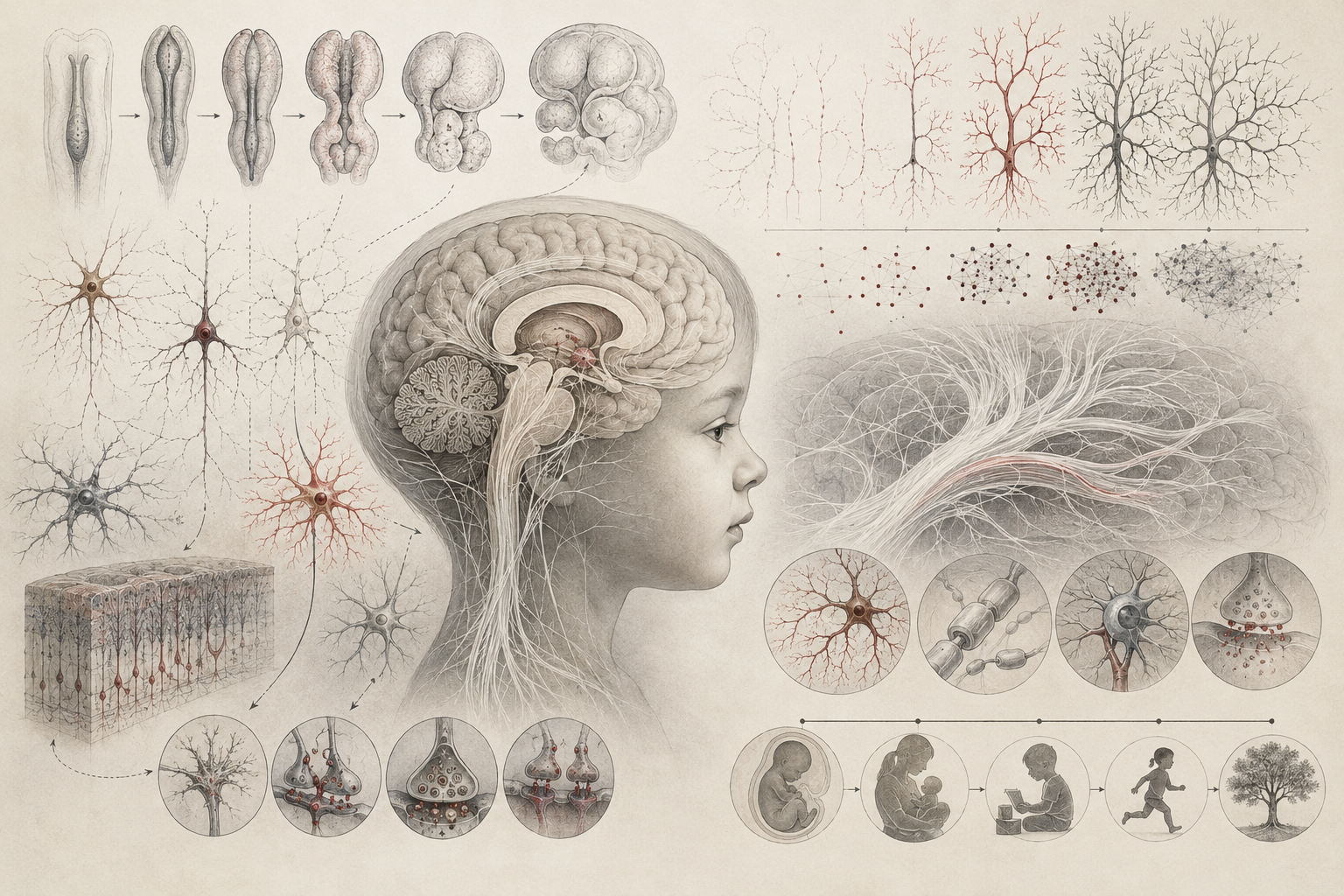
Modern developmental science treats brain development as biologically organized, environmentally responsive, and socially embedded. NICHD describes neuroscience as the study of the nervous system, including the brain, spinal cord, and networks of nerve cells throughout the body. NINDS emphasizes that understanding the brain helps explain learning, memory, movement, sensation, emotion, and neurological health. WHO’s early-childhood materials similarly stress that early experience, safety, nutrition, responsive care, and opportunities for learning are vital for healthy brain development. A serious developmental psychology therefore cannot reduce the brain either to fixed genetic destiny or to a blank organ written entirely by experience. Brain development is structured, plastic, relational, embodied, ecological, and unequal.
This article examines brain development not as a replacement for psychological explanation, but as one of its essential foundations. Attachment is embodied. Cognition is embodied. Emotion regulation is embodied. Language is embodied. Trauma is embodied. School learning is embodied. Social cognition is embodied. To understand development seriously is not to choose between brain and environment, biology and culture, neural maturation and caregiving, or plasticity and constraint. It is to understand how all of these processes participate in human becoming.
Why Brain Development Matters
Brain development matters because the nervous system is the living medium through which psychological development becomes possible. The child perceives, feels, moves, remembers, imitates, sleeps, regulates, speaks, explores, learns, and relates through a developing nervous system. Developmental change in cognition, emotion, motor coordination, language, stress response, and social understanding is therefore also neurodevelopmental change, even when researchers study it behaviorally. Developmental psychology has long examined attachment, learning, language, identity, self-regulation, peer relations, and socialization. Neuroscience deepens these topics by showing how psychological capacities depend on changing neural systems.
But brain development matters only if it is understood carefully. The brain should not become a new form of biological determinism. A developing child is never “just a brain.” Children are persons living in bodies, families, cultures, schools, neighborhoods, technologies, and institutions. Neural development is not an alternative to developmental psychology; it is part of the developmental system that psychology studies. The danger is not neuroscience itself. The danger is treating neural explanation as if it cancels social, relational, cultural, and moral explanation.
Brain development matters because timing matters. Some neural systems are especially responsive during particular periods. Early sensory input, language exposure, caregiving, nutrition, safety, and stress can shape later developmental possibilities. But timing should not be misunderstood as closure. The nervous system continues to develop, reorganize, learn, compensate, and adapt across life. Early life is foundational, not final.
Brain development also matters because vulnerability and plasticity exist together. The developing nervous system can be shaped by deprivation, injury, toxic stress, environmental risk, and neglect. It can also be shaped by care, treatment, learning, therapy, practice, sleep, safety, assistive technology, and stable relationships. A serious developmental account therefore resists both fatalism and fantasy. The brain is neither fixed destiny nor infinitely moldable clay. It is structured plasticity unfolding under conditions of support and constraint.
Finally, brain development matters because it exposes the public-health dimension of development. Nutrition, prenatal care, environmental toxins, sleep, safety, caregiver stress, healthcare access, disability support, early education, and poverty are not merely social background factors. They help shape the conditions under which the nervous system develops. A society that cares about children’s brains must care about the worlds in which children’s brains are growing.
What the Developing Nervous System Is
The developing nervous system includes the brain, spinal cord, peripheral nerves, sensory systems, autonomic regulation, and the cellular networks through which the body and environment are connected. It is the system through which sensation, perception, movement, learning, memory, sleep, stress response, emotion, pain, coordination, and bodily regulation are organized. This broad scope matters because developmental psychology often narrows its gaze too quickly to visible behavior or school-like cognition. Neural development is relevant not only to intelligence and language, but also to arousal, sensory processing, motor control, sleep, feeding, touch, emotional reactivity, and stress regulation.
The nervous system is also developmental from the start. Neurons do not simply appear fully formed and then wait for later experience. Neural cells proliferate, migrate, differentiate, extend axons and dendrites, form synapses, respond to chemical signals, become integrated into circuits, and are later refined through activity and experience. Development includes both growth and selection. Some connections are strengthened; others weaken. Some networks become more efficient; others remain flexible. Myelination changes the speed and coordination of neural communication. Plasticity allows adaptation, but within biological and developmental constraints.
The developing nervous system is also embodied. The brain is not a detached command center floating above the body. It is connected to the gut, immune system, endocrine system, sensory organs, muscles, cardiovascular regulation, and stress systems. A child’s neural development is shaped by sleep, nutrition, illness, movement, inflammation, sensory experience, pain, and hormonal regulation. Psychological development is therefore not separate from bodily development. The infant who sleeps poorly, the child with chronic pain, the adolescent under stress, and the young person with sensory sensitivity all develop within embodied nervous systems.
The nervous system is also relational. Caregivers help regulate infants’ arousal before children can regulate themselves. Voices, touch, rhythm, gaze, routine, feeding, rocking, and comfort become part of early regulation. Social experience affects attention, stress response, emotional learning, language, and memory. The developing nervous system is not sealed inside the skull. It is continually shaped through patterned exchange with other people.
Finally, the nervous system is ecological. Homes, schools, neighborhoods, healthcare systems, digital environments, toxins, violence, nutrition, sleep schedules, and public policy all shape developmental conditions. The brain develops biologically, but biological development is never isolated from the material and social worlds that support or strain it.
Prenatal Neural Development and the Earliest Foundations
Brain development begins before birth. Prenatal development includes the formation of the neural tube, early brain regions, neuronal proliferation, migration, differentiation, and the earliest organization of neural pathways. These processes are highly structured, but they are also sensitive to maternal health, nutrition, infection, toxic exposures, stress physiology, genetics, placental function, and broader social conditions. The prenatal brain is not yet a psychological mind in the later sense, but it is the biological foundation through which later sensation, movement, regulation, and learning become possible.
Prenatal neurodevelopment is one of the clearest places where biology and social conditions cannot be cleanly separated. Access to prenatal care, maternal nutrition, environmental safety, exposure to lead or pollution, violence, housing stability, medication access, disability support, and stress all matter. These are not only private maternal factors. They are public-health and social-policy conditions that shape developmental beginnings. The earliest foundations of the nervous system are therefore already unequally distributed.
Fetal neural development also prepares the infant for postnatal life. Before birth, the developing nervous system is already involved in movement, sensory responsiveness, sleep-wake organization, and early forms of bodily regulation. After birth, neural development accelerates in interaction with sensory input, feeding, touch, light, sound, movement, and caregiving. Prenatal development therefore does not end at birth so much as transition into a new environment of regulation and stimulation.
This does not mean prenatal conditions determine everything. The developing nervous system remains plastic. Postnatal care, medical support, therapy, nutrition, early intervention, stable caregiving, and enriched environments can all matter profoundly. But prenatal development reminds us that developmental psychology begins before the child can speak, attend, remember, or interact in recognizable ways. The conditions of later psychological life are being prepared in biological systems long before visible behavior becomes complex.
A serious developmental account therefore treats prenatal neural development as foundational but not fatalistic. It is the beginning of a pathway, not the entire pathway. It matters because it establishes early conditions, but it remains embedded in the later developmental possibilities of care, repair, adaptation, and support.
Early Brain Development and the Pace of Change
Early childhood is a period of unusually rapid brain development. Neural growth, synapse formation, sensory organization, motor development, language readiness, emotional regulation, and learning all change quickly in the first years of life. WHO’s nurturing-care framework emphasizes that the period from pregnancy to age three is especially important for brain development and later well-being. That emphasis matters because early experience is not merely “nice to have.” Safety, nutrition, responsive caregiving, health, and opportunities for learning are part of the developmental conditions through which early neural systems organize.
The rapid pace of early development helps explain why infants and toddlers are both remarkably capable and deeply vulnerable. Their nervous systems are open to learning, but also dependent on protection. Touch, voice, sleep, feeding, play, movement, and routine become developmental inputs. Responsive caregiving helps organize arousal and emotional recovery. Language exposure begins shaping auditory and symbolic pathways. Repetition stabilizes expectation. Safe exploration supports motor, perceptual, and cognitive development.
Early brain development also helps explain why deprivation can be consequential. Severe neglect, chronic stress, malnutrition, sensory deprivation, institutional deprivation, untreated hearing loss, and exposure to toxins can alter developmental conditions during a period of rapid neural organization. Yet the developmental meaning of early experience depends on timing, duration, severity, support, and later repair. Early adversity can matter greatly without making later development impossible.
The concept of early foundations should therefore be handled carefully. Early development is foundational because later development builds upon earlier organization. But foundational does not mean irreversible. Children can recover, adapt, compensate, and reorganize when conditions improve. Early intervention, stable caregiving, therapy, medical care, language access, disability support, nutrition, and safe environments can redirect pathways. The early brain is powerful not because it closes the future, but because it opens developmental pathways that deserve protection.
Developmental psychology must therefore hold two truths together: early childhood matters intensely, and development continues. The nervous system is especially active early in life, but neural and psychological development remain plastic across childhood, adolescence, and adulthood. The early years are not a prison sentence. They are a responsibility.
Neurons, Synapses, Connectivity, and Myelination
Brain development depends on the formation and refinement of neural systems. Neurons communicate through electrical and chemical signaling, but the developmental story is not simply that more neurons mean more intelligence. The developing nervous system depends on the organization of connections: which neurons connect, which pathways become active, which circuits are refined, and which systems become coordinated across the brain and body.
Synaptogenesis, the formation of synaptic connections, expands the brain’s capacity for communication. But development also involves pruning, the selective reduction of some connections. Pruning is not developmental loss in a simple negative sense. It can reflect specialization and efficiency. Neural systems become more organized partly by strengthening frequently used or adaptive pathways and reducing less-used ones. Development is therefore both addition and refinement.
Myelination is another major developmental process. Myelin helps insulate axons and allows neural signals to travel more efficiently. As myelination progresses, communication among neural systems can become faster and more coordinated. This matters for movement, attention, processing speed, language, executive function, and later complex cognition. Myelination continues across childhood and adolescence, which helps explain why some cognitive and regulatory capacities develop gradually over long periods.
Connectivity matters because psychological capacities do not sit in isolated brain locations as simple one-to-one modules. Language, memory, social understanding, attention, and emotion regulation depend on networks of regions working together. A child’s development includes changes in network integration and specialization. The capacity to regulate emotion, for example, depends not only on emotional reactivity but on developing connections among systems involved in arousal, attention, memory, language, and control.
These processes also help explain why development is uneven. Sensory systems, motor systems, language systems, emotional systems, and executive systems do not all mature at the same pace. Some capacities emerge early, others later. Some are highly sensitive to experience, others more constrained. Some children show advanced development in one domain and difficulty in another. The brain is not a single developmental clock. It is a complex system of overlapping developmental timelines.
The developmental significance of neurons, synapses, connectivity, and myelination is therefore not that biology determines destiny. It is that psychological capacities require organized neural systems, and those systems develop through both biological structure and lived experience.
Plasticity: Promise, Constraint, and Timing
Plasticity is one of the most important concepts linking neuroscience and developmental psychology. At its broadest, plasticity refers to the nervous system’s capacity to change in response to activity, experience, learning, injury, deprivation, or environmental demand. It helps explain learning, recovery, adaptation, therapy, rehabilitation, skill acquisition, and developmental resilience. Without plasticity, development would be little more than fixed maturation. With plasticity, development becomes responsive to life.
Plasticity is often discussed too casually. Popular culture sometimes treats it as proof that the brain can become anything under the right conditions. That is not serious developmental science. Plasticity is real, but it is bounded. The nervous system can reorganize, but not without biological constraints, timing effects, energy costs, prior structure, and environmental support. Some forms of learning are easier at some developmental periods than others. Some injuries can be compensated for more readily than others. Some developmental disruptions require long-term support rather than simple “rewiring.”
Plasticity is also not automatically positive. The brain can adapt to dangerous environments in ways that support survival but create later costs. Chronic vigilance, heightened stress reactivity, avoidance, emotional numbing, or rapid threat detection may be adaptive under threat but burdensome in safer contexts. The nervous system learns from the world it is given. Plasticity therefore explains both resilience and vulnerability.
Developmental plasticity also depends on prior organization. New learning does not occur in an empty system. It builds on existing neural pathways, habits, expectations, regulation patterns, and environmental conditions. A child who receives strong language input builds later literacy on a different foundation from a child who has had limited language access. A child with secure caregiving may approach exploration differently from a child shaped by chronic threat. A child with disability may need assistive tools or specialized support for plasticity to become developmental opportunity.
The promise of plasticity is that development remains open. Therapy, education, stable caregiving, language access, rehabilitation, enriched environments, sleep, nutrition, and safe relationships can change developmental pathways. The constraint of plasticity is that change is not magic. It requires time, support, repetition, timing, and conditions that make new organization possible.
Plasticity therefore should make developmental psychology more hopeful, but also more serious. The brain can change. The conditions of change matter.
Sensitive Periods and Developmental Timing
Sensitive periods are developmental windows when particular neural systems are especially responsive to particular kinds of experience. They are not identical to absolute critical periods, although the terms are sometimes confused. A sensitive period means timing matters: some experiences have especially strong effects when they occur during particular developmental windows. A critical period implies a narrower window after which certain forms of development become extremely difficult or impossible. Developmental psychology must use these concepts carefully because they can easily become either too deterministic or too vague.
Sensitive periods help explain why early sensory experience, language exposure, caregiving, nutrition, and safety can have powerful developmental effects. The nervous system is not equally responsive to every kind of input at every age. Visual development, auditory discrimination, language learning, attachment-related regulation, and some aspects of motor and social development may show periods of heightened sensitivity. This does not mean later learning stops. It means developmental timing can affect ease, cost, and pathway.
Timing also matters in intervention. Earlier support can sometimes prevent cascading difficulties. Hearing screening and language access, for example, can shape communication pathways. Early support for motor differences, sensory needs, caregiver stress, autism, developmental delay, or trauma can alter developmental trajectories before secondary difficulties accumulate. But early intervention should not be used to imply that later intervention is pointless. Later support can remain powerful, especially when it changes the environment, provides tools, and reduces stress.
Sensitive periods also remind us that development is cumulative. A missed or strained early condition may affect later development not because the brain is closed, but because later development builds on earlier organization. A child with limited early language access may face later literacy challenges; a child under chronic stress may have difficulty with attention and regulation; a child without stable caregiving may enter school with different expectations of adults. These are pathways, not verdicts.
Ethically, sensitive-period science should increase public responsibility. If early environments matter, then societies should support prenatal care, parental leave, nutrition, housing stability, early childcare, disability support, safe neighborhoods, and caregiver mental health. Sensitive periods should not become a tool for blaming parents. They should become an argument for building developmental conditions worthy of children’s plasticity.
Experience, Caregiving, Stress, and Learning
The developing brain is shaped by experience, but experience must be understood broadly. It includes sensory input, touch, voice, movement, play, sleep, nutrition, safety, language, routine, caregiving, peer interaction, schooling, stress exposure, emotional security, healthcare, and opportunities for exploration. WHO’s nurturing-care framework places responsive caregiving, security, health, nutrition, and early learning together rather than treating them as isolated developmental variables. This is crucial because neural development does not respond only to formal instruction. It responds to the total ecology in which the child lives.
Caregiving matters because early regulation is shared before it becomes self-directed. Infants cannot regulate arousal, distress, feeding, sleep, or sensory overload alone. Caregivers provide rhythm, touch, voice, comfort, timing, repetition, and protection. These interactions help organize stress response, attention, emotional recovery, and expectation. The caregiver is therefore not merely an external influence on the brain. Caregiving is part of the developmental system through which neural regulation emerges.
Learning also depends on neural development, but learning is not simply information poured into a finished brain. The child’s nervous system changes through practice, repetition, error, feedback, play, instruction, and exploration. Language learning, motor learning, reading, music, mathematics, social cognition, and executive function all involve repeated activity that strengthens and refines neural pathways. Learning is plasticity organized by meaningful activity.
Stress complicates this process. The nervous system is deeply involved in the body’s response to threat, uncertainty, pain, and overload. Some stress is normal and can even support growth when it occurs with recovery and support. But chronic, severe, unpredictable, or unsupported stress can alter developmental conditions for attention, sleep, emotion regulation, memory, and behavior. The problem is not that children must be protected from every challenge. The problem is toxic load without adequate protection, repair, or relational buffering.
Experience also includes culture. Language environments, family routines, religious practices, storytelling, music, discipline, play, school expectations, food, movement, and social roles all shape the kinds of repeated activity through which neural pathways are strengthened. Brain development is not culturally neutral. The brain develops through the worlds children inhabit.
A serious developmental account therefore treats experience not as a generic variable, but as a layered ecology of care, stress, learning, culture, and institutional support.
Sleep, Nutrition, Movement, and the Body
Brain development cannot be separated from the body. Sleep, nutrition, movement, illness, pain, sensory regulation, immune function, and environmental exposure all shape the conditions under which the nervous system develops. Developmental psychology sometimes treats cognition, language, and emotion as if they operate separately from bodily systems. They do not. A tired, hungry, overstimulated, inflamed, injured, or chronically stressed child is developing and learning under different neurobiological conditions than a child whose body is well supported.
Sleep is central because it supports brain development, memory consolidation, emotional regulation, attention, and recovery. Sleep problems can affect learning and behavior, and behavioral difficulties may in turn worsen sleep. This feedback matters. A child who is chronically sleep-deprived may appear inattentive, impulsive, emotionally reactive, or unmotivated when the deeper issue is partly physiological regulation. Developmental interpretation must ask about sleep before reducing behavior to character or ability.
Nutrition is equally important. The developing brain requires energy and nutrients. Prenatal nutrition, breastfeeding or infant feeding support, food security, micronutrients, and overall health all participate in neurodevelopmental conditions. Food insecurity and malnutrition can affect attention, growth, energy, illness vulnerability, and stress. Nutrition is therefore not merely a household preference. It is developmental infrastructure.
Movement matters because motor development, sensory exploration, spatial learning, balance, coordination, and play all shape the child’s engagement with the world. A child learns through reaching, crawling, walking, climbing, manipulating objects, drawing, dancing, playing, and exploring space. Motor development expands cognitive opportunity because new movement creates new experiences. The body is not a vehicle carrying the mind. It is part of the mind’s development.
Sensory experience also shapes neural development. Light, sound, touch, smell, vestibular input, proprioception, pain, and environmental stimulation affect how children regulate attention and arousal. Children with sensory differences may experience ordinary environments as overwhelming or under-stimulating. Their behavior cannot be understood without considering sensory processing and bodily regulation.
Developmental psychology therefore needs an embodied neuroscience. The developing brain is always the brain of a living body, and the body is always situated in environments that provide or deny rest, nourishment, movement, safety, and care.
Stress, Trauma, and Toxic Developmental Load
Stress is not one thing. Developmental science often distinguishes ordinary manageable stress, stress buffered by supportive relationships, and chronic or severe stress without adequate support. This distinction matters because the nervous system is built to respond to challenge, but not to live indefinitely under threat. Some stress can build competence when it is predictable, limited, and followed by recovery. Chronic, severe, chaotic, humiliating, violent, or unsupported stress can become toxic load.
Trauma affects development because it can reorganize attention, memory, emotion, threat detection, sleep, bodily arousal, and relational expectation. A child exposed to violence, neglect, loss, abuse, displacement, war, family instability, racism, or chronic insecurity may show changes in behavior that are better understood as adaptations to danger than as simple deficits. Hypervigilance, avoidance, emotional numbing, impulsivity, aggression, withdrawal, or dissociation can all have developmental logic under threat.
The developing brain learns from danger. This is both adaptive and costly. A child in a dangerous environment may become skilled at reading threat cues, monitoring adults, anticipating conflict, or suppressing emotion. These are forms of intelligence under constrained conditions. But when the environment changes, the same adaptations may interfere with school learning, peer relationships, sleep, or emotional regulation. Trauma-informed developmental psychology therefore asks not only “What is wrong with this child?” but “What has this nervous system had to learn in order to survive?”
Relational buffering matters. Supportive caregivers, kin, teachers, therapists, peers, and community structures can reduce the developmental impact of stress by providing safety, predictability, interpretation, and repair. The nervous system can recover when the environment becomes safer and when the child has relationships that help regulate distress. This does not erase trauma automatically, but it changes developmental possibilities.
Stress also reveals inequality. Some children face chronic stress because of poverty, housing instability, neighborhood violence, environmental toxins, discrimination, family separation, under-resourced schools, medical insecurity, or state violence. These are not merely psychological experiences. They become embodied developmental conditions. A developmental neuroscience that ignores inequality risks treating social harm as individual pathology.
The goal of studying stress and brain development should therefore be prevention, support, repair, and justice. Children’s nervous systems should not be required to adapt to avoidable harm as a condition of growing up.
Adolescence, Reorganization, and Later Development
Adolescence is one of the clearest examples of why brain development must be studied beyond early childhood. Developmental psychology has long recognized adolescence as a period of identity formation, peer sensitivity, emotional intensity, autonomy-seeking, future orientation, and changing risk behavior. Brain development helps explain why this period can involve both vulnerability and opportunity. Neural systems involved in reward, emotion, social evaluation, self-control, planning, and long-term reasoning are reorganizing in relation to new social demands.
The adolescent brain should not be described as simply “unfinished.” That framing can become dismissive and politically dangerous. Adolescents are not defective adults. They are developing people navigating a distinct period of neural, hormonal, social, and institutional transition. Their sensitivity to peers, novelty, reward, status, justice, identity, and belonging reflects developmental reorganization, not irrationality alone. Adolescence is a period when the nervous system is being shaped by expanded social worlds.
Adolescent plasticity can be powerful. Learning, therapy, mentoring, community belonging, sports, art, music, activism, work, spiritual practice, and intellectual challenge can all shape development. Adolescence is not merely a risk period; it is a period of potential transformation. The same sensitivity that can make adolescents vulnerable to social threat can also make them responsive to meaningful support, identity affirmation, and opportunities for mastery.
Later development also matters. Neural and psychological development continue into adulthood and aging. Adults build expertise, refine judgment, adapt to roles, recover from injury, learn new skills, and reorganize cognitive strategies. Older adults may experience changes in processing speed, memory retrieval, sensory function, and neural efficiency, but they may also retain or deepen semantic knowledge, emotional perspective, narrative understanding, and practical wisdom. Lifespan development is not a simple movement from growth to decline. It is changing organization across time.
A lifespan neuroscience therefore strengthens developmental psychology. It reminds us that brain development is not finished after early childhood and not finished after adolescence. Human beings remain plastic, embodied, and context-sensitive across life. The forms of plasticity change, but developmental change continues.
Culture, Inequality, Disability, and Neurodevelopment
Brain development never occurs outside culture or inequality. Neural development is shaped by language environments, caregiving norms, sensory environments, educational opportunity, nutrition, exposure to violence, environmental toxins, health systems, disability support, and social expectations. To speak of the developing brain without these contexts is to convert neurodevelopment into abstraction. WHO’s work on early child development and brain health repeatedly ties development to nurturing care, social support, and public systems rather than treating neural growth as an isolated biological event.
Culture shapes the developing brain because repeated practices shape attention, memory, language, perception, emotion regulation, and social expectation. Children grow up in particular worlds of speech, music, movement, touch, discipline, play, storytelling, religion, technology, schooling, and work. These worlds provide the repeated patterns through which neural systems are used and refined. There is no culturally neutral nervous system developing in a vacuum.
Inequality matters because developmental conditions are not equally distributed. Some children grow up with stable housing, clean air, safe neighborhoods, responsive care, timely healthcare, low pollution exposure, nutritious food, and well-resourced schools. Others face crowding, food insecurity, chronic surveillance, under-resourced schools, environmental risk, unstable care, or persistent stress. These are not merely social inconveniences layered onto otherwise normal brain development. They are part of the developmental environment itself.
Environmental injustice is a neurodevelopmental issue. Lead exposure, air pollution, unsafe water, noise, housing instability, heat exposure, and neighborhood violence can all shape the conditions of neural development. These risks often fall unevenly along lines of race, class, geography, colonial history, and political power. Developmental neuroscience becomes ethically weak when it measures brain outcomes but ignores the systems that distribute exposure and protection.
Disability support is also central. Children with motor, sensory, intellectual, communication, medical, or neurodevelopmental differences may need assistive technology, accessible environments, therapies, medical care, educational accommodations, and respectful interpretation of behavior. Their development cannot be understood by comparing them against a narrow standard pathway without asking whether the environment provides the supports needed for participation.
A just developmental neuroscience therefore asks not only how brains develop, but under what conditions, for whom, with what supports, and under what burdens. The developing nervous system is biological, but the conditions of biological development are social.
Neurodivergence and Developmental Difference
Neurodevelopmental difference requires careful interpretation. Autism, ADHD, dyslexia, developmental coordination disorder, intellectual disability, sensory processing differences, language disorders, epilepsy, cerebral palsy, traumatic brain injury, and other neurological or developmental conditions may involve real needs, impairments, strengths, vulnerabilities, and support requirements. But developmental difference should not be reduced to deficit-only language. Some differences become disabling partly because environments are inflexible, inaccessible, punitive, or built around narrow assumptions about normal development.
Neurodivergent development often reveals the limits of a one-path model of the brain. A child may show intense pattern recognition, deep memory for specific interests, sensory sensitivity, difficulty with transitions, strong visual thinking, weaker working memory under pressure, unusual attention patterns, or different forms of social communication. These profiles are not well captured by a single scale of “more developed” or “less developed.” They are developmental configurations.
Support matters because the same child can function very differently across environments. A noisy, unpredictable classroom may overwhelm a sensory-sensitive child, while a structured, respectful, interest-based environment may allow learning and participation. A child with ADHD may struggle in sedentary settings but thrive with movement, coaching, external structure, and meaningful engagement. A dyslexic child may be underestimated in text-heavy tasks but show strong reasoning, creativity, spatial ability, or oral expression when supported.
Neurodevelopmental difference also complicates how brain science is used publicly. Brain images, biomarkers, and diagnostic categories can open access to support, but they can also encourage stigma or reductionism if treated as destiny. A diagnosis should not become a ceiling. It should be a pathway toward understanding, accommodation, and respect.
Developmental psychology and neuroscience are strongest when they hold together three truths: neurodevelopmental differences are real; support needs are real; and human value is not determined by conformity to a single neural or cognitive profile. The goal is not to normalize every child into one template, but to build environments where different nervous systems can develop, learn, communicate, and belong.
Digital Environments and the Developing Brain
Digital environments are now part of the developmental ecology of the nervous system. Screens, games, video calls, social media, educational platforms, streaming content, recommendation systems, assistive technologies, and AI tools shape attention, language exposure, social comparison, sleep, learning, reward patterns, and memory habits. Developmental psychology cannot treat digital media as external to brain development. They are part of the environments in which brains now develop.
The question is not whether digital technology is simply good or bad. The developmental question is what kinds of experience digital environments provide. Do they support shared attention, problem solving, creativity, language, accessibility, social connection, and agency? Or do they fragment attention, displace sleep, intensify stress, commercialize identity, and reward compulsive engagement? The answer depends on design, timing, duration, content, context, caregiver mediation, child characteristics, and social use.
Digital tools can support neurodevelopment when they expand access. Children with communication differences may use augmentative and alternative communication. Deaf or hard-of-hearing children may benefit from captions, visual language supports, or remote services. Children with motor disabilities may use adaptive interfaces. Multilingual children may access translation, stories, songs, and family connection. Educational software can provide practice, feedback, and individualized pacing when used thoughtfully.
But digital environments can also strain development. Sleep disruption, constant novelty, social comparison, algorithmic reinforcement, cyberbullying, rapid content switching, and reduced embodied play can affect attention, emotion, and regulation. Background media can interfere with caregiver-child interaction. Passive content can displace reciprocal conversation. AI-generated answers can support learning when used reflectively, but weaken learning when they replace effortful thinking, memory, verification, and judgment.
A brain-development perspective therefore asks about cognitive agency. Does the digital environment help the child think, communicate, create, regulate, and learn? Or does it capture attention while reducing meaningful participation? Does it expand access for disabled and marginalized children? Or does it reproduce inequity through surveillance, bias, and unequal access?
The developing brain adapts to the environments it repeatedly inhabits. Digital environments are now among those environments, and their developmental design matters.
From Neural Development to Psychological Development
Brain development matters in developmental psychology not because every psychological question has a simple neural answer, but because psychological development is embodied. Attention depends on neural systems of selection and control. Language depends on sensory, motor, memory, and symbolic systems that develop through time. Emotional regulation depends on neural, bodily, and relational organization. Social cognition, memory, coordination, and learning all unfold through nervous-system development as well as experience and culture.
This means brain development should not be treated as competing with psychological explanation. It complements and deepens it. Attachment theory becomes stronger when co-regulation is understood as embodied nervous-system development. Cognitive development becomes stronger when memory, attention, executive function, and plasticity are understood as changing neural systems. Developmental psychopathology becomes stronger when stress, trauma, regulation, and adaptation are understood biologically and relationally. Ecological models become stronger when environments are understood as conditions of neural as well as social development.
At the same time, neural explanation should not swallow psychological explanation. A brain region lighting up in a study does not explain the full meaning of grief, trauma, language, play, culture, racism, school exclusion, disability, or love. The brain participates in these processes, but it does not exhaust them. Psychological life is embodied, but it is also relational, symbolic, historical, and moral.
The real intellectual task is integration. Developmental psychology must understand how neural systems, caregiving, culture, language, schooling, stress, disability, and institutions shape one another across time. The child’s brain develops through experience, but experience is socially organized. The child’s psychological life emerges through neural systems, but those systems are shaped by relationships and environments. Neither level is complete alone.
From brain to psychology, then, the developmental story is not reduction. It is relation. Brain development is one level of the larger developmental system through which human beings become capable of thought, feeling, language, care, agency, and belonging.
What Neuroscience Can and Cannot Explain
Neuroscience can explain a great deal about development. It can help explain why early experience matters, how learning changes neural pathways, why stress affects attention and regulation, why sleep and nutrition matter, why adolescence is a period of reorganization, how injury and recovery interact, and why disability support can change developmental opportunity. It can help developmental psychology become more precise about timing, mechanism, embodiment, and plasticity.
Neuroscience can also correct harmful moral interpretations. A child who struggles with regulation may not be “bad.” A child with attention difficulties may not be lazy. A child with trauma history may not be defiant in a simple sense. A child with sensory sensitivity may not be overreacting. A child with dyslexia may not lack intelligence. Brain development can help adults interpret behavior as developmental, embodied, and support-responsive rather than as character failure.
But neuroscience cannot explain everything. It cannot by itself tell us the full meaning of a child’s culture, identity, grief, story, moral world, language, faith, oppression, family history, or social belonging. It cannot replace listening. It cannot transform a political problem into a private brain problem. It cannot justify ranking children by neural conformity. It cannot settle questions of justice by pointing to biology. The brain matters, but it is never the whole story.
Neuroscience can also be misused. Brain language can make claims sound more certain than they are. Brain images can seduce audiences into thinking complex social problems have simple biological answers. Plasticity can be used to blame individuals for not overcoming adversity. Sensitive-period research can be used to blame parents rather than support families. Neurodevelopmental categories can be used to stigmatize difference rather than provide support. A serious developmental psychology must use neuroscience carefully, not as decoration or authority theater.
The strongest approach is integrative and humble. Neuroscience should deepen developmental explanation while remaining accountable to psychology, culture, ethics, disability studies, public health, and social justice. The brain is central to development, but children are not reducible to brains. They are embodied persons developing in worlds of care, risk, meaning, and power.
An Analytical Framework for Brain Development and Plasticity
A stylized developmental outcome \(Y_{it}\) for child \(i\) at time \(t\) can be represented as a function of neural development, experience, and stress:
Y_{it} = \alpha_i + \beta_N N_{it} + \beta_E E_{it} – \beta_S S_{it} + \varepsilon_{it}
\]
Interpretation: \(N_{it}\) represents neural development or maturation, \(E_{it}\) represents experience, learning, care, or environmental support, and \(S_{it}\) represents stress burden or adversity. The model captures a basic developmental claim: psychological outcomes depend on biological growth and environmental condition together.
To express plasticity more explicitly, we can model developmental change recursively:
N_{i,t+1} = N_{it} + \gamma_1 L_{it} + \gamma_2 C_{it} – \gamma_3 A_{it}
\]
Interpretation: \(L_{it}\) represents learning-related input, \(C_{it}\) represents caregiving or contextual support, and \(A_{it}\) represents adversity or chronic stress. The next state of the nervous system depends partly on the current one and partly on developmental inputs. This expresses the path-dependent character of neural plasticity.
To represent developmental timing, responsiveness can vary with age or developmental period:
N_{i,t+1} = N_{it} + \left(\lambda e^{-kt}\right)E_{it} – \mu S_{it}
\]
Interpretation: The term \( \lambda e^{-kt} \) represents declining marginal sensitivity for some forms of experience over time. This does not mean later experience stops mattering. It models the idea that some developmental systems may be more sensitive at particular periods than others.
Because neurodevelopment is nested within institutions and environments, a multilevel model is often more realistic:
Y_{ijt} = \alpha + u_j + \beta_N N_{ijt} + \beta_E E_{ijt} – \beta_S S_{ijt} + \varepsilon_{ijt}
\]
Interpretation: \(u_j\) captures family, classroom, clinic, neighborhood, childcare, or health-system context. This matters because neural development is not isolated from the developmental ecology in which children live.
To model support and adversity as interacting rather than separate influences, we can write:
Y_{it} = \rho Y_{i,t-1} + \theta_1 C_{it} + \theta_2 L_{it} – \theta_3 A_{it} + \theta_4(C_{it} \times A_{it}) + \varepsilon_{it}
\]
Interpretation: The interaction \(C_{it} \times A_{it}\) represents buffering. Supportive caregiving, therapeutic care, stable schooling, or safe relationships may alter how adversity affects developmental outcomes.
Finally, a multidomain neurodevelopmental composite can be written as:
D_{it} = w_1R_{it} + w_2M_{it} + w_3A_{it} + w_4L_{it} + w_5S_{it}
\]
Interpretation: \(D_{it}\) represents overall developmental functioning; \(R_{it}\) regulation, \(M_{it}\) memory, \(A_{it}\) attention, \(L_{it}\) language, and \(S_{it}\) social cognition. The weights \(w_1\) through \(w_5\) remind us that development is multidimensional rather than reducible to one brain score.
The point of this framework is not to pretend that one equation can capture the brain. It is to clarify that neural development, plasticity, timing, support, stress, and inequality belong in the same developmental model.
R: Simulating Neural Plasticity, Stress, and Developmental Outcome
The following R example simulates children observed across eight waves. It includes neural maturation, caregiving support, learning opportunity, sleep quality, chronic stress, acute stress, family support, school support, and a developmental outcome that can be read as a cognitive-regulatory functioning composite. The data are synthetic and intended for methodological demonstration.
# Simulating neural plasticity, stress, and developmental outcome
# --------------------------------------------------------------
# This synthetic example models brain development as a longitudinal,
# plastic process shaped by caregiving support, learning opportunity,
# sleep quality, family support, school support, acute stress, chronic
# stress, and prior neural state.

suppressPackageStartupMessages({
  library(dplyr)
  library(tidyr)
  library(lme4)
  library(ggplot2)
})

set.seed(2026)

n_children <- 820
n_waves <- 8
n_contexts <- 36

children <- data.frame(
  child_id = 1:n_children,
  context_id = sample(1:n_contexts, n_children, replace = TRUE),
  baseline_neural_state = rnorm(n_children, mean = 50, sd = 7),
  family_support = rnorm(n_children, mean = 0, sd = 1),
  learning_context = rnorm(n_children, mean = 0, sd = 1),
  sleep_quality = rnorm(n_children, mean = 0, sd = 1),
  sensory_regulation_support = rnorm(n_children, mean = 0, sd = 1),
  chronic_stress = rbinom(n_children, size = 1, prob = 0.30)
)

contexts <- data.frame(
  context_id = 1:n_contexts,
  school_support = rnorm(n_contexts, mean = 0, sd = 0.6),
  neighborhood_safety = rnorm(n_contexts, mean = 0, sd = 0.6),
  health_service_access = rnorm(n_contexts, mean = 0, sd = 0.6),
  environmental_risk = rnorm(n_contexts, mean = 0, sd = 0.6)
)

panel_data <- children |>
  slice(rep(1:n(), each = n_waves)) |>
  group_by(child_id) |>
  mutate(
    wave = 0:(n_waves - 1),
    current_family_support = rnorm(n_waves, mean = family_support, sd = 0.6),
    current_learning = rnorm(n_waves, mean = learning_context, sd = 0.6),
    current_sleep = rnorm(n_waves, mean = sleep_quality, sd = 0.5),
    current_sensory_support = rnorm(n_waves, mean = sensory_regulation_support, sd = 0.5),
    acute_stress = rnorm(n_waves, mean = 0.35 * chronic_stress, sd = 0.8)
  ) |>
  ungroup() |>
  left_join(contexts, by = "context_id") |>
  mutate(
    developmental_support_context =
      current_family_support +
      current_learning +
      current_sleep +
      current_sensory_support +
      school_support +
      neighborhood_safety +
      health_service_access -
      environmental_risk,
    neural_state =
      baseline_neural_state +
      1.65 * wave -
      0.035 * wave^2 +
      1.15 * current_family_support +
      1.20 * current_learning +
      0.90 * current_sleep +
      0.75 * current_sensory_support +
      0.80 * school_support +
      0.70 * neighborhood_safety +
      0.75 * health_service_access -
      1.30 * acute_stress -
      0.90 * chronic_stress -
      0.70 * environmental_risk +
      0.25 * developmental_support_context +
      rnorm(n(), mean = 0, sd = 2.5),
    developmental_outcome =
      0.72 * neural_state +
      0.85 * current_family_support +
      0.80 * current_learning +
      0.70 * current_sleep +
      0.65 * current_sensory_support -
      0.95 * acute_stress -
      0.65 * environmental_risk +
      rnorm(n(), mean = 0, sd = 2.4)
  )

model <- lmer(
  developmental_outcome ~ wave + I(wave^2) + neural_state +
    current_family_support + current_learning + current_sleep +
    current_sensory_support + school_support + neighborhood_safety +
    health_service_access + acute_stress + chronic_stress +
    environmental_risk + developmental_support_context +
    (1 + wave | context_id/child_id),
  data = panel_data
)

summary(model)

trajectory_summary <- panel_data |>
  group_by(wave, chronic_stress) |>
  summarize(
    mean_outcome = mean(developmental_outcome),
    mean_neural_state = mean(neural_state),
    mean_support_context = mean(developmental_support_context),
    standard_error = sd(developmental_outcome) / sqrt(n()),
    .groups = "drop"
  ) |>
  mutate(
    lower = mean_outcome - 1.96 * standard_error,
    upper = mean_outcome + 1.96 * standard_error,
    stress_group = ifelse(chronic_stress == 1, "Higher chronic stress", "Lower chronic stress")
  )

ggplot(trajectory_summary, aes(x = wave, y = mean_outcome, linetype = stress_group)) +
  geom_line(linewidth = 1) +
  geom_ribbon(aes(ymin = lower, ymax = upper, group = stress_group), alpha = 0.12) +
  labs(
    title = "Simulated Brain Development and Developmental Outcome Across Time",
    x = "Wave",
    y = "Developmental outcome",
    linetype = "Group"
  ) +
  theme_minimal()

context_summary <- panel_data |>
  group_by(wave) |>
  summarize(
    average_family_support = mean(current_family_support),
    average_learning = mean(current_learning),
    average_sleep = mean(current_sleep),
    average_sensory_support = mean(current_sensory_support),
    average_stress = mean(acute_stress),
    average_support_context = mean(developmental_support_context),
    average_neural_state = mean(neural_state),
    average_outcome = mean(developmental_outcome),
    .groups = "drop"
  )

ggplot(context_summary, aes(x = wave)) +
  geom_line(aes(y = average_family_support, linetype = "family support"), linewidth = 1) +
  geom_line(aes(y = average_learning, linetype = "learning opportunity"), linewidth = 1) +
  geom_line(aes(y = average_sleep, linetype = "sleep quality"), linewidth = 1) +
  geom_line(aes(y = average_sensory_support, linetype = "sensory support"), linewidth = 1) +
  geom_line(aes(y = average_stress, linetype = "acute stress"), linewidth = 1) +
  geom_line(aes(y = average_support_context, linetype = "support context"), linewidth = 1) +
  labs(
    title = "Synthetic Neurodevelopmental Support Context Across Waves",
    x = "Wave",
    y = "Average index",
    linetype = "Measure"
  ) +
  theme_minimal()

# Analysts can extend this model by:
# 1. separating memory, language, executive function, and emotion regulation;
# 2. adding nonlinear sensitive-period terms;
# 3. including family, school, neighborhood, or clinic random effects;
# 4. simulating intervention timing and dosage;
# 5. modeling adolescent reorganization separately;
# 6. adding disability support and assistive-technology access;
# 7. estimating Bayesian hierarchical models for developmental uncertainty.
This simulation highlights a central developmental idea: neural development and psychological outcome are shaped by interacting supports and stressors across time rather than by maturation alone.
Python: Modeling Brain Development Under Support and Adversity
The following Python example simulates a panel of children with changing neural state, support, learning context, sleep quality, sensory support, environmental risk, and stress exposure over ten periods. It then estimates a longitudinal model for developmental functioning. The data are synthetic and intended for conceptual demonstration.
# Modeling brain development under support and adversity
# ------------------------------------------------------
# This synthetic example models brain development as a dynamic,
# state-dependent process shaped by family support, learning opportunity,
# sleep quality, sensory regulation support, school support, neighborhood
# safety, health service access, environmental risk, acute stress,
# chronic stress, and prior neural organization.

from __future__ import annotations

import numpy as np
import pandas as pd
import statsmodels.formula.api as smf
import matplotlib.pyplot as plt

np.random.seed(2026)

n_children = 900
n_periods = 10
n_contexts = 40

children = pd.DataFrame({
    "child_id": np.arange(1, n_children + 1),
    "context_id": np.random.choice(np.arange(1, n_contexts + 1), size=n_children),
    "baseline_neural_state": np.random.normal(50, 7, n_children),
    "family_support": np.random.normal(0, 1, n_children),
    "learning_context": np.random.normal(0, 1, n_children),
    "sleep_quality": np.random.normal(0, 1, n_children),
    "sensory_regulation_support": np.random.normal(0, 1, n_children),
    "chronic_stress": np.random.binomial(1, 0.30, n_children)
})

contexts = pd.DataFrame({
    "context_id": np.arange(1, n_contexts + 1),
    "school_support": np.random.normal(0, 0.6, n_contexts),
    "neighborhood_safety": np.random.normal(0, 0.6, n_contexts),
    "health_service_access": np.random.normal(0, 0.6, n_contexts),
    "environmental_risk": np.random.normal(0, 0.6, n_contexts)
})

panel = children.loc[children.index.repeat(n_periods)].copy()
panel["time"] = np.tile(np.arange(n_periods), n_children)
panel = panel.merge(contexts, on="context_id", how="left")

panel["current_family_support"] = np.random.normal(
    loc=panel["family_support"],
    scale=0.7,
    size=len(panel)
)

panel["current_learning"] = np.random.normal(
    loc=panel["learning_context"],
    scale=0.7,
    size=len(panel)
)

panel["current_sleep"] = np.random.normal(
    loc=panel["sleep_quality"],
    scale=0.5,
    size=len(panel)
)

panel["current_sensory_support"] = np.random.normal(
    loc=panel["sensory_regulation_support"],
    scale=0.5,
    size=len(panel)
)

panel["acute_stress"] = np.random.normal(
    loc=0.35 * panel["chronic_stress"],
    scale=0.8,
    size=len(panel)
)

panel["developmental_support_context"] = (
    panel["current_family_support"]
    + panel["current_learning"]
    + panel["current_sleep"]
    + panel["current_sensory_support"]
    + panel["school_support"]
    + panel["neighborhood_safety"]
    + panel["health_service_access"]
    - panel["environmental_risk"]
)

panel = panel.sort_values(["child_id", "time"]).reset_index(drop=True)
panel["neural_state"] = np.nan
panel["developmental_outcome"] = np.nan

for child in panel["child_id"].unique():
    child_rows = panel["child_id"] == child
    child_data = panel.loc[child_rows].copy()

    previous_neural_state = child_data["baseline_neural_state"].iloc[0]

    for idx in child_data.index:
        time = panel.at[idx, "time"]
        family = panel.at[idx, "current_family_support"]
        learning = panel.at[idx, "current_learning"]
        sleep = panel.at[idx, "current_sleep"]
        sensory = panel.at[idx, "current_sensory_support"]
        school = panel.at[idx, "school_support"]
        safety = panel.at[idx, "neighborhood_safety"]
        health = panel.at[idx, "health_service_access"]
        environmental_risk = panel.at[idx, "environmental_risk"]
        acute_stress = panel.at[idx, "acute_stress"]
        chronic = panel.at[idx, "chronic_stress"]
        support_context = panel.at[idx, "developmental_support_context"]

        current_neural_state = (
            0.70 * previous_neural_state
            + 0.85 * time
            - 0.010 * time**2
            + 1.15 * family
            + 1.20 * learning
            + 0.90 * sleep
            + 0.75 * sensory
            + 0.80 * school
            + 0.70 * safety
            + 0.75 * health
            - 1.30 * acute_stress
            - 0.90 * chronic
            - 0.70 * environmental_risk
            + 0.25 * support_context
            + np.random.normal(0, 2.5)
        )

        developmental_outcome = (
            0.72 * current_neural_state
            + 0.85 * family
            + 0.80 * learning
            + 0.70 * sleep
            + 0.65 * sensory
            - 0.95 * acute_stress
            - 0.65 * environmental_risk
            + np.random.normal(0, 2.4)
        )

        panel.at[idx, "neural_state"] = current_neural_state
        panel.at[idx, "developmental_outcome"] = developmental_outcome
        previous_neural_state = current_neural_state

panel["lag_neural_state"] = panel.groupby("child_id")["neural_state"].shift(1)
panel["lag_outcome"] = panel.groupby("child_id")["developmental_outcome"].shift(1)

regression_data = panel.dropna(subset=["lag_neural_state", "lag_outcome"]).copy()

model = smf.ols(
    formula="""
    developmental_outcome ~ lag_outcome + neural_state + lag_neural_state +
    time + I(time ** 2) + current_family_support + current_learning +
    current_sleep + current_sensory_support + school_support +
    neighborhood_safety + health_service_access + environmental_risk +
    acute_stress + chronic_stress + developmental_support_context
    """,
    data=regression_data
).fit(cov_type="HC3")

print(model.summary())

trajectory = panel.groupby(["time", "chronic_stress"], as_index=False).agg(
    average_developmental_outcome=("developmental_outcome", "mean"),
    average_neural_state=("neural_state", "mean"),
    average_family_support=("current_family_support", "mean"),
    average_learning=("current_learning", "mean"),
    average_sleep=("current_sleep", "mean"),
    average_stress=("acute_stress", "mean"),
    average_support_context=("developmental_support_context", "mean"),
    standard_error=("developmental_outcome", lambda x: x.std() / np.sqrt(len(x)))
)

trajectory["stress_group"] = trajectory["chronic_stress"].map({
    0: "Lower chronic stress",
    1: "Higher chronic stress"
})

plt.figure(figsize=(8, 5))
for group_name, subset in trajectory.groupby("stress_group"):
    plt.plot(
        subset["time"],
        subset["average_developmental_outcome"],
        marker="o",
        label=group_name
    )

plt.xlabel("Time")
plt.ylabel("Average developmental outcome")
plt.title("Simulated Brain Development Under Support and Adversity")
plt.legend()
plt.tight_layout()
plt.show()

context_summary = panel.groupby("context_id", as_index=False).agg(
    school_support=("school_support", "mean"),
    neighborhood_safety=("neighborhood_safety", "mean"),
    health_service_access=("health_service_access", "mean"),
    environmental_risk=("environmental_risk", "mean"),
    average_neural_state=("neural_state", "mean"),
    average_developmental_outcome=("developmental_outcome", "mean"),
    average_stress=("acute_stress", "mean"),
    average_support_context=("developmental_support_context", "mean"),
    children=("child_id", "nunique")
)

print(context_summary.sort_values("average_developmental_outcome", ascending=False).head())

# Analysts can extend this framework by:
# 1. modeling sensitive periods explicitly;
# 2. separating cortical, subcortical, autonomic, and behavioral subdomains;
# 3. adding family, school, clinic, or neighborhood clustering;
# 4. introducing intervention timing and dosage;
# 5. simulating adolescent neural reorganization;
# 6. adding disability support and assistive-technology variables;
# 7. estimating nonlinear growth, latent classes, or hierarchical Bayesian models.
The advantage of a model like this is that it makes neurodevelopmental reasoning explicit: brain development is shaped by growth, care, learning, sleep, sensory support, health access, stress, and environmental risk together. Psychological outcomes emerge through those interacting pathways rather than through maturation alone.
GitHub Repository
Complete Code Repository
Access the full companion repository for this article, including reproducible analysis materials and multi-language code workflows for brain development, neural plasticity, developmental timing, stress, caregiving support, learning context, sleep, sensory regulation, school support, health access, environmental risk, and neurodevelopmental trajectories across time.
Conclusion
Brain development, plasticity, and the developing nervous system belong at the center of developmental psychology because they illuminate how human capacities become possible through time. The nervous system develops rapidly, remains plastic, responds to experience, and continues reorganizing beyond the earliest years. It supports perception, movement, language, attention, memory, emotion, stress response, social understanding, and learning. But it never develops outside context. Caregiving, safety, stress, learning, nutrition, sleep, health systems, disability support, culture, and inequality all help shape the conditions under which neural development proceeds.
The strongest developmental account therefore refuses two simplifications at once. It does not reduce psychological life to the brain alone, and it does not pretend psychology can be understood while ignoring neural development. Brain development is a developmental process: structured, plastic, embodied, ecological, relational, and unequal. To understand the developing person, one must understand the developing nervous system as part of a larger story of relationship, environment, time, and human becoming.
The developing brain is not destiny, but it is not irrelevant. It is the living tissue of developmental possibility. It carries the marks of care and harm, learning and stress, body and culture, vulnerability and repair. A humane developmental psychology must therefore study the brain not as a biological object detached from society, but as part of the child’s whole developmental world.
To protect brain development is to protect conditions of life: prenatal care, nutrition, sleep, safety, clean environments, responsive relationships, disability support, early learning, public health, and dignity. The nervous system develops in the world. The world must be made worthy of that development.
Related Articles
- What Is Developmental Psychology?
- Prenatal Development and the Earliest Foundations of Life
- Nature, Nurture, and the Developmental Question
- Continuity, Discontinuity, and the Logic of Developmental Change
- Temperament and Individual Differences in Development
- Attachment and Early Relational Development
- Developmental Psychopathology, Risk, Trauma, and Adaptation
- Lifespan Development from Childhood to Aging
- Developmental Psychology knowledge series
Further Reading
- Developmental Psychology knowledge series
- Casey, B.J., Tottenham, N., Liston, C. and Durston, S. (2005) ‘Imaging the developing brain: what have we learned about cognitive development?’, Trends in Cognitive Sciences, 9(3), pp. 104–110.
- Giedd, J.N. and Rapoport, J.L. (2010) ‘Structural MRI of pediatric brain development: what have we learned and where are we going?’, Neuron, 67(5), pp. 728–734.
- National Institute of Neurological Disorders and Stroke (2025) Brain Basics: Know Your Brain. Available at: https://www.ninds.nih.gov/health-information/public-education/brain-basics/brain-basics-know-your-brain.
- National Institute of Neurological Disorders and Stroke (2025) Brain Basics: The Life and Death of a Neuron. Available at: https://www.ninds.nih.gov/health-information/public-education/brain-basics/brain-basics-life-and-death-neuron.
- Shonkoff, J.P. and Phillips, D.A. (eds.) (2000) From Neurons to Neighborhoods: The Science of Early Childhood Development. Washington, DC: National Academies Press. Available at: https://nap.nationalacademies.org/catalog/9824/from-neurons-to-neighborhoods-the-science-of-early-childhood-development.
- Thelen, E. and Smith, L.B. (1994) A Dynamic Systems Approach to the Development of Cognition and Action. Cambridge, MA: MIT Press. Available at: https://mitpress.mit.edu/9780262700597/a-dynamic-systems-approach-to-the-development-of-cognition-and-action/.
- World Health Organization (2018) Nurturing care for early childhood development: a framework for helping children survive and thrive. Available at: https://www.who.int/publications/i/item/9789241514064.
References
- American Psychological Association (n.d.) Developmental Psychology. Available at: https://www.apa.org/education-career/guide/subfields/developmental.
- American Psychological Association (n.d.) Life Span Development. Available at: https://www.apa.org/ed/precollege/topss/lessons/life-development.pdf.
- Centers for Disease Control and Prevention (n.d.) Child Development. Available at: https://www.cdc.gov/child-development/index.html.
- Eunice Kennedy Shriver National Institute of Child Health and Human Development (2026) Child Development and Behavior Branch. Available at: https://www.nichd.nih.gov/about/org/der/branches/cdbb.
- Eunice Kennedy Shriver National Institute of Child Health and Human Development (n.d.) Neuroscience. Available at: https://www.nichd.nih.gov/health/topics/neuro.
- Eunice Kennedy Shriver National Institute of Child Health and Human Development (n.d.) What does the nervous system do? Available at: https://www.nichd.nih.gov/health/topics/neuro/conditioninfo/functions.
- National Institute of Neurological Disorders and Stroke (2024) Brain Basics. Available at: https://www.ninds.nih.gov/health-information/public-education/brain-basics.
- National Institute of Neurological Disorders and Stroke (2025) Brain Basics: Know Your Brain. Available at: https://www.ninds.nih.gov/health-information/public-education/brain-basics/brain-basics-know-your-brain.
- National Institute of Neurological Disorders and Stroke (2025) Brain Basics: The Life and Death of a Neuron. Available at: https://www.ninds.nih.gov/health-information/public-education/brain-basics/brain-basics-life-and-death-neuron.
- World Health Organization (2018) Nurturing care for early childhood development: a framework for helping children survive and thrive. Available at: https://www.who.int/publications/i/item/9789241514064.
- World Health Organization (n.d.) Global Scales for Early Development. Available at: https://www.who.int/teams/mental-health-and-substance-use/data-research/global-scale-for-early-development.