
Last Updated May 21, 2026
Stage theories of development have exercised extraordinary influence because they promise something developmental psychology has always wanted: an intelligible order to human change. They propose that development does not proceed only as accumulation, practice, or gradual improvement, but sometimes through distinguishable forms, phases, reorganizations, or thresholds, each with its own characteristic logic. In this sense, stage theories offer more than classification. They offer explanation. They tell us why infancy differs from childhood, why adolescence is not merely older childhood, why moral reasoning or identity may reorganize rather than simply expand, and why development can appear patterned rather than chaotic.
The power of stage theories has always lain in this interpretive clarity. Their vulnerability has always lain in the temptation to treat that clarity as universal law. A stage model can help researchers and teachers see qualitative change, but it can also become a rigid script used to rank children, adolescents, adults, cultures, disabled people, neurodivergent people, and nonstandard life pathways against a narrow developmental ideal. The most serious contemporary use of stage theory therefore requires both appreciation and critique: appreciation for the insight that development can reorganize, and critique of the assumption that all lives unfold through the same ordered sequence at the same pace, toward the same endpoint, under the same social conditions.
Main Library
Publications
Article Map
Developmental Psychology
Related Topic
Cognitive Psychology
Related Topic
Social Psychology
Related Topic
Risk & Resilience
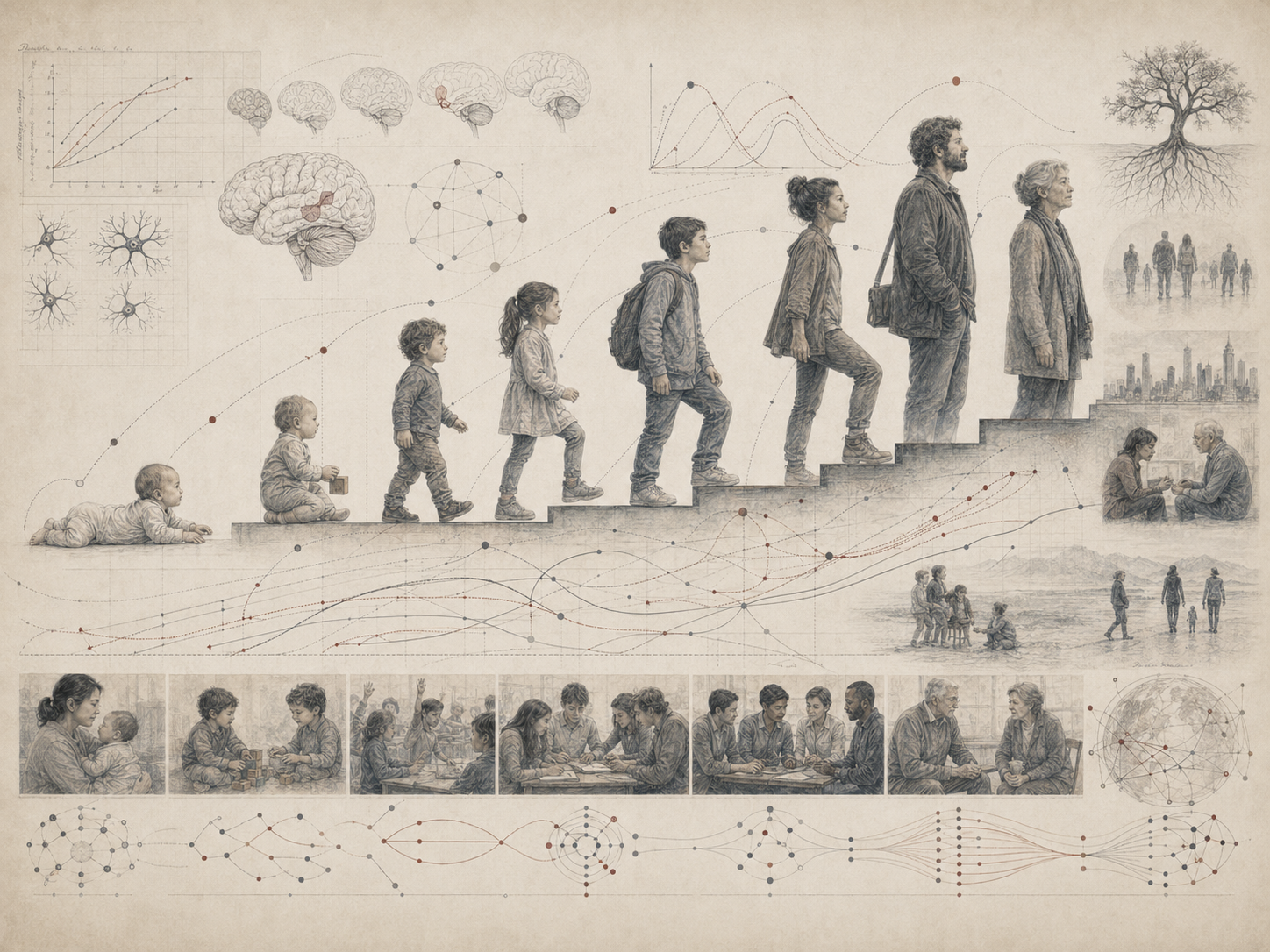
The history of developmental psychology is deeply marked by stage thinking. Piaget’s cognitive stages, Erikson’s psychosocial stages, Kohlberg’s moral stages, Freud’s psychosexual phases, and related age-graded models gave the field a language for qualitative change. They also shaped education, parenting discourse, clinical interpretation, moral education, developmental screening, and public understanding of childhood and adolescence. Yet stage theories have been repeatedly criticized for overgeneralization, cultural narrowness, weak sensitivity to inequality and ecological context, insufficient attention to disability and neurodivergence, and the tendency to mistake historically specific life pathways for universal developmental sequence.
The resulting picture is not that stage theories are useless, nor that they should be accepted without revision. It is that they remain powerful when treated as heuristic maps of developmental reorganization rather than rigid scripts of human life. Stage theories can help identify developmental thresholds, transitions, and reorganizations. They become dangerous when they are used as universal timetables, cultural hierarchies, or institutional tools for judging people whose development follows different pathways.
Why Stage Theories Matter
Stage theories matter because they answer a basic question beneath all developmental inquiry: what kind of change is development? If development is only more of the same, then psychologists can focus mainly on accumulation, practice, increasing efficiency, and quantitative growth. If development sometimes involves qualitative reorganization, then the field needs concepts capable of describing new forms of cognition, identity, moral reasoning, emotional organization, social participation, and life structure. Stage theories emerged as a response to that need. They gave developmental psychology a grammar of thresholds, phases, crises, transformations, and structured transitions.
Their influence extended far beyond academic psychology. Stage thinking helped organize school expectations, parenting advice, developmental screening, therapeutic interpretation, moral education, youth policy, and institutional assumptions about maturity, readiness, responsibility, and competence. The appeal is easy to understand. Stage theories convert bewildering human variation into a legible sequence. They tell a story in which development has order, direction, and recognizable form. For teachers, clinicians, parents, and students, that story can be intellectually powerful and practically useful.
Yet this appeal also explains why stage theories are vulnerable to misuse. Once stages become common sense, they can harden into norms against which real lives are measured and found wanting. A child may be treated as delayed because they do not fit a standard sequence. An adolescent may be judged immature because they do not display the identity pattern expected by a theory. An adult may be seen as developmentally incomplete because their life course does not match a model built around marriage, stable work, parenthood, generativity, or retirement. A disabled or neurodivergent person may be interpreted through failure rather than difference. A culturally different moral framework may be ranked as lower because it does not match the theorist’s definition of abstraction or autonomy.
The strongest treatment of stage theory therefore requires both appreciation and suspicion. Appreciation is necessary because stage theories capture something real: development often includes recognizable reorganizations. Suspicion is necessary because the language of stages can easily become a language of hierarchy, normality, and social ranking. Stage theories matter not because they are always right, but because they reveal a central tension in developmental psychology: the tension between pattern and variation.
What a Stage Theory Claims
A genuine stage theory makes several strong claims. First, it claims that development proceeds through distinguishable forms rather than only through simple quantitative increase. Second, it usually claims that these forms appear in a characteristic order. Third, it often assumes that later stages reorganize rather than merely extend earlier functioning. Fourth, it typically implies that some forms of functioning are more advanced, integrated, differentiated, or developmentally mature than others.
These claims are stronger than ordinary milestone language. To say that a child usually crawls before walking, or walks before running, is not yet to offer a stage theory. A milestone marks a typical achievement. A stage theory makes a deeper assertion: that development passes through internally related structures with a logic of progression. In a strong stage theory, the child or adolescent does not simply know more, feel more, or behave more skillfully. The person organizes the world differently.
This is why stage theories have been especially attractive in domains like cognition, psychosocial identity, and moral reasoning. Piaget believed he was observing different structures of thought, not merely different amounts of knowledge. Erikson described shifting psychosocial tensions across the life course, not merely a growing list of social tasks. Kohlberg described changing structures of moral reasoning, not merely greater obedience or better behavior. Stage thinking becomes powerful when the theorist believes a new developmental form has emerged.
The difficulty is that these claims are empirically and ethically demanding. If stages are real in a strong sense, then developmental science must show that they are not merely artifacts of measurement, schooling, language privilege, interviewer expectation, or historically specific life scripts. If stages imply hierarchy, then the field must explain whether that hierarchy is developmental, cultural, institutional, or some unstable mixture of all three. If stage theories claim universality, they must be tested across cultures, social classes, languages, disabilities, neurodevelopmental profiles, and historical conditions rather than generalized from narrow samples.
Stage theory is therefore not a casual metaphor. It is a strong claim about the shape of development. That strength is what makes it useful. It is also what makes it risky.
What Stage Theories Are Not
Stage theories should not be confused with all forms of developmental ordering. Developmental psychology often describes sequences, milestones, sensitive periods, trajectories, transitions, and age-graded changes. Not all of these are stage theories. A developmental sequence may describe common ordering without claiming that each phase is qualitatively distinct. A milestone may describe a typical achievement without claiming a structural reorganization. A sensitive period may describe heightened plasticity without claiming a fixed stage. A trajectory may describe a pattern of growth without dividing development into internally coherent phases.
This distinction matters because stage language is often used loosely. People may speak of “stages” of grief, adolescence, identity, parenting, learning, or recovery when they mean recurring themes or common experiences. Such frameworks may still be useful, but they should not be treated as strong developmental stage theories unless they make clear claims about order, structure, transition, and qualitative reorganization.
Stage theories are also not destiny. Even when a stage-like pattern appears in a population, it does not follow that every individual must move through the same sequence at the same pace. Development can be uneven across domains. A person may show advanced reasoning in one context and less sophisticated reasoning in another. A child may appear to have reached a particular cognitive level under supportive conditions but not under stressful or unfamiliar conditions. An adolescent may move forward, backward, sideways, or recursively in identity development depending on family, peer, school, cultural, and historical conditions.
Finally, stage theories are not neutral simply because they appear orderly. Every stage model reflects assumptions about what matters, what counts as maturity, what kind of endpoint is valued, and what forms of life are treated as typical. The question is not whether stage theories have assumptions. They do. The question is whether those assumptions are made explicit, tested carefully, and revised when they fail to fit the diversity of human development.
Classical Stage Models in Developmental Psychology
The classical stage theories of developmental psychology remain important not because they are accepted in their original forms, but because they shaped the field’s imagination. Freud, Piaget, Erikson, Kohlberg, and related theorists gave developmental psychology a vocabulary of phases, structures, conflicts, crises, and transitions. Their models remain part of the field’s intellectual inheritance, even when later research has substantially revised, criticized, or replaced them.
Freud and Psychosexual Phases
Freud’s psychosexual model is no longer accepted in its classical form, but it remains historically important because it gave developmental psychology one of its earliest influential accounts of structured developmental sequence. Freud argued that the child passes through phases in which bodily zones, desire, conflict, and socialization are organized differently over time. The enduring contribution of this framework lies less in its specific claims than in the broader idea that early development is layered, conflictual, embodied, and consequential for later life.
Its limitations are substantial. Freud’s model is historically specific, insufficiently testable by contemporary standards, often overly deterministic, and deeply marked by the gender assumptions of its time. It gave too much interpretive authority to a narrow psychoanalytic framework and too little weight to culture, inequality, attachment, trauma, social learning, and empirical developmental measurement. Even so, it helped establish the idea that development involves patterned transformation rather than mere growth.
Piaget and Cognitive Stages
Piaget’s stage theory remains the most famous and perhaps the most intellectually elegant stage model in developmental psychology. Sensorimotor, preoperational, concrete operational, and formal operational thought were presented as qualitatively distinct structures of reasoning. Piaget’s achievement was to show that children are not simply less knowledgeable than adults. They often organize the world differently. In this sense, stage theory gave cognitive development conceptual depth.
The model’s power came from its claim that development is constructive and reorganizing. Children actively build knowledge through interaction with the world. Their errors are not merely failures; they can reveal the logic of a developing mind. This insight remains profound. Piaget helped developmental psychology see children as thinkers rather than empty containers.
The model’s weakness came from the rigidity with which stages were sometimes interpreted. Later research showed more variability across domains, more sensitivity to task demands, and greater importance of language, culture, instruction, and social scaffolding than the original theory allowed. Children can demonstrate surprising competence under supportive conditions. Adults do not uniformly display formal operational reasoning in all domains. Cognitive development is more uneven, contextual, and domain-specific than a simple stage sequence suggests.
Erikson and Psychosocial Stages
Erikson extended stage thinking beyond childhood and made identity, intimacy, generativity, and integrity central developmental concerns. His psychosocial stages were powerful precisely because they connected development to meaning, role, recognition, and life structure. Erikson’s model helped normalize the idea that adulthood and aging are developmental periods, not merely the aftermath of childhood. This was a major contribution to lifespan developmental thinking.
At the same time, Erikson’s stages can easily become normative scripts. They may imply an idealized developmental life course tied to certain family forms, labor expectations, gender assumptions, and institutional pathways. Lives marked by migration, precarity, chronic illness, disability, caregiving burden, incarceration, displacement, war, unemployment, infertility, social exclusion, or housing instability do not necessarily move through these tensions in clean sequence. Identity, intimacy, generativity, and integrity remain important developmental concerns, but they unfold under unequal social conditions and may recur across life rather than appear once in a fixed order.
Kohlberg and Moral Stages
Kohlberg’s theory of moral development proposed an ordered progression in moral reasoning from obedience and punishment toward more abstract reasoning about law, principle, and justice. The value of the model was its insistence that morality involves developmental structure. It pushed the field to think about how moral judgment changes rather than assuming that morality is static or merely imposed by adults.
Its critique has been equally influential. Carol Gilligan and others argued that Kohlberg privileged abstract justice reasoning in ways that obscured care, responsibility, context, and relational moral life. The theory also reflected culturally narrow assumptions about what counts as higher moral reasoning. Abstract principle was often treated as more advanced than care-based, communal, or context-sensitive reasoning. In this case, stage thinking illuminated something real while simultaneously narrowing moral complexity.
Beyond the Classical Models
Other developmental frameworks also used stage-like ideas, including theories of language development, attachment, identity, faith development, ego development, and adult development. Some of these models remain influential as interpretive frameworks, while others have been revised substantially. The broader lesson is that stage thinking repeatedly returns whenever developmental psychologists confront transformation: the emergence of symbolic thought, the reorganization of selfhood, the onset of puberty, the transition to parenthood, the experience of aging, or the reconstruction of meaning after loss.
The question is not whether stage thinking should disappear. The question is how it should be used. Classical stage models remain valuable when they are treated as historically important attempts to understand developmental reorganization. They become misleading when they are treated as universal maps that override variation, context, culture, disability, and unequal life conditions.
The Promise and Power of Stage Theories
Stage theories remain compelling for at least four reasons. First, they make qualitative change visible. Without them, development can be reduced to measurement of more and less, faster and slower, higher and lower. Stage theories remind the field that a new developmental form may not be reducible to an increment on an old scale. A child who begins using symbolic representation is not merely adding facts. An adolescent forming identity is not merely accumulating preferences. A person confronting mortality in later adulthood is not merely older. In many cases, the structure of experience changes.
Second, stage theories organize observation. Development produces enormous complexity. Stage theories help researchers, educators, and clinicians identify recurring patterns and developmental tensions that might otherwise be lost in empirical detail. A theory may help a teacher understand why a child struggles with abstraction, why a teenager is preoccupied with identity, or why an older adult may be engaged in life review and meaning-making. Even imperfect stage models can provide useful questions.
Third, stage theories foreground temporality. A stage model insists that what a person can do, understand, or resolve at one point in life may differ fundamentally from what becomes possible later. This gives development a temporal logic that static psychology lacks. It also reminds researchers that timing matters. The same experience may have different meaning depending on when it occurs in the life course.
Fourth, stage theories are pedagogically powerful. They translate developmental research into interpretive frameworks that can be used in education, practice, and public discourse. This partly explains their durability. People remember stages because stages are story-like. They make development teachable.
The best defense of stage theories is therefore not that they are perfectly true in every detail. It is that they capture a genuine feature of human development: some changes really do feel reorganizing. New symbolic capacities, identity commitments, social roles, pubertal transformations, moral horizons, and late-life orientations often seem to alter the structure of experience itself. Stage theories give us language for that kind of change.
But language is not proof. The promise of stage theory becomes strongest when paired with empirical humility. A stage model should open inquiry, not close it. It should help researchers ask whether development is reorganizing, when, for whom, in what domain, under what conditions, and with what cultural meaning.
Major Critiques of Stage Thinking
The first critique is empirical rigidity. Real development rarely unfolds in uniformly bounded phases. People show unevenness across domains, partial attainment, regression, acceleration, and context-dependent competence. What looks like a stage in one domain may dissolve into variability under closer observation. A child may reason concretely in one task and abstractly in another. An adolescent may show mature moral concern in family life and immature reasoning under peer pressure. An adult may display generativity in caregiving but identity uncertainty in work or faith. Development is often jagged rather than neatly stepped.
The second critique is methodological. Stage theories often rely on tasks, interviews, or interpretations that may overstate structural difference. Finer-grained longitudinal and microgenetic research can reveal that apparently sudden shifts are built from many smaller changes. Development may be more continuous in process than stage theories imply, even when it appears discontinuous in visible outcome. A stage-like result may emerge because a measure is too coarse to detect gradual change.
The third critique is normative hierarchy. Stage theories often smuggle in judgments about what counts as more advanced, mature, rational, or healthy. This is risky when hierarchy is attached to culturally specific forms of language, schooling, autonomy, abstraction, individualism, or institutional participation. A model may claim to describe development while actually ranking people according to the values of a particular social world.
The fourth critique concerns universality. Much classical developmental theory was built on narrow samples and then generalized broadly. When developmental sequence is derived primarily from Euro-American, educated, institutionally stable populations, stage claims can become indistinguishable from the universalization of privilege. The fact that a pathway is common in one historical setting does not make it a universal structure of human development.
The fifth critique is underattention to institutions and inequality. Development does not unfold in a vacuum. Poverty, displacement, discrimination, violence, underfunded schooling, disability accommodation, public policy, family stress, environmental toxicity, immigration status, and healthcare access all affect the timing, expression, and meaning of developmental change. A stage model that abstracts too far from these conditions can misdescribe the actual logic of development.
The sixth critique is individualism. Stage theories often locate developmental movement inside the individual while treating context as background. Contemporary developmental science increasingly rejects that separation. Development is produced through relations among person, body, caregiver, peer group, school, culture, institution, environment, and historical moment. A child does not simply move through stages alone. Development is socially and materially organized.
The strongest critique of stage thinking is therefore not that qualitative change never occurs. It is that stage theories have too often confused local patterns with universal laws, social privilege with maturity, measurement artifacts with structure, and developmental description with moral ranking.
Culture, Inequality, Disability, and Developmental Difference
One of the strongest critiques of stage theory is that it too often confuses a dominant pathway with a universal one. Culture shapes what counts as competence, maturity, autonomy, obligation, emotional expression, caregiving, moral reasoning, adulthood, elderhood, and successful transition. Developmental forms that appear advanced in one cultural or institutional setting may not have the same meaning in another.
For example, a theory that ranks abstract individual principle above relational obligation may misread communities in which moral maturity is expressed through care, kinship, duty, or collective responsibility. A theory that treats individual autonomy as the primary endpoint may misinterpret cultures that value interdependence. A theory that assumes a stable school-to-work-to-family sequence may misdescribe lives shaped by migration, extended family obligation, economic precarity, early caregiving, or disrupted institutions.
Inequality matters just as much. Developmental pathways differ under conditions of housing instability, food insecurity, environmental toxicity, chronic stress, underfunded schooling, racialized discipline, policing, war, displacement, and uneven access to healthcare. In such contexts, developmental sequence may be delayed, compressed, disrupted, or reorganized by forces external to the individual but internal to the developmental ecology. A child living under chronic stress may appear less advanced on a task not because they lack developmental capacity, but because the environment has constrained attention, safety, language exposure, sleep, nutrition, and opportunity.
Disability and neurodivergence also challenge simplistic stage frameworks. Developmental difference should not automatically be treated as failed progression through a standard sequence. Some differences reflect alternative profiles of attention, sensory processing, communication, motor development, social cognition, learning, or regulation rather than mere deficit from a normal track. This does not eliminate impairment where it exists. It does demand that developmental psychology distinguish between need for support and compulsory conformity to a single idealized developmental order.
This is especially important in educational and clinical settings. A stage model can help identify support needs, but it can also pathologize difference when it treats one developmental trajectory as the only acceptable one. A neurodivergent child may develop language, social understanding, executive function, or sensory regulation on a pathway that does not fit standard age-stage expectations. A disabled adolescent may confront identity, autonomy, intimacy, and dependence in forms not anticipated by classical models. A culturally marginalized child may demonstrate forms of responsibility and moral reasoning invisible to the measures being used.
Contemporary developmental science increasingly emphasizes variation, contextuality, and multiple pathways for this reason. Stage thinking can still help, but only when it is used with enough humility to avoid turning developmental description into social ranking. The central question should not be “Which stage is this person in?” but “What kind of developmental organization is visible here, under what conditions, and what supports make further growth possible?”
Stage Theories, Schools, Clinics, and Institutions
Stage theories are not only academic ideas. They become institutional tools. Schools use developmental expectations to organize curricula, readiness standards, age-graded classrooms, testing, discipline, and special education referral. Clinics use developmental sequences to identify delay, risk, impairment, and intervention need. Courts, welfare systems, and public policy often assume particular developmental thresholds for competence, responsibility, consent, and vulnerability. In these settings, stage thinking can be useful, but it can also become blunt.
In schools, stage models can help teachers avoid expecting children to think like adults. They can support age-appropriate pedagogy, scaffold abstraction, and recognize that children’s reasoning has its own logic. But when stage thinking becomes rigid, it can lead educators to underestimate children who do not fit expected patterns, especially children from marginalized backgrounds, bilingual children, disabled children, neurodivergent children, or children whose competencies are expressed outside formal school tasks.
In clinical and developmental screening contexts, stage-based expectations can help identify children who need support. This is valuable. Early identification can connect children and families to services. But screening becomes ethically dangerous when it collapses difference into deficit, ignores context, or treats a child’s divergence from a standard timeline as evidence of diminished worth. A serious developmental approach uses stages as signals for inquiry, not as final judgments.
In public discourse, stage theories can become even more problematic. They may be simplified into claims about what children, adolescents, adults, or older people “are like” in ways that erase variation. Adolescents may be treated as irrational by definition. Older adults may be treated as inevitably declining. Children may be treated as incapable of moral insight. Adults who do not follow conventional life sequences may be seen as immature. These are not neutral applications of developmental science. They are social judgments wearing developmental language.
The institutional use of stage theory should therefore be guided by care. Stage models can help institutions recognize developmental need, timing, and support. They should not be used to rank people rigidly, deny opportunity, erase cultural variation, or pathologize alternative pathways. Institutions need developmental knowledge, but they also need humility.
From Stage Models to Lifespan and Developmental Systems Perspectives
Modern developmental psychology has not abandoned stage thinking entirely, but it has placed it inside broader frameworks. APA defines developmental psychology as the study of human growth and change across the lifespan, not merely childhood, and its lifespan teaching materials emphasize contextual variation in development. NICHD similarly frames development as shaped by genetic, family, social, and broader environmental influences, including emerging social conditions and public-health pressures. This broader view makes rigid age-stage models insufficient on their own.
Lifespan developmental psychology, especially in the work of Paul Baltes, further challenged rigid stage thinking by arguing that development is lifelong, multidirectional, contextual, and marked by both gains and losses. Development is not a staircase toward a single endpoint. It is a changing system of possibility, constraint, compensation, plasticity, and decline. A person can gain in one domain while losing in another. Maturity does not move in one straight line.
Developmental systems theory pushes this critique further. It treats development as emerging from reciprocal interactions among genes, bodies, relationships, institutions, and historical environments. In such a framework, stage-like phenomena may still occur, but they are not the whole story. They may be threshold effects, context-dependent reorganizations, local patterns within a broader system, or emergent properties of person-context relations.
Dynamic systems approaches also challenge simple stage sequences by showing how new patterns can emerge from repeated interactions among perception, action, body, environment, and task demands. What looks like a discrete stage may be the visible stabilization of many interacting processes. Development can appear sudden when underlying systems cross a threshold, even if the path to that threshold was gradual.
The movement from stages to systems does not mean the old question disappears. Developmental psychologists still need to ask whether some changes are qualitatively reorganizing. But contemporary frameworks ask that question with greater attention to timing, context, variability, multiple pathways, embodiment, and historical condition. Stage thinking survives best when nested inside lifespan, ecological, and systems perspectives.
Continuity, Discontinuity, and Developmental Thresholds
One reason stage theories remain intellectually attractive is that development often looks discontinuous even when it is built from continuous processes. A child suddenly speaks in sentences. A student suddenly grasps conservation. An adolescent suddenly seems preoccupied with identity. A young adult suddenly reorganizes priorities after leaving home. An older adult suddenly changes after retirement, illness, bereavement, or becoming a caregiver. These shifts may feel stage-like because the visible organization of behavior changes.
But the underlying processes may be gradual. Language emerges from months of hearing, babbling, turn-taking, motor control, social responsiveness, and symbolic mapping. Abstract reasoning emerges from repeated experience with language, schooling, problem-solving, and representational tools. Identity emerges from years of attachment, role expectation, peer comparison, bodily change, memory, conflict, and future imagination. What looks like a sudden shift may be a threshold crossed after cumulative preparation.
This is where modern stage theory can become more precise. Rather than claiming that development moves through fixed universal stages, researchers can ask whether development contains thresholds, tipping points, attractor states, or reorganizations. A threshold model does not require every person to transition at the same age. A dynamic model does not require each domain to move together. A contextual model does not assume that stage-like change is independent of support, stress, culture, or institution.
Continuity and discontinuity should therefore not be treated as opposites. Many developmental changes are continuous in process and discontinuous in appearance. Others are discontinuous because of real transitions in biology, role, institution, or social expectation. Puberty, school entry, migration, trauma, disability onset, parenthood, incarceration, retirement, and bereavement can create sharp developmental reorganization. A serious theory must be able to model both gradual accumulation and threshold change.
The best contemporary use of stage thinking may therefore be threshold thinking. It preserves the insight that new developmental organization can emerge, while avoiding the rigidity of universal age-graded stages.
Where Stage Theories Still Help
Despite critique, stage theories remain useful in at least three ways. First, they remain heuristically valuable. In teaching and theory-building, stage models help clarify the difference between quantitative increase and qualitative reorganization. They give students and researchers a vocabulary for asking whether something genuinely new has emerged. Even when a stage model is later revised, the question it asks may remain important.
Second, stage theories remain interpretively useful in certain developmental domains. Puberty, school transition, identity formation, role change, moral conflict, symbolic thought, caregiving, aging, and some cognitive shifts often do involve recognizable reorganizations. A purely continuous model can miss the experiential force of these transitions. Stage language can help name the lived feeling of crossing into a different developmental organization.
Third, stage theories remain historically important. Developmental psychology cannot be understood without them. Even contemporary alternatives often define themselves against stage thinking, revise it, or preserve some of its insights under new language. Piaget, Erikson, and Kohlberg remain part of the field not because their models are final, but because they shaped the questions later researchers had to answer.
Stage theories also remain useful in practice when they are used cautiously. Teachers may benefit from knowing that children’s reasoning changes over time. Clinicians may benefit from recognizing developmental tasks and transitions. Parents may benefit from understanding that adolescence involves identity reorganization, not merely defiance. Public-health professionals may benefit from recognizing sensitive periods and developmental timing.
The strongest present-day use of stage theory is therefore critical and limited. Stages can function as provisional maps of recurrent developmental organization, not as iron laws of human becoming. They are best used as questions, not verdicts: What kind of change is occurring? Is it gradual or reorganizing? What supports does this transition require? Whose pathway is being treated as normal? What variation does the model miss?
Methods for Studying Stage-Like Change
Studying stage-like development requires methods that can distinguish genuine reorganization from measurement artifact. Cross-sectional comparisons alone are rarely sufficient because age differences may reflect cohort, schooling, culture, language, or task familiarity. Longitudinal methods are stronger because they can observe change within individuals over time. Microgenetic methods are especially useful when researchers want to see how new forms emerge through repeated experience across short intervals.
Task design matters greatly. If a task is too difficult, children may appear less advanced than they are. If a task depends heavily on language, schooling, or cultural familiarity, it may measure privilege as much as developmental structure. If a stage is inferred from a single task, the theory may overstate domain-general reorganization. Stronger research uses multiple measures, multiple contexts, and repeated observations.
Statistical methods also matter. Traditional stage theories often implied sharp boundaries. Contemporary researchers can test for linear growth, nonlinear growth, threshold effects, latent classes, mixture models, transition probabilities, and person-specific trajectories. These methods allow stage-like patterns to be studied without assuming universal sequence in advance. A model can ask whether a transition exists, whether it is abrupt or gradual, whether people transition at different times, and whether context alters the probability or shape of transition.
Qualitative methods remain important as well. Some developmental reorganizations are not fully captured by test scores. Identity, moral reasoning, adult role transition, grief, caregiving, spirituality, and aging often involve meaning-making. Interviews, life histories, ethnography, and narrative methods can reveal how people experience developmental transitions, especially in domains where cultural and institutional meaning is central.
A strong method for stage-like development therefore combines longitudinal evidence, contextual sensitivity, measurement humility, and attention to lived meaning. The goal is not to prove or disprove stages in the abstract. It is to understand the shape of developmental change in particular domains, populations, histories, and environments.
Ethical Use of Stage Theory
Stage theories must be used ethically because developmental categories can shape how people are treated. A stage label can open support, but it can also close possibility. It can help an adult understand a child, but it can also become a reason to underestimate that child. It can identify a transition, but it can also become a script that people are pressured to follow. The ethical question is not only whether a stage theory is accurate. It is what happens when the theory is applied.
Ethical stage theory should avoid treating stages as measures of human worth. Being at one developmental point rather than another does not make a person more or less valuable. Children are not incomplete adults. Adolescents are not defective rational agents. Older adults are not failed younger adults. Disabled and neurodivergent people are not failed versions of a standard developmental sequence. Developmental difference should be understood in relation to support, context, access, and dignity.
Ethical stage theory should also avoid cultural arrogance. A theory built in one social world should not be imposed globally without testing, revision, and humility. The fact that a model is orderly does not make it universal. The fact that a theory uses developmental language does not make it free from cultural values.
Finally, ethical stage theory should be used to support development rather than police it. The point of developmental knowledge should be to create better care, education, accommodation, policy, and understanding. Stage theories are most humane when they help adults ask what kind of support a person needs at a particular developmental moment. They are least humane when they become tools for ranking, exclusion, surveillance, or blame.
The ethical use of stage theory therefore requires a shift from judgment to care. A stage is not a verdict. At best, it is a provisional map of developmental organization that may help us understand what kind of transition, support, or opportunity is needed next.
An Analytical Framework for Stage-Like Development
A simple continuous developmental process for individual \(i\) at time \(t\) can be written as:
Y_{it} = \alpha_i + \beta_i t + \varepsilon_{it}
\]
Interpretation: \( \alpha_i \) represents initial status and \( \beta_i \) represents the growth rate. This model captures incremental development, but it does not represent stage-like reorganization.
A basic stage-shift model adds a threshold:
Y_{it} = \alpha_i + \beta_i t + \gamma_i \mathbf{1}(t \geq \tau_i) + \varepsilon_{it}
\]
Interpretation: \( \mathbf{1}(t \geq \tau_i) \) equals 1 after the individual reaches threshold \( \tau_i \). The parameter \( \gamma_i \) represents a jump or qualitative shift associated with a developmental transition. This could represent school entry, puberty, intervention onset, a new symbolic capacity, or a cognitive structure becoming behaviorally visible.
A smoother stage transition can be modeled with a logistic function:
Y_{it} = \alpha_i + \beta_i t + \frac{\gamma_i}{1 + e^{-k(t-\tau_i)}} + \varepsilon_{it}
\]
Interpretation: Many apparently abrupt developmental changes are not instantaneous. They may emerge through a transition zone in which reorganization accelerates and then stabilizes. The parameter \(k\) governs how sharp the transition is.
To incorporate developmental heterogeneity and context, we can write:
Y_{ijt} = \alpha + u_j + \beta t + \frac{\gamma}{1 + e^{-k(t-\tau)}} + \delta X_{ijt} + \varepsilon_{ijt}
\]
Interpretation: \(u_j\) captures contextual effects such as family, school, neighborhood, clinic, or community. \(X_{ijt}\) represents time-varying supports or stressors. This matters because stage-like development may be delayed, accelerated, suppressed, or reorganized by ecological conditions rather than unfolding identically across all persons.
To model whether adversity delays stage-like transitions, a threshold can be made context-sensitive:
\tau_i = \theta_0 + \theta_1 S_i – \theta_2 P_i + \eta_i
\]
Interpretation: \(S_i\) represents stress or constraint, while \(P_i\) represents protective support. The transition threshold \( \tau_i \) can vary across people. This allows stage-like change to be studied without assuming that everyone reaches the same transition at the same age or under the same conditions.
The analytical lesson is that stage theories can be understood as claims about the shape of developmental change. They are strongest when reformulated as models of threshold, reorganization, transition, and context-sensitive timing rather than as rigid age scripts.
R: Simulating Stage-Like and Continuous Developmental Patterns
The following R example simulates two kinds of developmental trajectories across ten waves: mostly continuous growth and stage-like reorganization after a threshold. It then estimates a mixed model including both time and transition effects. The data are synthetic and intended for conceptual demonstration only.
# Simulating stage-like and continuous developmental patterns
# ----------------------------------------------------------
# This synthetic example compares continuous growth with stage-like
# reorganization after an individually varying developmental threshold.

suppressPackageStartupMessages({
  library(dplyr)
  library(tidyr)
  library(ggplot2)
  library(lme4)
})

set.seed(2026)

n_children <- 850
n_waves <- 10
n_contexts <- 32

children <- data.frame(
  child_id = 1:n_children,
  context_id = sample(1:n_contexts, n_children, replace = TRUE),
  baseline_score = rnorm(n_children, mean = 46, sd = 7),
  growth_rate = rnorm(n_children, mean = 1.7, sd = 0.5),
  threshold_wave = sample(4:7, n_children, replace = TRUE),
  stage_pattern = rbinom(n_children, size = 1, prob = 0.50),
  family_support = rnorm(n_children, mean = 0, sd = 1),
  chronic_stress = rbinom(n_children, size = 1, prob = 0.32)
)

contexts <- data.frame(
  context_id = 1:n_contexts,
  school_support = rnorm(n_contexts, mean = 0, sd = 0.6),
  resource_stability = rnorm(n_contexts, mean = 0, sd = 0.5)
)

panel_data <- children |>
  slice(rep(1:n(), each = n_waves)) |>
  group_by(child_id) |>
  mutate(
    wave = 0:(n_waves - 1),
    threshold_on = ifelse(wave >= threshold_wave, 1, 0),
    current_support = rnorm(n_waves, mean = family_support, sd = 0.7)
  ) |>
  ungroup() |>
  left_join(contexts, by = "context_id") |>
  mutate(
    transition_readiness =
      current_support +
      school_support +
      resource_stability -
      0.75 * chronic_stress,
    outcome_score =
      baseline_score +
      growth_rate * wave +
      1.20 * current_support +
      0.90 * school_support +
      0.70 * resource_stability -
      2.10 * chronic_stress +
      5.00 * stage_pattern * threshold_on +
      0.75 * stage_pattern * threshold_on * transition_readiness +
      rnorm(n(), mean = 0, sd = 2.6)
  )

model <- lmer(
  outcome_score ~ wave + current_support + school_support +
    resource_stability + chronic_stress + stage_pattern +
    threshold_on + stage_pattern:threshold_on +
    stage_pattern:threshold_on:transition_readiness +
    (1 + wave | context_id/child_id),
  data = panel_data
)

summary(model)

trajectory_summary <- panel_data |>
  group_by(wave, stage_pattern) |>
  summarize(
    mean_score = mean(outcome_score),
    standard_error = sd(outcome_score) / sqrt(n()),
    .groups = "drop"
  ) |>
  mutate(
    lower = mean_score - 1.96 * standard_error,
    upper = mean_score + 1.96 * standard_error,
    pattern_label = ifelse(
      stage_pattern == 1,
      "Stage-like reorganization",
      "Mostly continuous growth"
    )
  )

ggplot(trajectory_summary, aes(x = wave, y = mean_score, linetype = pattern_label)) +
  geom_line(linewidth = 1) +
  geom_ribbon(aes(ymin = lower, ymax = upper, group = pattern_label), alpha = 0.12) +
  labs(
    title = "Simulated Continuous and Stage-Like Developmental Patterns",
    x = "Wave",
    y = "Outcome score",
    linetype = "Pattern"
  ) +
  theme_minimal()

threshold_summary <- panel_data |>
  group_by(threshold_wave, stage_pattern) |>
  summarize(
    average_outcome = mean(outcome_score),
    average_readiness = mean(transition_readiness),
    .groups = "drop"
  )

ggplot(threshold_summary, aes(x = threshold_wave, y = average_outcome, linetype = factor(stage_pattern))) +
  geom_line(linewidth = 1) +
  geom_point(size = 2) +
  labs(
    title = "Synthetic Threshold Timing and Developmental Outcome",
    x = "Threshold wave",
    y = "Average outcome score",
    linetype = "Stage pattern"
  ) +
  theme_minimal()

# Analysts can extend this model by:
# 1. introducing nonlinear growth with wave^2;
# 2. allowing threshold timing to vary by adversity or support;
# 3. separating cognitive, language, moral, and identity-related outcomes;
# 4. adding school, neighborhood, or family random effects;
# 5. comparing multiple developmental thresholds across the life course;
# 6. estimating whether support changes the timing or strength of transition.
This kind of simulation helps clarify why stage theory remains attractive. Threshold effects can produce recognizable reorganizations even when much of the underlying development is cumulative.
Python: Modeling Thresholds, Transitions, and Developmental Reorganization
The Python example below simulates a developmental process with both gradual growth and stage-like transition. It includes lagged dependence, environmental support, chronic stress, context support, and a threshold effect that turns on for some individuals after a developmental transition.
# Modeling thresholds, transitions, and developmental reorganization
# -----------------------------------------------------------------
# This synthetic example models development as a combination of gradual
# growth, state dependence, contextual support, chronic stress, and a
# stage-like threshold transition.

from __future__ import annotations

import numpy as np
import pandas as pd
import statsmodels.formula.api as smf
import matplotlib.pyplot as plt

np.random.seed(2026)

n_children = 950
n_periods = 10
n_contexts = 36

children = pd.DataFrame({
    "child_id": np.arange(1, n_children + 1),
    "context_id": np.random.choice(np.arange(1, n_contexts + 1), size=n_children),
    "baseline_functioning": np.random.normal(46, 7, n_children),
    "support_context": np.random.normal(0, 1, n_children),
    "chronic_stress": np.random.binomial(1, 0.32, n_children),
    "threshold_time": np.random.randint(4, 8, n_children),
    "stage_pattern": np.random.binomial(1, 0.50, n_children),
})

contexts = pd.DataFrame({
    "context_id": np.arange(1, n_contexts + 1),
    "school_support": np.random.normal(0, 0.6, n_contexts),
    "resource_stability": np.random.normal(0, 0.5, n_contexts),
})

panel = children.loc[children.index.repeat(n_periods)].copy()
panel["time"] = np.tile(np.arange(n_periods), n_children)
panel = panel.merge(contexts, on="context_id", how="left")

panel["current_support"] = np.random.normal(
    loc=panel["support_context"],
    scale=0.7,
    size=len(panel),
)

panel["threshold_on"] = (panel["time"] >= panel["threshold_time"]).astype(int)

panel["transition_readiness"] = (
    panel["current_support"]
    + panel["school_support"]
    + panel["resource_stability"]
    - 0.75 * panel["chronic_stress"]
)

panel = panel.sort_values(["child_id", "time"]).reset_index(drop=True)
panel["development_score"] = np.nan

for child in panel["child_id"].unique():
    child_data = panel.loc[panel["child_id"] == child].copy()
    previous_score = child_data["baseline_functioning"].iloc[0]

    for idx in child_data.index:
        time = panel.at[idx, "time"]
        support = panel.at[idx, "current_support"]
        stress = panel.at[idx, "chronic_stress"]
        school_support = panel.at[idx, "school_support"]
        stability = panel.at[idx, "resource_stability"]
        threshold_on = panel.at[idx, "threshold_on"]
        stage_pattern = panel.at[idx, "stage_pattern"]
        readiness = panel.at[idx, "transition_readiness"]

        current_score = (
            0.69 * previous_score
            + 1.05 * time
            + 1.15 * support
            + 0.90 * school_support
            + 0.70 * stability
            - 2.00 * stress
            + 4.60 * threshold_on * stage_pattern
            + 0.75 * threshold_on * stage_pattern * readiness
            + np.random.normal(0, 2.5)
        )

        panel.at[idx, "development_score"] = current_score
        previous_score = current_score

panel["lag_score"] = panel.groupby("child_id")["development_score"].shift(1)
regression_data = panel.dropna(subset=["lag_score"]).copy()

model = smf.ols(
    formula="""
    development_score ~ lag_score + time + current_support +
    school_support + resource_stability + chronic_stress +
    threshold_on + stage_pattern + transition_readiness +
    threshold_on:stage_pattern +
    threshold_on:stage_pattern:transition_readiness
    """,
    data=regression_data
).fit(cov_type="HC3")

print(model.summary())

trajectory = panel.groupby(["time", "stage_pattern"], as_index=False).agg(
    average_score=("development_score", "mean"),
    standard_error=("development_score", lambda x: x.std() / np.sqrt(len(x))),
)

trajectory["pattern_label"] = trajectory["stage_pattern"].map({
    0: "Mostly continuous growth",
    1: "Stage-like reorganization",
})

trajectory["lower"] = trajectory["average_score"] - 1.96 * trajectory["standard_error"]
trajectory["upper"] = trajectory["average_score"] + 1.96 * trajectory["standard_error"]

plt.figure(figsize=(8, 5))
for group_name, subset in trajectory.groupby("pattern_label"):
    plt.plot(subset["time"], subset["average_score"], marker="o", label=group_name)

plt.xlabel("Time")
plt.ylabel("Average development score")
plt.title("Simulated Developmental Trajectories with Stage-Like Transitions")
plt.legend()
plt.tight_layout()
plt.show()

threshold_summary = panel.groupby(["threshold_time", "stage_pattern"], as_index=False).agg(
    average_score=("development_score", "mean"),
    average_readiness=("transition_readiness", "mean"),
    average_support=("current_support", "mean"),
)

print(threshold_summary.head())

# Analysts can extend this framework by:
# 1. modeling multiple thresholds across development;
# 2. adding nonlinear or logistic transitions;
# 3. including school, family, or neighborhood clustering;
# 4. comparing domains such as cognition, identity, and moral reasoning;
# 5. testing whether adversity delays or alters stage-like change;
# 6. estimating whether support accelerates or strengthens transition.
The value of a model like this is that it turns the abstract logic of stage theory into a testable question about the shape of developmental change. Rather than assuming that stages exist everywhere, the model asks whether a threshold effect is visible, how strong it is, when it appears, and whether context changes its timing or meaning.
GitHub Repository
Complete Code Repository
Access the full companion repository for this article, including reproducible analysis materials and multi-language code workflows for stage theories of development, continuous growth, developmental thresholds, stage-like reorganization, contextual support, chronic stress, transition readiness, and nonlinear developmental change.
Conclusion
Stage theories of development remain important because they captured something the field still needs: the possibility that development is not only growth, but reorganization. They offered developmental psychology a language for thresholds, phases, crises, and structured change. Their promise was conceptual power. Their danger was rigidity.
The most serious contemporary position is neither unconditional defense nor total dismissal. Stage theories are strongest when treated as heuristic accounts of recurrent developmental organization, useful for identifying qualitative transition without pretending that every life follows a single ordered script. They are weakest when used as universal law, cultural hierarchy, or institutional justification for ranking real people against idealized sequences.
Developmental psychology has moved toward lifespan, ecological, and systems approaches not because stage theories had nothing to offer, but because their insights had to be placed inside a richer account of variation, context, inequality, plasticity, disability, neurodivergence, culture, and human difference. In that more mature setting, stage theories remain intellectually useful precisely when they are held critically rather than dogmatically.
The enduring lesson is simple: development may have patterns, but people are not patterns. Stage theories help when they illuminate change. They harm when they replace attention to real lives with a staircase everyone is expected to climb in the same way.
Related Articles
- What Is Developmental Psychology?
- The History of Developmental Psychology: From Child Study to Lifespan Science
- Continuity, Discontinuity, and the Logic of Developmental Change
- Nature, Nurture, and the Developmental Question
- Critical Periods, Sensitive Periods, and the Timing of Development
- Developmental Systems Theory and the Ecology of Human Growth
- Lifespan Development from Childhood to Aging
- Developmental Psychology knowledge series
Further Reading
- Baltes, P.B. (1987) ‘Theoretical propositions of life-span developmental psychology: On the dynamics between growth and decline’, Developmental Psychology, 23(5), pp. 611–626. Available at: https://www.imprs-life.mpg.de/25277/022_baltes_1987.pdf.
- Case, R. (1998) The Mind’s Staircase: Exploring the Conceptual Underpinnings of Children’s Thought and Knowledge. Mahwah, NJ: Lawrence Erlbaum.
- Erikson, E.H. (1963) Childhood and Society. 2nd edn. New York: Norton. Available at: https://archive.org/details/childhoodsociety00erik.
- Gilligan, C. (1982) In a Different Voice: Psychological Theory and Women’s Development. Cambridge, MA: Harvard University Press. Available at: https://www.hup.harvard.edu/books/9780674970960.
- Piaget, J. (1952) The Origins of Intelligence in Children. New York: International Universities Press. Available at: https://archive.org/details/originsofintelli0000piag.
- Thelen, E. and Smith, L.B. (1994) A Dynamic Systems Approach to the Development of Cognition and Action. Cambridge, MA: MIT Press. Available at: https://mitpress.mit.edu/9780262700597/a-dynamic-systems-approach-to-the-development-of-cognition-and-action/.
- Turiel, E. (2006) ‘The development of morality’, in Damon, W. and Lerner, R.M. (eds.) Handbook of Child Psychology. 6th edn. Hoboken, NJ: Wiley.
- Woolfolk, A. (2024) Educational Psychology. 15th edn. Boston: Pearson.
References
- American Psychological Association (n.d.) Developmental Psychology. Available at: https://www.apa.org/education-career/guide/subfields/developmental.
- American Psychological Association (n.d.) Life Span Development. Available at: https://www.apa.org/ed/precollege/topss/lessons/life-development.pdf.
- Baltes, P.B. (1987) ‘Theoretical propositions of life-span developmental psychology: On the dynamics between growth and decline’, Developmental Psychology, 23(5), pp. 611–626. Available at: https://www.imprs-life.mpg.de/25277/022_baltes_1987.pdf.
- Eunice Kennedy Shriver National Institute of Child Health and Human Development (2026) Child Development and Behavior Branch (CDBB). Available at: https://www.nichd.nih.gov/about/org/der/branches/cdbb.
- Eunice Kennedy Shriver National Institute of Child Health and Human Development (2025) CDBB Research Programs. Available at: https://www.nichd.nih.gov/about/org/der/branches/cdbb/programs.
- Erikson, E.H. (1963) Childhood and Society. 2nd edn. New York: Norton. Available at: https://archive.org/details/childhoodsociety00erik.
- Gilligan, C. (1982) In a Different Voice: Psychological Theory and Women’s Development. Cambridge, MA: Harvard University Press. Available at: https://www.hup.harvard.edu/books/9780674970960.
- Piaget, J. (1952) The Origins of Intelligence in Children. New York: International Universities Press. Available at: https://archive.org/details/originsofintelli0000piag.
- Society for Research in Child Development (2021) Child Development Special Section: Formalizing Theories of Child Development. Available at: https://www.srcd.org/news/child-development-special-section-formalizing-theories-child-development.
- Thelen, E. and Smith, L.B. (1994) A Dynamic Systems Approach to the Development of Cognition and Action. Cambridge, MA: MIT Press. Available at: https://mitpress.mit.edu/9780262700597/a-dynamic-systems-approach-to-the-development-of-cognition-and-action/.