
Last Updated May 21, 2026
The history of developmental psychology is the history of a field gradually learning to take time, context, and human change seriously. What began as child study, educational observation, philosophical speculation, moral training, and early measurement eventually became a broader science of development across the lifespan. Along that path, the field passed through child-study observation, maturational models, psychoanalytic theories, behaviorism, cognitive developmental theory, attachment research, ecological systems thinking, longitudinal methods, developmental psychopathology, developmental neuroscience, sociocultural theory, lifespan psychology, and contemporary developmental systems approaches. The discipline did not move in a straight line. It expanded through argument, institutional growth, methodological invention, public policy, critique, and repeated correction.
Its history is therefore not only a sequence of famous theorists. It is also a history of changing assumptions about childhood, adulthood, aging, culture, family, education, normality, intelligence, disability, social class, race, gender, and the proper scale at which human development should be studied. The field gradually widened from a science of early growth into a science of human change under biological, relational, cultural, institutional, and historical conditions. That widening is one of developmental psychology’s central intellectual achievements.
Main Library
Publications
Article Map
Developmental Psychology
Related Topic
Psychology
Related Topic
Cognitive Psychology
Related Topic
Social Psychology
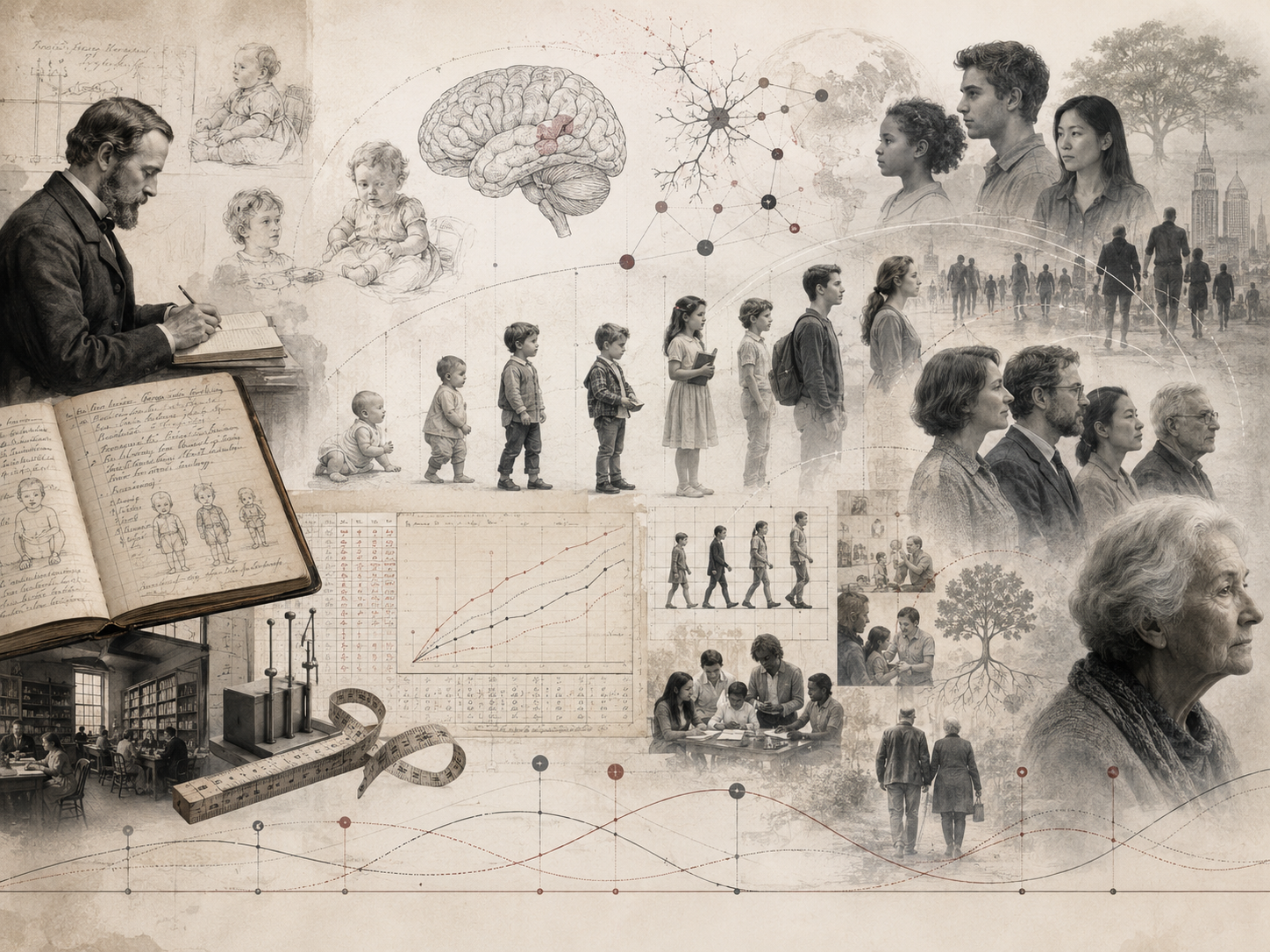
The field now called developmental psychology studies change and continuity from conception through old age, but that was not always its dominant frame. Earlier traditions often centered the child, treated adulthood as developmental completion, and relied heavily on Euro-American norms of family life, schooling, rationality, independence, and personhood. The move from child study to lifespan science required major conceptual and institutional change: the rise of research societies, specialized journals, longitudinal designs, developmental neuroscience, public-health concern with child development, gerontology, life-course research, and the recognition that adulthood and aging are not residual topics but core developmental domains.
To understand the history of developmental psychology is therefore to understand how the field came to ask larger questions. What changes across the life course? What remains continuous? How do biology, experience, culture, inequality, education, family, and historical period shape development? How do research methods create developmental facts? How have developmental norms been used to support care, schooling, policy, and intervention—and also to classify, exclude, rank, and pathologize? A serious history of the field must hold both sides together: developmental psychology produced powerful knowledge about human change, but it also inherited and sometimes reinforced the biases of the societies in which it developed.
Why the History of Developmental Psychology Matters
The history of developmental psychology matters because developmental ideas do not remain inside laboratories, journals, or textbooks. They travel into schools, parenting advice, pediatric care, juvenile justice, social policy, disability services, mental-health practice, child welfare, workplace expectations, aging policy, and public assumptions about what counts as normal growth. When developmental psychology defines a milestone, a stage, a delay, a sensitive period, a risk factor, a competency, or a pathway, it helps shape how institutions respond to human beings at different points in life.
Historical awareness helps prevent developmental concepts from being treated as timeless truths detached from the conditions that produced them. Many ideas once presented as universal were shaped by narrow samples, Euro-American assumptions, patriarchal family models, school-centered definitions of ability, racialized theories of intelligence, able-bodied norms, and class-specific expectations about childhood and maturity. A history of the field reveals how developmental science has been both knowledge-producing and norm-producing.
The history also matters because it shows how the field became more expansive. Developmental psychology did not begin with today’s concern for lifespan plasticity, ecological systems, culture, inequality, disability, neurodivergence, trauma, resilience, and developmental timing. Those concerns emerged through critique and evidence. The discipline had to learn that children are not isolated units, that adults continue to develop, that aging is not merely decline, that culture matters, that family life varies, that disability is not reducible to deficit, and that inequality shapes developmental opportunity.
A historical account therefore protects the field from two errors. The first is triumphalism: the belief that developmental psychology simply progressed from ignorance to truth. The second is dismissal: the belief that past theories are worthless because they were partial or biased. The better view is that the field developed through conflict, correction, and widening. Earlier models often asked powerful questions even when their answers were incomplete. Later models often corrected blind spots while inheriting new ones. Developmental psychology’s history is a reminder that the science of development is itself developmental.
Before the Discipline: Early Reflections on Human Development
Developmental psychology did not emerge out of nothing in the late nineteenth century. Long before it became an organized scientific field, philosophers, physicians, religious thinkers, educators, moralists, legal theorists, and literary traditions reflected on growth, maturation, character formation, moral education, aging, and the stages of life. Human beings have long understood life as temporally structured: infancy, childhood, youth, maturity, elderhood, decline, wisdom, dependency, apprenticeship, parenthood, and social inheritance all appeared in earlier moral, religious, medical, and political vocabularies.
Ancient and early modern theories were not developmental psychology in the modern scientific sense, but they established enduring questions. Are children naturally good, corrupt, rational, irrational, innocent, selfish, dependent, teachable, or morally unfinished? Is education the unfolding of nature or the shaping of character? Does adulthood represent completion, responsibility, or simply another stage of change? Is aging decline, wisdom, loss, spiritual preparation, or social repositioning? These questions predate the discipline, but developmental psychology later gave them empirical, institutional, and methodological form.
The modern field also inherited older tensions between nature and education, maturation and discipline, freedom and authority, family and state, individual potential and social order. Philosophical debates about Locke, Rousseau, moral education, empiricism, rationalism, and the nature of childhood shaped the conditions under which later scientific questions became thinkable. The discipline did not invent the idea of development. It reorganized older concerns into researchable problems.
What changed in the nineteenth century was the effort to make development an object of organized empirical inquiry. This meant observation, measurement, classification, comparison, and eventually experimentation. It also meant that childhood became more visible as a domain of schooling, reform, public administration, medicine, family expertise, and scientific attention. Developmental psychology emerged not only from theory, but from institutions that increasingly wanted to measure, educate, guide, protect, and regulate children.
Childhood, Modernity, and the Rise of Observation
The rise of developmental psychology was closely linked to the modern reorganization of childhood. As schooling expanded, child labor laws changed, pediatrics emerged, literacy became a public concern, and families were increasingly addressed through expert guidance, children became a more visible object of knowledge. The child was no longer merely a member of the household or a future adult. The child became a subject of observation, measurement, protection, education, reform, and classification.
Observation was central to this transformation. Diaries, school records, growth charts, infant observations, intelligence tests, developmental norms, and laboratory tasks all made development visible in new ways. But observation is never neutral. What researchers choose to observe reflects assumptions about what development is. Early observers often focused on language, motor control, obedience, reasoning, school readiness, intelligence, moral behavior, and adjustment because those qualities mattered to emerging institutions of family, school, medicine, and citizenship.
The rise of observation also changed the moral meaning of childhood. If development could be measured, then delay, precocity, deviation, and normality could be named. This created new possibilities for support, intervention, and care. It also created new risks of surveillance, ranking, and exclusion. Children could be helped because differences became visible; they could also be sorted because differences became visible.
This double legacy runs through the entire history of developmental psychology. The field has repeatedly developed tools that make human change more understandable, but those tools often carry institutional consequences. A developmental chart can reassure, guide, and detect need. It can also narrow expectations. A test can identify support needs. It can also rank, track, stigmatize, or exclude. The history of developmental psychology must therefore be read as a history of knowledge and power together.
The Child Study Movement and the Scientific Turn
One of the key precursors of modern developmental psychology was the child study movement of the late nineteenth and early twentieth centuries. This movement aimed to observe children systematically rather than treat them merely as small adults. It was influenced by evolutionary thought, educational reform, statistical thinking, public schooling, and the expanding prestige of scientific method. The emerging assumption was that the child could be studied developmentally: as a being in process, marked by sequence, growth, immaturity, variation, and transformation.
G. Stanley Hall became one of the most visible figures in this early formation. His work helped institutionalize the study of children and adolescents, even though much of it now appears conceptually dated. Hall’s importance lies less in the lasting adequacy of his theories than in the scale of his influence. He helped make development thinkable as a formal psychological domain and drew attention to adolescence as a distinct period rather than merely incomplete adulthood.
The child study movement also reflected a broader cultural desire to understand children in order to educate and govern them. Teachers, parents, reformers, and administrators wanted developmental knowledge that could guide schooling, discipline, curriculum, moral formation, and social policy. Developmental psychology grew partly because modern societies increasingly organized childhood through institutions. The child became an object of research because the child had become an object of public concern.
Yet the movement had serious limitations. Its observational methods were often unsystematic by modern standards. Its samples were narrow. Its claims could be normative, gendered, racialized, class-bound, and entangled with civilizational assumptions. It often treated Euro-American middle-class childhood as the implied developmental standard. Even at its beginning, the field carried both scientific ambition and historical bias. That tension remains one of the central themes of developmental psychology’s history.
Early Twentieth-Century Developmental Psychology
In the early twentieth century, developmental psychology took firmer institutional shape. Research on infants, children, schooling, maturation, language, intelligence, habit, and behavior gained visibility. More formal research settings emerged, and child guidance, educational psychology, pediatrics, social work, and child welfare helped create demand for developmental knowledge. The field was no longer only broad reflection on growth. It was becoming a specialized area of inquiry with its own methods, theories, research settings, and practical applications.
This was also the period in which developmental psychology became more closely connected to schools. Children were observed and measured partly because schools needed ways to organize instruction, identify difficulty, sort students, and standardize expectations. The school became a major developmental institution and a major source of developmental data. As a result, developmental psychology became intertwined with educational policy and educational inequality from an early stage.
Early developmental psychology also had a complicated relationship with medicine and public health. Infant welfare, child guidance, mental hygiene, nutrition, growth monitoring, and pediatric observation all helped shape what counted as normal and abnormal development. These developments created real gains: greater attention to infant health, child well-being, early intervention, and the importance of developmental timing. But they also increased the authority of experts over families, especially poor families, immigrant families, racialized communities, and mothers.
The early twentieth century therefore marked both institutional consolidation and ethical risk. Developmental psychology became more systematic and socially influential, but its tools were not politically innocent. It gained the power to describe development, and with that power came the ability to define normality, deviation, and readiness in ways that affected children’s futures.
Measurement, Normality, and Classification
No serious history of developmental psychology can avoid the history of measurement. Growth charts, intelligence tests, developmental norms, school readiness assessments, mental-age concepts, observational schedules, and later standardized instruments transformed the field. Measurement allowed researchers to compare children, track change, identify delays, test theories, design interventions, and build cumulative evidence. Without measurement, developmental psychology could not have become a modern empirical science.
But measurement also made normality more powerful. Once development could be plotted, scored, compared, and ranked, children could be sorted more efficiently. Psychometrics and intelligence testing had enormous influence, both productive and damaging. They helped create tools for identifying learning needs and studying developmental variation, but they also became entangled with exclusionary educational sorting, eugenic ideology, racialized hierarchies, class bias, immigration restriction, and institutional decisions about who deserved opportunity.
Developmental measurement often carried hidden assumptions. Which children were included in norming samples? Which languages counted? Which forms of family life were treated as standard? Which behaviors were interpreted as intelligence, compliance, maturity, disorder, giftedness, disability, or defiance? What counted as independence, emotional regulation, moral development, or school readiness? These questions reveal that developmental measurement is never merely technical. It is also cultural and institutional.
Modern developmental psychology has become more careful, but the issue remains. Measurement can support dignity when it identifies need, guides intervention, and challenges neglect. It can harm when it becomes ranking, surveillance, deficit labeling, or premature closure of possibility. The field’s history shows that developmental science must always ask not only whether a measure is reliable, but how it will be used, against whom, and with what consequences.
Psychoanalytic, Learning, and Maturational Traditions
As the field matured, several major frameworks competed to explain development. Psychoanalytic traditions, especially through Sigmund Freud and later Erik Erikson, emphasized conflict, early experience, attachment, desire, identity, and the historical formation of the self. Freud’s psychosexual model is no longer accepted in its classical form, but psychoanalysis changed developmental thinking by insisting that early experience matters, that emotional life has developmental history, and that the child’s inner world is not reducible to visible behavior.
Erikson extended psychoanalytic developmental thinking into a broader psychosocial model. His emphasis on identity, trust, autonomy, initiative, industry, intimacy, generativity, and integrity helped move developmental thought beyond early childhood alone. Erikson’s stages can be criticized for their cultural assumptions and broad generality, but his work remains important because it treated identity and social recognition as developmental problems across the life course.
Maturational theory, associated especially with Arnold Gesell, emphasized biologically guided sequences of growth. This work helped normalize systematic observation of developmental timing and patterning. It drew attention to the fact that children do not simply become competent because adults instruct them; bodily maturation and developmental readiness matter. Yet maturational accounts could become overly deterministic when environmental, cultural, and institutional influences were treated as secondary.
Learning theory and behaviorism shifted attention in a different direction. Rather than treating development as stage-like unfolding from within, behaviorists stressed reinforcement, conditioning, modeling, and environmental shaping. This tradition corrected speculative theorizing by demanding observable evidence. It helped make developmental science more experimentally disciplined. But it often flattened the richness of development when it focused too narrowly on externally visible behavior and neglected meaning, cognition, relationship, identity, and culture.
These traditions did not merely compete. They forced developmental psychology to clarify what counted as explanation. Was development best understood as inner conflict, biological maturation, environmental shaping, cognitive construction, social participation, or relational regulation? The field’s later strength came partly from refusing to let any single answer dominate completely.
The Cognitive Revolution and Stage-Based Thought
The mid-twentieth century saw one of the most influential shifts in developmental psychology: the rise of cognitive developmental theory, especially through Jean Piaget. Piaget transformed the field by arguing that children are active constructors of knowledge and that cognition develops through structured reorganization rather than simple accumulation. His work on sensorimotor development, symbolic thought, conservation, classification, perspective-taking, and formal reasoning gave developmental psychology a powerful model of qualitative change.
Piaget’s influence was enormous because he made the child’s mind theoretically serious. Children were not merely deficient adults, passive learners, or bundles of conditioned responses. They had their own forms of reasoning, and those forms changed developmentally. This gave the field a language for thinking about structure, sequence, transformation, and the active role of the child in constructing knowledge.
Yet later work also exposed the limits of Piagetian theory. Children’s competence often depended on task design, language demands, cultural familiarity, social context, instruction, and domain-specific knowledge. Some abilities appeared earlier than Piaget expected when tasks were simplified or made more ecologically meaningful. Development also proved less stage-unified than classical accounts suggested. Children may reason more advancedly in one domain than another, and their performance can vary across context.
The cognitive revolution therefore advanced developmental psychology while also creating new questions. It showed that development includes changes in representation, reasoning, memory, attention, problem solving, and symbolic thought. But it also revealed that cognition cannot be fully understood apart from culture, language, interaction, schooling, and social meaning. The history of cognitive developmental theory is not a simple replacement of older models. It is a major expansion that later had to be expanded again.
Sociocultural Perspectives and the Development of Mind
Lev Vygotsky’s sociocultural perspective became increasingly influential in later twentieth-century developmental theory, especially as the field grew more critical of isolated, individualistic models of cognition. Vygotsky shifted attention from the child as a solitary constructor of knowledge to the child as a participant in historically organized social worlds. Language, instruction, tools, play, apprenticeship, and interaction were not merely external supports for development. They were part of the process through which higher psychological functions emerged.
This perspective challenged the idea that cognitive development could be understood primarily through universal stages detached from culture. Children develop in communities that provide symbols, practices, technologies, stories, roles, expectations, and forms of participation. A child’s reasoning is shaped by the cultural tools available and by the social relations through which those tools are learned. Development is therefore not simply inside the child. It is mediated.
The sociocultural turn also helped developmental psychology take education more seriously. Teaching is not merely the delivery of information to a developing mind. It is a social process that can reorganize attention, memory, language, strategy, self-regulation, and identity. The zone of proximal development became influential because it described development not only in terms of what a child can already do alone, but in terms of what becomes possible with guided participation.
Sociocultural perspectives also opened the field to a broader view of human diversity. If development occurs through participation in cultural practices, then variation is not automatically deficiency. Different communities organize learning, autonomy, responsibility, language, moral formation, family obligation, and competence differently. Developmental psychology had to become more cautious about treating one cultural pathway as universal. This remains one of the most important lessons of the field’s historical expansion.
Attachment, Social Development, and Ecological Context
Another major chapter in developmental psychology involved the study of relationships. Attachment theory, especially through John Bowlby and Mary Ainsworth, made early caregiving a central developmental concern. It linked emotional security, protection, exploration, separation, reunion, and regulation in ways that profoundly shaped later developmental science. Attachment research also helped bridge psychoanalytic concerns, ethology, observational method, and empirical developmental research.
The importance of attachment theory was not only that it highlighted early caregiving. It also showed that relationships are developmental systems. The child develops not as an isolated organism but in patterned relation to caregivers. Security, trust, regulation, and exploration are not merely traits inside the child. They emerge within caregiving arrangements that may be stable, responsive, frightening, unavailable, culturally organized, or materially constrained.
The history of developmental psychology also includes the growing recognition that development is inherently social and ecological. Albert Bandura’s work on observational learning widened developmental explanation beyond direct reinforcement by showing how children learn through modeling and social observation. Later, Urie Bronfenbrenner transformed the field by arguing that development occurs within nested ecological systems: families, schools, neighborhoods, labor structures, institutions, cultures, and historical periods.
Bronfenbrenner’s importance lies in how he reframed the developmental question. The field could no longer ask only how the child changes. It had to ask under what institutional and material conditions development unfolds. A child’s development is shaped by family life, but family life itself is shaped by work schedules, housing, public policy, culture, healthcare, school quality, and historical context. The ecological turn widened developmental psychology from person-centered explanation to person-in-context explanation.
That shift remains one of the field’s most important expansions. Developmental psychology became more capable of studying inequality, policy, culture, and institutions because ecological thinking made those conditions developmentally relevant rather than merely background factors.
From Child Development to Lifespan Development
One of the most important transformations in developmental psychology was the move from a primarily child-centered discipline toward lifespan science. Although earlier thinkers had considered development across the whole life course, the organized field often centered infancy, childhood, and adolescence. Adulthood was frequently treated as stability, and aging was often treated as decline rather than development.
The lifespan turn challenged this narrowing. Paul B. Baltes was especially important in articulating life-span developmental psychology as a broader perspective concerned with change and continuity from conception to death. In this account, lifespan development involved multidirectionality, plasticity, contextual embeddedness, historical change, and the joint presence of gains and losses. This was not simply an extension of child psychology into later years. It was a reconceptualization of development itself.
The field’s lifespan expansion was shaped by multiple forces: demographic aging, the growth of gerontology, longitudinal studies whose participants and investigators aged, public concern about aging populations, and increasing recognition that adulthood contains major developmental transitions. Work, intimacy, parenting, illness, migration, grief, political change, caregiving, midlife, retirement, disability, memory, wisdom, and elderhood all became more visible as developmental topics.
The lifespan turn also challenged the idea that development has one endpoint. Earlier developmental theories often implied that growth culminates in mature adulthood. Lifespan psychology made this assumption harder to sustain. Human development includes gain and loss, growth and decline, stability and reorganization, vulnerability and compensation. The life course is not a ladder toward a single peak. It is a changing system of capacities, roles, relationships, bodies, institutions, and historical circumstances.
This shift remains crucial for contemporary developmental psychology. It prevents childhood from becoming the entire discipline, and it prevents aging from being reduced to deterioration. It allows the field to study human beings across the whole arc of life, including the ways early conditions shape later outcomes and later contexts reinterpret earlier experience.
Methods, Journals, and the Institutionalization of the Field
The history of developmental psychology is also the history of its institutions. Specialized journals, professional societies, university programs, research centers, public agencies, longitudinal studies, and funding streams helped stabilize the field. The journal Child Development, first issued in 1930 and published by the Society for Research in Child Development, became one of the central venues through which the field defined itself and disseminated research. Professional societies made developmental psychology a collective scientific enterprise rather than scattered observation.
Research infrastructure mattered because development cannot be understood through one-time snapshots alone. The field increasingly relied on longitudinal designs, cross-sectional studies, sequential methods, growth modeling, observational systems, standardized measures, experimental tasks, naturalistic observation, clinical follow-up, epidemiological approaches, and later neurodevelopmental and genetic tools. Methodological sophistication helped researchers distinguish age effects, cohort effects, historical timing, individual differences, and contextual influences.
Longitudinal research was especially transformative. It allowed developmental psychology to study change, not merely age-group difference. A cross-sectional comparison can show that 6-year-olds and 10-year-olds differ, but longitudinal research can ask how individual children change, what predicts divergent trajectories, what remains stable, and how earlier life relates to later outcomes. Lifespan and life-course approaches depended heavily on the maturation of such methods.
Public institutions also transformed the field. In the United States, the creation of the National Institute of Child Health and Human Development in 1962 reflected the growing legitimacy of human development as a major scientific and policy concern. Importantly, the institute’s founding mission was not limited to one disease category. It signaled that human development itself—from reproduction and infancy through later developmental concerns—had become a domain of national research investment.
Institutions shape science by deciding what can be funded, published, trained, measured, and repeated. Developmental psychology’s history is therefore not only theoretical. It is also infrastructural. The field became what it could sustain institutionally.
Developmental Psychopathology, Risk, and Resilience
Developmental psychopathology marked another major widening of the field. Rather than treating disorders as fixed categories detached from development, developmental psychopathology asked how maladaptation and adaptation unfold over time. It examined risk, resilience, vulnerability, protection, timing, transaction, continuity, discontinuity, and multiple pathways to similar outcomes.
This perspective helped developmental psychology move beyond simple normal-versus-abnormal divisions. A child may show difficulty in one context but not another. A symptom may have different meaning depending on age, trauma history, family system, school environment, neurodevelopmental profile, or cultural expectation. A behavior that appears maladaptive in one setting may have been adaptive under earlier conditions of threat or instability. Developmental psychopathology therefore insisted on process.
The field also made resilience more central, though resilience has had to be interpreted carefully. Resilience is not merely individual toughness. It often depends on protective systems: stable caregiving, safe schools, mentoring, cultural belonging, material support, treatment, disability accommodation, peer connection, and public policy. A history of developmental psychology that includes resilience must avoid turning survival under adversity into proof that adversity is acceptable.
Developmental psychopathology also helped connect developmental psychology to clinical science, psychiatry, social work, education, trauma research, and public health. It made clear that mental health and developmental history cannot be separated. Conditions such as anxiety, depression, conduct problems, trauma responses, attention difficulties, autism, intellectual disability, substance use, self-harm, and relational disturbance all require developmental interpretation. The question is not only what a person has, but how a pattern emerged, what maintains it, and what conditions might redirect it.
This process-oriented view strengthened the field by showing that development includes both competence and suffering, both adaptation and harm, both continuity and transformation. It also reinforced the ethical importance of context: developmental difficulty should not be reduced to defect when it may be shaped by deprivation, exclusion, violence, discrimination, disability barriers, or institutional failure.
Developmental Neuroscience, Genetics, and Systems Thinking
Late twentieth- and early twenty-first-century developmental psychology was increasingly shaped by developmental neuroscience, genetics, epigenetics, and systems theory. Brain development became central to public and scientific conversations about infancy, adolescence, learning, stress, trauma, plasticity, executive function, language, emotion regulation, and aging. Genetic research complicated simple environmental accounts, while epigenetic and gene-environment frameworks complicated simple genetic determinism.
Developmental neuroscience contributed important insights, especially by showing that the brain is not a finished organ simply executing behavior. Neural systems develop through biological maturation and experience. Sleep, nutrition, stress, caregiving, language exposure, toxins, education, trauma, social interaction, and activity all matter. Adolescence became especially important in neuroscience because brain development continues through major social and emotional transitions.
At the same time, neuroscience introduced new risks of reductionism. Brain images can appear more definitive than they are. Neural explanations can be overinterpreted. Complex social problems can be reframed as individual brain deficits. Developmental psychology has therefore had to integrate neuroscience without surrendering to it. A brain develops in a body, a family, a school, a culture, an economy, and a historical period.
Developmental systems thinking has been important because it offers a broader integrative frame. Rather than asking whether genes, brains, parents, schools, culture, or policy determine development, systems approaches ask how these levels coact over time. Development emerges through reciprocal relations among organism and environment. Biology matters, but biology is developmental. Environment matters, but environment is not a simple external force. The developing person is both shaped by and active within context.
This systems turn represents one of the clearest outcomes of developmental psychology’s long history. The field began by isolating the child as an object of observation. It now increasingly understands development as a multilevel process involving genes, bodies, relationships, institutions, culture, history, and inequality. That does not make the field simpler. It makes it more truthful.
Critique, Expansion, and the Broadening of Developmental Science
No adequate history of developmental psychology can end with canonical theorists alone. The field has been repeatedly criticized for universalizing white, Western, middle-class, able-bodied, school-centered, heteronormative, and individualist developmental pathways. Developmental norms were too often treated as natural facts when they were partly artifacts of sample selection, institutional expectation, and cultural dominance.
Late twentieth- and early twenty-first-century developmental science broadened partly in response to these critiques. Researchers increasingly examined culture, poverty, migration, racism, colonial history, trauma, disability, neurodivergence, gender, sexuality, language, family diversity, and cross-cultural variation in caregiving, autonomy, schooling, moral development, and personhood. The field became more aware that development cannot be studied only in laboratories or clinics detached from social location.
This broadening also changed what counted as developmental evidence. Ethnographic work, community-based research, population studies, participatory methods, mixed methods, policy analysis, and cross-cultural research became more important. The field learned that development looks different depending on where one stands, what one measures, whose experience is centered, and which institutions are assumed to be normal.
Critique has not weakened developmental psychology. It has made it more responsible. By challenging narrow norms, critique helped the field ask better questions. What counts as independence? What counts as competence? How do racism, poverty, and disability exclusion shape development? How do migration, war, climate instability, and family separation affect children and adults? How do social institutions create developmental harm? How can developmental science support dignity rather than ranking?
The broadening of developmental psychology is therefore not a departure from science. It is part of scientific correction. A field that studies human development must be accountable to human variation, historical power, and unequal conditions of life.
Inequality, Culture, Disability, and Power in the Field’s History
Developmental psychology has always been entangled with inequality, even when it did not name that entanglement directly. Early theories often treated development as if all children moved through comparable environments. But families differ in resources, neighborhoods differ in safety, schools differ in quality, healthcare differs in access, and societies differ in how they recognize childhood, disability, gender, aging, and personhood. Developmental psychology became more adequate only when it began treating these differences as central rather than peripheral.
Culture is not decoration added to universal development. It shapes language, care, discipline, autonomy, moral responsibility, family obligation, learning, play, elderhood, gender roles, religious formation, and the meaning of maturity. A developmental theory built from one cultural pathway cannot simply be exported as universal. Cross-cultural and cultural-developmental work challenged the field to distinguish human capacities from culturally specific expectations.
Disability and neurodivergence also expose the limits of narrow developmental norms. Developmental psychology has often contributed to classification and support, but it has also sometimes reinforced deficit models. A more ethical history recognizes disability as both embodied difference and social relation. Whether a developmental difference becomes disabling depends partly on accessibility, stigma, support, communication tools, schooling, medical care, family resources, and institutional imagination. Developmental science must therefore avoid reducing people to delays, deficits, or deviations from a single path.
Power matters because developmental knowledge is used by institutions. Schools, courts, clinics, welfare systems, immigration systems, and public-health agencies can use developmental science to protect people or to control them. A milestone can guide intervention; it can also intensify surveillance. A diagnosis can open support; it can also stigmatize. A risk measure can direct resources; it can also justify punitive monitoring. The history of developmental psychology should therefore be written not only as intellectual history, but as institutional history.
The strongest contemporary developmental psychology is aware of this legacy. It asks not only how people develop, but who gets to define development, whose pathways are treated as normative, whose suffering is individualized, and whose environments are allowed to remain harmful.
Where the Field Stands Now
Developmental psychology now stands as a broad, interdisciplinary science of change and continuity across the life course. It includes infancy, childhood, adolescence, adulthood, aging, family systems, education, cognition, language, emotion, social development, moral development, culture, disability, trauma, risk, resilience, neuroscience, genetics, inequality, and public policy. The field no longer fits comfortably inside the older label of child study, even though child development remains central.
Its strongest contemporary approaches are relational and multilevel. They treat development as an interaction among biology, behavior, relationships, institutions, culture, history, and material conditions. They recognize that developmental pathways are shaped by timing, plasticity, feedback, cumulative advantage, cumulative harm, and intervention. They also recognize that human development is not only a matter of individual ability but of opportunity, recognition, support, and justice.
The field is still incomplete. It continues to struggle with sampling bias, measurement validity, replication, cultural generalization, the interpretation of neuroscience, the ethics of predictive analytics, the politics of disability, and the use of developmental science in institutions that may harm the very people they claim to support. These are not side issues. They are central to the future of developmental psychology.
Still, the historical arc is clear. Developmental psychology has moved from observing the child toward studying human beings across time and context. It has moved from isolated stages toward systems, from maturation alone toward plasticity, from laboratory tasks alone toward ecology, from childhood alone toward lifespan, and from universalized norms toward a more critical awareness of culture and inequality. The discipline’s history is a record of widening vision.
An Analytical Framework for Historical Change in Developmental Psychology
The history of developmental psychology can be modeled analytically as a changing distribution of theoretical emphasis over time. Let \(P_{kt}\) represent the relative prominence of paradigm \(k\) at time \(t\), where paradigms may include child study, maturational theory, psychoanalytic theory, behaviorism, cognitive developmental theory, ecological approaches, lifespan developmental science, or developmental systems theory.
\sum_{k=1}^{K} P_{kt} = 1
\]
Interpretation: The field’s attention is distributed across paradigms. A paradigm may dominate a period without fully eliminating older or competing approaches.
The historical evolution of a paradigm’s prominence can be represented as:
P_{k,t+1} = P_{kt} + \alpha_k I_{kt} + \beta_k M_{kt} + \gamma_k S_{kt} – \delta_k C_{kt}
\]
Interpretation: \(I_{kt}\) captures institutional support such as journals, societies, funding, and training programs; \(M_{kt}\) captures methodological advantage; \(S_{kt}\) captures social relevance, including demographic and policy pressures; and \(C_{kt}\) captures critical challenge, conceptual exhaustion, or ethical critique.
A more explicitly competitive form can model paradigm replacement or displacement:
\frac{dP_k}{dt} = r_k P_k \left(1 – \sum_{j=1}^{K} a_{kj} P_j \right)
\]
Interpretation: \(r_k\) is the growth potential of paradigm \(k\), while \(a_{kj}\) represents competitive or inhibitory interaction with other paradigms. New approaches rise not only because they are persuasive, but because they address blind spots in older models.
The expansion from child-centered research to lifespan science can be represented as a shift in topic coverage:
L_t = \frac{A_t + G_t}{C_t + A_t + G_t}
\]
Interpretation: \(C_t\) is the share of research focused primarily on childhood, \(A_t\) the share focused on adulthood, and \(G_t\) the share focused on aging. As \(L_t\) rises, the field becomes more fully lifespan-oriented.
We can also represent the broadening of developmental psychology beyond individual child-centered models:
B_t = E_t + S_t + L_t + D_t
\]
Interpretation: \(E_t\) represents ecological attention, \(S_t\) systems-oriented explanation, \(L_t\) lifespan orientation, and \(D_t\) attention to diversity, disability, culture, inequality, and historical context. This synthetic index captures the field’s movement toward broader developmental explanation.
This analytical language does not replace historical interpretation. It clarifies that intellectual history is not only a story of ideas. It is a dynamic system shaped by institutions, methods, funding, critique, demography, public concern, and changing social problems.
R: Modeling the Historical Shift from Child-Centered to Lifespan Research
The following R example simulates the field’s changing research balance from 1900 to 2025. It tracks the relative weight of child-centered research, adolescence, adulthood, aging, ecological approaches, and systems-oriented approaches, then estimates the rise of lifespan and broadening orientations as historical processes.
# Modeling the historical shift from child-centered to lifespan research
# --------------------------------------------------------------------
# This synthetic example does not use real bibliometric data.
# It illustrates how developmental psychology's historical broadening
# can be modeled as changing shares of research attention.

suppressPackageStartupMessages({
  library(dplyr)
  library(ggplot2)
  library(tidyr)
})

set.seed(2026)

years <- 1900:2025
n_years <- length(years)

history_df <- data.frame(year = years)

# Child-centered research starts high and gradually declines as a share
# of total developmental attention, though it remains important.
history_df$child_share <- plogis(3.2 - 0.030 * (history_df$year - 1900)) +
  rnorm(n_years, 0, 0.018)

# Adolescence becomes more visible after the child-study era.
history_df$adolescent_share <- plogis(-1.6 + 0.026 * (history_df$year - 1920)) +
  rnorm(n_years, 0, 0.018)

# Adulthood receives more attention later in the twentieth century.
history_df$adult_share <- plogis(-3.6 + 0.052 * (history_df$year - 1960)) +
  rnorm(n_years, 0, 0.018)

# Aging expands with gerontology, demography, and lifespan psychology.
history_df$aging_share <- plogis(-4.1 + 0.060 * (history_df$year - 1970)) +
  rnorm(n_years, 0, 0.018)

# Ecological and contextual approaches rise after the mid-twentieth century.
history_df$ecological_share <- plogis(-3.4 + 0.060 * (history_df$year - 1975)) +
  rnorm(n_years, 0, 0.018)

# Developmental systems thinking expands later.
history_df$systems_share <- plogis(-4.4 + 0.075 * (history_df$year - 1995)) +
  rnorm(n_years, 0, 0.018)

history_df <- history_df |>
  mutate(across(-year, ~pmax(.x, 0.01)))

# Normalize shares so they sum to 1.
history_df <- history_df |>
  rowwise() |>
  mutate(
    total = child_share + adolescent_share + adult_share + aging_share +
      ecological_share + systems_share,
    child_share = child_share / total,
    adolescent_share = adolescent_share / total,
    adult_share = adult_share / total,
    aging_share = aging_share / total,
    ecological_share = ecological_share / total,
    systems_share = systems_share / total
  ) |>
  ungroup()

history_df <- history_df |>
  mutate(
    lifespan_index = adult_share + aging_share,
    broadening_index = ecological_share + systems_share + lifespan_index
  )

plot_df <- history_df |>
  select(
    year,
    child_share,
    adolescent_share,
    adult_share,
    aging_share,
    ecological_share,
    systems_share
  ) |>
  pivot_longer(
    cols = -year,
    names_to = "domain",
    values_to = "share"
  )

ggplot(plot_df, aes(x = year, y = share, linetype = domain)) +
  geom_line(linewidth = 1) +
  labs(
    title = "Simulated Historical Shift in Developmental Psychology",
    x = "Year",
    y = "Share of research attention",
    linetype = "Developmental domain"
  ) +
  theme_minimal()

ggplot(history_df, aes(x = year, y = lifespan_index)) +
  geom_line(linewidth = 1) +
  labs(
    title = "Rise of Lifespan Orientation in Developmental Psychology",
    x = "Year",
    y = "Lifespan orientation index"
  ) +
  theme_minimal()

ggplot(history_df, aes(x = year, y = broadening_index)) +
  geom_line(linewidth = 1) +
  labs(
    title = "Broadening of Developmental Psychology",
    x = "Year",
    y = "Broadening index"
  ) +
  theme_minimal()

# Analysts can extend this by:
# 1. replacing simulated values with real bibliometric data;
# 2. adding journals, societies, funding agencies, and citation patterns;
# 3. estimating structural breaks around major institutional moments;
# 4. distinguishing theory, method, and applied-policy attention;
# 5. comparing child-focused, lifespan, ecological, and systems-oriented journals.
This model is simplified, but it captures a central historical pattern: developmental psychology gradually widened from a predominantly child-centered framework toward a broader lifespan, ecological, and systems-oriented science.
Python: Simulating Intellectual Change Across Developmental Paradigms
The following Python example simulates paradigm prominence in developmental psychology over time. It models how institutional support, methodological fit, social relevance, and critical challenge can reshape the field’s intellectual balance.
# Simulating intellectual change across developmental paradigms
# -------------------------------------------------------------
# This synthetic example does not use real bibliometric data.
# It models developmental psychology's history as changing
# paradigm prominence across time.

from __future__ import annotations

import numpy as np
import pandas as pd
import matplotlib.pyplot as plt

np.random.seed(2026)

years = np.arange(1900, 2026)

paradigms = pd.DataFrame({
    "year": years,
    "child_study": 0.0,
    "maturational": 0.0,
    "behaviorist": 0.0,
    "psychoanalytic": 0.0,
    "cognitive_developmental": 0.0,
    "sociocultural": 0.0,
    "attachment_social": 0.0,
    "ecological": 0.0,
    "lifespan": 0.0,
    "developmental_systems": 0.0,
})

# Broad historical waves. These are illustrative, not empirical estimates.
paradigms["child_study"] = 1 / (1 + np.exp(0.060 * (years - 1925)))
paradigms["maturational"] = (
    1 / (1 + np.exp(-0.090 * (years - 1920))) -
    1 / (1 + np.exp(-0.070 * (years - 1960)))
)
paradigms["behaviorist"] = (
    1 / (1 + np.exp(-0.100 * (years - 1925))) -
    1 / (1 + np.exp(-0.075 * (years - 1970)))
)
paradigms["psychoanalytic"] = (
    1 / (1 + np.exp(-0.075 * (years - 1915))) -
    1 / (1 + np.exp(-0.055 * (years - 1980)))
)
paradigms["cognitive_developmental"] = (
    1 / (1 + np.exp(-0.105 * (years - 1955))) -
    0.25 / (1 + np.exp(-0.050 * (years - 1995)))
)
paradigms["sociocultural"] = 1 / (1 + np.exp(-0.070 * (years - 1975)))
paradigms["attachment_social"] = 1 / (1 + np.exp(-0.075 * (years - 1965)))
paradigms["ecological"] = 1 / (1 + np.exp(-0.080 * (years - 1975)))
paradigms["lifespan"] = 1 / (1 + np.exp(-0.095 * (years - 1970)))
paradigms["developmental_systems"] = 1 / (1 + np.exp(-0.090 * (years - 1995)))

score_cols = paradigms.columns[1:]

# Add mild historical noise.
for col in score_cols:
    paradigms[col] = np.clip(
        paradigms[col] + np.random.normal(0, 0.020, len(paradigms)),
        0.001,
        None,
    )

# Normalize paradigm prominence within each year.
paradigms[score_cols] = paradigms[score_cols].div(
    paradigms[score_cols].sum(axis=1),
    axis=0,
)

selected_years = paradigms.loc[
    paradigms["year"].isin([1900, 1930, 1950, 1975, 2000, 2025])
]
print(selected_years)

plt.figure(figsize=(10, 6))
for col in score_cols:
    plt.plot(paradigms["year"], paradigms[col], label=col)

plt.xlabel("Year")
plt.ylabel("Relative paradigm prominence")
plt.title("Simulated Intellectual History of Developmental Psychology")
plt.legend(fontsize=8)
plt.tight_layout()
plt.show()

paradigms["broadening_index"] = (
    paradigms["sociocultural"]
    + paradigms["ecological"]
    + paradigms["lifespan"]
    + paradigms["developmental_systems"]
)

plt.figure(figsize=(8, 5))
plt.plot(paradigms["year"], paradigms["broadening_index"])
plt.xlabel("Year")
plt.ylabel("Broadening index")
plt.title("Expansion Beyond Early Child-Centered Models")
plt.tight_layout()
plt.show()

# Analysts can extend this structure by:
# 1. replacing simulated curves with real publication or citation counts;
# 2. adding institutional milestones such as journals, societies, and institutes;
# 3. modeling paradigm interaction with Lotka-Volterra dynamics;
# 4. distinguishing theoretical prominence from applied-policy influence;
# 5. comparing the field across regions, languages, and research traditions.
The value of this analytical approach is not that it replaces historical interpretation. It helps clarify that theoretical dominance changes under identifiable pressures: institutional support, methodological advantage, demographic reality, interdisciplinary borrowing, public-policy need, and criticism of earlier paradigms.
GitHub Repository
Complete Code Repository
Access the full companion repository for this article, including reproducible analysis materials and multi-language code workflows for the history of developmental psychology, child-study traditions, paradigm change, institutionalization, lifespan science, ecological expansion, developmental systems thinking, and historical modeling of research attention.
Conclusion
The history of developmental psychology is not the story of a field steadily perfecting a single idea of growth. It is the story of expanding scope, recurrent correction, and growing awareness of what earlier models left out. The field began with child study and age-graded observation, passed through major debates over maturation, learning, cognition, attachment, socialization, and measurement, and eventually widened into lifespan, ecological, cultural, developmental psychopathology, neuroscience, and systems science.
Its most important historical achievement may be conceptual rather than technical. Developmental psychology learned, slowly and incompletely, that development cannot be understood apart from time, context, inequality, institution, culture, biology, and history. Childhood remains central, but it is no longer the entire field. Human development is now studied as a lifelong, multidirectional, context-sensitive process shaped by growth and loss, support and deprivation, embodiment and social structure, continuity and transformation.
The field’s future will depend on whether it can keep widening without losing rigor. It must continue to refine its methods, challenge its inherited norms, protect against misuse, and place marginalized lives, disabled lives, neurodivergent lives, aging lives, culturally diverse lives, and unequal conditions of development at the center of serious inquiry. The movement from child study to lifespan science is not finished. It is an ongoing demand that developmental psychology remain accountable to the full complexity of human change.
Related Articles
- What Is Developmental Psychology?
- Stage Theories of Development: Promise, Power, and Critique
- Attachment, Caregiving, and Early Emotional Development
- Developmental Systems Theory and the Ecology of Human Growth
- Lifespan Developmental Psychology and the Baltes Tradition
- Research Methods in Developmental Psychology: Longitudinal, Cross-Sectional, and Cohort Designs
- Developmental Psychopathology: Risk, Resilience, and Adaptation
- Culture, Socialization, and Developmental Variation
- Developmental Psychology knowledge series
Further Reading
- Baltes, P.B. (1987) ‘Theoretical propositions of life-span developmental psychology: On the dynamics between growth and decline’, Developmental Psychology, 23(5), pp. 611–626. Available at: https://www.imprs-life.mpg.de/25277/022_baltes_1987.pdf.
- Cairns, R.B. (1998) The Making of Developmental Psychology. Cambridge: Cambridge University Press. Available at: https://www.cambridge.org/core/books/making-of-developmental-psychology/6EDC0D0A5776D2A04986EB7494B8B9FF.
- Lerner, R.M. (2018) Concepts and Theories of Human Development. 4th edn. New York: Routledge. Available at: https://www.routledge.com/Concepts-and-Theories-of-Human-Development/Lerner/p/book/9781138087552.
- Shonkoff, J.P. and Phillips, D.A. (eds.) (2000) From Neurons to Neighborhoods: The Science of Early Childhood Development. Washington, DC: National Academies Press. Available at: https://nap.nationalacademies.org/catalog/9824/from-neurons-to-neighborhoods-the-science-of-early-childhood-development.
- Wohlwill, J.F. (1973) The Study of Behavioral Development. New York: Academic Press.
- Valsiner, J. (2000) Culture and Human Development. London: Sage.
- Overton, W.F. and Lerner, R.M. (2014) ‘Fundamental concepts and methods in developmental science: A relational perspective’, Research in Human Development, 11(1), pp. 63–73.
References
- American Psychological Association (n.d.) Developmental Psychology. Available at: https://www.apa.org/education-career/guide/subfields/developmental.
- American Psychological Association (n.d.) Life Span Development. Available at: https://www.apa.org/ed/precollege/topss/lessons/life-development.pdf.
- Baltes, P.B. (1987) ‘Theoretical propositions of life-span developmental psychology: On the dynamics between growth and decline’, Developmental Psychology, 23(5), pp. 611–626. Available at: https://www.imprs-life.mpg.de/25277/022_baltes_1987.pdf.
- Cairns, R.B. (1998) The Making of Developmental Psychology. Cambridge: Cambridge University Press. Available at: https://www.cambridge.org/core/books/making-of-developmental-psychology/6EDC0D0A5776D2A04986EB7494B8B9FF.
- National Institutes of Health (2025) Eunice Kennedy Shriver National Institute of Child Health and Human Development (NICHD). Available at: https://www.nih.gov/about-nih/nih-almanac/eunice-kennedy-shriver-national-institute-child-health-human-development-nichd.
- NICHD (2019) NICHD History. Available at: https://www.nichd.nih.gov/about/history.
- Shonkoff, J.P. and Phillips, D.A. (eds.) (2000) From Neurons to Neighborhoods: The Science of Early Childhood Development. Washington, DC: National Academies Press. Available at: https://nap.nationalacademies.org/catalog/9824/from-neurons-to-neighborhoods-the-science-of-early-childhood-development.
- Society for Research in Child Development (n.d.) Child Development. Available at: https://www.srcd.org/publications/journals/child-development.
- Society for Research in Child Development (n.d.) About SRCD. Available at: https://www.srcd.org/.
- Valsiner, J. (2000) Culture and Human Development. London: Sage.
- Wohlwill, J.F. (1973) The Study of Behavioral Development. New York: Academic Press.